
Please Sign-In by visiting the link below
TF
Published · 80 slides · 0 views
1 / 1
Description
Please Sign-In by visiting the link below https:tinyurl.comsigninMR Trainers Names: Organization: Venue: Date: Housekeeping This training will last approximately 90 minutes with questions included Please follow along using the Mandated
Related Topics
Share
Embed code
Download this presentation From Below
"Please Sign-In by visiting the link below" is the property of its rightful owner. Permission is granted to download and print the materials on this website for personal, non-commercial use only, and to display it on your personal computer provided you do not modify the materials and that you retain all copyright notices contained in the materials. By downloading content from our website, you accept the terms of this agreement.
Presentation Transcript
01
Please Sign-In by visiting the link below https://tinyurl.com/signinMR<br>
02
Trainer’s Names:
Organization:
Venue:
Date:<br>
Organization:
Venue:
Date:<br>
03
Housekeeping This training will last approximately 90 minutes with questions included
Please follow along using the Mandated Reporter Training Notes Handout provided on page 11 of your packet<br>
Please follow along using the Mandated Reporter Training Notes Handout provided on page 11 of your packet<br>
04
Objectives Understand how the laws around mandated reporting affect you
Define four types of abuse and related indicators
Describe the process for handling a disclosure of abuse
Follow the basic procedure for reporting suspected child abuse
Identify protective factors and strategies for preventing child abuse<br>
Define four types of abuse and related indicators
Describe the process for handling a disclosure of abuse
Follow the basic procedure for reporting suspected child abuse
Identify protective factors and strategies for preventing child abuse<br>
05
Understanding a Mandated Reporter’s Role Ideally, mandated reporting is the early recognition of child maltreatment with the goal of preventing further abuse from occurring.
Includes individuals who work or volunteer for organizations that serve children and/or families. Barriers?<br>
Includes individuals who work or volunteer for organizations that serve children and/or families. Barriers?<br>
06
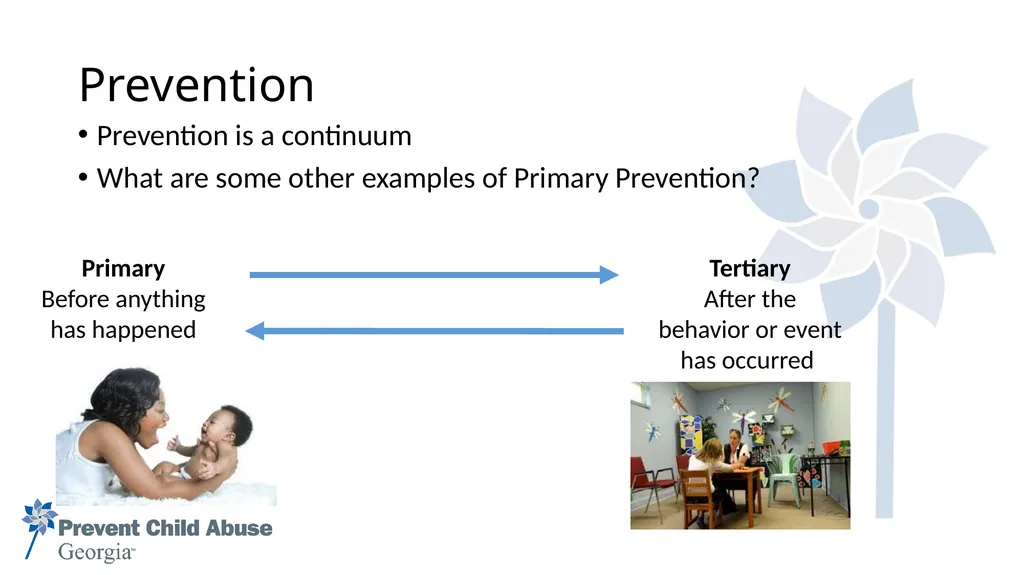
Prevention Prevention is a continuum
What are some other examples of Primary Prevention? Primary
Before anything has happened Tertiary
After the behavior or event has occurred<br>
What are some other examples of Primary Prevention? Primary
Before anything has happened Tertiary
After the behavior or event has occurred<br>
07
Why is Prevention so Important<br>
08
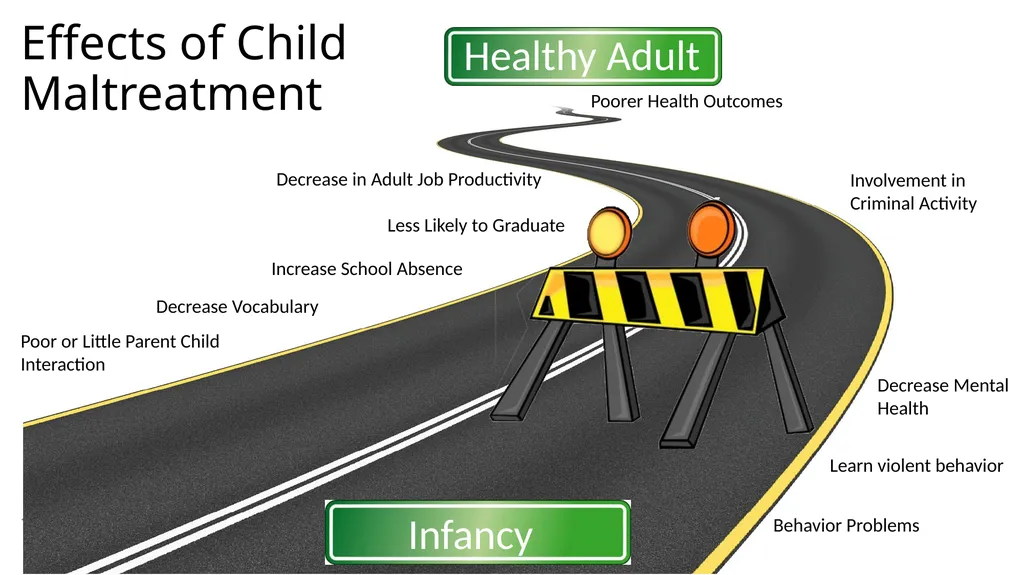
Effects of Child Maltreatment Infancy Healthy Adult Decrease Vocabulary Less Likely to Graduate Increase School Absence Poor or Little Parent Child Interaction Poorer Health Outcomes Decrease in Adult Job Productivity Learn violent behavior Behavior Problems Decrease Mental Health Involvement in Criminal Activity<br>
09
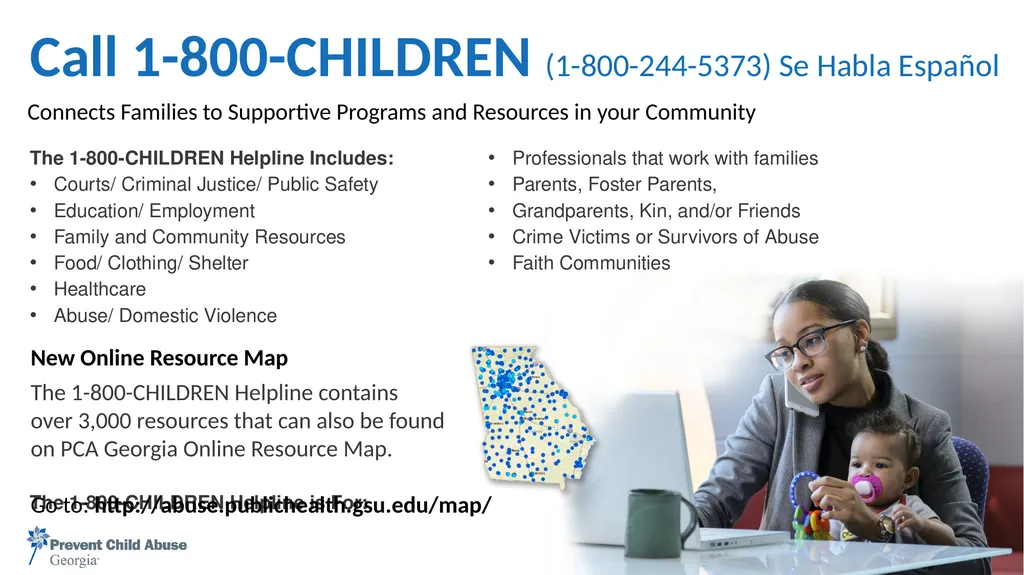
Call 1-800-CHILDREN (1-800-244-5373) Se Habla Español The 1-800-CHILDREN Helpline Includes:
Courts/ Criminal Justice/ Public Safety
Education/ Employment
Family and Community Resources
Food/ Clothing/ Shelter
Healthcare
Abuse/ Domestic Violence
The 1-800-CHILDREN Helpline is For:
Professionals that work with families
Parents, Foster Parents,
Grandparents, Kin, and/or Friends
Crime Victims or Survivors of Abuse
Faith Communities Connects Families to Supportive Programs and Resources in your Community New Online Resource Map
The 1-800-CHILDREN Helpline contains over 3,000 resources that can also be found on PCA Georgia Online Resource Map.
Go to: http://abuse.publichealth.gsu.edu/map/<br>
10
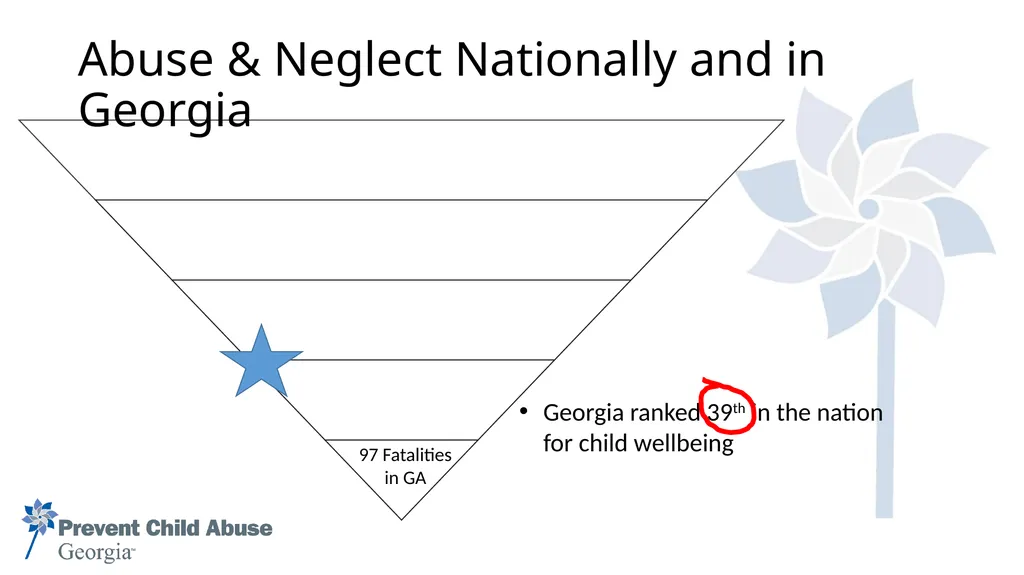
Abuse & Neglect Nationally and in Georgia Georgia ranked 39th in the nation for child wellbeing 97 Fatalities in GA<br>
11
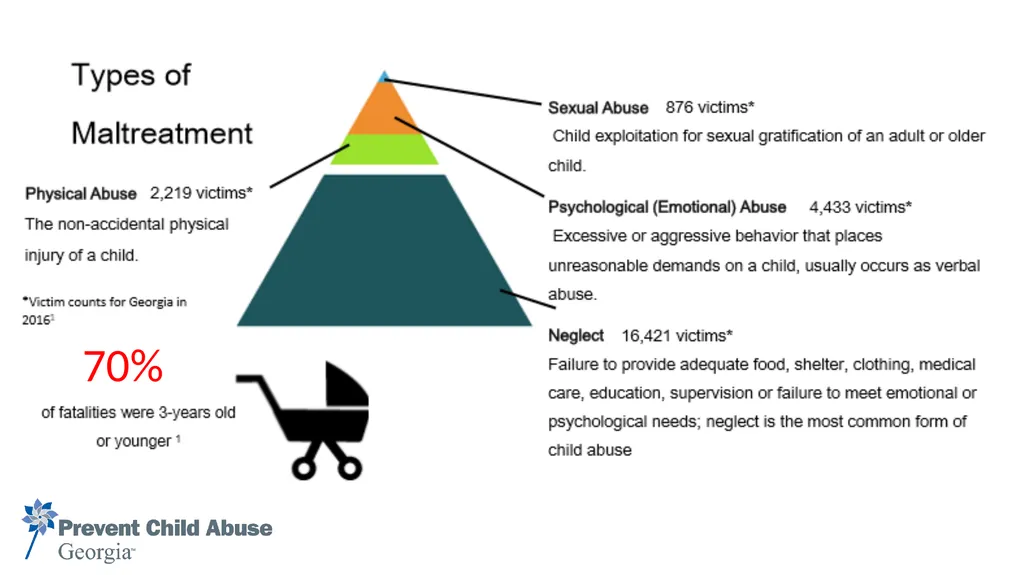
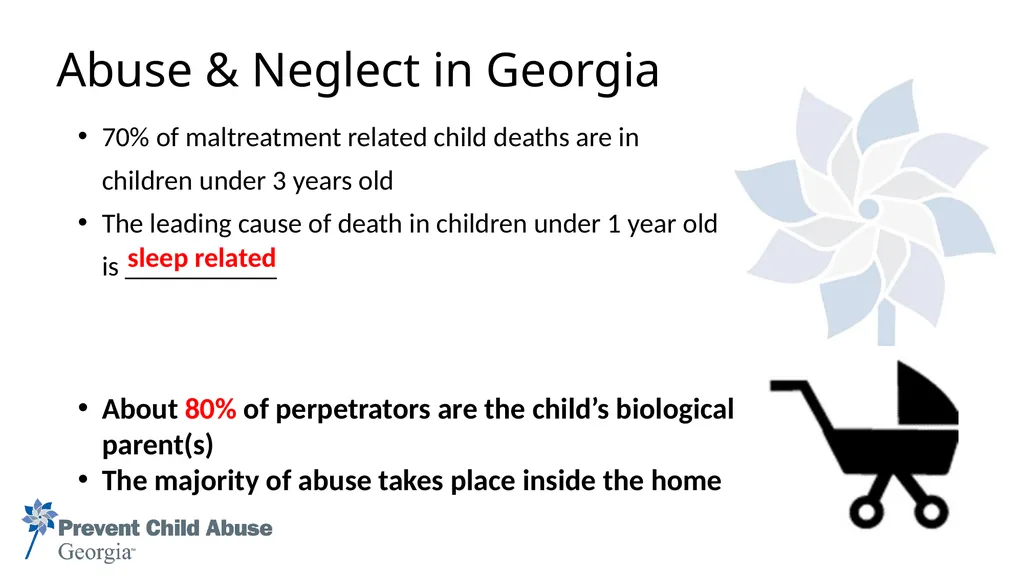
Abuse & Neglect in Georgia 70% of maltreatment related child deaths are in children under 3 years old
The leading cause of death in children under 1 year old is ___________
About 80% of perpetrators are the child’s biological parent(s)
The majority of abuse takes place inside the home sleep related<br>
The leading cause of death in children under 1 year old is ___________
About 80% of perpetrators are the child’s biological parent(s)
The majority of abuse takes place inside the home sleep related<br>
12
Parental & Family Factors Maturity level of parent/ caregiver
Unrealistic expectations of child
Social isolation
Unmet emotional needs
Frequent crisis
Poor childhood experiences
Drug or alcohol problems
Mental illnesses
Poor family boundaries
Dangerous home environment<br>
Unrealistic expectations of child
Social isolation
Unmet emotional needs
Frequent crisis
Poor childhood experiences
Drug or alcohol problems
Mental illnesses
Poor family boundaries
Dangerous home environment<br>
13
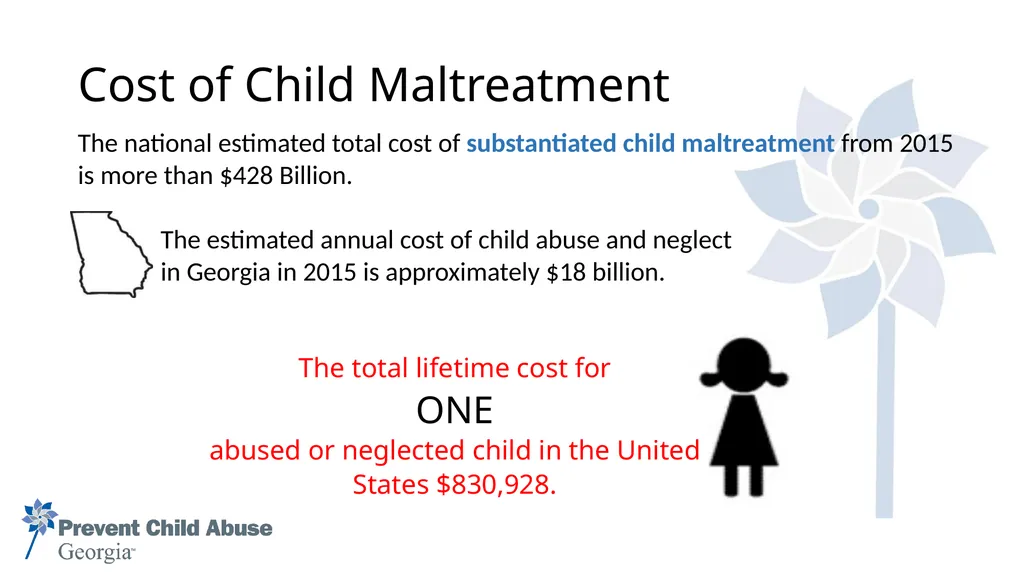
Cost of Child Maltreatment The estimated annual cost of child abuse and neglect in Georgia in 2015 is approximately $18 billion. The total lifetime cost for
ONE
abused or neglected child in the United States $830,928. The national estimated total cost of substantiated child maltreatment from 2015 is more than $428 Billion.<br>
ONE
abused or neglected child in the United States $830,928. The national estimated total cost of substantiated child maltreatment from 2015 is more than $428 Billion.<br>
14
Recognizing
Child Maltreatment<br>
15
How does Georgia define abuse? O.C.G.A. § 15-11-2 (2) (A) (2015) Any non-accidental physical injury or physical injury which is inconsistent with the explanation given for it suffered by a child as the result of the acts or omissions of a person responsible for the care of a child.
Expanded Definition
“Physical injury or death inflicted upon a child by a parent or caretaker thereof by other than accidental means; provided, however, physical forms of discipline may be used as long as there is no physical injury to the child…”
O.C.G.A. § 19-7-5 (2016)<br>
Expanded Definition
“Physical injury or death inflicted upon a child by a parent or caretaker thereof by other than accidental means; provided, however, physical forms of discipline may be used as long as there is no physical injury to the child…”
O.C.G.A. § 19-7-5 (2016)<br>
16
Physical Abuse-
Non-accidental physical injury of a child PHYSICAL INDICATORS
• Unexplained bruises and welts
• Unexplained burns
• Unexplained fractures /dislocations
• Bald patches on the scalp BEHAVIORAL INDICATORS
• Feels deserving of punishment
• Wary of adult/physical contact
• Frightened of parents/afraid to go home
• Self-destructive behaviors
• Wears clothing to cover body –
inappropriate for weather<br>
17
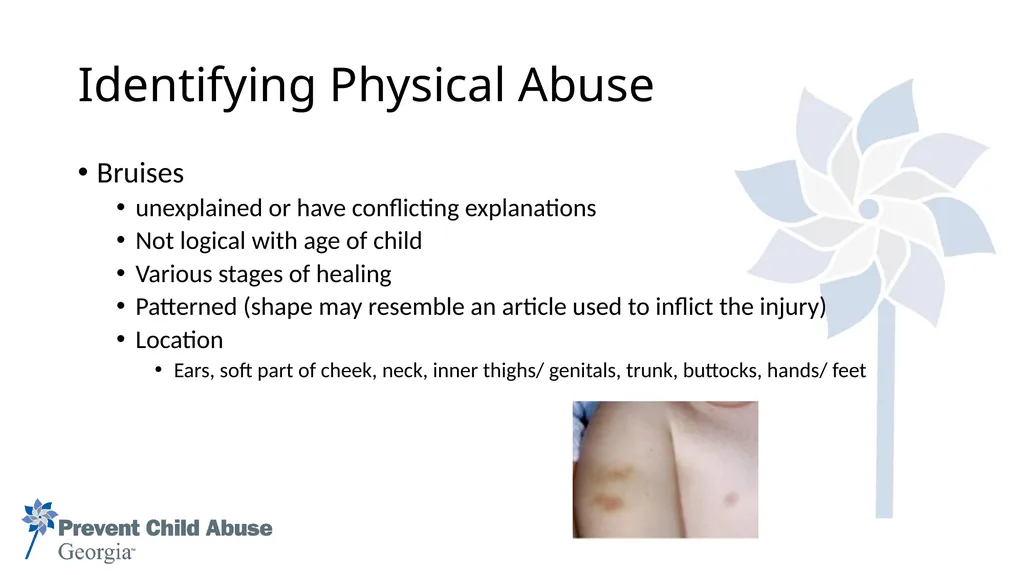
Identifying Physical Abuse Bruises
unexplained or have conflicting explanations
Not logical with age of child
Various stages of healing
Patterned (shape may resemble an article used to inflict the injury)
Location
Ears, soft part of cheek, neck, inner thighs/ genitals, trunk, buttocks, hands/ feet<br>
unexplained or have conflicting explanations
Not logical with age of child
Various stages of healing
Patterned (shape may resemble an article used to inflict the injury)
Location
Ears, soft part of cheek, neck, inner thighs/ genitals, trunk, buttocks, hands/ feet<br>
18
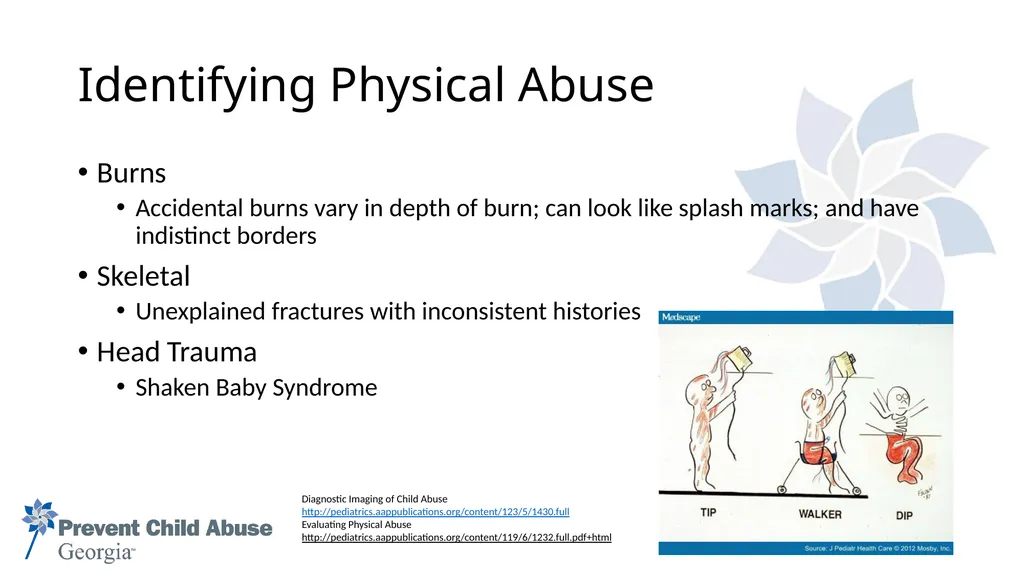
Identifying Physical Abuse Burns
Accidental burns vary in depth of burn; can look like splash marks; and have indistinct borders
Skeletal
Unexplained fractures with inconsistent histories
Head Trauma
Shaken Baby Syndrome Diagnostic Imaging of Child Abuse
http://pediatrics.aappublications.org/content/123/5/1430.full
Evaluating Physical Abuse
http://pediatrics.aappublications.org/content/119/6/1232.full.pdf+html<br>
19
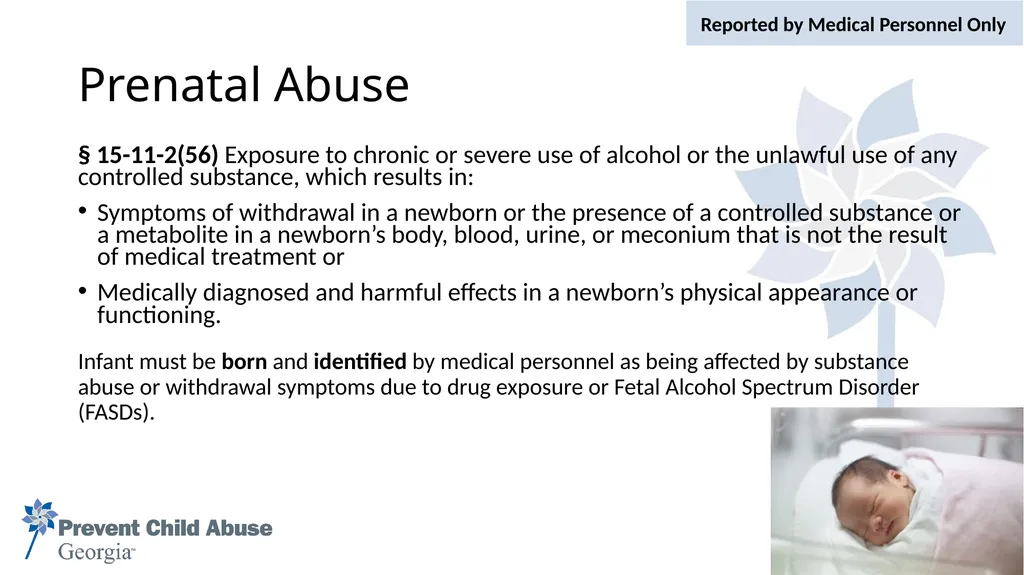
Prenatal Abuse Infant must be born and identified by medical personnel as being affected by substance abuse or withdrawal symptoms due to drug exposure or Fetal Alcohol Spectrum Disorder (FASDs). Reported by Medical Personnel Only § 15-11-2(56) Exposure to chronic or severe use of alcohol or the unlawful use of any controlled substance, which results in:
Symptoms of withdrawal in a newborn or the presence of a controlled substance or a metabolite in a newborn’s body, blood, urine, or meconium that is not the result of medical treatment or
Medically diagnosed and harmful effects in a newborn’s physical appearance or functioning.<br>
Symptoms of withdrawal in a newborn or the presence of a controlled substance or a metabolite in a newborn’s body, blood, urine, or meconium that is not the result of medical treatment or
Medically diagnosed and harmful effects in a newborn’s physical appearance or functioning.<br>
20
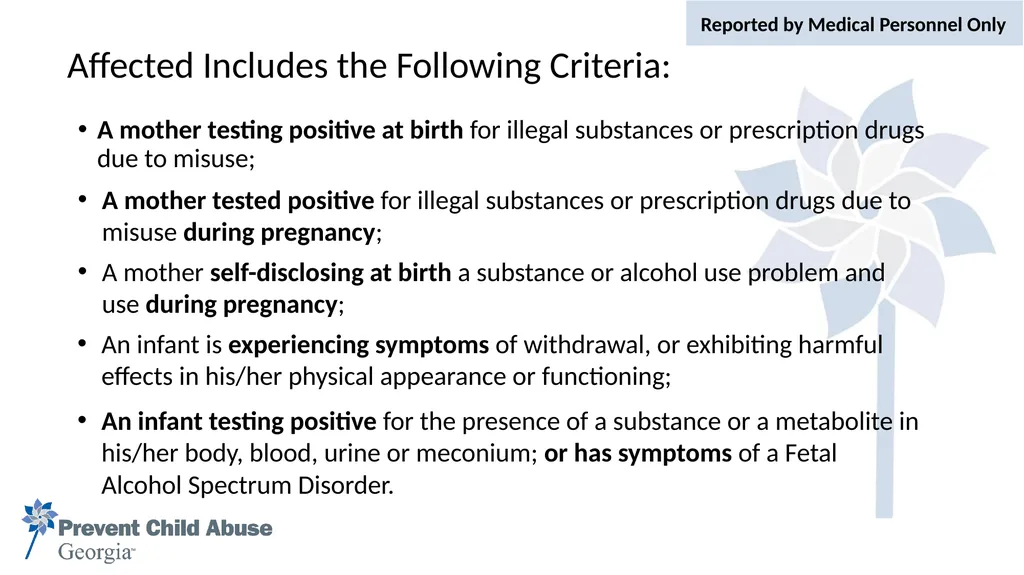
A mother testing positive at birth for illegal substances or prescription drugs due to misuse; Reported by Medical Personnel Only Affected Includes the Following Criteria: A mother tested positive for illegal substances or prescription drugs due to misuse during pregnancy; A mother self-disclosing at birth a substance or alcohol use problem and use during pregnancy; An infant is experiencing symptoms of withdrawal, or exhibiting harmful effects in his/her physical appearance or functioning; An infant testing positive for the presence of a substance or a metabolite in his/her body, blood, urine or meconium; or has symptoms of a Fetal Alcohol Spectrum Disorder.<br>
21
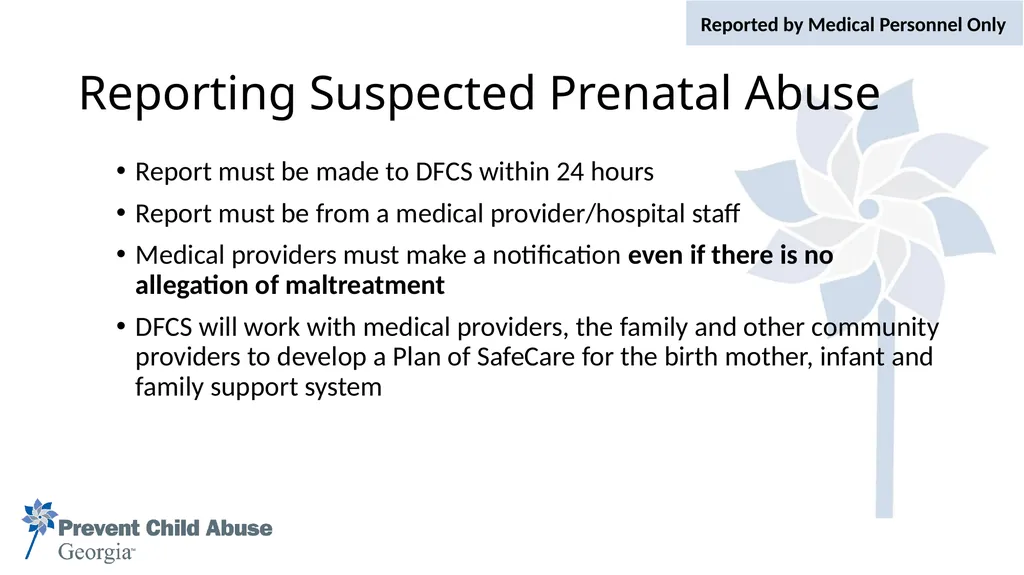
Reporting Suspected Prenatal Abuse Report must be made to DFCS within 24 hours
Report must be from a medical provider/hospital staff
Medical providers must make a notification even if there is no allegation of maltreatment
DFCS will work with medical providers, the family and other community providers to develop a Plan of SafeCare for the birth mother, infant and family support system Reported by Medical Personnel Only<br>
22
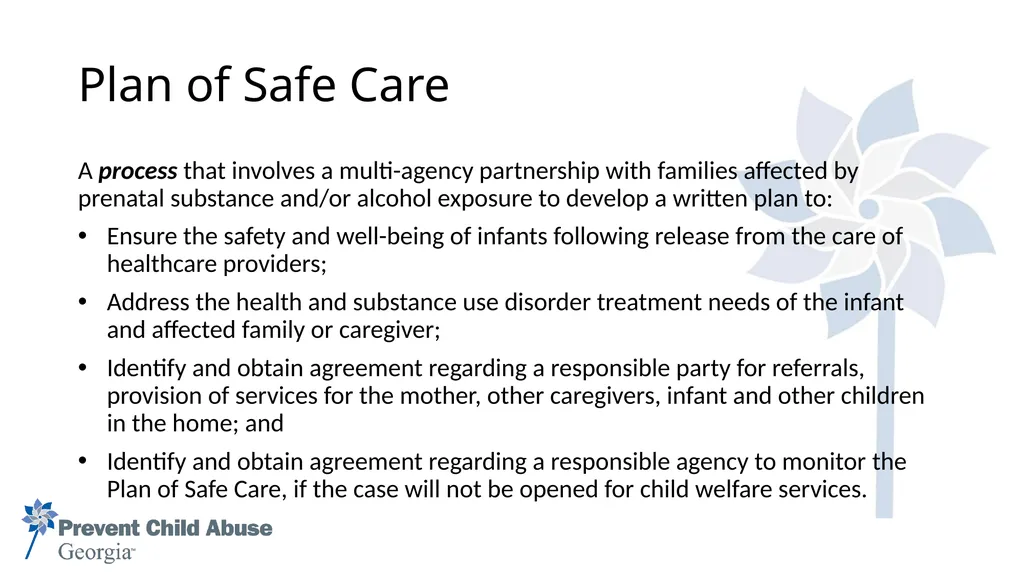
Plan of Safe Care A process that involves a multi-agency partnership with families affected by prenatal substance and/or alcohol exposure to develop a written plan to:
Ensure the safety and well-being of infants following release from the care of healthcare providers;
Address the health and substance use disorder treatment needs of the infant and affected family or caregiver;
Identify and obtain agreement regarding a responsible party for referrals, provision of services for the mother, other caregivers, infant and other children in the home; and
Identify and obtain agreement regarding a responsible agency to monitor the Plan of Safe Care, if the case will not be opened for child welfare services.<br>
23
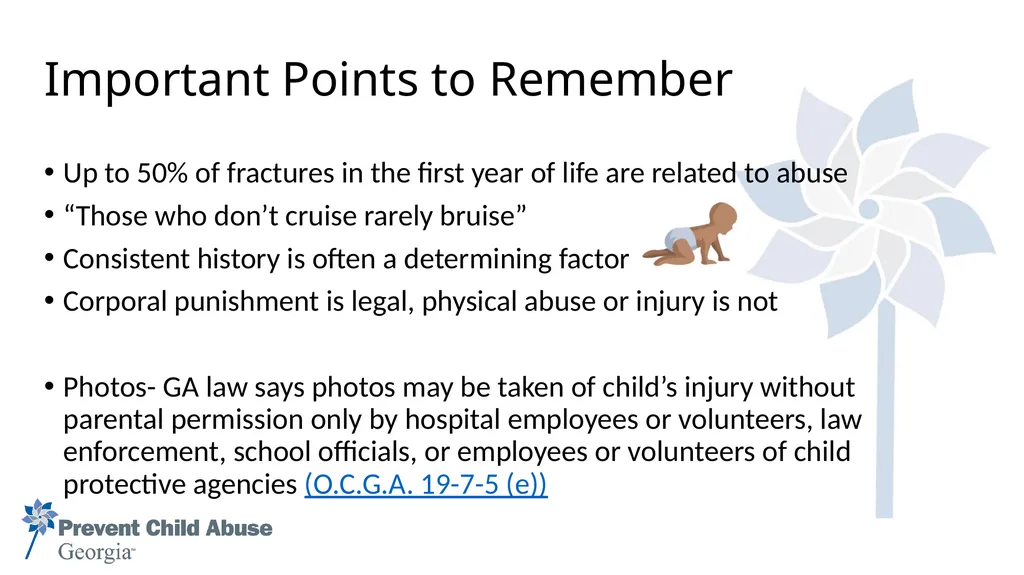
Important Points to Remember Up to 50% of fractures in the first year of life are related to abuse
“Those who don’t cruise rarely bruise”
Consistent history is often a determining factor
Corporal punishment is legal, physical abuse or injury is not
Photos- GA law says photos may be taken of child’s injury without parental permission only by hospital employees or volunteers, law enforcement, school officials, or employees or volunteers of child protective agencies (O.C.G.A. 19-7-5 (e))<br>
24
Neglect Georgia Code (O.C.G.A. § 49-5-180(5)(B));The Definition of Child Neglect (current as of 2016):
“The failure to provide proper parental care or control, subsistence, education as required by law, or other care or control necessary for a child's physical, mental, or emotional health or morals; the failure to provide a child with adequate supervision necessary for such child's well-being; or the abandonment of a child by his or her parent, guardian, or legal custodian.”<br>
“The failure to provide proper parental care or control, subsistence, education as required by law, or other care or control necessary for a child's physical, mental, or emotional health or morals; the failure to provide a child with adequate supervision necessary for such child's well-being; or the abandonment of a child by his or her parent, guardian, or legal custodian.”<br>
25
Neglect Most common form of child maltreatment
Can be difficult to identify
Parents who abuse substances (alcohol & drugs) and/or have inadequate parenting skills are responsible for many of the neglect cases
Because so many cases go unreported, child abuse and neglect is a much larger problem than statistics indicate<br>
Can be difficult to identify
Parents who abuse substances (alcohol & drugs) and/or have inadequate parenting skills are responsible for many of the neglect cases
Because so many cases go unreported, child abuse and neglect is a much larger problem than statistics indicate<br>
26
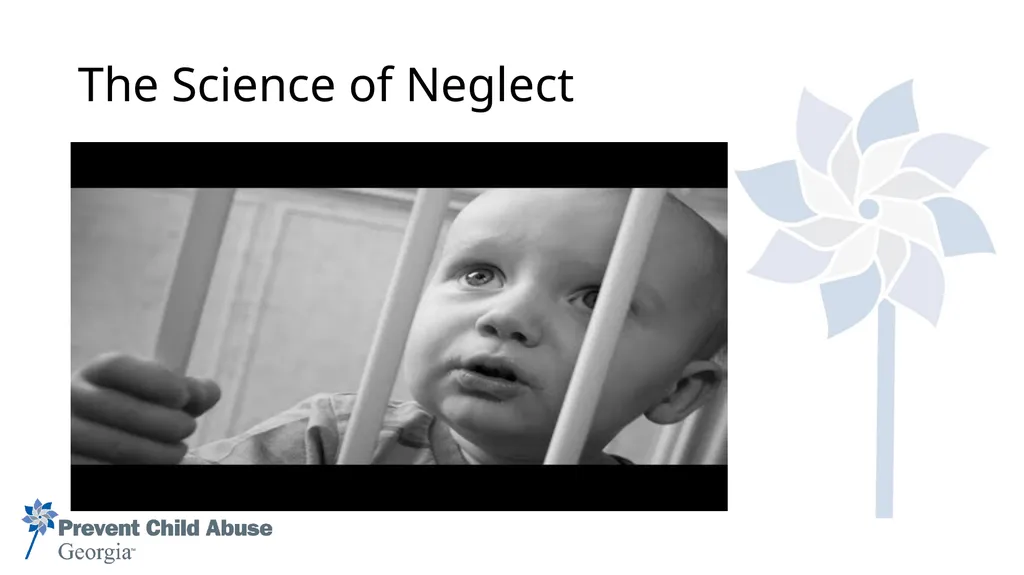
The Science of Neglect<br>
27
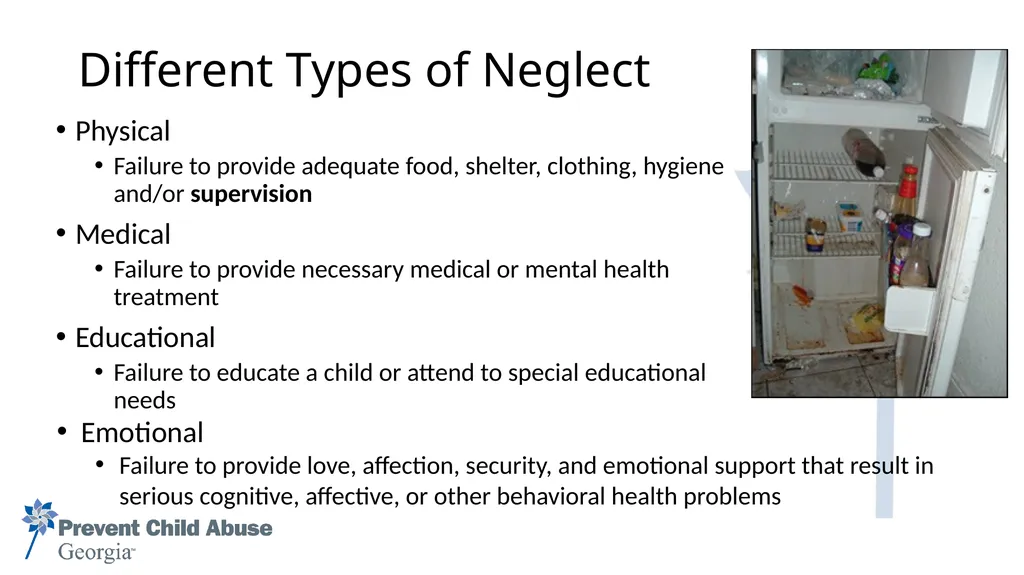
Different Types of Neglect Physical
Failure to provide adequate food, shelter, clothing, hygiene and/or supervision
Medical
Failure to provide necessary medical or mental health treatment
Educational
Failure to educate a child or attend to special educational needs Emotional
Failure to provide love, affection, security, and emotional support that result in serious cognitive, affective, or other behavioral health problems<br>
28
Neglect PHYISCAL INDICATORS
Consistent hunger/underweight
Poor hygiene
Consistent lack of supervision
Unattended physical/medical needs
Failure to thrive/poor growth
Distended stomach
Inappropriate dress BEHAVIORAL INDICATORS
• Self-destructive behaviors
• Begging, stealing food
• Extended stays at school (early
arrival and late departures)
• Constant fatigue, listlessness
• Assuming adult responsibilities
• Says no caretaker at home
• Frequently absent / tardy<br>
29
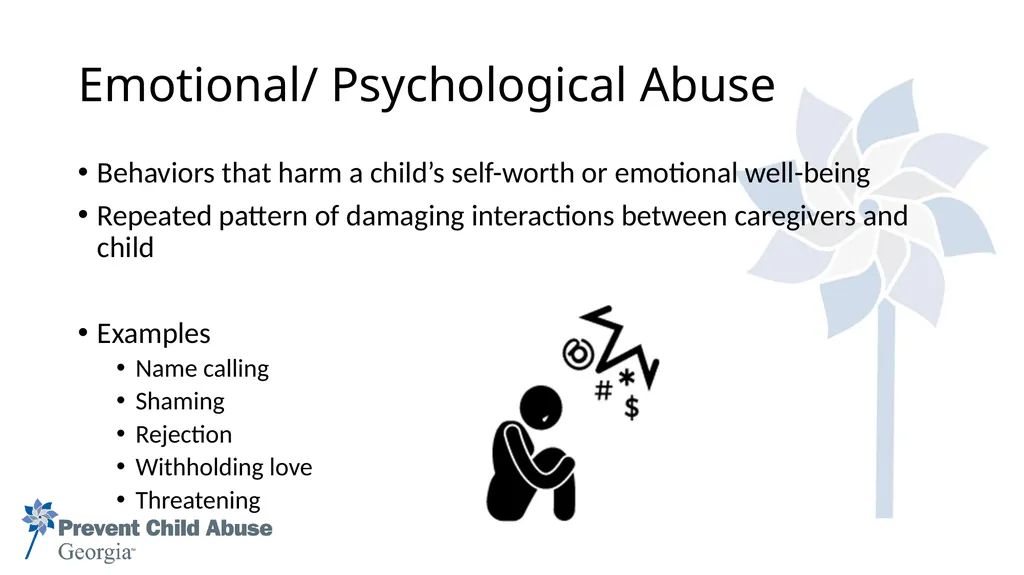
Emotional/ Psychological Abuse Behaviors that harm a child’s self-worth or emotional well-being
Repeated pattern of damaging interactions between caregivers and child
Examples
Name calling
Shaming
Rejection
Withholding love
Threatening<br>
Repeated pattern of damaging interactions between caregivers and child
Examples
Name calling
Shaming
Rejection
Withholding love
Threatening<br>
30
Emotional/ Psychological Abuse Potential Indicators
Speech disorders
Lags in physical development
Failure to thrive
Disruptive behavior
Sleep disorders
Disorganization<br>
Speech disorders
Lags in physical development
Failure to thrive
Disruptive behavior
Sleep disorders
Disorganization<br>
31
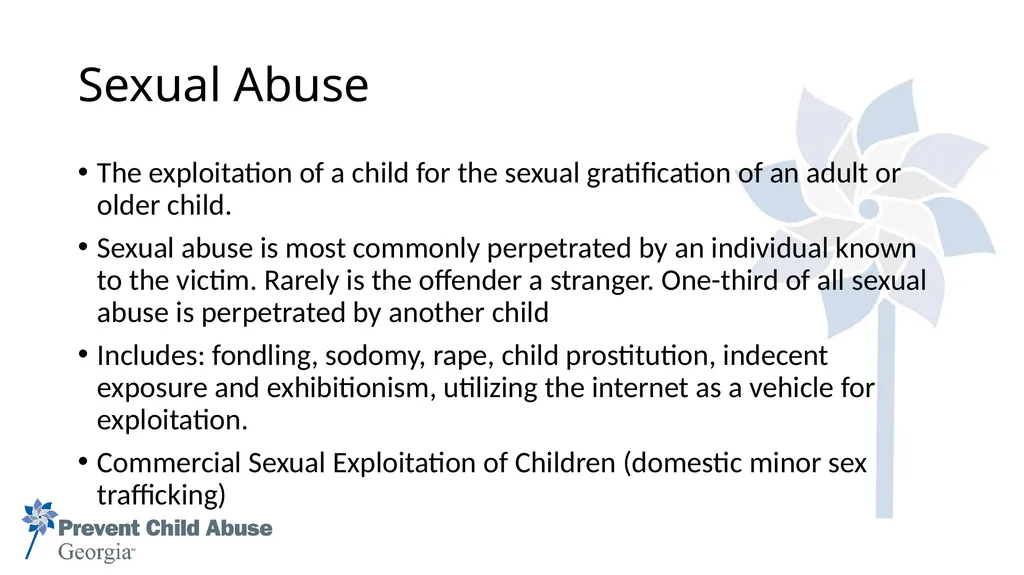
Sexual Abuse The exploitation of a child for the sexual gratification of an adult or older child.
Sexual abuse is most commonly perpetrated by an individual known to the victim. Rarely is the offender a stranger. One-third of all sexual abuse is perpetrated by another child
Includes: fondling, sodomy, rape, child prostitution, indecent exposure and exhibitionism, utilizing the internet as a vehicle for exploitation.
Commercial Sexual Exploitation of Children (domestic minor sex trafficking)<br>
32
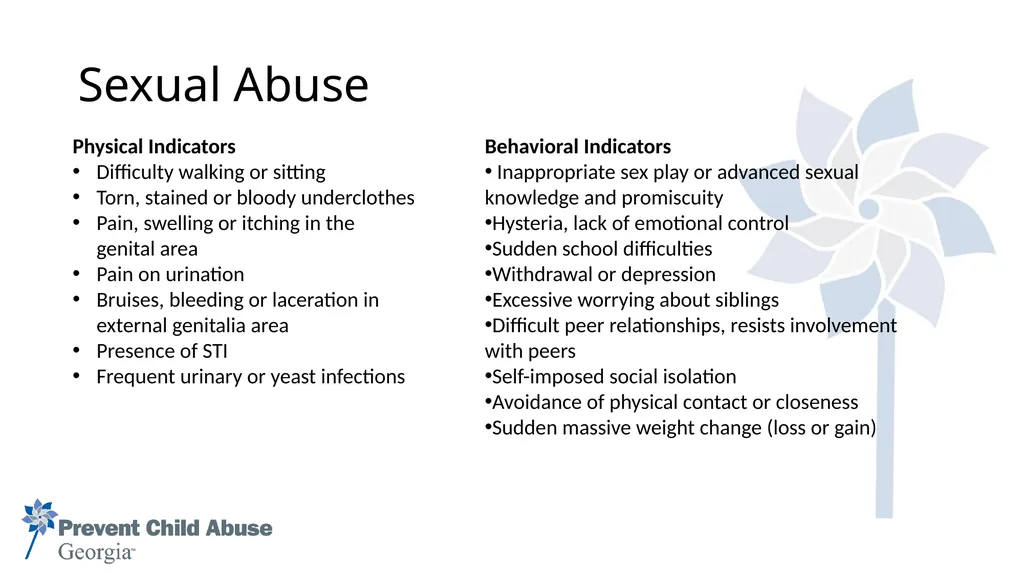
Sexual Abuse Physical Indicators
Difficulty walking or sitting
Torn, stained or bloody underclothes
Pain, swelling or itching in the genital area
Pain on urination
Bruises, bleeding or laceration in external genitalia area
Presence of STI
Frequent urinary or yeast infections Behavioral Indicators
Inappropriate sex play or advanced sexual knowledge and promiscuity
Hysteria, lack of emotional control
Sudden school difficulties
Withdrawal or depression
Excessive worrying about siblings
Difficult peer relationships, resists involvement with peers
Self-imposed social isolation
Avoidance of physical contact or closeness
Sudden massive weight change (loss or gain)<br>
33
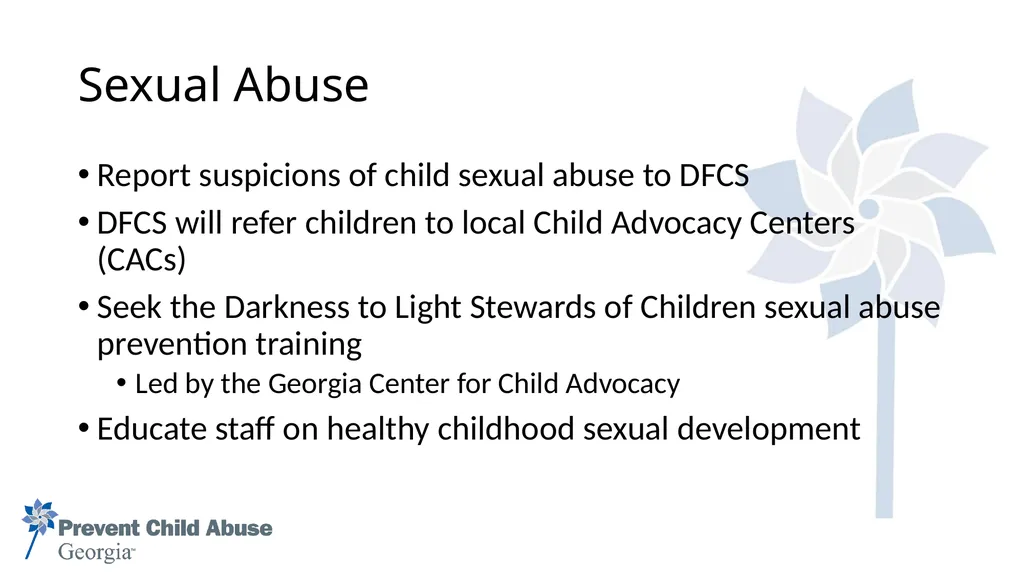
Sexual Abuse Report suspicions of child sexual abuse to DFCS
DFCS will refer children to local Child Advocacy Centers (CACs)
Seek the Darkness to Light Stewards of Children sexual abuse prevention training
Led by the Georgia Center for Child Advocacy
Educate staff on healthy childhood sexual development<br>
DFCS will refer children to local Child Advocacy Centers (CACs)
Seek the Darkness to Light Stewards of Children sexual abuse prevention training
Led by the Georgia Center for Child Advocacy
Educate staff on healthy childhood sexual development<br>
34
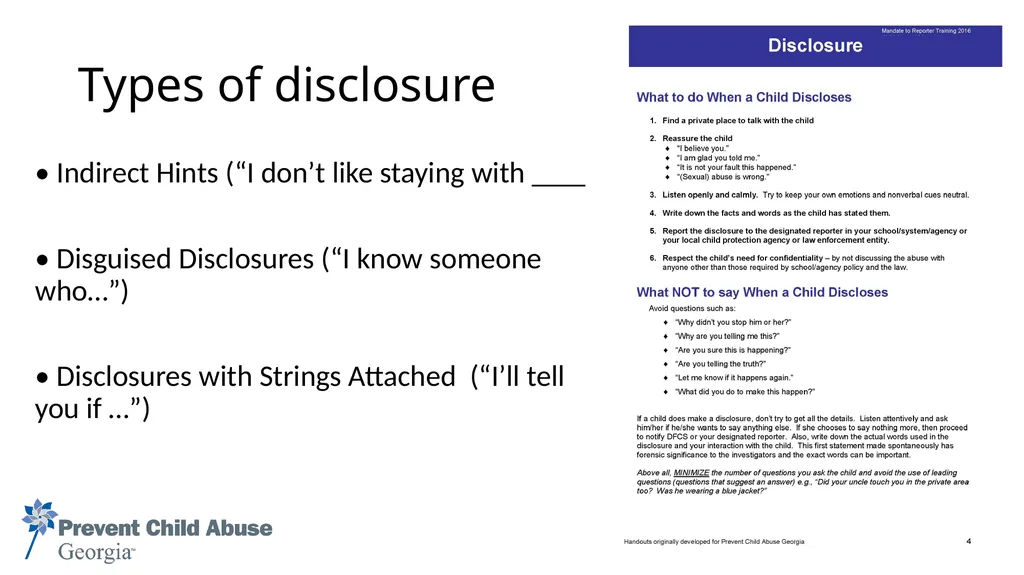
Types of disclosure • Indirect Hints (“I don’t like staying with ____)
• Disguised Disclosures (“I know someone who…”)
• Disclosures with Strings Attached (“I’ll tell you if …”)<br>
• Disguised Disclosures (“I know someone who…”)
• Disclosures with Strings Attached (“I’ll tell you if …”)<br>
35
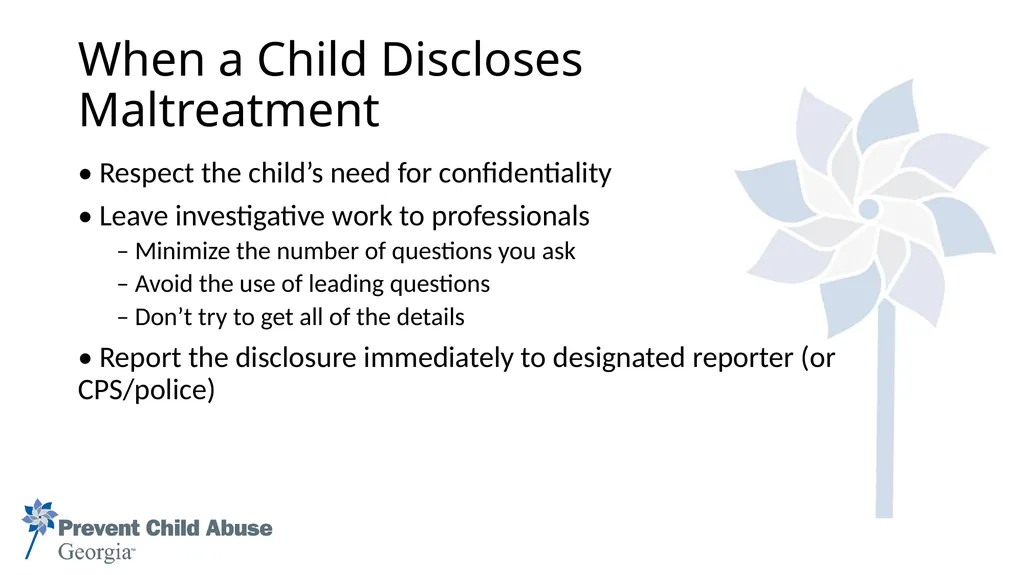
When a Child Discloses
Maltreatment • Respect the child’s need for confidentiality
• Leave investigative work to professionals
– Minimize the number of questions you ask
– Avoid the use of leading questions
– Don’t try to get all of the details
• Report the disclosure immediately to designated reporter (or CPS/police)<br>
• Leave investigative work to professionals
– Minimize the number of questions you ask
– Avoid the use of leading questions
– Don’t try to get all of the details
• Report the disclosure immediately to designated reporter (or CPS/police)<br>
36
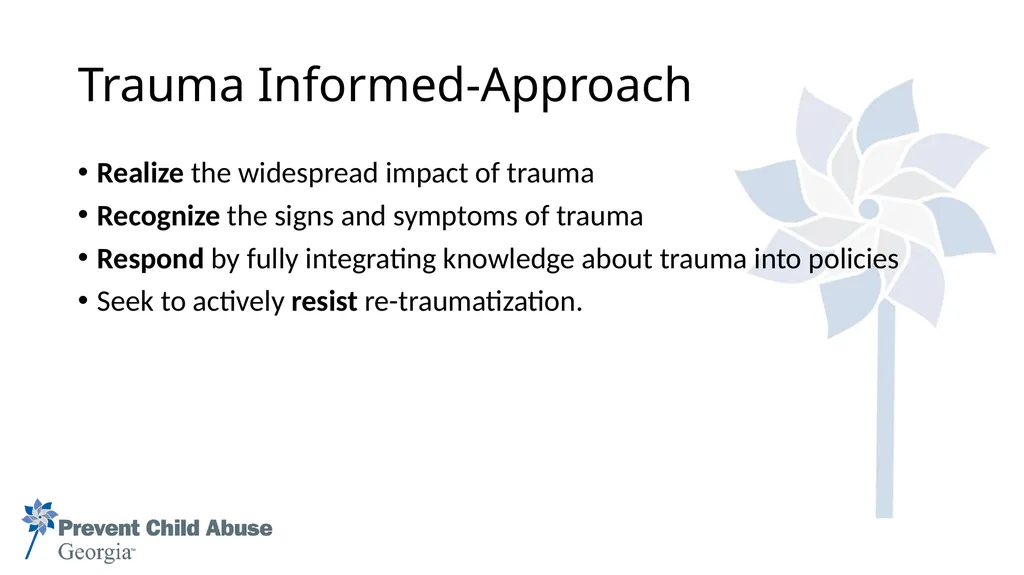
Trauma Informed-Approach Realize the widespread impact of trauma
Recognize the signs and symptoms of trauma
Respond by fully integrating knowledge about trauma into policies
Seek to actively resist re-traumatization.<br>
Recognize the signs and symptoms of trauma
Respond by fully integrating knowledge about trauma into policies
Seek to actively resist re-traumatization.<br>
37
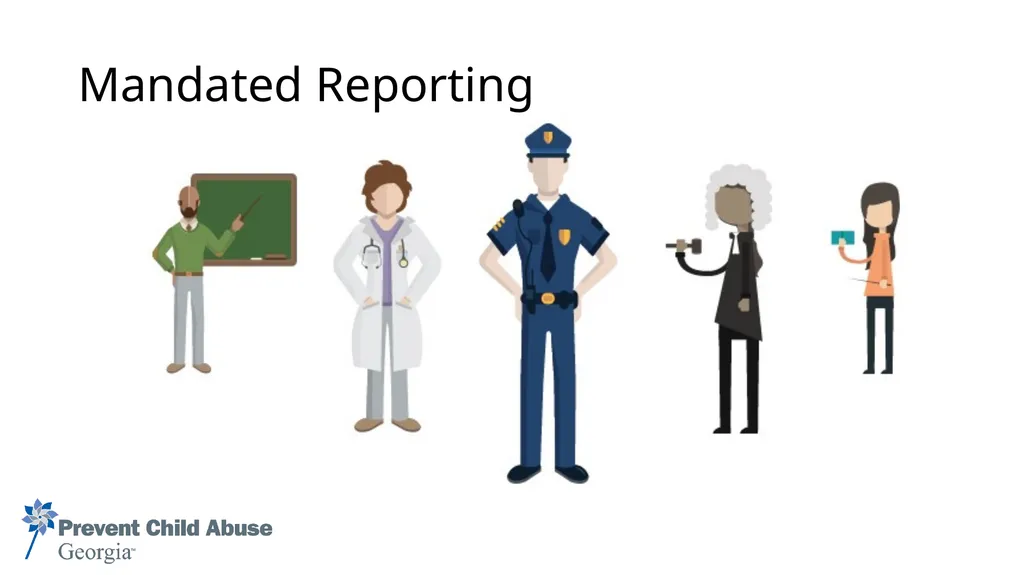
Mandated Reporting<br>
38
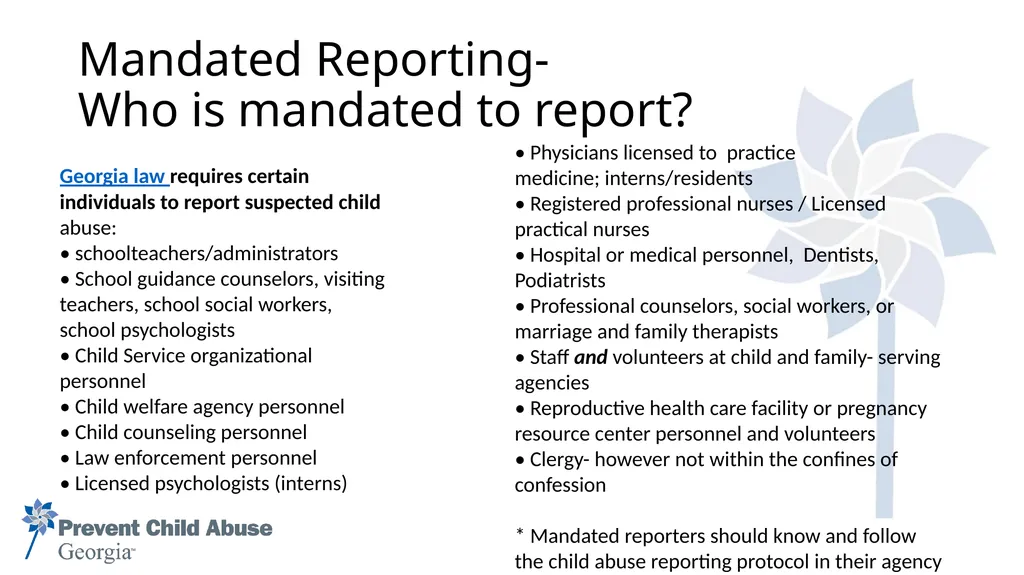
Mandated Reporting-
Who is mandated to report? Georgia law requires certain individuals to report suspected child abuse:
• schoolteachers/administrators
• School guidance counselors, visiting teachers, school social workers, school psychologists
• Child Service organizational personnel
• Child welfare agency personnel
• Child counseling personnel
• Law enforcement personnel
• Licensed psychologists (interns) • Physicians licensed to practice
medicine; interns/residents
• Registered professional nurses / Licensed practical nurses
• Hospital or medical personnel, Dentists, Podiatrists
• Professional counselors, social workers, or marriage and family therapists
• Staff and volunteers at child and family- serving agencies
• Reproductive health care facility or pregnancy resource center personnel and volunteers
• Clergy- however not within the confines of confession
* Mandated reporters should know and follow the child abuse reporting protocol in their agency<br>
39
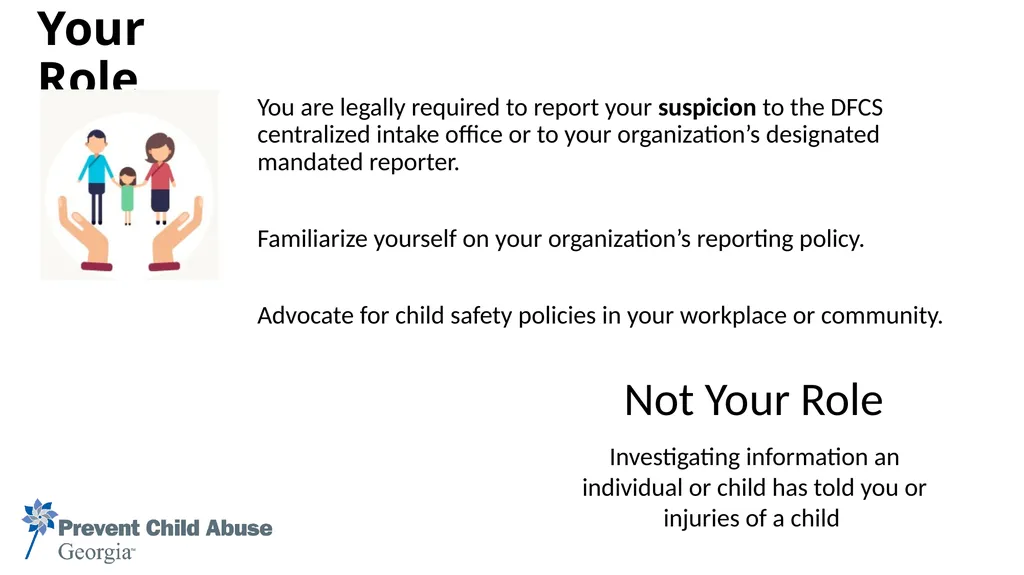
Your Role You are legally required to report your suspicion to the DFCS centralized intake office or to your organization’s designated mandated reporter.
Familiarize yourself on your organization’s reporting policy.
Advocate for child safety policies in your workplace or community. Not Your Role Investigating information an individual or child has told you or injuries of a child<br>
Familiarize yourself on your organization’s reporting policy.
Advocate for child safety policies in your workplace or community. Not Your Role Investigating information an individual or child has told you or injuries of a child<br>
40
What are the rights of a mandated reporter? Rights of the Mandated Reporter
Anonymity or confidentiality
Limited Liability
Knowledge of the outcome only of a report
Whether the case was substantiated or not
Turning Over Images or Materials
Designated mandated reporters MUST submit all reports made to them
Penalty for not reporting: misdemeanor<br>
Anonymity or confidentiality
Limited Liability
Knowledge of the outcome only of a report
Whether the case was substantiated or not
Turning Over Images or Materials
Designated mandated reporters MUST submit all reports made to them
Penalty for not reporting: misdemeanor<br>
41
Report by calling 1-855-GACHILD (422-4453) Required to report immediately, but at least within 24 hours
Mandated reporters in good faith possession of any illegal materials or images of children should give them over to police within 72 hours. (O.C.G.A §16–3–22.1(2016)
Immediate Danger call 911
It is helpful to know
Demographic information of child
Care takers, who is in the house
Injury/ situation specifics
Risk factors
Prior concerns
Child’s current safety 1-855-GACHILD<br>
42
Electronic Ways to Report Mandated Reporters have the choice of two options for submitting this completed form electronically.
Option One: E-mail the completed Georgia Mandated Reporter From to cpsintake@dhs.ga.gov. You will receive an auto-reply stating that the CPS report has been received. You will also receive a return phone call within 2 hours to acknowledge your report and collect any additional information needed. This return phone call satisfies the legal requirement to speak with a DHS employee. Please include on the report a number where you can be reached. To request a PDF version of the form, please contact customer_services_dfcs@dhr.state.ga.us. You can also fax the form to 229-317-9663).<br>
Option One: E-mail the completed Georgia Mandated Reporter From to cpsintake@dhs.ga.gov. You will receive an auto-reply stating that the CPS report has been received. You will also receive a return phone call within 2 hours to acknowledge your report and collect any additional information needed. This return phone call satisfies the legal requirement to speak with a DHS employee. Please include on the report a number where you can be reached. To request a PDF version of the form, please contact customer_services_dfcs@dhr.state.ga.us. You can also fax the form to 229-317-9663).<br>
43
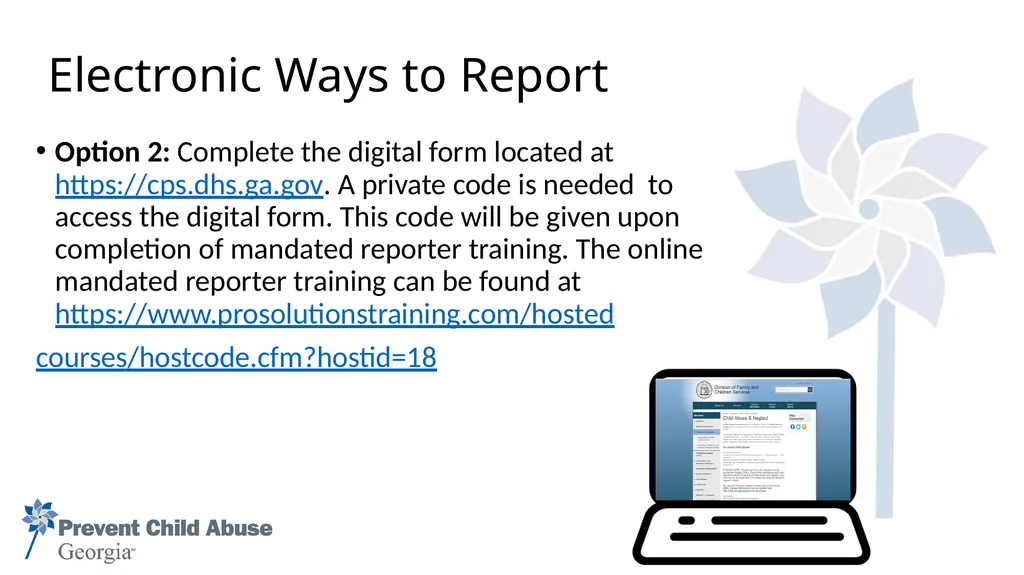
Electronic Ways to Report Option 2: Complete the digital form located at https://cps.dhs.ga.gov. A private code is needed to access the digital form. This code will be given upon completion of mandated reporter training. The online mandated reporter training can be found at https://www.prosolutionstraining.com/hosted
courses/hostcode.cfm?hostid=18<br>
courses/hostcode.cfm?hostid=18<br>
44
When to call 911 Present Danger:
Currently occurring
Serious unexplained injury
Left unattended in a parking lot
Parent is unconscious due to drugs and there are young children in the home, or parent behavior is very bizarre
Calling 911 and DFCS may be necessary. Law enforcement is designed to respond within minutes, whereas DFCS may respond as soon as they get the report or within 24 hours. Report Child Maltreatment by calling 1-855-GACHILD<br>
45
After the Report is Made DFCS must send confirmation notification of report to mandated reporter within 24 hours of the intake report.
Includes process for the reporter to obtain the outcome of the case
School personnel
Will receive confirmation of report, additionally they will also receive case outcome within 5 days of completion of investigation if the case is substantiated
You may report anonymously, and your identify will not be given to the family.
You may be called back to gather more information needed or to clarify.
There is the potential that you will need to appear in court.<br>
46
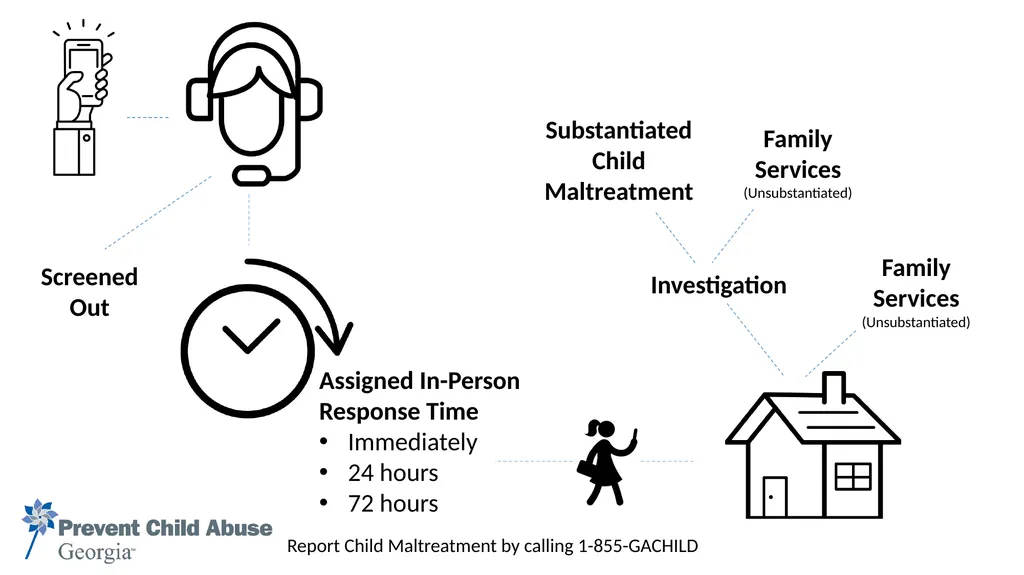
How does DFCS Screen Calls and Assign Response Times? The extent of maltreatment
The circumstances surrounding maltreatment
The level of child functioning
The level of adult functioning
Parent behavior/ decisions
Discipline Report Child Maltreatment by calling 1-855-GACHILD<br>
The circumstances surrounding maltreatment
The level of child functioning
The level of adult functioning
Parent behavior/ decisions
Discipline Report Child Maltreatment by calling 1-855-GACHILD<br>
47
Screened Out Assigned In-Person
Response Time
Immediately
24 hours
72 hours Family Services
(Unsubstantiated) Investigation Family Services
(Unsubstantiated) Substantiated Child Maltreatment Report Child Maltreatment by calling 1-855-GACHILD<br>
Response Time
Immediately
24 hours
72 hours Family Services
(Unsubstantiated) Investigation Family Services
(Unsubstantiated) Substantiated Child Maltreatment Report Child Maltreatment by calling 1-855-GACHILD<br>
48
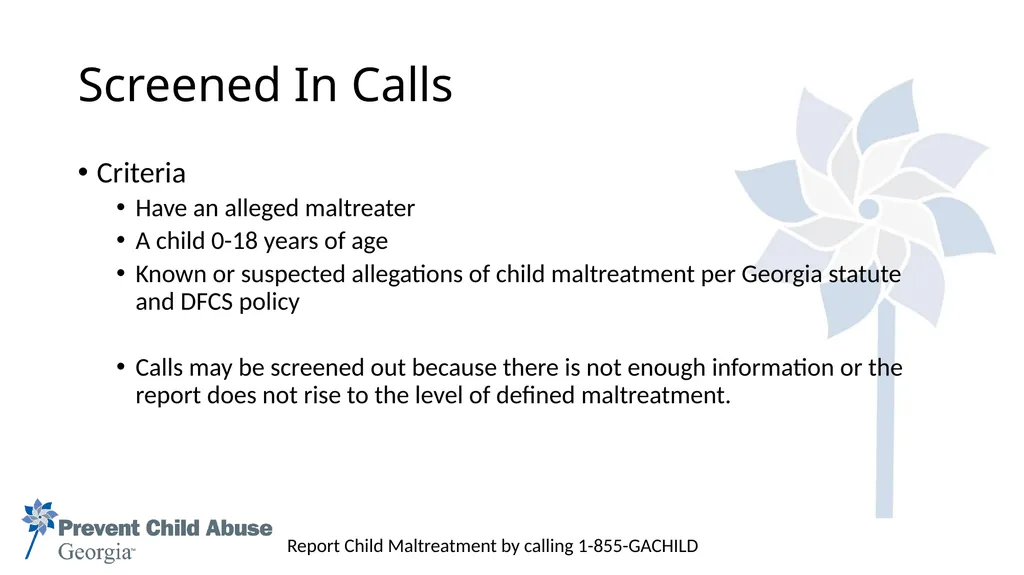
Screened In Calls Criteria
Have an alleged maltreater
A child 0-18 years of age
Known or suspected allegations of child maltreatment per Georgia statute and DFCS policy
Calls may be screened out because there is not enough information or the report does not rise to the level of defined maltreatment. Report Child Maltreatment by calling 1-855-GACHILD<br>
49
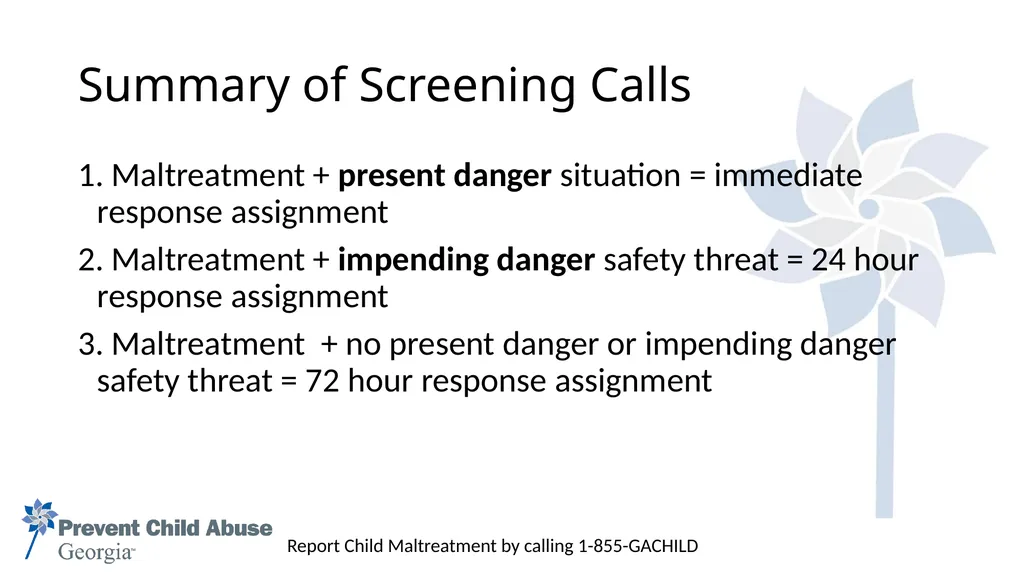
Summary of Screening Calls Maltreatment + present danger situation = immediate response assignment
Maltreatment + impending danger safety threat = 24 hour response assignment
Maltreatment + no present danger or impending danger safety threat = 72 hour response assignment Report Child Maltreatment by calling 1-855-GACHILD<br>
Maltreatment + impending danger safety threat = 24 hour response assignment
Maltreatment + no present danger or impending danger safety threat = 72 hour response assignment Report Child Maltreatment by calling 1-855-GACHILD<br>
50
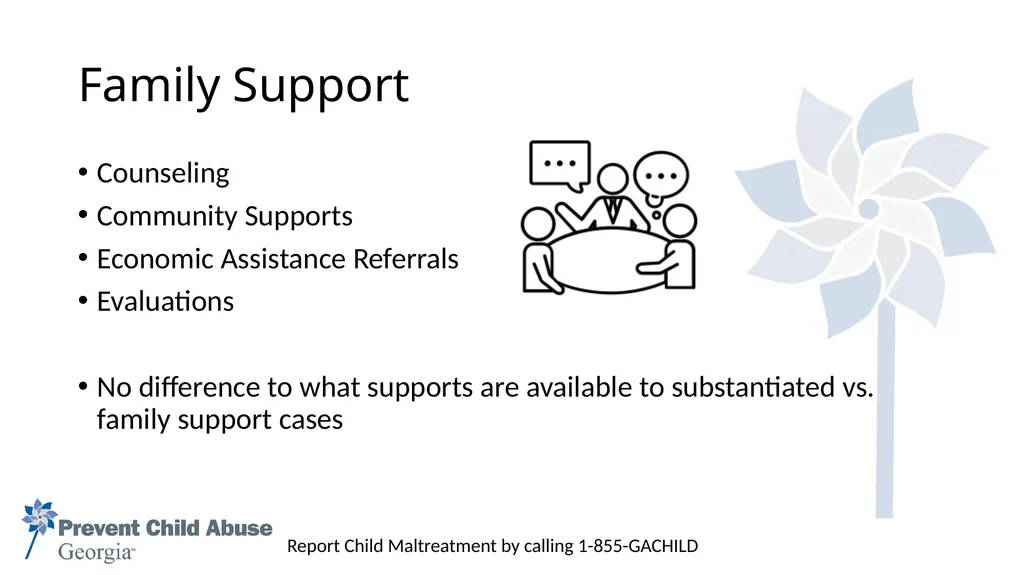
Family Support Counseling
Community Supports
Economic Assistance Referrals
Evaluations
No difference to what supports are available to substantiated vs. family support cases Report Child Maltreatment by calling 1-855-GACHILD<br>
Community Supports
Economic Assistance Referrals
Evaluations
No difference to what supports are available to substantiated vs. family support cases Report Child Maltreatment by calling 1-855-GACHILD<br>
51
Final Tips Your role is to report, not investigate!
Give volunteers tools and training for handling disclosures (i.e. never make promises, consult with staff but also require direct report to 1-855-GACHILD)
Discuss with organizational leadership who is responsible for making reports
Cooperate with law enforcement and any on-going investigation
Go with your gut instincts-if something doesn’t feel right, talk about it with your supervisor (encourage your volunteers to do the same)
Make a report even if you know there is an open case<br>
52
Recent Updates to Pertinent Sections of the O.C.G.A. O.C.G.A. 20-2-143
Effective July 1, 2018
Will require annual age-appropriate sexual abuse and assault awareness and prevention education in kindergarten through grade 9.<br>
Effective July 1, 2018
Will require annual age-appropriate sexual abuse and assault awareness and prevention education in kindergarten through grade 9.<br>
53
Recent Update to Mandated Reporter Law O.C.G.A. 19-7-5
Effective July 1, 2017
The definition of sexual abuse has been expanded to include acts involving trafficking a person for sexual servitude<br>
Effective July 1, 2017
The definition of sexual abuse has been expanded to include acts involving trafficking a person for sexual servitude<br>
54
Recent Updates/ Clarifications O.C.G.A. 19-7-5
Lowered the threshold for what must be reported: “ reasonable cause to suspect child abuse”
By making the report to a supervisor or an organizational designated reporter the mandated reporter "shall be deemed to have fully complied" with the statute. It is then the responsibility of the supervisor to report the suspected abuse to DFCS.
O.C.G.A 16-3-22.1
72 hours to turn over unlawful images and material to law enforcement.<br>
55
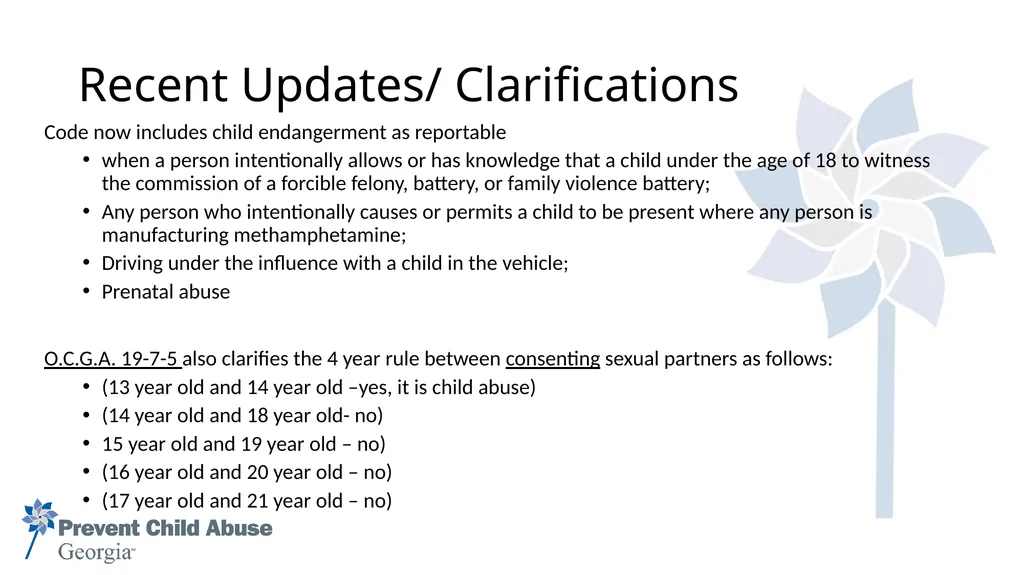
Recent Updates/ Clarifications Code now includes child endangerment as reportable
when a person intentionally allows or has knowledge that a child under the age of 18 to witness the commission of a forcible felony, battery, or family violence battery;
Any person who intentionally causes or permits a child to be present where any person is manufacturing methamphetamine;
Driving under the influence with a child in the vehicle;
Prenatal abuse
O.C.G.A. 19-7-5 also clarifies the 4 year rule between consenting sexual partners as follows:
(13 year old and 14 year old –yes, it is child abuse)
(14 year old and 18 year old- no)
15 year old and 19 year old – no)
(16 year old and 20 year old – no)
(17 year old and 21 year old – no)<br>
56
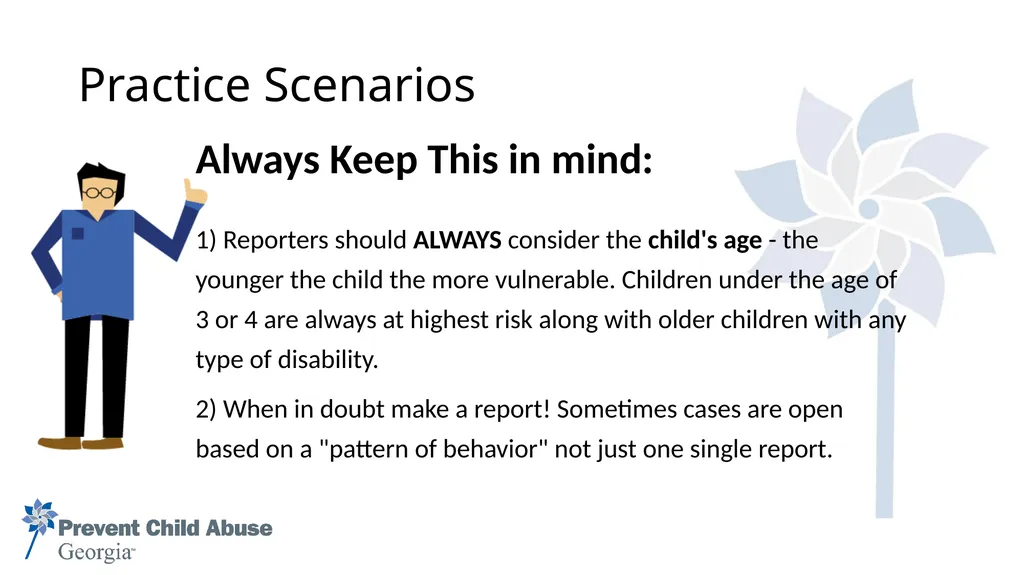
Practice Scenarios Always Keep This in mind:
1) Reporters should ALWAYS consider the child's age - the younger the child the more vulnerable. Children under the age of 3 or 4 are always at highest risk along with older children with any type of disability.
2) When in doubt make a report! Sometimes cases are open based on a "pattern of behavior" not just one single report.<br>
57
Practice Scenario A A paternal grandmother whose son is in the military and currently deployed overseas (and due to return in 6 months) was visiting her grandson (age 15 months) and her daughter in law, age 21. She told a friend about the visit, seeking advice. The grandmother has long believed that her DIL is very lazy and extremely dirty and is concerned now more than ever because she thinks her son was the only one who ever maintained and cleaned the house. When she went to visit she saw “more animals than she could count.” There was a chicken living in the house and it looked like it had a broken neck. Her DIL said that one of the dogs got after it and nearly killed it. The grandmother also said that the house reeked of animal urine and feces. The grandmother saw dishes, beer cans, and full ash trays everywhere and she saw her grandson put 2 cigarette butts in his mouth and her DIL did not respond so she had to take them away. The grandmother and DIL argued about the condition of the home and she was then kicked out.<br>
58
Practice Scenarios B Pam confides in you that she is really struggling with her toddler boy. She shares that she “potty-trained” him last month and he refuses to stop wetting the bed at night. Every morning when she wakes him his bed is wet and she is convinced he is just trying to get her day off to a bad start because he doesn’t want to go to daycare. She is at her wit’s end with her child saying she doesn’t know what else to do. She says she spanks him every morning and that doesn’t seem to change the behavior, and she is really starting to wonder if he just hates her.<br>
59
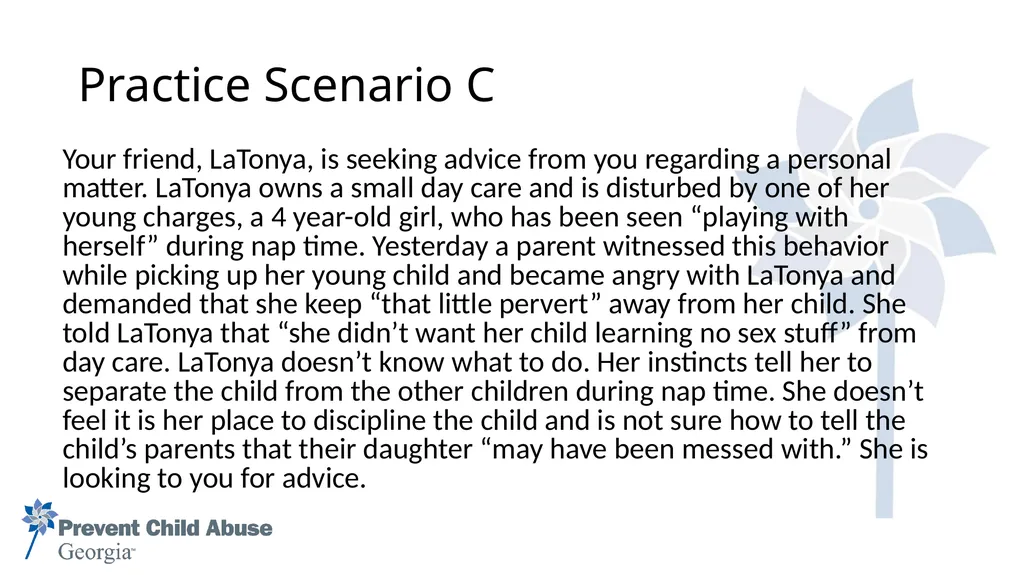
Practice Scenario C Your friend, LaTonya, is seeking advice from you regarding a personal matter. LaTonya owns a small day care and is disturbed by one of her young charges, a 4 year-old girl, who has been seen “playing with herself” during nap time. Yesterday a parent witnessed this behavior while picking up her young child and became angry with LaTonya and demanded that she keep “that little pervert” away from her child. She told LaTonya that “she didn’t want her child learning no sex stuff” from day care. LaTonya doesn’t know what to do. Her instincts tell her to separate the child from the other children during nap time. She doesn’t feel it is her place to discipline the child and is not sure how to tell the child’s parents that their daughter “may have been messed with.” She is looking to you for advice.<br>
60
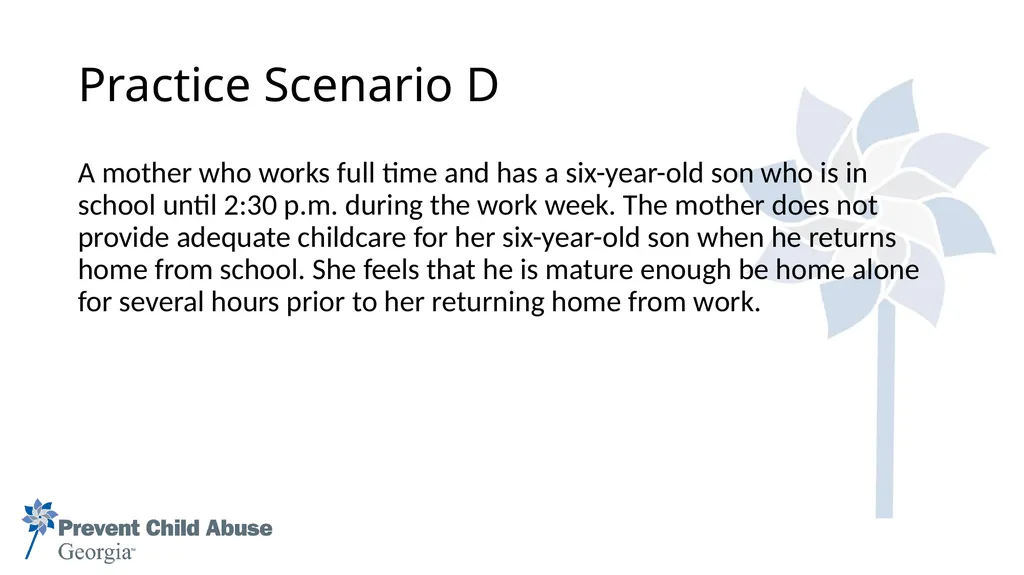
Practice Scenario D A mother who works full time and has a six-year-old son who is in school until 2:30 p.m. during the work week. The mother does not provide adequate childcare for her six-year-old son when he returns home from school. She feels that he is mature enough be home alone for several hours prior to her returning home from work.<br>
61
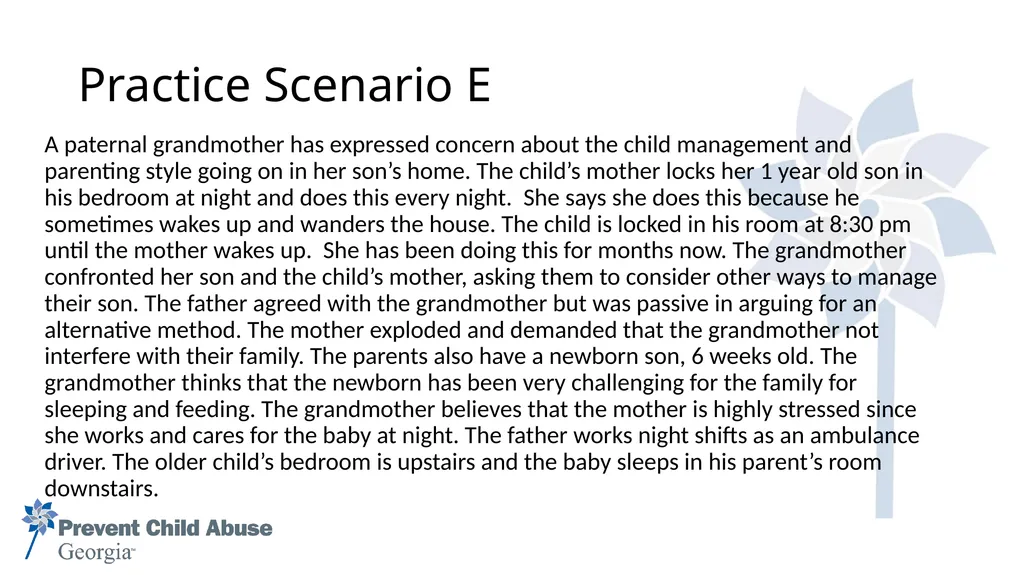
Practice Scenario E A paternal grandmother has expressed concern about the child management and parenting style going on in her son’s home. The child’s mother locks her 1 year old son in his bedroom at night and does this every night. She says she does this because he sometimes wakes up and wanders the house. The child is locked in his room at 8:30 pm until the mother wakes up. She has been doing this for months now. The grandmother confronted her son and the child’s mother, asking them to consider other ways to manage their son. The father agreed with the grandmother but was passive in arguing for an alternative method. The mother exploded and demanded that the grandmother not interfere with their family. The parents also have a newborn son, 6 weeks old. The grandmother thinks that the newborn has been very challenging for the family for sleeping and feeding. The grandmother believes that the mother is highly stressed since she works and cares for the baby at night. The father works night shifts as an ambulance driver. The older child’s bedroom is upstairs and the baby sleeps in his parent’s room downstairs.<br>
62
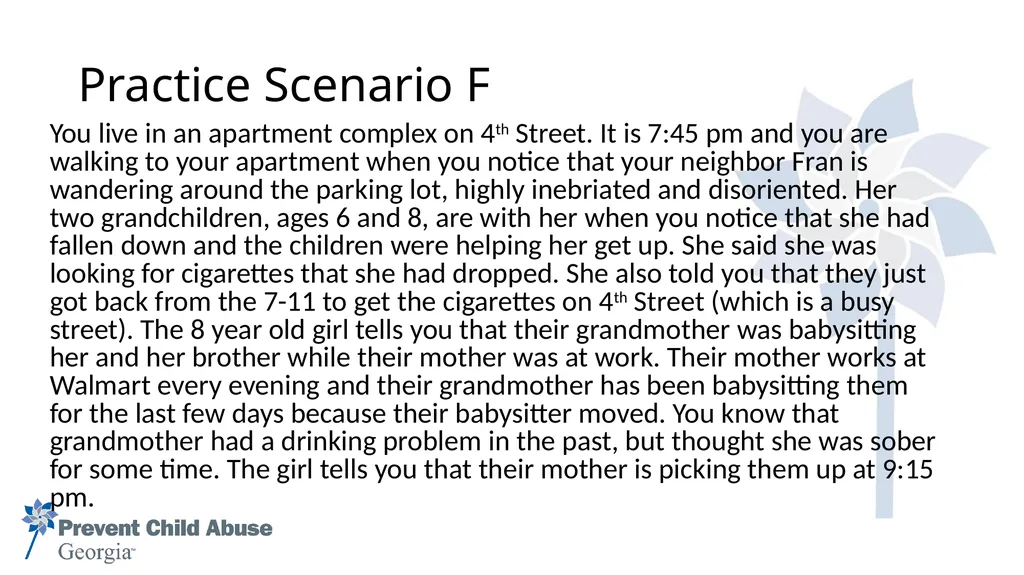
Practice Scenario F You live in an apartment complex on 4th Street. It is 7:45 pm and you are walking to your apartment when you notice that your neighbor Fran is wandering around the parking lot, highly inebriated and disoriented. Her two grandchildren, ages 6 and 8, are with her when you notice that she had fallen down and the children were helping her get up. She said she was looking for cigarettes that she had dropped. She also told you that they just got back from the 7-11 to get the cigarettes on 4th Street (which is a busy street). The 8 year old girl tells you that their grandmother was babysitting her and her brother while their mother was at work. Their mother works at Walmart every evening and their grandmother has been babysitting them for the last few days because their babysitter moved. You know that grandmother had a drinking problem in the past, but thought she was sober for some time. The girl tells you that their mother is picking them up at 9:15 pm.<br>
63
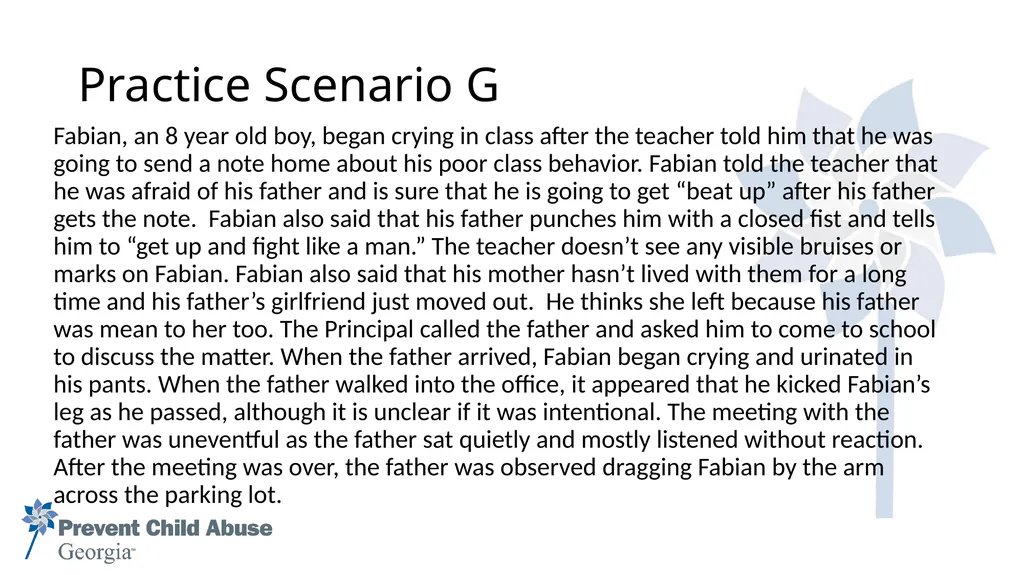
Practice Scenario G Fabian, an 8 year old boy, began crying in class after the teacher told him that he was going to send a note home about his poor class behavior. Fabian told the teacher that he was afraid of his father and is sure that he is going to get “beat up” after his father gets the note. Fabian also said that his father punches him with a closed fist and tells him to “get up and fight like a man.” The teacher doesn’t see any visible bruises or marks on Fabian. Fabian also said that his mother hasn’t lived with them for a long time and his father’s girlfriend just moved out. He thinks she left because his father was mean to her too. The Principal called the father and asked him to come to school to discuss the matter. When the father arrived, Fabian began crying and urinated in his pants. When the father walked into the office, it appeared that he kicked Fabian’s leg as he passed, although it is unclear if it was intentional. The meeting with the father was uneventful as the father sat quietly and mostly listened without reaction. After the meeting was over, the father was observed dragging Fabian by the arm across the parking lot.<br>
64
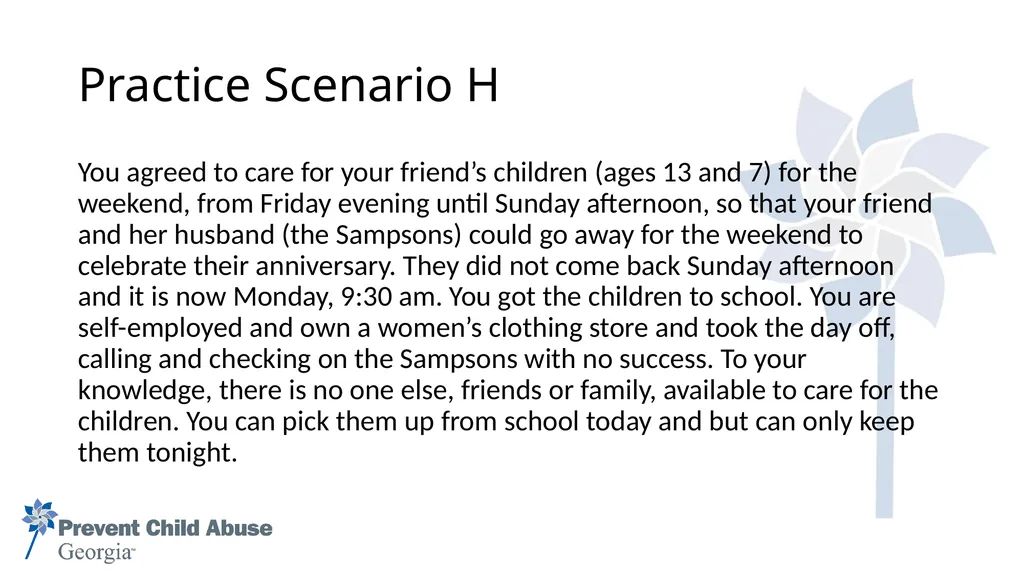
Practice Scenario H You agreed to care for your friend’s children (ages 13 and 7) for the weekend, from Friday evening until Sunday afternoon, so that your friend and her husband (the Sampsons) could go away for the weekend to celebrate their anniversary. They did not come back Sunday afternoon and it is now Monday, 9:30 am. You got the children to school. You are self-employed and own a women’s clothing store and took the day off, calling and checking on the Sampsons with no success. To your knowledge, there is no one else, friends or family, available to care for the children. You can pick them up from school today and but can only keep them tonight.<br>
65
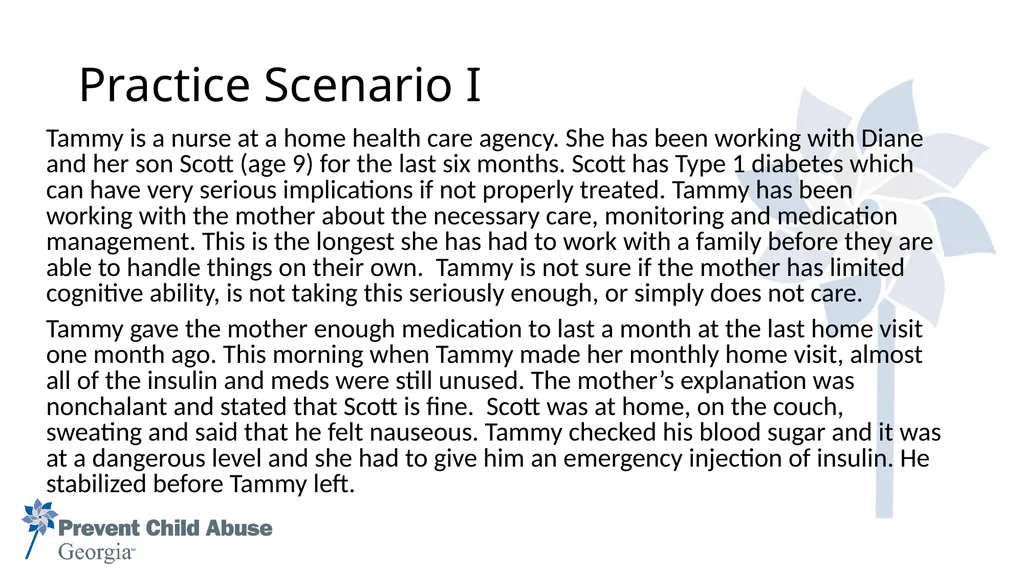
Practice Scenario I Tammy is a nurse at a home health care agency. She has been working with Diane and her son Scott (age 9) for the last six months. Scott has Type 1 diabetes which can have very serious implications if not properly treated. Tammy has been working with the mother about the necessary care, monitoring and medication management. This is the longest she has had to work with a family before they are able to handle things on their own. Tammy is not sure if the mother has limited cognitive ability, is not taking this seriously enough, or simply does not care.
Tammy gave the mother enough medication to last a month at the last home visit one month ago. This morning when Tammy made her monthly home visit, almost all of the insulin and meds were still unused. The mother’s explanation was nonchalant and stated that Scott is fine. Scott was at home, on the couch, sweating and said that he felt nauseous. Tammy checked his blood sugar and it was at a dangerous level and she had to give him an emergency injection of insulin. He stabilized before Tammy left.<br>
Tammy gave the mother enough medication to last a month at the last home visit one month ago. This morning when Tammy made her monthly home visit, almost all of the insulin and meds were still unused. The mother’s explanation was nonchalant and stated that Scott is fine. Scott was at home, on the couch, sweating and said that he felt nauseous. Tammy checked his blood sugar and it was at a dangerous level and she had to give him an emergency injection of insulin. He stabilized before Tammy left.<br>
66
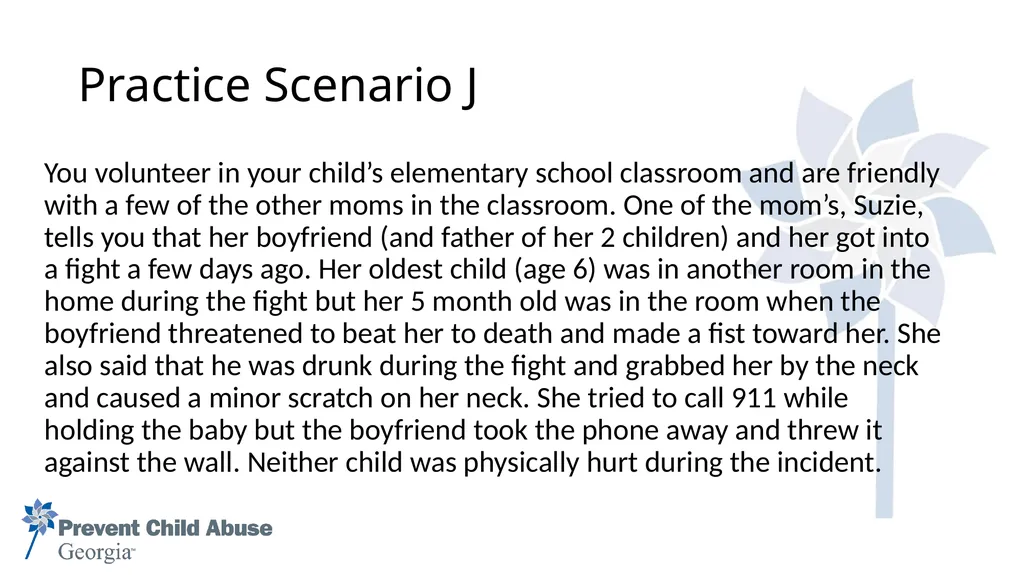
Practice Scenario J You volunteer in your child’s elementary school classroom and are friendly with a few of the other moms in the classroom. One of the mom’s, Suzie, tells you that her boyfriend (and father of her 2 children) and her got into a fight a few days ago. Her oldest child (age 6) was in another room in the home during the fight but her 5 month old was in the room when the boyfriend threatened to beat her to death and made a fist toward her. She also said that he was drunk during the fight and grabbed her by the neck and caused a minor scratch on her neck. She tried to call 911 while holding the baby but the boyfriend took the phone away and threw it against the wall. Neither child was physically hurt during the incident.<br>
67
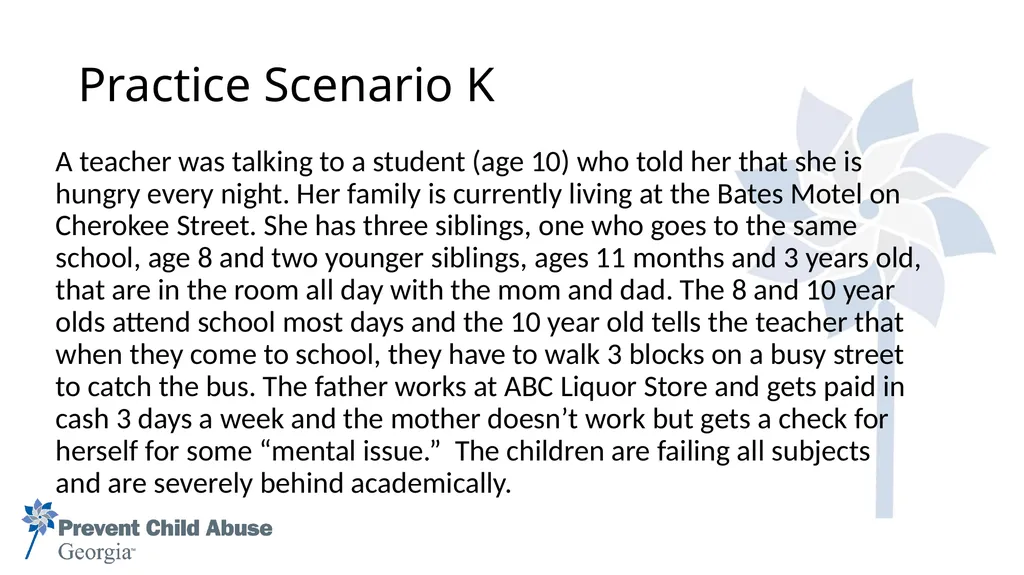
Practice Scenario K A teacher was talking to a student (age 10) who told her that she is hungry every night. Her family is currently living at the Bates Motel on Cherokee Street. She has three siblings, one who goes to the same school, age 8 and two younger siblings, ages 11 months and 3 years old, that are in the room all day with the mom and dad. The 8 and 10 year olds attend school most days and the 10 year old tells the teacher that when they come to school, they have to walk 3 blocks on a busy street to catch the bus. The father works at ABC Liquor Store and gets paid in cash 3 days a week and the mother doesn’t work but gets a check for herself for some “mental issue.” The children are failing all subjects and are severely behind academically.<br>
68
Please fill out the training evaluation by visiting the link below https://tinyurl.com/EvalMR<br>
69
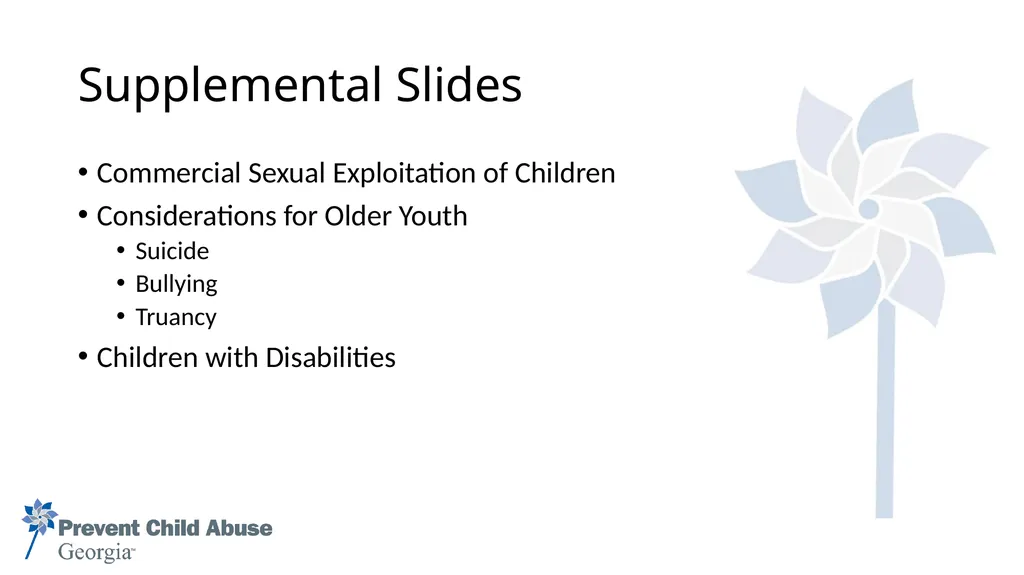
Supplemental Slides Commercial Sexual Exploitation of Children
Considerations for Older Youth
Suicide
Bullying
Truancy
Children with Disabilities<br>
Considerations for Older Youth
Suicide
Bullying
Truancy
Children with Disabilities<br>
70
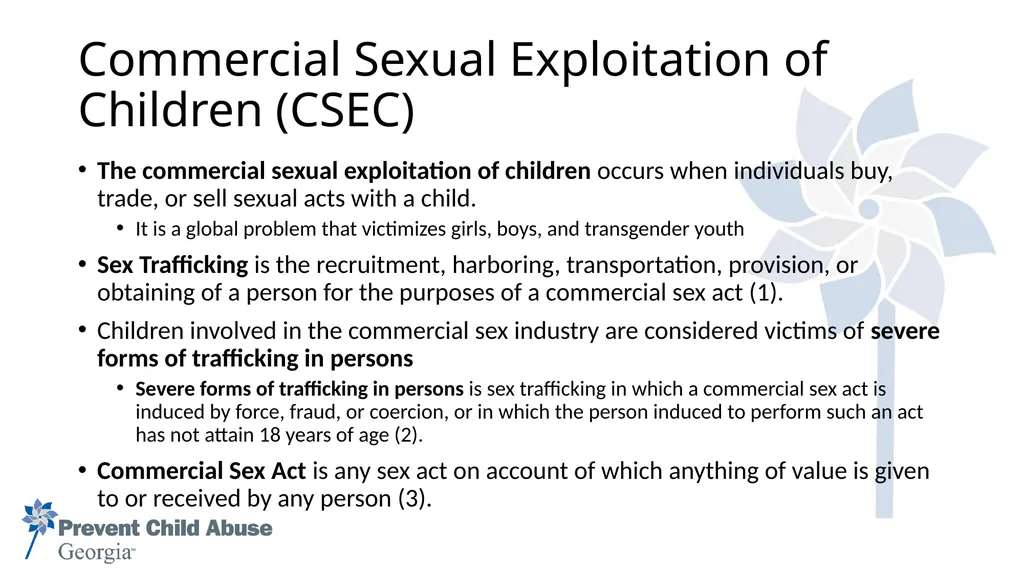
Commercial Sexual Exploitation of Children (CSEC) The commercial sexual exploitation of children occurs when individuals buy, trade, or sell sexual acts with a child.
It is a global problem that victimizes girls, boys, and transgender youth
Sex Trafficking is the recruitment, harboring, transportation, provision, or obtaining of a person for the purposes of a commercial sex act (1).
Children involved in the commercial sex industry are considered victims of severe forms of trafficking in persons
Severe forms of trafficking in persons is sex trafficking in which a commercial sex act is induced by force, fraud, or coercion, or in which the person induced to perform such an act has not attain 18 years of age (2).
Commercial Sex Act is any sex act on account of which anything of value is given to or received by any person (3).<br>
71
Characteristics of Youth at Risk of CSEC Runaways
Neglected youth
Youth who have been sexually or physically abused
Youth living in shelters
Youth living on the streets
Youth with low self-esteem
Youth living in volatile homes
See resource “Governor’s Office for Children and Families: Georgia’s Sex Trade Problem”<br>
Neglected youth
Youth who have been sexually or physically abused
Youth living in shelters
Youth living on the streets
Youth with low self-esteem
Youth living in volatile homes
See resource “Governor’s Office for Children and Families: Georgia’s Sex Trade Problem”<br>
72
Potential Indicators of Trafficking and Exploitation History of emotional, sexual, or other physical abuse
Signs of current physical abuse and/or sexually transmitted diseases
History of running away or current status as a runaway
Inexplicable appearance of expensive gifts, clothing, or other costly items
Presence of an older boy-/girlfriend
Drug addiction
Withdrawal or lack of interest in previous activities
Gang Involvement
See CSEC Fact Sheet for more information<br>
73
Considerations in Older Youth Suicide
Risk factors
Depression, substance abuse, isolation, mental disorders, access to lethal means, self injury, bullying, minority sexual orientation or gender identity
Immediate signs- call 911 and Suicide Hotline 1-800-273-TALK (8255)
Talking about wanting to die or kill oneself
Looking for a way to kill oneself, searching online, obtaining a gun
Talking about feeling hopeless or having no reason to live
Protective factors
Strong self-esteem
Supportive family/ emotional support
Safe schools
Getting counseling if needed
Recommended
Keep firearms and prescription drugs locked up<br>
74
Considerations in Older Youth Bullying
Risk Factors: disabled, in foster care, perceived as ‘different’, perceived as weak
Several Forms of Bullying:
Physical: kicking, hitting spitting, pushing, etc.
Verbal: taunting, malicious teasing, threats, etc.
Psychological: spreading rumors, manipulation, intimidation
Sexual: unwanted physical contact, abusive comments about physical development
Cyber bullying
Texting
Computers and hand held devices
Video games
sexting<br>
75
Truancy Truant – any child subject to compulsory attendance who during the school calendar year has more than five days of unexcused absences.
Exceptions:
Illness
Suspension
Family Death
Observation of religious holidays
Registering to vote or voting in a public election
Visiting a parent or guardian in the Armed Forces who is deployed(O.C.G.A. § 20-2-692.1)
Foster child who must appear in court (O.C.G.A. § 20-2-692.2) Additional questions: policy@doe.k12.ga.us<br>
76
Truancy Georgia state law requires communities and schools to work together through the recommendations of their local Student Attendance Protocol Committee. The polices of the Department of Education offers several resources that discuss truancy including the state attendance rule on its website.
Visit the Truancy Intervention Project to find additional resources to help families struggling to adequately get their children to school.<br>
Visit the Truancy Intervention Project to find additional resources to help families struggling to adequately get their children to school.<br>
77
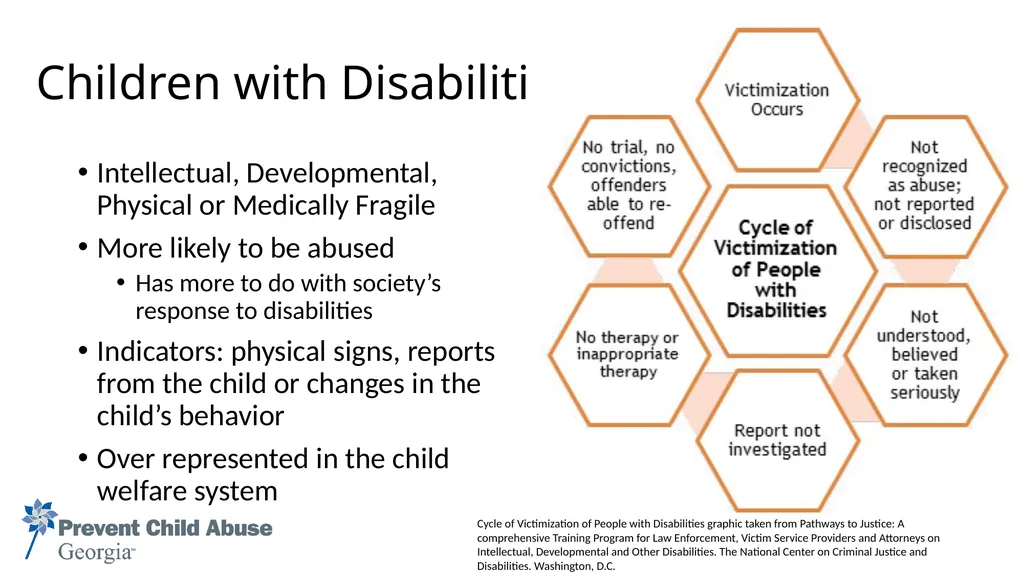
Children with Disabilities Intellectual, Developmental, Physical or Medically Fragile
More likely to be abused
Has more to do with society’s response to disabilities
Indicators: physical signs, reports from the child or changes in the child’s behavior
Over represented in the child welfare system Cycle of Victimization of People with Disabilities graphic taken from Pathways to Justice: A comprehensive Training Program for Law Enforcement, Victim Service Providers and Attorneys on Intellectual, Developmental and Other Disabilities. The National Center on Criminal Justice and Disabilities. Washington, D.C.<br>
78
Contact Name
Title
Email
Phone Number<br>
Title
Phone Number<br>