
PLPT 609 Title: Inter-Relationships Between
SN
Published · 20 slides · 0 views
1 / 1
Description
PLPT 609 Title: Inter-Relationships Between Insects and Plants Credit hours 3 (21) Instructor: Prof. Abdulrahman Saad Aldawood Department of Plant Protection, college of Food and Agriculture Sciences, King Saud University, Riyadh, Saudi
Related Topics
Share
Embed code
Download this presentation From Below
"PLPT 609 Title: Inter-Relationships Between" is the property of its rightful owner. Permission is granted to download and print the materials on this website for personal, non-commercial use only, and to display it on your personal computer provided you do not modify the materials and that you retain all copyright notices contained in the materials. By downloading content from our website, you accept the terms of this agreement.
Presentation Transcript
01
PLPT 609
Title: Inter-Relationships Between Insects and Plants
Credit hours= 3 (2+1)
Instructor: Prof. Abdulrahman Saad Aldawood
Department of Plant Protection, college of Food and Agriculture Sciences, King Saud University, Riyadh, Saudi Arabia 1<br>
Credit hours= 3 (2+1)
Instructor: Prof. Abdulrahman Saad Aldawood
Department of Plant Protection, college of Food and Agriculture Sciences, King Saud University, Riyadh, Saudi Arabia 1<br>
02
Contents
Allelochemicals interactions among plants
Herbivores and their predators
Allelochemicals reflecting interactions between plants and pests
Role of plant allelochemicals in the survival strategy of herbivores
Rare plant-insect relationships
Plant stress and Insect interactions 2<br>
Allelochemicals interactions among plants
Herbivores and their predators
Allelochemicals reflecting interactions between plants and pests
Role of plant allelochemicals in the survival strategy of herbivores
Rare plant-insect relationships
Plant stress and Insect interactions 2<br>
03
Many organisms share a close relationship built over millions of years of evolutionary history.
Some plants and insects have grown special structures to feed or house their helpful friends.
In most of the cases Rare plant-insect relationship is mutualistic in nature. 3 What are primary metabolic processes, primary metabolites, and their functions in plant? Rare plant-insect relationships<br>
Some plants and insects have grown special structures to feed or house their helpful friends.
In most of the cases Rare plant-insect relationship is mutualistic in nature. 3 What are primary metabolic processes, primary metabolites, and their functions in plant? Rare plant-insect relationships<br>
04
Symbioses, is the close association of two species living permanently together.
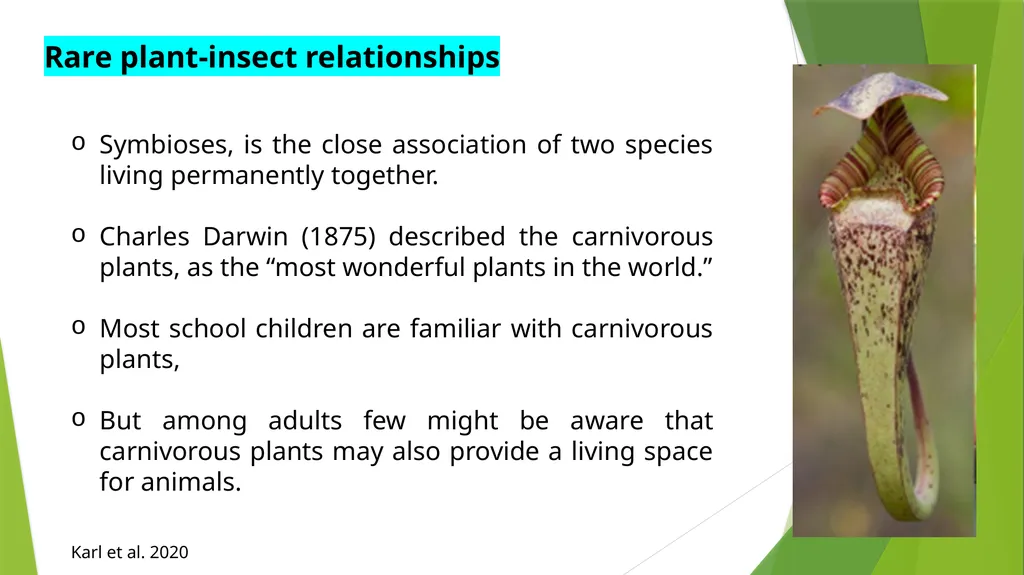
Charles Darwin (1875) described the carnivorous plants, as the “most wonderful plants in the world.”
Most school children are familiar with carnivorous plants,
But among adults few might be aware that carnivorous plants may also provide a living space for animals. 4 Rare plant-insect relationships Karl et al. 2020<br>
Charles Darwin (1875) described the carnivorous plants, as the “most wonderful plants in the world.”
Most school children are familiar with carnivorous plants,
But among adults few might be aware that carnivorous plants may also provide a living space for animals. 4 Rare plant-insect relationships Karl et al. 2020<br>
05
The pools of digestive liquid inside the pitcher traps provide an aquatic habitat for a surprisingly diverse range of specialist species from microbes to insect larvae and even tadpoles.
Misumenops nepenthicola is a pitcher-dwelling crab spider which responds to disturbance by dropping into the digestive liquid and hiding among the debris in the bottom of the pitcher. 5 What happens inside the trap? Read the biology and behavior of pitcher-dwelling crab spider in detail at https://doi.org/10.1002/ppp3.10104 Rare plant-insect relationships Karl et al. 2020<br>
Misumenops nepenthicola is a pitcher-dwelling crab spider which responds to disturbance by dropping into the digestive liquid and hiding among the debris in the bottom of the pitcher. 5 What happens inside the trap? Read the biology and behavior of pitcher-dwelling crab spider in detail at https://doi.org/10.1002/ppp3.10104 Rare plant-insect relationships Karl et al. 2020<br>
06
Plant-insect mutualistic relationships are fundamentally of two basic types: protection and pollination. 6 Rare plant-insect relationships González-Teuber et al. 2015<br>
07
Protection
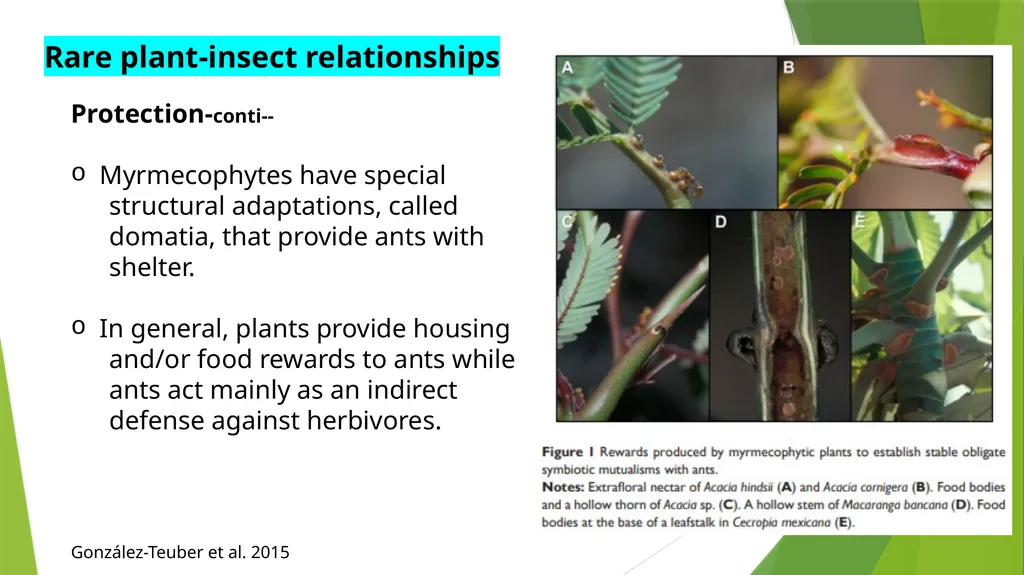
Ant–plant interactions are classic examples of defensive mutualisms and have served as model systems to study the ecology and evolution of mutualisms.
Ant–plant mutualisms range in specificity from myrmecophilic (ant-loving) plants, which attract free-living ants to obtain defense against herbivores.
Obligate myrmecophytes (ants– plants), which provide specialized structures such as shelter and, in most cases, food rewards such as extrafloral nectar (EFN) and food bodies (FBs) to specialized ants. 7 González-Teuber et al. 2015 Rare plant-insect relationships<br>
Ant–plant interactions are classic examples of defensive mutualisms and have served as model systems to study the ecology and evolution of mutualisms.
Ant–plant mutualisms range in specificity from myrmecophilic (ant-loving) plants, which attract free-living ants to obtain defense against herbivores.
Obligate myrmecophytes (ants– plants), which provide specialized structures such as shelter and, in most cases, food rewards such as extrafloral nectar (EFN) and food bodies (FBs) to specialized ants. 7 González-Teuber et al. 2015 Rare plant-insect relationships<br>
08
Protection-conti--
Myrmecophytes have special
structural adaptations, called
domatia, that provide ants with
shelter.
In general, plants provide housing
and/or food rewards to ants while
ants act mainly as an indirect
defense against herbivores. 8 González-Teuber et al. 2015 Rare plant-insect relationships<br>
Myrmecophytes have special
structural adaptations, called
domatia, that provide ants with
shelter.
In general, plants provide housing
and/or food rewards to ants while
ants act mainly as an indirect
defense against herbivores. 8 González-Teuber et al. 2015 Rare plant-insect relationships<br>
09
Protection-conti--
Rewards provided by myrmecophytic plants.
Extrafloral nectaries: Secretory tissues generally located on vegetative tissues and are not involved in pollination. Nectar secreted is a mixture of compounds usually dominated by sugars and amino acids.
Food bodies: Cellular structures that serve as rewards for ants, and are rich in lipids and proteins.
Domatia: Plant structures that serve as nesting space for ants. All ant–myrmecophyte symbiotic associations have one thing in common, that is plants provide domatia, such as hollow thorns, petioles, stems, or modified leaves to their inhabitant ants. 9 González-Teuber et al. 2015 Rare plant-insect relationships<br>
Rewards provided by myrmecophytic plants.
Extrafloral nectaries: Secretory tissues generally located on vegetative tissues and are not involved in pollination. Nectar secreted is a mixture of compounds usually dominated by sugars and amino acids.
Food bodies: Cellular structures that serve as rewards for ants, and are rich in lipids and proteins.
Domatia: Plant structures that serve as nesting space for ants. All ant–myrmecophyte symbiotic associations have one thing in common, that is plants provide domatia, such as hollow thorns, petioles, stems, or modified leaves to their inhabitant ants. 9 González-Teuber et al. 2015 Rare plant-insect relationships<br>
10
Pollination
Plants have also developed mutualistic relationships with animals to help them successfully pollinate.
This mutualism (pollination by insects) is hypothesized to be one of the driving forces in the evolution of angiosperms.
There are two main ways plants pollinate: wind pollination and animal pollination.
The vast majority of plants are pollinated by insects. 10 Grimaldi, 1999 What could be the downside of wind pollination? Rare plant-insect relationships<br>
Plants have also developed mutualistic relationships with animals to help them successfully pollinate.
This mutualism (pollination by insects) is hypothesized to be one of the driving forces in the evolution of angiosperms.
There are two main ways plants pollinate: wind pollination and animal pollination.
The vast majority of plants are pollinated by insects. 10 Grimaldi, 1999 What could be the downside of wind pollination? Rare plant-insect relationships<br>
11
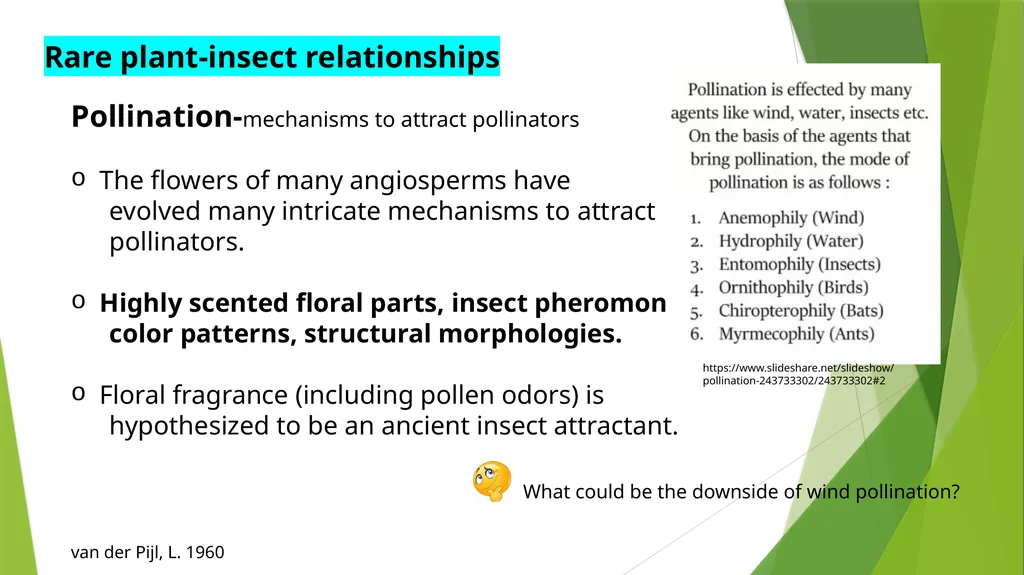
Pollination-mechanisms to attract pollinators
The flowers of many angiosperms have
evolved many intricate mechanisms to attract
pollinators.
Highly scented floral parts, insect pheromones,
color patterns, structural morphologies.
Floral fragrance (including pollen odors) is
hypothesized to be an ancient insect attractant. 11 van der Pijl, L. 1960 What could be the downside of wind pollination? https://www.slideshare.net/slideshow/pollination-243733302/243733302#2 Rare plant-insect relationships<br>
The flowers of many angiosperms have
evolved many intricate mechanisms to attract
pollinators.
Highly scented floral parts, insect pheromones,
color patterns, structural morphologies.
Floral fragrance (including pollen odors) is
hypothesized to be an ancient insect attractant. 11 van der Pijl, L. 1960 What could be the downside of wind pollination? https://www.slideshare.net/slideshow/pollination-243733302/243733302#2 Rare plant-insect relationships<br>
12
Groups of pollinators breeding on flowers
Group 1. Ovule parasites.
Pollination by ovule parasites has been recorded in few plants.
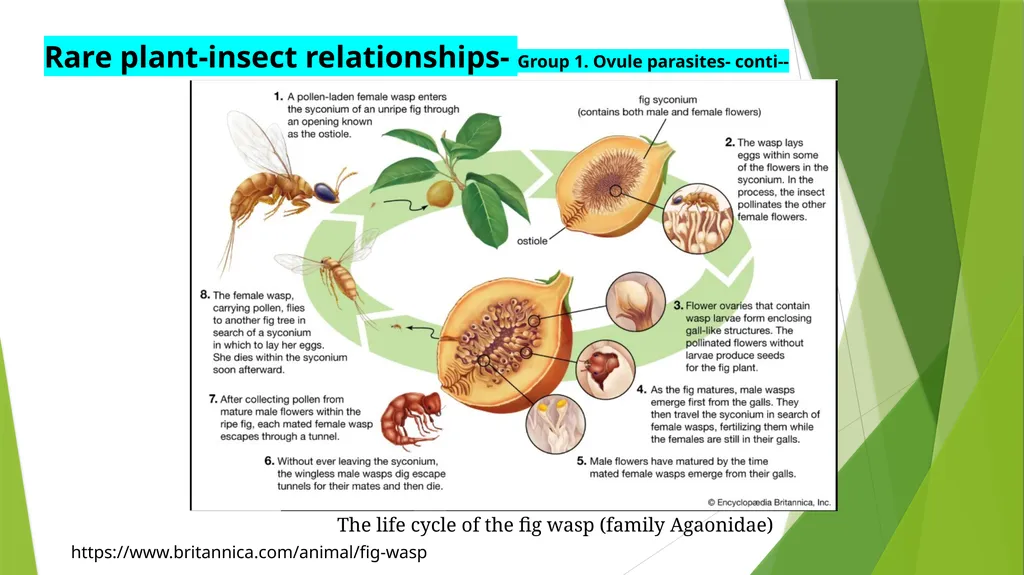
Figs (Ficus, Moraceae) pollinated by fig wasps (Agaonidae, Hymenoptera).
The pollinators enter into the fig by a tight ostiole. Once inside the fig, wasps pollinate the flowers and lay eggs inside the fig ovules
Pollinators actively deposit pollen grains on stigmas to assure pollination (active pollination), because development of their larvae depends upon the growth of ovules after pollination to insure food for the larvae. 12 Rare plant-insect relationships Sakai 2002; Kjellberg et al., 2005<br>
Group 1. Ovule parasites.
Pollination by ovule parasites has been recorded in few plants.
Figs (Ficus, Moraceae) pollinated by fig wasps (Agaonidae, Hymenoptera).
The pollinators enter into the fig by a tight ostiole. Once inside the fig, wasps pollinate the flowers and lay eggs inside the fig ovules
Pollinators actively deposit pollen grains on stigmas to assure pollination (active pollination), because development of their larvae depends upon the growth of ovules after pollination to insure food for the larvae. 12 Rare plant-insect relationships Sakai 2002; Kjellberg et al., 2005<br>
13
13 Rare plant-insect relationships- Group 1. Ovule parasites- conti-- https://www.britannica.com/animal/fig-wasp The life cycle of the fig wasp (family Agaonidae)<br>
14
Groups of pollinators breeding on flowers
Group II. Pollen parasites.
In this group, the larvae of pollinators feed on pollen grains of fresh flowers attached to the plant, e.g thrips (Thysanoptera).
An outstanding characteristic of thrips are:
High rate of reproduction (egg to adult period is 1–2weeks), as a result, large numbers of individuals are produced and can function as pollinators
and small body (1–2 mm in length), the number and size of pollen grains they carry tend to be small in comparison to other pollinators. 14 Rare plant-insect relationships Sakai 2002 Please explore which plants are pollinated primarily by thrips?<br>
Group II. Pollen parasites.
In this group, the larvae of pollinators feed on pollen grains of fresh flowers attached to the plant, e.g thrips (Thysanoptera).
An outstanding characteristic of thrips are:
High rate of reproduction (egg to adult period is 1–2weeks), as a result, large numbers of individuals are produced and can function as pollinators
and small body (1–2 mm in length), the number and size of pollen grains they carry tend to be small in comparison to other pollinators. 14 Rare plant-insect relationships Sakai 2002 Please explore which plants are pollinated primarily by thrips?<br>
15
Groups of pollinators breeding on flowers
Group III. Postpollination larval development in decomposing flowers and inflorescences.
In this group, pollinator larvae grow on floral parts or inflorescences (postpollination) that no longer play a role in attracting pollinators.
In most cases, the flowers and inflorescences have abscissed (abscissed=shed of, cut of, or fell down) from the plant body, and the larvae grow on the decomposing plant material on the forest floor.
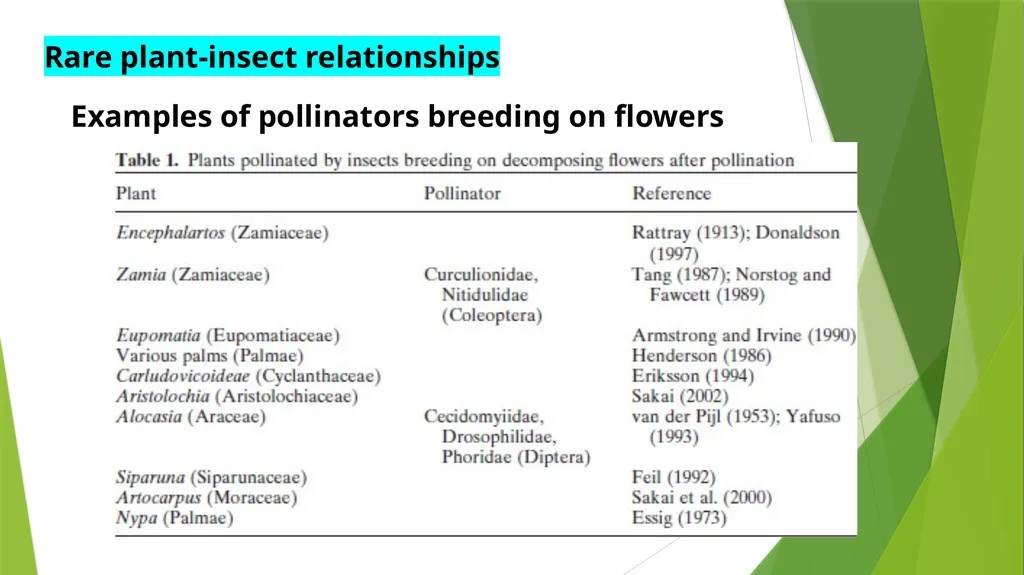
In this group, the pollinators are beetles (Curculionidae and Nitidulidae) and flies (Cecidomyiidae, Drosophilidae and Phoridae). 15 Rare plant-insect relationships Sakai 2002<br>
Group III. Postpollination larval development in decomposing flowers and inflorescences.
In this group, pollinator larvae grow on floral parts or inflorescences (postpollination) that no longer play a role in attracting pollinators.
In most cases, the flowers and inflorescences have abscissed (abscissed=shed of, cut of, or fell down) from the plant body, and the larvae grow on the decomposing plant material on the forest floor.
In this group, the pollinators are beetles (Curculionidae and Nitidulidae) and flies (Cecidomyiidae, Drosophilidae and Phoridae). 15 Rare plant-insect relationships Sakai 2002<br>
16
Examples of pollinators breeding on flowers 16 Rare plant-insect relationships<br>
17
Insect–plant interactions are classic examples of defensive mutualisms and have served as model systems to study the ecology and evolution of mutualisms.
Carnivorous plants may also provide a living space for animals.
Plants provide housing and/or food rewards to insects while insects act mainly as an indirect defense against herbivores
The mutualism (pollination by insects) is hypothesized to be one of the driving forces in the evolution of angiosperms. 17 Conclusion<br>
Carnivorous plants may also provide a living space for animals.
Plants provide housing and/or food rewards to insects while insects act mainly as an indirect defense against herbivores
The mutualism (pollination by insects) is hypothesized to be one of the driving forces in the evolution of angiosperms. 17 Conclusion<br>
18
González-Teuber, M., & Heil, M. (2015). Comparative anatomy and physiology of myrmecophytes: ecological and evolutionary perspectives. Research and Reports in Biodiversity Studies, 21-32.
Grimaldi, D. (1999). The co-radiations of pollinating insects and angiosperms in the Cretaceous. Annals of the Missouri Botanical Garden, 373-406.
van der Pijl, L. (1960). Ecological aspects of flower evolution. I. Phyletic evolution. Evolution, 403-416.
Kjellberg, F., Bronstein, J. L., van Ginkel, G., Greeff, J. M., Moore, J. C., Bossu-Dupriez, N., ... & Michaloud, G. (2005). Clutch size: a major sex ratio determinant in fig pollinating wasps?. Comptes rendus. Biologies, 328(5), 471-476.
Sakai, S. (2002). A review of brood-site pollination mutualism: plants providing breeding sites for their pollinators. Journal of Plant Research, 115, 0161-0168.
The Editors of Encyclopaedia Britannica. "fig wasp". Encyclopedia Britannica, 15 Nov. 2024, https://www.britannica.com/animal/fig-wasp. Accessed 9 March 2025. 18 References<br>
Grimaldi, D. (1999). The co-radiations of pollinating insects and angiosperms in the Cretaceous. Annals of the Missouri Botanical Garden, 373-406.
van der Pijl, L. (1960). Ecological aspects of flower evolution. I. Phyletic evolution. Evolution, 403-416.
Kjellberg, F., Bronstein, J. L., van Ginkel, G., Greeff, J. M., Moore, J. C., Bossu-Dupriez, N., ... & Michaloud, G. (2005). Clutch size: a major sex ratio determinant in fig pollinating wasps?. Comptes rendus. Biologies, 328(5), 471-476.
Sakai, S. (2002). A review of brood-site pollination mutualism: plants providing breeding sites for their pollinators. Journal of Plant Research, 115, 0161-0168.
The Editors of Encyclopaedia Britannica. "fig wasp". Encyclopedia Britannica, 15 Nov. 2024, https://www.britannica.com/animal/fig-wasp. Accessed 9 March 2025. 18 References<br>
19
Ritsuo Nishida 2002. SEQUESTRATION OF DEFENSIVE SUBSTANCES FROM PLANTS BY LEPIDOPTERA. Annu. Rev. Entomol. 2002. 47:57–92
Rattray G (1913) Notes on the pollination of some African cycads. Trans R Soc S Africa 3:259–270.
Donaldson JS (1997) Is there a floral parasite mutualism in cycad pollination? The pollination biology of Encephalartos villosus (Zamiaceae). Am J Bot 84:1398–1406.
Tang W (1987) Insect pollination in the cycad Zamia pumila (Zamiaceae). Am J Bot 74:90–99.
Norstog K, Fawcett PKS (1989) Insect-cycad symbiosis and its relation to the pollination of Zamia furfuracea (Zamiaceae) by Rhopalotria mollis (Curculionidae). Amer J Bot 76:1380–1394.
Armstrong JE, Irving HK (1990) Functions of staminodia in the beetlepollinated flowers of Eupomatia laurina. Biotropica 22:429–431.
Henderson A (1986) A review of pollination studies in the Palmae. Bot Rev 52:221–259.
Eriksson R (1994) The remarkable weevil pollination of the Neotropical Carludovicoideae (Cyclanthaceae). Plant Syst Evol 189:75–81.
Yafuso M (1993) Thermogenisis of Alocasia odora (Araceae) and the role of Colocasiomyia flies (Diptera: Drosophilidae) as cross-pollinators. Pop Ecol 22:601–606. 19 References-conti--<br>
Rattray G (1913) Notes on the pollination of some African cycads. Trans R Soc S Africa 3:259–270.
Donaldson JS (1997) Is there a floral parasite mutualism in cycad pollination? The pollination biology of Encephalartos villosus (Zamiaceae). Am J Bot 84:1398–1406.
Tang W (1987) Insect pollination in the cycad Zamia pumila (Zamiaceae). Am J Bot 74:90–99.
Norstog K, Fawcett PKS (1989) Insect-cycad symbiosis and its relation to the pollination of Zamia furfuracea (Zamiaceae) by Rhopalotria mollis (Curculionidae). Amer J Bot 76:1380–1394.
Armstrong JE, Irving HK (1990) Functions of staminodia in the beetlepollinated flowers of Eupomatia laurina. Biotropica 22:429–431.
Henderson A (1986) A review of pollination studies in the Palmae. Bot Rev 52:221–259.
Eriksson R (1994) The remarkable weevil pollination of the Neotropical Carludovicoideae (Cyclanthaceae). Plant Syst Evol 189:75–81.
Yafuso M (1993) Thermogenisis of Alocasia odora (Araceae) and the role of Colocasiomyia flies (Diptera: Drosophilidae) as cross-pollinators. Pop Ecol 22:601–606. 19 References-conti--<br>
20
Feil JP (1992) Reproductive ecology of dioecious Siparuna (Monimiaceae) in Ecuador: a case of gall midge pollination. Biol J Linn Soc 110:171–203.
Sakai S, Kato M, Nagamasu H (2000) Artocarpus (Moraceae)–gall midge pollination mutualism mediated by a male-flower parasitic fungus. Am J Bot 87:440–445.
Essig FB (1973) Pollination in some New Guinea palms. Principes 17:75–83. 20 References-conti--<br>
Sakai S, Kato M, Nagamasu H (2000) Artocarpus (Moraceae)–gall midge pollination mutualism mediated by a male-flower parasitic fungus. Am J Bot 87:440–445.
Essig FB (1973) Pollination in some New Guinea palms. Principes 17:75–83. 20 References-conti--<br>