
PLPT 609 Title: Inter-Relationships Between
TF
Published · 19 slides · 0 views
1 / 1



Description
PLPT 609 Title: Inter-Relationships Between Insects and Plants Credit hours 3 (21) Instructor: Prof. Abdulrahman Saad Aldawood Department of Plant Protection, college of Food and Agriculture Sciences, King Saud University, Riyadh, Saudi
Related Topics
Share
Embed code
Download this presentation From Below
"PLPT 609 Title: Inter-Relationships Between" is the property of its rightful owner. Permission is granted to download and print the materials on this website for personal, non-commercial use only, and to display it on your personal computer provided you do not modify the materials and that you retain all copyright notices contained in the materials. By downloading content from our website, you accept the terms of this agreement.
Presentation Transcript
01
PLPT 609
Title: Inter-Relationships Between Insects and Plants
Credit hours= 3 (2+1)
Instructor: Prof. Abdulrahman Saad Aldawood
Department of Plant Protection, college of Food and Agriculture Sciences, King Saud University, Riyadh, Saudi Arabia 1<br>
Credit hours= 3 (2+1)
Instructor: Prof. Abdulrahman Saad Aldawood
Department of Plant Protection, college of Food and Agriculture Sciences, King Saud University, Riyadh, Saudi Arabia 1<br>
02
Contents
Allelochemicals interactions among plants
Herbivores and their predators
Allelochemicals reflecting interactions between plants and pests
Role of plant allelochemicals in the survival strategy of herbivores
Rare plant-insect relationships
Plant stress and Insect interactions 2<br>
Allelochemicals interactions among plants
Herbivores and their predators
Allelochemicals reflecting interactions between plants and pests
Role of plant allelochemicals in the survival strategy of herbivores
Rare plant-insect relationships
Plant stress and Insect interactions 2<br>
03
Majority of insects are herbivores which depends on plants for their nutrients.
Allelochemicals have significant effects on insect–plant interactions.
Secondary metabolites, play important roles in many types of insect behaviors and can even regulate their growth and reproduction.
The abilities of insects to counteract the plants allow them to make use of certain phytochemicals as cues to locate and recognize suitable food or host plants.
Various attractants, stimulants, repellents, and deterrents are usually involved in this process. 3 Hori and Kainoh 2013 Allelochemicals reflecting interactions between plants and pests<br>
Allelochemicals have significant effects on insect–plant interactions.
Secondary metabolites, play important roles in many types of insect behaviors and can even regulate their growth and reproduction.
The abilities of insects to counteract the plants allow them to make use of certain phytochemicals as cues to locate and recognize suitable food or host plants.
Various attractants, stimulants, repellents, and deterrents are usually involved in this process. 3 Hori and Kainoh 2013 Allelochemicals reflecting interactions between plants and pests<br>
04
Phytochemicals Involved in Oviposition
Host selection by insects are influenced by the chemical constituents present in the plants.
Plant chemicals serve as oviposition stimulants or deterrents for many lepidopterans and other insects.
The North American black swallowtail butterfly, Papilio polyxenes, a specialist on members of carrot family (Apiaceae), lay eggs in response to a mixture of two chemotactile stimulants, luteolin 7-O-(600-O-malonyl)-b-D-glucoside and trans-chlorogenic acid, identified from one of its major host plants, Daucus carota (wild carrot). 4 Carter et al 1998 Allelochemicals reflecting interactions between plants and pests<br>
Host selection by insects are influenced by the chemical constituents present in the plants.
Plant chemicals serve as oviposition stimulants or deterrents for many lepidopterans and other insects.
The North American black swallowtail butterfly, Papilio polyxenes, a specialist on members of carrot family (Apiaceae), lay eggs in response to a mixture of two chemotactile stimulants, luteolin 7-O-(600-O-malonyl)-b-D-glucoside and trans-chlorogenic acid, identified from one of its major host plants, Daucus carota (wild carrot). 4 Carter et al 1998 Allelochemicals reflecting interactions between plants and pests<br>
05
Phytochemicals Involved in Oviposition-conti---
The diamondback moth, Plutella xylostella (Plutellidae), has previously been shown to lay eggs in response to diverse glucosinolates (sinigrin, etc.) present in crucifers, synergized by leaf epicuticular waxes.
More recently, 4-methoxyglucobrassicin (4-methoxy-indol-3-ylmethylglucosinolate), present in Arabidopsis thaliana, has been identified as a strong oviposition stimulant for the moth. 5 Sun et al., 2009 Allelochemicals reflecting interactions between plants and pests<br>
The diamondback moth, Plutella xylostella (Plutellidae), has previously been shown to lay eggs in response to diverse glucosinolates (sinigrin, etc.) present in crucifers, synergized by leaf epicuticular waxes.
More recently, 4-methoxyglucobrassicin (4-methoxy-indol-3-ylmethylglucosinolate), present in Arabidopsis thaliana, has been identified as a strong oviposition stimulant for the moth. 5 Sun et al., 2009 Allelochemicals reflecting interactions between plants and pests<br>
06
Phytochemicals Involved in Oviposition-conti---
The European corn borer, Ostrinia nubilalis (Crambidae), is a highly polyphagous moth, which attacks several major crops including maize, tomato, and cotton.
Each of the n-alkanes (C26–C29) and tritriacontane (C33) present in the leaf epicuticular wax of corn, Zea mays, was shown to be responsible for eliciting oviposition on the plant. 6 Udayagiri et al., 1997 Allelochemicals reflecting interactions between plants and pests Find more examples of allelochemicals which are involved in oviposition?<br>
The European corn borer, Ostrinia nubilalis (Crambidae), is a highly polyphagous moth, which attacks several major crops including maize, tomato, and cotton.
Each of the n-alkanes (C26–C29) and tritriacontane (C33) present in the leaf epicuticular wax of corn, Zea mays, was shown to be responsible for eliciting oviposition on the plant. 6 Udayagiri et al., 1997 Allelochemicals reflecting interactions between plants and pests Find more examples of allelochemicals which are involved in oviposition?<br>
07
Phytochemicals as Feeding Attractants and Stimulants
Many coleopteran beetles use host-plant volatiles for host location.
Strawberry leaf beetle, Galerucella vittaticollis (Crysomelidae),feeds on polygonaceous plant leaves and also on strawberry leaves, Fragaria ananassa (Rosaceae).
The main component of both polygonaceous plant and strawberry leaf volatiles is the compound, (Z)-3-hexenyl acetate. (Z)-3-Hexenyl acetate attracts G. vittaticollis at concentrations of 0.01–0.05%. 7 Hori et al., 2006 Allelochemicals reflecting interactions between plants and pests<br>
Many coleopteran beetles use host-plant volatiles for host location.
Strawberry leaf beetle, Galerucella vittaticollis (Crysomelidae),feeds on polygonaceous plant leaves and also on strawberry leaves, Fragaria ananassa (Rosaceae).
The main component of both polygonaceous plant and strawberry leaf volatiles is the compound, (Z)-3-hexenyl acetate. (Z)-3-Hexenyl acetate attracts G. vittaticollis at concentrations of 0.01–0.05%. 7 Hori et al., 2006 Allelochemicals reflecting interactions between plants and pests<br>
08
Phytochemicals as Feeding Attractants and Stimulants-conti---
The Japanese beetle, Popillia japonica (Scarabaeidae), is a polyphagous insect feeding on the fruit, flowers, or foliage of about 300 species of plants.
It is attracted to many naturally occurring plant volatiles, including
phenylacetonitrile, (Z)-3-hexenyl benzoate,
nerolidol, (Z)-3-hexenyl hexanoate,
(Z)-3-hexenyl 2-methylbutyrate, (þ)-limonene,
and (þ)-a-pinene, 8 Loughrin et al., 1998 Allelochemicals reflecting interactions between plants and pests<br>
The Japanese beetle, Popillia japonica (Scarabaeidae), is a polyphagous insect feeding on the fruit, flowers, or foliage of about 300 species of plants.
It is attracted to many naturally occurring plant volatiles, including
phenylacetonitrile, (Z)-3-hexenyl benzoate,
nerolidol, (Z)-3-hexenyl hexanoate,
(Z)-3-hexenyl 2-methylbutyrate, (þ)-limonene,
and (þ)-a-pinene, 8 Loughrin et al., 1998 Allelochemicals reflecting interactions between plants and pests<br>
09
Phytochemicals as Feeding Attractants and Stimulants-conti---
The strawberry sap beetle, Stelidota geminata
(Nitidulidae), is also a pest of berries.
Both adults and larvae feed on ripe and overripe
fruits of strawberry, blueberry, raspberry, cherry,
peach, melon, etc.
Strawberry headspace contained sixteen ester
compounds which evoke antennal responses in
adult female beetles.
The beetles are strongly attracted to strawberry odor. 9 Loughrin et al., 1998 Allelochemicals reflecting interactions between plants and pests Sixteen ester compounds
ethyl acetate, ethyl propionate, propyl acetate, methyl butyrate, ethyl isobutyrate, 2-methyl propyl acetate, methyl isovalerate, ethyl butyrate, butyl acetate, ethyl 2 methylbutyrate, ethyl isovalerate, isoamyl acetate, 2-methylbutyl acetate, propyl butyrate, butyl propionate and hexyl butyrate<br>
The strawberry sap beetle, Stelidota geminata
(Nitidulidae), is also a pest of berries.
Both adults and larvae feed on ripe and overripe
fruits of strawberry, blueberry, raspberry, cherry,
peach, melon, etc.
Strawberry headspace contained sixteen ester
compounds which evoke antennal responses in
adult female beetles.
The beetles are strongly attracted to strawberry odor. 9 Loughrin et al., 1998 Allelochemicals reflecting interactions between plants and pests Sixteen ester compounds
ethyl acetate, ethyl propionate, propyl acetate, methyl butyrate, ethyl isobutyrate, 2-methyl propyl acetate, methyl isovalerate, ethyl butyrate, butyl acetate, ethyl 2 methylbutyrate, ethyl isovalerate, isoamyl acetate, 2-methylbutyl acetate, propyl butyrate, butyl propionate and hexyl butyrate<br>
10
Phytochemicals as Feeding Attractants and Stimulants-conti---
Plant volatiles also act synergistically with aggregation pheromones.
Aggregation of the American palm weevil, Rhynchophorus palmarum (Curculionidae), on host plants is mediated by host-plant volatiles and a male pheromone (rhynchophorol).
Acetoin, one of the major volatile components of the host plants Cocos nucifera (Arecaceae), Saccharum officinarum (Poaceae), Jacaratia spp. (Caricaceae), and Elaeis spp. (Arecaceae), plays an important role in the aggregation of weevils on these plants. 10 Saïd et al., 2005 Allelochemicals reflecting interactions between plants and pests Find more examples of allelochemicals which act as a feeding attractants ?<br>
Plant volatiles also act synergistically with aggregation pheromones.
Aggregation of the American palm weevil, Rhynchophorus palmarum (Curculionidae), on host plants is mediated by host-plant volatiles and a male pheromone (rhynchophorol).
Acetoin, one of the major volatile components of the host plants Cocos nucifera (Arecaceae), Saccharum officinarum (Poaceae), Jacaratia spp. (Caricaceae), and Elaeis spp. (Arecaceae), plays an important role in the aggregation of weevils on these plants. 10 Saïd et al., 2005 Allelochemicals reflecting interactions between plants and pests Find more examples of allelochemicals which act as a feeding attractants ?<br>
11
Phytochemicals as Feeding Attractants and Stimulants-conti---
Floral Volatiles
Many species of insects visit flowers to acquire nutrition and coincidentally contribute to pollination.
The scents, as well as the colors, of flowers serve as primary cues for mediating the long-range attraction of insects.
More than 1700 compounds from around 1000 plant species have been identified as floral volatiles.
Honeybees, butterflies, and moths preferentially respond to linalool, benzaldehyde, and/or phenylacetaldehyde contained in the floral scents of various plants. 11 Wright et al., 2005; Knudsen et al., 2006; Raguso et al., 2006 Allelochemicals reflecting interactions between plants and pests Find more examples of floral scents which act as a feeding attractants ?<br>
Floral Volatiles
Many species of insects visit flowers to acquire nutrition and coincidentally contribute to pollination.
The scents, as well as the colors, of flowers serve as primary cues for mediating the long-range attraction of insects.
More than 1700 compounds from around 1000 plant species have been identified as floral volatiles.
Honeybees, butterflies, and moths preferentially respond to linalool, benzaldehyde, and/or phenylacetaldehyde contained in the floral scents of various plants. 11 Wright et al., 2005; Knudsen et al., 2006; Raguso et al., 2006 Allelochemicals reflecting interactions between plants and pests Find more examples of floral scents which act as a feeding attractants ?<br>
12
Phytochemicals role as Insect-Plant Interface in Multitrophic Interactions
As a response to feeding damage by insect herbivores plants emit various volatiles called herbivore-induced plant volatiles (HIPVs).
Natural enemies of these herbivores, (parasitoids and predators), use these HIPVs to locate the plant on which the hosts or prey are feeding.
Release of HIPVs occurs a few hours after the initial damage and is not limited to the feeding site but can systemically occur from the whole plant, so even undamaged leaves of a damaged plant release volatiles.
In this way, plants indirectly attract natural enemies to defend themselves. 12 Turlings et al., 1992; Hilker & Meiners, 2006 Allelochemicals reflecting interactions between plants and pests Find more examples of allelochemicals which act as a feeding attractants ?<br>
As a response to feeding damage by insect herbivores plants emit various volatiles called herbivore-induced plant volatiles (HIPVs).
Natural enemies of these herbivores, (parasitoids and predators), use these HIPVs to locate the plant on which the hosts or prey are feeding.
Release of HIPVs occurs a few hours after the initial damage and is not limited to the feeding site but can systemically occur from the whole plant, so even undamaged leaves of a damaged plant release volatiles.
In this way, plants indirectly attract natural enemies to defend themselves. 12 Turlings et al., 1992; Hilker & Meiners, 2006 Allelochemicals reflecting interactions between plants and pests Find more examples of allelochemicals which act as a feeding attractants ?<br>
13
HIPVs role as Insect-Plant Interface in Multitrophic Interactions-Conti---
Predators
Few studies have been reported on the attraction of predators to prey-infested plants.
The predatory mite Phytoseiulus persimilis was first reported to be attracted to volatiles from lima bean leaves infested with the two-spotted spider mite Tetranychus urticae.
Those prey-induced volatiles were identified as linalool, methyl salicylate (53), (E)-ß-ocimene and DMNT, all were attractive to P. persimilis. 13 Sabelis et al., 1983; Dicke et al., 1990 Allelochemicals reflecting interactions between plants and pests Find more examples of HIPVs which attracts predators?<br>
Predators
Few studies have been reported on the attraction of predators to prey-infested plants.
The predatory mite Phytoseiulus persimilis was first reported to be attracted to volatiles from lima bean leaves infested with the two-spotted spider mite Tetranychus urticae.
Those prey-induced volatiles were identified as linalool, methyl salicylate (53), (E)-ß-ocimene and DMNT, all were attractive to P. persimilis. 13 Sabelis et al., 1983; Dicke et al., 1990 Allelochemicals reflecting interactions between plants and pests Find more examples of HIPVs which attracts predators?<br>
14
HIPVs role as Insect-Plant Interface in Multitrophic Interactions-Conti---
Parasitic Wasps
A number of hymenopteran parasitoids are attracted to herbivore-infested plants that emit HIPVs.
Cotesia marginiventris (Hymenoptera: Braconidae) is responsive to HIPVs from corn seedlings damaged by Spodoptera exigua.
Cotesia kariyai, braconid parasitoid of the common armyworm Mythimna separata (Lepidoptera: Noctuidae). The female wasp uses chemical cues from the host and host-plant complex to find their hosts. 14 Turlings et al., 1990; Takabayashi et al., 1995 Allelochemicals reflecting interactions between plants and pests Find more examples of HIPVs which attracts parasitic wasps?<br>
Parasitic Wasps
A number of hymenopteran parasitoids are attracted to herbivore-infested plants that emit HIPVs.
Cotesia marginiventris (Hymenoptera: Braconidae) is responsive to HIPVs from corn seedlings damaged by Spodoptera exigua.
Cotesia kariyai, braconid parasitoid of the common armyworm Mythimna separata (Lepidoptera: Noctuidae). The female wasp uses chemical cues from the host and host-plant complex to find their hosts. 14 Turlings et al., 1990; Takabayashi et al., 1995 Allelochemicals reflecting interactions between plants and pests Find more examples of HIPVs which attracts parasitic wasps?<br>
15
HIPVs role as Insect-Plant Interface in Multitrophic Interactions-Conti---
Parasitic Flies
The parasitic fly, Exorista japonica (Diptera: Tachinidae), is a gregarious and polyphagous parasitoid that attacks a number of lepidopteran pests, particularly noctuid larvae.
When corn plants infested with final instar larvae of common armyworm Mythimna separata, the plants release a blend of HIPVs.
The odors of HIPVs attract E. japonica females that lay eggs on last instar host larvae 15 Ichiki et al., 2011 Allelochemicals reflecting interactions between plants and pests Find more examples of HIPVs which attracts parasitic flies?<br>
Parasitic Flies
The parasitic fly, Exorista japonica (Diptera: Tachinidae), is a gregarious and polyphagous parasitoid that attacks a number of lepidopteran pests, particularly noctuid larvae.
When corn plants infested with final instar larvae of common armyworm Mythimna separata, the plants release a blend of HIPVs.
The odors of HIPVs attract E. japonica females that lay eggs on last instar host larvae 15 Ichiki et al., 2011 Allelochemicals reflecting interactions between plants and pests Find more examples of HIPVs which attracts parasitic flies?<br>
16
HIPVs role as Insect-Plant Interface in Multitrophic Interactions-Conti---
Elicitors
Elicitors are compounds stimulating any type of plant defense.
Feeding by herbivorous insects results in mechanical damage and adhesion of regurgitant to the wounded leaves, which cause the emission of HIPVs from the plant.
The regurgitant contains an elicitor that induces plant defenses.
ß-glucosidase was isolated and identified as an elicitor from Pieris braccicae larvae that causes the release of volatiles from Brassica plants. 16 Mattiacci et al., 1995 Allelochemicals reflecting interactions between plants and pests<br>
Elicitors
Elicitors are compounds stimulating any type of plant defense.
Feeding by herbivorous insects results in mechanical damage and adhesion of regurgitant to the wounded leaves, which cause the emission of HIPVs from the plant.
The regurgitant contains an elicitor that induces plant defenses.
ß-glucosidase was isolated and identified as an elicitor from Pieris braccicae larvae that causes the release of volatiles from Brassica plants. 16 Mattiacci et al., 1995 Allelochemicals reflecting interactions between plants and pests<br>
17
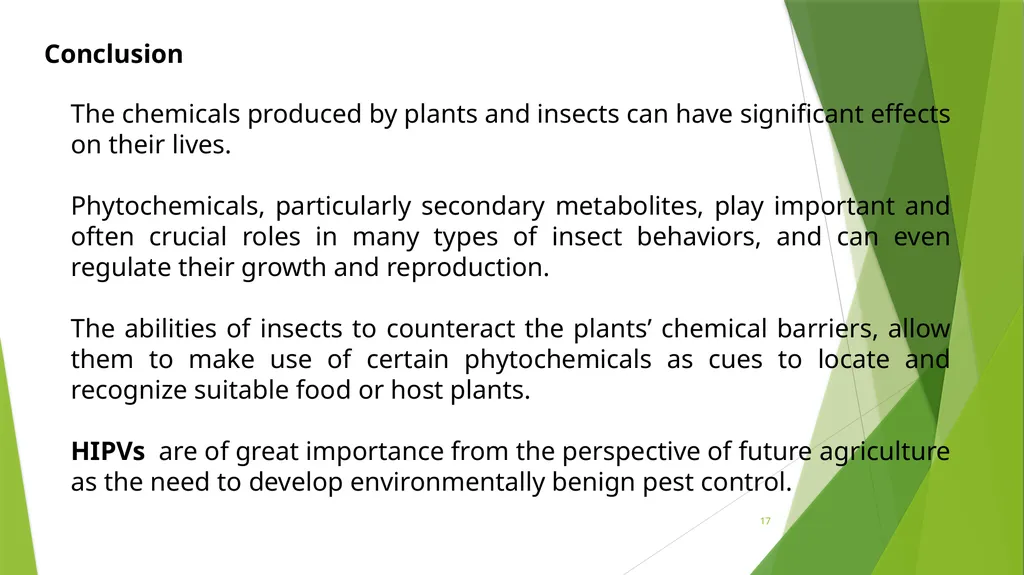
The chemicals produced by plants and insects can have significant effects on their lives.
Phytochemicals, particularly secondary metabolites, play important and often crucial roles in many types of insect behaviors, and can even regulate their growth and reproduction.
The abilities of insects to counteract the plants’ chemical barriers, allow them to make use of certain phytochemicals as cues to locate and recognize suitable food or host plants.
HIPVs are of great importance from the perspective of future agriculture as the need to develop environmentally benign pest control. 17 Conclusion<br>
Phytochemicals, particularly secondary metabolites, play important and often crucial roles in many types of insect behaviors, and can even regulate their growth and reproduction.
The abilities of insects to counteract the plants’ chemical barriers, allow them to make use of certain phytochemicals as cues to locate and recognize suitable food or host plants.
HIPVs are of great importance from the perspective of future agriculture as the need to develop environmentally benign pest control. 17 Conclusion<br>
18
Hori, M., & Kainoh, Y. 2013. Allelochemicals in Plant–Insect Interactions.
Carter, M., Sachdev-Gupta, K., & Feeny, P. (1998). Tyramine isolated from parsnip leaves: A stimulant and synergist for oviposition of the black swallowtail. Physiol. Entomol., 23, 303-312.
Sun, J. Y., Sønderby, I. E., Halkier, B. A., Jander, G., & de Vos, M. (2009). Non-volatile intact indole glucosinolates are host recognition cues for ovipositing Plutella xylostella. Journal of chemical ecology, 35, 1427-1436.
Udayagiri, S., & Mason, C. E. (1997). Epicuticular wax chemicals in Zea mays influence oviposition in Ostrinia nubilalis. Journal of Chemical Ecology, 23, 1675-1687.
Hori, M., Ohuchi, K., & Matsuda, K. (2006). Role of host plant volatile in the host-finding behavior of the strawberry leaf beetle, Galerucella vittaticollis Baly (Coleoptera: Chrysomelidae). Applied entomology and zoology, 41(2), 357-363.
Loughrin, J. H., Potter, D. A., & Hamilton-Kemp, T. R. (1998). Attraction of Japanese beetles (Coleoptera: Scarabaeidae) to host plant volatiles in field trapping experiments. Environmental entomology, 27(2), 395-400.
Saïd, I., Renou, M., Morin, J. P., Ferreira, J. M., & Rochat, D. (2005). Interactions between acetoin, a plant volatile, and pheromone in Rhynchophorus palmarum: Behavioral and olfactory neuron responses. Journal of Chemical Ecology, 31, 1789-1805.
Raguso, R. A. Behavioral Responses to Floral Scent: Experimental Manipulations and the Interplay of Sensory Modalities. In Biology of Floral Scent; Dudareva, N.; Pichersky, E., Eds.; CRC Press: Boca Raton, 2006; pp 297–318, Chapter 13.
Knudsen, J. T., Eriksson, R., Gershenzon, J., & Ståhl, B. (2006). Diversity and distribution of floral scent. The botanical review, 72(1), 1-120. 18 References<br>
Carter, M., Sachdev-Gupta, K., & Feeny, P. (1998). Tyramine isolated from parsnip leaves: A stimulant and synergist for oviposition of the black swallowtail. Physiol. Entomol., 23, 303-312.
Sun, J. Y., Sønderby, I. E., Halkier, B. A., Jander, G., & de Vos, M. (2009). Non-volatile intact indole glucosinolates are host recognition cues for ovipositing Plutella xylostella. Journal of chemical ecology, 35, 1427-1436.
Udayagiri, S., & Mason, C. E. (1997). Epicuticular wax chemicals in Zea mays influence oviposition in Ostrinia nubilalis. Journal of Chemical Ecology, 23, 1675-1687.
Hori, M., Ohuchi, K., & Matsuda, K. (2006). Role of host plant volatile in the host-finding behavior of the strawberry leaf beetle, Galerucella vittaticollis Baly (Coleoptera: Chrysomelidae). Applied entomology and zoology, 41(2), 357-363.
Loughrin, J. H., Potter, D. A., & Hamilton-Kemp, T. R. (1998). Attraction of Japanese beetles (Coleoptera: Scarabaeidae) to host plant volatiles in field trapping experiments. Environmental entomology, 27(2), 395-400.
Saïd, I., Renou, M., Morin, J. P., Ferreira, J. M., & Rochat, D. (2005). Interactions between acetoin, a plant volatile, and pheromone in Rhynchophorus palmarum: Behavioral and olfactory neuron responses. Journal of Chemical Ecology, 31, 1789-1805.
Raguso, R. A. Behavioral Responses to Floral Scent: Experimental Manipulations and the Interplay of Sensory Modalities. In Biology of Floral Scent; Dudareva, N.; Pichersky, E., Eds.; CRC Press: Boca Raton, 2006; pp 297–318, Chapter 13.
Knudsen, J. T., Eriksson, R., Gershenzon, J., & Ståhl, B. (2006). Diversity and distribution of floral scent. The botanical review, 72(1), 1-120. 18 References<br>
19
Wright, G. A., Lutmerding, A., Dudareva, N., & Smith, B. H. (2005). Intensity and the ratios of compounds in the scent of snapdragon flowers affect scent discrimination by honeybees (Apis mellifera). Journal of Comparative Physiology A, 191, 105-114.
Hilker, M., & Meiners, T. (2006). Early herbivore alert: insect eggs induce plant defense. Journal of chemical ecology, 32, 1379-1397.
Turlings, T. C., & Tumlinson, J. H. (1992). Systemic release of chemical signals by herbivore-injured corn. Proceedings of the National Academy of Sciences, 89(17), 8399-8402.
Turlings, T. C., Tumlinson, J. H., & Lewis, W. J. (1990). Exploitation of herbivore-induced plant odors by host-seeking parasitic wasps. Science, 250(4985), 1251-1253.
Takabayashi, J., Takahashi, S., Dicke, M., & Posthumus, M. A. (1995). Developmental stage of herbivore Pseudaletia separata affects production of herbivore-induced synomone by corn plants. Journal of Chemical Ecology, 21, 273-287.
Ichiki, R. T., Kainoh, Y., Yamawaki, Y., & Nakamura, S. (2011). The parasitoid fly Exorista japonica uses visual and olfactory cues to locate herbivore‐infested plants. Entomologia Experimentalis et Applicata, 138(3), 175-183.
Sabelis, M. W., & Van de Baan, H. E. (1983). Location of distant spider mite colonies by phytoseiid predators: demonstration of specific kairomones emitted by Tetranychus urticae and Panonychus ulmi. Entomologia experimentalis et applicata, 33(3), 303-314.
Dicke, M., Van Beek, T. A., Posthumus, M. A., Ben Dom, N., Van Bokhoven, H., & De Groot, A. E. (1990). Isolation and identification of volatile kairomone that affects acarine predatorprey interactions Involvement of host plant in its production. Journal of chemical ecology, 16, 381-396.
Mattiacci, L., Dicke, M., & Posthumus, M. A. (1995). beta-Glucosidase: an elicitor of herbivore-induced plant odor that attracts host-searching parasitic wasps. Proceedings of the National Academy of Sciences, 92(6), 2036-2040 19 References-conti--<br>
Hilker, M., & Meiners, T. (2006). Early herbivore alert: insect eggs induce plant defense. Journal of chemical ecology, 32, 1379-1397.
Turlings, T. C., & Tumlinson, J. H. (1992). Systemic release of chemical signals by herbivore-injured corn. Proceedings of the National Academy of Sciences, 89(17), 8399-8402.
Turlings, T. C., Tumlinson, J. H., & Lewis, W. J. (1990). Exploitation of herbivore-induced plant odors by host-seeking parasitic wasps. Science, 250(4985), 1251-1253.
Takabayashi, J., Takahashi, S., Dicke, M., & Posthumus, M. A. (1995). Developmental stage of herbivore Pseudaletia separata affects production of herbivore-induced synomone by corn plants. Journal of Chemical Ecology, 21, 273-287.
Ichiki, R. T., Kainoh, Y., Yamawaki, Y., & Nakamura, S. (2011). The parasitoid fly Exorista japonica uses visual and olfactory cues to locate herbivore‐infested plants. Entomologia Experimentalis et Applicata, 138(3), 175-183.
Sabelis, M. W., & Van de Baan, H. E. (1983). Location of distant spider mite colonies by phytoseiid predators: demonstration of specific kairomones emitted by Tetranychus urticae and Panonychus ulmi. Entomologia experimentalis et applicata, 33(3), 303-314.
Dicke, M., Van Beek, T. A., Posthumus, M. A., Ben Dom, N., Van Bokhoven, H., & De Groot, A. E. (1990). Isolation and identification of volatile kairomone that affects acarine predatorprey interactions Involvement of host plant in its production. Journal of chemical ecology, 16, 381-396.
Mattiacci, L., Dicke, M., & Posthumus, M. A. (1995). beta-Glucosidase: an elicitor of herbivore-induced plant odor that attracts host-searching parasitic wasps. Proceedings of the National Academy of Sciences, 92(6), 2036-2040 19 References-conti--<br>