
Plumbing challenges in Dynamic Capacity Devices



Description: Plumbing challenges in Dynamic Capacity Devices LPC CXL micro conference 2023 Navneet Singh, Ira Weiny, and Jonathan Cameron Introduction Asynchronous addrelease of memory Partial extents Interleaving flow challenges Force release support
Related Topics
Download Presentation
"Plumbing challenges in Dynamic Capacity Devices" is the property of its rightful owner. Permission is granted to download and print the materials on this website for personal, non-commercial use only, and to display it on your personal computer provided you do not modify the materials and that you retain all copyright notices contained in the materials. By downloading content from our website, you accept the terms of this agreement.
Presentation Transcript
slide2. Plumbing challenges in Dynamic Capacity Devices
LPC CXL micro conference 2023 Navneet Singh, Ira Weiny, and Jonathan Cameron<br>
slide3. Introduction
Asynchronous add/release of memory
Partial extents
Interleaving flow challenges
Force release support
Host user interactions
Backup
Memory sharing Agenda<br>
slide4. What are we after? Highlight the challenges brought in by CXL 3.0 DCD feature
Identify Industry use cases
Ensure User APIs provide for those use cases
Open discussion/feedback/suggestions
Other?<br>
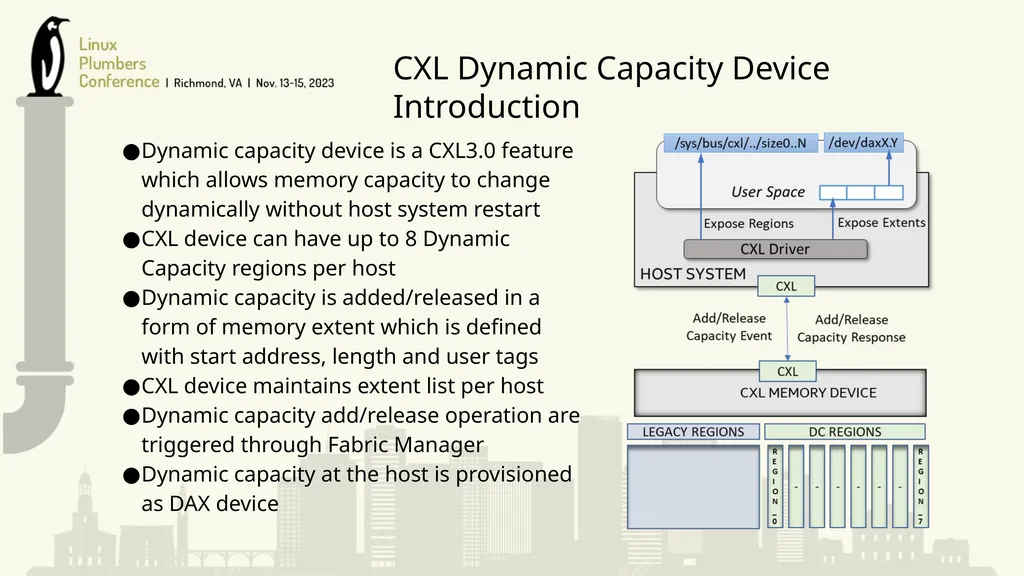
slide5. CXL Dynamic Capacity Device Introduction Dynamic capacity device is a CXL3.0 feature which allows memory capacity to change dynamically without host system restart
CXL device can have up to 8 Dynamic Capacity regions per host
Dynamic capacity is added/released in a form of memory extent which is defined with start address, length and user tags
CXL device maintains extent list per host
Dynamic capacity add/release operation are triggered through Fabric Manager
Dynamic capacity at the host is provisioned as DAX device<br>
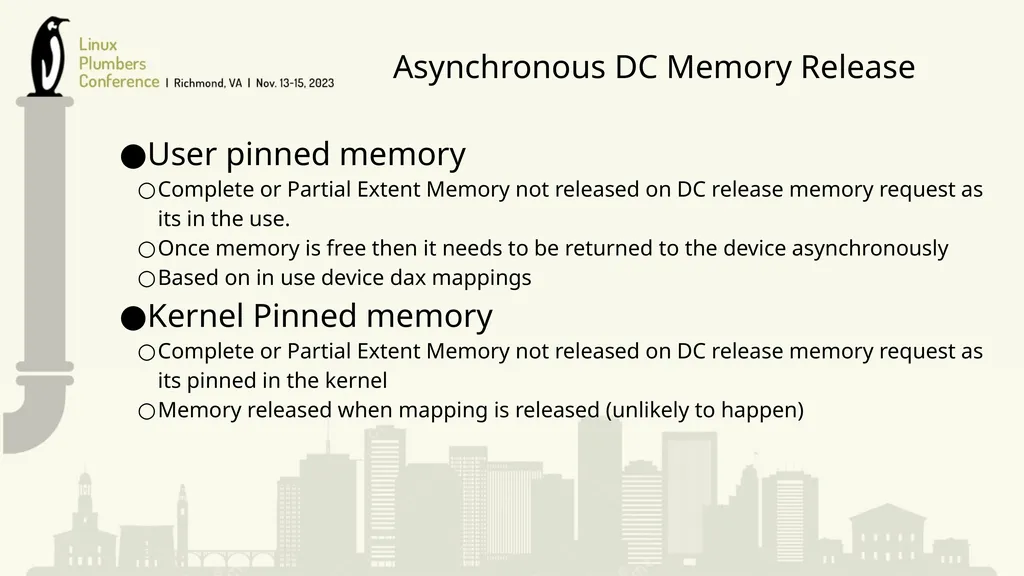
slide6. Asynchronous DC Memory Release User pinned memory
Complete or Partial Extent Memory not released on DC release memory request as its in the use.
Once memory is free then it needs to be returned to the device asynchronously
Based on in use device dax mappings
Kernel Pinned memory
Complete or Partial Extent Memory not released on DC release memory request as its pinned in the kernel
Memory released when mapping is released (unlikely to happen)<br>
slide7. Partial extents Any strong use case in Linux?
Spec allows
the device to request release of sub-extents
(vs what was previously added)
the host to accept part of an extent offered from the device
sub-extents not supported for now
[based on discord discussion]<br>
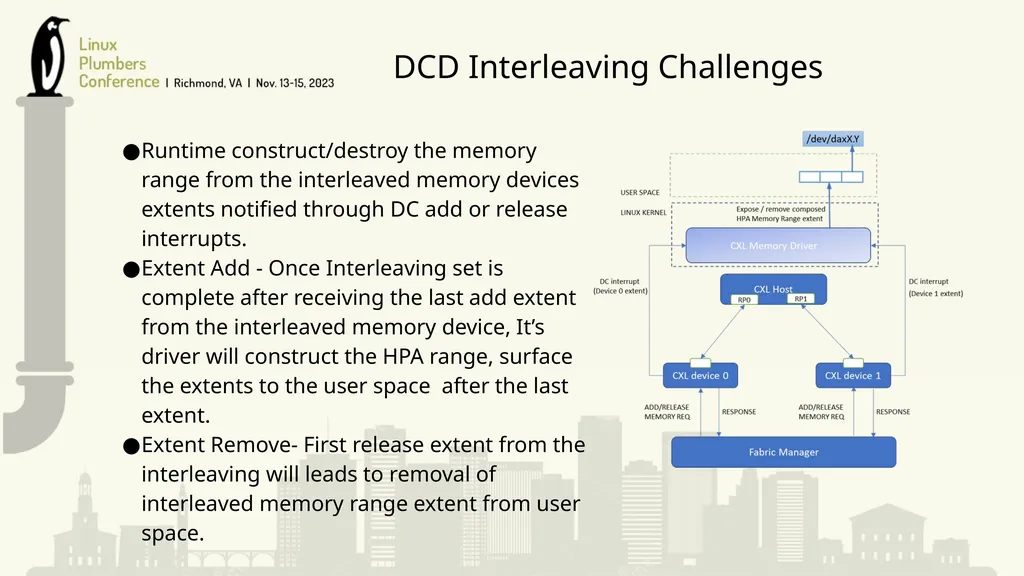
slide8. DCD Interleaving Challenges Runtime construct/destroy the memory range from the interleaved memory devices extents notified through DC add or release interrupts.
Extent Add - Once Interleaving set is complete after receiving the last add extent from the interleaved memory device, It’s driver will construct the HPA range, surface the extents to the user space after the last extent.
Extent Remove- First release extent from the interleaving will leads to removal of interleaved memory range extent from user space.<br>
slide9. Forced Dynamic capacity support If memory is pinned for long time, then device can raise forced dynamic capacity release request
Device will not wait for the response and will remove the memory
Any access to that memory by the kernel will lead to poison
Force ignored by Linux software
[dev_err_ratelimited()]
Extent is leaked
Probably will require host reboot…<br>
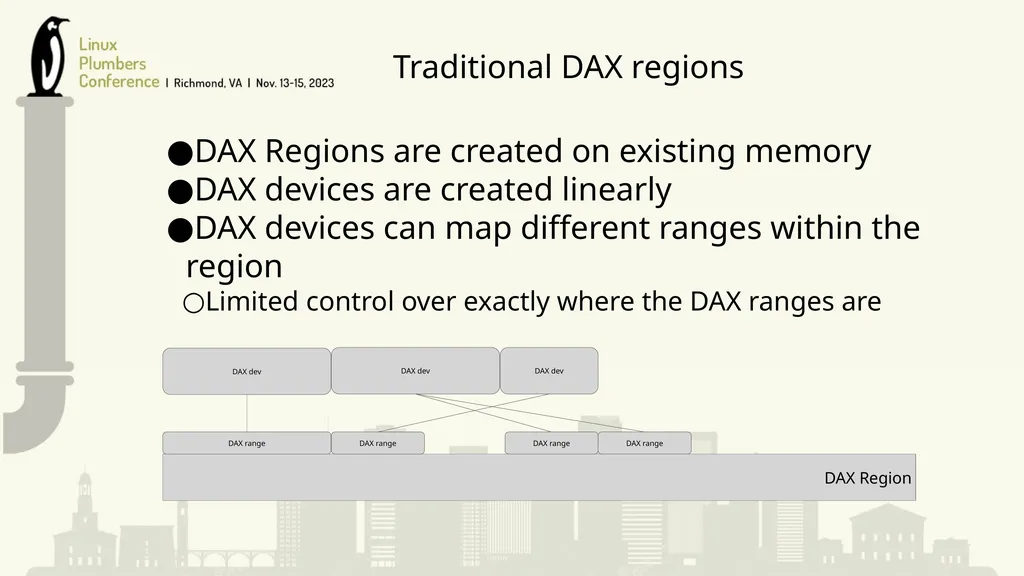
slide10. Traditional DAX regions DAX Regions are created on existing memory
DAX devices are created linearly
DAX devices can map different ranges within the region
Limited control over exactly where the DAX ranges are DAX Region DAX dev DAX range DAX dev DAX dev DAX range DAX range DAX range<br>
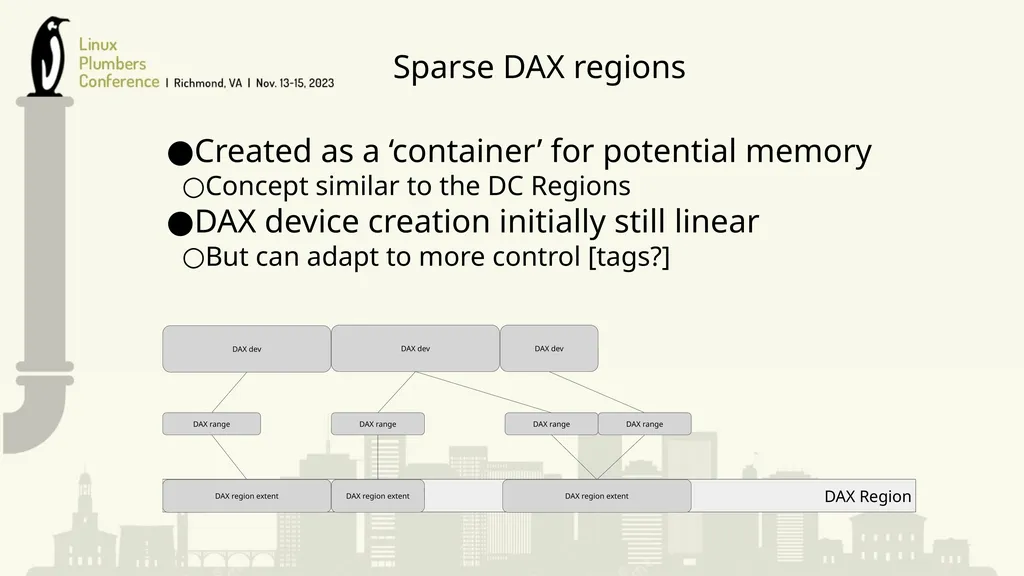
slide11. Sparse DAX regions Created as a ‘container’ for potential memory
Concept similar to the DC Regions
DAX device creation initially still linear
But can adapt to more control [tags?] DAX Region DAX dev DAX range DAX dev DAX dev DAX range DAX range DAX range DAX region extent DAX region extent DAX region extent<br>
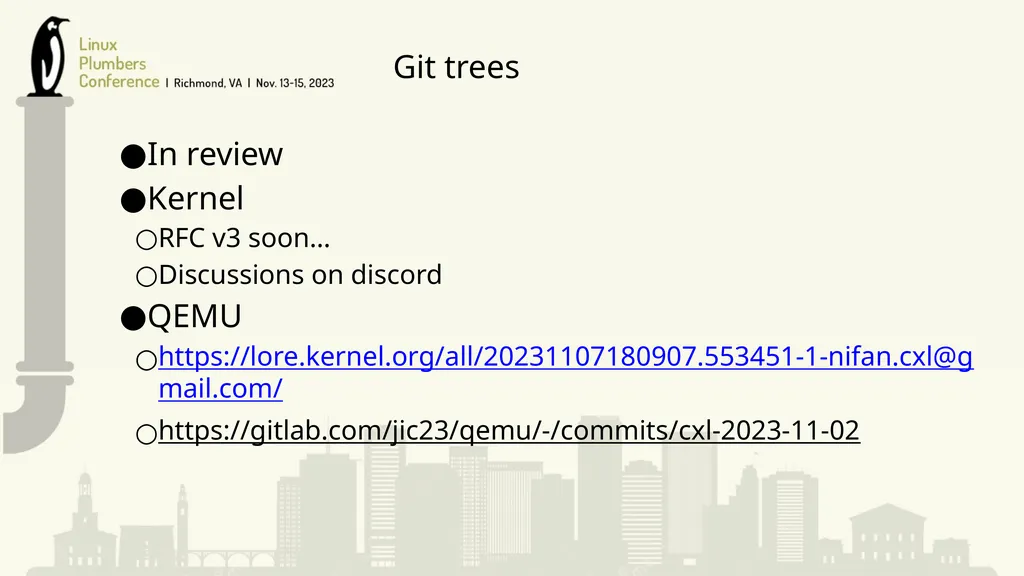
slide12. Git trees In review
Kernel
RFC v3 soon…
Discussions on discord
QEMU
https://lore.kernel.org/all/20231107180907.553451-1-nifan.cxl@gmail.com/
https://gitlab.com/jic23/qemu/-/commits/cxl-2023-11-02<br>
slide13. Backup<br>
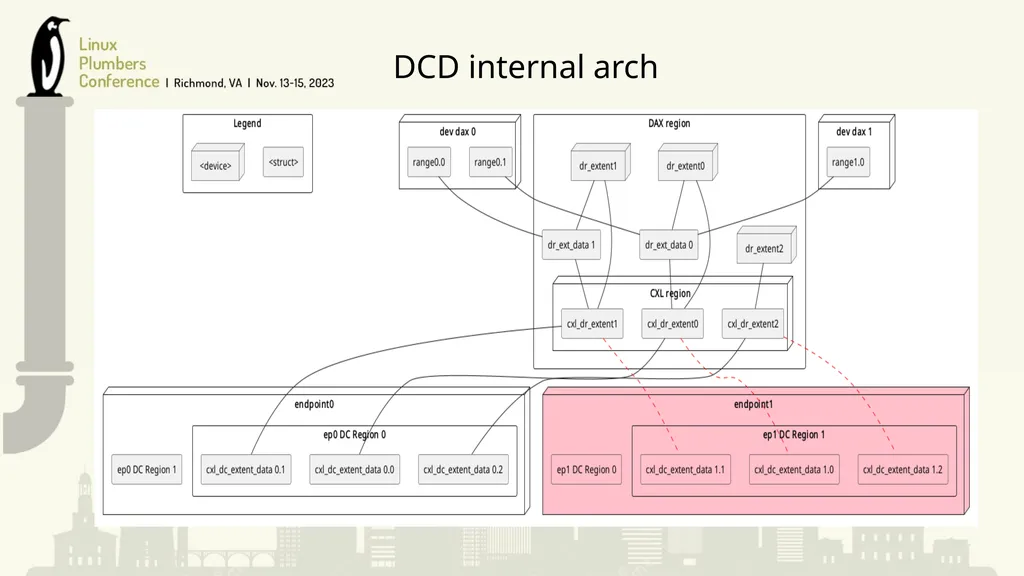
slide14. DCD internal arch<br>
slide15. Extents What is an extent?
A range of memory in region block size chunks
Multiple ‘extent’ objects in the code
DC extent
CXL DAX Region extent
DAX Region extent<br>
slide16. Dynamic Capacity Extent acceptance should a region be required for memory accept?
spec requires region
ensures CFMWS and decoder availability prior to memory acceptance
allows for more flexible interactions with the host/orchestrator/FM<br>
LPC CXL micro conference 2023 Navneet Singh, Ira Weiny, and Jonathan Cameron<br>
slide3. Introduction
Asynchronous add/release of memory
Partial extents
Interleaving flow challenges
Force release support
Host user interactions
Backup
Memory sharing Agenda<br>
slide4. What are we after? Highlight the challenges brought in by CXL 3.0 DCD feature
Identify Industry use cases
Ensure User APIs provide for those use cases
Open discussion/feedback/suggestions
Other?<br>
slide5. CXL Dynamic Capacity Device Introduction Dynamic capacity device is a CXL3.0 feature which allows memory capacity to change dynamically without host system restart
CXL device can have up to 8 Dynamic Capacity regions per host
Dynamic capacity is added/released in a form of memory extent which is defined with start address, length and user tags
CXL device maintains extent list per host
Dynamic capacity add/release operation are triggered through Fabric Manager
Dynamic capacity at the host is provisioned as DAX device<br>
slide6. Asynchronous DC Memory Release User pinned memory
Complete or Partial Extent Memory not released on DC release memory request as its in the use.
Once memory is free then it needs to be returned to the device asynchronously
Based on in use device dax mappings
Kernel Pinned memory
Complete or Partial Extent Memory not released on DC release memory request as its pinned in the kernel
Memory released when mapping is released (unlikely to happen)<br>
slide7. Partial extents Any strong use case in Linux?
Spec allows
the device to request release of sub-extents
(vs what was previously added)
the host to accept part of an extent offered from the device
sub-extents not supported for now
[based on discord discussion]<br>
slide8. DCD Interleaving Challenges Runtime construct/destroy the memory range from the interleaved memory devices extents notified through DC add or release interrupts.
Extent Add - Once Interleaving set is complete after receiving the last add extent from the interleaved memory device, It’s driver will construct the HPA range, surface the extents to the user space after the last extent.
Extent Remove- First release extent from the interleaving will leads to removal of interleaved memory range extent from user space.<br>
slide9. Forced Dynamic capacity support If memory is pinned for long time, then device can raise forced dynamic capacity release request
Device will not wait for the response and will remove the memory
Any access to that memory by the kernel will lead to poison
Force ignored by Linux software
[dev_err_ratelimited()]
Extent is leaked
Probably will require host reboot…<br>
slide10. Traditional DAX regions DAX Regions are created on existing memory
DAX devices are created linearly
DAX devices can map different ranges within the region
Limited control over exactly where the DAX ranges are DAX Region DAX dev DAX range DAX dev DAX dev DAX range DAX range DAX range<br>
slide11. Sparse DAX regions Created as a ‘container’ for potential memory
Concept similar to the DC Regions
DAX device creation initially still linear
But can adapt to more control [tags?] DAX Region DAX dev DAX range DAX dev DAX dev DAX range DAX range DAX range DAX region extent DAX region extent DAX region extent<br>
slide12. Git trees In review
Kernel
RFC v3 soon…
Discussions on discord
QEMU
https://lore.kernel.org/all/20231107180907.553451-1-nifan.cxl@gmail.com/
https://gitlab.com/jic23/qemu/-/commits/cxl-2023-11-02<br>
slide13. Backup<br>
slide14. DCD internal arch<br>
slide15. Extents What is an extent?
A range of memory in region block size chunks
Multiple ‘extent’ objects in the code
DC extent
CXL DAX Region extent
DAX Region extent<br>
slide16. Dynamic Capacity Extent acceptance should a region be required for memory accept?
spec requires region
ensures CFMWS and decoder availability prior to memory acceptance
allows for more flexible interactions with the host/orchestrator/FM<br>