Portable Fire Extinguishers Standard 29 CFR Part 1910.157 Presented by: Nelson Connets 2005, 2013, 2020 Zywave, Inc. All rights reserved. Learning Objectives After this training program, participants will understand: The purpose of fire
"Portable Fire Extinguishers Standard 29 CFR Part" is the property of its rightful owner. Permission is granted to
download and print the materials on this website for personal, non-commercial use only, and to display it
on your personal computer provided you do not modify the materials and that you retain all copyright
notices contained in the materials. By downloading content from our website, you accept the terms of this
agreement.
Learning Objectives After this training program, participants will understand:
The purpose of fire extinguishers
The different classes of fires and fire extinguishers
The PASS method for extinguishing fires
When it’s appropriate to attempt to put out a fire
How to maintain and inspect fire extinguishers<br>
03
When and How to Use Fire Extinguishers Fire extinguishers are designed for incipient stage fires only. Incipient stage fires include:
Fires that are small or slow to grow
Fires that give off minimal smoke or heat
Fire extinguishers are not for large, structural or fast growing fires.<br>
04
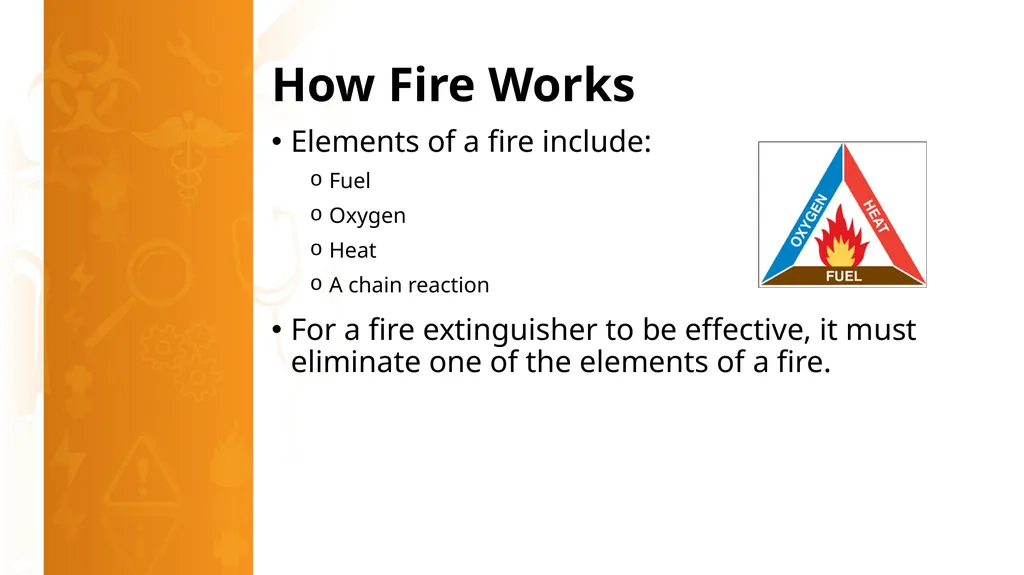
How Fire Works Elements of a fire include:
Fuel
Oxygen
Heat
A chain reaction
For a fire extinguisher to be effective, it must eliminate one of the elements of a fire.<br>
05
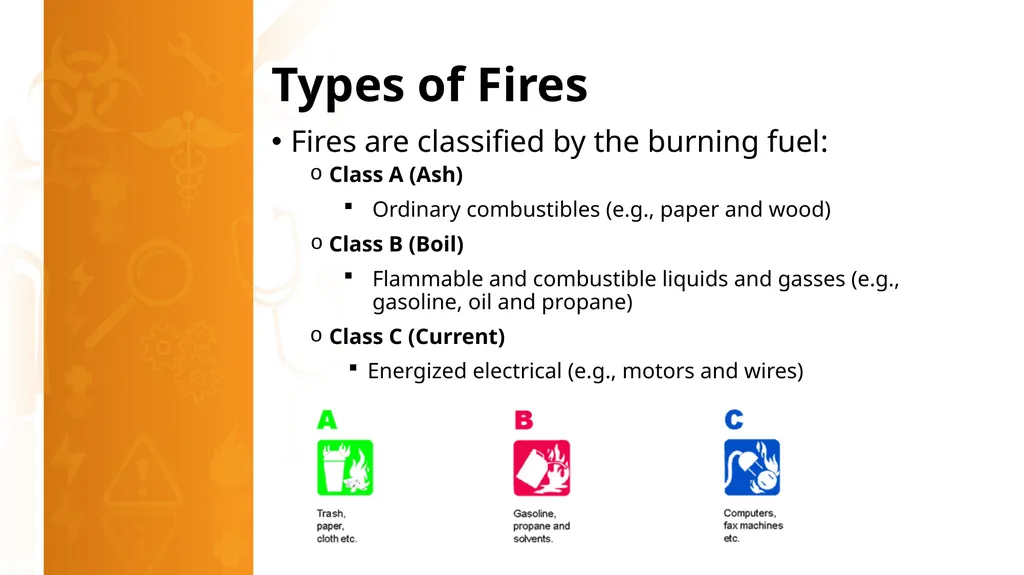
Types of Fires Fires are classified by the burning fuel:
Class A (Ash)
Ordinary combustibles (e.g., paper and wood)
Class B (Boil)
Flammable and combustible liquids and gasses (e.g., gasoline, oil and propane)
Class C (Current)
Energized electrical (e.g., motors and wires)<br>
06
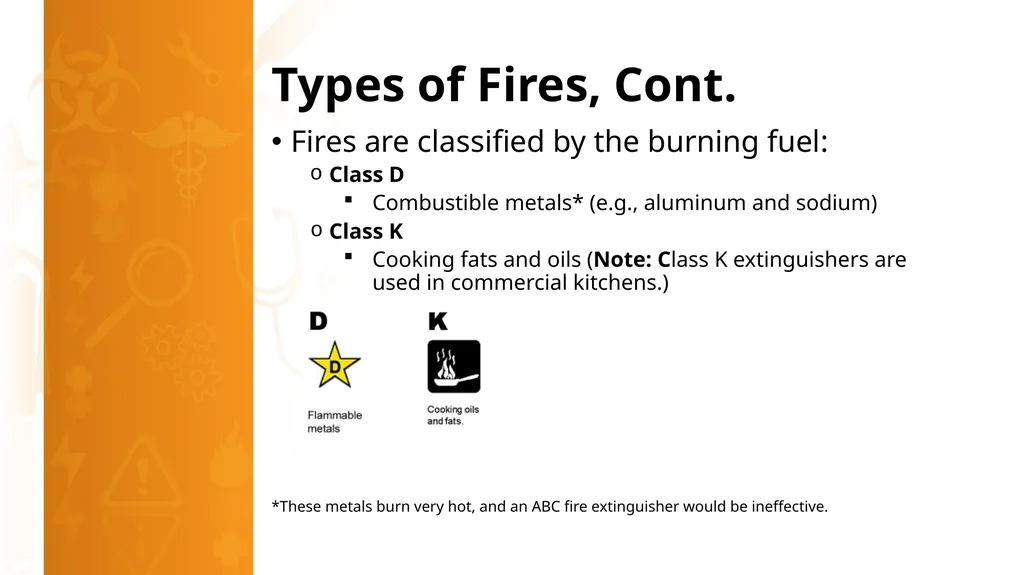
Types of Fires, Cont. Fires are classified by the burning fuel:
Class D
Combustible metals* (e.g., aluminum and sodium)
Class K
Cooking fats and oils (Note: Class K extinguishers are used in commercial kitchens.)
*These metals burn very hot, and an ABC fire extinguisher would be ineffective.<br>
07
Selecting a Fire Extinguisher ABC fire extinguishers are the most common for business/industry use.
ABC fire extinguishers have different extinguishing agents—agents that fight fires differently and have unique pros and cons.<br>
08
Water Extinguishers Water or air-pressurized water (APW) extinguishers:
Work by cooling the surface and removing heat
Look different than traditional fire extinguishers and are large, silver containers
Can only be used on Class A fires, as water is extremely ineffective at extinguishing flammable liquid and electrical fires:
Water is extremely ineffective at extinguishing flammable liquids and may even cause the fire to spread.
Water is a good conductor and may cause electrocution if used to extinguish an electrical fire.<br>
09
Carbon Dioxide Fire Extinguishers Carbon Dioxide (CO2) extinguishers:
Work by displacing oxygen from a fire
Should only be used on Class B and C fires only:
CO2 is not recommended for Class A fires, because these fires may continue to smolder and reignite after the CO2 dissipates.
Displace oxygen, and therefore should not be used in a confined space unless a supplied air respirator is available<br>
10
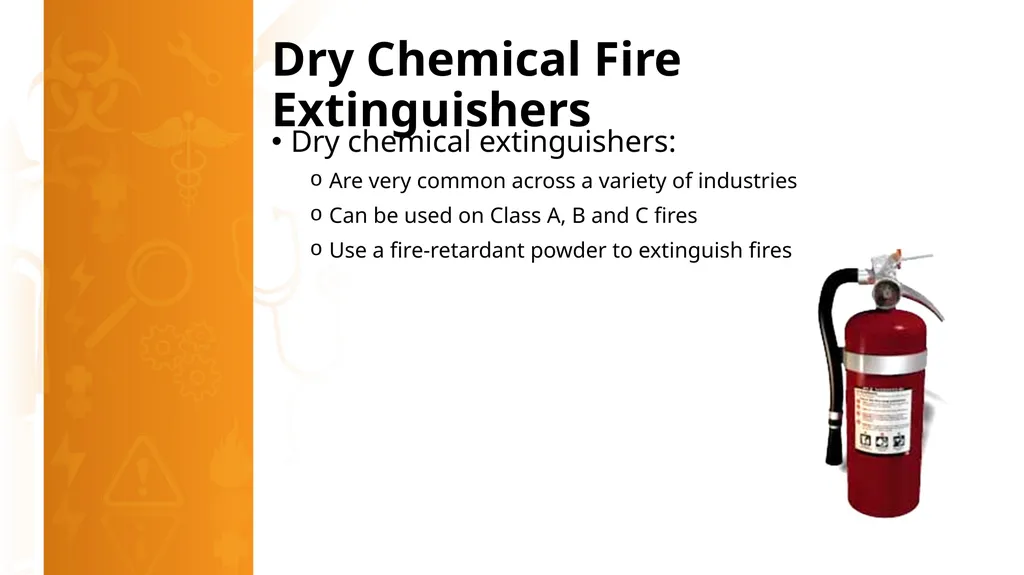
Dry Chemical Fire Extinguishers Dry chemical extinguishers:
Are very common across a variety of industries
Can be used on Class A, B and C fires
Use a fire-retardant powder to extinguish fires<br>
11
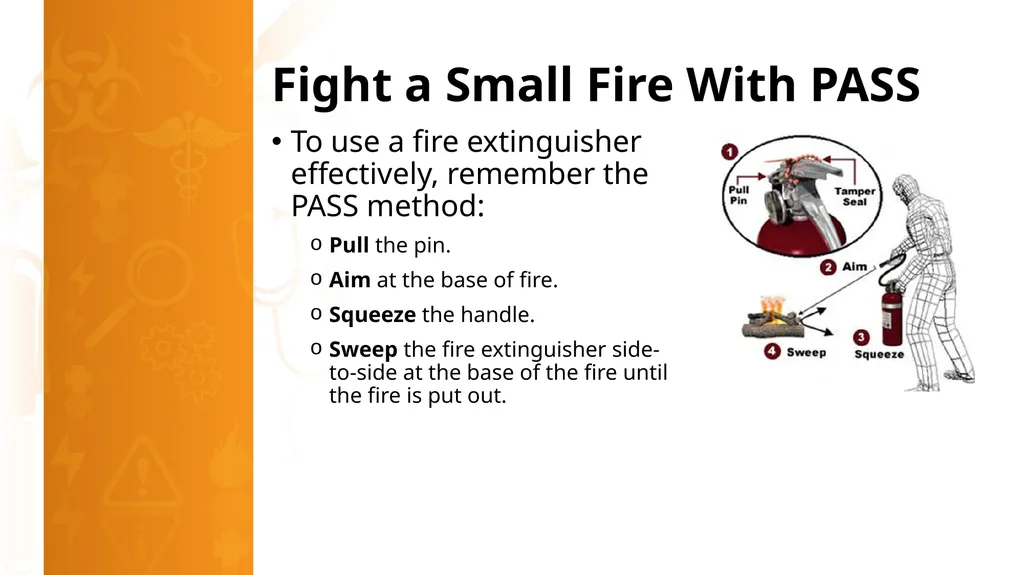
Fight a Small Fire With PASS To use a fire extinguisher effectively, remember the PASS method:
Pull the pin.
Aim at the base of fire.
Squeeze the handle.
Sweep the fire extinguisher side-to-side at the base of the fire until the fire is put out.<br>
12
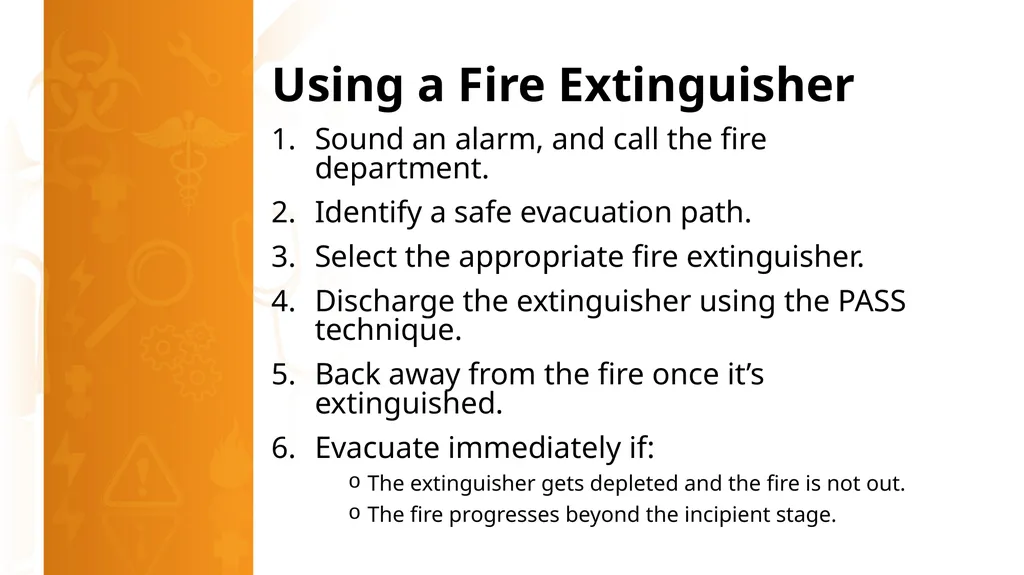
Using a Fire Extinguisher Sound an alarm, and call the fire department.
Identify a safe evacuation path.
Select the appropriate fire extinguisher.
Discharge the extinguisher using the PASS technique.
Back away from the fire once it’s extinguished.
Evacuate immediately if:
The extinguisher gets depleted and the fire is not out.
The fire progresses beyond the incipient stage.<br>
13
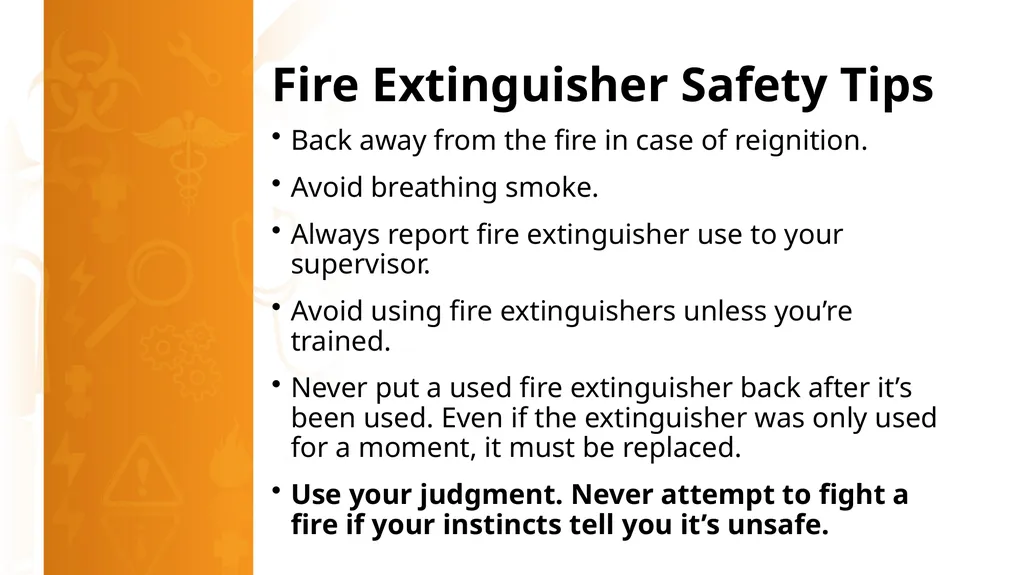
Fire Extinguisher Safety Tips Back away from the fire in case of reignition.
Avoid breathing smoke.
Always report fire extinguisher use to your supervisor.
Avoid using fire extinguishers unless you’re trained.
Never put a used fire extinguisher back after it’s been used. Even if the extinguisher was only used for a moment, it must be replaced.
Use your judgment. Never attempt to fight a fire if your instincts tell you it’s unsafe.<br>
14
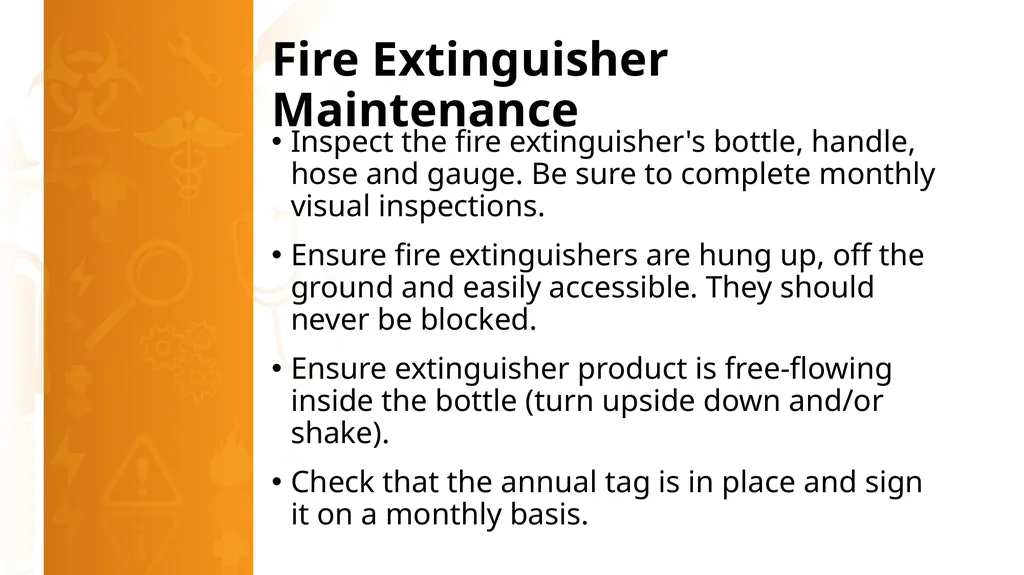
Fire Extinguisher Maintenance Inspect the fire extinguisher's bottle, handle, hose and gauge. Be sure to complete monthly visual inspections.
Ensure fire extinguishers are hung up, off the ground and easily accessible. They should never be blocked.
Ensure extinguisher product is free-flowing inside the bottle (turn upside down and/or shake).
Check that the annual tag is in place and sign it on a monthly basis.<br>
15
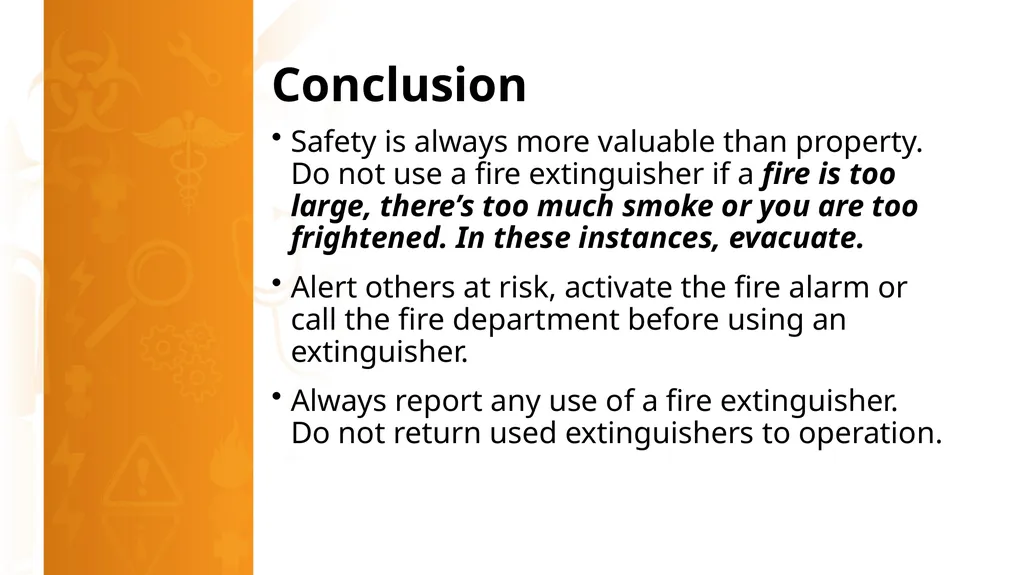
Conclusion Safety is always more valuable than property. Do not use a fire extinguisher if a fire is too large, there’s too much smoke or you are too frightened. In these instances, evacuate.
Alert others at risk, activate the fire alarm or call the fire department before using an extinguisher.
Always report any use of a fire extinguisher. Do not return used extinguishers to operation.<br>