
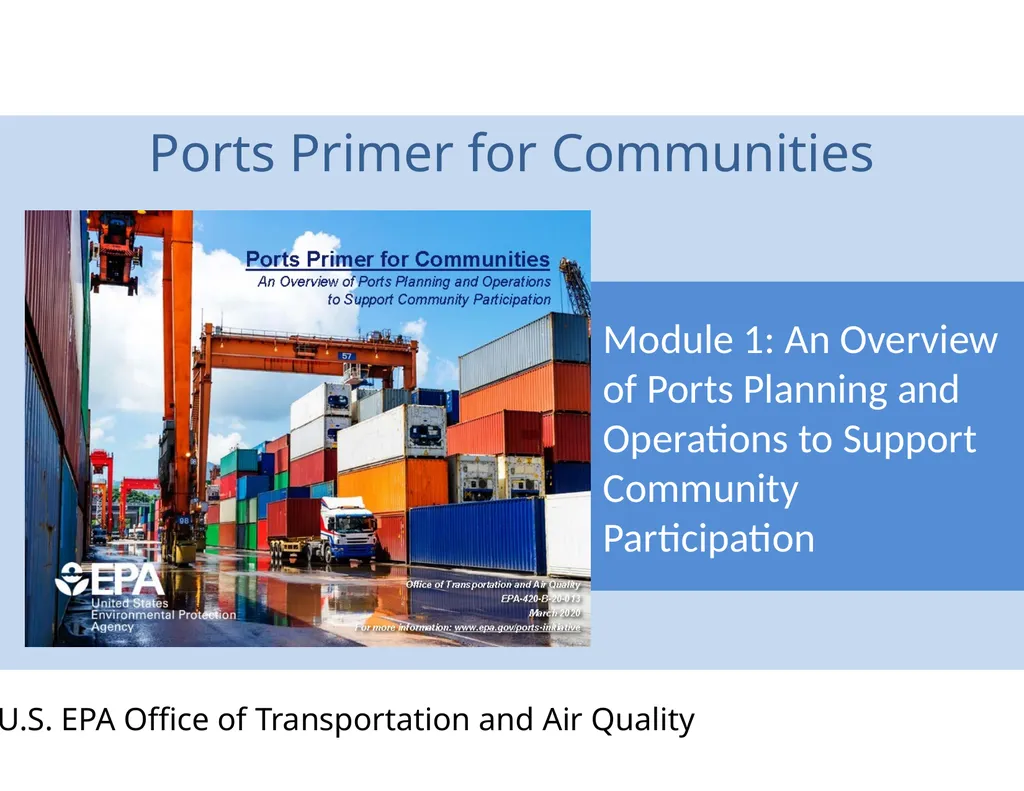
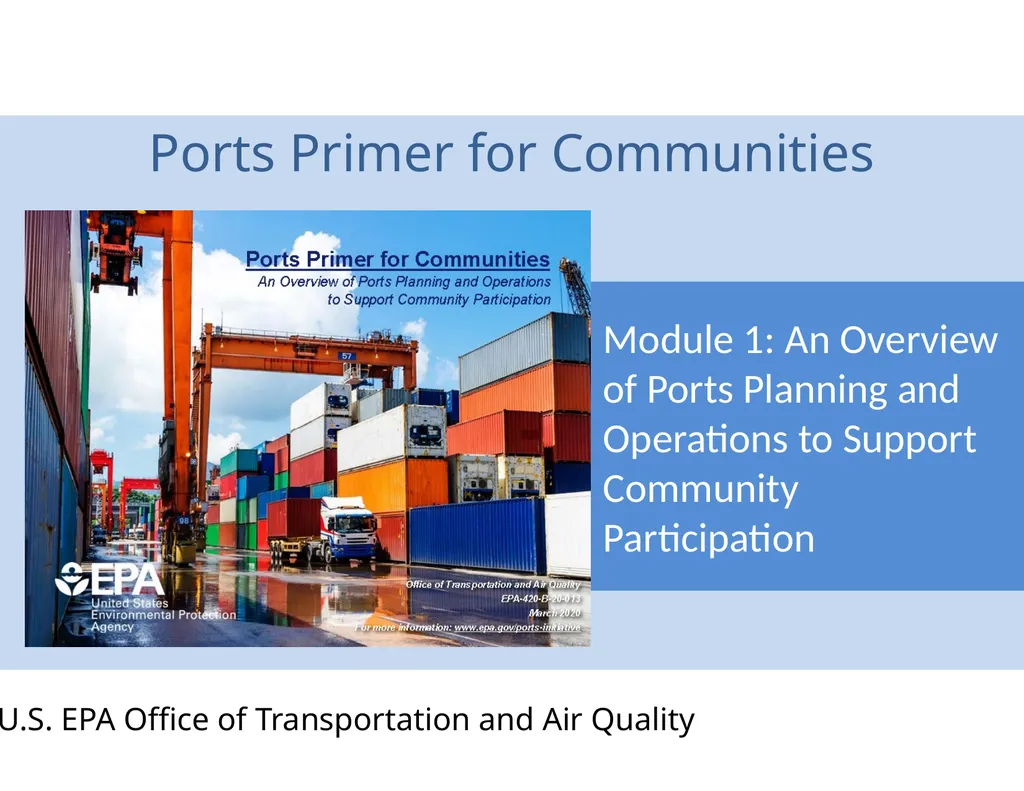
Ports Primer for Communities Module 1: An Overview
MY
Published · 41 slides · 0 views
1 / 1


Description
Ports Primer for Communities Module 1: An Overview of Ports Planning and Operations to Support Community Participation U.S. EPA Office of Transportation and Air Quality Tools 2 Pilots Toolkit Update 3 This Primer is intended to help
Related Topics
Share
Embed code
Download this presentation From Below
"Ports Primer for Communities Module 1: An Overview" is the property of its rightful owner. Permission is granted to download and print the materials on this website for personal, non-commercial use only, and to display it on your personal computer provided you do not modify the materials and that you retain all copyright notices contained in the materials. By downloading content from our website, you accept the terms of this agreement.
Presentation Transcript
01
Ports Primer for Communities Module 1: An Overview of Ports Planning and Operations to Support Community Participation U.S. EPA Office of Transportation and Air Quality<br>
02
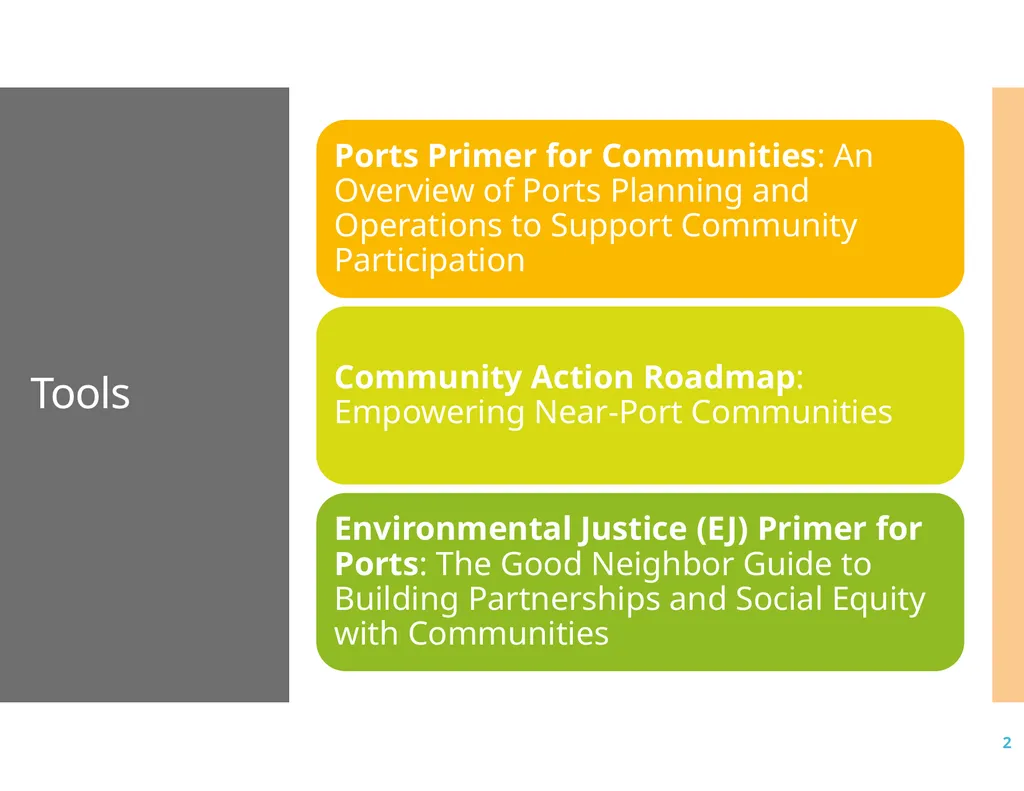
Tools 2<br>
03
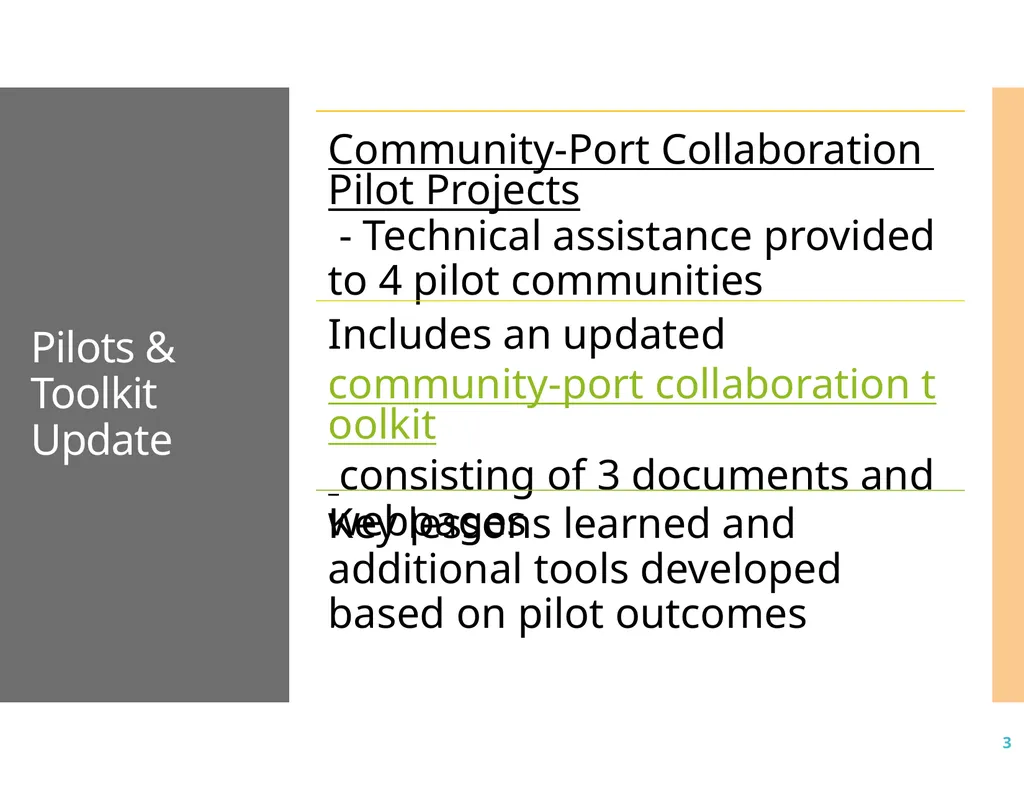
Pilots & Toolkit Update 3<br>
04
This Primer is intended to help community members participate effectively in the decision-making process by increasing local understanding of:
The role of ports,
How ports can impact local land use, economic trends, air quality and other aspects of the environment and quality of life, and
Tools and resources that have been successful in other communities.
Provides a general overview that can be used as a springboard for further exploration and learning.
Developed as part of EPA’s Ports Initiative in the Office of Transportation and Air Quality (OTAQ) in partnership with Regional Offices and the Office of Environmental Justice 1.0 Introduction 4<br>
The role of ports,
How ports can impact local land use, economic trends, air quality and other aspects of the environment and quality of life, and
Tools and resources that have been successful in other communities.
Provides a general overview that can be used as a springboard for further exploration and learning.
Developed as part of EPA’s Ports Initiative in the Office of Transportation and Air Quality (OTAQ) in partnership with Regional Offices and the Office of Environmental Justice 1.0 Introduction 4<br>
05
How to Use this Document 5 Designed to be an interactive. The navigation bar along the bottom of each page allows users to:
jump to the home page.
jump to the previous page or the next page.
refresh the current page to minimize its interactive features.
jump from section to section.
jump to the Appendix or Endnotes.
jump to the Glossary, which contains definitions for
words that are underlined throughout the document.
Within each section, buttons in the lower left, or in some cases icon buttons, reveal additional information and case studies.
Web links throughout the document allow users to access additional online resources.<br>
jump to the home page.
jump to the previous page or the next page.
refresh the current page to minimize its interactive features.
jump from section to section.
jump to the Appendix or Endnotes.
jump to the Glossary, which contains definitions for
words that are underlined throughout the document.
Within each section, buttons in the lower left, or in some cases icon buttons, reveal additional information and case studies.
Web links throughout the document allow users to access additional online resources.<br>
06
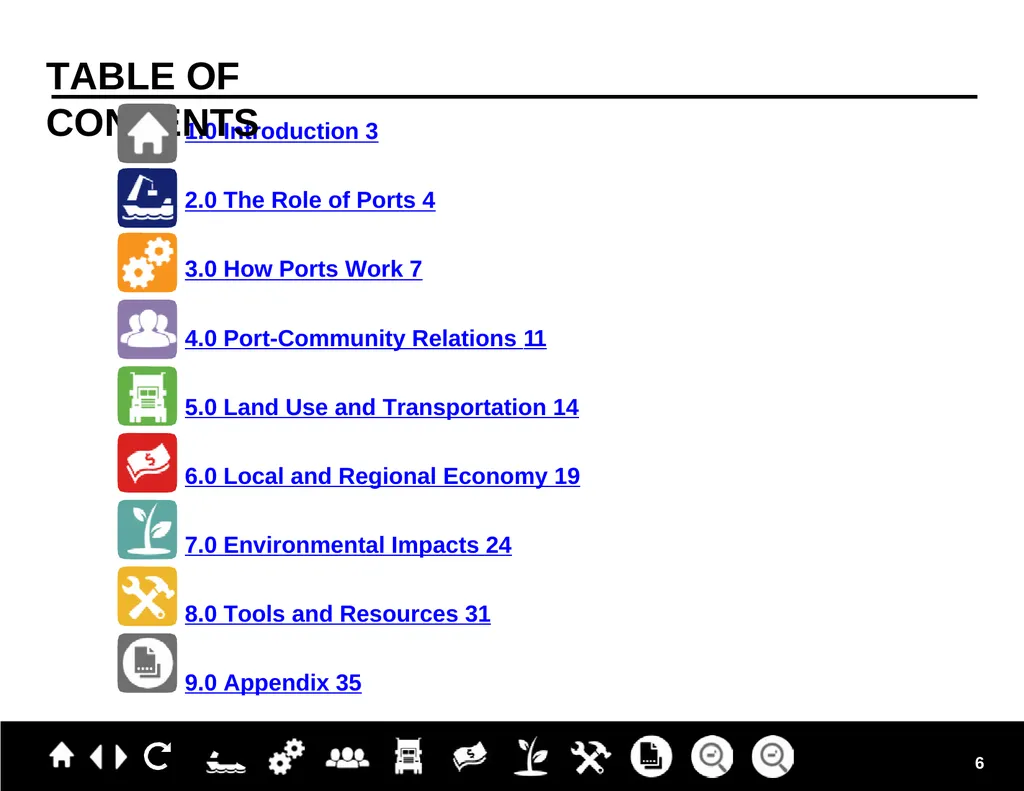
1.0 Introduction 3
2.0 The Role of Ports 4
3.0 How Ports Work 7
4.0 Port-Community Relations 11
5.0 Land Use and Transportation 14
6.0 Local and Regional Economy 19
7.0 Environmental Impacts 24
8.0 Tools and Resources 31
9.0 Appendix 35 TABLE OF CONTENTS 6<br>
2.0 The Role of Ports 4
3.0 How Ports Work 7
4.0 Port-Community Relations 11
5.0 Land Use and Transportation 14
6.0 Local and Regional Economy 19
7.0 Environmental Impacts 24
8.0 Tools and Resources 31
9.0 Appendix 35 TABLE OF CONTENTS 6<br>
07
2.0 The Role of Ports 7<br>
08
The Role of Ports The Role of Ports
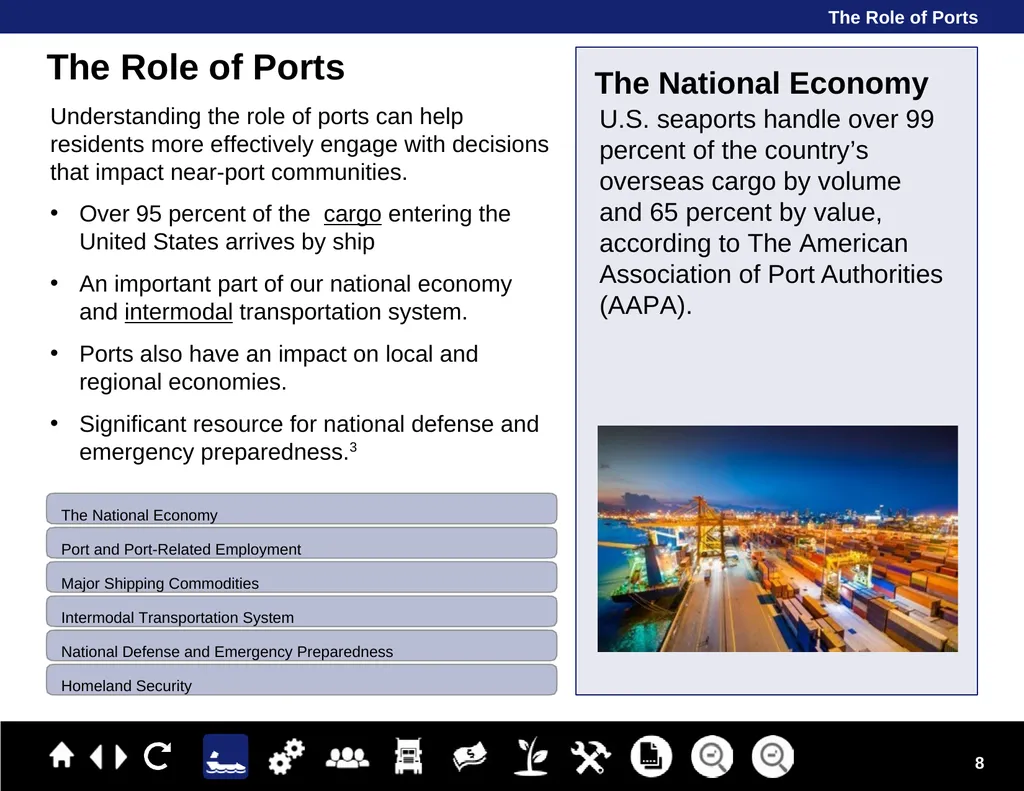
Understanding the role of ports can help residents more effectively engage with decisions that impact near-port communities.
Over 95 percent of the cargo entering the United States arrives by ship
An important part of our national economy and intermodal transportation system.
Ports also have an impact on local and regional economies.
Significant resource for national defense and emergency preparedness.3 The National Economy
Port and Port-Related Employment Major Shipping Commodities Intermodal Transportation System
National Defense and Emergency Preparedness Homeland Security The National Economy U.S. seaports handle over 99 percent of the country’s overseas cargo by volume and 65 percent by value, according to The American Association of Port Authorities (AAPA). 8<br>
Understanding the role of ports can help residents more effectively engage with decisions that impact near-port communities.
Over 95 percent of the cargo entering the United States arrives by ship
An important part of our national economy and intermodal transportation system.
Ports also have an impact on local and regional economies.
Significant resource for national defense and emergency preparedness.3 The National Economy
Port and Port-Related Employment Major Shipping Commodities Intermodal Transportation System
National Defense and Emergency Preparedness Homeland Security The National Economy U.S. seaports handle over 99 percent of the country’s overseas cargo by volume and 65 percent by value, according to The American Association of Port Authorities (AAPA). 8<br>
09
The Role of Ports
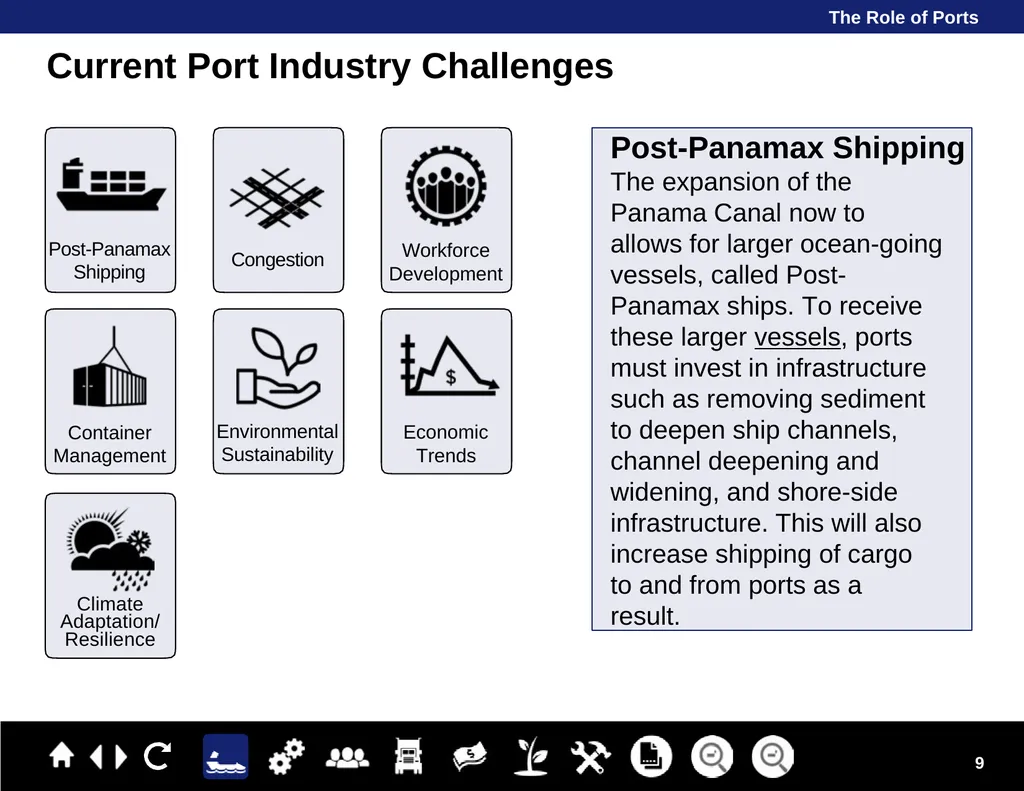
Current Port Industry Challenges Congestion Post-Panamax Shipping Workforce Development Container Management Environmental Sustainability Economic Trends Climate Adaptation/ Resilience Post-Panamax Shipping
The expansion of the Panama Canal now to allows for larger ocean-going vessels, called Post-Panamax ships. To receive these larger vessels, ports must invest in infrastructure such as removing sediment
to deepen ship channels, channel deepening and widening, and shore-side infrastructure. This will also increase shipping of cargo to and from ports as a result. 9<br>
Current Port Industry Challenges Congestion Post-Panamax Shipping Workforce Development Container Management Environmental Sustainability Economic Trends Climate Adaptation/ Resilience Post-Panamax Shipping
The expansion of the Panama Canal now to allows for larger ocean-going vessels, called Post-Panamax ships. To receive these larger vessels, ports must invest in infrastructure such as removing sediment
to deepen ship channels, channel deepening and widening, and shore-side infrastructure. This will also increase shipping of cargo to and from ports as a result. 9<br>
10
3.0 How Ports Work 10<br>
11
How Ports Work
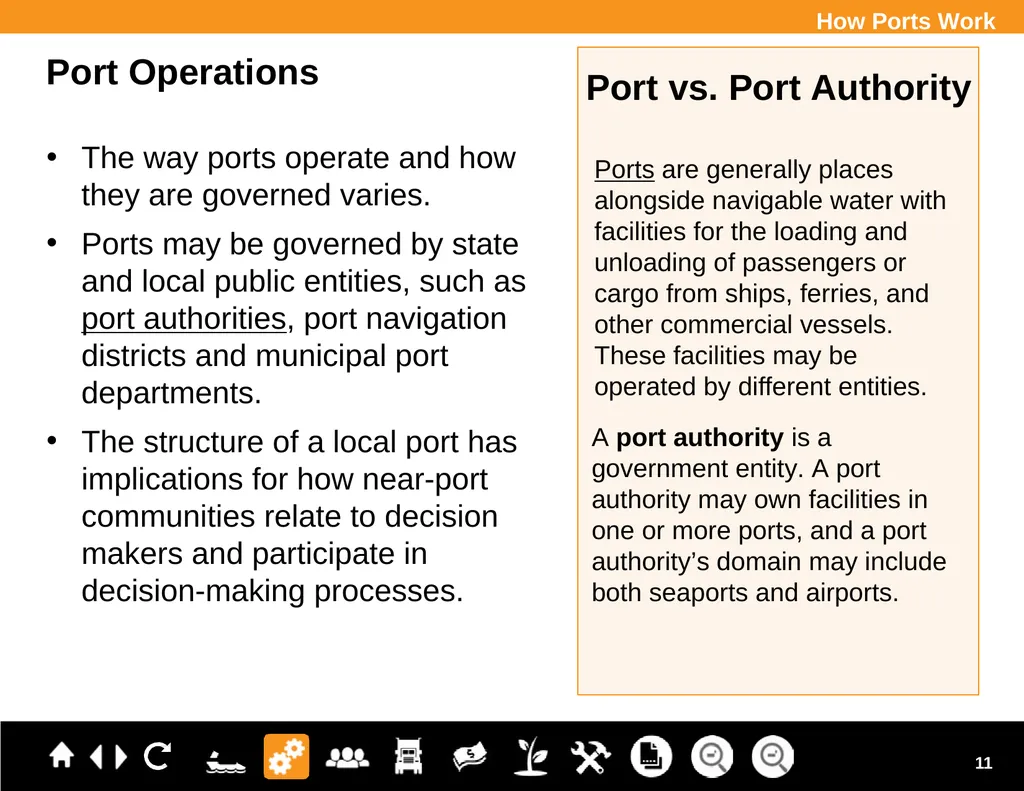
Port Operations The way ports operate and how they are governed varies.
Ports may be governed by state and local public entities, such as port authorities, port navigation districts and municipal port departments.
The structure of a local port has implications for how near-port communities relate to decision makers and participate in decision-making processes. Port vs. Port Authority Ports are generally places alongside navigable water with facilities for the loading and unloading of passengers or cargo from ships, ferries, and other commercial vessels. These facilities may be operated by different entities. A port authority is a government entity. A port authority may own facilities in one or more ports, and a port authority’s domain may include both seaports and airports. 11<br>
Port Operations The way ports operate and how they are governed varies.
Ports may be governed by state and local public entities, such as port authorities, port navigation districts and municipal port departments.
The structure of a local port has implications for how near-port communities relate to decision makers and participate in decision-making processes. Port vs. Port Authority Ports are generally places alongside navigable water with facilities for the loading and unloading of passengers or cargo from ships, ferries, and other commercial vessels. These facilities may be operated by different entities. A port authority is a government entity. A port authority may own facilities in one or more ports, and a port authority’s domain may include both seaports and airports. 11<br>
12
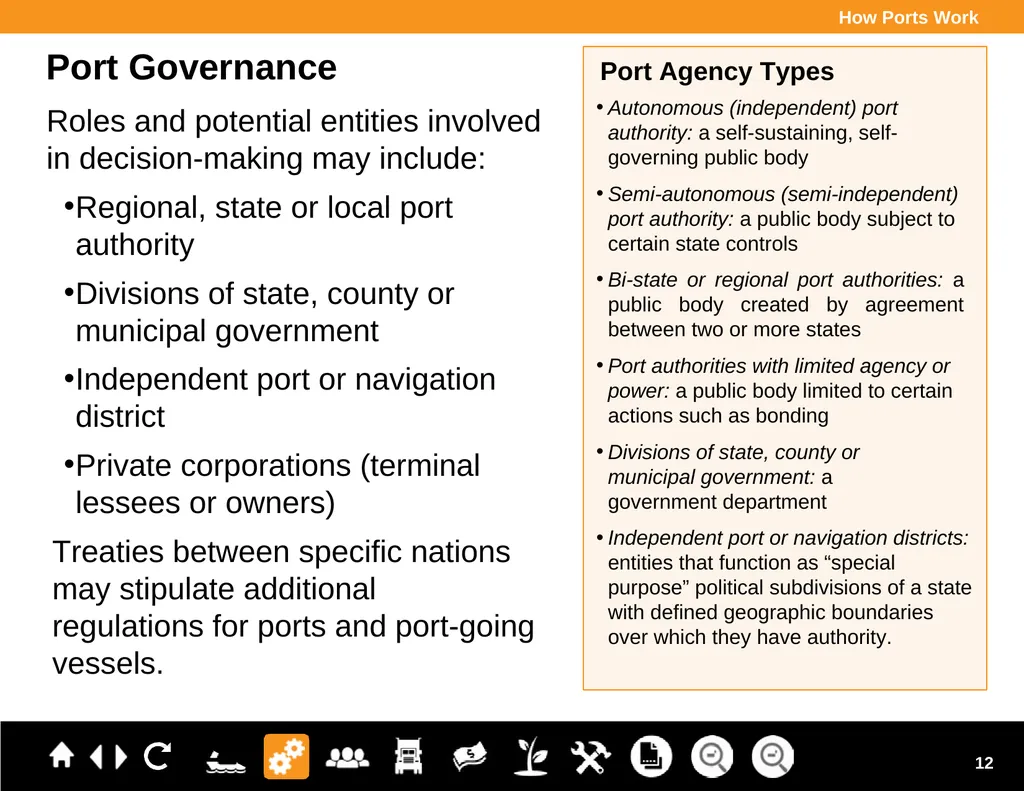
How Ports Work Port Agency Types Autonomous (independent) port authority: a self-sustaining, self-governing public body
Semi-autonomous (semi-independent) port authority: a public body subject to certain state controls
Bi-state or regional port authorities: a public body created by agreement between two or more states
Port authorities with limited agency or power: a public body limited to certain actions such as bonding
Divisions of state, county or municipal government: a government department
Independent port or navigation districts: entities that function as “special purpose” political subdivisions of a state with defined geographic boundaries over which they have authority. Port Governance
Roles and potential entities involved in decision-making may include:
Regional, state or local port authority
Divisions of state, county or municipal government
Independent port or navigation district
Private corporations (terminal lessees or owners)
Treaties between specific nations may stipulate additional
regulations for ports and port-going vessels. 12<br>
Semi-autonomous (semi-independent) port authority: a public body subject to certain state controls
Bi-state or regional port authorities: a public body created by agreement between two or more states
Port authorities with limited agency or power: a public body limited to certain actions such as bonding
Divisions of state, county or municipal government: a government department
Independent port or navigation districts: entities that function as “special purpose” political subdivisions of a state with defined geographic boundaries over which they have authority. Port Governance
Roles and potential entities involved in decision-making may include:
Regional, state or local port authority
Divisions of state, county or municipal government
Independent port or navigation district
Private corporations (terminal lessees or owners)
Treaties between specific nations may stipulate additional
regulations for ports and port-going vessels. 12<br>
13
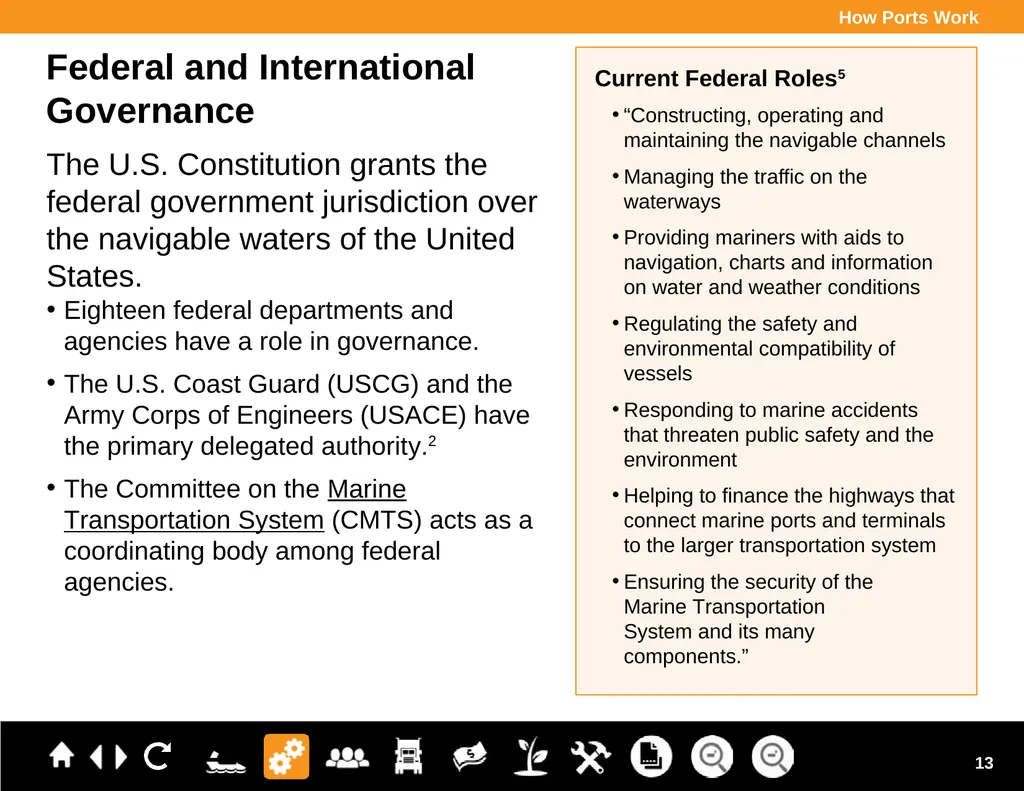
How Ports Work Federal and International Governance
The U.S. Constitution grants the federal government jurisdiction over the navigable waters of the United States.
Eighteen federal departments and agencies have a role in governance.
The U.S. Coast Guard (USCG) and the Army Corps of Engineers (USACE) have the primary delegated authority.2
The Committee on the Marine Transportation System (CMTS) acts as a coordinating body among federal agencies. Current Federal Roles5 “Constructing, operating and maintaining the navigable channels
Managing the traffic on the waterways
Providing mariners with aids to navigation, charts and information on water and weather conditions
Regulating the safety and environmental compatibility of vessels
Responding to marine accidents that threaten public safety and the environment
Helping to finance the highways that connect marine ports and terminals to the larger transportation system
Ensuring the security of the Marine Transportation System and its many components.” 13<br>
The U.S. Constitution grants the federal government jurisdiction over the navigable waters of the United States.
Eighteen federal departments and agencies have a role in governance.
The U.S. Coast Guard (USCG) and the Army Corps of Engineers (USACE) have the primary delegated authority.2
The Committee on the Marine Transportation System (CMTS) acts as a coordinating body among federal agencies. Current Federal Roles5 “Constructing, operating and maintaining the navigable channels
Managing the traffic on the waterways
Providing mariners with aids to navigation, charts and information on water and weather conditions
Regulating the safety and environmental compatibility of vessels
Responding to marine accidents that threaten public safety and the environment
Helping to finance the highways that connect marine ports and terminals to the larger transportation system
Ensuring the security of the Marine Transportation System and its many components.” 13<br>
14
4.0 Port-Community Relations 14<br>
15
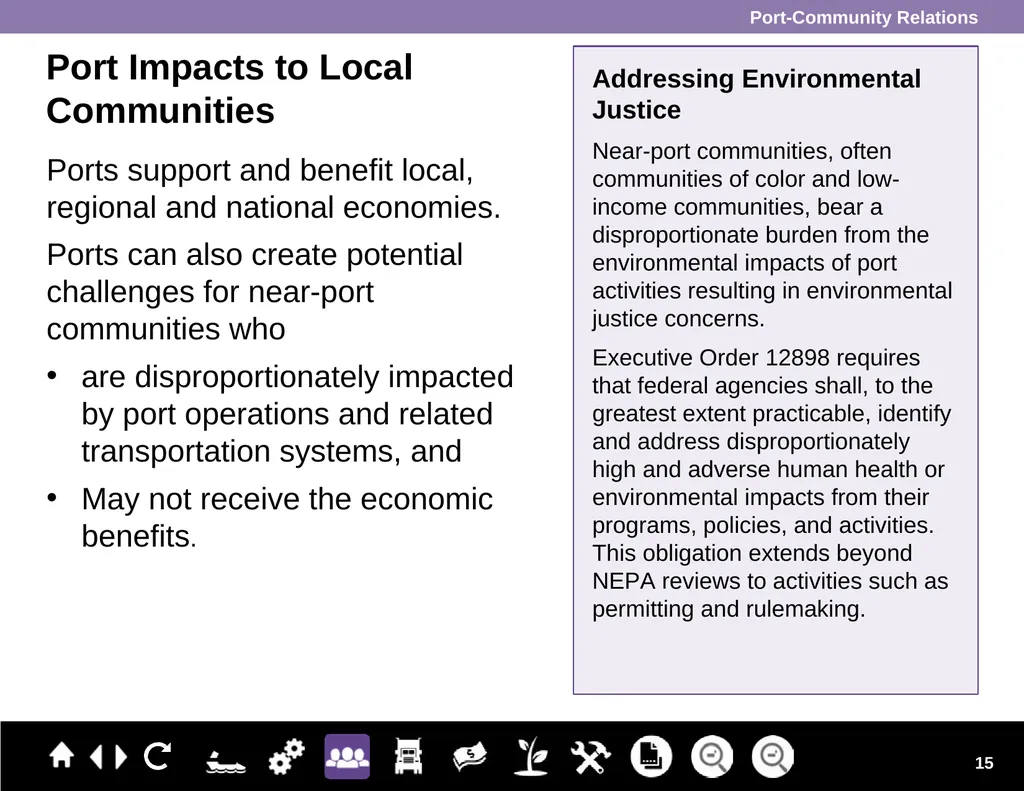
Port-Community Relations Port Impacts to Local Communities
Ports support and benefit local, regional and national economies.
Ports can also create potential challenges for near-port communities who
are disproportionately impacted by port operations and related transportation systems, and
May not receive the economic benefits. Addressing Environmental Justice
Near-port communities, often communities of color and low-income communities, bear a disproportionate burden from the environmental impacts of port activities resulting in environmental justice concerns.
Executive Order 12898 requires that federal agencies shall, to the greatest extent practicable, identify and address disproportionately high and adverse human health or environmental impacts from their programs, policies, and activities. This obligation extends beyond NEPA reviews to activities such as permitting and rulemaking. 15<br>
Ports support and benefit local, regional and national economies.
Ports can also create potential challenges for near-port communities who
are disproportionately impacted by port operations and related transportation systems, and
May not receive the economic benefits. Addressing Environmental Justice
Near-port communities, often communities of color and low-income communities, bear a disproportionate burden from the environmental impacts of port activities resulting in environmental justice concerns.
Executive Order 12898 requires that federal agencies shall, to the greatest extent practicable, identify and address disproportionately high and adverse human health or environmental impacts from their programs, policies, and activities. This obligation extends beyond NEPA reviews to activities such as permitting and rulemaking. 15<br>
16
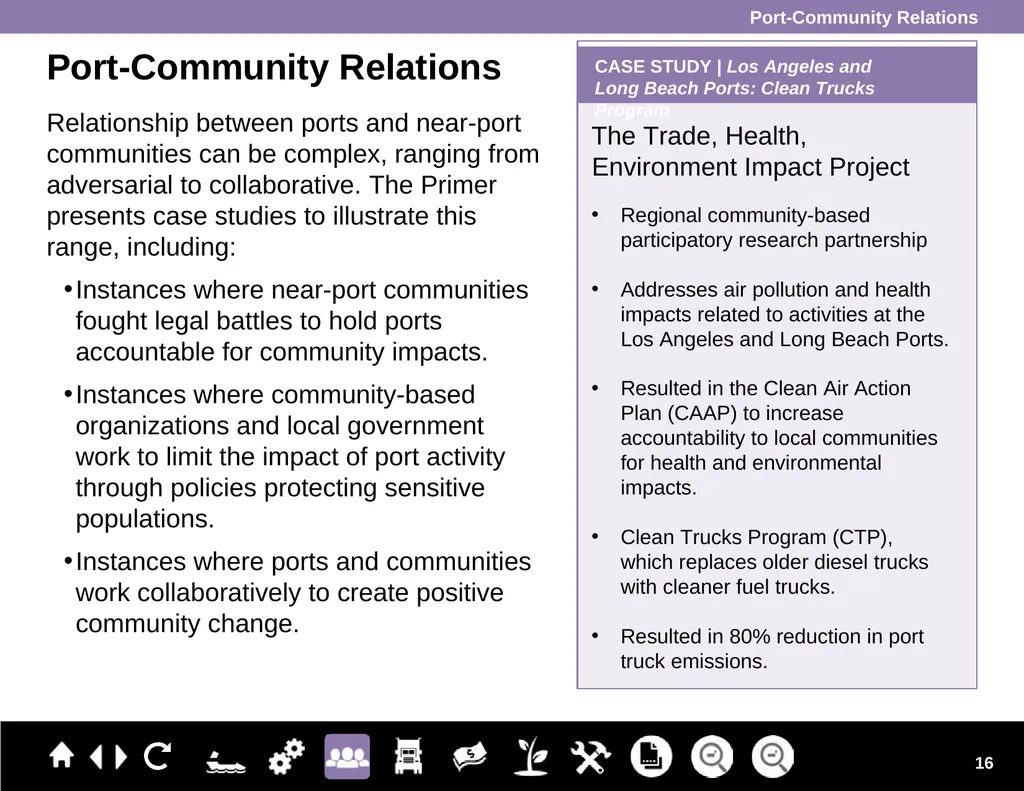
Port-Community Relations Port-Community Relations
Relationship between ports and near-port communities can be complex, ranging from adversarial to collaborative. The Primer presents case studies to illustrate this range, including:
Instances where near-port communities fought legal battles to hold ports accountable for community impacts.
Instances where community-based organizations and local government work to limit the impact of port activity through policies protecting sensitive populations.
Instances where ports and communities work collaboratively to create positive community change. The Trade, Health, Environment Impact Project
Regional community-based participatory research partnership
Addresses air pollution and health impacts related to activities at the Los Angeles and Long Beach Ports.
Resulted in the Clean Air Action Plan (CAAP) to increase accountability to local communities for health and environmental impacts.
Clean Trucks Program (CTP), which replaces older diesel trucks with cleaner fuel trucks.
Resulted in 80% reduction in port truck emissions. CASE STUDY | Los Angeles and Long Beach Ports: Clean Trucks Program 16<br>
Relationship between ports and near-port communities can be complex, ranging from adversarial to collaborative. The Primer presents case studies to illustrate this range, including:
Instances where near-port communities fought legal battles to hold ports accountable for community impacts.
Instances where community-based organizations and local government work to limit the impact of port activity through policies protecting sensitive populations.
Instances where ports and communities work collaboratively to create positive community change. The Trade, Health, Environment Impact Project
Regional community-based participatory research partnership
Addresses air pollution and health impacts related to activities at the Los Angeles and Long Beach Ports.
Resulted in the Clean Air Action Plan (CAAP) to increase accountability to local communities for health and environmental impacts.
Clean Trucks Program (CTP), which replaces older diesel trucks with cleaner fuel trucks.
Resulted in 80% reduction in port truck emissions. CASE STUDY | Los Angeles and Long Beach Ports: Clean Trucks Program 16<br>
17
5.0 Land Use and Transportation 17<br>
18
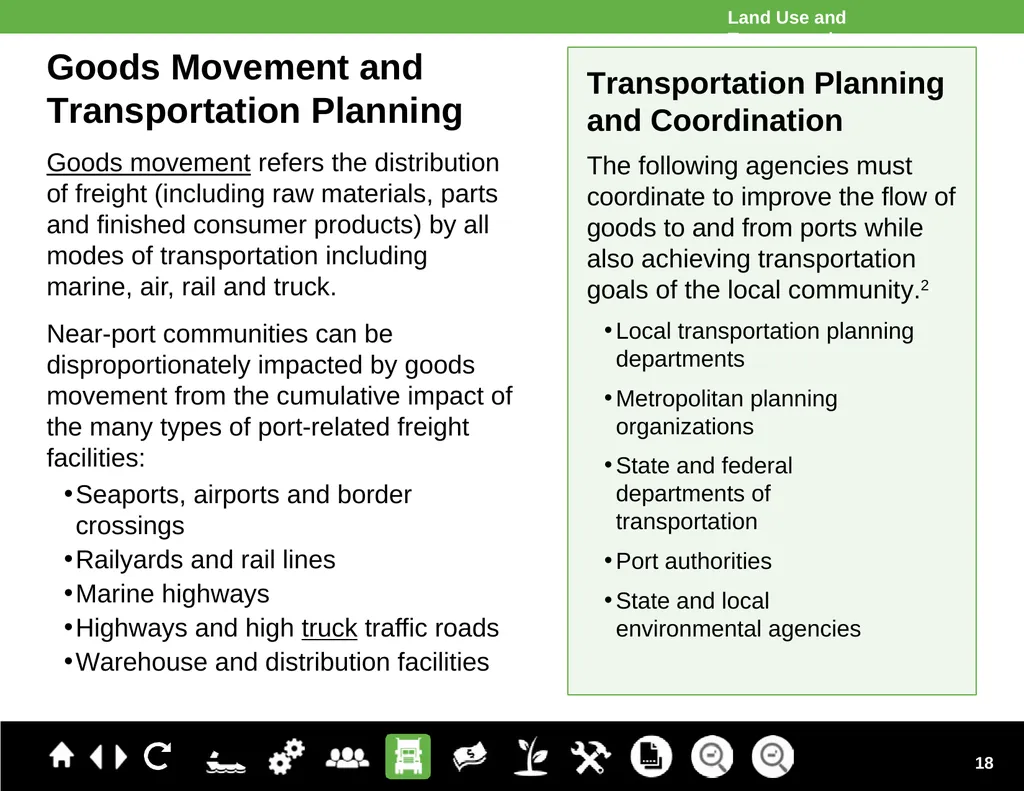
Land Use and Transportation Goods Movement and Transportation Planning
Goods movement refers the distribution of freight (including raw materials, parts and finished consumer products) by all modes of transportation including marine, air, rail and truck.
Near-port communities can be disproportionately impacted by goods movement from the cumulative impact of the many types of port-related freight facilities:
Seaports, airports and border crossings
Railyards and rail lines
Marine highways
Highways and high truck traffic roads
Warehouse and distribution facilities Transportation Planning and Coordination
The following agencies must coordinate to improve the flow of goods to and from ports while also achieving transportation goals of the local community.2
Local transportation planning departments
Metropolitan planning organizations
State and federal departments of transportation
Port authorities
State and local environmental agencies 18<br>
Goods movement refers the distribution of freight (including raw materials, parts and finished consumer products) by all modes of transportation including marine, air, rail and truck.
Near-port communities can be disproportionately impacted by goods movement from the cumulative impact of the many types of port-related freight facilities:
Seaports, airports and border crossings
Railyards and rail lines
Marine highways
Highways and high truck traffic roads
Warehouse and distribution facilities Transportation Planning and Coordination
The following agencies must coordinate to improve the flow of goods to and from ports while also achieving transportation goals of the local community.2
Local transportation planning departments
Metropolitan planning organizations
State and federal departments of transportation
Port authorities
State and local environmental agencies 18<br>
19
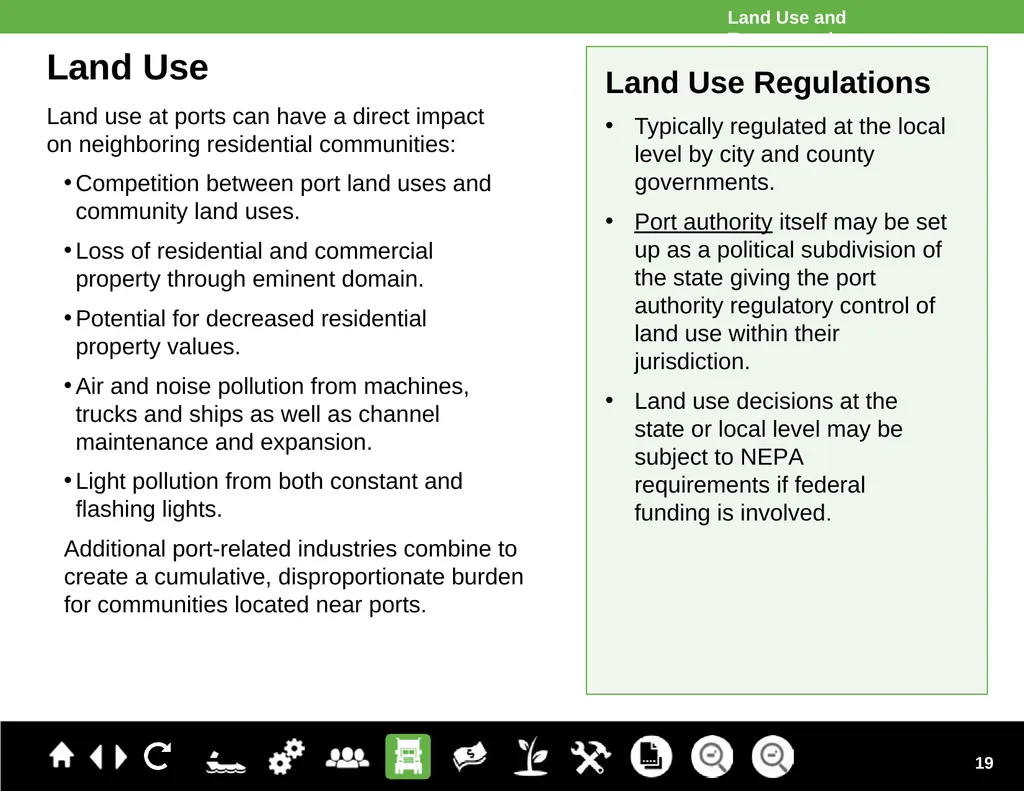
Land Use and Transportation Land Use
Land use at ports can have a direct impact on neighboring residential communities:
Competition between port land uses and community land uses.
Loss of residential and commercial property through eminent domain.
Potential for decreased residential property values.
Air and noise pollution from machines, trucks and ships as well as channel maintenance and expansion.
Light pollution from both constant and flashing lights.
Additional port-related industries combine to create a cumulative, disproportionate burden for communities located near ports. Land Use Regulations
Typically regulated at the local level by city and county governments.
Port authority itself may be set up as a political subdivision of the state giving the port authority regulatory control of land use within their jurisdiction.
Land use decisions at the state or local level may be subject to NEPA requirements if federal funding is involved. 19<br>
Land use at ports can have a direct impact on neighboring residential communities:
Competition between port land uses and community land uses.
Loss of residential and commercial property through eminent domain.
Potential for decreased residential property values.
Air and noise pollution from machines, trucks and ships as well as channel maintenance and expansion.
Light pollution from both constant and flashing lights.
Additional port-related industries combine to create a cumulative, disproportionate burden for communities located near ports. Land Use Regulations
Typically regulated at the local level by city and county governments.
Port authority itself may be set up as a political subdivision of the state giving the port authority regulatory control of land use within their jurisdiction.
Land use decisions at the state or local level may be subject to NEPA requirements if federal funding is involved. 19<br>
20
Land Use and Transportation Community Interests
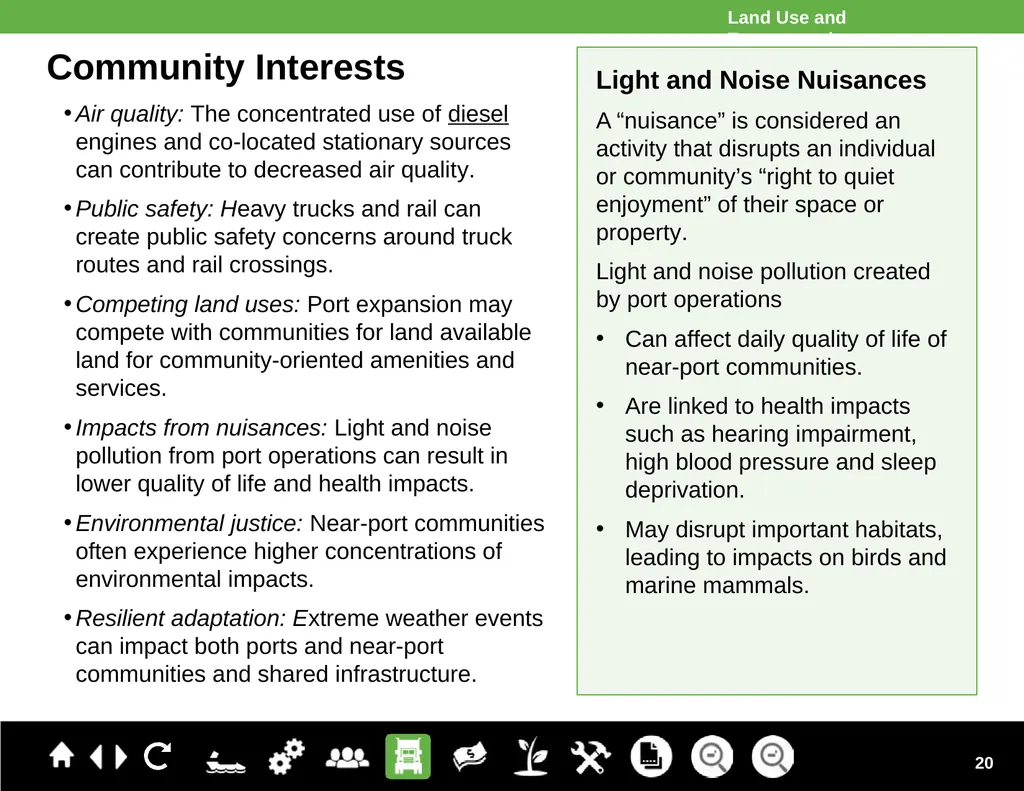
Air quality: The concentrated use of diesel engines and co-located stationary sources can contribute to decreased air quality.
Public safety: Heavy trucks and rail can create public safety concerns around truck routes and rail crossings.
Competing land uses: Port expansion may compete with communities for land available land for community-oriented amenities and services.
Impacts from nuisances: Light and noise pollution from port operations can result in lower quality of life and health impacts.
Environmental justice: Near-port communities often experience higher concentrations of environmental impacts.
Resilient adaptation: Extreme weather events can impact both ports and near-port communities and shared infrastructure. Light and Noise Nuisances
A “nuisance” is considered an activity that disrupts an individual or community’s “right to quiet enjoyment” of their space or property.
Light and noise pollution created by port operations
Can affect daily quality of life of near-port communities.
Are linked to health impacts such as hearing impairment, high blood pressure and sleep deprivation.
May disrupt important habitats, leading to impacts on birds and marine mammals. 20<br>
Air quality: The concentrated use of diesel engines and co-located stationary sources can contribute to decreased air quality.
Public safety: Heavy trucks and rail can create public safety concerns around truck routes and rail crossings.
Competing land uses: Port expansion may compete with communities for land available land for community-oriented amenities and services.
Impacts from nuisances: Light and noise pollution from port operations can result in lower quality of life and health impacts.
Environmental justice: Near-port communities often experience higher concentrations of environmental impacts.
Resilient adaptation: Extreme weather events can impact both ports and near-port communities and shared infrastructure. Light and Noise Nuisances
A “nuisance” is considered an activity that disrupts an individual or community’s “right to quiet enjoyment” of their space or property.
Light and noise pollution created by port operations
Can affect daily quality of life of near-port communities.
Are linked to health impacts such as hearing impairment, high blood pressure and sleep deprivation.
May disrupt important habitats, leading to impacts on birds and marine mammals. 20<br>
21
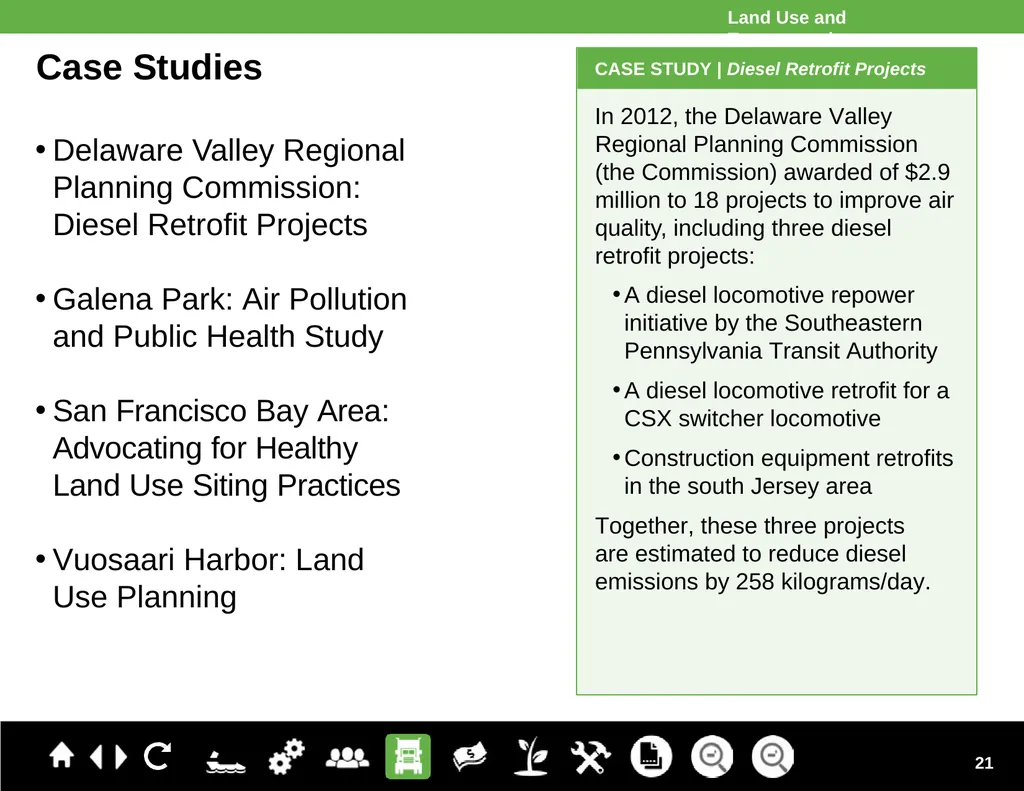
Land Use and Transportation Case Studies
Delaware Valley Regional Planning Commission: Diesel Retrofit Projects
Galena Park: Air Pollution and Public Health Study
San Francisco Bay Area: Advocating for Healthy Land Use Siting Practices
Vuosaari Harbor: Land Use Planning In 2012, the Delaware Valley Regional Planning Commission (the Commission) awarded of $2.9 million to 18 projects to improve air quality, including three diesel retrofit projects:
A diesel locomotive repower initiative by the Southeastern Pennsylvania Transit Authority
A diesel locomotive retrofit for a CSX switcher locomotive
Construction equipment retrofits in the south Jersey area
Together, these three projects are estimated to reduce diesel emissions by 258 kilograms/day. CASE STUDY | Diesel Retrofit Projects 21<br>
Delaware Valley Regional Planning Commission: Diesel Retrofit Projects
Galena Park: Air Pollution and Public Health Study
San Francisco Bay Area: Advocating for Healthy Land Use Siting Practices
Vuosaari Harbor: Land Use Planning In 2012, the Delaware Valley Regional Planning Commission (the Commission) awarded of $2.9 million to 18 projects to improve air quality, including three diesel retrofit projects:
A diesel locomotive repower initiative by the Southeastern Pennsylvania Transit Authority
A diesel locomotive retrofit for a CSX switcher locomotive
Construction equipment retrofits in the south Jersey area
Together, these three projects are estimated to reduce diesel emissions by 258 kilograms/day. CASE STUDY | Diesel Retrofit Projects 21<br>
22
6.0 Local and Regional Economy 22<br>
23
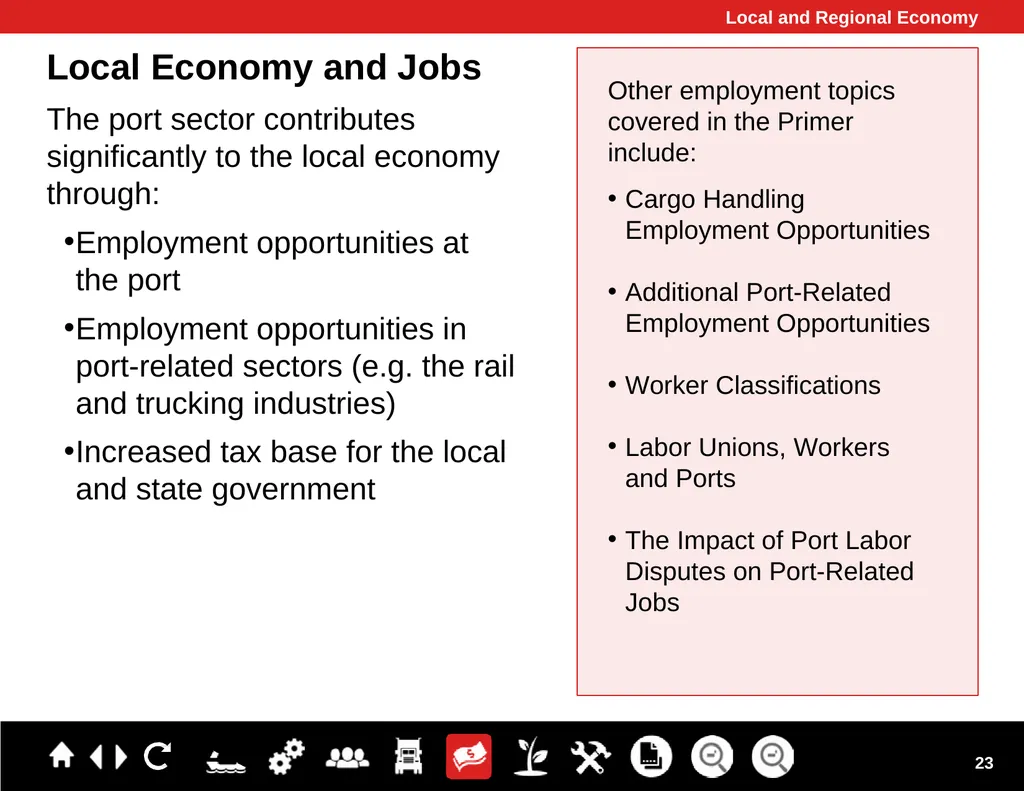
Local and Regional Economy The port sector contributes significantly to the local economy through:
Employment opportunities at the port
Employment opportunities in port-related sectors (e.g. the rail and trucking industries)
Increased tax base for the local and state government Local Economy and Jobs 23 Other employment topics covered in the Primer include:
Cargo Handling Employment Opportunities
Additional Port-Related Employment Opportunities
Worker Classifications
Labor Unions, Workers and Ports
The Impact of Port Labor Disputes on Port-Related Jobs<br>
Employment opportunities at the port
Employment opportunities in port-related sectors (e.g. the rail and trucking industries)
Increased tax base for the local and state government Local Economy and Jobs 23 Other employment topics covered in the Primer include:
Cargo Handling Employment Opportunities
Additional Port-Related Employment Opportunities
Worker Classifications
Labor Unions, Workers and Ports
The Impact of Port Labor Disputes on Port-Related Jobs<br>
24
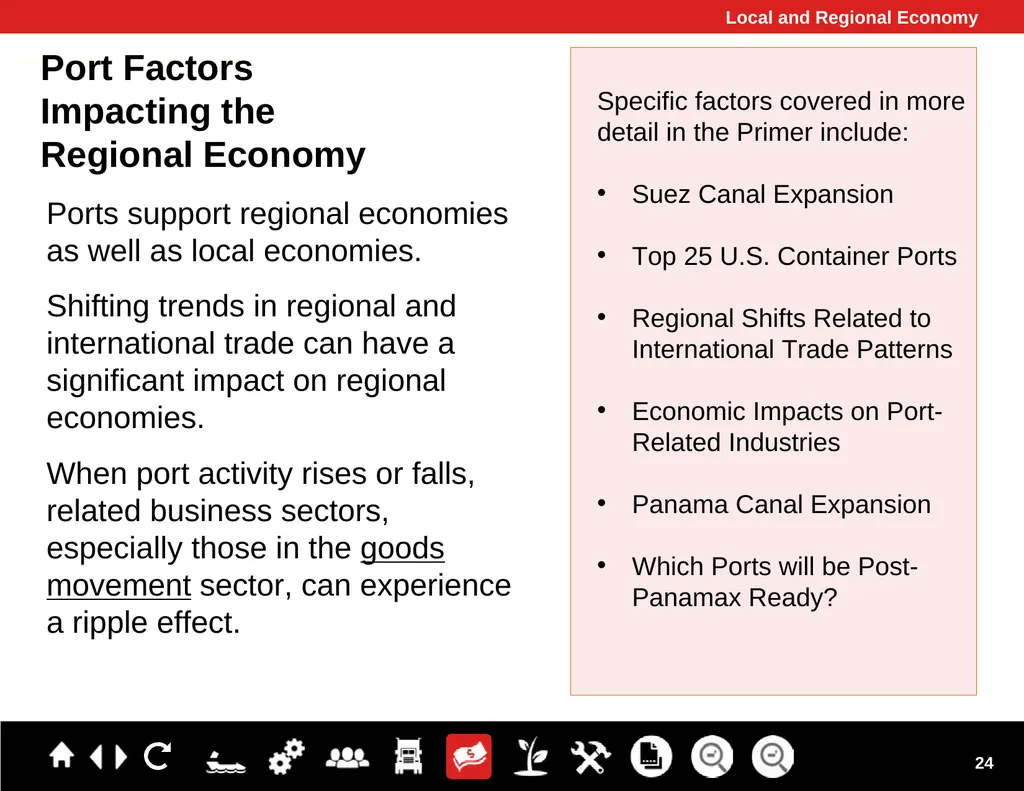
Local and Regional Economy Port Factors Impacting the Regional Economy
Ports support regional economies as well as local economies.
Shifting trends in regional and international trade can have a significant impact on regional economies.
When port activity rises or falls, related business sectors, especially those in the goods movement sector, can experience a ripple effect. Specific factors covered in more detail in the Primer include:
Suez Canal Expansion
Top 25 U.S. Container Ports
Regional Shifts Related to International Trade Patterns
Economic Impacts on Port-Related Industries
Panama Canal Expansion
Which Ports will be Post-Panamax Ready? 24<br>
Ports support regional economies as well as local economies.
Shifting trends in regional and international trade can have a significant impact on regional economies.
When port activity rises or falls, related business sectors, especially those in the goods movement sector, can experience a ripple effect. Specific factors covered in more detail in the Primer include:
Suez Canal Expansion
Top 25 U.S. Container Ports
Regional Shifts Related to International Trade Patterns
Economic Impacts on Port-Related Industries
Panama Canal Expansion
Which Ports will be Post-Panamax Ready? 24<br>
25
Local and Regional Economy
Potential Community Interests
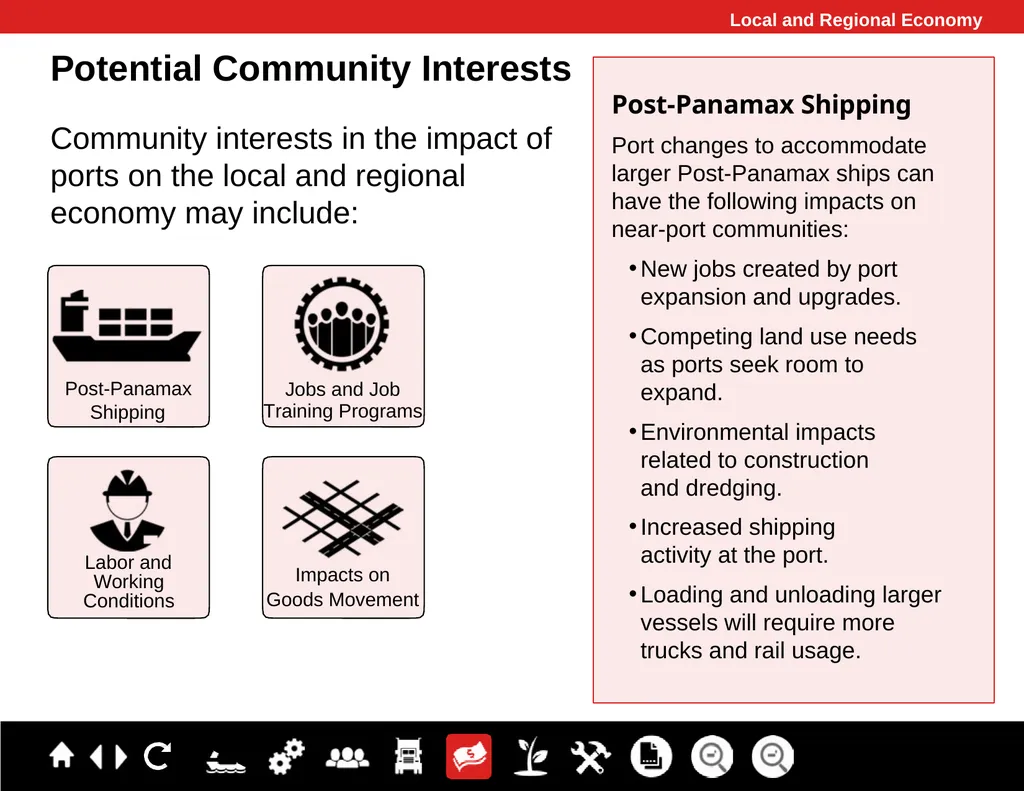
Community interests in the impact of ports on the local and regional economy may include: Post-Panamax Shipping
Port changes to accommodate larger Post-Panamax ships can have the following impacts on near-port communities:
New jobs created by port expansion and upgrades.
Competing land use needs as ports seek room to expand.
Environmental impacts related to construction and dredging.
Increased shipping activity at the port.
Loading and unloading larger vessels will require more trucks and rail usage. Post-Panamax Shipping Jobs and Job Training Programs Impacts on Goods Movement Labor and Working Conditions<br>
Potential Community Interests
Community interests in the impact of ports on the local and regional economy may include: Post-Panamax Shipping
Port changes to accommodate larger Post-Panamax ships can have the following impacts on near-port communities:
New jobs created by port expansion and upgrades.
Competing land use needs as ports seek room to expand.
Environmental impacts related to construction and dredging.
Increased shipping activity at the port.
Loading and unloading larger vessels will require more trucks and rail usage. Post-Panamax Shipping Jobs and Job Training Programs Impacts on Goods Movement Labor and Working Conditions<br>
26
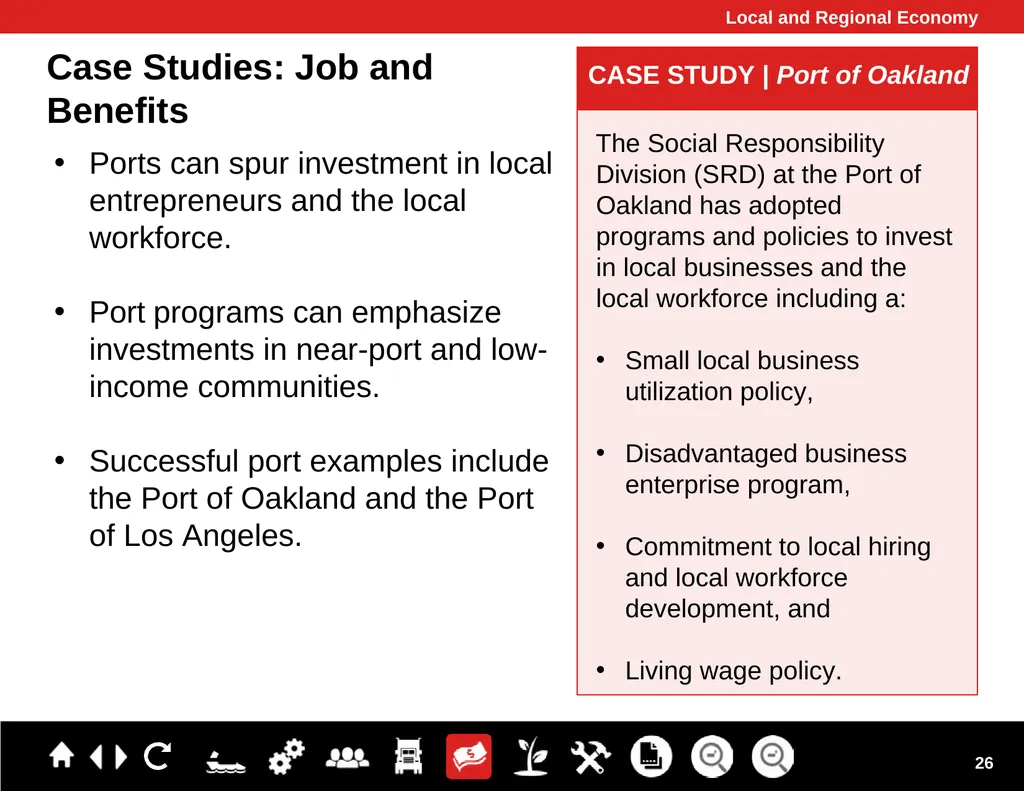
Local and Regional Economy Ports can spur investment in local entrepreneurs and the local workforce.
Port programs can emphasize investments in near-port and low-income communities.
Successful port examples include the Port of Oakland and the Port of Los Angeles. Case Studies: Job and Benefits The Social Responsibility Division (SRD) at the Port of Oakland has adopted programs and policies to invest in local businesses and the local workforce including a:
Small local business utilization policy,
Disadvantaged business enterprise program,
Commitment to local hiring and local workforce development, and
Living wage policy. CASE STUDY | Port of Oakland 26<br>
Port programs can emphasize investments in near-port and low-income communities.
Successful port examples include the Port of Oakland and the Port of Los Angeles. Case Studies: Job and Benefits The Social Responsibility Division (SRD) at the Port of Oakland has adopted programs and policies to invest in local businesses and the local workforce including a:
Small local business utilization policy,
Disadvantaged business enterprise program,
Commitment to local hiring and local workforce development, and
Living wage policy. CASE STUDY | Port of Oakland 26<br>
27
7.0 Environmental Impacts 27<br>
28
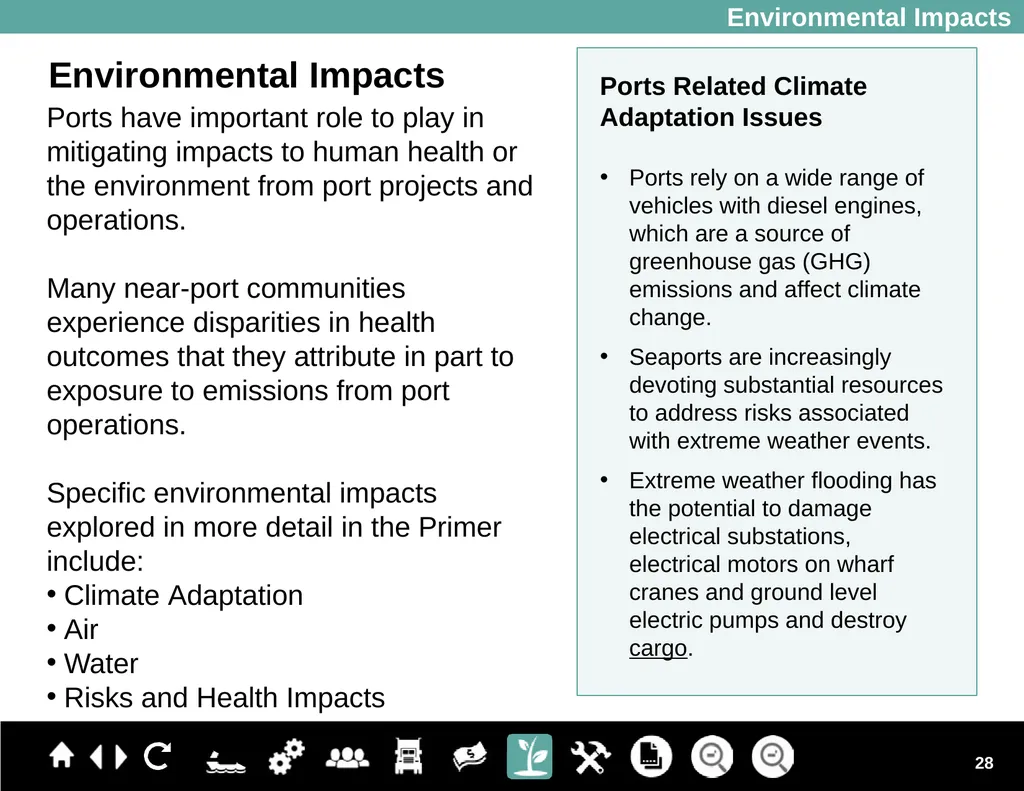
Environmental Impacts Ports have important role to play in mitigating impacts to human health or the environment from port projects and operations.
Many near-port communities experience disparities in health outcomes that they attribute in part to exposure to emissions from port operations.
Specific environmental impacts explored in more detail in the Primer include:
Climate Adaptation
Air
Water
Risks and Health Impacts Ports Related Climate Adaptation Issues
Ports rely on a wide range of vehicles with diesel engines, which are a source of greenhouse gas (GHG) emissions and affect climate change.
Seaports are increasingly devoting substantial resources to address risks associated with extreme weather events.
Extreme weather flooding has the potential to damage electrical substations, electrical motors on wharf cranes and ground level electric pumps and destroy cargo. 28 Environmental Impacts<br>
Many near-port communities experience disparities in health outcomes that they attribute in part to exposure to emissions from port operations.
Specific environmental impacts explored in more detail in the Primer include:
Climate Adaptation
Air
Water
Risks and Health Impacts Ports Related Climate Adaptation Issues
Ports rely on a wide range of vehicles with diesel engines, which are a source of greenhouse gas (GHG) emissions and affect climate change.
Seaports are increasingly devoting substantial resources to address risks associated with extreme weather events.
Extreme weather flooding has the potential to damage electrical substations, electrical motors on wharf cranes and ground level electric pumps and destroy cargo. 28 Environmental Impacts<br>
29
Environmental Impacts
Air Emissions
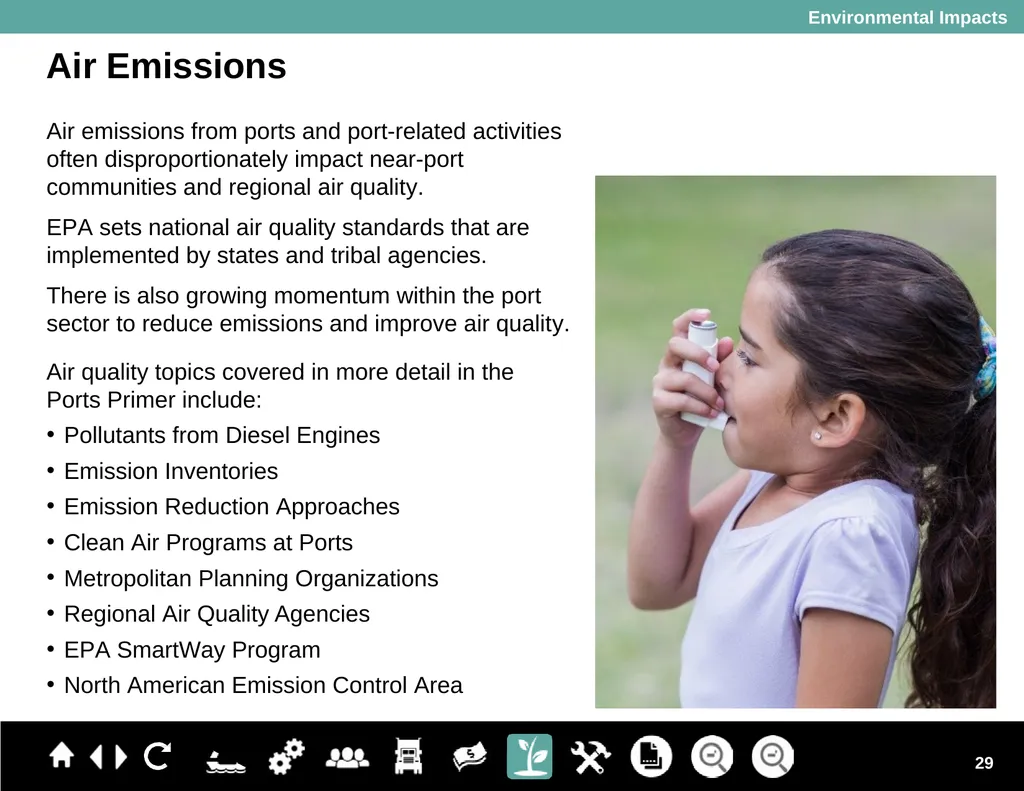
Air emissions from ports and port-related activities often disproportionately impact near-port communities and regional air quality.
EPA sets national air quality standards that are implemented by states and tribal agencies.
There is also growing momentum within the port sector to reduce emissions and improve air quality.
Air quality topics covered in more detail in the Ports Primer include:
Pollutants from Diesel Engines
Emission Inventories
Emission Reduction Approaches
Clean Air Programs at Ports
Metropolitan Planning Organizations
Regional Air Quality Agencies
EPA SmartWay Program
North American Emission Control Area 29<br>
Air Emissions
Air emissions from ports and port-related activities often disproportionately impact near-port communities and regional air quality.
EPA sets national air quality standards that are implemented by states and tribal agencies.
There is also growing momentum within the port sector to reduce emissions and improve air quality.
Air quality topics covered in more detail in the Ports Primer include:
Pollutants from Diesel Engines
Emission Inventories
Emission Reduction Approaches
Clean Air Programs at Ports
Metropolitan Planning Organizations
Regional Air Quality Agencies
EPA SmartWay Program
North American Emission Control Area 29<br>
30
Environmental Impacts Federal Environmental Regulations and Programs
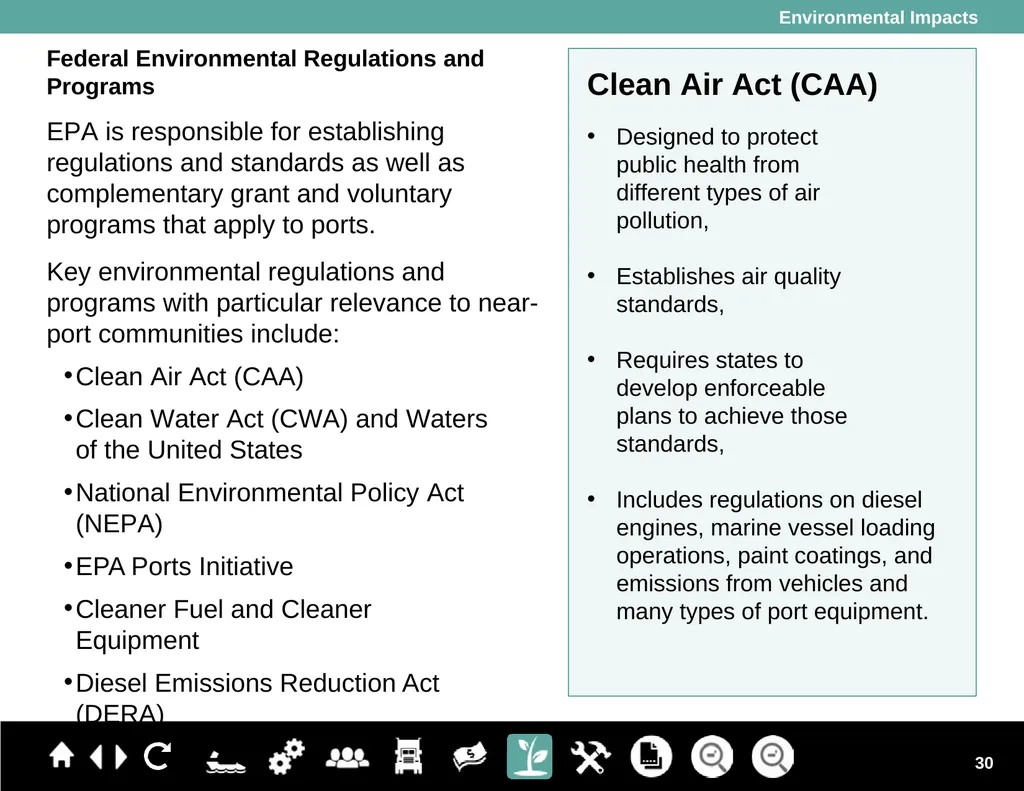
EPA is responsible for establishing regulations and standards as well as complementary grant and voluntary programs that apply to ports.
Key environmental regulations and programs with particular relevance to near-port communities include:
Clean Air Act (CAA)
Clean Water Act (CWA) and Waters of the United States
National Environmental Policy Act (NEPA)
EPA Ports Initiative
Cleaner Fuel and Cleaner Equipment
Diesel Emissions Reduction Act (DERA) Clean Air Act (CAA)
Designed to protect public health from different types of air pollution,
Establishes air quality standards,
Requires states to develop enforceable plans to achieve those standards,
Includes regulations on diesel engines, marine vessel loading operations, paint coatings, and emissions from vehicles and many types of port equipment. 30<br>
EPA is responsible for establishing regulations and standards as well as complementary grant and voluntary programs that apply to ports.
Key environmental regulations and programs with particular relevance to near-port communities include:
Clean Air Act (CAA)
Clean Water Act (CWA) and Waters of the United States
National Environmental Policy Act (NEPA)
EPA Ports Initiative
Cleaner Fuel and Cleaner Equipment
Diesel Emissions Reduction Act (DERA) Clean Air Act (CAA)
Designed to protect public health from different types of air pollution,
Establishes air quality standards,
Requires states to develop enforceable plans to achieve those standards,
Includes regulations on diesel engines, marine vessel loading operations, paint coatings, and emissions from vehicles and many types of port equipment. 30<br>
31
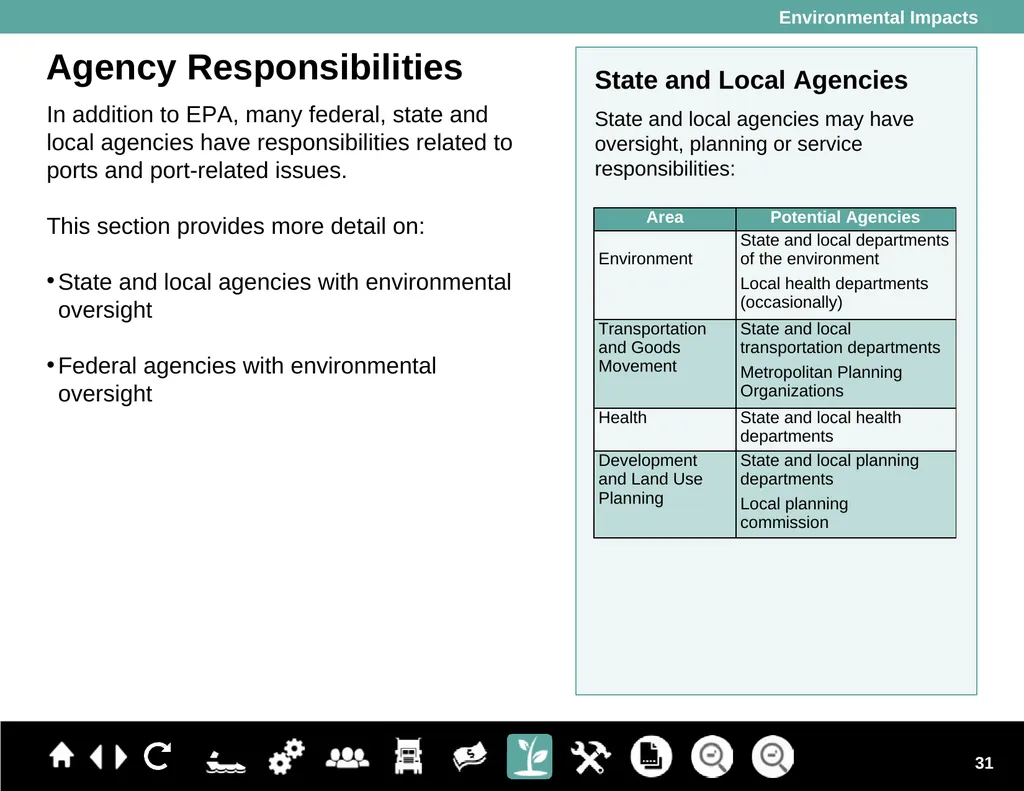
Environmental Impacts Agency Responsibilities In addition to EPA, many federal, state and local agencies have responsibilities related to ports and port-related issues.
This section provides more detail on:
State and local agencies with environmental oversight
Federal agencies with environmental oversight State and Local Agencies
State and local agencies may have oversight, planning or service responsibilities: 31<br>
This section provides more detail on:
State and local agencies with environmental oversight
Federal agencies with environmental oversight State and Local Agencies
State and local agencies may have oversight, planning or service responsibilities: 31<br>
32
Environmental Impacts
Potential Community Interests
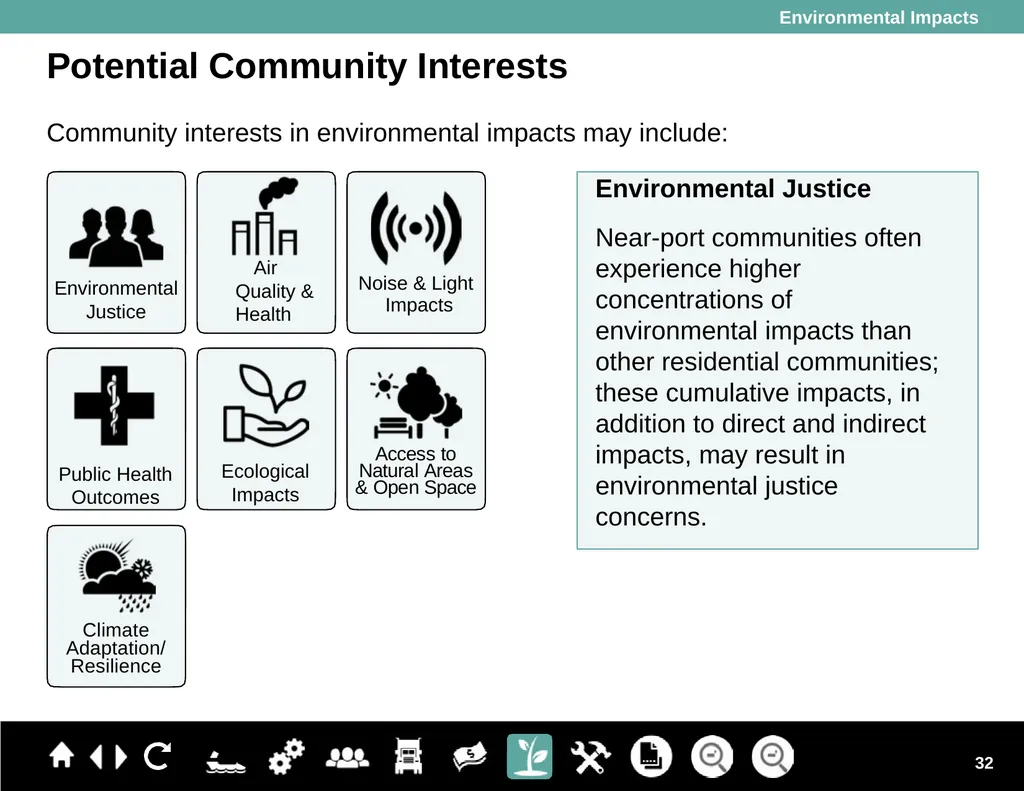
Community interests in environmental impacts may include: Environmental Justice Air Quality & Health Noise & Light Impacts Public Health Outcomes Ecological Impacts Access to Natural Areas & Open Space Environmental Justice
Near-port communities often experience higher concentrations of environmental impacts than other residential communities; these cumulative impacts, in addition to direct and indirect impacts, may result in environmental justice concerns. Climate Adaptation/ Resilience 32<br>
Potential Community Interests
Community interests in environmental impacts may include: Environmental Justice Air Quality & Health Noise & Light Impacts Public Health Outcomes Ecological Impacts Access to Natural Areas & Open Space Environmental Justice
Near-port communities often experience higher concentrations of environmental impacts than other residential communities; these cumulative impacts, in addition to direct and indirect impacts, may result in environmental justice concerns. Climate Adaptation/ Resilience 32<br>
33
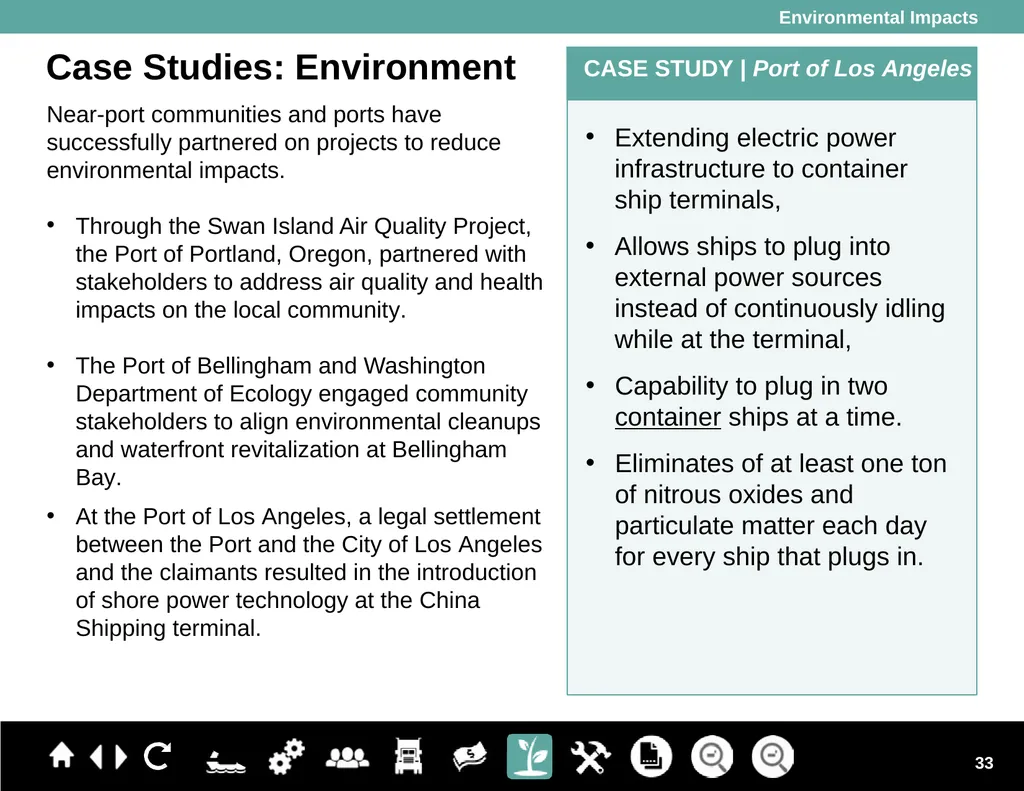
Environmental Impacts Case Studies: Environment Near-port communities and ports have successfully partnered on projects to reduce environmental impacts.
Through the Swan Island Air Quality Project, the Port of Portland, Oregon, partnered with stakeholders to address air quality and health impacts on the local community.
The Port of Bellingham and Washington Department of Ecology engaged community stakeholders to align environmental cleanups and waterfront revitalization at Bellingham Bay.
At the Port of Los Angeles, a legal settlement between the Port and the City of Los Angeles and the claimants resulted in the introduction of shore power technology at the China Shipping terminal. Extending electric power infrastructure to container ship terminals,
Allows ships to plug into external power sources instead of continuously idling while at the terminal,
Capability to plug in two container ships at a time.
Eliminates of at least one ton of nitrous oxides and particulate matter each day for every ship that plugs in. CASE STUDY | Port of Los Angeles 33<br>
Through the Swan Island Air Quality Project, the Port of Portland, Oregon, partnered with stakeholders to address air quality and health impacts on the local community.
The Port of Bellingham and Washington Department of Ecology engaged community stakeholders to align environmental cleanups and waterfront revitalization at Bellingham Bay.
At the Port of Los Angeles, a legal settlement between the Port and the City of Los Angeles and the claimants resulted in the introduction of shore power technology at the China Shipping terminal. Extending electric power infrastructure to container ship terminals,
Allows ships to plug into external power sources instead of continuously idling while at the terminal,
Capability to plug in two container ships at a time.
Eliminates of at least one ton of nitrous oxides and particulate matter each day for every ship that plugs in. CASE STUDY | Port of Los Angeles 33<br>
34
8.0 Tools and Resources 34<br>
35
Tools and Resources Scientific Data and Research Communities can demonstrate environmental concerns by providing scientific evidence of environmental impact.
Communities may be able to partner with a local agency to access existing local data and conduct their own analyses.
Technical support may be needed to conduct the data analysis desired by the community.
When local data are not available, communities may turn to existing studies to demonstrate the known and potential impacts of environmental conditions on human health and the environment. Bay Area Air Quality Management District: Local Data Analysis
The Bay Area Air Quality Management District provides air quality analyses for regional land use and transportation planning,
This regional agency applied their data and expertise to conduct air quality analyses for West Oakland, California when required by as part of Environmental Impact Reviews (EIRs),
The methodologies might be adapted by other agencies or technical service providers partnering with local communities. 35<br>
Communities may be able to partner with a local agency to access existing local data and conduct their own analyses.
Technical support may be needed to conduct the data analysis desired by the community.
When local data are not available, communities may turn to existing studies to demonstrate the known and potential impacts of environmental conditions on human health and the environment. Bay Area Air Quality Management District: Local Data Analysis
The Bay Area Air Quality Management District provides air quality analyses for regional land use and transportation planning,
This regional agency applied their data and expertise to conduct air quality analyses for West Oakland, California when required by as part of Environmental Impact Reviews (EIRs),
The methodologies might be adapted by other agencies or technical service providers partnering with local communities. 35<br>
36
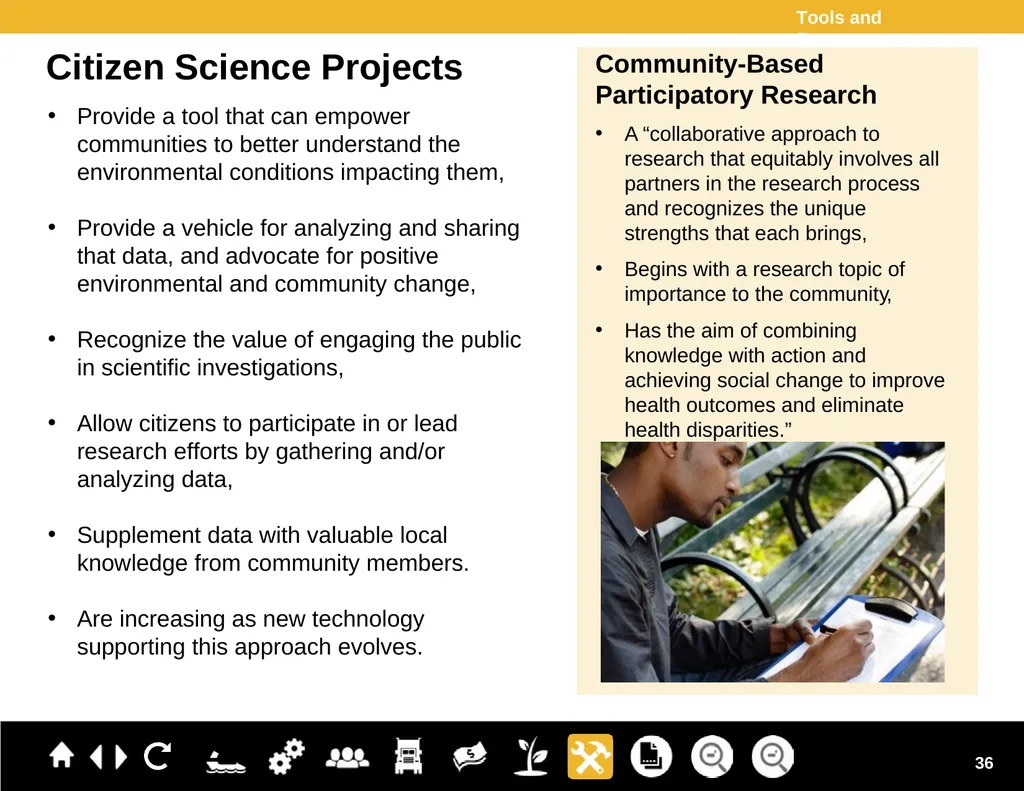
Tools and Resources Citizen Science Projects Provide a tool that can empower communities to better understand the environmental conditions impacting them,
Provide a vehicle for analyzing and sharing that data, and advocate for positive environmental and community change,
Recognize the value of engaging the public in scientific investigations,
Allow citizens to participate in or lead research efforts by gathering and/or analyzing data,
Supplement data with valuable local knowledge from community members.
Are increasing as new technology supporting this approach evolves. Community-Based Participatory Research
A “collaborative approach to research that equitably involves all partners in the research process and recognizes the unique strengths that each brings,
Begins with a research topic of importance to the community,
Has the aim of combining knowledge with action and achieving social change to improve health outcomes and eliminate health disparities.” 36<br>
Provide a vehicle for analyzing and sharing that data, and advocate for positive environmental and community change,
Recognize the value of engaging the public in scientific investigations,
Allow citizens to participate in or lead research efforts by gathering and/or analyzing data,
Supplement data with valuable local knowledge from community members.
Are increasing as new technology supporting this approach evolves. Community-Based Participatory Research
A “collaborative approach to research that equitably involves all partners in the research process and recognizes the unique strengths that each brings,
Begins with a research topic of importance to the community,
Has the aim of combining knowledge with action and achieving social change to improve health outcomes and eliminate health disparities.” 36<br>
37
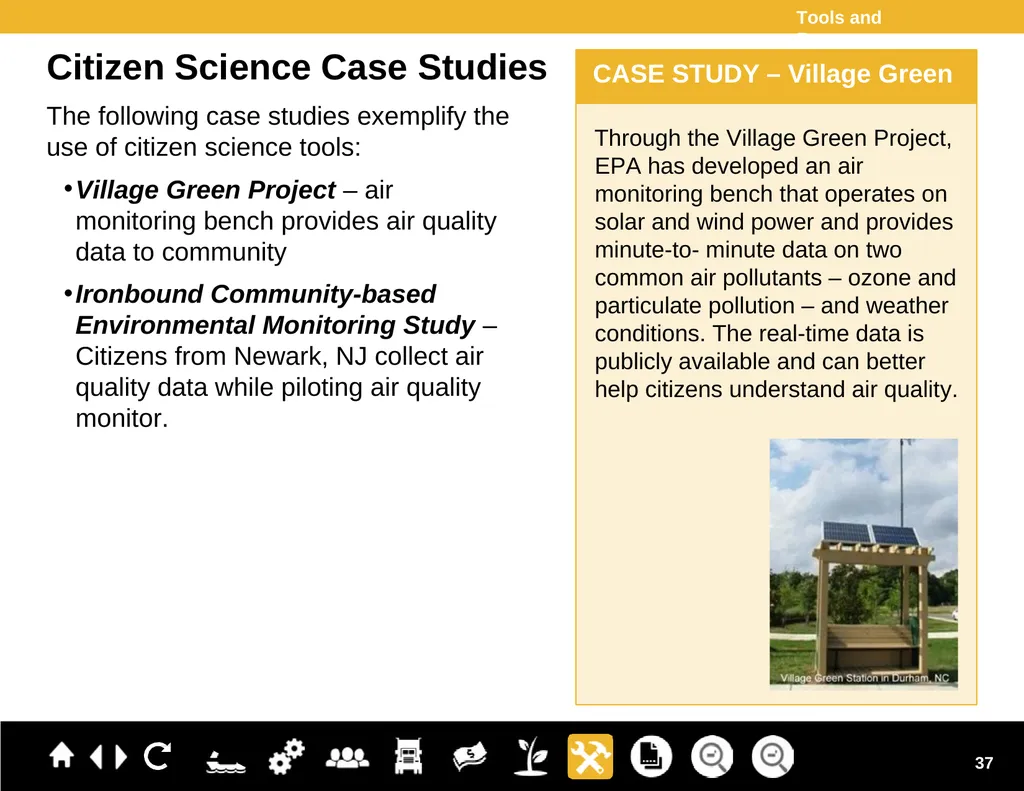
Tools and Resources Citizen Science Case Studies The following case studies exemplify the use of citizen science tools:
Village Green Project – air monitoring bench provides air quality data to community
Ironbound Community-based Environmental Monitoring Study – Citizens from Newark, NJ collect air quality data while piloting air quality monitor. Through the Village Green Project, EPA has developed an air monitoring bench that operates on solar and wind power and provides minute-to- minute data on two common air pollutants – ozone and particulate pollution – and weather conditions. The real-time data is publicly available and can better help citizens understand air quality. CASE STUDY – Village Green 37<br>
Village Green Project – air monitoring bench provides air quality data to community
Ironbound Community-based Environmental Monitoring Study – Citizens from Newark, NJ collect air quality data while piloting air quality monitor. Through the Village Green Project, EPA has developed an air monitoring bench that operates on solar and wind power and provides minute-to- minute data on two common air pollutants – ozone and particulate pollution – and weather conditions. The real-time data is publicly available and can better help citizens understand air quality. CASE STUDY – Village Green 37<br>
38
9.0 Appendix 38<br>
39
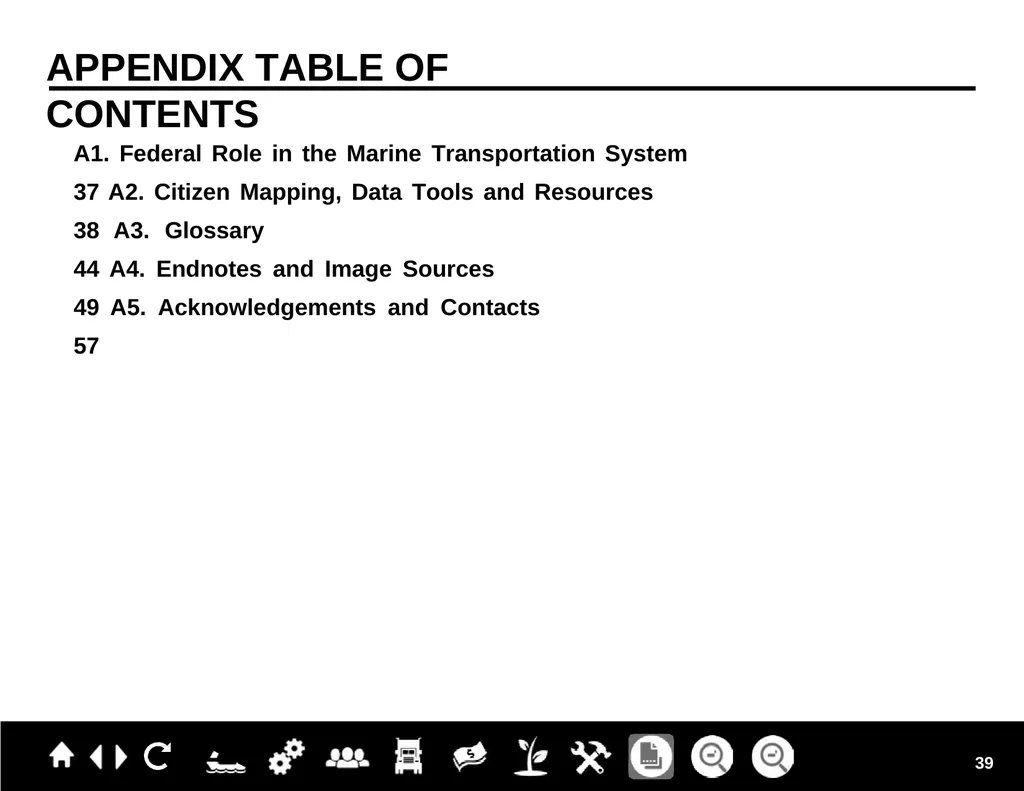
APPENDIX TABLE OF CONTENTS A1. Federal Role in the Marine Transportation System 37 A2. Citizen Mapping, Data Tools and Resources 38 A3. Glossary 44 A4. Endnotes and Image Sources 49 A5. Acknowledgements and Contacts 57 39<br>
40
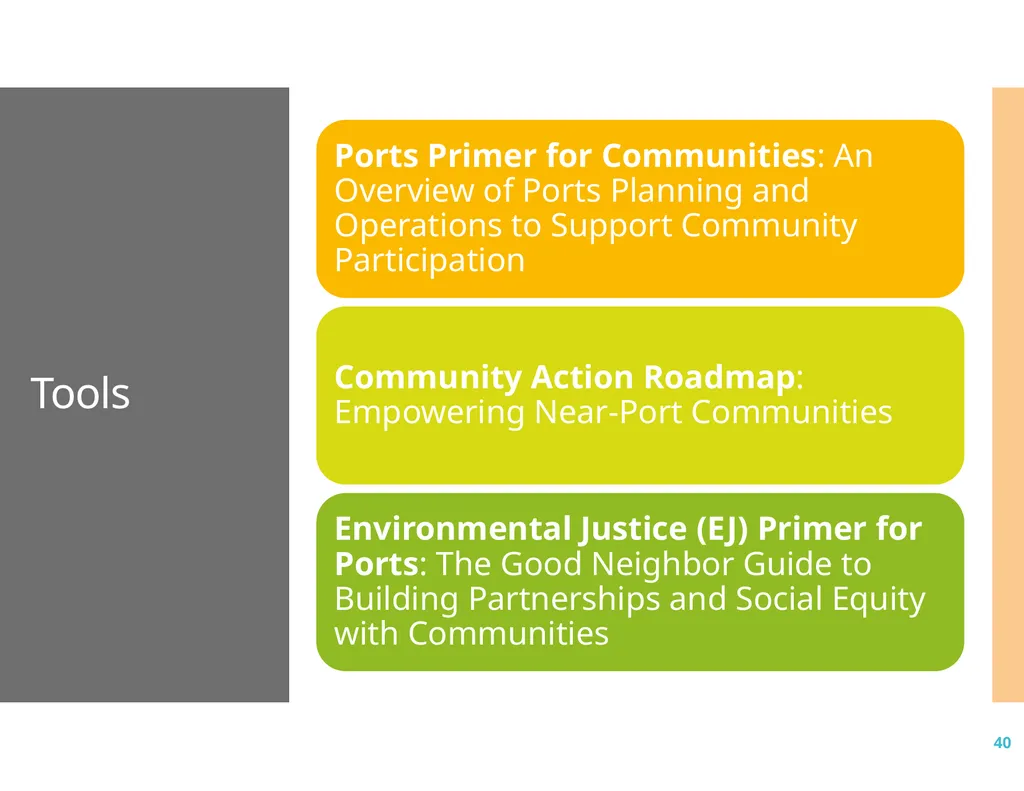
Tools 40<br>
41
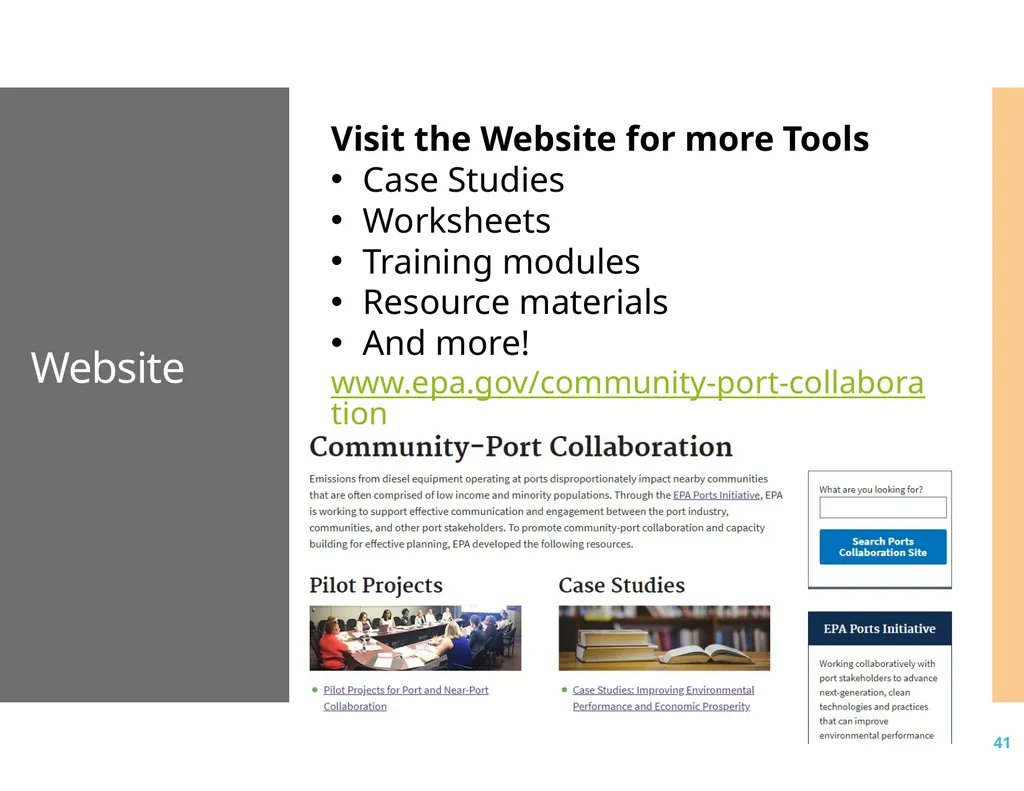
Website 41 Visit the Website for more Tools
Case Studies
Worksheets
Training modules
Resource materials
And more!
www.epa.gov/community-port-collaboration<br>
Case Studies
Worksheets
Training modules
Resource materials
And more!
www.epa.gov/community-port-collaboration<br>