
Post-Concussion: More than Return to Play Leslie
FD
Published · 49 slides · 0 views

1 / 1















Description
Post-Concussion: More than Return to Play Leslie Seymour, MD MPH Anna Gaichas, MS Jon Roesler, MS Mark Kinde MPH Minnesota Brain Injury Alliance Annual Professional Conference April 21, 2017 Brooklyn Center, MN Objectives 1)
Related Topics
Share
Embed code
Download this presentation From Below
"Post-Concussion: More than Return to Play Leslie" is the property of its rightful owner. Permission is granted to download and print the materials on this website for personal, non-commercial use only, and to display it on your personal computer provided you do not modify the materials and that you retain all copyright notices contained in the materials. By downloading content from our website, you accept the terms of this agreement.
Presentation Transcript
01
Post-Concussion:
More than Return to Play Leslie Seymour, MD MPH * Anna Gaichas, MS
Jon Roesler, MS * Mark Kinde MPH Minnesota Brain Injury Alliance
Annual Professional Conference
April 21, 2017 / Brooklyn Center, MN<br>
Jon Roesler, MS * Mark Kinde MPH Minnesota Brain Injury Alliance
Annual Professional Conference
April 21, 2017 / Brooklyn Center, MN<br>
02
Objectives 1) Understand the magnitude of the problem
2)Understand the impact concussion can have on learning.
2) Understand accommodations that can be made by the school.<br>
2)Understand the impact concussion can have on learning.
2) Understand accommodations that can be made by the school.<br>
03
Concussion “Any trauma induced alteration in mental status that may or may not include a loss of consciousness” *
* American Academy of Neurology<br>
* American Academy of Neurology<br>
04
What is a Concussion? A concussion can occur when a bump or blow to the head or hit to the body causes movement of the brain inside the skull
The brain can move back and forth or twist within the skull…<br>
The brain can move back and forth or twist within the skull…<br>
05
What is a Concussion?, continued Movement may stretch and damage brain cells, creating chemical changes in the brain
Chemical changes can result in slowing down of brain activity... can worsen over time
Outcomes can vary greatly, depending on gender, age, location of impact, force<br>
Chemical changes can result in slowing down of brain activity... can worsen over time
Outcomes can vary greatly, depending on gender, age, location of impact, force<br>
06
Diagnosis of concussion No general consensus
Of course there is not anything set in stone or published yet, but many of the researchers recommended and challenged providers to begin moving away from diagnosing concussion only based on symptoms, but also on neurological findings that research is beginning to show are consistent with a concussive injury, including the visual motor deficits (poor convergence, accommodation and saccades/smooth pursuit eye movement), cervical spine findings (whiplash) that often accompanies concussion, balance difficulty (abnormal Romberg, tandem walking or BESS testing), vestibular difficulty and/or autonomic dysfunction (abnormally high heart rates and blood pressures at rest and with mild physical activity).
Dr. Leddy has done a lot of the research on this and would be a good resource to read. He has multiple publications as main author and co-contributor.<br>
Of course there is not anything set in stone or published yet, but many of the researchers recommended and challenged providers to begin moving away from diagnosing concussion only based on symptoms, but also on neurological findings that research is beginning to show are consistent with a concussive injury, including the visual motor deficits (poor convergence, accommodation and saccades/smooth pursuit eye movement), cervical spine findings (whiplash) that often accompanies concussion, balance difficulty (abnormal Romberg, tandem walking or BESS testing), vestibular difficulty and/or autonomic dysfunction (abnormally high heart rates and blood pressures at rest and with mild physical activity).
Dr. Leddy has done a lot of the research on this and would be a good resource to read. He has multiple publications as main author and co-contributor.<br>
07
Hospitalized Concussion<br>
08
ED Treated Concussion<br>
09
What about out-patient?
Clinic, Urgent Care…<br>
Clinic, Urgent Care…<br>
10
Minnesota’s APCD Includes most payers of medical claims.
It incorporates data from Medicaid and Medicare as well as from commercial payers – thus permitting a rich and systematic analysis of health care delivery for the state.
Minnesota one of few states that also include claims from self-insured employers, making the data uniquely comprehensive and complete.<br>
It incorporates data from Medicaid and Medicare as well as from commercial payers – thus permitting a rich and systematic analysis of health care delivery for the state.
Minnesota one of few states that also include claims from self-insured employers, making the data uniquely comprehensive and complete.<br>
11
Out-patient Concussion<br>
12
Focusing on youth<br>
13
Return to... Return to Learn: Returning to school with full homework load and no accommodations
Return to Play: Returning to prior level of physical activity including return to gym and/or return to sport<br>
Return to Play: Returning to prior level of physical activity including return to gym and/or return to sport<br>
14
Return to Learn Overview Rest & Planning
Return gradually with support
Slowly work up to full time and full workload
Return to physical activities<br>
Return gradually with support
Slowly work up to full time and full workload
Return to physical activities<br>
15
THANKS! Contact Information
Leslie Seymour, MD, MPH
Phone: 651-201-5489
Email: leslie.seymour@state.mn.us<br>
Leslie Seymour, MD, MPH
Phone: 651-201-5489
Email: leslie.seymour@state.mn.us<br>
16
Presented by…<br>
17
Concussion Signs Loss of consciousness (rare in concussion/mild TBI)
Dazed or stunned
Confusion, forgets events before and after impact, difficulty with daily routines
Memory loss of events surrounding the injury
Slow to respond to questions<br>
Dazed or stunned
Confusion, forgets events before and after impact, difficulty with daily routines
Memory loss of events surrounding the injury
Slow to respond to questions<br>
18
Concussion Symptoms Headache/pressure in the head
Sleep problems (too much or too little)
Fatigued, sluggish, groggy
Nausea/Vomiting
Dizziness
Balance difficulty<br>
Sleep problems (too much or too little)
Fatigued, sluggish, groggy
Nausea/Vomiting
Dizziness
Balance difficulty<br>
19
Concussion Signs & Symptoms, continued Sensitivity to light/noise
Visual changes (difficulty focusing or double vision)
Tinnitus (ringing in the ears)
Difficulty remembering or concentrating
May feel irritable, anxious or depressed<br>
Visual changes (difficulty focusing or double vision)
Tinnitus (ringing in the ears)
Difficulty remembering or concentrating
May feel irritable, anxious or depressed<br>
20
Concussion Symptoms, continued Symptoms can be immediate or delayed (up to 24 to 48 hours after injury)
Some symptoms may go unnoticed until certain demands are placed (i.e. reading in class)
Delay in recognizing or experiencing symptoms can result in child returning to play or school immediately after injury... followed by abrupt increase in symptoms<br>
Some symptoms may go unnoticed until certain demands are placed (i.e. reading in class)
Delay in recognizing or experiencing symptoms can result in child returning to play or school immediately after injury... followed by abrupt increase in symptoms<br>
21
Concussion Symptoms, continued Severity of the impact doesn’t always correlate with the severity of symptoms
Symptoms often resolve over 10-14 days; however, recovery can be prolonged (weeks to months)<br>
Symptoms often resolve over 10-14 days; however, recovery can be prolonged (weeks to months)<br>
22
Second Impact Syndrome Second concussion sustained prior to complete healing of the initial concussion
The healing brain is more vulnerable
Outcomes are typically more severe than the initial injury
Can result in coma or death<br>
The healing brain is more vulnerable
Outcomes are typically more severe than the initial injury
Can result in coma or death<br>
23
Initial Concussion Care Remove immediately from physical & cognitive activity
Assess for concussion symptoms & other injuries
Gather injury information and document
Contact parent/guardian
Reevaluate after a period of rest and determine next steps
WHEN IN DOUBT - SIT THEM OUT!<br>
Assess for concussion symptoms & other injuries
Gather injury information and document
Contact parent/guardian
Reevaluate after a period of rest and determine next steps
WHEN IN DOUBT - SIT THEM OUT!<br>
24
After a Concussion has occurred… Gather information from family (medical documentation if available)
Notify school personnel (Concussion Care Team)
Identify a plan for return to school
Disseminate information to teachers and staff<br>
Notify school personnel (Concussion Care Team)
Identify a plan for return to school
Disseminate information to teachers and staff<br>
25
Roles of Concussion Care Team Identify points of contact within your school for:
Communicating with family, external providers and school team
Monitoring and documenting symptoms
Implementing and monitoring academic supports
Identify student’s contact person in school
Don’t forget to involve student & discuss their role<br>
Communicating with family, external providers and school team
Monitoring and documenting symptoms
Implementing and monitoring academic supports
Identify student’s contact person in school
Don’t forget to involve student & discuss their role<br>
26
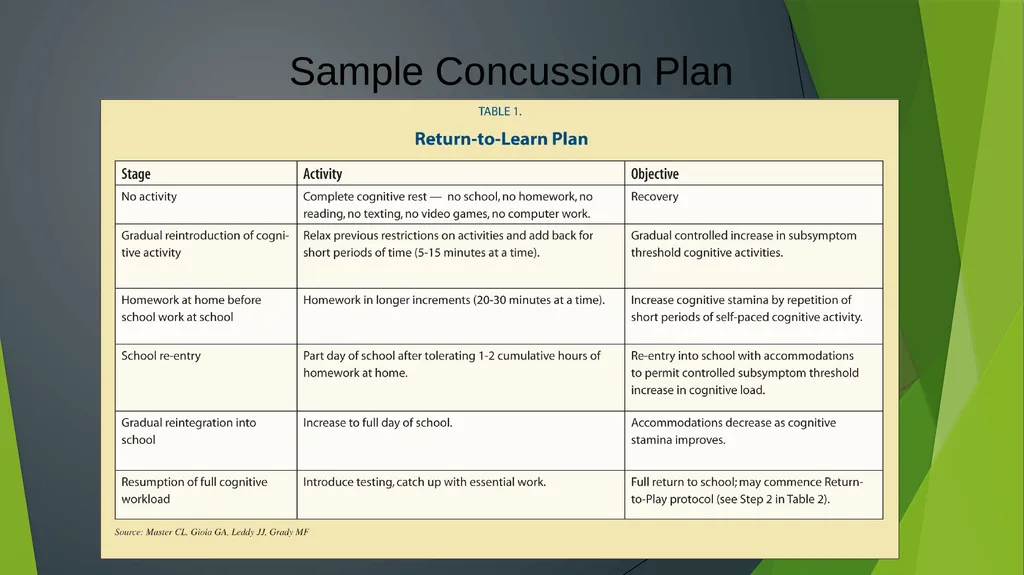
A Concussion Plan Goal: To get student back to previous activities, supported with proper accommodations to manage symptoms.
When to Return
School contacts
Specific accommodations
Timelines<br>
When to Return
School contacts
Specific accommodations
Timelines<br>
27
Sample Concussion Plan<br>
28
When to Return to School Extended time away from school after a concussion is rarely recommended
Factors to consider for return timeline:
Symptom severity
Other injuries
How much school has already been missed
Home environment
Return to school may include partial days as tolerated<br>
Factors to consider for return timeline:
Symptom severity
Other injuries
How much school has already been missed
Home environment
Return to school may include partial days as tolerated<br>
29
Examples of Accommodations for Concussion Shorter school days
Frequent breaks in quiet area - scheduled and as needed
Open hours/study halls
Avoid over-stimulating environments
Alternative passing times
Modify test format or setting
Sensory accommodations - visual, vestibular, auditory<br>
Frequent breaks in quiet area - scheduled and as needed
Open hours/study halls
Avoid over-stimulating environments
Alternative passing times
Modify test format or setting
Sensory accommodations - visual, vestibular, auditory<br>
30
Examples of Accommodations for Concussion, continued Drop or delay some classes
Adjust assignment length/homework
Consider pass/fail or alternate grading system
No physical education classes or recess
Consider no music class/band
No/reduced extra-curricular activities
Consider alternate transportation to/from school<br>
Adjust assignment length/homework
Consider pass/fail or alternate grading system
No physical education classes or recess
Consider no music class/band
No/reduced extra-curricular activities
Consider alternate transportation to/from school<br>
31
Communication Communicate concussion plan with team members:
Student/Family
Academic Team (Teachers, Nurse, Guidance Counselor, Administrators, Social Worker, Phy Ed teacher)
Athletic Team (Coach)
Medical Team (Primary Care Provider or Concussion Specialist, Athletic Trainer, Rehab team, Psychology)<br>
Student/Family
Academic Team (Teachers, Nurse, Guidance Counselor, Administrators, Social Worker, Phy Ed teacher)
Athletic Team (Coach)
Medical Team (Primary Care Provider or Concussion Specialist, Athletic Trainer, Rehab team, Psychology)<br>
32
Emotional Toll Consider emotional and social impact of injury and recovery
Isolation from peers
Impact on identity
Restricted from preferred activities
Academic stressors<br>
Isolation from peers
Impact on identity
Restricted from preferred activities
Academic stressors<br>
33
Challenges... “But they look fine…”
Symptoms - variable & individual
Information from medical providers
Communication with family
Pre-injury factors
No one plan fits all; if you have seen one concussion, you have only seen one concussion!<br>
Symptoms - variable & individual
Information from medical providers
Communication with family
Pre-injury factors
No one plan fits all; if you have seen one concussion, you have only seen one concussion!<br>
34
Keep in Mind Accommodations may be needed for days to months
Should be agreed upon by parents, school staff, medical providers, and student
Monitor progress and document
As symptoms decrease, supports can be removed gradually
No return to activity until cleared<br>
Should be agreed upon by parents, school staff, medical providers, and student
Monitor progress and document
As symptoms decrease, supports can be removed gradually
No return to activity until cleared<br>
35
School Team In addition to the student and family, the concussion care team in the school could consist of many multidisciplinary members<br>
36
In addition to the student and family, the concussion care team in the school could consist of many multidisciplinary members… School nurse
Speech therapist
504 coordinator or counselor
School psychologist
Classroom teacher
Special education teacher Athletic trainer
Coaches
Physical therapist
Occupational therapist
Administrator
District TBI specialist
Social worker<br>
Speech therapist
504 coordinator or counselor
School psychologist
Classroom teacher
Special education teacher Athletic trainer
Coaches
Physical therapist
Occupational therapist
Administrator
District TBI specialist
Social worker<br>
37
Spectrum of Supports:
Overlapping Domains
In the School Setting<br>
Overlapping Domains
In the School Setting<br>
38
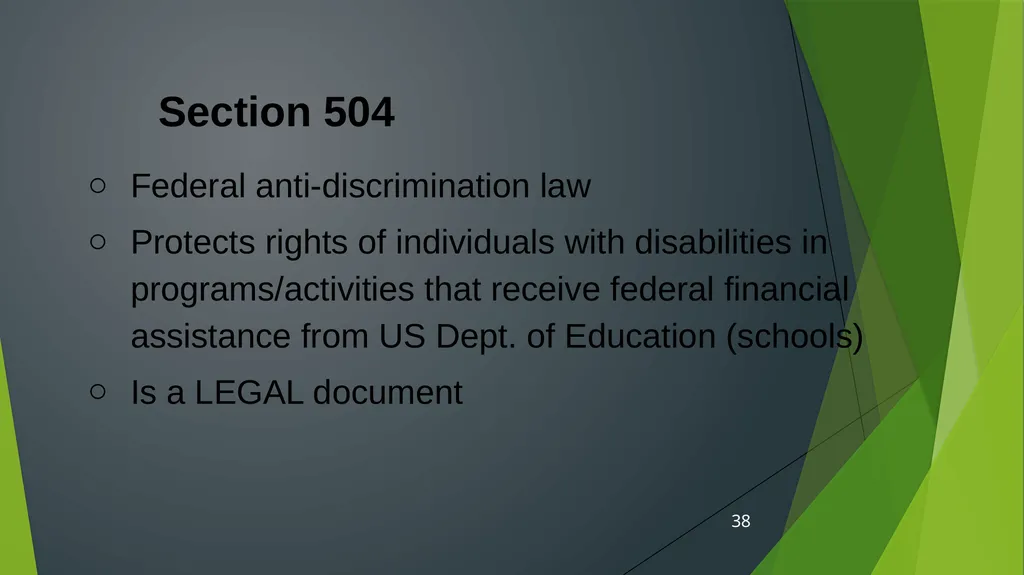
Federal anti-discrimination law
Protects rights of individuals with disabilities in programs/activities that receive federal financial assistance from US Dept. of Education (schools)
Is a LEGAL document 38 Section 504<br>
Protects rights of individuals with disabilities in programs/activities that receive federal financial assistance from US Dept. of Education (schools)
Is a LEGAL document 38 Section 504<br>
39
When to Consider an Evaluation & 504 Plan When symptoms don’t resolve after 4-6 weeks, or worsen with increased activity
When new symptoms occur over time
When a concussion plan doesn’t provide enough support
When there’s increased need for documentation<br>
When new symptoms occur over time
When a concussion plan doesn’t provide enough support
When there’s increased need for documentation<br>
40
CDC Concussion Signs & Symptoms Checklist
Evaluates:
Observed signs
Physical Symptoms
Cognitive Symptoms
Emotional Symptoms
https://stacks.cdc.gov/view/cdc/12353/<br>
Evaluates:
Observed signs
Physical Symptoms
Cognitive Symptoms
Emotional Symptoms
https://stacks.cdc.gov/view/cdc/12353/<br>
41
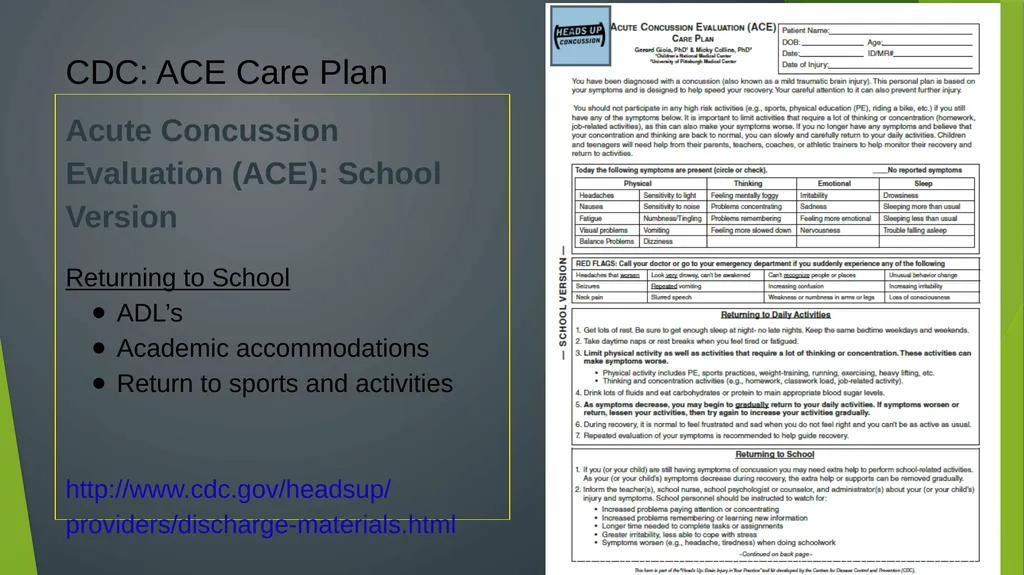
Acute Concussion Evaluation (ACE): School Version
Returning to School
ADL’s
Academic accommodations
Return to sports and activities
http://www.cdc.gov/headsup/providers/discharge-materials.html CDC: ACE Care Plan<br>
Returning to School
ADL’s
Academic accommodations
Return to sports and activities
http://www.cdc.gov/headsup/providers/discharge-materials.html CDC: ACE Care Plan<br>
42
CDC Fact Sheets: School Nurses, Parents, Educators, Coaches Heads Up to Schools:
Know Your Concussion ABCs
A—Assess the situation
B—Be alert for signs and symptoms
C—Contact a healthcare professional
www.cdc.gov/concussion<br>
Know Your Concussion ABCs
A—Assess the situation
B—Be alert for signs and symptoms
C—Contact a healthcare professional
www.cdc.gov/concussion<br>
43
Computerized Cognitive Testing ImPACT neurocognitive testing www.impacttest.com<br>
44
State & Local Resources (alpha order) Children’s Hospitals & Clinics of Minnesota www.childrensmn.org/services/care-specialties-departments/concussion-program/
Gillette Children’s Specialty Healthcare www.gillettechildrens.com
Hennepin County Medical Center: Pediatric Brain Injury Program www.hcmc.org/depts/PediatricBrainInjuryProgram.html<br>
Gillette Children’s Specialty Healthcare www.gillettechildrens.com
Hennepin County Medical Center: Pediatric Brain Injury Program www.hcmc.org/depts/PediatricBrainInjuryProgram.html<br>
45
State & Local Resources, continued MN Brain Injury Alliance www.braininjurymn.org
Mayo Clinic www.mayoclinic.org (search ‘concussion’)
MN Low Incidence Projects http://www.mnlowincidenceprojects.org/tbiConcussion.html
Minnesota Athletic Trainers Association www.mnata.com
(ADD AGENCIES & LINKS HERE)<br>
Mayo Clinic www.mayoclinic.org (search ‘concussion’)
MN Low Incidence Projects http://www.mnlowincidenceprojects.org/tbiConcussion.html
Minnesota Athletic Trainers Association www.mnata.com
(ADD AGENCIES & LINKS HERE)<br>
46
Additional Resources National Athletic Trainers Association www.nata.org
REAP program (Remove/Reduce, Educate, Adjust/Accommodate, Pace) http://rockymountainorthope-px.rtrk.com/util/forms/REAP.pdf
NASN Concussion Position Statement https://www.nasn.org/PolicyAdvocacy/PositionPapersandReports/NASNPositionStatementsFullView/tabid/462/smid/824/ArticleID/218/Default.aspx
(ADD AGENCIES & LINKS HERE)<br>
REAP program (Remove/Reduce, Educate, Adjust/Accommodate, Pace) http://rockymountainorthope-px.rtrk.com/util/forms/REAP.pdf
NASN Concussion Position Statement https://www.nasn.org/PolicyAdvocacy/PositionPapersandReports/NASNPositionStatementsFullView/tabid/462/smid/824/ArticleID/218/Default.aspx
(ADD AGENCIES & LINKS HERE)<br>
47
Additional Resources, continued The Center on Brain Injury Research & Training http://cbirt.org/
MN Department of Education (do they have TBI info)
MN State High School League Protocol
Any school nurse resources?
(ADD AGENCIES & LINKS HERE)<br>
MN Department of Education (do they have TBI info)
MN State High School League Protocol
Any school nurse resources?
(ADD AGENCIES & LINKS HERE)<br>
48
Electronic Resources Centers for Disease Control & Prevention: Concussion www.cdc.gov/concussion
Brainline www.brainline.org
Get Schooled on Concussions www.getschooledonconcussions.com
(ADD SOURCES/LINKS HERE)<br>
Brainline www.brainline.org
Get Schooled on Concussions www.getschooledonconcussions.com
(ADD SOURCES/LINKS HERE)<br>
49
This presentation was developed by the following
agency partners (alpha order): Children’s Hospitals and Clinics of Minnesota
Gillette Children’s Specialty Healthcare
Hennepin County Medical Center
Minnesota Athletic Trainer’s Association
Minnesota Department of Health
Minnesota Low Incidence Projects<br>
Gillette Children’s Specialty Healthcare
Hennepin County Medical Center
Minnesota Athletic Trainer’s Association
Minnesota Department of Health
Minnesota Low Incidence Projects<br>