
Post COVID Fatigue Management Produced by the
TD
Published · 39 slides · 0 views

1 / 1

Description
Post COVID Fatigue Management Produced by the Exeter CFSME Service Who we are We are a team of specialist Occupational Therapists who work for the CFSME Service. We cover North, Mid, and East Devon and Exeter. In line with the latest
Related Topics
Share
Embed code
Download this presentation From Below
"Post COVID Fatigue Management Produced by the" is the property of its rightful owner. Permission is granted to download and print the materials on this website for personal, non-commercial use only, and to display it on your personal computer provided you do not modify the materials and that you retain all copyright notices contained in the materials. By downloading content from our website, you accept the terms of this agreement.
Presentation Transcript
01
Post COVID Fatigue Management Produced by the Exeter CFS/ME Service<br>
02
Who we are We are a team of specialist Occupational Therapists who work for the CFS/ME Service. We cover North, Mid, and East Devon and Exeter.
In line with the latest government guidelines we have produced this presentation to support your post COVID recovery.
We have many years experience of fatigue management and are specialists in this field. In this presentation we will share some of the fatigue management strategies we use in clinic to help you in your recovery.<br>
In line with the latest government guidelines we have produced this presentation to support your post COVID recovery.
We have many years experience of fatigue management and are specialists in this field. In this presentation we will share some of the fatigue management strategies we use in clinic to help you in your recovery.<br>
03
Contents Fatigue is real
Over-activity / Underactivity
Maintaining factors / Drivers
Setting Stopping Points
Sleep and Activity Diaries
Rest
Eating well
Communication
Goal setting
Employment<br>
Over-activity / Underactivity
Maintaining factors / Drivers
Setting Stopping Points
Sleep and Activity Diaries
Rest
Eating well
Communication
Goal setting
Employment<br>
04
Fatigue is real Fatigue is a common symptom following a viral infection.
It is a continuing response to the COVID virus even though the infection has gone.
It is different than ordinary tiredness and can be physical and cognitive in nature. It can also affect your emotional wellbeing.
It is important to understand the impact it is having on yourself and to explain this to others.<br>
It is a continuing response to the COVID virus even though the infection has gone.
It is different than ordinary tiredness and can be physical and cognitive in nature. It can also affect your emotional wellbeing.
It is important to understand the impact it is having on yourself and to explain this to others.<br>
05
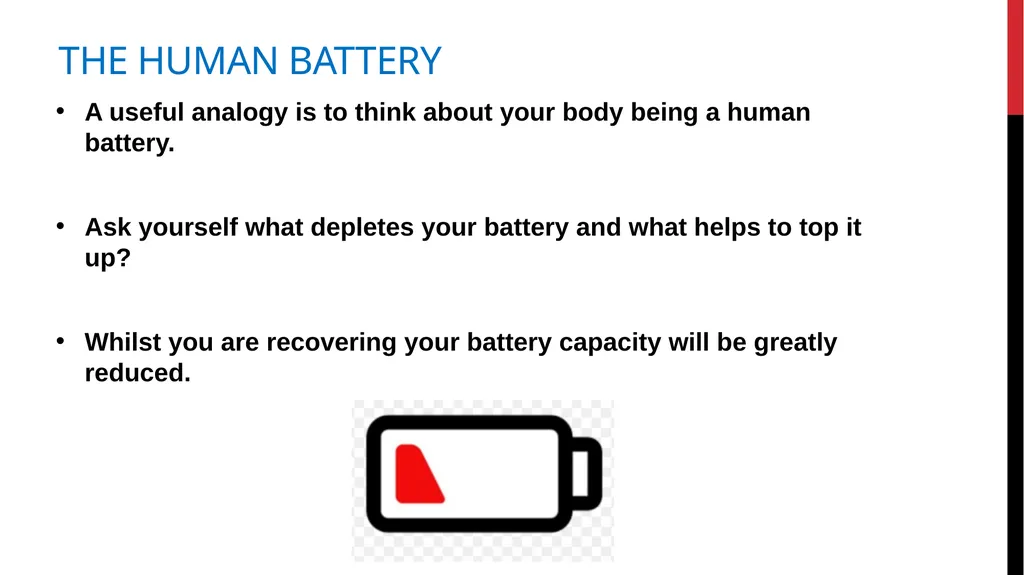
The human battery A useful analogy is to think about your body being a human battery.
Ask yourself what depletes your battery and what helps to top it up?
Whilst you are recovering your battery capacity will be greatly reduced.<br>
Ask yourself what depletes your battery and what helps to top it up?
Whilst you are recovering your battery capacity will be greatly reduced.<br>
06
The over / under activity cycle We all have to engage in activities in our daily lives and have different roles and responsibilities.
It is important to manage these activities in a way that does not impact on fatigue.
It is all to easy to push through on a better day or when you have commitments and responsibilities but the impact of this can lead to enforced rest.
This is what we call the over / under activity cycle or ‘boom and bust’.<br>
It is important to manage these activities in a way that does not impact on fatigue.
It is all to easy to push through on a better day or when you have commitments and responsibilities but the impact of this can lead to enforced rest.
This is what we call the over / under activity cycle or ‘boom and bust’.<br>
07
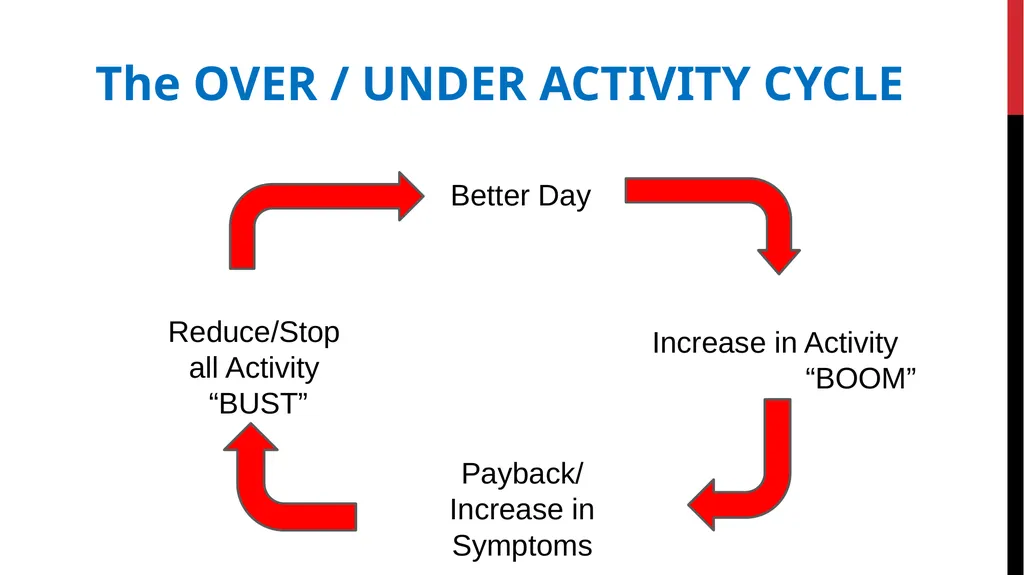
The OVER / UNDER ACTIVITY CYCLE Better Day Reduce/Stop
all Activity
“BUST” Increase in Activity “BOOM” Payback/
Increase in Symptoms<br>
all Activity
“BUST” Increase in Activity “BOOM” Payback/
Increase in Symptoms<br>
08
Reasons for doing more /
Driver behaviours Catching up with tasks
Feeling ‘normal’
Thinking I’m better
Enjoying the feeling
Emotions eg. Guilt and excitement
Social connections<br>
Feeling ‘normal’
Thinking I’m better
Enjoying the feeling
Emotions eg. Guilt and excitement
Social connections<br>
09
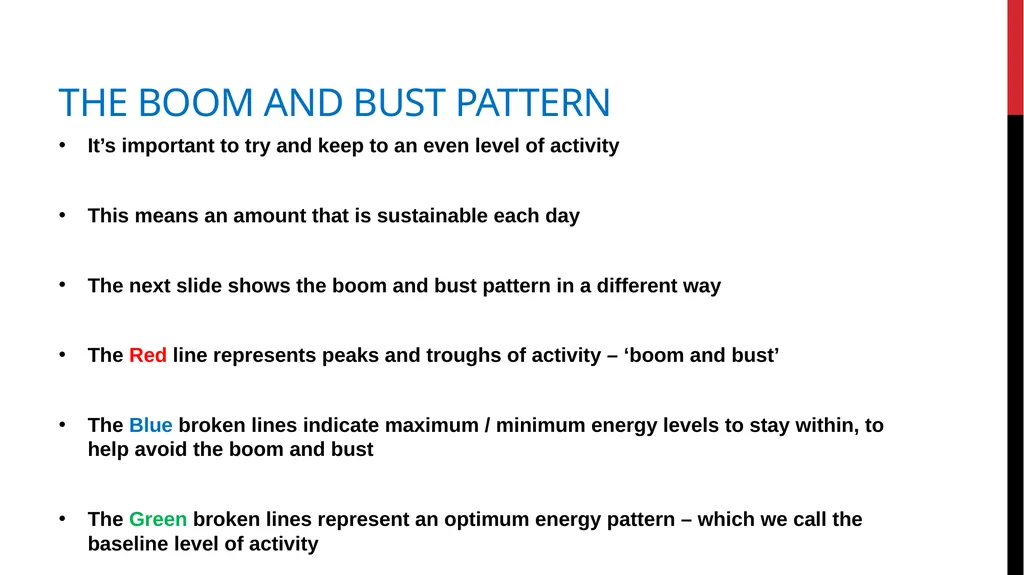
The Boom and bust pattern It’s important to try and keep to an even level of activity
This means an amount that is sustainable each day
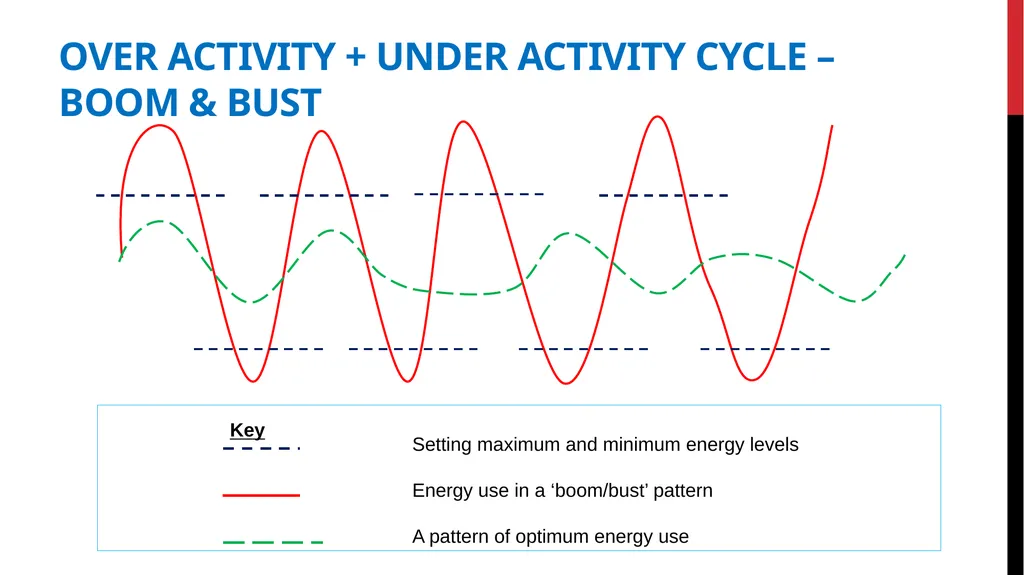
The next slide shows the boom and bust pattern in a different way
The Red line represents peaks and troughs of activity – ‘boom and bust’
The Blue broken lines indicate maximum / minimum energy levels to stay within, to help avoid the boom and bust
The Green broken lines represent an optimum energy pattern – which we call the baseline level of activity<br>
This means an amount that is sustainable each day
The next slide shows the boom and bust pattern in a different way
The Red line represents peaks and troughs of activity – ‘boom and bust’
The Blue broken lines indicate maximum / minimum energy levels to stay within, to help avoid the boom and bust
The Green broken lines represent an optimum energy pattern – which we call the baseline level of activity<br>
10
Over activity + Under activity Cycle – boom & Bust Setting maximum and minimum energy levels
Energy use in a ‘boom/bust’ pattern
A pattern of optimum energy use Key<br>
Energy use in a ‘boom/bust’ pattern
A pattern of optimum energy use Key<br>
11
Starter / finisher pattern A maintaining factor to the boom and bust activity cycle can be the ‘starter / finisher’ pattern of doing.
Do you find it difficult to stop a task once you’ve started it?
Is this due to your roles, responsibilities and commitments?
Do you push through to complete tasks despite depleting energy levels due to thoughts or feelings of guilt?
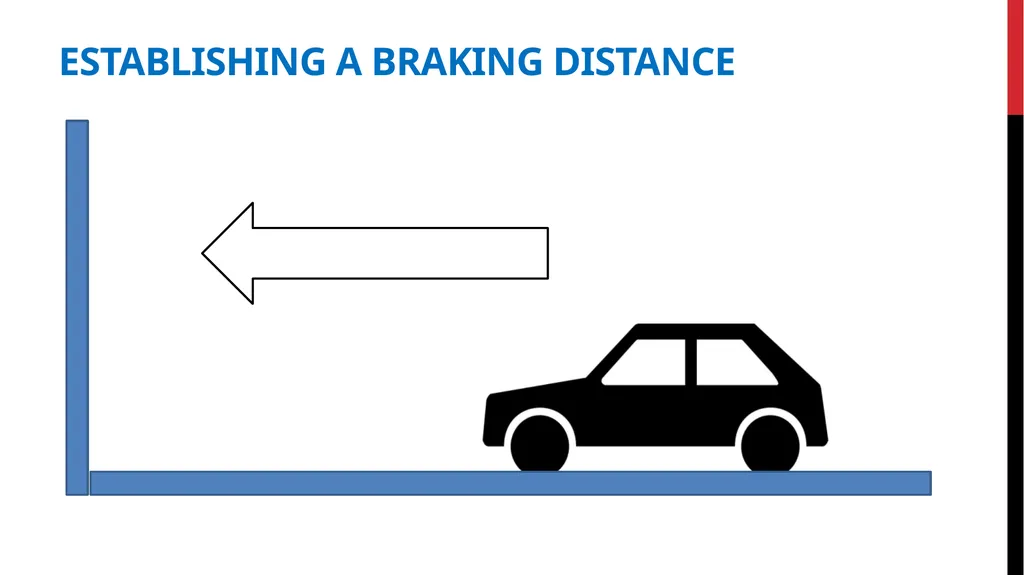
The next slide demonstrates the importance of establishing safe stopping points to avoid crashing & hitting a brick wall of fatigue.<br>
Do you find it difficult to stop a task once you’ve started it?
Is this due to your roles, responsibilities and commitments?
Do you push through to complete tasks despite depleting energy levels due to thoughts or feelings of guilt?
The next slide demonstrates the importance of establishing safe stopping points to avoid crashing & hitting a brick wall of fatigue.<br>
12
Establishing a Braking Distance<br>
13
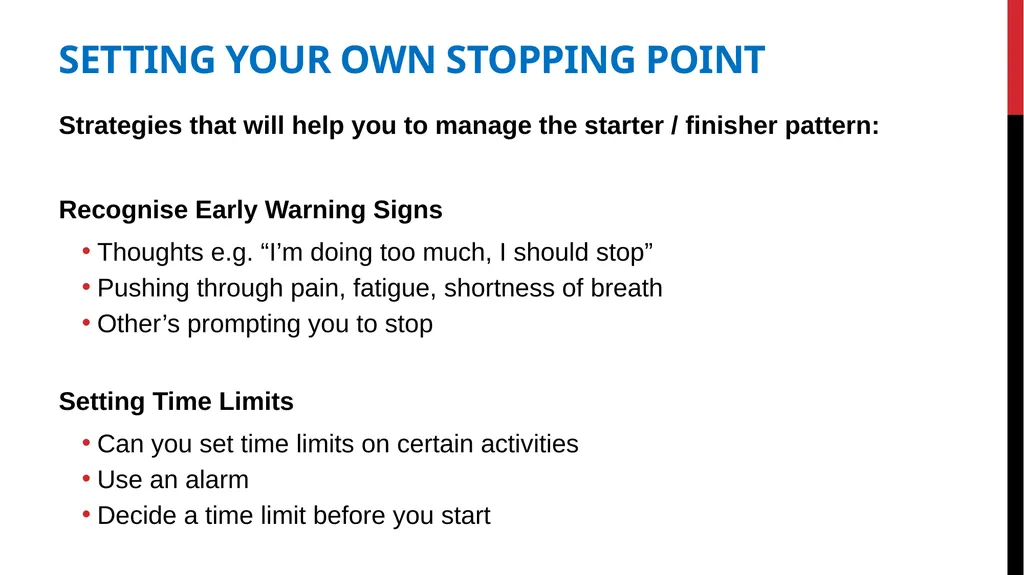
Setting Your Own Stopping Point Strategies that will help you to manage the starter / finisher pattern:
Recognise Early Warning Signs
Thoughts e.g. “I’m doing too much, I should stop”
Pushing through pain, fatigue, shortness of breath
Other’s prompting you to stop
Setting Time Limits
Can you set time limits on certain activities
Use an alarm
Decide a time limit before you start<br>
Recognise Early Warning Signs
Thoughts e.g. “I’m doing too much, I should stop”
Pushing through pain, fatigue, shortness of breath
Other’s prompting you to stop
Setting Time Limits
Can you set time limits on certain activities
Use an alarm
Decide a time limit before you start<br>
14
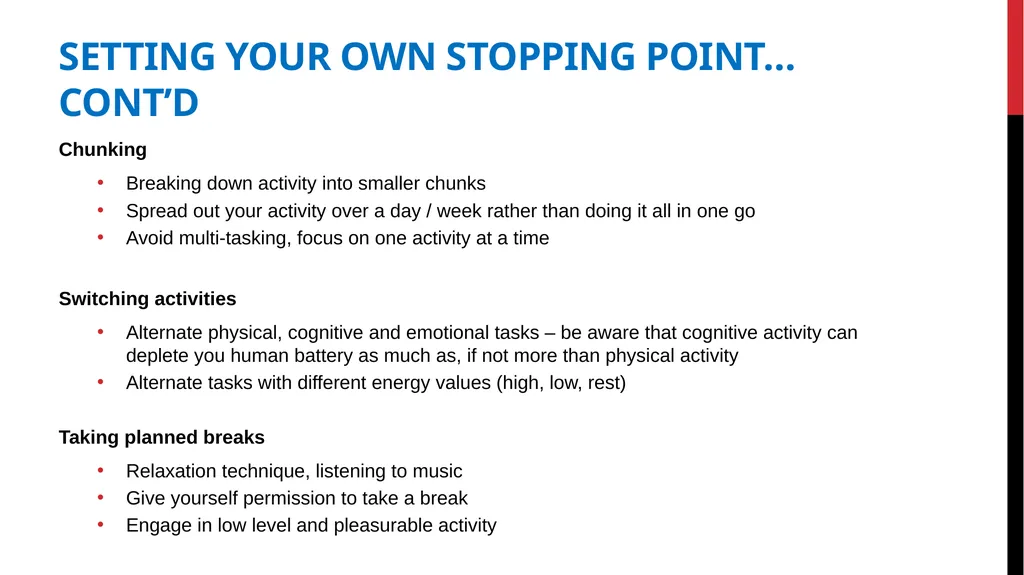
Setting Your Own Stopping Point… Cont’d Chunking
Breaking down activity into smaller chunks
Spread out your activity over a day / week rather than doing it all in one go
Avoid multi-tasking, focus on one activity at a time
Switching activities
Alternate physical, cognitive and emotional tasks – be aware that cognitive activity can deplete you human battery as much as, if not more than physical activity
Alternate tasks with different energy values (high, low, rest)
Taking planned breaks
Relaxation technique, listening to music
Give yourself permission to take a break
Engage in low level and pleasurable activity<br>
Breaking down activity into smaller chunks
Spread out your activity over a day / week rather than doing it all in one go
Avoid multi-tasking, focus on one activity at a time
Switching activities
Alternate physical, cognitive and emotional tasks – be aware that cognitive activity can deplete you human battery as much as, if not more than physical activity
Alternate tasks with different energy values (high, low, rest)
Taking planned breaks
Relaxation technique, listening to music
Give yourself permission to take a break
Engage in low level and pleasurable activity<br>
15
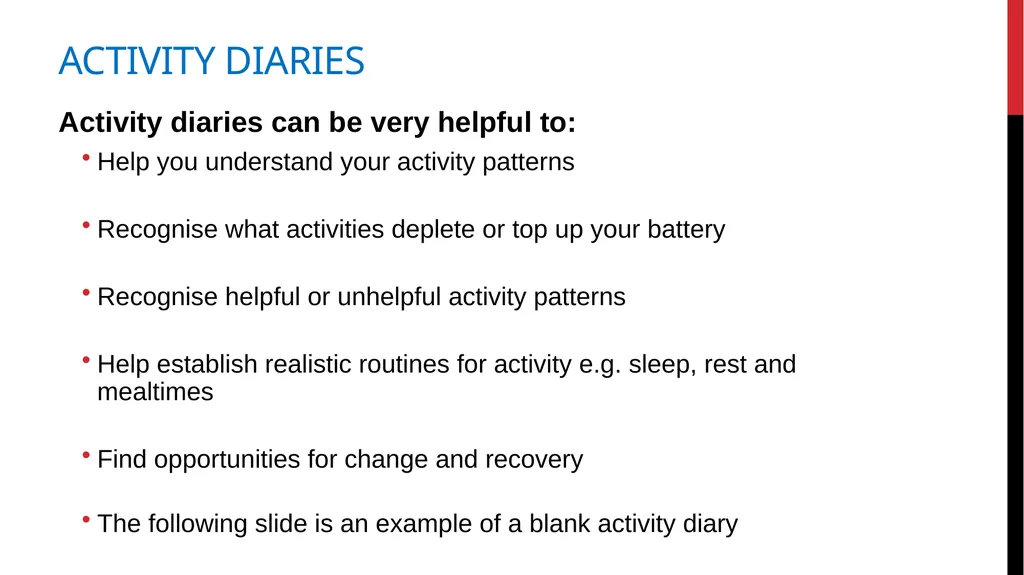
Activity Diaries Activity diaries can be very helpful to:
Help you understand your activity patterns
Recognise what activities deplete or top up your battery
Recognise helpful or unhelpful activity patterns
Help establish realistic routines for activity e.g. sleep, rest and mealtimes
Find opportunities for change and recovery
The following slide is an example of a blank activity diary<br>
Help you understand your activity patterns
Recognise what activities deplete or top up your battery
Recognise helpful or unhelpful activity patterns
Help establish realistic routines for activity e.g. sleep, rest and mealtimes
Find opportunities for change and recovery
The following slide is an example of a blank activity diary<br>
16
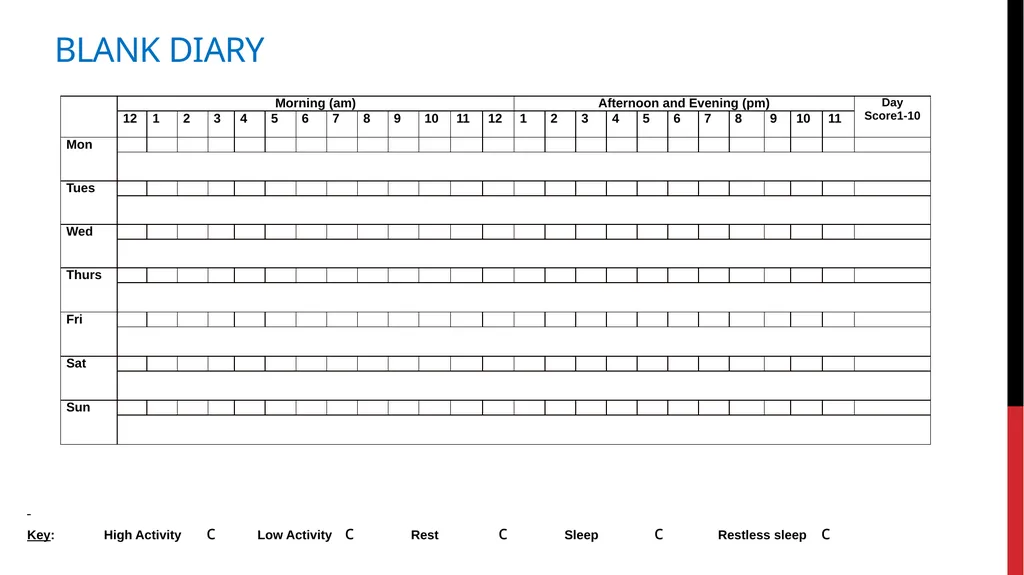
Blank Diary Key: High Activity c Low Activity c Rest c Sleep c Restless sleep c<br>
17
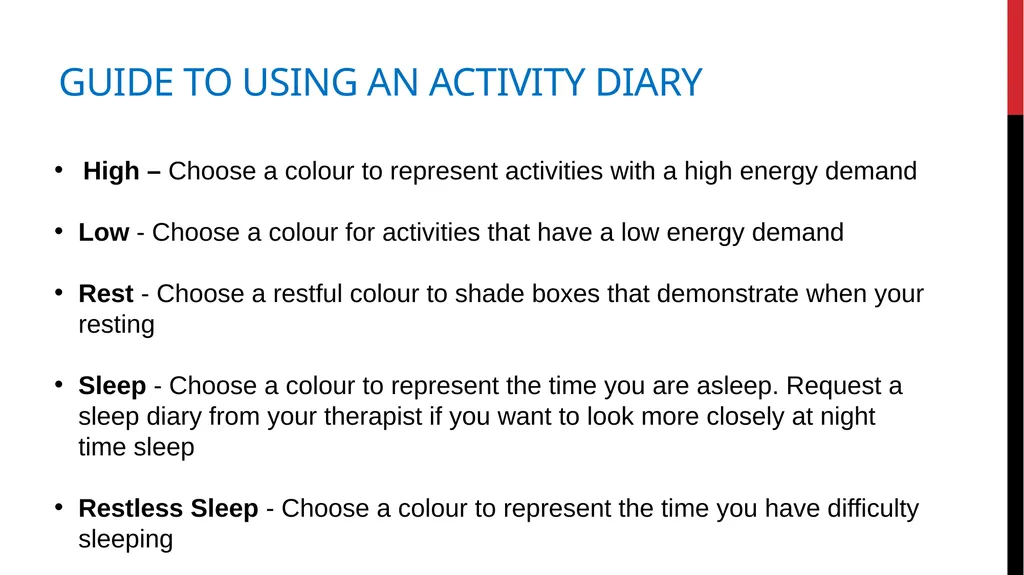
Guide to using an activity diary High – Choose a colour to represent activities with a high energy demand
Low - Choose a colour for activities that have a low energy demand
Rest - Choose a restful colour to shade boxes that demonstrate when your resting
Sleep - Choose a colour to represent the time you are asleep. Request a sleep diary from your therapist if you want to look more closely at night time sleep
Restless Sleep - Choose a colour to represent the time you have difficulty sleeping<br>
Low - Choose a colour for activities that have a low energy demand
Rest - Choose a restful colour to shade boxes that demonstrate when your resting
Sleep - Choose a colour to represent the time you are asleep. Request a sleep diary from your therapist if you want to look more closely at night time sleep
Restless Sleep - Choose a colour to represent the time you have difficulty sleeping<br>
18
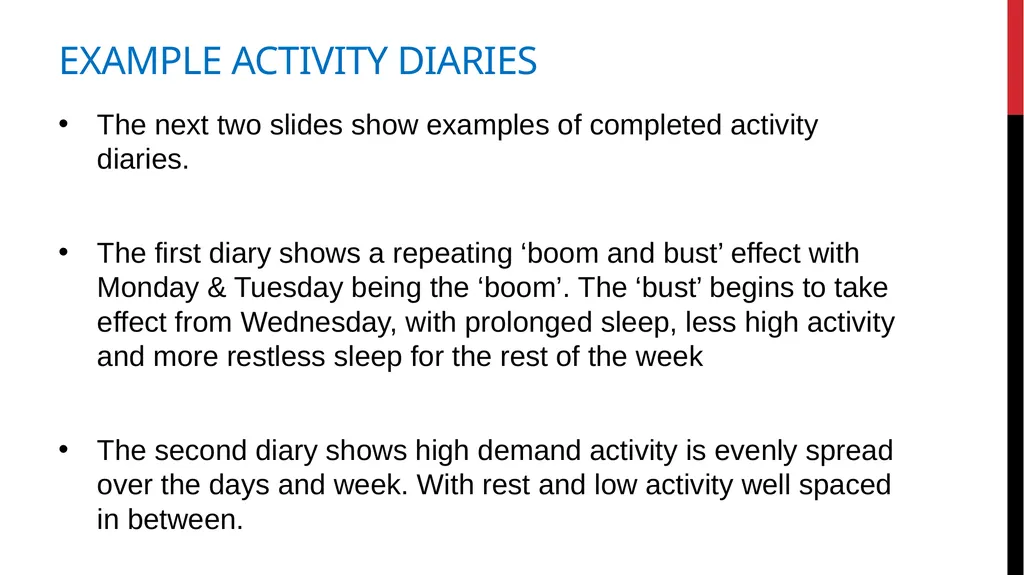
Example activity diaries The next two slides show examples of completed activity diaries.
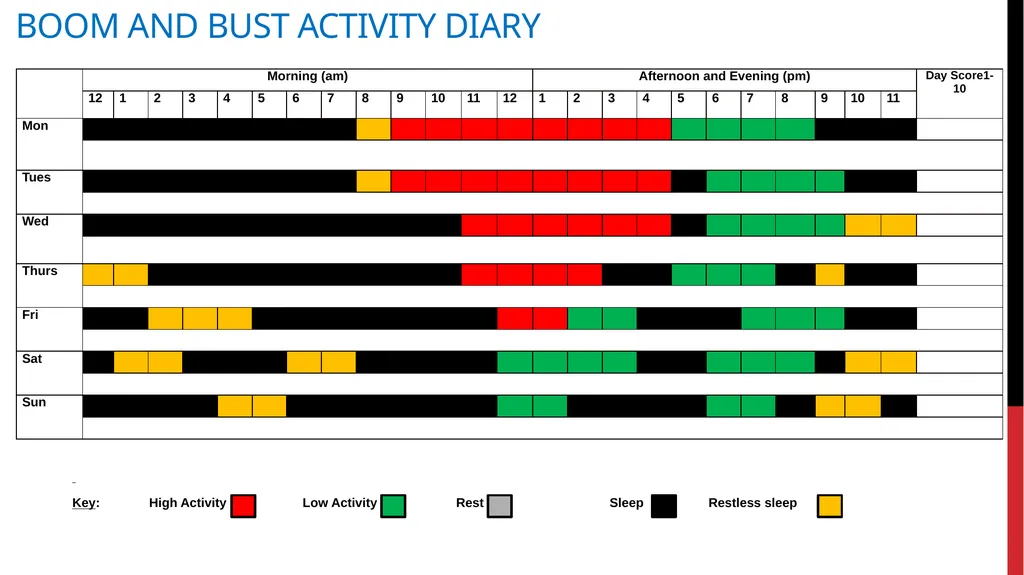
The first diary shows a repeating ‘boom and bust’ effect with Monday & Tuesday being the ‘boom’. The ‘bust’ begins to take effect from Wednesday, with prolonged sleep, less high activity and more restless sleep for the rest of the week
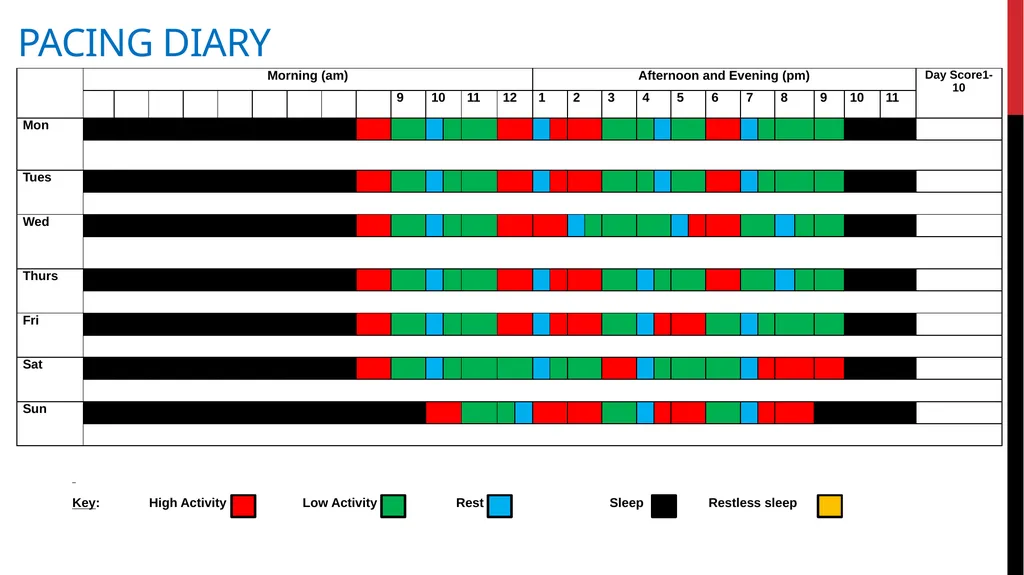
The second diary shows high demand activity is evenly spread over the days and week. With rest and low activity well spaced in between.<br>
The first diary shows a repeating ‘boom and bust’ effect with Monday & Tuesday being the ‘boom’. The ‘bust’ begins to take effect from Wednesday, with prolonged sleep, less high activity and more restless sleep for the rest of the week
The second diary shows high demand activity is evenly spread over the days and week. With rest and low activity well spaced in between.<br>
19
Boom and Bust activity Diary Key: High Activity Low Activity Rest Sleep cRestless sleep<br>
20
Pacing Diary Key: High Activity Low Activity Rest Sleep cRestless sleep<br>
21
What is Rest? An important part of activity management
Resting Mind and Body at the same time
Being in the moment
Not sleeping, watching TV or reading<br>
Resting Mind and Body at the same time
Being in the moment
Not sleeping, watching TV or reading<br>
22
Why use Rest? To conserve and top up human battery / energy
Can reduce daytime sleep
Lower the stress response
Helps to pace your activities better throughout the day<br>
Can reduce daytime sleep
Lower the stress response
Helps to pace your activities better throughout the day<br>
23
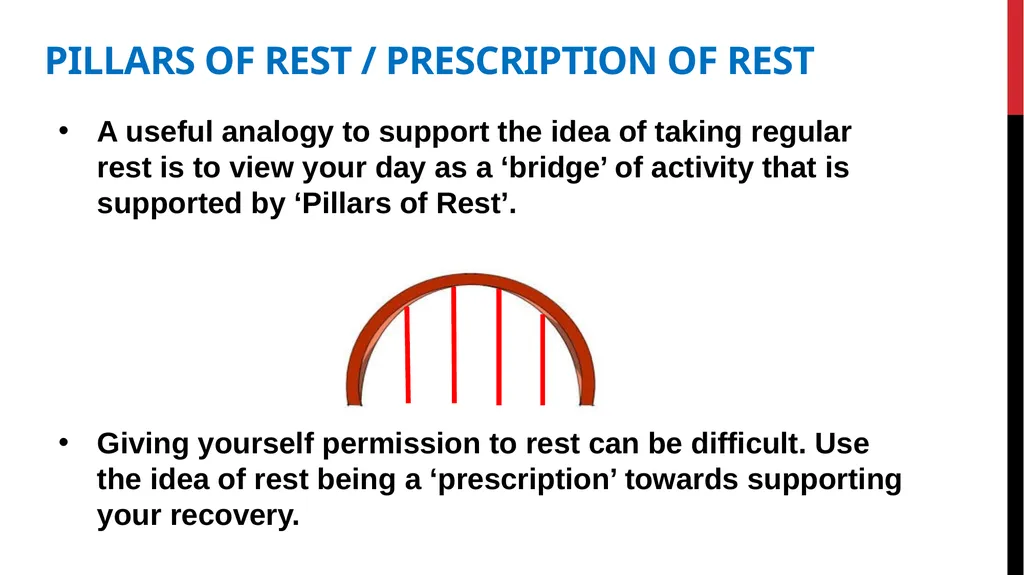
Pillars of rest / prescription of rest A useful analogy to support the idea of taking regular rest is to view your day as a ‘bridge’ of activity that is supported by ‘Pillars of Rest’.
Giving yourself permission to rest can be difficult. Use the idea of rest being a ‘prescription’ towards supporting your recovery.<br>
Giving yourself permission to rest can be difficult. Use the idea of rest being a ‘prescription’ towards supporting your recovery.<br>
24
Ideas for Rest Breathing techniques
Relaxation exercises
Visualisation
Simple meditation practices / mindfulness
Use of senses to aid relaxation e.g. listening to and looking at nature
Very quiet music
Use of apps e.g. Insight Timer, Headspace https://www.headspace.com/headspace-meditation-app<br>
Relaxation exercises
Visualisation
Simple meditation practices / mindfulness
Use of senses to aid relaxation e.g. listening to and looking at nature
Very quiet music
Use of apps e.g. Insight Timer, Headspace https://www.headspace.com/headspace-meditation-app<br>
25
Key Tips Find what works for you
Take rest before you need it
Take short regular rest breaks throughout the day – remember the ‘Pillars of Rest’ analogy
Try not to rest in your bed
Minimise disturbance if you can
Set appropriate goals for rest<br>
Take rest before you need it
Take short regular rest breaks throughout the day – remember the ‘Pillars of Rest’ analogy
Try not to rest in your bed
Minimise disturbance if you can
Set appropriate goals for rest<br>
26
Pace, plan and Prioritise PACE:
Give yourself permission to slow down
Break activities into smaller chunks
Build frequent rest breaks into your day
Mix up physical / cognitive / emotional activities
Spread out high demanding activities over the day and week<br>
Give yourself permission to slow down
Break activities into smaller chunks
Build frequent rest breaks into your day
Mix up physical / cognitive / emotional activities
Spread out high demanding activities over the day and week<br>
27
Pace, plan and Prioritise… cont’d PLAN:
Use an activity diary to help you plan and schedule ahead
Ensure you have planned in pleasurable activities
Think about easier ways of doing things e.g. sitting instead of standing to do tasks, use of equipment, online shop
Set yourself realistic goals<br>
Use an activity diary to help you plan and schedule ahead
Ensure you have planned in pleasurable activities
Think about easier ways of doing things e.g. sitting instead of standing to do tasks, use of equipment, online shop
Set yourself realistic goals<br>
28
Pace, plan and Prioritise… cont’d PRIORITSE:
What needs to be done today?
What can I put off to another day?
What can I ask someone else to do for me?<br>
What needs to be done today?
What can I put off to another day?
What can I ask someone else to do for me?<br>
29
Sleep Whether you have been unwell at home or in hospital this can cause disruptions in your sleep
Top tips:
Set regular going to bed / getting up time
Allow yourself wind down before
Minimise day time sleep to 30 minutes
Engage with relaxing activities before bed, preferably no screen time 60 minutes before bed
Avoid alcohol, spicy food, caffeine close to bed time
Reserve bedroom space for sleep and intimacy<br>
Top tips:
Set regular going to bed / getting up time
Allow yourself wind down before
Minimise day time sleep to 30 minutes
Engage with relaxing activities before bed, preferably no screen time 60 minutes before bed
Avoid alcohol, spicy food, caffeine close to bed time
Reserve bedroom space for sleep and intimacy<br>
30
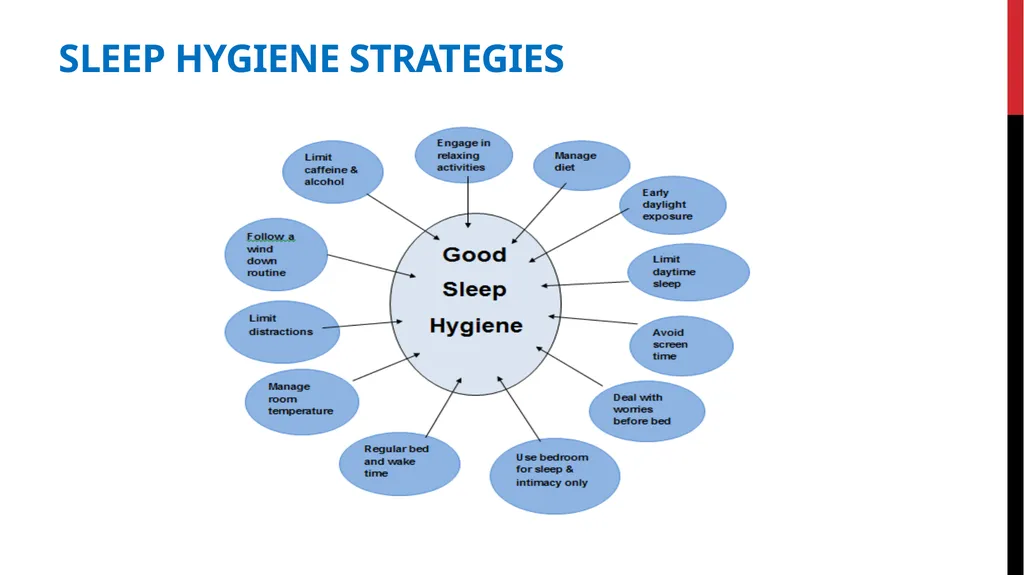
Sleep hygiene strategies<br>
31
Eat well Key tips:
Eat regularly to fuel your human battery
Eat a healthy well balanced diet
Keep meals simple and / or ask for help
Easy / ready meals can be helpful if you’re too tired to cook
Smoothies / soups
Healthy snacks
Batch cooking and freeze
Consider online shopping / meal delivery services<br>
Eat regularly to fuel your human battery
Eat a healthy well balanced diet
Keep meals simple and / or ask for help
Easy / ready meals can be helpful if you’re too tired to cook
Smoothies / soups
Healthy snacks
Batch cooking and freeze
Consider online shopping / meal delivery services<br>
32
Ways to increase your activity safely Key tips:
Start lower than you think
Stabilise for longer than you think at each level
Apply a smaller increment than you think
Take more time overall to reach a goal than you think
Be patient – be the tortoise not the hare!
If you’re finding this difficult or distressing talk to your GP about referring you to a specialist.<br>
Start lower than you think
Stabilise for longer than you think at each level
Apply a smaller increment than you think
Take more time overall to reach a goal than you think
Be patient – be the tortoise not the hare!
If you’re finding this difficult or distressing talk to your GP about referring you to a specialist.<br>
33
Communicating your health needs It is important to communicate your health needs effectively to others. The following ideas will support you to do this:
Be kind to yourself – say no to avoid taking on too much
Ask for thinking time before committing
Use ‘I statements’ – such as ‘I am going to have a 10 minute rest before washing up’.
Plan and rehearse what you wish to say in advance – such as ‘I would welcome the opportunity to discuss my phased return to work plan’.
Use open and honest communication skills<br>
Be kind to yourself – say no to avoid taking on too much
Ask for thinking time before committing
Use ‘I statements’ – such as ‘I am going to have a 10 minute rest before washing up’.
Plan and rehearse what you wish to say in advance – such as ‘I would welcome the opportunity to discuss my phased return to work plan’.
Use open and honest communication skills<br>
34
Communicating your health needs… Positive health statements can help explain your symptoms to others and identify what helps you to manage them. Here are some examples:
I am experiencing high levels of fatigue at the moment but regular rest breaks help me.
I would appreciate your support if you would prompt me to rest after one hour of activity.
Using an activity diary is proving really helpful when trying to plan my work tasks and manage my energy levels.<br>
I am experiencing high levels of fatigue at the moment but regular rest breaks help me.
I would appreciate your support if you would prompt me to rest after one hour of activity.
Using an activity diary is proving really helpful when trying to plan my work tasks and manage my energy levels.<br>
35
Employment – are you ready to go back to work? These are useful factors to consider before returning to work:
Don’t go back too soon
Assess your physical / cognitive / emotional stamina
Simulate work tasks at home to assess your capabilities
Keep communications open with your employer
Have a return to work planning meeting
Discuss with your GP / Health Professional / Occupational Health – phased return / fit note<br>
Don’t go back too soon
Assess your physical / cognitive / emotional stamina
Simulate work tasks at home to assess your capabilities
Keep communications open with your employer
Have a return to work planning meeting
Discuss with your GP / Health Professional / Occupational Health – phased return / fit note<br>
36
Employment – reasonable adjustments These are some examples of reasonable adjustments that may support your return to work:
Extended phased return
Work from home
Build in frequent rest breaks
Flexible / temporary changes in working hours
Parking permit / designated car space
Temporary delegation of certain tasks to others
Gradual reintroduction of roles and responsibilities<br>
Extended phased return
Work from home
Build in frequent rest breaks
Flexible / temporary changes in working hours
Parking permit / designated car space
Temporary delegation of certain tasks to others
Gradual reintroduction of roles and responsibilities<br>
37
Employment – sources of support Managers
Colleagues
Occupational Health
Access to Work: https://www.gov.uk/access-to-work/overview
Wellbeing services
Unions
ACAS
C.A.B.
http://fitforwork.org/<br>
Colleagues
Occupational Health
Access to Work: https://www.gov.uk/access-to-work/overview
Wellbeing services
Unions
ACAS
C.A.B.
http://fitforwork.org/<br>
38
What next? Please talk to your GP if:
Your fatigue is getting worse rather than better.
After 3 months your fatigue is unchanged.
You are worried or have other new symptoms.<br>
Your fatigue is getting worse rather than better.
After 3 months your fatigue is unchanged.
You are worried or have other new symptoms.<br>
39
Useful resources General:
www.yourcovidrecovery.nhs.uk
Diet:
www.bda.uk.com
Loss of taste and smell:
www.fifthsense.org.uk
www.abscent.org<br>
www.yourcovidrecovery.nhs.uk
Diet:
www.bda.uk.com
Loss of taste and smell:
www.fifthsense.org.uk
www.abscent.org<br>