Post Disaster Shelter and Energy Efficiency: A Scoping ProAct Network and WWFUS Kelly Adele Billups Margaret Ledyard-Marks Anita Van Breda Jennifer Pepson Background Significant effort and funds are put into shelter after disaster Many
Related Topics
Share
Embed code
Download this presentation From Below
"Post Disaster Shelter and Energy Efficiency: A" is the property of its rightful owner. Permission is granted to
download and print the materials on this website for personal, non-commercial use only, and to display it
on your personal computer provided you do not modify the materials and that you retain all copyright
notices contained in the materials. By downloading content from our website, you accept the terms of this
agreement.
Presentation Transcript
01
Post Disaster Shelter and Energy Efficiency: A Scoping ProAct Network and WWF/US
Kelly
Adele Billups
Margaret Ledyard-Marks
Anita Van Breda
Jennifer Pepson<br>
02
Background Significant effort and funds are put into shelter after disaster
Many shelter issues relate to energy
Existing options to improve shelter energy efficiency
The challenge in rebuilding quickly doesn’t allow designers, managers or beneficiaries identify and incorporate energy efficiency into post disaster shelter
Working group under the Environment Community of Practice, Global Shelter Cluster<br>
03
A Scoping Exercise To identify current best practice and guidance on energy efficient construction, including the production, sourcing, transport, stockpiling and use of construction materials and methods
It is only a scoping – expect and welcome additional information and inputs<br>
04
The Presentation: Introduction
Energy Efficiency – Approaches and Experience – Margaret Ledyard-Marks
Life Cycle Analysis – Adele Billups
Questions, Comments, Next steps<br>
05
Energy Efficiency – Approaches and Experience Margaret Ledyard-Marks<br>
06
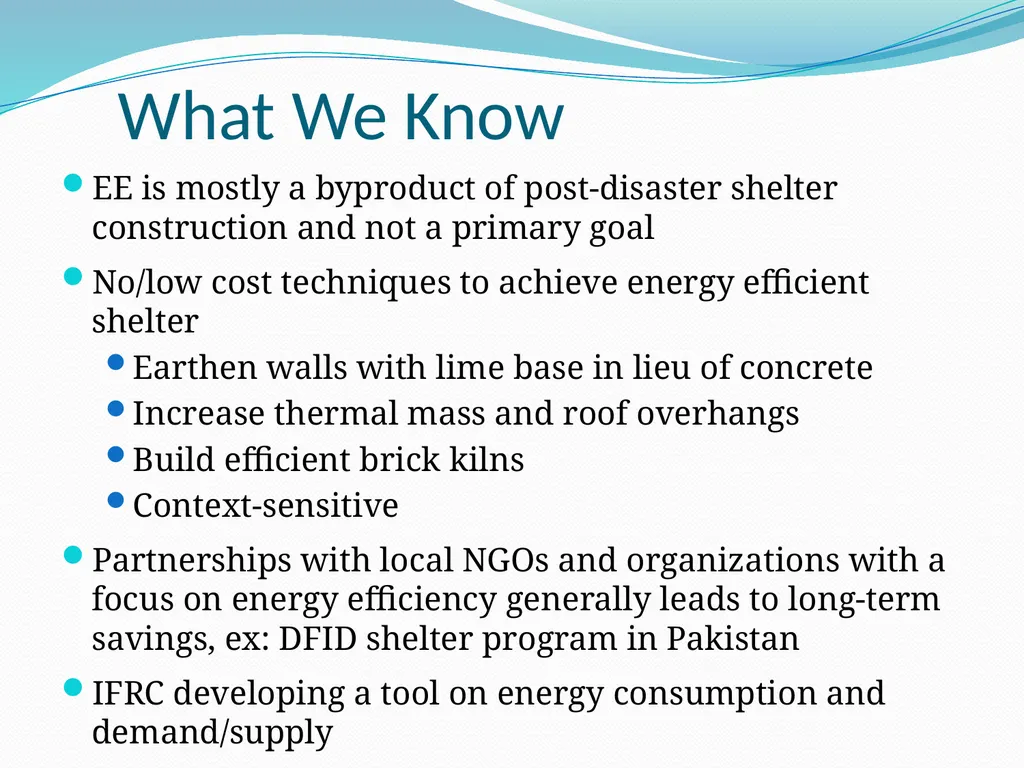
What We Know EE is mostly a byproduct of post-disaster shelter construction and not a primary goal
No/low cost techniques to achieve energy efficient shelter
Earthen walls with lime base in lieu of concrete
Increase thermal mass and roof overhangs
Build efficient brick kilns
Context-sensitive
Partnerships with local NGOs and organizations with a focus on energy efficiency generally leads to long-term savings, ex: DFID shelter program in Pakistan
IFRC developing a tool on energy consumption and demand/supply<br>
07
What We Don’t Know A better understanding of the tradeoffs
Following BREEAM or LEED criteria?
EE building orientation vs organic community structure
Case studies to demonstrate EE can be practical in post-disaster shelter
Materials, logistics, transportation costs, etc.
Standardized approach/methodology for construction
Funding – we have tools but we don’t know if they are justified on a cost basis.<br>
08
Future Action/Recommendations List of experts in energy efficient post-disaster shelter practices and theory
Magnus Wolfe Murray, Jim Kennedy, and others….
Adapting EE tools and techniques to specific post-disaster situations – suggestions from surveys
“Cheat Sheets” for different EE techniques to incorporate into post-disaster shelter construction
Lists of suggested EE materials by region
More research on appropriate materials and methods by region (ex: Kyrgyzstan different from Sri Lanka)<br>
09
Life Cycle Analysis Adele Billups<br>
10
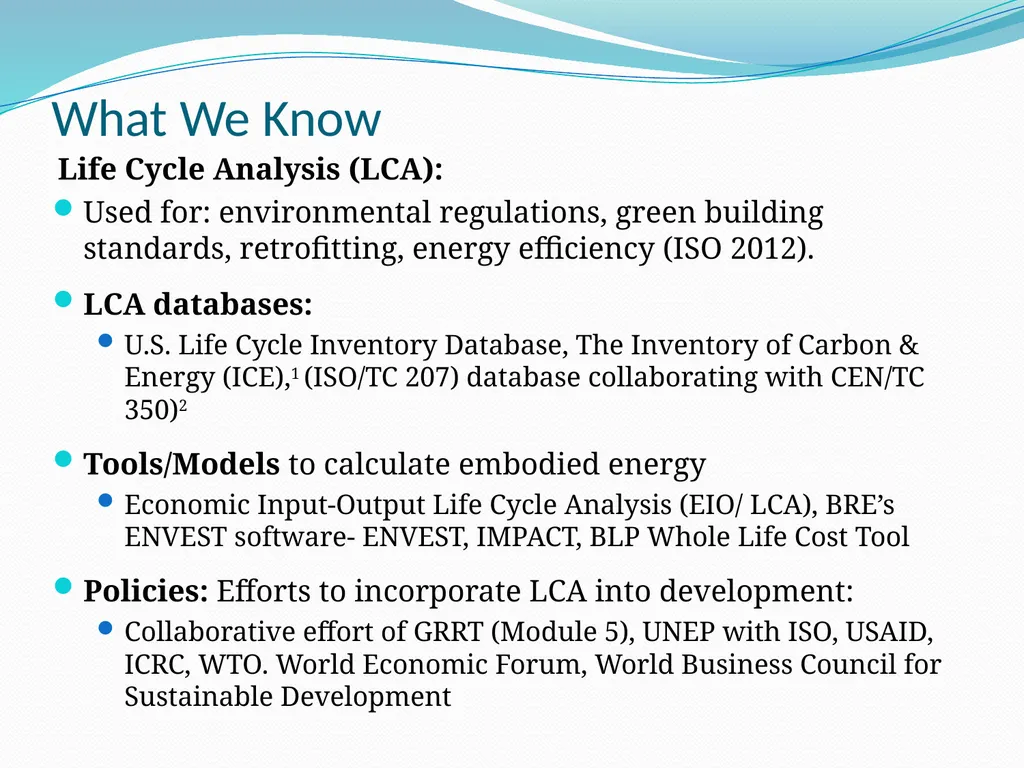
What We Know Life Cycle Analysis (LCA):
Used for: environmental regulations, green building standards, retrofitting, energy efficiency (ISO 2012).
LCA databases:
U.S. Life Cycle Inventory Database, The Inventory of Carbon & Energy (ICE),1 (ISO/TC 207) database collaborating with CEN/TC 350)2
Tools/Models to calculate embodied energy
Economic Input-Output Life Cycle Analysis (EIO/ LCA), BRE’s ENVEST software- ENVEST, IMPACT, BLP Whole Life Cost Tool
Policies: Efforts to incorporate LCA into development:
Collaborative effort of GRRT (Module 5), UNEP with ISO, USAID, ICRC, WTO. World Economic Forum, World Business Council for Sustainable Development<br>
11
What We Don’t Know LCA lacks uniform definition/methodology, incomplete databases, lack of public awareness
Application of EE methodologies in humanitarian assistance, i.e., construction process, procurement, on the ground
Potential as tool for cost-benefit analysis, i.e. CEN’s life-cycle costing for procurement.
Ambiguity over EE: how is EE perceived in the field humanitarian assistance? environmental vrs economic
Social perceptions: holistic approaches vrs perceptions of modernity (“build back better” issue)
Future Action/Recommendations Increase awareness of incorporating energy-efficient guidelines in 1-2 leaflets during humanitarian assistant conferences, meetings, technical exchanges/ trainings, etc.*
Energy audits of humanitarian response to identify most energy intensive aspects
Conduct studies on feasible responses
Encourage role of energy-efficiency in mitigating environmental impact, i.e. IFRC, UNHCR, WFP/DHL
Policies and tools exists but a need for specific energy-efficient policies pertaining to emergency assistance.
Stock-piles of energy efficient NFIs, transportation, standardized catalogues of vetted choices, field agent training<br>
13
Conclusions Need to clarify what is energy efficiency
Lots of entry points
Develop community of practice, common tools, and evidence of success (case studies)
Focus on energy efficiency from a financial perspective: it is more financially efficient: more done, better, and more sustainably<br>
14
Post Disaster Shelter and Energy Efficiency: A Scoping ProAct Network and WWF/US
Adele Billups
C. Kelly
Margaret Ledyard-Marks
Anita Van Breda
Jennifer Pepson