
Post-Separation Coercive Control: Impacts on
SN
Published · 34 slides · 0 views
1 / 1


Description
Post-Separation Coercive Control: Impacts on Children and Young People Contact me at katzehope.ac.uk Follow me on Twitter DrEmmaKatz Dr Emma Katz Senior Lecturer in Childhood and Youth Liverpool Hope University katzehope.ac.uk
Related Topics
Share
Embed code
Download this presentation From Below
"Post-Separation Coercive Control: Impacts on" is the property of its rightful owner. Permission is granted to download and print the materials on this website for personal, non-commercial use only, and to display it on your personal computer provided you do not modify the materials and that you retain all copyright notices contained in the materials. By downloading content from our website, you accept the terms of this agreement.
Presentation Transcript
01
Post-Separation Coercive Control:
Impacts on Children and Young People
Contact me at katze@hope.ac.uk
Follow me on Twitter @DrEmmaKatz Dr Emma Katz Senior Lecturer in Childhood and Youth Liverpool Hope University katze@hope.ac.uk<br>
Impacts on Children and Young People
Contact me at katze@hope.ac.uk
Follow me on Twitter @DrEmmaKatz Dr Emma Katz Senior Lecturer in Childhood and Youth Liverpool Hope University katze@hope.ac.uk<br>
02
Understanding Coercive Control katze@hope.ac.uk<br>
03
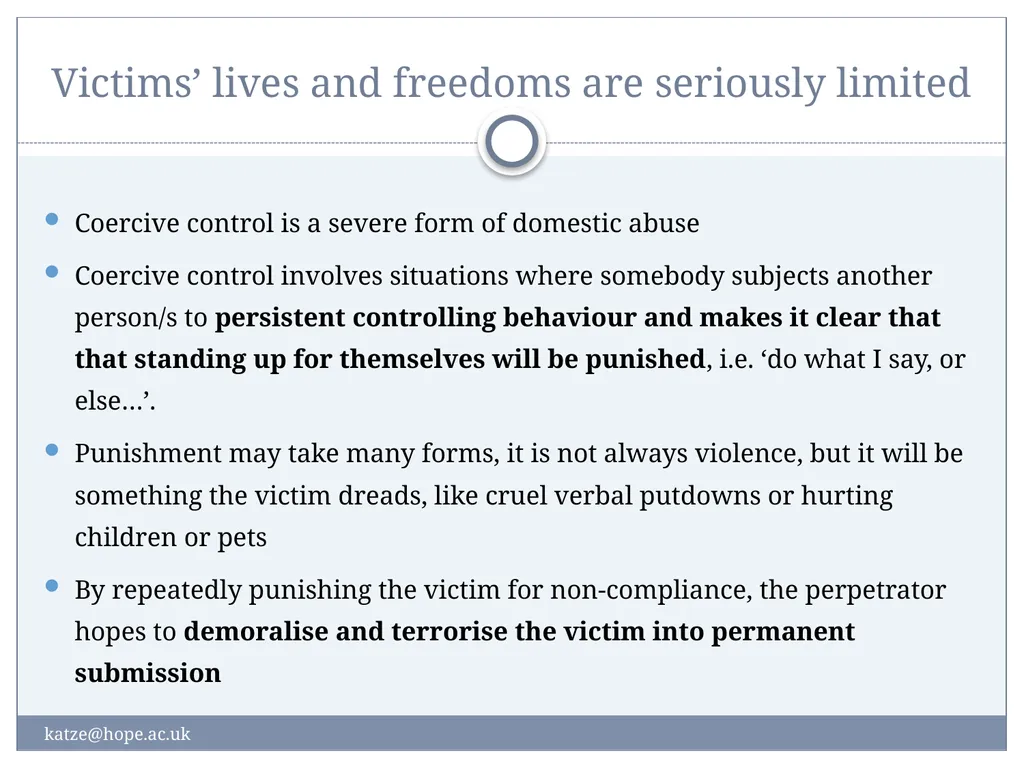
Victims’ lives and freedoms are seriously limited katze@hope.ac.uk Coercive control is a severe form of domestic abuse
Coercive control involves situations where somebody subjects another person/s to persistent controlling behaviour and makes it clear that that standing up for themselves will be punished, i.e. ‘do what I say, or else…’.
Punishment may take many forms, it is not always violence, but it will be something the victim dreads, like cruel verbal putdowns or hurting children or pets
By repeatedly punishing the victim for non-compliance, the perpetrator hopes to demoralise and terrorise the victim into permanent submission<br>
Coercive control involves situations where somebody subjects another person/s to persistent controlling behaviour and makes it clear that that standing up for themselves will be punished, i.e. ‘do what I say, or else…’.
Punishment may take many forms, it is not always violence, but it will be something the victim dreads, like cruel verbal putdowns or hurting children or pets
By repeatedly punishing the victim for non-compliance, the perpetrator hopes to demoralise and terrorise the victim into permanent submission<br>
04
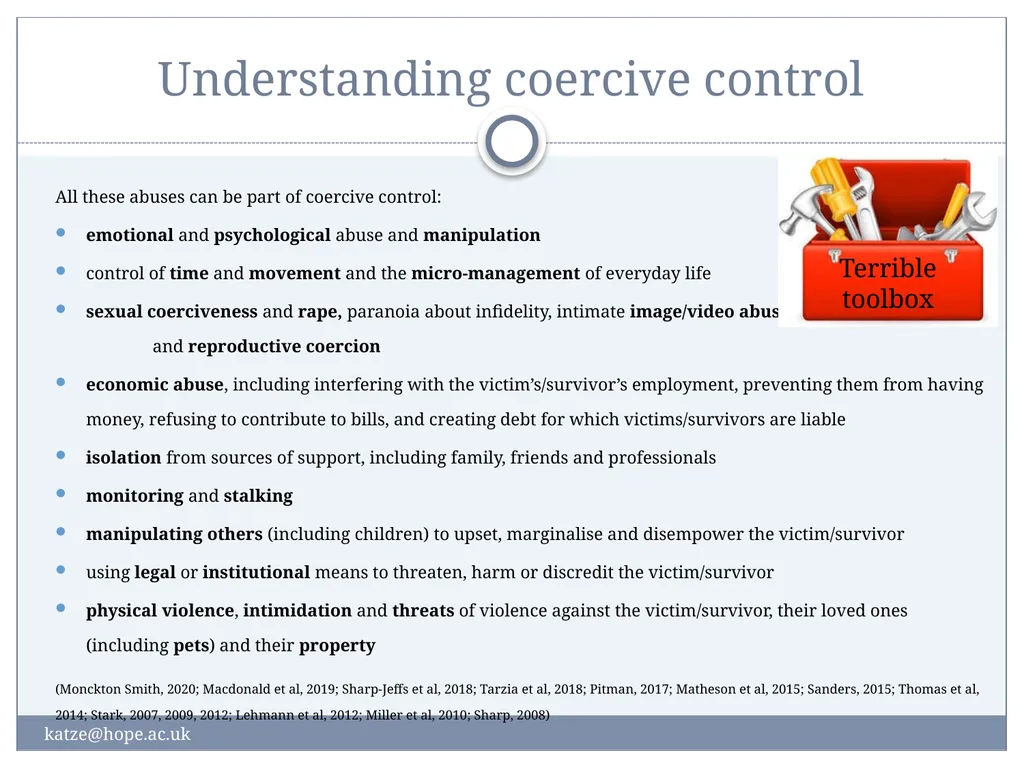
Understanding coercive control All these abuses can be part of coercive control:
emotional and psychological abuse and manipulation
control of time and movement and the micro-management of everyday life
sexual coerciveness and rape, paranoia about infidelity, intimate image/video abuse and reproductive coercion
economic abuse, including interfering with the victim’s/survivor’s employment, preventing them from having money, refusing to contribute to bills, and creating debt for which victims/survivors are liable
isolation from sources of support, including family, friends and professionals
monitoring and stalking
manipulating others (including children) to upset, marginalise and disempower the victim/survivor
using legal or institutional means to threaten, harm or discredit the victim/survivor
physical violence, intimidation and threats of violence against the victim/survivor, their loved ones (including pets) and their property
(Monckton Smith, 2020; Macdonald et al, 2019; Sharp-Jeffs et al, 2018; Tarzia et al, 2018; Pitman, 2017; Matheson et al, 2015; Sanders, 2015; Thomas et al, 2014; Stark, 2007, 2009, 2012; Lehmann et al, 2012; Miller et al, 2010; Sharp, 2008) katze@hope.ac.uk<br>
emotional and psychological abuse and manipulation
control of time and movement and the micro-management of everyday life
sexual coerciveness and rape, paranoia about infidelity, intimate image/video abuse and reproductive coercion
economic abuse, including interfering with the victim’s/survivor’s employment, preventing them from having money, refusing to contribute to bills, and creating debt for which victims/survivors are liable
isolation from sources of support, including family, friends and professionals
monitoring and stalking
manipulating others (including children) to upset, marginalise and disempower the victim/survivor
using legal or institutional means to threaten, harm or discredit the victim/survivor
physical violence, intimidation and threats of violence against the victim/survivor, their loved ones (including pets) and their property
(Monckton Smith, 2020; Macdonald et al, 2019; Sharp-Jeffs et al, 2018; Tarzia et al, 2018; Pitman, 2017; Matheson et al, 2015; Sanders, 2015; Thomas et al, 2014; Stark, 2007, 2009, 2012; Lehmann et al, 2012; Miller et al, 2010; Sharp, 2008) katze@hope.ac.uk<br>
05
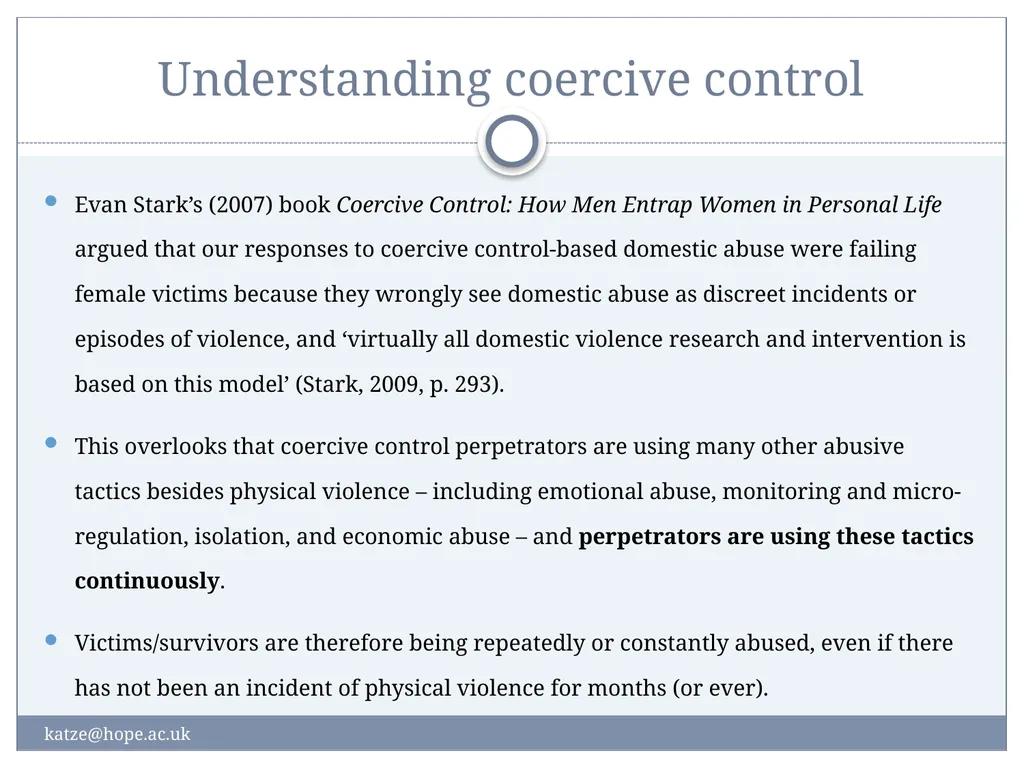
Understanding coercive control katze@hope.ac.uk Evan Stark’s (2007) book Coercive Control: How Men Entrap Women in Personal Life argued that our responses to coercive control-based domestic abuse were failing female victims because they wrongly see domestic abuse as discreet incidents or episodes of violence, and ‘virtually all domestic violence research and intervention is based on this model’ (Stark, 2009, p. 293).
This overlooks that coercive control perpetrators are using many other abusive tactics besides physical violence – including emotional abuse, monitoring and micro-regulation, isolation, and economic abuse – and perpetrators are using these tactics continuously.
Victims/survivors are therefore being repeatedly or constantly abused, even if there has not been an incident of physical violence for months (or ever).<br>
This overlooks that coercive control perpetrators are using many other abusive tactics besides physical violence – including emotional abuse, monitoring and micro-regulation, isolation, and economic abuse – and perpetrators are using these tactics continuously.
Victims/survivors are therefore being repeatedly or constantly abused, even if there has not been an incident of physical violence for months (or ever).<br>
06
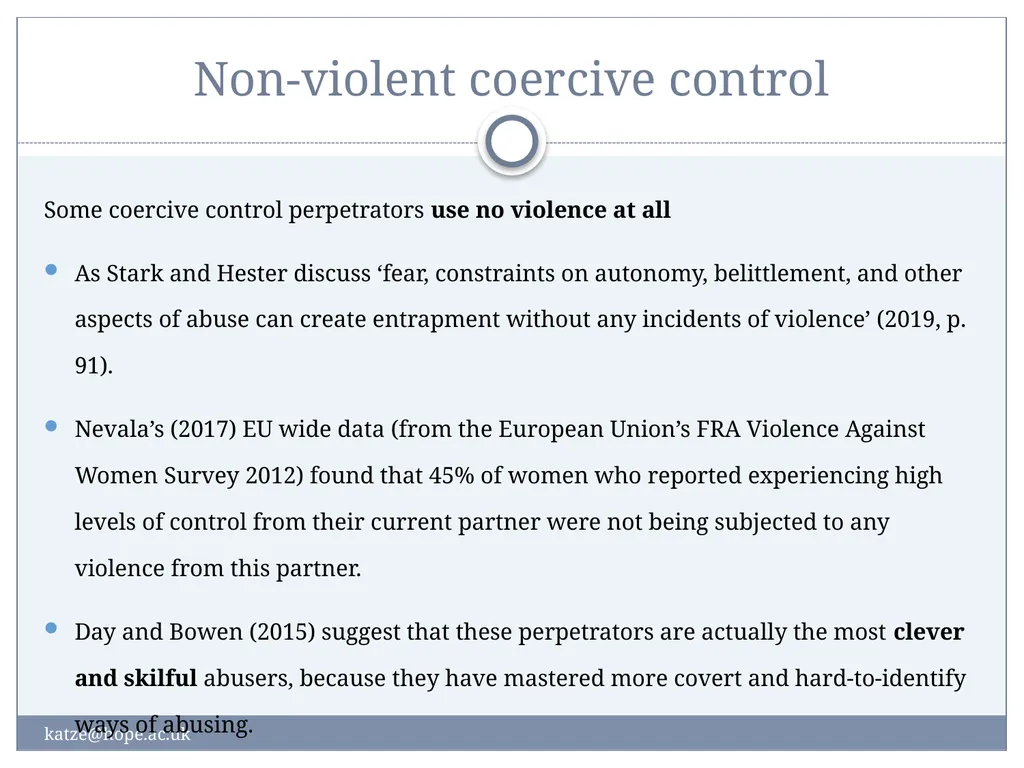
Non-violent coercive control katze@hope.ac.uk Some coercive control perpetrators use no violence at all
As Stark and Hester discuss ‘fear, constraints on autonomy, belittlement, and other aspects of abuse can create entrapment without any incidents of violence’ (2019, p. 91).
Nevala’s (2017) EU wide data (from the European Union’s FRA Violence Against Women Survey 2012) found that 45% of women who reported experiencing high levels of control from their current partner were not being subjected to any violence from this partner.
Day and Bowen (2015) suggest that these perpetrators are actually the most clever and skilful abusers, because they have mastered more covert and hard-to-identify ways of abusing.<br>
As Stark and Hester discuss ‘fear, constraints on autonomy, belittlement, and other aspects of abuse can create entrapment without any incidents of violence’ (2019, p. 91).
Nevala’s (2017) EU wide data (from the European Union’s FRA Violence Against Women Survey 2012) found that 45% of women who reported experiencing high levels of control from their current partner were not being subjected to any violence from this partner.
Day and Bowen (2015) suggest that these perpetrators are actually the most clever and skilful abusers, because they have mastered more covert and hard-to-identify ways of abusing.<br>
07
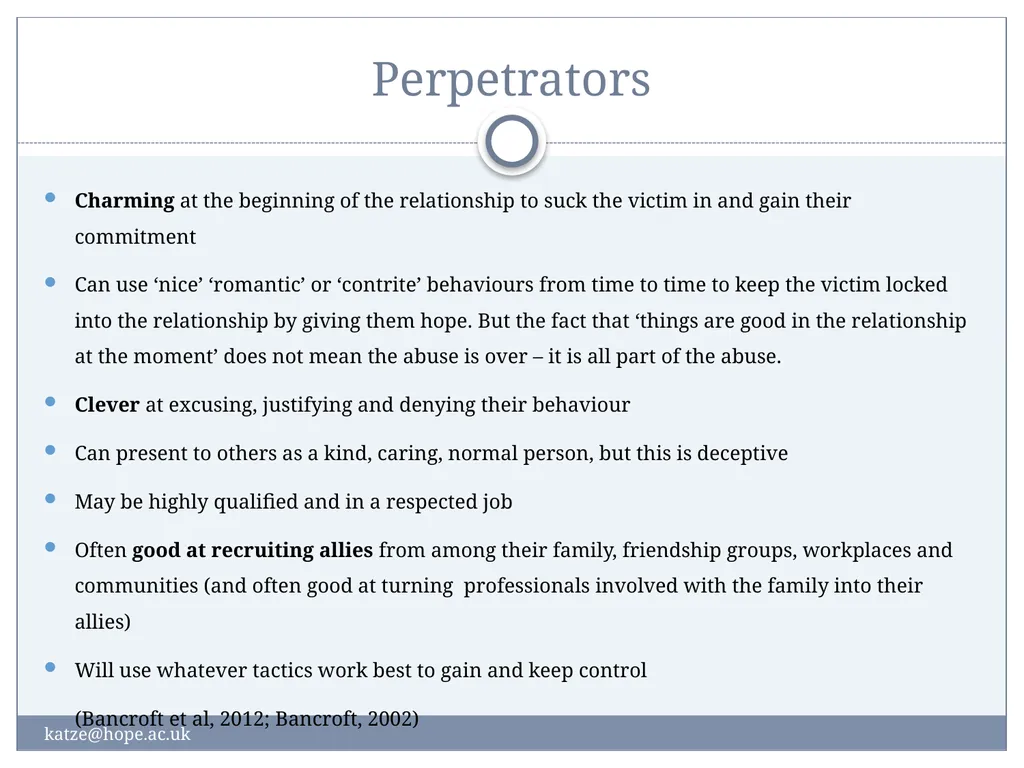
Perpetrators Charming at the beginning of the relationship to suck the victim in and gain their commitment
Can use ‘nice’ ‘romantic’ or ‘contrite’ behaviours from time to time to keep the victim locked into the relationship by giving them hope. But the fact that ‘things are good in the relationship at the moment’ does not mean the abuse is over – it is all part of the abuse.
Clever at excusing, justifying and denying their behaviour
Can present to others as a kind, caring, normal person, but this is deceptive
May be highly qualified and in a respected job
Often good at recruiting allies from among their family, friendship groups, workplaces and communities (and often good at turning professionals involved with the family into their allies)
Will use whatever tactics work best to gain and keep control
(Bancroft et al, 2012; Bancroft, 2002) katze@hope.ac.uk<br>
Can use ‘nice’ ‘romantic’ or ‘contrite’ behaviours from time to time to keep the victim locked into the relationship by giving them hope. But the fact that ‘things are good in the relationship at the moment’ does not mean the abuse is over – it is all part of the abuse.
Clever at excusing, justifying and denying their behaviour
Can present to others as a kind, caring, normal person, but this is deceptive
May be highly qualified and in a respected job
Often good at recruiting allies from among their family, friendship groups, workplaces and communities (and often good at turning professionals involved with the family into their allies)
Will use whatever tactics work best to gain and keep control
(Bancroft et al, 2012; Bancroft, 2002) katze@hope.ac.uk<br>
08
Coercive control is caused by the perpetrator Perpetrators tend to be extremely self-centred and often have a highly inflated sense of entitlement: they believe their needs come first and that their partner and children should make pleasing them their priority (Bancroft, 2002).
Coercive control is not caused by a ‘turbulent or toxic relationship’: it is caused by the perpetrator’s deeply held belief systems, attitudes and expectations, things that they held before the relationship began.
The perpetrator’s tendency to coercively control doesn’t disappear when the relationship ends – it remains within the perpetrator.
Put simply – the problem is in the perpetrator, not in the relationship (Monckton Smith, 2020). katze@hope.ac.uk<br>
Coercive control is not caused by a ‘turbulent or toxic relationship’: it is caused by the perpetrator’s deeply held belief systems, attitudes and expectations, things that they held before the relationship began.
The perpetrator’s tendency to coercively control doesn’t disappear when the relationship ends – it remains within the perpetrator.
Put simply – the problem is in the perpetrator, not in the relationship (Monckton Smith, 2020). katze@hope.ac.uk<br>
09
Adult victims katze@hope.ac.uk Myth – If a victim/survivor fights back or has less than perfect behaviour herself, or is intelligent, seems confident and is from an affluent background, then she can’t be a real victim.
Reality – victims come from all walks of life and are affected in different ways.
- Some victims fight back and some don’t, depending on the context.
- Some maintain employment and seem confident and successful.
- Some turn to alcohol, medication or drugs to try to cope with the perpetrator’s abuse.
- Many become mentally unwell because of the perpetrator’s abuse.
They are all real victims.<br>
Reality – victims come from all walks of life and are affected in different ways.
- Some victims fight back and some don’t, depending on the context.
- Some maintain employment and seem confident and successful.
- Some turn to alcohol, medication or drugs to try to cope with the perpetrator’s abuse.
- Many become mentally unwell because of the perpetrator’s abuse.
They are all real victims.<br>
10
2. Impacts on children & young people katze@hope.ac.uk<br>
11
Perpetrators harm children There is a wealth of research evidence from multiple countries that male coercive control/domestic abuse perpetrators are usually harmful fathers (e.g. Thompson-Walsh et al, 2021; Haselschwerdt et al, 2020; Katz et al, 2020; Humphreys et al, 2019; Mohaupt et al, 2019; Smith and Humphreys, 2019; Heward-Belle, 2016; Overlien, 2013; Bancroft et al, 2012; Harne, 2011)<br>
12
Perpetrators harm children ‘Early work [on] the parenting of domestically violent men described them as hostile, coercive, demanding, and entitled fathers who are likely to have rigid and unreasonable rules, little patience, high expectations, and to use harsh forms of discipline. Subsequent research has borne out these descriptions.’ (Thompson-Walsh, 2021, p. 2)
Perpetrators have elevated risks of physically, psychologically and sexually abusing and neglecting children in their care (Heward-Belle, 2016; Bancroft et al, 2012; Harne, 2011)
Perpetrators may also stalk, threaten and terrorise their children as part of their abuse of ex-partners (Katz et al, 2020)<br>
Perpetrators have elevated risks of physically, psychologically and sexually abusing and neglecting children in their care (Heward-Belle, 2016; Bancroft et al, 2012; Harne, 2011)
Perpetrators may also stalk, threaten and terrorise their children as part of their abuse of ex-partners (Katz et al, 2020)<br>
13
Post separation coercive control When adult victims separate from perpetrators, perpetrators typically continue their efforts to control and dominate their ex-partner’s life and/or punish them for trying to break free (e.g. Monk and Bowen, 2020; Humphreys et al, 2019; Feresin et al, 2019; Sharp-Jeffs et al, 2018; Elizabeth, 2017; Thiara and Gill, 2012; Harne, 2011; Beeble et al, 2007)
Most perpetrators of coercive control continue to harm their children post-separation<br>
Most perpetrators of coercive control continue to harm their children post-separation<br>
14
Post-separation coercive control I teamed up with researchers at the University of Lapland, Finland
We analysed interview data we had collected with 29 children who had experienced coercive control from fathers/father-figures, 15 in the UK and 14 in Finland
The key question we asked was: ‘How did the children experience their fathers’/father figures’ post-separation coercive control?’
See our publication: Katz, Emma, Anna Nikupeteri and Merja Laitinen (2020) When Coercive Control Continues to Harm Children: Post-Separation Fathering, Stalking, and Domestic Violence. Child Abuse Review, vol. 29, no. 4, pp. 310–324. Available FREE: https://onlinelibrary.wiley.com/doi/10.1002/car.2611<br>
We analysed interview data we had collected with 29 children who had experienced coercive control from fathers/father-figures, 15 in the UK and 14 in Finland
The key question we asked was: ‘How did the children experience their fathers’/father figures’ post-separation coercive control?’
See our publication: Katz, Emma, Anna Nikupeteri and Merja Laitinen (2020) When Coercive Control Continues to Harm Children: Post-Separation Fathering, Stalking, and Domestic Violence. Child Abuse Review, vol. 29, no. 4, pp. 310–324. Available FREE: https://onlinelibrary.wiley.com/doi/10.1002/car.2611<br>
15
Findings<br>
16
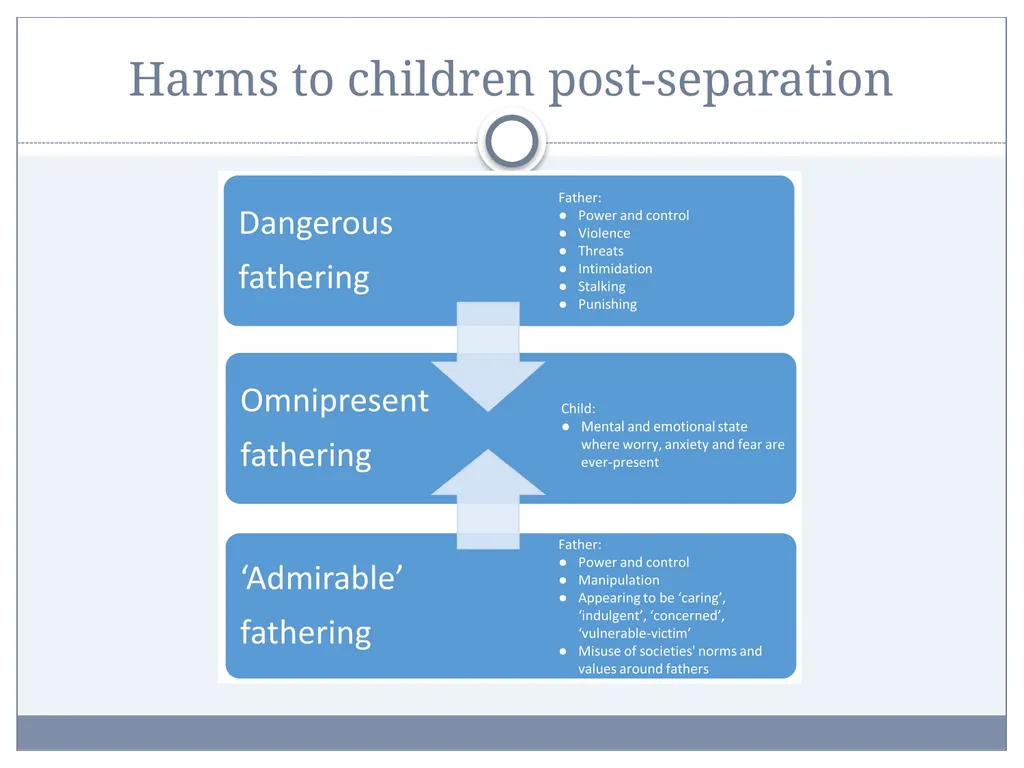
Harms to children post-separation<br>
17
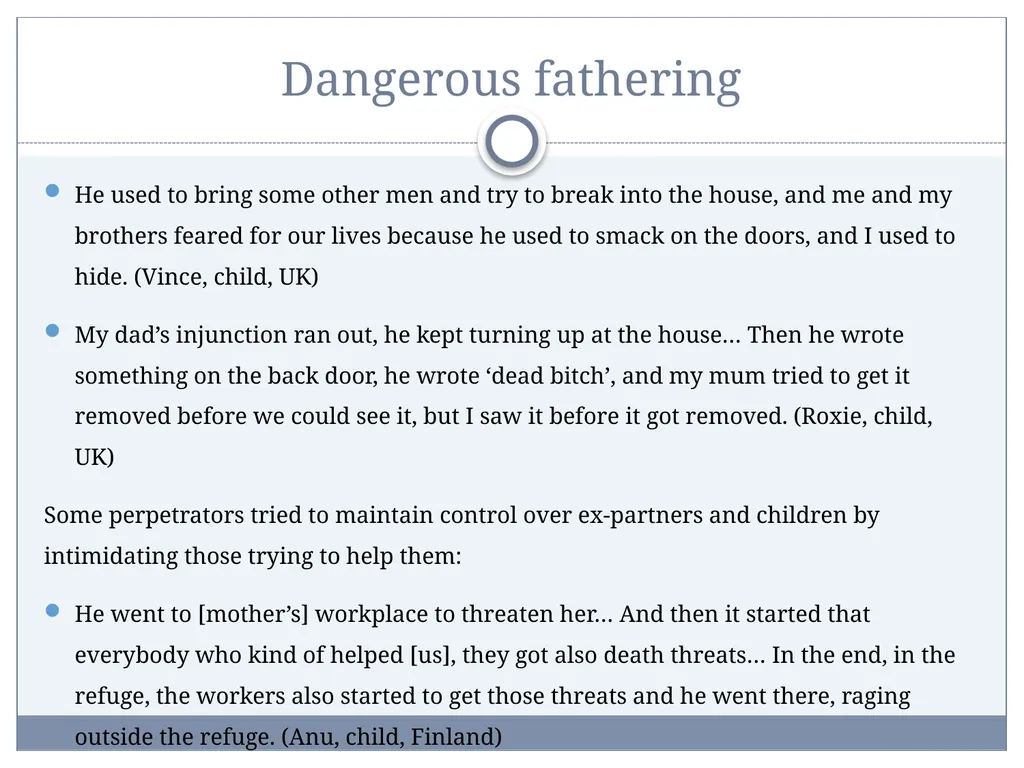
Dangerous fathering He used to bring some other men and try to break into the house, and me and my brothers feared for our lives because he used to smack on the doors, and I used to hide. (Vince, child, UK)
My dad’s injunction ran out, he kept turning up at the house… Then he wrote something on the back door, he wrote ‘dead bitch’, and my mum tried to get it removed before we could see it, but I saw it before it got removed. (Roxie, child, UK)
Some perpetrators tried to maintain control over ex-partners and children by intimidating those trying to help them:
He went to [mother’s] workplace to threaten her… And then it started that everybody who kind of helped [us], they got also death threats… In the end, in the refuge, the workers also started to get those threats and he went there, raging outside the refuge. (Anu, child, Finland)<br>
My dad’s injunction ran out, he kept turning up at the house… Then he wrote something on the back door, he wrote ‘dead bitch’, and my mum tried to get it removed before we could see it, but I saw it before it got removed. (Roxie, child, UK)
Some perpetrators tried to maintain control over ex-partners and children by intimidating those trying to help them:
He went to [mother’s] workplace to threaten her… And then it started that everybody who kind of helped [us], they got also death threats… In the end, in the refuge, the workers also started to get those threats and he went there, raging outside the refuge. (Anu, child, Finland)<br>
18
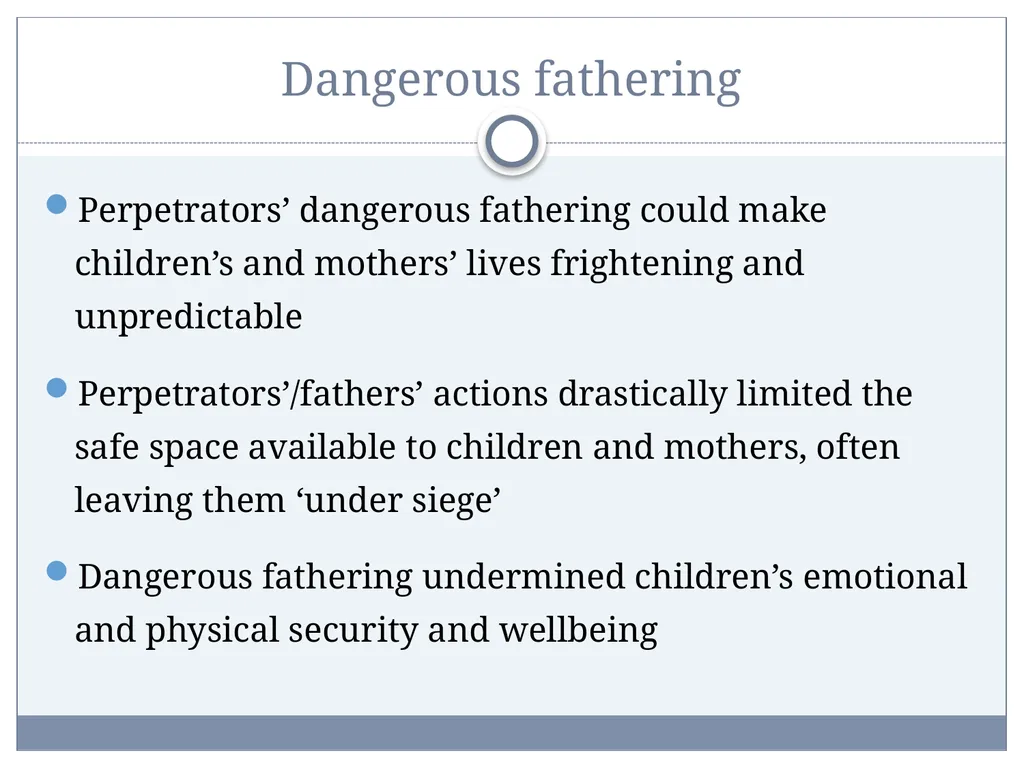
Dangerous fathering Perpetrators’ dangerous fathering could make children’s and mothers’ lives frightening and unpredictable
Perpetrators’/fathers’ actions drastically limited the safe space available to children and mothers, often leaving them ‘under siege’
Dangerous fathering undermined children’s emotional and physical security and wellbeing<br>
Perpetrators’/fathers’ actions drastically limited the safe space available to children and mothers, often leaving them ‘under siege’
Dangerous fathering undermined children’s emotional and physical security and wellbeing<br>
19
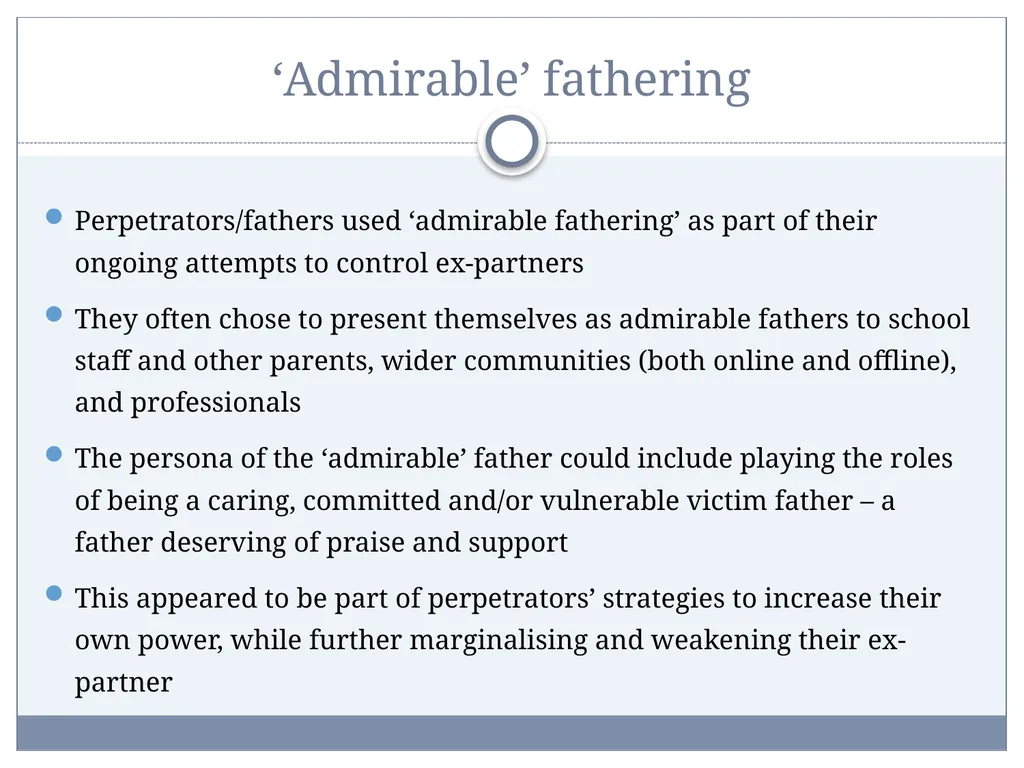
‘Admirable’ fathering Perpetrators/fathers used ‘admirable fathering’ as part of their ongoing attempts to control ex-partners
They often chose to present themselves as admirable fathers to school staff and other parents, wider communities (both online and offline), and professionals
The persona of the ‘admirable’ father could include playing the roles of being a caring, committed and/or vulnerable victim father – a father deserving of praise and support
This appeared to be part of perpetrators’ strategies to increase their own power, while further marginalising and weakening their ex-partner<br>
They often chose to present themselves as admirable fathers to school staff and other parents, wider communities (both online and offline), and professionals
The persona of the ‘admirable’ father could include playing the roles of being a caring, committed and/or vulnerable victim father – a father deserving of praise and support
This appeared to be part of perpetrators’ strategies to increase their own power, while further marginalising and weakening their ex-partner<br>
20
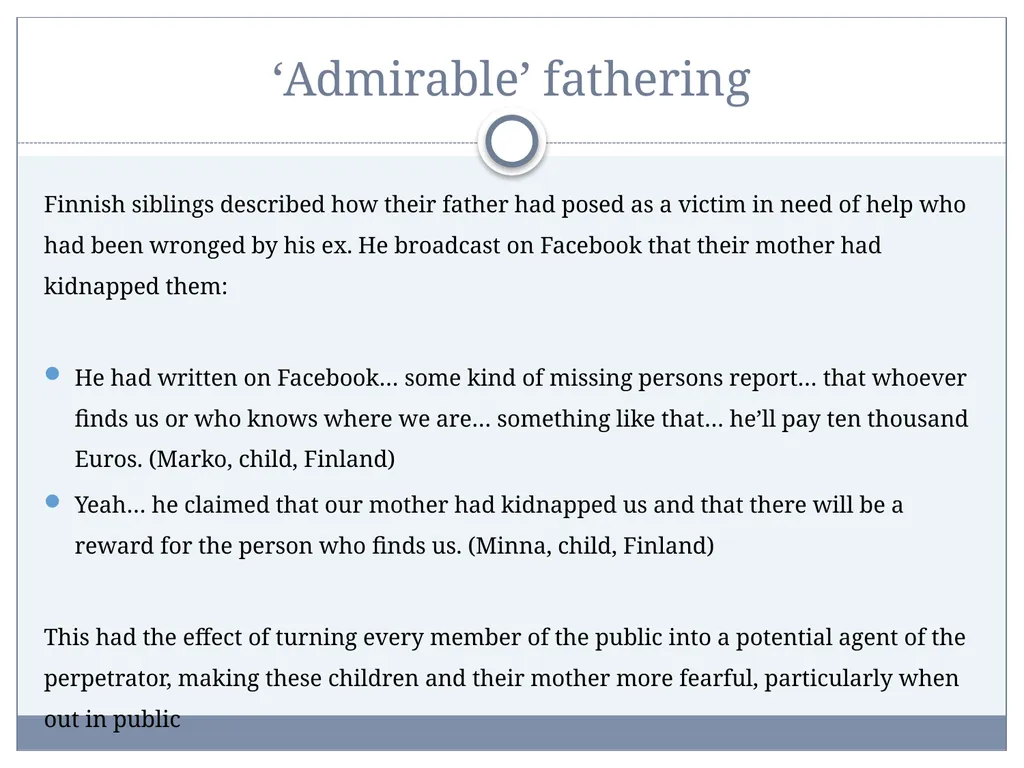
‘Admirable’ fathering Finnish siblings described how their father had posed as a victim in need of help who had been wronged by his ex. He broadcast on Facebook that their mother had kidnapped them:
He had written on Facebook… some kind of missing persons report… that whoever finds us or who knows where we are… something like that… he’ll pay ten thousand Euros. (Marko, child, Finland)
Yeah… he claimed that our mother had kidnapped us and that there will be a reward for the person who finds us. (Minna, child, Finland)
This had the effect of turning every member of the public into a potential agent of the perpetrator, making these children and their mother more fearful, particularly when out in public<br>
He had written on Facebook… some kind of missing persons report… that whoever finds us or who knows where we are… something like that… he’ll pay ten thousand Euros. (Marko, child, Finland)
Yeah… he claimed that our mother had kidnapped us and that there will be a reward for the person who finds us. (Minna, child, Finland)
This had the effect of turning every member of the public into a potential agent of the perpetrator, making these children and their mother more fearful, particularly when out in public<br>
21
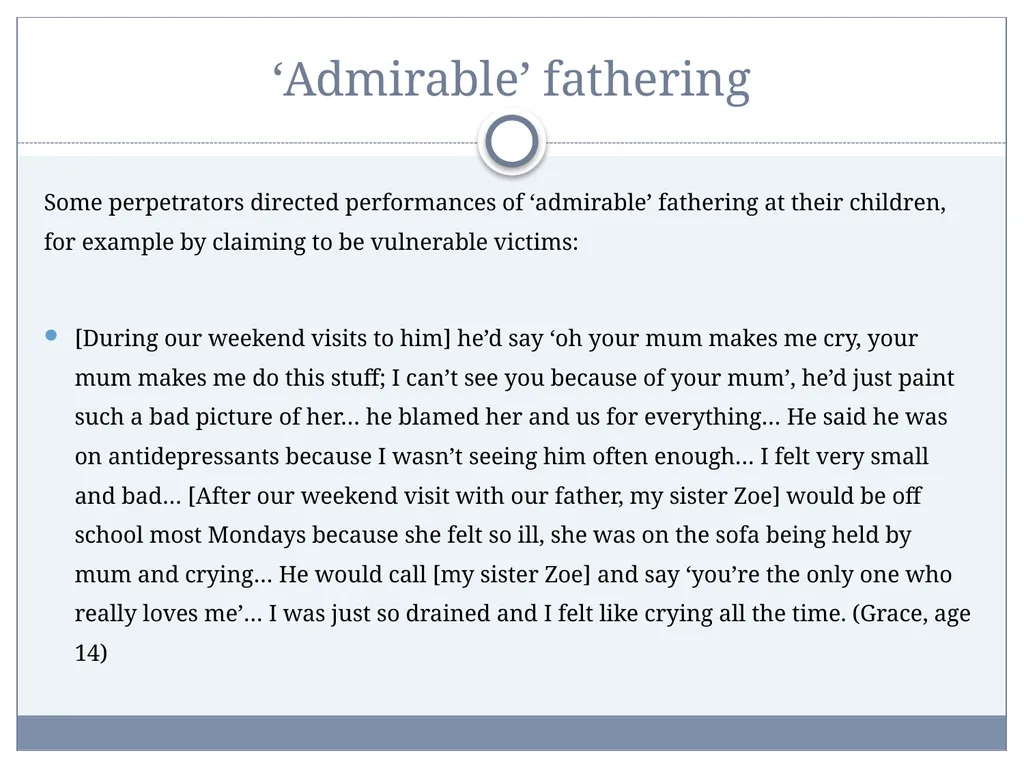
‘Admirable’ fathering Some perpetrators directed performances of ‘admirable’ fathering at their children, for example by claiming to be vulnerable victims:
[During our weekend visits to him] he’d say ‘oh your mum makes me cry, your mum makes me do this stuff; I can’t see you because of your mum’, he’d just paint such a bad picture of her… he blamed her and us for everything… He said he was on antidepressants because I wasn’t seeing him often enough… I felt very small and bad… [After our weekend visit with our father, my sister Zoe] would be off school most Mondays because she felt so ill, she was on the sofa being held by mum and crying… He would call [my sister Zoe] and say ‘you’re the only one who really loves me’… I was just so drained and I felt like crying all the time. (Grace, age 14)<br>
[During our weekend visits to him] he’d say ‘oh your mum makes me cry, your mum makes me do this stuff; I can’t see you because of your mum’, he’d just paint such a bad picture of her… he blamed her and us for everything… He said he was on antidepressants because I wasn’t seeing him often enough… I felt very small and bad… [After our weekend visit with our father, my sister Zoe] would be off school most Mondays because she felt so ill, she was on the sofa being held by mum and crying… He would call [my sister Zoe] and say ‘you’re the only one who really loves me’… I was just so drained and I felt like crying all the time. (Grace, age 14)<br>
22
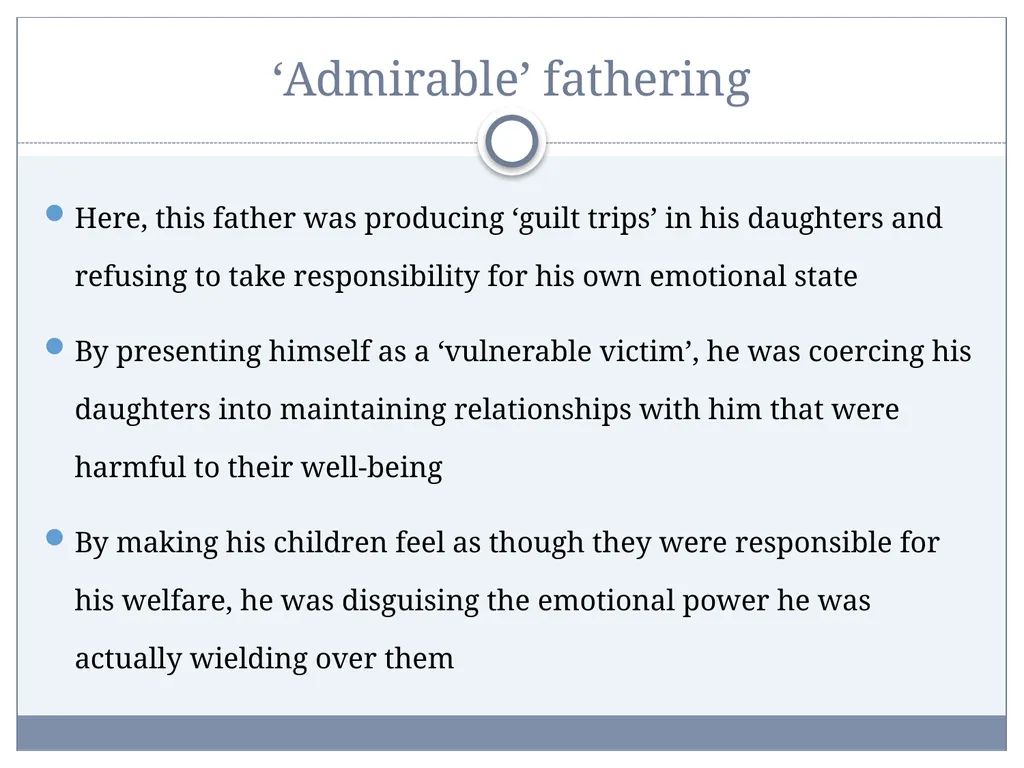
‘Admirable’ fathering Here, this father was producing ‘guilt trips’ in his daughters and refusing to take responsibility for his own emotional state
By presenting himself as a ‘vulnerable victim’, he was coercing his daughters into maintaining relationships with him that were harmful to their well-being
By making his children feel as though they were responsible for his welfare, he was disguising the emotional power he was actually wielding over them<br>
By presenting himself as a ‘vulnerable victim’, he was coercing his daughters into maintaining relationships with him that were harmful to their well-being
By making his children feel as though they were responsible for his welfare, he was disguising the emotional power he was actually wielding over them<br>
23
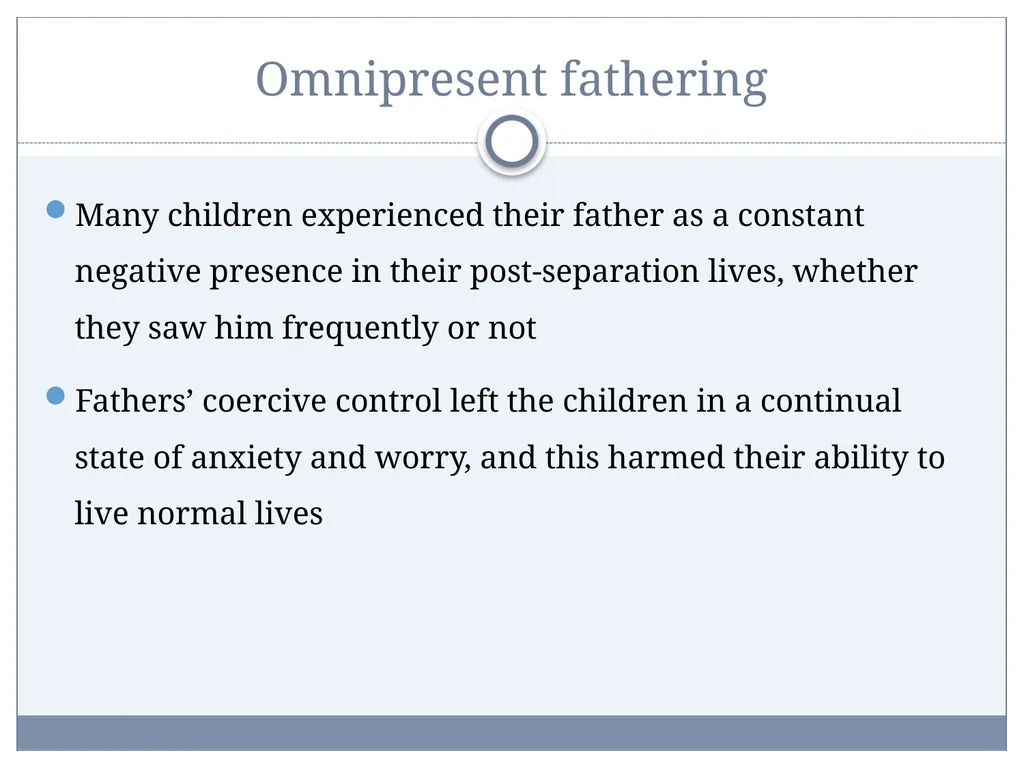
Omnipresent fathering Many children experienced their father as a constant negative presence in their post-separation lives, whether they saw him frequently or not
Fathers’ coercive control left the children in a continual state of anxiety and worry, and this harmed their ability to live normal lives<br>
Fathers’ coercive control left the children in a continual state of anxiety and worry, and this harmed their ability to live normal lives<br>
24
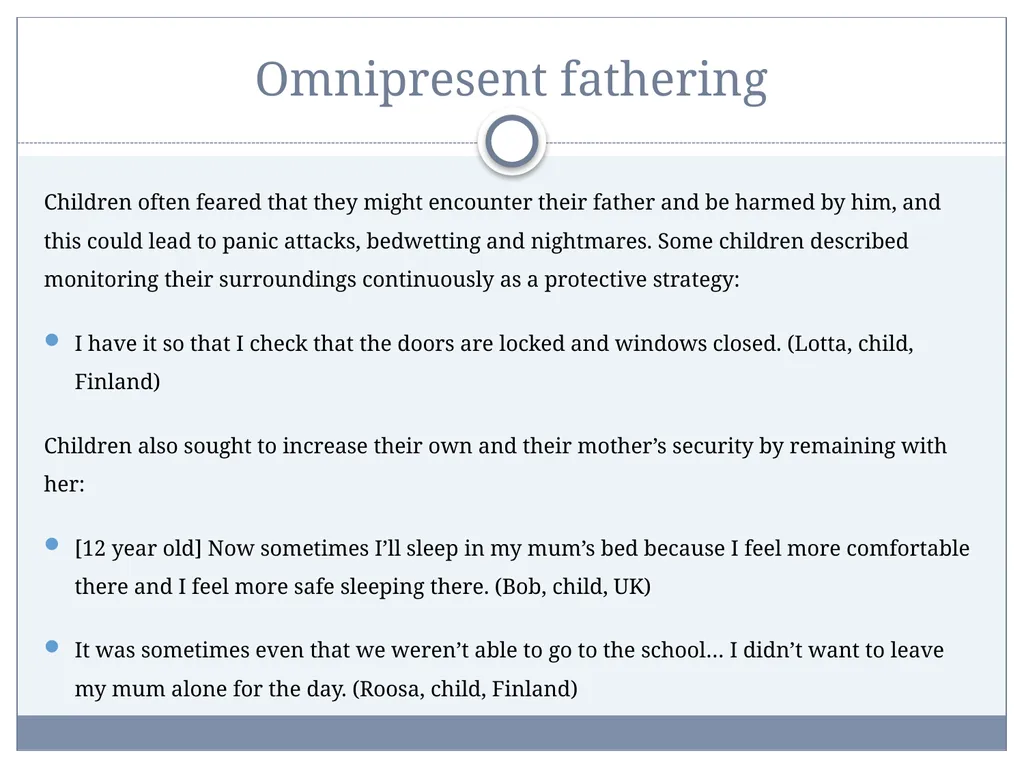
Omnipresent fathering Children often feared that they might encounter their father and be harmed by him, and this could lead to panic attacks, bedwetting and nightmares. Some children described monitoring their surroundings continuously as a protective strategy:
I have it so that I check that the doors are locked and windows closed. (Lotta, child, Finland)
Children also sought to increase their own and their mother’s security by remaining with her:
[12 year old] Now sometimes I’ll sleep in my mum’s bed because I feel more comfortable there and I feel more safe sleeping there. (Bob, child, UK)
It was sometimes even that we weren’t able to go to the school… I didn’t want to leave my mum alone for the day. (Roosa, child, Finland)<br>
I have it so that I check that the doors are locked and windows closed. (Lotta, child, Finland)
Children also sought to increase their own and their mother’s security by remaining with her:
[12 year old] Now sometimes I’ll sleep in my mum’s bed because I feel more comfortable there and I feel more safe sleeping there. (Bob, child, UK)
It was sometimes even that we weren’t able to go to the school… I didn’t want to leave my mum alone for the day. (Roosa, child, Finland)<br>
25
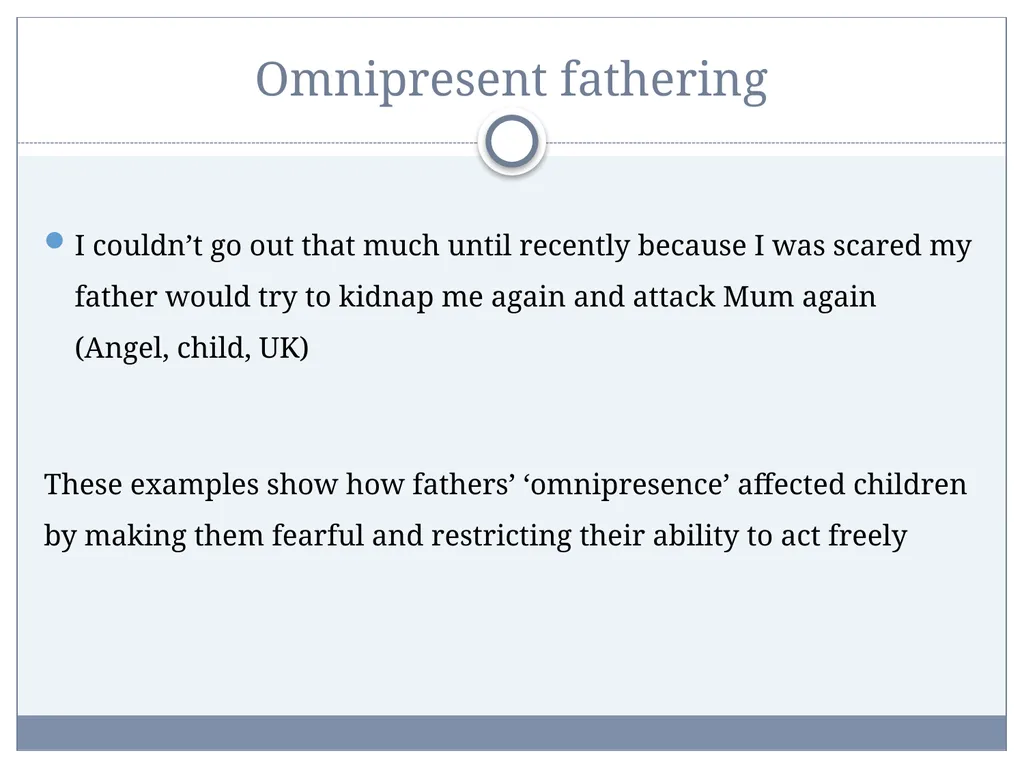
Omnipresent fathering I couldn’t go out that much until recently because I was scared my father would try to kidnap me again and attack Mum again (Angel, child, UK)
These examples show how fathers’ ‘omnipresence’ affected children by making them fearful and restricting their ability to act freely<br>
These examples show how fathers’ ‘omnipresence’ affected children by making them fearful and restricting their ability to act freely<br>
26
Conclusions<br>
27
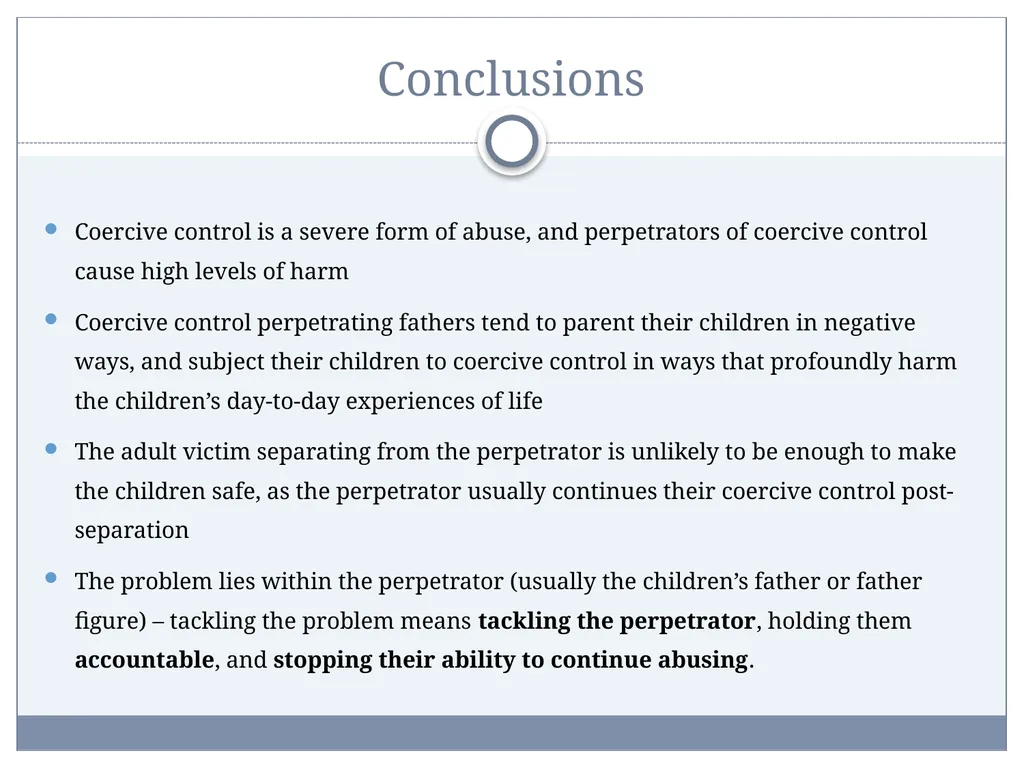
Conclusions Coercive control is a severe form of abuse, and perpetrators of coercive control cause high levels of harm
Coercive control perpetrating fathers tend to parent their children in negative ways, and subject their children to coercive control in ways that profoundly harm the children’s day-to-day experiences of life
The adult victim separating from the perpetrator is unlikely to be enough to make the children safe, as the perpetrator usually continues their coercive control post-separation
The problem lies within the perpetrator (usually the children’s father or father figure) – tackling the problem means tackling the perpetrator, holding them accountable, and stopping their ability to continue abusing.<br>
Coercive control perpetrating fathers tend to parent their children in negative ways, and subject their children to coercive control in ways that profoundly harm the children’s day-to-day experiences of life
The adult victim separating from the perpetrator is unlikely to be enough to make the children safe, as the perpetrator usually continues their coercive control post-separation
The problem lies within the perpetrator (usually the children’s father or father figure) – tackling the problem means tackling the perpetrator, holding them accountable, and stopping their ability to continue abusing.<br>
28
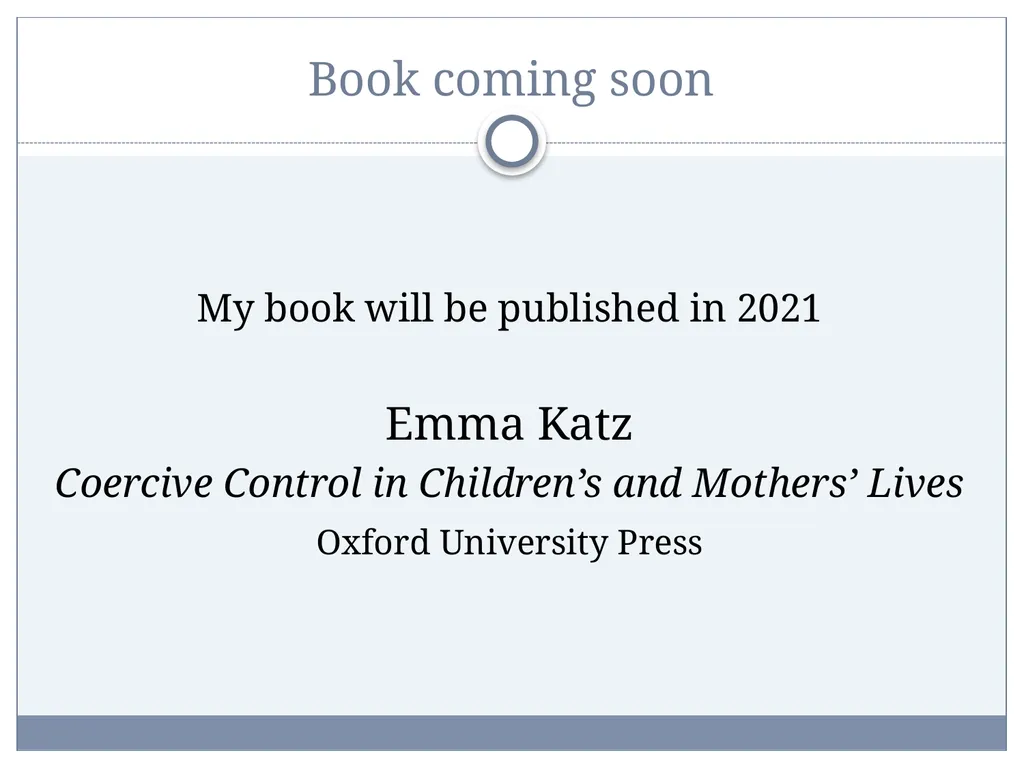
Book coming soon My book will be published in 2021
Emma Katz
Coercive Control in Children’s and Mothers’ Lives
Oxford University Press<br>
Emma Katz
Coercive Control in Children’s and Mothers’ Lives
Oxford University Press<br>
29
Was this talk useful? katze@hope.ac.uk Please take a couple of minutes to provide me with some brief feedback
https://www.surveymonkey.co.uk/r/HDCJGKJ<br>
https://www.surveymonkey.co.uk/r/HDCJGKJ<br>
30
Email Emma at katze@hope.ac.uk if you want copies
Katz, E., Nikupeteri, A. and Laitinen, M. (2020) When Coercive Control Continues to Harm Children: Post-Separation Fathering, Stalking, and Domestic Violence. Child Abuse Review, vol. 29, no. 4, pp. 310-324.
Katz, E. (2019) Coercive Control, Domestic Violence and a Five-Factor Framework: Five Factors that Influence Closeness, Distance and Strain in Mother-Child Relationships. Violence Against Women, vol. 25, no. 15, pp. 1829–1853.
Katz, E. (2016) Beyond the Physical Incident Model: How Children Living with Domestic Violence are Harmed by and Resist Regimes of Coercive Control. Child Abuse Review, vol. 25, no. 1, pp. 46–59.
Katz, E. (2015) Recovery-Promoters: Ways that Mothers and Children Support One Another’s Recoveries from Domestic Violence. British Journal of Social Work, vol. 45, sup. 1, pp. i153–i169.
Katz, E. (2015) Domestic Violence, Children’s Agency and Mother-Child Relationships: Towards a More Advanced Model. Children and Society, vol. 29, no. 1, pp. 69–79. Emma’s publications<br>
Katz, E., Nikupeteri, A. and Laitinen, M. (2020) When Coercive Control Continues to Harm Children: Post-Separation Fathering, Stalking, and Domestic Violence. Child Abuse Review, vol. 29, no. 4, pp. 310-324.
Katz, E. (2019) Coercive Control, Domestic Violence and a Five-Factor Framework: Five Factors that Influence Closeness, Distance and Strain in Mother-Child Relationships. Violence Against Women, vol. 25, no. 15, pp. 1829–1853.
Katz, E. (2016) Beyond the Physical Incident Model: How Children Living with Domestic Violence are Harmed by and Resist Regimes of Coercive Control. Child Abuse Review, vol. 25, no. 1, pp. 46–59.
Katz, E. (2015) Recovery-Promoters: Ways that Mothers and Children Support One Another’s Recoveries from Domestic Violence. British Journal of Social Work, vol. 45, sup. 1, pp. i153–i169.
Katz, E. (2015) Domestic Violence, Children’s Agency and Mother-Child Relationships: Towards a More Advanced Model. Children and Society, vol. 29, no. 1, pp. 69–79. Emma’s publications<br>
31
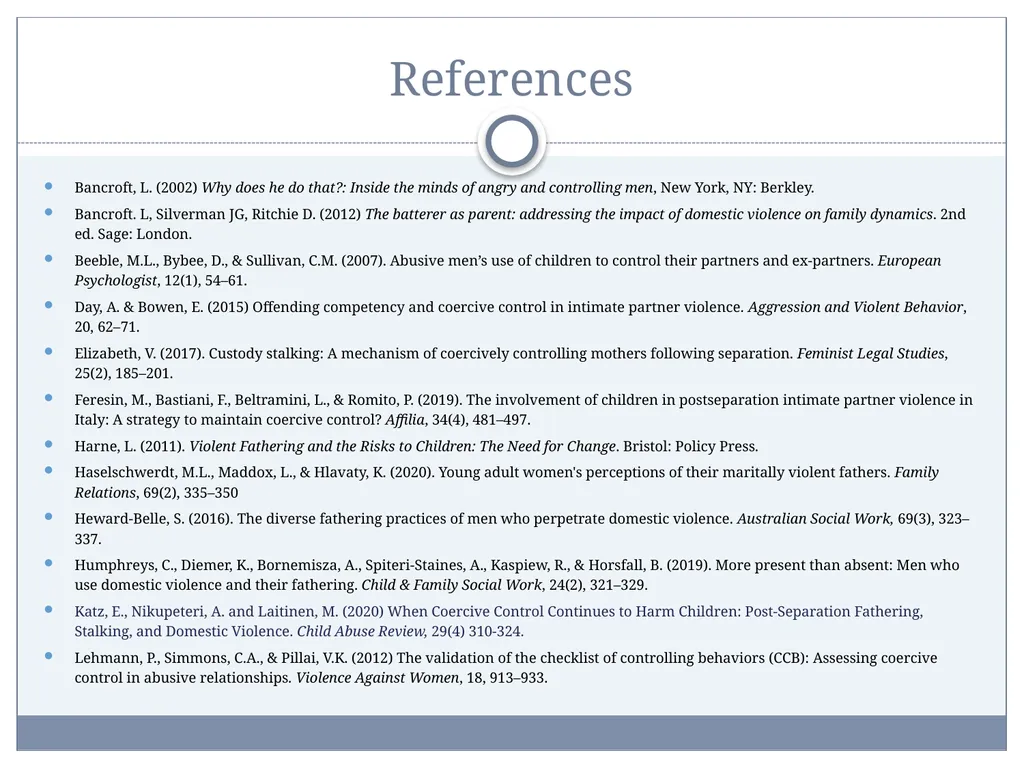
References Bancroft, L. (2002) Why does he do that?: Inside the minds of angry and controlling men, New York, NY: Berkley.
Bancroft. L, Silverman JG, Ritchie D. (2012) The batterer as parent: addressing the impact of domestic violence on family dynamics. 2nd ed. Sage: London.
Beeble, M.L., Bybee, D., & Sullivan, C.M. (2007). Abusive men’s use of children to control their partners and ex-partners. European Psychologist, 12(1), 54–61.
Day, A. & Bowen, E. (2015) Offending competency and coercive control in intimate partner violence. Aggression and Violent Behavior, 20, 62–71.
Elizabeth, V. (2017). Custody stalking: A mechanism of coercively controlling mothers following separation. Feminist Legal Studies, 25(2), 185–201.
Feresin, M., Bastiani, F., Beltramini, L., & Romito, P. (2019). The involvement of children in postseparation intimate partner violence in Italy: A strategy to maintain coercive control? Affilia, 34(4), 481–497.
Harne, L. (2011). Violent Fathering and the Risks to Children: The Need for Change. Bristol: Policy Press.
Haselschwerdt, M.L., Maddox, L., & Hlavaty, K. (2020). Young adult women's perceptions of their maritally violent fathers. Family Relations, 69(2), 335–350
Heward-Belle, S. (2016). The diverse fathering practices of men who perpetrate domestic violence. Australian Social Work, 69(3), 323–337.
Humphreys, C., Diemer, K., Bornemisza, A., Spiteri‐Staines, A., Kaspiew, R., & Horsfall, B. (2019). More present than absent: Men who use domestic violence and their fathering. Child & Family Social Work, 24(2), 321–329.
Katz, E., Nikupeteri, A. and Laitinen, M. (2020) When Coercive Control Continues to Harm Children: Post-Separation Fathering, Stalking, and Domestic Violence. Child Abuse Review, 29(4) 310-324.
Lehmann, P., Simmons, C.A., & Pillai, V.K. (2012) The validation of the checklist of controlling behaviors (CCB): Assessing coercive control in abusive relationships. Violence Against Women, 18, 913–933.<br>
Bancroft. L, Silverman JG, Ritchie D. (2012) The batterer as parent: addressing the impact of domestic violence on family dynamics. 2nd ed. Sage: London.
Beeble, M.L., Bybee, D., & Sullivan, C.M. (2007). Abusive men’s use of children to control their partners and ex-partners. European Psychologist, 12(1), 54–61.
Day, A. & Bowen, E. (2015) Offending competency and coercive control in intimate partner violence. Aggression and Violent Behavior, 20, 62–71.
Elizabeth, V. (2017). Custody stalking: A mechanism of coercively controlling mothers following separation. Feminist Legal Studies, 25(2), 185–201.
Feresin, M., Bastiani, F., Beltramini, L., & Romito, P. (2019). The involvement of children in postseparation intimate partner violence in Italy: A strategy to maintain coercive control? Affilia, 34(4), 481–497.
Harne, L. (2011). Violent Fathering and the Risks to Children: The Need for Change. Bristol: Policy Press.
Haselschwerdt, M.L., Maddox, L., & Hlavaty, K. (2020). Young adult women's perceptions of their maritally violent fathers. Family Relations, 69(2), 335–350
Heward-Belle, S. (2016). The diverse fathering practices of men who perpetrate domestic violence. Australian Social Work, 69(3), 323–337.
Humphreys, C., Diemer, K., Bornemisza, A., Spiteri‐Staines, A., Kaspiew, R., & Horsfall, B. (2019). More present than absent: Men who use domestic violence and their fathering. Child & Family Social Work, 24(2), 321–329.
Katz, E., Nikupeteri, A. and Laitinen, M. (2020) When Coercive Control Continues to Harm Children: Post-Separation Fathering, Stalking, and Domestic Violence. Child Abuse Review, 29(4) 310-324.
Lehmann, P., Simmons, C.A., & Pillai, V.K. (2012) The validation of the checklist of controlling behaviors (CCB): Assessing coercive control in abusive relationships. Violence Against Women, 18, 913–933.<br>
32
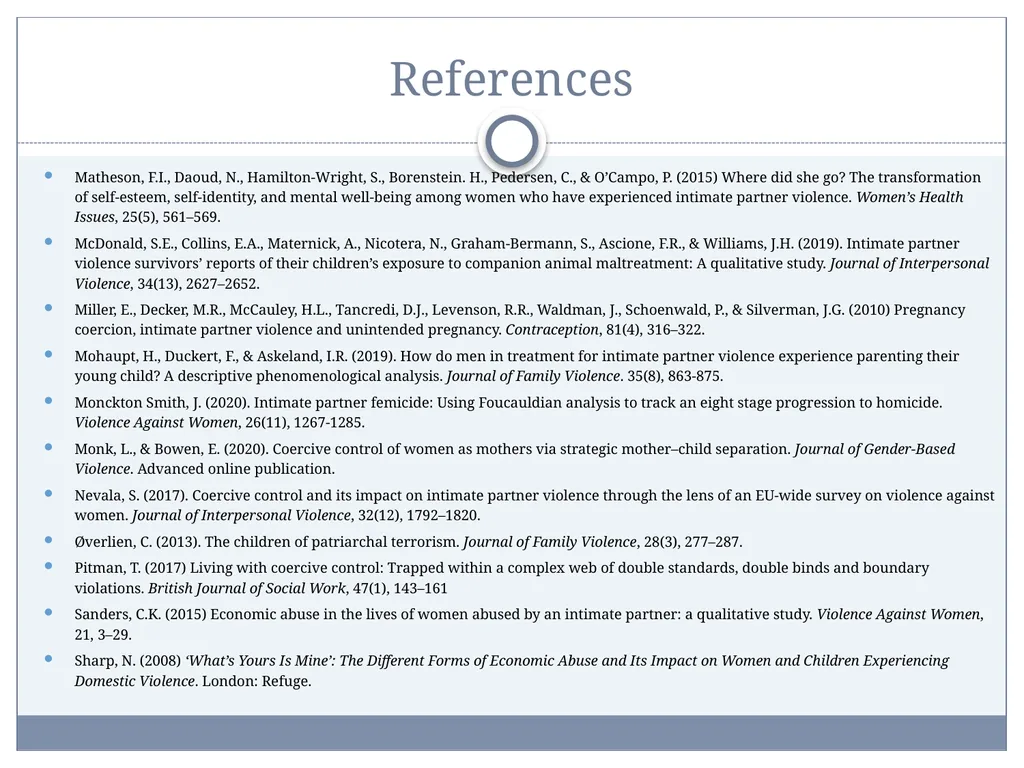
References Matheson, F.I., Daoud, N., Hamilton-Wright, S., Borenstein. H., Pedersen, C., & O’Campo, P. (2015) Where did she go? The transformation of self-esteem, self-identity, and mental well-being among women who have experienced intimate partner violence. Women’s Health Issues, 25(5), 561–569.
McDonald, S.E., Collins, E.A., Maternick, A., Nicotera, N., Graham-Bermann, S., Ascione, F.R., & Williams, J.H. (2019). Intimate partner violence survivors’ reports of their children’s exposure to companion animal maltreatment: A qualitative study. Journal of Interpersonal Violence, 34(13), 2627–2652.
Miller, E., Decker, M.R., McCauley, H.L., Tancredi, D.J., Levenson, R.R., Waldman, J., Schoenwald, P., & Silverman, J.G. (2010) Pregnancy coercion, intimate partner violence and unintended pregnancy. Contraception, 81(4), 316–322.
Mohaupt, H., Duckert, F., & Askeland, I.R. (2019). How do men in treatment for intimate partner violence experience parenting their young child? A descriptive phenomenological analysis. Journal of Family Violence. 35(8), 863-875.
Monckton Smith, J. (2020). Intimate partner femicide: Using Foucauldian analysis to track an eight stage progression to homicide. Violence Against Women, 26(11), 1267-1285.
Monk, L., & Bowen, E. (2020). Coercive control of women as mothers via strategic mother–child separation. Journal of Gender-Based Violence. Advanced online publication.
Nevala, S. (2017). Coercive control and its impact on intimate partner violence through the lens of an EU-wide survey on violence against women. Journal of Interpersonal Violence, 32(12), 1792–1820.
Øverlien, C. (2013). The children of patriarchal terrorism. Journal of Family Violence, 28(3), 277–287.
Pitman, T. (2017) Living with coercive control: Trapped within a complex web of double standards, double binds and boundary violations. British Journal of Social Work, 47(1), 143–161
Sanders, C.K. (2015) Economic abuse in the lives of women abused by an intimate partner: a qualitative study. Violence Against Women, 21, 3–29.
Sharp, N. (2008) ‘What’s Yours Is Mine’: The Different Forms of Economic Abuse and Its Impact on Women and Children Experiencing Domestic Violence. London: Refuge.<br>
McDonald, S.E., Collins, E.A., Maternick, A., Nicotera, N., Graham-Bermann, S., Ascione, F.R., & Williams, J.H. (2019). Intimate partner violence survivors’ reports of their children’s exposure to companion animal maltreatment: A qualitative study. Journal of Interpersonal Violence, 34(13), 2627–2652.
Miller, E., Decker, M.R., McCauley, H.L., Tancredi, D.J., Levenson, R.R., Waldman, J., Schoenwald, P., & Silverman, J.G. (2010) Pregnancy coercion, intimate partner violence and unintended pregnancy. Contraception, 81(4), 316–322.
Mohaupt, H., Duckert, F., & Askeland, I.R. (2019). How do men in treatment for intimate partner violence experience parenting their young child? A descriptive phenomenological analysis. Journal of Family Violence. 35(8), 863-875.
Monckton Smith, J. (2020). Intimate partner femicide: Using Foucauldian analysis to track an eight stage progression to homicide. Violence Against Women, 26(11), 1267-1285.
Monk, L., & Bowen, E. (2020). Coercive control of women as mothers via strategic mother–child separation. Journal of Gender-Based Violence. Advanced online publication.
Nevala, S. (2017). Coercive control and its impact on intimate partner violence through the lens of an EU-wide survey on violence against women. Journal of Interpersonal Violence, 32(12), 1792–1820.
Øverlien, C. (2013). The children of patriarchal terrorism. Journal of Family Violence, 28(3), 277–287.
Pitman, T. (2017) Living with coercive control: Trapped within a complex web of double standards, double binds and boundary violations. British Journal of Social Work, 47(1), 143–161
Sanders, C.K. (2015) Economic abuse in the lives of women abused by an intimate partner: a qualitative study. Violence Against Women, 21, 3–29.
Sharp, N. (2008) ‘What’s Yours Is Mine’: The Different Forms of Economic Abuse and Its Impact on Women and Children Experiencing Domestic Violence. London: Refuge.<br>
33
References Sharp-Jeffs, N., Kelly, L., & Klein, R. (2018) Long journeys toward freedom: The relationship between coercive control and space for action – measurement and emerging evidence. Violence Against Women, 24(2), 163–185.
Smith, J., & Humphreys, C. (2019). Child protection and fathering where there is domestic violence: Contradictions and consequences. Child & Family Social Work, 24(1), 156–163.
Stark, E. (2007) Coercive Control: The Entrapment of Women in Personal Life. Oxford: Oxford University Press.
Stark E. (2009) Rethinking custody evaluation in cases involving domestic violence. Journal of Child Custody, 6, 287–321.
Stark E. (2012) Looking beyond domestic violence: policing coercive control. Journal of Police Crisis Negotiations, 12, 199–217.
Stark, E. & Hester, M. (2019) Coercive control: Update and review. Violence Against Women, 25(1), 81–104.
Tarzia, L., Wellington, M., Marino, J., & Hegarty, K. (2019) ‘A huge, hidden problem’: Australian health practitioners’ views and understandings of reproductive coercion. Qualitative Health Research, 29(10), 1395–1407.
Thomas, K.A., Joshi, M., & Sorenson, S.B. (2014) ‘Do you know what it feels like to drown?’: Strangulation as coercive control in intimate relationships. Psychology of Women Quarterly, 38, 124–137.
Thompson-Walsh, C., Scott, K. L., Lishak, V., & Dyson, A. (2021). How domestically violent Fathers impact children’s social-emotional development: Fathers’ psychological functioning, parenting, and coparenting. Child Abuse & Neglect, 112, 104866.
Thiara, R.K., & Gill, A.K. (2012). Domestic Violence, Child Contact and Post-Separation Violence Issues for South Asian and African-Caribbean Women and Children: A Report of Findings. NSPCC: London.
Thiara, R.K., & Humphreys, C. (2017). Absent presence: The ongoing impact of men’s violence on the mother–child relationship. Child & Family Social Work, 22(1), 137–145.
Williamson, E. (2010) Living in the World of the Domestic Violence Perpetrator: Negotiating the Unreality of Coercive Control, Violence Against Women, 16(12) 1412-1423.<br>
Smith, J., & Humphreys, C. (2019). Child protection and fathering where there is domestic violence: Contradictions and consequences. Child & Family Social Work, 24(1), 156–163.
Stark, E. (2007) Coercive Control: The Entrapment of Women in Personal Life. Oxford: Oxford University Press.
Stark E. (2009) Rethinking custody evaluation in cases involving domestic violence. Journal of Child Custody, 6, 287–321.
Stark E. (2012) Looking beyond domestic violence: policing coercive control. Journal of Police Crisis Negotiations, 12, 199–217.
Stark, E. & Hester, M. (2019) Coercive control: Update and review. Violence Against Women, 25(1), 81–104.
Tarzia, L., Wellington, M., Marino, J., & Hegarty, K. (2019) ‘A huge, hidden problem’: Australian health practitioners’ views and understandings of reproductive coercion. Qualitative Health Research, 29(10), 1395–1407.
Thomas, K.A., Joshi, M., & Sorenson, S.B. (2014) ‘Do you know what it feels like to drown?’: Strangulation as coercive control in intimate relationships. Psychology of Women Quarterly, 38, 124–137.
Thompson-Walsh, C., Scott, K. L., Lishak, V., & Dyson, A. (2021). How domestically violent Fathers impact children’s social-emotional development: Fathers’ psychological functioning, parenting, and coparenting. Child Abuse & Neglect, 112, 104866.
Thiara, R.K., & Gill, A.K. (2012). Domestic Violence, Child Contact and Post-Separation Violence Issues for South Asian and African-Caribbean Women and Children: A Report of Findings. NSPCC: London.
Thiara, R.K., & Humphreys, C. (2017). Absent presence: The ongoing impact of men’s violence on the mother–child relationship. Child & Family Social Work, 22(1), 137–145.
Williamson, E. (2010) Living in the World of the Domestic Violence Perpetrator: Negotiating the Unreality of Coercive Control, Violence Against Women, 16(12) 1412-1423.<br>
34
Thank you
Dr Emma Katz
Liverpool Hope University
Email: katze@hope.ac.uk
Follow me on Twitter @DrEmmaKatz<br>
Dr Emma Katz
Liverpool Hope University
Email: katze@hope.ac.uk
Follow me on Twitter @DrEmmaKatz<br>