
Coercive Controlling Behaviour in an intimate or
LD
Published · 39 slides · 0 views
1 / 1



Description
Coercive Controlling Behaviour in an intimate or family relationship Chani Mortimer and Tina Sharp Aim: To raise awareness of coercive controlling behaviour legislation and enable participants to respond appropriately to intimate partner
Related Topics
Share
Embed code
Download this presentation From Below
"Coercive Controlling Behaviour in an intimate or" is the property of its rightful owner. Permission is granted to download and print the materials on this website for personal, non-commercial use only, and to display it on your personal computer provided you do not modify the materials and that you retain all copyright notices contained in the materials. By downloading content from our website, you accept the terms of this agreement.
Presentation Transcript
01
Coercive Controlling Behaviour in an intimate or family relationship Chani Mortimer and Tina Sharp<br>
02
Aim: To raise awareness of coercive controlling behaviour legislation and enable participants to respond appropriately to intimate partner and adult family victims Learning outcomes:
Explain legislation for coercive controlling behaviour in an intimate or family relationship
Describe the impact of coercive controlling behaviour on intimate partner and adult family victims
Assess risk from disclosures and victim behaviour
Identify measures to assist victims to mitigate risk and for appropriate sources of support<br>
Explain legislation for coercive controlling behaviour in an intimate or family relationship
Describe the impact of coercive controlling behaviour on intimate partner and adult family victims
Assess risk from disclosures and victim behaviour
Identify measures to assist victims to mitigate risk and for appropriate sources of support<br>
03
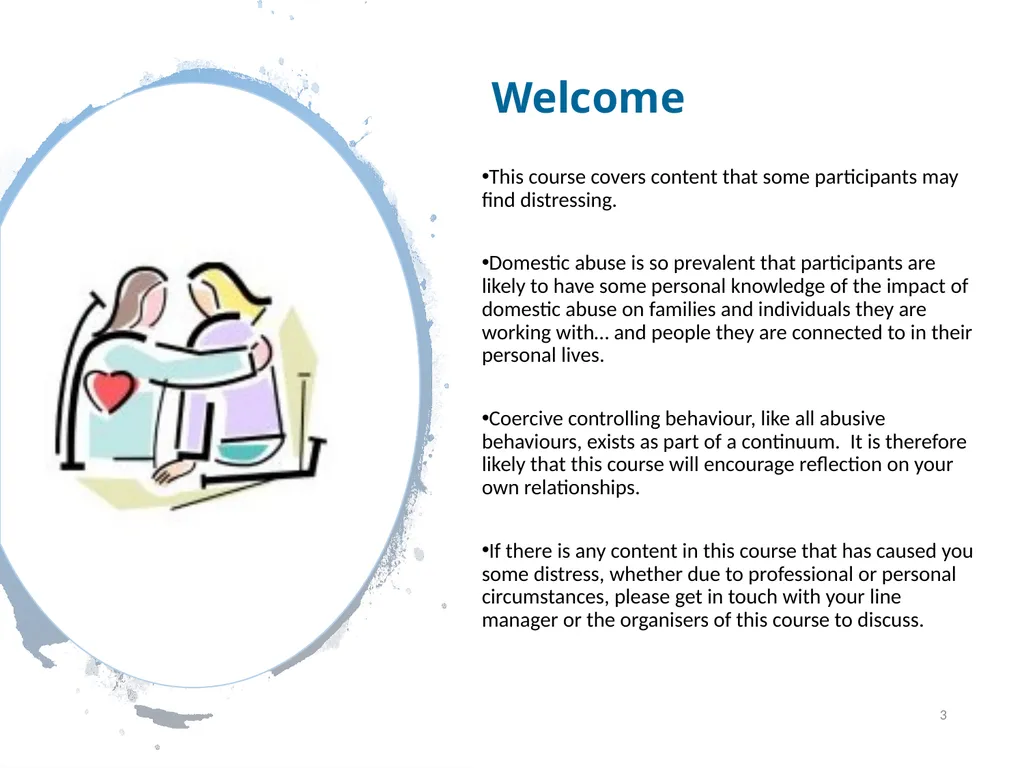
Welcome This course covers content that some participants may find distressing.
Domestic abuse is so prevalent that participants are likely to have some personal knowledge of the impact of domestic abuse on families and individuals they are working with… and people they are connected to in their personal lives.
Coercive controlling behaviour, like all abusive behaviours, exists as part of a continuum. It is therefore likely that this course will encourage reflection on your own relationships.
If there is any content in this course that has caused you some distress, whether due to professional or personal circumstances, please get in touch with your line manager or the organisers of this course to discuss. 3<br>
Domestic abuse is so prevalent that participants are likely to have some personal knowledge of the impact of domestic abuse on families and individuals they are working with… and people they are connected to in their personal lives.
Coercive controlling behaviour, like all abusive behaviours, exists as part of a continuum. It is therefore likely that this course will encourage reflection on your own relationships.
If there is any content in this course that has caused you some distress, whether due to professional or personal circumstances, please get in touch with your line manager or the organisers of this course to discuss. 3<br>
04
www.kirklees.gov.uk/beta/domestic-abuse/pdf/domestic-abuse-strategy.pdf This course sits within the broader vision in the<br>
05
What do victims tell us is the worst part of an abusive relationship?
Does coercive control include:
Limiting access to resources
Assault
Criminal damage
Honour based abuse
Is coercive control a new dynamic of abusive relationships?
What proportion of domestic homicides include coercive controlling behaviour?<br>
Does coercive control include:
Limiting access to resources
Assault
Criminal damage
Honour based abuse
Is coercive control a new dynamic of abusive relationships?
What proportion of domestic homicides include coercive controlling behaviour?<br>
06
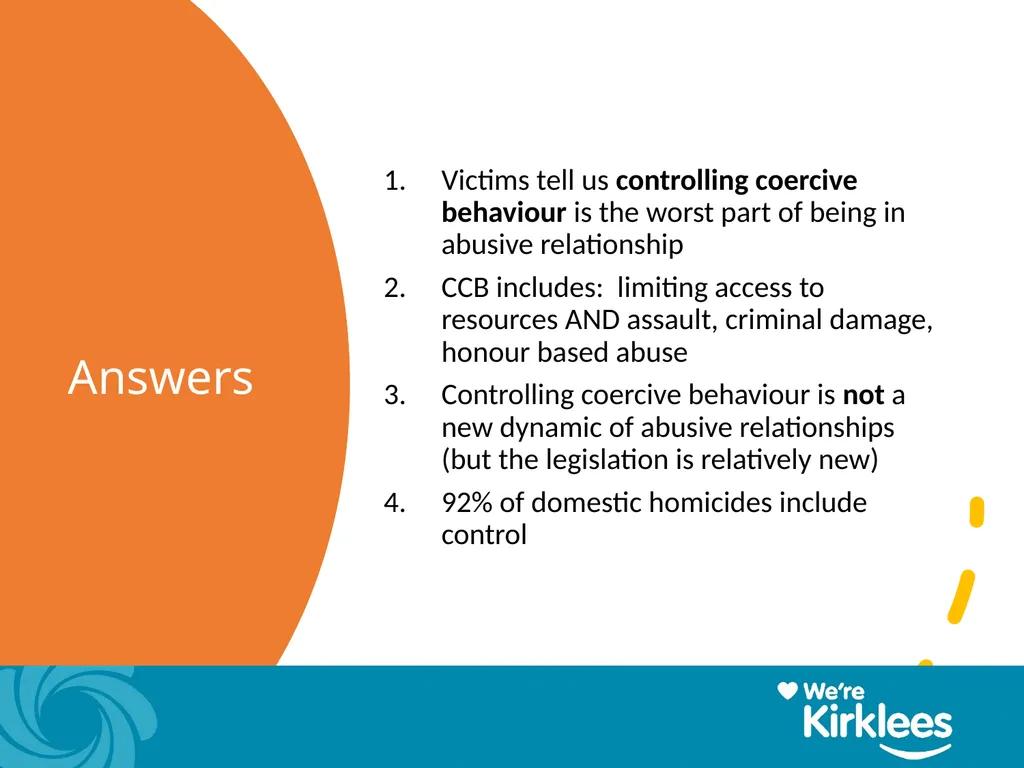
Answers Victims tell us controlling coercive behaviour is the worst part of being in abusive relationship
CCB includes: limiting access to resources AND assault, criminal damage, honour based abuse
Controlling coercive behaviour is not a new dynamic of abusive relationships (but the legislation is relatively new)
92% of domestic homicides include control<br>
CCB includes: limiting access to resources AND assault, criminal damage, honour based abuse
Controlling coercive behaviour is not a new dynamic of abusive relationships (but the legislation is relatively new)
92% of domestic homicides include control<br>
07
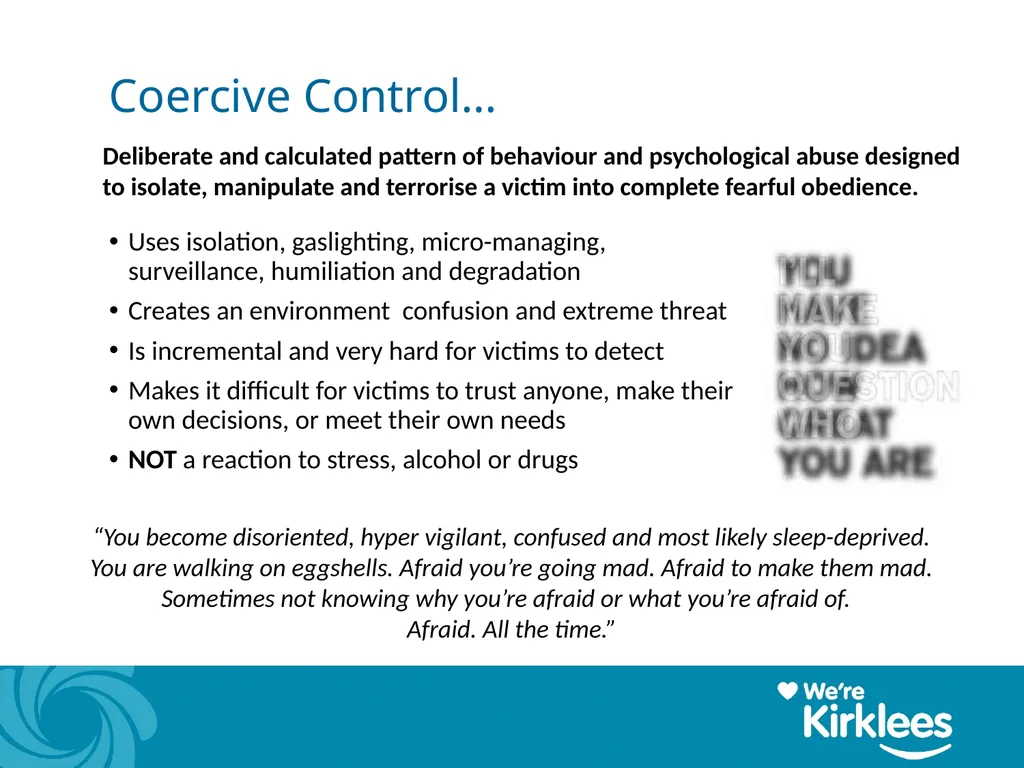
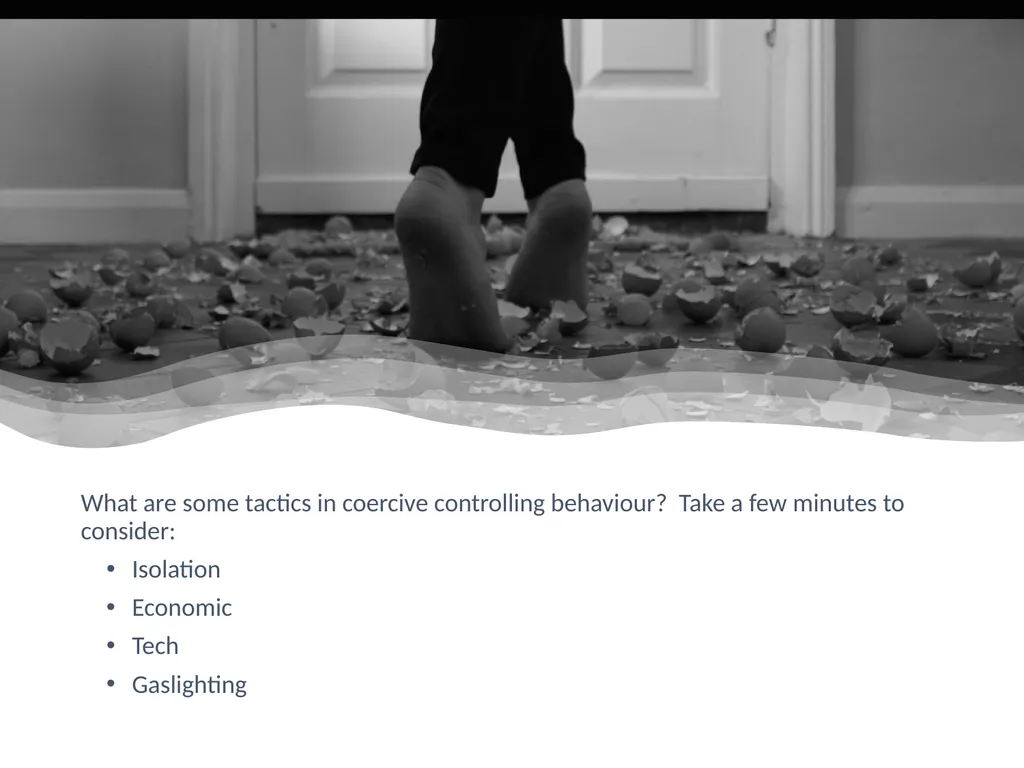
Coercive Control… “You become disoriented, hyper vigilant, confused and most likely sleep-deprived. You are walking on eggshells. Afraid you’re going mad. Afraid to make them mad. Sometimes not knowing why you’re afraid or what you’re afraid of.
Afraid. All the time.” Deliberate and calculated pattern of behaviour and psychological abuse designed to isolate, manipulate and terrorise a victim into complete fearful obedience. Uses isolation, gaslighting, micro-managing, surveillance, humiliation and degradation
Creates an environment confusion and extreme threat
Is incremental and very hard for victims to detect
Makes it difficult for victims to trust anyone, make their own decisions, or meet their own needs
NOT a reaction to stress, alcohol or drugs<br>
Afraid. All the time.” Deliberate and calculated pattern of behaviour and psychological abuse designed to isolate, manipulate and terrorise a victim into complete fearful obedience. Uses isolation, gaslighting, micro-managing, surveillance, humiliation and degradation
Creates an environment confusion and extreme threat
Is incremental and very hard for victims to detect
Makes it difficult for victims to trust anyone, make their own decisions, or meet their own needs
NOT a reaction to stress, alcohol or drugs<br>
08
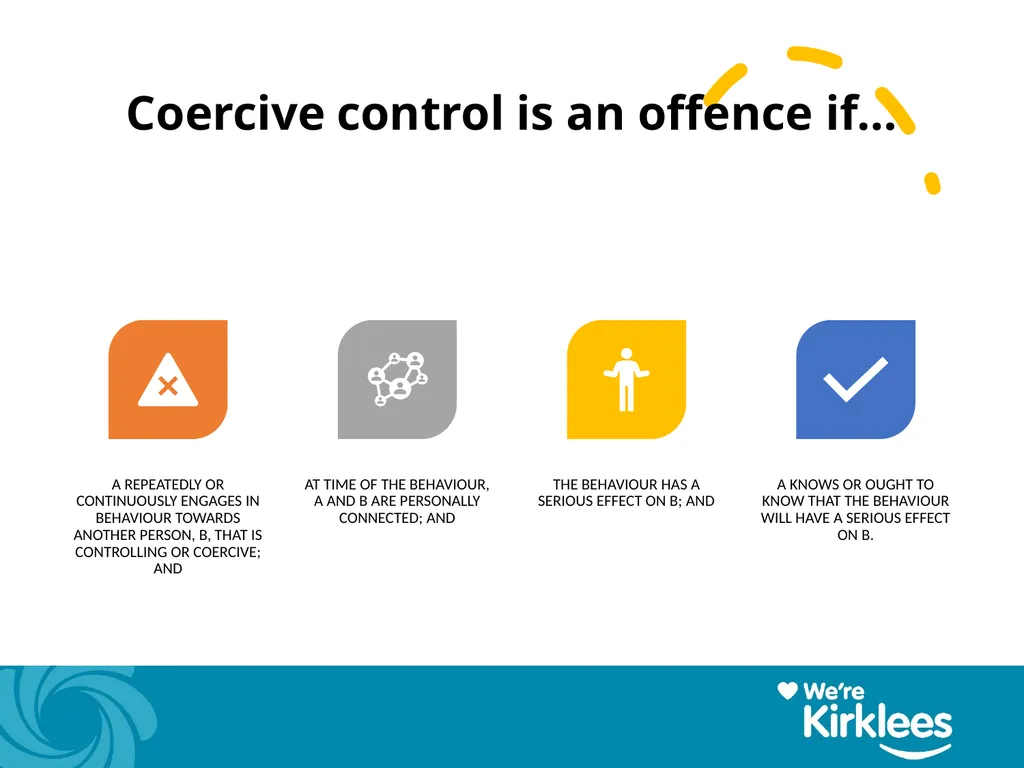
Coercive control is an offence if…<br>
09
Claire and Charlotte Hart “Control is the point of abuse. Violence is just a way to gain control… and our father had managed to gain control without violence.”
Luke Hart Available from:
https://www.youtube.com/watch?v=AYDJ52_l_cg<br>
Luke Hart Available from:
https://www.youtube.com/watch?v=AYDJ52_l_cg<br>
10
What are some tactics in coercive controlling behaviour? Take a few minutes to consider:
Isolation
Economic
Tech
Gaslighting<br>
Isolation
Economic
Tech
Gaslighting<br>
11
Isolation Guilt for wanting to spend time with other people “you care more about them than you do about me”
Jealousy, constant contact, being rude to visitors
No one understands the victim better or cares more than the perpetrator does, them against the world
Victims may feel defensive or misunderstood
Perpetrators may move them
Isolation from family and friends seen in 78% DHRs<br>
Jealousy, constant contact, being rude to visitors
No one understands the victim better or cares more than the perpetrator does, them against the world
Victims may feel defensive or misunderstood
Perpetrators may move them
Isolation from family and friends seen in 78% DHRs<br>
12
Economic Economic abuse limits victim’s choices and ability to access safety. Its not just about money, but access to resources…
Control how their partner acquires money and economic resources (work, benefits, bank accounts)
Limit how their partner uses resources
Sabotages partners resources (theft, damage to property, spends all the money, building up debt)
https://survivingeconomicabuse.org/<br>
Control how their partner acquires money and economic resources (work, benefits, bank accounts)
Limit how their partner uses resources
Sabotages partners resources (theft, damage to property, spends all the money, building up debt)
https://survivingeconomicabuse.org/<br>
13
Tech Monitoring of messages, emails and social media
Threatening to share personal or inflammatory information online
Using GPS geolocator or software to track the victim’s movements
Using spyware, keystroke logging hardware, caller ID and spoofing
Hidden cameras
https://safelives.org.uk/tech-vs-abuse<br>
Threatening to share personal or inflammatory information online
Using GPS geolocator or software to track the victim’s movements
Using spyware, keystroke logging hardware, caller ID and spoofing
Hidden cameras
https://safelives.org.uk/tech-vs-abuse<br>
14
Gaslighting To manipulate (someone) by psychological means into doubting their own sanity…
It comes from a 1930s play Gaslight. A husband successfully drives his wife mad by constantly changing the lighting in their house and denying that there was any change. Over time, the wife becomes so doubtful of her own perceptions that she comes to rely on her husband for everything.<br>
It comes from a 1930s play Gaslight. A husband successfully drives his wife mad by constantly changing the lighting in their house and denying that there was any change. Over time, the wife becomes so doubtful of her own perceptions that she comes to rely on her husband for everything.<br>
15
Gaslighting Idealisation – the gaslighter is the answer to all your problems.
Then…
Victims cannot do anything right
Perpetrator rewrites history, makes backhanded compliments, says victims are overly sensitive
It’s her crazy behaviour that requires him to control her . . . she’s the abusive partner. She’s so out of touch with reality that she needs help<br>
Then…
Victims cannot do anything right
Perpetrator rewrites history, makes backhanded compliments, says victims are overly sensitive
It’s her crazy behaviour that requires him to control her . . . she’s the abusive partner. She’s so out of touch with reality that she needs help<br>
16
Why is this so effective? The person who is isolating, controlling, manipulating, abusing and dehumanising you is also the person who is providing you with the basics you need to live, or offer some pain relief, psychological contact or affection…<br>
17
Relationships are hard… In many relationships, there are occasions when one person makes a decision on behalf of another, or when one partner takes control of a situation and the other has to compromise.
The difference in an abusive relationship is that decisions by a dominant partner can become rules that, when broken, lead to consequences for the victim.<br>
The difference in an abusive relationship is that decisions by a dominant partner can become rules that, when broken, lead to consequences for the victim.<br>
18
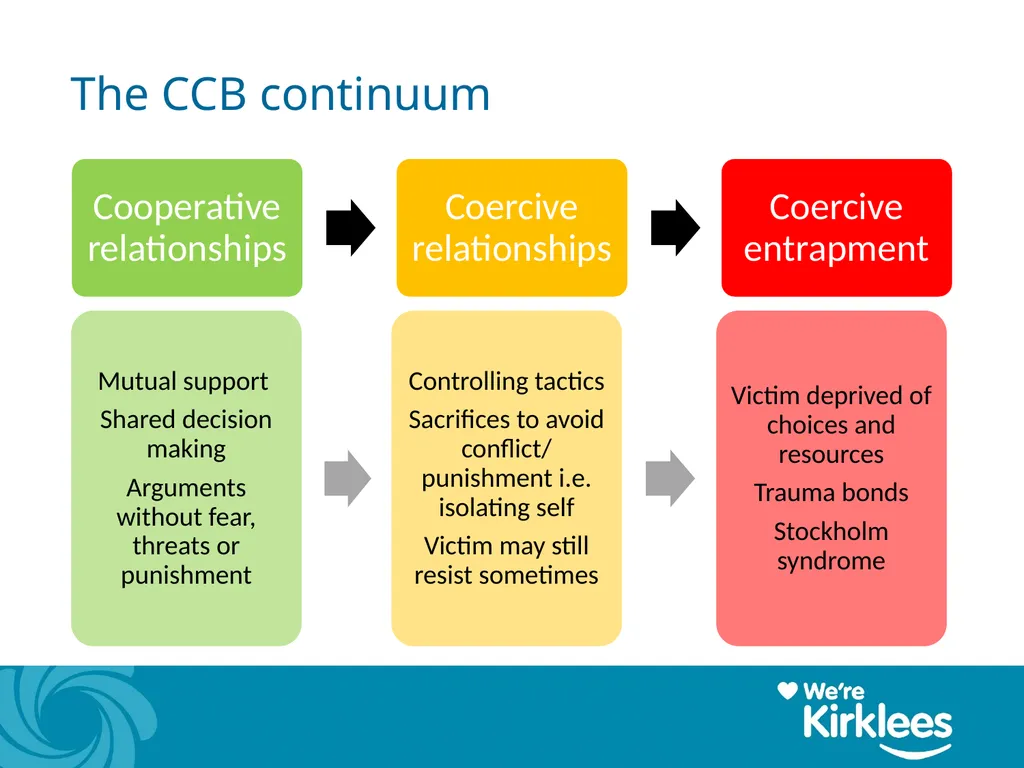
The CCB continuum<br>
19
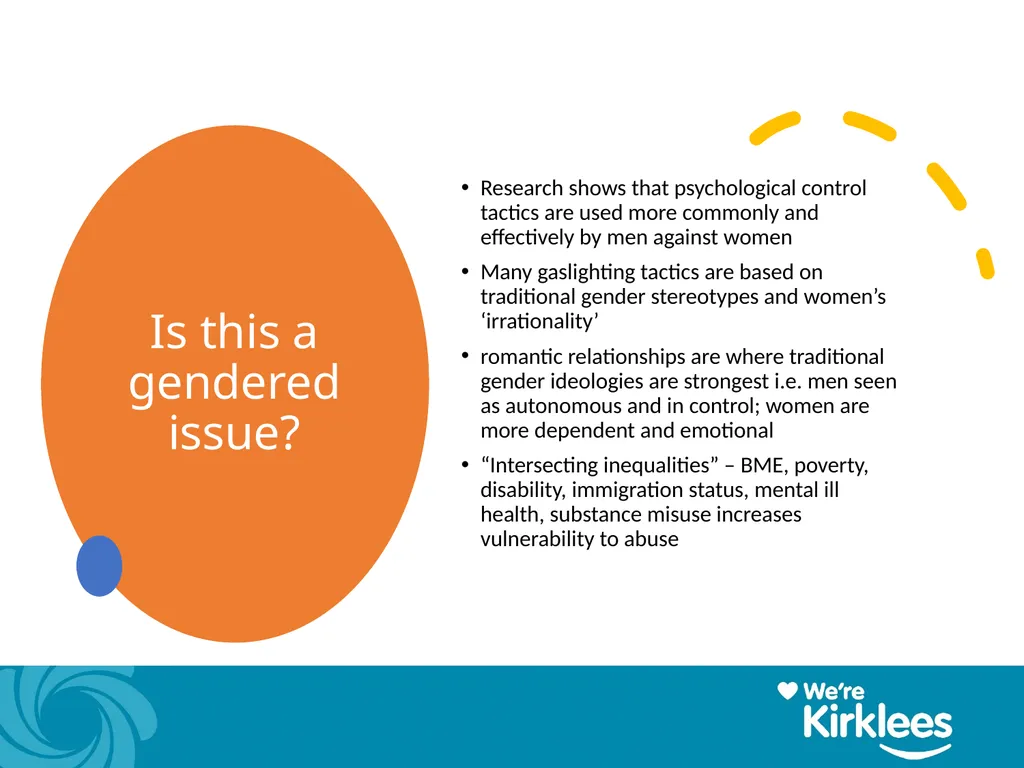
Is this a gendered issue? Research shows that psychological control tactics are used more commonly and effectively by men against women
Many gaslighting tactics are based on traditional gender stereotypes and women’s ‘irrationality’
romantic relationships are where traditional gender ideologies are strongest i.e. men seen as autonomous and in control; women are more dependent and emotional
“Intersecting inequalities” – BME, poverty, disability, immigration status, mental ill health, substance misuse increases vulnerability to abuse<br>
Many gaslighting tactics are based on traditional gender stereotypes and women’s ‘irrationality’
romantic relationships are where traditional gender ideologies are strongest i.e. men seen as autonomous and in control; women are more dependent and emotional
“Intersecting inequalities” – BME, poverty, disability, immigration status, mental ill health, substance misuse increases vulnerability to abuse<br>
20
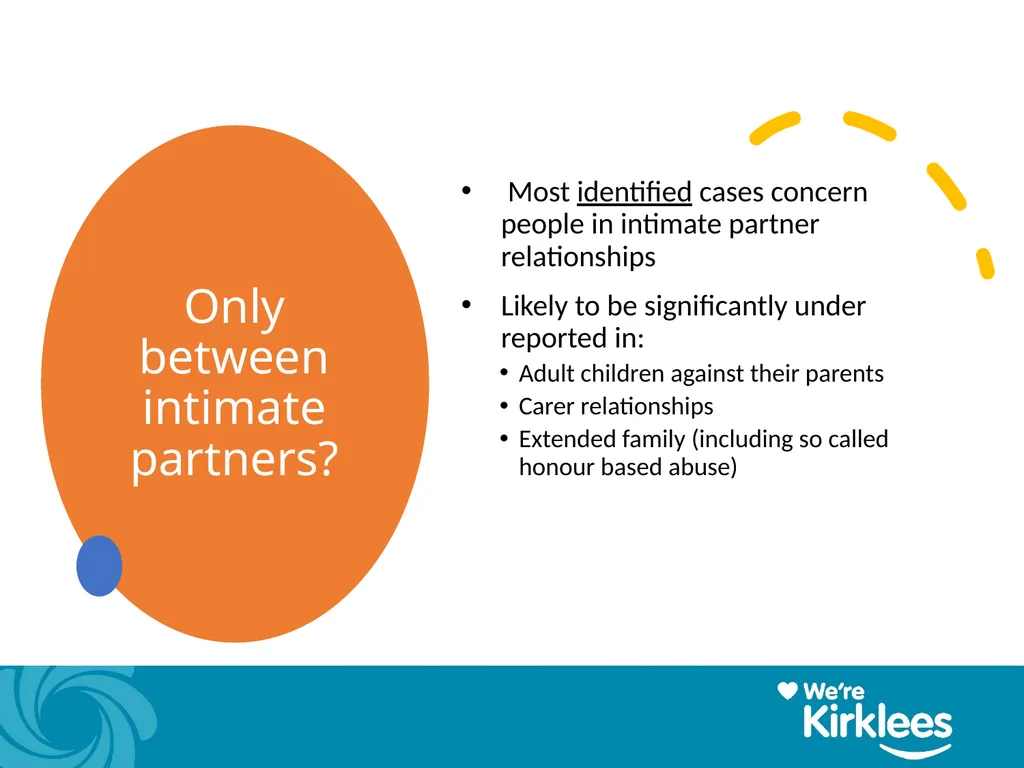
Only between intimate partners? Most identified cases concern people in intimate partner relationships
Likely to be significantly under reported in:
Adult children against their parents
Carer relationships
Extended family (including so called honour based abuse)<br>
Likely to be significantly under reported in:
Adult children against their parents
Carer relationships
Extended family (including so called honour based abuse)<br>
21
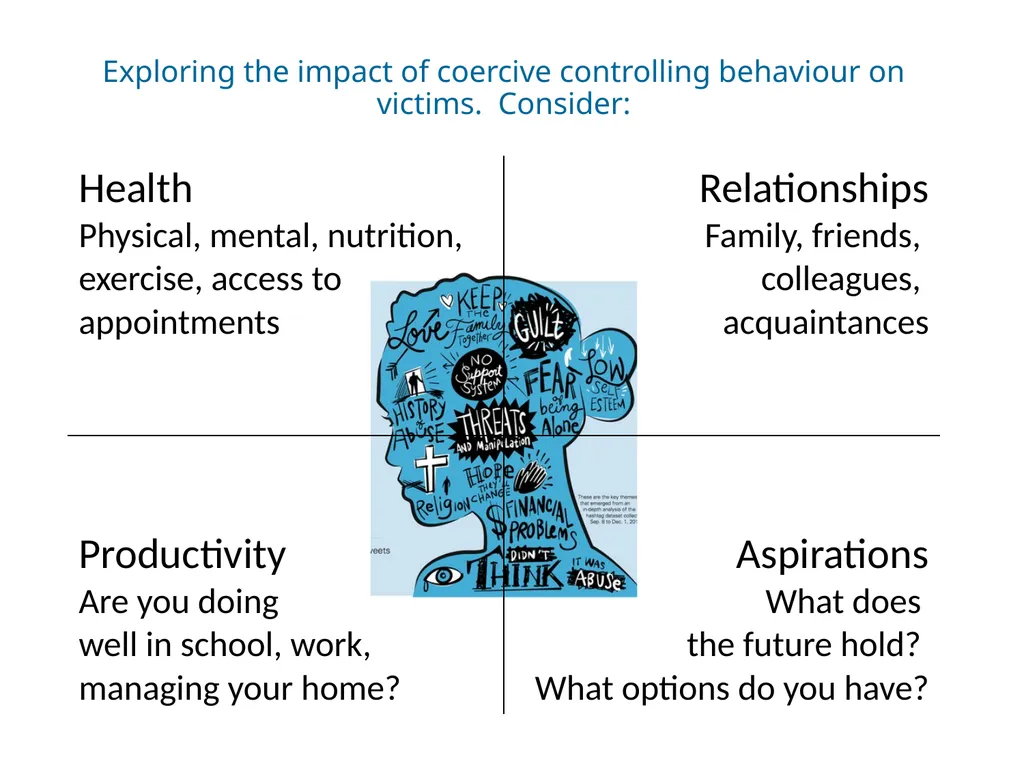
Exploring the impact of coercive controlling behaviour on victims. Consider:<br>
22
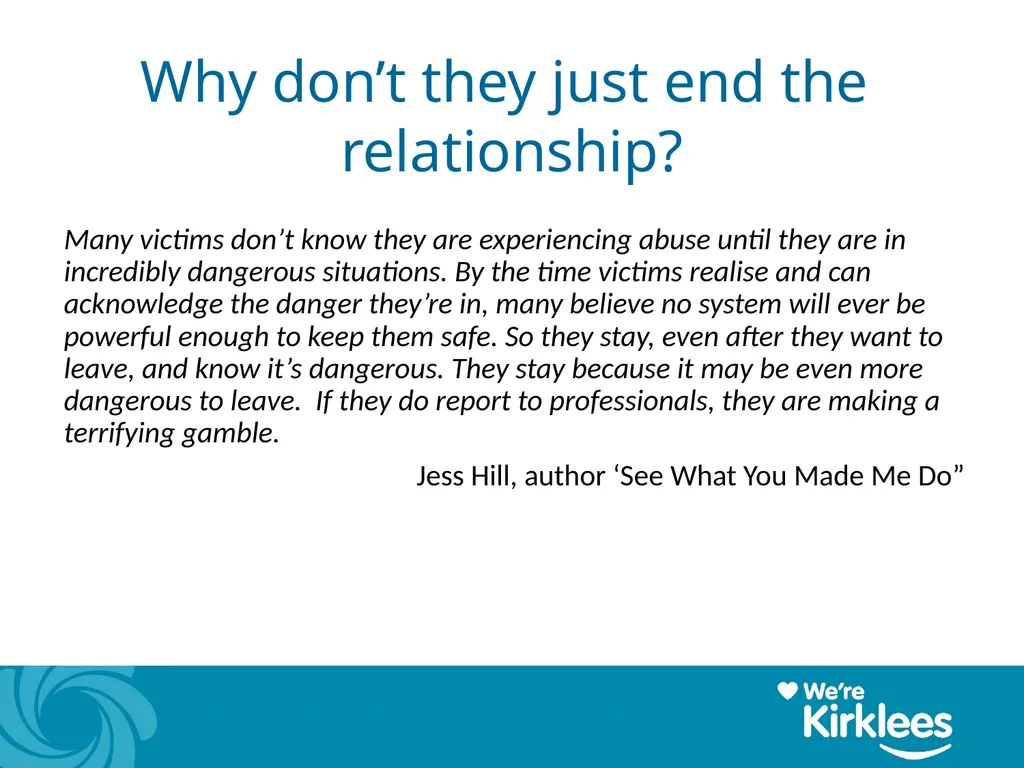
Why don’t they just end the relationship? Many victims don’t know they are experiencing abuse until they are in incredibly dangerous situations. By the time victims realise and can acknowledge the danger they’re in, many believe no system will ever be powerful enough to keep them safe. So they stay, even after they want to leave, and know it’s dangerous. They stay because it may be even more dangerous to leave. If they do report to professionals, they are making a terrifying gamble.
Jess Hill, author ‘See What You Made Me Do”<br>
Jess Hill, author ‘See What You Made Me Do”<br>
23
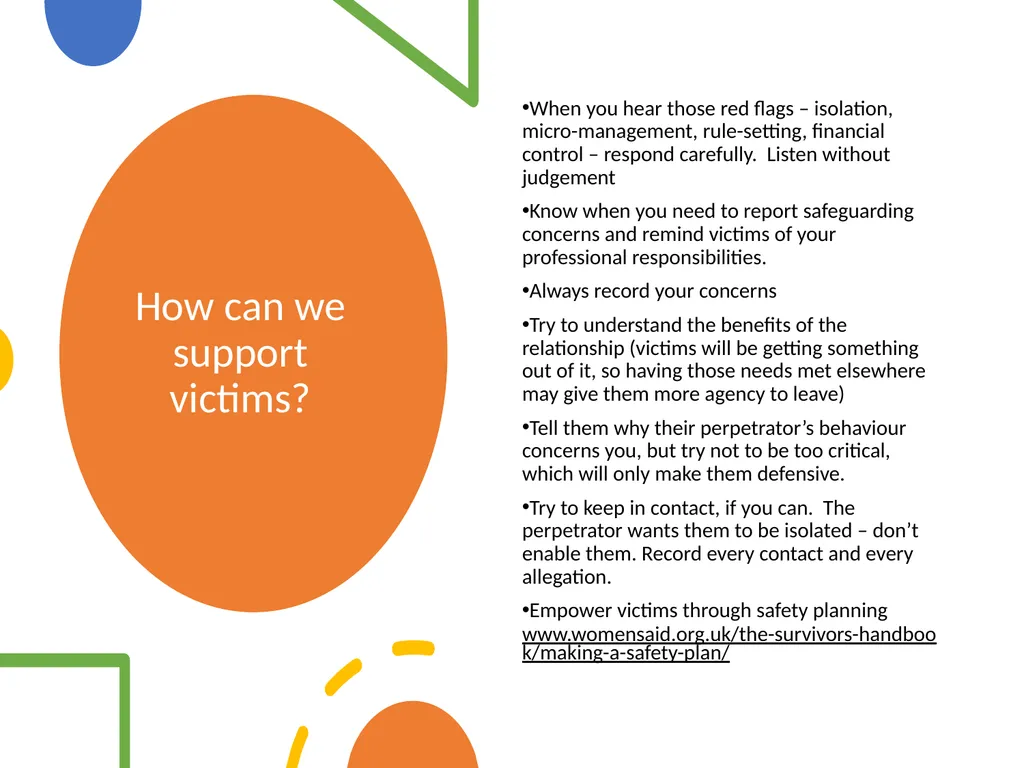
When you hear those red flags – isolation, micro-management, rule-setting, financial control – respond carefully. Listen without judgement
Know when you need to report safeguarding concerns and remind victims of your professional responsibilities.
Always record your concerns
Try to understand the benefits of the relationship (victims will be getting something out of it, so having those needs met elsewhere may give them more agency to leave)
Tell them why their perpetrator’s behaviour concerns you, but try not to be too critical, which will only make them defensive.
Try to keep in contact, if you can. The perpetrator wants them to be isolated – don’t enable them. Record every contact and every allegation.
Empower victims through safety planning www.womensaid.org.uk/the-survivors-handbook/making-a-safety-plan/ How can we support victims?<br>
Know when you need to report safeguarding concerns and remind victims of your professional responsibilities.
Always record your concerns
Try to understand the benefits of the relationship (victims will be getting something out of it, so having those needs met elsewhere may give them more agency to leave)
Tell them why their perpetrator’s behaviour concerns you, but try not to be too critical, which will only make them defensive.
Try to keep in contact, if you can. The perpetrator wants them to be isolated – don’t enable them. Record every contact and every allegation.
Empower victims through safety planning www.womensaid.org.uk/the-survivors-handbook/making-a-safety-plan/ How can we support victims?<br>
24
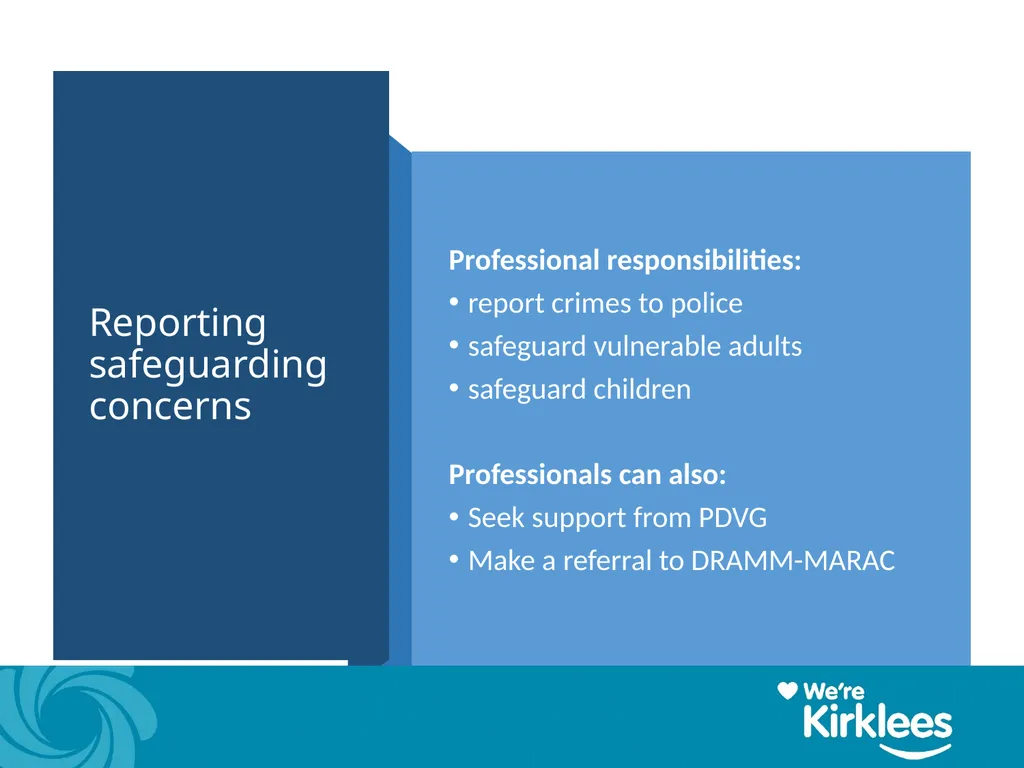
Reporting safeguarding concerns Professional responsibilities:
report crimes to police
safeguard vulnerable adults
safeguard children
Professionals can also:
Seek support from PDVG
Make a referral to DRAMM-MARAC<br>
report crimes to police
safeguard vulnerable adults
safeguard children
Professionals can also:
Seek support from PDVG
Make a referral to DRAMM-MARAC<br>
25
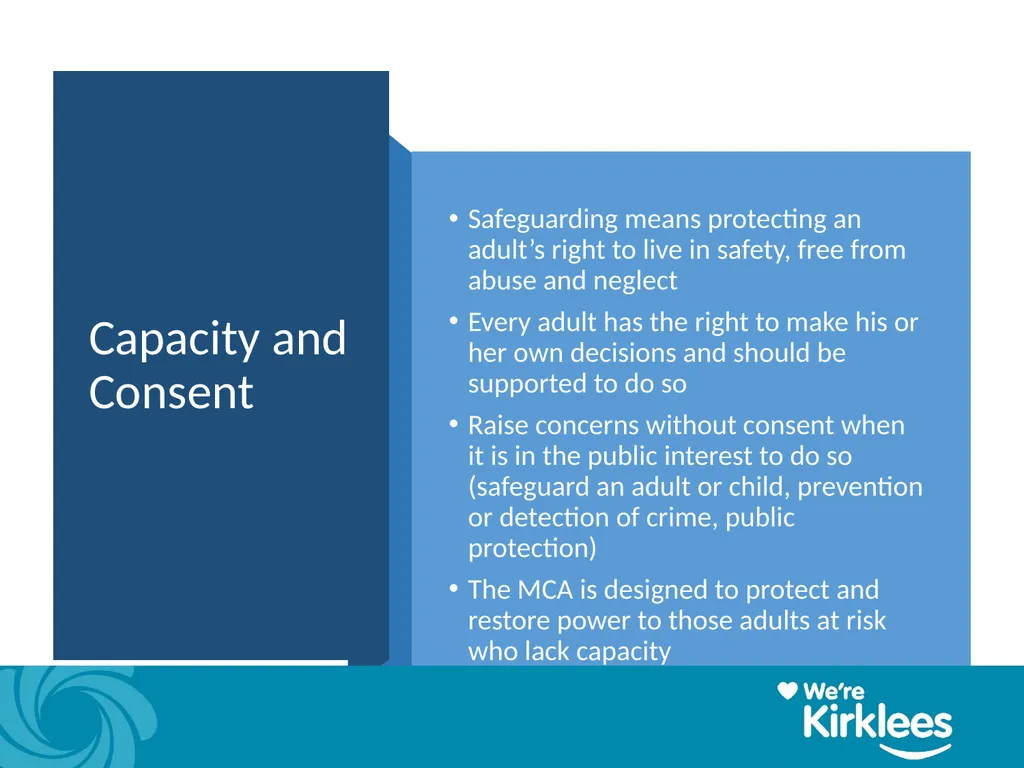
Capacity and Consent Safeguarding means protecting an adult’s right to live in safety, free from abuse and neglect
Every adult has the right to make his or her own decisions and should be supported to do so
Raise concerns without consent when it is in the public interest to do so (safeguard an adult or child, prevention or detection of crime, public protection)
The MCA is designed to protect and restore power to those adults at risk who lack capacity<br>
Every adult has the right to make his or her own decisions and should be supported to do so
Raise concerns without consent when it is in the public interest to do so (safeguard an adult or child, prevention or detection of crime, public protection)
The MCA is designed to protect and restore power to those adults at risk who lack capacity<br>
26
Impact on children Coercive control may cause more harm to children than witnessing physical violence. Research by Emma Katz suggests:
children experience behavioural and emotional difficulties as a result of coercive control –
feeling isolated at home because the perpetrator monopolised the victim’s time;
language and developmental delay due to lack of opportunities for play; and
broader isolation as not allowed to spend time with family members, have visitors to the home or attend appointments
Children learn to limit what they say and do (to avoid further abuse)
Impact on victims can affect their capacity to provide care for children.<br>
children experience behavioural and emotional difficulties as a result of coercive control –
feeling isolated at home because the perpetrator monopolised the victim’s time;
language and developmental delay due to lack of opportunities for play; and
broader isolation as not allowed to spend time with family members, have visitors to the home or attend appointments
Children learn to limit what they say and do (to avoid further abuse)
Impact on victims can affect their capacity to provide care for children.<br>
27
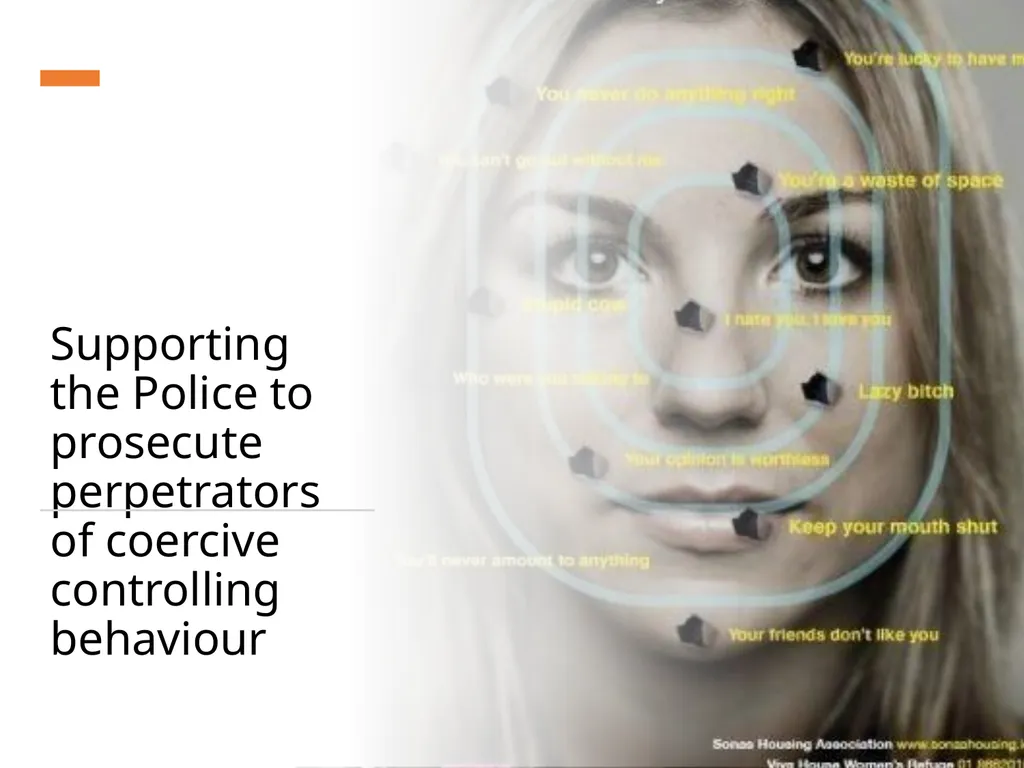
Supporting the Police to prosecute perpetrators of coercive controlling behaviour<br>
28
Coercive Controlling Behaviour legislation Prior to Serious Crime Bill 2015 there was no domestic abuse specific offence
Domestic abuse crimes frequently prosecuted as assault, sexual assault, criminal damage, threats to kill, harassment, threatening behaviour
Difficult to evidence pattern of behaviour
Non violent behaviour with equally devastating impact on victim is Coercive and Controlling Behaviour<br>
Domestic abuse crimes frequently prosecuted as assault, sexual assault, criminal damage, threats to kill, harassment, threatening behaviour
Difficult to evidence pattern of behaviour
Non violent behaviour with equally devastating impact on victim is Coercive and Controlling Behaviour<br>
29
CCB (Serious Crime Act 2015) Pattern of behaviour must have had “serious effect” on victim
Fearing violence on “at least two occasions”, OR caused serious alarm or distress, substantial adverse effect on victim’s day-to-day activities
Perpetrator and victim have to be personally connected<br>
Fearing violence on “at least two occasions”, OR caused serious alarm or distress, substantial adverse effect on victim’s day-to-day activities
Perpetrator and victim have to be personally connected<br>
30
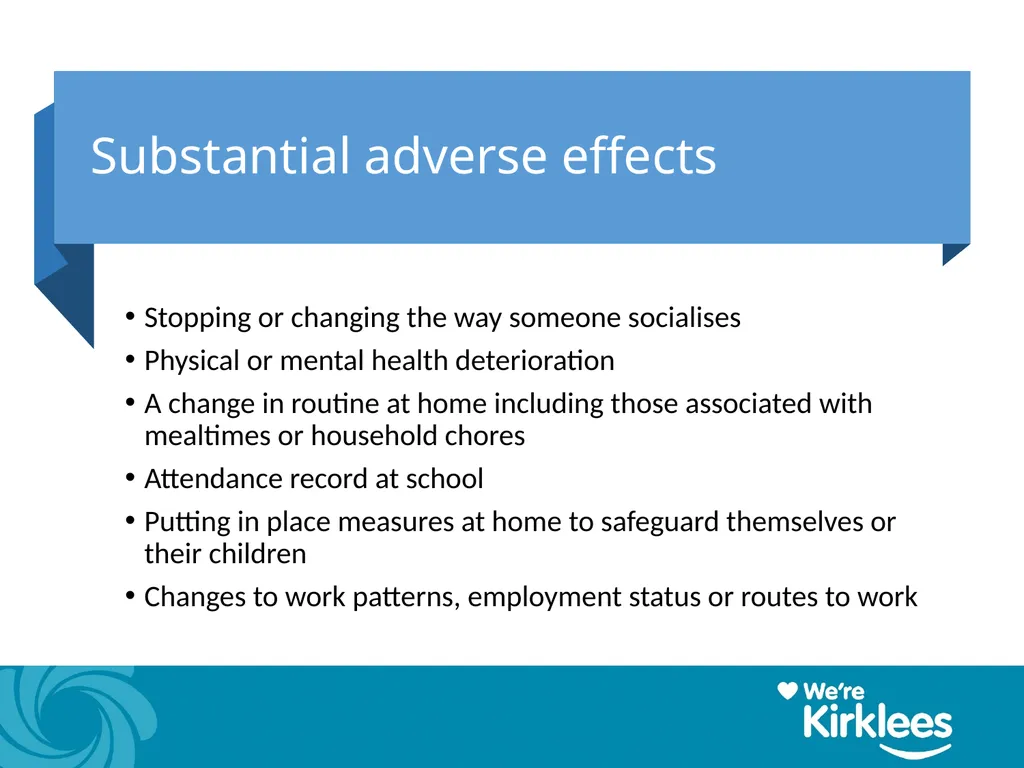
Substantial adverse effects Stopping or changing the way someone socialises
Physical or mental health deterioration
A change in routine at home including those associated with mealtimes or household chores
Attendance record at school
Putting in place measures at home to safeguard themselves or their children
Changes to work patterns, employment status or routes to work<br>
Physical or mental health deterioration
A change in routine at home including those associated with mealtimes or household chores
Attendance record at school
Putting in place measures at home to safeguard themselves or their children
Changes to work patterns, employment status or routes to work<br>
31
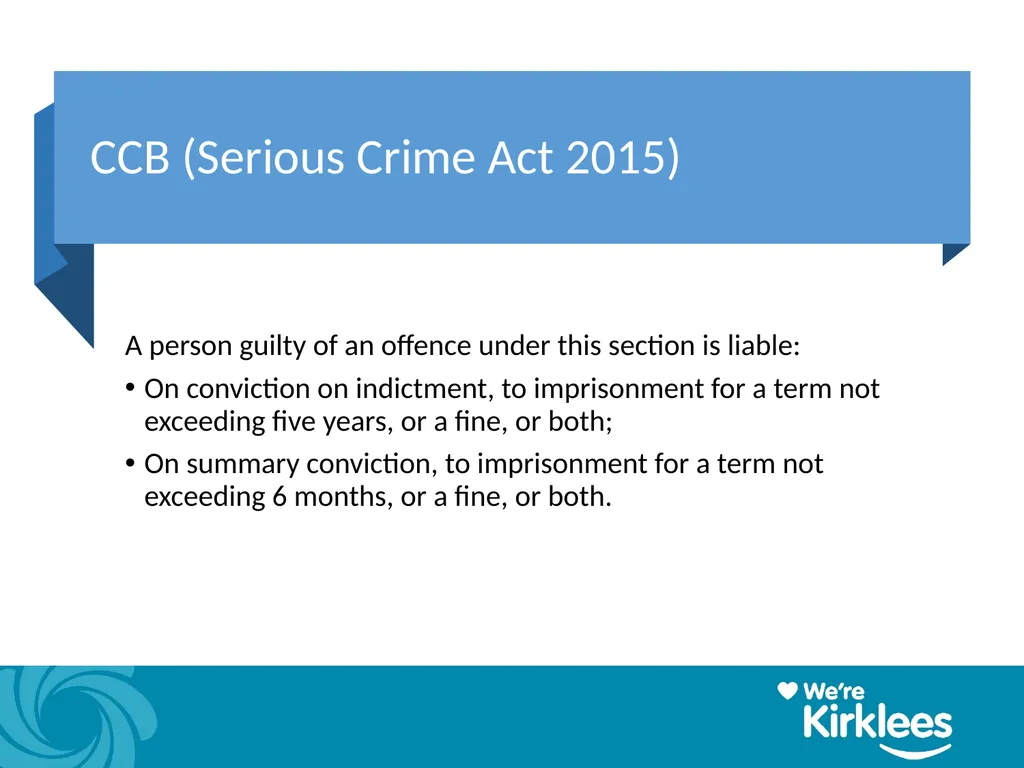
CCB (Serious Crime Act 2015) A person guilty of an offence under this section is liable:
On conviction on indictment, to imprisonment for a term not exceeding five years, or a fine, or both;
On summary conviction, to imprisonment for a term not exceeding 6 months, or a fine, or both.<br>
On conviction on indictment, to imprisonment for a term not exceeding five years, or a fine, or both;
On summary conviction, to imprisonment for a term not exceeding 6 months, or a fine, or both.<br>
32
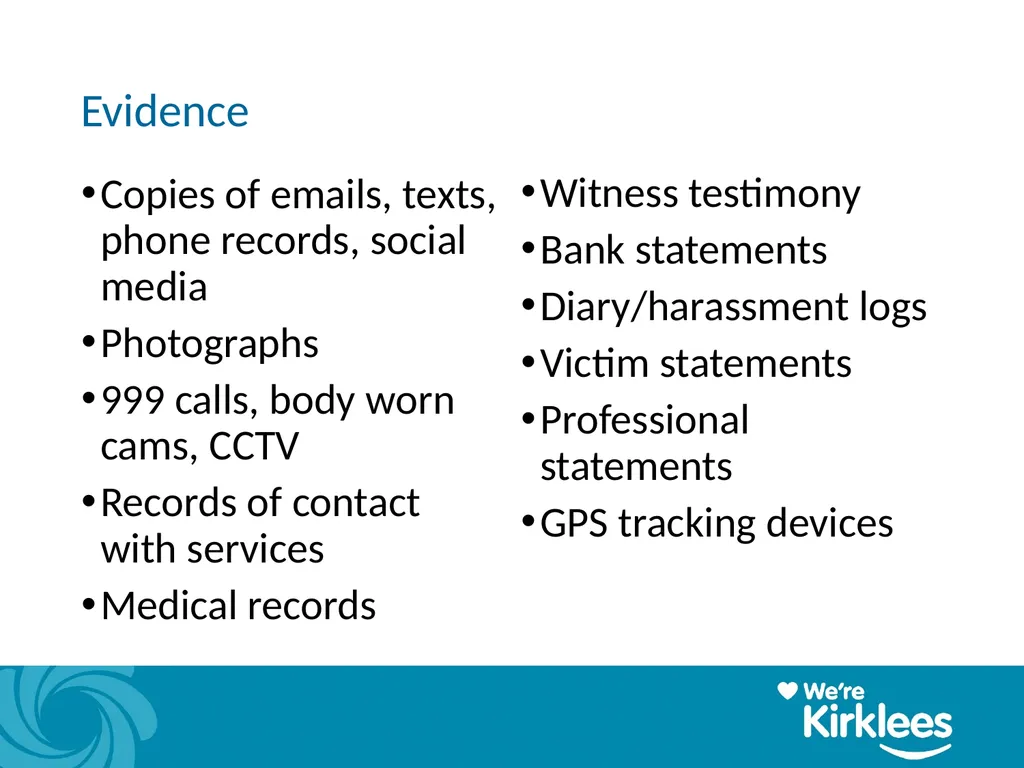
Copies of emails, texts, phone records, social media
Photographs
999 calls, body worn cams, CCTV
Records of contact with services
Medical records Evidence Witness testimony
Bank statements
Diary/harassment logs
Victim statements
Professional statements
GPS tracking devices<br>
Photographs
999 calls, body worn cams, CCTV
Records of contact with services
Medical records Evidence Witness testimony
Bank statements
Diary/harassment logs
Victim statements
Professional statements
GPS tracking devices<br>
33
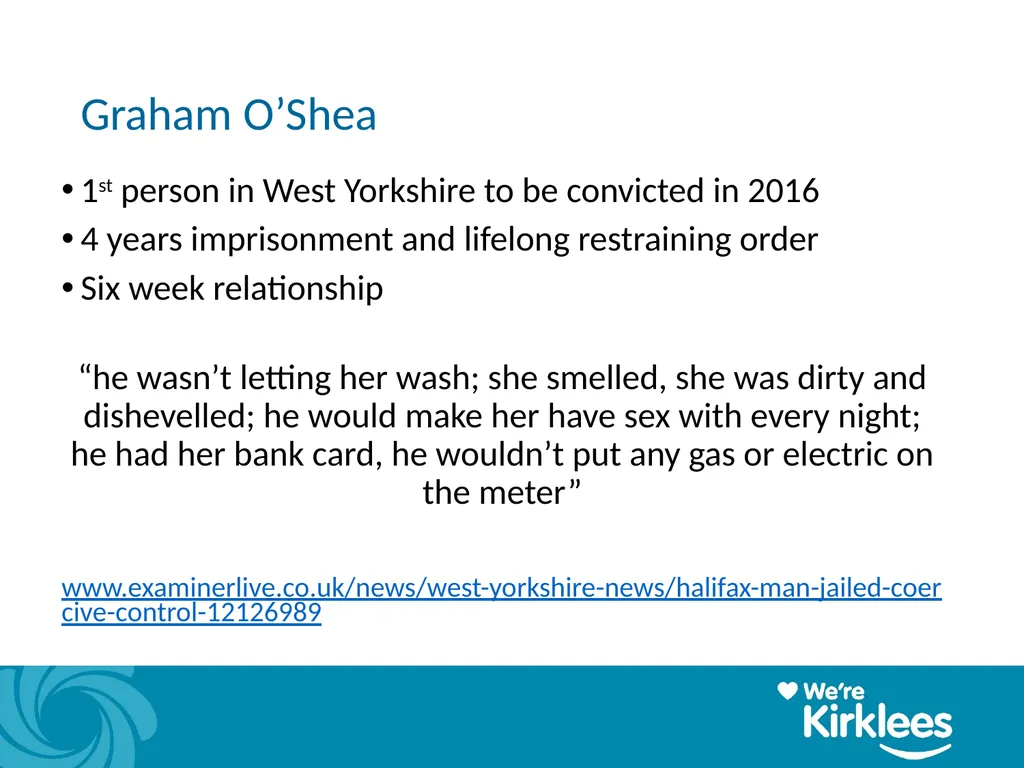
Graham O’Shea 1st person in West Yorkshire to be convicted in 2016
4 years imprisonment and lifelong restraining order
Six week relationship
“he wasn’t letting her wash; she smelled, she was dirty and dishevelled; he would make her have sex with every night; he had her bank card, he wouldn’t put any gas or electric on the meter”
www.examinerlive.co.uk/news/west-yorkshire-news/halifax-man-jailed-coercive-control-12126989<br>
4 years imprisonment and lifelong restraining order
Six week relationship
“he wasn’t letting her wash; she smelled, she was dirty and dishevelled; he would make her have sex with every night; he had her bank card, he wouldn’t put any gas or electric on the meter”
www.examinerlive.co.uk/news/west-yorkshire-news/halifax-man-jailed-coercive-control-12126989<br>
34
While we can do a lot to support victims, change is hard to achieve There was significant evidence, despite the mother’s assertions that the relationship had ended, that the father remained in contact with her and the children. The daily difficulties that the mother faced as an abused and coerced woman and the impact that this would have on her decision making, her self-identity and her ability to protect herself and the children was not understood.
Analysis from a serious case review<br>
Analysis from a serious case review<br>
35
Supporting victims of controlling behaviour Available from: https://www.youtube.com/watch?v=36mQFefBylM<br>
36
Local services Pennine Domestic Abuse Partnership (PDAP)
A key provider of domestic abuse support services in Kirklees. We believe that everyone has the right to live free from all forms of abuse and have the right to be free from potential or actual harm.
24 hour helpline O800 052 7222
https://pdap.co.uk/
Kirklees DRAMM-MARAC Team
Coordinates the multi-agency risk assessment and safety planning processes for high risk cases of domestic abuse.
07977 986744 or 01924 482112<br>
A key provider of domestic abuse support services in Kirklees. We believe that everyone has the right to live free from all forms of abuse and have the right to be free from potential or actual harm.
24 hour helpline O800 052 7222
https://pdap.co.uk/
Kirklees DRAMM-MARAC Team
Coordinates the multi-agency risk assessment and safety planning processes for high risk cases of domestic abuse.
07977 986744 or 01924 482112<br>
37
Safeguarding Adults Everyone has the right to live in safety, free from abuse and neglect.
If you are concerned that an adult at risk living in Kirklees is being abused you can telephone, visit or email us using the contact details below:-
Report abuse or seek advice contacts
Kirklees Council
Customer Service Centre Civic Centre 3, Market Street, Huddersfield, HD1 2TG
Gateway to care Walsh Building, Town Hall Way, Dewsbury, WF12 8EQ
Phone 01484 414933 Open 24 hours a day
Email secure.gatewaytocare@kirklees.gcsx.gov.uk<br>
If you are concerned that an adult at risk living in Kirklees is being abused you can telephone, visit or email us using the contact details below:-
Report abuse or seek advice contacts
Kirklees Council
Customer Service Centre Civic Centre 3, Market Street, Huddersfield, HD1 2TG
Gateway to care Walsh Building, Town Hall Way, Dewsbury, WF12 8EQ
Phone 01484 414933 Open 24 hours a day
Email secure.gatewaytocare@kirklees.gcsx.gov.uk<br>
38
What to do if you are worried about a child Professional responsibility for safeguarding
Children’s Social Care Service 01484 456848
Kirklees Emergency Duty Service 01484 414933 (out of office hours)
NSPCC Helpline: 0808 800 5000
NSPCC email: help@nspcc.org.uk
NSPCC text: 88858 (free service)<br>
Children’s Social Care Service 01484 456848
Kirklees Emergency Duty Service 01484 414933 (out of office hours)
NSPCC Helpline: 0808 800 5000
NSPCC email: help@nspcc.org.uk
NSPCC text: 88858 (free service)<br>
39
Reporting to Police Professionals have a duty to report safeguarding concerns to police
Emergency 999
Crimes reported to 101
Police Information/Advice
Safeguarding Unit 01924 335073<br>
Emergency 999
Crimes reported to 101
Police Information/Advice
Safeguarding Unit 01924 335073<br>