03
What is an outcome? Outcome is defined as the result or effect of an action
An outcome is something that is measurable, but it is different from the measurement itself
So, for instance it is the:
diagnosis of a heart attack, rather than a troponin level
remission of cancer, rather than the presence of remaining cancer cells
absence of moderate or severe pain, rather than a measurement of pain<br>
04
Postoperative pain-related outcomes Reduction of pain by at least 50%
Time to remedication
Opioid requirement
Adverse events (including Postoperative nausea and vomiting (PONV))
Length of hospital stay
Readmission due to pain or adverse events<br>
05
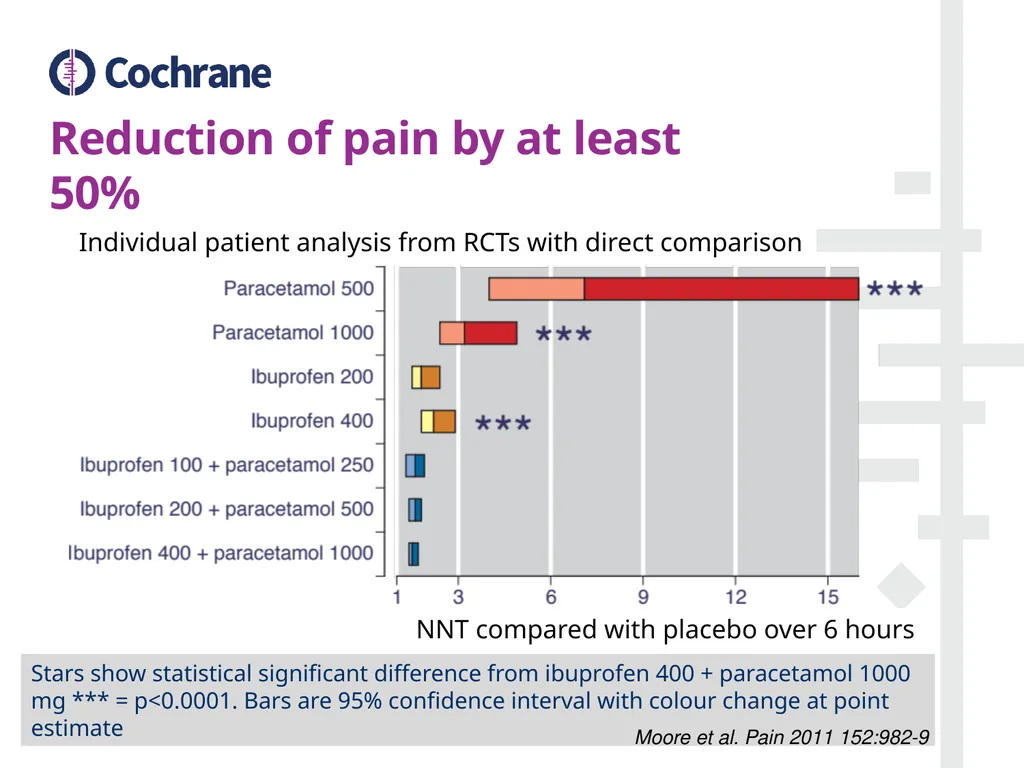
Reduction of pain by at least 50% Outcome of value to people with acute and chronic pain
In standard trials of analgesics for acute pain, it is typically measured as an area under the curve over 6 to 8 hours as the number of people:
achieving at least 50% of the maximum possible pain relief or reduction
achieving at least 50% reduction in pain intensity
Value that also achieves greatest discrimination between different analgesics, with bimodal distribution
By far most common outcome used in postoperative pain (see CD008659. DOI: 10.1002/14651858.CD008659.pub3)<br>
06
Reduction of pain by at least 50% Stars show statistical significant difference from ibuprofen 400 + paracetamol 1000 mg *** = p<0.0001. Bars are 95% confidence interval with colour change at point estimate Moore et al. Pain 2011 152:982-9 Individual patient analysis from RCTs with direct comparison NNT compared with placebo over 6 hours<br>
07
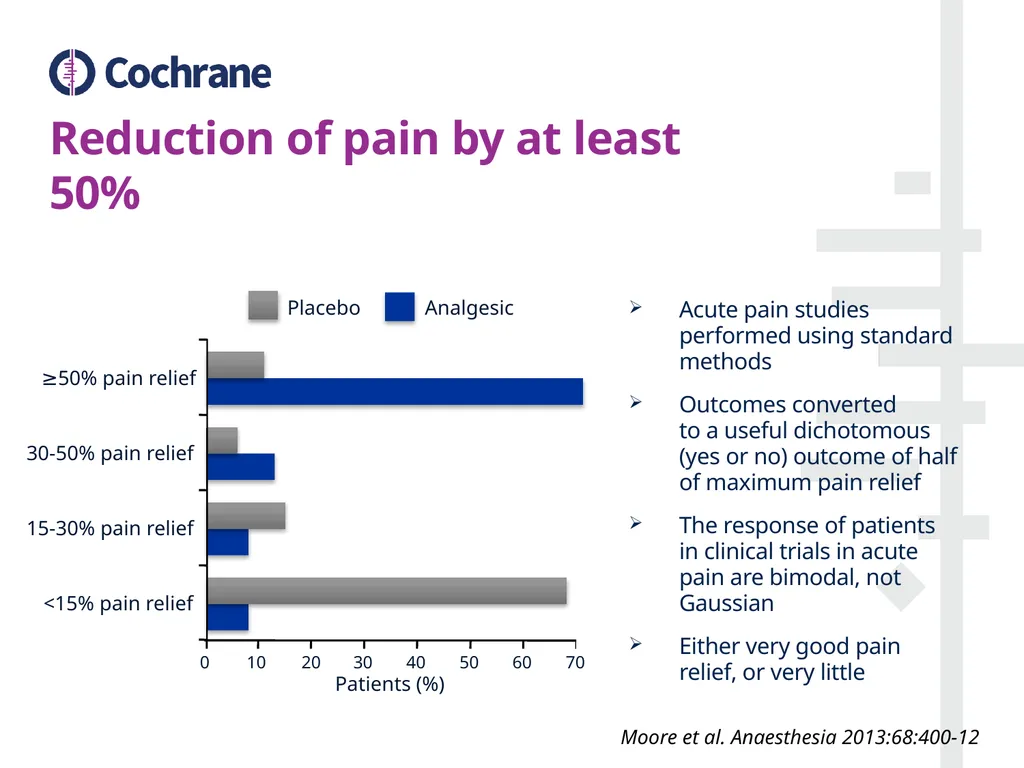
Reduction of pain by at least 50% Acute pain studies performed using standard methods
Outcomes converted �to a useful dichotomous (yes or no) outcome of half of maximum pain relief
The response of patients in clinical trials in acute pain are bimodal, not Gaussian
Either very good pain relief, or very little Moore et al. Anaesthesia 2013:68:400-12<br>
08
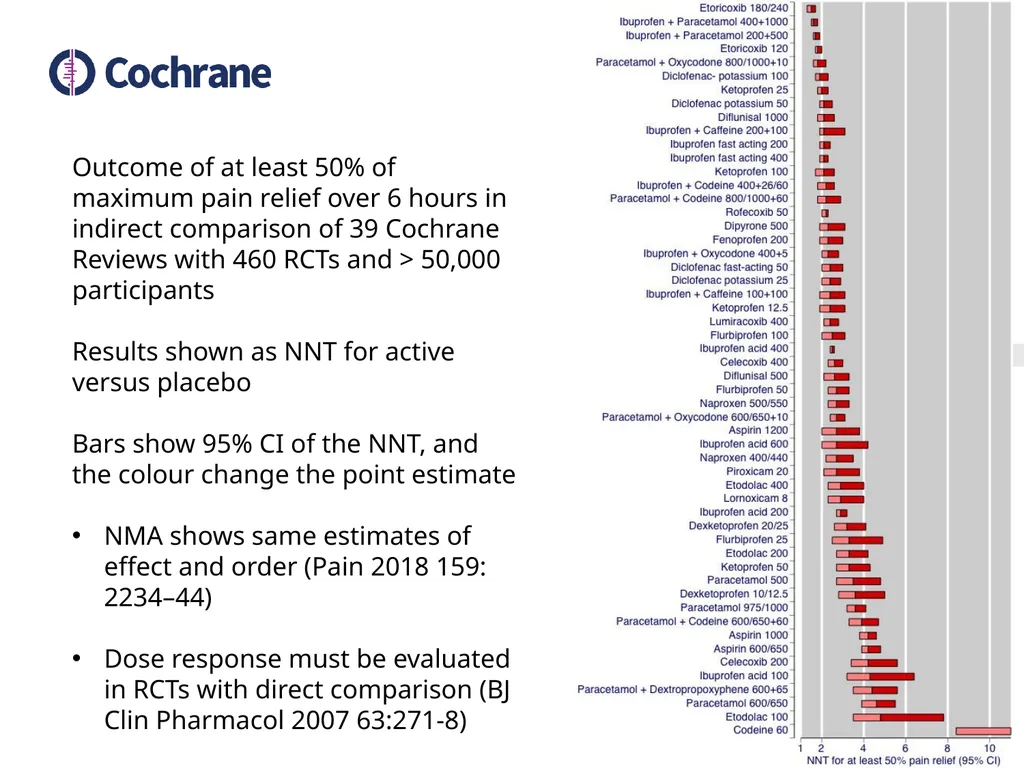
Outcome of at least 50% of maximum pain relief over 6 hours in indirect comparison of 39 Cochrane Reviews with 460 RCTs and > 50,000 participants
Results shown as NNT for active versus placebo
Bars show 95% CI of the NNT, and the colour change the point estimate
NMA shows same estimates of effect and order (Pain 2018 159: 2234–44)
Dose response must be evaluated in RCTs with direct comparison (BJ Clin Pharmacol 2007 63:271-8)<br>
09
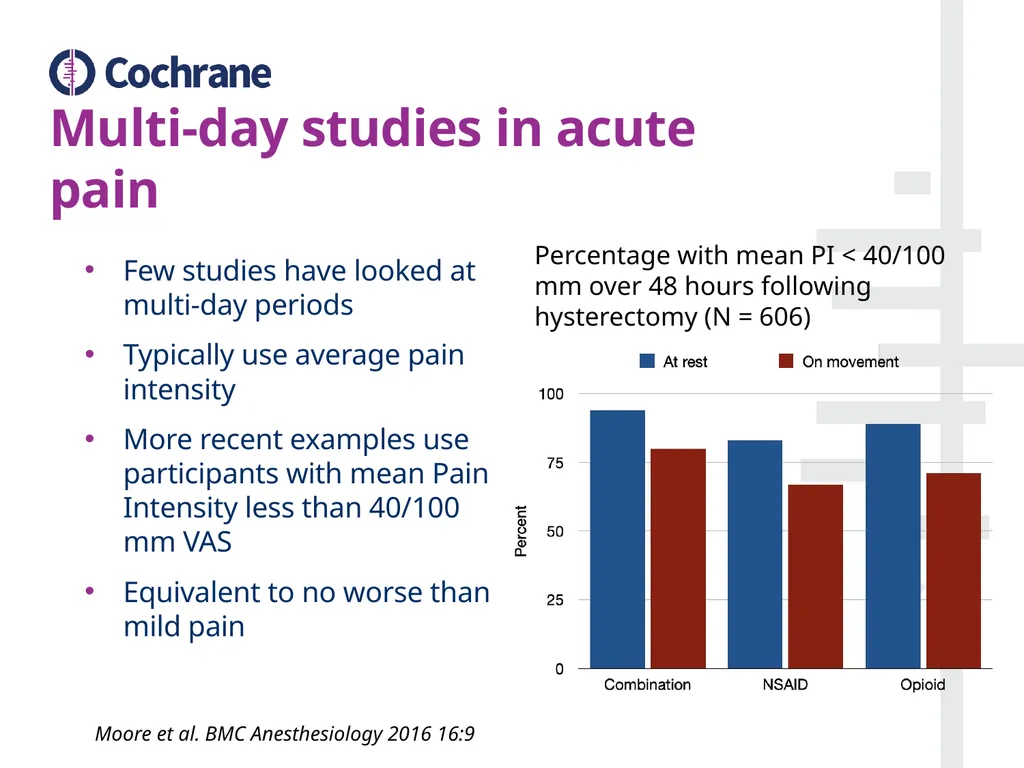
Multi-day studies in acute pain Few studies have looked at multi-day periods
Typically use average pain intensity
More recent examples use participants with mean Pain Intensity less than 40/100 mm VAS
Equivalent to no worse than mild pain Percentage with mean PI < 40/100 mm over 48 hours following hysterectomy (N = 606) Moore et al. BMC Anesthesiology 2016 16:9<br>
10
Time to remedication Interventions for acute pain have a finite duration of efficacy
Typically, people will request or need additional analgesia at this time (which may be the same intervention, or a different one)
This is known as the time to remedication
The duration of analgesia is an important practical outcome
Measured as either:
Mean time to remedication
Proportion remedicated in a specific time period<br>
11
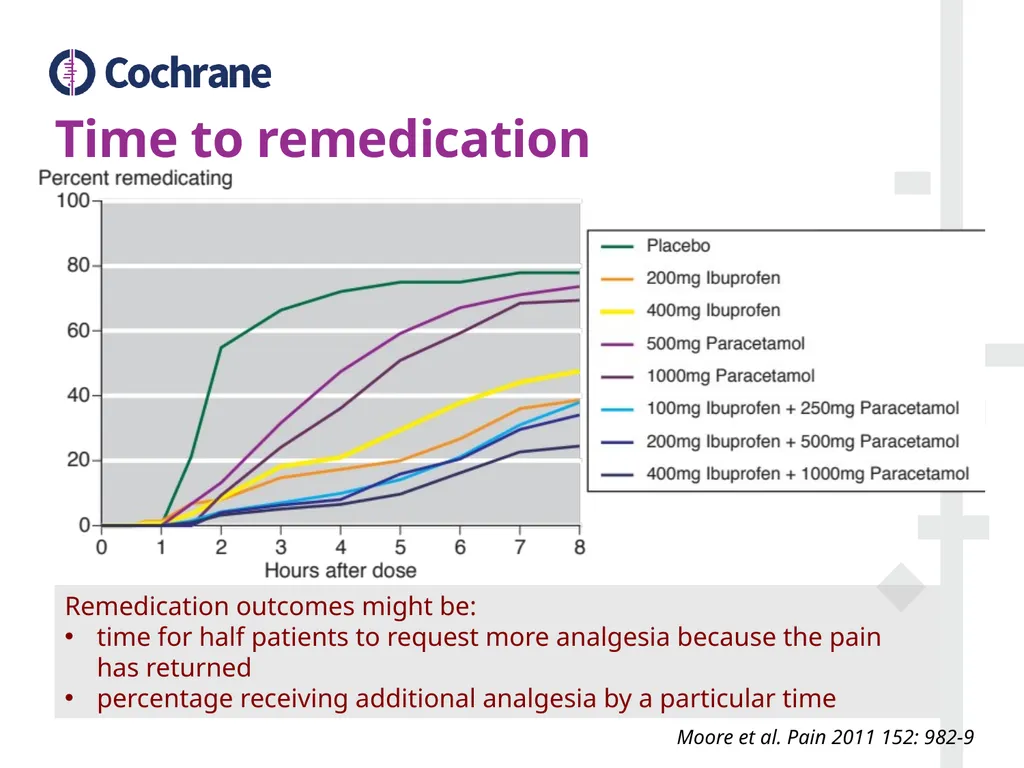
Time to remedication Moore et al. Pain 2011 152: 982-9 Remedication outcomes might be:
time for half patients to request more analgesia because the pain has returned
percentage receiving additional analgesia by a particular time<br>
12
Opioid or analgesic requirement Opioid (analgesic) consumption does not have a normal distribution
The mean, median, and mode are very different from one another
Most people need quite modest amounts postoperatively
A few consume the most
Small or moderate differences in opioid or analgesic consumption have little clinical significance, especially in small studies and in groups of small studies<br>
13
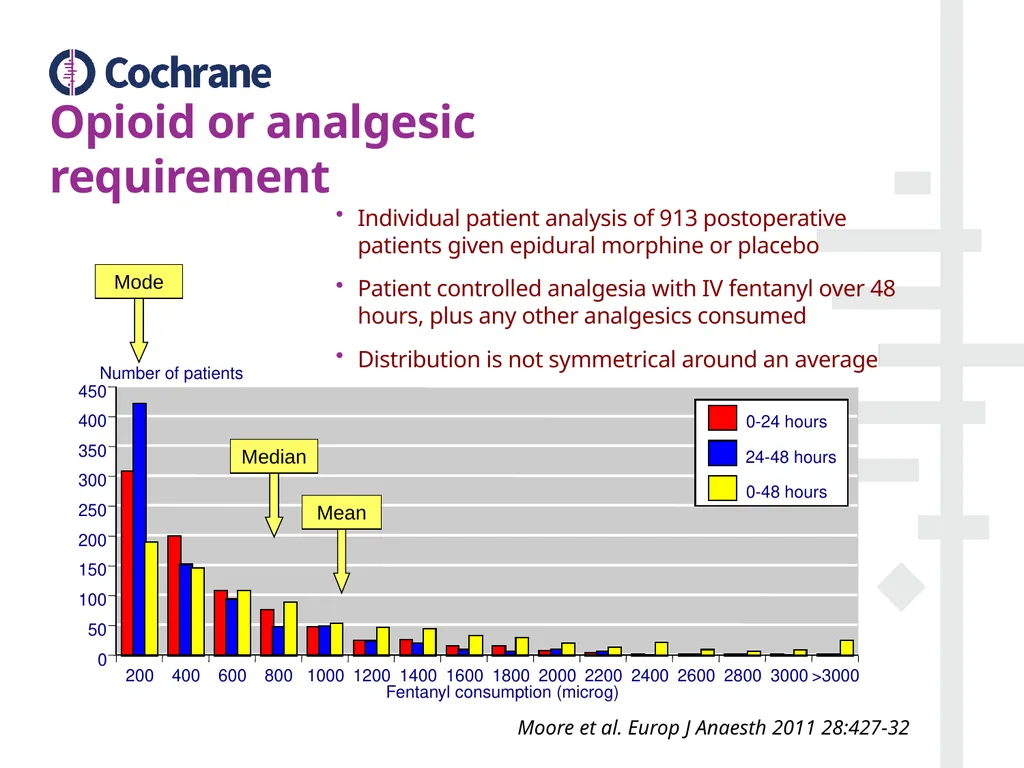
Opioid or analgesic requirement Individual patient analysis of 913 postoperative patients given epidural morphine or placebo
Patient controlled analgesia with IV fentanyl over 48 hours, plus any other analgesics consumed
Distribution is not symmetrical around an average Moore et al. Europ J Anaesth 2011 28:427-32<br>
14
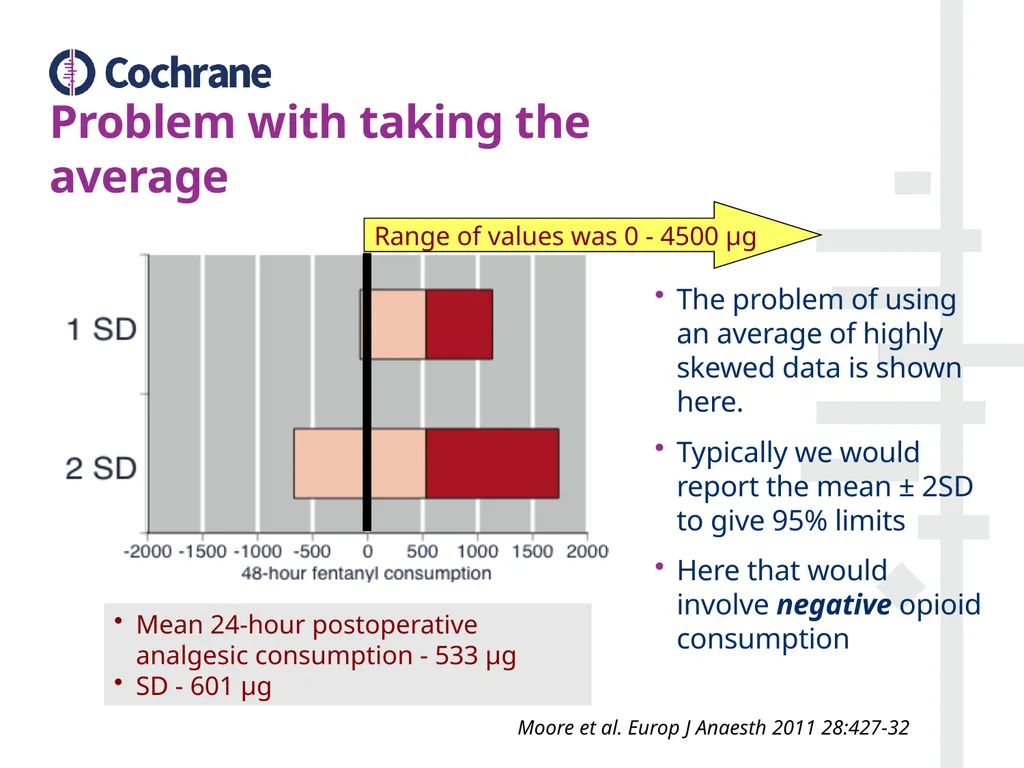
Problem with taking the average The problem of using an average of highly skewed data is shown here.
Typically we would report the mean ± 2SD to give 95% limits
Here that would involve negative opioid consumption Moore et al. Europ J Anaesth 2011 28:427-32 Mean 24-hour postoperative analgesic consumption - 533 µg
SD - 601 µg Range of values was 0 - 4500 µg<br>
15
Adverse events The collection and measurement of adverse events (AEs) in systematic reviews is challenging
There is an extensive literature on adverse event evidence consistently demonstrating the many major difficulties that exist
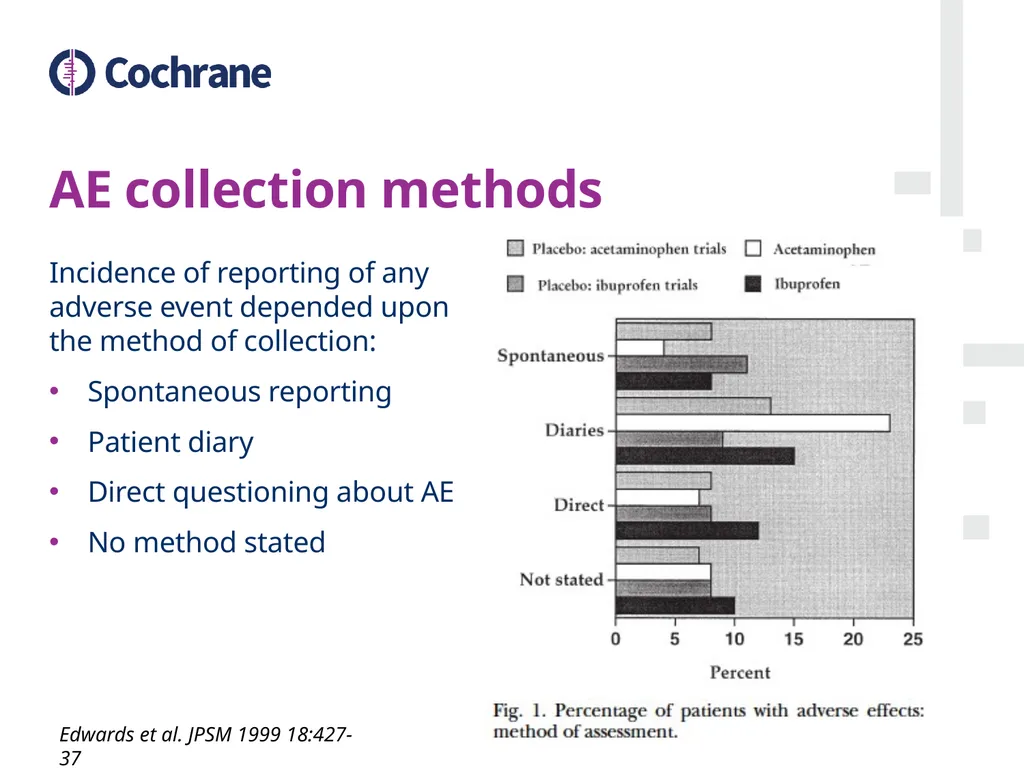
In acute pain the main issue is the large differences in collection methods
“Different methods of assessing adverse effects produce different reported incidence: patient diaries yielded significantly more adverse effects than other forms of assessment” (JPSM 1999 18:427-37; CD011407. DOI:10.1002/14651858.CD011407.pub2)<br>
16
AE collection methods Incidence of reporting of any adverse event depended upon the method of collection:
Spontaneous reporting
Patient diary
Direct questioning about AE
No method stated Edwards et al. JPSM 1999 18:427-37<br>
17
Recommended AE outcomes Proportion (or number) of participants reporting any adverse event
Proportion (or number) of participants reporting any serious adverse event
Proportion (or number) of participants reporting particularly relevant adverse event: examples of systematic reviews of serious AE include:
Propofol and bradycardia in RCTs (Br J Anaesth 1997 78:642-51)
Serious epidural AE in observational studies (Anethesiology 2006 105:394-9)<br>
18
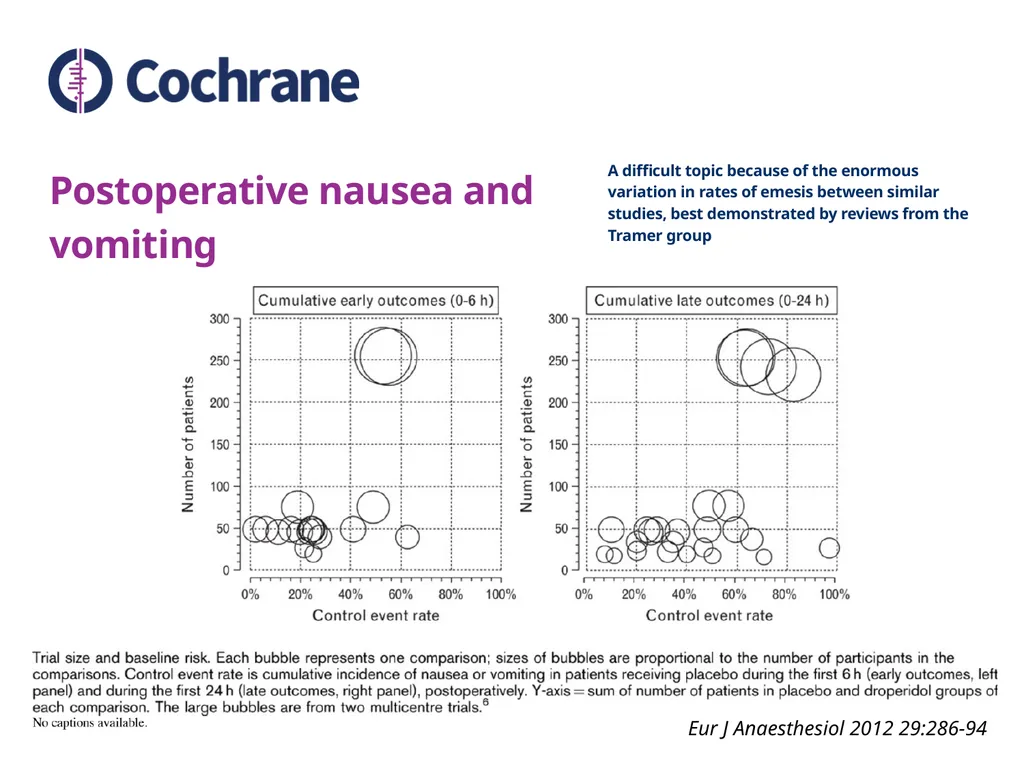
Postoperative nausea and vomiting A difficult topic because of the enormous variation in rates of emesis between similar studies, best demonstrated by reviews from the Tramer group Eur J Anaesthesiol 2012 29:286-94<br>
19
Length of hospital stay Length of hospital stay is an important outcome, especially as time in hospital is minimized
Problems with this outcomes include:
Often dependent on non-patient issues
Times of discharge often determined by hospital routines
Often considerable variance<br>
20
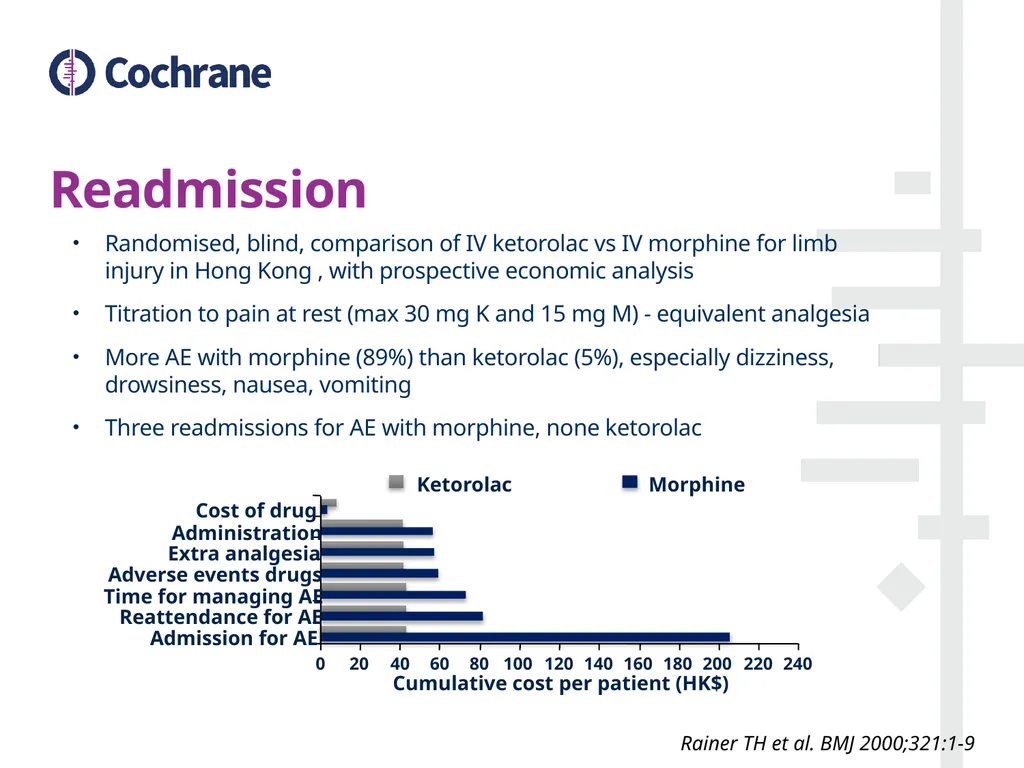
Readmission Randomised, blind, comparison of IV ketorolac vs IV morphine for limb injury in Hong Kong , with prospective economic analysis
Titration to pain at rest (max 30 mg K and 15 mg M) - equivalent analgesia
More AE with morphine (89%) than ketorolac (5%), especially dizziness, drowsiness, nausea, vomiting
Three readmissions for AE with morphine, none ketorolac Rainer TH et al. BMJ 2000;321:1-9<br>
21
Putting it all together Any outcome chosen for a systematic review involving pain is, of course, highly dependent on the precise clinical circumstance being considered
It is always worth considering that changes in a pain measurement are not, in themselves, an outcome
Pain outcomes chosen should be:
Of importance to people with pain (not having pain)
Of important to healthcare systems (reduced stay)
Of importance to society (ability to function)<br>
22
Acknowledgements Thank you to the Cochrane Network Innovation Fund
Thank you to Mohammed A. Abusayed (University Hospitals of Derby and Burton, UK) for auditing reviews of interventions for pain in the Cochrane Library in 2016
Thank you to all the project team members and MOSS key contacts
Joanne Abbott; Geert Crombez; Rob Dellavalle; Christopher Eccleston; Anna Erskine; Emma Fisher; Kerry Harding; Jennifer Hilgart; John Lawrenson; Hopin Lee; Nuala Livingstone; Lara Maxwell; Andrew Moore; Gill Norman; Neil O'Connell; Roses Parker; Phil Riley; Kate Seers; Teo Aminah Wasteneys Quay; Andrew Smith; Martin Tramèr; Peter Tugwell; Katie Webster; Amanda C de C Williams
All the slides and documents hosted on the PaPaS website https://papas.cochrane.org/resources/acute-pain-outcomes<br>