Potassium Basics Potassium Basics Chemical symbol K comes from Kalium Common fertilizer potash (K20) Plants utilize K through root adsorption of K in the soluble (dissolved) form from the soil solution Why is Potassium Important?
"Potassium Basics Potassium Basics Chemical symbol" is the property of its rightful owner. Permission is granted to
download and print the materials on this website for personal, non-commercial use only, and to display it
on your personal computer provided you do not modify the materials and that you retain all copyright
notices contained in the materials. By downloading content from our website, you accept the terms of this
agreement.
Share
Embed code
Presentation Transcript
01
Potassium Basics<br>
02
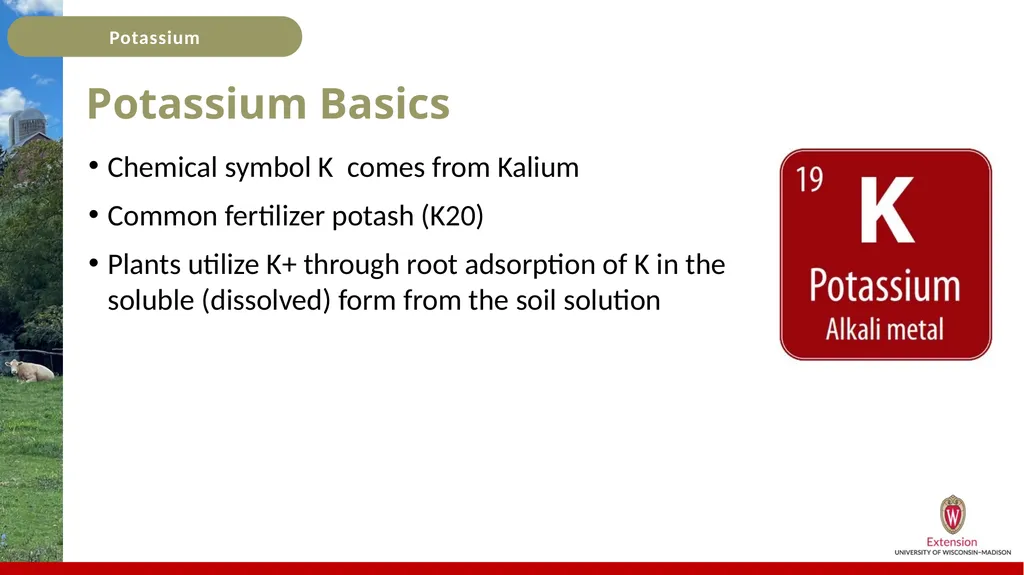
Potassium Basics Chemical symbol K comes from Kalium
Common fertilizer potash (K20)
Plants utilize K+ through root adsorption of K in the soluble (dissolved) form from the soil solution<br>
03
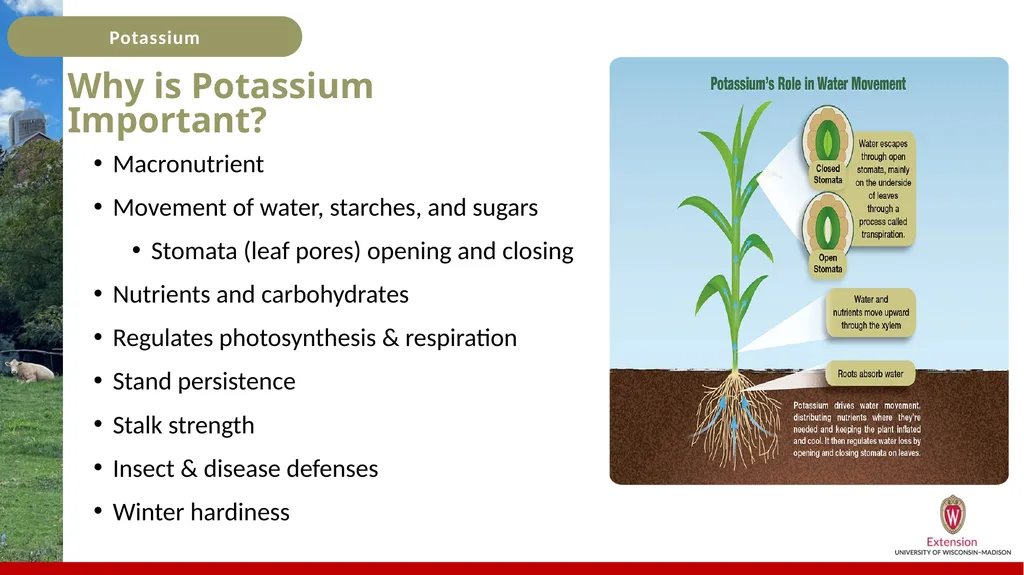
Why is Potassium Important? Macronutrient
Movement of water, starches, and sugars
Stomata (leaf pores) opening and closing
Nutrients and carbohydrates
Regulates photosynthesis & respiration
Stand persistence
Stalk strength
Insect & disease defenses
Winter hardiness<br>
04
K deficiency in crops is common in Wisconsin. We grow many HIGH K demand crops: forages, corn silage & alfalfa.
Potassium is mobile in plants.
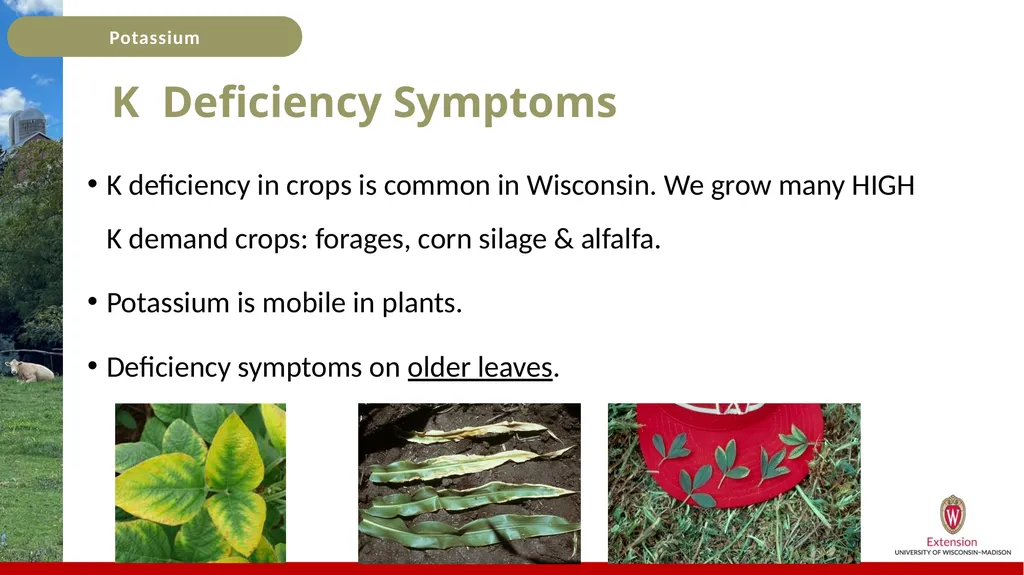
Deficiency symptoms on older leaves. K Deficiency Symptoms<br>
05
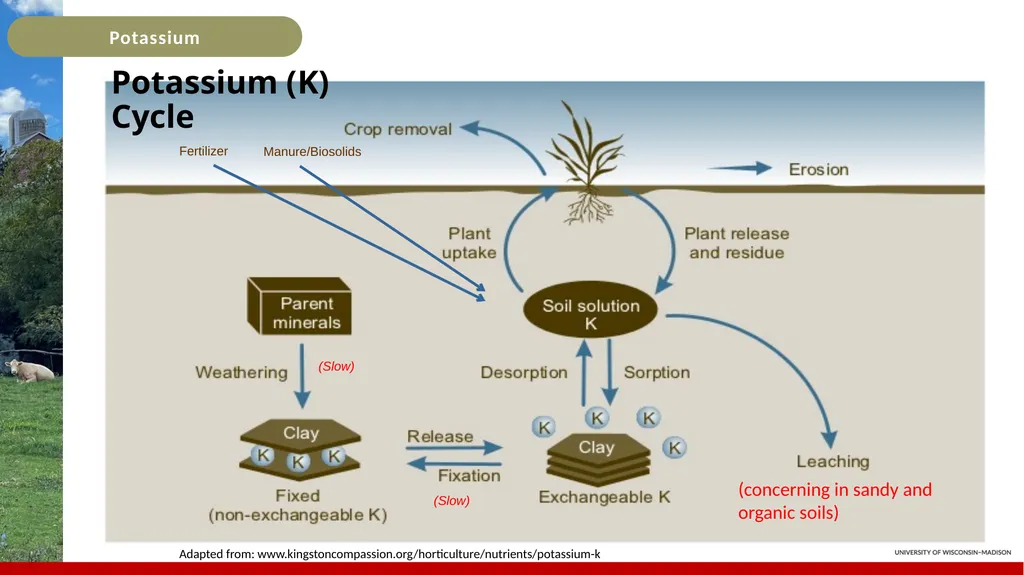
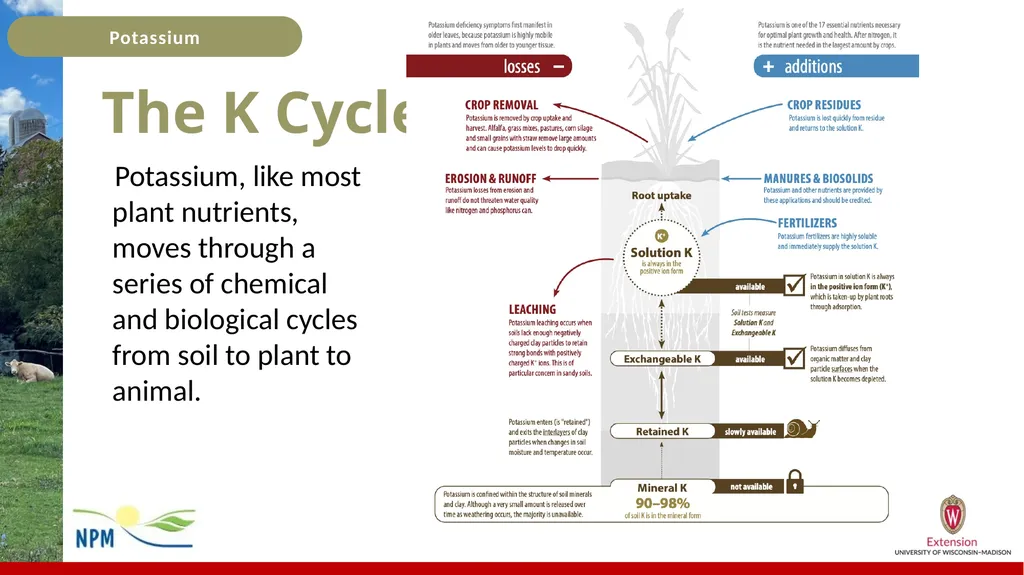
Adapted from: www.kingstoncompassion.org/horticulture/nutrients/potassium-k/ (Slow) (concerning in sandy and organic soils) (Slow) Potassium (K) Cycle<br>
06
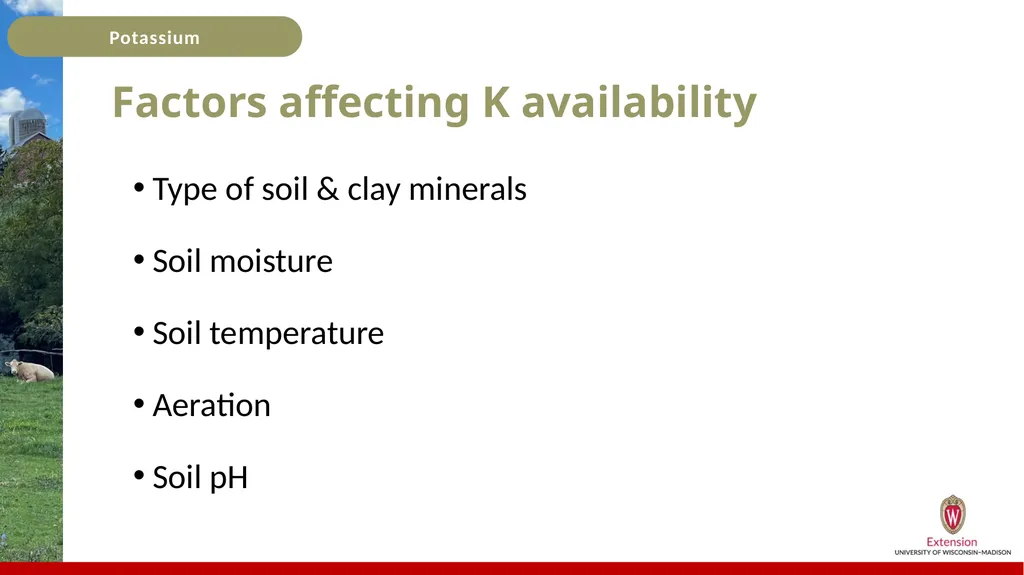
Factors affecting K availability Type of soil & clay minerals
Soil moisture
Soil temperature
Aeration
Soil pH<br>
07
The K Cycle Potassium, like most plant nutrients, moves through a series of chemical and biological cycles from soil to plant to animal.<br>
08
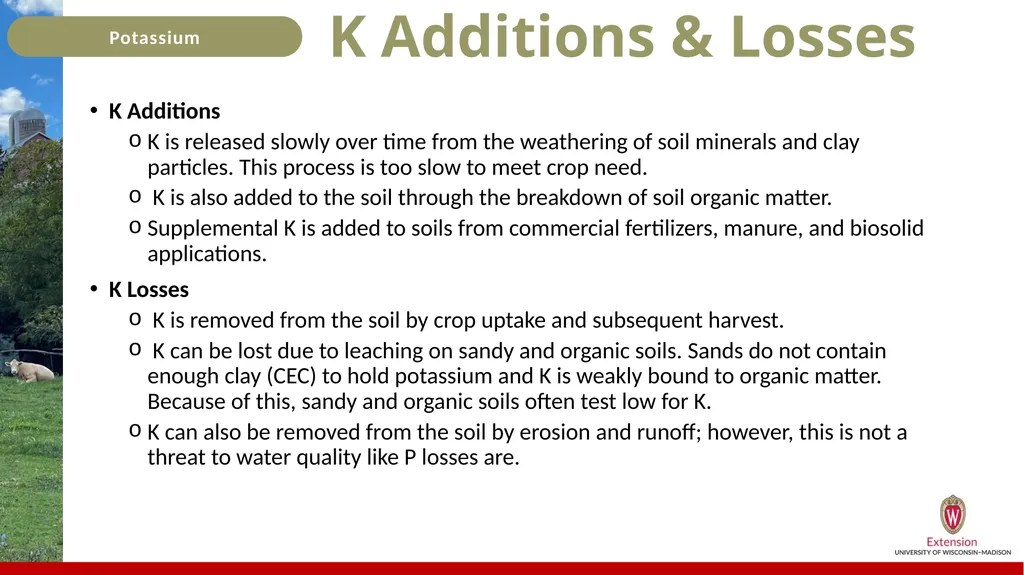
K Additions & Losses K Additions
K is released slowly over time from the weathering of soil minerals and clay particles. This process is too slow to meet crop need.
K is also added to the soil through the breakdown of soil organic matter.
Supplemental K is added to soils from commercial fertilizers, manure, and biosolid applications.
K Losses
K is removed from the soil by crop uptake and subsequent harvest.
K can be lost due to leaching on sandy and organic soils. Sands do not contain enough clay (CEC) to hold potassium and K is weakly bound to organic matter. Because of this, sandy and organic soils often test low for K.
K can also be removed from the soil by erosion and runoff; however, this is not a threat to water quality like P losses are.<br>
09
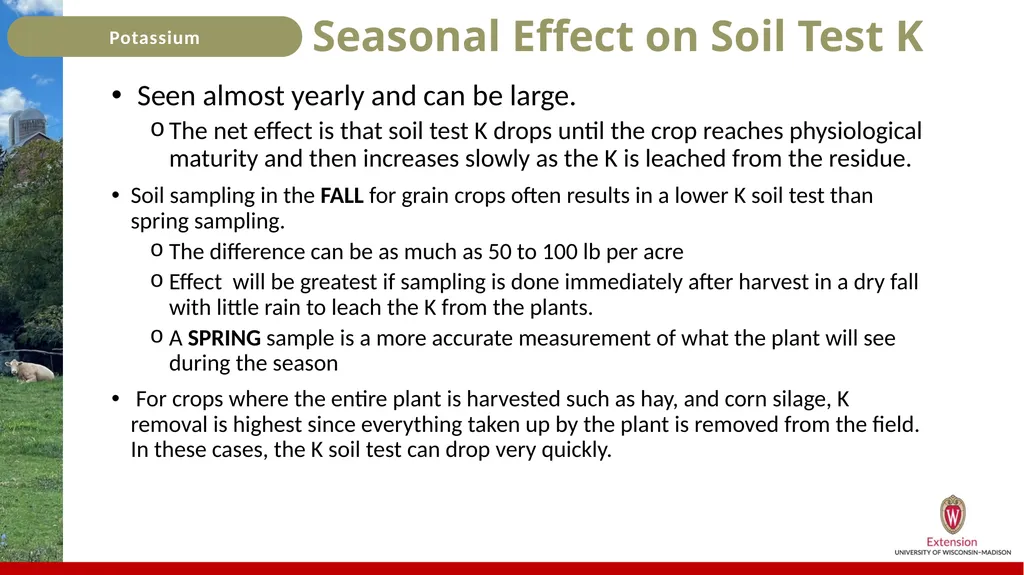
Seasonal Effect on Soil Test K Seen almost yearly and can be large.
The net effect is that soil test K drops until the crop reaches physiological maturity and then increases slowly as the K is leached from the residue.
Soil sampling in the FALL for grain crops often results in a lower K soil test than spring sampling.
The difference can be as much as 50 to 100 lb per acre
Effect will be greatest if sampling is done immediately after harvest in a dry fall with little rain to leach the K from the plants.
A SPRING sample is a more accurate measurement of what the plant will see during the season
For crops where the entire plant is harvested such as hay, and corn silage, K removal is highest since everything taken up by the plant is removed from the field. In these cases, the K soil test can drop very quickly.<br>
10
Potassium Management<br>
11
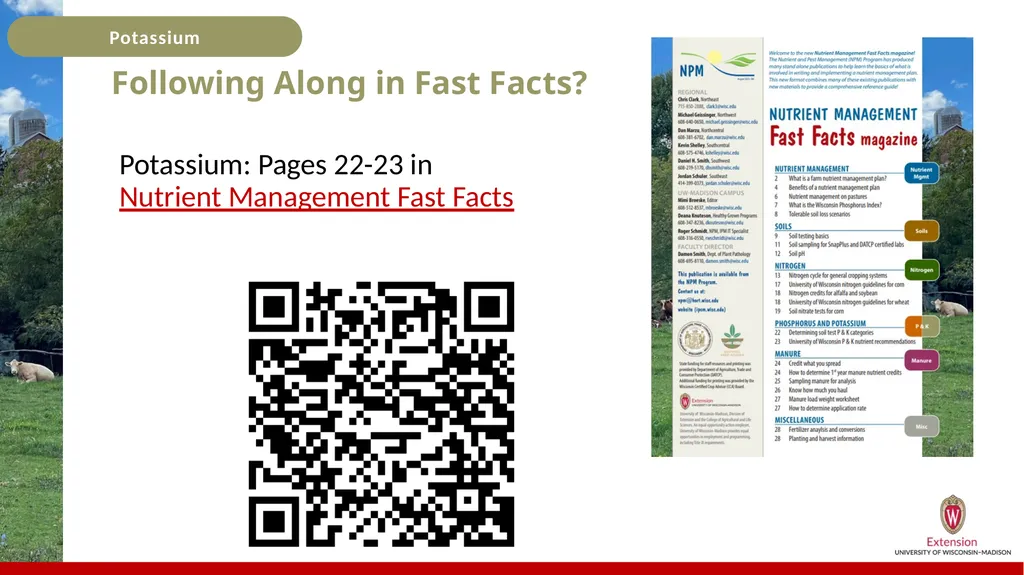
Following Along in Fast Facts? Potassium: Pages 22-23 in Nutrient Management Fast Facts<br>
12
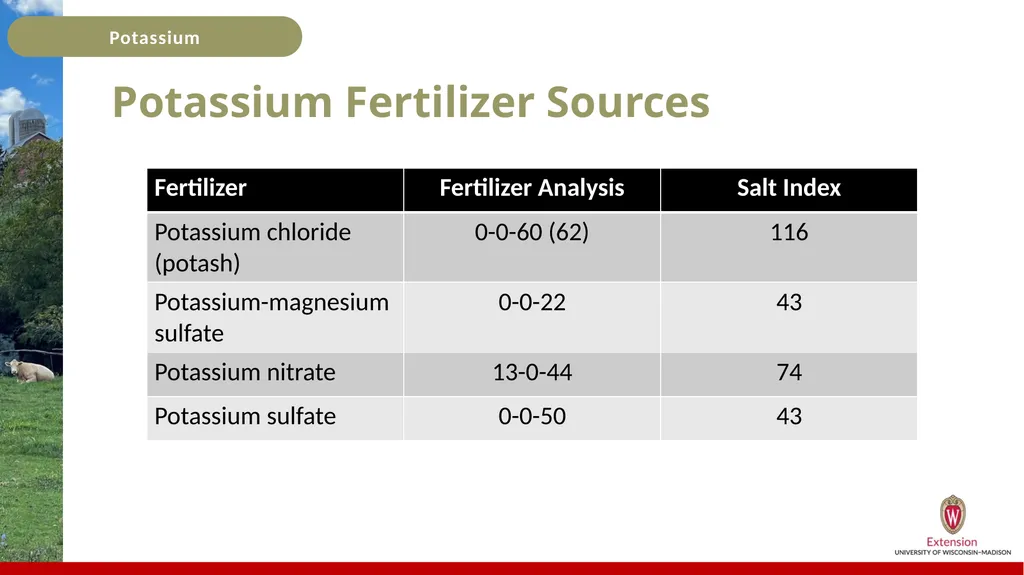
Potassium Fertilizer Sources<br>
13
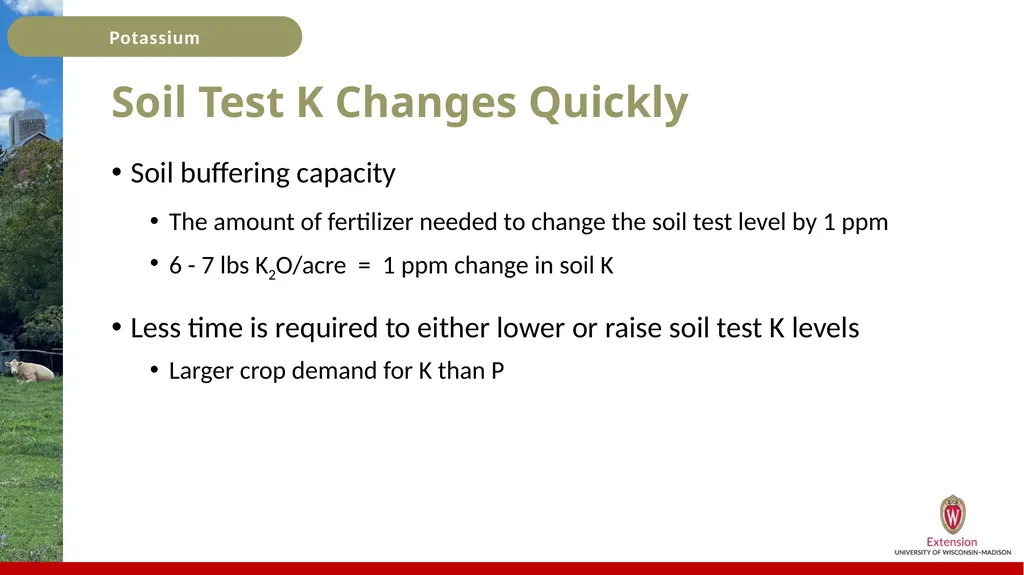
Soil Test K Changes Quickly Soil buffering capacity
The amount of fertilizer needed to change the soil test level by 1 ppm
6 - 7 lbs K2O/acre = 1 ppm change in soil K
Less time is required to either lower or raise soil test K levels
Larger crop demand for K than P<br>
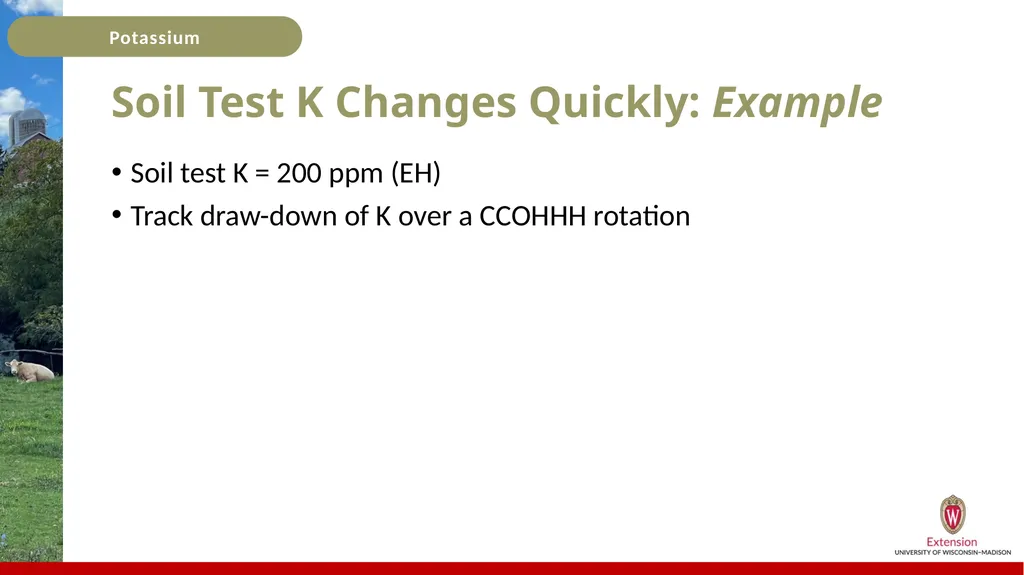
Soil Test K Changes Quickly: Example Soil test K = 200 ppm (EH)
Track draw-down of K over a CCOHHH rotation<br>
16
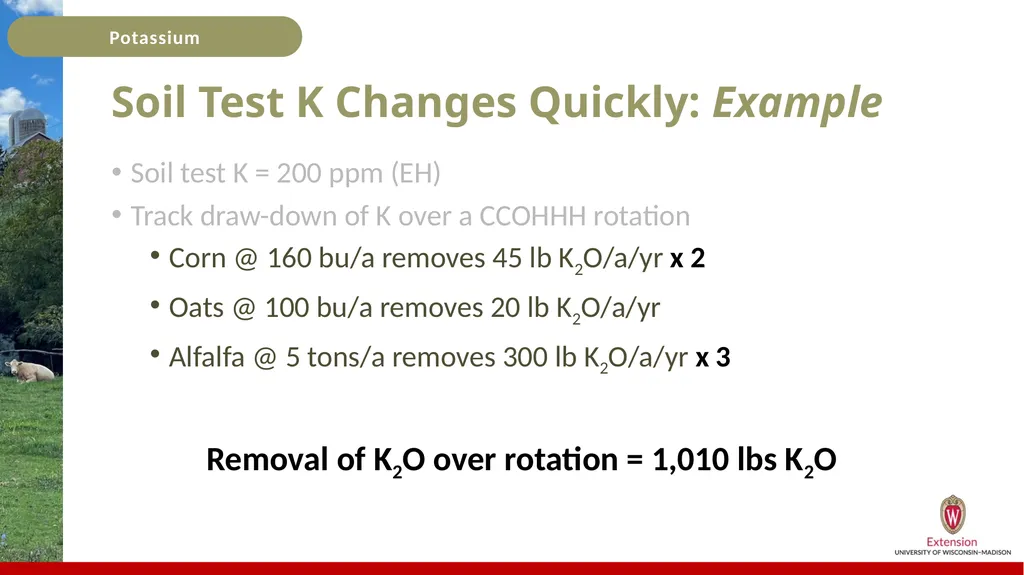
Soil Test K Changes Quickly: Example Soil test K = 200 ppm (EH)
Track draw-down of K over a CCOHHH rotation
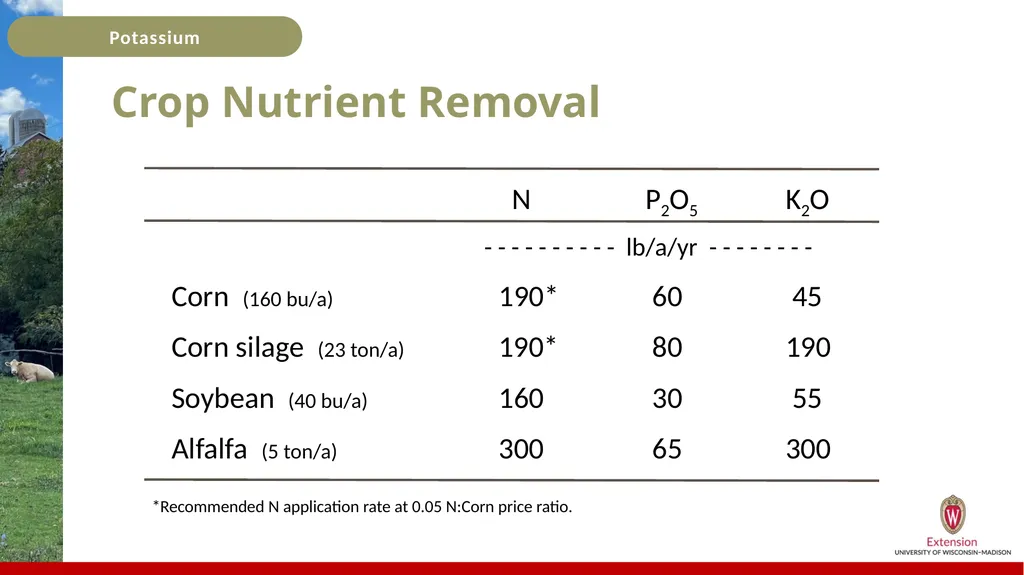
Corn @ 160 bu/a removes 45 lb K2O/a/yr x 2
Oats @ 100 bu/a removes 20 lb K2O/a/yr
Alfalfa @ 5 tons/a removes 300 lb K2O/a/yr x 3
Removal of K2O over rotation = 1,010 lbs K2O<br>
17
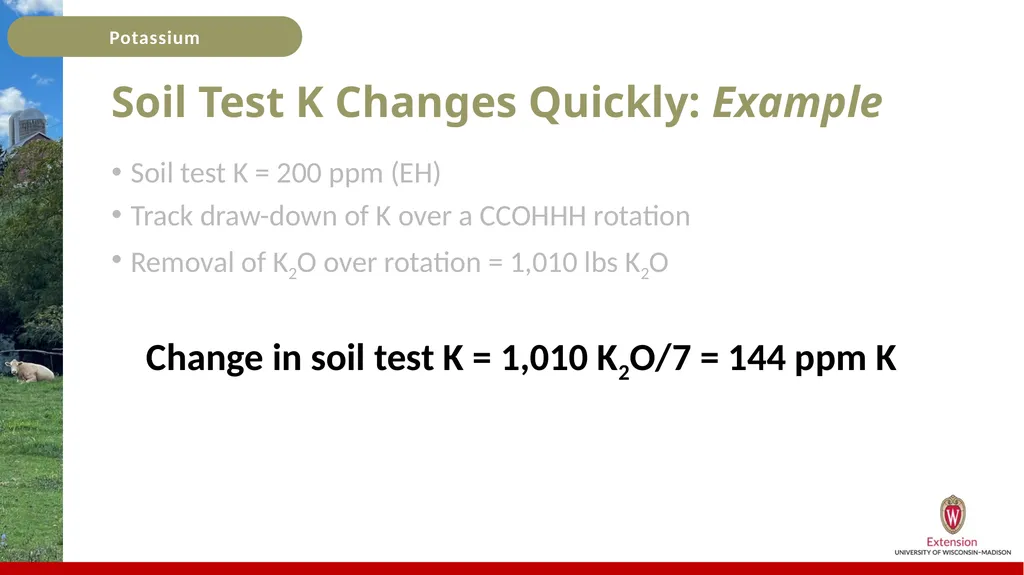
Soil Test K Changes Quickly: Example Soil test K = 200 ppm (EH)
Track draw-down of K over a CCOHHH rotation
Removal of K2O over rotation = 1,010 lbs K2O
Change in soil test K = 1,010 K2O/7 = 144 ppm K<br>
18
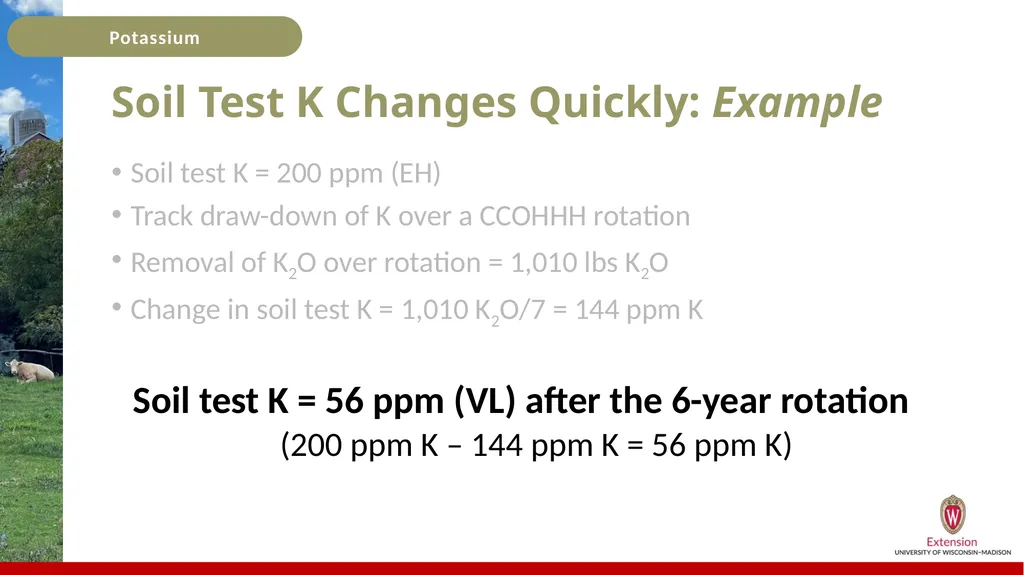
Soil Test K Changes Quickly: Example Soil test K = 200 ppm (EH)
Track draw-down of K over a CCOHHH rotation
Removal of K2O over rotation = 1,010 lbs K2O
Change in soil test K = 1,010 K2O/7 = 144 ppm K
Soil test K = 56 ppm (VL) after the 6-year rotation
(200 ppm K – 144 ppm K = 56 ppm K)<br>
19
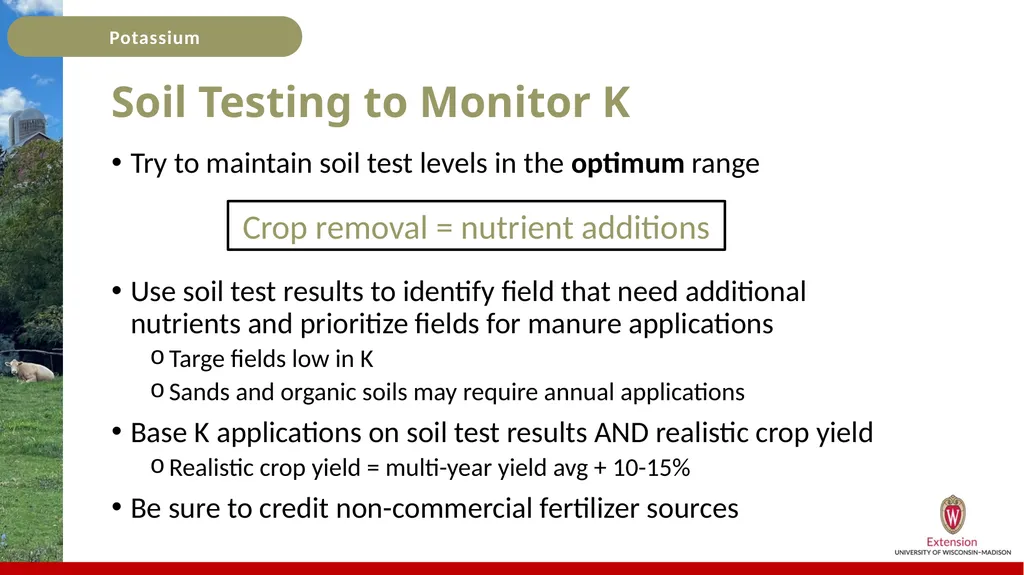
Soil Testing to Monitor K Try to maintain soil test levels in the optimum range
Use soil test results to identify field that need additional nutrients and prioritize fields for manure applications
Targe fields low in K
Sands and organic soils may require annual applications
Base K applications on soil test results AND realistic crop yield
Realistic crop yield = multi-year yield avg + 10-15%
Be sure to credit non-commercial fertilizer sources Crop removal = nutrient additions<br>
20
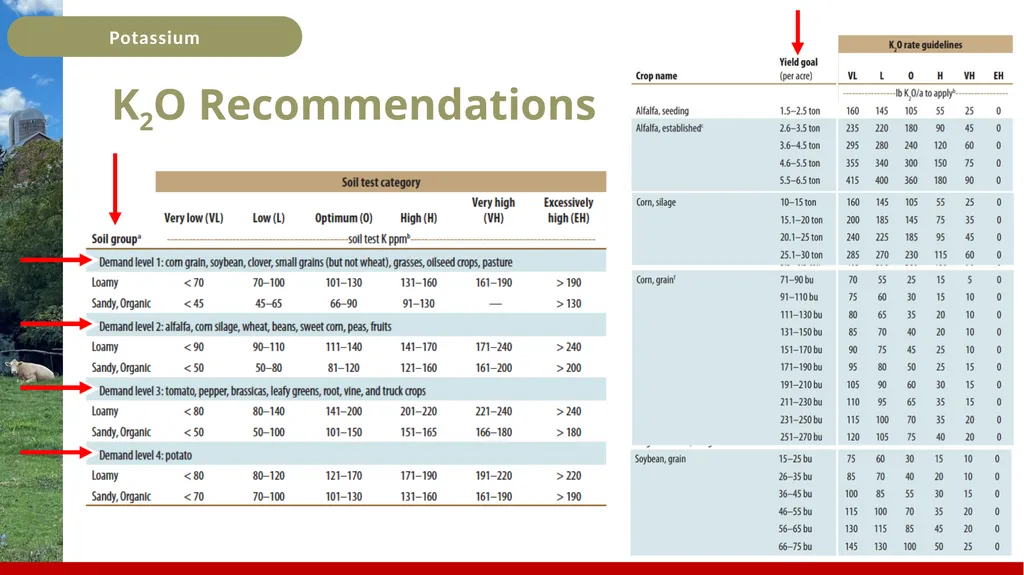
K2O Recommendations<br>
21
Manure Applications to Hay Apply the manure before the new seeding to meet partial potash demands of the rotation.
Top-dress established hay with manure.
Limit rate to 10-12 tons/acre or 3,000 – 5,000 gallons/acre
Spread on older hay stands
Spread on firm soils – avoid compaction
Spread ASAP after cutting<br>
22
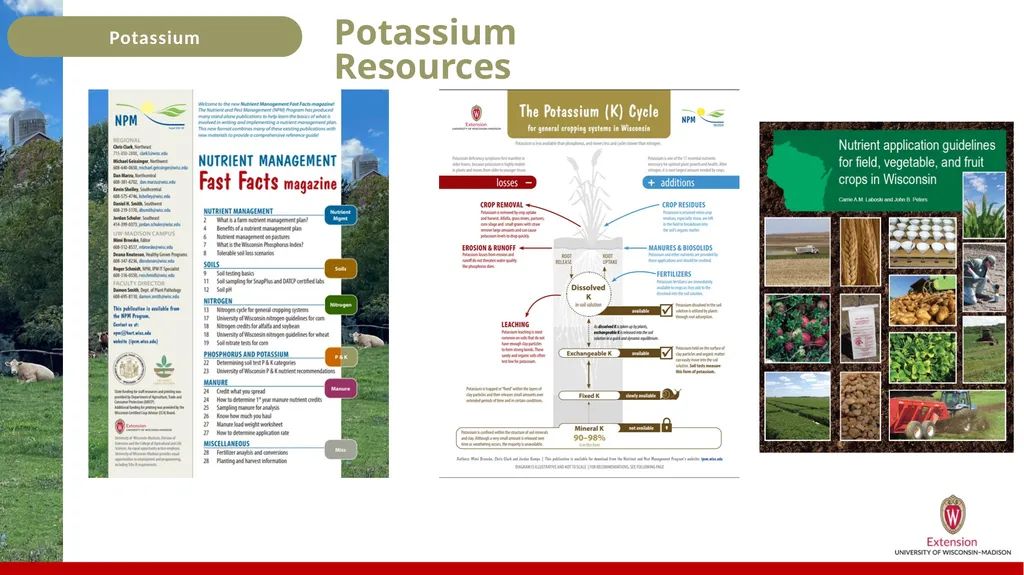
Potassium Resources<br>
23
Thanks! Name
Title
Nutrient and Pest Management (NPM) Program
UW-Madison Division of Extension