PowerPoint Instructions: Check to see if you have
Description: PowerPoint Instructions: Check to see if you have the most up to date version of the GCP Icons, they are available at cloud.google.comarchitectureicons Find the icon, diagram element, or diagram example that you need Create your own GCP
Related Topics
Download Presentation
"PowerPoint Instructions: Check to see if you have" is the property of its rightful owner. Permission is granted to download and print the materials on this website for personal, non-commercial use only, and to display it on your personal computer provided you do not modify the materials and that you retain all copyright notices contained in the materials. By downloading content from our website, you accept the terms of this agreement.
Presentation Transcript
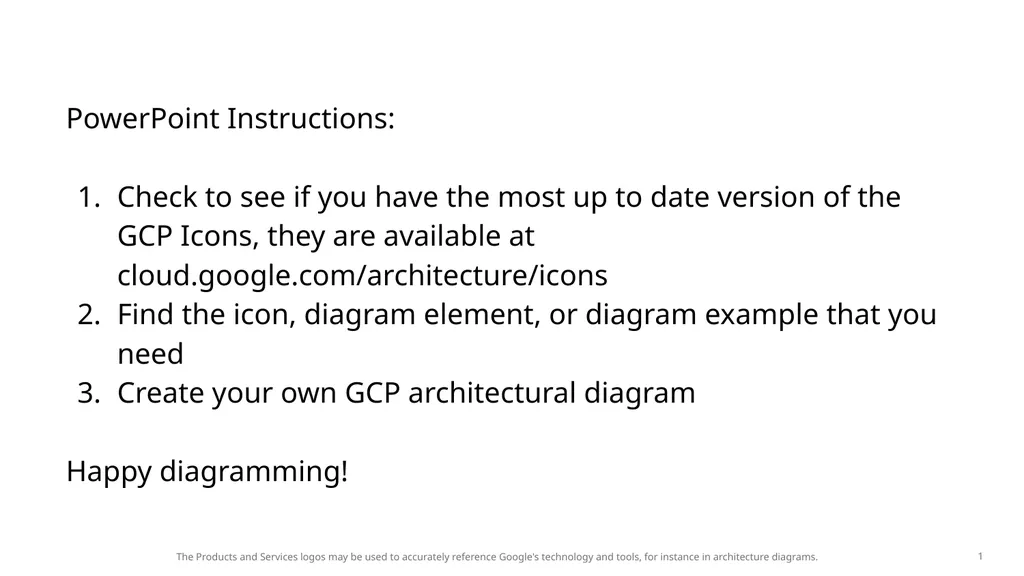
slide1. PowerPoint Instructions:
Check to see if you have the most up to date version of the GCP Icons, they are available at cloud.google.com/architecture/icons
Find the icon, diagram element, or diagram example that you need
Create your own GCP architectural diagram
Happy diagramming!<br>
slide2. GCP Icons v1.0<br>
slide3. Table of Contents Diagram Examples: General 30
Diagram Examples: Specific 44
Media
Gaming
Digital Marketing
Internet of Things
Financial Services
Dev Test
Backup and Archive
Websites
Mobile
LifeSciences
Retail
Big Data
Resources 87 Google Cloud Platform Icons 4
Diagram Elements 6
Overview
User Cards and User Paths
Product and Service Cards
Zones and Nesting
Title and Footer Bars
Material Icons from Google 17
Elements for Slides & PPT 19
User and Device Cards
Service Cards
Zones
Product Cards
Expanded Product Cards
Title bar, Footer bar, Project Zone, Notes, Markers, and Legend<br>
slide4. Compute Compute Engine App Engine Container Engine Container Registry Cloud Functions Networking Cloud Virtual Network Cloud Load Balancing Cloud CDN Cloud Interconnect Cloud DNS Big Data BigQuery Cloud Dataflow Cloud Dataproc Cloud Datalab Cloud Pub/Sub Genomics Each Google Cloud Platform product and service have a unique Blue hexagonal icon. Identity & Security Cloud IAM Cloud Resource Manager Cloud Security Scanner Cloud Platform Security Storage and Databases Cloud Storage Cloud Bigtable Cloud Datastore Cloud SQL Persistent Disk Machine Learning Cloud Machine Learning Vision API Speech API Natural Language API Translation API Google Cloud Platform Icons Jobs API<br>
slide5. Management Tools Stackdriver Monitoring Logging Error Reporting Trace Debugger Deployment Manager Cloud Endpoints Cloud Console GCP products and services without a unique icon utilize a generic hexagonal icon. Google Cloud Platform Icons Cloud Shell Cloud Mobile App Billing App Cloud APIs<br>
slide6. Diagram Elements<br>
slide7. Architecture: Backup and Archive > DR Cold standby server Cloud LoadBalancing Diagram Elements: Overview The call-outs below identify the various elements found in a diagram.
1 User Cards2 User Paths3 Project/Platform Zone4 Product Card5 Zone grouping6 Expanded Product Card7 Service Card8 Title bar (Optional)9 Footer (Optional)<br>
slide8. Diagram Elements: User Cards and User Paths Generic User Specific User Phone User Alternate Input Grey icons represent user or device input.
User elements are located on the left side of the diagram, where the flow originates. A path connects these elements to Google Cloud Platform elements. A name can be used to clarify the user or alternate input method.
User and alternate input icons are 72x72px with a black (#000000) fill at 54% opacity. Secondary Path Optional Primary Path Optional Secondary Path 2pt | 38% Black | #9E9E9E 2pt Dashed | Google Blue | #4284F3 2pt Dashed | 38% Black | #9E9E9E Primary Path 2pt | Google Blue | #4284F3 Success Status 2pt | Google Green | #34A853 Failure Status 2pt | Google Red | #EA4335<br>
slide9. Diagram Elements: Product and Service Cards Expanded Product Card Product and Service information is displayed using Material Design cards.
Product Cards can be single or grouped. Product Cards can display a functional name above the product name for additional clarity.
Expanded Product Cards allow the use of icons and text to identify attributes of the product.
Service cards use a circular icon frame and text wrapped to decrease card width. Product Card Service Card<br>
slide10. Diagram Elements: Zones and Nesting Zones define project areas and groups within project areas.
Use zones to clarify diagram structure and flow. The user area can also contain zones to clarify user pathways.
All zones have 2px rounded corners.
Zones do not have shadows.<br>
slide11. Diagram Elements: Zones and Nesting - Specifications User Zones:
1 16px padding (all sides)
2 Zone Heading - Roboto Med16px type / 24px line-height#000000 | 38% opacity
3 Zone Subhead - Roboto Reg12px type / 16px line-height#000000 | 38% opacity
4 Icon Title - Roboto Reg12px | #000000 | 87% opacity
5 Icons #000000 | 54% Opacitycentered in zones<br>
slide12. Diagram Elements: Zones and Nesting - Specifications Project Zone:
1 16px padding top |24px padding right, bottom, left
2 Project Zone - Heading (Optional) Roboto Med16px type / 24px line-height#000000 | 87% opacity
3 Zone Level 1 - HeadingRoboto Med16px type / 24px line-height#000000 | 38% opacity8px pad top, 16px Pad left
4 Zone Level 1 - Cards8px padding top, right, bottom, left and between cards<br>
slide13. Diagram Elements: Zones and Nesting - Specifications Project Zone Exceptions:
1 Stacked cards need additional padding due to shadow width.
+ 8px padding right, bottom and, left Stacked card with additional padding Standard card with normal padding +8px +8px +8px<br>
slide14. Diagram Elements: Expanded Product Card - Specifications Disks
Call out disk size and type used on a Product Card.
When using the Expanded Product Card you can identify the number of disks, the total storage capacity, and the type of disks being used.
Disk optionsPD - Persistent DiskPD-SSD - Persistent SSD DiskLocal SSD - Local SSD Disk
Disk icons, like other icons, are black (#000000) at 54% opacity Disk size and type Number of disks Instance w/1 Persistent Disk Disk icon<br>
slide15. Diagram Elements: Expanded Product Card - Specifications Machine Type
Six different machine types can be defined by a unique icon and identifiers for “GB of RAM per core” and “number of cores”.
Machine Type OptionsStandard machineShared-core machine (F1)Shared-core machine (G1)High-CPU machineHigh-memory machineCustom Virtual Machine Standard machine High-CPU machine High-memory machine Shared-core machine Machine type Instance w/4GB RAM for each core Number of cores GB of RAM per core Custom Virtual Machine Shared-core machine Longer RAM value example<br>
slide16. Diagram Elements: Title and Footer Bars Footer Bar An optional Title and Footer bar can be added to diagrams if needed.
The Title and Footer bars create a polished and complete look when used with a diagram. Title Bar Architecture: App Engine and Cloud Endpoints<br>
slide17. Material Icons from Google<br>
slide18. Icons and Material Design Material Design icons are simple, modern, friendly, and sometimes quirky. Each icon is reduced to its minimal form. The designs ensure readability and clarity even at small sizes.
Use these icons to create specific User and Device Cards or Service Cards while maintaining a consistent visual look.
Material icons can be searched and downloaded directly from material.io/icons/ Sample of Material icons<br>
slide19. Elements for Slides & PPT<br>
slide20. User and Device Cards<br>
slide21. Service Cards Blank Two& Three Line Blank One Line<br>
slide22. Zones<br>
slide23. Product Cards Compute Storage and Databases<br>
slide24. Product Cards Networking Big Data<br>
slide25. Product Cards Machine Learning Identity & Security<br>
slide26. Product Cards Management Tools<br>
slide27. Product Cards Developer Tools<br>
slide28. Expanded Product Cards<br>
slide29. Title bar, Footer bar, Project Zone, Notes, Markers, and Legend Use this note to call outor clarify parts of a diagram 1 Commit code
2 Detect code change 3 Build immutable image
4 Launch test instance from image 5 Run tests
6 Perform rolling update of image to autoscaler Markers to be use with the legend to the right Architecture: App Engine and Cloud Endpoints 1 2 3 4 5 6 7<br>
slide30. Diagram Examples: General<br>
slide31. General > App Engine and Cloud Endpoints EndpointClients Architecture: General > App Engine and Cloud Endpoints<br>
slide32. General > Compute Engine and REST or gRPC Architecture: General > Compute Engine and REST of gRPC<br>
slide33. General > Content Management Architecture: General > Content Management<br>
slide34. General > Digital Asset Management and Sharing Authentication Push Meta DataNavigationSearch Share Upload / Download Media Architecture: General > Digital Asset Management and Sharing<br>
slide35. General > Firebase and Google App Engine Update Data SynchronizeAcrossDevices Processthe Data Architecture: General > Firebase and Google App Engine<br>
slide36. General > Firebase and Managed VMs Update Data Synchronize Across Devices Processthe Data Runs YourService inDockerContainers Architecture: General > Firebase and Managed VMs<br>
slide37. Update Data SynchronizeData AcrossDevices Architecture: General > Firebase General > Firebase<br>
slide38. General > GitLabCIonGKE Backups Architecture: General > GitLabClonGKE<br>
slide39. General > Hadoop on Google Cloud Platform Google Cloud StorageConnector for Hadoop Google Cloud StorageConnector for Hadoop Architecture: General > App Engine and Cloud Endpoints<br>
slide40. General > High Performance Computing Architecture: General > High Performance Computing<br>
slide41. General > Real Time Bidding DoubleClickAd Exchange Architecture: General > Real Time Bidding<br>
slide42. General > Real Time Stream Processing IoT Architecture: General > Real Time Stream Processing - Internet of Things<br>
slide43. General > Web Application on Google App Engine Architecture: General > Web Application on Google App Engine<br>
slide44. Diagram Examples: Specific<br>
slide45. Media > Hybrid Rendering Google CloudInterconnect& VPN Architecture: Media > Hybrid Rendering<br>
slide46. Media > Live Streaming RTPM / RTSP RecordingModule Architecture: Media > Live Streaming<br>
slide47. Media > Rendering Google CloudInterconnect& VPN NFS& SMB Architecture: Media > Rendering<br>
slide48. Media > Transcoding ShutdownVM Launch VMs Queuing / Scheduler Copy FilesLocally QualityAssurance Ready forStreaming ffmpegcommand DRM on VM Output is multiple codecs,resolutions, and bit rates If DRM is Windows based,a separate VM can be used Architecture: Media > Transcoding<br>
slide49. Gaming > Backend Database or Architecture: Gaming > Backend Database<br>
slide50. Gaming > Gaming Analytics Architecture: Gaming > Gaming Analytics<br>
slide51. Gaming > Mobile Game Backend Sockets API CloudEndpointClients Architecture: Gaming > Mobile Game Backend<br>
slide52. Gaming > Real-Time AAA Games Servers or or Architecture: Gaming > Real-Time AAA Games Servers<br>
slide53. Digital Marketing > DMP Data Warehouse Architecture: Digital Marketing > DMP Data Warehouse<br>
slide54. Digital Marketing > Publisher side analysis Experiences or BatchProcessing or Real-timeAnalytics<br>
slide55. Digital Marketing > Real-Time Bidding<br>
slide56. Internet of Things > MQTT to PubSub Broker Architecture: Internet of Things > MQTT to PubSub Broker<br>
slide57. Internet of Things > Sensor stream ingest and processing Architecture: Internet of Things > Sensor stream ingest and processing<br>
slide58. Financial Services > Monte Carlo Simulations Architecture: Financial Services > Monte Carlo Simulations<br>
slide59. Financial Services > Time Series Analysis Architecture: Financial Services > Time Series Analysis<br>
slide60. Dev Test > Continuous Delivery with Spinnaker 1 Commit code
2 Detect code change 3 Build immutable image
4 Launch test instance from image 5 Run tests
6 Perform rolling update of image to autoscaler 1 2 3 5 6 4<br>
slide61. Dev Test > Jenkins on k8s 1 Commit Code
2 Code Enters CD Pipeline 3 Test/Build Job Submitted to Slave
4 Push Docker images 5 Images Deployed to Staging
6 Operational and Functional Testing
7 Images Deployed to Production 5 7 2 3 4 1 6<br>
slide62. Dev Test > Scale Testing with Kubernetes+Locust 1 Tester starts test
2 Master starts load
3 Workers send request to FE service 4 FE pods talk to BE service
5 Worker report results
6 Tester views results FrontendService BackendService Architecture: Dev Test > Scale Testing with Kubernetes+Locust 1 2 5 6 3 4<br>
slide63. Dev Test > UI Testing with Kubernetes HubService FrontendService BackendService Architecture: Dev Test > UI Testing with Kubernetes<br>
slide64. Backup and Archive > DR Cold standby server Architecture: Backup and Archive > DR Cold standby server<br>
slide65. Backup and Archive > DR Warm static site Architecture: Backup and Archive > DR Warm static site<br>
slide66. Backup and Archive > DR with Application Replication Replication VPN CarrierInterconnect Architecture: Backup and Archive > DR with Application Replication<br>
slide67. Backup and Archive > Hosting Filers Architecture: Backup and Archive > Hosting Filers<br>
slide68. Websites > API Hosting Architecture: Websites > API Hosting<br>
slide69. Websites > Content Hosting Architecture: Websites > Content Hosting<br>
slide70. Websites > Dynamic Hosting Replication Architecture: Websites > Dynamic Hosting<br>
slide71. Websites > Mobile Site Hosting Architecture: Websites > Mobile Site Hosting<br>
slide72. Websites > Static Hosting Architecture: Websites > Static Hosting<br>
slide73. Mobile > Mobile Game Backend Architecture: Mobile > Mobile Game Backend Sockets API CloudEndpointClients<br>
slide74. LifeSciences > Genomics, Secondary Analysis CarrierInterconnect Architecture: LifeSciences > Genomics, Secondary Analysis<br>
slide75. LifeSciences > Patient Monitoring Architecture: LifeSciences > Patient Monitoring<br>
slide76. LifeSciences > Variant Analysis BAMFASTQ Architecture: LifeSciences > Variant Analysis<br>
slide77. Retail > Beacons and Targeted Marketing Architecture: Retail > Beacons and Targeted Marketing<br>
slide78. Retail > Fraud Detection Architecture: Retail > Fraud Detection<br>
slide79. Retail > PCI Architecture: Retail > PCI<br>
slide80. Retail > Real-Time Inventory Architecture: Retail > Real-Time Inventory<br>
slide81. Retail > Recommendation Engines Architecture: Retail > Recommendation Engines<br>
slide82. Retail > Shopping Cart Analysis Architecture: Retail > Shopping Cart Analysis<br>
slide83. Big Data > Complex Event Processing<br>
slide84. Big Data > DMP Data Warehouse Architecture: Big Data > DMP Data Warehouse<br>
slide85. Big Data > Log Processing Architecture: Big Data > Log Processing<br>
slide86. Big Data > Time Series Analysis Architecture: Big Data > Time Series Analysis<br>
slide87. Resources<br>
slide88. Icon and sample diagrams landing page https://cloud.google.com/icons Web Resources<br>
Check to see if you have the most up to date version of the GCP Icons, they are available at cloud.google.com/architecture/icons
Find the icon, diagram element, or diagram example that you need
Create your own GCP architectural diagram
Happy diagramming!<br>
slide2. GCP Icons v1.0<br>
slide3. Table of Contents Diagram Examples: General 30
Diagram Examples: Specific 44
Media
Gaming
Digital Marketing
Internet of Things
Financial Services
Dev Test
Backup and Archive
Websites
Mobile
LifeSciences
Retail
Big Data
Resources 87 Google Cloud Platform Icons 4
Diagram Elements 6
Overview
User Cards and User Paths
Product and Service Cards
Zones and Nesting
Title and Footer Bars
Material Icons from Google 17
Elements for Slides & PPT 19
User and Device Cards
Service Cards
Zones
Product Cards
Expanded Product Cards
Title bar, Footer bar, Project Zone, Notes, Markers, and Legend<br>
slide4. Compute Compute Engine App Engine Container Engine Container Registry Cloud Functions Networking Cloud Virtual Network Cloud Load Balancing Cloud CDN Cloud Interconnect Cloud DNS Big Data BigQuery Cloud Dataflow Cloud Dataproc Cloud Datalab Cloud Pub/Sub Genomics Each Google Cloud Platform product and service have a unique Blue hexagonal icon. Identity & Security Cloud IAM Cloud Resource Manager Cloud Security Scanner Cloud Platform Security Storage and Databases Cloud Storage Cloud Bigtable Cloud Datastore Cloud SQL Persistent Disk Machine Learning Cloud Machine Learning Vision API Speech API Natural Language API Translation API Google Cloud Platform Icons Jobs API<br>
slide5. Management Tools Stackdriver Monitoring Logging Error Reporting Trace Debugger Deployment Manager Cloud Endpoints Cloud Console GCP products and services without a unique icon utilize a generic hexagonal icon. Google Cloud Platform Icons Cloud Shell Cloud Mobile App Billing App Cloud APIs<br>
slide6. Diagram Elements<br>
slide7. Architecture: Backup and Archive > DR Cold standby server Cloud LoadBalancing Diagram Elements: Overview The call-outs below identify the various elements found in a diagram.
1 User Cards2 User Paths3 Project/Platform Zone4 Product Card5 Zone grouping6 Expanded Product Card7 Service Card8 Title bar (Optional)9 Footer (Optional)<br>
slide8. Diagram Elements: User Cards and User Paths Generic User Specific User Phone User Alternate Input Grey icons represent user or device input.
User elements are located on the left side of the diagram, where the flow originates. A path connects these elements to Google Cloud Platform elements. A name can be used to clarify the user or alternate input method.
User and alternate input icons are 72x72px with a black (#000000) fill at 54% opacity. Secondary Path Optional Primary Path Optional Secondary Path 2pt | 38% Black | #9E9E9E 2pt Dashed | Google Blue | #4284F3 2pt Dashed | 38% Black | #9E9E9E Primary Path 2pt | Google Blue | #4284F3 Success Status 2pt | Google Green | #34A853 Failure Status 2pt | Google Red | #EA4335<br>
slide9. Diagram Elements: Product and Service Cards Expanded Product Card Product and Service information is displayed using Material Design cards.
Product Cards can be single or grouped. Product Cards can display a functional name above the product name for additional clarity.
Expanded Product Cards allow the use of icons and text to identify attributes of the product.
Service cards use a circular icon frame and text wrapped to decrease card width. Product Card Service Card<br>
slide10. Diagram Elements: Zones and Nesting Zones define project areas and groups within project areas.
Use zones to clarify diagram structure and flow. The user area can also contain zones to clarify user pathways.
All zones have 2px rounded corners.
Zones do not have shadows.<br>
slide11. Diagram Elements: Zones and Nesting - Specifications User Zones:
1 16px padding (all sides)
2 Zone Heading - Roboto Med16px type / 24px line-height#000000 | 38% opacity
3 Zone Subhead - Roboto Reg12px type / 16px line-height#000000 | 38% opacity
4 Icon Title - Roboto Reg12px | #000000 | 87% opacity
5 Icons #000000 | 54% Opacitycentered in zones<br>
slide12. Diagram Elements: Zones and Nesting - Specifications Project Zone:
1 16px padding top |24px padding right, bottom, left
2 Project Zone - Heading (Optional) Roboto Med16px type / 24px line-height#000000 | 87% opacity
3 Zone Level 1 - HeadingRoboto Med16px type / 24px line-height#000000 | 38% opacity8px pad top, 16px Pad left
4 Zone Level 1 - Cards8px padding top, right, bottom, left and between cards<br>
slide13. Diagram Elements: Zones and Nesting - Specifications Project Zone Exceptions:
1 Stacked cards need additional padding due to shadow width.
+ 8px padding right, bottom and, left Stacked card with additional padding Standard card with normal padding +8px +8px +8px<br>
slide14. Diagram Elements: Expanded Product Card - Specifications Disks
Call out disk size and type used on a Product Card.
When using the Expanded Product Card you can identify the number of disks, the total storage capacity, and the type of disks being used.
Disk optionsPD - Persistent DiskPD-SSD - Persistent SSD DiskLocal SSD - Local SSD Disk
Disk icons, like other icons, are black (#000000) at 54% opacity Disk size and type Number of disks Instance w/1 Persistent Disk Disk icon<br>
slide15. Diagram Elements: Expanded Product Card - Specifications Machine Type
Six different machine types can be defined by a unique icon and identifiers for “GB of RAM per core” and “number of cores”.
Machine Type OptionsStandard machineShared-core machine (F1)Shared-core machine (G1)High-CPU machineHigh-memory machineCustom Virtual Machine Standard machine High-CPU machine High-memory machine Shared-core machine Machine type Instance w/4GB RAM for each core Number of cores GB of RAM per core Custom Virtual Machine Shared-core machine Longer RAM value example<br>
slide16. Diagram Elements: Title and Footer Bars Footer Bar An optional Title and Footer bar can be added to diagrams if needed.
The Title and Footer bars create a polished and complete look when used with a diagram. Title Bar Architecture: App Engine and Cloud Endpoints<br>
slide17. Material Icons from Google<br>
slide18. Icons and Material Design Material Design icons are simple, modern, friendly, and sometimes quirky. Each icon is reduced to its minimal form. The designs ensure readability and clarity even at small sizes.
Use these icons to create specific User and Device Cards or Service Cards while maintaining a consistent visual look.
Material icons can be searched and downloaded directly from material.io/icons/ Sample of Material icons<br>
slide19. Elements for Slides & PPT<br>
slide20. User and Device Cards<br>
slide21. Service Cards Blank Two& Three Line Blank One Line<br>
slide22. Zones<br>
slide23. Product Cards Compute Storage and Databases<br>
slide24. Product Cards Networking Big Data<br>
slide25. Product Cards Machine Learning Identity & Security<br>
slide26. Product Cards Management Tools<br>
slide27. Product Cards Developer Tools<br>
slide28. Expanded Product Cards<br>
slide29. Title bar, Footer bar, Project Zone, Notes, Markers, and Legend Use this note to call outor clarify parts of a diagram 1 Commit code
2 Detect code change 3 Build immutable image
4 Launch test instance from image 5 Run tests
6 Perform rolling update of image to autoscaler Markers to be use with the legend to the right Architecture: App Engine and Cloud Endpoints 1 2 3 4 5 6 7<br>
slide30. Diagram Examples: General<br>
slide31. General > App Engine and Cloud Endpoints EndpointClients Architecture: General > App Engine and Cloud Endpoints<br>
slide32. General > Compute Engine and REST or gRPC Architecture: General > Compute Engine and REST of gRPC<br>
slide33. General > Content Management Architecture: General > Content Management<br>
slide34. General > Digital Asset Management and Sharing Authentication Push Meta DataNavigationSearch Share Upload / Download Media Architecture: General > Digital Asset Management and Sharing<br>
slide35. General > Firebase and Google App Engine Update Data SynchronizeAcrossDevices Processthe Data Architecture: General > Firebase and Google App Engine<br>
slide36. General > Firebase and Managed VMs Update Data Synchronize Across Devices Processthe Data Runs YourService inDockerContainers Architecture: General > Firebase and Managed VMs<br>
slide37. Update Data SynchronizeData AcrossDevices Architecture: General > Firebase General > Firebase<br>
slide38. General > GitLabCIonGKE Backups Architecture: General > GitLabClonGKE<br>
slide39. General > Hadoop on Google Cloud Platform Google Cloud StorageConnector for Hadoop Google Cloud StorageConnector for Hadoop Architecture: General > App Engine and Cloud Endpoints<br>
slide40. General > High Performance Computing Architecture: General > High Performance Computing<br>
slide41. General > Real Time Bidding DoubleClickAd Exchange Architecture: General > Real Time Bidding<br>
slide42. General > Real Time Stream Processing IoT Architecture: General > Real Time Stream Processing - Internet of Things<br>
slide43. General > Web Application on Google App Engine Architecture: General > Web Application on Google App Engine<br>
slide44. Diagram Examples: Specific<br>
slide45. Media > Hybrid Rendering Google CloudInterconnect& VPN Architecture: Media > Hybrid Rendering<br>
slide46. Media > Live Streaming RTPM / RTSP RecordingModule Architecture: Media > Live Streaming<br>
slide47. Media > Rendering Google CloudInterconnect& VPN NFS& SMB Architecture: Media > Rendering<br>
slide48. Media > Transcoding ShutdownVM Launch VMs Queuing / Scheduler Copy FilesLocally QualityAssurance Ready forStreaming ffmpegcommand DRM on VM Output is multiple codecs,resolutions, and bit rates If DRM is Windows based,a separate VM can be used Architecture: Media > Transcoding<br>
slide49. Gaming > Backend Database or Architecture: Gaming > Backend Database<br>
slide50. Gaming > Gaming Analytics Architecture: Gaming > Gaming Analytics<br>
slide51. Gaming > Mobile Game Backend Sockets API CloudEndpointClients Architecture: Gaming > Mobile Game Backend<br>
slide52. Gaming > Real-Time AAA Games Servers or or Architecture: Gaming > Real-Time AAA Games Servers<br>
slide53. Digital Marketing > DMP Data Warehouse Architecture: Digital Marketing > DMP Data Warehouse<br>
slide54. Digital Marketing > Publisher side analysis Experiences or BatchProcessing or Real-timeAnalytics<br>
slide55. Digital Marketing > Real-Time Bidding<br>
slide56. Internet of Things > MQTT to PubSub Broker Architecture: Internet of Things > MQTT to PubSub Broker<br>
slide57. Internet of Things > Sensor stream ingest and processing Architecture: Internet of Things > Sensor stream ingest and processing<br>
slide58. Financial Services > Monte Carlo Simulations Architecture: Financial Services > Monte Carlo Simulations<br>
slide59. Financial Services > Time Series Analysis Architecture: Financial Services > Time Series Analysis<br>
slide60. Dev Test > Continuous Delivery with Spinnaker 1 Commit code
2 Detect code change 3 Build immutable image
4 Launch test instance from image 5 Run tests
6 Perform rolling update of image to autoscaler 1 2 3 5 6 4<br>
slide61. Dev Test > Jenkins on k8s 1 Commit Code
2 Code Enters CD Pipeline 3 Test/Build Job Submitted to Slave
4 Push Docker images 5 Images Deployed to Staging
6 Operational and Functional Testing
7 Images Deployed to Production 5 7 2 3 4 1 6<br>
slide62. Dev Test > Scale Testing with Kubernetes+Locust 1 Tester starts test
2 Master starts load
3 Workers send request to FE service 4 FE pods talk to BE service
5 Worker report results
6 Tester views results FrontendService BackendService Architecture: Dev Test > Scale Testing with Kubernetes+Locust 1 2 5 6 3 4<br>
slide63. Dev Test > UI Testing with Kubernetes HubService FrontendService BackendService Architecture: Dev Test > UI Testing with Kubernetes<br>
slide64. Backup and Archive > DR Cold standby server Architecture: Backup and Archive > DR Cold standby server<br>
slide65. Backup and Archive > DR Warm static site Architecture: Backup and Archive > DR Warm static site<br>
slide66. Backup and Archive > DR with Application Replication Replication VPN CarrierInterconnect Architecture: Backup and Archive > DR with Application Replication<br>
slide67. Backup and Archive > Hosting Filers Architecture: Backup and Archive > Hosting Filers<br>
slide68. Websites > API Hosting Architecture: Websites > API Hosting<br>
slide69. Websites > Content Hosting Architecture: Websites > Content Hosting<br>
slide70. Websites > Dynamic Hosting Replication Architecture: Websites > Dynamic Hosting<br>
slide71. Websites > Mobile Site Hosting Architecture: Websites > Mobile Site Hosting<br>
slide72. Websites > Static Hosting Architecture: Websites > Static Hosting<br>
slide73. Mobile > Mobile Game Backend Architecture: Mobile > Mobile Game Backend Sockets API CloudEndpointClients<br>
slide74. LifeSciences > Genomics, Secondary Analysis CarrierInterconnect Architecture: LifeSciences > Genomics, Secondary Analysis<br>
slide75. LifeSciences > Patient Monitoring Architecture: LifeSciences > Patient Monitoring<br>
slide76. LifeSciences > Variant Analysis BAMFASTQ Architecture: LifeSciences > Variant Analysis<br>
slide77. Retail > Beacons and Targeted Marketing Architecture: Retail > Beacons and Targeted Marketing<br>
slide78. Retail > Fraud Detection Architecture: Retail > Fraud Detection<br>
slide79. Retail > PCI Architecture: Retail > PCI<br>
slide80. Retail > Real-Time Inventory Architecture: Retail > Real-Time Inventory<br>
slide81. Retail > Recommendation Engines Architecture: Retail > Recommendation Engines<br>
slide82. Retail > Shopping Cart Analysis Architecture: Retail > Shopping Cart Analysis<br>
slide83. Big Data > Complex Event Processing<br>
slide84. Big Data > DMP Data Warehouse Architecture: Big Data > DMP Data Warehouse<br>
slide85. Big Data > Log Processing Architecture: Big Data > Log Processing<br>
slide86. Big Data > Time Series Analysis Architecture: Big Data > Time Series Analysis<br>
slide87. Resources<br>
slide88. Icon and sample diagrams landing page https://cloud.google.com/icons Web Resources<br>