
PowerPoint presentation Career opportunities in
Description: PowerPoint presentation Career opportunities in hospitality Unit 201: Understanding the hospitality industry Coverage Transferable skills across different job roles Working patterns in hospitality Progression routes for team member roles.
Related Topics
Download Presentation
"PowerPoint presentation Career opportunities in" is the property of its rightful owner. Permission is granted to download and print the materials on this website for personal, non-commercial use only, and to display it on your personal computer provided you do not modify the materials and that you retain all copyright notices contained in the materials. By downloading content from our website, you accept the terms of this agreement.
Presentation Transcript
slide1. PowerPoint presentation Career opportunities in hospitality Unit 201: Understanding the hospitality industry<br>
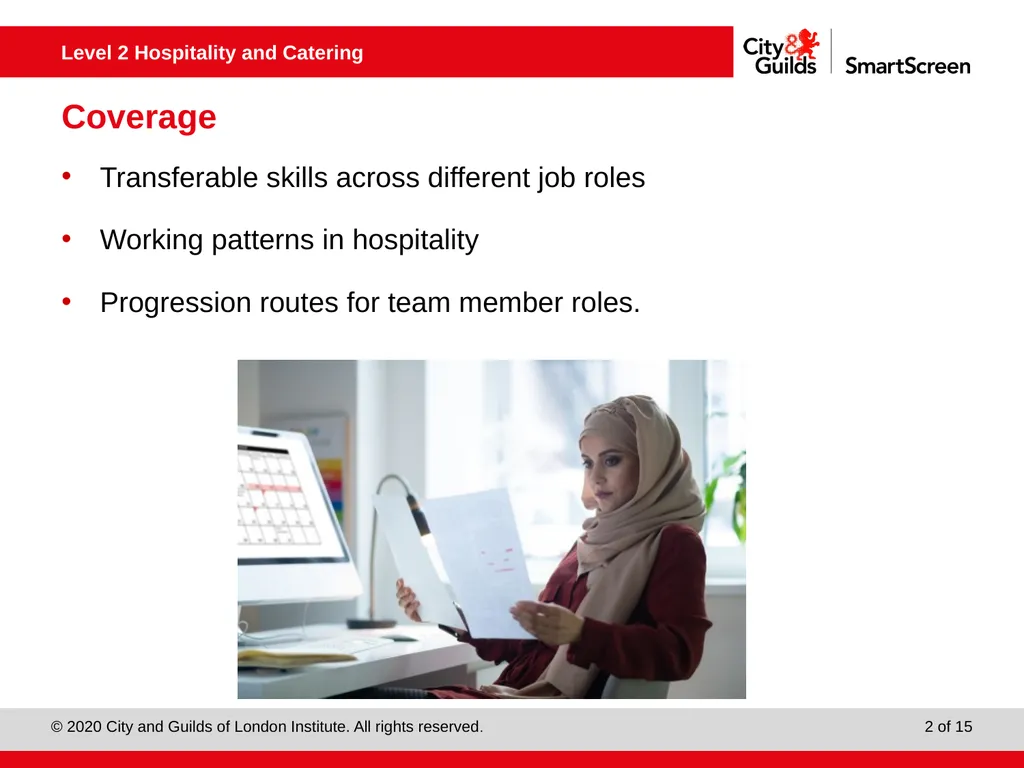
slide2. Coverage Transferable skills across different job roles
Working patterns in hospitality
Progression routes for team member roles.<br>
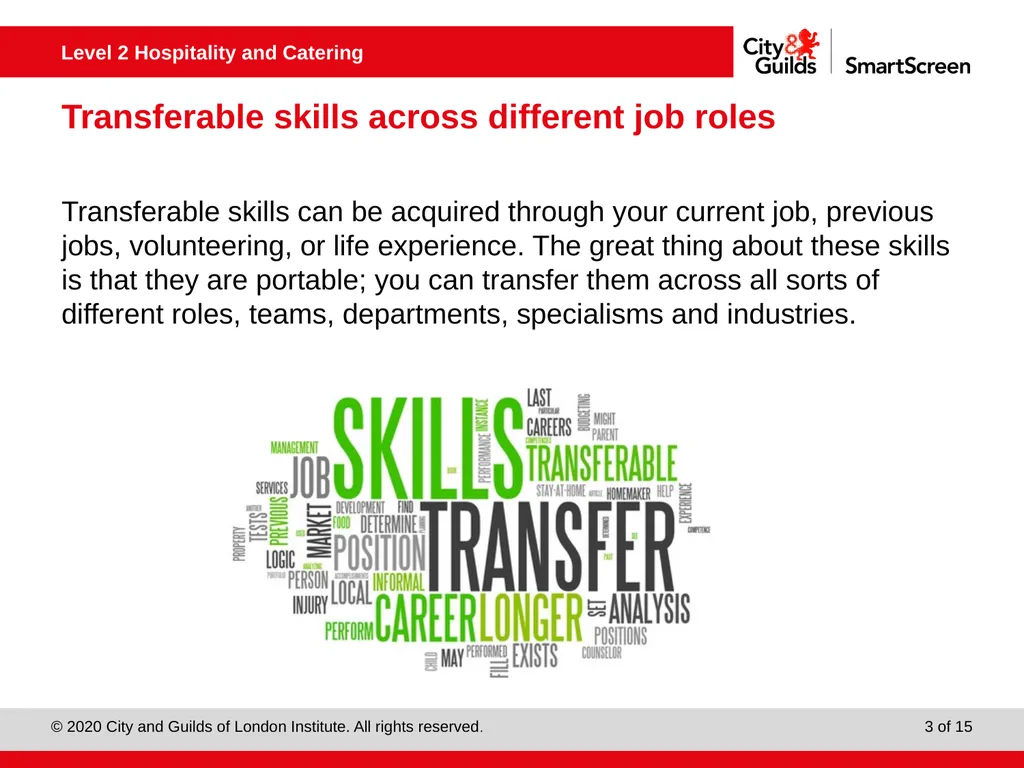
slide3. Transferable skills across different job roles Transferable skills can be acquired through your current job, previous jobs, volunteering, or life experience. The great thing about these skills is that they are portable; you can transfer them across all sorts of different roles, teams, departments, specialisms and industries.<br>
slide4. Transferable skills across different job roles Communication – it is possible through good communication and teamwork to create a finely tuned service to guests by eliminating the duplication of tasks and possible confusion about the progress of tasks. When working in a hospitality establishment it is important that you able to communicate effectively with other members of staff, suppliers, external agencies and customers. Communication is a 2-way process. It involves:
Listening to others (receiving)
Asserting/expressing (sending)
Customer services – or guest services, is the most important part of a hospitality industry role. Staff must be able to build a good relationship with their guests. Making the customer feel like they’re having a person-to-person interaction is what great customer service is all about.<br>
slide5. Transferable skills across different job roles Planning – is about prioritising and managing time and resources effectively, while balancing the need to be able to handle pressure and remain calm when things get busy.
Time keeping – being punctual and managing time effectively is vitality important in an industry which has time constraints. Being punctual means arriving on time for work.
Attitude – most employers in the hospitality industry rely on their guest-facing staff to uphold the reputation of their brand. Therefore, it’s important to always remain highly professional with a positive attitude, putting the guest at the heart of all you do.<br>
slide6. Transferable skills across different job roles Appearance – first appearances count, especially if dealing with guests; so it is important to look tidy and well-groomed at all times, following the establishments dress code. This may include wearing the correct personal protective equipment.
Respecting diversity – in hospitality, a large number of the guests and the staff you work alongside may be from a variety of cultural backgrounds. As a result, the ability to be culturally aware, respect diversity and adapt to attitudes that are different from your own is crucial to meeting guests needs and building successful relationships with team members.
Reliability – it is important that you are reliable, able to arrive to work on time with the correct equipment and are tidy and well-groomed at all times. This is essential for management to know that departments are correctly resourced.<br>
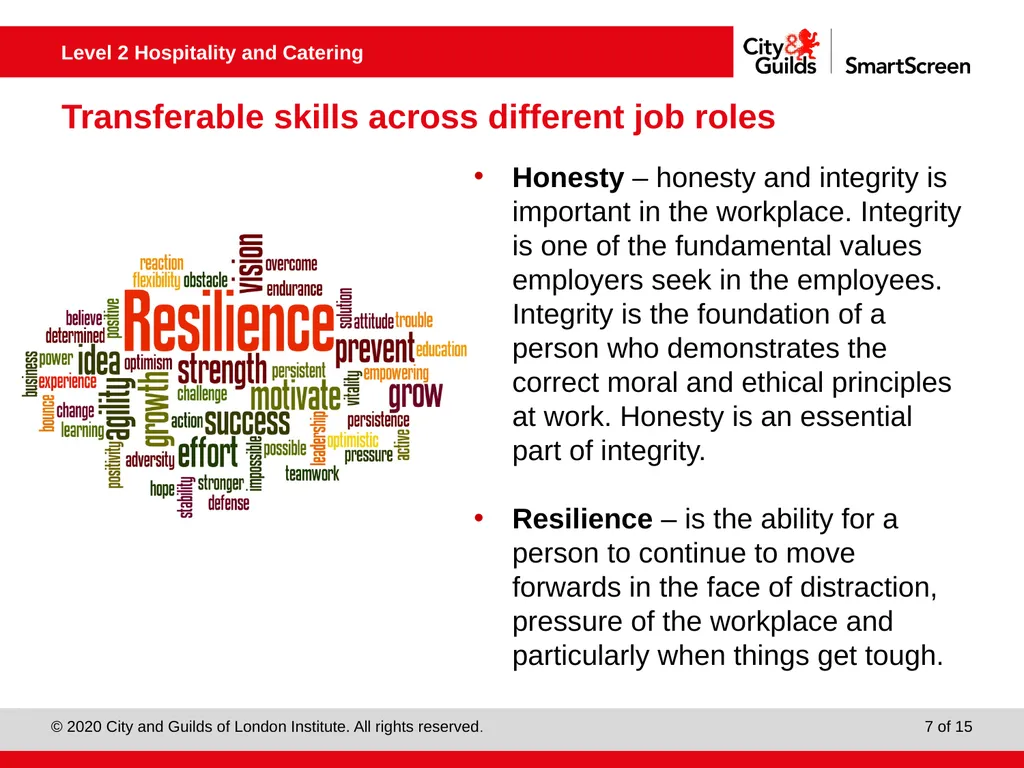
slide7. Transferable skills across different job roles Honesty – honesty and integrity is important in the workplace. Integrity is one of the fundamental values employers seek in the employees. Integrity is the foundation of a person who demonstrates the correct moral and ethical principles at work. Honesty is an essential part of integrity.
Resilience – is the ability for a person to continue to move forwards in the face of distraction, pressure of the workplace and particularly when things get tough.<br>
slide8. Working patterns in hospitality Hospitality jobs are fast-paced and generally involve longer working hours, but the upside is that there is also a great deal of flexibility in terms of when and how many hours staff want to work.
Working patterns in the hospitality industry will vary depending on the type of establishment, the number of staff, guest requirements and legalisation.
Full time – 40 hours per week is commonly used as a measure to identify a member of staff as a full-time member of staff. The difference between full-time and part-time employees is the number of hours they work. Both categories of employee usually receive the same remuneration, annual, sick and holiday entitlement but for the part-time employee, it is on a pro-rata basis.<br>
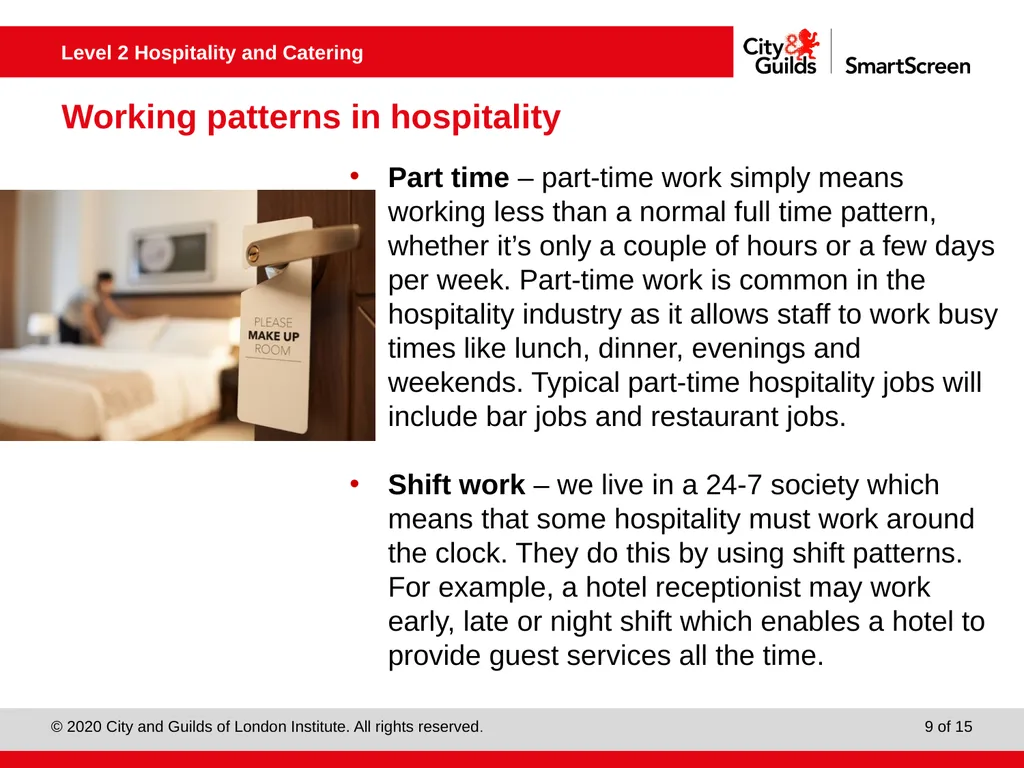
slide9. Working patterns in hospitality Part time – part-time work simply means working less than a normal full time pattern, whether it’s only a couple of hours or a few days per week. Part-time work is common in the hospitality industry as it allows staff to work busy times like lunch, dinner, evenings and weekends. Typical part-time hospitality jobs will include bar jobs and restaurant jobs.
Shift work – we live in a 24-7 society which means that some hospitality must work around the clock. They do this by using shift patterns. For example, a hotel receptionist may work early, late or night shift which enables a hotel to provide guest services all the time.<br>
slide10. Working patterns in hospitality Split shifts – split shifts are common in the hospitality industry where an establishment has peak periods of work at certain times of day. For example, a commis chef may work 9am–1pm preparing food and covering the lunch service and then return 5pm–10pm to cover evening service.
Rotational – rotational shift work covers a wide variety of work schedules and implies that shifts rotate or change according to a set schedule, commonly found in hotels. These shifts can be either continuous, running 24 hours per day, 7 days per week, or semi-continuous, running 2 or 3 shifts per day with or without weekends.
Seasonal – staff will be employed in peak periods of work at certain times of the year when hospitality establishment get busier, for example during the Christmas festive season.<br>
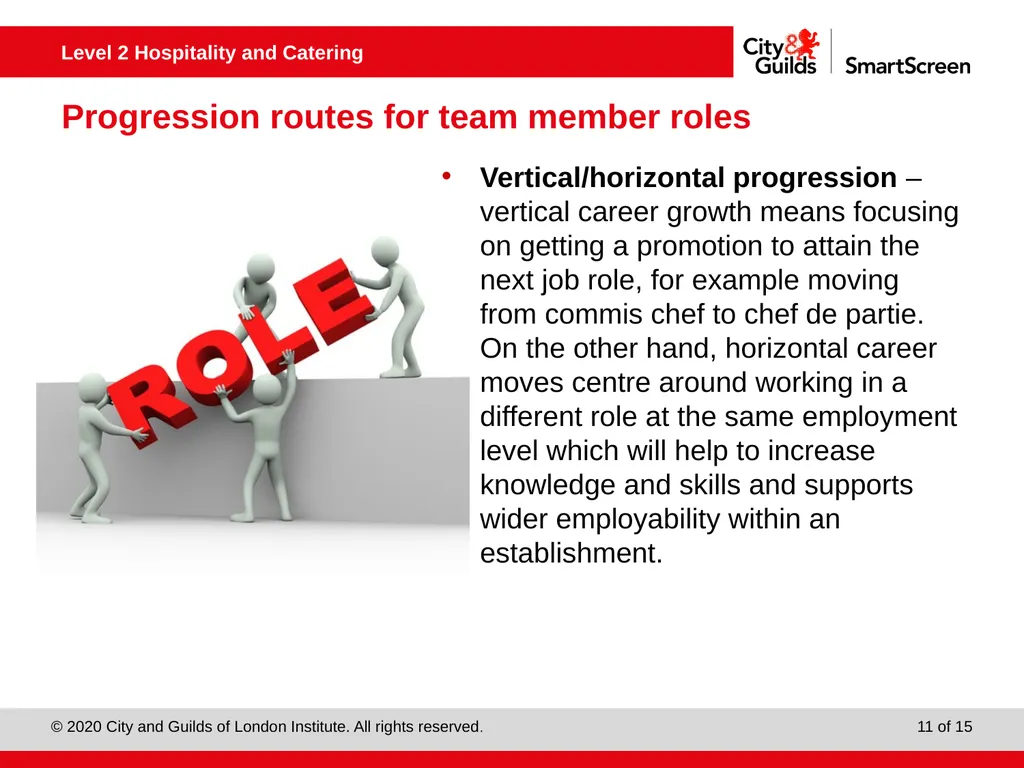
slide11. Progression routes for team member roles Vertical/horizontal progression – vertical career growth means focusing on getting a promotion to attain the next job role, for example moving from commis chef to chef de partie. On the other hand, horizontal career moves centre around working in a different role at the same employment level which will help to increase knowledge and skills and supports wider employability within an establishment.<br>
slide12. Progression routes for team member roles Trainee – a traineeship is an education and training programme which incorporates work experience, preparing young people for their future careers by helping them to become ‘work ready’ or ready for an apprenticeship.
Apprentice/graduate – an apprentice will complete an apprenticeship which gives them hands-on experience, a salary and the opportunity to train while they work. A graduate is someone who has successfully completed a degree at a university or college.
Team member – roles are very varied and although hospitality team members tend to specialise in an area, they have to be adaptable and ready to support team members across the business; for example during busy periods. Specialist areas in hospitality include food and beverage service, serving alcoholic beverages, barista, food preparation, housekeeping, concierge and guest services, and reception.<br>
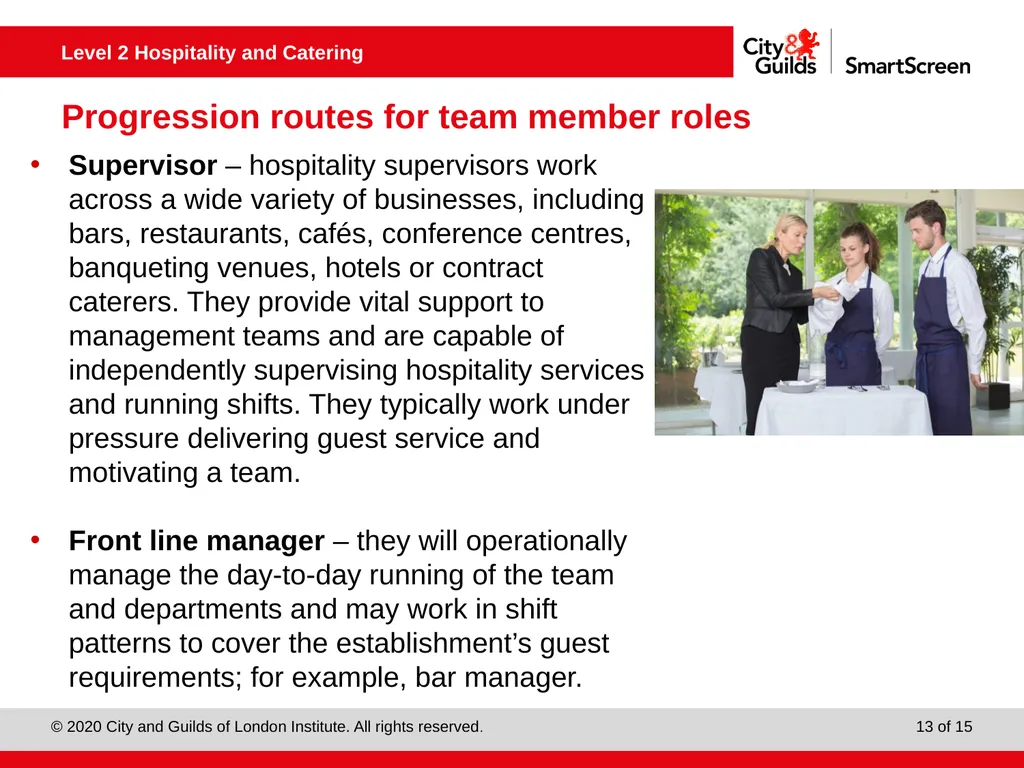
slide13. Progression routes for team member roles Supervisor – hospitality supervisors work across a wide variety of businesses, including bars, restaurants, cafés, conference centres, banqueting venues, hotels or contract caterers. They provide vital support to management teams and are capable of independently supervising hospitality services and running shifts. They typically work under pressure delivering guest service and motivating a team.
Front line manager – they will operationally manage the day-to-day running of the team and departments and may work in shift patterns to cover the establishment’s guest requirements; for example, bar manager.<br>
slide14. Progression routes for team member roles Department manager – managers generally specialise in a particular area, for example, restaurant managers. However, their core knowledge, skills and behaviours are aligned. Depending on the size of the establishment, typical responsibilities will include recruiting and supervising staff, managing budgets and dealing with guests.
Senior manager – hospitality senior managers have a high level of responsibility and are accountable for fulfilling the business vision and objectives. They may have several teams working under their management structure. Will be responsible for financial budgets and targets.<br>
slide15. Any questions?<br>
slide2. Coverage Transferable skills across different job roles
Working patterns in hospitality
Progression routes for team member roles.<br>
slide3. Transferable skills across different job roles Transferable skills can be acquired through your current job, previous jobs, volunteering, or life experience. The great thing about these skills is that they are portable; you can transfer them across all sorts of different roles, teams, departments, specialisms and industries.<br>
slide4. Transferable skills across different job roles Communication – it is possible through good communication and teamwork to create a finely tuned service to guests by eliminating the duplication of tasks and possible confusion about the progress of tasks. When working in a hospitality establishment it is important that you able to communicate effectively with other members of staff, suppliers, external agencies and customers. Communication is a 2-way process. It involves:
Listening to others (receiving)
Asserting/expressing (sending)
Customer services – or guest services, is the most important part of a hospitality industry role. Staff must be able to build a good relationship with their guests. Making the customer feel like they’re having a person-to-person interaction is what great customer service is all about.<br>
slide5. Transferable skills across different job roles Planning – is about prioritising and managing time and resources effectively, while balancing the need to be able to handle pressure and remain calm when things get busy.
Time keeping – being punctual and managing time effectively is vitality important in an industry which has time constraints. Being punctual means arriving on time for work.
Attitude – most employers in the hospitality industry rely on their guest-facing staff to uphold the reputation of their brand. Therefore, it’s important to always remain highly professional with a positive attitude, putting the guest at the heart of all you do.<br>
slide6. Transferable skills across different job roles Appearance – first appearances count, especially if dealing with guests; so it is important to look tidy and well-groomed at all times, following the establishments dress code. This may include wearing the correct personal protective equipment.
Respecting diversity – in hospitality, a large number of the guests and the staff you work alongside may be from a variety of cultural backgrounds. As a result, the ability to be culturally aware, respect diversity and adapt to attitudes that are different from your own is crucial to meeting guests needs and building successful relationships with team members.
Reliability – it is important that you are reliable, able to arrive to work on time with the correct equipment and are tidy and well-groomed at all times. This is essential for management to know that departments are correctly resourced.<br>
slide7. Transferable skills across different job roles Honesty – honesty and integrity is important in the workplace. Integrity is one of the fundamental values employers seek in the employees. Integrity is the foundation of a person who demonstrates the correct moral and ethical principles at work. Honesty is an essential part of integrity.
Resilience – is the ability for a person to continue to move forwards in the face of distraction, pressure of the workplace and particularly when things get tough.<br>
slide8. Working patterns in hospitality Hospitality jobs are fast-paced and generally involve longer working hours, but the upside is that there is also a great deal of flexibility in terms of when and how many hours staff want to work.
Working patterns in the hospitality industry will vary depending on the type of establishment, the number of staff, guest requirements and legalisation.
Full time – 40 hours per week is commonly used as a measure to identify a member of staff as a full-time member of staff. The difference between full-time and part-time employees is the number of hours they work. Both categories of employee usually receive the same remuneration, annual, sick and holiday entitlement but for the part-time employee, it is on a pro-rata basis.<br>
slide9. Working patterns in hospitality Part time – part-time work simply means working less than a normal full time pattern, whether it’s only a couple of hours or a few days per week. Part-time work is common in the hospitality industry as it allows staff to work busy times like lunch, dinner, evenings and weekends. Typical part-time hospitality jobs will include bar jobs and restaurant jobs.
Shift work – we live in a 24-7 society which means that some hospitality must work around the clock. They do this by using shift patterns. For example, a hotel receptionist may work early, late or night shift which enables a hotel to provide guest services all the time.<br>
slide10. Working patterns in hospitality Split shifts – split shifts are common in the hospitality industry where an establishment has peak periods of work at certain times of day. For example, a commis chef may work 9am–1pm preparing food and covering the lunch service and then return 5pm–10pm to cover evening service.
Rotational – rotational shift work covers a wide variety of work schedules and implies that shifts rotate or change according to a set schedule, commonly found in hotels. These shifts can be either continuous, running 24 hours per day, 7 days per week, or semi-continuous, running 2 or 3 shifts per day with or without weekends.
Seasonal – staff will be employed in peak periods of work at certain times of the year when hospitality establishment get busier, for example during the Christmas festive season.<br>
slide11. Progression routes for team member roles Vertical/horizontal progression – vertical career growth means focusing on getting a promotion to attain the next job role, for example moving from commis chef to chef de partie. On the other hand, horizontal career moves centre around working in a different role at the same employment level which will help to increase knowledge and skills and supports wider employability within an establishment.<br>
slide12. Progression routes for team member roles Trainee – a traineeship is an education and training programme which incorporates work experience, preparing young people for their future careers by helping them to become ‘work ready’ or ready for an apprenticeship.
Apprentice/graduate – an apprentice will complete an apprenticeship which gives them hands-on experience, a salary and the opportunity to train while they work. A graduate is someone who has successfully completed a degree at a university or college.
Team member – roles are very varied and although hospitality team members tend to specialise in an area, they have to be adaptable and ready to support team members across the business; for example during busy periods. Specialist areas in hospitality include food and beverage service, serving alcoholic beverages, barista, food preparation, housekeeping, concierge and guest services, and reception.<br>
slide13. Progression routes for team member roles Supervisor – hospitality supervisors work across a wide variety of businesses, including bars, restaurants, cafés, conference centres, banqueting venues, hotels or contract caterers. They provide vital support to management teams and are capable of independently supervising hospitality services and running shifts. They typically work under pressure delivering guest service and motivating a team.
Front line manager – they will operationally manage the day-to-day running of the team and departments and may work in shift patterns to cover the establishment’s guest requirements; for example, bar manager.<br>
slide14. Progression routes for team member roles Department manager – managers generally specialise in a particular area, for example, restaurant managers. However, their core knowledge, skills and behaviours are aligned. Depending on the size of the establishment, typical responsibilities will include recruiting and supervising staff, managing budgets and dealing with guests.
Senior manager – hospitality senior managers have a high level of responsibility and are accountable for fulfilling the business vision and objectives. They may have several teams working under their management structure. Will be responsible for financial budgets and targets.<br>
slide15. Any questions?<br>