
PowerPoint Slides About the PowerPoint slides
Description: PowerPoint Slides About the PowerPoint slides These slides are provided as a resource for teachers and students using Research Methods for Sport Studies and Sport Management: A Practical Guide. They are not intended to constitute prescribed
Related Topics
Download Presentation
"PowerPoint Slides About the PowerPoint slides" is the property of its rightful owner. Permission is granted to download and print the materials on this website for personal, non-commercial use only, and to display it on your personal computer provided you do not modify the materials and that you retain all copyright notices contained in the materials. By downloading content from our website, you accept the terms of this agreement.
Presentation Transcript
slide1. PowerPoint Slides<br>
slide2. About the PowerPoint slides These slides are provided as a resource for teachers and students using Research Methods for Sport Studies and Sport Management: A Practical Guide.
They are not intended to constitute prescribed lectures. It is envisaged that users will select from, add to and modify the slides to suit their own requirements.
A number of the slides are ‘animated’: this feature can be turned off for individual slides or objects via Animations > Custom animation > Remove.
The slides are subject to the normal copyright rules applying to the book content.
The full set of slides and other support material are provided at: www.pearsoned.co.uk/veal
Any feedback or comments for improvement, corrections etc. would be welcome via: Tony.Veal@uts.edu.au A. J. Veal and S. Darcy (2014) Research Methods for Sport Studies and Sport Management: A practical guide. London: Routledge<br>
slide3. PART I: PREPARATION
Chapter 1: Introduction to Research: What, Why & Who?<br>
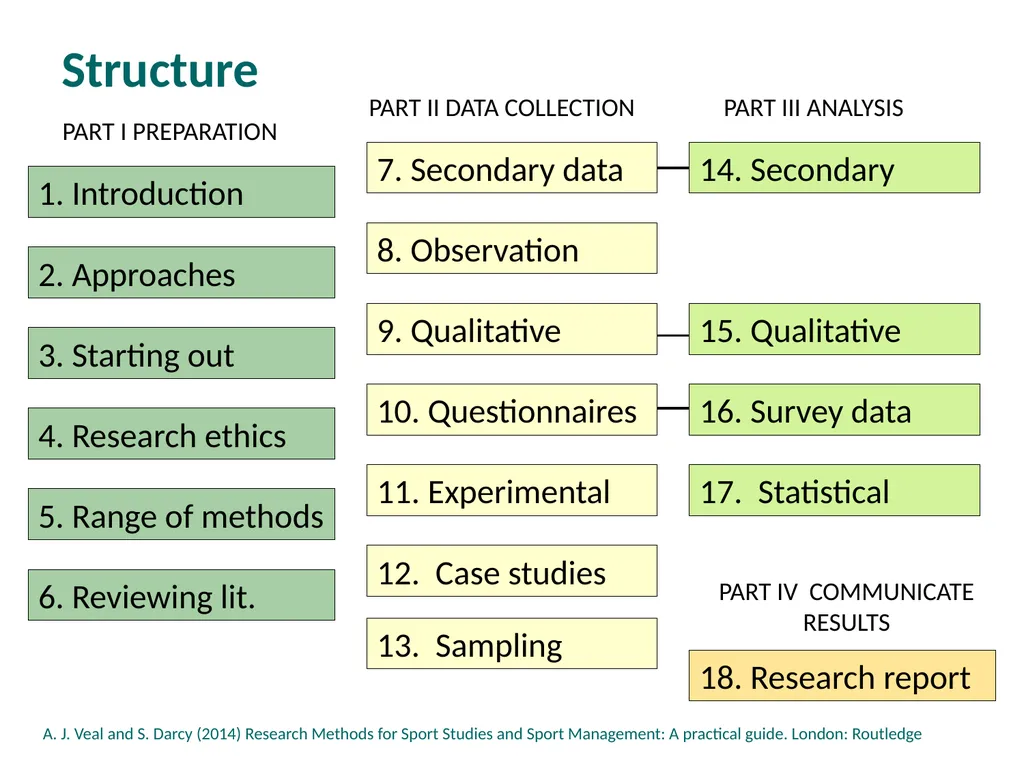
slide4. Structure 10. Questionnaires 9. Qualitative 13. Sampling 11. Experimental 8. Observation 7. Secondary data 16. Survey data 15. Qualitative 18. Research report 14. Secondary 4. Research ethics 3. Starting out 6. Reviewing lit. 5. Range of methods 2. Approaches 1. Introduction PART I PREPARATION PART II DATA COLLECTION 12. Case studies PART III ANALYSIS PART IV COMMUNICATE RESULTS 17. Statistical A. J. Veal and S. Darcy (2014) Research Methods for Sport Studies and Sport Management: A practical guide. London: Routledge<br>
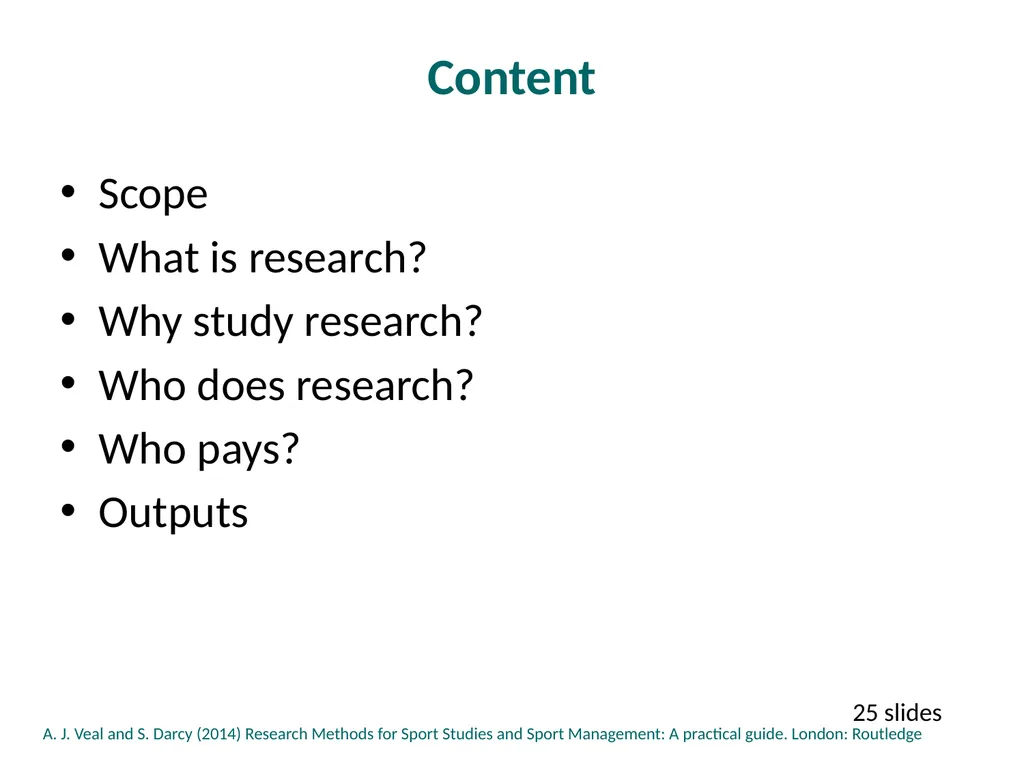
slide5. Scope
What is research?
Why study research?
Who does research?
Who pays?
Outputs 25 slides A. J. Veal and S. Darcy (2014) Research Methods for Sport Studies and Sport Management: A practical guide. London: Routledge Content<br>
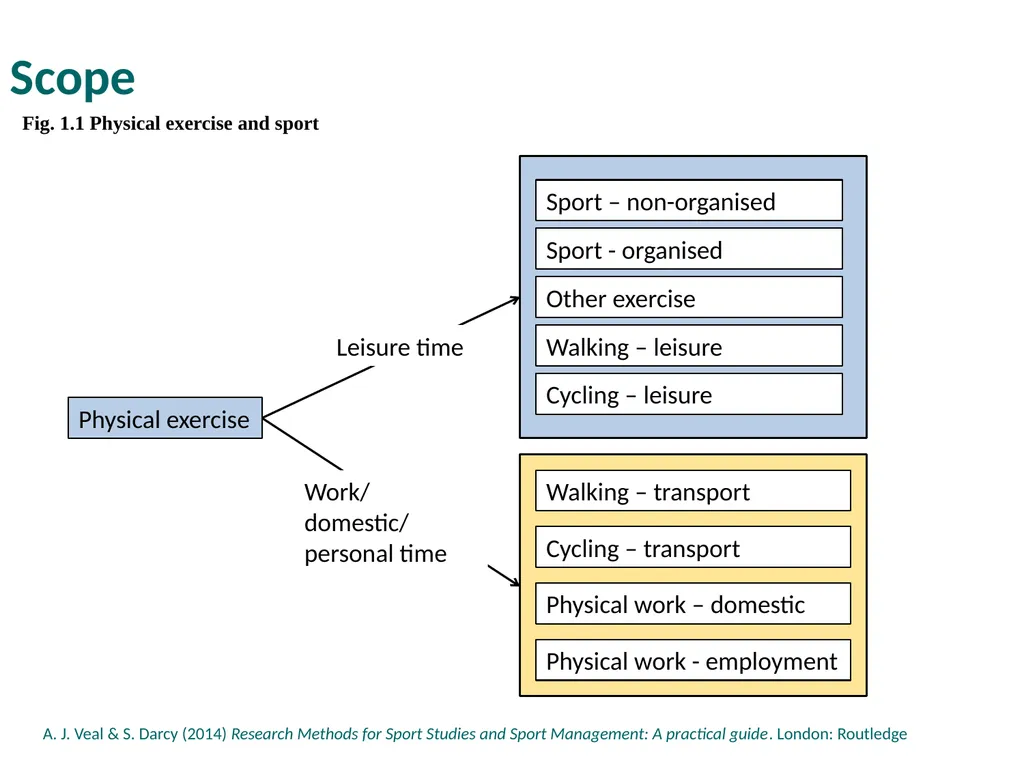
slide6. Sport – non-organised Walking – transport Physical exercise Cycling – transport Physical work - employment Physical work – domestic Walking – leisure Cycling – leisure Sport - organised Other exercise Work/domestic/personal time Leisure time Fig. 1.1 Physical exercise and sport Scope A. J. Veal & S. Darcy (2014) Research Methods for Sport Studies and Sport Management: A practical guide. London: Routledge<br>
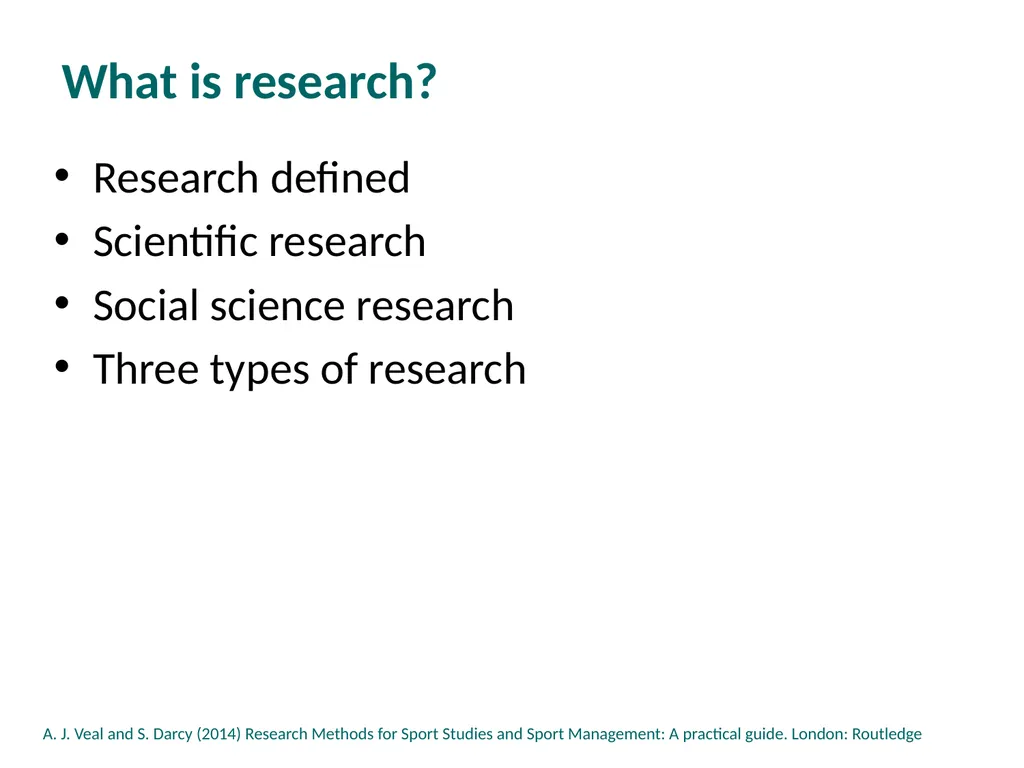
slide7. What is research? Research defined
Scientific research
Social science research
Three types of research A. J. Veal and S. Darcy (2014) Research Methods for Sport Studies and Sport Management: A practical guide. London: Routledge<br>
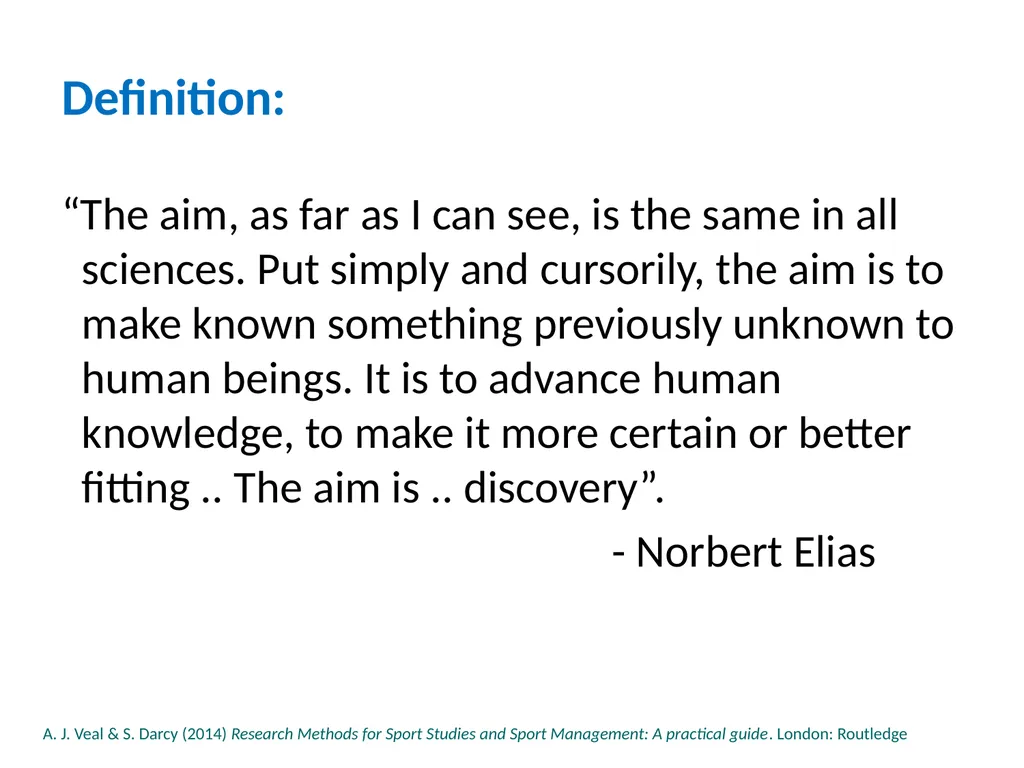
slide8. Definition: “The aim, as far as I can see, is the same in all sciences. Put simply and cursorily, the aim is to make known something previously unknown to human beings. It is to advance human knowledge, to make it more certain or better fitting .. The aim is .. discovery”.
- Norbert Elias A. J. Veal & S. Darcy (2014) Research Methods for Sport Studies and Sport Management: A practical guide. London: Routledge<br>
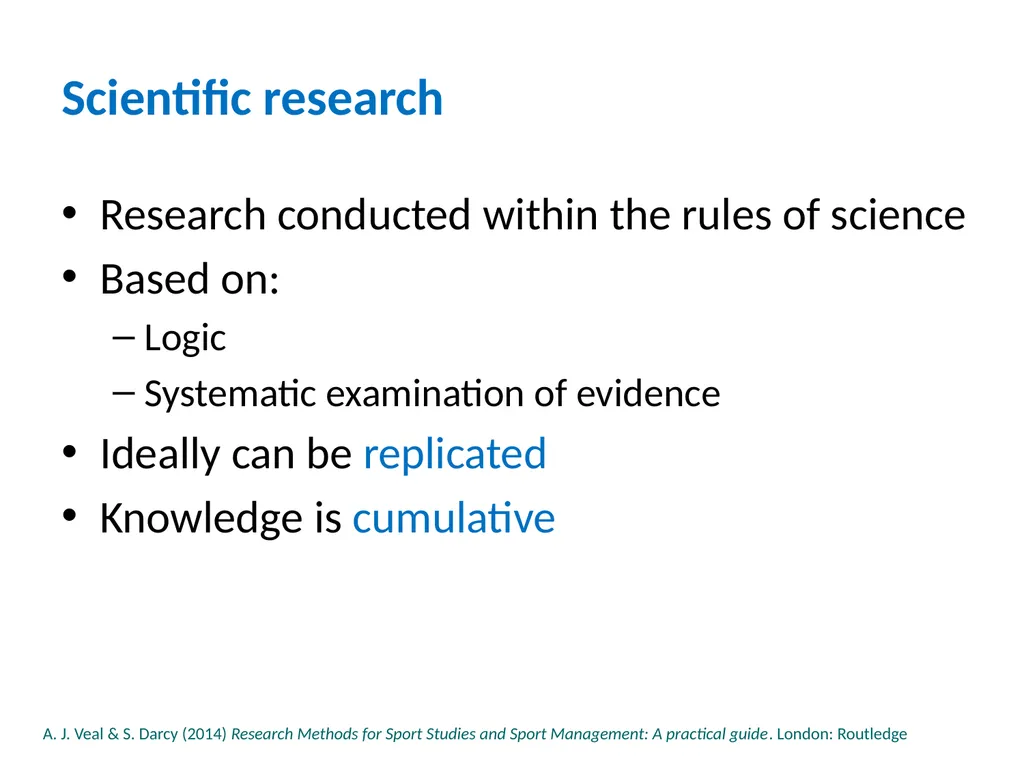
slide9. Scientific research Research conducted within the rules of science
Based on:
Logic
Systematic examination of evidence
Ideally can be replicated
Knowledge is cumulative A. J. Veal & S. Darcy (2014) Research Methods for Sport Studies and Sport Management: A practical guide. London: Routledge<br>
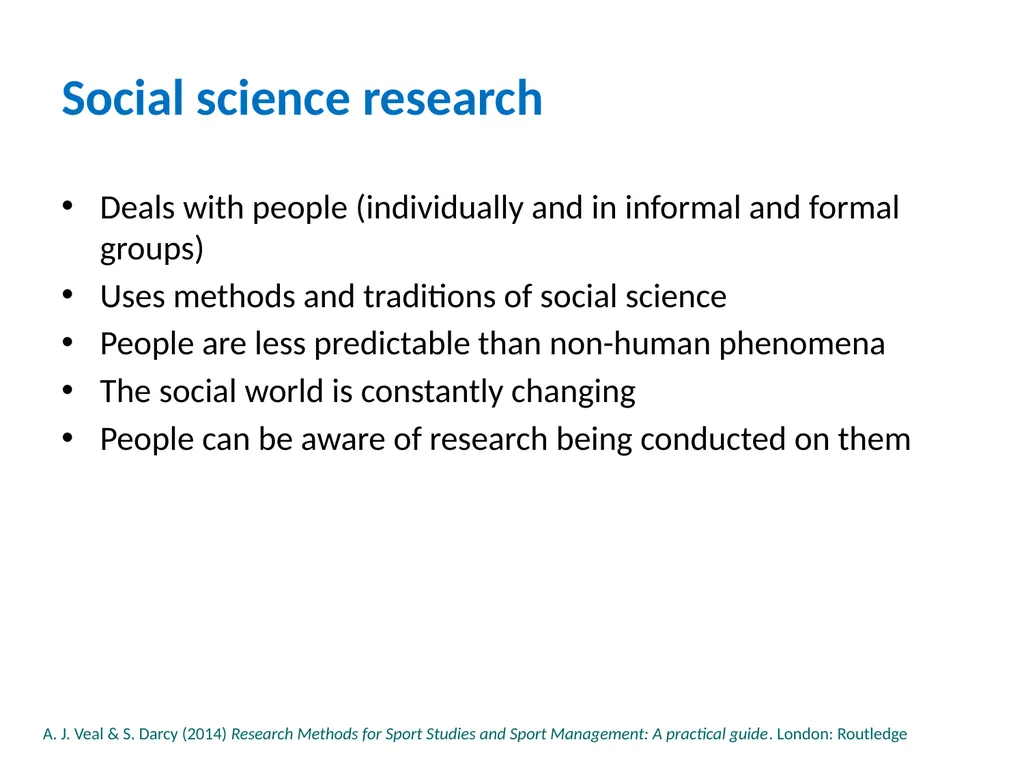
slide10. Social science research Deals with people (individually and in informal and formal groups)
Uses methods and traditions of social science
People are less predictable than non-human phenomena
The social world is constantly changing
People can be aware of research being conducted on them A. J. Veal & S. Darcy (2014) Research Methods for Sport Studies and Sport Management: A practical guide. London: Routledge<br>
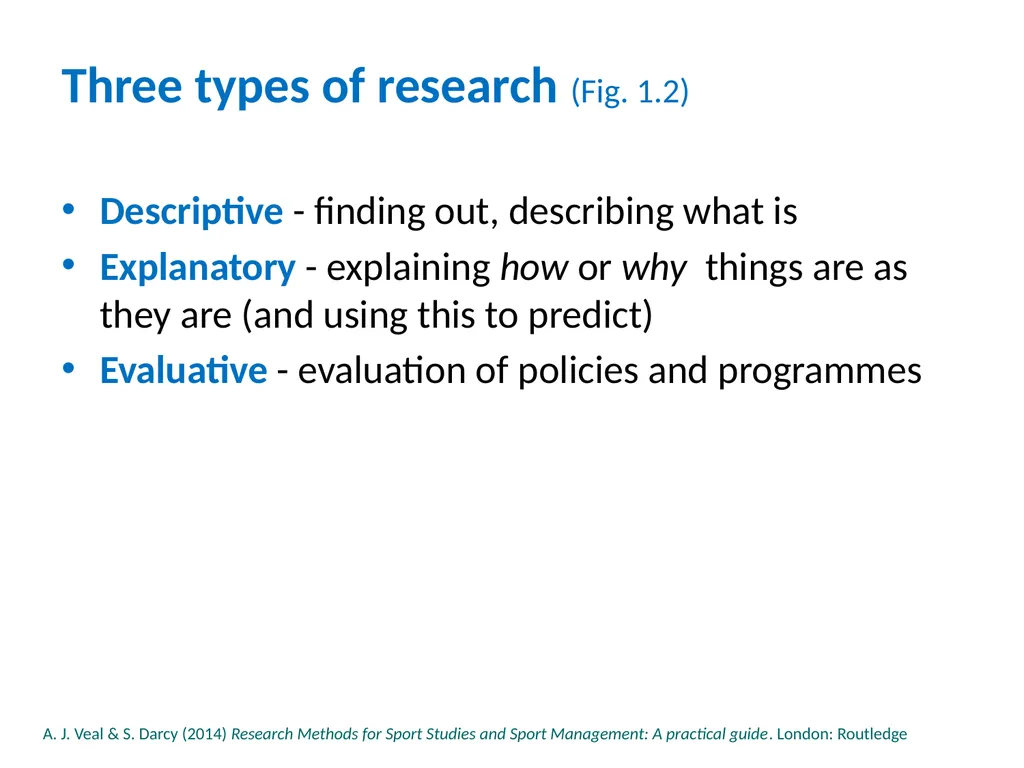
slide11. Three types of research (Fig. 1.2) Descriptive - finding out, describing what is
Explanatory - explaining how or why things are as they are (and using this to predict)
Evaluative - evaluation of policies and programmes A. J. Veal & S. Darcy (2014) Research Methods for Sport Studies and Sport Management: A practical guide. London: Routledge<br>
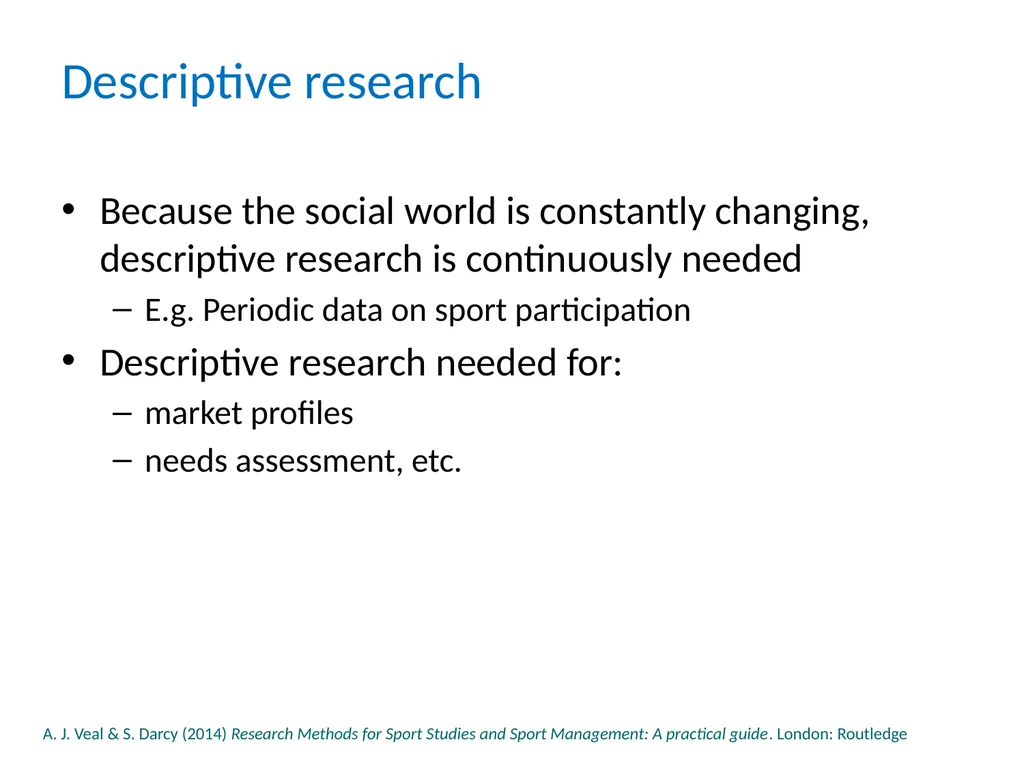
slide12. Descriptive research Because the social world is constantly changing, descriptive research is continuously needed
E.g. Periodic data on sport participation
Descriptive research needed for:
market profiles
needs assessment, etc. A. J. Veal & S. Darcy (2014) Research Methods for Sport Studies and Sport Management: A practical guide. London: Routledge<br>
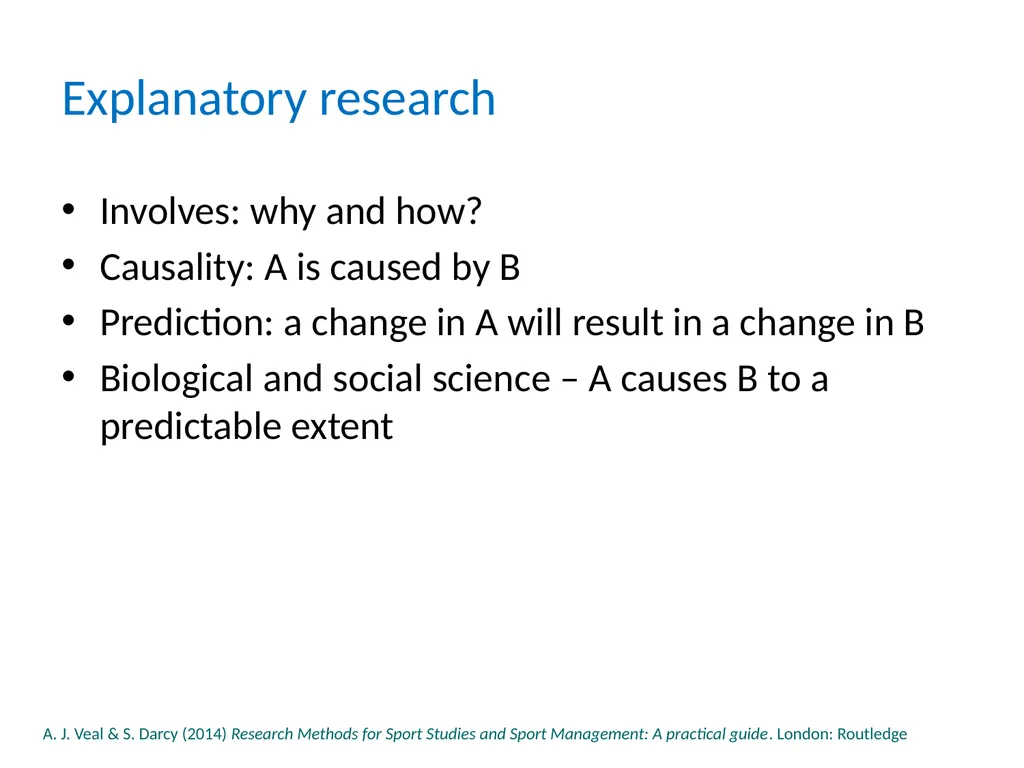
slide13. Explanatory research Involves: why and how?
Causality: A is caused by B
Prediction: a change in A will result in a change in B
Biological and social science – A causes B to a predictable extent A. J. Veal & S. Darcy (2014) Research Methods for Sport Studies and Sport Management: A practical guide. London: Routledge<br>
slide14. Evaluative research To what extent has a programme achieved its aims? A. J. Veal & S. Darcy (2014) Research Methods for Sport Studies and Sport Management: A practical guide. London: Routledge<br>
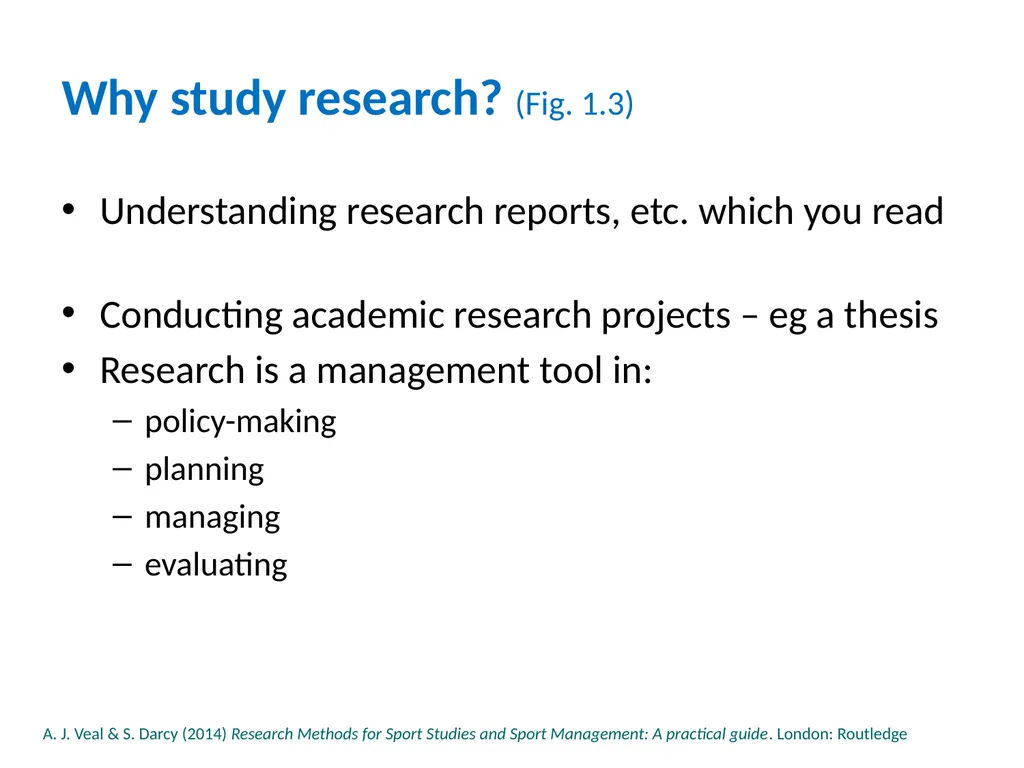
slide15. Why study research? (Fig. 1.3) Understanding research reports, etc. which you read
Conducting academic research projects – eg a thesis
Research is a management tool in:
policy-making
planning
managing
evaluating A. J. Veal & S. Darcy (2014) Research Methods for Sport Studies and Sport Management: A practical guide. London: Routledge<br>
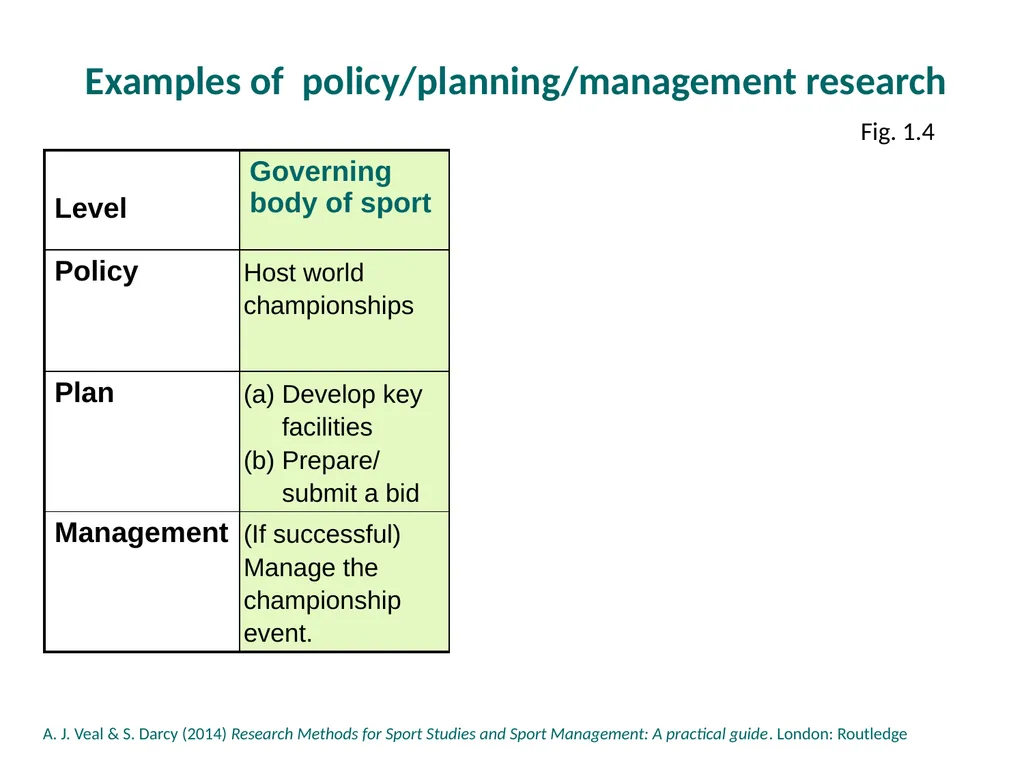
slide16. Examples of policy/planning/management research Fig. 1.4 A. J. Veal & S. Darcy (2014) Research Methods for Sport Studies and Sport Management: A practical guide. London: Routledge<br>
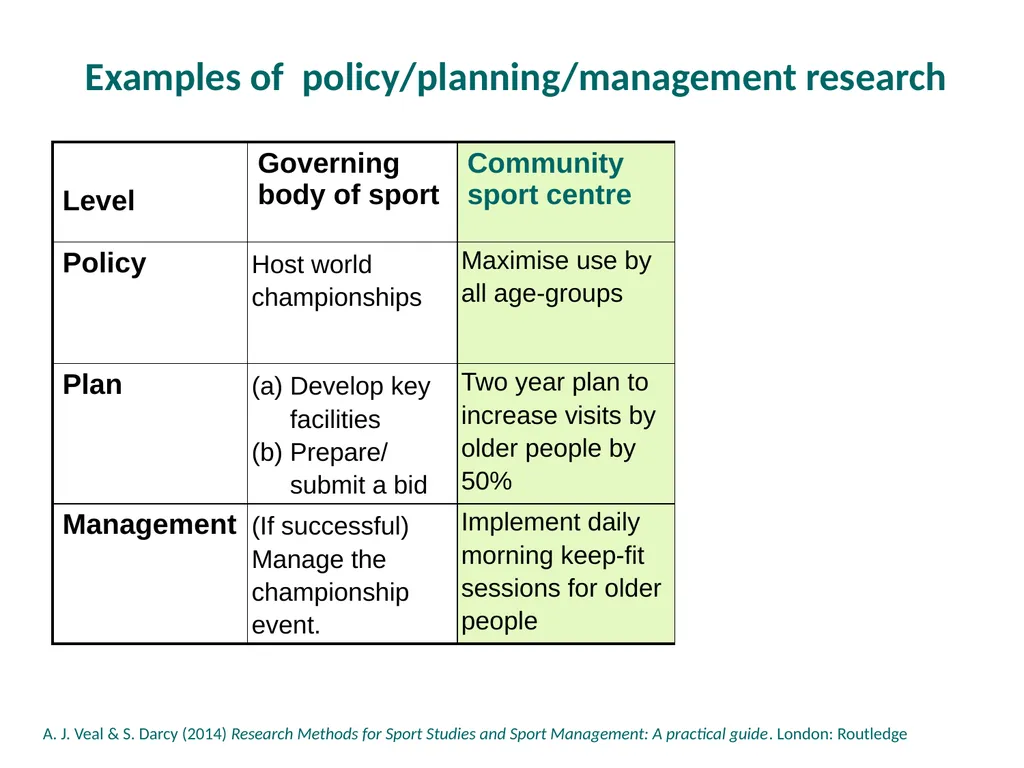
slide17. Examples of policy/planning/management research A. J. Veal & S. Darcy (2014) Research Methods for Sport Studies and Sport Management: A practical guide. London: Routledge<br>
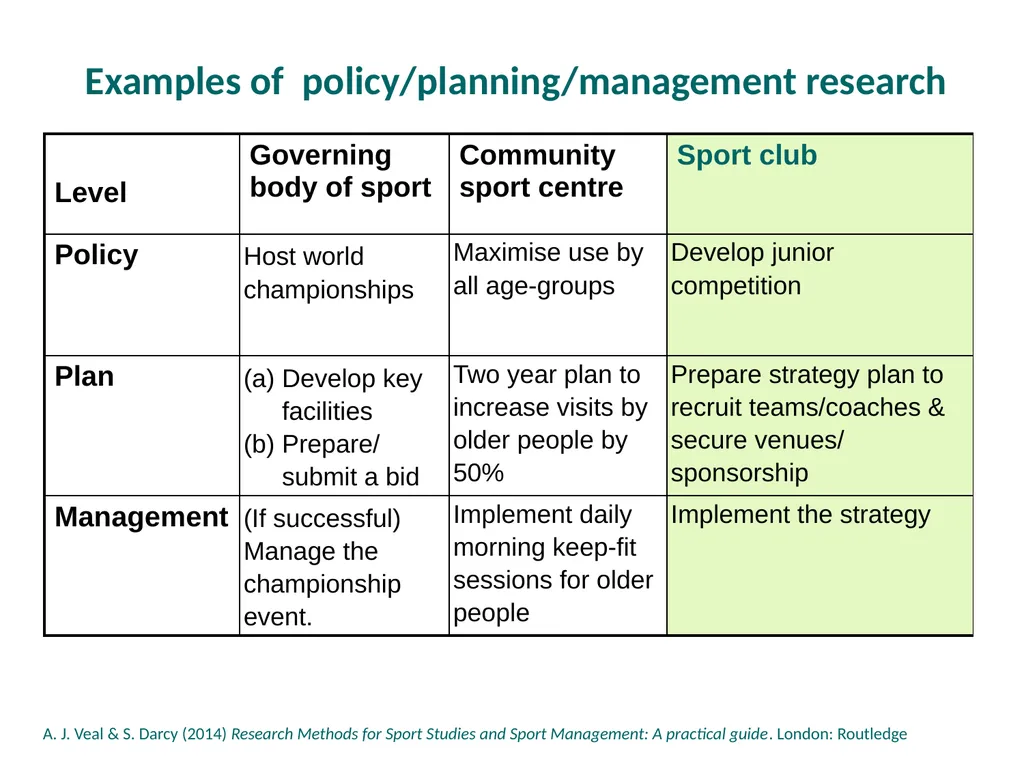
slide18. Examples of policy/planning/management research A. J. Veal & S. Darcy (2014) Research Methods for Sport Studies and Sport Management: A practical guide. London: Routledge<br>
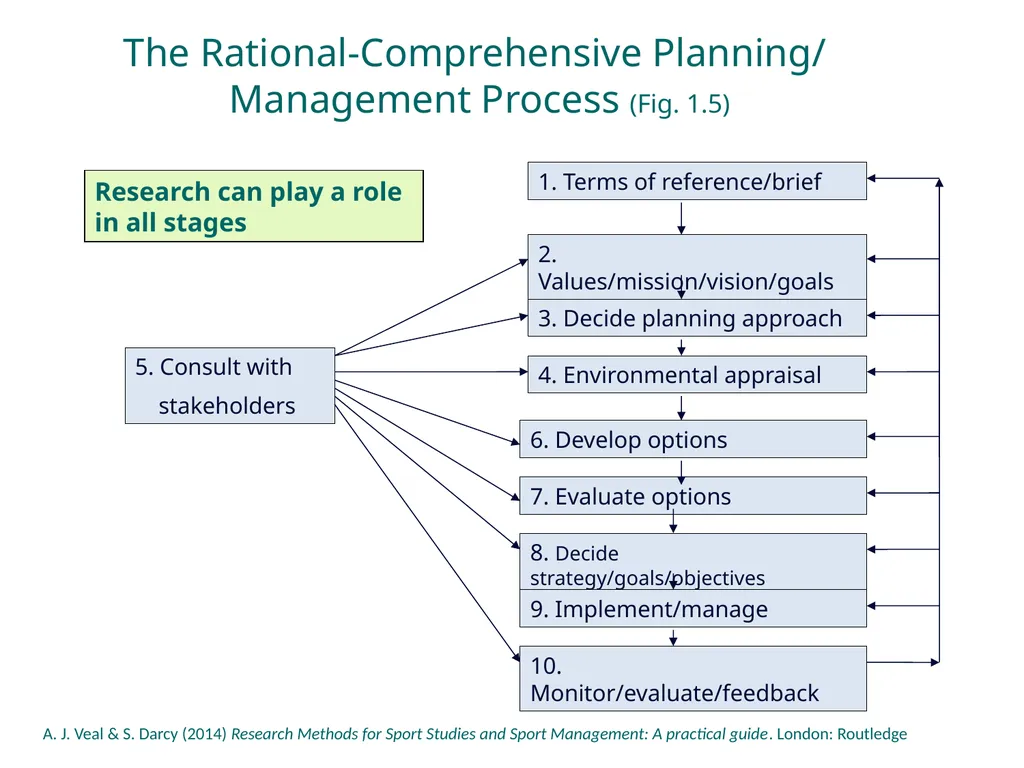
slide19. The Rational-Comprehensive Planning/ Management Process (Fig. 1.5) 1. Terms of reference/brief 2. Values/mission/vision/goals 3. Decide planning approach 5. Consult with
stakeholders 4. Environmental appraisal 7. Evaluate options 8. Decide strategy/goals/objectives 9. Implement/manage 10. Monitor/evaluate/feedback Research can play a role in all stages 6. Develop options A. J. Veal & S. Darcy (2014) Research Methods for Sport Studies and Sport Management: A practical guide. London: Routledge<br>
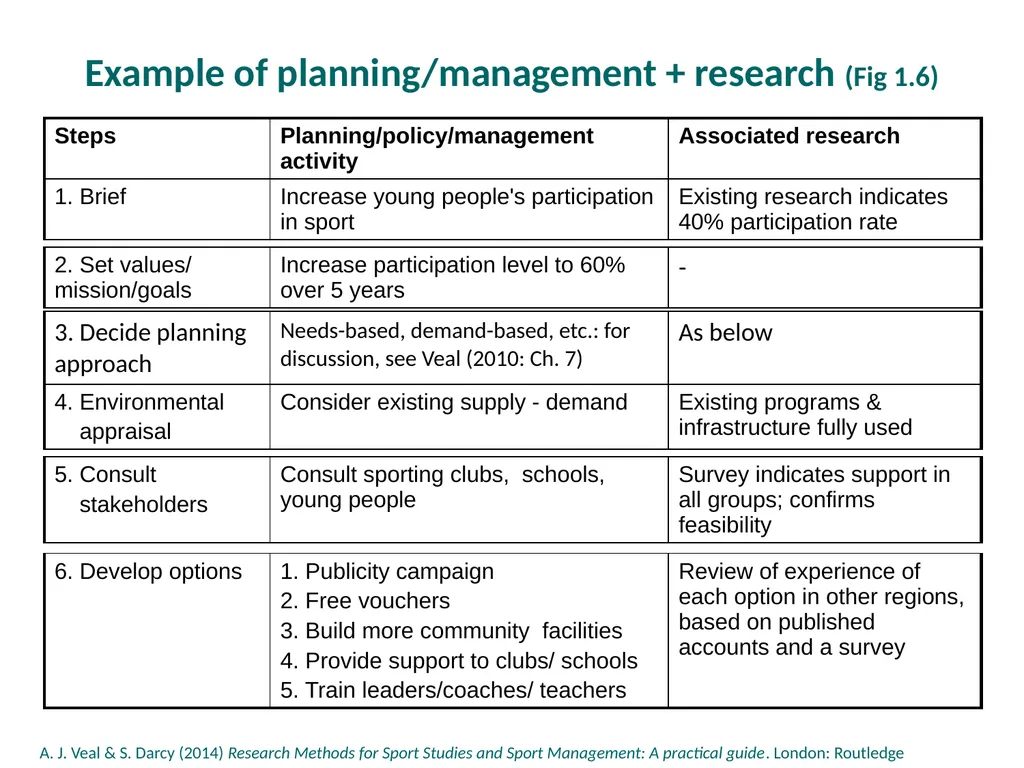
slide20. Example of planning/management + research (Fig 1.6) A. J. Veal & S. Darcy (2014) Research Methods for Sport Studies and Sport Management: A practical guide. London: Routledge<br>
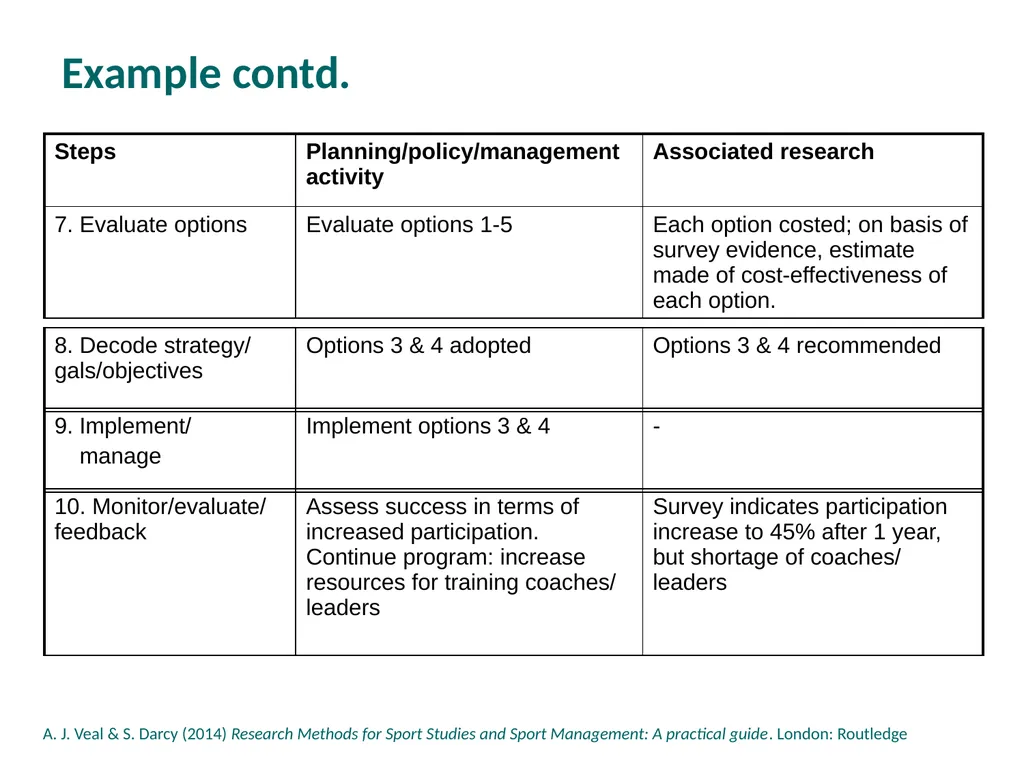
slide21. Example contd. A. J. Veal & S. Darcy (2014) Research Methods for Sport Studies and Sport Management: A practical guide. London: Routledge<br>
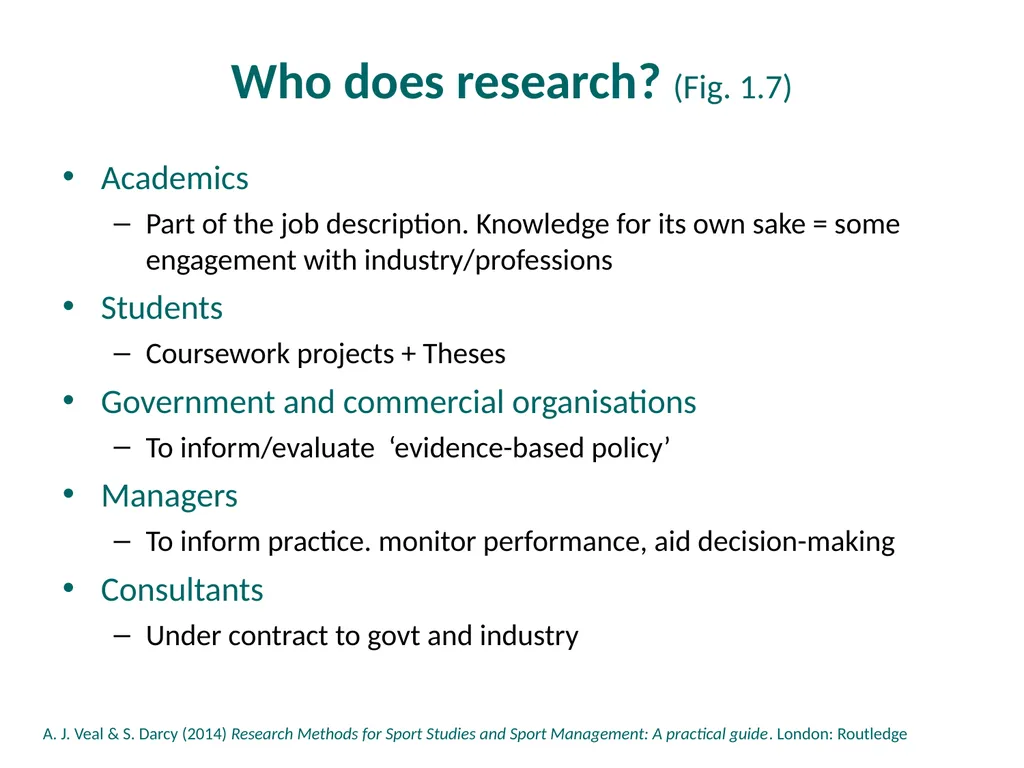
slide22. Who does research? (Fig. 1.7) Academics
Part of the job description. Knowledge for its own sake = some engagement with industry/professions
Students
Coursework projects + Theses
Government and commercial organisations
To inform/evaluate ‘evidence-based policy’
Managers
To inform practice. monitor performance, aid decision-making
Consultants
Under contract to govt and industry A. J. Veal & S. Darcy (2014) Research Methods for Sport Studies and Sport Management: A practical guide. London: Routledge<br>
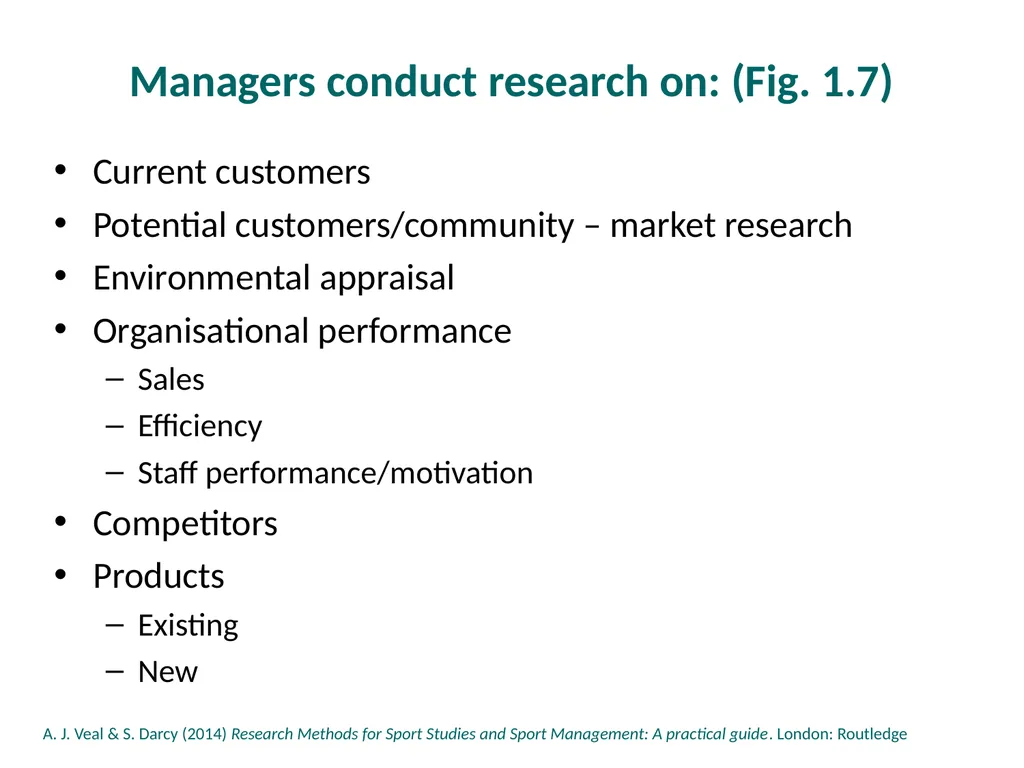
slide23. Managers conduct research on: (Fig. 1.7) Current customers
Potential customers/community – market research
Environmental appraisal
Organisational performance
Sales
Efficiency
Staff performance/motivation
Competitors
Products
Existing
New A. J. Veal & S. Darcy (2014) Research Methods for Sport Studies and Sport Management: A practical guide. London: Routledge<br>
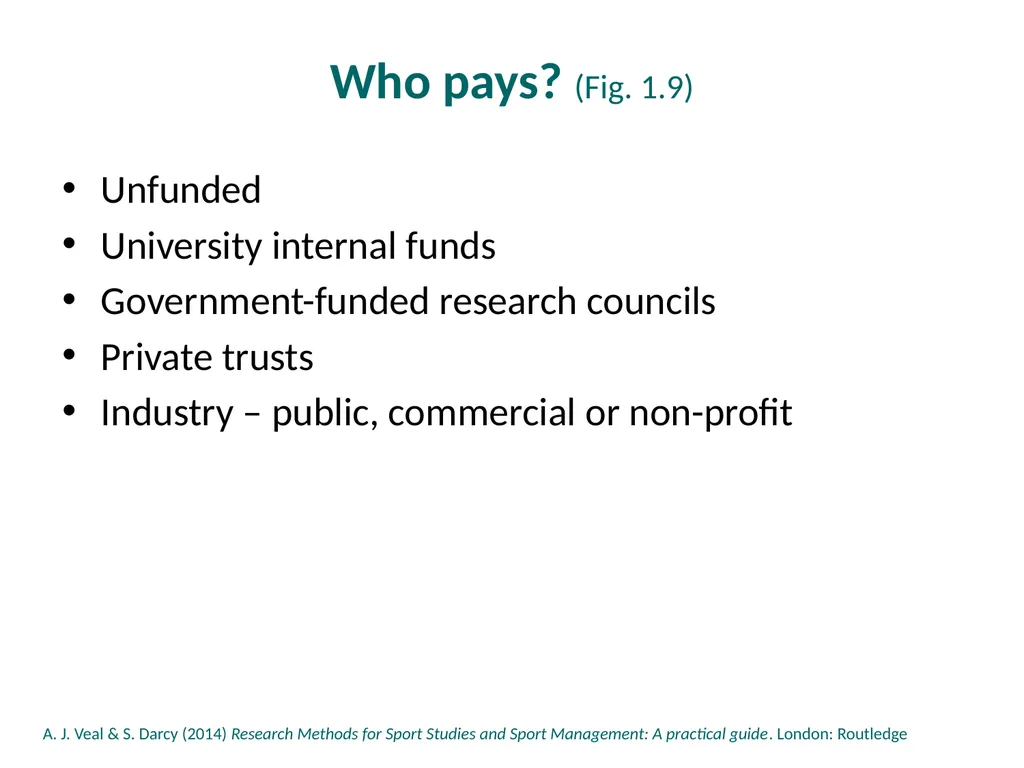
slide24. Who pays? (Fig. 1.9) Unfunded
University internal funds
Government-funded research councils
Private trusts
Industry – public, commercial or non-profit A. J. Veal & S. Darcy (2014) Research Methods for Sport Studies and Sport Management: A practical guide. London: Routledge<br>
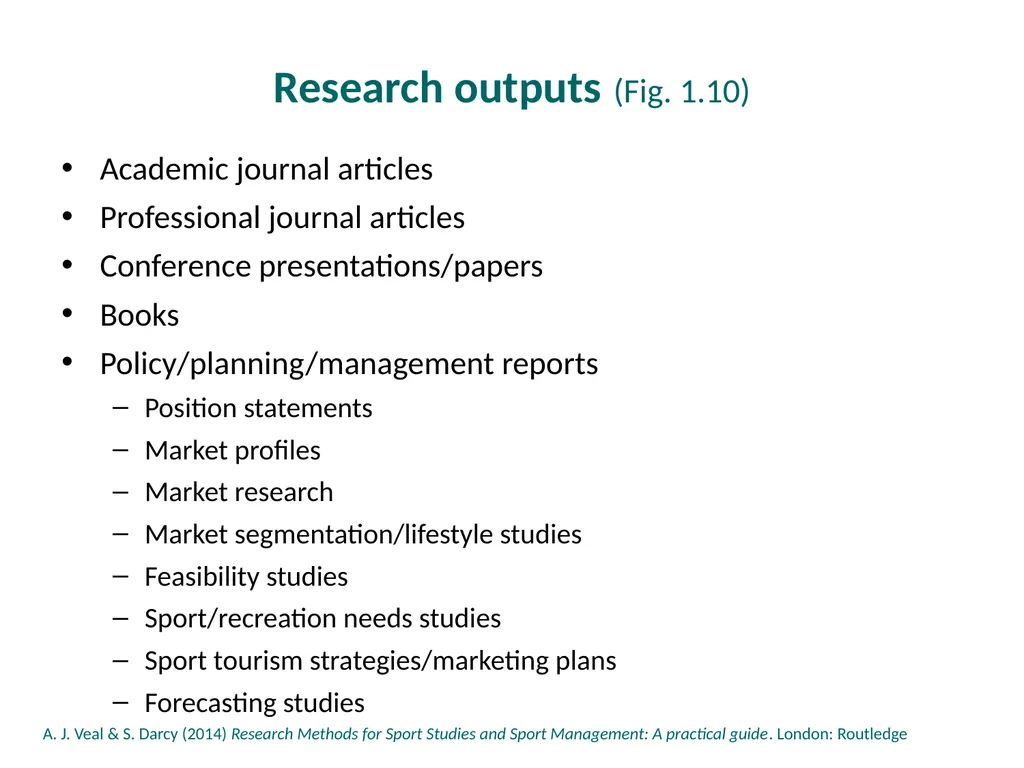
slide25. Research outputs (Fig. 1.10) Academic journal articles
Professional journal articles
Conference presentations/papers
Books
Policy/planning/management reports
Position statements
Market profiles
Market research
Market segmentation/lifestyle studies
Feasibility studies
Sport/recreation needs studies
Sport tourism strategies/marketing plans
Forecasting studies A. J. Veal & S. Darcy (2014) Research Methods for Sport Studies and Sport Management: A practical guide. London: Routledge<br>
slide2. About the PowerPoint slides These slides are provided as a resource for teachers and students using Research Methods for Sport Studies and Sport Management: A Practical Guide.
They are not intended to constitute prescribed lectures. It is envisaged that users will select from, add to and modify the slides to suit their own requirements.
A number of the slides are ‘animated’: this feature can be turned off for individual slides or objects via Animations > Custom animation > Remove.
The slides are subject to the normal copyright rules applying to the book content.
The full set of slides and other support material are provided at: www.pearsoned.co.uk/veal
Any feedback or comments for improvement, corrections etc. would be welcome via: Tony.Veal@uts.edu.au A. J. Veal and S. Darcy (2014) Research Methods for Sport Studies and Sport Management: A practical guide. London: Routledge<br>
slide3. PART I: PREPARATION
Chapter 1: Introduction to Research: What, Why & Who?<br>
slide4. Structure 10. Questionnaires 9. Qualitative 13. Sampling 11. Experimental 8. Observation 7. Secondary data 16. Survey data 15. Qualitative 18. Research report 14. Secondary 4. Research ethics 3. Starting out 6. Reviewing lit. 5. Range of methods 2. Approaches 1. Introduction PART I PREPARATION PART II DATA COLLECTION 12. Case studies PART III ANALYSIS PART IV COMMUNICATE RESULTS 17. Statistical A. J. Veal and S. Darcy (2014) Research Methods for Sport Studies and Sport Management: A practical guide. London: Routledge<br>
slide5. Scope
What is research?
Why study research?
Who does research?
Who pays?
Outputs 25 slides A. J. Veal and S. Darcy (2014) Research Methods for Sport Studies and Sport Management: A practical guide. London: Routledge Content<br>
slide6. Sport – non-organised Walking – transport Physical exercise Cycling – transport Physical work - employment Physical work – domestic Walking – leisure Cycling – leisure Sport - organised Other exercise Work/domestic/personal time Leisure time Fig. 1.1 Physical exercise and sport Scope A. J. Veal & S. Darcy (2014) Research Methods for Sport Studies and Sport Management: A practical guide. London: Routledge<br>
slide7. What is research? Research defined
Scientific research
Social science research
Three types of research A. J. Veal and S. Darcy (2014) Research Methods for Sport Studies and Sport Management: A practical guide. London: Routledge<br>
slide8. Definition: “The aim, as far as I can see, is the same in all sciences. Put simply and cursorily, the aim is to make known something previously unknown to human beings. It is to advance human knowledge, to make it more certain or better fitting .. The aim is .. discovery”.
- Norbert Elias A. J. Veal & S. Darcy (2014) Research Methods for Sport Studies and Sport Management: A practical guide. London: Routledge<br>
slide9. Scientific research Research conducted within the rules of science
Based on:
Logic
Systematic examination of evidence
Ideally can be replicated
Knowledge is cumulative A. J. Veal & S. Darcy (2014) Research Methods for Sport Studies and Sport Management: A practical guide. London: Routledge<br>
slide10. Social science research Deals with people (individually and in informal and formal groups)
Uses methods and traditions of social science
People are less predictable than non-human phenomena
The social world is constantly changing
People can be aware of research being conducted on them A. J. Veal & S. Darcy (2014) Research Methods for Sport Studies and Sport Management: A practical guide. London: Routledge<br>
slide11. Three types of research (Fig. 1.2) Descriptive - finding out, describing what is
Explanatory - explaining how or why things are as they are (and using this to predict)
Evaluative - evaluation of policies and programmes A. J. Veal & S. Darcy (2014) Research Methods for Sport Studies and Sport Management: A practical guide. London: Routledge<br>
slide12. Descriptive research Because the social world is constantly changing, descriptive research is continuously needed
E.g. Periodic data on sport participation
Descriptive research needed for:
market profiles
needs assessment, etc. A. J. Veal & S. Darcy (2014) Research Methods for Sport Studies and Sport Management: A practical guide. London: Routledge<br>
slide13. Explanatory research Involves: why and how?
Causality: A is caused by B
Prediction: a change in A will result in a change in B
Biological and social science – A causes B to a predictable extent A. J. Veal & S. Darcy (2014) Research Methods for Sport Studies and Sport Management: A practical guide. London: Routledge<br>
slide14. Evaluative research To what extent has a programme achieved its aims? A. J. Veal & S. Darcy (2014) Research Methods for Sport Studies and Sport Management: A practical guide. London: Routledge<br>
slide15. Why study research? (Fig. 1.3) Understanding research reports, etc. which you read
Conducting academic research projects – eg a thesis
Research is a management tool in:
policy-making
planning
managing
evaluating A. J. Veal & S. Darcy (2014) Research Methods for Sport Studies and Sport Management: A practical guide. London: Routledge<br>
slide16. Examples of policy/planning/management research Fig. 1.4 A. J. Veal & S. Darcy (2014) Research Methods for Sport Studies and Sport Management: A practical guide. London: Routledge<br>
slide17. Examples of policy/planning/management research A. J. Veal & S. Darcy (2014) Research Methods for Sport Studies and Sport Management: A practical guide. London: Routledge<br>
slide18. Examples of policy/planning/management research A. J. Veal & S. Darcy (2014) Research Methods for Sport Studies and Sport Management: A practical guide. London: Routledge<br>
slide19. The Rational-Comprehensive Planning/ Management Process (Fig. 1.5) 1. Terms of reference/brief 2. Values/mission/vision/goals 3. Decide planning approach 5. Consult with
stakeholders 4. Environmental appraisal 7. Evaluate options 8. Decide strategy/goals/objectives 9. Implement/manage 10. Monitor/evaluate/feedback Research can play a role in all stages 6. Develop options A. J. Veal & S. Darcy (2014) Research Methods for Sport Studies and Sport Management: A practical guide. London: Routledge<br>
slide20. Example of planning/management + research (Fig 1.6) A. J. Veal & S. Darcy (2014) Research Methods for Sport Studies and Sport Management: A practical guide. London: Routledge<br>
slide21. Example contd. A. J. Veal & S. Darcy (2014) Research Methods for Sport Studies and Sport Management: A practical guide. London: Routledge<br>
slide22. Who does research? (Fig. 1.7) Academics
Part of the job description. Knowledge for its own sake = some engagement with industry/professions
Students
Coursework projects + Theses
Government and commercial organisations
To inform/evaluate ‘evidence-based policy’
Managers
To inform practice. monitor performance, aid decision-making
Consultants
Under contract to govt and industry A. J. Veal & S. Darcy (2014) Research Methods for Sport Studies and Sport Management: A practical guide. London: Routledge<br>
slide23. Managers conduct research on: (Fig. 1.7) Current customers
Potential customers/community – market research
Environmental appraisal
Organisational performance
Sales
Efficiency
Staff performance/motivation
Competitors
Products
Existing
New A. J. Veal & S. Darcy (2014) Research Methods for Sport Studies and Sport Management: A practical guide. London: Routledge<br>
slide24. Who pays? (Fig. 1.9) Unfunded
University internal funds
Government-funded research councils
Private trusts
Industry – public, commercial or non-profit A. J. Veal & S. Darcy (2014) Research Methods for Sport Studies and Sport Management: A practical guide. London: Routledge<br>
slide25. Research outputs (Fig. 1.10) Academic journal articles
Professional journal articles
Conference presentations/papers
Books
Policy/planning/management reports
Position statements
Market profiles
Market research
Market segmentation/lifestyle studies
Feasibility studies
Sport/recreation needs studies
Sport tourism strategies/marketing plans
Forecasting studies A. J. Veal & S. Darcy (2014) Research Methods for Sport Studies and Sport Management: A practical guide. London: Routledge<br>