PPT : CONTRIBUTION OF SWAMI VIVEKANANDA ON PHILOSOPHY OF EDUCATION PRESENTED BY PRAVRAJIKA TAPOMAYAPRANA All the power is within you , you can do anything and everything. Believe in that , dont believe that you are weak. Stand-up and
"PPT : CONTRIBUTION OF SWAMI VIVEKANANDA ON" is the property of its rightful owner. Permission is granted to
download and print the materials on this website for personal, non-commercial use only, and to display it
on your personal computer provided you do not modify the materials and that you retain all copyright
notices contained in the materials. By downloading content from our website, you accept the terms of this
agreement.
Presentation Transcript
01
PPT : CONTRIBUTION OF SWAMI VIVEKANANDA ON PHILOSOPHY OF EDUCATION PRESENTED BY
PRAVRAJIKA TAPOMAYAPRANA<br>
02
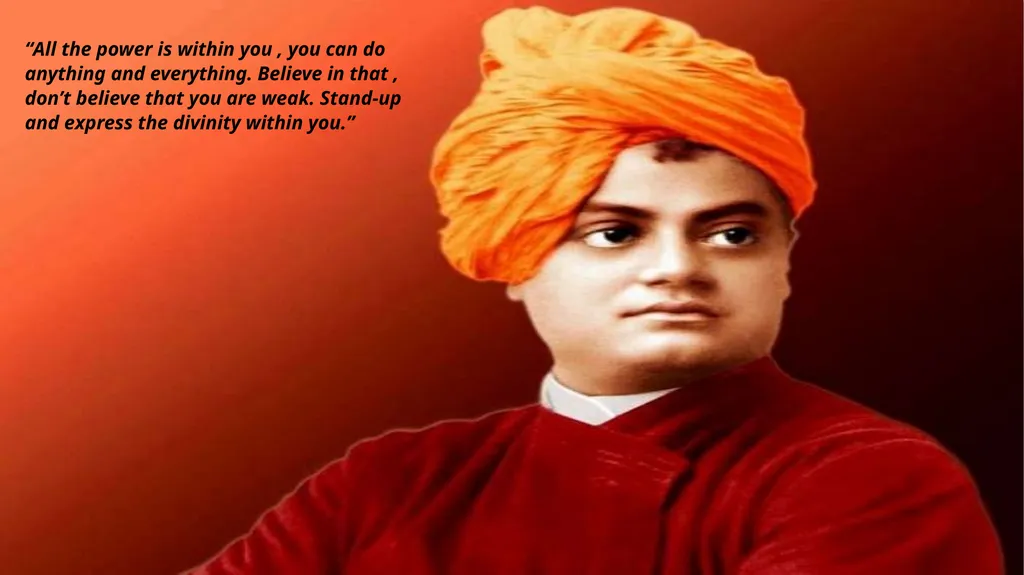
“All the power is within you , you can do anything and everything. Believe in that , don’t believe that you are weak. Stand-up and express the divinity within you.”<br>
03
At a Glance Date of Birth: January12, 1863
Place of Birth: Calcutta, Bengal Presidency (Now Kolkata in West Bengal)
Parents: Vishwanath Dutta (Father) and Bhuvaneshwari Devi (Mother)
Education: Calcutta Metropolitan School; Presidency College, Calcutta
Institutions: Ramakrishna Math; Ramakrishna Mission; Vedanta Society of New York
Religious Views: Hinduism
Philosophy: Advaita Vedanta
Publications: Karma Yoga (1896); Raja Yoga (1896); Lectures from Colombo to Almora (1897); My Master (1901)
Death: July 4, 1902
Place of Death: Belur Math, Belur, Bengal
Memorial: Belur Math, Belur, West Bengal<br>
04
Meaning and Definition of Education According to Swami Vivekananda,
Education is not the mass of information which is inserted into the minds of the children by force.
“ Education is the manifestation of divine perfection already in man”.
It is a life-long process which prepares a man for his struggle for existence by making him self-reliant and developing his character and intelligence.<br>
05
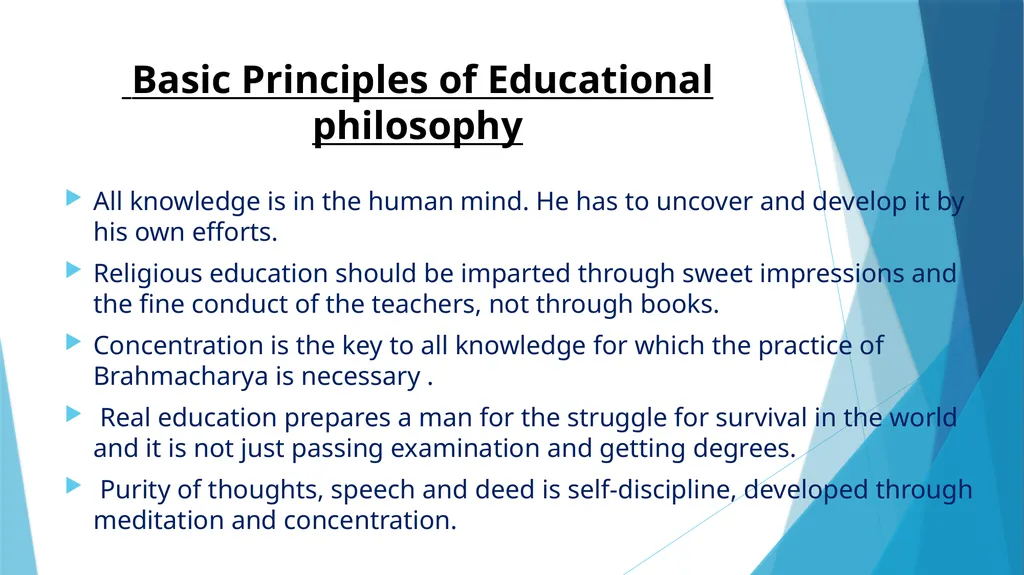
Basic Principles of Educational philosophy All knowledge is in the human mind. He has to uncover and develop it by his own efforts.
Religious education should be imparted through sweet impressions and the fine conduct of the teachers, not through books.
Concentration is the key to all knowledge for which the practice of Brahmacharya is necessary .
Real education prepares a man for the struggle for survival in the world and it is not just passing examination and getting degrees.
Purity of thoughts, speech and deed is self-discipline, developed through meditation and concentration.<br>
06
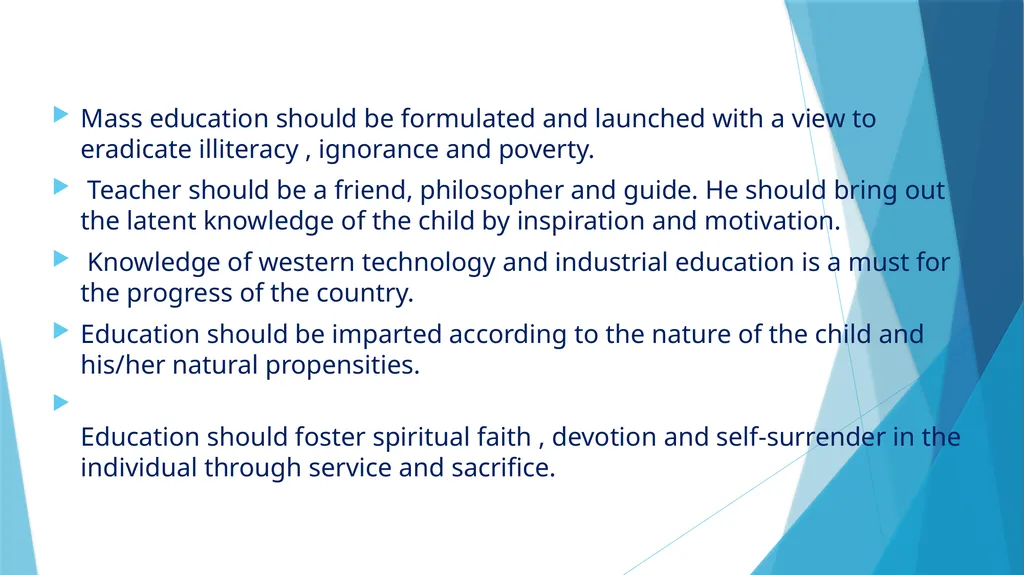
Mass education should be formulated and launched with a view to eradicate illiteracy , ignorance and poverty.
Teacher should be a friend, philosopher and guide. He should bring out the latent knowledge of the child by inspiration and motivation.
Knowledge of western technology and industrial education is a must for the progress of the country.
Education should be imparted according to the nature of the child and his/her natural propensities.
Education should foster spiritual faith , devotion and self-surrender in the individual through service and sacrifice.<br>
07
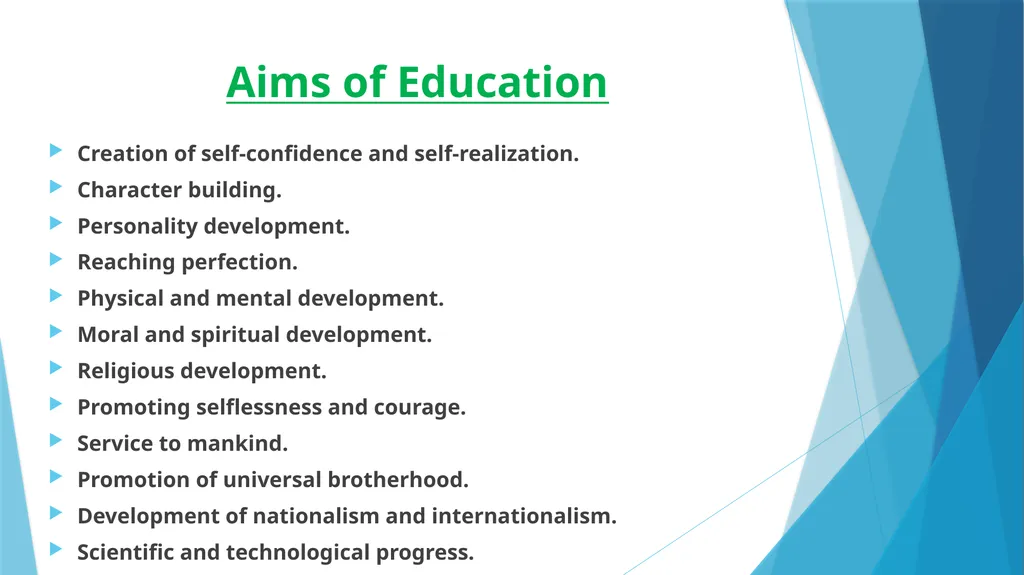
Aims of Education Creation of self-confidence and self-realization.
Character building.
Personality development.
Reaching perfection.
Physical and mental development.
Moral and spiritual development.
Religious development.
Promoting selflessness and courage.
Service to mankind.
Promotion of universal brotherhood.
Development of nationalism and internationalism.
Scientific and technological progress.<br>
08
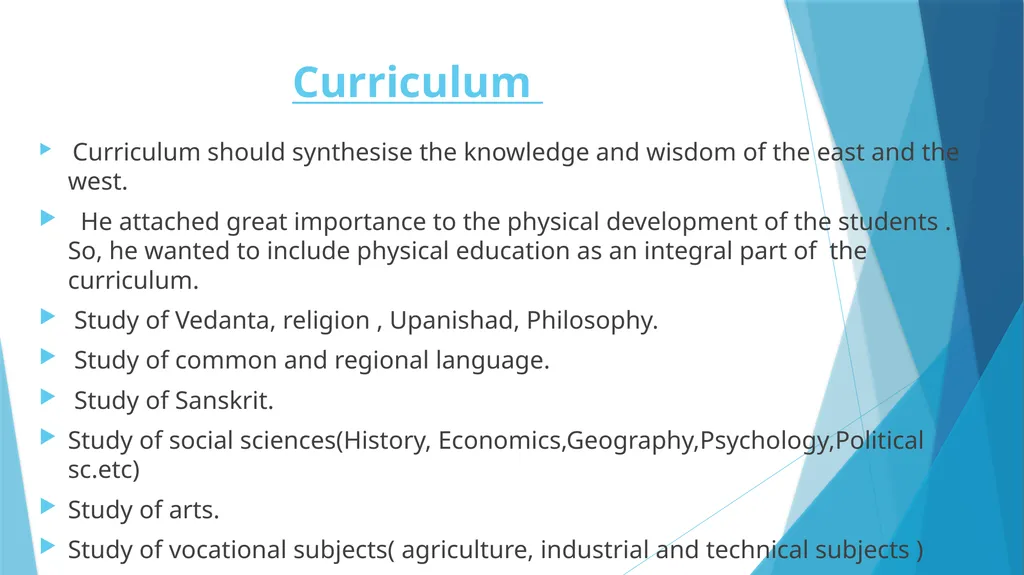
Curriculum Curriculum should synthesise the knowledge and wisdom of the east and the west.
He attached great importance to the physical development of the students . So, he wanted to include physical education as an integral part of the curriculum.
Study of Vedanta, religion , Upanishad, Philosophy.
Study of common and regional language.
Study of Sanskrit.
Study of social sciences(History, Economics,Geography,Psychology,Political sc.etc)
Study of arts.
Study of vocational subjects( agriculture, industrial and technical subjects )<br>
09
Method of Teaching Practice of yoga
Observing meditation
Concentration
Brahmacharya
Lecture and discussion
Guidance and counselling
Self-learning
Travel<br>
10
Swami Vivekananda suggested a relevant and meaningful system of education based on the needs of modern India. His mission was the service of mankind through social service, mass education, religious revival and social awakening through education.<br>
11
REFERENCES https://www.culturalindia.net/reformers/vivekananda.html
A Comprehensive Study of Education , S. Samuel Ravi
NTA UGC,Education , Nandini Sharma and Renu Kulshreshtha
Shiksha Darshan , Dr. Mihir kumar Chattopadhyaya , Dr. Avijit Kumar Pal and Pranay Pandey .<br>