
Practical Covert Authentication Stanislaw Jarecki
Description: Practical Covert Authentication Stanislaw Jarecki University of California at Irvine Public Key Cryptography 2014 Presentation Plan Introduction to Covert Computation Practical Covert Authentication Protocol O(1) rounds, group elements,
Related Topics
Download Presentation
"Practical Covert Authentication Stanislaw Jarecki" is the property of its rightful owner. Permission is granted to download and print the materials on this website for personal, non-commercial use only, and to display it on your personal computer provided you do not modify the materials and that you retain all copyright notices contained in the materials. By downloading content from our website, you accept the terms of this agreement.
Presentation Transcript
slide1. Practical Covert Authentication Stanislaw Jarecki
University of California at Irvine
Public Key Cryptography 2014<br>
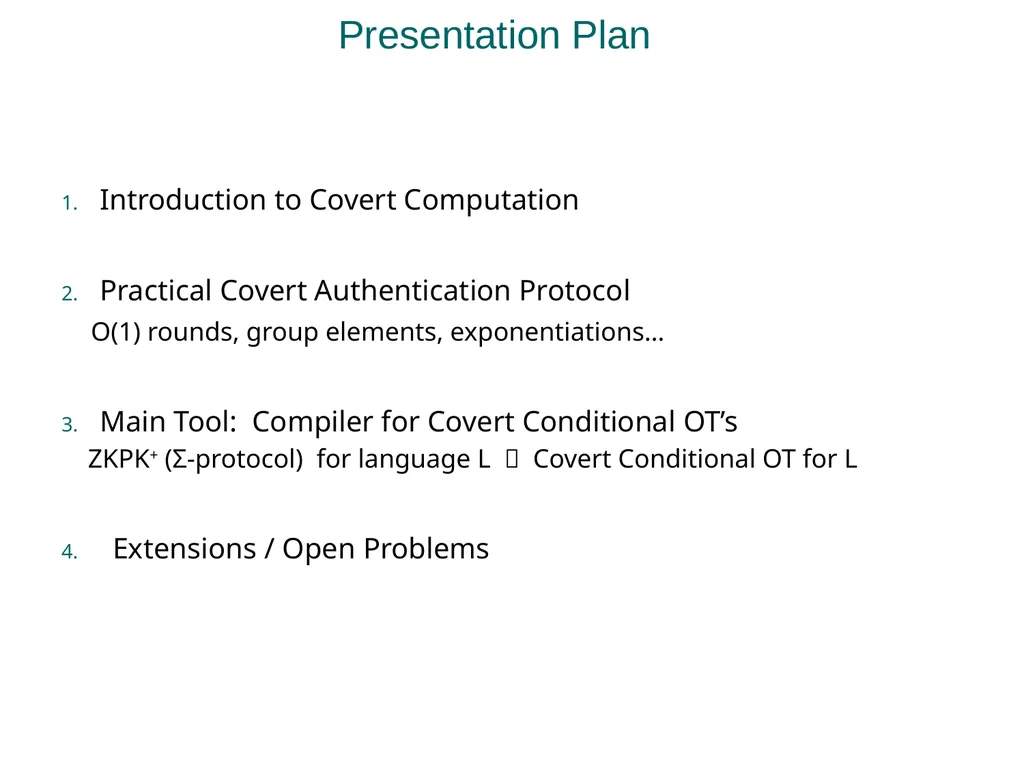
slide2. Presentation Plan Introduction to Covert Computation
Practical Covert Authentication Protocol
O(1) rounds, group elements, exponentiations…
Main Tool: Compiler for Covert Conditional OT’s
ZKPK+ (Σ-protocol) for language L Covert Conditional OT for L
Extensions / Open Problems<br>
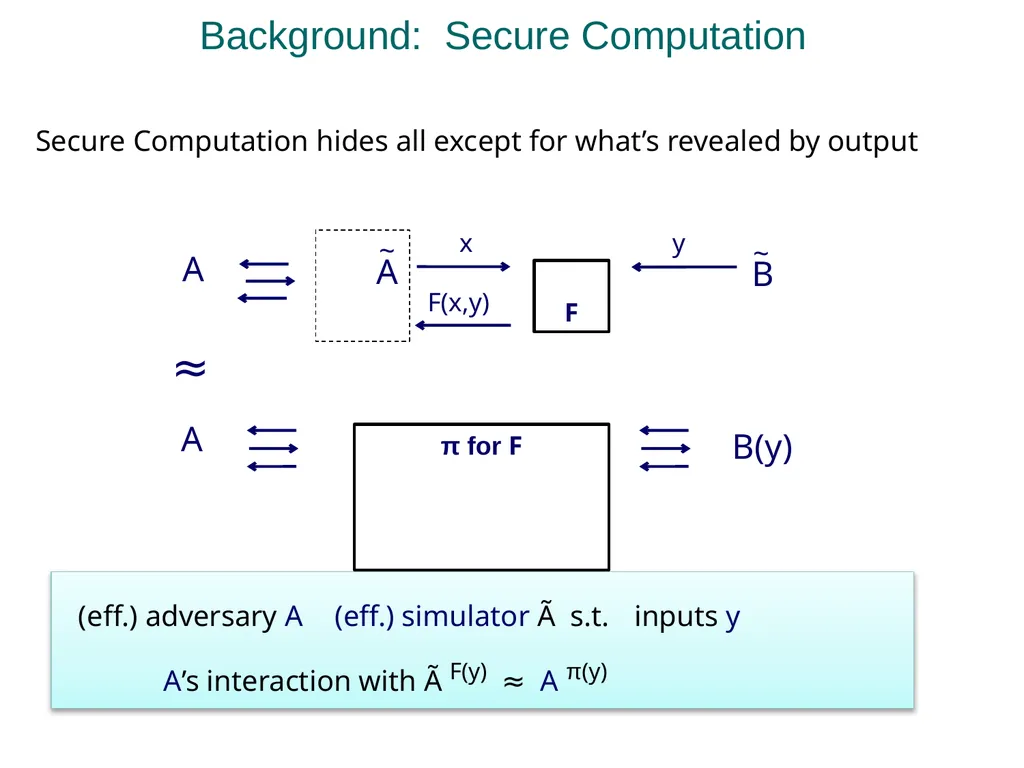
slide3. Background: Secure Computation Secure Computation hides all except for what’s revealed by output A F(x,y) F x A A π for F B(y) ~ (eff.) adversary A (eff.) simulator à s.t. inputs y
A’s interaction with à F(y) ≈ A π(y) ≈ ~ y B<br>
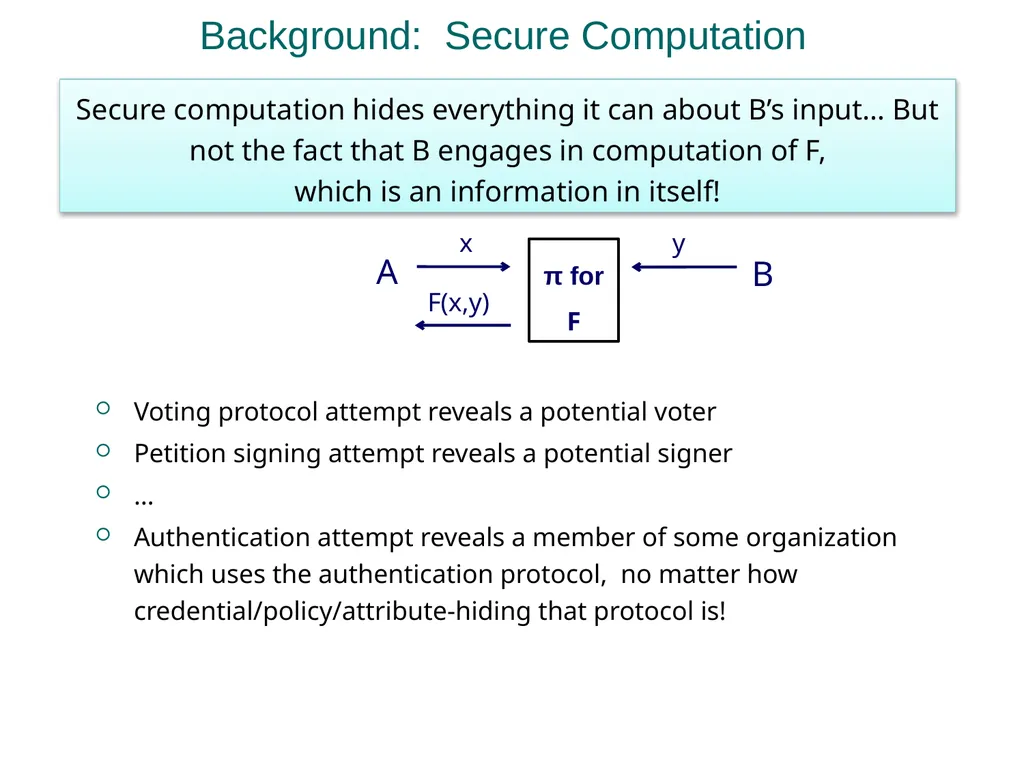
slide4. Voting protocol attempt reveals a potential voter
Petition signing attempt reveals a potential signer
…
Authentication attempt reveals a member of some organization which uses the authentication protocol, no matter how credential/policy/attribute-hiding that protocol is! A F(x,y) x y B π for F Secure computation hides everything it can about B’s input… But not the fact that B engages in computation of F,
which is an information in itself! Background: Secure Computation<br>
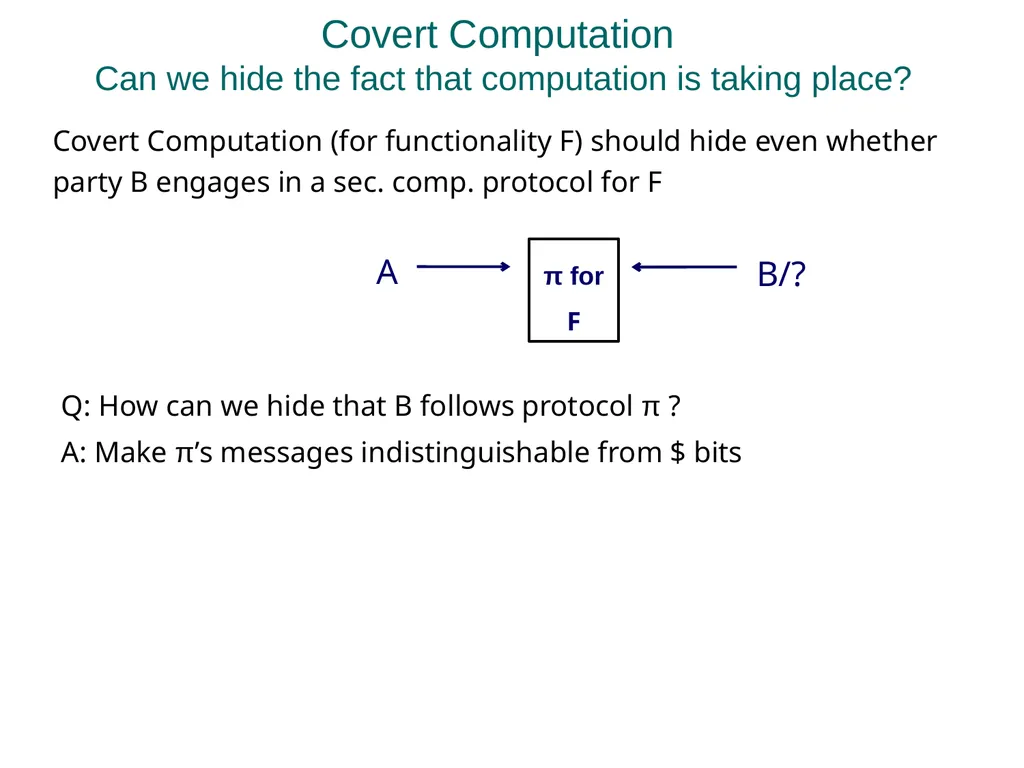
slide5. Covert Computation Can we hide the fact that computation is taking place? Covert Computation (for functionality F) should hide even whether party B engages in a sec. comp. protocol for F A Q: How can we hide that B follows protocol π ?
A: Make π’s messages indistinguishable from $ bits B/? π for F<br>
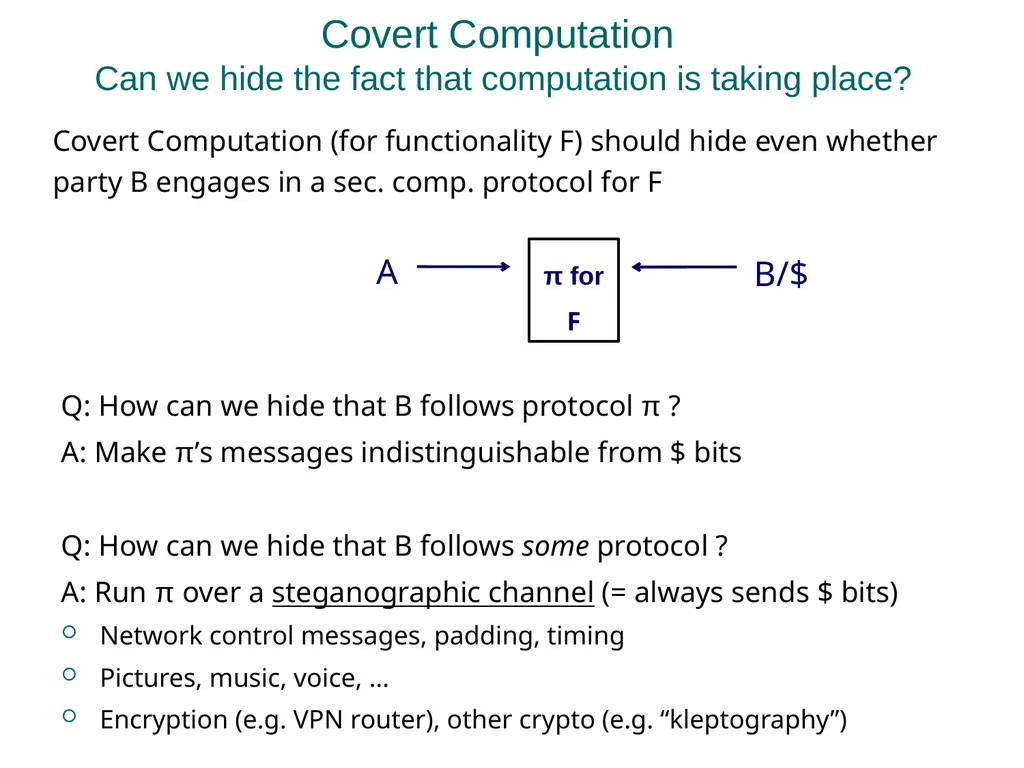
slide6. Covert Computation (for functionality F) should hide even whether party B engages in a sec. comp. protocol for F A Q: How can we hide that B follows protocol π ?
A: Make π’s messages indistinguishable from $ bits
Q: How can we hide that B follows some protocol ?
A: Run π over a steganographic channel (= always sends $ bits)
Network control messages, padding, timing
Pictures, music, voice, …
Encryption (e.g. VPN router), other crypto (e.g. “kleptography”) B/$ Covert Computation Can we hide the fact that computation is taking place? π for F<br>
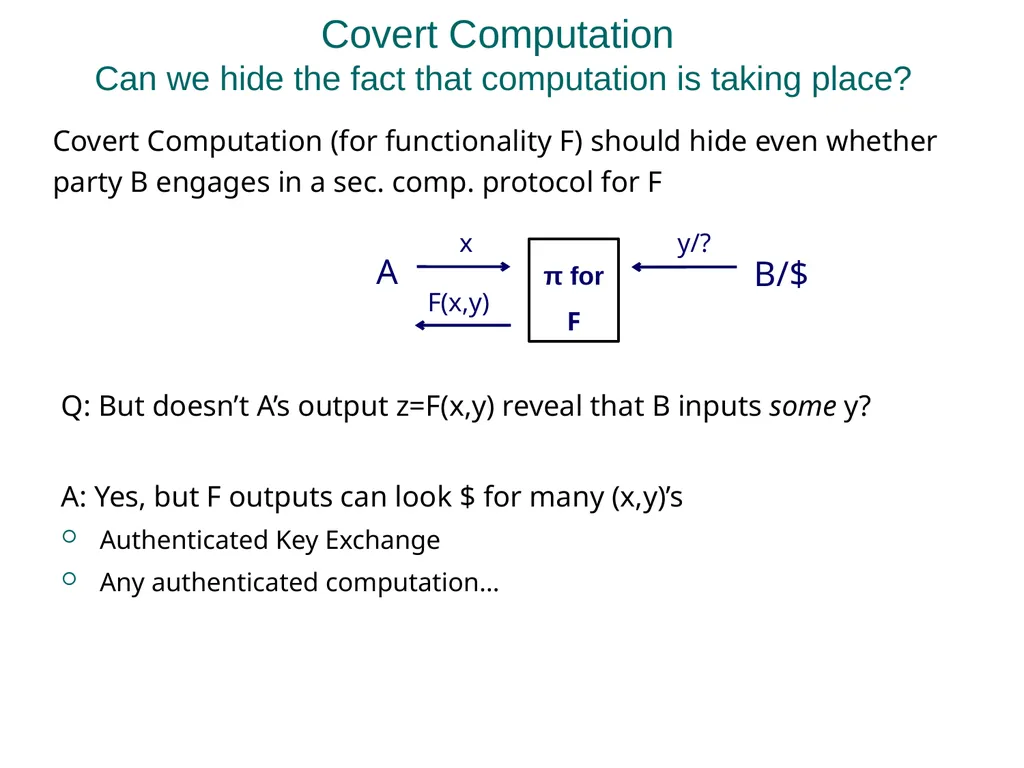
slide7. Covert Computation (for functionality F) should hide even whether party B engages in a sec. comp. protocol for F A F(x,y) x Q: But doesn’t A’s output z=F(x,y) reveal that B inputs some y?
A: Yes, but F outputs can look $ for many (x,y)’s
Authenticated Key Exchange
Any authenticated computation… π for F B/$ y/? Covert Computation Can we hide the fact that computation is taking place?<br>
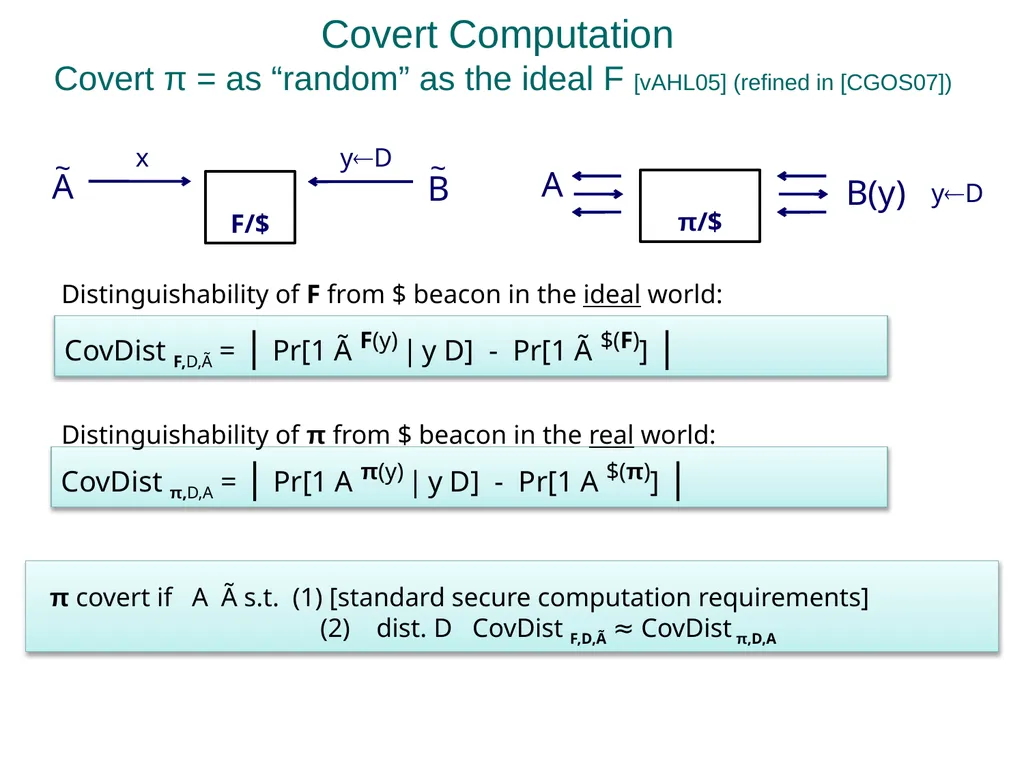
slide8. A B x yD Distinguishability of F from $ beacon in the ideal world: F/$ ~ ~ A π/$ B(y) yD CovDist F,D,Ã = | Pr[1Ã F(y) | yD] - Pr[1Ã $(F)] | CovDist π,D,A = | Pr[1A π(y) | yD] - Pr[1A $(π)] | π covert if A Ã s.t. (1) [standard secure computation requirements]
(2) dist. D CovDist F,D,Ã ≈ CovDist π,D,A Distinguishability of π from $ beacon in the real world: Covert Computation Covert π = as “random” as the ideal F [vAHL05] (refined in [CGOS07])<br>
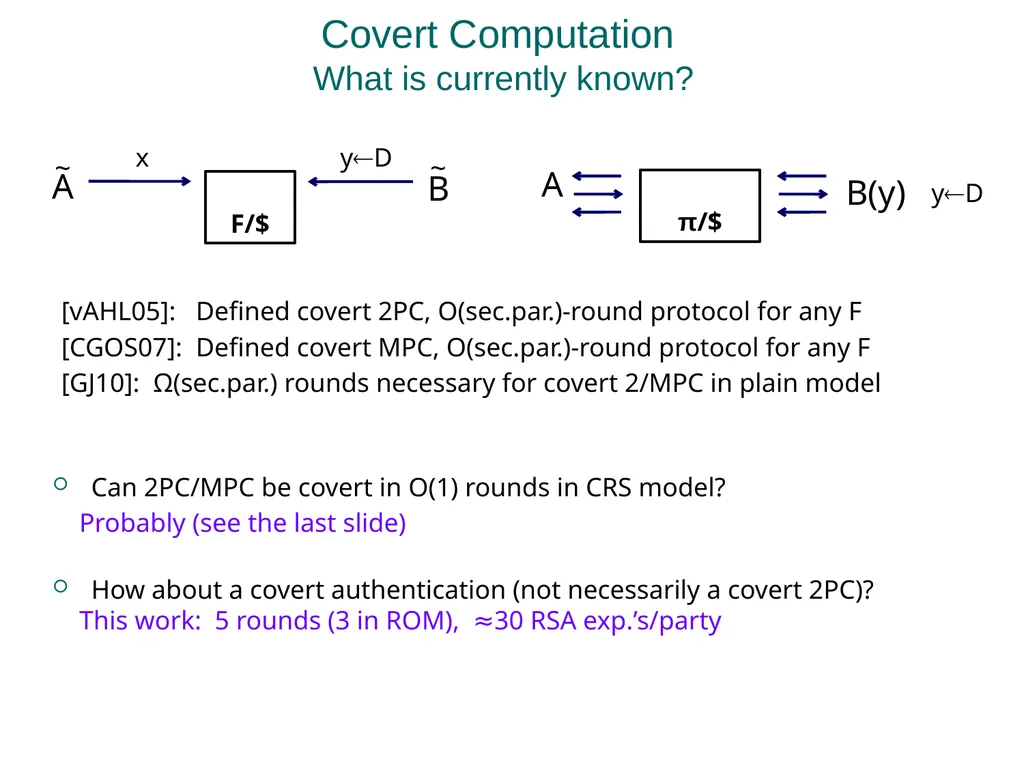
slide9. Covert Computation What is currently known? A B x yD [vAHL05]: Defined covert 2PC, O(sec.par.)-round protocol for any F
[CGOS07]: Defined covert MPC, O(sec.par.)-round protocol for any F
[GJ10]: Ω(sec.par.) rounds necessary for covert 2/MPC in plain model F/$ ~ ~ A π/$ B(y) yD Can 2PC/MPC be covert in O(1) rounds in CRS model?
Probably (see the last slide)
How about a covert authentication (not necessarily a covert 2PC)?
This work: 5 rounds (3 in ROM), ≈30 RSA exp.’s/party<br>
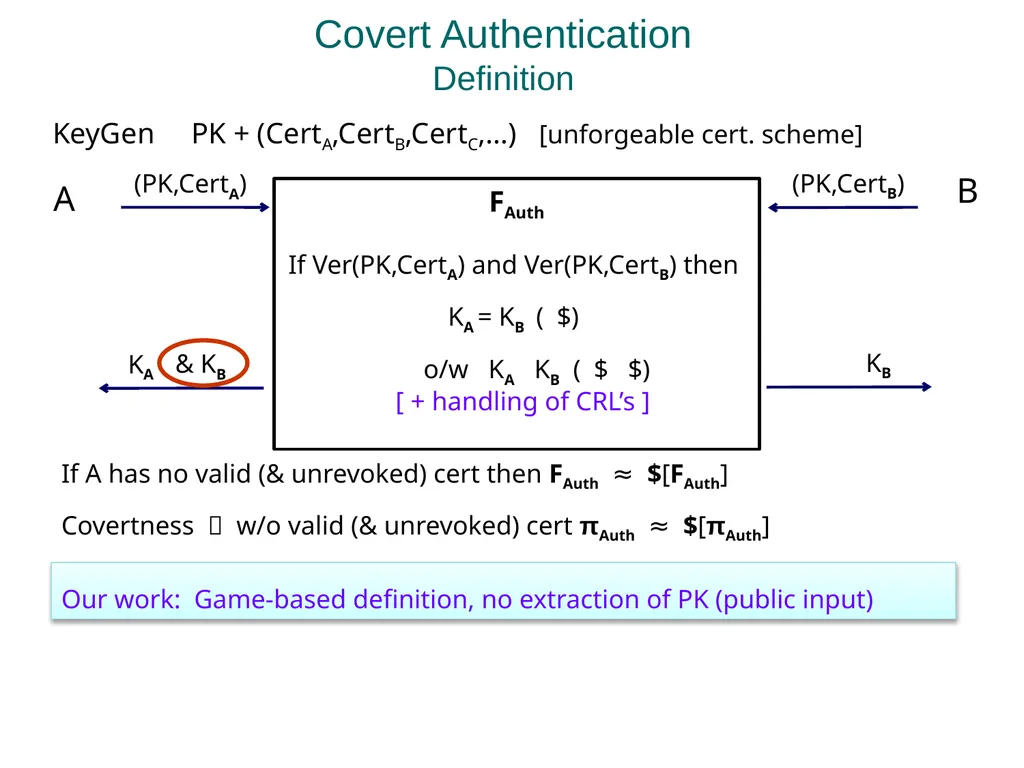
slide10. Covert Authentication Definition KeyGen PK + (CertA,CertB,CertC,…) [unforgeable cert. scheme] A B (PK,CertA) If A has no valid (& unrevoked) cert then FAuth ≈ $[FAuth]
Covertness w/o valid (& unrevoked) cert πAuth ≈ $[πAuth] FAuth
If Ver(PK,CertA) and Ver(PK,CertB) then KA = KB ( $)
o/w KA KB ( $ $) (PK,CertB) KA KB [ + handling of CRL’s ] Our work: Game-based definition, no extraction of PK (public input) & KB<br>
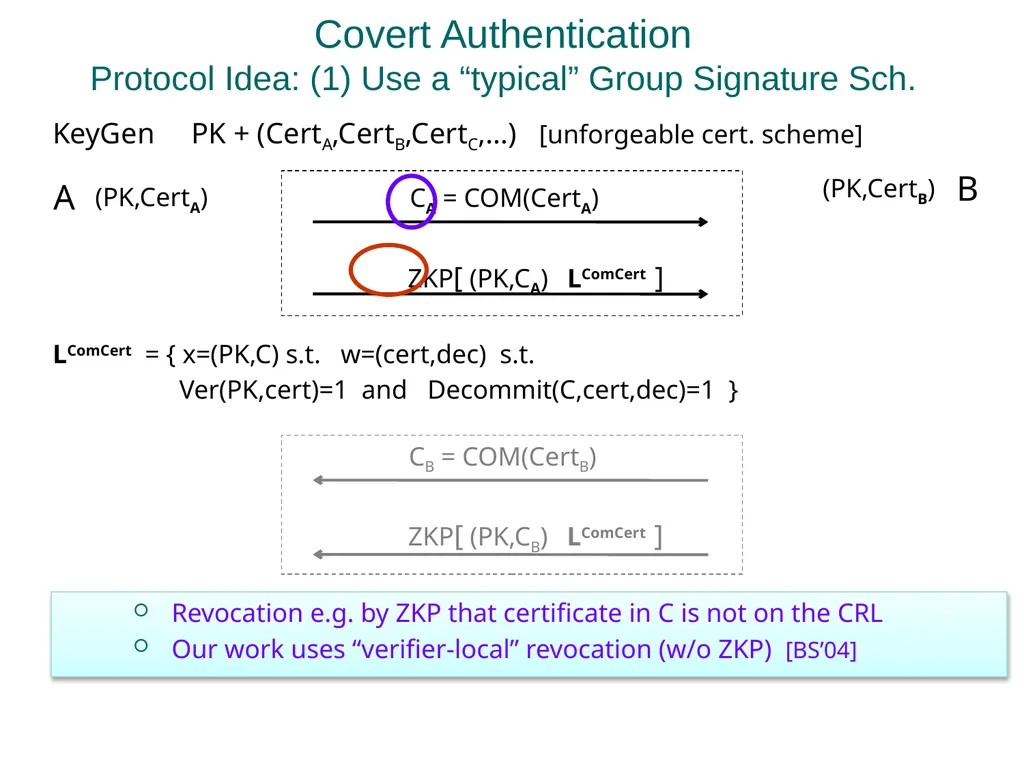
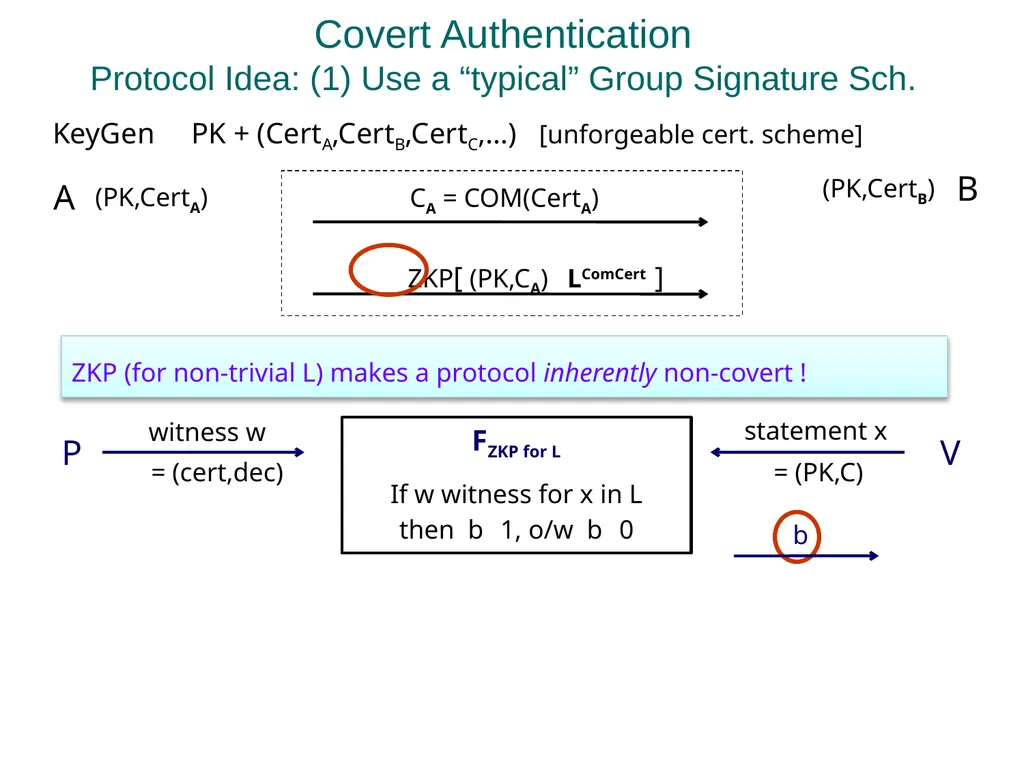
slide11. Covert Authentication Protocol Idea: (1) Use a “typical” Group Signature Sch. A B CA = COM(CertA) Revocation e.g. by ZKP that certificate in C is not on the CRL
Our work uses “verifier-local” revocation (w/o ZKP) [BS’04] (PK,CertB) (PK,CertA) ZKP[ (PK,CA) LComCert ] CB = COM(CertB) ZKP[ (PK,CB) LComCert ] LComCert = { x=(PK,C) s.t. w=(cert,dec) s.t.
Ver(PK,cert)=1 and Decommit(C,cert,dec)=1 } KeyGen PK + (CertA,CertB,CertC,…) [unforgeable cert. scheme]<br>
slide12. Covert Authentication Protocol Idea: (1) Use a “typical” Group Signature Sch. A B CA = COM(CertA) (PK,CertB) (PK,CertA) ZKP[ (PK,CA) LComCert ] KeyGen PK + (CertA,CertB,CertC,…) [unforgeable cert. scheme] P FZKP for L
If w witness for x in L
then b 1, o/w b 0 V b ZKP (for non-trivial L) makes a protocol inherently non-covert ! witness w statement x = (cert,dec) = (PK,C)<br>
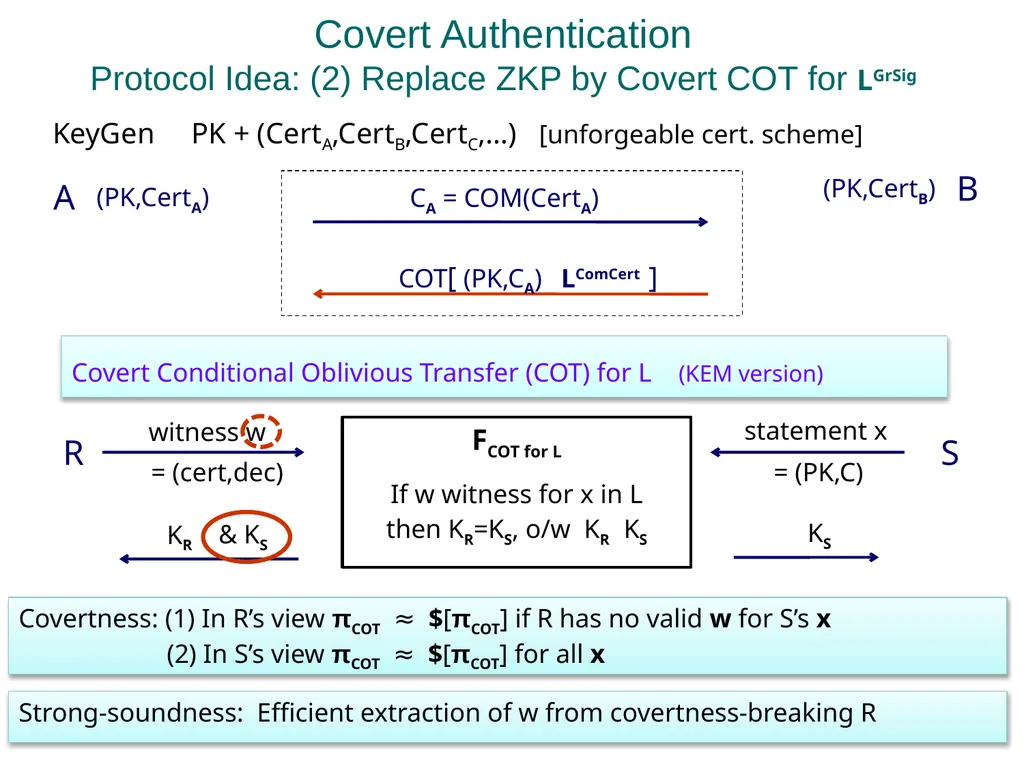
slide13. Covert Authentication Protocol Idea: (2) Replace ZKP by Covert COT for LGrSig A B CA = COM(CertA) (PK,CertB) (PK,CertA) COT[ (PK,CA) LComCert ] KeyGen PK + (CertA,CertB,CertC,…) [unforgeable cert. scheme] FCOT for L
If w witness for x in L
then KR=KS, o/w KR KS KR KS R witness w = (cert,dec) S statement x = (PK,C) & KS Covertness: (1) In R’s view πCOT ≈ $[πCOT] if R has no valid w for S’s x
(2) In S’s view πCOT ≈ $[πCOT] for all x Covert Conditional Oblivious Transfer (COT) for L (KEM version) Strong-soundness: Efficient extraction of w from covertness-breaking R<br>
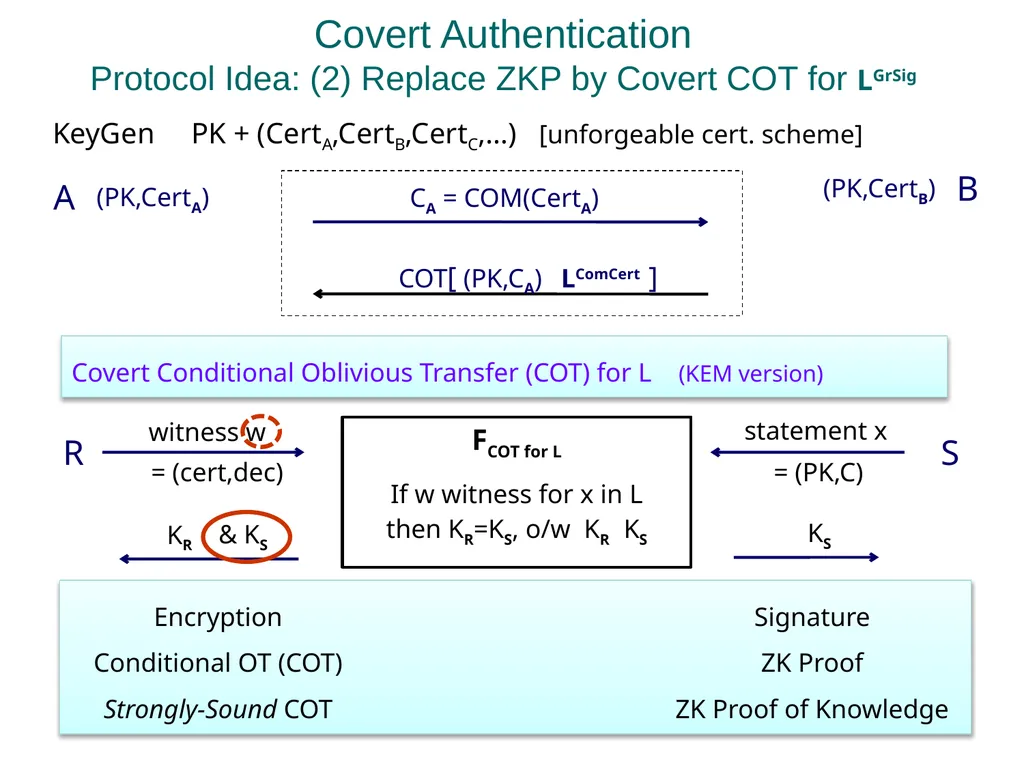
slide14. Covert Authentication Protocol Idea: (2) Replace ZKP by Covert COT for LGrSig A B CA = COM(CertA) (PK,CertB) (PK,CertA) COT[ (PK,CA) LComCert ] KeyGen PK + (CertA,CertB,CertC,…) [unforgeable cert. scheme] FCOT for L
If w witness for x in L
then KR=KS, o/w KR KS KR KS R witness w = (cert,dec) S statement x = (PK,C) & KS Encryption
Conditional OT (COT)
Strongly-Sound COT
Signature
ZK Proof
ZK Proof of Knowledge Covert Conditional Oblivious Transfer (COT) for L (KEM version)<br>
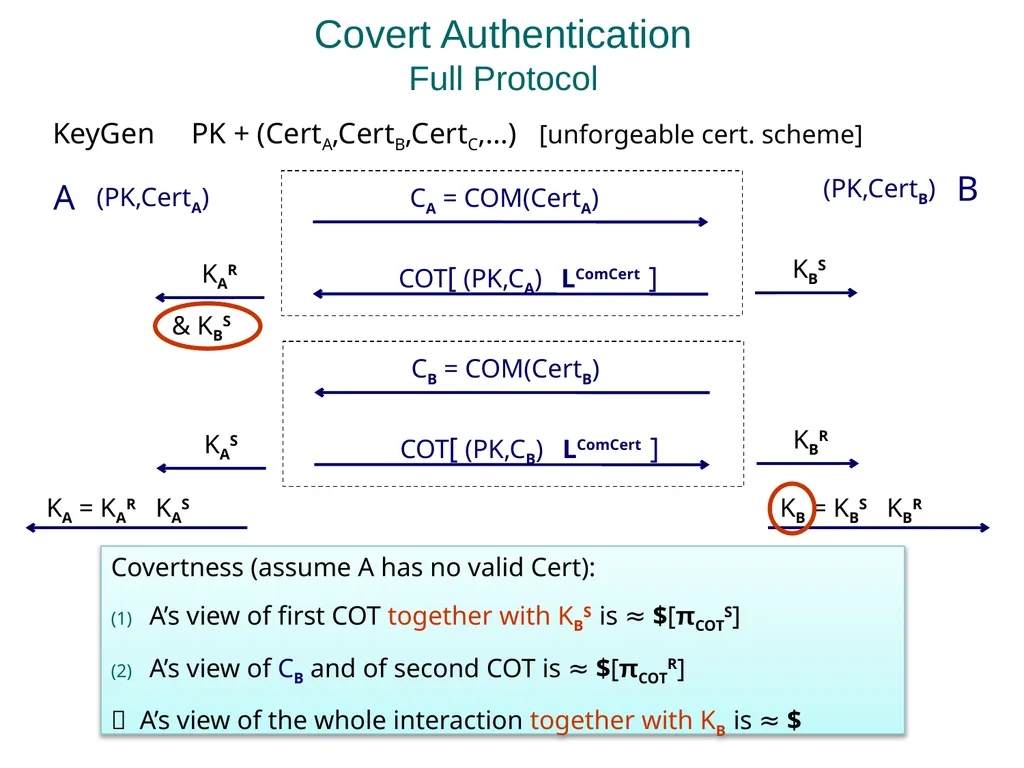
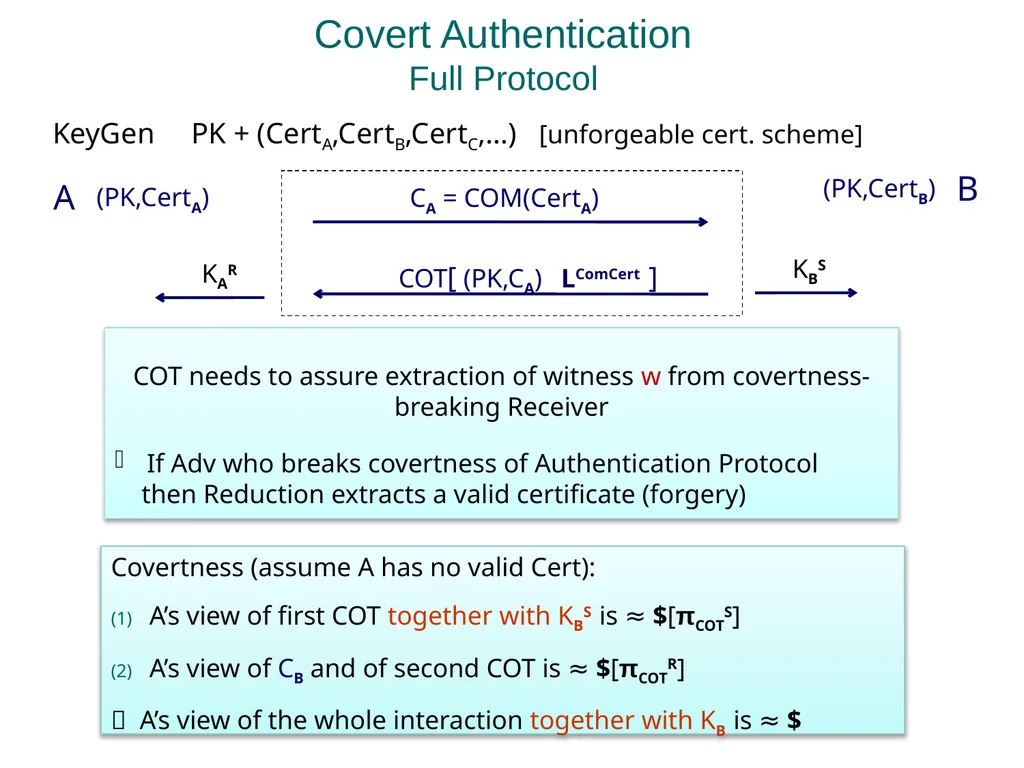
slide15. Covert Authentication Full Protocol A B CA = COM(CertA) (PK,CertB) (PK,CertA) COT[ (PK,CA) LComCert ] KeyGen PK + (CertA,CertB,CertC,…) [unforgeable cert. scheme] KAR KBS CB = COM(CertB) COT[ (PK,CB) LComCert ] KAS KBR KB = KBS KBR Covertness (assume A has no valid Cert):
A’s view of first COT together with KBS is ≈ $[πCOTS]
A’s view of CB and of second COT is ≈ $[πCOTR]
A’s view of the whole interaction together with KB is ≈ $ KA = KAR KAS & KBS<br>
slide16. Covert Authentication Full Protocol A B CA = COM(CertA) (PK,CertB) (PK,CertA) COT[ (PK,CA) LComCert ] KeyGen PK + (CertA,CertB,CertC,…) [unforgeable cert. scheme] KAR KBS CB = COM(CertB) COT[ (PK,CB) LComCert ] KAS KBR Covertness (assume A has no valid Cert):
A’s view of first COT together with KBS is ≈ $[πCOTS]
A’s view of CB and of second COT is ≈ $[πCOTR]
A’s view of the whole interaction together with KB is ≈ $ COT needs to assure extraction of witness w from covertness-breaking Receiver
If Adv who breaks covertness of Authentication Protocol
then Reduction extracts a valid certificate (forgery)<br>
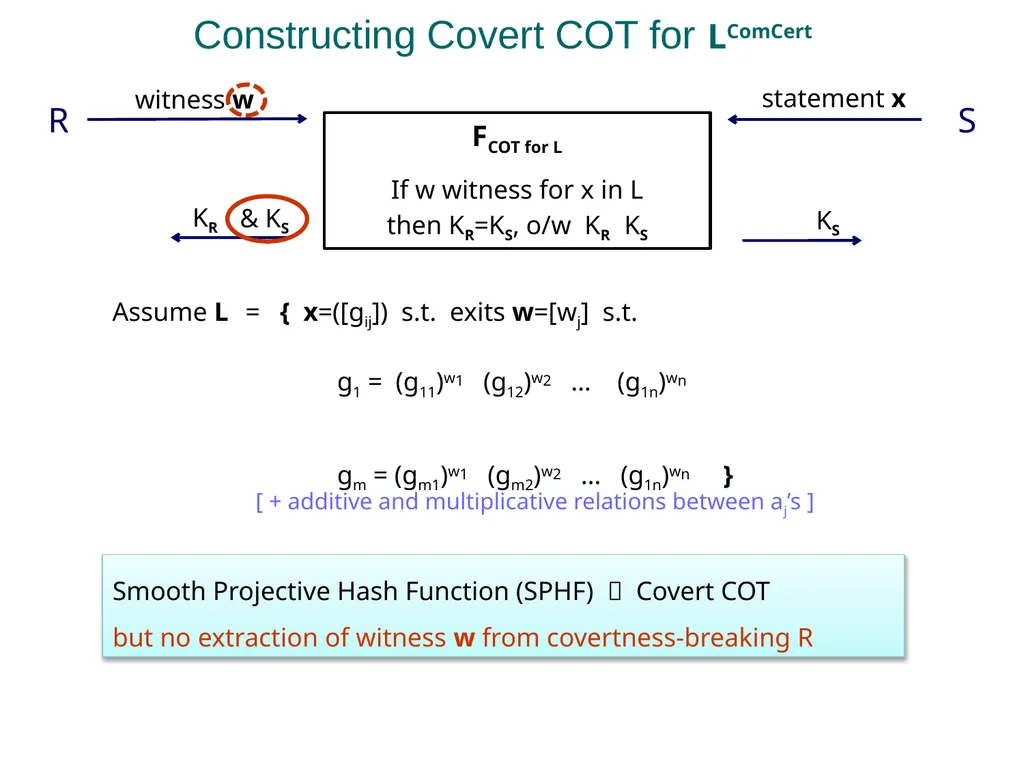
slide17. & KS KR KS witness w S statement x Assume L = { x=([gij]) s.t. exits w=[wj] s.t.
g1 = (g11)w1 (g12)w2 … (g1n)wn
gm = (gm1)w1 (gm2)w2 … (g1n)wn } Smooth Projective Hash Function (SPHF) Covert COT
but no extraction of witness w from covertness-breaking R [ + additive and multiplicative relations between aj’s ] Constructing Covert COT for LComCert FCOT for L
If w witness for x in L
then KR=KS, o/w KR KS R<br>
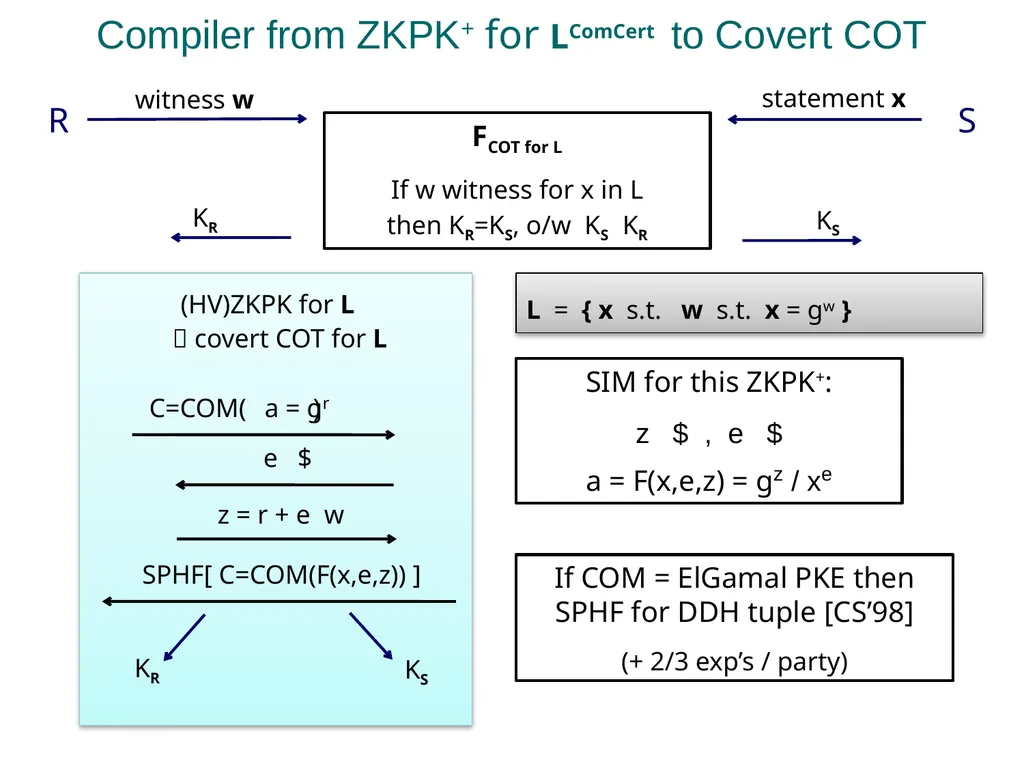
slide18. R Compiler from ZKPK+ for LComCert to Covert COT KR KS witness w S statement x FCOT for L
If w witness for x in L
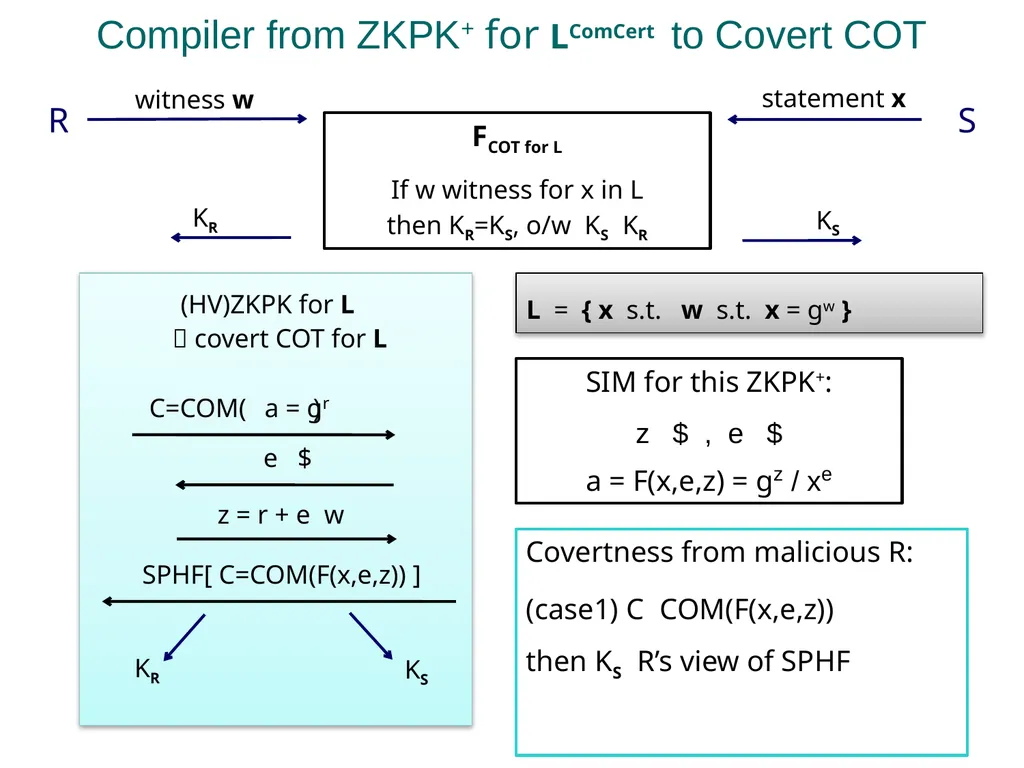
then KR=KS, o/w KS KR a = gr L = { x s.t. w s.t. x = gw } e $ z = r + e w (HV)ZKPK for L C=COM( ) SPHF[ C=COM(F(x,e,z)) ] If COM = ElGamal PKE then
SPHF for DDH tuple [CS’98]
(+ 2/3 exp’s / party) KS KR covert COT for L SIM for this ZKPK+:
z $ , e $
a = F(x,e,z) = gz / xe<br>
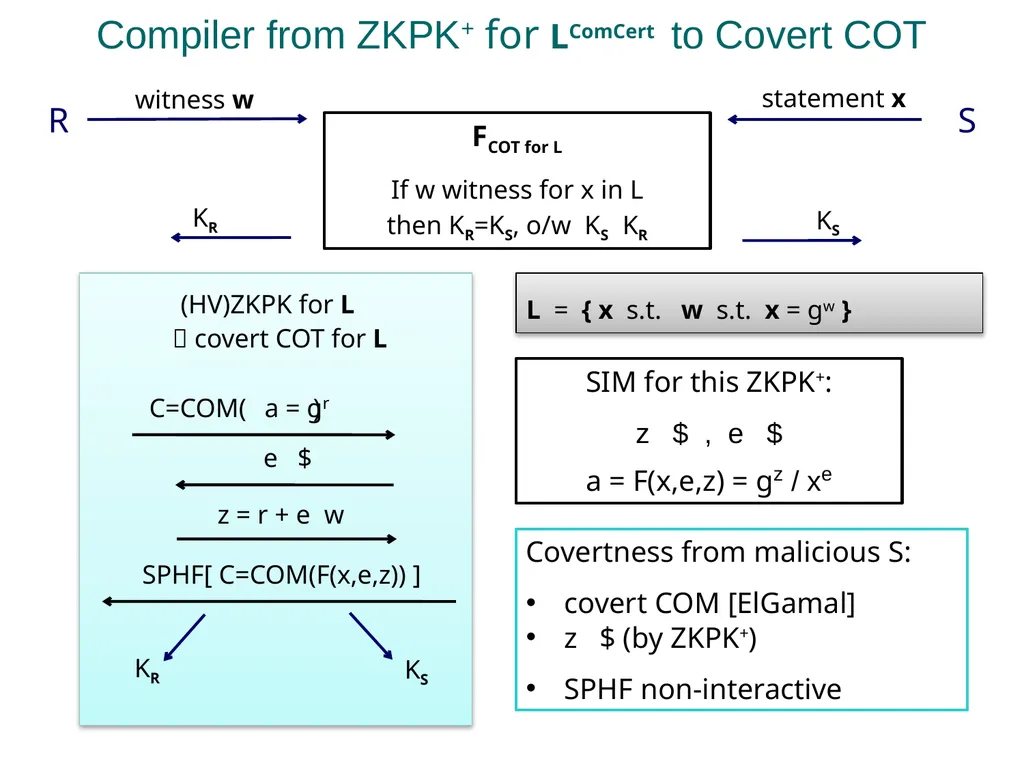
slide19. R Compiler from ZKPK+ for LComCert to Covert COT KR KS witness w S statement x FCOT for L
If w witness for x in L
then KR=KS, o/w KS KR L = { x s.t. w s.t. x = gw } SIM for this ZKPK+:
z $ , e $
a = F(x,e,z) = gz / xe Covertness from malicious S:
covert COM [ElGamal]
z $ (by ZKPK+)
SPHF non-interactive a = gr e $ z = r + e w (HV)ZKPK for L C=COM( ) SPHF[ C=COM(F(x,e,z)) ] KS KR covert COT for L<br>
slide20. R Compiler from ZKPK+ for LComCert to Covert COT KR KS witness w S statement x FCOT for L
If w witness for x in L
then KR=KS, o/w KS KR L = { x s.t. w s.t. x = gw } SIM for this ZKPK+:
z $ , e $
a = F(x,e,z) = gz / xe Covertness from malicious R:
(case1) C COM(F(x,e,z))
then KS R’s view of SPHF a = gr e $ z = r + e w (HV)ZKPK for L C=COM( ) SPHF[ C=COM(F(x,e,z)) ] KS KR covert COT for L<br>
slide21. R Compiler from ZKPK+ for LComCert to Covert COT KR KS witness w S statement x FCOT for L
If w witness for x in L
then KR=KS, o/w KS KR L = { x s.t. w s.t. x = gw } SIM for this ZKPK+:
z $ , e $
a = F(x,e,z) = gz / xe Covertness from malicious R:
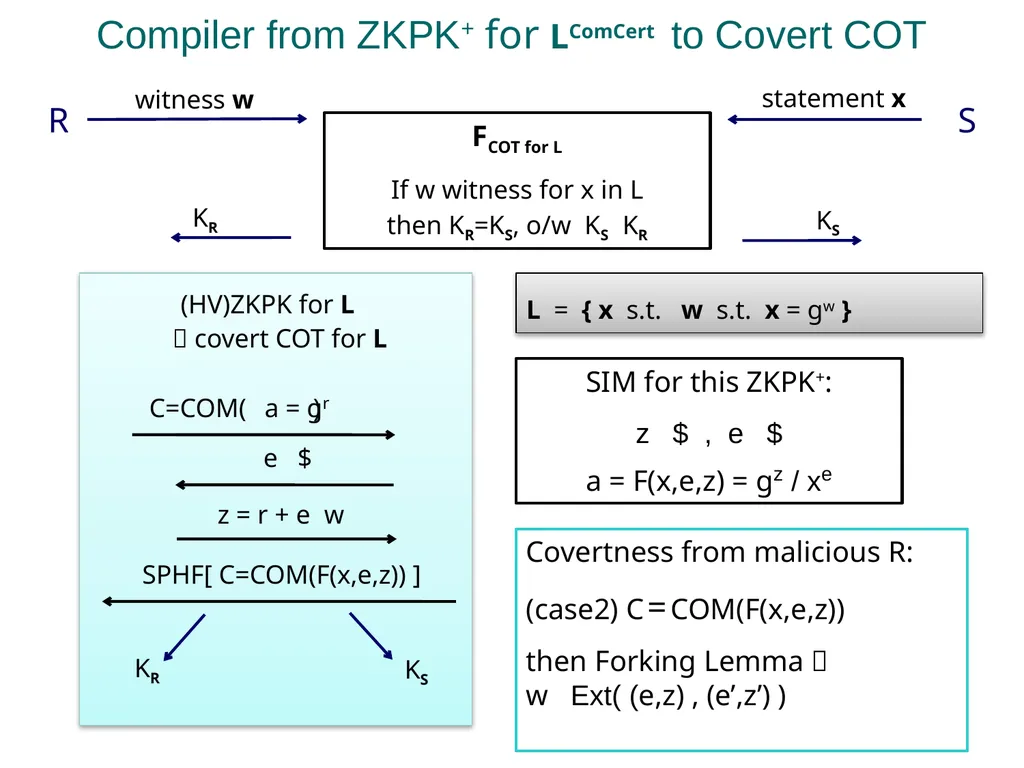
(case2) C = COM(F(x,e,z))
then Forking Lemma
w Ext( (e,z) , (e’,z’) ) a = gr e $ z = r + e w (HV)ZKPK for L C=COM( ) SPHF[ C=COM(F(x,e,z)) ] KS KR covert COT for L<br>
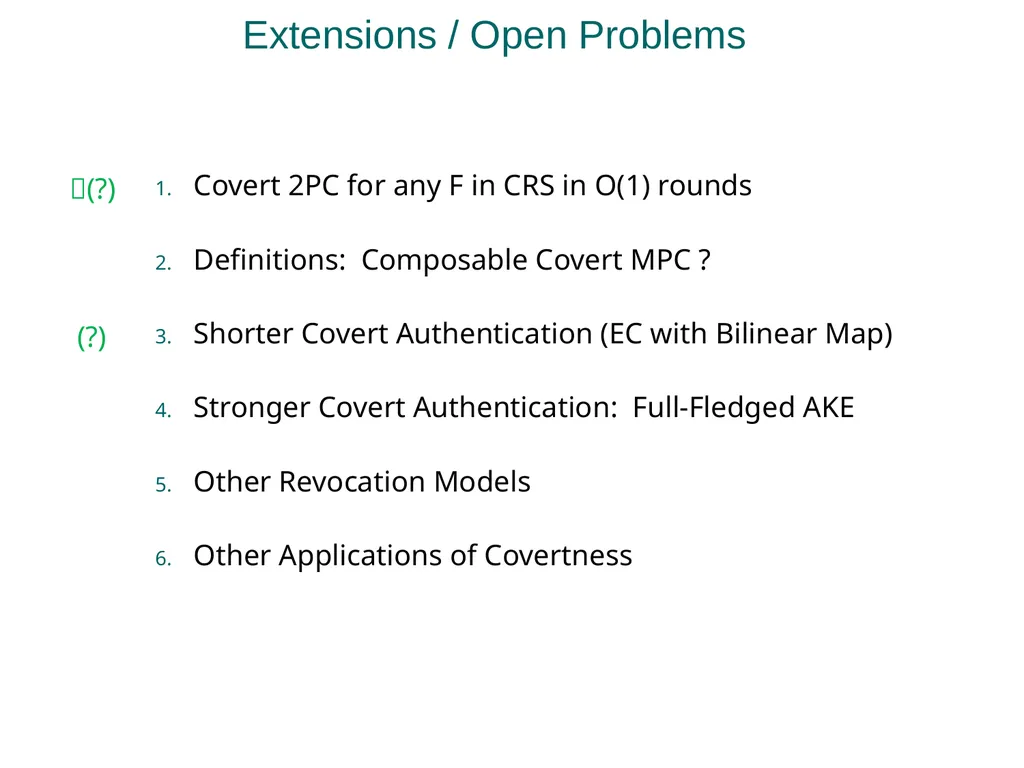
slide22. Extensions / Open Problems Covert 2PC for any F in CRS in O(1) rounds
Definitions: Composable Covert MPC ?
Shorter Covert Authentication (EC with Bilinear Map)
Stronger Covert Authentication: Full-Fledged AKE
Other Revocation Models
Other Applications of Covertness (?)
(?)<br>
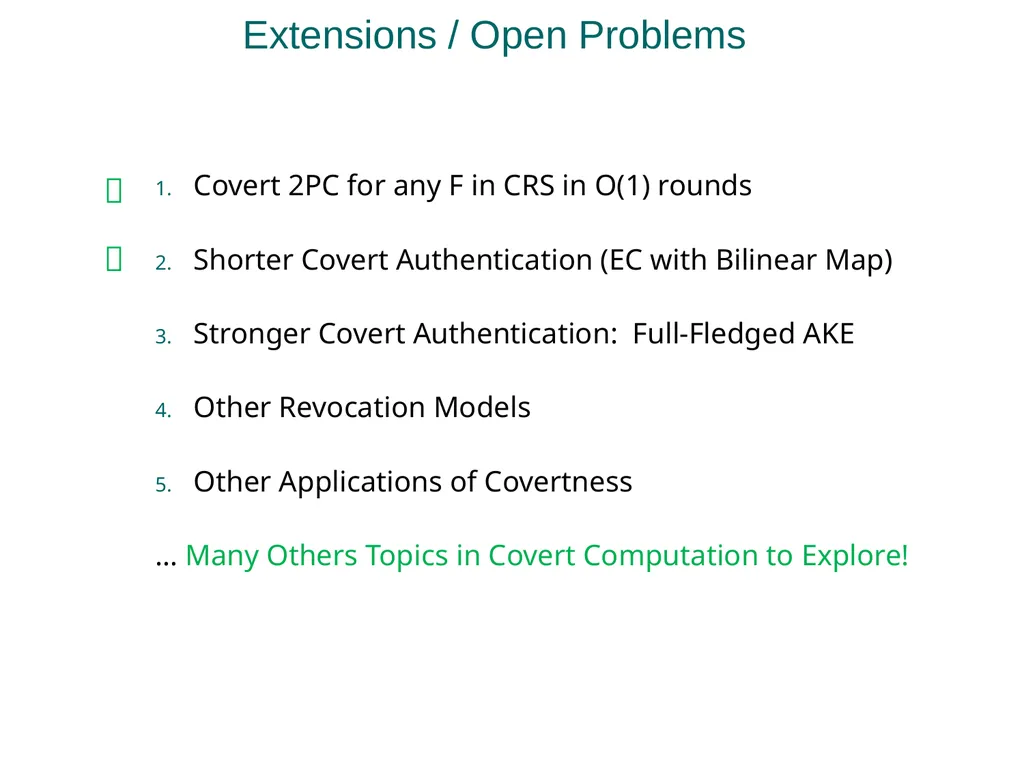
slide23. Extensions / Open Problems Covert 2PC for any F in CRS in O(1) rounds
Shorter Covert Authentication (EC with Bilinear Map)
Stronger Covert Authentication: Full-Fledged AKE
Other Revocation Models
Other Applications of Covertness
… Many Others Topics in Covert Computation to Explore!
<br>
University of California at Irvine
Public Key Cryptography 2014<br>
slide2. Presentation Plan Introduction to Covert Computation
Practical Covert Authentication Protocol
O(1) rounds, group elements, exponentiations…
Main Tool: Compiler for Covert Conditional OT’s
ZKPK+ (Σ-protocol) for language L Covert Conditional OT for L
Extensions / Open Problems<br>
slide3. Background: Secure Computation Secure Computation hides all except for what’s revealed by output A F(x,y) F x A A π for F B(y) ~ (eff.) adversary A (eff.) simulator à s.t. inputs y
A’s interaction with à F(y) ≈ A π(y) ≈ ~ y B<br>
slide4. Voting protocol attempt reveals a potential voter
Petition signing attempt reveals a potential signer
…
Authentication attempt reveals a member of some organization which uses the authentication protocol, no matter how credential/policy/attribute-hiding that protocol is! A F(x,y) x y B π for F Secure computation hides everything it can about B’s input… But not the fact that B engages in computation of F,
which is an information in itself! Background: Secure Computation<br>
slide5. Covert Computation Can we hide the fact that computation is taking place? Covert Computation (for functionality F) should hide even whether party B engages in a sec. comp. protocol for F A Q: How can we hide that B follows protocol π ?
A: Make π’s messages indistinguishable from $ bits B/? π for F<br>
slide6. Covert Computation (for functionality F) should hide even whether party B engages in a sec. comp. protocol for F A Q: How can we hide that B follows protocol π ?
A: Make π’s messages indistinguishable from $ bits
Q: How can we hide that B follows some protocol ?
A: Run π over a steganographic channel (= always sends $ bits)
Network control messages, padding, timing
Pictures, music, voice, …
Encryption (e.g. VPN router), other crypto (e.g. “kleptography”) B/$ Covert Computation Can we hide the fact that computation is taking place? π for F<br>
slide7. Covert Computation (for functionality F) should hide even whether party B engages in a sec. comp. protocol for F A F(x,y) x Q: But doesn’t A’s output z=F(x,y) reveal that B inputs some y?
A: Yes, but F outputs can look $ for many (x,y)’s
Authenticated Key Exchange
Any authenticated computation… π for F B/$ y/? Covert Computation Can we hide the fact that computation is taking place?<br>
slide8. A B x yD Distinguishability of F from $ beacon in the ideal world: F/$ ~ ~ A π/$ B(y) yD CovDist F,D,Ã = | Pr[1Ã F(y) | yD] - Pr[1Ã $(F)] | CovDist π,D,A = | Pr[1A π(y) | yD] - Pr[1A $(π)] | π covert if A Ã s.t. (1) [standard secure computation requirements]
(2) dist. D CovDist F,D,Ã ≈ CovDist π,D,A Distinguishability of π from $ beacon in the real world: Covert Computation Covert π = as “random” as the ideal F [vAHL05] (refined in [CGOS07])<br>
slide9. Covert Computation What is currently known? A B x yD [vAHL05]: Defined covert 2PC, O(sec.par.)-round protocol for any F
[CGOS07]: Defined covert MPC, O(sec.par.)-round protocol for any F
[GJ10]: Ω(sec.par.) rounds necessary for covert 2/MPC in plain model F/$ ~ ~ A π/$ B(y) yD Can 2PC/MPC be covert in O(1) rounds in CRS model?
Probably (see the last slide)
How about a covert authentication (not necessarily a covert 2PC)?
This work: 5 rounds (3 in ROM), ≈30 RSA exp.’s/party<br>
slide10. Covert Authentication Definition KeyGen PK + (CertA,CertB,CertC,…) [unforgeable cert. scheme] A B (PK,CertA) If A has no valid (& unrevoked) cert then FAuth ≈ $[FAuth]
Covertness w/o valid (& unrevoked) cert πAuth ≈ $[πAuth] FAuth
If Ver(PK,CertA) and Ver(PK,CertB) then KA = KB ( $)
o/w KA KB ( $ $) (PK,CertB) KA KB [ + handling of CRL’s ] Our work: Game-based definition, no extraction of PK (public input) & KB<br>
slide11. Covert Authentication Protocol Idea: (1) Use a “typical” Group Signature Sch. A B CA = COM(CertA) Revocation e.g. by ZKP that certificate in C is not on the CRL
Our work uses “verifier-local” revocation (w/o ZKP) [BS’04] (PK,CertB) (PK,CertA) ZKP[ (PK,CA) LComCert ] CB = COM(CertB) ZKP[ (PK,CB) LComCert ] LComCert = { x=(PK,C) s.t. w=(cert,dec) s.t.
Ver(PK,cert)=1 and Decommit(C,cert,dec)=1 } KeyGen PK + (CertA,CertB,CertC,…) [unforgeable cert. scheme]<br>
slide12. Covert Authentication Protocol Idea: (1) Use a “typical” Group Signature Sch. A B CA = COM(CertA) (PK,CertB) (PK,CertA) ZKP[ (PK,CA) LComCert ] KeyGen PK + (CertA,CertB,CertC,…) [unforgeable cert. scheme] P FZKP for L
If w witness for x in L
then b 1, o/w b 0 V b ZKP (for non-trivial L) makes a protocol inherently non-covert ! witness w statement x = (cert,dec) = (PK,C)<br>
slide13. Covert Authentication Protocol Idea: (2) Replace ZKP by Covert COT for LGrSig A B CA = COM(CertA) (PK,CertB) (PK,CertA) COT[ (PK,CA) LComCert ] KeyGen PK + (CertA,CertB,CertC,…) [unforgeable cert. scheme] FCOT for L
If w witness for x in L
then KR=KS, o/w KR KS KR KS R witness w = (cert,dec) S statement x = (PK,C) & KS Covertness: (1) In R’s view πCOT ≈ $[πCOT] if R has no valid w for S’s x
(2) In S’s view πCOT ≈ $[πCOT] for all x Covert Conditional Oblivious Transfer (COT) for L (KEM version) Strong-soundness: Efficient extraction of w from covertness-breaking R<br>
slide14. Covert Authentication Protocol Idea: (2) Replace ZKP by Covert COT for LGrSig A B CA = COM(CertA) (PK,CertB) (PK,CertA) COT[ (PK,CA) LComCert ] KeyGen PK + (CertA,CertB,CertC,…) [unforgeable cert. scheme] FCOT for L
If w witness for x in L
then KR=KS, o/w KR KS KR KS R witness w = (cert,dec) S statement x = (PK,C) & KS Encryption
Conditional OT (COT)
Strongly-Sound COT
Signature
ZK Proof
ZK Proof of Knowledge Covert Conditional Oblivious Transfer (COT) for L (KEM version)<br>
slide15. Covert Authentication Full Protocol A B CA = COM(CertA) (PK,CertB) (PK,CertA) COT[ (PK,CA) LComCert ] KeyGen PK + (CertA,CertB,CertC,…) [unforgeable cert. scheme] KAR KBS CB = COM(CertB) COT[ (PK,CB) LComCert ] KAS KBR KB = KBS KBR Covertness (assume A has no valid Cert):
A’s view of first COT together with KBS is ≈ $[πCOTS]
A’s view of CB and of second COT is ≈ $[πCOTR]
A’s view of the whole interaction together with KB is ≈ $ KA = KAR KAS & KBS<br>
slide16. Covert Authentication Full Protocol A B CA = COM(CertA) (PK,CertB) (PK,CertA) COT[ (PK,CA) LComCert ] KeyGen PK + (CertA,CertB,CertC,…) [unforgeable cert. scheme] KAR KBS CB = COM(CertB) COT[ (PK,CB) LComCert ] KAS KBR Covertness (assume A has no valid Cert):
A’s view of first COT together with KBS is ≈ $[πCOTS]
A’s view of CB and of second COT is ≈ $[πCOTR]
A’s view of the whole interaction together with KB is ≈ $ COT needs to assure extraction of witness w from covertness-breaking Receiver
If Adv who breaks covertness of Authentication Protocol
then Reduction extracts a valid certificate (forgery)<br>
slide17. & KS KR KS witness w S statement x Assume L = { x=([gij]) s.t. exits w=[wj] s.t.
g1 = (g11)w1 (g12)w2 … (g1n)wn
gm = (gm1)w1 (gm2)w2 … (g1n)wn } Smooth Projective Hash Function (SPHF) Covert COT
but no extraction of witness w from covertness-breaking R [ + additive and multiplicative relations between aj’s ] Constructing Covert COT for LComCert FCOT for L
If w witness for x in L
then KR=KS, o/w KR KS R<br>
slide18. R Compiler from ZKPK+ for LComCert to Covert COT KR KS witness w S statement x FCOT for L
If w witness for x in L
then KR=KS, o/w KS KR a = gr L = { x s.t. w s.t. x = gw } e $ z = r + e w (HV)ZKPK for L C=COM( ) SPHF[ C=COM(F(x,e,z)) ] If COM = ElGamal PKE then
SPHF for DDH tuple [CS’98]
(+ 2/3 exp’s / party) KS KR covert COT for L SIM for this ZKPK+:
z $ , e $
a = F(x,e,z) = gz / xe<br>
slide19. R Compiler from ZKPK+ for LComCert to Covert COT KR KS witness w S statement x FCOT for L
If w witness for x in L
then KR=KS, o/w KS KR L = { x s.t. w s.t. x = gw } SIM for this ZKPK+:
z $ , e $
a = F(x,e,z) = gz / xe Covertness from malicious S:
covert COM [ElGamal]
z $ (by ZKPK+)
SPHF non-interactive a = gr e $ z = r + e w (HV)ZKPK for L C=COM( ) SPHF[ C=COM(F(x,e,z)) ] KS KR covert COT for L<br>
slide20. R Compiler from ZKPK+ for LComCert to Covert COT KR KS witness w S statement x FCOT for L
If w witness for x in L
then KR=KS, o/w KS KR L = { x s.t. w s.t. x = gw } SIM for this ZKPK+:
z $ , e $
a = F(x,e,z) = gz / xe Covertness from malicious R:
(case1) C COM(F(x,e,z))
then KS R’s view of SPHF a = gr e $ z = r + e w (HV)ZKPK for L C=COM( ) SPHF[ C=COM(F(x,e,z)) ] KS KR covert COT for L<br>
slide21. R Compiler from ZKPK+ for LComCert to Covert COT KR KS witness w S statement x FCOT for L
If w witness for x in L
then KR=KS, o/w KS KR L = { x s.t. w s.t. x = gw } SIM for this ZKPK+:
z $ , e $
a = F(x,e,z) = gz / xe Covertness from malicious R:
(case2) C = COM(F(x,e,z))
then Forking Lemma
w Ext( (e,z) , (e’,z’) ) a = gr e $ z = r + e w (HV)ZKPK for L C=COM( ) SPHF[ C=COM(F(x,e,z)) ] KS KR covert COT for L<br>
slide22. Extensions / Open Problems Covert 2PC for any F in CRS in O(1) rounds
Definitions: Composable Covert MPC ?
Shorter Covert Authentication (EC with Bilinear Map)
Stronger Covert Authentication: Full-Fledged AKE
Other Revocation Models
Other Applications of Covertness (?)
(?)<br>
slide23. Extensions / Open Problems Covert 2PC for any F in CRS in O(1) rounds
Shorter Covert Authentication (EC with Bilinear Map)
Stronger Covert Authentication: Full-Fledged AKE
Other Revocation Models
Other Applications of Covertness
… Many Others Topics in Covert Computation to Explore!
<br>