Pre-Job Briefings Continuing Education First Quarter 2024 Upon completion of this continuing education module, you should be able to: Explain the why and purpose of conducting a pre-job briefing Identify what is required to be included in a
"Pre-Job Briefings Continuing Education First" is the property of its rightful owner. Permission is granted to
download and print the materials on this website for personal, non-commercial use only, and to display it
on your personal computer provided you do not modify the materials and that you retain all copyright
notices contained in the materials. By downloading content from our website, you accept the terms of this
agreement.
Presentation Transcript
01
Pre-Job Briefings Continuing Education First Quarter 2024<br>
02
Upon completion of this continuing education module, you should be able to:
Explain the why and purpose of conducting a pre-job briefing
Identify what is required to be included in a pre-job briefing
Identify precursors, notice exposures, and identify effective controls to reduce and/or eliminate a serious injury or fatality.
Explain roles and responsibilities for crew lead, and crew makeup Objectives 2<br>
03
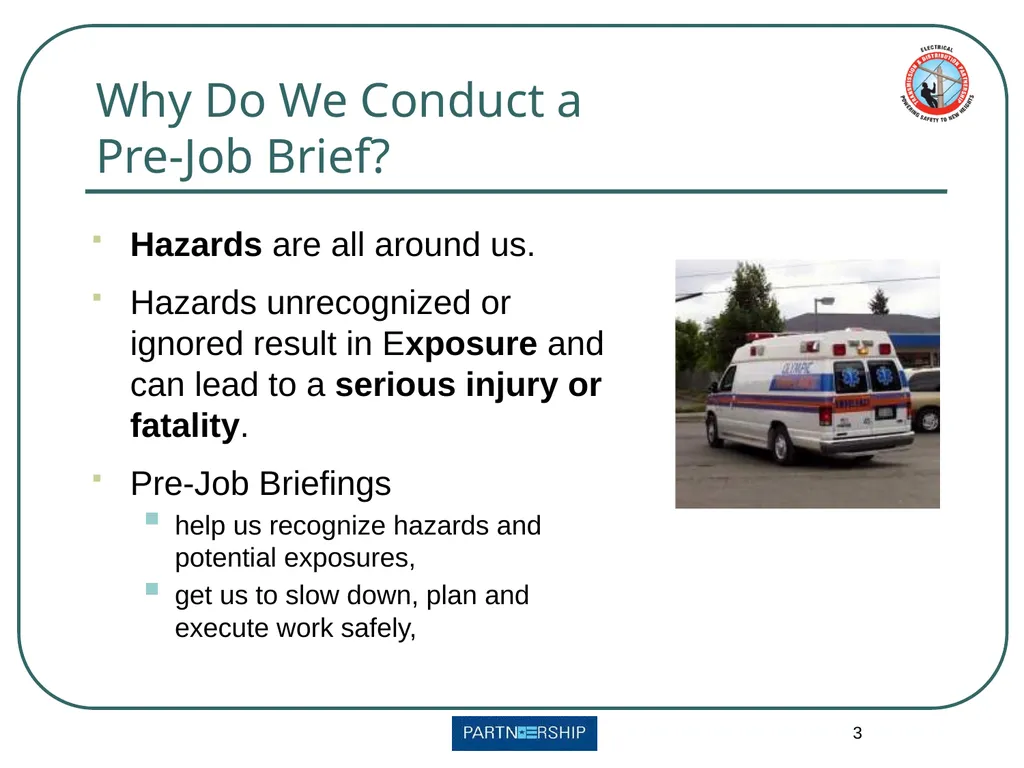
Why Do We Conduct a Pre-Job Brief? Hazards are all around us.
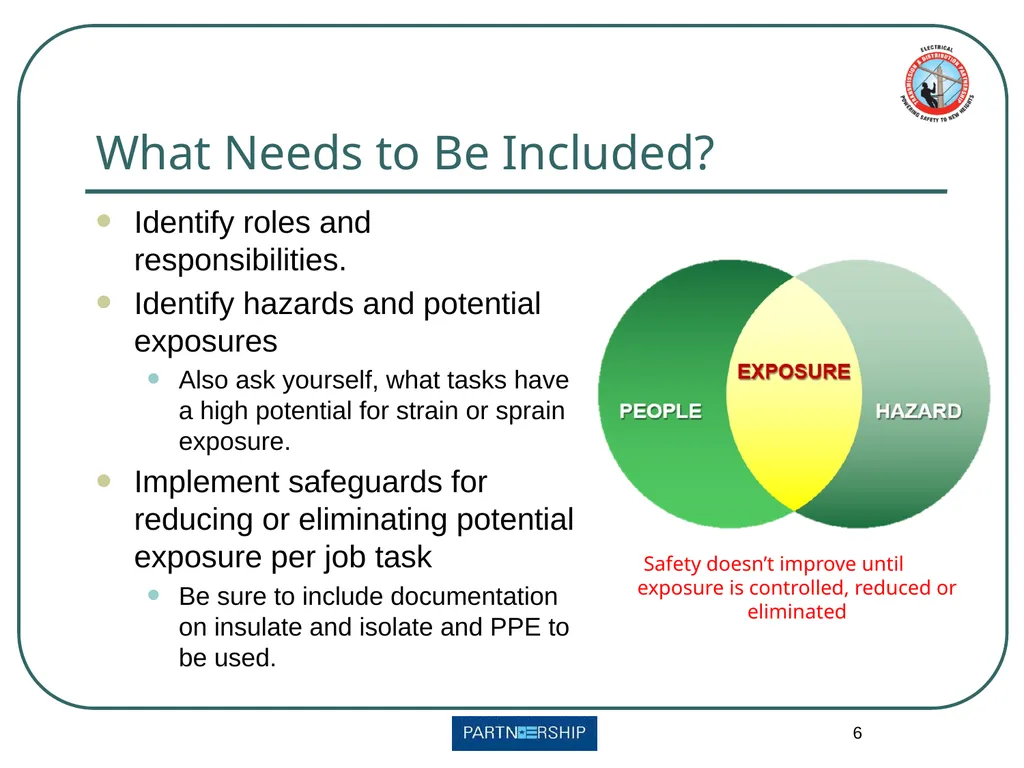
Hazards unrecognized or ignored result in Exposure and can lead to a serious injury or fatality.
Pre-Job Briefings
help us recognize hazards and potential exposures,
get us to slow down, plan and execute work safely, 3<br>
04
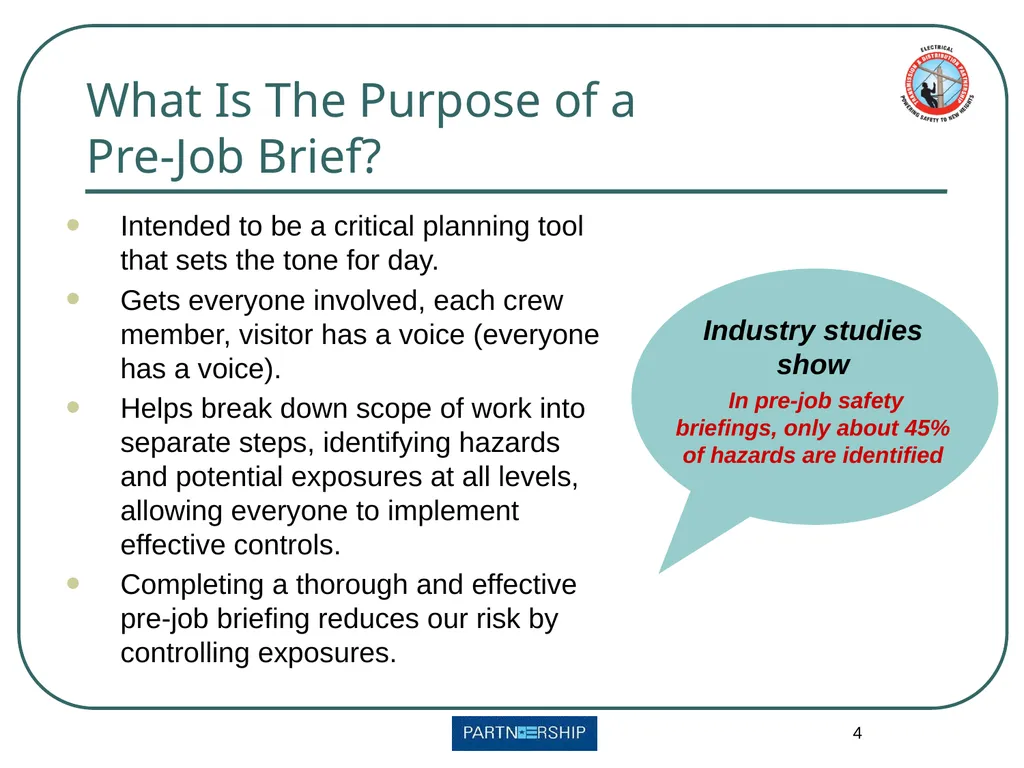
What Is The Purpose of a Pre-Job Brief? 4 Intended to be a critical planning tool that sets the tone for day.
Gets everyone involved, each crew member, visitor has a voice (everyone has a voice).
Helps break down scope of work into separate steps, identifying hazards and potential exposures at all levels, allowing everyone to implement effective controls.
Completing a thorough and effective pre-job briefing reduces our risk by controlling exposures. Industry studies show
In pre-job safety briefings, only about 45% of hazards are identified<br>
05
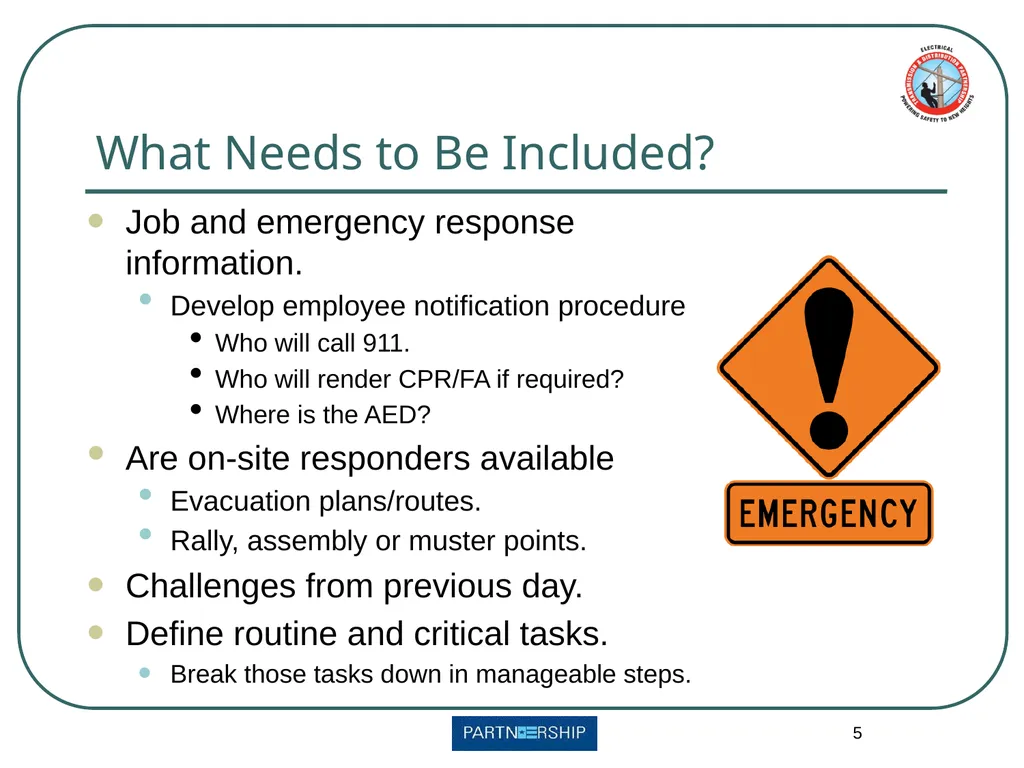
What Needs to Be Included? Job and emergency response information.
Develop employee notification procedure
Who will call 911.
Who will render CPR/FA if required?
Where is the AED?
Are on-site responders available
Evacuation plans/routes.
Rally, assembly or muster points.
Challenges from previous day.
Define routine and critical tasks.
Break those tasks down in manageable steps. 5<br>
06
What Needs to Be Included? Identify roles and responsibilities.
Identify hazards and potential exposures
Also ask yourself, what tasks have a high potential for strain or sprain exposure.
Implement safeguards for reducing or eliminating potential exposure per job task
Be sure to include documentation on insulate and isolate and PPE to be used. 6 Safety doesn’t improve until exposure is controlled, reduced or eliminated<br>
07
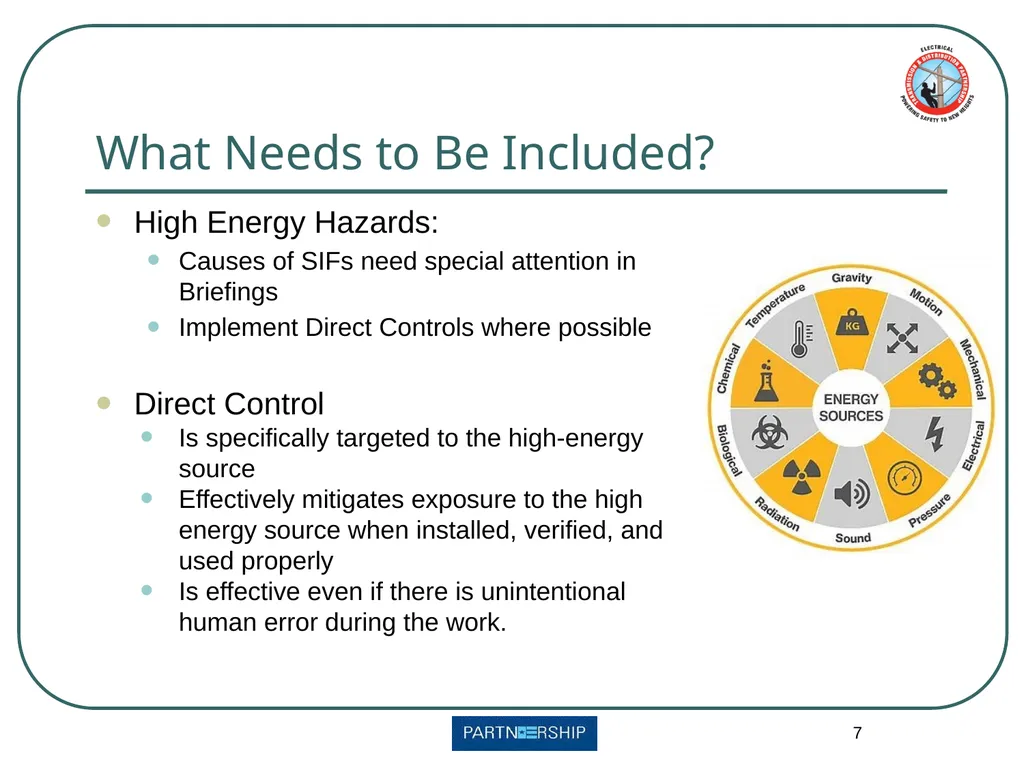
What Needs to Be Included? High Energy Hazards:
Causes of SIFs need special attention in Briefings
Implement Direct Controls where possible
Direct Control
Is specifically targeted to the high-energy source
Effectively mitigates exposure to the high energy source when installed, verified, and used properly
Is effective even if there is unintentional human error during the work. 7<br>
08
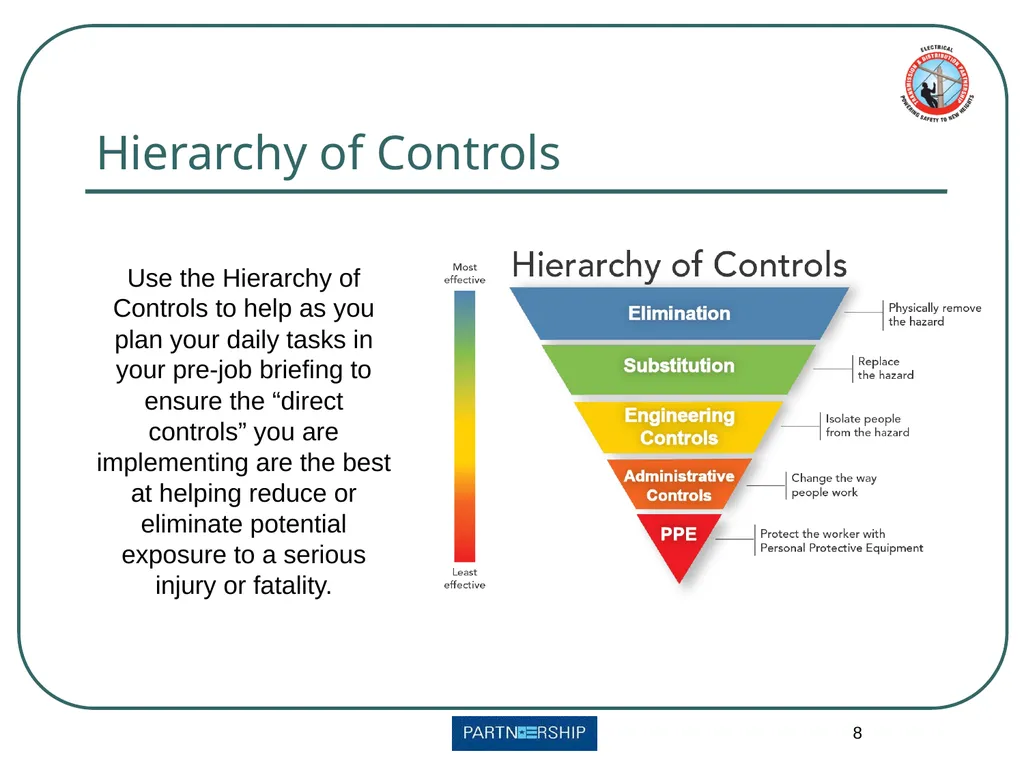
Hierarchy of Controls Use the Hierarchy of Controls to help as you plan your daily tasks in your pre-job briefing to ensure the “direct controls” you are implementing are the best at helping reduce or eliminate potential exposure to a serious injury or fatality. 8<br>
09
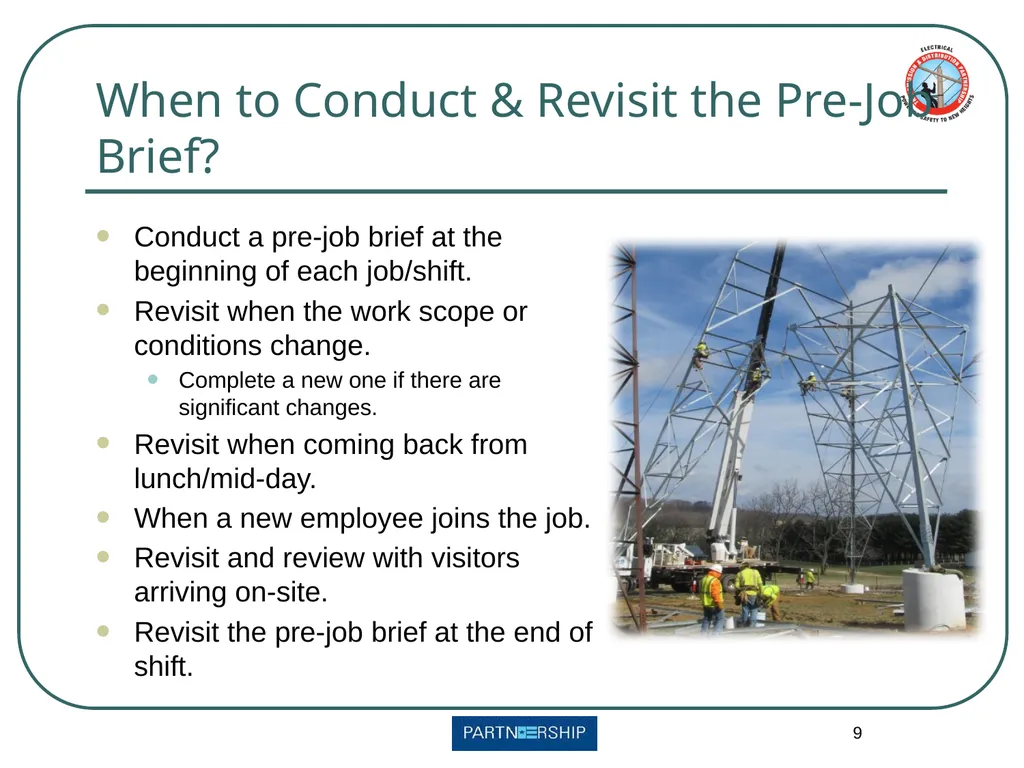
When to Conduct & Revisit the Pre-Job Brief? Conduct a pre-job brief at the beginning of each job/shift.
Revisit when the work scope or conditions change.
Complete a new one if there are significant changes.
Revisit when coming back from lunch/mid-day.
When a new employee joins the job.
Revisit and review with visitors arriving on-site.
Revisit the pre-job brief at the end of shift. 9<br>
10
Working Alone According to the Pre-Job Briefing Best Practice:
An employee working alone shall complete a pre-job briefing.
The briefing shall be documented.
The briefing shall be used to verify controls are in place per work tasks. 10<br>
11
DOs and DONTs 11 DO this when conducting a PJB Shall be conducted before ANY work starts.
Share the responsibility of writing out and presenting the pre-job brief with each crew member.
Make sure the pre-job brief is a discussion, not just a read-out.
Make sure the area has adequate lighting.
Make sure the area is quiet enough that everyone can hear and be heard.
Make sure the pre-job brief is legible.
Make sure the pre-job brief is kept readily available on site.
Make sure all crew members and visitors sign in. Start work without a pre-job brief.
Just pass the pre-job brief around for everyone to sign without discussion.
Just hand a visitor the pre-job brief without reviewing it with them in detail.
Just copy the pre-job brief from the day before.
Assume everyone knows their role and the hazards they will encounter.
Forget about the “tasks between tasks”. These are the work area set-up, common material and tool handling, mobilization-demobilization type tasks that support the primary task steps. DON’T do this when conducting a PJB<br>
12
Review When are job briefings required?
Who is required to conduct them?
Per OSHA, what topics must be discussed?
When are additional job briefings required?
When do you need a rally point? 12<br>