Preamble of Indian Constitution Paste preamble Why Constitutions Have Preamble? Preamble means introduction tells us the source of the authority of the Constitution. It indicates the Ideals, goals Vision of framers It tells us about the
"Preamble of Indian Constitution Paste preamble Why" is the property of its rightful owner. Permission is granted to
download and print the materials on this website for personal, non-commercial use only, and to display it
on your personal computer provided you do not modify the materials and that you retain all copyright
notices contained in the materials. By downloading content from our website, you accept the terms of this
agreement.
Presentation Transcript
01
Preamble of Indian Constitution Paste preamble<br>
02
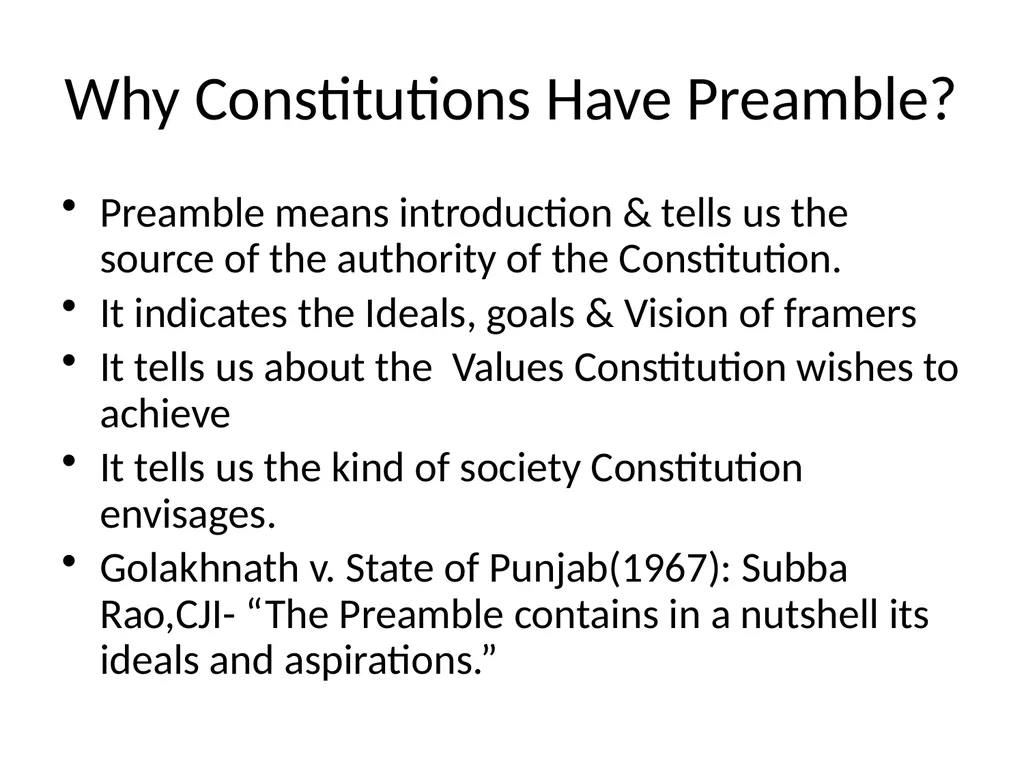
Why Constitutions Have Preamble? Preamble means introduction & tells us the source of the authority of the Constitution.
It indicates the Ideals, goals & Vision of framers
It tells us about the Values Constitution wishes to achieve
It tells us the kind of society Constitution envisages.
Golakhnath v. State of Punjab(1967): Subba Rao,CJI- “The Preamble contains in a nutshell its ideals and aspirations.”<br>
03
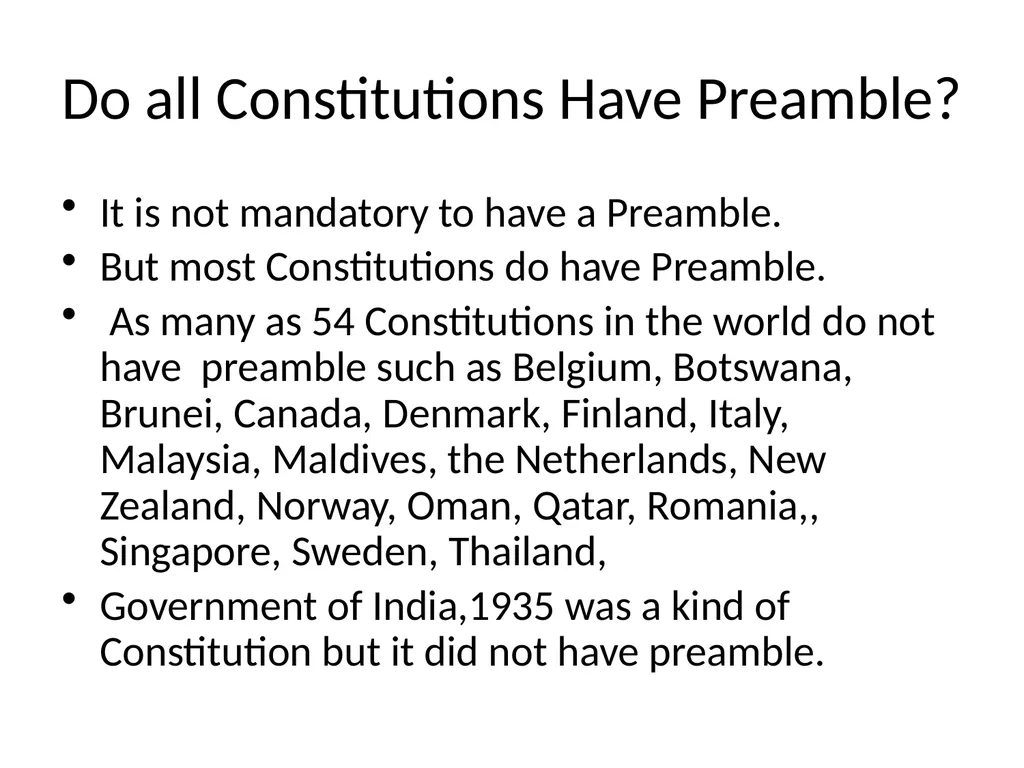
Do all Constitutions Have Preamble? It is not mandatory to have a Preamble.
But most Constitutions do have Preamble.
As many as 54 Constitutions in the world do not have preamble such as Belgium, Botswana, Brunei, Canada, Denmark, Finland, Italy, Malaysia, Maldives, the Netherlands, New Zealand, Norway, Oman, Qatar, Romania,, Singapore, Sweden, Thailand,
Government of India,1935 was a kind of Constitution but it did not have preamble.<br>
04
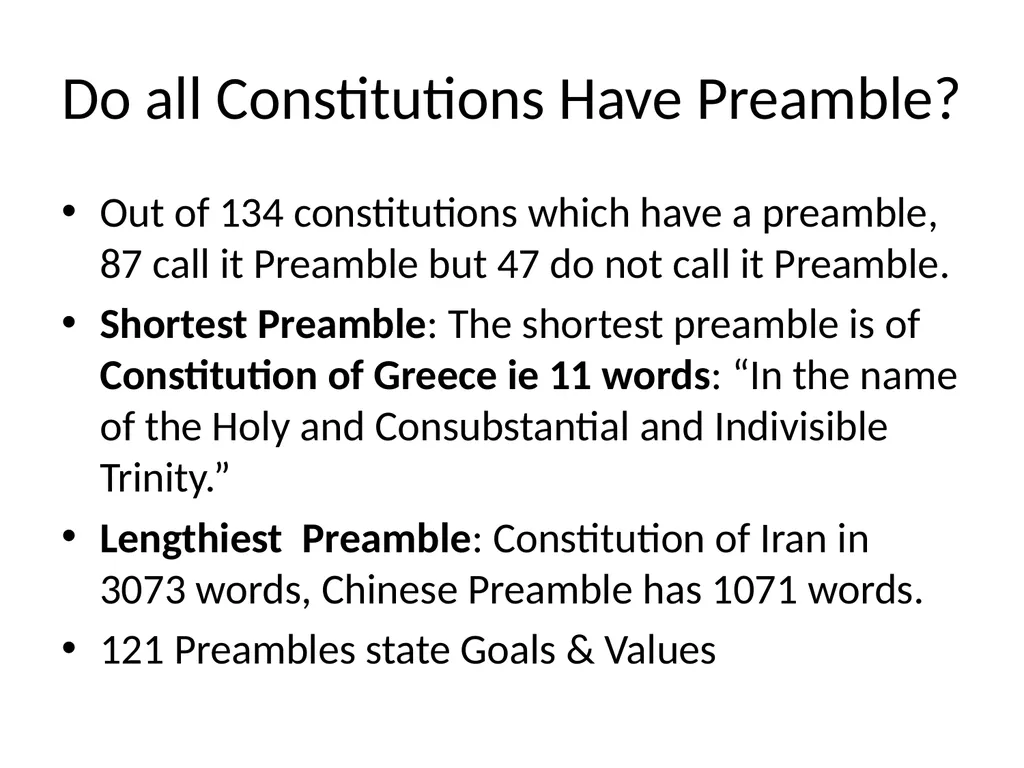
Do all Constitutions Have Preamble? Out of 134 constitutions which have a preamble, 87 call it Preamble but 47 do not call it Preamble.
Shortest Preamble: The shortest preamble is of Constitution of Greece ie 11 words: “In the name of the Holy and Consubstantial and Indivisible Trinity.”
Lengthiest Preamble: Constitution of Iran in 3073 words, Chinese Preamble has 1071 words.
121 Preambles state Goals & Values<br>
05
What the common Values referred in the Preambles? Reference to God in 60 Preambles Albania, Brazil, Uganda, Germany,, Greece, Iran, Iraq and Ireland.
Sovereignty, independence, territorial integrity of the Nation and right to self-determination.
Democracy, rule of law, justice, social justice, freedom, equality, equality before law and human rights.
Peaceful & Cordial relations with other countries, prosperity, welfare.
Humanism, Pluralism, protection of interests of minorities.<br>
06
Who Drafted Indian Preamble? No clear record
Three Views:
Predominant View- Based on Objective Resolution of Pt. Jawaharlal Nehru
Sir B. N. Rau: Advisor to Constituent Assembly
Drafting Committee: Most members did not work
Dr.B.R. Ambedkar: Prof. Akash Singh Rathore<br>
07
Is Preamble Part of Constitution? Preamble of Ordinary Acts may not be enacted by the Legislature.
Preamble was originally presented as Objective Resolution but eventually it was adopted at last on the suggestion of Hasrat Mohani.
Preamble of Constitution was adopted by the Constituent Assembly just like other provisions.
In re Berubari(1960)- Preamble is not part of the Constitution and cannot be amended.
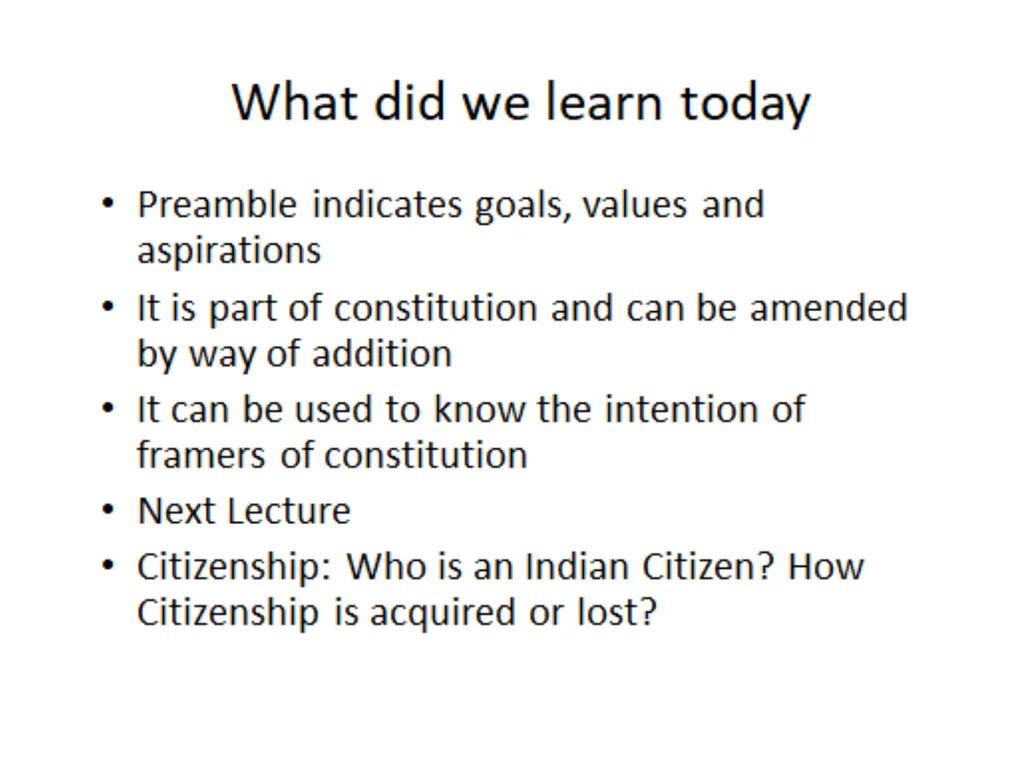
Keshavanand Bharti Judgment(1973)- Preamble is part of Constitution and can be amended.
Preamble is Basic Structure of the Constitution- State of U.P. v Dina Nath Shukla(1997)<br>
08
Can Preamble be amended? Since today Preamble is part of Basic Structure- It can be amended.
But How?
Only way of addition.
Supreme Court refused to delete word ‘Socialist’
Preamble was amended by the 42nd Amendment in 1976.
Three words were added: Secular, Socialist & Integrity.<br>
09
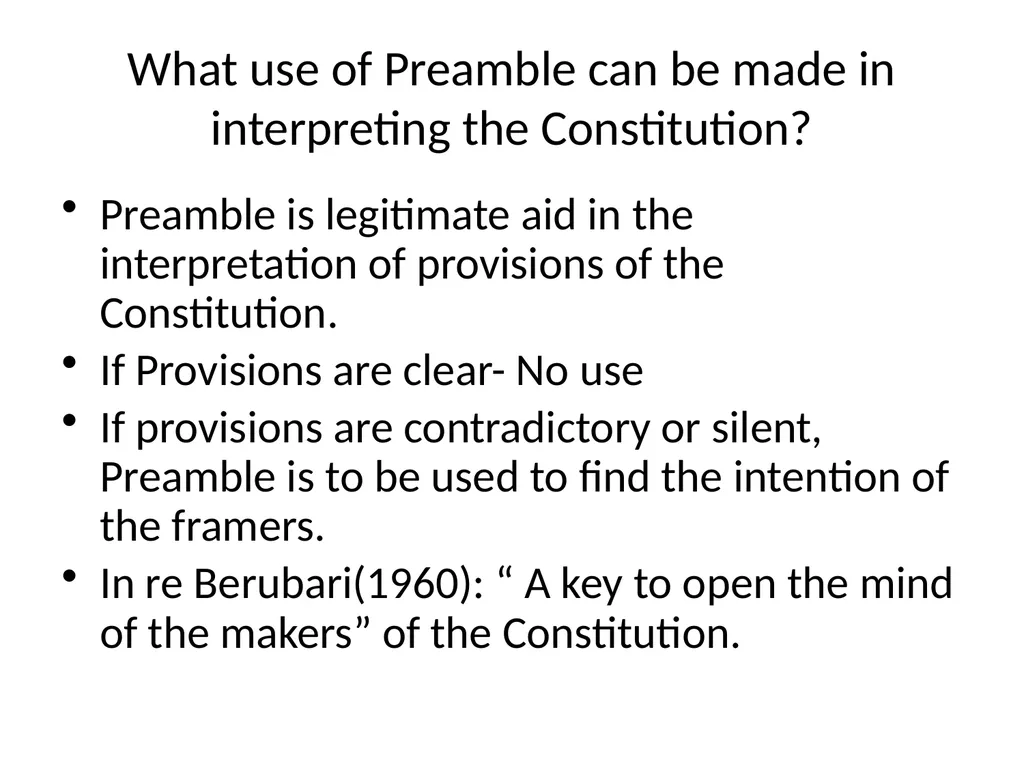
What use of Preamble can be made in interpreting the Constitution? Preamble is legitimate aid in the interpretation of provisions of the Constitution.
If Provisions are clear- No use
If provisions are contradictory or silent, Preamble is to be used to find the intention of the framers.
In re Berubari(1960): “ A key to open the mind of the makers” of the Constitution.<br>
10
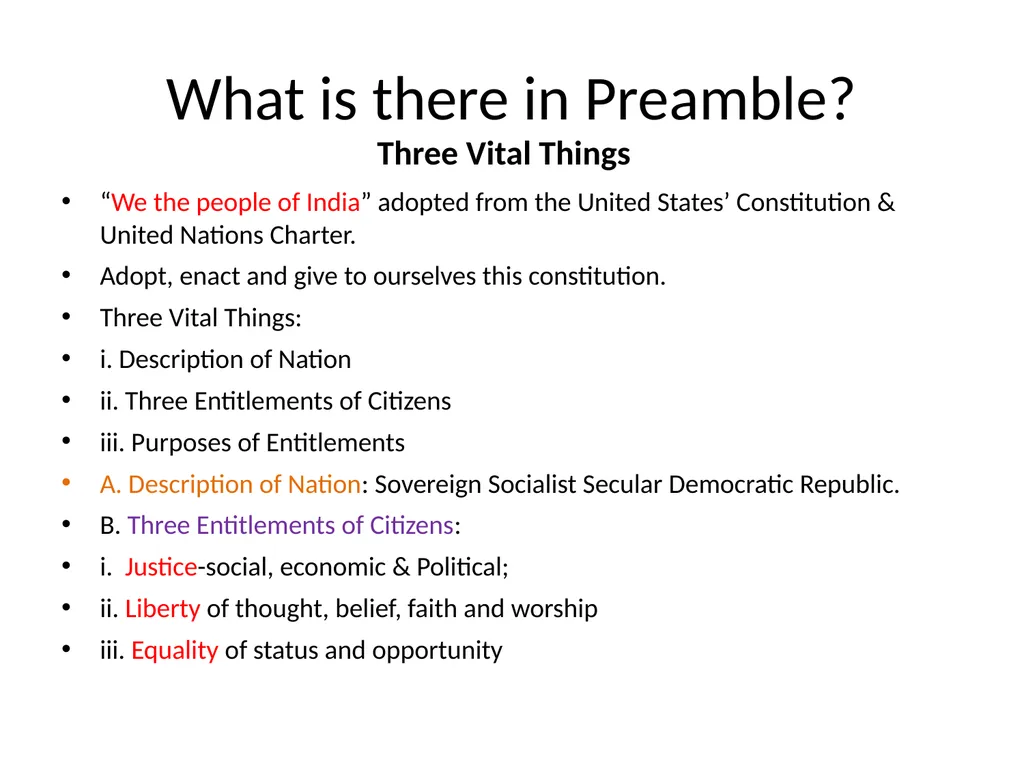
What is there in Preamble? “We the people of India” adopted from the United States’ Constitution & United Nations Charter.
Adopt, enact and give to ourselves this constitution.
Three Vital Things:
i. Description of Nation
ii. Three Entitlements of Citizens
iii. Purposes of Entitlements
A. Description of Nation: Sovereign Socialist Secular Democratic Republic.
B. Three Entitlements of Citizens:
i. Justice-social, economic & Political;
ii. Liberty of thought, belief, faith and worship
iii. Equality of status and opportunity Three Vital Things<br>
11
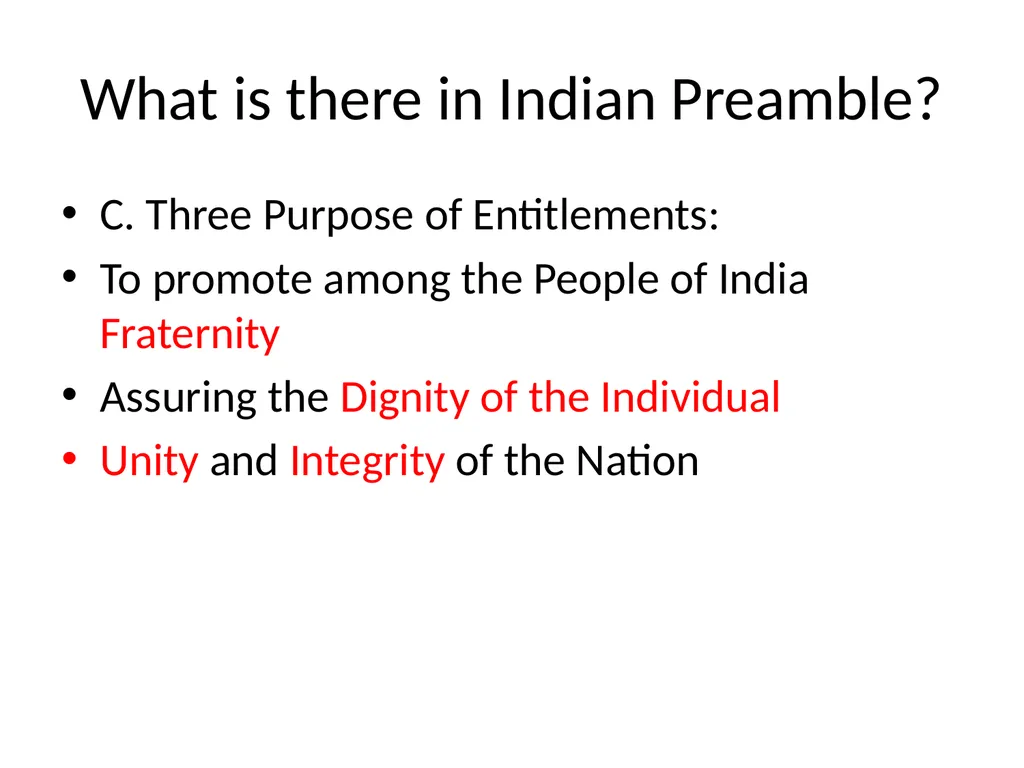
What is there in Indian Preamble? C. Three Purpose of Entitlements:
To promote among the People of India Fraternity
Assuring the Dignity of the Individual
Unity and Integrity of the Nation<br>
12
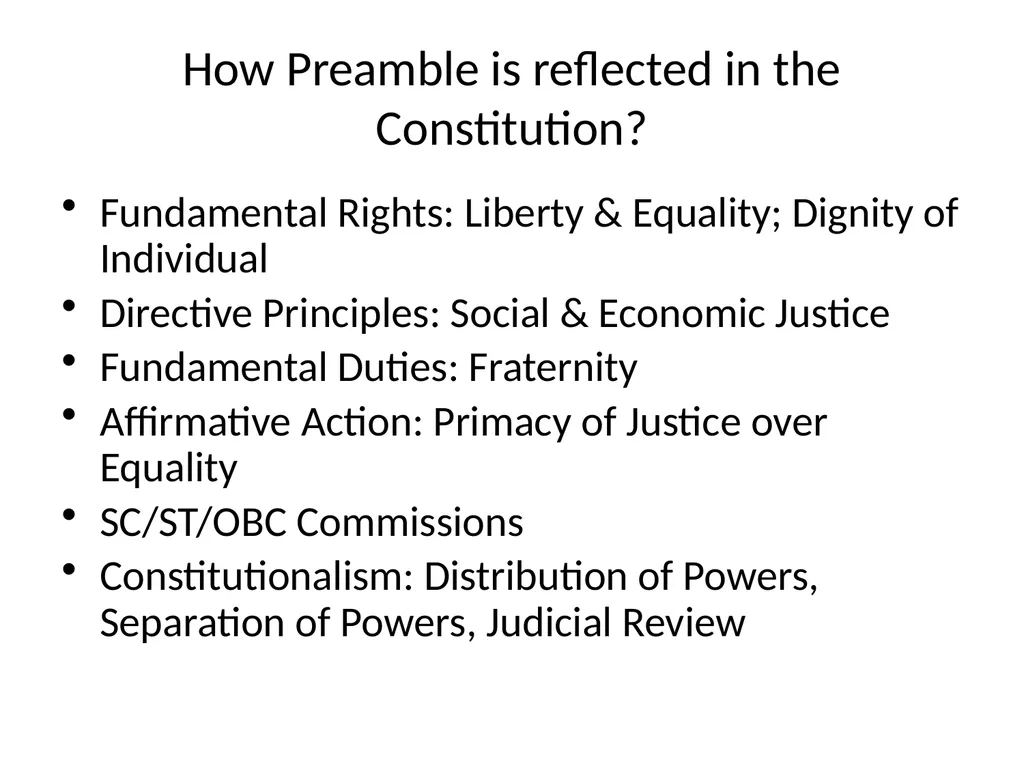
How Preamble is reflected in the Constitution? Fundamental Rights: Liberty & Equality; Dignity of Individual
Directive Principles: Social & Economic Justice
Fundamental Duties: Fraternity
Affirmative Action: Primacy of Justice over Equality
SC/ST/OBC Commissions
Constitutionalism: Distribution of Powers, Separation of Powers, Judicial Review<br>
13
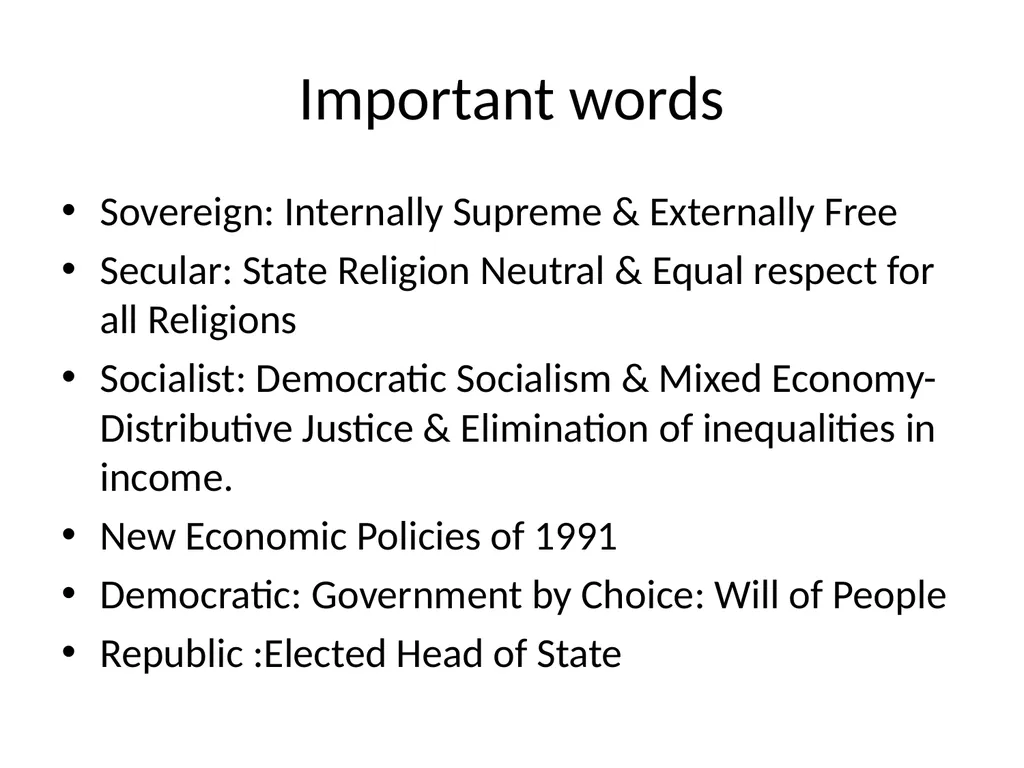
Important words Sovereign: Internally Supreme & Externally Free
Secular: State Religion Neutral & Equal respect for all Religions
Socialist: Democratic Socialism & Mixed Economy- Distributive Justice & Elimination of inequalities in income.
New Economic Policies of 1991
Democratic: Government by Choice: Will of People
Republic :Elected Head of State<br>
14
Disclaimer The views which have been expressed by the speaker in the lecture are his personal views.<br>