PRECCA Prevention and Combating Corrupt Activities Act The Prevention and Combating of Corrupt Activities Act (PRECCA) aims to prevent and fight corruption in government and in the private sector PURPOSE OF PRECCA To strengthen measures to
"PRECCA Prevention and Combating Corrupt Activities" is the property of its rightful owner. Permission is granted to
download and print the materials on this website for personal, non-commercial use only, and to display it
on your personal computer provided you do not modify the materials and that you retain all copyright
notices contained in the materials. By downloading content from our website, you accept the terms of this
agreement.
Presentation Transcript
01
PRECCA Prevention and Combating Corrupt Activities Act<br>
02
The Prevention and Combating of Corrupt Activities Act (PRECCA)
aims to prevent and fight corruption in government and in the private sector<br>
03
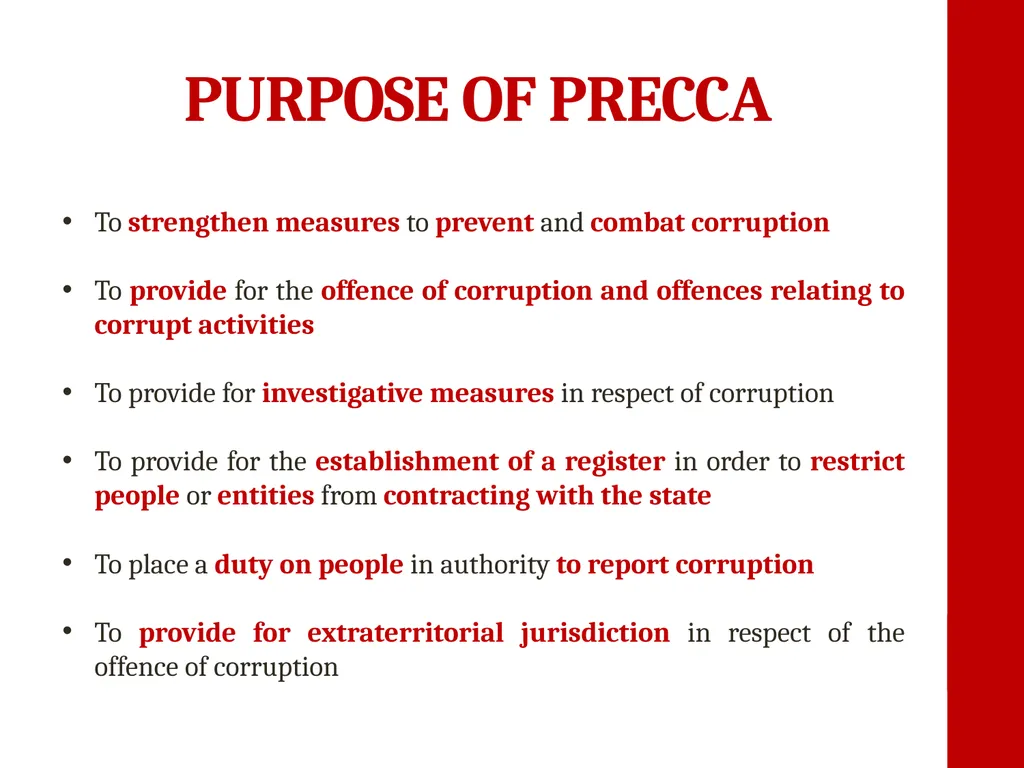
PURPOSE OF PRECCA To strengthen measures to prevent and combat corruption
To provide for the offence of corruption and offences relating to corrupt activities
To provide for investigative measures in respect of corruption
To provide for the establishment of a register in order to restrict people or entities from contracting with the state
To place a duty on people in authority to report corruption
To provide for extraterritorial jurisdiction in respect of the offence of corruption<br>
04
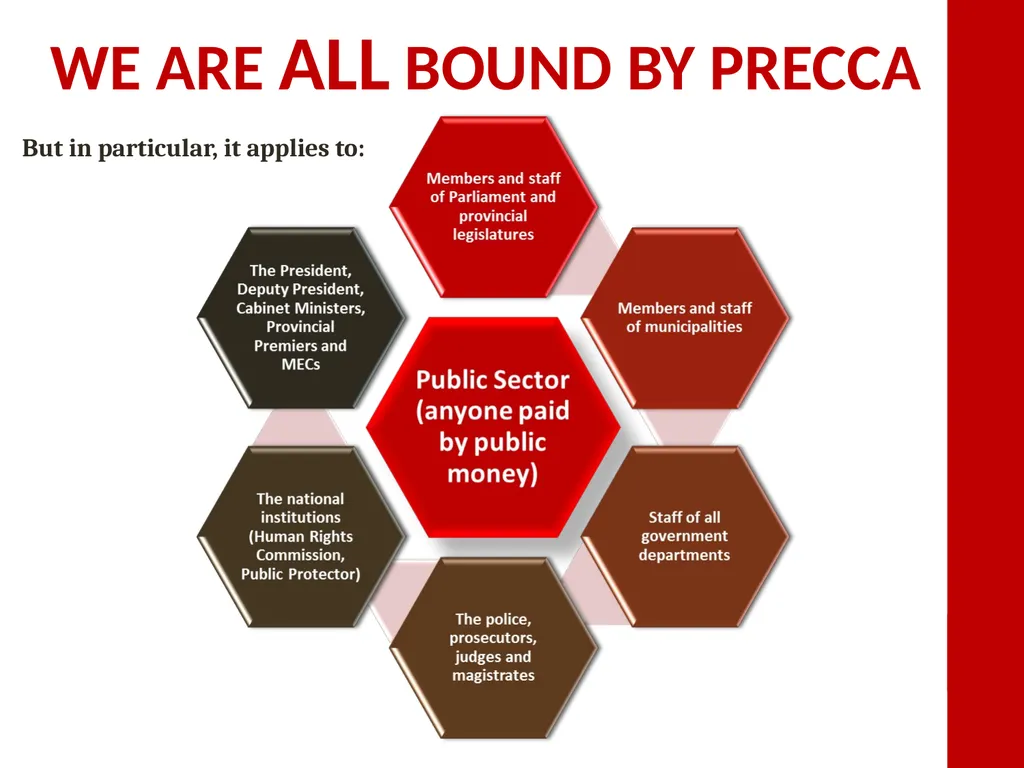
WE ARE ALL BOUND BY PRECCA But in particular, it applies to:<br>
05
GENERAL OFFENCE OF CORRUPTION UNDER PRECCA In simple terms, corruption is:
Someone offering to give or someone agreeing to receive
Gratification
Someone in a position of power using their power illegally or unfairly, where their conduct is unjustified.
Broadly, what does gratification mean?
Money
A donation
A vote
A service or a favour
Employment<br>
06
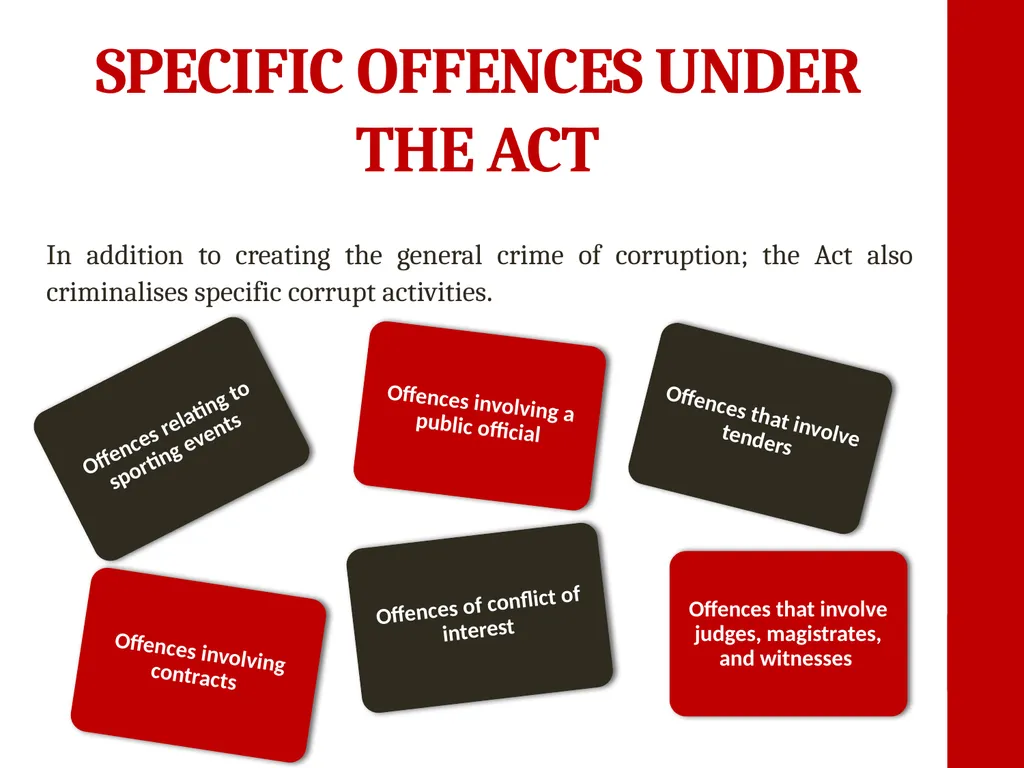
SPECIFIC OFFENCES UNDER THE ACT In addition to creating the general crime of corruption; the Act also criminalises specific corrupt activities.<br>
07
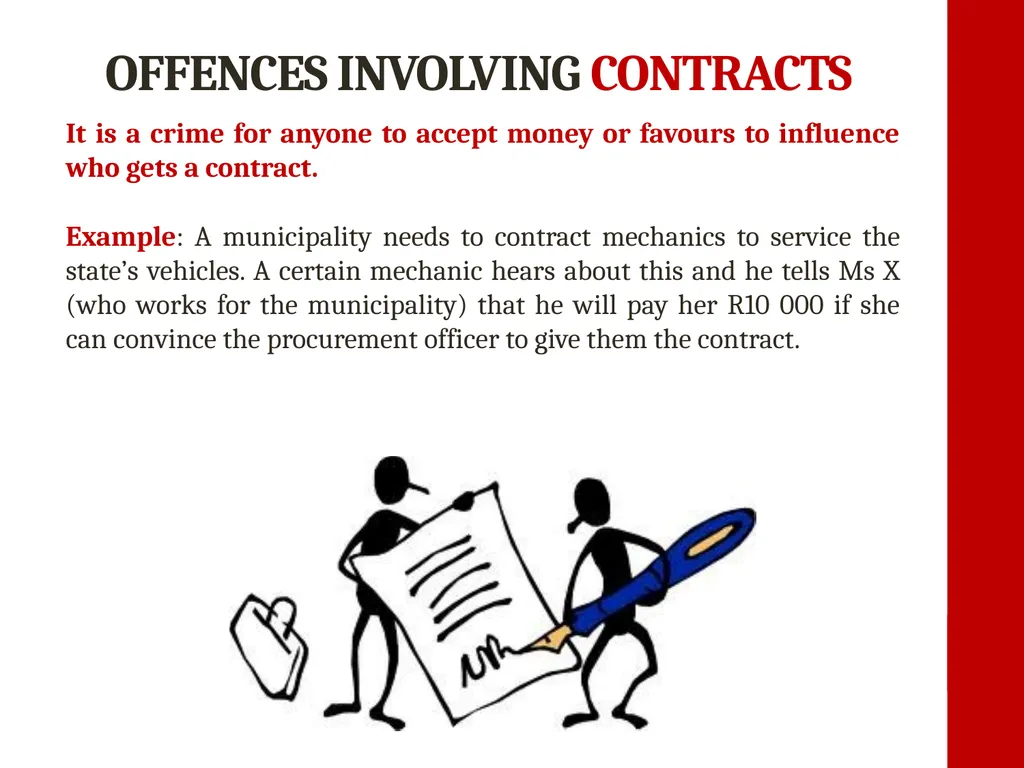
OFFENCES INVOLVING CONTRACTS It is a crime for anyone to accept money or favours to influence who gets a contract.
Example: A municipality needs to contract mechanics to service the state’s vehicles. A certain mechanic hears about this and he tells Ms X (who works for the municipality) that he will pay her R10 000 if she can convince the procurement officer to give them the contract.<br>
08
OFFENCES INVOLVING A PUBLIC OFFICIAL If anyone in the private sector offers a public official money or a favour to give them a benefit, they will be guilty of corruption.
If a public official offers to do something for someone in the private sector in exchange for money or a favour, the public official will be guilty of corruption.
Example: Bribing a traffic cop to escape a fine.<br>
09
OFFENCES THAT INVOLVE JUDGES, MAGISTRATES AND WITNESSES It is a crime to offer a magistrate or judge money or a favour to decide on a case in a certain way.
Example: A magistrate who accepts bribes to influence the outcome of a court case.<br>
10
OFFENCES THAT INVOLVE TENDERS The Act makes it a crime to offer or accept money or favours in order to influence the awarding of a tender.
Example: A member of a bid committee awards a contract to a particular bidder in exchange for a fee.<br>
11
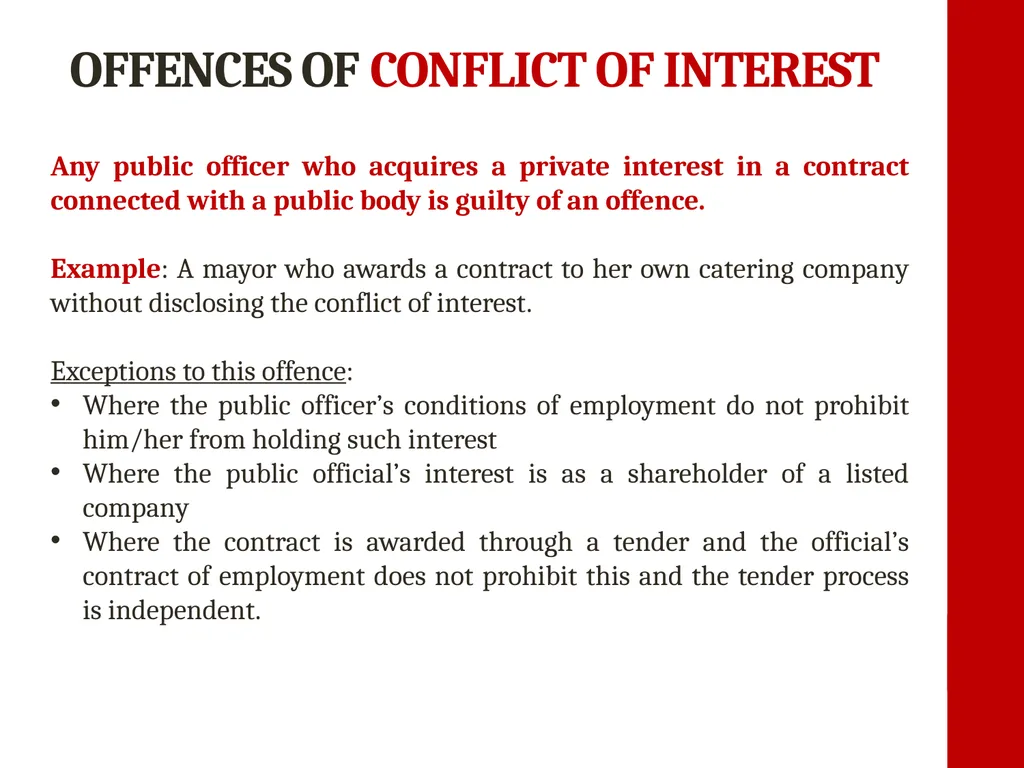
OFFENCES OF CONFLICT OF INTEREST Any public officer who acquires a private interest in a contract connected with a public body is guilty of an offence.
Example: A mayor who awards a contract to her own catering company without disclosing the conflict of interest.
Exceptions to this offence:
Where the public officer’s conditions of employment do not prohibit him/her from holding such interest
Where the public official’s interest is as a shareholder of a listed company
Where the contract is awarded through a tender and the official’s contract of employment does not prohibit this and the tender process is independent.<br>
12
PENALTIES UNDER THE ACT The Act imposes penalties for people who are convicted of corrupt activities. Hefty prison sentences can be imposed, as well as fines.
If convicted in the High Court, one can receive up to life imprisonment.
If convicted in the regional magistrates’ court, one can receive a sentence of up to 18 years in prison.
If convicted in the district magistrates’ court, one can receive up to five years in prison.<br>
13
REPORTING CORRUPTION UNDER PRECCA Section 34 of the Act requires all people in positions of authority in both the public and private sector to report corruption to the police if it involves amounts worth more than R100 000.
Failure by people in positions of authority to report corruption is an offence!
People in positions of authority include:
The director-general/ head of national or provincial government
The municipal manager of the municipality
The principal or head of a tertiary institution
The director of a company
The executive manager of a bank
A partner in a partnership
CEOs<br>