Preparing to Chair Bruce Reed, PhD Deputy Director, CSR Summer 2023 Additional Preparation Shift roles Being study section chair is quite different from serving as a reviewer Switch from reviewing applications to leading discussions about
"Preparing to Chair Bruce Reed, PhD Deputy" is the property of its rightful owner. Permission is granted to
download and print the materials on this website for personal, non-commercial use only, and to display it
on your personal computer provided you do not modify the materials and that you retain all copyright
notices contained in the materials. By downloading content from our website, you accept the terms of this
agreement.
Presentation Transcript
01
Preparing to Chair Bruce Reed, PhD
Deputy Director, CSR
Summer 2023<br>
02
Additional Preparation Shift roles
Being study section chair is quite different from serving as a reviewer
Switch from reviewing applications to leading discussions about applications
Contemplate your role; Get clear on the main things you will be trying to accomplish
Consider this opportunity to change things
How well do your study section practices align with today’s talk?
Work in partnership with the SRO
Review concerns with your SRO.<br>
03
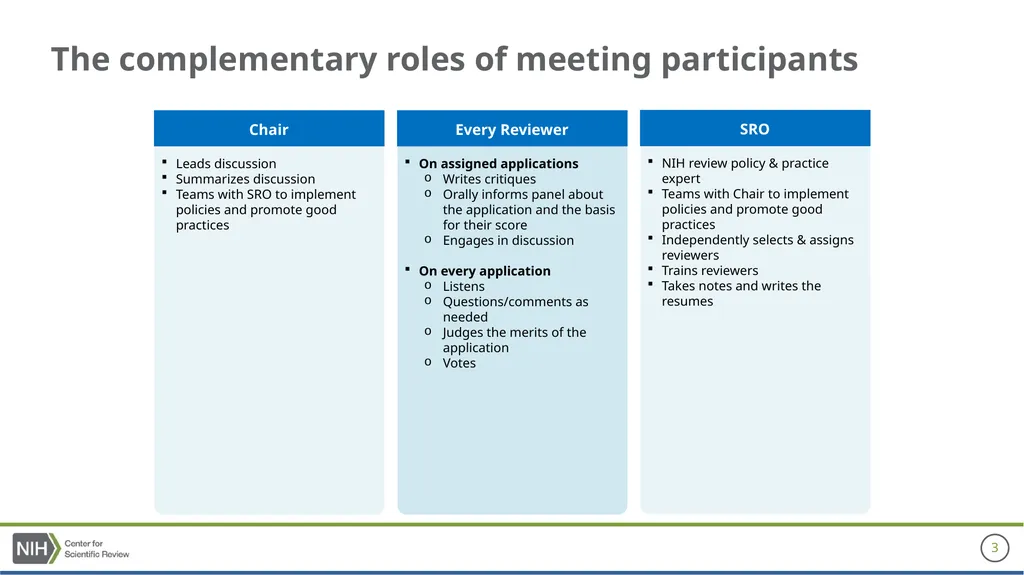
The complementary roles of meeting participants<br>
04
Why discuss at all? Review outcomes are committee decisions.
Panels add valuable additional perspectives on the significance of the research and strength of the approach.
Everyone votes and all votes are weighted equally
Every vote should reflect an informed, independent judgment
Oral critiques: should inform the panel of the basis for that reviewer’s score
Discussions allow
Assigned reviewers to explore or explain their differences
Clarifications
Challenges
Adding new (score driving) considerations
Score calibration
A good discussion gives panel members the information they need to make an informed judgment about the proposal.
Clarity, not consensus, is the goal.<br>
05
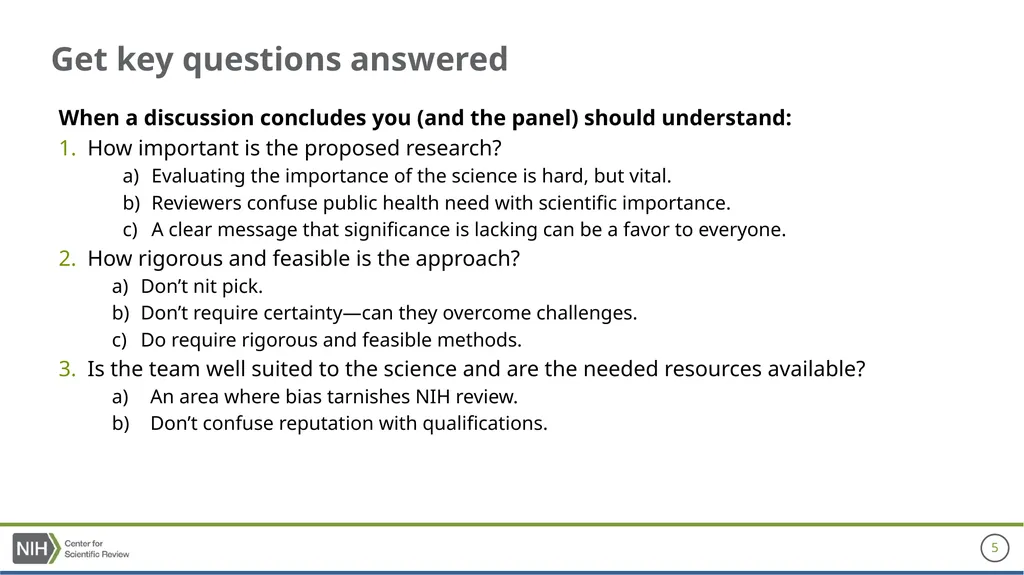
Get key questions answered When a discussion concludes you (and the panel) should understand:
How important is the proposed research?
Evaluating the importance of the science is hard, but vital.
Reviewers confuse public health need with scientific importance.
A clear message that significance is lacking can be a favor to everyone.
How rigorous and feasible is the approach?
Don’t nit pick.
Don’t require certainty—can they overcome challenges.
Do require rigorous and feasible methods.
Is the team well suited to the science and are the needed resources available?
An area where bias tarnishes NIH review.
Don’t confuse reputation with qualifications.<br>
06
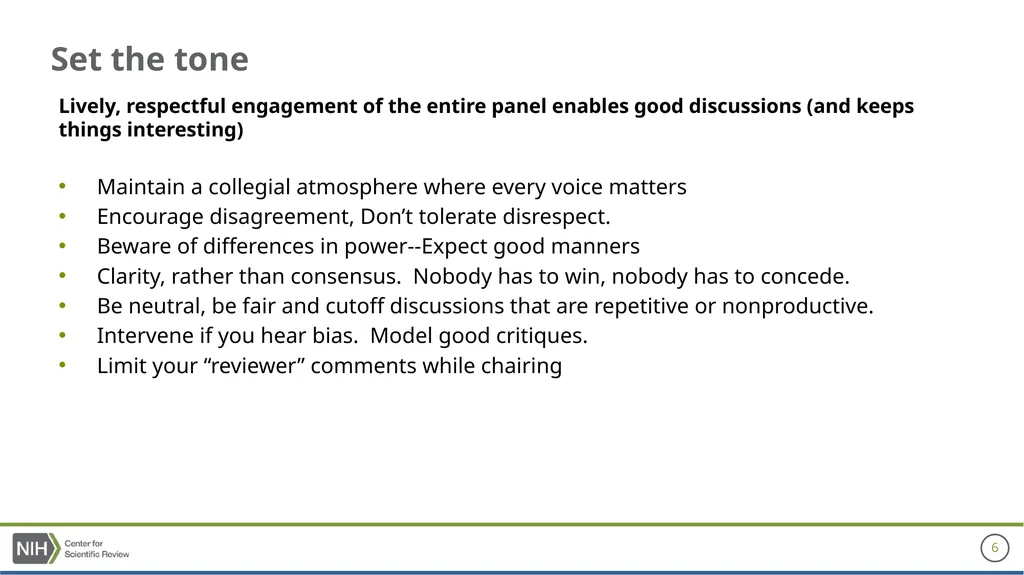
Set the tone Lively, respectful engagement of the entire panel enables good discussions (and keeps things interesting)
Maintain a collegial atmosphere where every voice matters
Encourage disagreement, Don’t tolerate disrespect.
Beware of differences in power--Expect good manners
Clarity, rather than consensus. Nobody has to win, nobody has to concede.
Be neutral, be fair and cutoff discussions that are repetitive or nonproductive.
Intervene if you hear bias. Model good critiques.
Limit your “reviewer” comments while chairing<br>
07
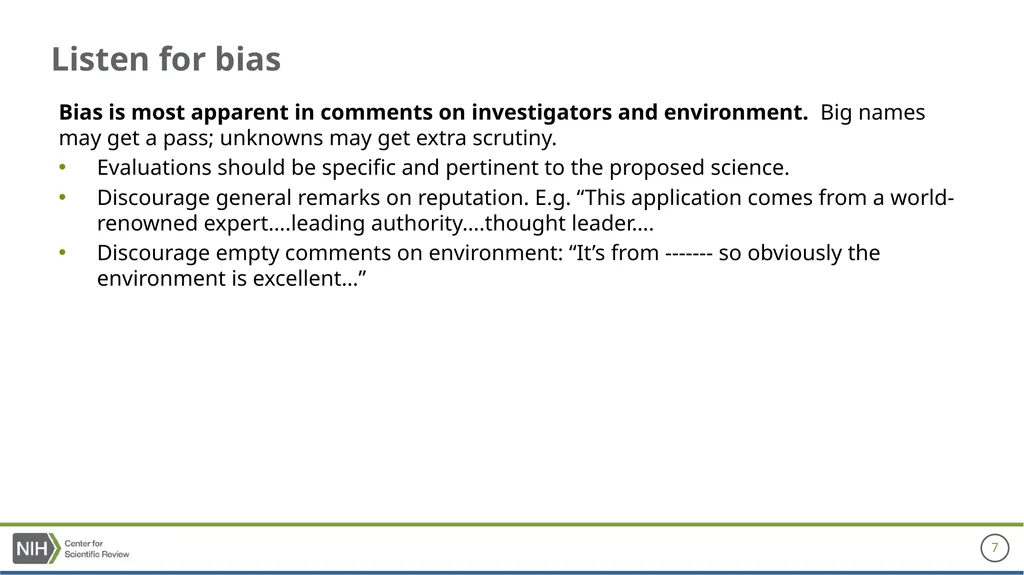
Listen for bias Bias is most apparent in comments on investigators and environment. Big names may get a pass; unknowns may get extra scrutiny.
Evaluations should be specific and pertinent to the proposed science.
Discourage general remarks on reputation. E.g. “This application comes from a world-renowned expert….leading authority….thought leader….
Discourage empty comments on environment: “It’s from ------- so obviously the environment is excellent…”<br>
08
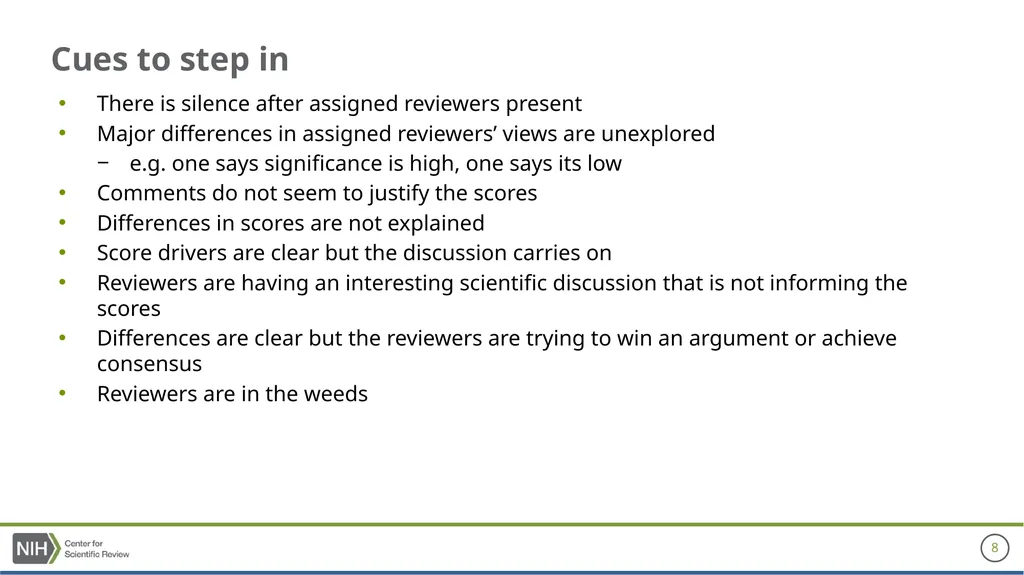
Cues to step in There is silence after assigned reviewers present
Major differences in assigned reviewers’ views are unexplored
e.g. one says significance is high, one says its low
Comments do not seem to justify the scores
Differences in scores are not explained
Score drivers are clear but the discussion carries on
Reviewers are having an interesting scientific discussion that is not informing the scores
Differences are clear but the reviewers are trying to win an argument or achieve consensus
Reviewers are in the weeds<br>
09
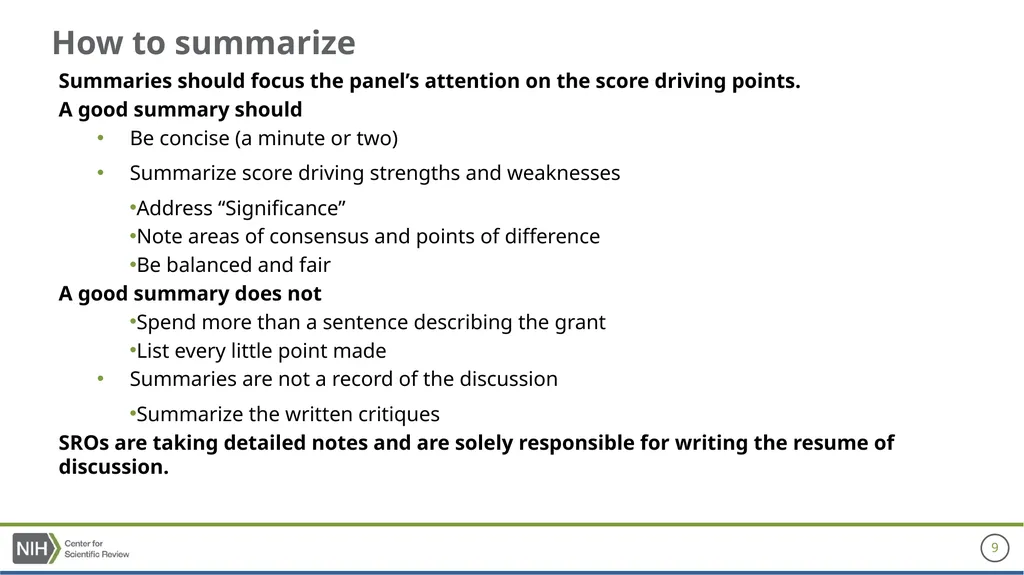
How to summarize Summaries should focus the panel’s attention on the score driving points.
A good summary should
Be concise (a minute or two)
Summarize score driving strengths and weaknesses
Address “Significance”
Note areas of consensus and points of difference
Be balanced and fair
A good summary does not
Spend more than a sentence describing the grant
List every little point made
Summaries are not a record of the discussion
Summarize the written critiques
SROs are taking detailed notes and are solely responsible for writing the resume of discussion.<br>
10
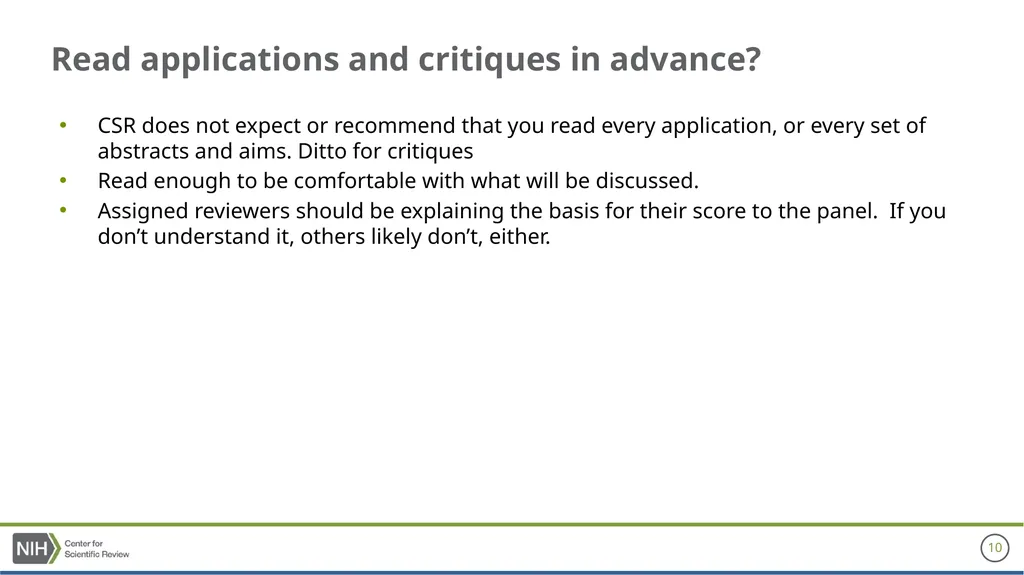
Read applications and critiques in advance? CSR does not expect or recommend that you read every application, or every set of abstracts and aims. Ditto for critiques
Read enough to be comfortable with what will be discussed.
Assigned reviewers should be explaining the basis for their score to the panel. If you don’t understand it, others likely don’t, either.<br>
11
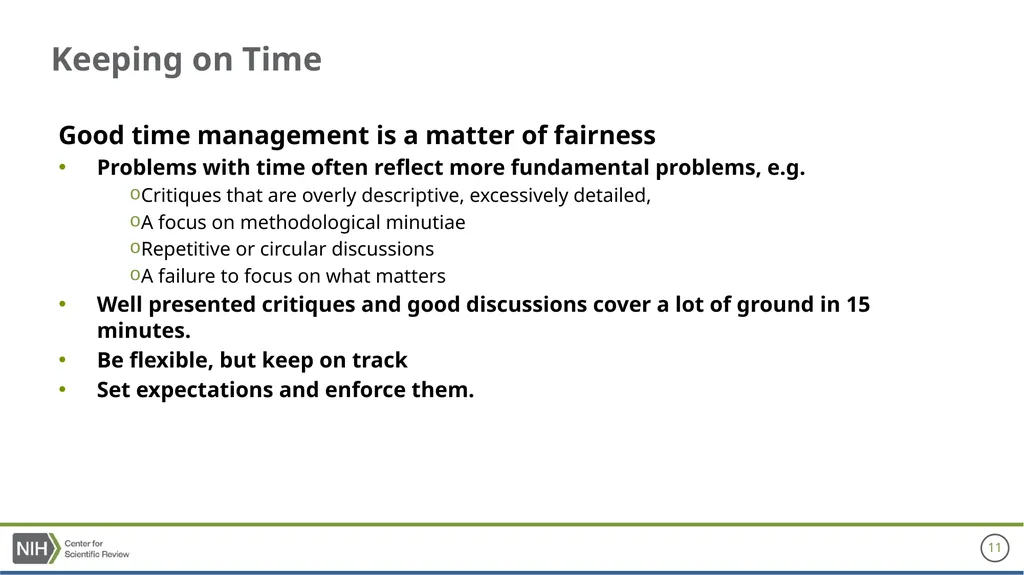
Keeping on Time Good time management is a matter of fairness
Problems with time often reflect more fundamental problems, e.g.
Critiques that are overly descriptive, excessively detailed,
A focus on methodological minutiae
Repetitive or circular discussions
A failure to focus on what matters
Well presented critiques and good discussions cover a lot of ground in 15 minutes.
Be flexible, but keep on track
Set expectations and enforce them.<br>
12
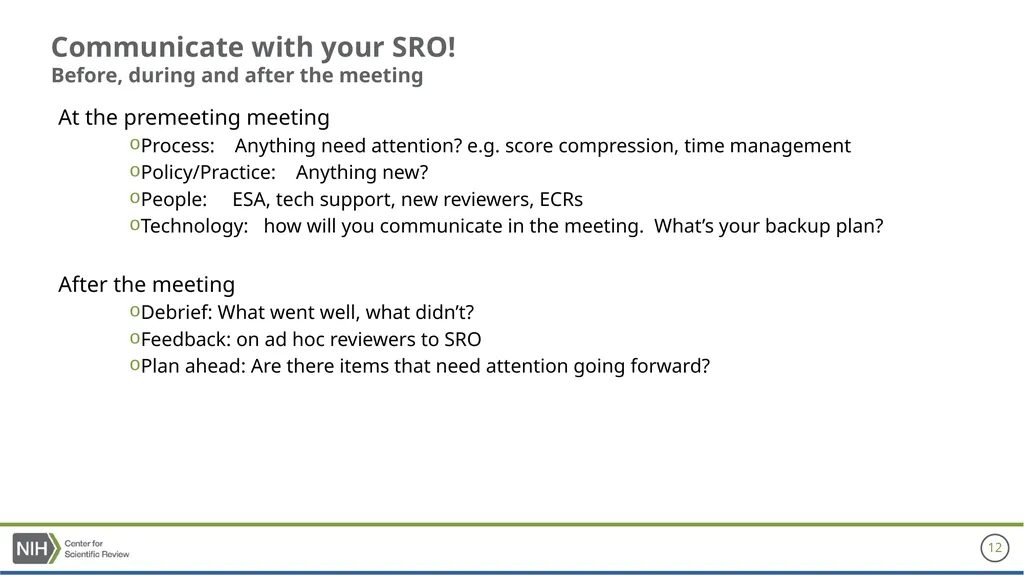
Communicate with your SRO! Before, during and after the meeting At the premeeting meeting
Process: Anything need attention? e.g. score compression, time management
Policy/Practice: Anything new?
People: ESA, tech support, new reviewers, ECRs
Technology: how will you communicate in the meeting. What’s your backup plan?
After the meeting
Debrief: What went well, what didn’t?
Feedback: on ad hoc reviewers to SRO
Plan ahead: Are there items that need attention going forward?<br>
13
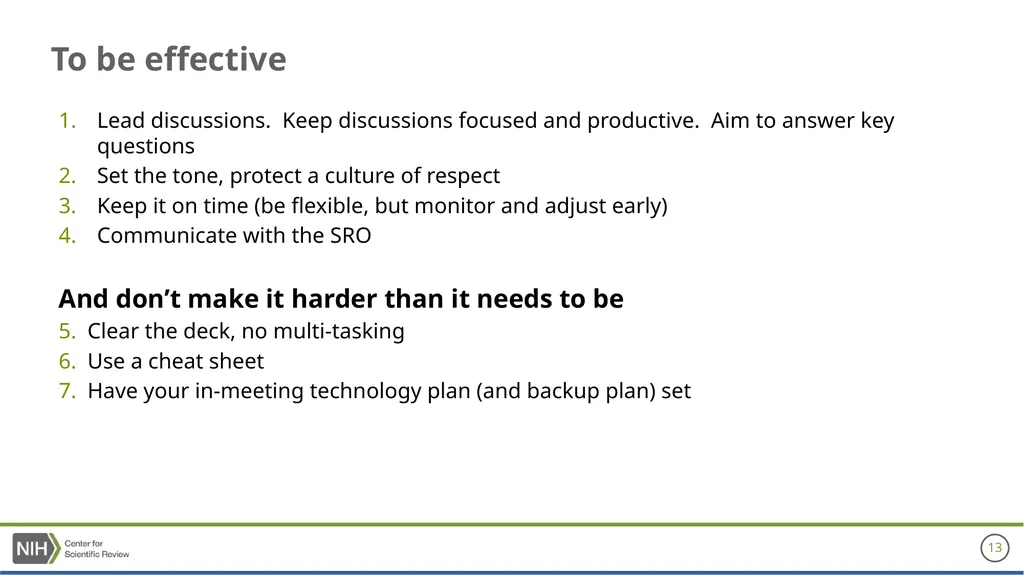
To be effective Lead discussions. Keep discussions focused and productive. Aim to answer key questions
Set the tone, protect a culture of respect
Keep it on time (be flexible, but monitor and adjust early)
Communicate with the SRO
And don’t make it harder than it needs to be
Clear the deck, no multi-tasking
Use a cheat sheet
Have your in-meeting technology plan (and backup plan) set<br>