
PRESENTATION BY NERSA CHAIRPERSON, MR THEMBANI
T
Published · 91 slides · 0 views

1 / 1
Description
PRESENTATION BY NERSA CHAIRPERSON, MR THEMBANI BUKULA, 16 OCTOBER 2024 NERSA PRESENTATION OF ITS ANNUAL REPORT FOR 202324 AT THE PORTFOLIO COMMITTEE ON ELECTRICITY AND ENERGY (PCEE) Executive Summary of detailed presentation Introduction
Related Topics
Share
Embed code
Download this presentation From Below
"PRESENTATION BY NERSA CHAIRPERSON, MR THEMBANI" is the property of its rightful owner. Permission is granted to download and print the materials on this website for personal, non-commercial use only, and to display it on your personal computer provided you do not modify the materials and that you retain all copyright notices contained in the materials. By downloading content from our website, you accept the terms of this agreement.
Presentation Transcript
01
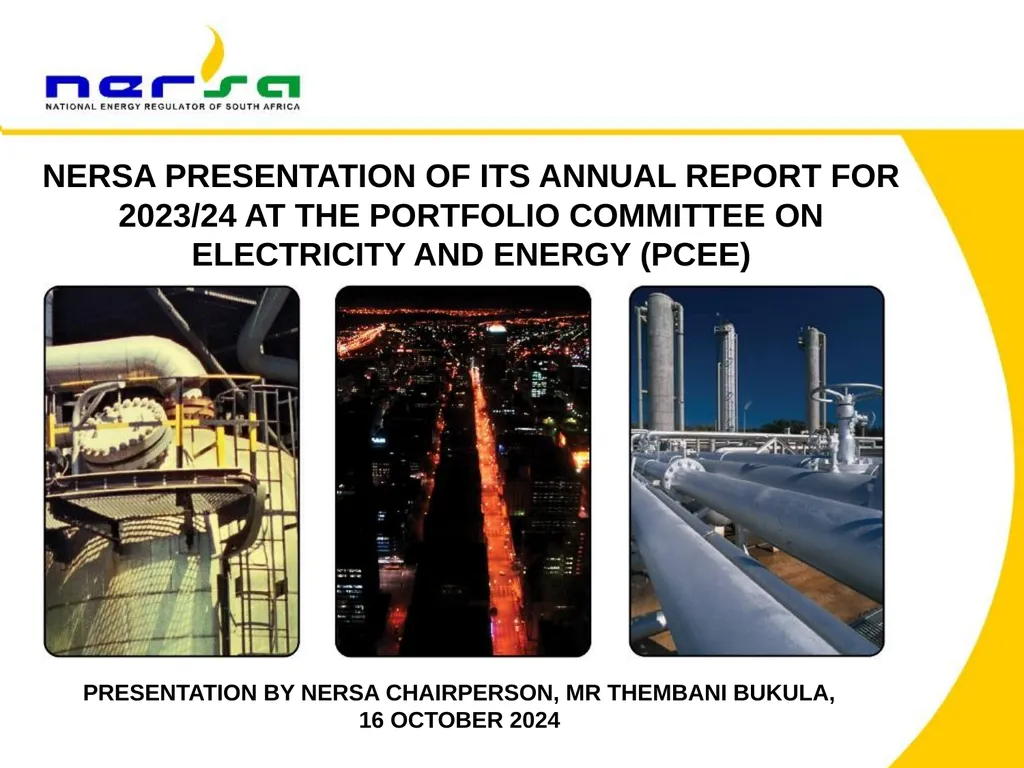
PRESENTATION BY NERSA CHAIRPERSON, MR THEMBANI BUKULA,
16 OCTOBER 2024 NERSA PRESENTATION OF ITS ANNUAL REPORT FOR 2023/24 AT THE PORTFOLIO COMMITTEE ON ELECTRICITY AND ENERGY (PCEE)<br>
16 OCTOBER 2024 NERSA PRESENTATION OF ITS ANNUAL REPORT FOR 2023/24 AT THE PORTFOLIO COMMITTEE ON ELECTRICITY AND ENERGY (PCEE)<br>
02
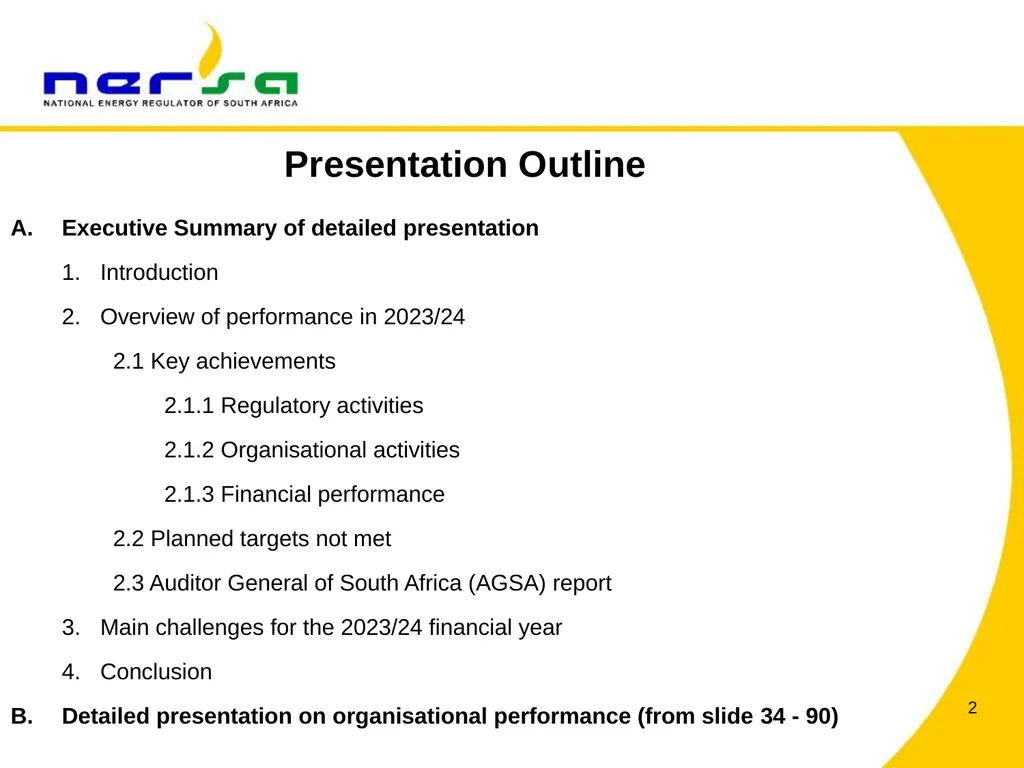
Executive Summary of detailed presentation
Introduction
Overview of performance in 2023/24
2.1 Key achievements
2.1.1 Regulatory activities
2.1.2 Organisational activities
2.1.3 Financial performance
2.2 Planned targets not met
2.3 Auditor General of South Africa (AGSA) report
Main challenges for the 2023/24 financial year
Conclusion
Detailed presentation on organisational performance (from slide 34 - 90) Presentation Outline 2<br>
Introduction
Overview of performance in 2023/24
2.1 Key achievements
2.1.1 Regulatory activities
2.1.2 Organisational activities
2.1.3 Financial performance
2.2 Planned targets not met
2.3 Auditor General of South Africa (AGSA) report
Main challenges for the 2023/24 financial year
Conclusion
Detailed presentation on organisational performance (from slide 34 - 90) Presentation Outline 2<br>
03
Executive summary of detailed presentation 3<br>
04
Introduction 4<br>
05
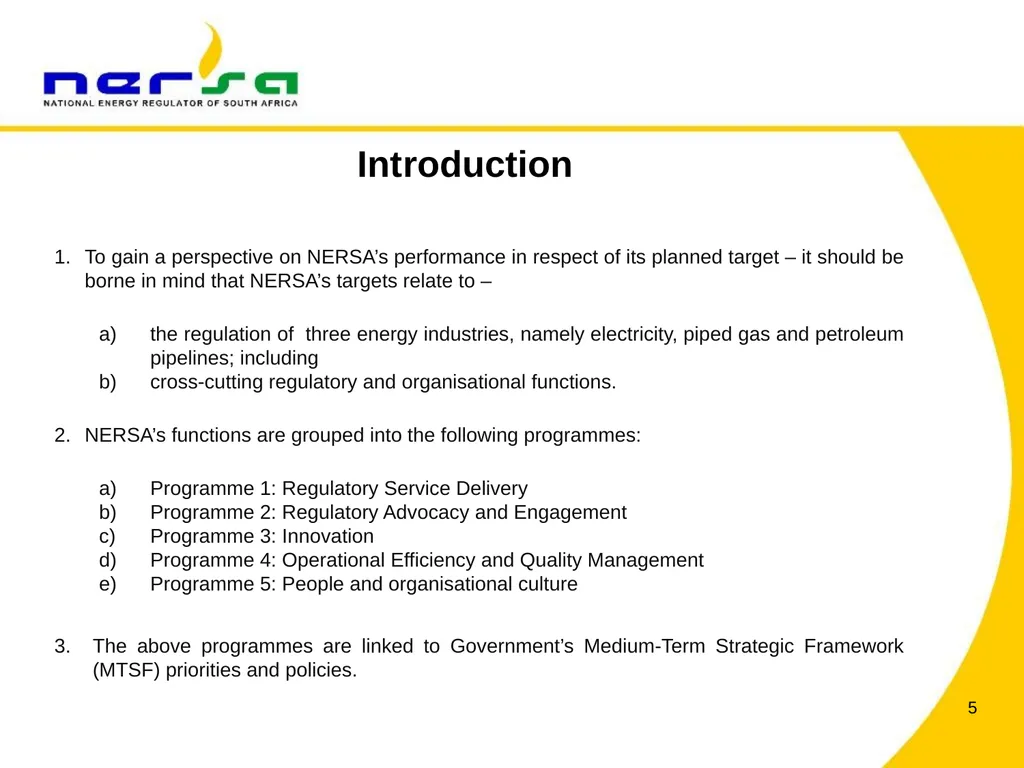
Introduction To gain a perspective on NERSA’s performance in respect of its planned target – it should be borne in mind that NERSA’s targets relate to –
the regulation of three energy industries, namely electricity, piped gas and petroleum pipelines; including
cross-cutting regulatory and organisational functions.
NERSA’s functions are grouped into the following programmes:
Programme 1: Regulatory Service Delivery
Programme 2: Regulatory Advocacy and Engagement
Programme 3: Innovation
Programme 4: Operational Efficiency and Quality Management
Programme 5: People and organisational culture
The above programmes are linked to Government’s Medium-Term Strategic Framework (MTSF) priorities and policies. 5<br>
the regulation of three energy industries, namely electricity, piped gas and petroleum pipelines; including
cross-cutting regulatory and organisational functions.
NERSA’s functions are grouped into the following programmes:
Programme 1: Regulatory Service Delivery
Programme 2: Regulatory Advocacy and Engagement
Programme 3: Innovation
Programme 4: Operational Efficiency and Quality Management
Programme 5: People and organisational culture
The above programmes are linked to Government’s Medium-Term Strategic Framework (MTSF) priorities and policies. 5<br>
06
Overview of performance in 2023/24 6<br>
07
2.1 Key achievements 7<br>
08
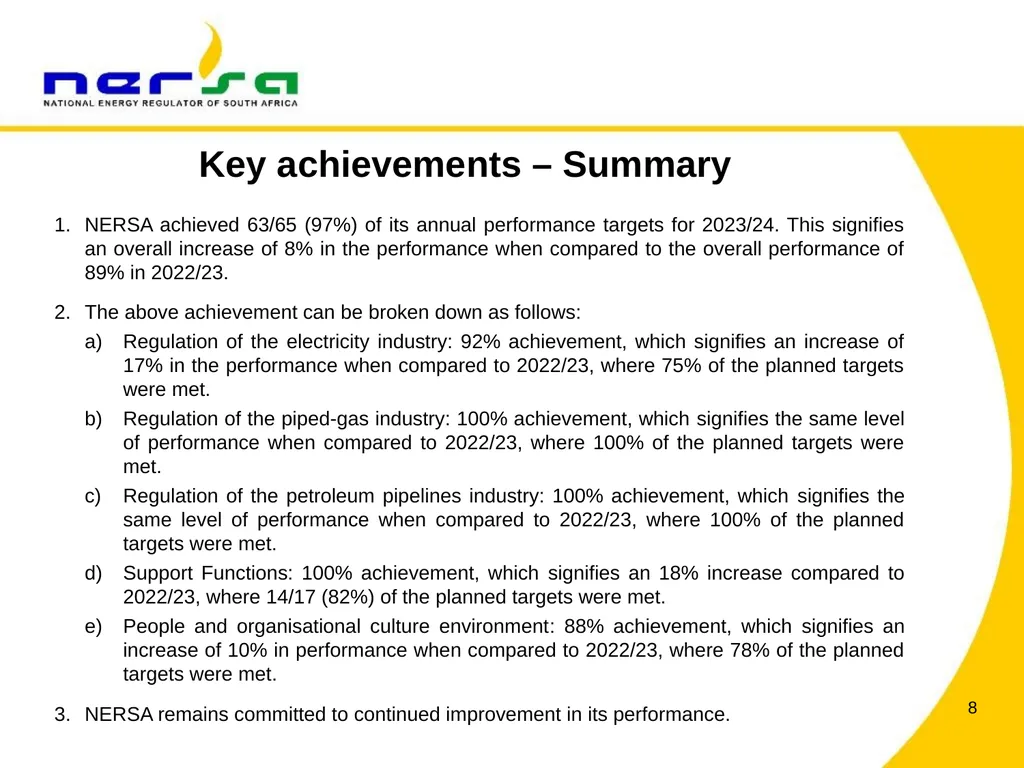
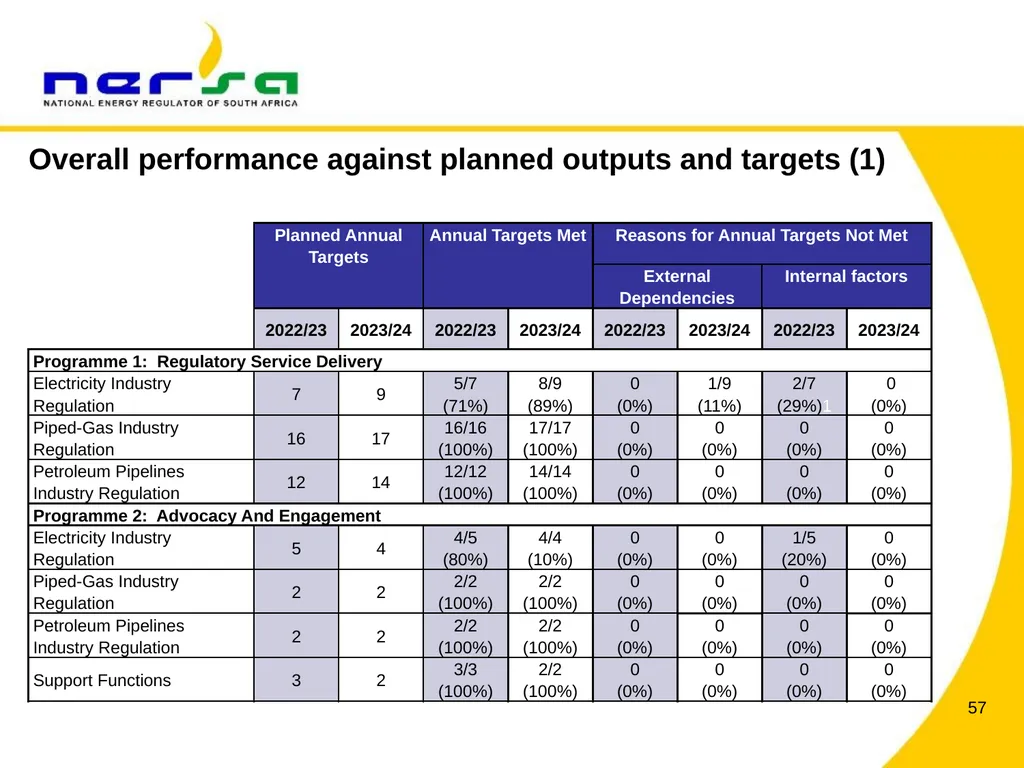
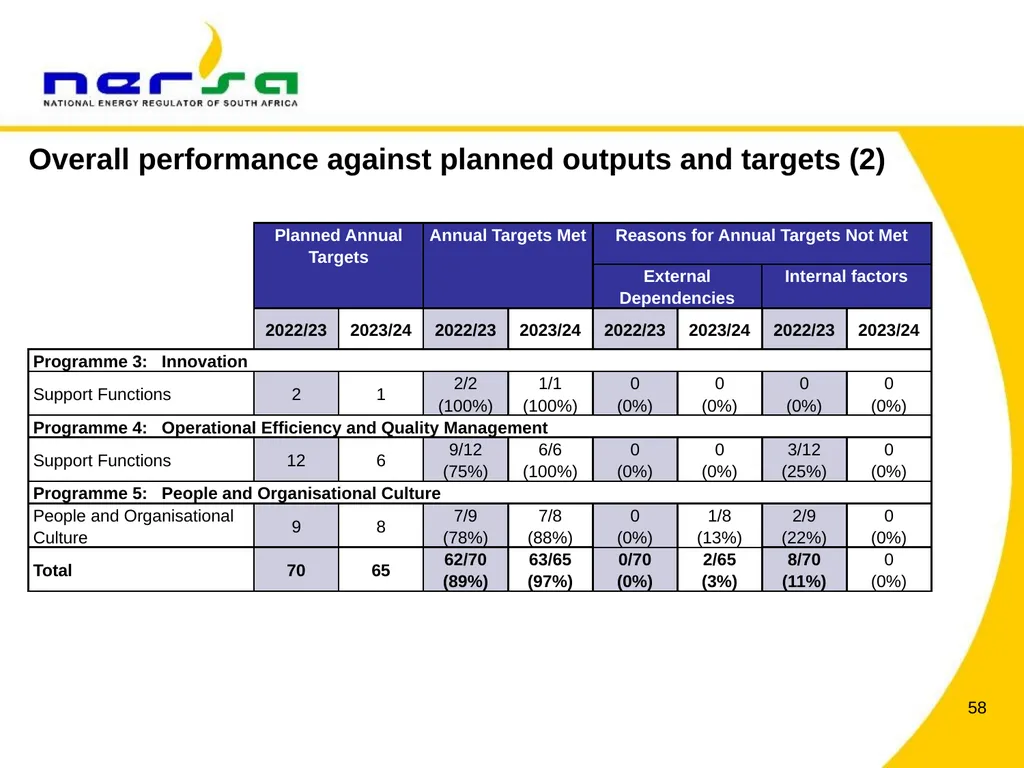
NERSA achieved 63/65 (97%) of its annual performance targets for 2023/24. This signifies an overall increase of 8% in the performance when compared to the overall performance of 89% in 2022/23.
The above achievement can be broken down as follows:
Regulation of the electricity industry: 92% achievement, which signifies an increase of 17% in the performance when compared to 2022/23, where 75% of the planned targets were met.
Regulation of the piped-gas industry: 100% achievement, which signifies the same level of performance when compared to 2022/23, where 100% of the planned targets were met.
Regulation of the petroleum pipelines industry: 100% achievement, which signifies the same level of performance when compared to 2022/23, where 100% of the planned targets were met.
Support Functions: 100% achievement, which signifies an 18% increase compared to 2022/23, where 14/17 (82%) of the planned targets were met.
People and organisational culture environment: 88% achievement, which signifies an increase of 10% in performance when compared to 2022/23, where 78% of the planned targets were met.
NERSA remains committed to continued improvement in its performance. Key achievements – Summary 8<br>
The above achievement can be broken down as follows:
Regulation of the electricity industry: 92% achievement, which signifies an increase of 17% in the performance when compared to 2022/23, where 75% of the planned targets were met.
Regulation of the piped-gas industry: 100% achievement, which signifies the same level of performance when compared to 2022/23, where 100% of the planned targets were met.
Regulation of the petroleum pipelines industry: 100% achievement, which signifies the same level of performance when compared to 2022/23, where 100% of the planned targets were met.
Support Functions: 100% achievement, which signifies an 18% increase compared to 2022/23, where 14/17 (82%) of the planned targets were met.
People and organisational culture environment: 88% achievement, which signifies an increase of 10% in performance when compared to 2022/23, where 78% of the planned targets were met.
NERSA remains committed to continued improvement in its performance. Key achievements – Summary 8<br>
09
2.1.1 Key achievements:
Regulatory activities 9<br>
Regulatory activities 9<br>
10
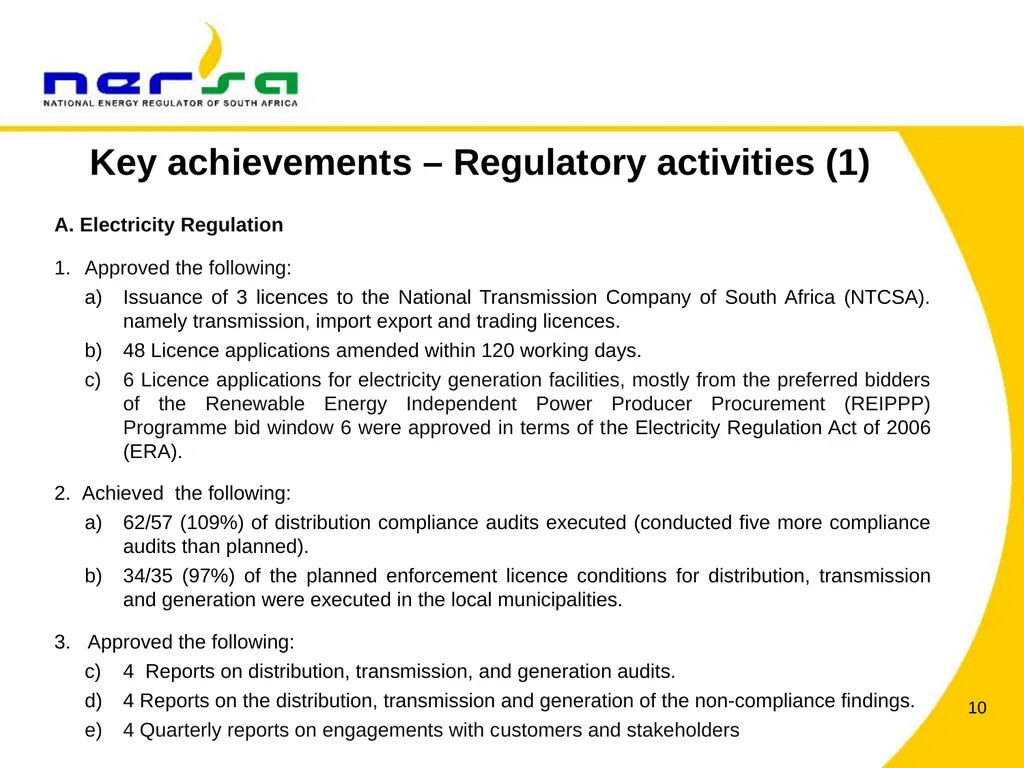
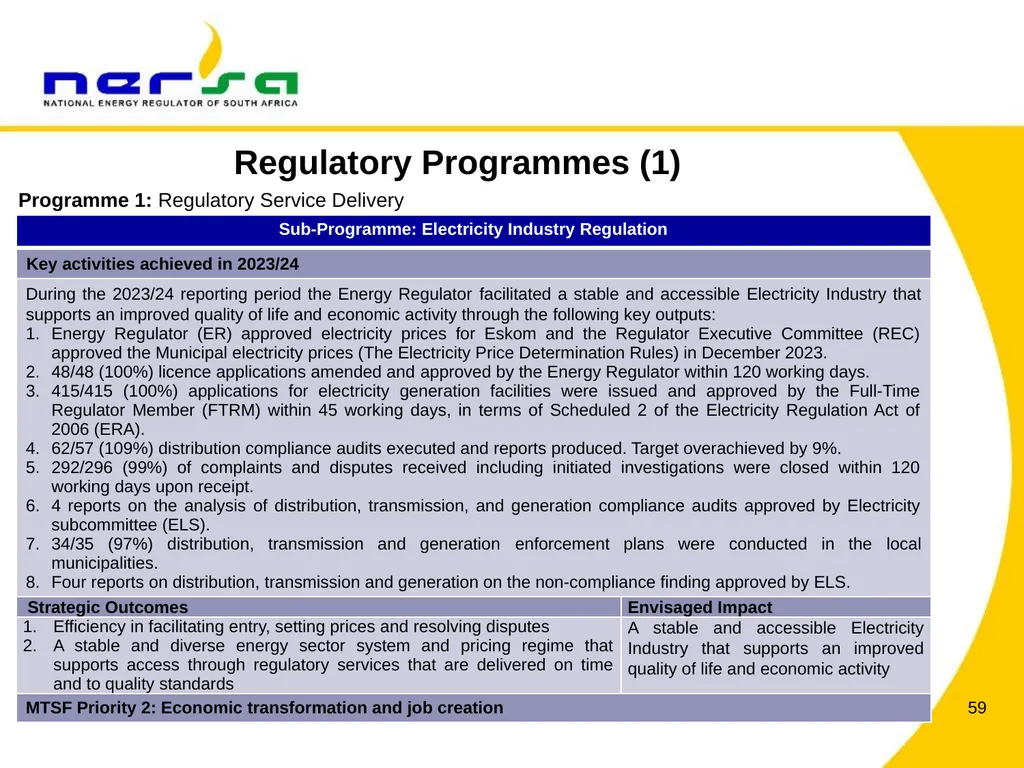
Key achievements – Regulatory activities (1) A. Electricity Regulation
Approved the following:
Issuance of 3 licences to the National Transmission Company of South Africa (NTCSA). namely transmission, import export and trading licences.
48 Licence applications amended within 120 working days.
6 Licence applications for electricity generation facilities, mostly from the preferred bidders of the Renewable Energy Independent Power Producer Procurement (REIPPP) Programme bid window 6 were approved in terms of the Electricity Regulation Act of 2006 (ERA).
Achieved the following:
62/57 (109%) of distribution compliance audits executed (conducted five more compliance audits than planned).
34/35 (97%) of the planned enforcement licence conditions for distribution, transmission and generation were executed in the local municipalities.
3. Approved the following:
4 Reports on distribution, transmission, and generation audits.
4 Reports on the distribution, transmission and generation of the non-compliance findings.
4 Quarterly reports on engagements with customers and stakeholders 10<br>
Approved the following:
Issuance of 3 licences to the National Transmission Company of South Africa (NTCSA). namely transmission, import export and trading licences.
48 Licence applications amended within 120 working days.
6 Licence applications for electricity generation facilities, mostly from the preferred bidders of the Renewable Energy Independent Power Producer Procurement (REIPPP) Programme bid window 6 were approved in terms of the Electricity Regulation Act of 2006 (ERA).
Achieved the following:
62/57 (109%) of distribution compliance audits executed (conducted five more compliance audits than planned).
34/35 (97%) of the planned enforcement licence conditions for distribution, transmission and generation were executed in the local municipalities.
3. Approved the following:
4 Reports on distribution, transmission, and generation audits.
4 Reports on the distribution, transmission and generation of the non-compliance findings.
4 Quarterly reports on engagements with customers and stakeholders 10<br>
11
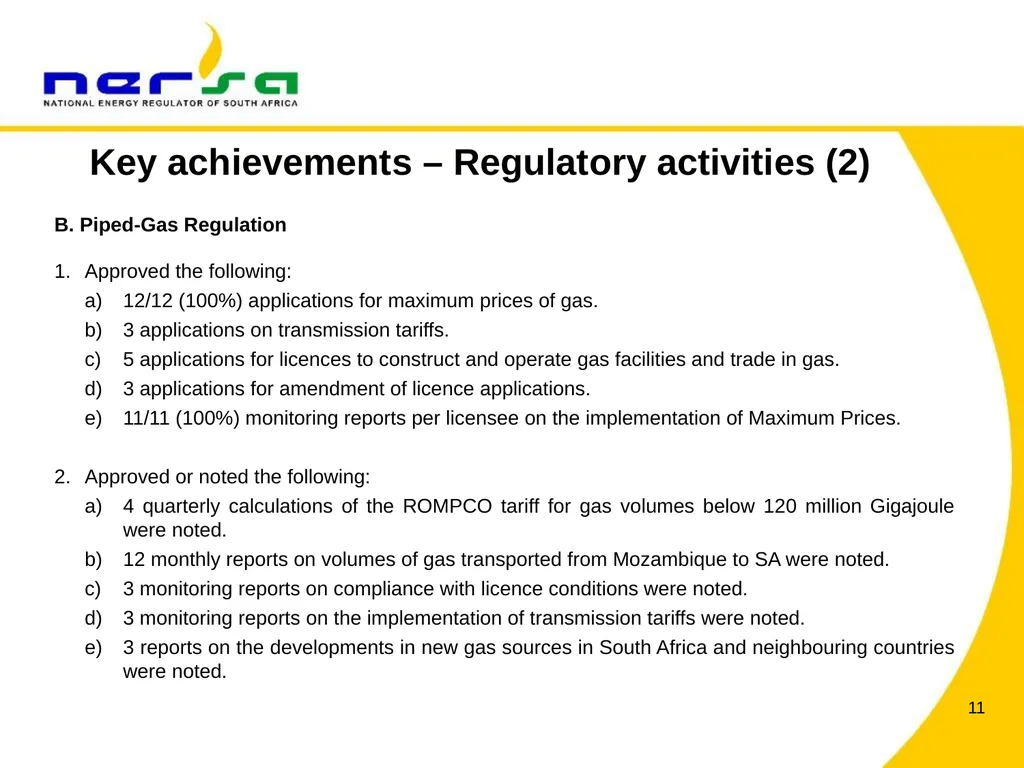
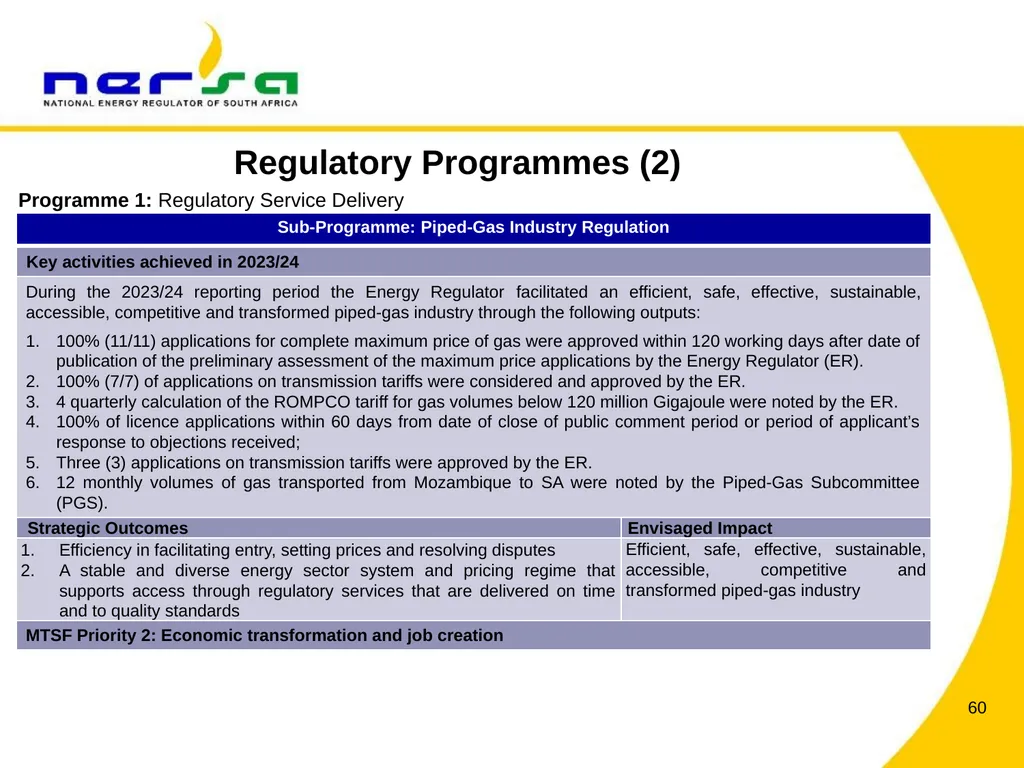
B. Piped-Gas Regulation
Approved the following:
12/12 (100%) applications for maximum prices of gas.
3 applications on transmission tariffs.
5 applications for licences to construct and operate gas facilities and trade in gas.
3 applications for amendment of licence applications.
11/11 (100%) monitoring reports per licensee on the implementation of Maximum Prices.
Approved or noted the following:
4 quarterly calculations of the ROMPCO tariff for gas volumes below 120 million Gigajoule were noted.
12 monthly reports on volumes of gas transported from Mozambique to SA were noted.
3 monitoring reports on compliance with licence conditions were noted.
3 monitoring reports on the implementation of transmission tariffs were noted.
3 reports on the developments in new gas sources in South Africa and neighbouring countries were noted. Key achievements – Regulatory activities (2) 11<br>
Approved the following:
12/12 (100%) applications for maximum prices of gas.
3 applications on transmission tariffs.
5 applications for licences to construct and operate gas facilities and trade in gas.
3 applications for amendment of licence applications.
11/11 (100%) monitoring reports per licensee on the implementation of Maximum Prices.
Approved or noted the following:
4 quarterly calculations of the ROMPCO tariff for gas volumes below 120 million Gigajoule were noted.
12 monthly reports on volumes of gas transported from Mozambique to SA were noted.
3 monitoring reports on compliance with licence conditions were noted.
3 monitoring reports on the implementation of transmission tariffs were noted.
3 reports on the developments in new gas sources in South Africa and neighbouring countries were noted. Key achievements – Regulatory activities (2) 11<br>
12
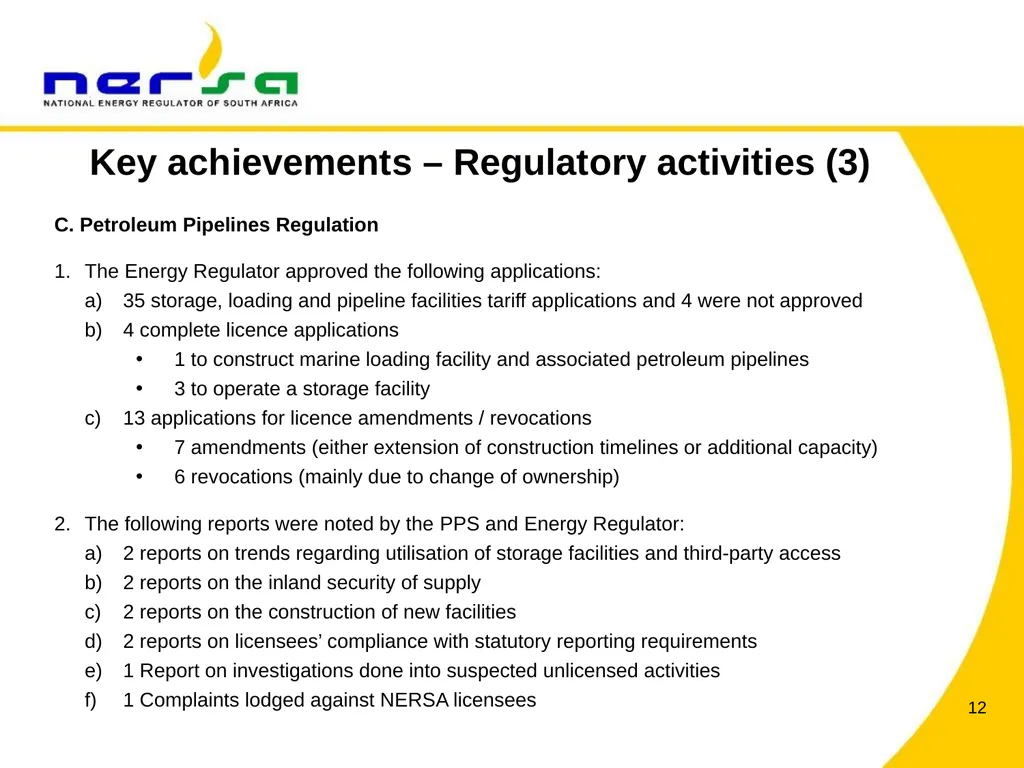
C. Petroleum Pipelines Regulation
The Energy Regulator approved the following applications:
35 storage, loading and pipeline facilities tariff applications and 4 were not approved
4 complete licence applications
1 to construct marine loading facility and associated petroleum pipelines
3 to operate a storage facility
13 applications for licence amendments / revocations
7 amendments (either extension of construction timelines or additional capacity)
6 revocations (mainly due to change of ownership)
The following reports were noted by the PPS and Energy Regulator:
2 reports on trends regarding utilisation of storage facilities and third-party access
2 reports on the inland security of supply
2 reports on the construction of new facilities
2 reports on licensees’ compliance with statutory reporting requirements
1 Report on investigations done into suspected unlicensed activities
1 Complaints lodged against NERSA licensees Key achievements – Regulatory activities (3) 12<br>
The Energy Regulator approved the following applications:
35 storage, loading and pipeline facilities tariff applications and 4 were not approved
4 complete licence applications
1 to construct marine loading facility and associated petroleum pipelines
3 to operate a storage facility
13 applications for licence amendments / revocations
7 amendments (either extension of construction timelines or additional capacity)
6 revocations (mainly due to change of ownership)
The following reports were noted by the PPS and Energy Regulator:
2 reports on trends regarding utilisation of storage facilities and third-party access
2 reports on the inland security of supply
2 reports on the construction of new facilities
2 reports on licensees’ compliance with statutory reporting requirements
1 Report on investigations done into suspected unlicensed activities
1 Complaints lodged against NERSA licensees Key achievements – Regulatory activities (3) 12<br>
13
2.1.2 Key achievements: Organisational activities 13<br>
14
Key achievements – Organisational activities (1) A. Human Resource Management (1) Achieved a vacancy rate of 5.9% compared to a 5.5% vacancy rate in the same period for 2022/23.
Staff strength = 236 employees
16 (5.9%) vacancies by the end of the review period.
Finalised the Operating Model Review project
Aimed to optimize business processes, resource allocation, and the organisational structure in order to enhance efficiency, effectiveness and alignment with strategic goals.
The next phase of the project will be the implementation of the recommendations of the Operating Model Review.
Conducted an organisational culture assessment.
Provided management with valuable insights into the current state of the organisational culture, enabling them to make informed decisions and take actions that foster a positive and productive work environment. 14<br>
Staff strength = 236 employees
16 (5.9%) vacancies by the end of the review period.
Finalised the Operating Model Review project
Aimed to optimize business processes, resource allocation, and the organisational structure in order to enhance efficiency, effectiveness and alignment with strategic goals.
The next phase of the project will be the implementation of the recommendations of the Operating Model Review.
Conducted an organisational culture assessment.
Provided management with valuable insights into the current state of the organisational culture, enabling them to make informed decisions and take actions that foster a positive and productive work environment. 14<br>
15
Key achievements – Organisational activities (2) A. Human Resource Management (2) NERSA talent management initiatives continued the implementation of the technical regulatory training programme:
Aimed at deploying a learning and development strategy geared at building and cultivating a high-performance and highly engaged workforce.
Aimed to ensure the capacitation and upskilling of roles in the Regulatory Divisions, which is expected to result in excellence, professionalism and innovation within NERSA. Continued to be an active member of the Regional Electricity Regulators Association (RERA) and the African Forum for Utility Regulators (AFUR).
NERSA presented a paper on market reforms at the AFUR Conference of 2023. B. International Coordination and Partnerships 15<br>
Aimed at deploying a learning and development strategy geared at building and cultivating a high-performance and highly engaged workforce.
Aimed to ensure the capacitation and upskilling of roles in the Regulatory Divisions, which is expected to result in excellence, professionalism and innovation within NERSA. Continued to be an active member of the Regional Electricity Regulators Association (RERA) and the African Forum for Utility Regulators (AFUR).
NERSA presented a paper on market reforms at the AFUR Conference of 2023. B. International Coordination and Partnerships 15<br>
16
2.1.3 Key achievements:
Financial performance 16<br>
Financial performance 16<br>
17
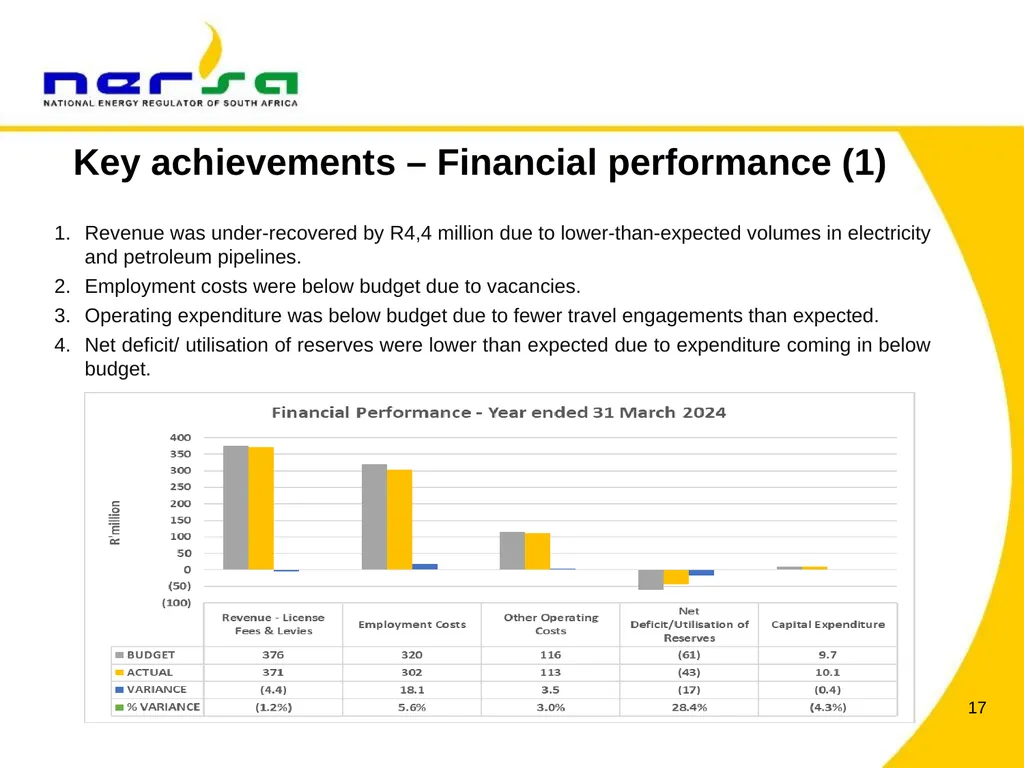
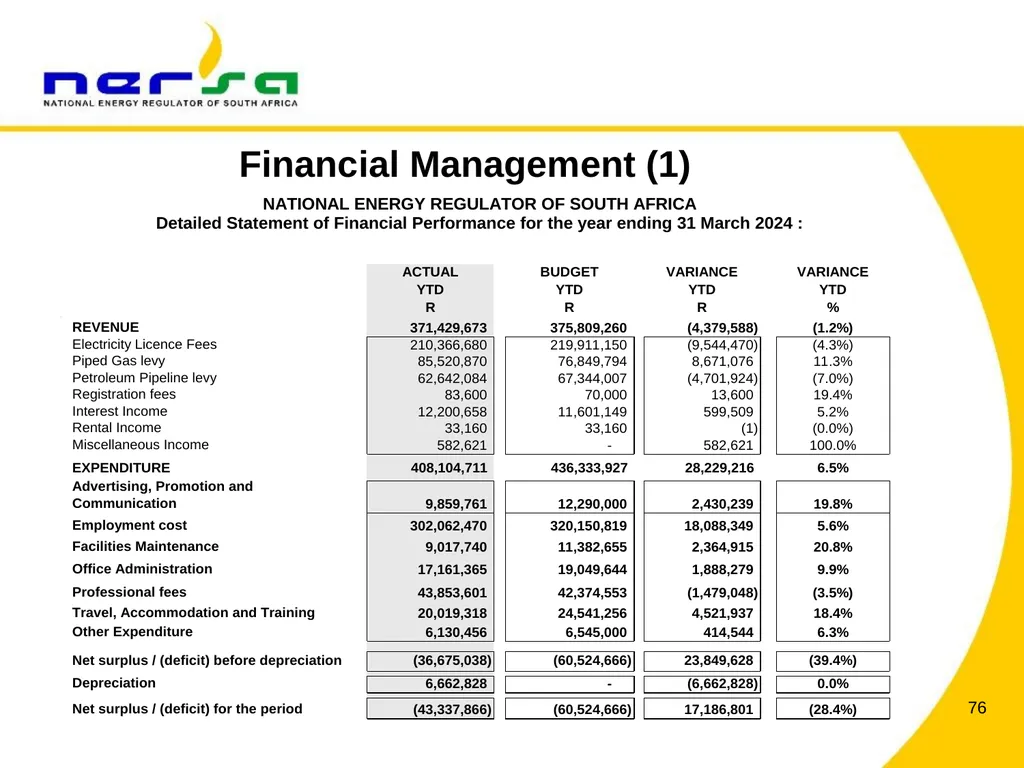
Revenue was under-recovered by R4,4 million due to lower-than-expected volumes in electricity and petroleum pipelines.
Employment costs were below budget due to vacancies.
Operating expenditure was below budget due to fewer travel engagements than expected.
Net deficit/ utilisation of reserves were lower than expected due to expenditure coming in below budget. Key achievements – Financial performance (1) 17<br>
Employment costs were below budget due to vacancies.
Operating expenditure was below budget due to fewer travel engagements than expected.
Net deficit/ utilisation of reserves were lower than expected due to expenditure coming in below budget. Key achievements – Financial performance (1) 17<br>
18
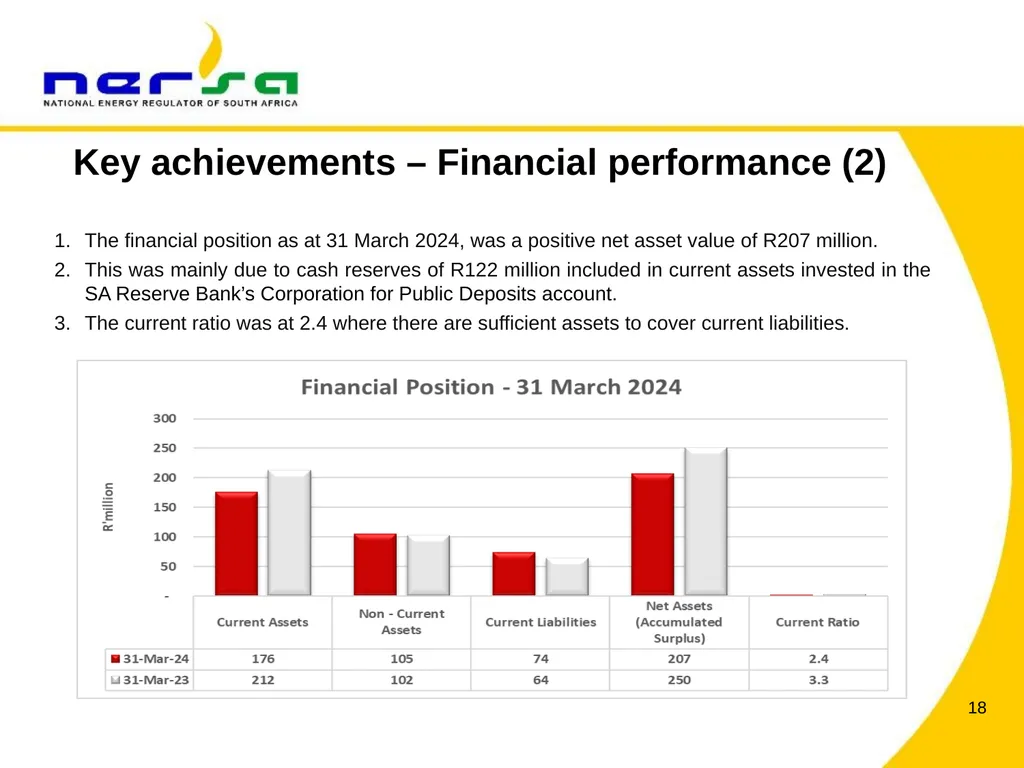
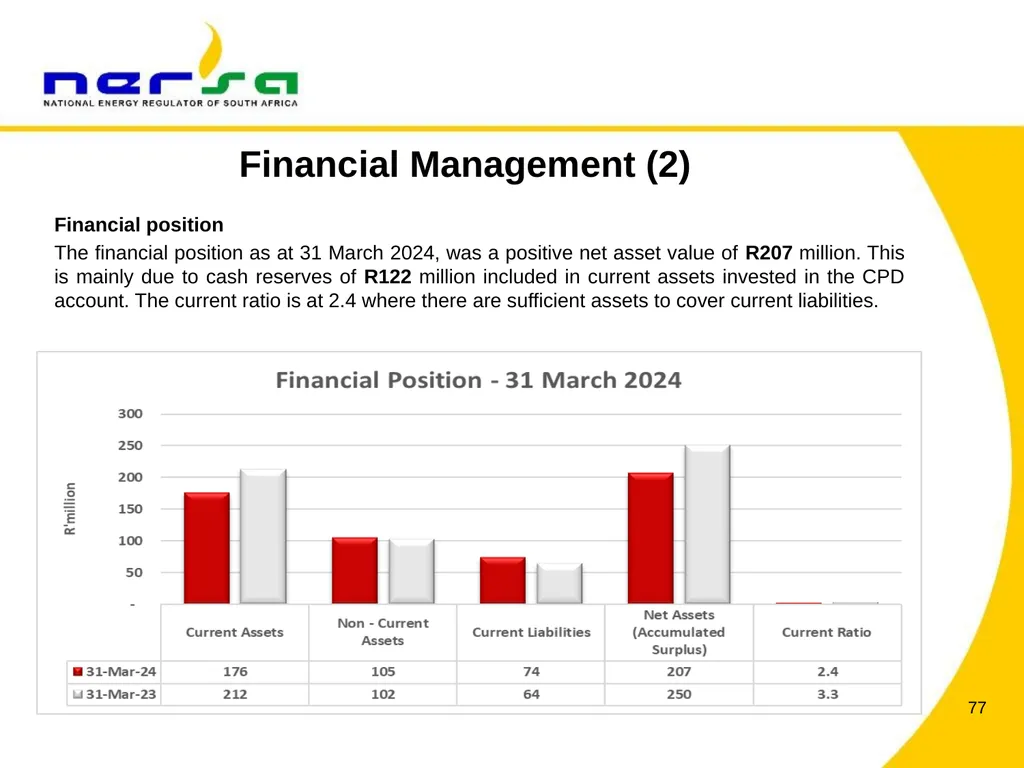
The financial position as at 31 March 2024, was a positive net asset value of R207 million.
This was mainly due to cash reserves of R122 million included in current assets invested in the SA Reserve Bank’s Corporation for Public Deposits account.
The current ratio was at 2.4 where there are sufficient assets to cover current liabilities. Key achievements – Financial performance (2) 18<br>
This was mainly due to cash reserves of R122 million included in current assets invested in the SA Reserve Bank’s Corporation for Public Deposits account.
The current ratio was at 2.4 where there are sufficient assets to cover current liabilities. Key achievements – Financial performance (2) 18<br>
19
Key achievements – Financial performance (3) Revenue collection challenges
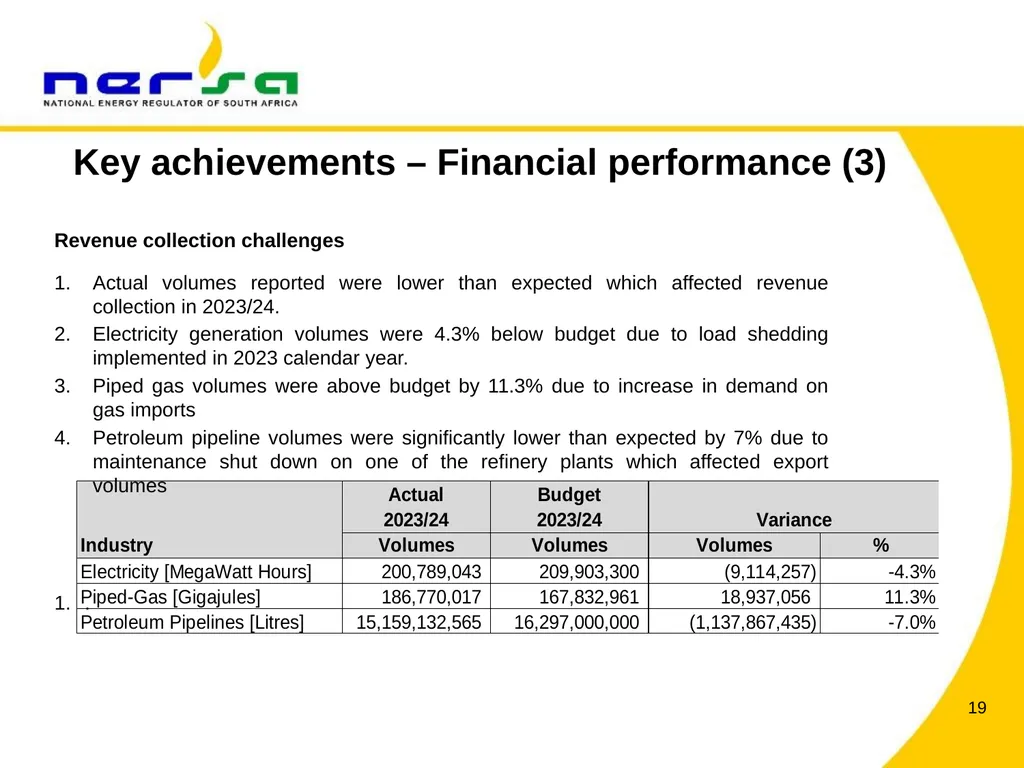
Actual volumes reported were lower than expected which affected revenue collection in 2023/24.
Electricity generation volumes were 4.3% below budget due to load shedding implemented in 2023 calendar year.
Piped gas volumes were above budget by 11.3% due to increase in demand on gas imports
Petroleum pipeline volumes were significantly lower than expected by 7% due to maintenance shut down on one of the refinery plants which affected export volumes
. 19<br>
Actual volumes reported were lower than expected which affected revenue collection in 2023/24.
Electricity generation volumes were 4.3% below budget due to load shedding implemented in 2023 calendar year.
Piped gas volumes were above budget by 11.3% due to increase in demand on gas imports
Petroleum pipeline volumes were significantly lower than expected by 7% due to maintenance shut down on one of the refinery plants which affected export volumes
. 19<br>
20
Key achievements – Financial performance (4) Revenue collection challenges
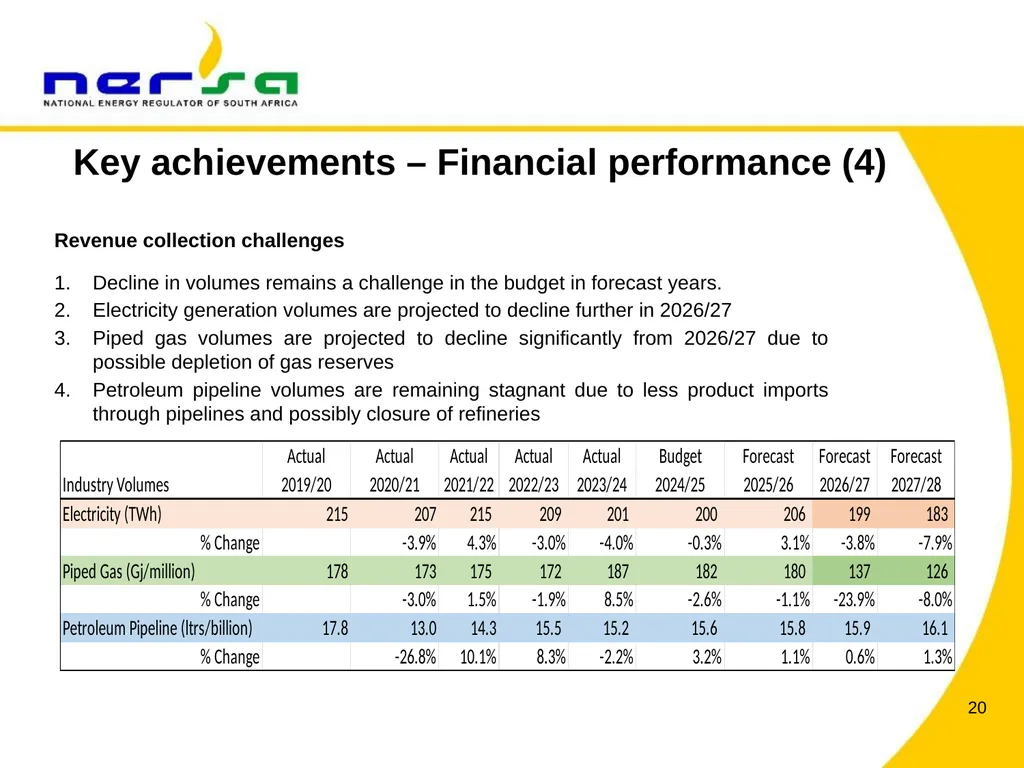
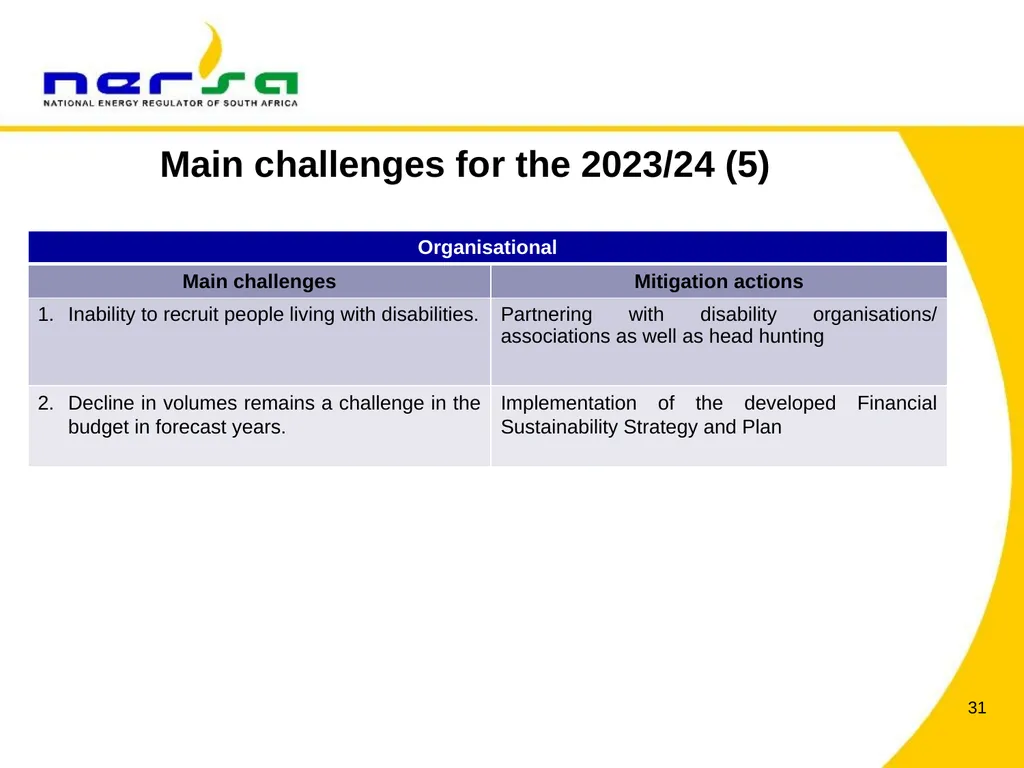
Decline in volumes remains a challenge in the budget in forecast years.
Electricity generation volumes are projected to decline further in 2026/27
Piped gas volumes are projected to decline significantly from 2026/27 due to possible depletion of gas reserves
Petroleum pipeline volumes are remaining stagnant due to less product imports through pipelines and possibly closure of refineries 20<br>
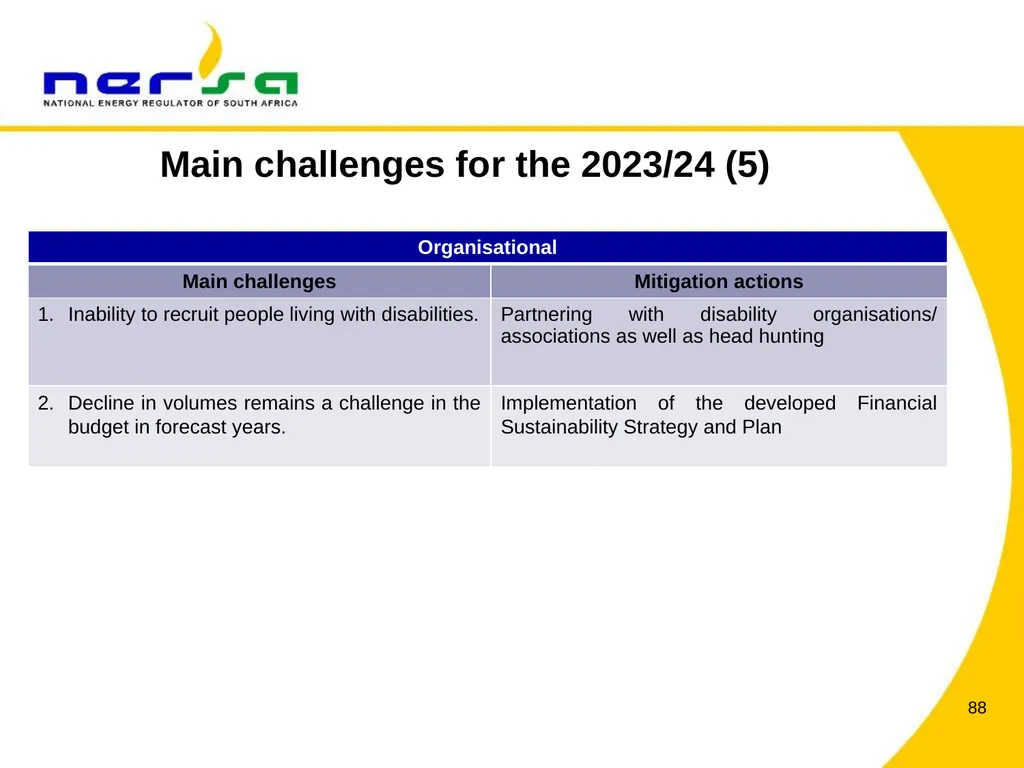
Decline in volumes remains a challenge in the budget in forecast years.
Electricity generation volumes are projected to decline further in 2026/27
Piped gas volumes are projected to decline significantly from 2026/27 due to possible depletion of gas reserves
Petroleum pipeline volumes are remaining stagnant due to less product imports through pipelines and possibly closure of refineries 20<br>
21
2.2 Planned targets not met 21<br>
22
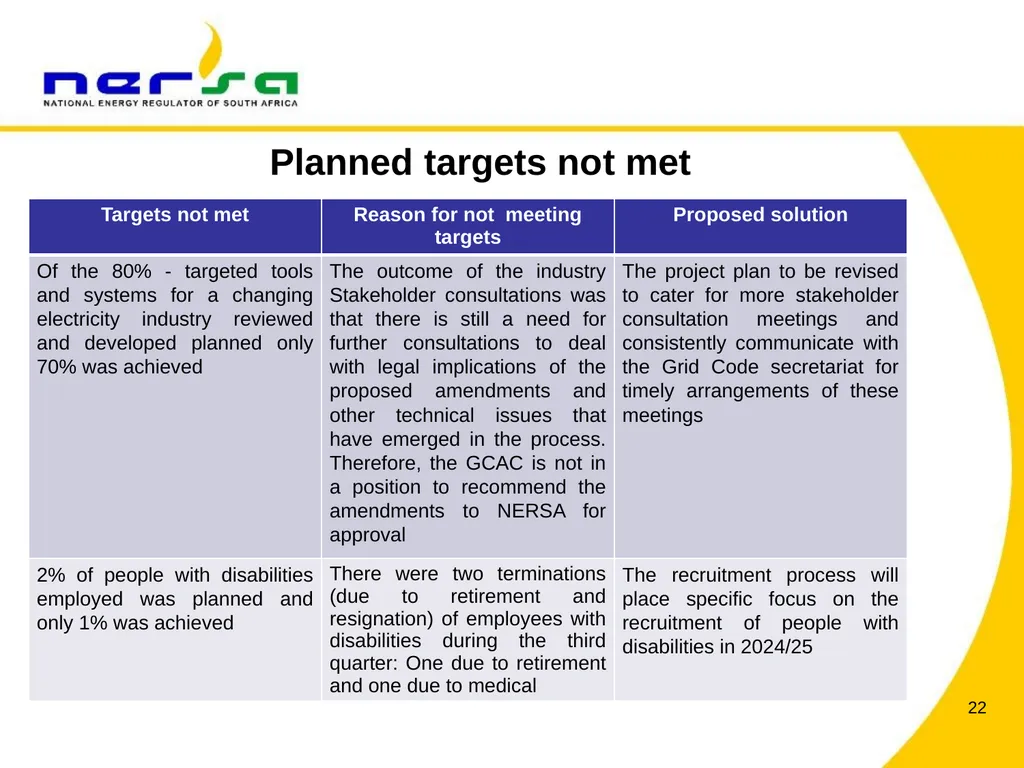
Planned targets not met 22<br>
23
2.3 Auditor General of South Africa (AGSA) report 23<br>
24
Annual Financial Statements
Audit Outcome – Annual Financial Statements
Unqualified opinion – with no findings (Clean Audit)
Irregular Fruitless and Wasteful Expenditure
None reported for 2023/24
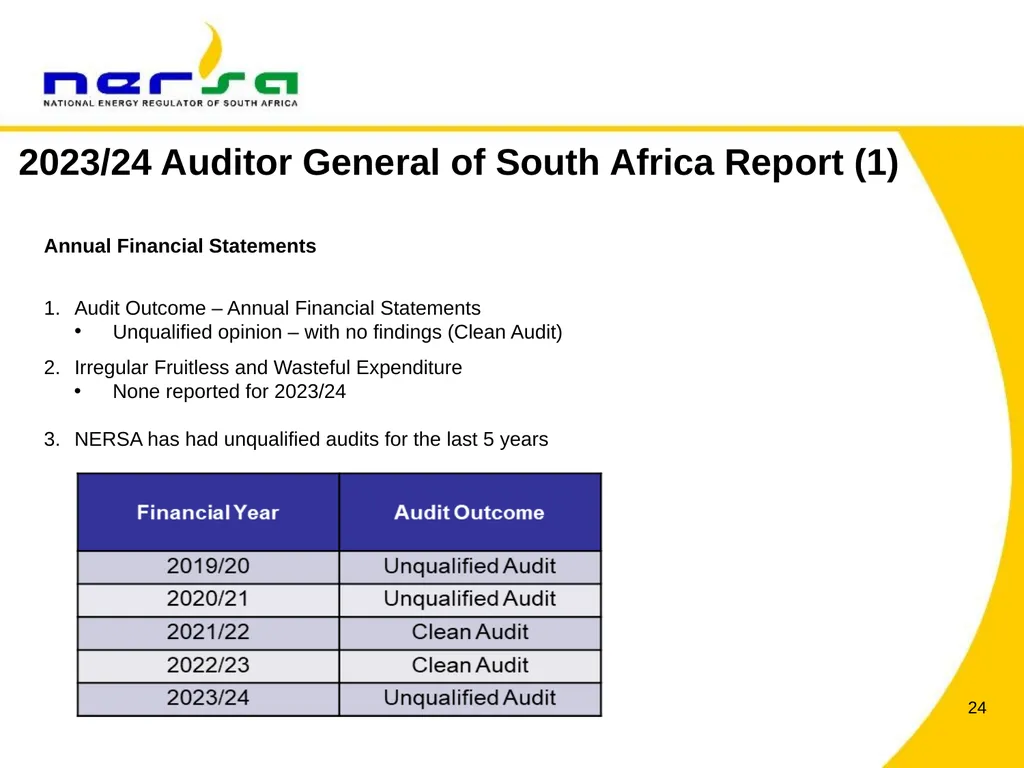
NERSA has had unqualified audits for the last 5 years 2023/24 Auditor General of South Africa Report (1) 24<br>
Audit Outcome – Annual Financial Statements
Unqualified opinion – with no findings (Clean Audit)
Irregular Fruitless and Wasteful Expenditure
None reported for 2023/24
NERSA has had unqualified audits for the last 5 years 2023/24 Auditor General of South Africa Report (1) 24<br>
25
Audit Outcome – Performance information
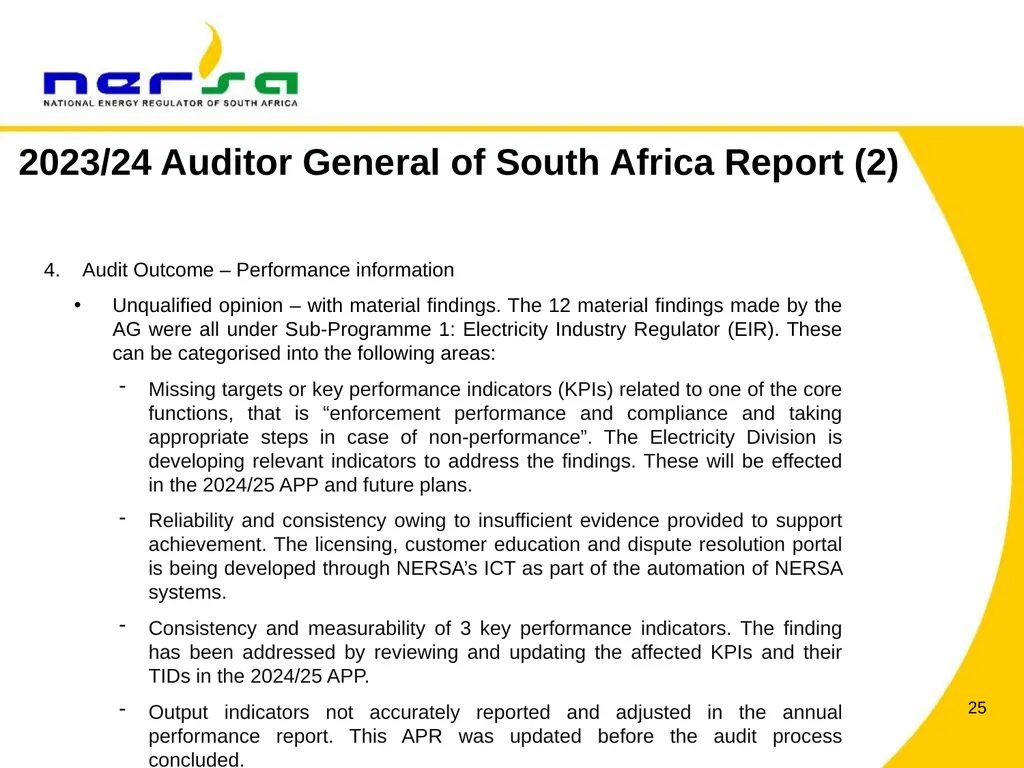
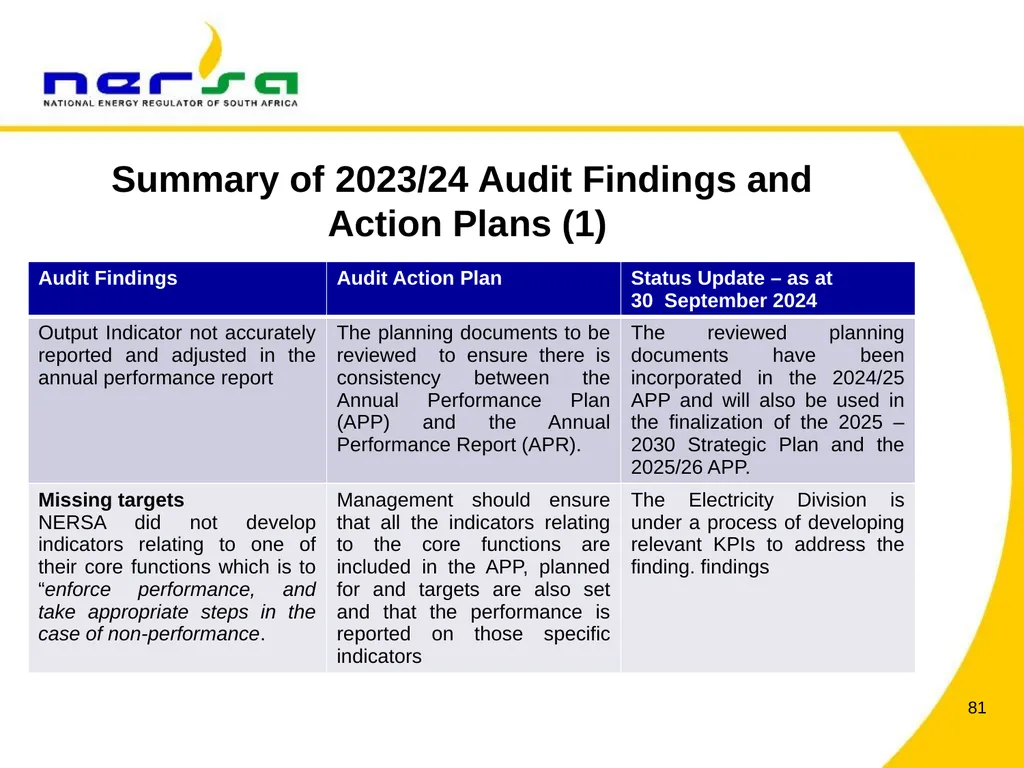
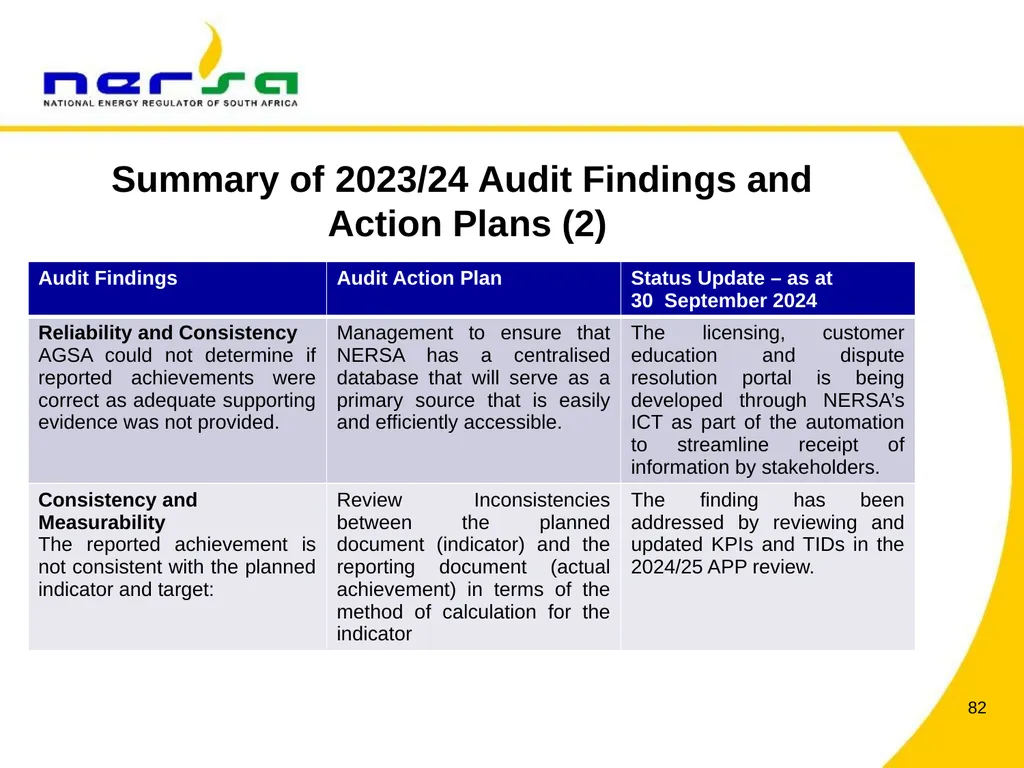
Unqualified opinion – with material findings. The 12 material findings made by the AG were all under Sub-Programme 1: Electricity Industry Regulator (EIR). These can be categorised into the following areas:
Missing targets or key performance indicators (KPIs) related to one of the core functions, that is “enforcement performance and compliance and taking appropriate steps in case of non-performance”. The Electricity Division is developing relevant indicators to address the findings. These will be effected in the 2024/25 APP and future plans.
Reliability and consistency owing to insufficient evidence provided to support achievement. The licensing, customer education and dispute resolution portal is being developed through NERSA’s ICT as part of the automation of NERSA systems.
Consistency and measurability of 3 key performance indicators. The finding has been addressed by reviewing and updating the affected KPIs and their TIDs in the 2024/25 APP.
Output indicators not accurately reported and adjusted in the annual performance report. This APR was updated before the audit process concluded. 2023/24 Auditor General of South Africa Report (2) 25<br>
Unqualified opinion – with material findings. The 12 material findings made by the AG were all under Sub-Programme 1: Electricity Industry Regulator (EIR). These can be categorised into the following areas:
Missing targets or key performance indicators (KPIs) related to one of the core functions, that is “enforcement performance and compliance and taking appropriate steps in case of non-performance”. The Electricity Division is developing relevant indicators to address the findings. These will be effected in the 2024/25 APP and future plans.
Reliability and consistency owing to insufficient evidence provided to support achievement. The licensing, customer education and dispute resolution portal is being developed through NERSA’s ICT as part of the automation of NERSA systems.
Consistency and measurability of 3 key performance indicators. The finding has been addressed by reviewing and updating the affected KPIs and their TIDs in the 2024/25 APP.
Output indicators not accurately reported and adjusted in the annual performance report. This APR was updated before the audit process concluded. 2023/24 Auditor General of South Africa Report (2) 25<br>
26
Main challenges for the 2023/24 financial year 26<br>
27
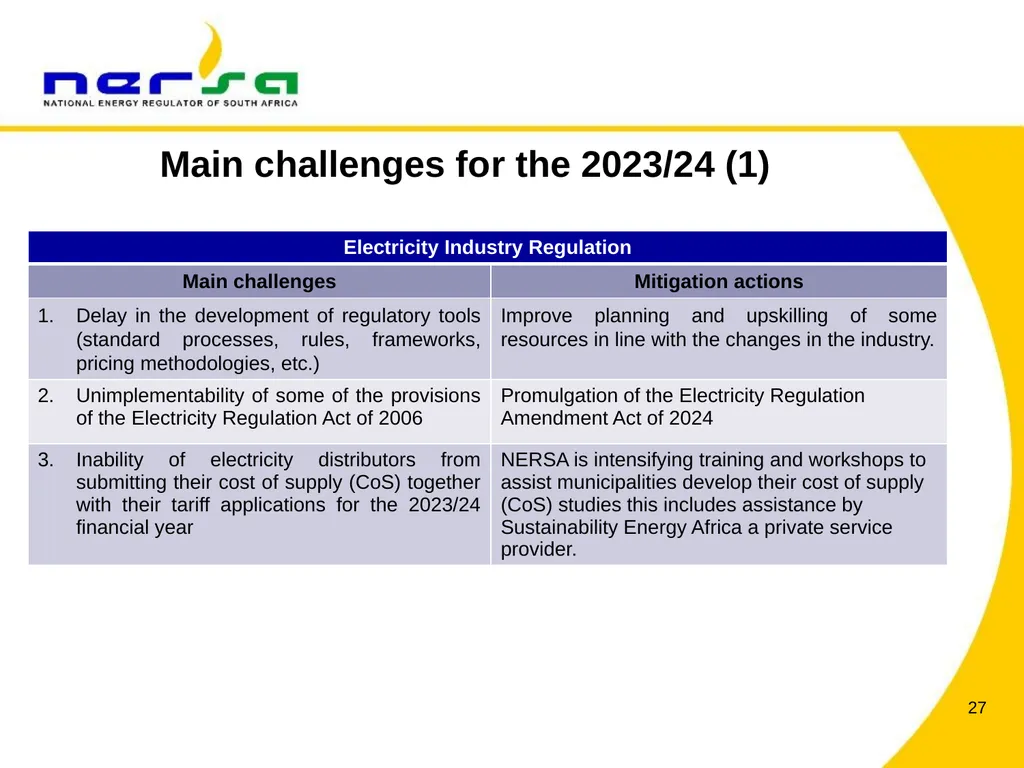
Main challenges for the 2023/24 (1) 27<br>
28
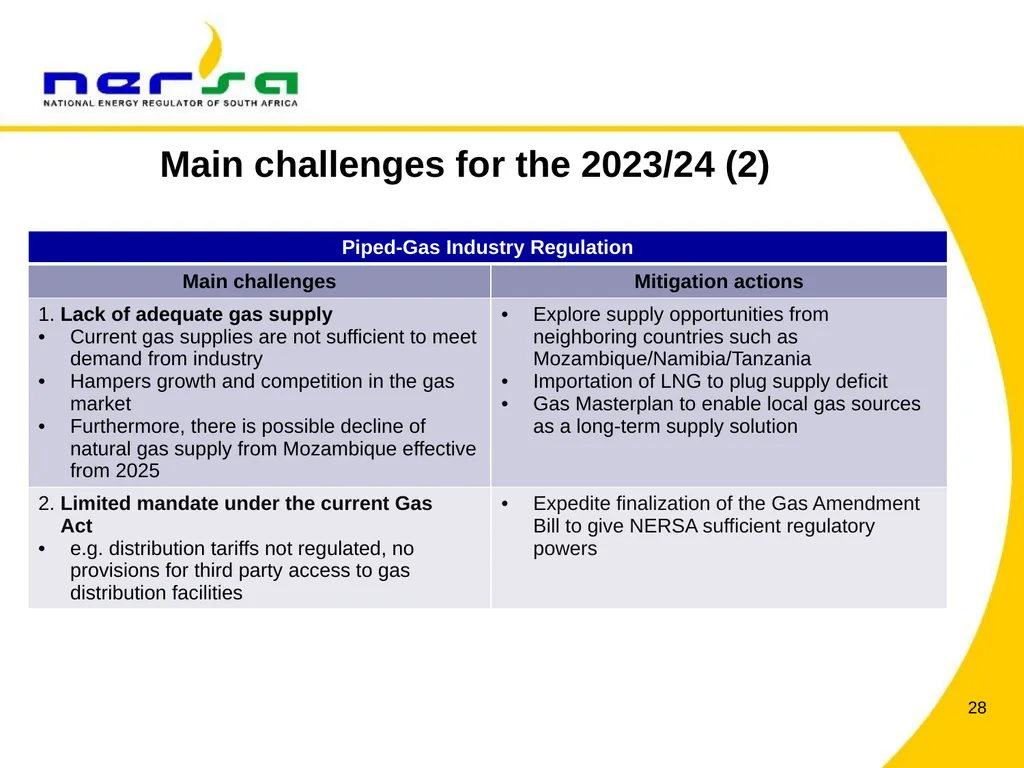
Main challenges for the 2023/24 (2) 28<br>
29
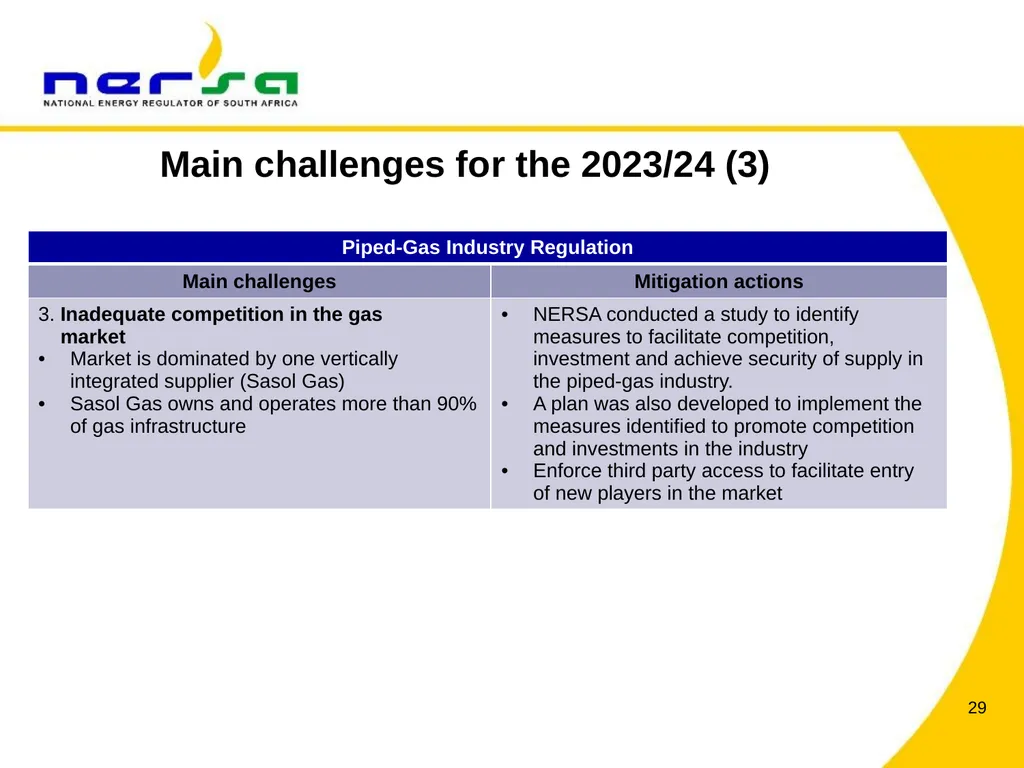
Main challenges for the 2023/24 (3) 29<br>
30
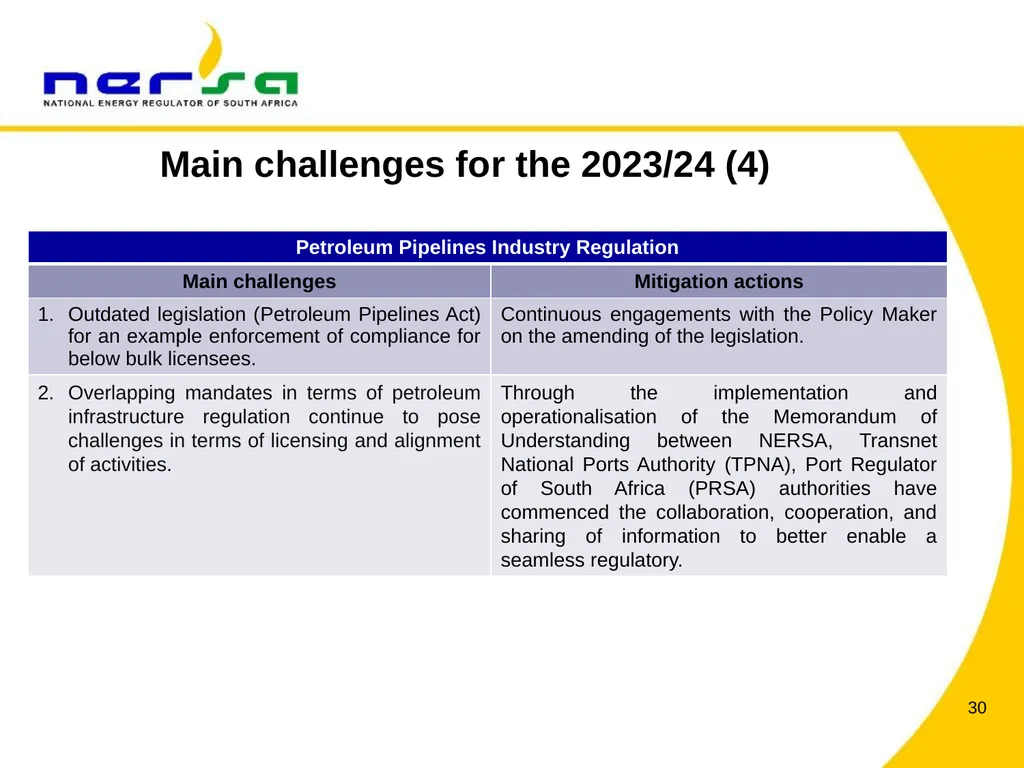
Main challenges for the 2023/24 (4) 30<br>
31
Main challenges for the 2023/24 (5) 31<br>
32
Conclusion 32<br>
33
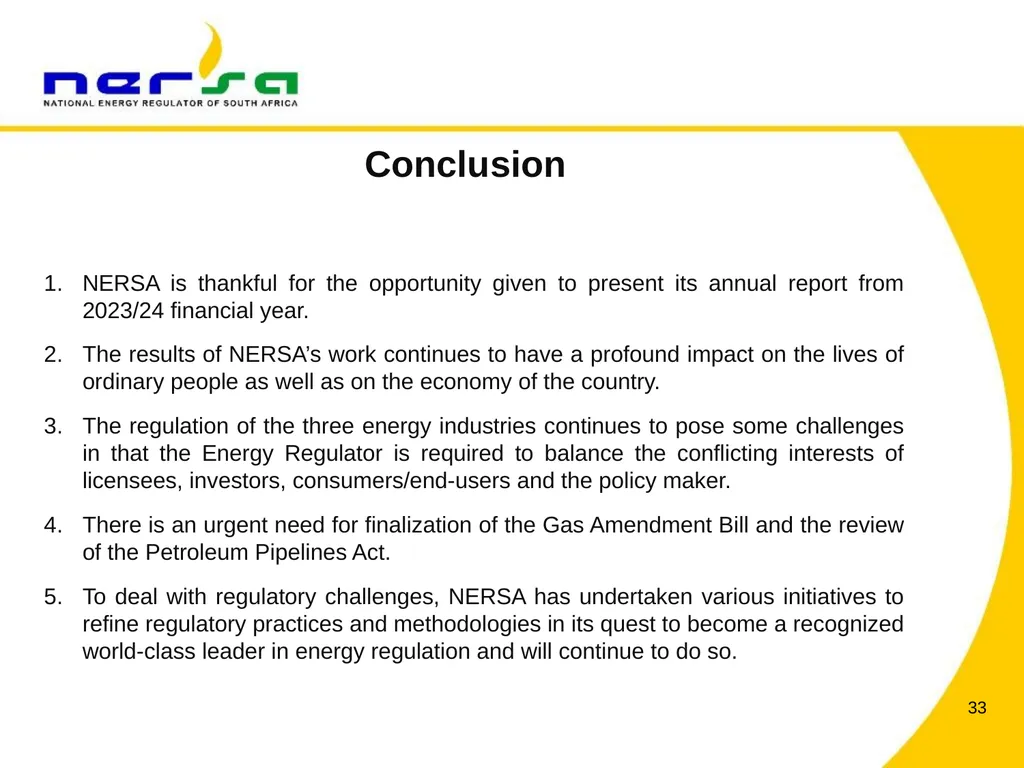
Conclusion NERSA is thankful for the opportunity given to present its annual report from 2023/24 financial year.
The results of NERSA’s work continues to have a profound impact on the lives of ordinary people as well as on the economy of the country.
The regulation of the three energy industries continues to pose some challenges in that the Energy Regulator is required to balance the conflicting interests of licensees, investors, consumers/end-users and the policy maker.
There is an urgent need for finalization of the Gas Amendment Bill and the review of the Petroleum Pipelines Act.
To deal with regulatory challenges, NERSA has undertaken various initiatives to refine regulatory practices and methodologies in its quest to become a recognized world-class leader in energy regulation and will continue to do so. 33<br>
The results of NERSA’s work continues to have a profound impact on the lives of ordinary people as well as on the economy of the country.
The regulation of the three energy industries continues to pose some challenges in that the Energy Regulator is required to balance the conflicting interests of licensees, investors, consumers/end-users and the policy maker.
There is an urgent need for finalization of the Gas Amendment Bill and the review of the Petroleum Pipelines Act.
To deal with regulatory challenges, NERSA has undertaken various initiatives to refine regulatory practices and methodologies in its quest to become a recognized world-class leader in energy regulation and will continue to do so. 33<br>
34
Thank you Website: www.nersa.org.za
Tel: 012 401 4600
Fax: 012 401 4700
Email: info@nersa.org.za
@NERSAZA
@NERSA_ZA 34<br>
Tel: 012 401 4600
Fax: 012 401 4700
Email: info@nersa.org.za
@NERSAZA
@NERSA_ZA 34<br>
35
Detailed presentation on organisational performance 35<br>
36
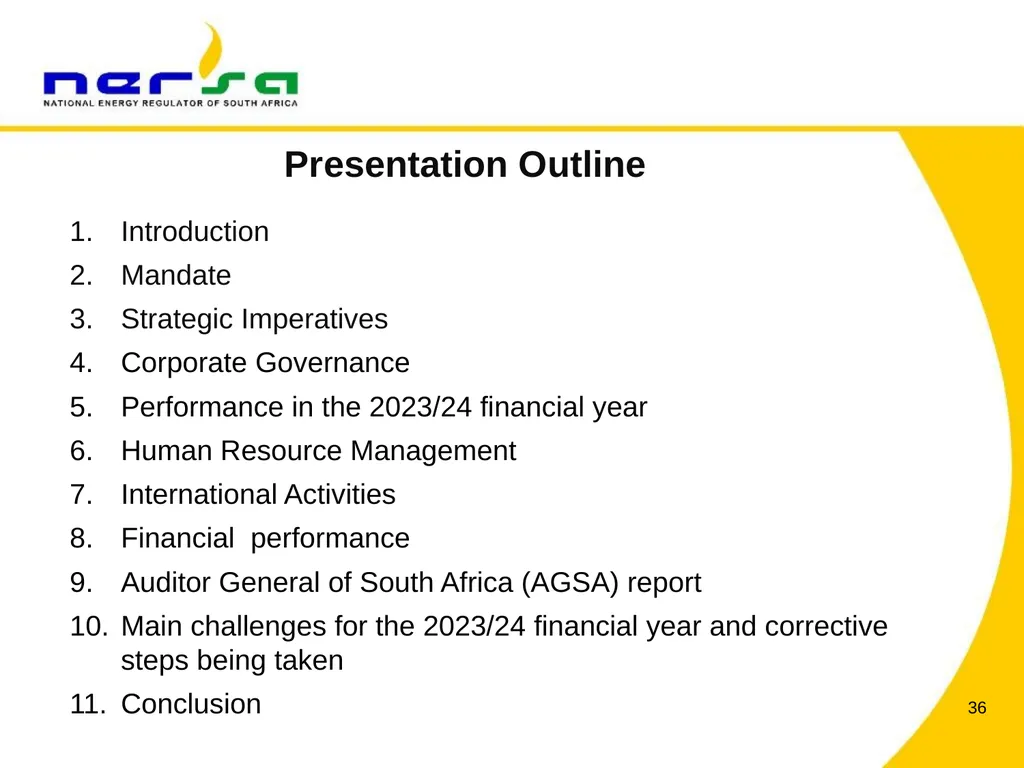
Introduction
Mandate
Strategic Imperatives
Corporate Governance
Performance in the 2023/24 financial year
Human Resource Management
International Activities
Financial performance
Auditor General of South Africa (AGSA) report
Main challenges for the 2023/24 financial year and corrective steps being taken
Conclusion Presentation Outline 36<br>
Mandate
Strategic Imperatives
Corporate Governance
Performance in the 2023/24 financial year
Human Resource Management
International Activities
Financial performance
Auditor General of South Africa (AGSA) report
Main challenges for the 2023/24 financial year and corrective steps being taken
Conclusion Presentation Outline 36<br>
37
Introduction<br>
38
The National Energy Regulator of South Africa (NERSA), a Schedule 3A Public Finance Management Act, 1999 (Act No. 1 of 1999) Public Entity was established on 1 October 2005 in terms of the National Energy Regulator Act, 2004 (Act No. 40 of 2004) to regulate:
Electricity industry (Electricity Regulation Act, 2006 (Act No. 4 of 2006));
Piped-Gas industry (Gas Act, 2001 (Act No. 48 of 2001)); and
Petroleum Pipelines industry (Petroleum Pipelines Act, 2003 (Act No. 60 of 2003)). Introduction (1) 38<br>
Electricity industry (Electricity Regulation Act, 2006 (Act No. 4 of 2006));
Piped-Gas industry (Gas Act, 2001 (Act No. 48 of 2001)); and
Petroleum Pipelines industry (Petroleum Pipelines Act, 2003 (Act No. 60 of 2003)). Introduction (1) 38<br>
39
In terms of section 5 of the Energy Regulator Act, No. 40 of 2004, the Minister appoints nine (9) Regulator Members:
Of the nine (9) Regulator Members:
Four (4) are Full-Time Regulator Members (FTRMs) and hold office for a period of five (5) years
Five (5) are Part-Time Regulator Members (PTRMs) and hold office for a period of four (4) years
Chairperson & Deputy Chairperson are Part-Time Members
Full-Time Regulator Members are:
Chief Executive Officer
3 Members each primarily responsible for Electricity, Piped-Gas and Petroleum Pipelines industry regulation Introduction (2) Governance Structure 39<br>
Of the nine (9) Regulator Members:
Four (4) are Full-Time Regulator Members (FTRMs) and hold office for a period of five (5) years
Five (5) are Part-Time Regulator Members (PTRMs) and hold office for a period of four (4) years
Chairperson & Deputy Chairperson are Part-Time Members
Full-Time Regulator Members are:
Chief Executive Officer
3 Members each primarily responsible for Electricity, Piped-Gas and Petroleum Pipelines industry regulation Introduction (2) Governance Structure 39<br>
40
Regulatory Independence
In terms of the National Energy Regulator Act the Regulator must act independently when making regulatory decisions.
In order to ensure regulatory independence, the Energy Regulator has developed regulatory mechanisms (i.e. procedures, rules, guidelines, systems, etc.) that makes its decision-making processes to be open, transparent, credible, consistent, predictable, as well as making it accountable for its decisions.
Revenue and Funding
NERSA is currently funded through imposing prescribed levies, licence fees and registration fees on the regulated industries following a prescribed transparent procedure. Introduction (3) 40<br>
In terms of the National Energy Regulator Act the Regulator must act independently when making regulatory decisions.
In order to ensure regulatory independence, the Energy Regulator has developed regulatory mechanisms (i.e. procedures, rules, guidelines, systems, etc.) that makes its decision-making processes to be open, transparent, credible, consistent, predictable, as well as making it accountable for its decisions.
Revenue and Funding
NERSA is currently funded through imposing prescribed levies, licence fees and registration fees on the regulated industries following a prescribed transparent procedure. Introduction (3) 40<br>
41
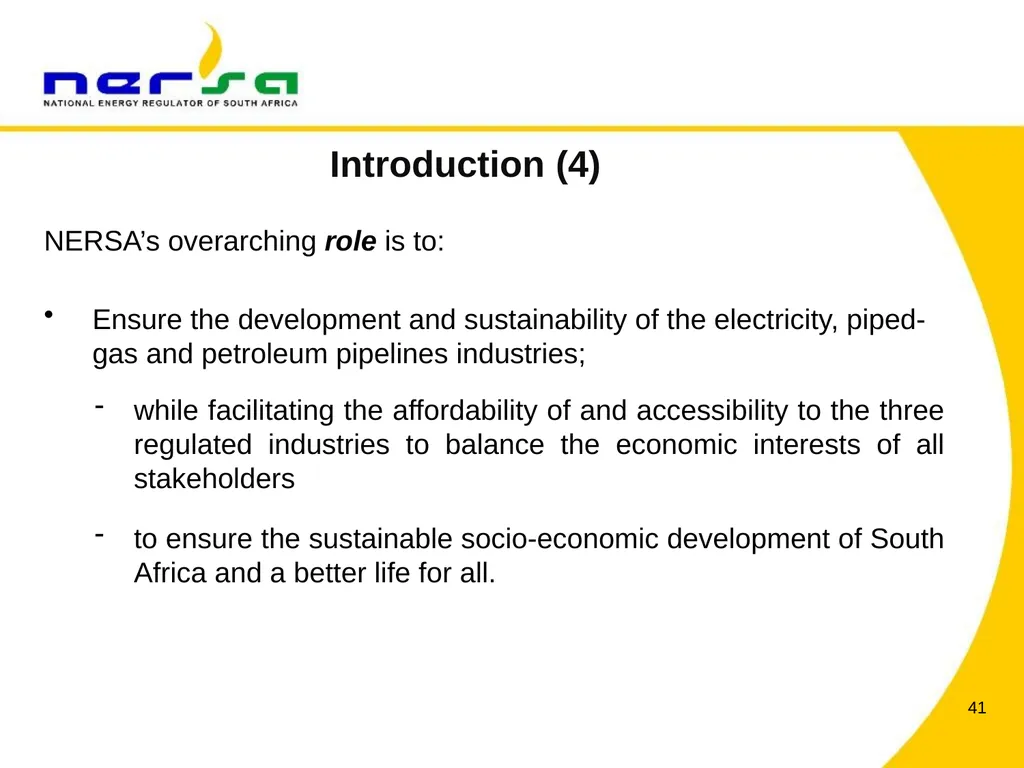
NERSA’s overarching role is to:
Ensure the development and sustainability of the electricity, piped-gas and petroleum pipelines industries;
while facilitating the affordability of and accessibility to the three regulated industries to balance the economic interests of all stakeholders
to ensure the sustainable socio-economic development of South Africa and a better life for all. Introduction (4) 41<br>
Ensure the development and sustainability of the electricity, piped-gas and petroleum pipelines industries;
while facilitating the affordability of and accessibility to the three regulated industries to balance the economic interests of all stakeholders
to ensure the sustainable socio-economic development of South Africa and a better life for all. Introduction (4) 41<br>
42
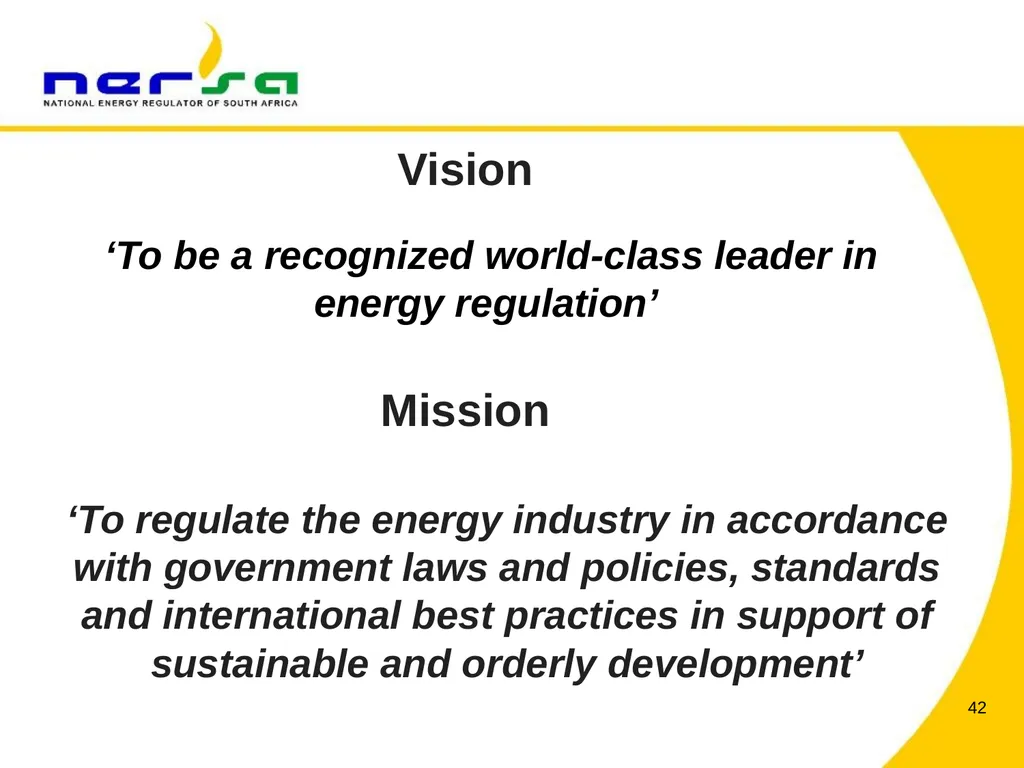
‘To be a recognized world-class leader in energy regulation’ ‘To regulate the energy industry in accordance with government laws and policies, standards and international best practices in support of sustainable and orderly development’ Vision Mission 42<br>
43
Mandate 43<br>
44
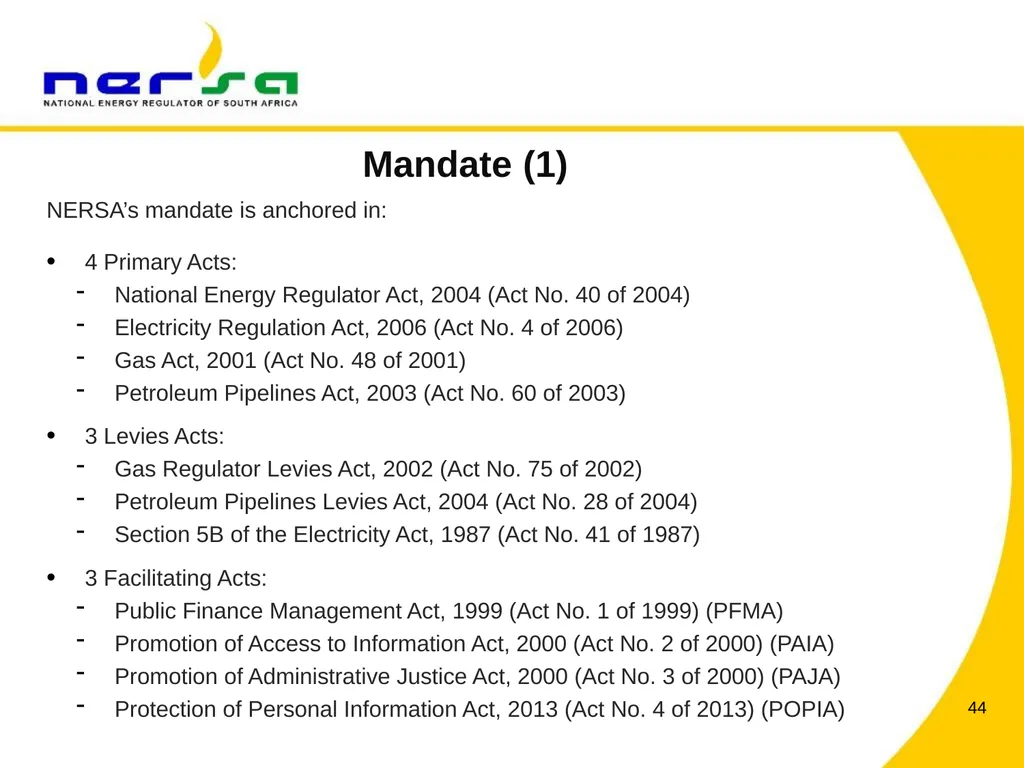
NERSA’s mandate is anchored in:
4 Primary Acts:
National Energy Regulator Act, 2004 (Act No. 40 of 2004)
Electricity Regulation Act, 2006 (Act No. 4 of 2006)
Gas Act, 2001 (Act No. 48 of 2001)
Petroleum Pipelines Act, 2003 (Act No. 60 of 2003)
3 Levies Acts:
Gas Regulator Levies Act, 2002 (Act No. 75 of 2002)
Petroleum Pipelines Levies Act, 2004 (Act No. 28 of 2004)
Section 5B of the Electricity Act, 1987 (Act No. 41 of 1987)
3 Facilitating Acts:
Public Finance Management Act, 1999 (Act No. 1 of 1999) (PFMA)
Promotion of Access to Information Act, 2000 (Act No. 2 of 2000) (PAIA)
Promotion of Administrative Justice Act, 2000 (Act No. 3 of 2000) (PAJA)
Protection of Personal Information Act, 2013 (Act No. 4 of 2013) (POPIA) Mandate (1) 44<br>
4 Primary Acts:
National Energy Regulator Act, 2004 (Act No. 40 of 2004)
Electricity Regulation Act, 2006 (Act No. 4 of 2006)
Gas Act, 2001 (Act No. 48 of 2001)
Petroleum Pipelines Act, 2003 (Act No. 60 of 2003)
3 Levies Acts:
Gas Regulator Levies Act, 2002 (Act No. 75 of 2002)
Petroleum Pipelines Levies Act, 2004 (Act No. 28 of 2004)
Section 5B of the Electricity Act, 1987 (Act No. 41 of 1987)
3 Facilitating Acts:
Public Finance Management Act, 1999 (Act No. 1 of 1999) (PFMA)
Promotion of Access to Information Act, 2000 (Act No. 2 of 2000) (PAIA)
Promotion of Administrative Justice Act, 2000 (Act No. 3 of 2000) (PAJA)
Protection of Personal Information Act, 2013 (Act No. 4 of 2013) (POPIA) Mandate (1) 44<br>
45
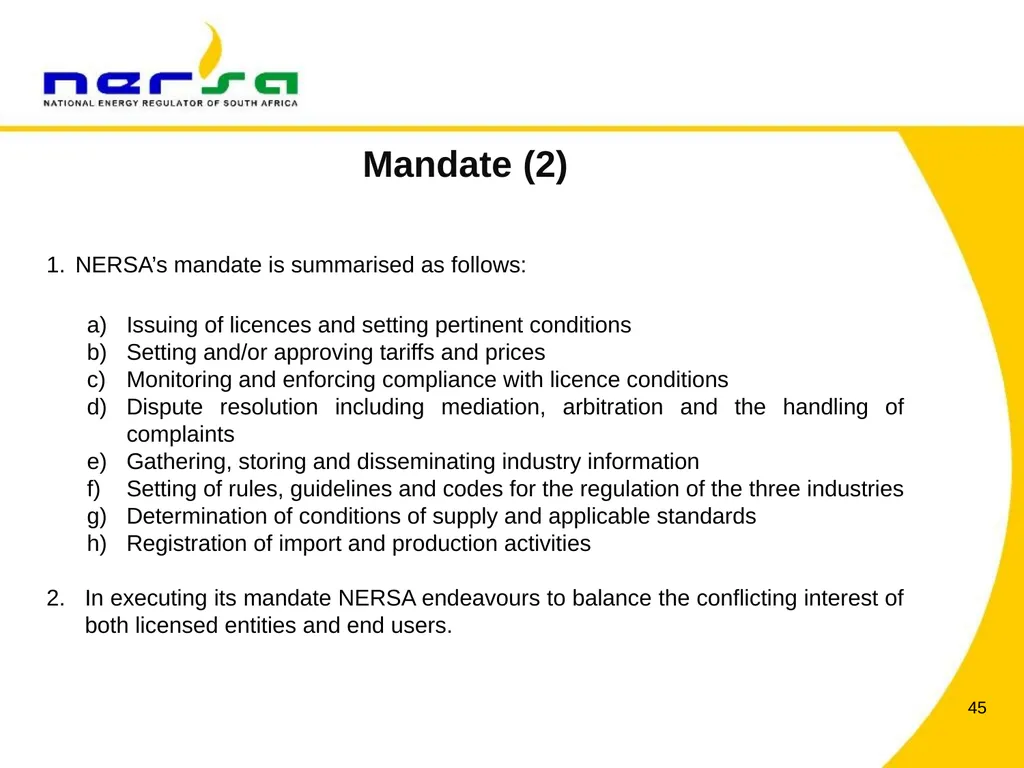
Mandate (2) NERSA’s mandate is summarised as follows:
Issuing of licences and setting pertinent conditions
Setting and/or approving tariffs and prices
Monitoring and enforcing compliance with licence conditions
Dispute resolution including mediation, arbitration and the handling of complaints
Gathering, storing and disseminating industry information
Setting of rules, guidelines and codes for the regulation of the three industries
Determination of conditions of supply and applicable standards
Registration of import and production activities
In executing its mandate NERSA endeavours to balance the conflicting interest of both licensed entities and end users. 45<br>
Issuing of licences and setting pertinent conditions
Setting and/or approving tariffs and prices
Monitoring and enforcing compliance with licence conditions
Dispute resolution including mediation, arbitration and the handling of complaints
Gathering, storing and disseminating industry information
Setting of rules, guidelines and codes for the regulation of the three industries
Determination of conditions of supply and applicable standards
Registration of import and production activities
In executing its mandate NERSA endeavours to balance the conflicting interest of both licensed entities and end users. 45<br>
46
Strategic Imperatives 46<br>
47
47<br>
48
Corporate Governance 48<br>
49
NERSA is committed to good corporate governance. It adopted the Corporate Governance Handbook containing corporate governance rules and prescripts.
The provisions of the National Energy Regulator Act, 2004 (Act No. 40 of 2004), the PFMA, and the principles contained in the King IV Report on Corporate Governance are included in the Corporate Governance Handbook to which NERSA adheres.
NERSA ensures declaration of interest.
In adhering to best practices and sound governance principles, the Energy Regulator subjects itself to an annual assessment on the effectiveness of the Energy Regulator and its committees. Corporate Governance (1) 49<br>
The provisions of the National Energy Regulator Act, 2004 (Act No. 40 of 2004), the PFMA, and the principles contained in the King IV Report on Corporate Governance are included in the Corporate Governance Handbook to which NERSA adheres.
NERSA ensures declaration of interest.
In adhering to best practices and sound governance principles, the Energy Regulator subjects itself to an annual assessment on the effectiveness of the Energy Regulator and its committees. Corporate Governance (1) 49<br>
50
Oversight
The Parliamentary Portfolio Committee (PPC) on Electricity and Energy has oversight of NERSA
Executive Authority
The Executive Authority of the National Energy Regulator is the Minister of Electricity and Energy.
The Energy Regulator submitted a number of statutory documents to the Executive Authority (DMRE), namely:
The Annual Performance Plan (2023/24 – 2025/26) submitted by 31 January 2023 to the Minister of Mineral Resources and Energy and approval and tabling in Parliament.
4 quarterly performance reports submitted within prescribed timeframes
The Annual Report (2023/24) was submitted to the Minister of Mineral Resources and Energy, the Minister of Finance, and the Auditor-General by August 2024.
Accounting Authority
The Energy Regulator, as the Accounting Authority, retains full and effective control over NERSA. Corporate Governance (2) 50<br>
The Parliamentary Portfolio Committee (PPC) on Electricity and Energy has oversight of NERSA
Executive Authority
The Executive Authority of the National Energy Regulator is the Minister of Electricity and Energy.
The Energy Regulator submitted a number of statutory documents to the Executive Authority (DMRE), namely:
The Annual Performance Plan (2023/24 – 2025/26) submitted by 31 January 2023 to the Minister of Mineral Resources and Energy and approval and tabling in Parliament.
4 quarterly performance reports submitted within prescribed timeframes
The Annual Report (2023/24) was submitted to the Minister of Mineral Resources and Energy, the Minister of Finance, and the Auditor-General by August 2024.
Accounting Authority
The Energy Regulator, as the Accounting Authority, retains full and effective control over NERSA. Corporate Governance (2) 50<br>
51
Regulatory Subcommittees – open to the public except where confidential matters are to be considered:
Electricity Subcommittee (ELS)
Piped-gas Subcommittee (PGS)
Petroleum Pipelines Subcommittee (PPS)
Crosscutting Subcommittees – open to the public except where confidential, organisational, or governance matters are to be considered:
Regulator Executive Committee (REC)
Governance Committees – not open to the public:
Human Resource and Remuneration Committee (HRRC)
Finance Committee (FIC)
Audit and Risk Committee (ARC)
Information Technology Governance Committee (ITGC) Energy Regulator Subcommittees and Committees 51<br>
Electricity Subcommittee (ELS)
Piped-gas Subcommittee (PGS)
Petroleum Pipelines Subcommittee (PPS)
Crosscutting Subcommittees – open to the public except where confidential, organisational, or governance matters are to be considered:
Regulator Executive Committee (REC)
Governance Committees – not open to the public:
Human Resource and Remuneration Committee (HRRC)
Finance Committee (FIC)
Audit and Risk Committee (ARC)
Information Technology Governance Committee (ITGC) Energy Regulator Subcommittees and Committees 51<br>
52
The Energy Regulator approved the Risk Appetite and Tolerance Thresholds for the organisation.
Progress made with mitigating the top 9 risks was reported in the quarterly performance reports.
NERSA has embarked on the implementation of the Combined Assurance Framework and Model. Risk Management The Internal Audit Unit completed all audits planned for the period under review.
An external five-year quality assessment of the Internal Audit Activity was conducted in 2024 and a ‘generally conform’ rating – the highest rating available – was obtained. Internal Audit 52<br>
Progress made with mitigating the top 9 risks was reported in the quarterly performance reports.
NERSA has embarked on the implementation of the Combined Assurance Framework and Model. Risk Management The Internal Audit Unit completed all audits planned for the period under review.
An external five-year quality assessment of the Internal Audit Activity was conducted in 2024 and a ‘generally conform’ rating – the highest rating available – was obtained. Internal Audit 52<br>
53
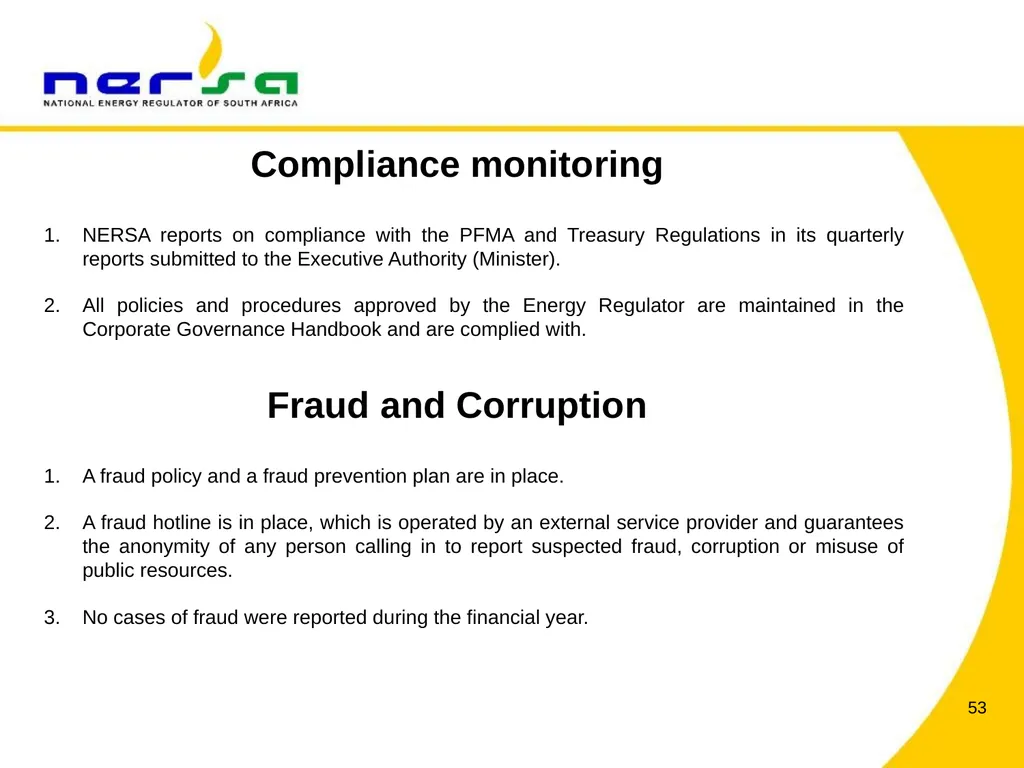
NERSA reports on compliance with the PFMA and Treasury Regulations in its quarterly reports submitted to the Executive Authority (Minister).
All policies and procedures approved by the Energy Regulator are maintained in the Corporate Governance Handbook and are complied with. Compliance monitoring A fraud policy and a fraud prevention plan are in place.
A fraud hotline is in place, which is operated by an external service provider and guarantees the anonymity of any person calling in to report suspected fraud, corruption or misuse of public resources.
No cases of fraud were reported during the financial year. Fraud and Corruption 53<br>
All policies and procedures approved by the Energy Regulator are maintained in the Corporate Governance Handbook and are complied with. Compliance monitoring A fraud policy and a fraud prevention plan are in place.
A fraud hotline is in place, which is operated by an external service provider and guarantees the anonymity of any person calling in to report suspected fraud, corruption or misuse of public resources.
No cases of fraud were reported during the financial year. Fraud and Corruption 53<br>
54
5. Performance in the 2023/24 financial year 54<br>
55
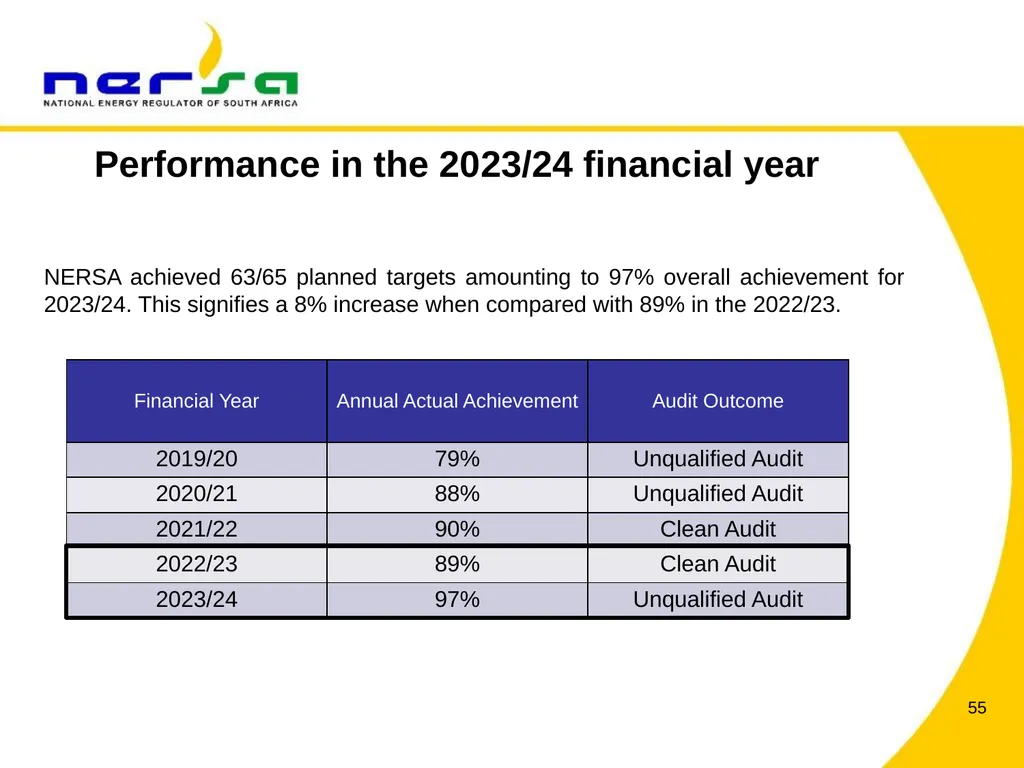
NERSA achieved 63/65 planned targets amounting to 97% overall achievement for 2023/24. This signifies a 8% increase when compared with 89% in the 2022/23. Performance in the 2023/24 financial year 55<br>
56
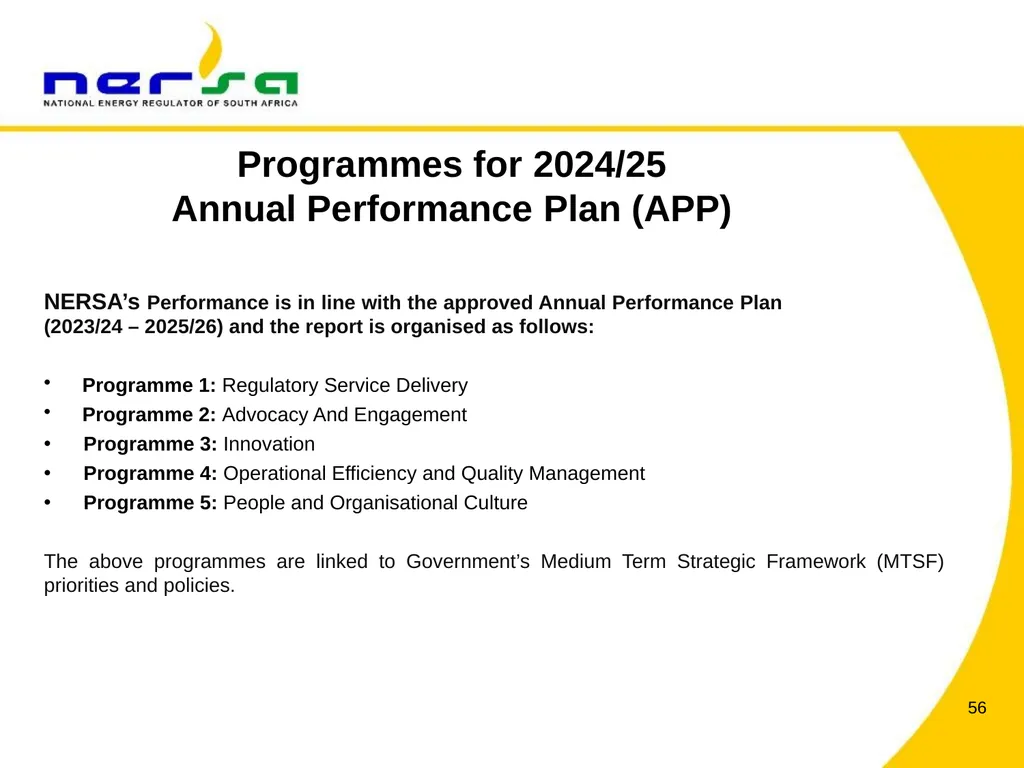
NERSA’s Performance is in line with the approved Annual Performance Plan (2023/24 – 2025/26) and the report is organised as follows:
Programme 1: Regulatory Service Delivery
Programme 2: Advocacy And Engagement
Programme 3: Innovation
Programme 4: Operational Efficiency and Quality Management
Programme 5: People and Organisational Culture
The above programmes are linked to Government’s Medium Term Strategic Framework (MTSF) priorities and policies. Programmes for 2024/25 Annual Performance Plan (APP) 56<br>
Programme 1: Regulatory Service Delivery
Programme 2: Advocacy And Engagement
Programme 3: Innovation
Programme 4: Operational Efficiency and Quality Management
Programme 5: People and Organisational Culture
The above programmes are linked to Government’s Medium Term Strategic Framework (MTSF) priorities and policies. Programmes for 2024/25 Annual Performance Plan (APP) 56<br>
57
Overall performance against planned outputs and targets (1) 57<br>
58
Overall performance against planned outputs and targets (2) 58<br>
59
Regulatory Programmes (1) Programme 1: Regulatory Service Delivery 59<br>
60
Regulatory Programmes (2) Programme 1: Regulatory Service Delivery 60<br>
61
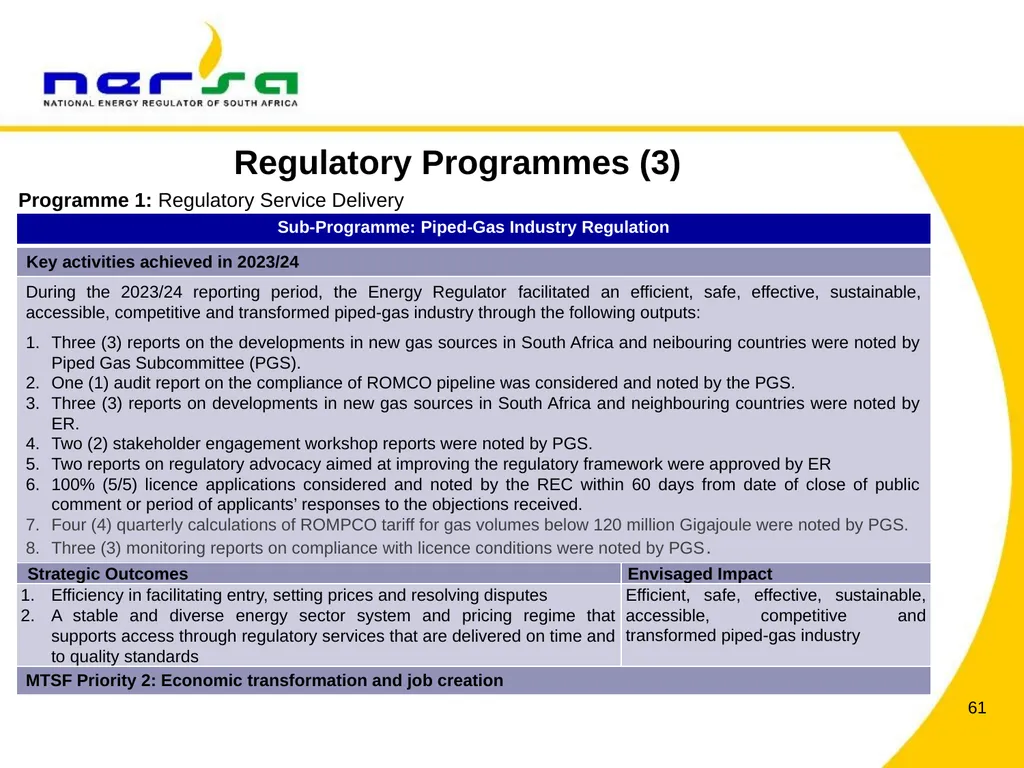
Regulatory Programmes (3) Programme 1: Regulatory Service Delivery 61<br>
62
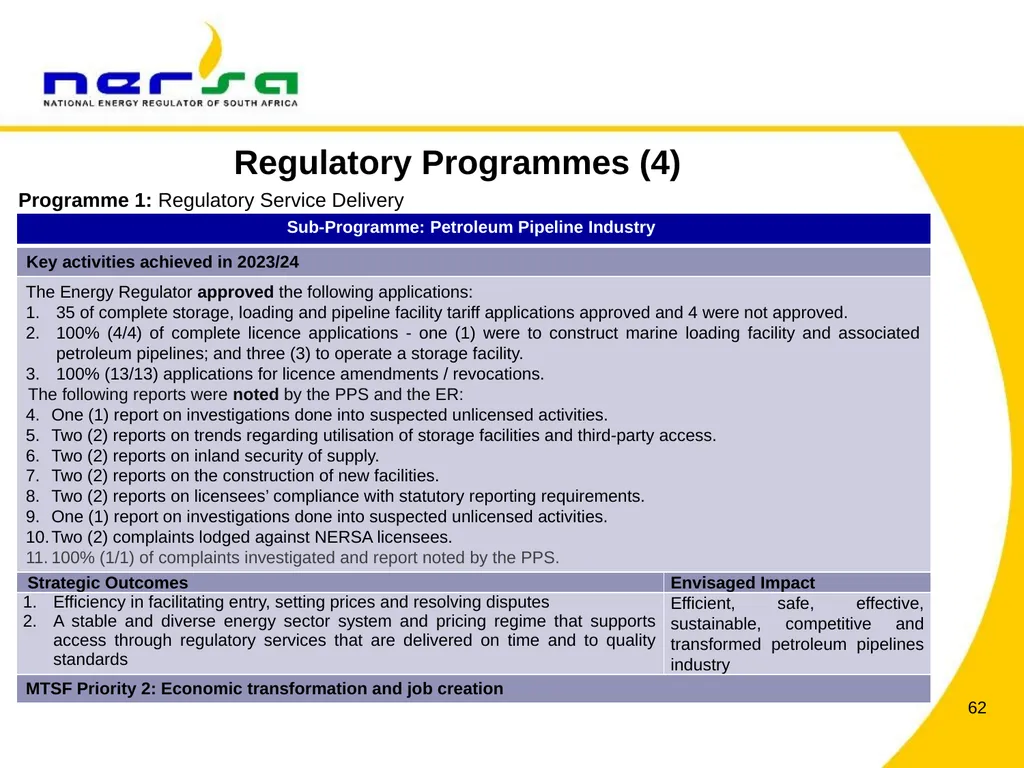
Regulatory Programmes (4) Programme 1: Regulatory Service Delivery 62<br>
63
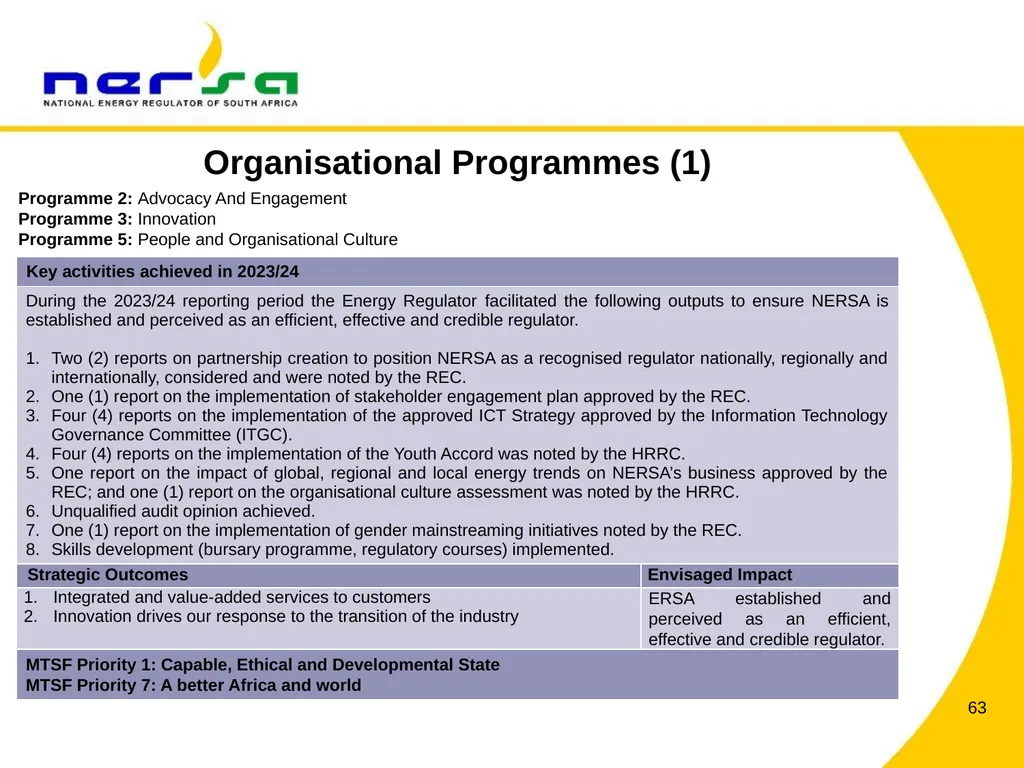
Organisational Programmes (1) Programme 2: Advocacy And Engagement
Programme 3: Innovation
Programme 5: People and Organisational Culture 63<br>
Programme 3: Innovation
Programme 5: People and Organisational Culture 63<br>
64
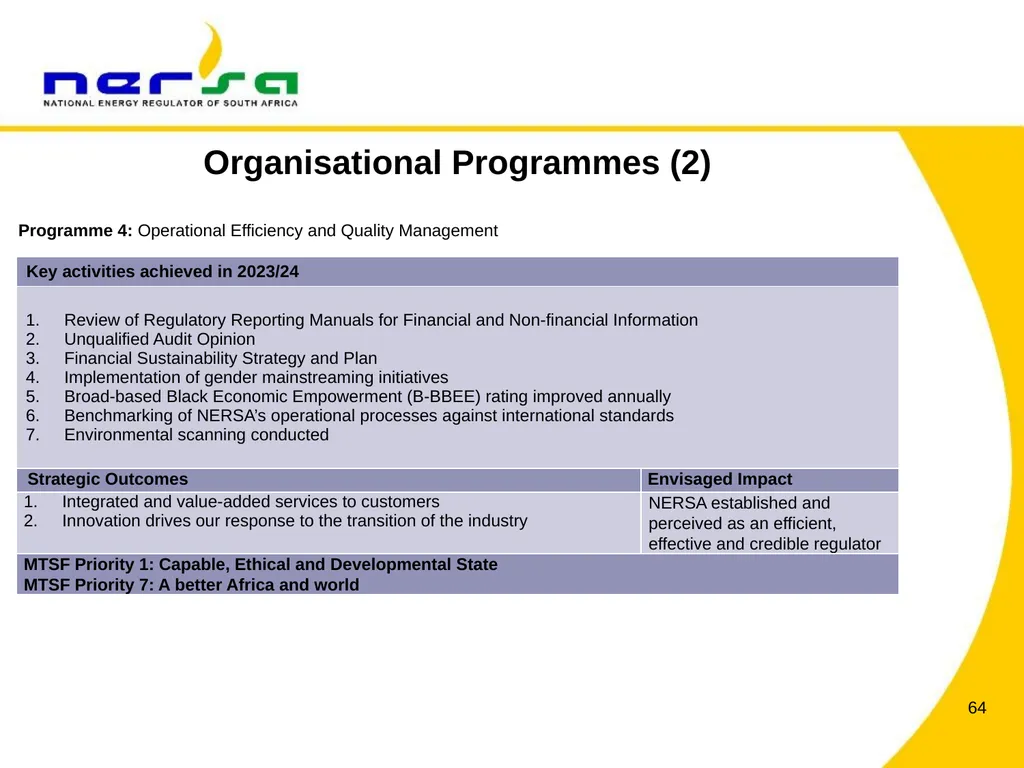
Organisational Programmes (2) Programme 4: Operational Efficiency and Quality Management 64<br>
65
6. Human Resource Management 65<br>
66
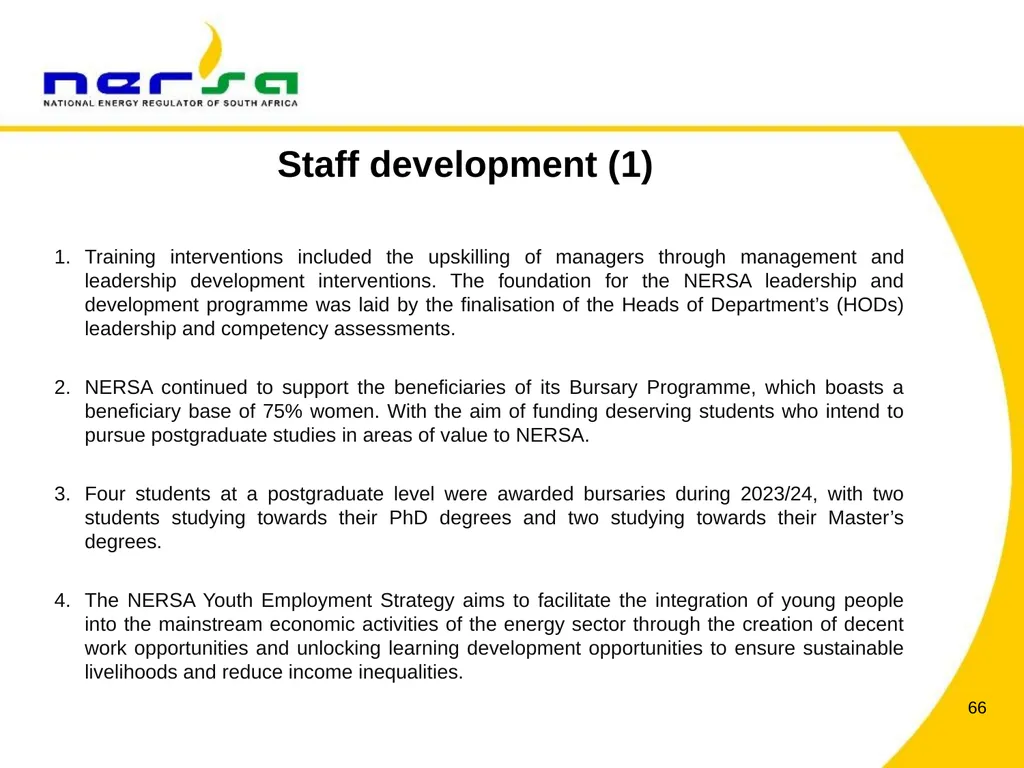
Training interventions included the upskilling of managers through management and leadership development interventions. The foundation for the NERSA leadership and development programme was laid by the finalisation of the Heads of Department’s (HODs) leadership and competency assessments.
NERSA continued to support the beneficiaries of its Bursary Programme, which boasts a beneficiary base of 75% women. With the aim of funding deserving students who intend to pursue postgraduate studies in areas of value to NERSA.
Four students at a postgraduate level were awarded bursaries during 2023/24, with two students studying towards their PhD degrees and two studying towards their Master’s degrees.
The NERSA Youth Employment Strategy aims to facilitate the integration of young people into the mainstream economic activities of the energy sector through the creation of decent work opportunities and unlocking learning development opportunities to ensure sustainable livelihoods and reduce income inequalities. Staff development (1) 66<br>
NERSA continued to support the beneficiaries of its Bursary Programme, which boasts a beneficiary base of 75% women. With the aim of funding deserving students who intend to pursue postgraduate studies in areas of value to NERSA.
Four students at a postgraduate level were awarded bursaries during 2023/24, with two students studying towards their PhD degrees and two studying towards their Master’s degrees.
The NERSA Youth Employment Strategy aims to facilitate the integration of young people into the mainstream economic activities of the energy sector through the creation of decent work opportunities and unlocking learning development opportunities to ensure sustainable livelihoods and reduce income inequalities. Staff development (1) 66<br>
67
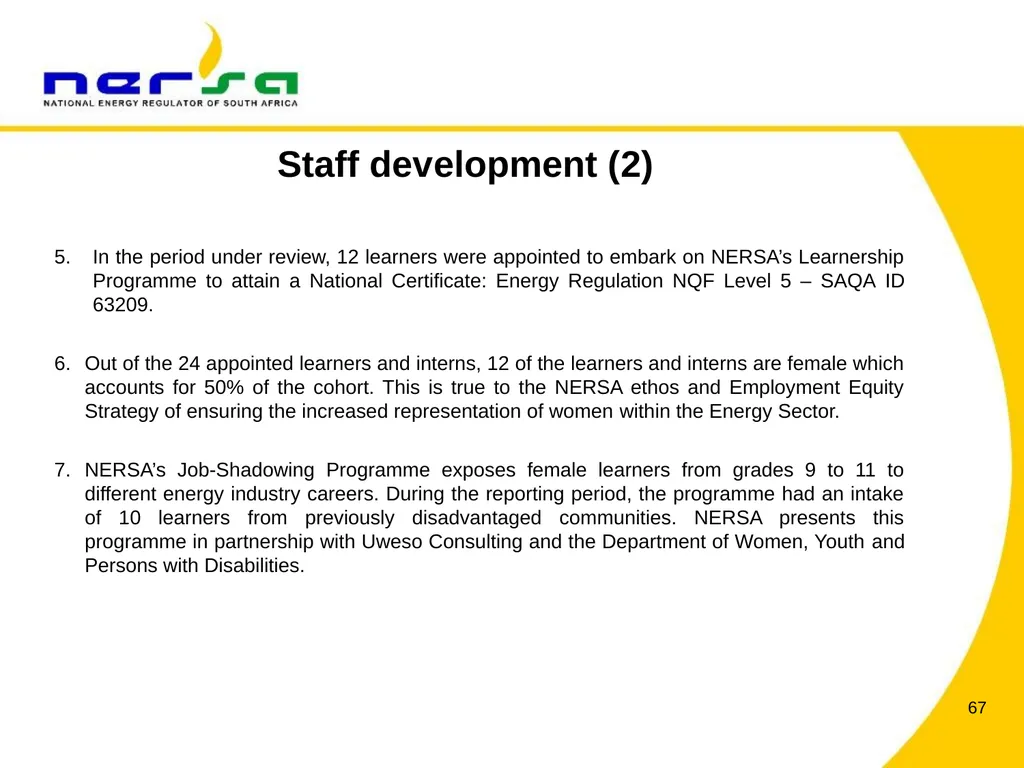
In the period under review, 12 learners were appointed to embark on NERSA’s Learnership Programme to attain a National Certificate: Energy Regulation NQF Level 5 – SAQA ID 63209.
Out of the 24 appointed learners and interns, 12 of the learners and interns are female which accounts for 50% of the cohort. This is true to the NERSA ethos and Employment Equity Strategy of ensuring the increased representation of women within the Energy Sector.
NERSA’s Job-Shadowing Programme exposes female learners from grades 9 to 11 to different energy industry careers. During the reporting period, the programme had an intake of 10 learners from previously disadvantaged communities. NERSA presents this programme in partnership with Uweso Consulting and the Department of Women, Youth and Persons with Disabilities. Staff development (2) 67<br>
Out of the 24 appointed learners and interns, 12 of the learners and interns are female which accounts for 50% of the cohort. This is true to the NERSA ethos and Employment Equity Strategy of ensuring the increased representation of women within the Energy Sector.
NERSA’s Job-Shadowing Programme exposes female learners from grades 9 to 11 to different energy industry careers. During the reporting period, the programme had an intake of 10 learners from previously disadvantaged communities. NERSA presents this programme in partnership with Uweso Consulting and the Department of Women, Youth and Persons with Disabilities. Staff development (2) 67<br>
68
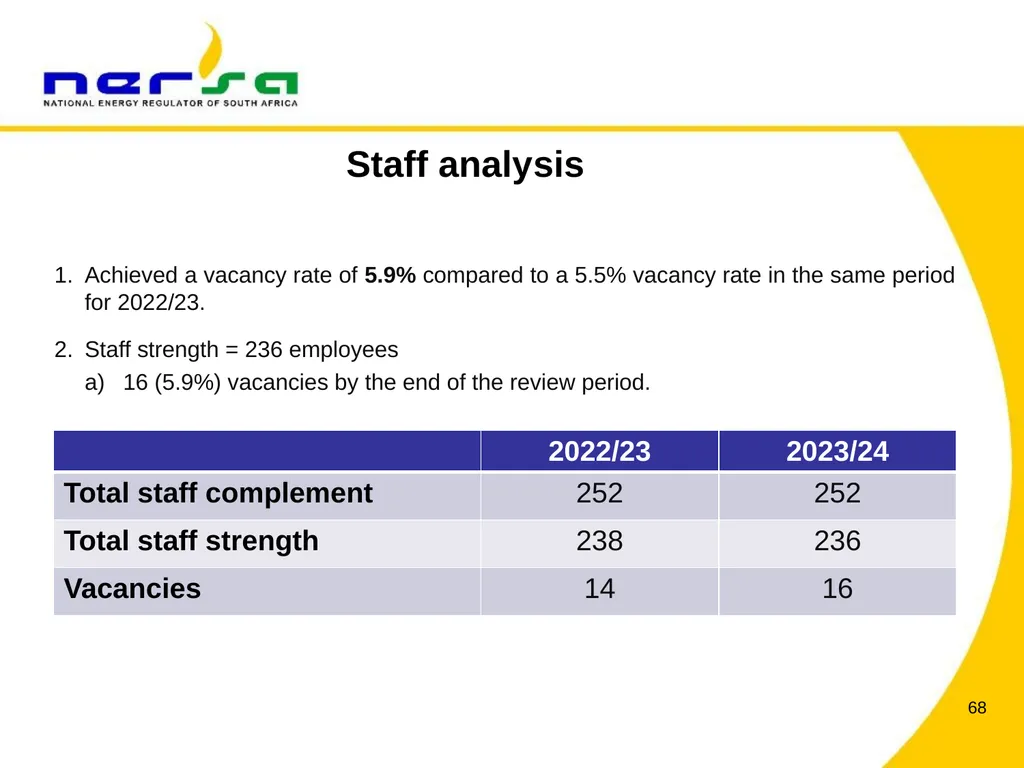
Staff analysis Achieved a vacancy rate of 5.9% compared to a 5.5% vacancy rate in the same period for 2022/23.
Staff strength = 236 employees
16 (5.9%) vacancies by the end of the review period. 68<br>
Staff strength = 236 employees
16 (5.9%) vacancies by the end of the review period. 68<br>
69
7. International Activities 69<br>
70
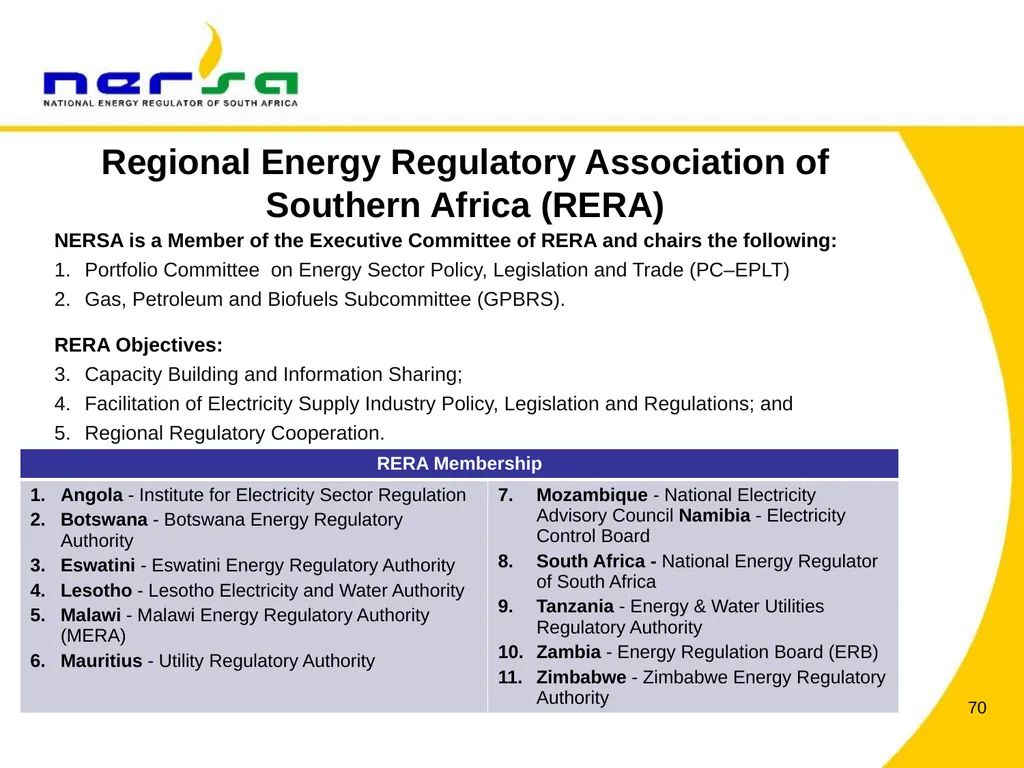
NERSA is a Member of the Executive Committee of RERA and chairs the following:
Portfolio Committee on Energy Sector Policy, Legislation and Trade (PC–EPLT)
Gas, Petroleum and Biofuels Subcommittee (GPBRS).
RERA Objectives:
Capacity Building and Information Sharing;
Facilitation of Electricity Supply Industry Policy, Legislation and Regulations; and
Regional Regulatory Cooperation. Regional Energy Regulatory Association of Southern Africa (RERA) 70<br>
Portfolio Committee on Energy Sector Policy, Legislation and Trade (PC–EPLT)
Gas, Petroleum and Biofuels Subcommittee (GPBRS).
RERA Objectives:
Capacity Building and Information Sharing;
Facilitation of Electricity Supply Industry Policy, Legislation and Regulations; and
Regional Regulatory Cooperation. Regional Energy Regulatory Association of Southern Africa (RERA) 70<br>
71
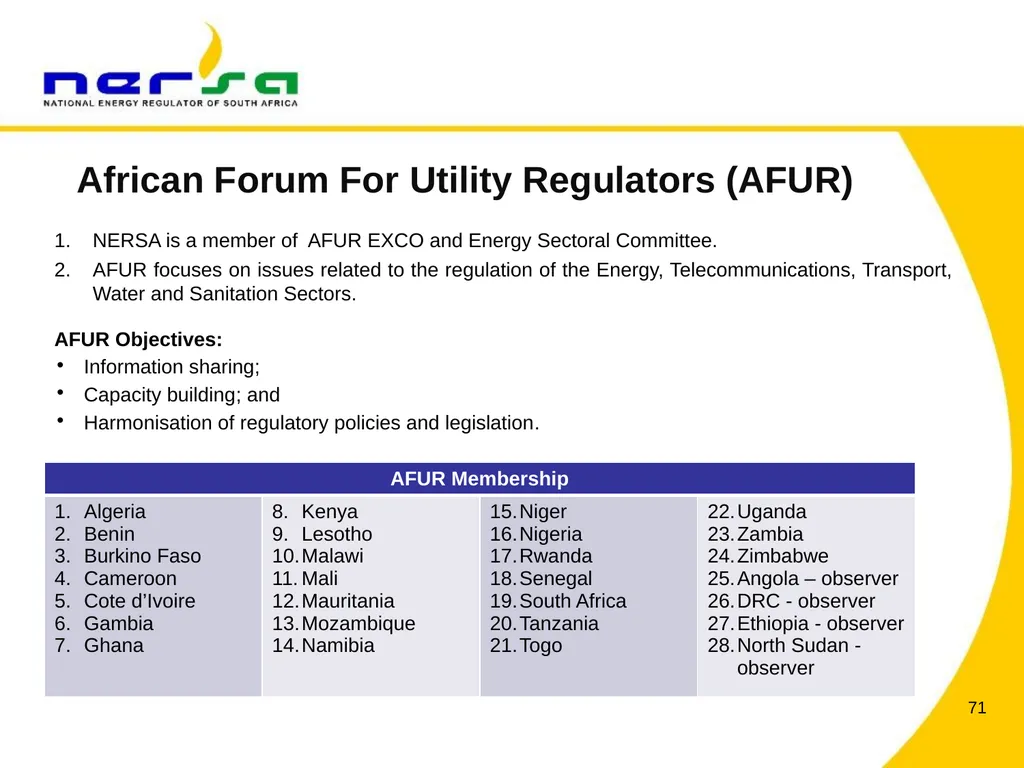
NERSA is a member of AFUR EXCO and Energy Sectoral Committee.
AFUR focuses on issues related to the regulation of the Energy, Telecommunications, Transport, Water and Sanitation Sectors.
AFUR Objectives:
Information sharing;
Capacity building; and
Harmonisation of regulatory policies and legislation.
AFUR Objectives:
Information sharing;
Capacity building; and
Harmonisation of regulatory policies and legislation. African Forum For Utility Regulators (AFUR) 71<br>
AFUR focuses on issues related to the regulation of the Energy, Telecommunications, Transport, Water and Sanitation Sectors.
AFUR Objectives:
Information sharing;
Capacity building; and
Harmonisation of regulatory policies and legislation.
AFUR Objectives:
Information sharing;
Capacity building; and
Harmonisation of regulatory policies and legislation. African Forum For Utility Regulators (AFUR) 71<br>
72
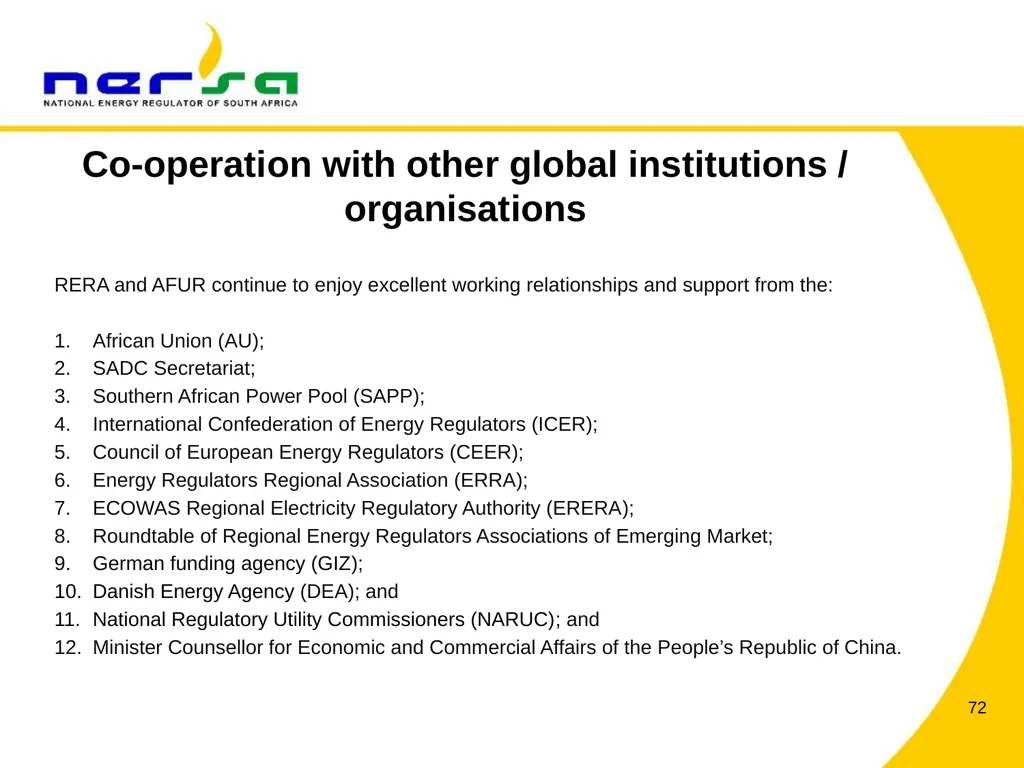
RERA and AFUR continue to enjoy excellent working relationships and support from the:
African Union (AU);
SADC Secretariat;
Southern African Power Pool (SAPP);
International Confederation of Energy Regulators (ICER);
Council of European Energy Regulators (CEER);
Energy Regulators Regional Association (ERRA);
ECOWAS Regional Electricity Regulatory Authority (ERERA);
Roundtable of Regional Energy Regulators Associations of Emerging Market;
German funding agency (GIZ);
Danish Energy Agency (DEA); and
National Regulatory Utility Commissioners (NARUC); and
Minister Counsellor for Economic and Commercial Affairs of the People’s Republic of China. Co-operation with other global institutions / organisations 72<br>
African Union (AU);
SADC Secretariat;
Southern African Power Pool (SAPP);
International Confederation of Energy Regulators (ICER);
Council of European Energy Regulators (CEER);
Energy Regulators Regional Association (ERRA);
ECOWAS Regional Electricity Regulatory Authority (ERERA);
Roundtable of Regional Energy Regulators Associations of Emerging Market;
German funding agency (GIZ);
Danish Energy Agency (DEA); and
National Regulatory Utility Commissioners (NARUC); and
Minister Counsellor for Economic and Commercial Affairs of the People’s Republic of China. Co-operation with other global institutions / organisations 72<br>
73
Financial Performance 73<br>
74
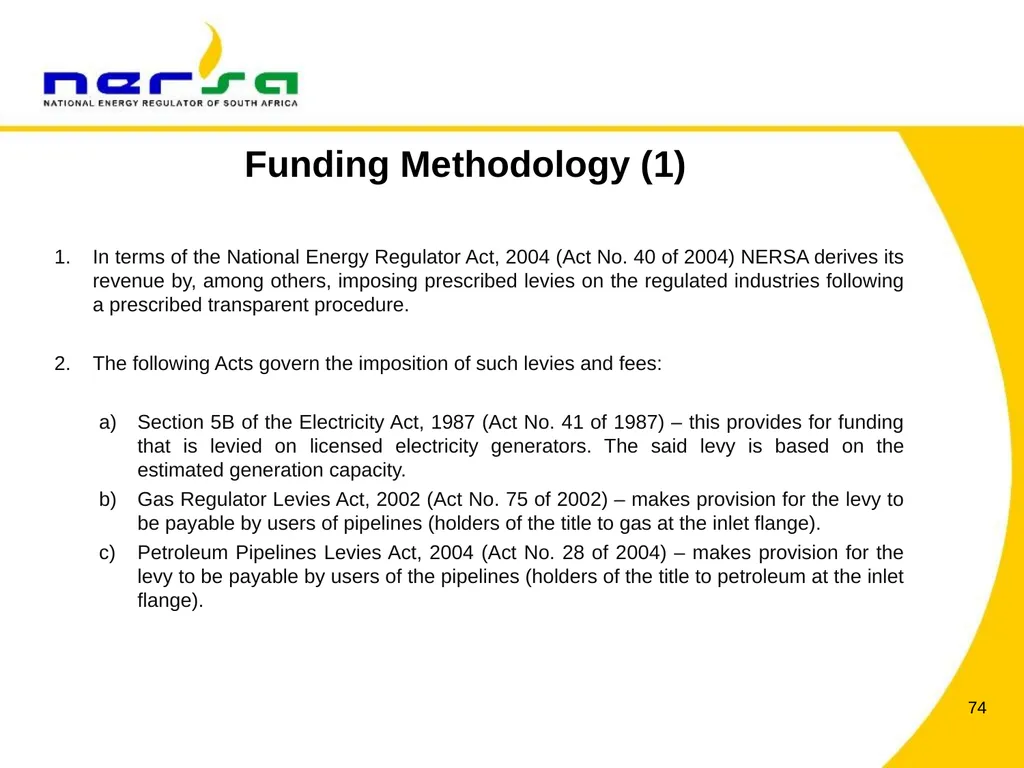
In terms of the National Energy Regulator Act, 2004 (Act No. 40 of 2004) NERSA derives its revenue by, among others, imposing prescribed levies on the regulated industries following a prescribed transparent procedure.
The following Acts govern the imposition of such levies and fees:
Section 5B of the Electricity Act, 1987 (Act No. 41 of 1987) – this provides for funding that is levied on licensed electricity generators. The said levy is based on the estimated generation capacity.
Gas Regulator Levies Act, 2002 (Act No. 75 of 2002) – makes provision for the levy to be payable by users of pipelines (holders of the title to gas at the inlet flange).
Petroleum Pipelines Levies Act, 2004 (Act No. 28 of 2004) – makes provision for the levy to be payable by users of the pipelines (holders of the title to petroleum at the inlet flange). Funding Methodology (1) 74<br>
The following Acts govern the imposition of such levies and fees:
Section 5B of the Electricity Act, 1987 (Act No. 41 of 1987) – this provides for funding that is levied on licensed electricity generators. The said levy is based on the estimated generation capacity.
Gas Regulator Levies Act, 2002 (Act No. 75 of 2002) – makes provision for the levy to be payable by users of pipelines (holders of the title to gas at the inlet flange).
Petroleum Pipelines Levies Act, 2004 (Act No. 28 of 2004) – makes provision for the levy to be payable by users of the pipelines (holders of the title to petroleum at the inlet flange). Funding Methodology (1) 74<br>
75
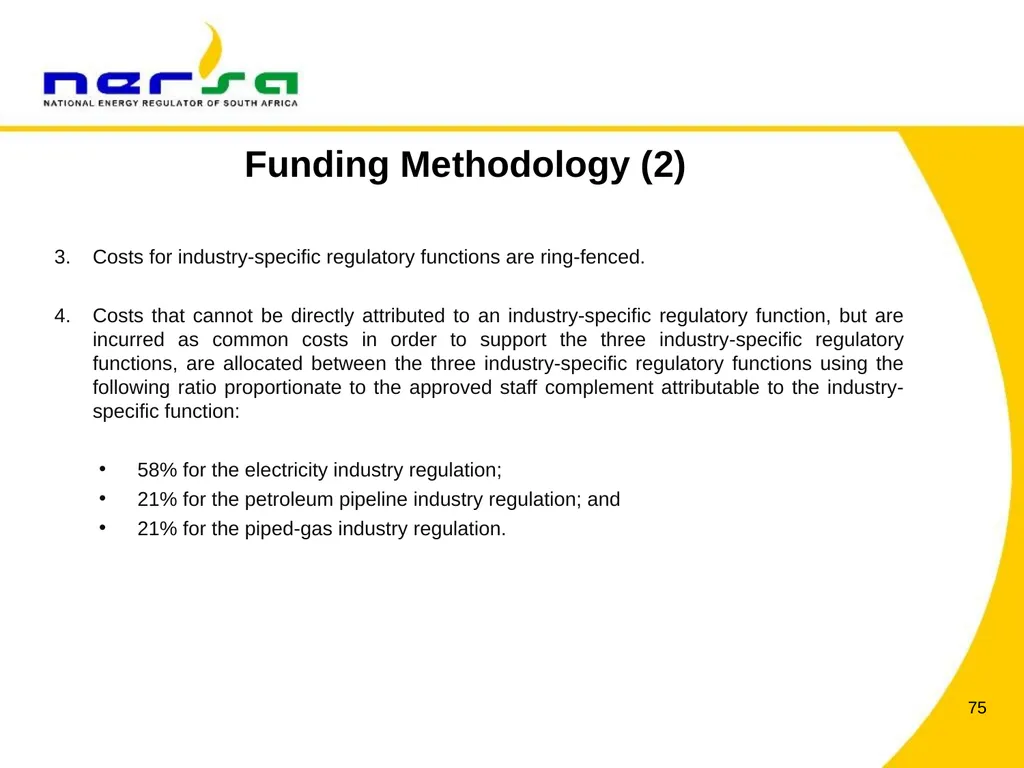
Costs for industry-specific regulatory functions are ring-fenced.
Costs that cannot be directly attributed to an industry-specific regulatory function, but are incurred as common costs in order to support the three industry-specific regulatory functions, are allocated between the three industry-specific regulatory functions using the following ratio proportionate to the approved staff complement attributable to the industry-specific function:
58% for the electricity industry regulation;
21% for the petroleum pipeline industry regulation; and
21% for the piped-gas industry regulation. Funding Methodology (2) 75<br>
Costs that cannot be directly attributed to an industry-specific regulatory function, but are incurred as common costs in order to support the three industry-specific regulatory functions, are allocated between the three industry-specific regulatory functions using the following ratio proportionate to the approved staff complement attributable to the industry-specific function:
58% for the electricity industry regulation;
21% for the petroleum pipeline industry regulation; and
21% for the piped-gas industry regulation. Funding Methodology (2) 75<br>
76
Financial Management (1) 76<br>
77
Financial Management (2) Financial position
The financial position as at 31 March 2024, was a positive net asset value of R207 million. This is mainly due to cash reserves of R122 million included in current assets invested in the CPD account. The current ratio is at 2.4 where there are sufficient assets to cover current liabilities. 77<br>
The financial position as at 31 March 2024, was a positive net asset value of R207 million. This is mainly due to cash reserves of R122 million included in current assets invested in the CPD account. The current ratio is at 2.4 where there are sufficient assets to cover current liabilities. 77<br>
78
Auditor General of South Africa (AGSA) report 78<br>
79
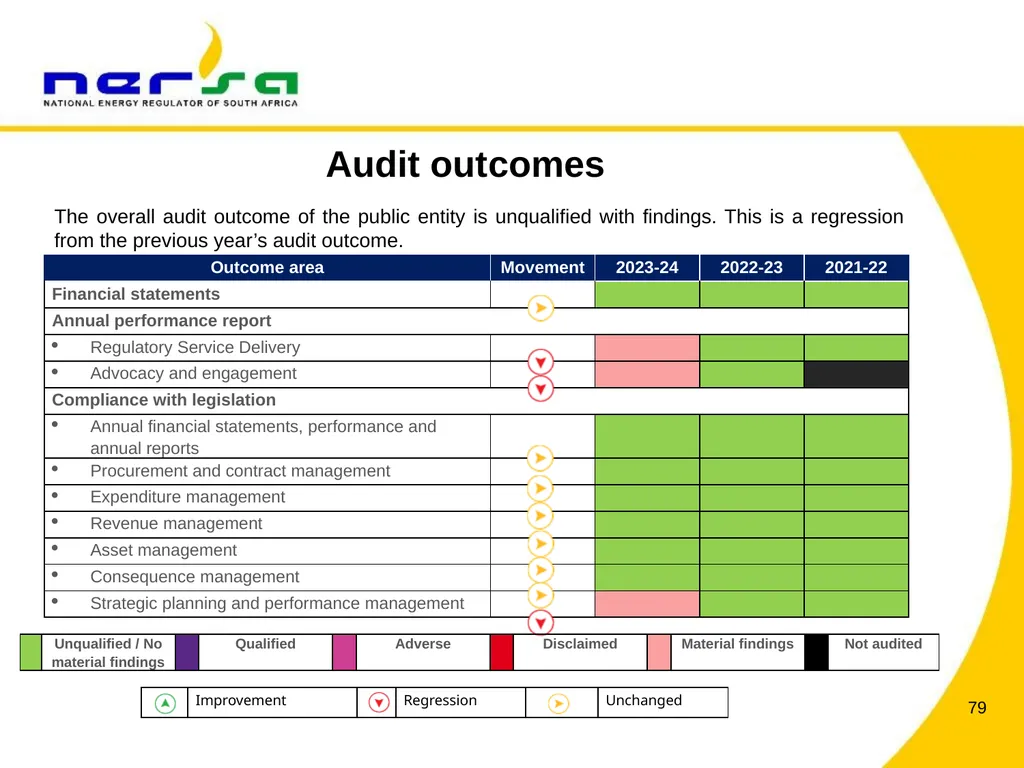
Audit outcomes The overall audit outcome of the public entity is unqualified with findings. This is a regression from the previous year’s audit outcome. 79<br>
80
Annual Financial Statements
Audit Outcome – Annual Financial Statements
Unqualified opinion – with no findings (Clean Audit)
Irregular Fruitless and Wasteful Expenditure
None reported for 2023/24
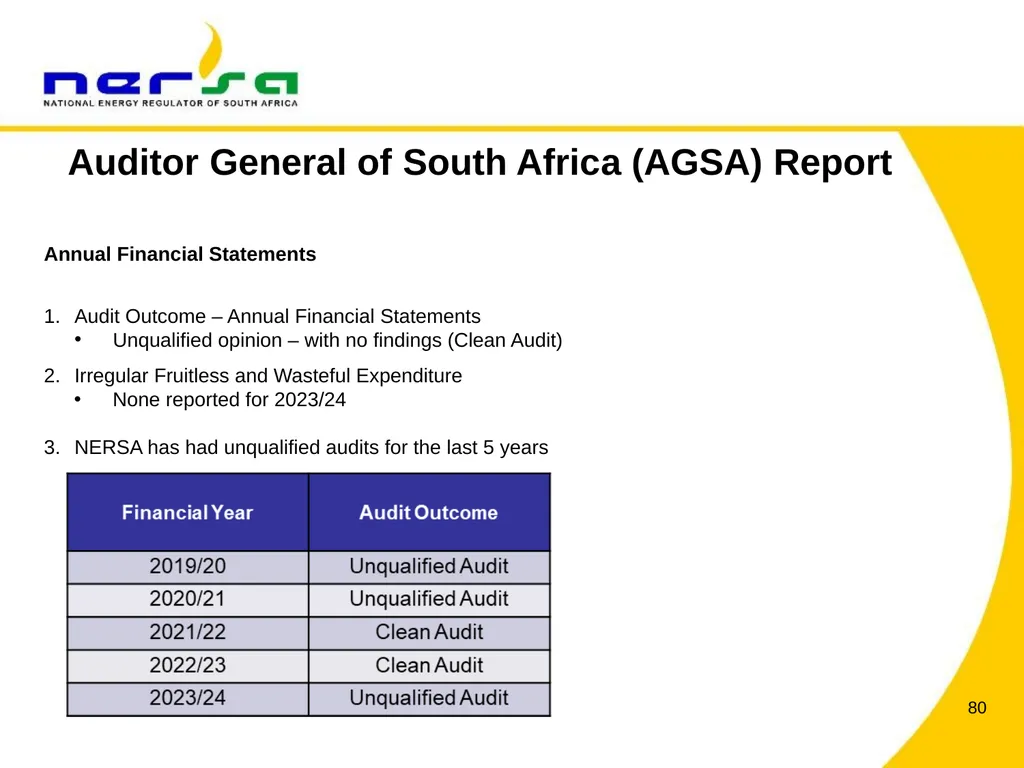
NERSA has had unqualified audits for the last 5 years Auditor General of South Africa (AGSA) Report 80<br>
Audit Outcome – Annual Financial Statements
Unqualified opinion – with no findings (Clean Audit)
Irregular Fruitless and Wasteful Expenditure
None reported for 2023/24
NERSA has had unqualified audits for the last 5 years Auditor General of South Africa (AGSA) Report 80<br>
81
Summary of 2023/24 Audit Findings and
Action Plans (1) 81<br>
82
Summary of 2023/24 Audit Findings and
Action Plans (2) 82<br>
83
Main challenges for the 2023/24 financial year and corrective steps being taken 83<br>
84
Main challenges for the 2023/24 (1) 84<br>
85
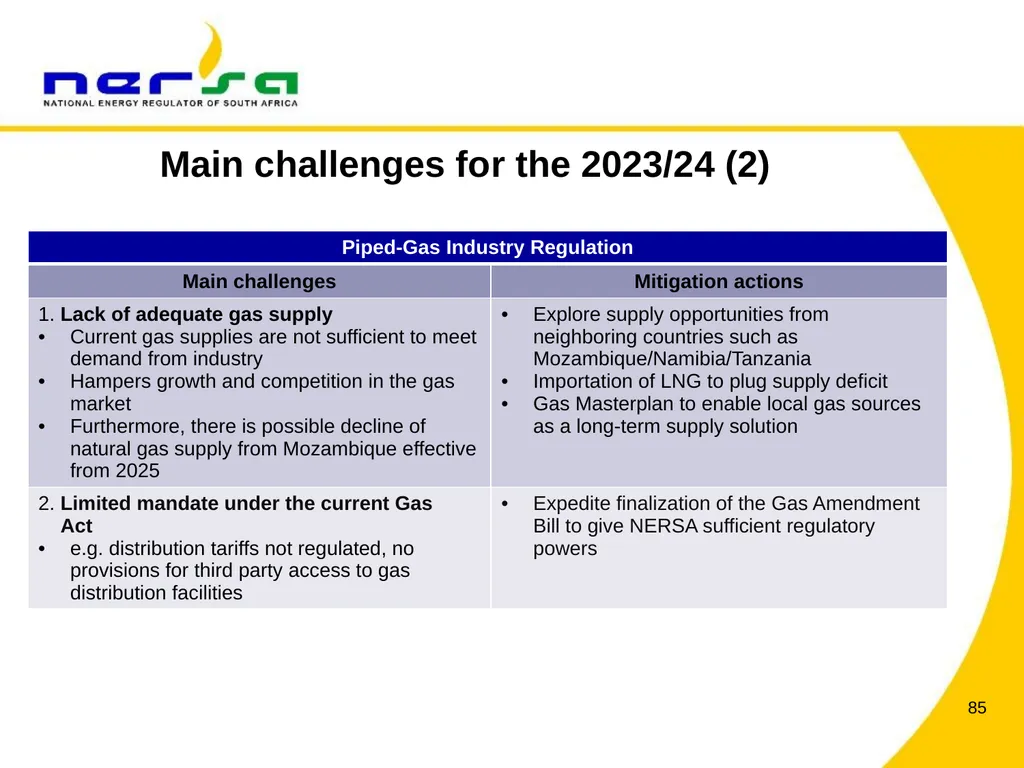
Main challenges for the 2023/24 (2) 85<br>
86
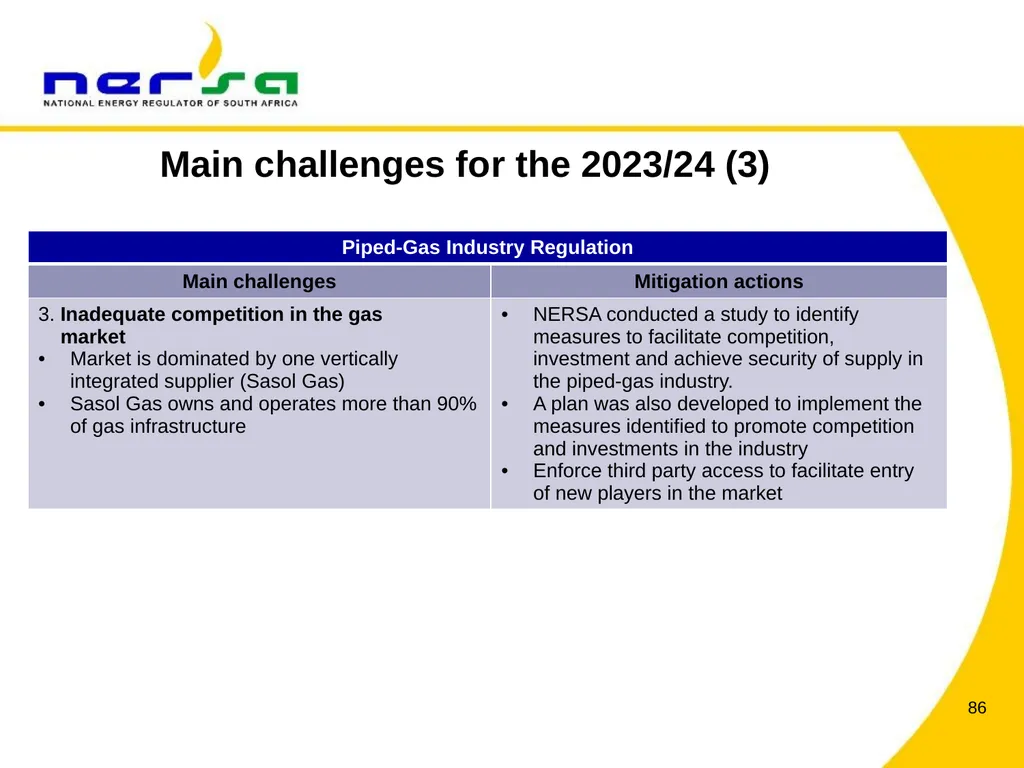
Main challenges for the 2023/24 (3) 86<br>
87
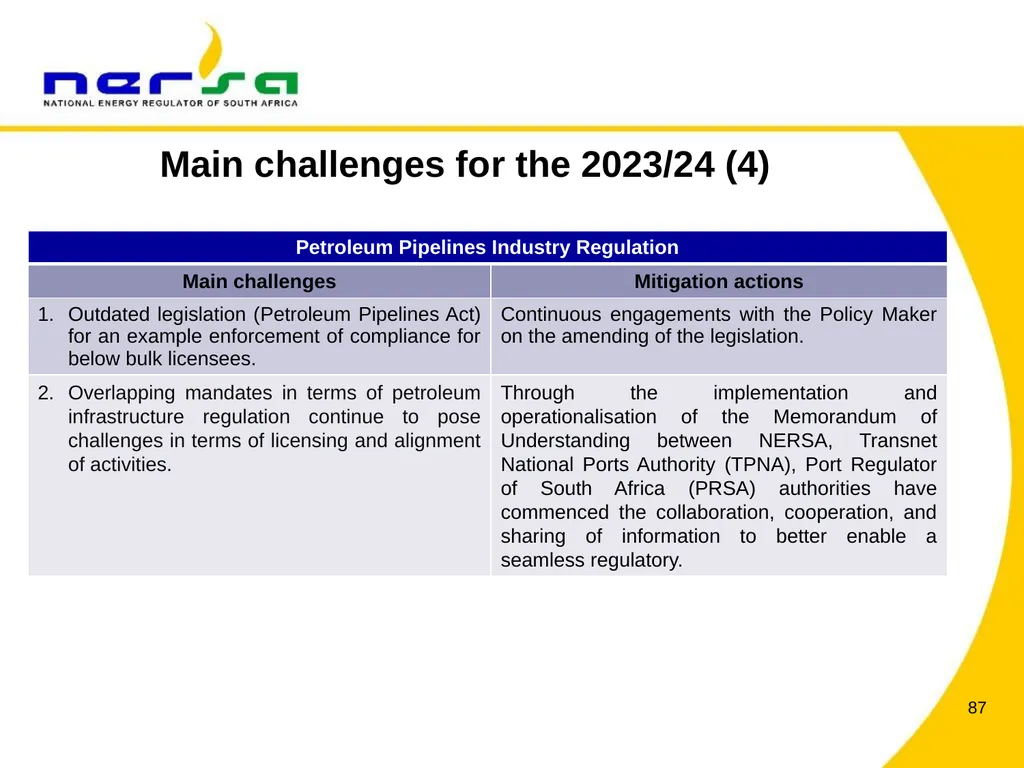
Main challenges for the 2023/24 (4) 87<br>
88
Main challenges for the 2023/24 (5) 88<br>
89
Conclusion 89<br>
90
Conclusion NERSA is thankful for the opportunity given to present its annual report from 2023/24 financial year.
The results of NERSA’s work continues to have a profound impact on the lives of ordinary people as well as on the economy of the country.
The regulation of the three energy industries continues to pose some challenges in that the Energy Regulator is required to balance the conflicting interests of licensees, investors, consumers/end-users and the policy maker.
There is an urgent need for finalization of the Gas Amendment Bill and the review of the Petroleum Pipelines Act.
To deal with regulatory challenges, NERSA has undertaken various initiatives to refine regulatory practices and methodologies in its quest to become a recognized world-class leader in energy regulation and will continue to do so. 90<br>
The results of NERSA’s work continues to have a profound impact on the lives of ordinary people as well as on the economy of the country.
The regulation of the three energy industries continues to pose some challenges in that the Energy Regulator is required to balance the conflicting interests of licensees, investors, consumers/end-users and the policy maker.
There is an urgent need for finalization of the Gas Amendment Bill and the review of the Petroleum Pipelines Act.
To deal with regulatory challenges, NERSA has undertaken various initiatives to refine regulatory practices and methodologies in its quest to become a recognized world-class leader in energy regulation and will continue to do so. 90<br>
91
Thank you Website: www.nersa.org.za
Tel: 012 401 4600
Fax: 012 401 4700
Email: info@nersa.org.za
@NERSAZA
@NERSA_ZA 91<br>
Tel: 012 401 4600
Fax: 012 401 4700
Email: info@nersa.org.za
@NERSAZA
@NERSA_ZA 91<br>