
Presentation on Call Masking and Pre-Registered
Description: Presentation on Call Masking and Pre-Registered SIM Cards By Prof. Umar Garba Danbatta, FNSE, FRAES Executive Vice Chairman CEO 1 Outline Problem Statement 1 Security Impact 3 4 5 6 Economic Impact Compliance Actions Taken Enforcement
Related Topics
Download Presentation
"Presentation on Call Masking and Pre-Registered" is the property of its rightful owner. Permission is granted to download and print the materials on this website for personal, non-commercial use only, and to display it on your personal computer provided you do not modify the materials and that you retain all copyright notices contained in the materials. By downloading content from our website, you accept the terms of this agreement.
Presentation Transcript
slide1. Presentation on Call Masking
and Pre-Registered SIM Cards
By
Prof. Umar Garba Danbatta, FNSE, FRAES
Executive Vice Chairman / CEO 1<br>
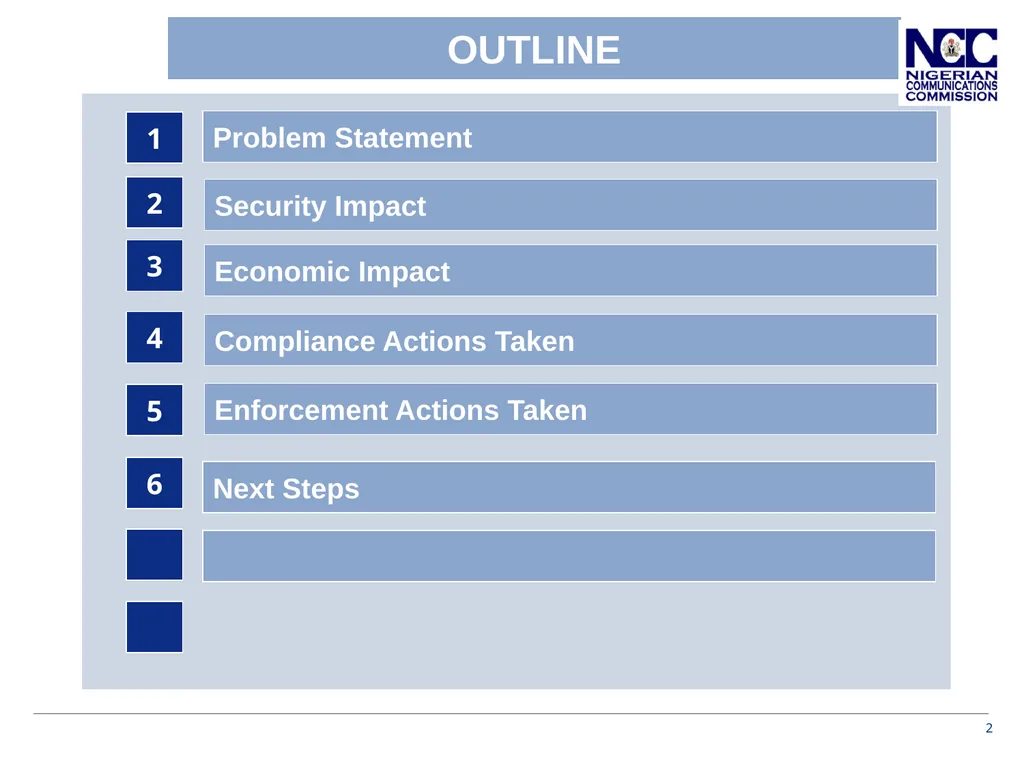
slide2. Outline Problem Statement 1 Security Impact 3 4 5 6 Economic Impact Compliance Actions Taken Enforcement Actions Taken Next Steps OUTLINE 2 2<br>
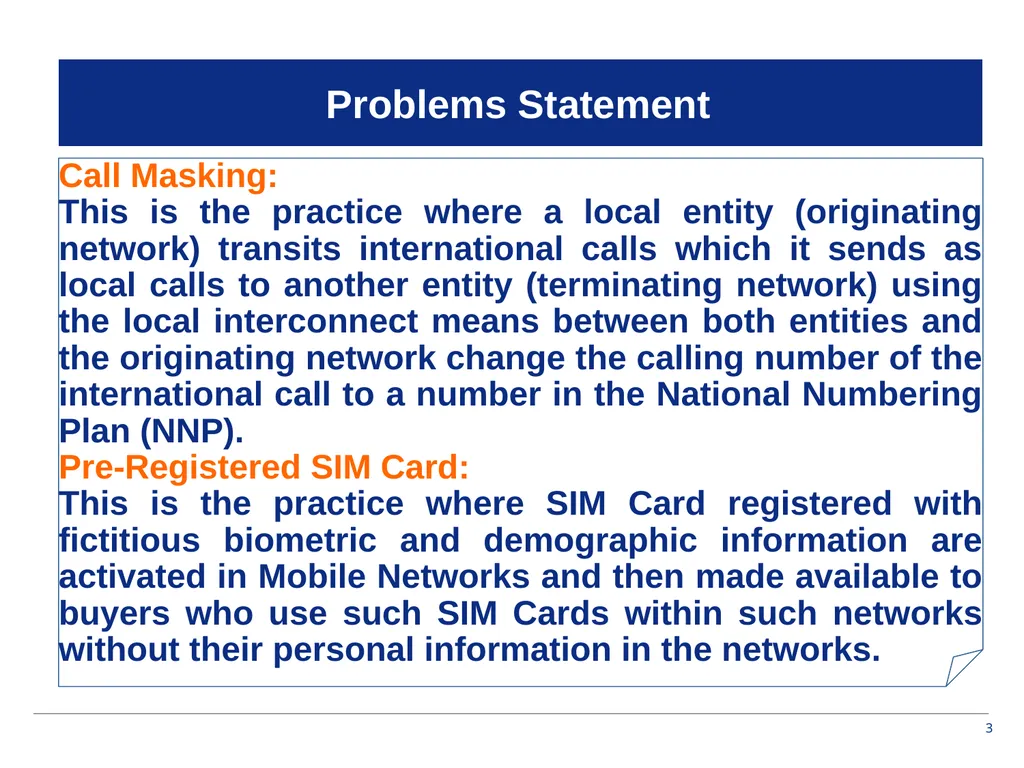
slide3. 3 Problems Statement Call Masking:
This is the practice where a local entity (originating network) transits international calls which it sends as local calls to another entity (terminating network) using the local interconnect means between both entities and the originating network change the calling number of the international call to a number in the National Numbering Plan (NNP).
Pre-Registered SIM Card:
This is the practice where SIM Card registered with fictitious biometric and demographic information are activated in Mobile Networks and then made available to buyers who use such SIM Cards within such networks without their personal information in the networks.<br>
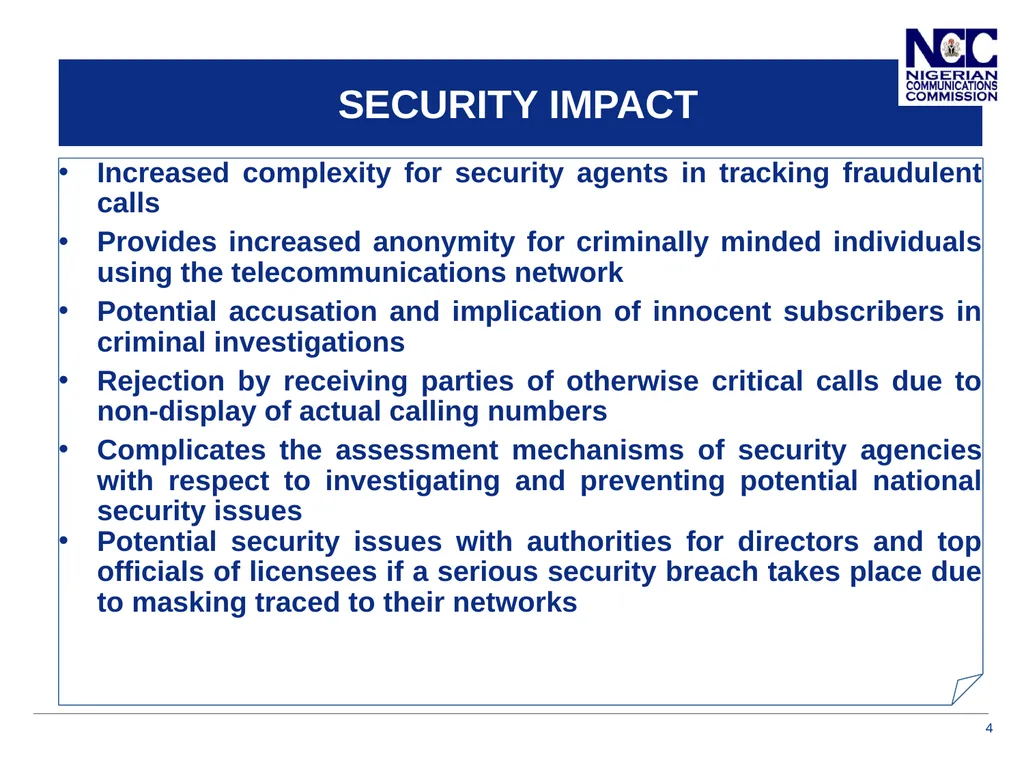
slide4. 4 SECURITY IMPACT Increased complexity for security agents in tracking fraudulent calls
Provides increased anonymity for criminally minded individuals using the telecommunications network
Potential accusation and implication of innocent subscribers in criminal investigations
Rejection by receiving parties of otherwise critical calls due to non-display of actual calling numbers
Complicates the assessment mechanisms of security agencies with respect to investigating and preventing potential national security issues
Potential security issues with authorities for directors and top officials of licensees if a serious security breach takes place due to masking traced to their networks<br>
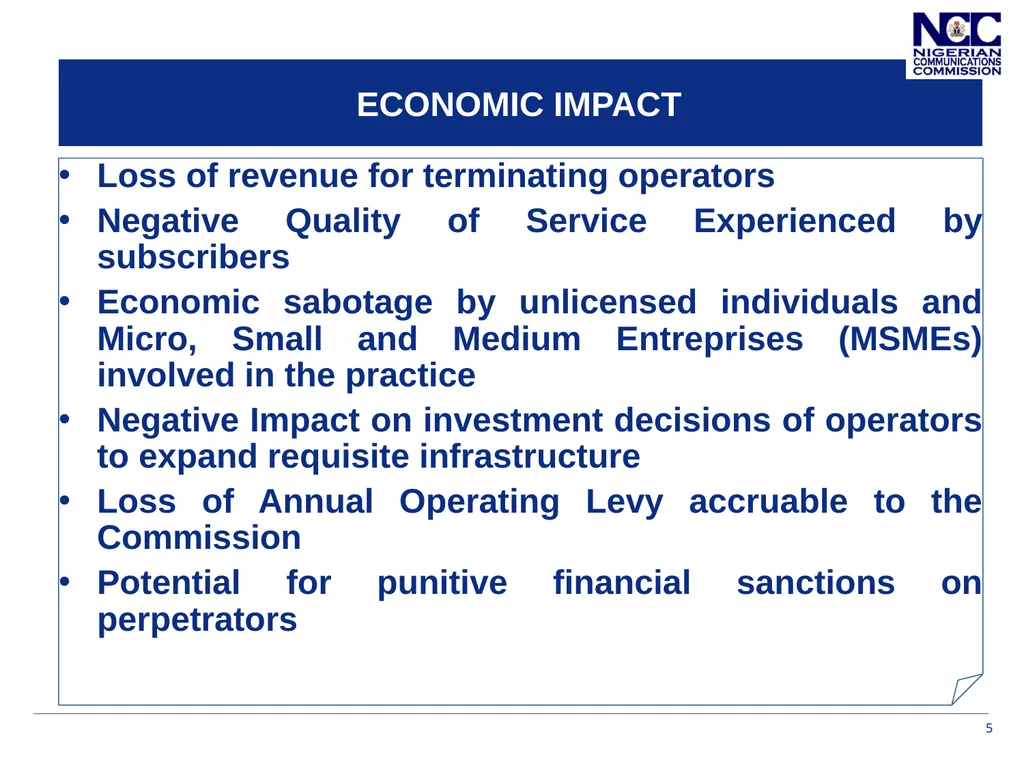
slide5. 5 ECONOMIC IMPACT Loss of revenue for terminating operators
Negative Quality of Service Experienced by subscribers
Economic sabotage by unlicensed individuals and Micro, Small and Medium Entreprises (MSMEs) involved in the practice
Negative Impact on investment decisions of operators to expand requisite infrastructure
Loss of Annual Operating Levy accruable to the Commission
Potential for punitive financial sanctions on perpetrators<br>
slide6. Outline Compliance Actions Taken 6<br>
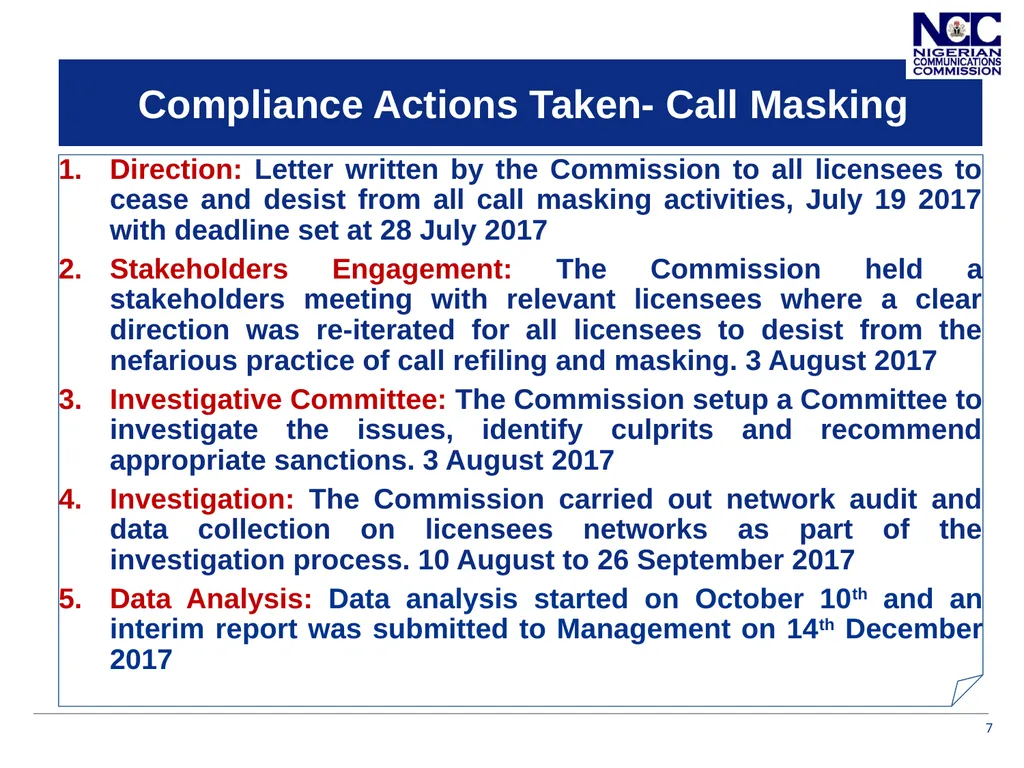
slide7. 7 Compliance Actions Taken- Call Masking Direction: Letter written by the Commission to all licensees to cease and desist from all call masking activities, July 19 2017 with deadline set at 28 July 2017
Stakeholders Engagement: The Commission held a stakeholders meeting with relevant licensees where a clear direction was re-iterated for all licensees to desist from the nefarious practice of call refiling and masking. 3 August 2017
Investigative Committee: The Commission setup a Committee to investigate the issues, identify culprits and recommend appropriate sanctions. 3 August 2017
Investigation: The Commission carried out network audit and data collection on licensees networks as part of the investigation process. 10 August to 26 September 2017
Data Analysis: Data analysis started on October 10th and an interim report was submitted to Management on 14th December 2017<br>
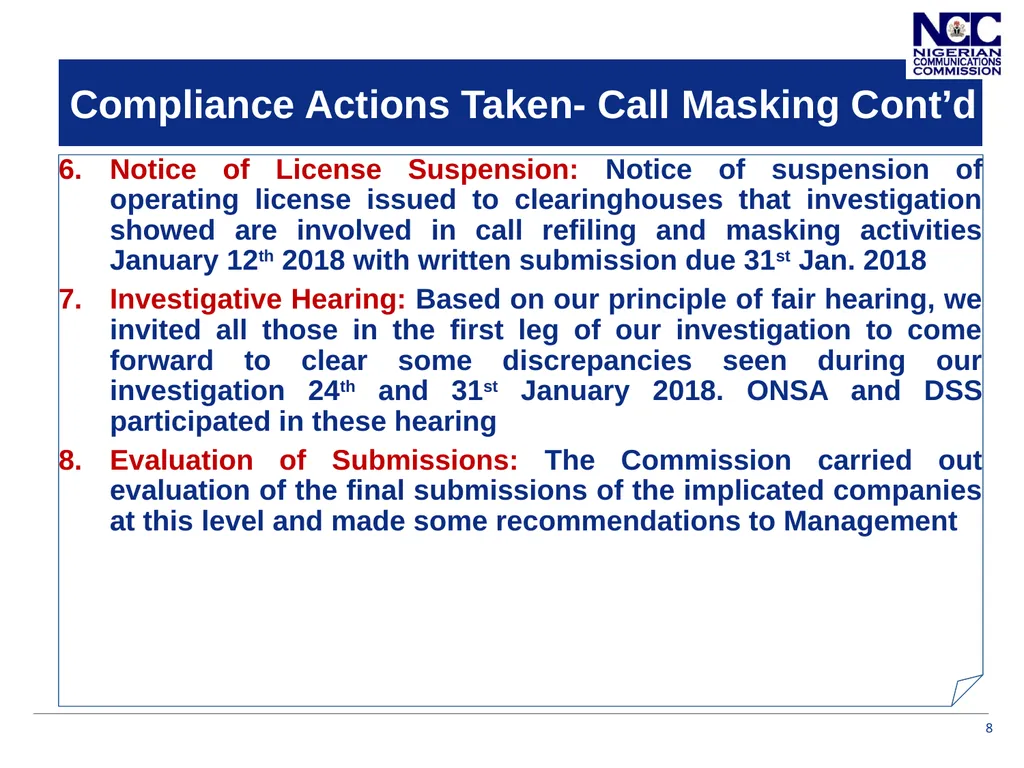
slide8. 8 Compliance Actions Taken- Call Masking Cont’d Notice of License Suspension: Notice of suspension of operating license issued to clearinghouses that investigation showed are involved in call refiling and masking activities January 12th 2018 with written submission due 31st Jan. 2018
Investigative Hearing: Based on our principle of fair hearing, we invited all those in the first leg of our investigation to come forward to clear some discrepancies seen during our investigation 24th and 31st January 2018. ONSA and DSS participated in these hearing
Evaluation of Submissions: The Commission carried out evaluation of the final submissions of the implicated companies at this level and made some recommendations to Management<br>
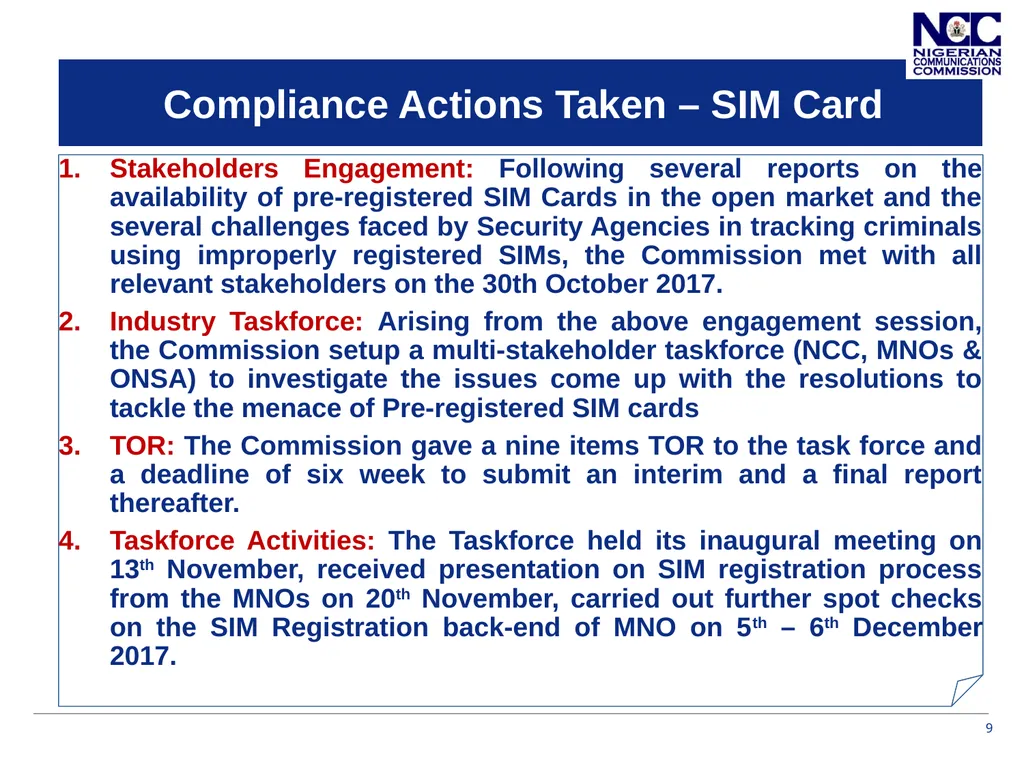
slide9. 9 Compliance Actions Taken – SIM Card Stakeholders Engagement: Following several reports on the availability of pre-registered SIM Cards in the open market and the several challenges faced by Security Agencies in tracking criminals using improperly registered SIMs, the Commission met with all relevant stakeholders on the 30th October 2017.
Industry Taskforce: Arising from the above engagement session, the Commission setup a multi-stakeholder taskforce (NCC, MNOs & ONSA) to investigate the issues come up with the resolutions to tackle the menace of Pre-registered SIM cards
TOR: The Commission gave a nine items TOR to the task force and a deadline of six week to submit an interim and a final report thereafter.
Taskforce Activities: The Taskforce held its inaugural meeting on 13th November, received presentation on SIM registration process from the MNOs on 20th November, carried out further spot checks on the SIM Registration back-end of MNO on 5th – 6th December 2017.<br>
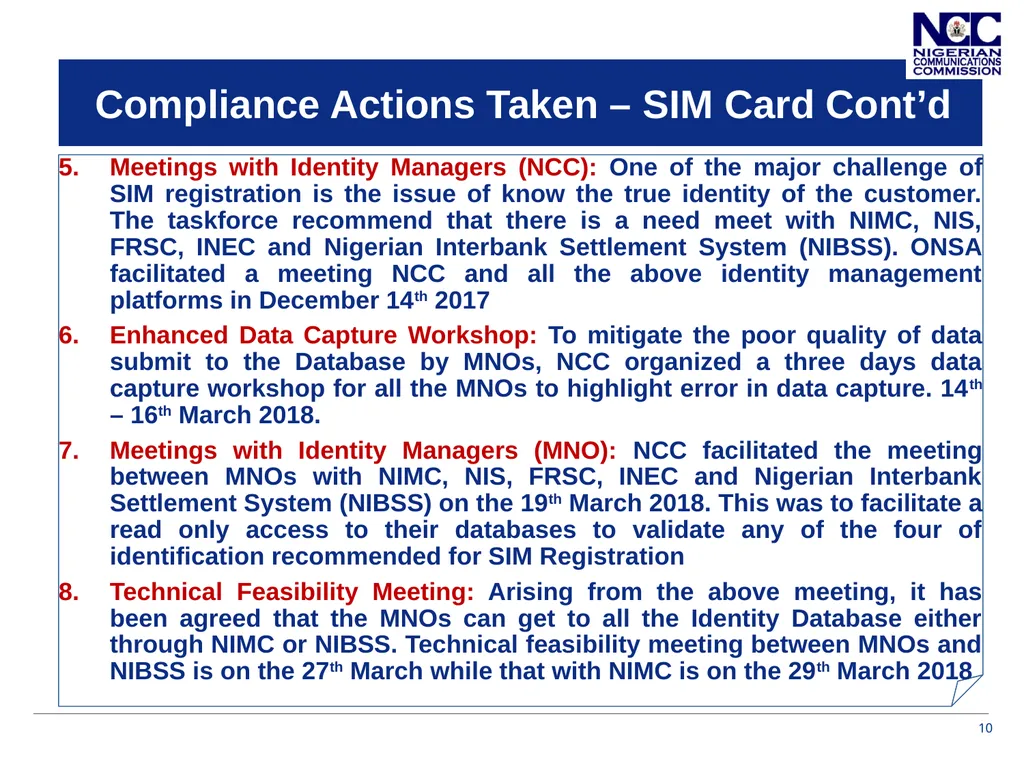
slide10. 10 Compliance Actions Taken – SIM Card Cont’d Meetings with Identity Managers (NCC): One of the major challenge of SIM registration is the issue of know the true identity of the customer. The taskforce recommend that there is a need meet with NIMC, NIS, FRSC, INEC and Nigerian Interbank Settlement System (NIBSS). ONSA facilitated a meeting NCC and all the above identity management platforms in December 14th 2017
Enhanced Data Capture Workshop: To mitigate the poor quality of data submit to the Database by MNOs, NCC organized a three days data capture workshop for all the MNOs to highlight error in data capture. 14th – 16th March 2018.
Meetings with Identity Managers (MNO): NCC facilitated the meeting between MNOs with NIMC, NIS, FRSC, INEC and Nigerian Interbank Settlement System (NIBSS) on the 19th March 2018. This was to facilitate a read only access to their databases to validate any of the four of identification recommended for SIM Registration
Technical Feasibility Meeting: Arising from the above meeting, it has been agreed that the MNOs can get to all the Identity Database either through NIMC or NIBSS. Technical feasibility meeting between MNOs and NIBSS is on the 27th March while that with NIMC is on the 29th March 2018<br>
slide11. Outline Enforcement Actions Taken 11<br>
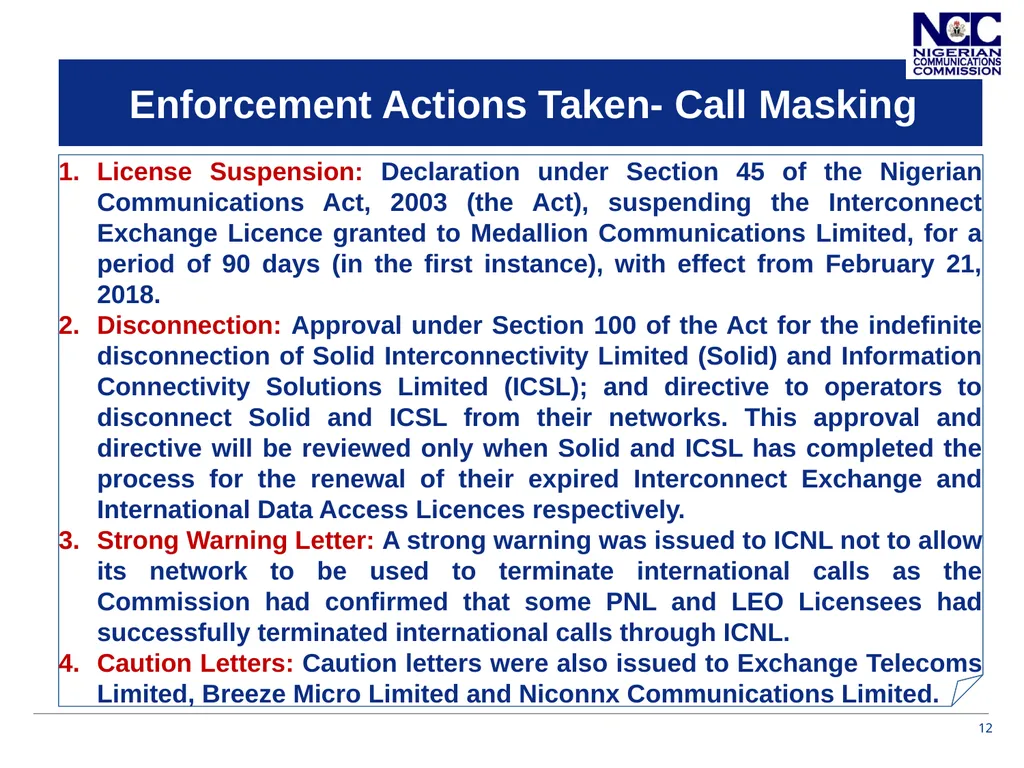
slide12. 12 Enforcement Actions Taken- Call Masking License Suspension: Declaration under Section 45 of the Nigerian Communications Act, 2003 (the Act), suspending the Interconnect Exchange Licence granted to Medallion Communications Limited, for a period of 90 days (in the first instance), with effect from February 21, 2018.
Disconnection: Approval under Section 100 of the Act for the indefinite disconnection of Solid Interconnectivity Limited (Solid) and Information Connectivity Solutions Limited (ICSL); and directive to operators to disconnect Solid and ICSL from their networks. This approval and directive will be reviewed only when Solid and ICSL has completed the process for the renewal of their expired Interconnect Exchange and International Data Access Licences respectively.
Strong Warning Letter: A strong warning was issued to ICNL not to allow its network to be used to terminate international calls as the Commission had confirmed that some PNL and LEO Licensees had successfully terminated international calls through ICNL.
Caution Letters: Caution letters were also issued to Exchange Telecoms Limited, Breeze Micro Limited and Niconnx Communications Limited.<br>
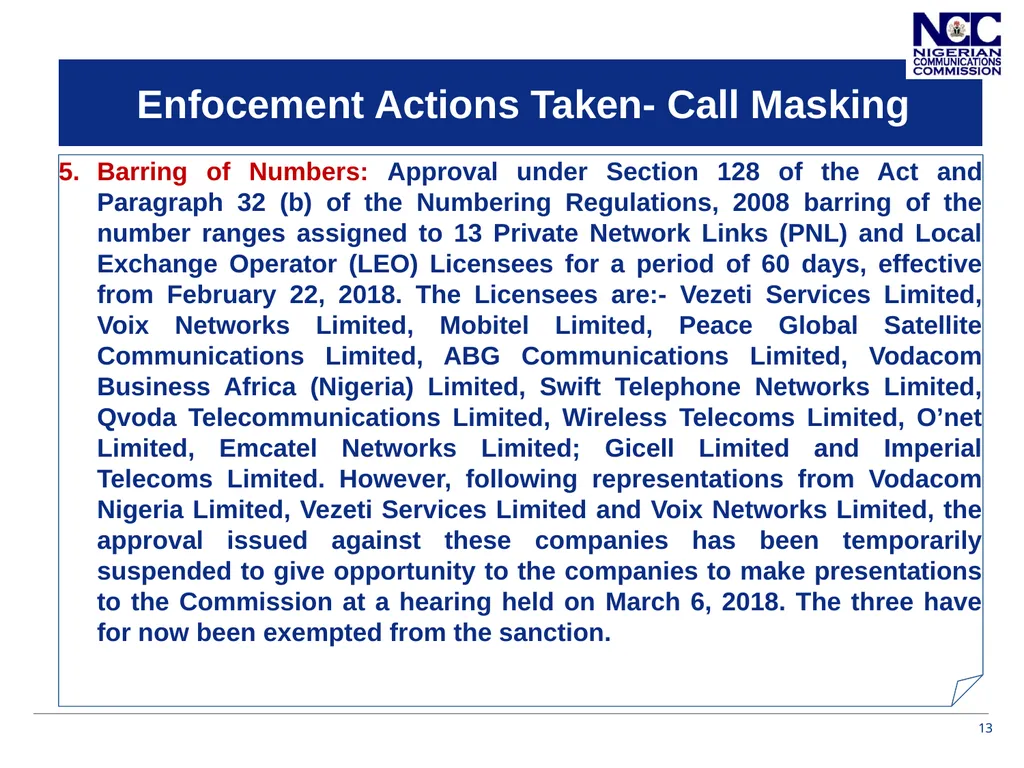
slide13. 13 Enfocement Actions Taken- Call Masking Barring of Numbers: Approval under Section 128 of the Act and Paragraph 32 (b) of the Numbering Regulations, 2008 barring of the number ranges assigned to 13 Private Network Links (PNL) and Local Exchange Operator (LEO) Licensees for a period of 60 days, effective from February 22, 2018. The Licensees are:- Vezeti Services Limited, Voix Networks Limited, Mobitel Limited, Peace Global Satellite Communications Limited, ABG Communications Limited, Vodacom Business Africa (Nigeria) Limited, Swift Telephone Networks Limited, Qvoda Telecommunications Limited, Wireless Telecoms Limited, O’net Limited, Emcatel Networks Limited; Gicell Limited and Imperial Telecoms Limited. However, following representations from Vodacom Nigeria Limited, Vezeti Services Limited and Voix Networks Limited, the approval issued against these companies has been temporarily suspended to give opportunity to the companies to make presentations to the Commission at a hearing held on March 6, 2018. The three have for now been exempted from the sanction.<br>
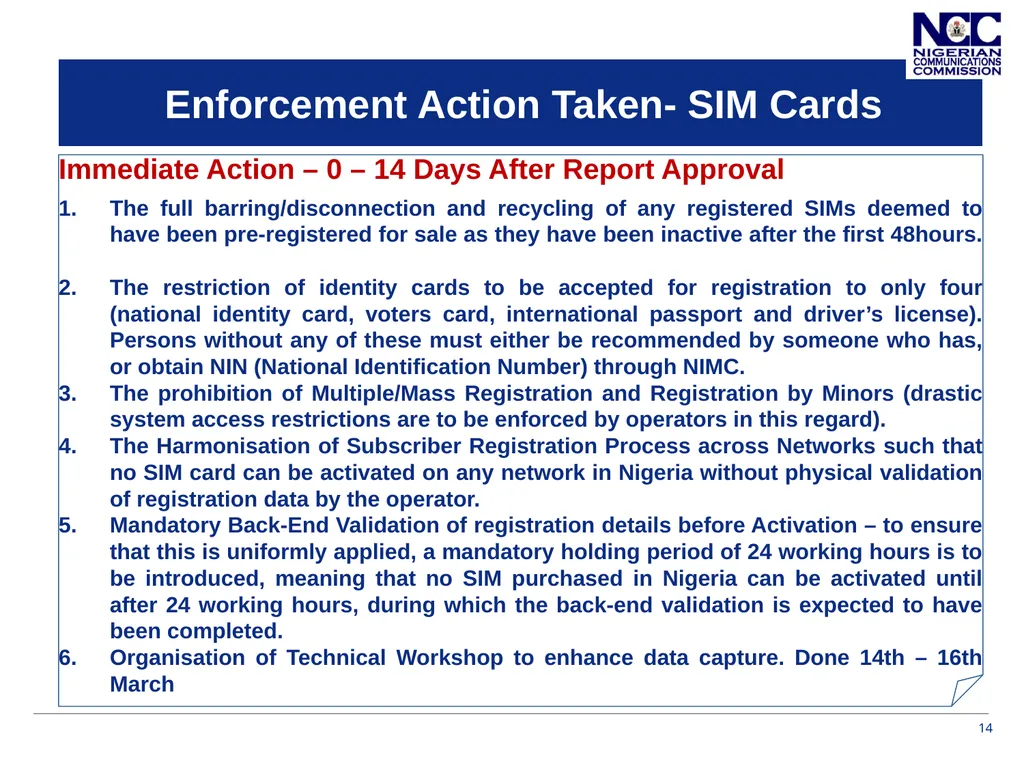
slide14. 14 Enforcement Action Taken- SIM Cards Immediate Action – 0 – 14 Days After Report Approval
The full barring/disconnection and recycling of any registered SIMs deemed to have been pre-registered for sale as they have been inactive after the first 48hours.
The restriction of identity cards to be accepted for registration to only four (national identity card, voters card, international passport and driver’s license). Persons without any of these must either be recommended by someone who has, or obtain NIN (National Identification Number) through NIMC.
The prohibition of Multiple/Mass Registration and Registration by Minors (drastic system access restrictions are to be enforced by operators in this regard).
The Harmonisation of Subscriber Registration Process across Networks such that no SIM card can be activated on any network in Nigeria without physical validation of registration data by the operator.
Mandatory Back-End Validation of registration details before Activation – to ensure that this is uniformly applied, a mandatory holding period of 24 working hours is to be introduced, meaning that no SIM purchased in Nigeria can be activated until after 24 working hours, during which the back-end validation is expected to have been completed.
Organisation of Technical Workshop to enhance data capture. Done 14th – 16th March<br>
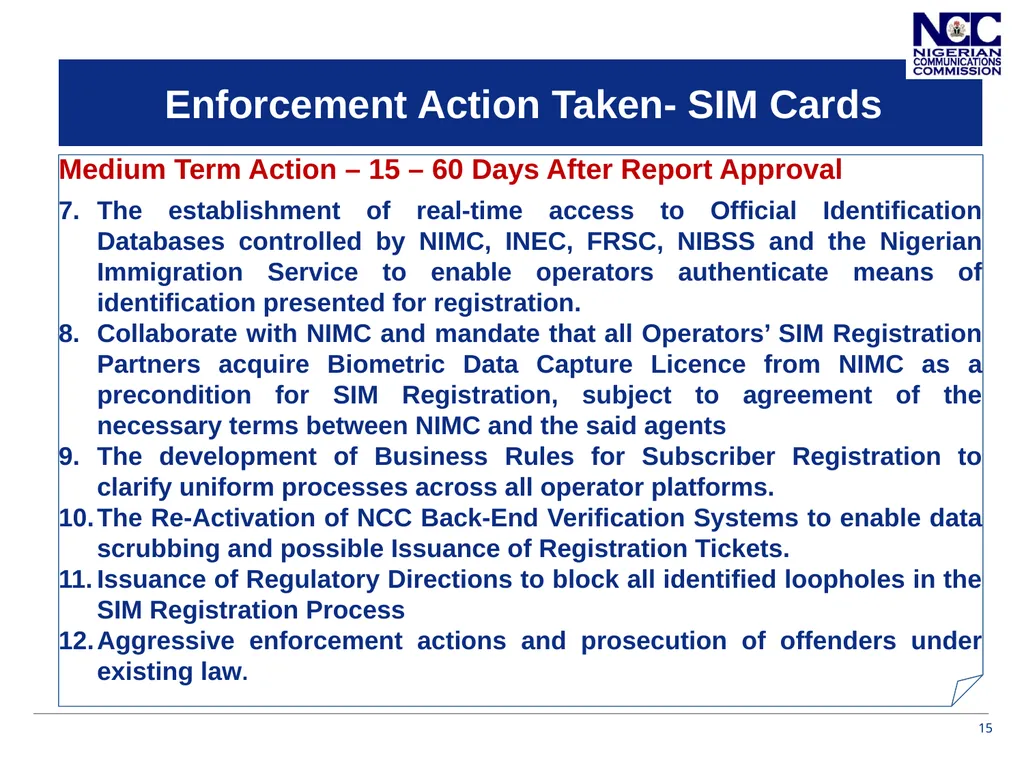
slide15. 15 Enforcement Action Taken- SIM Cards Medium Term Action – 15 – 60 Days After Report Approval
The establishment of real-time access to Official Identification Databases controlled by NIMC, INEC, FRSC, NIBSS and the Nigerian Immigration Service to enable operators authenticate means of identification presented for registration.
Collaborate with NIMC and mandate that all Operators’ SIM Registration Partners acquire Biometric Data Capture Licence from NIMC as a precondition for SIM Registration, subject to agreement of the necessary terms between NIMC and the said agents
The development of Business Rules for Subscriber Registration to clarify uniform processes across all operator platforms.
The Re-Activation of NCC Back-End Verification Systems to enable data scrubbing and possible Issuance of Registration Tickets.
Issuance of Regulatory Directions to block all identified loopholes in the SIM Registration Process
Aggressive enforcement actions and prosecution of offenders under existing law.<br>
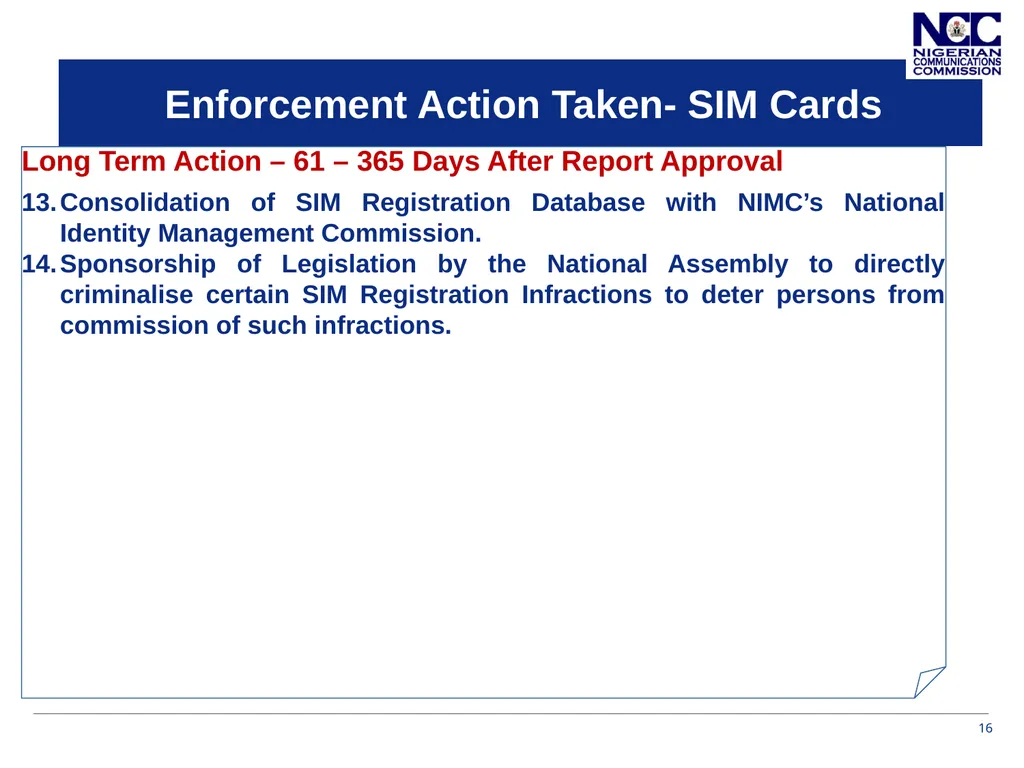
slide16. 16 Enforcement Action Taken- SIM Cards Long Term Action – 61 – 365 Days After Report Approval
Consolidation of SIM Registration Database with NIMC’s National Identity Management Commission.
Sponsorship of Legislation by the National Assembly to directly criminalise certain SIM Registration Infractions to deter persons from commission of such infractions.<br>
slide17. Outline Next Steps 17<br>
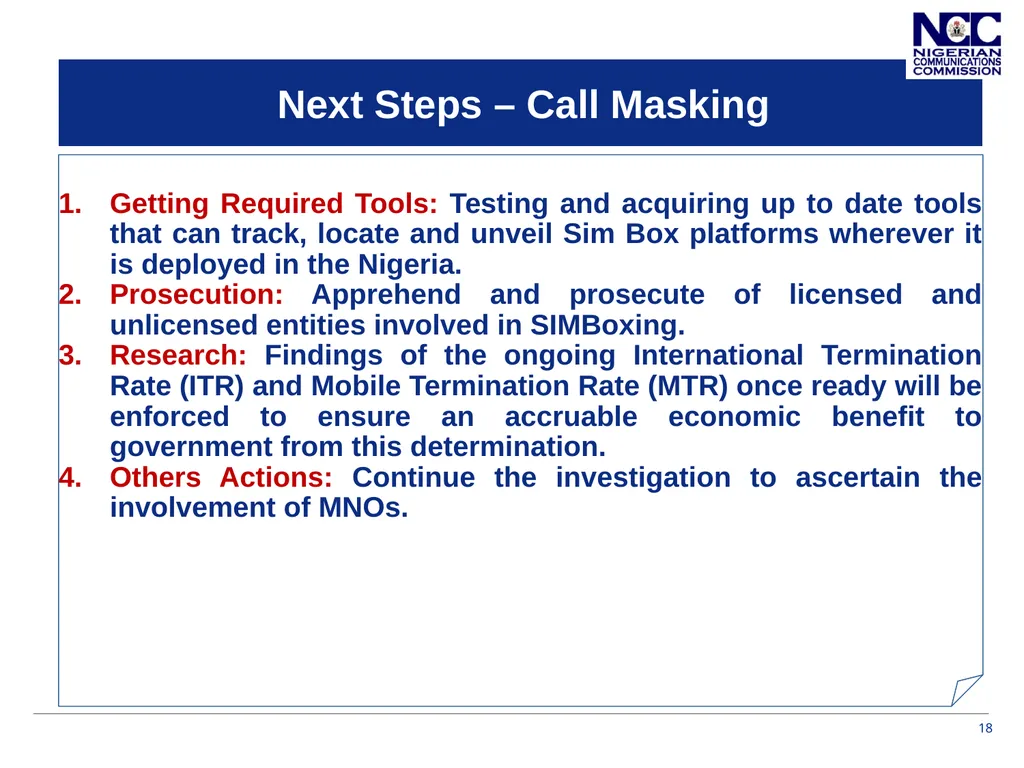
slide18. 18 Next Steps – Call Masking Getting Required Tools: Testing and acquiring up to date tools that can track, locate and unveil Sim Box platforms wherever it is deployed in the Nigeria.
Prosecution: Apprehend and prosecute of licensed and unlicensed entities involved in SIMBoxing.
Research: Findings of the ongoing International Termination Rate (ITR) and Mobile Termination Rate (MTR) once ready will be enforced to ensure an accruable economic benefit to government from this determination.
Others Actions: Continue the investigation to ascertain the involvement of MNOs.<br>
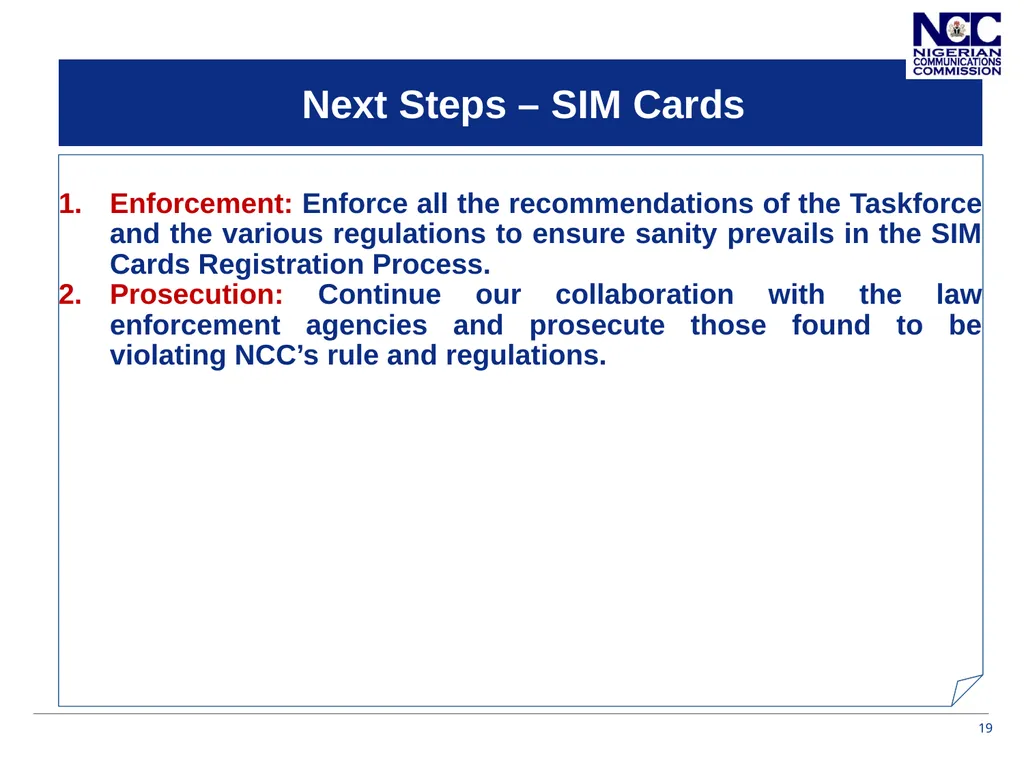
slide19. 19 Next Steps – SIM Cards Enforcement: Enforce all the recommendations of the Taskforce and the various regulations to ensure sanity prevails in the SIM Cards Registration Process.
Prosecution: Continue our collaboration with the law enforcement agencies and prosecute those found to be violating NCC’s rule and regulations.<br>
slide20. 20 Thank You<br>
By
Prof. Umar Garba Danbatta, FNSE, FRAES
Executive Vice Chairman / CEO 1<br>
slide2. Outline Problem Statement 1 Security Impact 3 4 5 6 Economic Impact Compliance Actions Taken Enforcement Actions Taken Next Steps OUTLINE 2 2<br>
slide3. 3 Problems Statement Call Masking:
This is the practice where a local entity (originating network) transits international calls which it sends as local calls to another entity (terminating network) using the local interconnect means between both entities and the originating network change the calling number of the international call to a number in the National Numbering Plan (NNP).
Pre-Registered SIM Card:
This is the practice where SIM Card registered with fictitious biometric and demographic information are activated in Mobile Networks and then made available to buyers who use such SIM Cards within such networks without their personal information in the networks.<br>
slide4. 4 SECURITY IMPACT Increased complexity for security agents in tracking fraudulent calls
Provides increased anonymity for criminally minded individuals using the telecommunications network
Potential accusation and implication of innocent subscribers in criminal investigations
Rejection by receiving parties of otherwise critical calls due to non-display of actual calling numbers
Complicates the assessment mechanisms of security agencies with respect to investigating and preventing potential national security issues
Potential security issues with authorities for directors and top officials of licensees if a serious security breach takes place due to masking traced to their networks<br>
slide5. 5 ECONOMIC IMPACT Loss of revenue for terminating operators
Negative Quality of Service Experienced by subscribers
Economic sabotage by unlicensed individuals and Micro, Small and Medium Entreprises (MSMEs) involved in the practice
Negative Impact on investment decisions of operators to expand requisite infrastructure
Loss of Annual Operating Levy accruable to the Commission
Potential for punitive financial sanctions on perpetrators<br>
slide6. Outline Compliance Actions Taken 6<br>
slide7. 7 Compliance Actions Taken- Call Masking Direction: Letter written by the Commission to all licensees to cease and desist from all call masking activities, July 19 2017 with deadline set at 28 July 2017
Stakeholders Engagement: The Commission held a stakeholders meeting with relevant licensees where a clear direction was re-iterated for all licensees to desist from the nefarious practice of call refiling and masking. 3 August 2017
Investigative Committee: The Commission setup a Committee to investigate the issues, identify culprits and recommend appropriate sanctions. 3 August 2017
Investigation: The Commission carried out network audit and data collection on licensees networks as part of the investigation process. 10 August to 26 September 2017
Data Analysis: Data analysis started on October 10th and an interim report was submitted to Management on 14th December 2017<br>
slide8. 8 Compliance Actions Taken- Call Masking Cont’d Notice of License Suspension: Notice of suspension of operating license issued to clearinghouses that investigation showed are involved in call refiling and masking activities January 12th 2018 with written submission due 31st Jan. 2018
Investigative Hearing: Based on our principle of fair hearing, we invited all those in the first leg of our investigation to come forward to clear some discrepancies seen during our investigation 24th and 31st January 2018. ONSA and DSS participated in these hearing
Evaluation of Submissions: The Commission carried out evaluation of the final submissions of the implicated companies at this level and made some recommendations to Management<br>
slide9. 9 Compliance Actions Taken – SIM Card Stakeholders Engagement: Following several reports on the availability of pre-registered SIM Cards in the open market and the several challenges faced by Security Agencies in tracking criminals using improperly registered SIMs, the Commission met with all relevant stakeholders on the 30th October 2017.
Industry Taskforce: Arising from the above engagement session, the Commission setup a multi-stakeholder taskforce (NCC, MNOs & ONSA) to investigate the issues come up with the resolutions to tackle the menace of Pre-registered SIM cards
TOR: The Commission gave a nine items TOR to the task force and a deadline of six week to submit an interim and a final report thereafter.
Taskforce Activities: The Taskforce held its inaugural meeting on 13th November, received presentation on SIM registration process from the MNOs on 20th November, carried out further spot checks on the SIM Registration back-end of MNO on 5th – 6th December 2017.<br>
slide10. 10 Compliance Actions Taken – SIM Card Cont’d Meetings with Identity Managers (NCC): One of the major challenge of SIM registration is the issue of know the true identity of the customer. The taskforce recommend that there is a need meet with NIMC, NIS, FRSC, INEC and Nigerian Interbank Settlement System (NIBSS). ONSA facilitated a meeting NCC and all the above identity management platforms in December 14th 2017
Enhanced Data Capture Workshop: To mitigate the poor quality of data submit to the Database by MNOs, NCC organized a three days data capture workshop for all the MNOs to highlight error in data capture. 14th – 16th March 2018.
Meetings with Identity Managers (MNO): NCC facilitated the meeting between MNOs with NIMC, NIS, FRSC, INEC and Nigerian Interbank Settlement System (NIBSS) on the 19th March 2018. This was to facilitate a read only access to their databases to validate any of the four of identification recommended for SIM Registration
Technical Feasibility Meeting: Arising from the above meeting, it has been agreed that the MNOs can get to all the Identity Database either through NIMC or NIBSS. Technical feasibility meeting between MNOs and NIBSS is on the 27th March while that with NIMC is on the 29th March 2018<br>
slide11. Outline Enforcement Actions Taken 11<br>
slide12. 12 Enforcement Actions Taken- Call Masking License Suspension: Declaration under Section 45 of the Nigerian Communications Act, 2003 (the Act), suspending the Interconnect Exchange Licence granted to Medallion Communications Limited, for a period of 90 days (in the first instance), with effect from February 21, 2018.
Disconnection: Approval under Section 100 of the Act for the indefinite disconnection of Solid Interconnectivity Limited (Solid) and Information Connectivity Solutions Limited (ICSL); and directive to operators to disconnect Solid and ICSL from their networks. This approval and directive will be reviewed only when Solid and ICSL has completed the process for the renewal of their expired Interconnect Exchange and International Data Access Licences respectively.
Strong Warning Letter: A strong warning was issued to ICNL not to allow its network to be used to terminate international calls as the Commission had confirmed that some PNL and LEO Licensees had successfully terminated international calls through ICNL.
Caution Letters: Caution letters were also issued to Exchange Telecoms Limited, Breeze Micro Limited and Niconnx Communications Limited.<br>
slide13. 13 Enfocement Actions Taken- Call Masking Barring of Numbers: Approval under Section 128 of the Act and Paragraph 32 (b) of the Numbering Regulations, 2008 barring of the number ranges assigned to 13 Private Network Links (PNL) and Local Exchange Operator (LEO) Licensees for a period of 60 days, effective from February 22, 2018. The Licensees are:- Vezeti Services Limited, Voix Networks Limited, Mobitel Limited, Peace Global Satellite Communications Limited, ABG Communications Limited, Vodacom Business Africa (Nigeria) Limited, Swift Telephone Networks Limited, Qvoda Telecommunications Limited, Wireless Telecoms Limited, O’net Limited, Emcatel Networks Limited; Gicell Limited and Imperial Telecoms Limited. However, following representations from Vodacom Nigeria Limited, Vezeti Services Limited and Voix Networks Limited, the approval issued against these companies has been temporarily suspended to give opportunity to the companies to make presentations to the Commission at a hearing held on March 6, 2018. The three have for now been exempted from the sanction.<br>
slide14. 14 Enforcement Action Taken- SIM Cards Immediate Action – 0 – 14 Days After Report Approval
The full barring/disconnection and recycling of any registered SIMs deemed to have been pre-registered for sale as they have been inactive after the first 48hours.
The restriction of identity cards to be accepted for registration to only four (national identity card, voters card, international passport and driver’s license). Persons without any of these must either be recommended by someone who has, or obtain NIN (National Identification Number) through NIMC.
The prohibition of Multiple/Mass Registration and Registration by Minors (drastic system access restrictions are to be enforced by operators in this regard).
The Harmonisation of Subscriber Registration Process across Networks such that no SIM card can be activated on any network in Nigeria without physical validation of registration data by the operator.
Mandatory Back-End Validation of registration details before Activation – to ensure that this is uniformly applied, a mandatory holding period of 24 working hours is to be introduced, meaning that no SIM purchased in Nigeria can be activated until after 24 working hours, during which the back-end validation is expected to have been completed.
Organisation of Technical Workshop to enhance data capture. Done 14th – 16th March<br>
slide15. 15 Enforcement Action Taken- SIM Cards Medium Term Action – 15 – 60 Days After Report Approval
The establishment of real-time access to Official Identification Databases controlled by NIMC, INEC, FRSC, NIBSS and the Nigerian Immigration Service to enable operators authenticate means of identification presented for registration.
Collaborate with NIMC and mandate that all Operators’ SIM Registration Partners acquire Biometric Data Capture Licence from NIMC as a precondition for SIM Registration, subject to agreement of the necessary terms between NIMC and the said agents
The development of Business Rules for Subscriber Registration to clarify uniform processes across all operator platforms.
The Re-Activation of NCC Back-End Verification Systems to enable data scrubbing and possible Issuance of Registration Tickets.
Issuance of Regulatory Directions to block all identified loopholes in the SIM Registration Process
Aggressive enforcement actions and prosecution of offenders under existing law.<br>
slide16. 16 Enforcement Action Taken- SIM Cards Long Term Action – 61 – 365 Days After Report Approval
Consolidation of SIM Registration Database with NIMC’s National Identity Management Commission.
Sponsorship of Legislation by the National Assembly to directly criminalise certain SIM Registration Infractions to deter persons from commission of such infractions.<br>
slide17. Outline Next Steps 17<br>
slide18. 18 Next Steps – Call Masking Getting Required Tools: Testing and acquiring up to date tools that can track, locate and unveil Sim Box platforms wherever it is deployed in the Nigeria.
Prosecution: Apprehend and prosecute of licensed and unlicensed entities involved in SIMBoxing.
Research: Findings of the ongoing International Termination Rate (ITR) and Mobile Termination Rate (MTR) once ready will be enforced to ensure an accruable economic benefit to government from this determination.
Others Actions: Continue the investigation to ascertain the involvement of MNOs.<br>
slide19. 19 Next Steps – SIM Cards Enforcement: Enforce all the recommendations of the Taskforce and the various regulations to ensure sanity prevails in the SIM Cards Registration Process.
Prosecution: Continue our collaboration with the law enforcement agencies and prosecute those found to be violating NCC’s rule and regulations.<br>
slide20. 20 Thank You<br>