Presentation on CAREC Study: Diversifying Trade Flows and Transport and Transit Routes in CAREC Region Roman Mogilevskii Regional Cooperation and Integration Unit Central and West Asia Department Asian Development Bank National Focal
"Presentation on CAREC Study: Diversifying Trade" is the property of its rightful owner. Permission is granted to
download and print the materials on this website for personal, non-commercial use only, and to display it
on your personal computer provided you do not modify the materials and that you retain all copyright
notices contained in the materials. By downloading content from our website, you accept the terms of this
agreement.
Presentation Transcript
01
Presentation on CAREC Study: Diversifying Trade Flows and Transport and Transit Routes in CAREC Region Roman Mogilevskii
Regional Cooperation and Integration Unit
Central and West Asia Department
Asian Development Bank National Focal Points' Meeting
18 October 2023<br>
02
Introduction This work responds to the requests for analysis of the recent shocks’ impact on trade and transit in the CAREC region
- change in and diversification of trade flows
- current situation and alternative transit options
Work in progress, final version in 2024
Preliminary version to be presented at the panel session “Diversifying Trade Flows and Transport and Transit Routes in CAREC Region” at the Ministerial Conference, 2023
Discussants at the session – development partners, private sector, governments
This PPT will be updated for the MC<br>
03
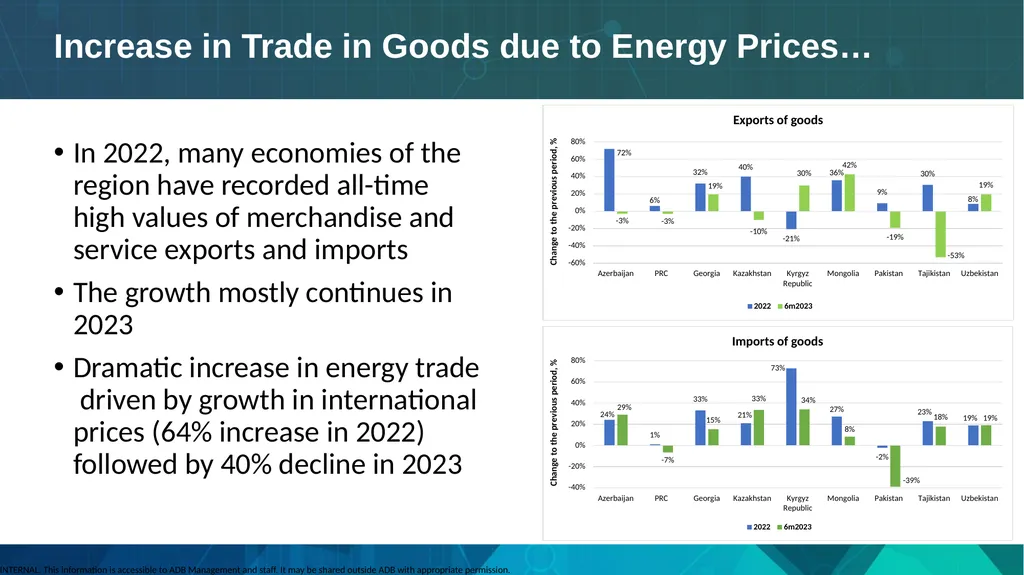
Increase in Trade in Goods due to Energy Prices… In 2022, many economies of the region have recorded all-time high values of merchandise and service exports and imports
The growth mostly continues in 2023
Dramatic increase in energy trade driven by growth in international prices (64% increase in 2022) followed by 40% decline in 2023<br>
04
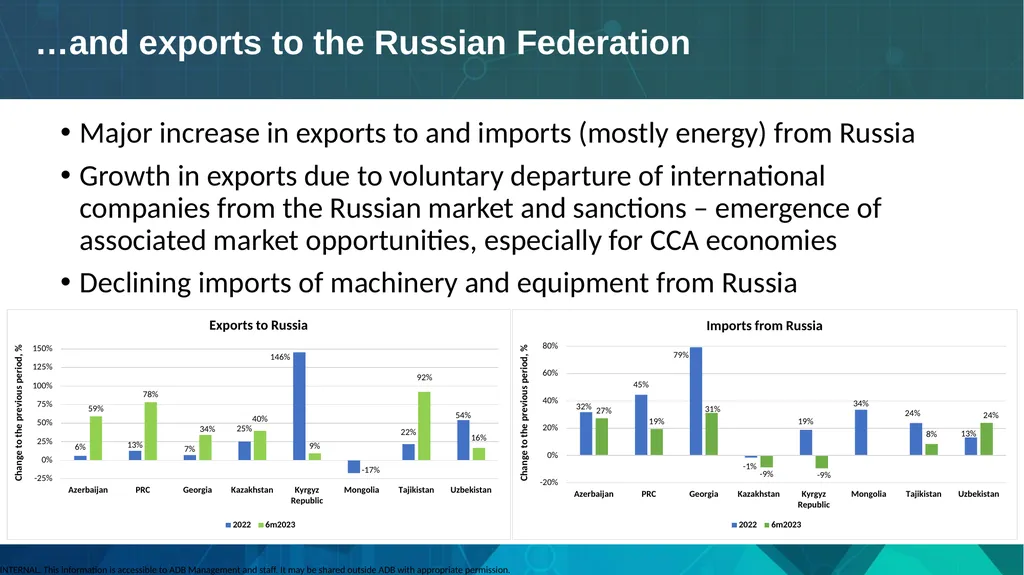
…and exports to the Russian Federation Major increase in exports to and imports (mostly energy) from Russia
Growth in exports due to voluntary departure of international companies from the Russian market and sanctions – emergence of associated market opportunities, especially for CCA economies
Declining imports of machinery and equipment from Russia<br>
05
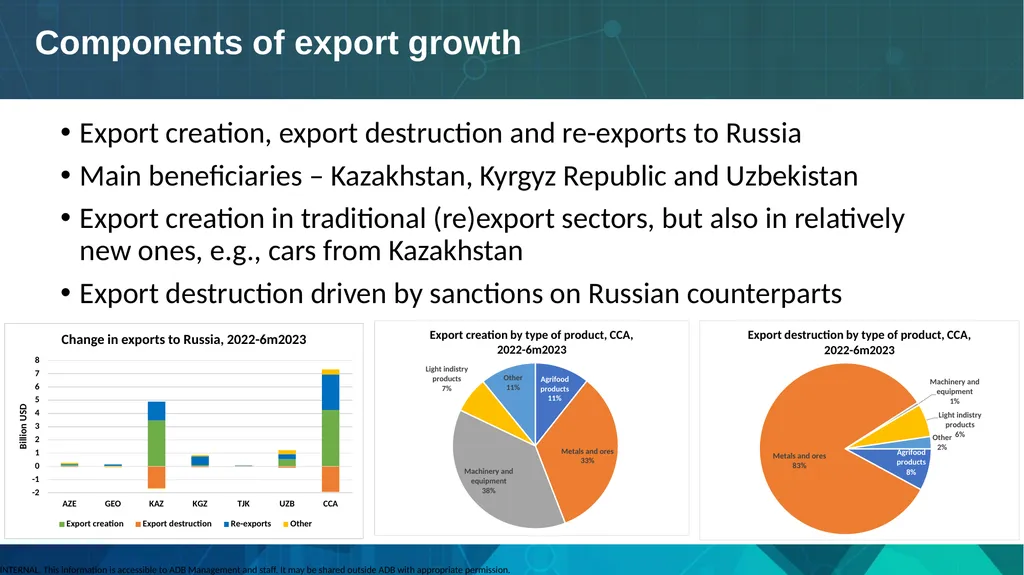
Components of export growth Export creation, export destruction and re-exports to Russia
Main beneficiaries – Kazakhstan, Kyrgyz Republic and Uzbekistan
Export creation in traditional (re)export sectors, but also in relatively new ones, e.g., cars from Kazakhstan
Export destruction driven by sanctions on Russian counterparts<br>
06
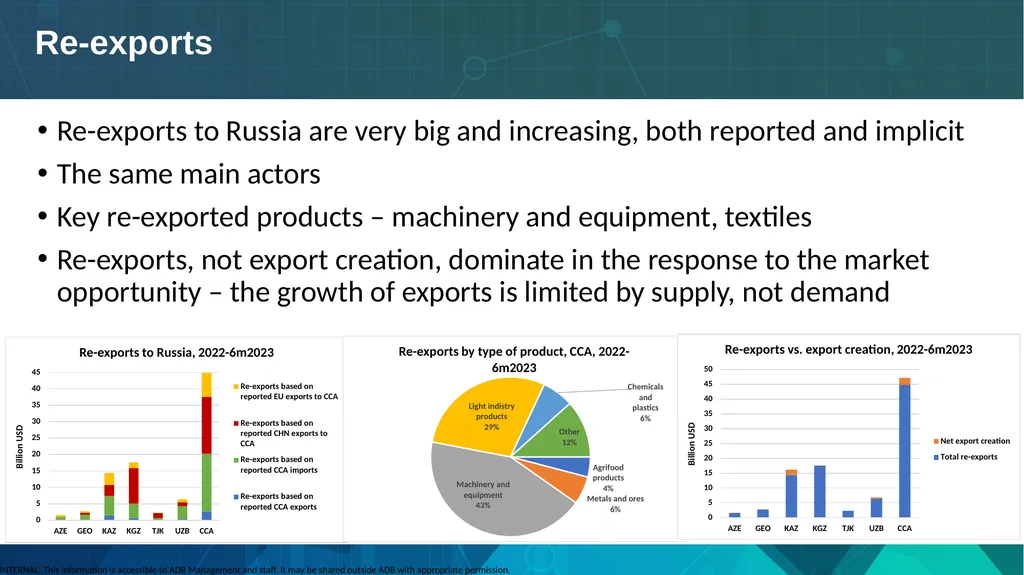
Re-exports Re-exports to Russia are very big and increasing, both reported and implicit
The same main actors
Key re-exported products – machinery and equipment, textiles
Re-exports, not export creation, dominate in the response to the market opportunity – the growth of exports is limited by supply, not demand<br>
07
Transit routes revisited The conflict and sanctions created multiple risks for CCA transit routes via Russia
Two types of transit: (i) from PRC to Europe and (ii) from Central Asia to Europe and elsewhere
The former type of transit has a robust alternative (sea shipments are back to normal after the COVID-19 pandemic); the latter type of transit has fewer alternatives
Middle Corridor development as a possible response
Challenges for Middle Corridor: infrastructure, logistics, climate change
ADB study on transit flows in the region: how these are changing and what are the infrastructure development drivers and impediments on the example of Aktau port
Converting all new CAREC corridor development in into economic corridors attracting private investments in agribusiness, tourism, transport connectivity etc.
Need in Middle Corridor development strategy<br>
08
Summary Dramatic growth of CAREC economies’ foreign trade in 2022 – first half of 2023 due to the conflict in Ukraine and post-pandemic recovery
The conflicts in the region caused supply chain disruptions but also created (short-term?) trade opportunities for the economies in the Caucasus and Central Asia
Hike in re-exports, not trade creation, was the main response to these opportunities
Long-term growth fundamentals—the ability to access foreign markets, access to advanced technologies, jobs for labor migrants etc.—have been questioned
CAREC economies and development partners are now looking into the alternative options for transit of their critical exports and imports
How enhanced regional cooperation through CAREC can help in responding to these challenges?<br>