
Session 1: Introduction to CAREC Disaster Risk





Description: Session 1: Introduction to CAREC Disaster Risk Project and Summary of Initial Results Istanbul, Türkiye November 2022 TA 9878 Developing a Disaster Risk Transfer Facility in the CAREC Region Engagement Event Objectives 2 Overview of
Related Topics
Download Presentation
"Session 1: Introduction to CAREC Disaster Risk" is the property of its rightful owner. Permission is granted to download and print the materials on this website for personal, non-commercial use only, and to display it on your personal computer provided you do not modify the materials and that you retain all copyright notices contained in the materials. By downloading content from our website, you accept the terms of this agreement.
Presentation Transcript
slide1. Session 1: Introduction to CAREC Disaster Risk Project and Summary of Initial Results Istanbul, Türkiye
November 2022 TA 9878 “Developing a Disaster Risk Transfer Facility in the CAREC Region” – Engagement Event<br>
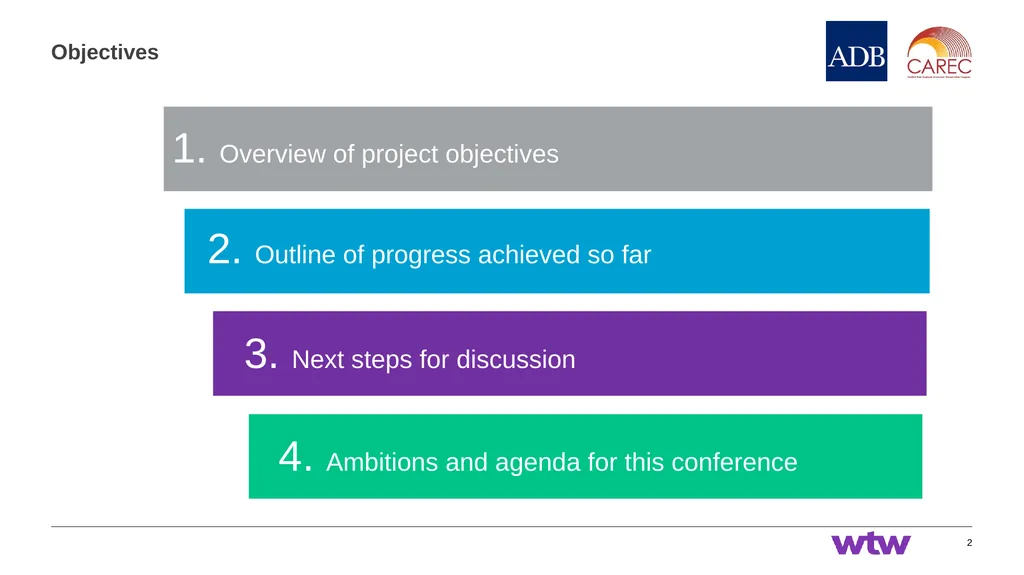
slide2. Objectives 2<br>
slide3. Overview of Project Objectives: Developing a Disaster Risk Transfer Facility in the CAREC Region 3<br>
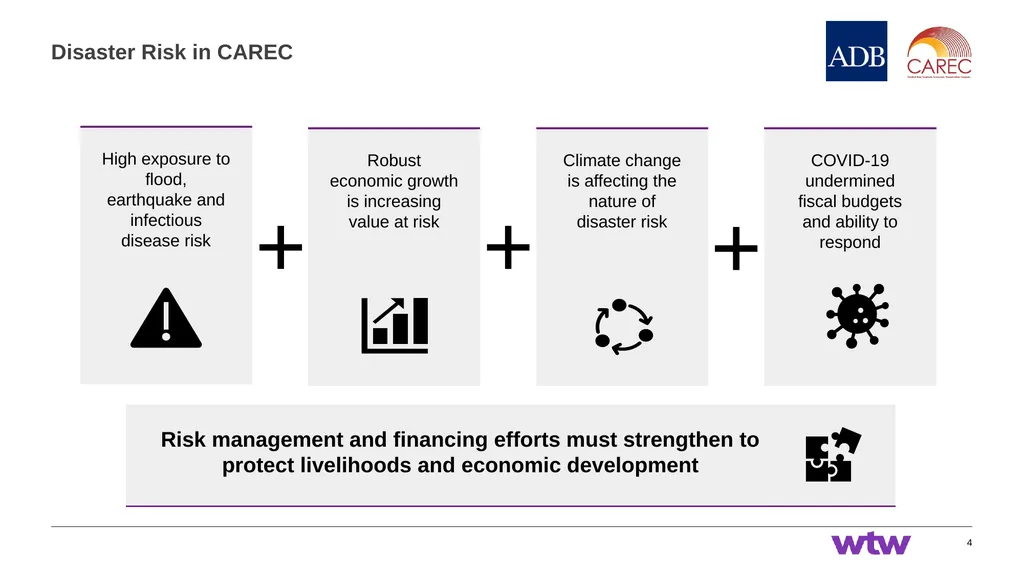
slide4. Disaster Risk in CAREC 4 Risk management and financing efforts must strengthen to protect livelihoods and economic development<br>
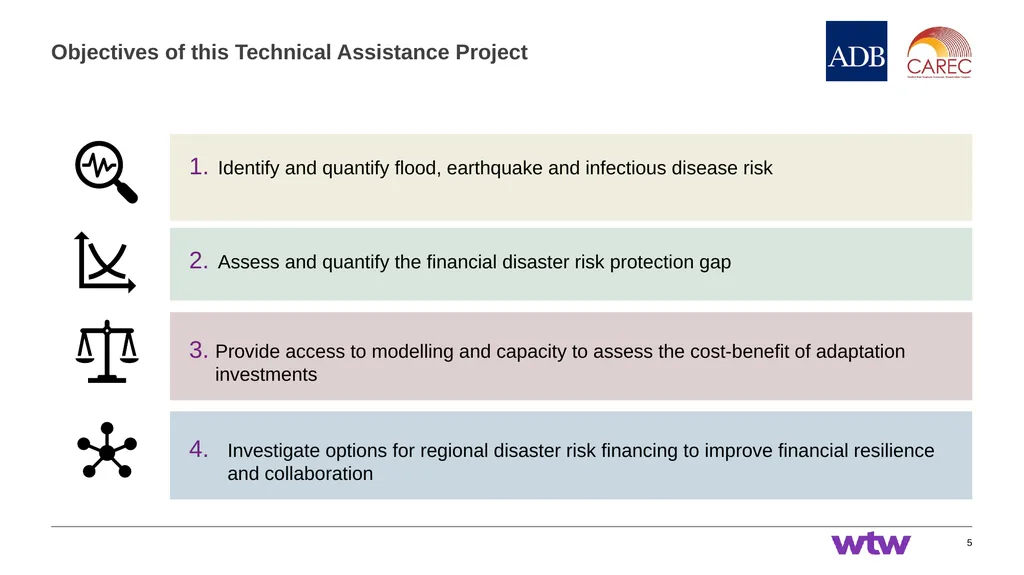
slide5. Objectives of this Technical Assistance Project 5 Identify and quantify flood, earthquake and infectious disease risk Assess and quantify the financial disaster risk protection gap Investigate options for regional disaster risk financing to improve financial resilience and collaboration Provide access to modelling and capacity to assess the cost-benefit of adaptation investments<br>
slide6. Progress Achieved 6<br>
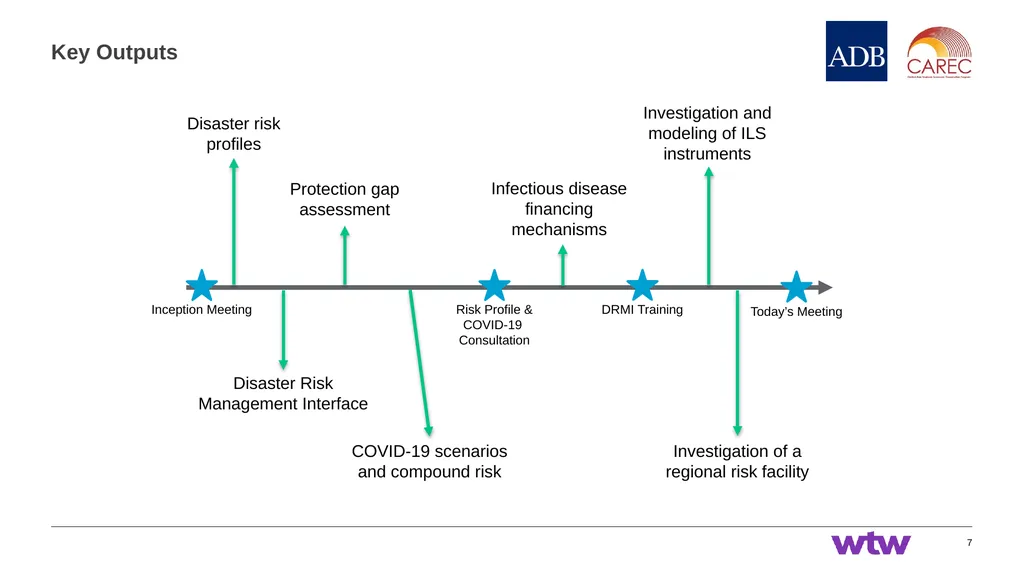
slide7. Key Outputs 7 Disaster risk profiles Disaster Risk Management Interface Infectious disease financing mechanisms Investigation and modeling of ILS instruments Investigation of a regional risk facility COVID-19 scenarios and compound risk<br>
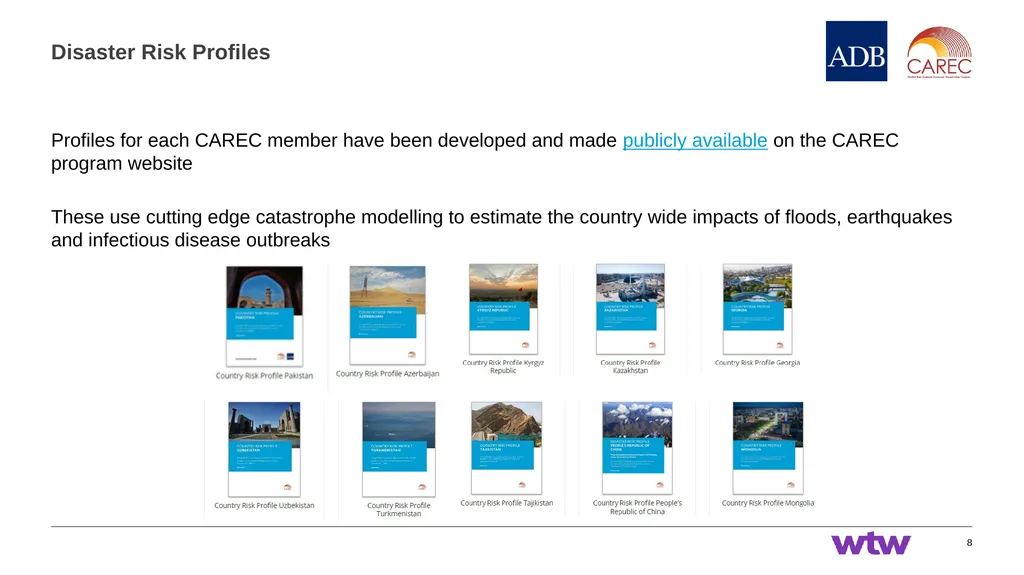
slide8. Disaster Risk Profiles Profiles for each CAREC member have been developed and made publicly available on the CAREC program website
These use cutting edge catastrophe modelling to estimate the country wide impacts of floods, earthquakes and infectious disease outbreaks 8<br>
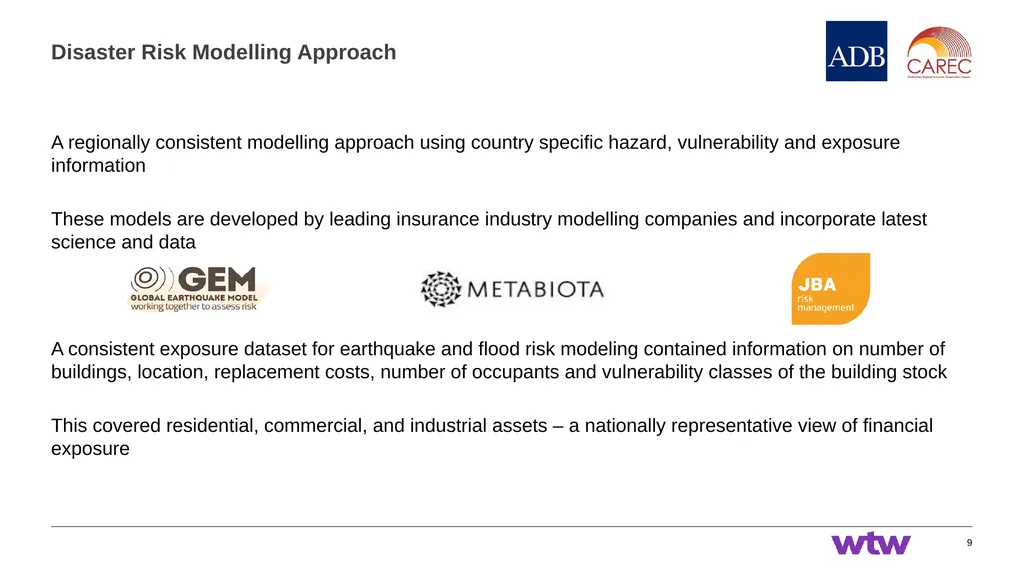
slide9. A regionally consistent modelling approach using country specific hazard, vulnerability and exposure information
These models are developed by leading insurance industry modelling companies and incorporate latest science and data
A consistent exposure dataset for earthquake and flood risk modeling contained information on number of buildings, location, replacement costs, number of occupants and vulnerability classes of the building stock
This covered residential, commercial, and industrial assets – a nationally representative view of financial exposure Disaster Risk Modelling Approach 9<br>
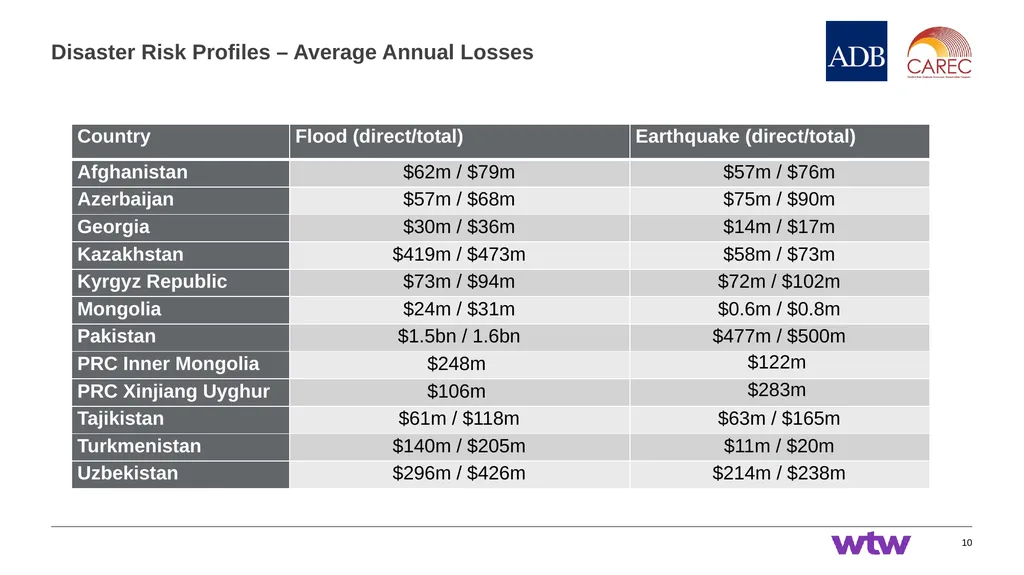
slide10. Disaster Risk Profiles – Average Annual Losses 10<br>
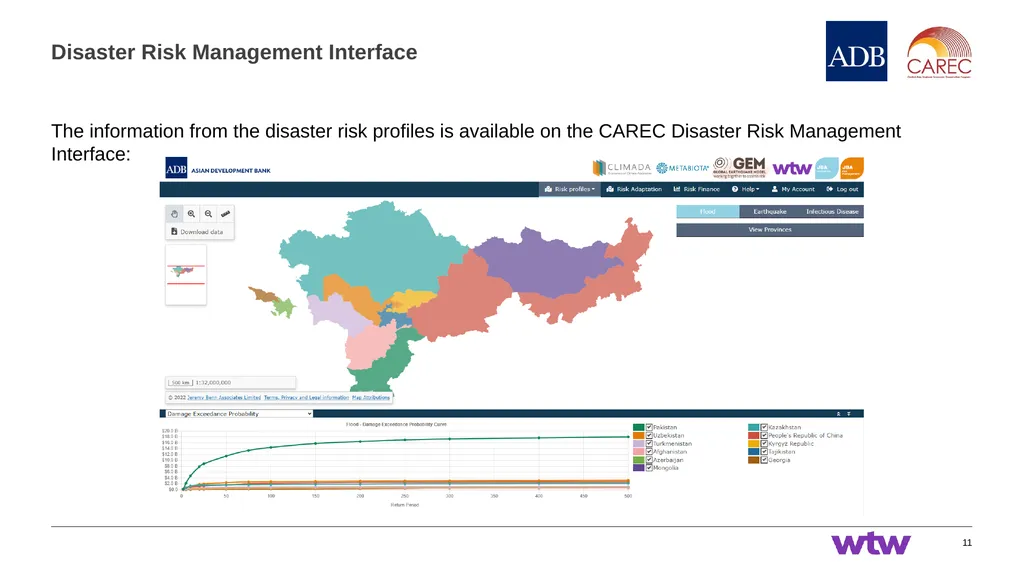
slide11. Disaster Risk Management Interface 11 The information from the disaster risk profiles is available on the CAREC Disaster Risk Management Interface:<br>
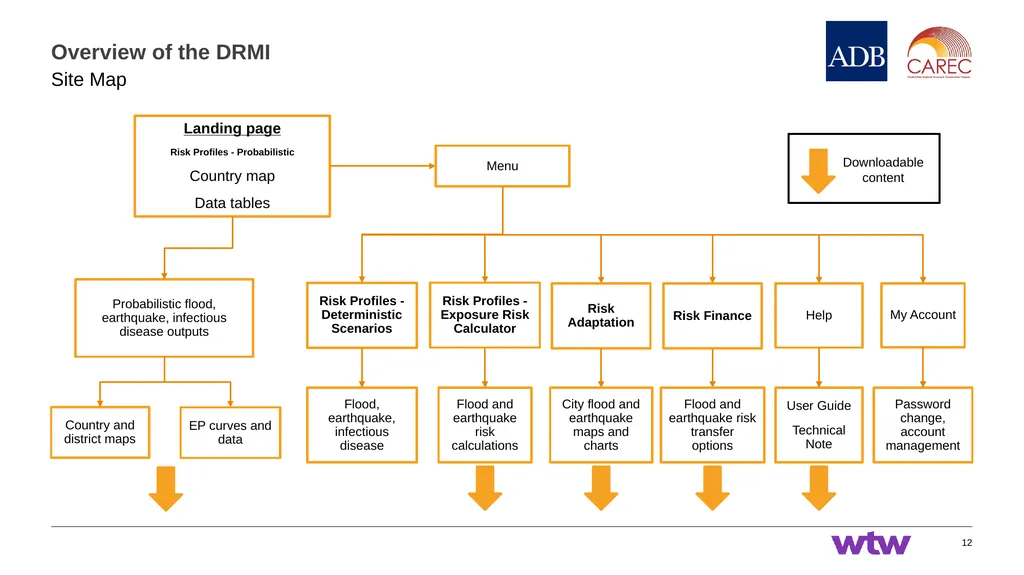
slide12. Overview of the DRMI Site Map 12<br>
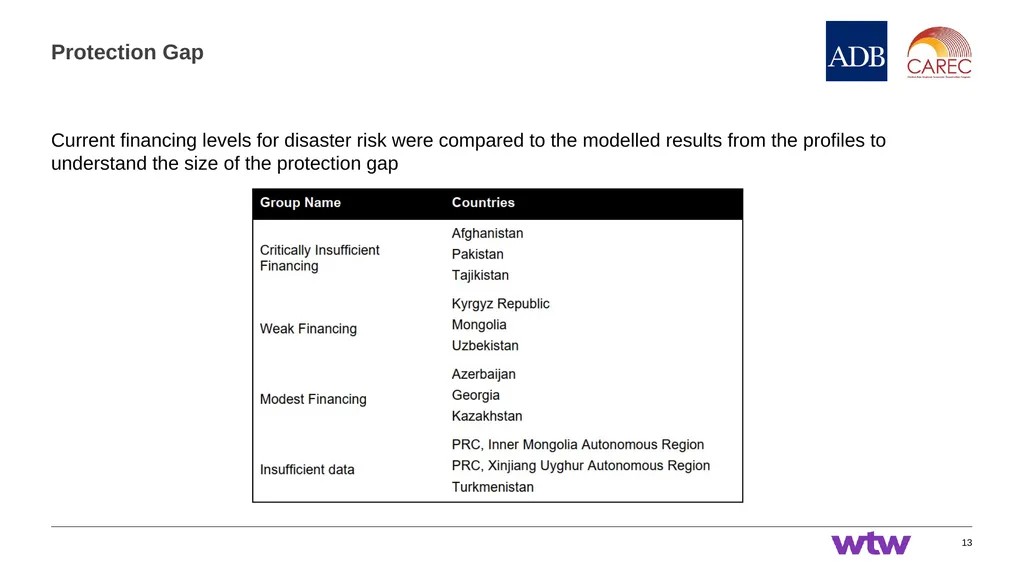
slide13. Protection Gap Current financing levels for disaster risk were compared to the modelled results from the profiles to understand the size of the protection gap 13<br>
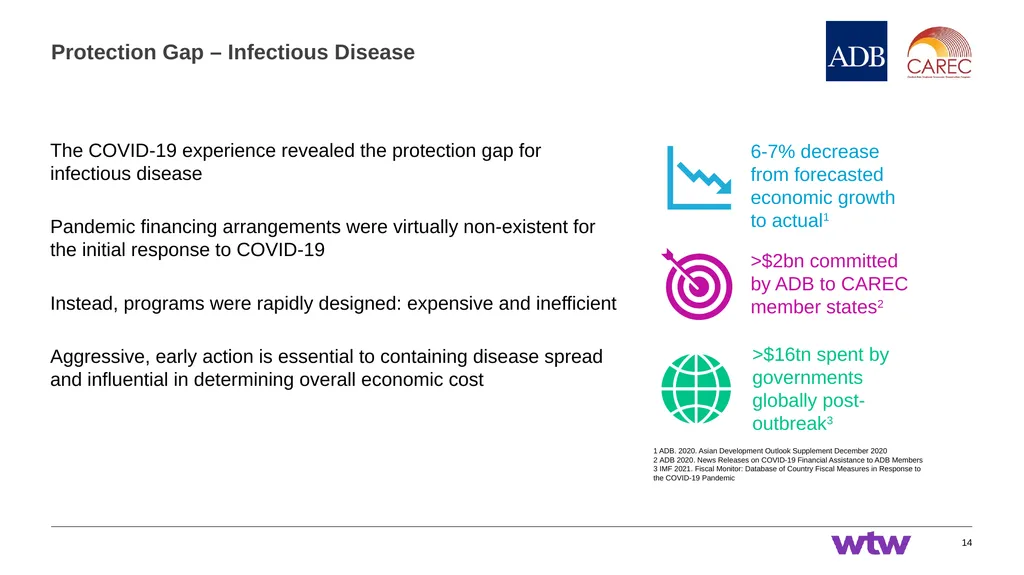
slide14. Protection Gap – Infectious Disease 14 >$2bn committed by ADB to CAREC member states2 6-7% decrease from forecasted economic growth to actual1 >$16tn spent by governments globally post-outbreak3 The COVID-19 experience revealed the protection gap for infectious disease
Pandemic financing arrangements were virtually non-existent for the initial response to COVID-19
Instead, programs were rapidly designed: expensive and inefficient
Aggressive, early action is essential to containing disease spread and influential in determining overall economic cost 1 ADB. 2020. Asian Development Outlook Supplement December 2020
2 ADB 2020. News Releases on COVID-19 Financial Assistance to ADB Members
3 IMF 2021. Fiscal Monitor: Database of Country Fiscal Measures in Response to the COVID-19 Pandemic<br>
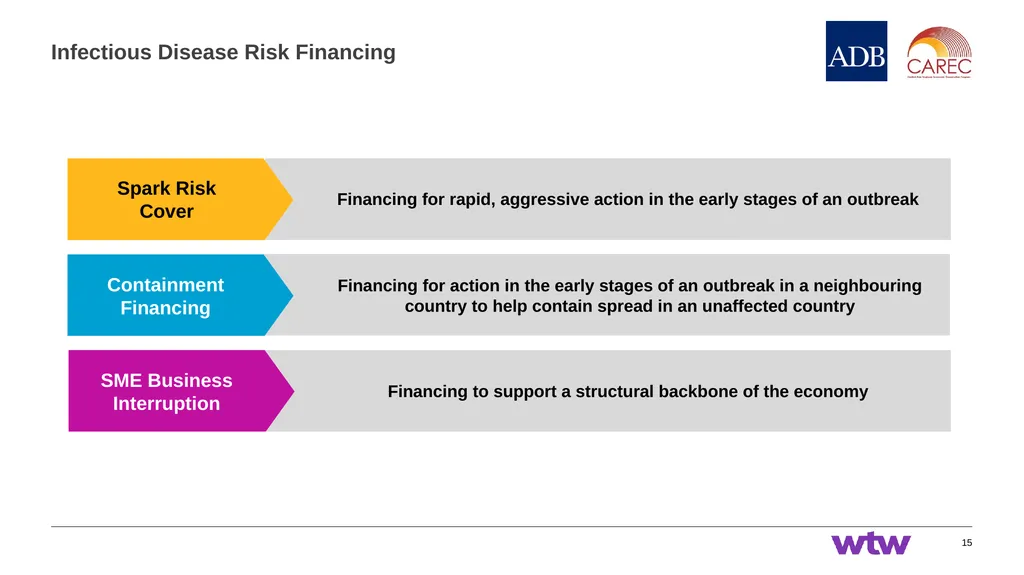
slide15. Infectious Disease Risk Financing 15<br>
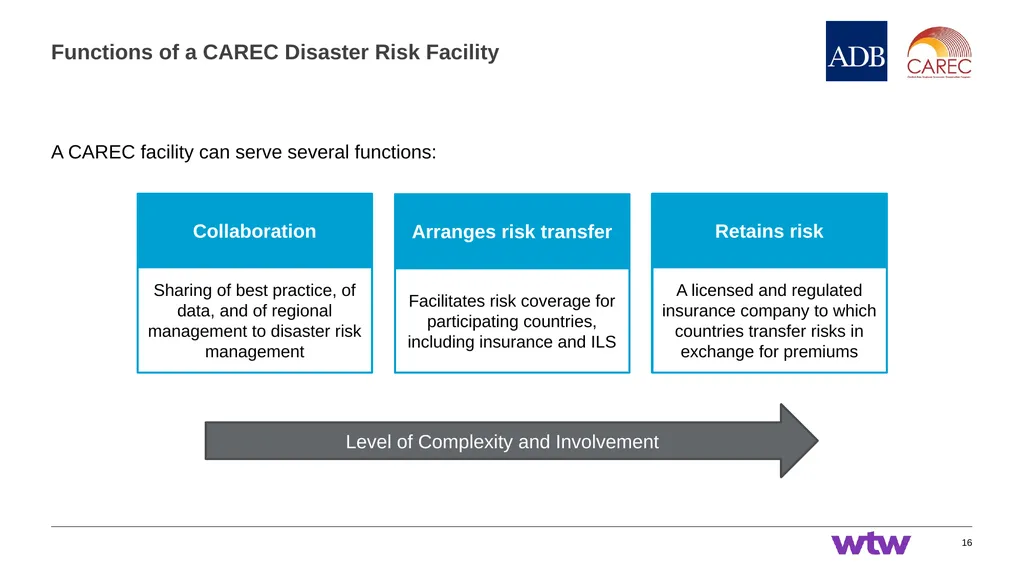
slide16. Functions of a CAREC Disaster Risk Facility A CAREC facility can serve several functions: 16 Level of Complexity and Involvement<br>
slide17. Next Steps for Discussion 17<br>
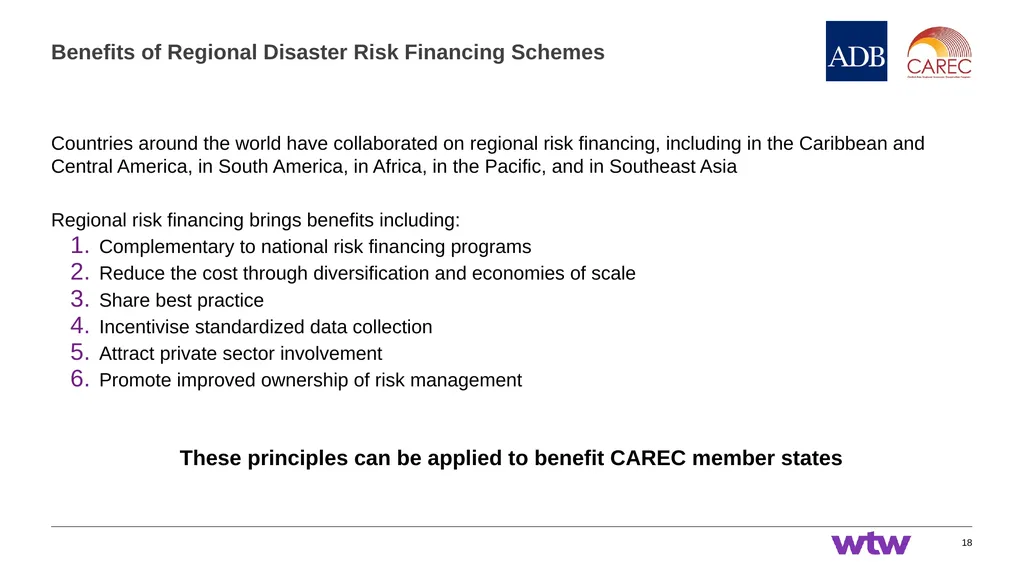
slide18. Benefits of Regional Disaster Risk Financing Schemes 18 Countries around the world have collaborated on regional risk financing, including in the Caribbean and Central America, in South America, in Africa, in the Pacific, and in Southeast Asia
Regional risk financing brings benefits including:
Complementary to national risk financing programs
Reduce the cost through diversification and economies of scale
Share best practice
Incentivise standardized data collection
Attract private sector involvement
Promote improved ownership of risk management These principles can be applied to benefit CAREC member states<br>
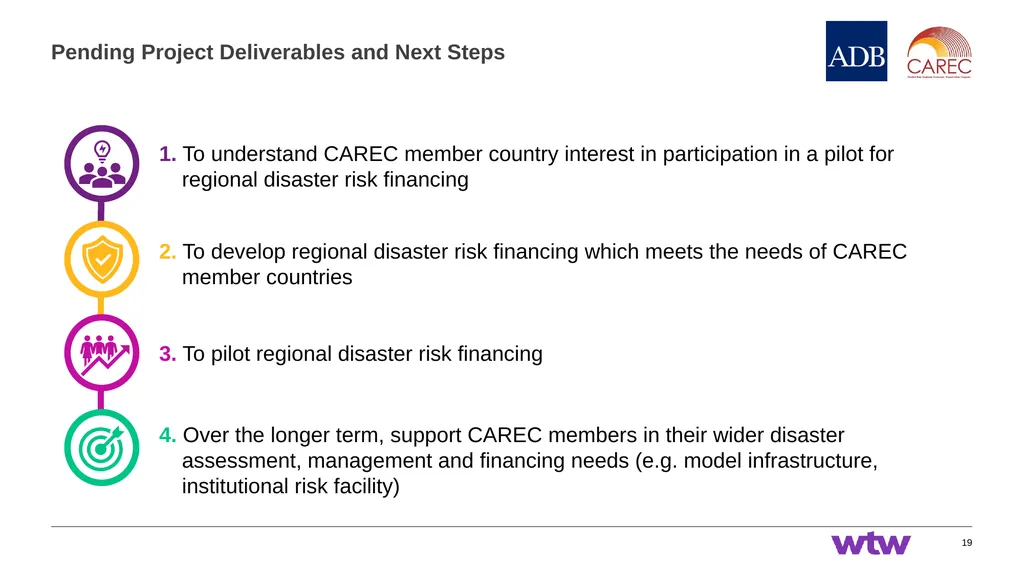
slide19. Pending Project Deliverables and Next Steps 19<br>
slide20. Ambition for this Conference 20<br>
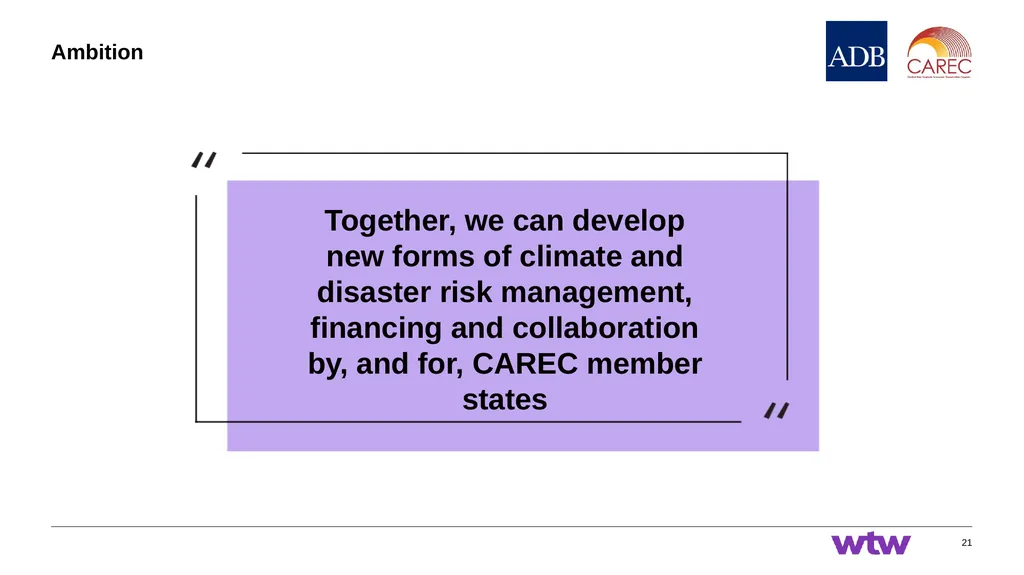
slide21. Ambition Together, we can develop new forms of climate and disaster risk management, financing and collaboration by, and for, CAREC member states 21<br>
slide22. Do you have any questions?
What are your expectations of this event? Questions and Discussion 22<br>
slide23. Disclaimer This analysis has been prepared by Willis Limited for the Asian Development Bank under a Technical Assistance contract.
Willis Limited has relied upon data from public and/or other sources when preparing this analysis. No attempt has been made to verify independently the accuracy of this data. Willis Limited does not represent or otherwise guarantee the accuracy or completeness of such data nor assume responsibility for the result of any error or omission in the data or other materials gathered from any source in the preparation of this analysis.
There are many uncertainties inherent in this analysis including, but not limited to, issues such as limitations in the available data, reliance on client data and outside data sources, the underlying volatility of loss and other random processes, uncertainties that characterize the application of professional judgment in estimates and assumptions, etc. Ultimate losses, liabilities and claims depend upon future contingent events, including but not limited to unanticipated changes in inflation, laws, and regulations. As a result of these uncertainties, the actual outcomes could vary significantly from Willis Limited’s estimates in either direction. Willis makes no representation about and does not guarantee the outcome, results, success, or profitability of any insurance or reinsurance program or venture, whether or not the analyses or conclusions contained herein apply to such program or venture.
Willis does not recommend making decisions based solely on the information contained in this analysis. Rather, this analysis should be viewed as a supplement to other information, including specific business practice, claims experience, and financial situation. Independent professional advisors should be consulted with respect to the issues and conclusions presented herein and their possible application. Willis makes no representation or warranty as to the accuracy or completeness of this document and its contents.
Willis does not provide legal, accounting, or tax advice. This analysis does not constitute, is not intended to provide, and should not be construed as such advice. Qualified advisers should be consulted in these areas.
Willis makes no representation, does not guarantee and assumes no liability for the accuracy or completeness of, or any results obtained by application of, this analysis and conclusions provided herein.
Acceptance of this document shall be deemed agreement to the above. 23<br>
November 2022 TA 9878 “Developing a Disaster Risk Transfer Facility in the CAREC Region” – Engagement Event<br>
slide2. Objectives 2<br>
slide3. Overview of Project Objectives: Developing a Disaster Risk Transfer Facility in the CAREC Region 3<br>
slide4. Disaster Risk in CAREC 4 Risk management and financing efforts must strengthen to protect livelihoods and economic development<br>
slide5. Objectives of this Technical Assistance Project 5 Identify and quantify flood, earthquake and infectious disease risk Assess and quantify the financial disaster risk protection gap Investigate options for regional disaster risk financing to improve financial resilience and collaboration Provide access to modelling and capacity to assess the cost-benefit of adaptation investments<br>
slide6. Progress Achieved 6<br>
slide7. Key Outputs 7 Disaster risk profiles Disaster Risk Management Interface Infectious disease financing mechanisms Investigation and modeling of ILS instruments Investigation of a regional risk facility COVID-19 scenarios and compound risk<br>
slide8. Disaster Risk Profiles Profiles for each CAREC member have been developed and made publicly available on the CAREC program website
These use cutting edge catastrophe modelling to estimate the country wide impacts of floods, earthquakes and infectious disease outbreaks 8<br>
slide9. A regionally consistent modelling approach using country specific hazard, vulnerability and exposure information
These models are developed by leading insurance industry modelling companies and incorporate latest science and data
A consistent exposure dataset for earthquake and flood risk modeling contained information on number of buildings, location, replacement costs, number of occupants and vulnerability classes of the building stock
This covered residential, commercial, and industrial assets – a nationally representative view of financial exposure Disaster Risk Modelling Approach 9<br>
slide10. Disaster Risk Profiles – Average Annual Losses 10<br>
slide11. Disaster Risk Management Interface 11 The information from the disaster risk profiles is available on the CAREC Disaster Risk Management Interface:<br>
slide12. Overview of the DRMI Site Map 12<br>
slide13. Protection Gap Current financing levels for disaster risk were compared to the modelled results from the profiles to understand the size of the protection gap 13<br>
slide14. Protection Gap – Infectious Disease 14 >$2bn committed by ADB to CAREC member states2 6-7% decrease from forecasted economic growth to actual1 >$16tn spent by governments globally post-outbreak3 The COVID-19 experience revealed the protection gap for infectious disease
Pandemic financing arrangements were virtually non-existent for the initial response to COVID-19
Instead, programs were rapidly designed: expensive and inefficient
Aggressive, early action is essential to containing disease spread and influential in determining overall economic cost 1 ADB. 2020. Asian Development Outlook Supplement December 2020
2 ADB 2020. News Releases on COVID-19 Financial Assistance to ADB Members
3 IMF 2021. Fiscal Monitor: Database of Country Fiscal Measures in Response to the COVID-19 Pandemic<br>
slide15. Infectious Disease Risk Financing 15<br>
slide16. Functions of a CAREC Disaster Risk Facility A CAREC facility can serve several functions: 16 Level of Complexity and Involvement<br>
slide17. Next Steps for Discussion 17<br>
slide18. Benefits of Regional Disaster Risk Financing Schemes 18 Countries around the world have collaborated on regional risk financing, including in the Caribbean and Central America, in South America, in Africa, in the Pacific, and in Southeast Asia
Regional risk financing brings benefits including:
Complementary to national risk financing programs
Reduce the cost through diversification and economies of scale
Share best practice
Incentivise standardized data collection
Attract private sector involvement
Promote improved ownership of risk management These principles can be applied to benefit CAREC member states<br>
slide19. Pending Project Deliverables and Next Steps 19<br>
slide20. Ambition for this Conference 20<br>
slide21. Ambition Together, we can develop new forms of climate and disaster risk management, financing and collaboration by, and for, CAREC member states 21<br>
slide22. Do you have any questions?
What are your expectations of this event? Questions and Discussion 22<br>
slide23. Disclaimer This analysis has been prepared by Willis Limited for the Asian Development Bank under a Technical Assistance contract.
Willis Limited has relied upon data from public and/or other sources when preparing this analysis. No attempt has been made to verify independently the accuracy of this data. Willis Limited does not represent or otherwise guarantee the accuracy or completeness of such data nor assume responsibility for the result of any error or omission in the data or other materials gathered from any source in the preparation of this analysis.
There are many uncertainties inherent in this analysis including, but not limited to, issues such as limitations in the available data, reliance on client data and outside data sources, the underlying volatility of loss and other random processes, uncertainties that characterize the application of professional judgment in estimates and assumptions, etc. Ultimate losses, liabilities and claims depend upon future contingent events, including but not limited to unanticipated changes in inflation, laws, and regulations. As a result of these uncertainties, the actual outcomes could vary significantly from Willis Limited’s estimates in either direction. Willis makes no representation about and does not guarantee the outcome, results, success, or profitability of any insurance or reinsurance program or venture, whether or not the analyses or conclusions contained herein apply to such program or venture.
Willis does not recommend making decisions based solely on the information contained in this analysis. Rather, this analysis should be viewed as a supplement to other information, including specific business practice, claims experience, and financial situation. Independent professional advisors should be consulted with respect to the issues and conclusions presented herein and their possible application. Willis makes no representation or warranty as to the accuracy or completeness of this document and its contents.
Willis does not provide legal, accounting, or tax advice. This analysis does not constitute, is not intended to provide, and should not be construed as such advice. Qualified advisers should be consulted in these areas.
Willis makes no representation, does not guarantee and assumes no liability for the accuracy or completeness of, or any results obtained by application of, this analysis and conclusions provided herein.
Acceptance of this document shall be deemed agreement to the above. 23<br>