
Presentation on University Education at the
CS
Published · 19 slides · 0 views

1 / 1

Description
Presentation on University Education at the Sub-National Level of Nigeria Committee of Vice Chancellors of Nigerian Universities. December 2023. Presentation Outline . . Collaboration with NGF The Challenge Matrix in the Nigerian University
Related Topics
Share
Embed code
Download this presentation From Below
"Presentation on University Education at the" is the property of its rightful owner. Permission is granted to download and print the materials on this website for personal, non-commercial use only, and to display it on your personal computer provided you do not modify the materials and that you retain all copyright notices contained in the materials. By downloading content from our website, you accept the terms of this agreement.
Presentation Transcript
01
Presentation
on
University Education at the Sub-National Level of Nigeria Committee of Vice Chancellors of Nigerian Universities.
December 2023.<br>
December 2023.<br>
02
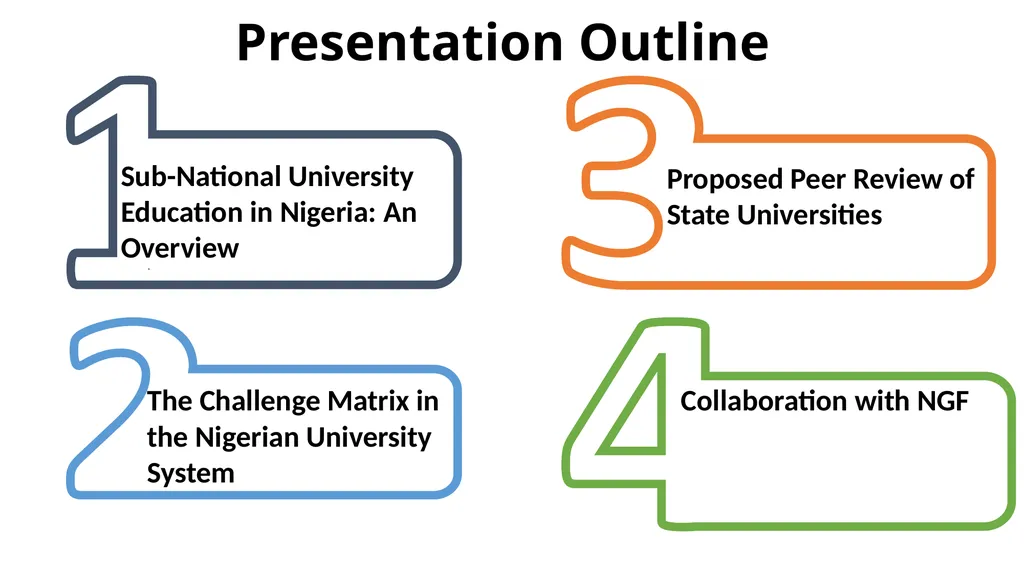
Presentation Outline . . Collaboration with NGF The Challenge Matrix in the Nigerian University System Sub-National University Education in Nigeria: An Overview Proposed Peer Review of State Universities<br>
03
University Education in Africa: An Overview The modern Western University system is over 1000 years old. While Universities like Oxford are over 900 years old, the oldest degree awarding University in Africa is Al Karaouine in Fez, Morocco founded in 859 AD.
Fourah Bay College established in 1927 is the oldest Western type University.
University of Cape Town established in 1829 is the oldest in Southern Africa.
Cairo University in Egypt was founded in 1908 is the oldest western style university in North Africa.
The University of Ibadan and Ghana were established in 1948 and University of Zimbabwe established in 1952 are amongst the top ten oldest Universities in Africa.
India – 4004 USA - 3281
China – 2310 Brazil – 1507
Nigeria has the highest number of Universities in Africa with 270, South Africa with 136 and Ethiopia with 134<br>
Fourah Bay College established in 1927 is the oldest Western type University.
University of Cape Town established in 1829 is the oldest in Southern Africa.
Cairo University in Egypt was founded in 1908 is the oldest western style university in North Africa.
The University of Ibadan and Ghana were established in 1948 and University of Zimbabwe established in 1952 are amongst the top ten oldest Universities in Africa.
India – 4004 USA - 3281
China – 2310 Brazil – 1507
Nigeria has the highest number of Universities in Africa with 270, South Africa with 136 and Ethiopia with 134<br>
04
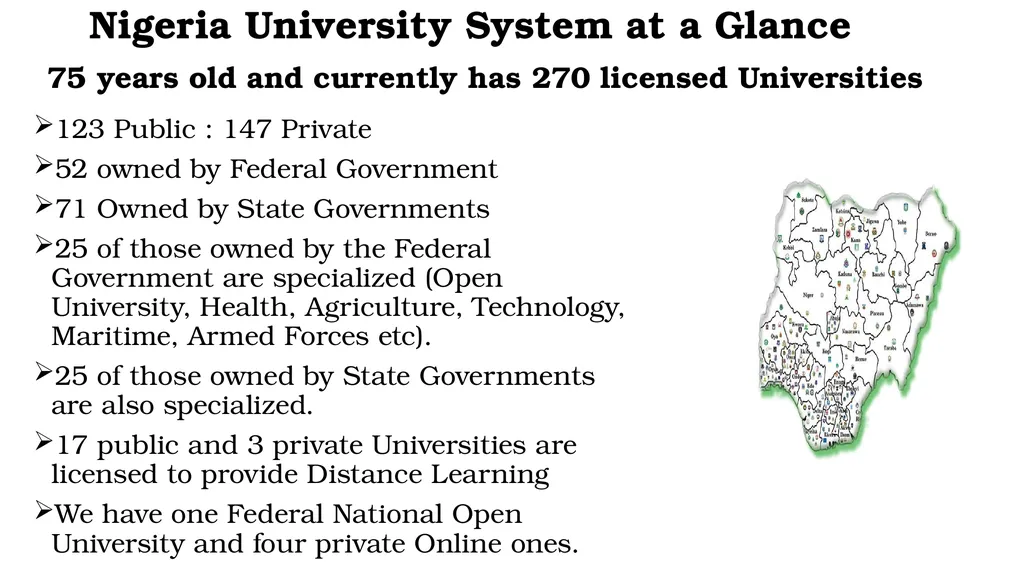
Nigeria University System at a Glance 75 years old and currently has 270 licensed Universities 123 Public : 147 Private
52 owned by Federal Government
71 Owned by State Governments
25 of those owned by the Federal Government are specialized (Open University, Health, Agriculture, Technology, Maritime, Armed Forces etc).
25 of those owned by State Governments are also specialized.
17 public and 3 private Universities are licensed to provide Distance Learning
We have one Federal National Open University and four private Online ones.<br>
52 owned by Federal Government
71 Owned by State Governments
25 of those owned by the Federal Government are specialized (Open University, Health, Agriculture, Technology, Maritime, Armed Forces etc).
25 of those owned by State Governments are also specialized.
17 public and 3 private Universities are licensed to provide Distance Learning
We have one Federal National Open University and four private Online ones.<br>
05
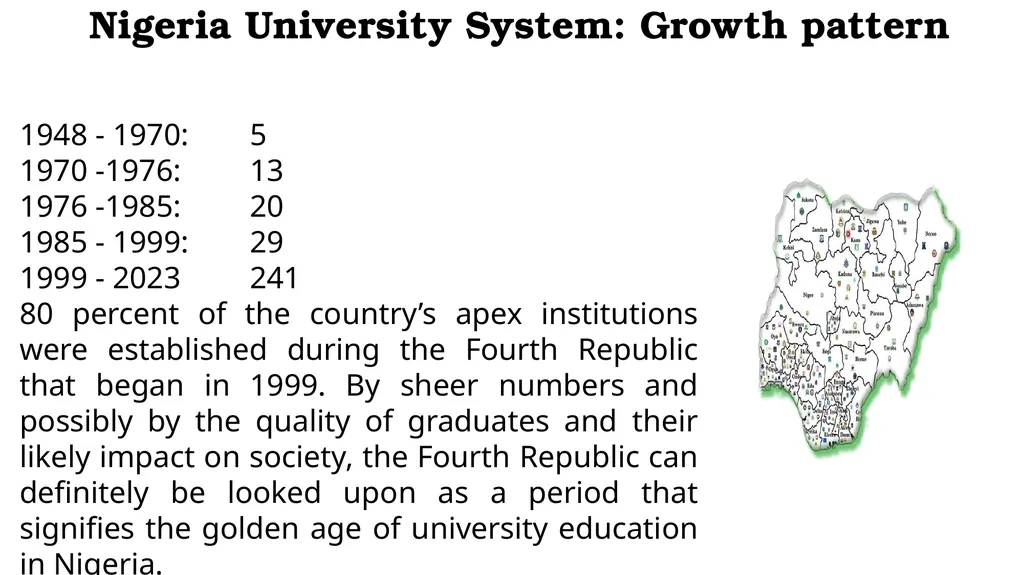
Nigeria University System: Growth pattern 1948 - 1970: 5
1970 -1976: 13
1976 -1985: 20
1985 - 1999: 29
1999 - 2023 241
80 percent of the country’s apex institutions were established during the Fourth Republic that began in 1999. By sheer numbers and possibly by the quality of graduates and their likely impact on society, the Fourth Republic can definitely be looked upon as a period that signifies the golden age of university education in Nigeria.<br>
1970 -1976: 13
1976 -1985: 20
1985 - 1999: 29
1999 - 2023 241
80 percent of the country’s apex institutions were established during the Fourth Republic that began in 1999. By sheer numbers and possibly by the quality of graduates and their likely impact on society, the Fourth Republic can definitely be looked upon as a period that signifies the golden age of university education in Nigeria.<br>
06
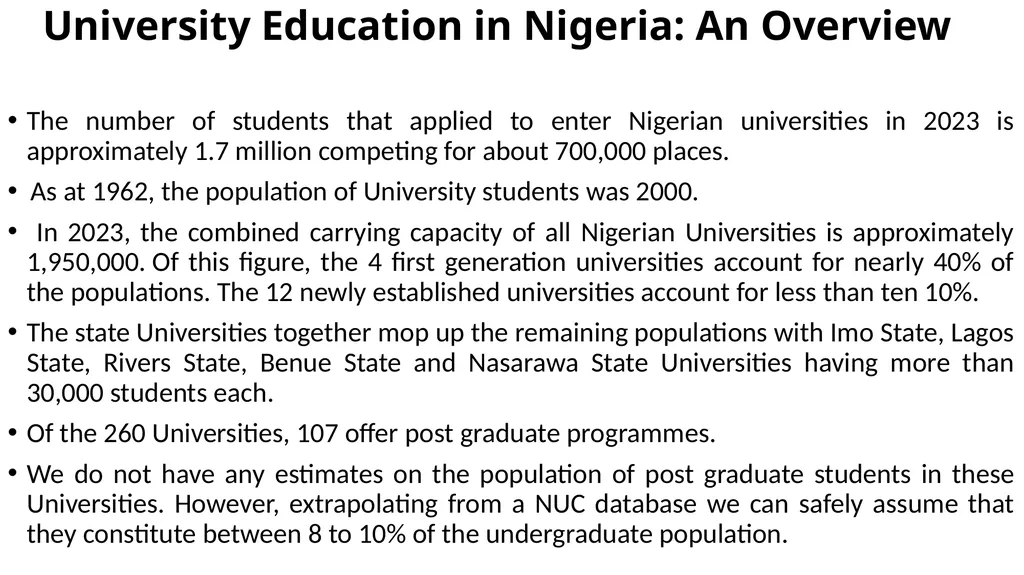
University Education in Nigeria: An Overview The number of students that applied to enter Nigerian universities in 2023 is approximately 1.7 million competing for about 700,000 places.
As at 1962, the population of University students was 2000.
In 2023, the combined carrying capacity of all Nigerian Universities is approximately 1,950,000. Of this figure, the 4 first generation universities account for nearly 40% of the populations. The 12 newly established universities account for less than ten 10%.
The state Universities together mop up the remaining populations with Imo State, Lagos State, Rivers State, Benue State and Nasarawa State Universities having more than 30,000 students each.
Of the 260 Universities, 107 offer post graduate programmes.
We do not have any estimates on the population of post graduate students in these Universities. However, extrapolating from a NUC database we can safely assume that they constitute between 8 to 10% of the undergraduate population.<br>
As at 1962, the population of University students was 2000.
In 2023, the combined carrying capacity of all Nigerian Universities is approximately 1,950,000. Of this figure, the 4 first generation universities account for nearly 40% of the populations. The 12 newly established universities account for less than ten 10%.
The state Universities together mop up the remaining populations with Imo State, Lagos State, Rivers State, Benue State and Nasarawa State Universities having more than 30,000 students each.
Of the 260 Universities, 107 offer post graduate programmes.
We do not have any estimates on the population of post graduate students in these Universities. However, extrapolating from a NUC database we can safely assume that they constitute between 8 to 10% of the undergraduate population.<br>
07
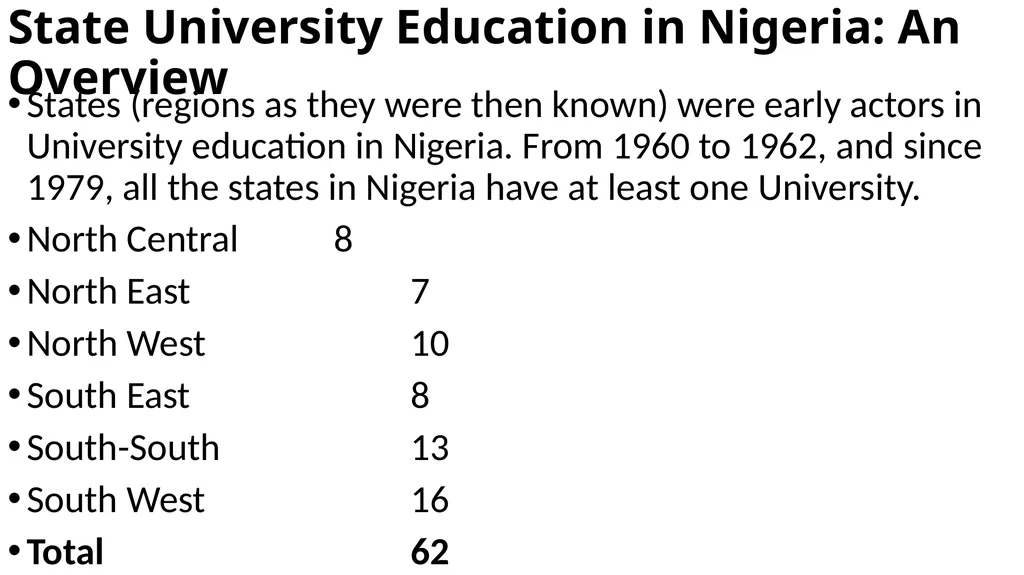
State University Education in Nigeria: An Overview States (regions as they were then known) were early actors in University education in Nigeria. From 1960 to 1962, and since 1979, all the states in Nigeria have at least one University.
North Central 8
North East 7
North West 10
South East 8
South-South 13
South West 16
Total 62 The licenses are also unique by their regional spread.<br>
North Central 8
North East 7
North West 10
South East 8
South-South 13
South West 16
Total 62 The licenses are also unique by their regional spread.<br>
08
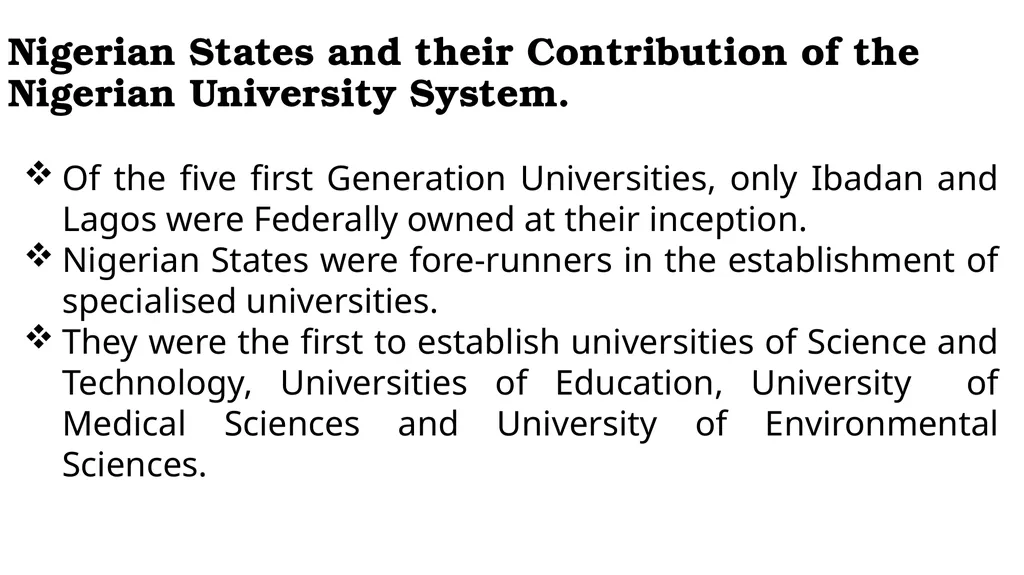
Nigerian States and their Contribution of the Nigerian University System. Of the five first Generation Universities, only Ibadan and Lagos were Federally owned at their inception.
Nigerian States were fore-runners in the establishment of specialised universities.
They were the first to establish universities of Science and Technology, Universities of Education, University of Medical Sciences and University of Environmental Sciences.<br>
Nigerian States were fore-runners in the establishment of specialised universities.
They were the first to establish universities of Science and Technology, Universities of Education, University of Medical Sciences and University of Environmental Sciences.<br>
09
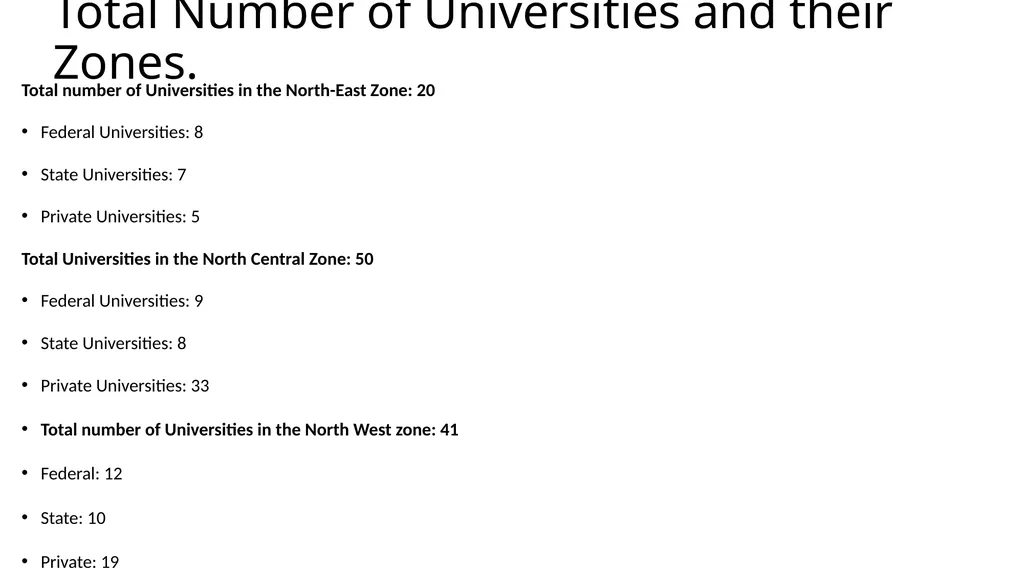
Total Number of Universities and their Zones. Total number of Universities in the North-East Zone: 20
Federal Universities: 8
State Universities: 7
Private Universities: 5
Total Universities in the North Central Zone: 50
Federal Universities: 9
State Universities: 8
Private Universities: 33
Total number of Universities in the North West zone: 41
Federal: 12
State: 10
Private: 19<br>
Federal Universities: 8
State Universities: 7
Private Universities: 5
Total Universities in the North Central Zone: 50
Federal Universities: 9
State Universities: 8
Private Universities: 33
Total number of Universities in the North West zone: 41
Federal: 12
State: 10
Private: 19<br>
10
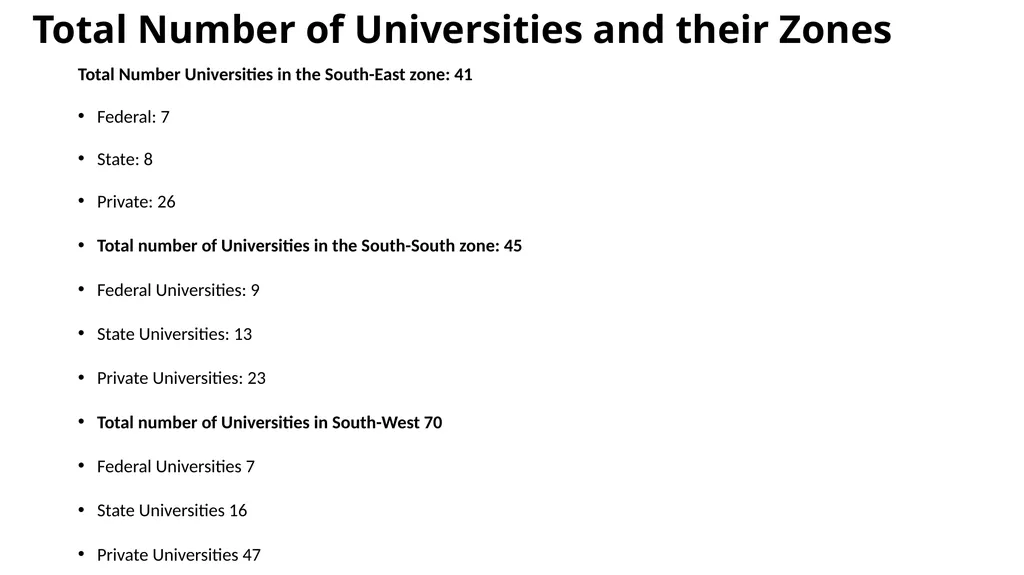
Total Number of Universities and their Zones Total Number Universities in the South-East zone: 41
Federal: 7
State: 8
Private: 26
Total number of Universities in the South-South zone: 45
Federal Universities: 9
State Universities: 13
Private Universities: 23
Total number of Universities in South-West 70
Federal Universities 7
State Universities 16
Private Universities 47<br>
Federal: 7
State: 8
Private: 26
Total number of Universities in the South-South zone: 45
Federal Universities: 9
State Universities: 13
Private Universities: 23
Total number of Universities in South-West 70
Federal Universities 7
State Universities 16
Private Universities 47<br>
11
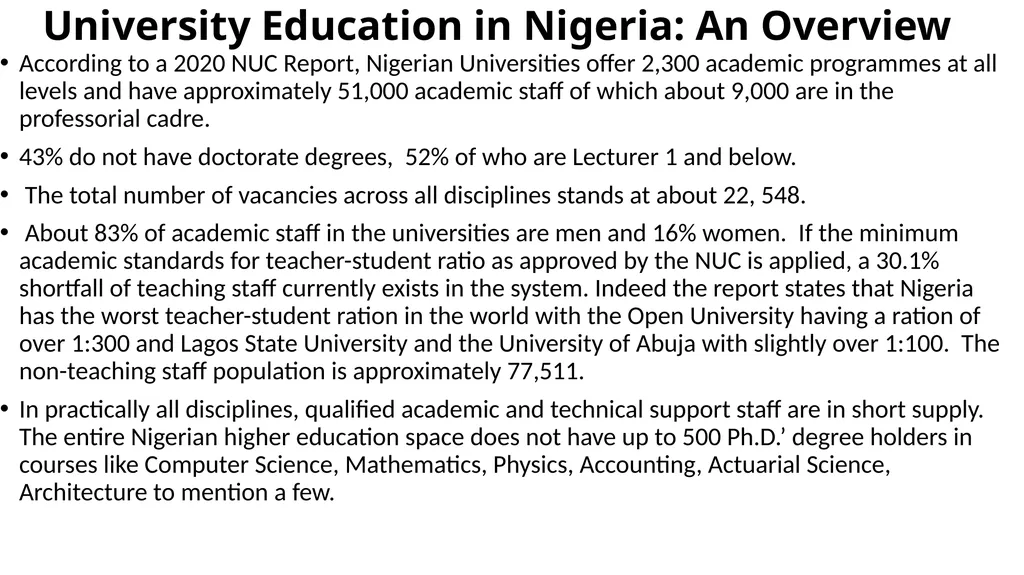
University Education in Nigeria: An Overview According to a 2020 NUC Report, Nigerian Universities offer 2,300 academic programmes at all levels and have approximately 51,000 academic staff of which about 9,000 are in the professorial cadre.
43% do not have doctorate degrees, 52% of who are Lecturer 1 and below.
The total number of vacancies across all disciplines stands at about 22, 548.
About 83% of academic staff in the universities are men and 16% women. If the minimum academic standards for teacher-student ratio as approved by the NUC is applied, a 30.1% shortfall of teaching staff currently exists in the system. Indeed the report states that Nigeria has the worst teacher-student ration in the world with the Open University having a ration of over 1:300 and Lagos State University and the University of Abuja with slightly over 1:100. The non-teaching staff population is approximately 77,511.
In practically all disciplines, qualified academic and technical support staff are in short supply. The entire Nigerian higher education space does not have up to 500 Ph.D.’ degree holders in courses like Computer Science, Mathematics, Physics, Accounting, Actuarial Science, Architecture to mention a few.<br>
43% do not have doctorate degrees, 52% of who are Lecturer 1 and below.
The total number of vacancies across all disciplines stands at about 22, 548.
About 83% of academic staff in the universities are men and 16% women. If the minimum academic standards for teacher-student ratio as approved by the NUC is applied, a 30.1% shortfall of teaching staff currently exists in the system. Indeed the report states that Nigeria has the worst teacher-student ration in the world with the Open University having a ration of over 1:300 and Lagos State University and the University of Abuja with slightly over 1:100. The non-teaching staff population is approximately 77,511.
In practically all disciplines, qualified academic and technical support staff are in short supply. The entire Nigerian higher education space does not have up to 500 Ph.D.’ degree holders in courses like Computer Science, Mathematics, Physics, Accounting, Actuarial Science, Architecture to mention a few.<br>
12
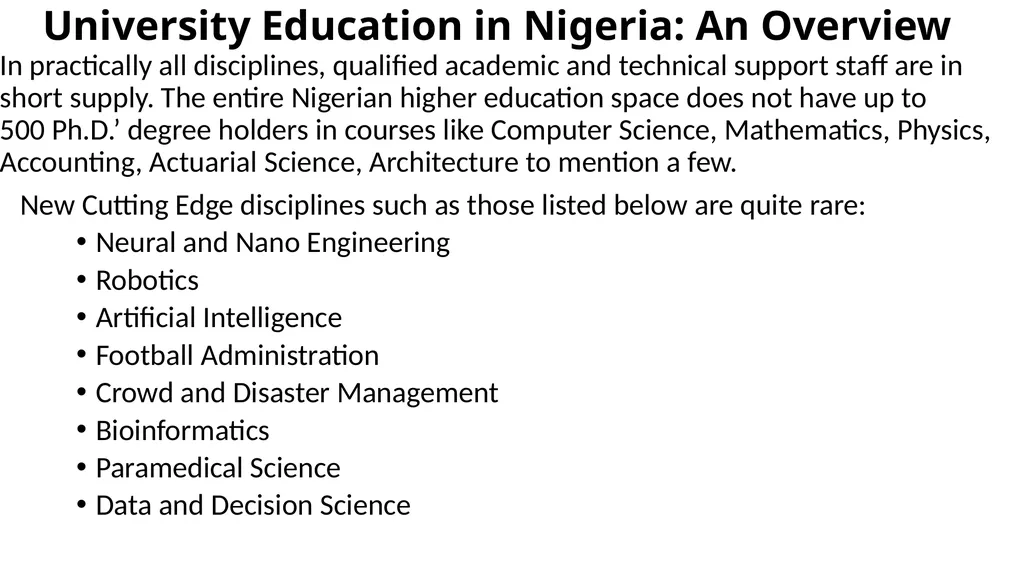
University Education in Nigeria: An Overview In practically all disciplines, qualified academic and technical support staff are in short supply. The entire Nigerian higher education space does not have up to 500 Ph.D.’ degree holders in courses like Computer Science, Mathematics, Physics, Accounting, Actuarial Science, Architecture to mention a few.
New Cutting Edge disciplines such as those listed below are quite rare:
Neural and Nano Engineering
Robotics
Artificial Intelligence
Football Administration
Crowd and Disaster Management
Bioinformatics
Paramedical Science
Data and Decision Science<br>
New Cutting Edge disciplines such as those listed below are quite rare:
Neural and Nano Engineering
Robotics
Artificial Intelligence
Football Administration
Crowd and Disaster Management
Bioinformatics
Paramedical Science
Data and Decision Science<br>
13
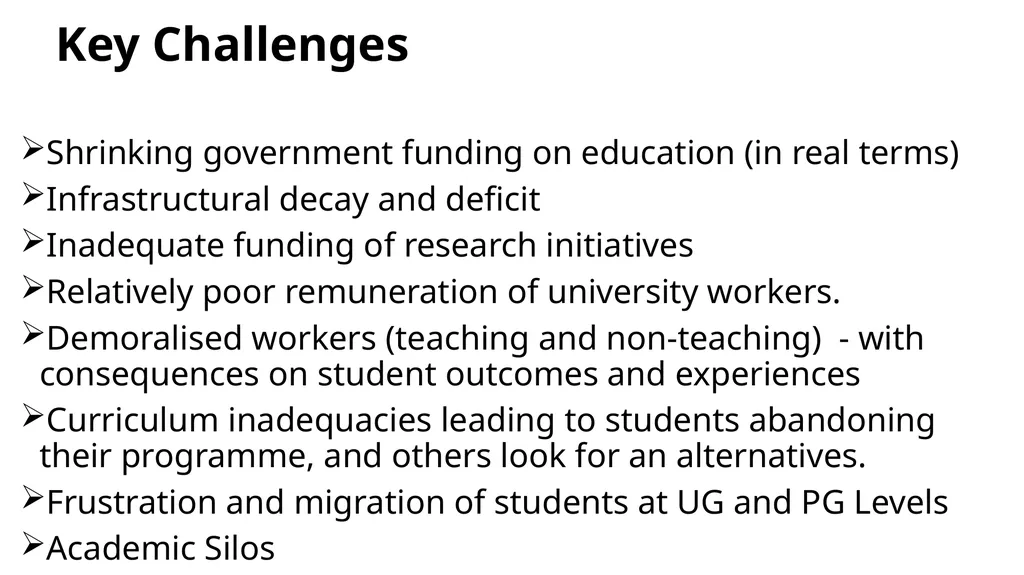
Key Challenges Shrinking government funding on education (in real terms)
Infrastructural decay and deficit
Inadequate funding of research initiatives
Relatively poor remuneration of university workers.
Demoralised workers (teaching and non-teaching) - with consequences on student outcomes and experiences
Curriculum inadequacies leading to students abandoning their programme, and others look for an alternatives.
Frustration and migration of students at UG and PG Levels
Academic Silos<br>
Infrastructural decay and deficit
Inadequate funding of research initiatives
Relatively poor remuneration of university workers.
Demoralised workers (teaching and non-teaching) - with consequences on student outcomes and experiences
Curriculum inadequacies leading to students abandoning their programme, and others look for an alternatives.
Frustration and migration of students at UG and PG Levels
Academic Silos<br>
14
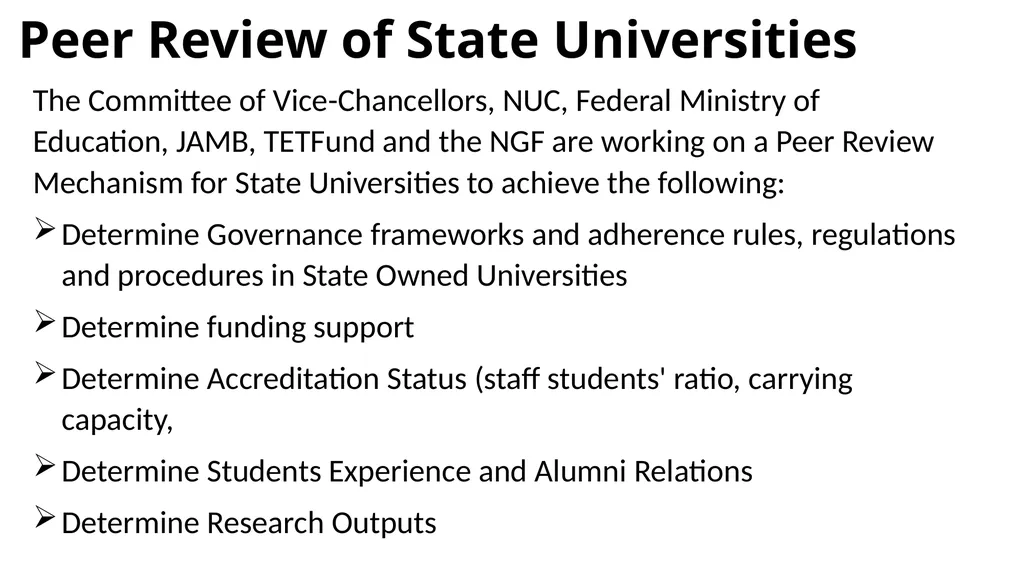
Peer Review of State Universities The Committee of Vice-Chancellors, NUC, Federal Ministry of Education, JAMB, TETFund and the NGF are working on a Peer Review Mechanism for State Universities to achieve the following:
Determine Governance frameworks and adherence rules, regulations and procedures in State Owned Universities
Determine funding support
Determine Accreditation Status (staff students' ratio, carrying capacity,
Determine Students Experience and Alumni Relations
Determine Research Outputs<br>
Determine Governance frameworks and adherence rules, regulations and procedures in State Owned Universities
Determine funding support
Determine Accreditation Status (staff students' ratio, carrying capacity,
Determine Students Experience and Alumni Relations
Determine Research Outputs<br>
15
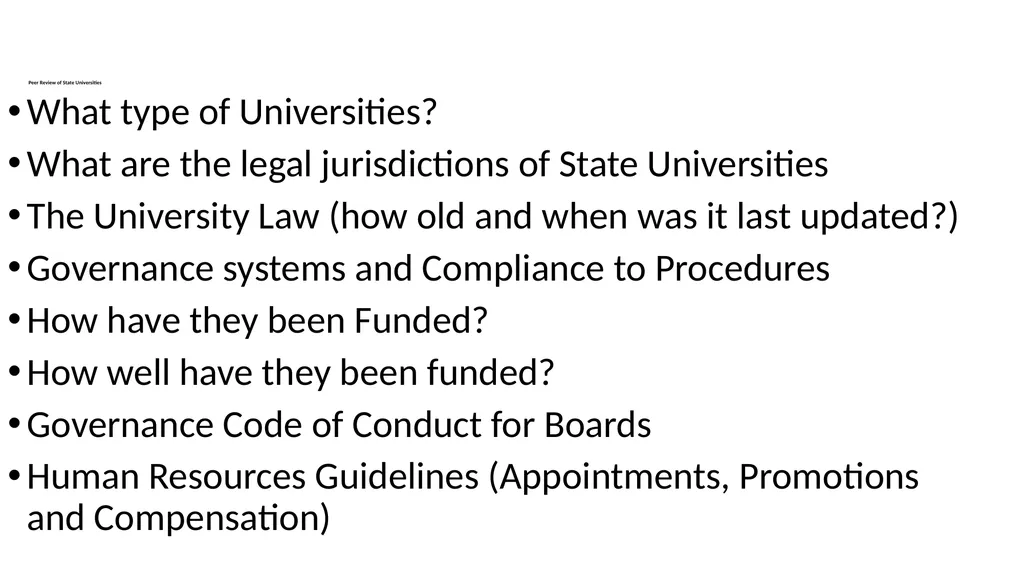
Peer Review of State Universities What type of Universities?
What are the legal jurisdictions of State Universities
The University Law (how old and when was it last updated?)
Governance systems and Compliance to Procedures
How have they been Funded?
How well have they been funded?
Governance Code of Conduct for Boards
Human Resources Guidelines (Appointments, Promotions and Compensation)<br>
What are the legal jurisdictions of State Universities
The University Law (how old and when was it last updated?)
Governance systems and Compliance to Procedures
How have they been Funded?
How well have they been funded?
Governance Code of Conduct for Boards
Human Resources Guidelines (Appointments, Promotions and Compensation)<br>
16
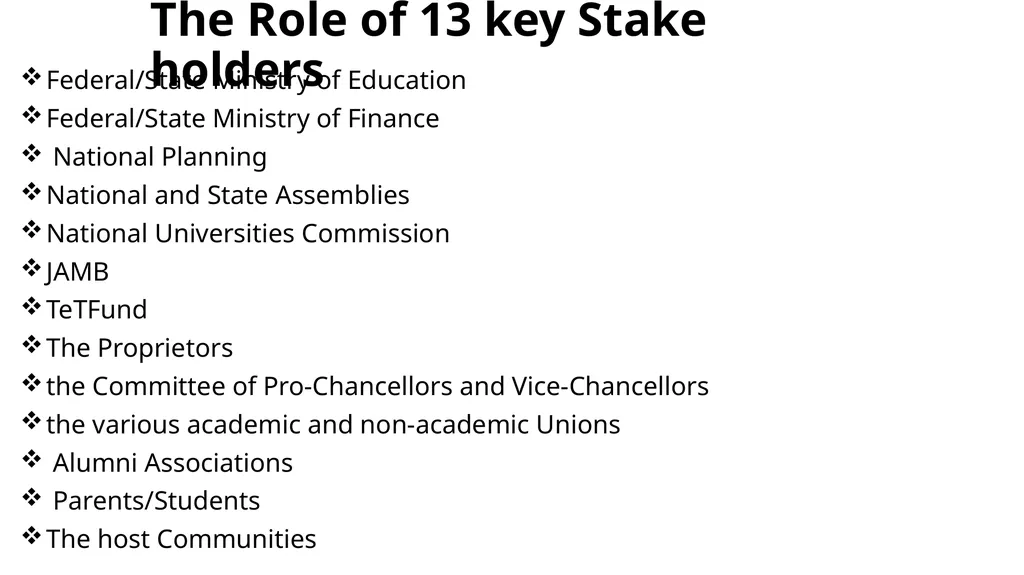
The Role of 13 key Stake holders Federal/State Ministry of Education
Federal/State Ministry of Finance
National Planning
National and State Assemblies
National Universities Commission
JAMB
TeTFund
The Proprietors
the Committee of Pro-Chancellors and Vice-Chancellors
the various academic and non-academic Unions
Alumni Associations
Parents/Students
The host Communities<br>
Federal/State Ministry of Finance
National Planning
National and State Assemblies
National Universities Commission
JAMB
TeTFund
The Proprietors
the Committee of Pro-Chancellors and Vice-Chancellors
the various academic and non-academic Unions
Alumni Associations
Parents/Students
The host Communities<br>
17
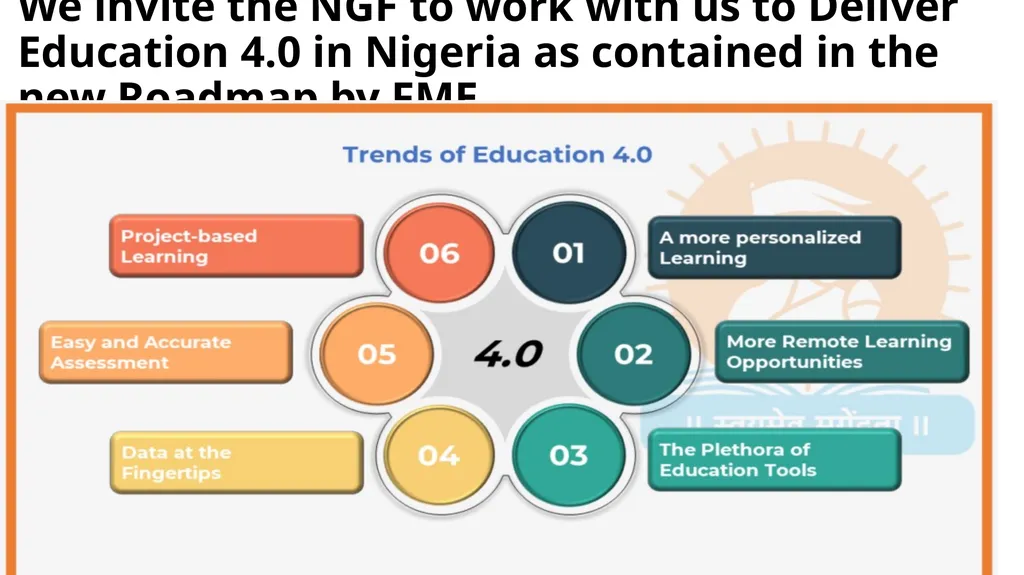
We invite the NGF to work with us to Deliver Education 4.0 in Nigeria as contained in the new Roadmap by FME<br>
18
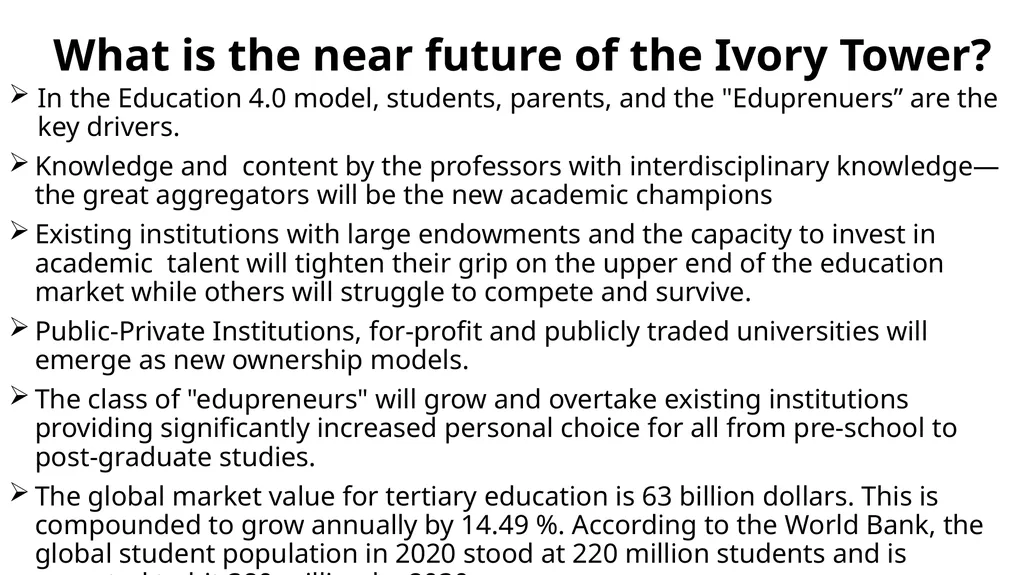
What is the near future of the Ivory Tower? In the Education 4.0 model, students, parents, and the "Eduprenuers” are the key drivers.
Knowledge and content by the professors with interdisciplinary knowledge—the great aggregators will be the new academic champions
Existing institutions with large endowments and the capacity to invest in academic talent will tighten their grip on the upper end of the education market while others will struggle to compete and survive.
Public-Private Institutions, for-profit and publicly traded universities will emerge as new ownership models.
The class of "edupreneurs" will grow and overtake existing institutions providing significantly increased personal choice for all from pre-school to post-graduate studies.
The global market value for tertiary education is 63 billion dollars. This is compounded to grow annually by 14.49 %. According to the World Bank, the global student population in 2020 stood at 220 million students and is expected to hit 380 million by 2030.<br>
Knowledge and content by the professors with interdisciplinary knowledge—the great aggregators will be the new academic champions
Existing institutions with large endowments and the capacity to invest in academic talent will tighten their grip on the upper end of the education market while others will struggle to compete and survive.
Public-Private Institutions, for-profit and publicly traded universities will emerge as new ownership models.
The class of "edupreneurs" will grow and overtake existing institutions providing significantly increased personal choice for all from pre-school to post-graduate studies.
The global market value for tertiary education is 63 billion dollars. This is compounded to grow annually by 14.49 %. According to the World Bank, the global student population in 2020 stood at 220 million students and is expected to hit 380 million by 2030.<br>
19
Where will the States be in this Global Projections? In the numbers mentioned above, where will the Nigerian States be? Thank You for attention as I leave you to ponder over this question<br>