Presentation Slides for Chapter 1 of Fundamentals of Atmospheric Modeling 2nd Edition Mark Z. Jacobson Department of Civil Environmental Engineering Stanford University Stanford, CA 94305-4020 jacobsonstanford.edu March 10, 2005 Brief
"Presentation Slides for Chapter 1 of Fundamentals" is the property of its rightful owner. Permission is granted to
download and print the materials on this website for personal, non-commercial use only, and to display it
on your personal computer provided you do not modify the materials and that you retain all copyright
notices contained in the materials. By downloading content from our website, you accept the terms of this
agreement.
Presentation Transcript
01
Presentation Slides for Chapter 1 of Fundamentals of Atmospheric Modeling 2nd Edition Mark Z. Jacobson
Department of Civil & Environmental Engineering
Stanford University
Stanford, CA 94305-4020
jacobson@stanford.edu
March 10, 2005<br>
02
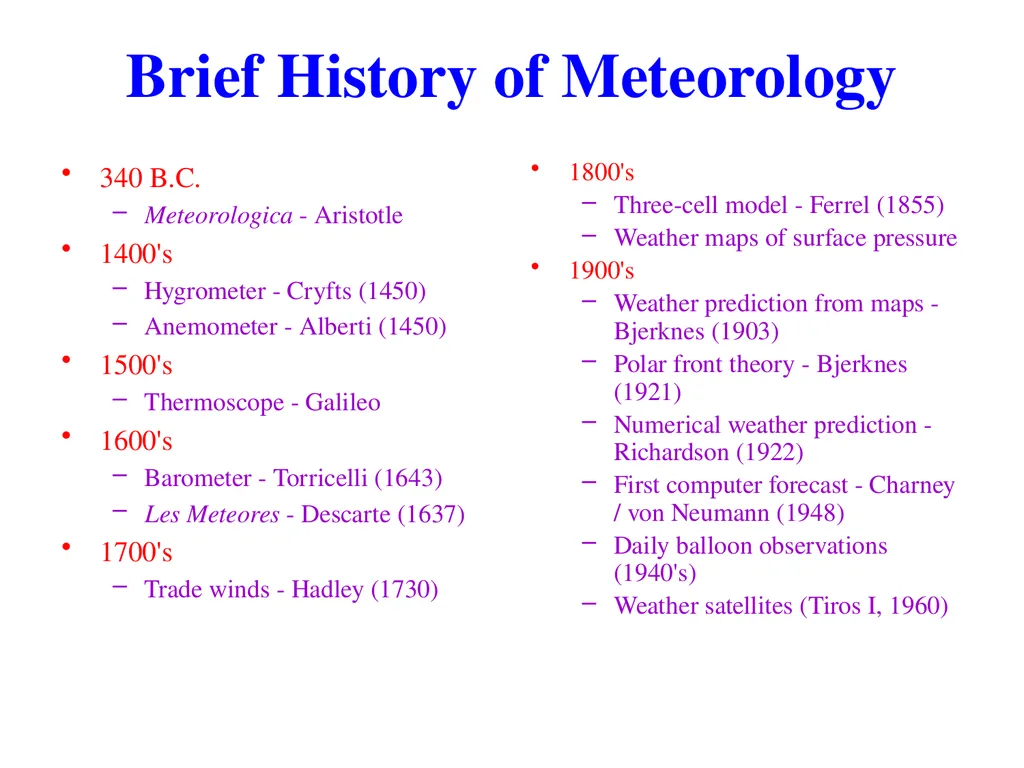
Brief History of Meteorology 340 B.C.
Meteorologica - Aristotle
1400's
Hygrometer - Cryfts (1450)
Anemometer - Alberti (1450)
1500's
Thermoscope - Galileo
1600's
Barometer - Torricelli (1643)
Les Meteores - Descarte (1637)
1700's
Trade winds - Hadley (1730) 1800's
Three-cell model - Ferrel (1855)
Weather maps of surface pressure
1900's
Weather prediction from maps - Bjerknes (1903)
Polar front theory - Bjerknes (1921)
Numerical weather prediction - Richardson (1922)
First computer forecast - Charney / von Neumann (1948)
Daily balloon observations (1940's)
Weather satellites (Tiros I, 1960)<br>
03
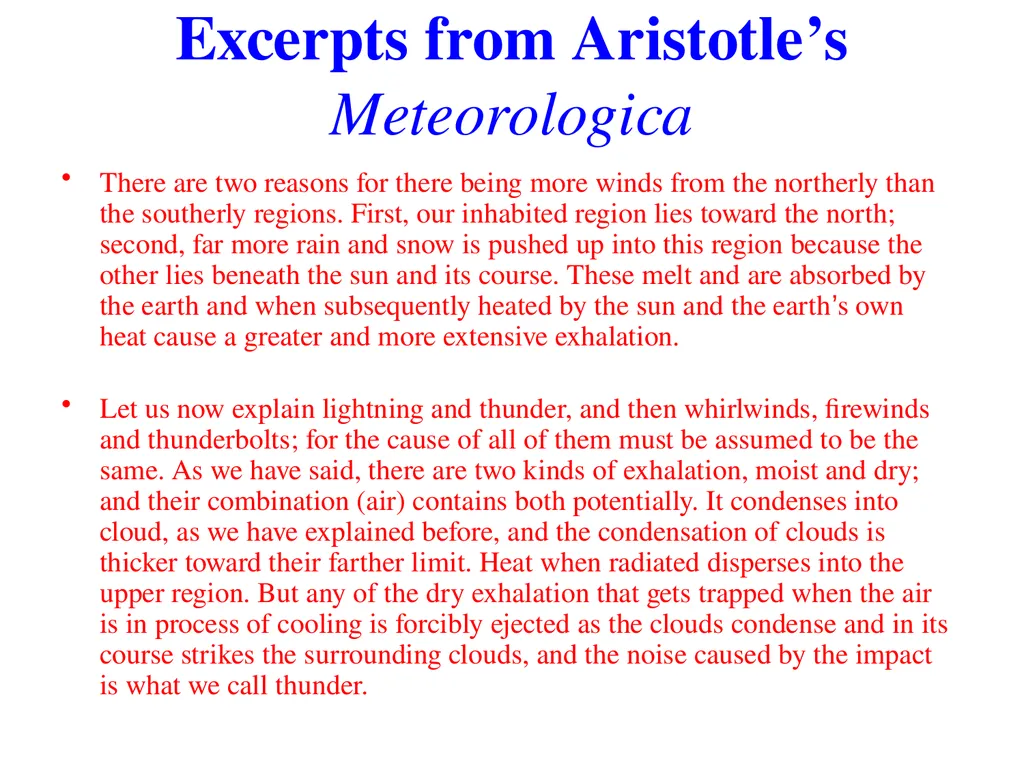
Excerpts from Aristotle’s Meteorologica There are two reasons for there being more winds from the northerly than the southerly regions. First, our inhabited region lies toward the north; second, far more rain and snow is pushed up into this region because the other lies beneath the sun and its course. These melt and are absorbed by the earth and when subsequently heated by the sun and the earth’s own heat cause a greater and more extensive exhalation.
Let us now explain lightning and thunder, and then whirlwinds, firewinds and thunderbolts; for the cause of all of them must be assumed to be the same. As we have said, there are two kinds of exhalation, moist and dry; and their combination (air) contains both potentially. It condenses into cloud, as we have explained before, and the condensation of clouds is thicker toward their farther limit. Heat when radiated disperses into the upper region. But any of the dry exhalation that gets trapped when the air is in process of cooling is forcibly ejected as the clouds condense and in its course strikes the surrounding clouds, and the noise caused by the impact is what we call thunder.<br>
04
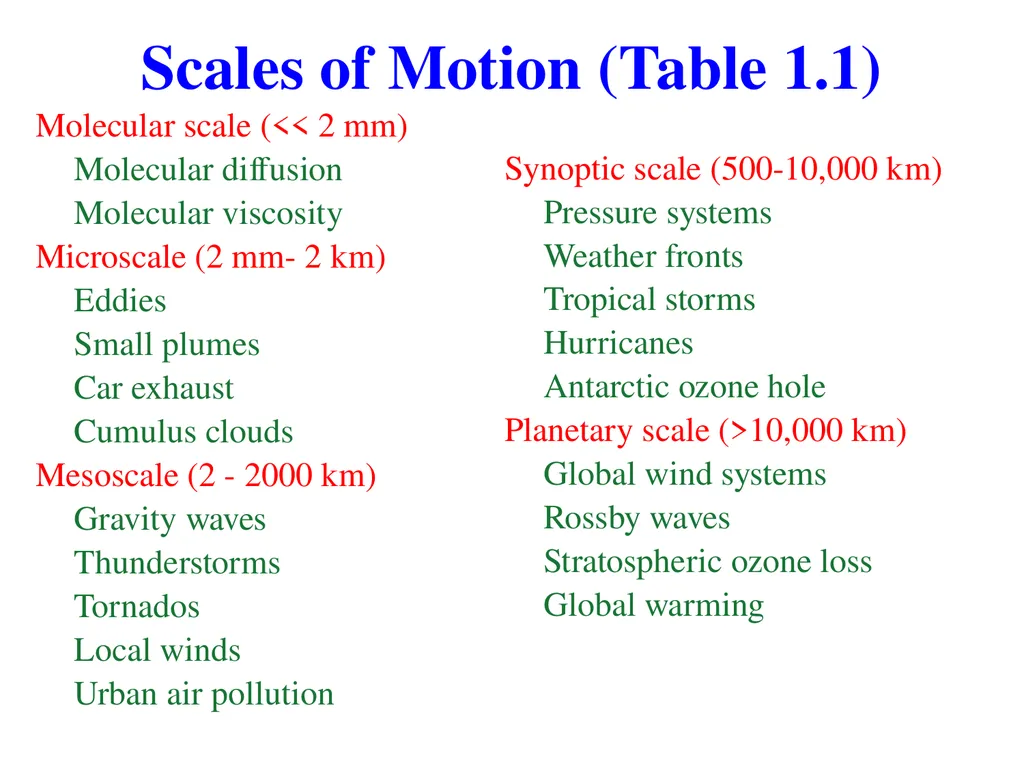
Scales of Motion (Table 1.1) Molecular scale (<< 2 mm)
Molecular diffusion
Molecular viscosity
Microscale (2 mm- 2 km)
Eddies
Small plumes
Car exhaust
Cumulus clouds
Mesoscale (2 - 2000 km)
Gravity waves
Thunderstorms
Tornados
Local winds
Urban air pollution Synoptic scale (500-10,000 km)
Pressure systems
Weather fronts
Tropical storms
Hurricanes
Antarctic ozone hole
Planetary scale (>10,000 km)
Global wind systems
Rossby waves
Stratospheric ozone loss
Global warming<br>
05
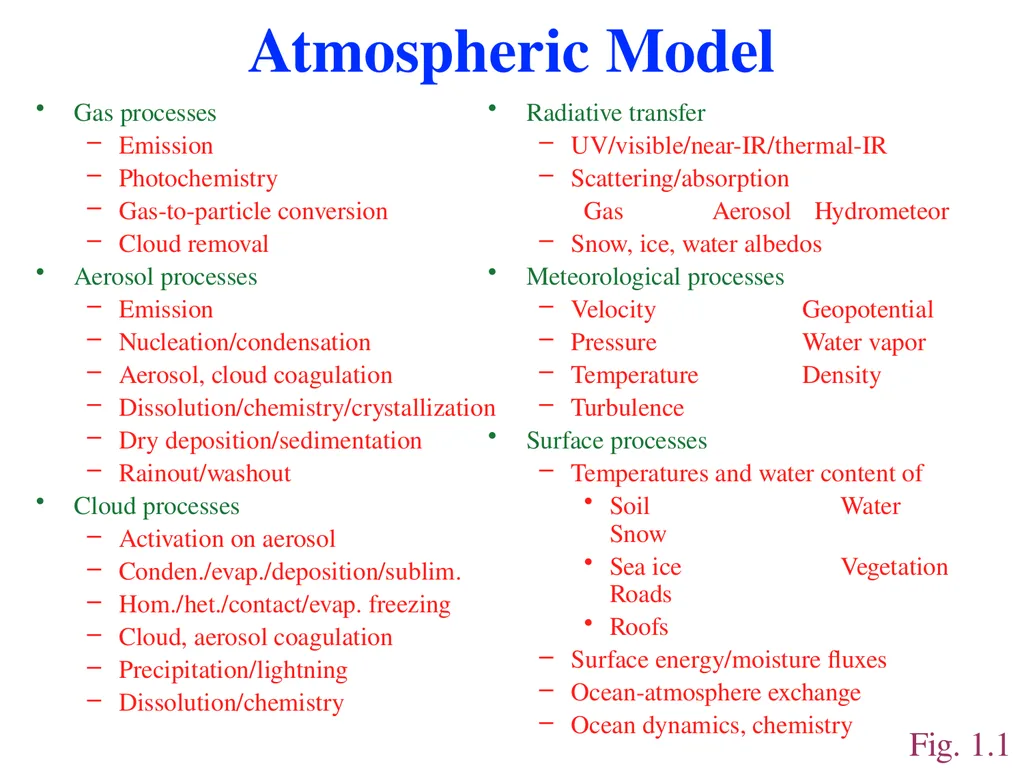
Atmospheric Model Gas processes
Emission
Photochemistry
Gas-to-particle conversion
Cloud removal
Aerosol processes
Emission
Nucleation/condensation
Aerosol, cloud coagulation
Dissolution/chemistry/crystallization
Dry deposition/sedimentation
Rainout/washout
Cloud processes
Activation on aerosol
Conden./evap./deposition/sublim.
Hom./het./contact/evap. freezing
Cloud, aerosol coagulation
Precipitation/lightning
Dissolution/chemistry Radiative transfer
UV/visible/near-IR/thermal-IR
Scattering/absorption
Gas Aerosol Hydrometeor
Snow, ice, water albedos
Meteorological processes
Velocity Geopotential
Pressure Water vapor
Temperature Density
Turbulence
Surface processes
Temperatures and water content of
Soil Water Snow
Sea ice Vegetation Roads
Roofs
Surface energy/moisture fluxes
Ocean-atmosphere exchange
Ocean dynamics, chemistry Fig. 1.1<br>