
PRESENTATION TO THE JOINT PORTFOLIO COMMITTEE ON
GB
Published · 102 slides · 0 views

1 / 1





























Description
PRESENTATION TO THE JOINT PORTFOLIO COMMITTEE ON HEALTH AND THE SELECT COMMITTEE ON HEALTH AND SOCIAL SERVICES 201920 ANNUAL REPORT 1 18 November 2020 DR SSS BUTHELEZI DIRECTOR-GENERAL:HEALTH To reflect on achievements and highlights in
Related Topics
Share
Embed code
Download this presentation From Below
"PRESENTATION TO THE JOINT PORTFOLIO COMMITTEE ON" is the property of its rightful owner. Permission is granted to download and print the materials on this website for personal, non-commercial use only, and to display it on your personal computer provided you do not modify the materials and that you retain all copyright notices contained in the materials. By downloading content from our website, you accept the terms of this agreement.
Presentation Transcript
01
PRESENTATION TO THE JOINT PORTFOLIO COMMITTEE ON HEALTH AND THE SELECT COMMITTEE ON HEALTH AND SOCIAL SERVICES 2019/20 ANNUAL REPORT 1 18 November 2020 DR SSS BUTHELEZI
DIRECTOR-GENERAL:HEALTH<br>
DIRECTOR-GENERAL:HEALTH<br>
02
To reflect on achievements and highlights in the Annual Report of the National Department of Health (NDoH) for 2019/20 financial year 2 Purpose of the Presentation<br>
03
Vision
A long and healthy life for all South Africans.
Mission
To improve the health status through the prevention of illnesses and the promotion of healthy lifestyles and consistently to improve the health care delivery system by focusing on access, equity, efficiency, quality and sustainability. 3 Vision and Mission<br>
A long and healthy life for all South Africans.
Mission
To improve the health status through the prevention of illnesses and the promotion of healthy lifestyles and consistently to improve the health care delivery system by focusing on access, equity, efficiency, quality and sustainability. 3 Vision and Mission<br>
04
The Health Sector derives its vision and mandate from NDP 2030. By 2030, South Africa should have:
Raised the life expectancy of South Africans to at least 70 years.
Progressively improved TB prevention and cure.
Reduced maternal, infant and child mortality.
Significantly reduced prevalence of non-communicable diseases.
Reduced injury, accidents and violence by 50 percent from 2010 levels.
Completed health system reforms.
Established primary healthcare teams to provide care to families and communities.
Implemented universal health coverage.
Filled posts with skilled, committed and competent individuals. 4 National Development Plan Vision 2030<br>
Raised the life expectancy of South Africans to at least 70 years.
Progressively improved TB prevention and cure.
Reduced maternal, infant and child mortality.
Significantly reduced prevalence of non-communicable diseases.
Reduced injury, accidents and violence by 50 percent from 2010 levels.
Completed health system reforms.
Established primary healthcare teams to provide care to families and communities.
Implemented universal health coverage.
Filled posts with skilled, committed and competent individuals. 4 National Development Plan Vision 2030<br>
05
The Annual Performance Plan 2019/20 was also designed to deliver on the MTSF commitments, namely:
Sub-outcome 1: Universal Health coverage progressively achieved through implementation of National Health Insurance
Sub-outcome 2: Improved quality of health care
Sub-outcome 3. Implement the re-engineering of Primary Health Care
Sub-outcome 4: Reduced health care costs
Sub-outcome 5: Improved human resources for health
Sub-outcome 6: Improved health management and leadership
Sub-outcome 7: Improved health facility planning and infrastructure delivery
Sub-outcome 8: HIV & AIDS and Tuberculosis prevented and successfully managed
Sub-outcome 9: Maternal, infant and child mortality reduced
Sub-outcome 10: Efficient Health Management Information System developed and implemented for improved decision making 5 Medium Term Strategic Framework
(MTSF) 2014-2019<br>
Sub-outcome 1: Universal Health coverage progressively achieved through implementation of National Health Insurance
Sub-outcome 2: Improved quality of health care
Sub-outcome 3. Implement the re-engineering of Primary Health Care
Sub-outcome 4: Reduced health care costs
Sub-outcome 5: Improved human resources for health
Sub-outcome 6: Improved health management and leadership
Sub-outcome 7: Improved health facility planning and infrastructure delivery
Sub-outcome 8: HIV & AIDS and Tuberculosis prevented and successfully managed
Sub-outcome 9: Maternal, infant and child mortality reduced
Sub-outcome 10: Efficient Health Management Information System developed and implemented for improved decision making 5 Medium Term Strategic Framework
(MTSF) 2014-2019<br>
06
Performance Information 6<br>
07
7 Progress Report PROGRAMME 1 : ADMINISTRATION<br>
08
8 Programme 1: Administration<br>
09
Programme 1: Performance Improvement Strategies The NDoH provides support on a continuous basis to all provincial DoH through development of Audit Improvement Plans to deal with audit findings and ensure internal controls are maintained.
The roll-out of the Case Management System to the remaining Provinces is being implemented in 2020/21 financial year.<br>
The roll-out of the Case Management System to the remaining Provinces is being implemented in 2020/21 financial year.<br>
10
10 Progress Report PROGRAMME 2 : NATIONAL HEALTH INSURANCE<br>
11
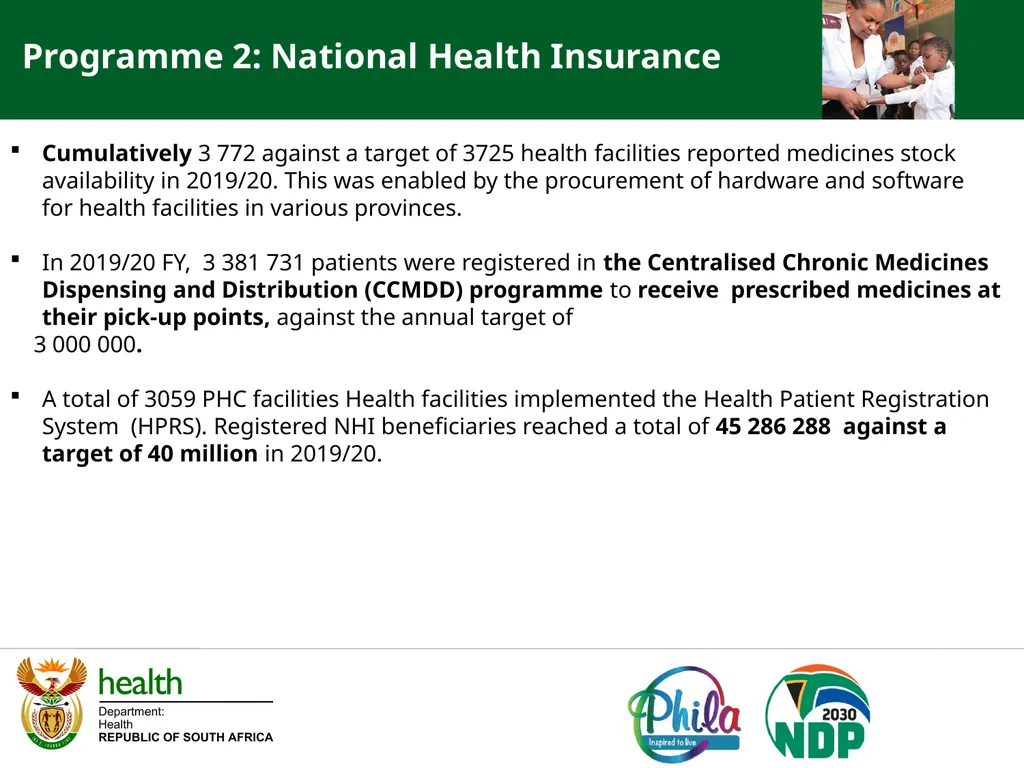
Cumulatively 3 772 against a target of 3725 health facilities reported medicines stock availability in 2019/20. This was enabled by the procurement of hardware and software for health facilities in various provinces.
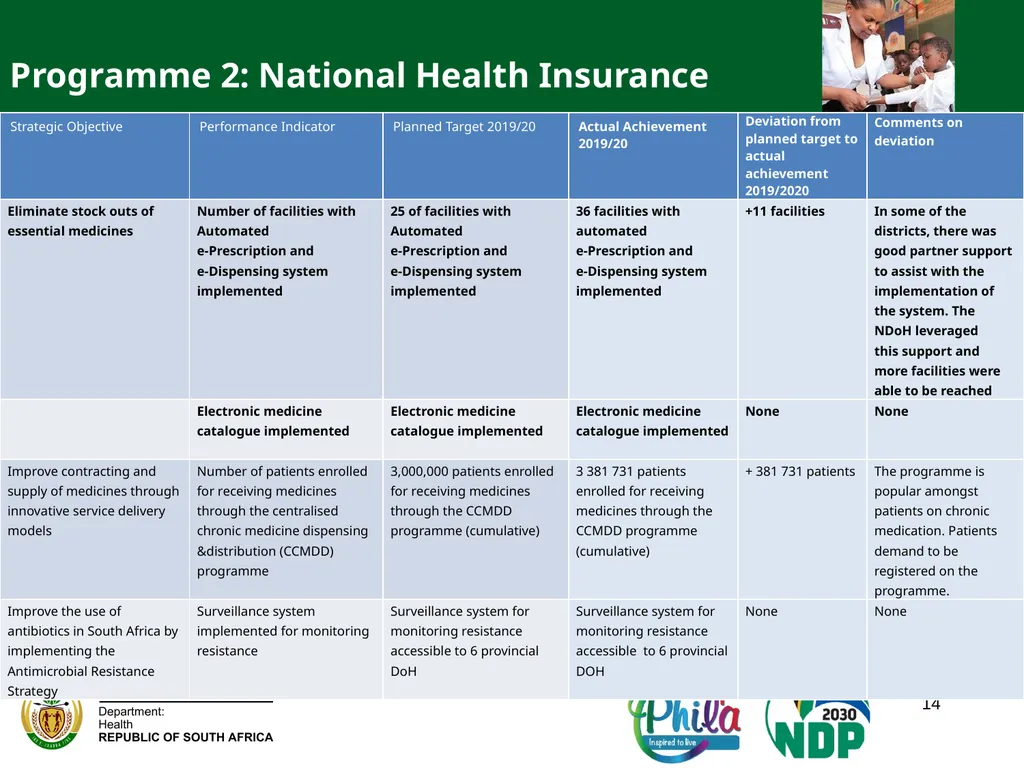
In 2019/20 FY, 3 381 731 patients were registered in the Centralised Chronic Medicines Dispensing and Distribution (CCMDD) programme to receive prescribed medicines at their pick-up points, against the annual target of
3 000 000.
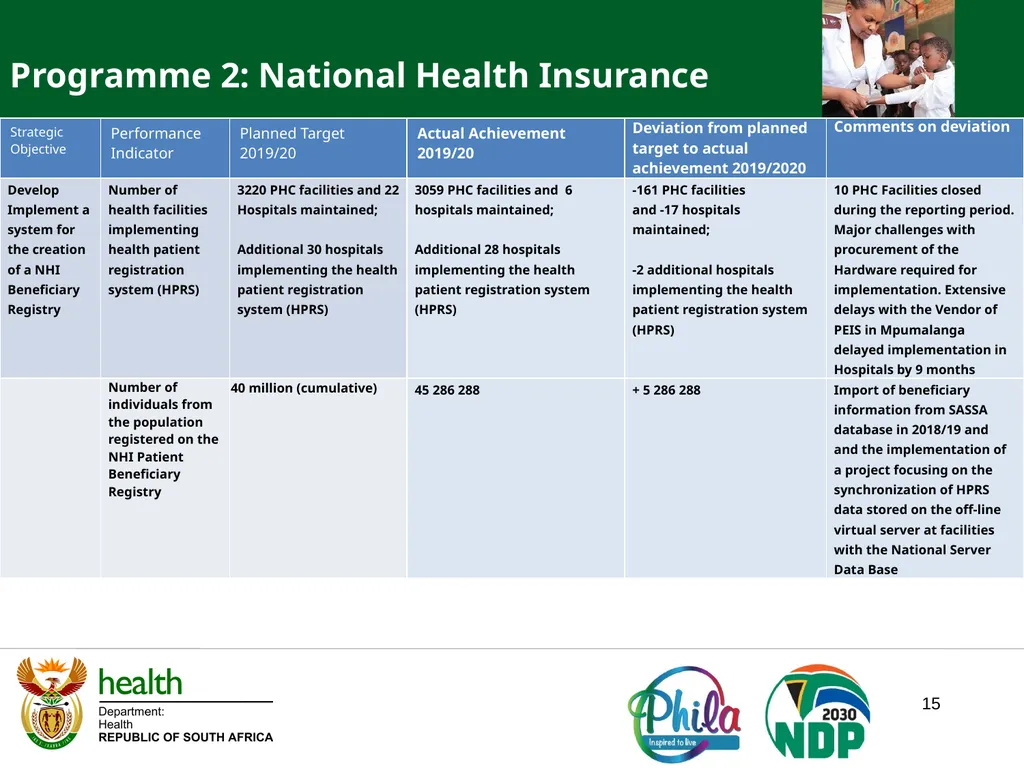
A total of 3059 PHC facilities Health facilities implemented the Health Patient Registration System (HPRS). Registered NHI beneficiaries reached a total of 45 286 288 against a target of 40 million in 2019/20. Programme 2: National Health Insurance<br>
In 2019/20 FY, 3 381 731 patients were registered in the Centralised Chronic Medicines Dispensing and Distribution (CCMDD) programme to receive prescribed medicines at their pick-up points, against the annual target of
3 000 000.
A total of 3059 PHC facilities Health facilities implemented the Health Patient Registration System (HPRS). Registered NHI beneficiaries reached a total of 45 286 288 against a target of 40 million in 2019/20. Programme 2: National Health Insurance<br>
12
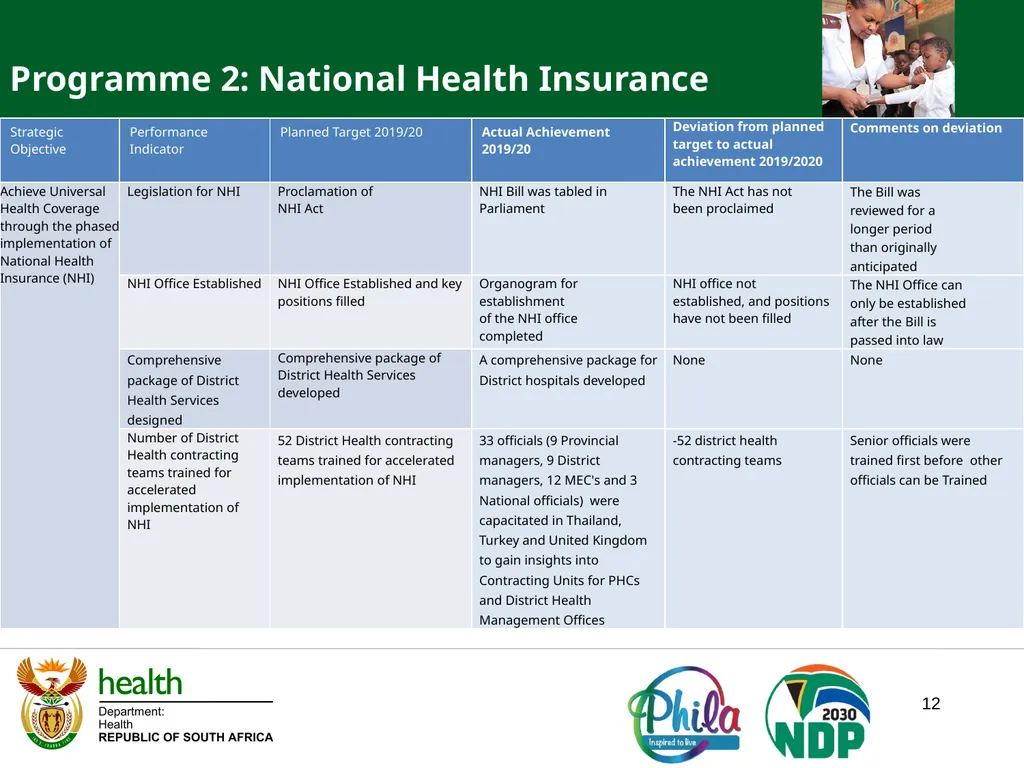
12 Programme 2: National Health Insurance<br>
13
13 Programme 2: National Health Insurance<br>
14
14 Programme 2: National Health Insurance<br>
15
15 Programme 2: National Health Insurance<br>
16
The NDoH will attend the 2020/21 public hearings on NHI Bill that will be arranged by the respective committees of Parliament.
A proposed organogram of the NDoH including NHI Office was prepared and submitted to DPSA during 2019/20 financial year. Discussions on filling of posts for the NHI Office will continue between Health and DPSA during the 2020/21 financial year.
Local training of district teams on NHI will resume once COVID-19 has subsided. Programme 2: Performance Improvement Strategies<br>
A proposed organogram of the NDoH including NHI Office was prepared and submitted to DPSA during 2019/20 financial year. Discussions on filling of posts for the NHI Office will continue between Health and DPSA during the 2020/21 financial year.
Local training of district teams on NHI will resume once COVID-19 has subsided. Programme 2: Performance Improvement Strategies<br>
17
17 Progress Report PROGRAMME 3: COMMUNICABLE AND NON-COMMUNICABLE DISEASES<br>
18
The backlogs of radiation oncology were reduced through the strategic purchasing of services from private healthcare providers.
29 184 CHWs were retrained in the revised scope of work against the annual target of 20 000. This was facilitated by the PEPFAR District Support Partners ivolvement in the training of CHWs in the provinces Programme 3: Communicable and Non-Communicable Diseases<br>
29 184 CHWs were retrained in the revised scope of work against the annual target of 20 000. This was facilitated by the PEPFAR District Support Partners ivolvement in the training of CHWs in the provinces Programme 3: Communicable and Non-Communicable Diseases<br>
19
Programme 3: Communicable and Non-Communicable Diseases 19<br>
20
Programme 3: Communicable and Non-Communicable Diseases 20<br>
21
Programme 3: Communicable and Non-Communicable Diseases 21<br>
22
Programme 3: Communicable and Non-Communicable Diseases 22<br>
23
Programme 3: Communicable and Non-Communicable Diseases 23<br>
24
Programme 3: Communicable and Non-Communicable Diseases 24<br>
25
The service provider submitted the final report of the immunisation coverage survey in June 2020.
With regard to MMC, the RT 35 Transversal Contract was expanded in the 27 PEPFAR-supported districts for the 10-14 years age group.
The number of service providers for RT 35 Transversal Contract in the 27 non-PEPFAR supported districts was increased from 3 to 12 to ensure sufficient capacity; and surgical aid was introduced to ensure mass circumcisions and eliminate adverse events.
The contracting of health professionals on the NHI indirect Personal Grant for mental health services, including forensic mental health services, will be decentralised to the provincial Departments of Health Programme 3: Performance Improvement Strategies<br>
With regard to MMC, the RT 35 Transversal Contract was expanded in the 27 PEPFAR-supported districts for the 10-14 years age group.
The number of service providers for RT 35 Transversal Contract in the 27 non-PEPFAR supported districts was increased from 3 to 12 to ensure sufficient capacity; and surgical aid was introduced to ensure mass circumcisions and eliminate adverse events.
The contracting of health professionals on the NHI indirect Personal Grant for mental health services, including forensic mental health services, will be decentralised to the provincial Departments of Health Programme 3: Performance Improvement Strategies<br>
26
26 Progress Report PROGRAMME 4 : PRIMARY HEALTH CARE<br>
27
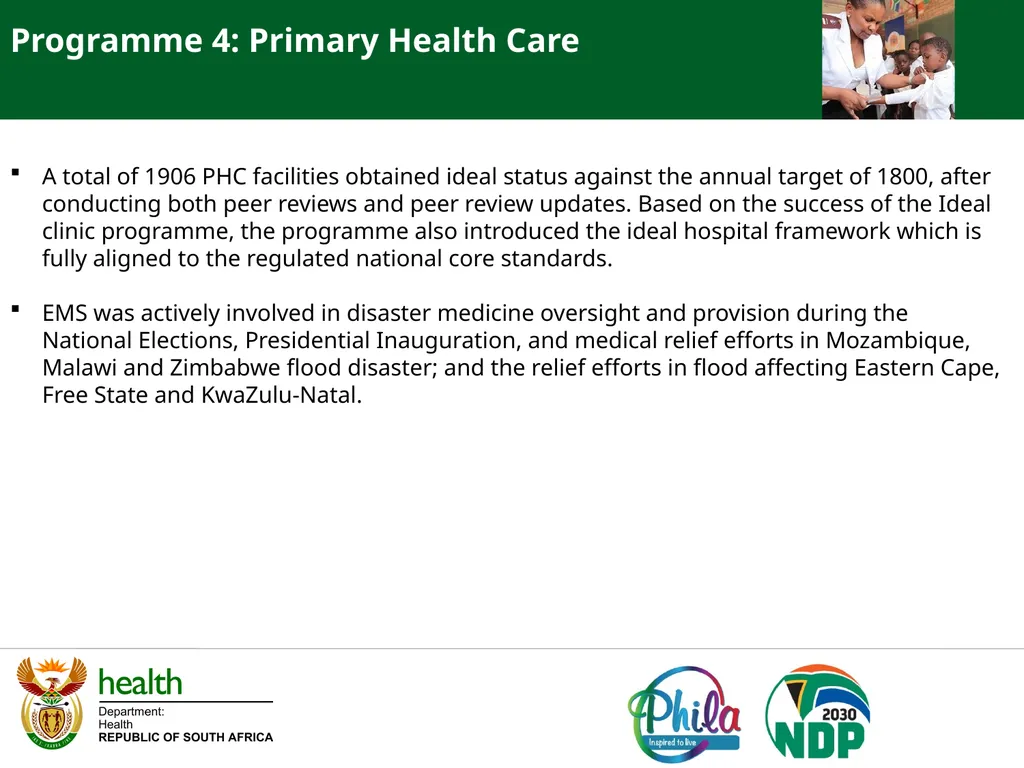
A total of 1906 PHC facilities obtained ideal status against the annual target of 1800, after conducting both peer reviews and peer review updates. Based on the success of the Ideal clinic programme, the programme also introduced the ideal hospital framework which is fully aligned to the regulated national core standards.
EMS was actively involved in disaster medicine oversight and provision during the National Elections, Presidential Inauguration, and medical relief efforts in Mozambique, Malawi and Zimbabwe flood disaster; and the relief efforts in flood affecting Eastern Cape, Free State and KwaZulu-Natal. Programme 4: Primary Health Care<br>
EMS was actively involved in disaster medicine oversight and provision during the National Elections, Presidential Inauguration, and medical relief efforts in Mozambique, Malawi and Zimbabwe flood disaster; and the relief efforts in flood affecting Eastern Cape, Free State and KwaZulu-Natal. Programme 4: Primary Health Care<br>
28
28 Programme 4: Primary Health Care<br>
29
29 Programme 4: Primary Health Care<br>
30
30 Programme 4: Primary Health Care<br>
31
31 Programme 4: Primary Health Care<br>
32
32 Programme 4: Primary Health Care<br>
33
33 Programme 4: Primary Health Care<br>
34
34 Programme 4: Primary Health Care<br>
35
Programme 4: Primary Health Care 35<br>
36
Programme 4
Performance Improvement Strategies The relevant sections of the National Health Act pertaining to DHMO will be amended once the NHI Bill has been enacted.
The work on PHC facility committees will be completed during 2020/21 financial year
The draft Traditional Health Practitioners Amendment Bill will be submitted to the State Law Advisers.
Closure of health facilities for renovation is necessary as certain structural renovation requires that day-to-day operations cease temporarily whilst renovation projects are ongoing. The compliance of those facilities will be assessed when the renovation projects have been completed.
The remaining Points of Entry will be assessed for compliance with IHR as part of future activities.
The revised PEC guideline will be tabled for the Tech NHC meeting for approval. Marketing strategy of Patient Satisfaction Assessment App will be improved within health establishments to improve utilization<br>
Performance Improvement Strategies The relevant sections of the National Health Act pertaining to DHMO will be amended once the NHI Bill has been enacted.
The work on PHC facility committees will be completed during 2020/21 financial year
The draft Traditional Health Practitioners Amendment Bill will be submitted to the State Law Advisers.
Closure of health facilities for renovation is necessary as certain structural renovation requires that day-to-day operations cease temporarily whilst renovation projects are ongoing. The compliance of those facilities will be assessed when the renovation projects have been completed.
The remaining Points of Entry will be assessed for compliance with IHR as part of future activities.
The revised PEC guideline will be tabled for the Tech NHC meeting for approval. Marketing strategy of Patient Satisfaction Assessment App will be improved within health establishments to improve utilization<br>
37
37 Progress Report PROGRAMME 5 : HOSPITAL SYSTEMS<br>
38
Programme 5: Hospitals Systems The emergency maintenance works were completed at four hospitals in the province of North West, namely, Zeerust Hospital, Klerksdorp Hospital and Mafikeng Provincial Hospital as well as at Dihlabeng Hospital in the province of the Free State.
Maintenance work was also completed at 39 facilities, most of which were PHC clinics. Projects were started for the procurement of new clinics in Mpumalanga, as well as upgrading theatres and HVAC systems in 25 hospitals. Of the 25 hospitals, 22 are in the North West, two (2) in Gauteng and one (1) in the Limpopo Province.
Additional staff was appointed to the Project Management Office to assist with all infrastructure projects.<br>
Maintenance work was also completed at 39 facilities, most of which were PHC clinics. Projects were started for the procurement of new clinics in Mpumalanga, as well as upgrading theatres and HVAC systems in 25 hospitals. Of the 25 hospitals, 22 are in the North West, two (2) in Gauteng and one (1) in the Limpopo Province.
Additional staff was appointed to the Project Management Office to assist with all infrastructure projects.<br>
39
Programme 5: Hospitals Systems 39<br>
40
Programme 5: Hospitals Systems 40<br>
41
Programme 5: Hospitals Systems 41<br>
42
Programme 5:
Performance Improvement Strategies The revised draft guidelines for central hospitals will be re-submitted to Tech NHC in 2020/21 financial year, after which the implementation plan will be finalised and costed.
All provincial Departments of Health have agreed to monitor and report on the ideal hospital status determination as part of the routinely reported information that will be implemented from 2020/21 financial year.
Revised construction programme for the health infrastructure projects will be closely monitored and progress will be reported in the 2020/21 financial year.
The Practical Completion date for Dr Pixley Ka Seme Hospital in the KZN was extended to 2020/21.<br>
Performance Improvement Strategies The revised draft guidelines for central hospitals will be re-submitted to Tech NHC in 2020/21 financial year, after which the implementation plan will be finalised and costed.
All provincial Departments of Health have agreed to monitor and report on the ideal hospital status determination as part of the routinely reported information that will be implemented from 2020/21 financial year.
Revised construction programme for the health infrastructure projects will be closely monitored and progress will be reported in the 2020/21 financial year.
The Practical Completion date for Dr Pixley Ka Seme Hospital in the KZN was extended to 2020/21.<br>
43
43 Progress Report PROGRAMME 6: HEALTH SYSTEM GOVERNANCE AND HUMAN RESOURCES<br>
44
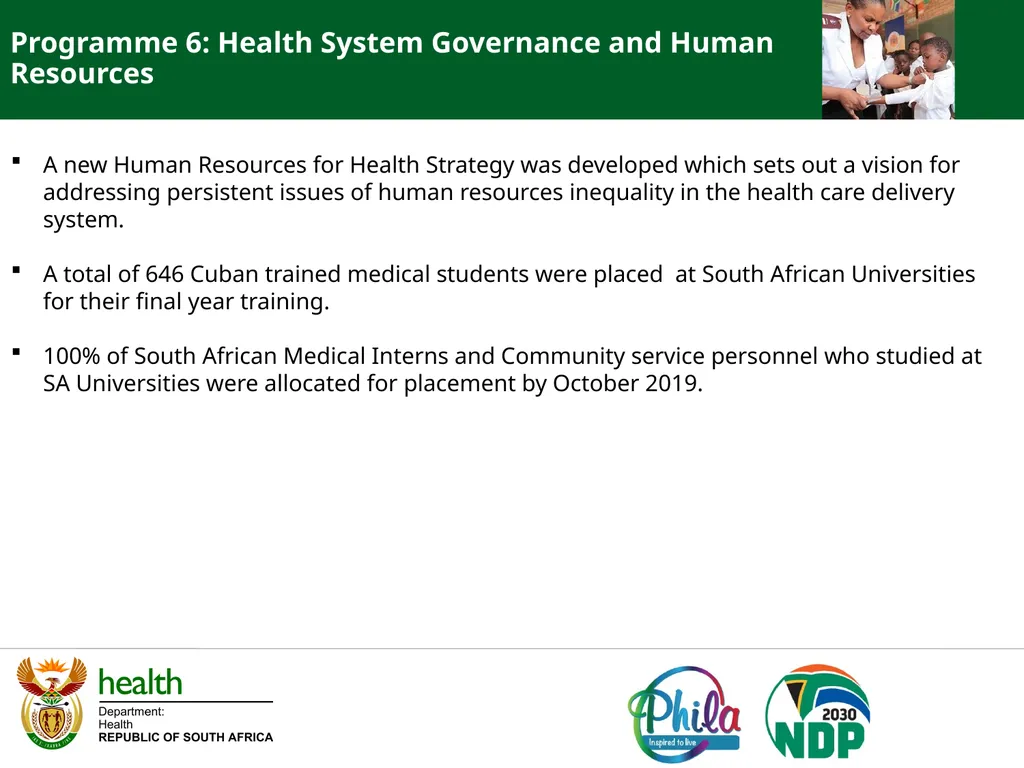
A new Human Resources for Health Strategy was developed which sets out a vision for addressing persistent issues of human resources inequality in the health care delivery system.
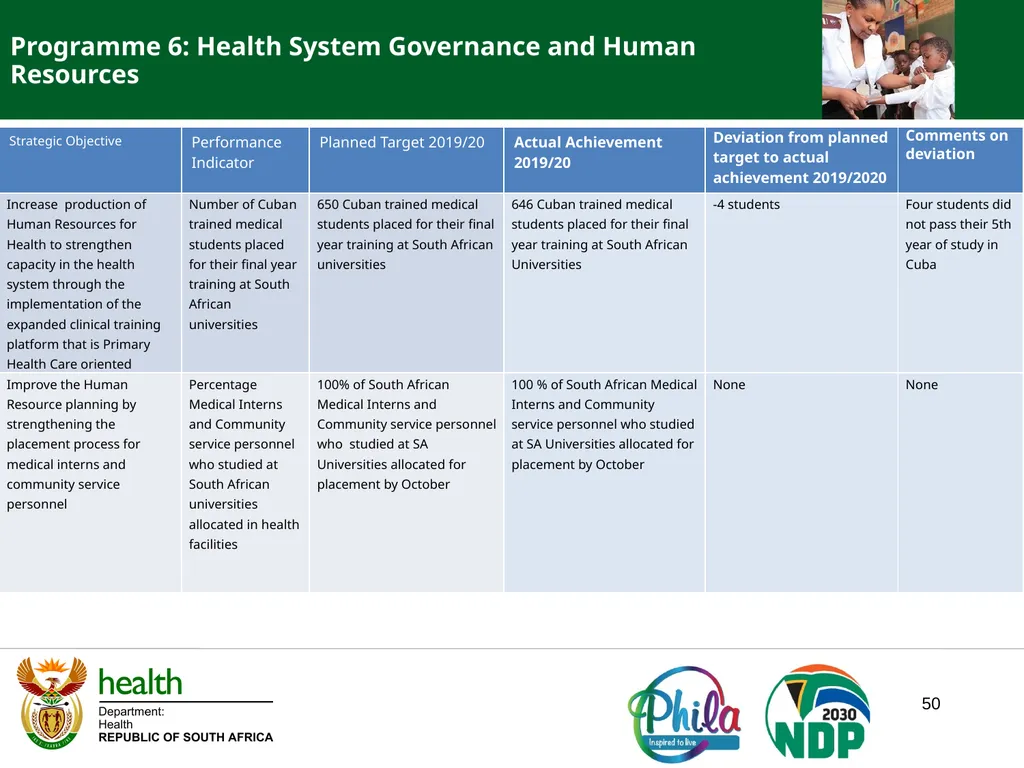
A total of 646 Cuban trained medical students were placed at South African Universities for their final year training.
100% of South African Medical Interns and Community service personnel who studied at SA Universities were allocated for placement by October 2019. Programme 6: Health System Governance and Human Resources<br>
A total of 646 Cuban trained medical students were placed at South African Universities for their final year training.
100% of South African Medical Interns and Community service personnel who studied at SA Universities were allocated for placement by October 2019. Programme 6: Health System Governance and Human Resources<br>
45
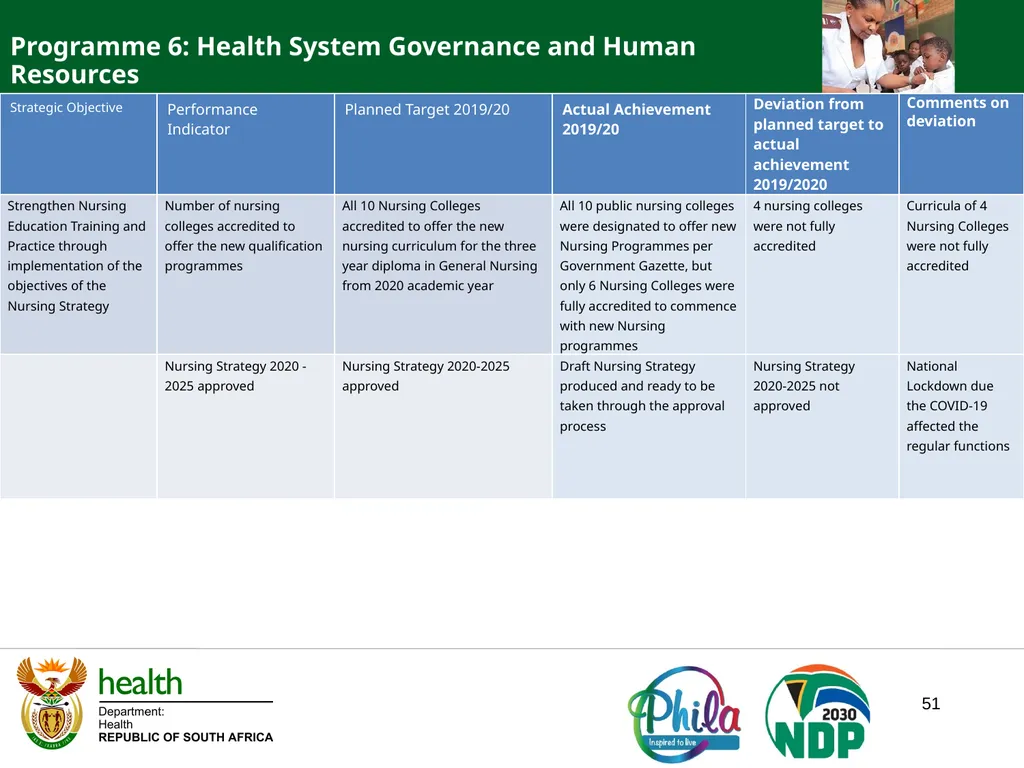
A collaborative approach for the accreditation process has been established by both South African Nursing Council (SANC) and Council for Higher Education (CHE), thus streamlining the accreditation process for higher education programmes leading to professional registration.
Guidelines for Nursing Clinical Education and Training Units in South Africa were also developed to assist clinical facilities that have complied with the requirements to offer new nursing programmes
All public colleges have also been re–organised into a single college per province with multi-campuses in districts or sub-districts. This has enabled provinces to better respond to broad range of national requirements, while improving access to public nursing colleges by local communities. Programme 6: Health System Governance and Human Resources<br>
Guidelines for Nursing Clinical Education and Training Units in South Africa were also developed to assist clinical facilities that have complied with the requirements to offer new nursing programmes
All public colleges have also been re–organised into a single college per province with multi-campuses in districts or sub-districts. This has enabled provinces to better respond to broad range of national requirements, while improving access to public nursing colleges by local communities. Programme 6: Health System Governance and Human Resources<br>
46
46 Programme 6: Health System Governance and Human Resources<br>
47
47 Programme 6: Health System Governance and Human Resources<br>
48
48 Programme 6: Health System Governance and Human Resources<br>
49
49 Programme 6: Health System Governance and Human Resources<br>
50
50 Programme 6: Health System Governance and Human Resources<br>
51
51 Programme 6: Health System Governance and Human Resources<br>
52
52 Programme 6: Health System Governance and Human Resources<br>
53
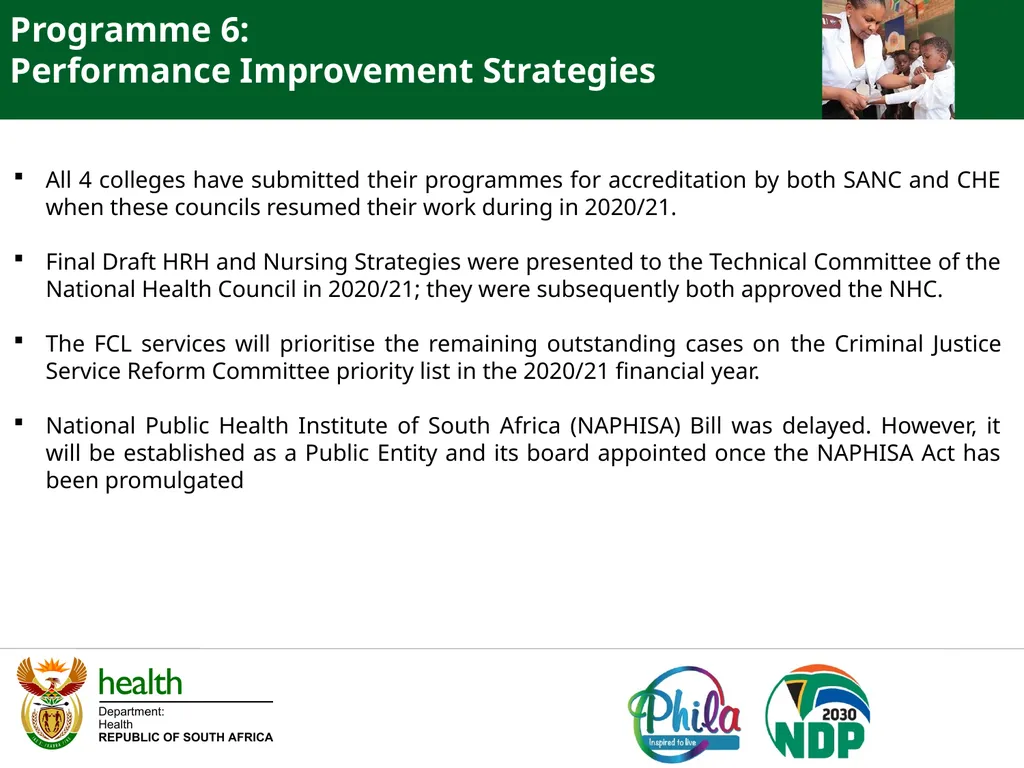
All 4 colleges have submitted their programmes for accreditation by both SANC and CHE when these councils resumed their work during in 2020/21.
Final Draft HRH and Nursing Strategies were presented to the Technical Committee of the National Health Council in 2020/21; they were subsequently both approved the NHC.
The FCL services will prioritise the remaining outstanding cases on the Criminal Justice Service Reform Committee priority list in the 2020/21 financial year.
National Public Health Institute of South Africa (NAPHISA) Bill was delayed. However, it will be established as a Public Entity and its board appointed once the NAPHISA Act has been promulgated Programme 6:
Performance Improvement Strategies<br>
Final Draft HRH and Nursing Strategies were presented to the Technical Committee of the National Health Council in 2020/21; they were subsequently both approved the NHC.
The FCL services will prioritise the remaining outstanding cases on the Criminal Justice Service Reform Committee priority list in the 2020/21 financial year.
National Public Health Institute of South Africa (NAPHISA) Bill was delayed. However, it will be established as a Public Entity and its board appointed once the NAPHISA Act has been promulgated Programme 6:
Performance Improvement Strategies<br>
54
Summary
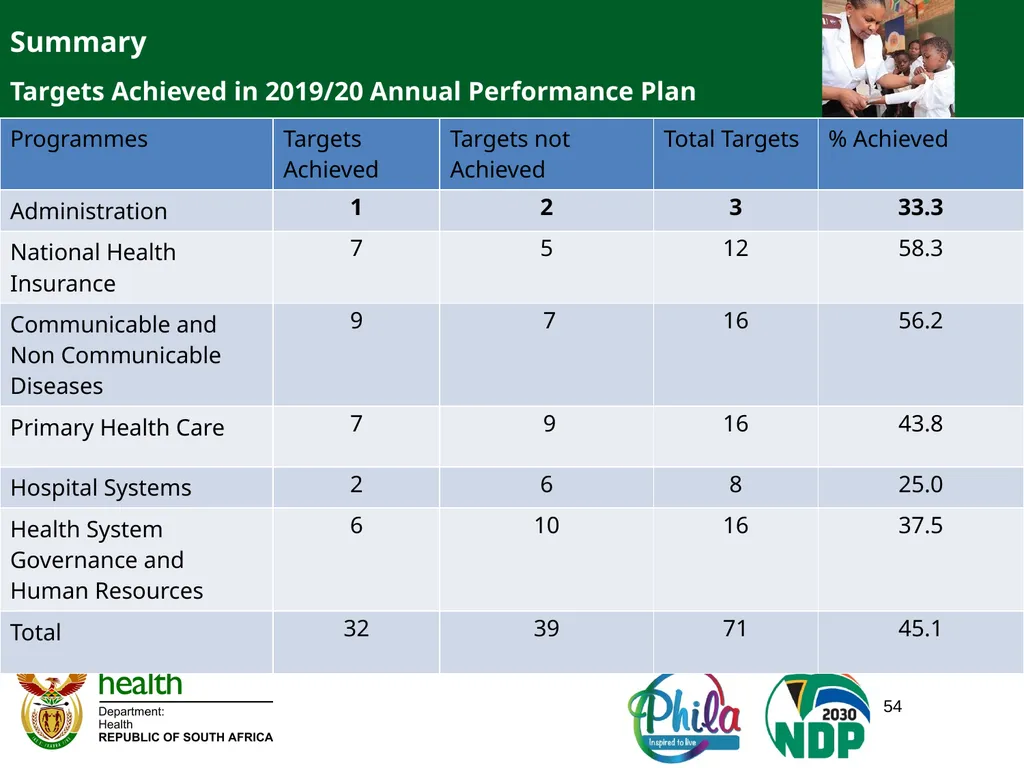
Targets Achieved in 2019/20 Annual Performance Plan 54<br>
Targets Achieved in 2019/20 Annual Performance Plan 54<br>
55
Human Resource (NDoH) 55<br>
56
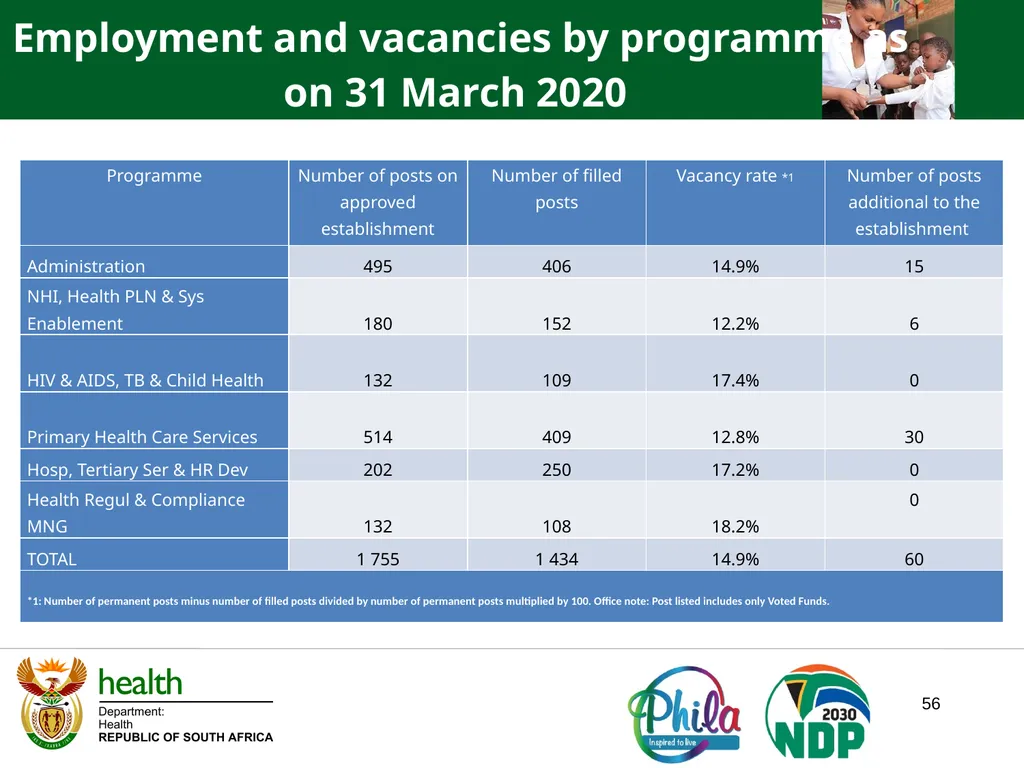
Employment and vacancies by programme as on 31 March 2020 56<br>
57
Financial Management 57<br>
58
58 Summary per Programme Expenditure as at 31 March 2020<br>
59
59 Summary per
Economic Classification Expenditure as at 31 March 2020<br>
Economic Classification Expenditure as at 31 March 2020<br>
60
60 Programme 1: Administration Expenditure as at 31 March 2020<br>
61
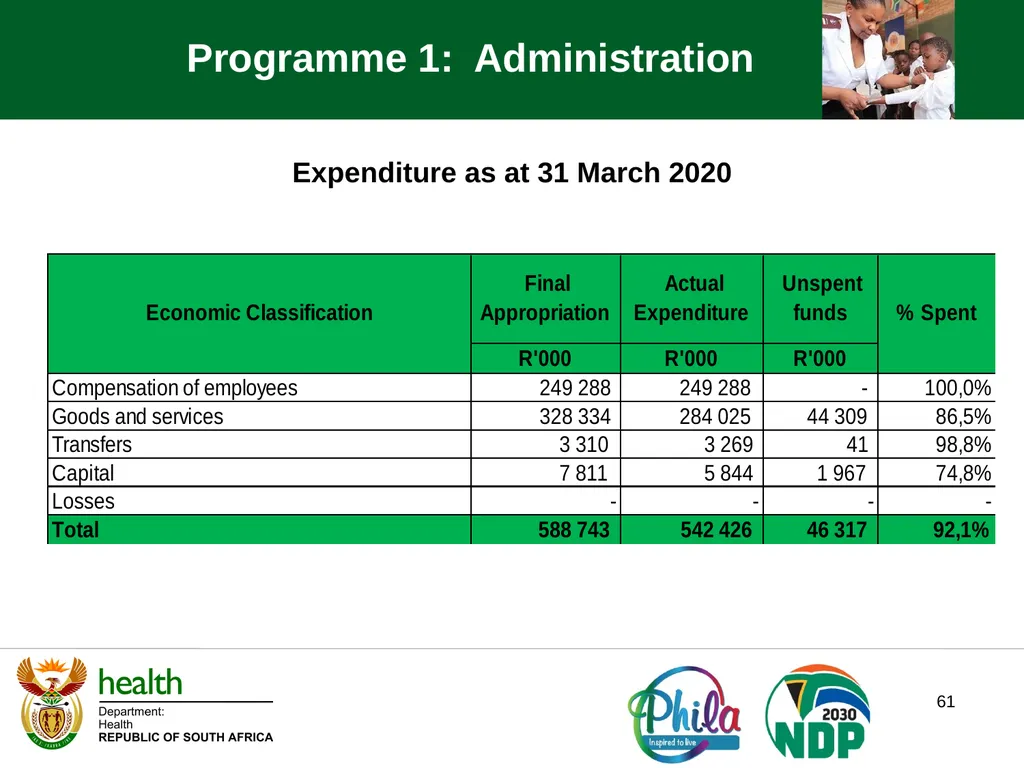
61 Programme 1: Administration Expenditure as at 31 March 2020<br>
62
62 Programme 1: Administration Reasons for deviations Goods & ServicesProgramme 1: Administration
Saving on annual membership fees due to rand/dollar exchange rate.
The last quarter's DIRCO accounts not received for payment timeously.
Microsoft licences and Medico Legal invoices could not be paid before year end.
Fewer consumables are procured than planned.
Disputed Property payments invoices and fourth quarter’s leases were not paid.
Purchase of Capital Assets
Upgrading of Security Systems of Civitas Building has been cancelled because of the possible relocating from Civitas Building.<br>
Saving on annual membership fees due to rand/dollar exchange rate.
The last quarter's DIRCO accounts not received for payment timeously.
Microsoft licences and Medico Legal invoices could not be paid before year end.
Fewer consumables are procured than planned.
Disputed Property payments invoices and fourth quarter’s leases were not paid.
Purchase of Capital Assets
Upgrading of Security Systems of Civitas Building has been cancelled because of the possible relocating from Civitas Building.<br>
63
63 Programme 2: National Health Insurance Expenditure as at 31 March 2020<br>
64
64 Programme 2: National Health Insurance Expenditure as at 31 March 2020<br>
65
65 Programme 2: National Health Insurance Reasons for deviations Compensation of Employees:
Vacant posts not filled.
Goods & ServicesProgramme 1: Administration
GP Contracting Capitation model could not be implemented during the financial year due to challenges experienced with the re-imbursement model.
Implementation of the new Warehouse Management System is in process; however there were challenges experienced with bidders which were resolved in latter half of 2019/20. Fifty percent of the project was finalized but paid in April 2020. The remaining portion could not be achieved because two provinces which were to be trained in March 2020 could not be visited due to COVID-19 travel restrictions.
Purchase of Capital Assets
The implementation of the National Surveillance Centre is put on hold, pending the relocation from the Civitas building.<br>
Vacant posts not filled.
Goods & ServicesProgramme 1: Administration
GP Contracting Capitation model could not be implemented during the financial year due to challenges experienced with the re-imbursement model.
Implementation of the new Warehouse Management System is in process; however there were challenges experienced with bidders which were resolved in latter half of 2019/20. Fifty percent of the project was finalized but paid in April 2020. The remaining portion could not be achieved because two provinces which were to be trained in March 2020 could not be visited due to COVID-19 travel restrictions.
Purchase of Capital Assets
The implementation of the National Surveillance Centre is put on hold, pending the relocation from the Civitas building.<br>
66
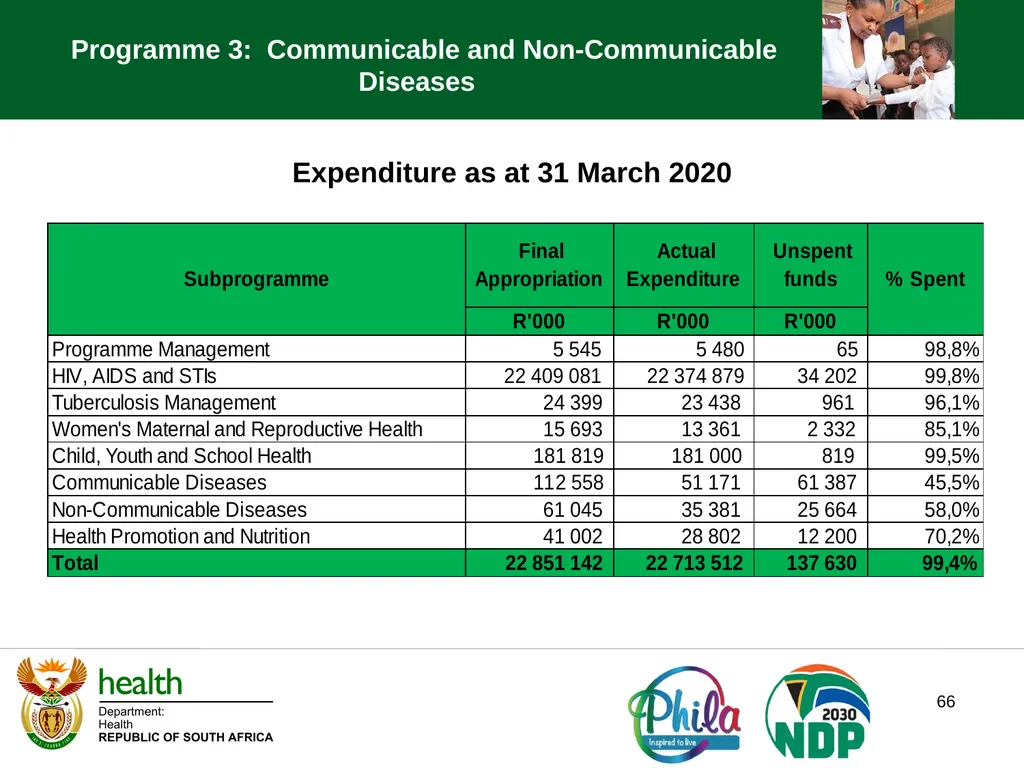
66 Programme 3: Communicable and Non-Communicable Diseases Expenditure as at 31 March 2020<br>
67
67 Programme 3: Communicable and Non-Communicable Diseases Expenditure as at 31 March 2020<br>
68
68 Programme 3: Communicable and Non-Communicable Diseases Reasons for deviations Compensation of Employees:
Vacant posts not filled.
Goods & ServicesPro
Service provider for health communication campaigns appointed, but invoices paid in 2020/21.
Invoices for condoms received late in 2019/20 could only be processed in 2020/21.
Annual TB day cancelled due to COVID-19.
Transfers & Subsidies
Some NGO's did not apply for funding.
Purchase of Capital Assets
Medical equipment needed for COVID-19 was neither received nor paid before year-end.
administration<br>
Vacant posts not filled.
Goods & ServicesPro
Service provider for health communication campaigns appointed, but invoices paid in 2020/21.
Invoices for condoms received late in 2019/20 could only be processed in 2020/21.
Annual TB day cancelled due to COVID-19.
Transfers & Subsidies
Some NGO's did not apply for funding.
Purchase of Capital Assets
Medical equipment needed for COVID-19 was neither received nor paid before year-end.
administration<br>
69
69 Programme 4: Primary Health Care Expenditure as at 31 March 2020<br>
70
70 Programme 4: Primary Health Care Expenditure as at 31 March 2020<br>
71
71 Programme 5: Hospital Systems Expenditure as at 31 March 2020<br>
72
72 Programme 5: Hospital Systems Expenditure as at 31 March 2020<br>
73
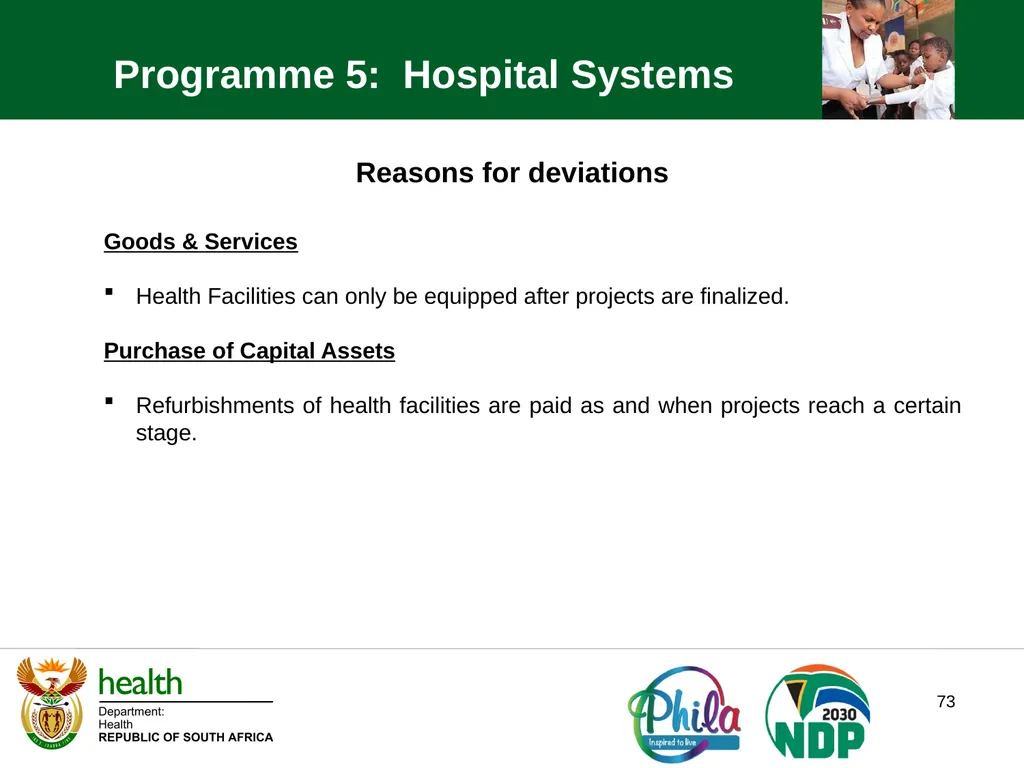
73 Programme 5: Hospital Systems Reasons for deviations Goods & Services
Health Facilities can only be equipped after projects are finalized.
Purchase of Capital Assets
Refurbishments of health facilities are paid as and when projects reach a certain stage.<br>
Health Facilities can only be equipped after projects are finalized.
Purchase of Capital Assets
Refurbishments of health facilities are paid as and when projects reach a certain stage.<br>
74
74 Programme 6: Health System Governance and Human Resources Expenditure as at 31 March 2020<br>
75
75 Programme 6: Health System Governance and Human Resources Expenditure as at 31 March 2020<br>
76
76 Programme 6: Health System Governance and Human Resources Reasons for deviations Compensation of Employees
Vacant posts not filled.
Goods & ServicesP
Underspending in Forensic Laboratories budget due to Durban Laboratory not having access to Logis and GroupWise due to cabling problems since September 2019. Spending delayed in other Laboratories due to problems experienced with the new procurement system between July 2019 and September 2019.
The Traditional Health Practitioners Council is not yet effective.
Purchase of Capital Assets
Tender processes are underway at the Forensic Laboratories for the procurement of Laboratory Equipment.
Refurbishments of health facilities are paid as and when projects reach a certain stage.
System problems prevented Forensic Chemistry Laboratories from procuring software.
ministration<br>
Vacant posts not filled.
Goods & ServicesP
Underspending in Forensic Laboratories budget due to Durban Laboratory not having access to Logis and GroupWise due to cabling problems since September 2019. Spending delayed in other Laboratories due to problems experienced with the new procurement system between July 2019 and September 2019.
The Traditional Health Practitioners Council is not yet effective.
Purchase of Capital Assets
Tender processes are underway at the Forensic Laboratories for the procurement of Laboratory Equipment.
Refurbishments of health facilities are paid as and when projects reach a certain stage.
System problems prevented Forensic Chemistry Laboratories from procuring software.
ministration<br>
77
Sector Conditional Grants<br>
78
78 [Direct Grants Overview] The Conditional Grants expenditure as at 31 March 2020
Total CG spending is at 98,7% or R45,7 bn against total adjusted
budget of R46.3 bn as compared to 97.9% or R 40,8 bn spent same
period last year which is slight under spending which is within
acceptable norm.
However, major contributors to under spending are:
HFRG spent 96,9% due to delays in project implementation.
NHI spent 90,5% due to delays in implementation of the business
plans
HPVG, HIVG, NTSG & HPTDG spent 99,9%, 99,2%, 98,8% and 99,1%
respectively and are within the acceptable norm.
HRCG spent 101,2% which is above the norm due to WC overspending
and awaiting finalization of year end procedures.<br>
Total CG spending is at 98,7% or R45,7 bn against total adjusted
budget of R46.3 bn as compared to 97.9% or R 40,8 bn spent same
period last year which is slight under spending which is within
acceptable norm.
However, major contributors to under spending are:
HFRG spent 96,9% due to delays in project implementation.
NHI spent 90,5% due to delays in implementation of the business
plans
HPVG, HIVG, NTSG & HPTDG spent 99,9%, 99,2%, 98,8% and 99,1%
respectively and are within the acceptable norm.
HRCG spent 101,2% which is above the norm due to WC overspending
and awaiting finalization of year end procedures.<br>
79
79 [DIRECT GRANTS SUMMARY]<br>
80
80 [DIRECT GRANTS PER PROVINCE]<br>
81
81 [Indirect Grant Overview] The Indirect Conditional Grants exp. as at 31 March 2020
Total CG spending is at 89,5% or R1,4 bn against total adjusted
budget of R1,5 bn which is below the acceptable norm.
However, major contributors to under spending are:
Personal Services Component (GP Contr: Capitation) – the model was not implemented during the year due to lack of capacity for reimbursement of the health practitioners.
Non-Personal Services Component
CCMDD – delays in submission of invoices by service providers
Information systems & Ideal Clinic – expiry of contract for equipment however deviation was obtained later in quarter four and supplier could not deliver within financial year.<br>
Total CG spending is at 89,5% or R1,4 bn against total adjusted
budget of R1,5 bn which is below the acceptable norm.
However, major contributors to under spending are:
Personal Services Component (GP Contr: Capitation) – the model was not implemented during the year due to lack of capacity for reimbursement of the health practitioners.
Non-Personal Services Component
CCMDD – delays in submission of invoices by service providers
Information systems & Ideal Clinic – expiry of contract for equipment however deviation was obtained later in quarter four and supplier could not deliver within financial year.<br>
82
82 [NATIONAL HEALTH INSURANCE INDIRECT GRANT]<br>
83
83 [NATIONAL TERTIARY SERVICES GRANT (01)]<br>
84
84 [NATIONAL TERTIARY SERVICES GRANT (02)] The spending is 98,8% and has improved from 96,7% spent in 2018/19 and is within the acceptable norm.
All provinces spent within the acceptable norm with the exception of GP & NW that underspent.
The underspending is attributable to delays in procurement processes which resulted in delays in supplier delivery and payment of equipment.
RA – Rollover requests made for EC, GP & NW and supported. Awaiting approval.<br>
All provinces spent within the acceptable norm with the exception of GP & NW that underspent.
The underspending is attributable to delays in procurement processes which resulted in delays in supplier delivery and payment of equipment.
RA – Rollover requests made for EC, GP & NW and supported. Awaiting approval.<br>
85
85 [HEALTH PROFESSIONS TRAINING GRANT (01)]<br>
86
86 [HEALTH PROFESSIONS TRAINING GRANT (02)] The spending is 99,1% and has improved from 97,3% spent in 2018/19 and is within the acceptable norm.
All provinces spent within the acceptable norm with the exception of GP that underspent.
The underspending is attributable to delays in procurement of equipment.
RA – Rollover requests was made and supported. Awaiting approval.<br>
All provinces spent within the acceptable norm with the exception of GP that underspent.
The underspending is attributable to delays in procurement of equipment.
RA – Rollover requests was made and supported. Awaiting approval.<br>
87
87 [HIV, TB, COS & MALARIA GRANT (01)]<br>
88
88 [HIV, TB, COS & MALARIA GRANT (02)] The spending is 99,2% and has improved from 98,0% spent in 2018/19 and is within the acceptable norm.
All provinces spent within the acceptable norm with the exception of FS & GP that underspent.
The underspending is attributable to delays in procurement of 22 X-Ray machines for 24 hr clinics. Machines were delivered however the delays also related to installation (delays in room preparations). Poor performance of service providers for condoms and MMC contracts challenges.
RA – Rollover requests was made and supported. Awaiting approval.<br>
All provinces spent within the acceptable norm with the exception of FS & GP that underspent.
The underspending is attributable to delays in procurement of 22 X-Ray machines for 24 hr clinics. Machines were delivered however the delays also related to installation (delays in room preparations). Poor performance of service providers for condoms and MMC contracts challenges.
RA – Rollover requests was made and supported. Awaiting approval.<br>
89
89 [HEALTH FACILITY REVITALISATION GRANT (01)]<br>
90
90 [HEALTH FACILITY REVITALISATION GRANT (02)] The spending is 96,9% and has improved from 96,7% spent in 2018/19 and is within the acceptable norm.
All provinces spent within the acceptable norm with the exception of FS & NW that underspent.
The underspending is attributable to delays in procurement of health technology, slow progress by contractors. Most of new projects did not take off due to delays in approval of clinical briefs, legal issues on some of projects and some had to be put off. Poor performance of contractors/consultants – pending litigations. Vacant positions not filled.
RA – Rollover requests was made and supported. Awaiting approval.<br>
All provinces spent within the acceptable norm with the exception of FS & NW that underspent.
The underspending is attributable to delays in procurement of health technology, slow progress by contractors. Most of new projects did not take off due to delays in approval of clinical briefs, legal issues on some of projects and some had to be put off. Poor performance of contractors/consultants – pending litigations. Vacant positions not filled.
RA – Rollover requests was made and supported. Awaiting approval.<br>
91
91 [HUMAN PAPILLOMAVIRUS GRANT (01)]<br>
92
92 [HUMAN PAPILLOMAVIRUS GRANT (02)] The spending is 99,9% and has improved from 87,9% spent in 2018/19 and is within the acceptable norm.
All provinces spent within the acceptable norm<br>
All provinces spent within the acceptable norm<br>
93
93 [HUMAN RESOURCES CAPACITATION GRANT (01)]<br>
94
94 [HUMAN RESOURCES CAPACITATION GRANT (02)] The spending is 101,2% which is within the above the norm. This is the first year of the grant being direct grant as it was converted in-year.
All provinces spent within the acceptable norm with the exception of WC that overspent.
The overspending is attributable to additional interns allocated to WC in-year and were not fully funded.<br>
All provinces spent within the acceptable norm with the exception of WC that overspent.
The overspending is attributable to additional interns allocated to WC in-year and were not fully funded.<br>
95
95 [NATIONAL HEALTH INSURANCE GRANT (01)]<br>
96
96 [NATIONAL HEALTH INSURANCE GRANT (02)] The spending is 90,5% which is below the acceptable norm. This is the first year of the grant being direct grant as it was converted in-year.
All provinces spent within the acceptable norm with the exception of FS & KZN that grossly underspent.
The underspending is attributable to late contracting, method of payment change from BAS to Persal led to resignation of doctors due to delays in payment of claims.<br>
All provinces spent within the acceptable norm with the exception of FS & KZN that grossly underspent.
The underspending is attributable to late contracting, method of payment change from BAS to Persal led to resignation of doctors due to delays in payment of claims.<br>
97
Audit Outcome 2019/20<br>
98
98 NDoH Audit Outcome: 2011/12-2019/20 9th year consecutive unqualified audit opinion in the face of many audit risks as well as COVID19 and audit thereof, Civitas, Labour etc. during 2019/20<br>
99
FINANCIAL AUDIT OUTCOMES 2019/20 Emphasis of Matter
Restatement of corresponding figures on Commitments as a result of a change in the Modified Cash Standards
Paragraph on subsequent events to deal with the impact of Covid19 and the plans that the Department has put in place.
Other Matters
1. Material Misstatements were corrected to ensure an unqualified audit was achieved – related to the inclusion of Management Fees in the Capital Work in Progress<br>
Restatement of corresponding figures on Commitments as a result of a change in the Modified Cash Standards
Paragraph on subsequent events to deal with the impact of Covid19 and the plans that the Department has put in place.
Other Matters
1. Material Misstatements were corrected to ensure an unqualified audit was achieved – related to the inclusion of Management Fees in the Capital Work in Progress<br>
100
PERFORMANCE AUDIT No opinion is raised in the Audit report but only in Management Report
Shows huge improvement year on year
Two Programmes Unqualified and One Qualified (Forensic Chemistry Laboratories)<br>
Shows huge improvement year on year
Two Programmes Unqualified and One Qualified (Forensic Chemistry Laboratories)<br>
101
AUDIT IMPROVEMENT STRATEGY Clean Audit is within reach both Financial and Performance information
Notes within AFS will be analyzed and corrective action implemented e.g. Capital Commitments, Irregular Expenditure and Performance Indicators<br>
Notes within AFS will be analyzed and corrective action implemented e.g. Capital Commitments, Irregular Expenditure and Performance Indicators<br>
102
Thank You<br>