
Presented By: Dallas Hamilton, Wakeelah Adelegan,
TA
Published · 21 slides · 0 views

1 / 1

Description
Presented By: Dallas Hamilton, Wakeelah Adelegan, Morgan Quinnelly Mission Statement Denton County MHMR Center, my health my resources, seeks to enhance the quality of life for the individuals served and their family members. Denton
Related Topics
Share
Embed code
Download this presentation From Below
"Presented By: Dallas Hamilton, Wakeelah Adelegan," is the property of its rightful owner. Permission is granted to download and print the materials on this website for personal, non-commercial use only, and to display it on your personal computer provided you do not modify the materials and that you retain all copyright notices contained in the materials. By downloading content from our website, you accept the terms of this agreement.
Presentation Transcript
01
Presented By:
Dallas Hamilton, Wakeelah Adelegan, & Morgan Quinnelly<br>
Dallas Hamilton, Wakeelah Adelegan, & Morgan Quinnelly<br>
02
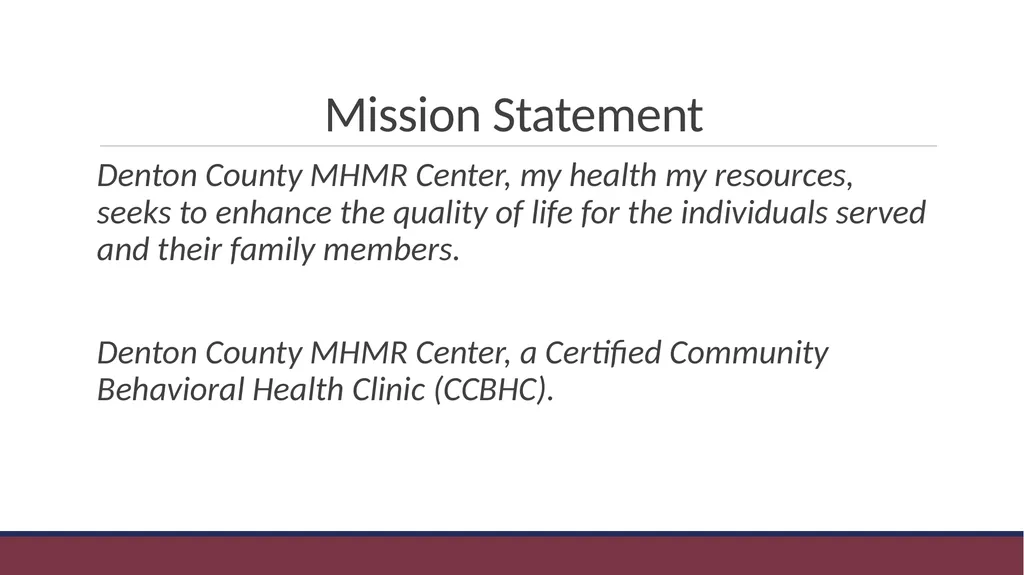
Mission Statement Denton County MHMR Center, my health my resources, seeks to enhance the quality of life for the individuals served and their family members.
Denton County MHMR Center, a Certified Community Behavioral Health Clinic (CCBHC).<br>
Denton County MHMR Center, a Certified Community Behavioral Health Clinic (CCBHC).<br>
03
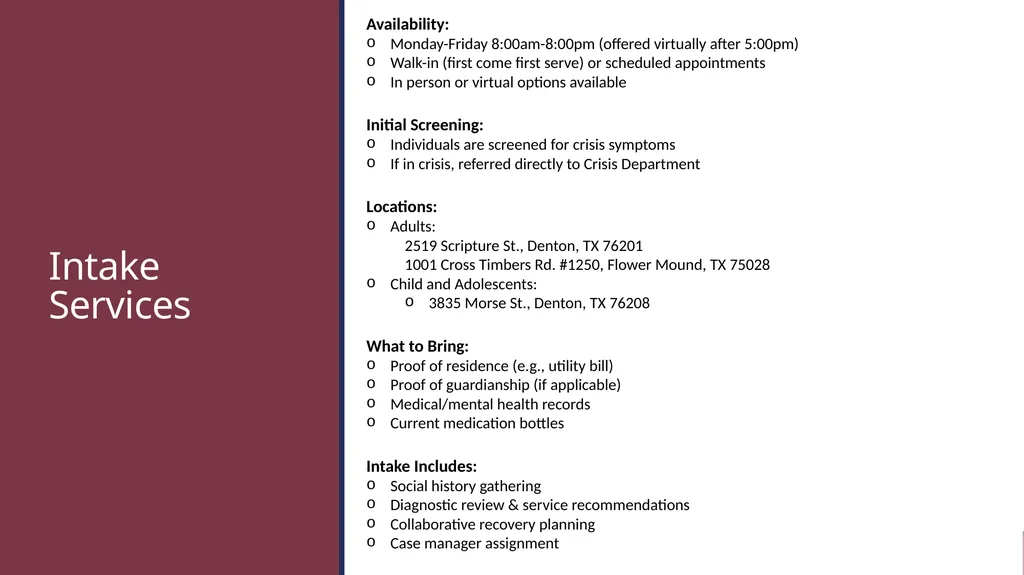
Intake Services Availability:
Monday-Friday 8:00am-8:00pm (offered virtually after 5:00pm)
Walk-in (first come first serve) or scheduled appointments
In person or virtual options available
Initial Screening:
Individuals are screened for crisis symptoms
If in crisis, referred directly to Crisis Department
Locations:
Adults:
2519 Scripture St., Denton, TX 76201
1001 Cross Timbers Rd. #1250, Flower Mound, TX 75028
Child and Adolescents:
3835 Morse St., Denton, TX 76208
What to Bring:
Proof of residence (e.g., utility bill)
Proof of guardianship (if applicable)
Medical/mental health records
Current medication bottles
Intake Includes:
Social history gathering
Diagnostic review & service recommendations
Collaborative recovery planning
Case manager assignment<br>
Monday-Friday 8:00am-8:00pm (offered virtually after 5:00pm)
Walk-in (first come first serve) or scheduled appointments
In person or virtual options available
Initial Screening:
Individuals are screened for crisis symptoms
If in crisis, referred directly to Crisis Department
Locations:
Adults:
2519 Scripture St., Denton, TX 76201
1001 Cross Timbers Rd. #1250, Flower Mound, TX 75028
Child and Adolescents:
3835 Morse St., Denton, TX 76208
What to Bring:
Proof of residence (e.g., utility bill)
Proof of guardianship (if applicable)
Medical/mental health records
Current medication bottles
Intake Includes:
Social history gathering
Diagnostic review & service recommendations
Collaborative recovery planning
Case manager assignment<br>
04
Core Services –
Adults & Children/
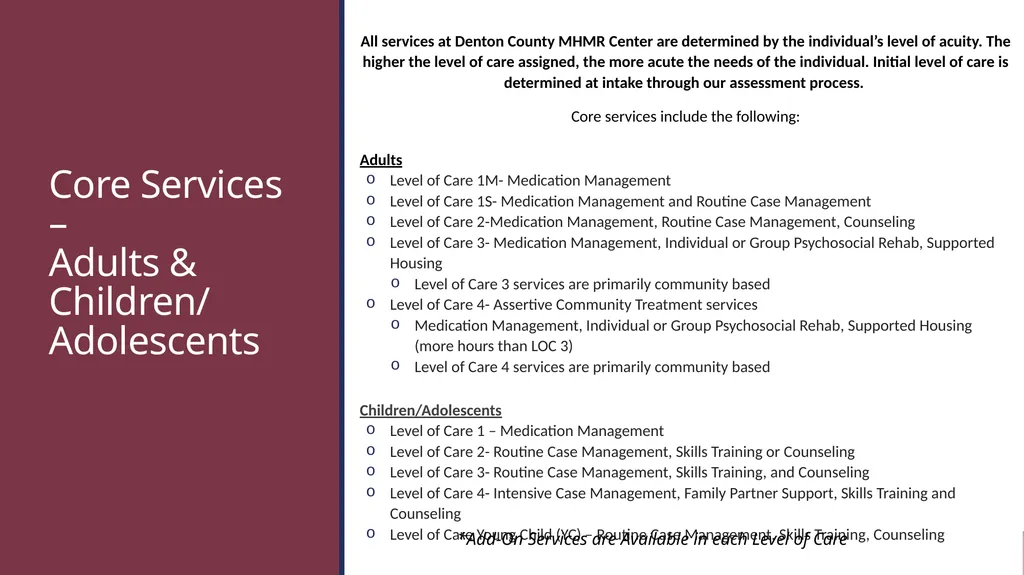
Adolescents All services at Denton County MHMR Center are determined by the individual’s level of acuity. The higher the level of care assigned, the more acute the needs of the individual. Initial level of care is determined at intake through our assessment process.
Core services include the following:
Adults
Level of Care 1M- Medication Management
Level of Care 1S- Medication Management and Routine Case Management
Level of Care 2-Medication Management, Routine Case Management, Counseling
Level of Care 3- Medication Management, Individual or Group Psychosocial Rehab, Supported Housing
Level of Care 3 services are primarily community based
Level of Care 4- Assertive Community Treatment services
Medication Management, Individual or Group Psychosocial Rehab, Supported Housing (more hours than LOC 3)
Level of Care 4 services are primarily community based
Children/Adolescents
Level of Care 1 – Medication Management
Level of Care 2- Routine Case Management, Skills Training or Counseling
Level of Care 3- Routine Case Management, Skills Training, and Counseling
Level of Care 4- Intensive Case Management, Family Partner Support, Skills Training and Counseling
Level of Care Young Child (YC) – Routine Case Management, Skills Training, Counseling *Add-On Services are Available in each Level of Care<br>
Core services include the following:
Adults
Level of Care 1M- Medication Management
Level of Care 1S- Medication Management and Routine Case Management
Level of Care 2-Medication Management, Routine Case Management, Counseling
Level of Care 3- Medication Management, Individual or Group Psychosocial Rehab, Supported Housing
Level of Care 3 services are primarily community based
Level of Care 4- Assertive Community Treatment services
Medication Management, Individual or Group Psychosocial Rehab, Supported Housing (more hours than LOC 3)
Level of Care 4 services are primarily community based
Children/Adolescents
Level of Care 1 – Medication Management
Level of Care 2- Routine Case Management, Skills Training or Counseling
Level of Care 3- Routine Case Management, Skills Training, and Counseling
Level of Care 4- Intensive Case Management, Family Partner Support, Skills Training and Counseling
Level of Care Young Child (YC) – Routine Case Management, Skills Training, Counseling *Add-On Services are Available in each Level of Care<br>
05
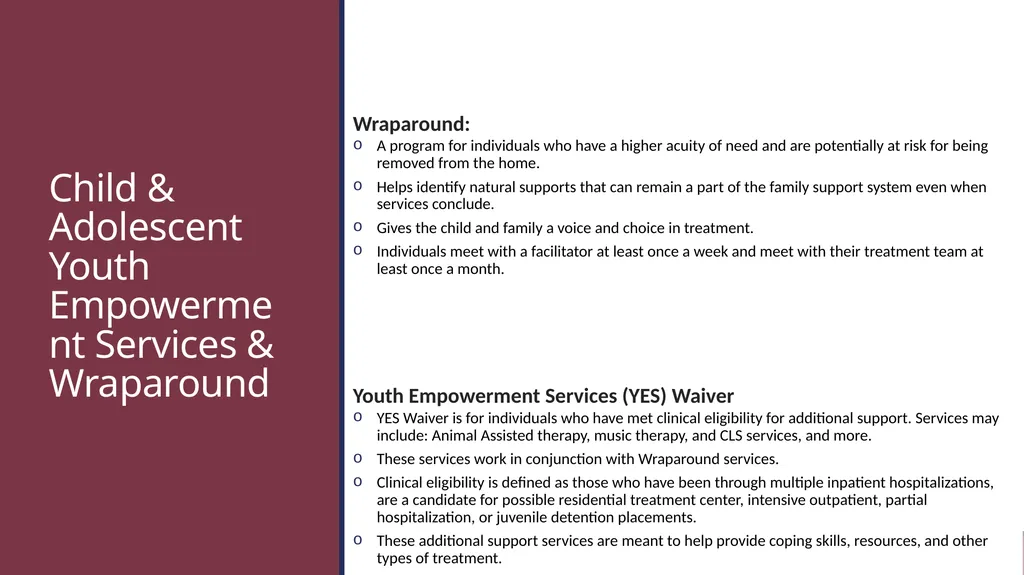
Child & Adolescent Youth Empowerment Services & Wraparound Wraparound:
A program for individuals who have a higher acuity of need and are potentially at risk for being removed from the home.
Helps identify natural supports that can remain a part of the family support system even when services conclude.
Gives the child and family a voice and choice in treatment.
Individuals meet with a facilitator at least once a week and meet with their treatment team at least once a month.
Youth Empowerment Services (YES) Waiver
YES Waiver is for individuals who have met clinical eligibility for additional support. Services may include: Animal Assisted therapy, music therapy, and CLS services, and more.
These services work in conjunction with Wraparound services.
Clinical eligibility is defined as those who have been through multiple inpatient hospitalizations, are a candidate for possible residential treatment center, intensive outpatient, partial hospitalization, or juvenile detention placements.
These additional support services are meant to help provide coping skills, resources, and other types of treatment.<br>
A program for individuals who have a higher acuity of need and are potentially at risk for being removed from the home.
Helps identify natural supports that can remain a part of the family support system even when services conclude.
Gives the child and family a voice and choice in treatment.
Individuals meet with a facilitator at least once a week and meet with their treatment team at least once a month.
Youth Empowerment Services (YES) Waiver
YES Waiver is for individuals who have met clinical eligibility for additional support. Services may include: Animal Assisted therapy, music therapy, and CLS services, and more.
These services work in conjunction with Wraparound services.
Clinical eligibility is defined as those who have been through multiple inpatient hospitalizations, are a candidate for possible residential treatment center, intensive outpatient, partial hospitalization, or juvenile detention placements.
These additional support services are meant to help provide coping skills, resources, and other types of treatment.<br>
06
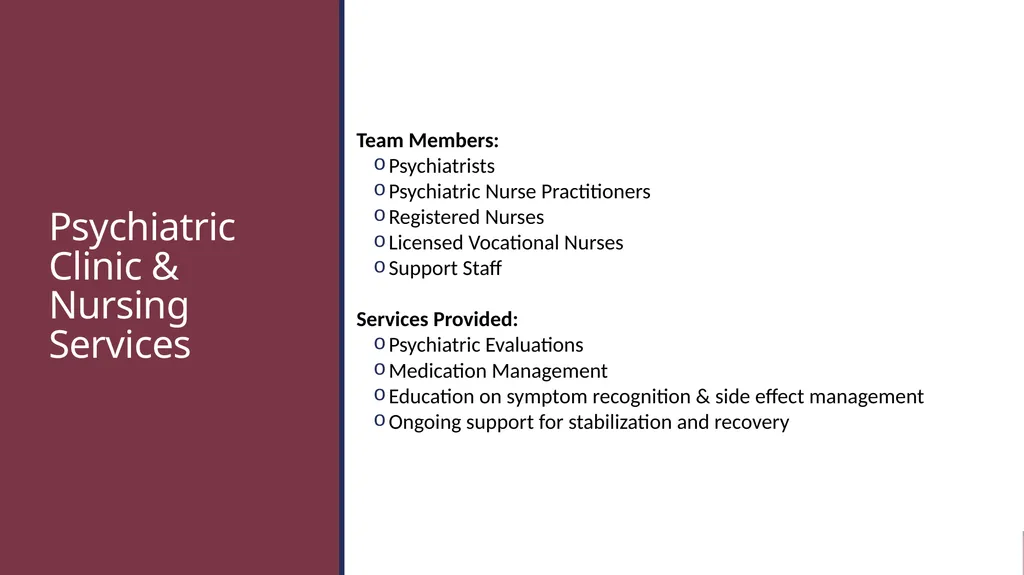
Psychiatric Clinic & Nursing Services Team Members:
Psychiatrists
Psychiatric Nurse Practitioners
Registered Nurses
Licensed Vocational Nurses
Support Staff
Services Provided:
Psychiatric Evaluations
Medication Management
Education on symptom recognition & side effect management
Ongoing support for stabilization and recovery<br>
Psychiatrists
Psychiatric Nurse Practitioners
Registered Nurses
Licensed Vocational Nurses
Support Staff
Services Provided:
Psychiatric Evaluations
Medication Management
Education on symptom recognition & side effect management
Ongoing support for stabilization and recovery<br>
07
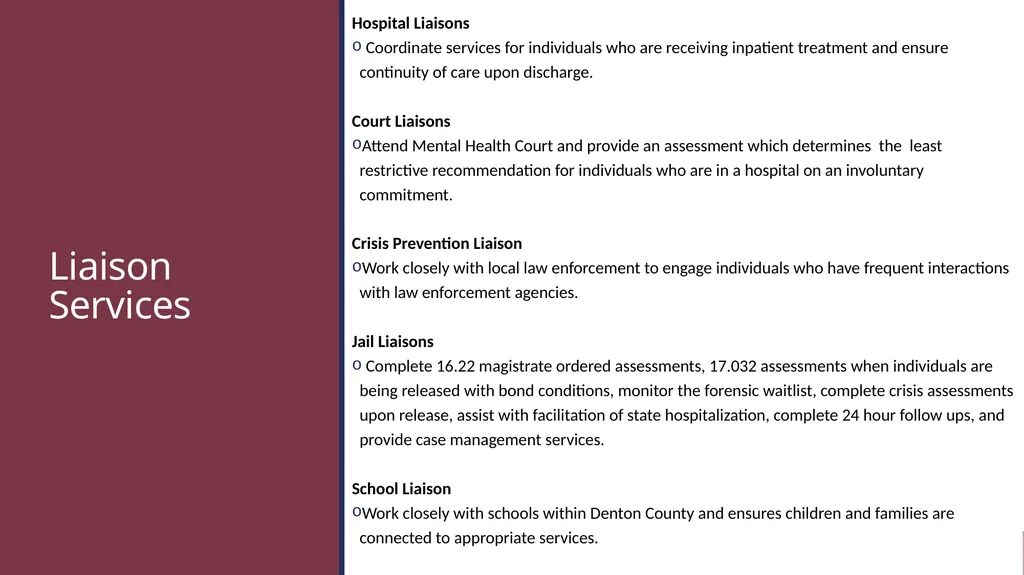
Liaison Services Hospital Liaisons
Coordinate services for individuals who are receiving inpatient treatment and ensure continuity of care upon discharge.
Court Liaisons
Attend Mental Health Court and provide an assessment which determines the least restrictive recommendation for individuals who are in a hospital on an involuntary commitment.
Crisis Prevention Liaison
Work closely with local law enforcement to engage individuals who have frequent interactions with law enforcement agencies.
Jail Liaisons
Complete 16.22 magistrate ordered assessments, 17.032 assessments when individuals are being released with bond conditions, monitor the forensic waitlist, complete crisis assessments upon release, assist with facilitation of state hospitalization, complete 24 hour follow ups, and provide case management services.
School Liaison
Work closely with schools within Denton County and ensures children and families are connected to appropriate services.<br>
Coordinate services for individuals who are receiving inpatient treatment and ensure continuity of care upon discharge.
Court Liaisons
Attend Mental Health Court and provide an assessment which determines the least restrictive recommendation for individuals who are in a hospital on an involuntary commitment.
Crisis Prevention Liaison
Work closely with local law enforcement to engage individuals who have frequent interactions with law enforcement agencies.
Jail Liaisons
Complete 16.22 magistrate ordered assessments, 17.032 assessments when individuals are being released with bond conditions, monitor the forensic waitlist, complete crisis assessments upon release, assist with facilitation of state hospitalization, complete 24 hour follow ups, and provide case management services.
School Liaison
Work closely with schools within Denton County and ensures children and families are connected to appropriate services.<br>
08
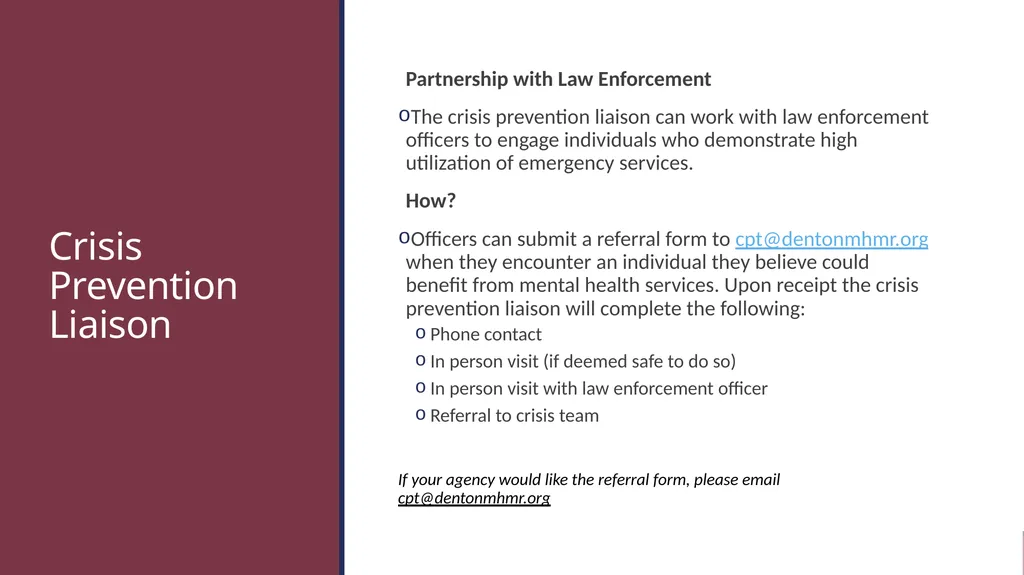
Crisis Prevention Liaison Partnership with Law Enforcement
The crisis prevention liaison can work with law enforcement officers to engage individuals who demonstrate high utilization of emergency services.
How?
Officers can submit a referral form to cpt@dentonmhmr.org when they encounter an individual they believe could benefit from mental health services. Upon receipt the crisis prevention liaison will complete the following:
Phone contact
In person visit (if deemed safe to do so)
In person visit with law enforcement officer
Referral to crisis team
If your agency would like the referral form, please email cpt@dentonmhmr.org<br>
The crisis prevention liaison can work with law enforcement officers to engage individuals who demonstrate high utilization of emergency services.
How?
Officers can submit a referral form to cpt@dentonmhmr.org when they encounter an individual they believe could benefit from mental health services. Upon receipt the crisis prevention liaison will complete the following:
Phone contact
In person visit (if deemed safe to do so)
In person visit with law enforcement officer
Referral to crisis team
If your agency would like the referral form, please email cpt@dentonmhmr.org<br>
09
Crisis Hotline The Crisis Hotline Number: 1-800-762-0157 or 988
The Hotline is available 24/7, 365 days per year.<br>
The Hotline is available 24/7, 365 days per year.<br>
10
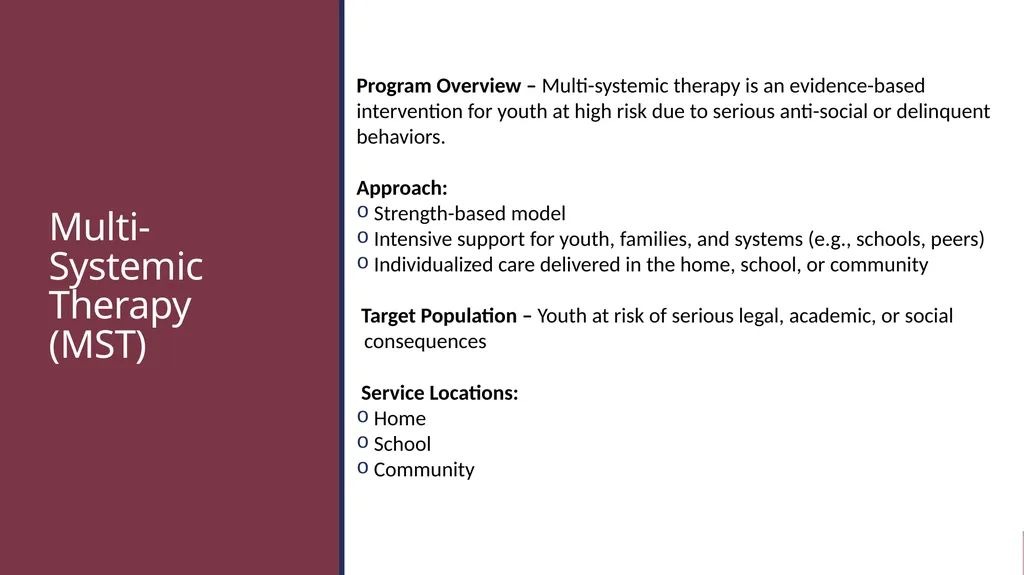
Multi-Systemic Therapy (MST) Program Overview – Multi-systemic therapy is an evidence-based intervention for youth at high risk due to serious anti-social or delinquent behaviors.
Approach:
Strength-based model
Intensive support for youth, families, and systems (e.g., schools, peers)
Individualized care delivered in the home, school, or community
Target Population – Youth at risk of serious legal, academic, or social consequences
Service Locations:
Home
School
Community<br>
Approach:
Strength-based model
Intensive support for youth, families, and systems (e.g., schools, peers)
Individualized care delivered in the home, school, or community
Target Population – Youth at risk of serious legal, academic, or social consequences
Service Locations:
Home
School
Community<br>
11
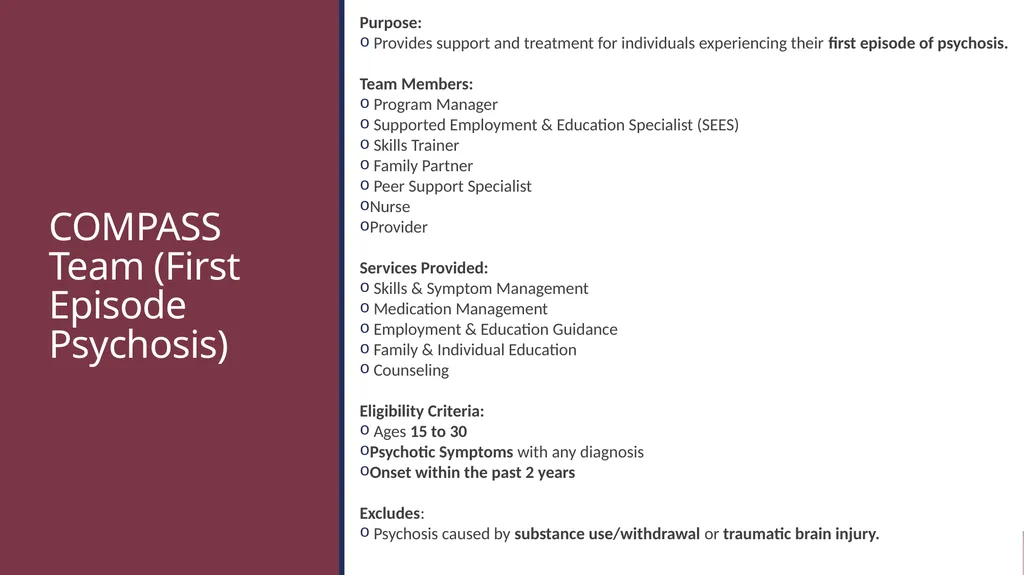
COMPASS Team (First Episode Psychosis) Purpose:
Provides support and treatment for individuals experiencing their first episode of psychosis.
Team Members:
Program Manager
Supported Employment & Education Specialist (SEES)
Skills Trainer
Family Partner
Peer Support Specialist
Nurse
Provider
Services Provided:
Skills & Symptom Management
Medication Management
Employment & Education Guidance
Family & Individual Education
Counseling
Eligibility Criteria:
Ages 15 to 30
Psychotic Symptoms with any diagnosis
Onset within the past 2 years
Excludes:
Psychosis caused by substance use/withdrawal or traumatic brain injury.<br>
Provides support and treatment for individuals experiencing their first episode of psychosis.
Team Members:
Program Manager
Supported Employment & Education Specialist (SEES)
Skills Trainer
Family Partner
Peer Support Specialist
Nurse
Provider
Services Provided:
Skills & Symptom Management
Medication Management
Employment & Education Guidance
Family & Individual Education
Counseling
Eligibility Criteria:
Ages 15 to 30
Psychotic Symptoms with any diagnosis
Onset within the past 2 years
Excludes:
Psychosis caused by substance use/withdrawal or traumatic brain injury.<br>
12
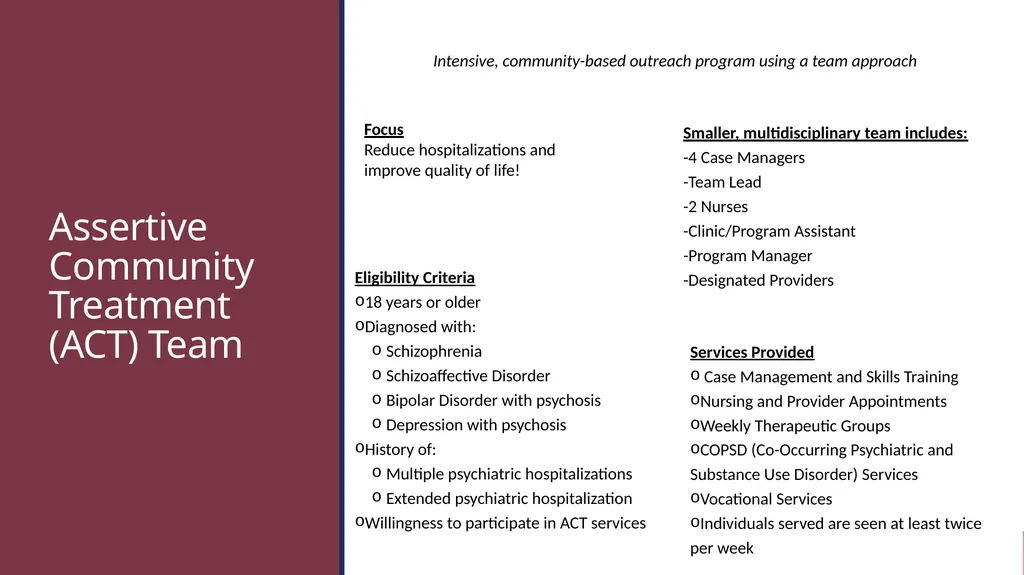
Assertive Community Treatment (ACT) Team Intensive, community-based outreach program using a team approach Smaller, multidisciplinary team includes:
-4 Case Managers
-Team Lead
-2 Nurses
-Clinic/Program Assistant
-Program Manager
-Designated Providers Services Provided
Case Management and Skills Training
Nursing and Provider Appointments
Weekly Therapeutic Groups
COPSD (Co-Occurring Psychiatric and Substance Use Disorder) Services
Vocational Services
Individuals served are seen at least twice per week Eligibility Criteria
18 years or older
Diagnosed with:
Schizophrenia
Schizoaffective Disorder
Bipolar Disorder with psychosis
Depression with psychosis
History of:
Multiple psychiatric hospitalizations
Extended psychiatric hospitalization
Willingness to participate in ACT services Focus
Reduce hospitalizations and improve quality of life!<br>
-4 Case Managers
-Team Lead
-2 Nurses
-Clinic/Program Assistant
-Program Manager
-Designated Providers Services Provided
Case Management and Skills Training
Nursing and Provider Appointments
Weekly Therapeutic Groups
COPSD (Co-Occurring Psychiatric and Substance Use Disorder) Services
Vocational Services
Individuals served are seen at least twice per week Eligibility Criteria
18 years or older
Diagnosed with:
Schizophrenia
Schizoaffective Disorder
Bipolar Disorder with psychosis
Depression with psychosis
History of:
Multiple psychiatric hospitalizations
Extended psychiatric hospitalization
Willingness to participate in ACT services Focus
Reduce hospitalizations and improve quality of life!<br>
13
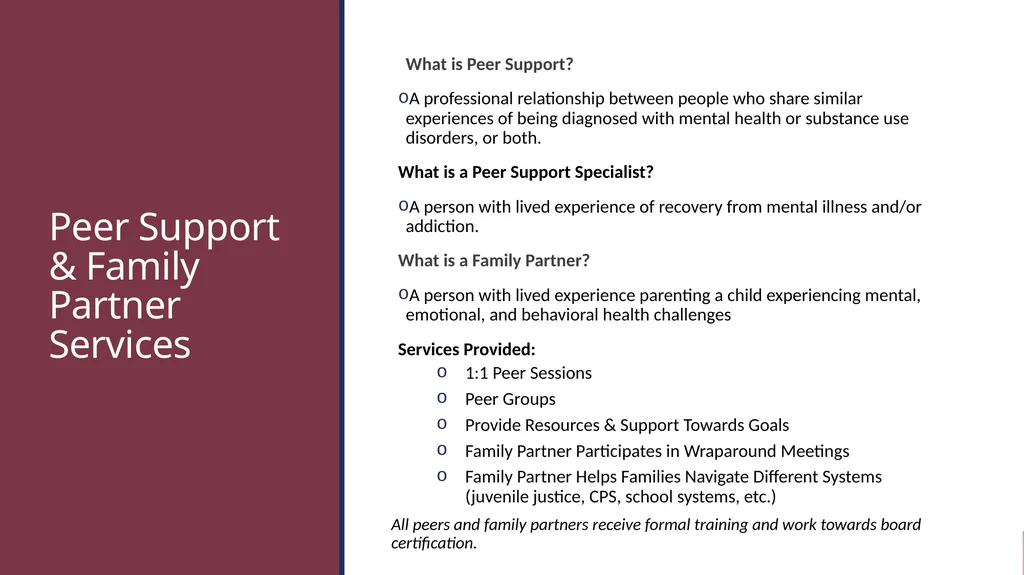
Peer Support & Family Partner Services What is Peer Support?
A professional relationship between people who share similar experiences of being diagnosed with mental health or substance use disorders, or both.
What is a Peer Support Specialist?
A person with lived experience of recovery from mental illness and/or addiction.
What is a Family Partner?
A person with lived experience parenting a child experiencing mental, emotional, and behavioral health challenges
Services Provided:
1:1 Peer Sessions
Peer Groups
Provide Resources & Support Towards Goals
Family Partner Participates in Wraparound Meetings
Family Partner Helps Families Navigate Different Systems (juvenile justice, CPS, school systems, etc.) All peers and family partners receive formal training and work towards board certification.<br>
A professional relationship between people who share similar experiences of being diagnosed with mental health or substance use disorders, or both.
What is a Peer Support Specialist?
A person with lived experience of recovery from mental illness and/or addiction.
What is a Family Partner?
A person with lived experience parenting a child experiencing mental, emotional, and behavioral health challenges
Services Provided:
1:1 Peer Sessions
Peer Groups
Provide Resources & Support Towards Goals
Family Partner Participates in Wraparound Meetings
Family Partner Helps Families Navigate Different Systems (juvenile justice, CPS, school systems, etc.) All peers and family partners receive formal training and work towards board certification.<br>
14
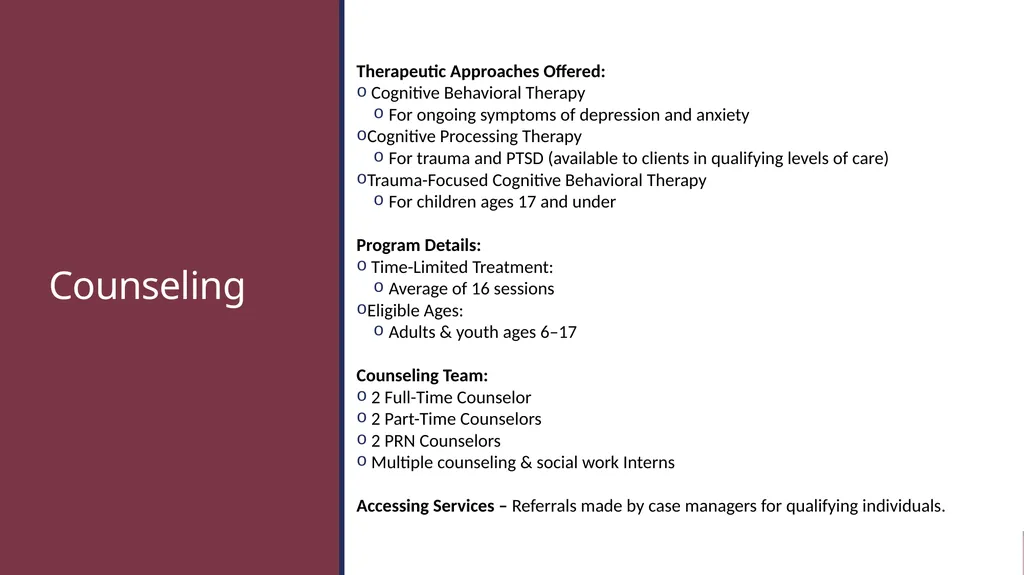
Counseling Therapeutic Approaches Offered:
Cognitive Behavioral Therapy
For ongoing symptoms of depression and anxiety
Cognitive Processing Therapy
For trauma and PTSD (available to clients in qualifying levels of care)
Trauma-Focused Cognitive Behavioral Therapy
For children ages 17 and under
Program Details:
Time-Limited Treatment:
Average of 16 sessions
Eligible Ages:
Adults & youth ages 6–17
Counseling Team:
2 Full-Time Counselor
2 Part-Time Counselors
2 PRN Counselors
Multiple counseling & social work Interns
Accessing Services – Referrals made by case managers for qualifying individuals.<br>
Cognitive Behavioral Therapy
For ongoing symptoms of depression and anxiety
Cognitive Processing Therapy
For trauma and PTSD (available to clients in qualifying levels of care)
Trauma-Focused Cognitive Behavioral Therapy
For children ages 17 and under
Program Details:
Time-Limited Treatment:
Average of 16 sessions
Eligible Ages:
Adults & youth ages 6–17
Counseling Team:
2 Full-Time Counselor
2 Part-Time Counselors
2 PRN Counselors
Multiple counseling & social work Interns
Accessing Services – Referrals made by case managers for qualifying individuals.<br>
15
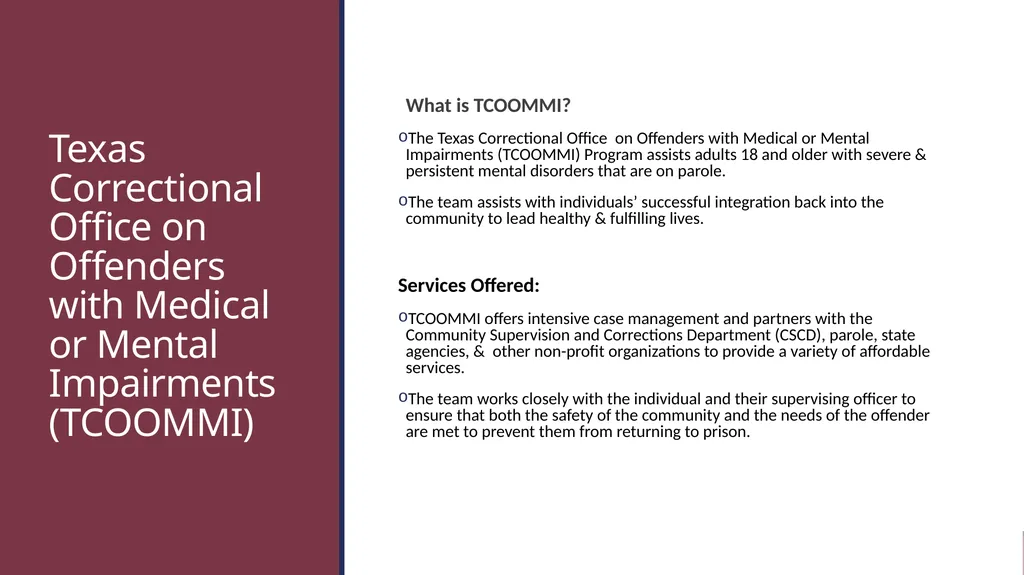
Texas Correctional Office on Offenders with Medical or Mental Impairments (TCOOMMI) What is TCOOMMI?
The Texas Correctional Office on Offenders with Medical or Mental Impairments (TCOOMMI) Program assists adults 18 and older with severe & persistent mental disorders that are on parole.
The team assists with individuals’ successful integration back into the community to lead healthy & fulfilling lives.
Services Offered:
TCOOMMI offers intensive case management and partners with the Community Supervision and Corrections Department (CSCD), parole, state agencies, & other non-profit organizations to provide a variety of affordable services.
The team works closely with the individual and their supervising officer to ensure that both the safety of the community and the needs of the offender are met to prevent them from returning to prison.<br>
The Texas Correctional Office on Offenders with Medical or Mental Impairments (TCOOMMI) Program assists adults 18 and older with severe & persistent mental disorders that are on parole.
The team assists with individuals’ successful integration back into the community to lead healthy & fulfilling lives.
Services Offered:
TCOOMMI offers intensive case management and partners with the Community Supervision and Corrections Department (CSCD), parole, state agencies, & other non-profit organizations to provide a variety of affordable services.
The team works closely with the individual and their supervising officer to ensure that both the safety of the community and the needs of the offender are met to prevent them from returning to prison.<br>
16
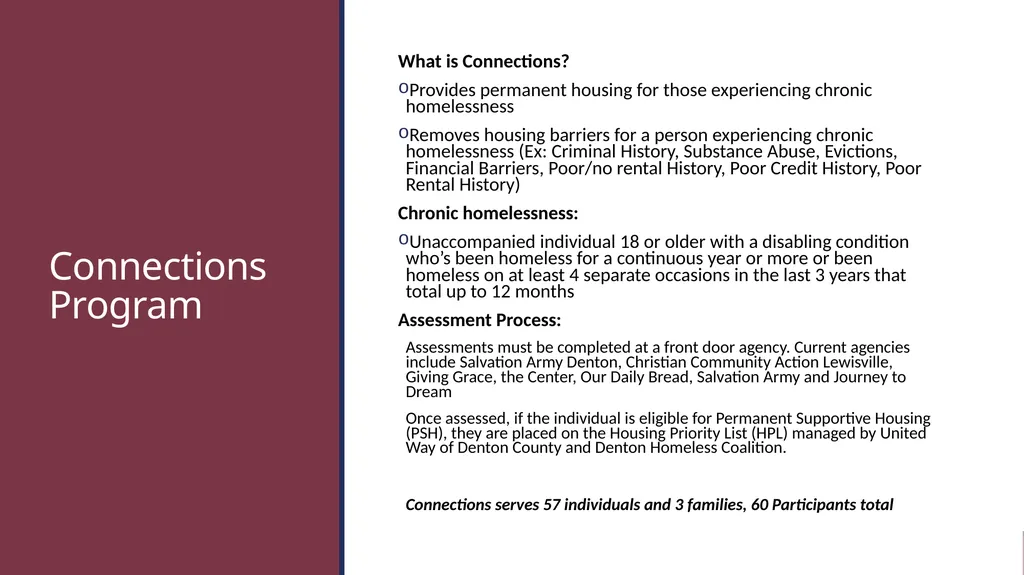
Connections Program What is Connections?
Provides permanent housing for those experiencing chronic homelessness
Removes housing barriers for a person experiencing chronic homelessness (Ex: Criminal History, Substance Abuse, Evictions, Financial Barriers, Poor/no rental History, Poor Credit History, Poor Rental History)
Chronic homelessness:
Unaccompanied individual 18 or older with a disabling condition who’s been homeless for a continuous year or more or been homeless on at least 4 separate occasions in the last 3 years that total up to 12 months
Assessment Process:
Assessments must be completed at a front door agency. Current agencies include Salvation Army Denton, Christian Community Action Lewisville, Giving Grace, the Center, Our Daily Bread, Salvation Army and Journey to Dream
Once assessed, if the individual is eligible for Permanent Supportive Housing (PSH), they are placed on the Housing Priority List (HPL) managed by United Way of Denton County and Denton Homeless Coalition.
Connections serves 57 individuals and 3 families, 60 Participants total<br>
Provides permanent housing for those experiencing chronic homelessness
Removes housing barriers for a person experiencing chronic homelessness (Ex: Criminal History, Substance Abuse, Evictions, Financial Barriers, Poor/no rental History, Poor Credit History, Poor Rental History)
Chronic homelessness:
Unaccompanied individual 18 or older with a disabling condition who’s been homeless for a continuous year or more or been homeless on at least 4 separate occasions in the last 3 years that total up to 12 months
Assessment Process:
Assessments must be completed at a front door agency. Current agencies include Salvation Army Denton, Christian Community Action Lewisville, Giving Grace, the Center, Our Daily Bread, Salvation Army and Journey to Dream
Once assessed, if the individual is eligible for Permanent Supportive Housing (PSH), they are placed on the Housing Priority List (HPL) managed by United Way of Denton County and Denton Homeless Coalition.
Connections serves 57 individuals and 3 families, 60 Participants total<br>
17
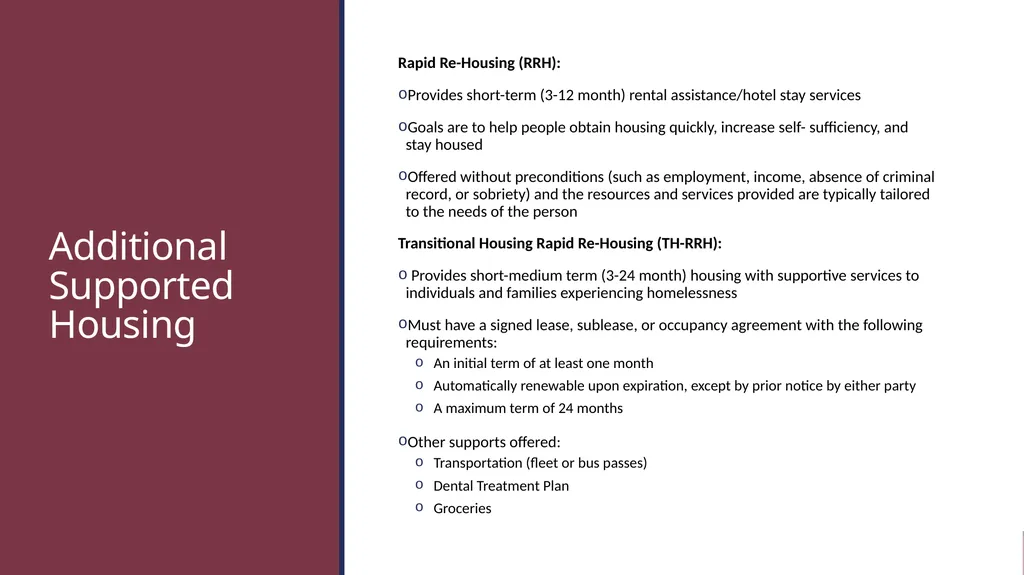
Additional Supported Housing Rapid Re-Housing (RRH):
Provides short-term (3-12 month) rental assistance/hotel stay services
Goals are to help people obtain housing quickly, increase self- sufficiency, and stay housed
Offered without preconditions (such as employment, income, absence of criminal record, or sobriety) and the resources and services provided are typically tailored to the needs of the person
Transitional Housing Rapid Re-Housing (TH-RRH):
Provides short-medium term (3-24 month) housing with supportive services to individuals and families experiencing homelessness
Must have a signed lease, sublease, or occupancy agreement with the following requirements:
An initial term of at least one month
Automatically renewable upon expiration, except by prior notice by either party
A maximum term of 24 months
Other supports offered:
Transportation (fleet or bus passes)
Dental Treatment Plan
Groceries<br>
Provides short-term (3-12 month) rental assistance/hotel stay services
Goals are to help people obtain housing quickly, increase self- sufficiency, and stay housed
Offered without preconditions (such as employment, income, absence of criminal record, or sobriety) and the resources and services provided are typically tailored to the needs of the person
Transitional Housing Rapid Re-Housing (TH-RRH):
Provides short-medium term (3-24 month) housing with supportive services to individuals and families experiencing homelessness
Must have a signed lease, sublease, or occupancy agreement with the following requirements:
An initial term of at least one month
Automatically renewable upon expiration, except by prior notice by either party
A maximum term of 24 months
Other supports offered:
Transportation (fleet or bus passes)
Dental Treatment Plan
Groceries<br>
18
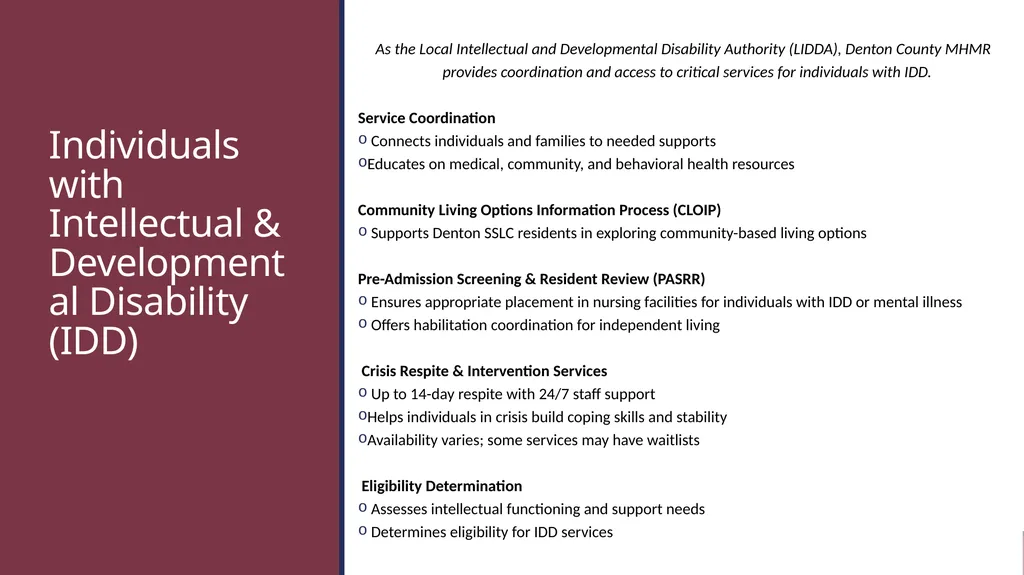
Individuals with Intellectual & Developmental Disability (IDD) As the Local Intellectual and Developmental Disability Authority (LIDDA), Denton County MHMR provides coordination and access to critical services for individuals with IDD.
Service Coordination
Connects individuals and families to needed supports
Educates on medical, community, and behavioral health resources
Community Living Options Information Process (CLOIP)
Supports Denton SSLC residents in exploring community-based living options
Pre-Admission Screening & Resident Review (PASRR)
Ensures appropriate placement in nursing facilities for individuals with IDD or mental illness
Offers habilitation coordination for independent living
Crisis Respite & Intervention Services
Up to 14-day respite with 24/7 staff support
Helps individuals in crisis build coping skills and stability
Availability varies; some services may have waitlists
Eligibility Determination
Assesses intellectual functioning and support needs
Determines eligibility for IDD services<br>
Service Coordination
Connects individuals and families to needed supports
Educates on medical, community, and behavioral health resources
Community Living Options Information Process (CLOIP)
Supports Denton SSLC residents in exploring community-based living options
Pre-Admission Screening & Resident Review (PASRR)
Ensures appropriate placement in nursing facilities for individuals with IDD or mental illness
Offers habilitation coordination for independent living
Crisis Respite & Intervention Services
Up to 14-day respite with 24/7 staff support
Helps individuals in crisis build coping skills and stability
Availability varies; some services may have waitlists
Eligibility Determination
Assesses intellectual functioning and support needs
Determines eligibility for IDD services<br>
19
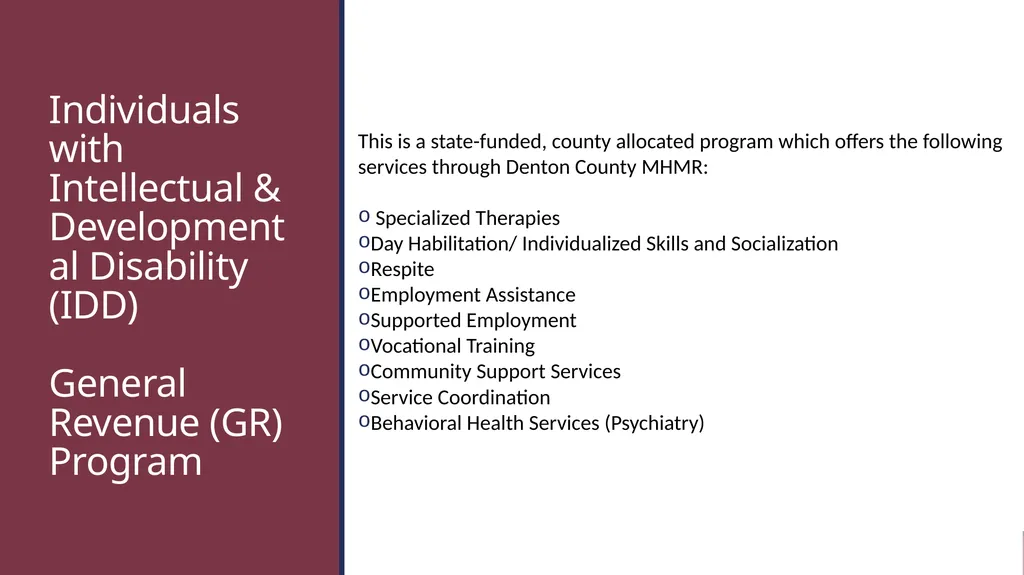
Individuals with Intellectual & Developmental Disability (IDD)
General Revenue (GR) Program This is a state-funded, county allocated program which offers the following services through Denton County MHMR:
Specialized Therapies
Day Habilitation/ Individualized Skills and Socialization
Respite
Employment Assistance
Supported Employment
Vocational Training
Community Support Services
Service Coordination
Behavioral Health Services (Psychiatry)<br>
Specialized Therapies
Day Habilitation/ Individualized Skills and Socialization
Respite
Employment Assistance
Supported Employment
Vocational Training
Community Support Services
Service Coordination
Behavioral Health Services (Psychiatry)<br>
20
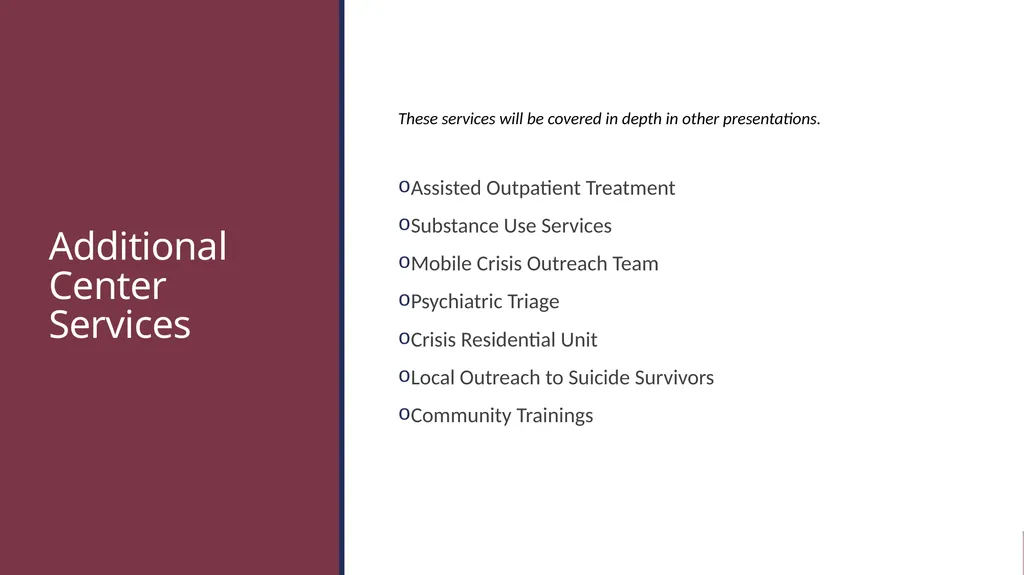
Additional Center
Services These services will be covered in depth in other presentations.
Assisted Outpatient Treatment
Substance Use Services
Mobile Crisis Outreach Team
Psychiatric Triage
Crisis Residential Unit
Local Outreach to Suicide Survivors
Community Trainings<br>
Assisted Outpatient Treatment
Substance Use Services
Mobile Crisis Outreach Team
Psychiatric Triage
Crisis Residential Unit
Local Outreach to Suicide Survivors
Community Trainings<br>
21
Questions? Dallas Hamilton M.S., LPC
Chief Operations Officer
940-594-1019
dallasc@dentonmhmr.org
Wakeelah Adelegan
Chief Clinical Officer
wakeelaha@dentonmhmr.org
Morgan Quinnelly
Chief Integration Officer
morgang@dentonmhmr.org<br>
Chief Operations Officer
940-594-1019
dallasc@dentonmhmr.org
Wakeelah Adelegan
Chief Clinical Officer
wakeelaha@dentonmhmr.org
Morgan Quinnelly
Chief Integration Officer
morgang@dentonmhmr.org<br>