
Presented By: David Kan, MD Medical Marijuana:
AS
Published · 48 slides · 0 views

1 / 1


Description
Presented By: David Kan, MD Medical Marijuana: What the California Physician Needs to Know Cannabis Epidemiology Cannabis Basics Physical and Psychological Effects Legal Issues Evidence Base for Medicinal Marijuana Cannabis Usage In 2008
Related Topics
Share
Embed code
Download this presentation From Below
"Presented By: David Kan, MD Medical Marijuana:" is the property of its rightful owner. Permission is granted to download and print the materials on this website for personal, non-commercial use only, and to display it on your personal computer provided you do not modify the materials and that you retain all copyright notices contained in the materials. By downloading content from our website, you accept the terms of this agreement.
Presentation Transcript
01
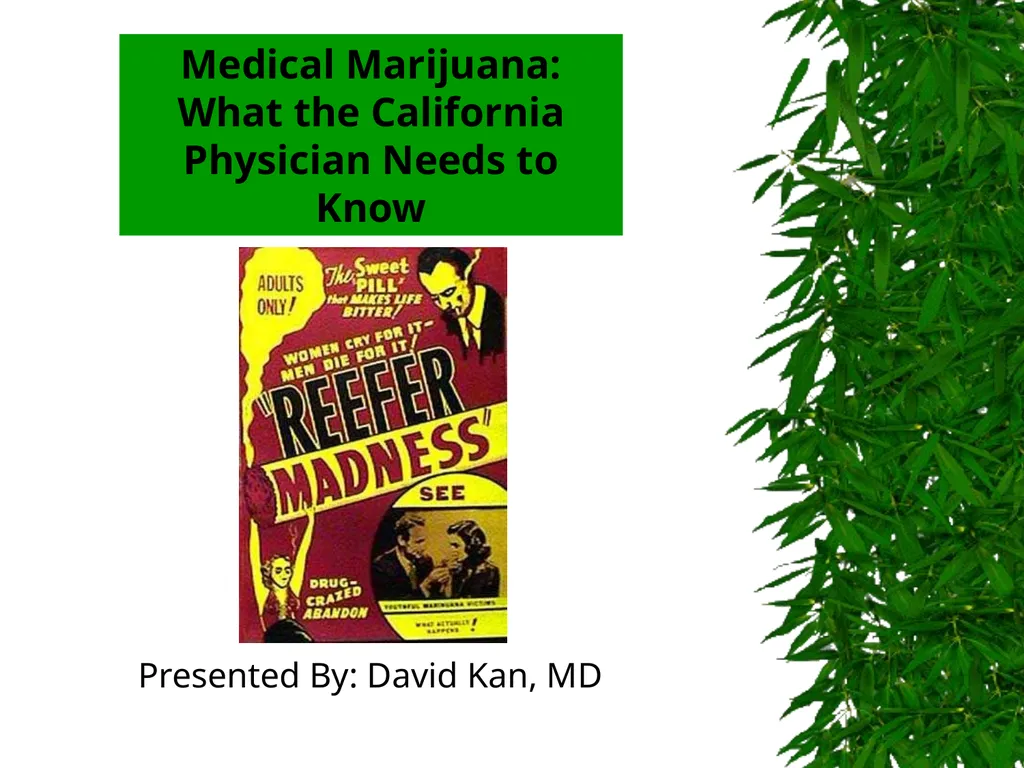
Presented By: David Kan, MD Medical Marijuana: What the California Physician Needs to Know<br>
02
Cannabis Epidemiology
Cannabis Basics
Physical and Psychological Effects
Legal Issues
Evidence Base for Medicinal Marijuana<br>
Cannabis Basics
Physical and Psychological Effects
Legal Issues
Evidence Base for Medicinal Marijuana<br>
03
Cannabis Usage In 2008 – regular users (Past-Month)
8th Grade – 1.4%
10th Grade – 7.7%
12th Grade – 17.8%
In 2008
15,203,000 regular users of Marijuana
20,077,000 regular users of any illicit drug<br>
8th Grade – 1.4%
10th Grade – 7.7%
12th Grade – 17.8%
In 2008
15,203,000 regular users of Marijuana
20,077,000 regular users of any illicit drug<br>
04
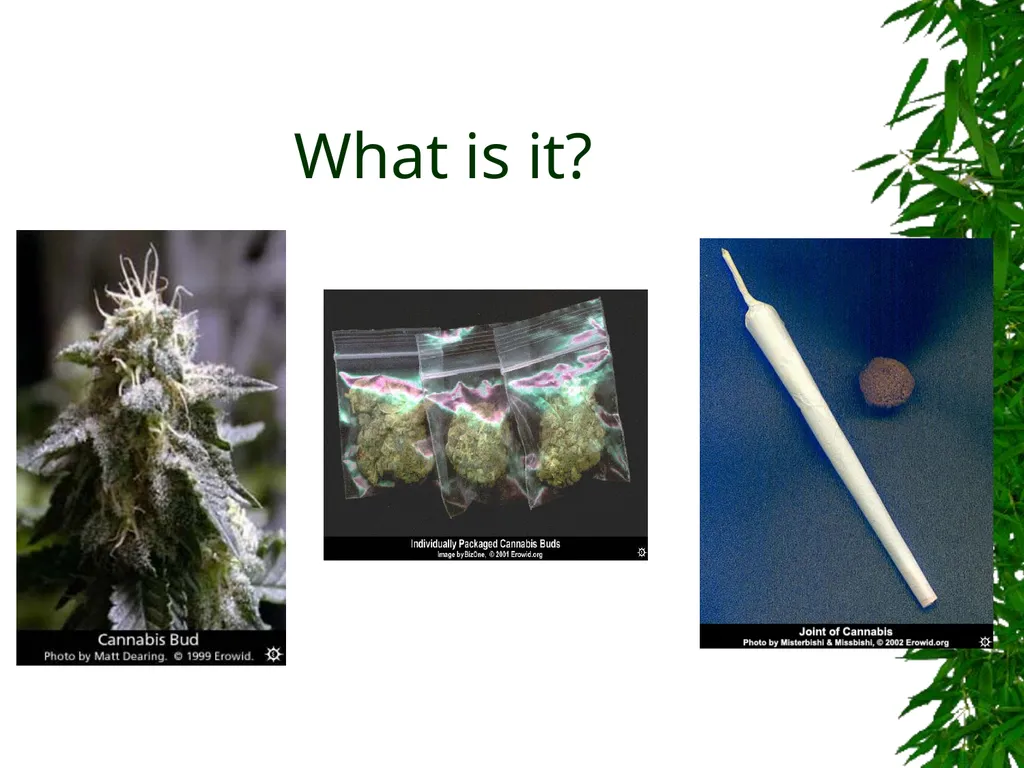
What is it?<br>
05
Cannabis Basics Leafy Plant
Cultivated indoors and outdoors
Flowering tops – “The Bud”
Cannabis v. Hemp
Species
Sativa, Indica, Ruderalis<br>
Cultivated indoors and outdoors
Flowering tops – “The Bud”
Cannabis v. Hemp
Species
Sativa, Indica, Ruderalis<br>
06
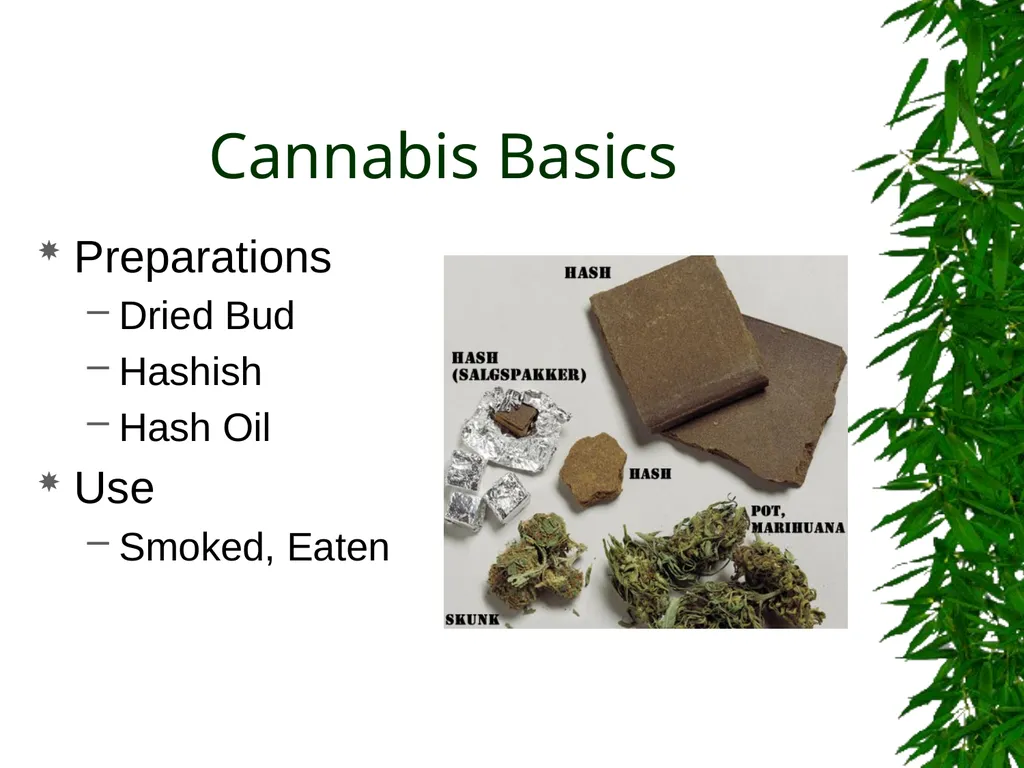
Cannabis Basics Preparations
Dried Bud
Hashish
Hash Oil
Use
Smoked, Eaten<br>
Dried Bud
Hashish
Hash Oil
Use
Smoked, Eaten<br>
07
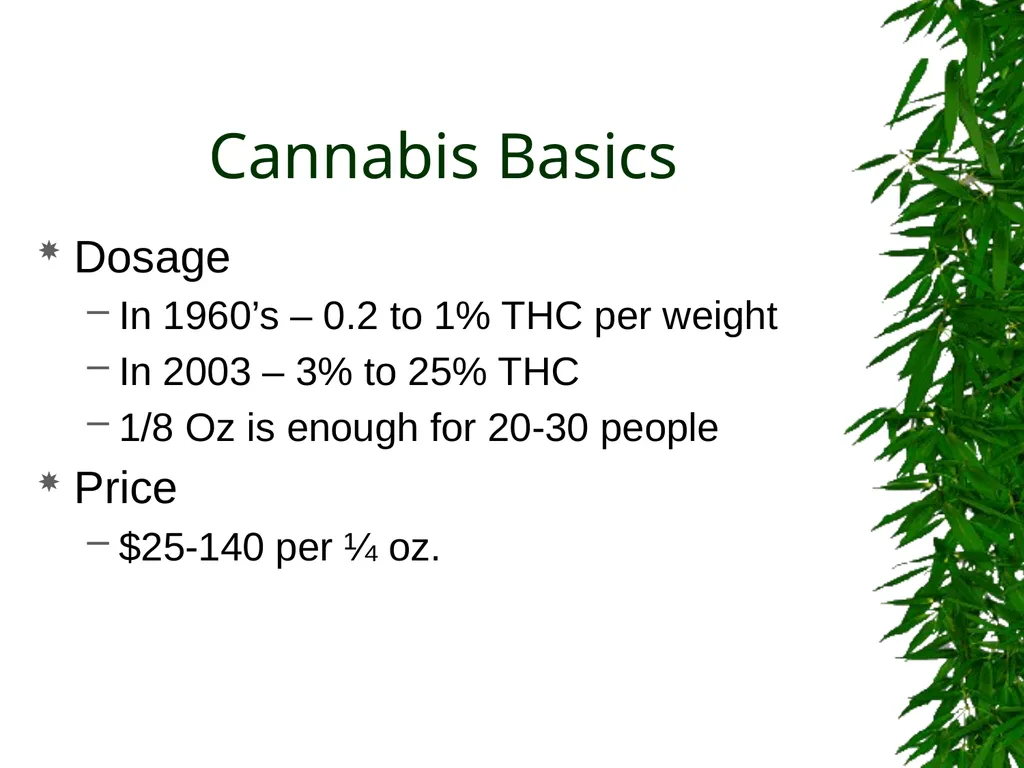
Cannabis Basics Dosage
In 1960’s – 0.2 to 1% THC per weight
In 2003 – 3% to 25% THC
1/8 Oz is enough for 20-30 people
Price
$25-140 per ¼ oz.<br>
In 1960’s – 0.2 to 1% THC per weight
In 2003 – 3% to 25% THC
1/8 Oz is enough for 20-30 people
Price
$25-140 per ¼ oz.<br>
08
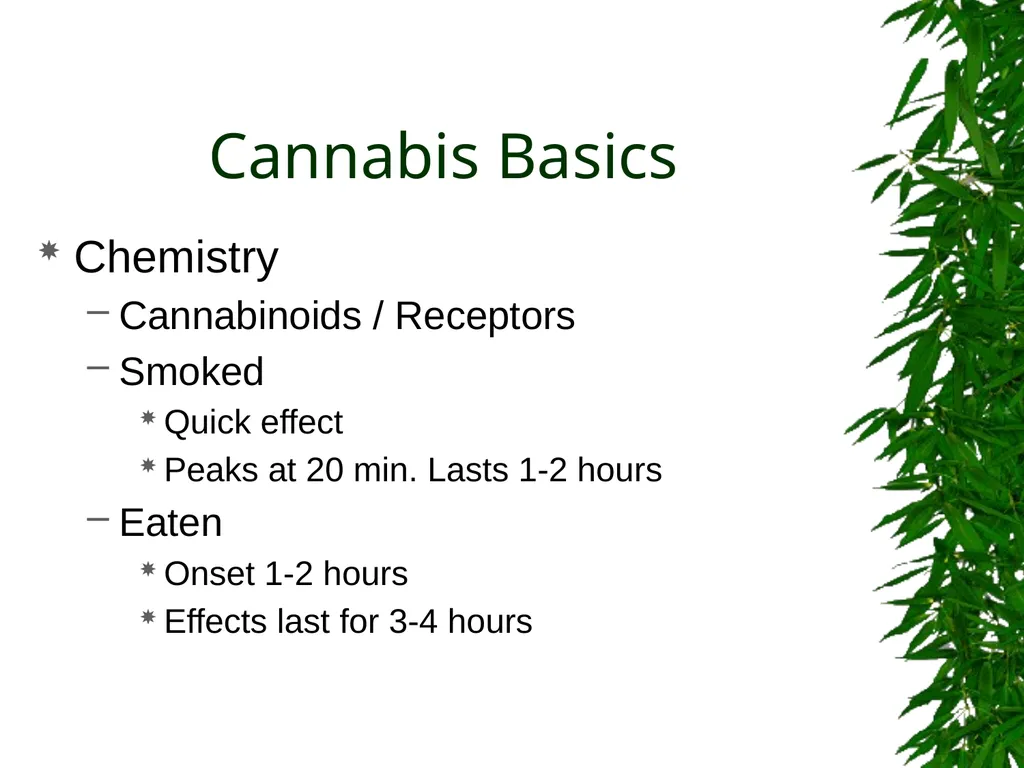
Cannabis Basics Chemistry
Cannabinoids / Receptors
Smoked
Quick effect
Peaks at 20 min. Lasts 1-2 hours
Eaten
Onset 1-2 hours
Effects last for 3-4 hours<br>
Cannabinoids / Receptors
Smoked
Quick effect
Peaks at 20 min. Lasts 1-2 hours
Eaten
Onset 1-2 hours
Effects last for 3-4 hours<br>
09
Cannabis Basics >400 compounds and 60 cannabinoids
Main psychoactive compound is THC (Tetrahydrocannabinol)
Cannabinoids found in Cannabis Sativa
Delta-9-THC is principal psychoactive component
Brain binding sites discovered in late 1980’s
1990 – Receptor CB1 first cloned and sequenced
Anandamide – Natural analogue<br>
Main psychoactive compound is THC (Tetrahydrocannabinol)
Cannabinoids found in Cannabis Sativa
Delta-9-THC is principal psychoactive component
Brain binding sites discovered in late 1980’s
1990 – Receptor CB1 first cloned and sequenced
Anandamide – Natural analogue<br>
10
Cannabinoid Receptors Widely distributed in brain
Reside within neural lipid membranes
Neuromodulators
Though intracellular G-proteins controlling cAMP formation and Ca++ and K+ ion transport
Post-synaptic reverse signaling contingent on firing rates<br>
Reside within neural lipid membranes
Neuromodulators
Though intracellular G-proteins controlling cAMP formation and Ca++ and K+ ion transport
Post-synaptic reverse signaling contingent on firing rates<br>
11
Endocannabinoid System and Addiction CB1 receptor agonists are rewarding
Activate endogenous DA system
Cannabinoids have strong interactions with the opioid system: THC increase B-endorphin in NAcc & VTA
Involved in rewarding effects of Alcohol
Synergistic with Nicotine rewarding effects
Inconsistent research regarding cocaine/ammphetamine Solinas, et al: The endocannabinoid system in brain reward processes, Br J Pharmacol v.154(2); May 2008<br>
Activate endogenous DA system
Cannabinoids have strong interactions with the opioid system: THC increase B-endorphin in NAcc & VTA
Involved in rewarding effects of Alcohol
Synergistic with Nicotine rewarding effects
Inconsistent research regarding cocaine/ammphetamine Solinas, et al: The endocannabinoid system in brain reward processes, Br J Pharmacol v.154(2); May 2008<br>
12
Psychological Effects<br>
13
Psychological Effects Euphoria, relaxation, changes in perception
Effect Dosage dependent
Low
Sense of well-being
Enhancement of senses
Subtle changes in thought and expression
Talkativeness, giggling
Increased appetite<br>
Effect Dosage dependent
Low
Sense of well-being
Enhancement of senses
Subtle changes in thought and expression
Talkativeness, giggling
Increased appetite<br>
14
Psychological Effects Higher Doses
Visual distortion
Sense of time altered
Attention span and memory affected
Thought processing
Mental Perception<br>
Visual distortion
Sense of time altered
Attention span and memory affected
Thought processing
Mental Perception<br>
15
Psychological Effects At Any Dose
Reduced ability to concentrate
Impaired Memory
Tiredness
Confusion<br>
Reduced ability to concentrate
Impaired Memory
Tiredness
Confusion<br>
16
Psychological Effects Different effects in older
– More unpleasant with oral>smoked
Multifaceted Symptoms
Potential use as adjunctive medication
Movement d/o and nausea
Anxiety has influence – may be indirect effect, false drug effect<br>
– More unpleasant with oral>smoked
Multifaceted Symptoms
Potential use as adjunctive medication
Movement d/o and nausea
Anxiety has influence – may be indirect effect, false drug effect<br>
17
Physical Risks Lung and throat problems
Carcinogenic effects (controversial)
Decreased eye pressure
Allergies
Heart Issues
MI + Stroke Risk >5 times in acute intoxication
Mittleman, et al, Triggering Myocardial Infarction by Marijuana, Circulation. 2001;103:2805.<br>
Carcinogenic effects (controversial)
Decreased eye pressure
Allergies
Heart Issues
MI + Stroke Risk >5 times in acute intoxication
Mittleman, et al, Triggering Myocardial Infarction by Marijuana, Circulation. 2001;103:2805.<br>
18
Physical Risks Harms within range of effects tolerated for other substances
Medicinal SE not necessarily comparable to SE of drug abuse
Harmful effect studies based on smoked MJ and not on cannabinoid<br>
Medicinal SE not necessarily comparable to SE of drug abuse
Harmful effect studies based on smoked MJ and not on cannabinoid<br>
19
Acute Risks Diminished psychomotor performance
Do not operate heavy machinery or vehicle
Dysphoria or unpleasant feelings
Short-term immunosuppressive effects do not necessarily preclude use<br>
Do not operate heavy machinery or vehicle
Dysphoria or unpleasant feelings
Short-term immunosuppressive effects do not necessarily preclude use<br>
20
Chronic Effects Chronic Smoking vs. Effects of THC
Smoke associated with:
Cancer – when combined with tobacco
Lung damage
Poor pregnancy
Habitual Marijuana smoking per se lacks good studies<br>
Smoke associated with:
Cancer – when combined with tobacco
Lung damage
Poor pregnancy
Habitual Marijuana smoking per se lacks good studies<br>
21
Cannabis and Psychosis On an individual level, cannabis use confers an overall twofold increase in the relative risk for later schizophrenia.
At the population level, elimination of cannabis use would reduce the incidence of schizophrenia by approximately 8%, assuming a causal relationship.
Causal association between cannabis and psychosis: examination of the evidence, Louise Arseneault, PhD et al, BJP 2004 184: 101<br>
At the population level, elimination of cannabis use would reduce the incidence of schizophrenia by approximately 8%, assuming a causal relationship.
Causal association between cannabis and psychosis: examination of the evidence, Louise Arseneault, PhD et al, BJP 2004 184: 101<br>
22
Patterns of Abuse Continuum of use/abuse
Occasional users – in groups, ritualized
More frequent users
Weekly or daily
Compulsive users
How much time is spent using or acquiring the drug
What happens in rest of life?
Is it used in combination with other drugs
REMEMBER – Abuse diagnosis takes into account consequences<br>
Occasional users – in groups, ritualized
More frequent users
Weekly or daily
Compulsive users
How much time is spent using or acquiring the drug
What happens in rest of life?
Is it used in combination with other drugs
REMEMBER – Abuse diagnosis takes into account consequences<br>
23
Legal Issues Prop 215 (Compassionate Use Act of 1996)
Exempts patients and defined caregivers who possess or cultivate marijuana recommended by a physician from criminal laws which otherwise prohibit possession or cultivation of marijuana.
Provides physicians who recommend use of marijuana for medical treatment shall not be punished or denied any right or privilege.
Declares that the measure is not to be construed to supersede prohibitions of conduct endangering others or to condone diversion of marijuana.<br>
Exempts patients and defined caregivers who possess or cultivate marijuana recommended by a physician from criminal laws which otherwise prohibit possession or cultivation of marijuana.
Provides physicians who recommend use of marijuana for medical treatment shall not be punished or denied any right or privilege.
Declares that the measure is not to be construed to supersede prohibitions of conduct endangering others or to condone diversion of marijuana.<br>
24
Legal Issues Prop 215
Does not legalize cannabis
Changes treatment of patients and caregivers treatment in court system
Is NOT a prescription
Local Legislation
Frequency of examination
Cannabis distribution<br>
Does not legalize cannabis
Changes treatment of patients and caregivers treatment in court system
Is NOT a prescription
Local Legislation
Frequency of examination
Cannabis distribution<br>
25
Legal Issues Doctor’s Recommendation allows Prop 215 protection
MD may be required to testify if patient arrested
Recommendation good for duration of treatment plan
Can change http://www.drugpolicy.org/library/cmrguide.cfm<br>
MD may be required to testify if patient arrested
Recommendation good for duration of treatment plan
Can change http://www.drugpolicy.org/library/cmrguide.cfm<br>
26
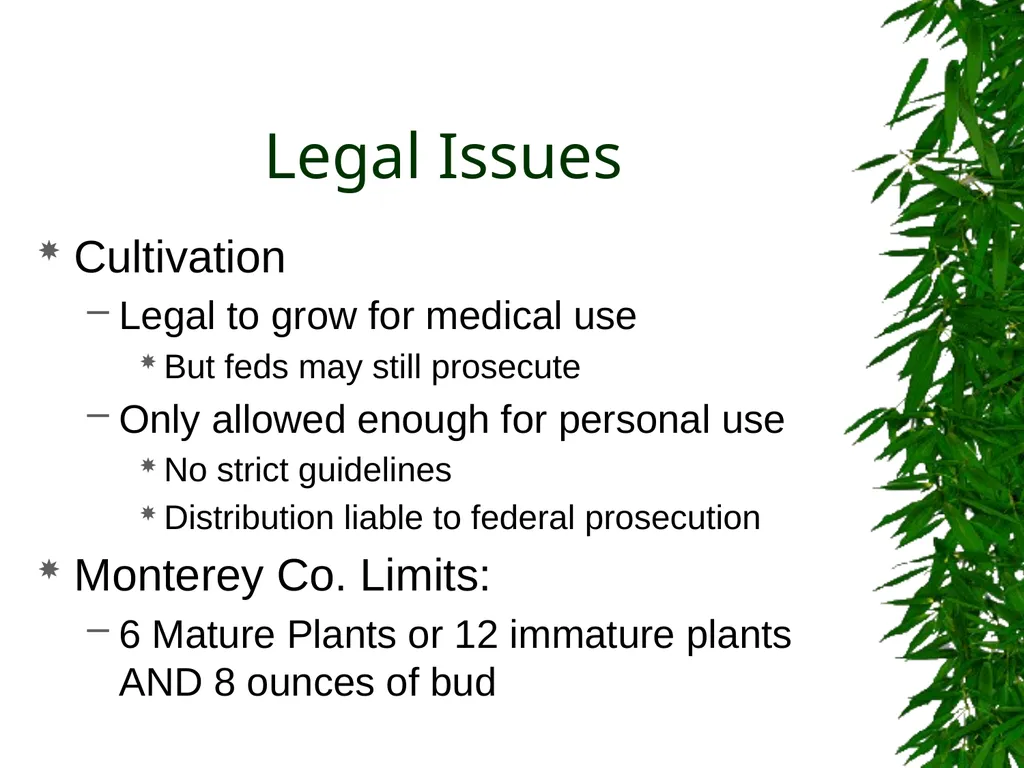
Legal Issues Cultivation
Legal to grow for medical use
But feds may still prosecute
Only allowed enough for personal use
No strict guidelines
Distribution liable to federal prosecution
Monterey Co. Limits:
6 Mature Plants or 12 immature plants AND 8 ounces of bud<br>
Legal to grow for medical use
But feds may still prosecute
Only allowed enough for personal use
No strict guidelines
Distribution liable to federal prosecution
Monterey Co. Limits:
6 Mature Plants or 12 immature plants AND 8 ounces of bud<br>
27
Legal Issues No insurance mandate to pay for services
Drug Free Workplace Act
DUI laws still apply
Can’t tell patient how to obtain cannabis<br>
Drug Free Workplace Act
DUI laws still apply
Can’t tell patient how to obtain cannabis<br>
28
Federal Review Conant v. Walters
(9th Cir. 2002) 209 F.3d 629
Severe Nausea
Wasting Syndrome
Increase intraocular pressure
Seizures
Muscle Spasms associated with chronic, debilitating condition (MS/Paralysis)
Severe, Chronic pain
Does not explicitly extend to other diseases or conditions<br>
Severe Nausea
Wasting Syndrome
Increase intraocular pressure
Seizures
Muscle Spasms associated with chronic, debilitating condition (MS/Paralysis)
Severe, Chronic pain
Does not explicitly extend to other diseases or conditions<br>
29
Recommendations Smoked Marijuana
Short-term
Terminally ill or those with debilitating symptoms
Future Developments
Non-smoked
Rapid-delivery, rapid-onset
Years before perfect drug
Weigh risks and benefits<br>
Short-term
Terminally ill or those with debilitating symptoms
Future Developments
Non-smoked
Rapid-delivery, rapid-onset
Years before perfect drug
Weigh risks and benefits<br>
30
Good Doctoring History and good faith examination of the patient.
Development of a treatment plan with objectives.
Provision of informed consent including discussion of side effects.
Periodic review of the treatment's efficacy.
Consultation, as necessary.
Proper record keeping that supports the decision to recommend the use of medical marijuana. http://www.medbd.ca.gov/medical_marijuana.htm<br>
Development of a treatment plan with objectives.
Provision of informed consent including discussion of side effects.
Periodic review of the treatment's efficacy.
Consultation, as necessary.
Proper record keeping that supports the decision to recommend the use of medical marijuana. http://www.medbd.ca.gov/medical_marijuana.htm<br>
31
Warnings Federal Liability still present
A patient need not have failed on all standard medications
Determine that medical marijuana use is not masking an acute or treatable progressive condition, or use will worsen condition
Evidence Based practice
Risk/Benefit ratio
A consultant can recommend MM, but should consult with PCP and obtain records to confirm diagnosis.<br>
A patient need not have failed on all standard medications
Determine that medical marijuana use is not masking an acute or treatable progressive condition, or use will worsen condition
Evidence Based practice
Risk/Benefit ratio
A consultant can recommend MM, but should consult with PCP and obtain records to confirm diagnosis.<br>
32
Warning Continued The initial examination must be in-person.
Recommendations should be limited to the time necessary to appropriately monitor the patient.
Periodic reviews should occur and be documented at least annually or more frequently as warranted.
If a physician recommends or approves the use of medical marijuana for a minor, the parents or legal guardians must be fully informed of the risks and benefits of such use and must consent to that use.<br>
Recommendations should be limited to the time necessary to appropriately monitor the patient.
Periodic reviews should occur and be documented at least annually or more frequently as warranted.
If a physician recommends or approves the use of medical marijuana for a minor, the parents or legal guardians must be fully informed of the risks and benefits of such use and must consent to that use.<br>
33
Medicinal Marijuana Effects of isolated cannabinoids
Health risks associated with the medical use of marijuana
Efficacy of marijuana<br>
Health risks associated with the medical use of marijuana
Efficacy of marijuana<br>
34
Cannabinoid Biology Cannabinoids have natural role in pain modulation, control of movement and memory
Immune system – unclear role
Tolerance develops
Potential for dependence
Withdrawal Symptoms occur but mild<br>
Immune system – unclear role
Tolerance develops
Potential for dependence
Withdrawal Symptoms occur but mild<br>
35
Efficacy Positive Evidence
Appetite stimulant in wasting syndromes
Analgesic and Antispasmodic
Nausea and Vomiting
Pain
Hepatitis C?
Marginal Evidence
Glaucoma, bronchodilator<br>
Appetite stimulant in wasting syndromes
Analgesic and Antispasmodic
Nausea and Vomiting
Pain
Hepatitis C?
Marginal Evidence
Glaucoma, bronchodilator<br>
36
Efficacy THC effects established
Cannabadiol less so
Combination of effects may be well-suited for AIDS wasting and Chemo nausea
Anxiety reduction, appetite stimulation, nausea reduction, pain relief
Foxglove vs. Digoxin
Smoked Marijuana a crude approach<br>
Cannabadiol less so
Combination of effects may be well-suited for AIDS wasting and Chemo nausea
Anxiety reduction, appetite stimulation, nausea reduction, pain relief
Foxglove vs. Digoxin
Smoked Marijuana a crude approach<br>
37
Efficacy Voth and Schwartz - 1997
Reviewed THC pure and raw in
Nausea associated with chemo
Glaucoma
Appetite Stimulation
Spinal cord spasticity<br>
Reviewed THC pure and raw in
Nausea associated with chemo
Glaucoma
Appetite Stimulation
Spinal cord spasticity<br>
38
Efficacy In Nausea
Oral THC was effective in treating nausea.
Effective doses were associated with a sense of intoxication<br>
Oral THC was effective in treating nausea.
Effective doses were associated with a sense of intoxication<br>
39
Efficacy Appetite Stimulation
Few studies
Large numbers dropped out except for past marijuana smokers
In Study at SFGH – synthetic and natural THC did better than placebo<br>
Few studies
Large numbers dropped out except for past marijuana smokers
In Study at SFGH – synthetic and natural THC did better than placebo<br>
40
Efficacy Glaucoma
Reduces eye pressure
Tolerance develops
No evidence that it helps the disease
Side effects do not justify use
Tomida, et al: Cannabinoids and Glaucoma Br J Ophthalmol. 2004 May; 88(5): 708–713<br>
Reduces eye pressure
Tolerance develops
No evidence that it helps the disease
Side effects do not justify use
Tomida, et al: Cannabinoids and Glaucoma Br J Ophthalmol. 2004 May; 88(5): 708–713<br>
41
Efficacy Pain
Statistically significant pain relief
Spasticity Reduction
Sleep improvement
Abrams, DI, et al., “Cannabis in Painful HIV associated Sensory Neuropathy: a Randomized, Placebo-controlled Clinical Trial,” Neurology 68(7):515-21 (2007) (painful HIV-related peripheral neuropathy);
Wilsey, B, et al., "A Randomized, Placebo- Controlled, Crossover Trial of Cannabis Cigarettes in Neuropathic Pain," The Journal of Pain 9(6):56-21 (2008) (neuropathic pain)
Ellis, RJ, et al., "Smoked Medicinal Cannabis for Neuropathic Pain in HIV: A Randomized, Crossover Clinical Trial," Neuropsychopharmacology 1-9 (2008) (painful HIV-related neuropathy).
Wallace, M, et al., "Dose-dependent Effects of Smoked Cannabis on Capsaicin induced Pain and Hyperalgesia in Healthy Volunteers," Anesthesiology 107785-96 (2007) (dose-dependenteffects in an experimental pain model)<br>
Statistically significant pain relief
Spasticity Reduction
Sleep improvement
Abrams, DI, et al., “Cannabis in Painful HIV associated Sensory Neuropathy: a Randomized, Placebo-controlled Clinical Trial,” Neurology 68(7):515-21 (2007) (painful HIV-related peripheral neuropathy);
Wilsey, B, et al., "A Randomized, Placebo- Controlled, Crossover Trial of Cannabis Cigarettes in Neuropathic Pain," The Journal of Pain 9(6):56-21 (2008) (neuropathic pain)
Ellis, RJ, et al., "Smoked Medicinal Cannabis for Neuropathic Pain in HIV: A Randomized, Crossover Clinical Trial," Neuropsychopharmacology 1-9 (2008) (painful HIV-related neuropathy).
Wallace, M, et al., "Dose-dependent Effects of Smoked Cannabis on Capsaicin induced Pain and Hyperalgesia in Healthy Volunteers," Anesthesiology 107785-96 (2007) (dose-dependenteffects in an experimental pain model)<br>
42
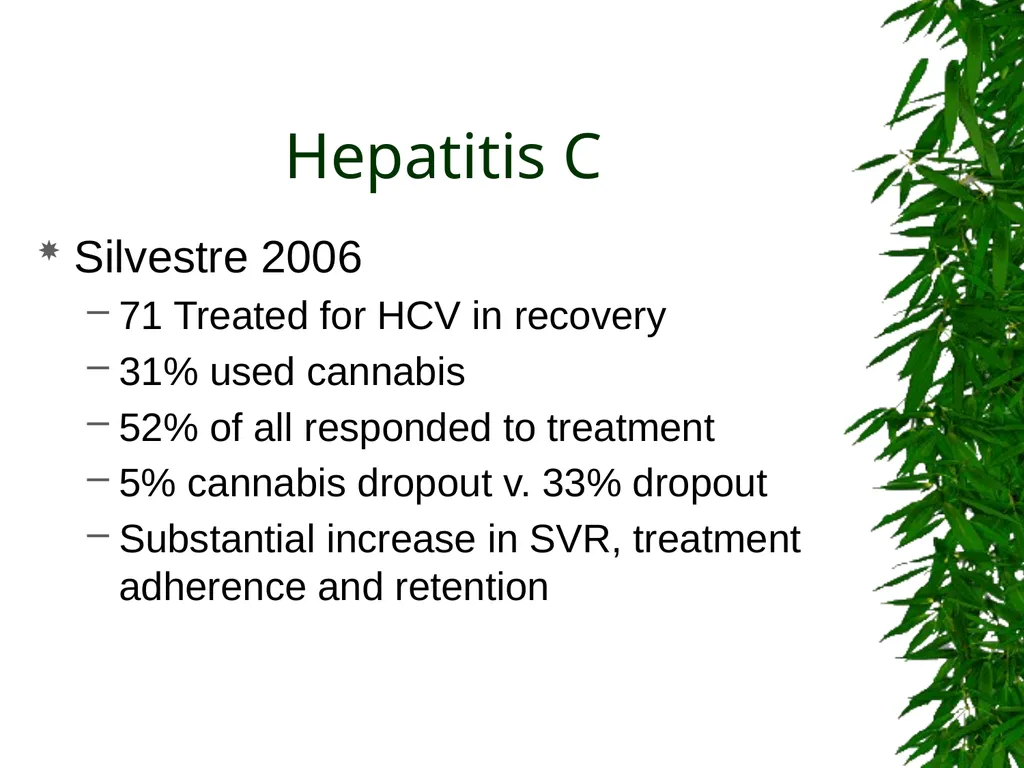
Hepatitis C Silvestre 2006
71 Treated for HCV in recovery
31% used cannabis
52% of all responded to treatment
5% cannabis dropout v. 33% dropout
Substantial increase in SVR, treatment adherence and retention<br>
71 Treated for HCV in recovery
31% used cannabis
52% of all responded to treatment
5% cannabis dropout v. 33% dropout
Substantial increase in SVR, treatment adherence and retention<br>
43
Cannabis and Youth Increased truancy and absenteeism
Lower IQ
Academic Development
Social Development
Pope HG, Gruber AJ, Hudson JI, Cohane G, Huestis MA, Yurgelun-Todd D. Early-onset cannabis use and cognitive deficits: What is the nature of the association? Drug Alcohol Depend. 2003;69:303–310.
Tapert SF, Schweinsburg AD, Drummond SPA, Paulus MP, Brown SA, Yang TT, et al. Functional MRI of inhibitory processing in abstinent adolescent marijuana users. Pyschopharmacology. 2007;194:173–183.
Pope, HG, Gruber, AJ, Hudson, JI, Huestis, MA, & Yurgelun-Todd, D. Neuropsychological performance in long-term cannabis users. Arch Gen Psychiatry. 2001;58:909–915.
Schneider JT, Pope HG, Silveri MM, Simpson NS, Gruber SA, Yurgelun-Todd, DA. Altered regional blood volume in chronic cannabis smokers. Exp Clin Psychopharmacol. 2006;14:422–428.
Bovet P, Viswanathan B, Faeh D, Warren W. Comparison of smoking, drinking, and marijuana use between students present or absent on the day of a school-based survey. J Sch Health. 2006;76(4):133–137.
Lynskey M, Hall W. The effects of adolescent cannabis use on educational attainment: a review. Addiction. 2000;95:1621-1630.
Fried P, Watkinson B, James D, Gray R. Current and former marijuana use: preliminary findings of a longitudinal study of effects on IQ in young adults. Can Med Assoc J. 2002;166:887–891.
Diego MA, Field TM, Sanders CE. Academic performance, popularity, and depression predict adolescent substance use. Adolescence. 2003;38:37–42.<br>
Lower IQ
Academic Development
Social Development
Pope HG, Gruber AJ, Hudson JI, Cohane G, Huestis MA, Yurgelun-Todd D. Early-onset cannabis use and cognitive deficits: What is the nature of the association? Drug Alcohol Depend. 2003;69:303–310.
Tapert SF, Schweinsburg AD, Drummond SPA, Paulus MP, Brown SA, Yang TT, et al. Functional MRI of inhibitory processing in abstinent adolescent marijuana users. Pyschopharmacology. 2007;194:173–183.
Pope, HG, Gruber, AJ, Hudson, JI, Huestis, MA, & Yurgelun-Todd, D. Neuropsychological performance in long-term cannabis users. Arch Gen Psychiatry. 2001;58:909–915.
Schneider JT, Pope HG, Silveri MM, Simpson NS, Gruber SA, Yurgelun-Todd, DA. Altered regional blood volume in chronic cannabis smokers. Exp Clin Psychopharmacol. 2006;14:422–428.
Bovet P, Viswanathan B, Faeh D, Warren W. Comparison of smoking, drinking, and marijuana use between students present or absent on the day of a school-based survey. J Sch Health. 2006;76(4):133–137.
Lynskey M, Hall W. The effects of adolescent cannabis use on educational attainment: a review. Addiction. 2000;95:1621-1630.
Fried P, Watkinson B, James D, Gray R. Current and former marijuana use: preliminary findings of a longitudinal study of effects on IQ in young adults. Can Med Assoc J. 2002;166:887–891.
Diego MA, Field TM, Sanders CE. Academic performance, popularity, and depression predict adolescent substance use. Adolescence. 2003;38:37–42.<br>
44
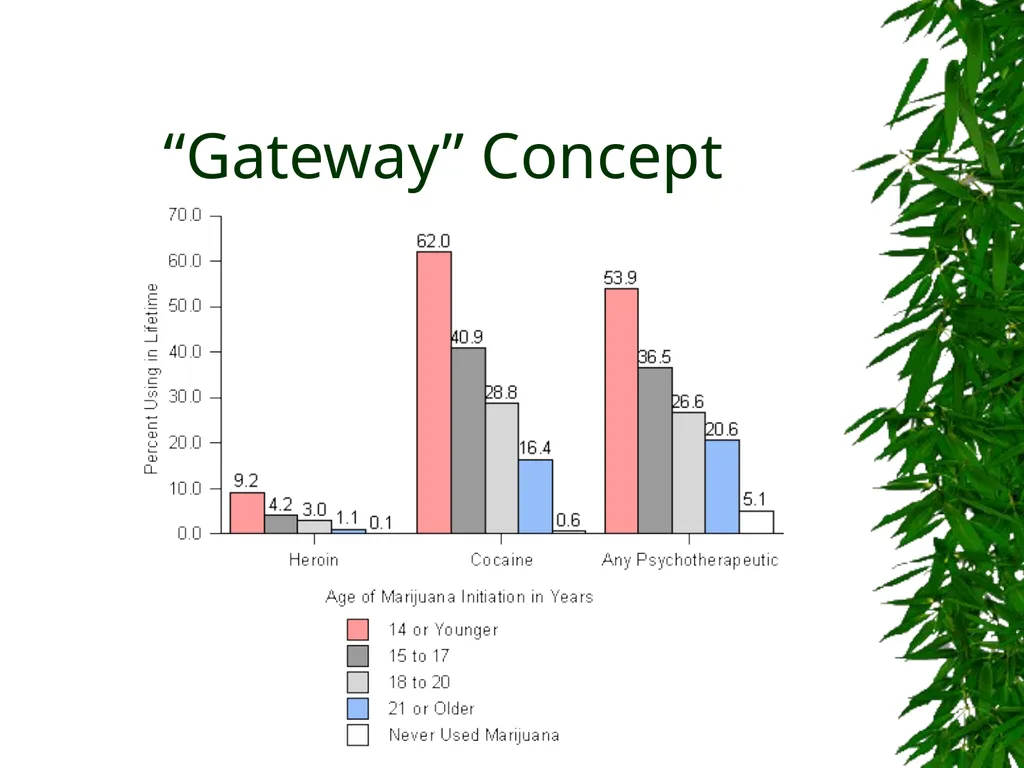
“Gateway” Concept<br>
45
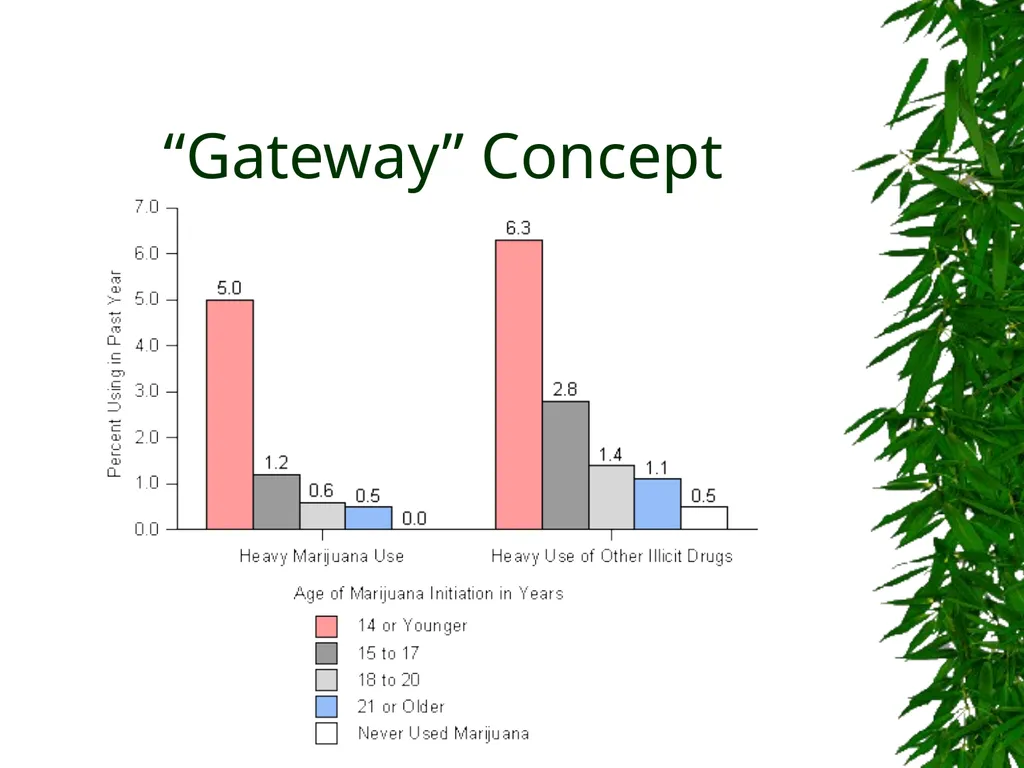
“Gateway” Concept<br>
46
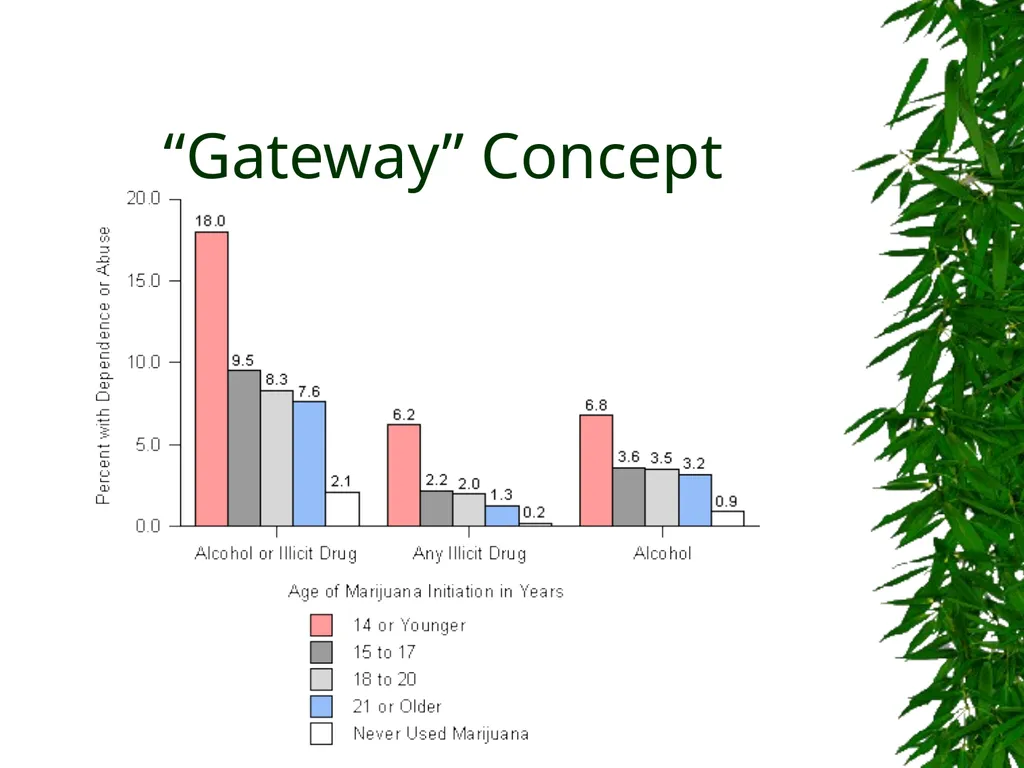
“Gateway” Concept<br>
47
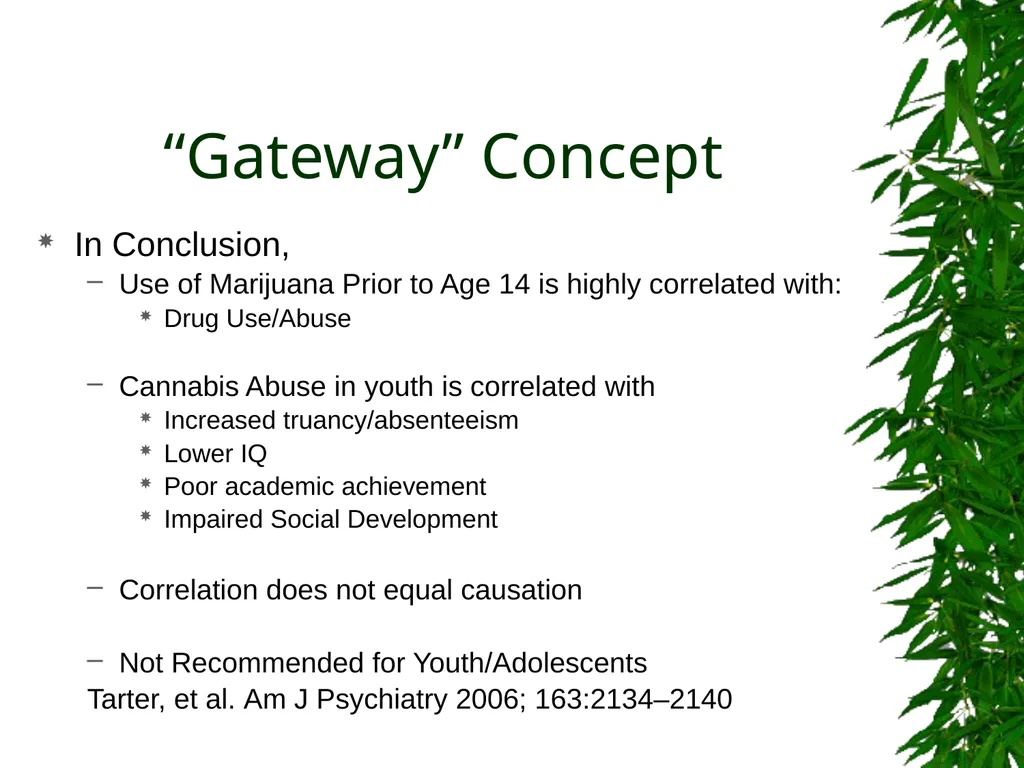
“Gateway” Concept In Conclusion,
Use of Marijuana Prior to Age 14 is highly correlated with:
Drug Use/Abuse
Cannabis Abuse in youth is correlated with
Increased truancy/absenteeism
Lower IQ
Poor academic achievement
Impaired Social Development
Correlation does not equal causation
Not Recommended for Youth/Adolescents
Tarter, et al. Am J Psychiatry 2006; 163:2134–2140<br>
Use of Marijuana Prior to Age 14 is highly correlated with:
Drug Use/Abuse
Cannabis Abuse in youth is correlated with
Increased truancy/absenteeism
Lower IQ
Poor academic achievement
Impaired Social Development
Correlation does not equal causation
Not Recommended for Youth/Adolescents
Tarter, et al. Am J Psychiatry 2006; 163:2134–2140<br>
48
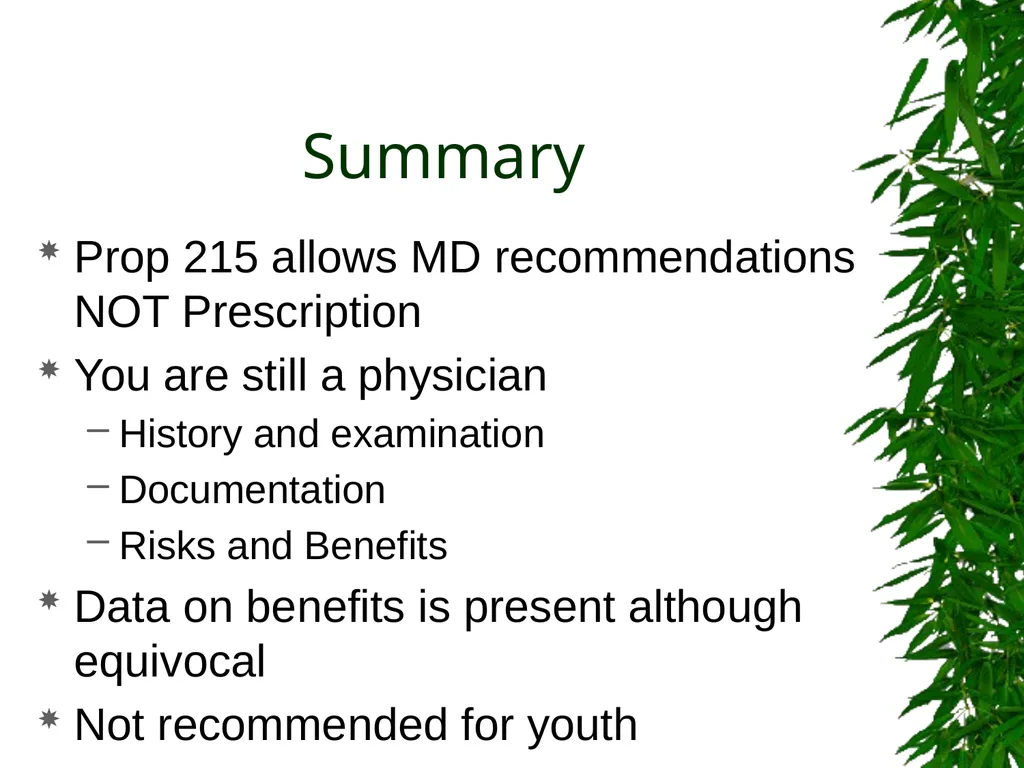
Summary Prop 215 allows MD recommendations NOT Prescription
You are still a physician
History and examination
Documentation
Risks and Benefits
Data on benefits is present although equivocal
Not recommended for youth<br>
You are still a physician
History and examination
Documentation
Risks and Benefits
Data on benefits is present although equivocal
Not recommended for youth<br>