Presented By Dr. Manjusha Ingawale. B.Sc.I Sem I Paper II Biomolecules and cell Biology JANATA SHIKSHAN SANSTHAS KISAN VEER MAHAVIDYALAYA, WAI Department of Botany JANATA SHIKSHAN SANSTHAS Janata Shikshan Sansthas KISAN VEER
"Presented By Dr. Manjusha Ingawale. B.Sc.I Sem I" is the property of its rightful owner. Permission is granted to
download and print the materials on this website for personal, non-commercial use only, and to display it
on your personal computer provided you do not modify the materials and that you retain all copyright
notices contained in the materials. By downloading content from our website, you accept the terms of this
agreement.
Presentation Transcript
01
Presented By
Dr. Manjusha Ingawale. B.Sc.I Sem I Paper II
Biomolecules and cell Biology JANATA SHIKSHAN SANSTHA’S
KISAN VEER MAHAVIDYALAYA, WAI
Department of Botany JANATA SHIKSHAN SANSTHA’S
Janata Shikshan Sanstha’s
KISAN VEER MAHAVIDYALAYA, WAI
Department Of Botany<br>
02
Plants form the basis of all life on earth and are known as producers.
Plant cells contain structures known as plastids which are absent in animal cells.
These plastids are double-membraned cell organelles which play a primary role in the manufacturing and storing of food
They were first observed by AFW Schimper (1885)
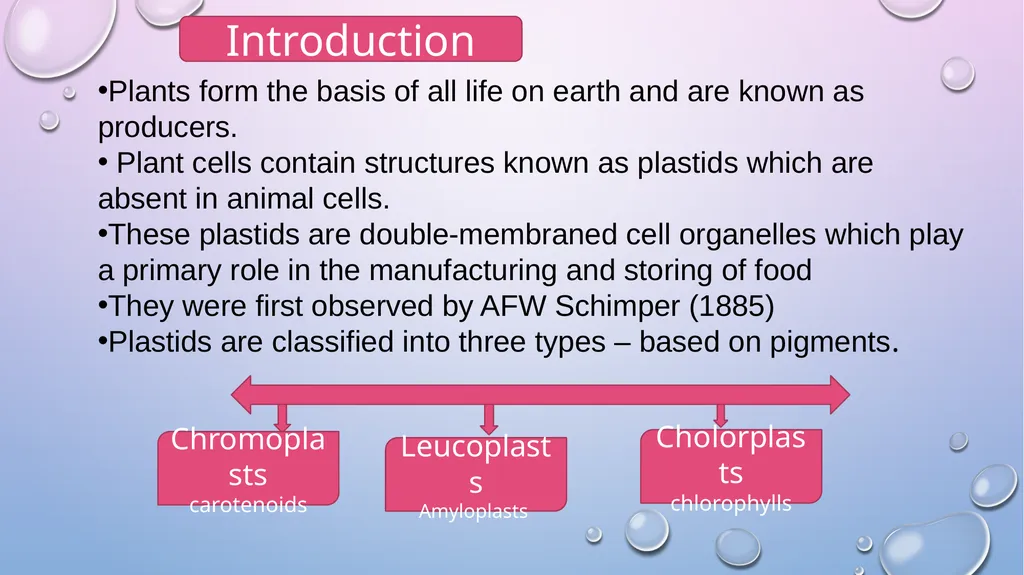
Plastids are classified into three types – based on pigments. Introduction Chromoplasts
carotenoids Leucoplasts
Amyloplasts Cholorplasts
chlorophylls<br>
03
Chloroplast
Chloroplast is an organelle that contains the photosynthetic pigment chlorophyll that captures sunlight and converts it into useful energy, thereby, releasing oxygen from water.
Chloroplasts are found in all green plants and algae. They are the food producers of plants. These are found in the guard cells located in the leaves of the plants.
They contain a high concentration of chlorophyll that traps sunlight.
This Cell organelle is not present in animal cells.<br>
04
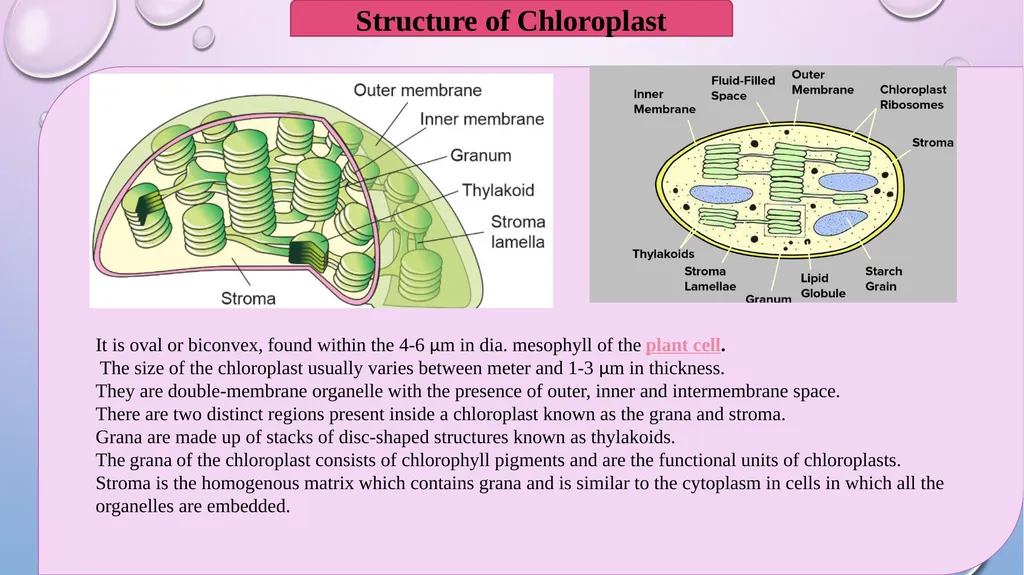
Structure of Chloroplast It is oval or biconvex, found within the 4-6 µm in dia. mesophyll of the plant cell.
The size of the chloroplast usually varies between meter and 1-3 µm in thickness.
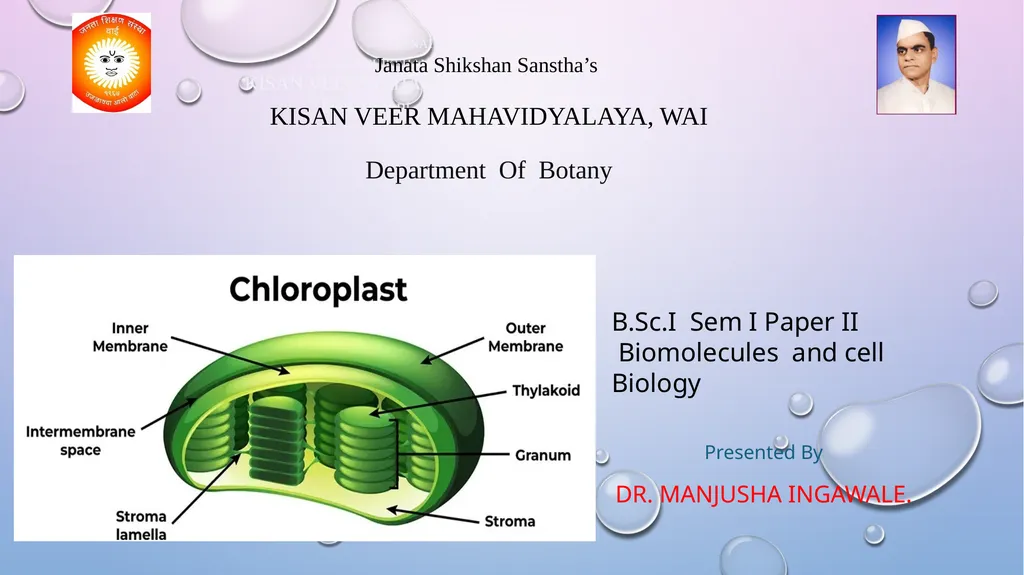
They are double-membrane organelle with the presence of outer, inner and intermembrane space.
There are two distinct regions present inside a chloroplast known as the grana and stroma.
Grana are made up of stacks of disc-shaped structures known as thylakoids.
The grana of the chloroplast consists of chlorophyll pigments and are the functional units of chloroplasts.
Stroma is the homogenous matrix which contains grana and is similar to the cytoplasm in cells in which all the organelles are embedded.<br>
05
Functions of Chloroplast
The most important function of the chloroplast is to synthesize food by the process of photosynthesis.
Absorbs light energy and converts it into chemical energy.
Chloroplast has a structure called chlorophyll which functions by trapping the solar energy and used for the synthesis of food in all green plants.
Produces NADPH and molecular oxygen (O2) by photolysis of water.
Produces ATP – Adenosine triphosphate by the process of photosynthesis.
The carbon dioxide (CO2) obtained from the air is used to generate carbon and sugar during the Calvin Cycle or dark reaction of photosynthesis.<br>