
Presented by Lorraine Poulos Professionalising
Description: Presented by Lorraine Poulos Professionalising Case Management 1 Acknowledgement of traditional owners Background to presentation Current environment ageddisabilitieshealthchildcare moving to a consumer driven human services where
Related Topics
Download Presentation
"Presented by Lorraine Poulos Professionalising" is the property of its rightful owner. Permission is granted to download and print the materials on this website for personal, non-commercial use only, and to display it on your personal computer provided you do not modify the materials and that you retain all copyright notices contained in the materials. By downloading content from our website, you accept the terms of this agreement.
Presentation Transcript
slide1. Presented by
Lorraine Poulos Professionalising Case Management 1<br>
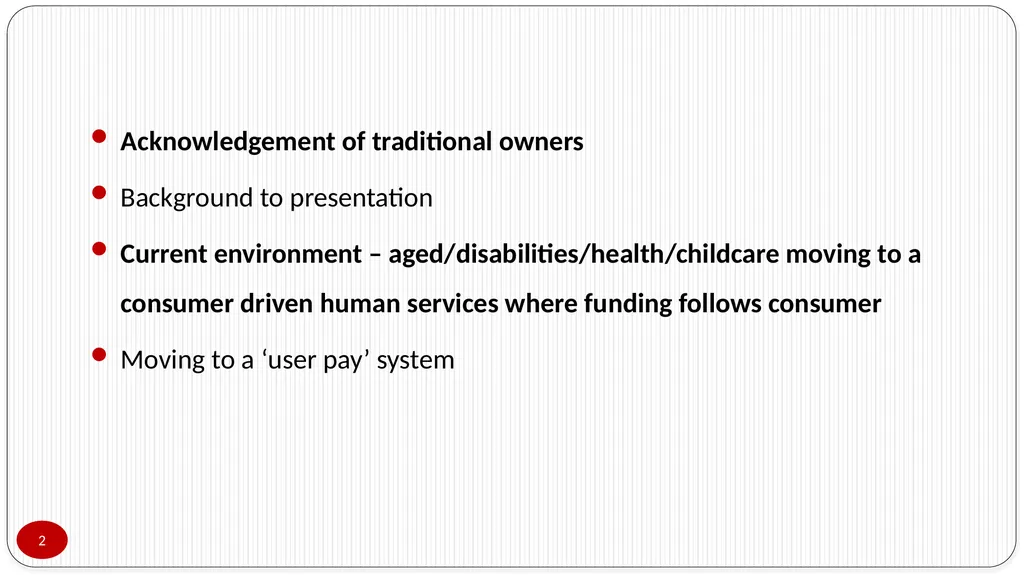
slide2. Acknowledgement of traditional owners
Background to presentation
Current environment – aged/disabilities/health/childcare moving to a consumer driven human services where funding follows consumer
Moving to a ‘user pay’ system 2<br>
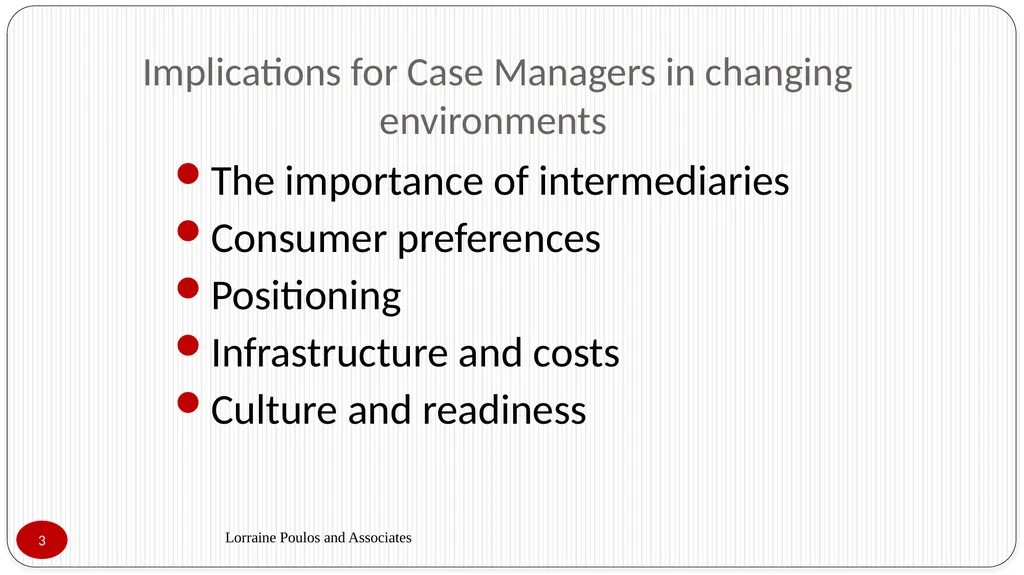
slide3. Implications for Case Managers in changing environments The importance of intermediaries
Consumer preferences
Positioning
Infrastructure and costs
Culture and readiness Lorraine Poulos and Associates 3<br>
slide4. Identified skills 4 The Community Services and Health Industry Skills Council environmental scan 2013/14:
Case management
Care planning
Financial management
Leadership skills
Australian Aged Care Quality Agency INA 2014 confirmed these with the addition of
CDC- budgets, choice, enablement
Quality Customer service
Consumer engagement
Identifying and managing risk<br>
slide5. Current state of play 5 Case Management service type out of CHSP – why ?
RAS- short term re-ablement case management in model – early days
NDIS –planners
CDC – consumers questioning value of ‘Case Management’
Confusion over what it means- co-ordination, rostering, short term/joint/ long term<br>
slide6. Why misunderstanding or lack of ‘value’ 6 Case Management unable to be ‘defined’ by those actually doing it !
Use of jargon when describing to clients particularly those who can self manage
Poor documentation and evidence of timely interventions/support e.g. mental health, aged care
Very poor skills in marketing services and benefits, lack of research/evidence<br>
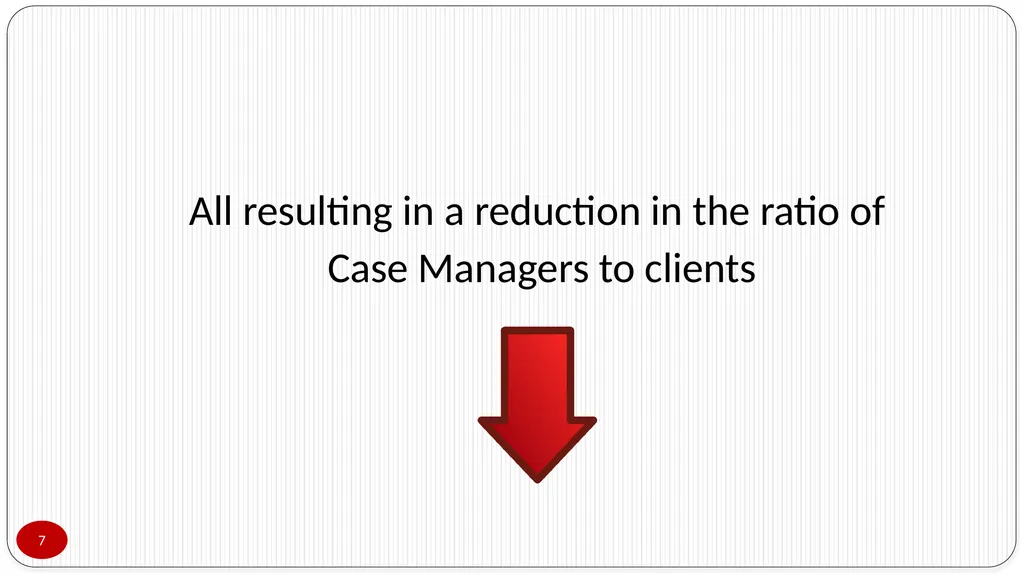
slide7. 7 All resulting in a reduction in the ratio of
Case Managers to clients<br>
slide8. Case Management – CMSA definitions case management is a collaborative process of assessment, planning, facilitation and advocacy for options and services to meet an individual’s holistic needs through communication and available resources to promote quality cost-effective outcomes. CMSA, National Standards of Practice for Case Management, 3rd Edition 2013 8<br>
slide9. Case Management – CMSA definitions Case Management is a process, encompassing a culmination of consecutive collaborative phases, that assist Clients to access available and relevant resources necessary for the Client to attain their identified goals. Key phases within the case management process include: Client identification (screening), assessment, stratifying risk, planning, implementation (care coordination), monitoring, transitioning and evaluation. Within the case management process the Case Manager navigates each phase of the case management process (as applicable) with careful consideration of the client's individual, diverse and special needs, including aspirations, choices, expectations, motivations, preferences and values, and available resources, services and supports.’
CMSA, National Standards of Practice for Case Management, 3rd Edition 2013 9<br>
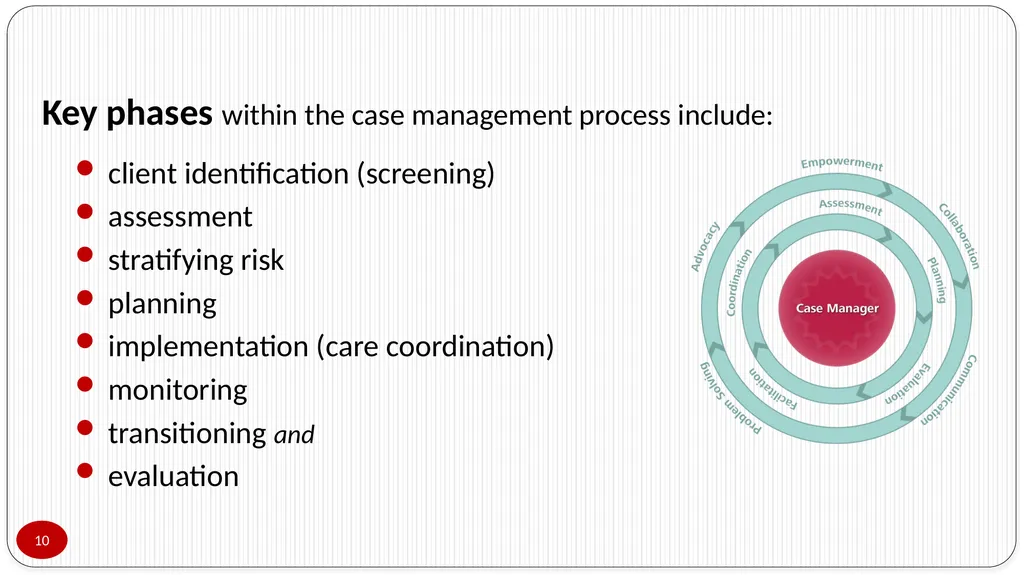
slide10. Key phases within the case management process include: client identification (screening)
assessment
stratifying risk
planning
implementation (care coordination)
monitoring
transitioning and
evaluation 10<br>
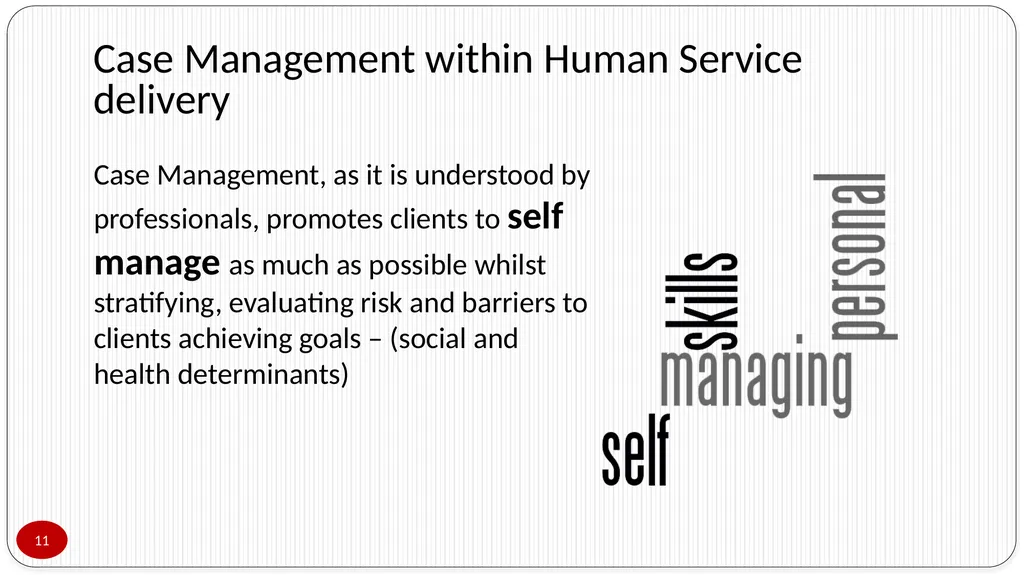
slide11. Case Management within Human Service delivery 11 Case Management, as it is understood by professionals, promotes clients to self manage as much as possible whilst stratifying, evaluating risk and barriers to clients achieving goals – (social and health determinants)<br>
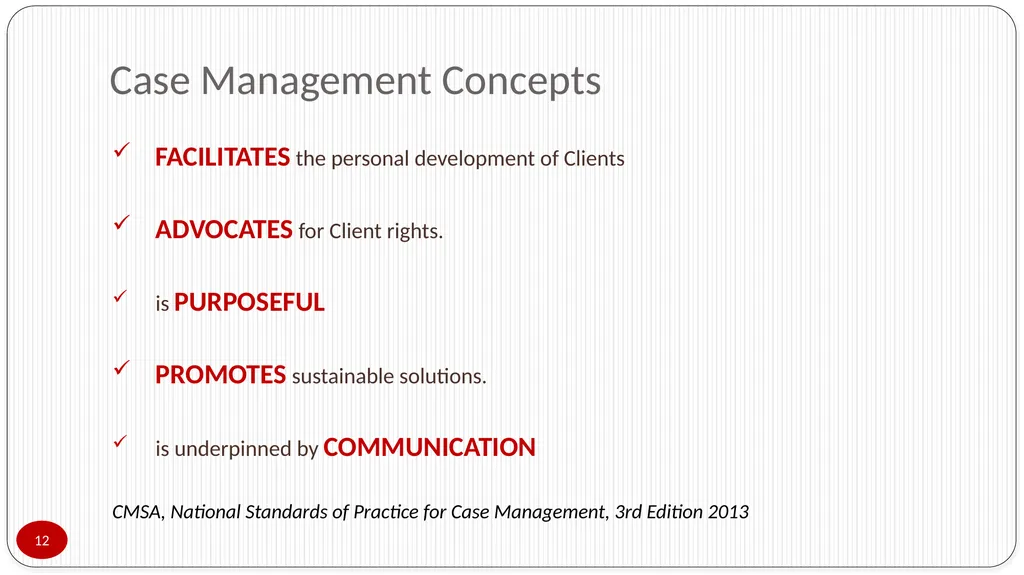
slide12. Case Management Concepts FACILITATES the personal development of Clients
ADVOCATES for Client rights.
is PURPOSEFUL
PROMOTES sustainable solutions.
is underpinned by COMMUNICATION
CMSA, National Standards of Practice for Case Management, 3rd Edition 2013 12<br>
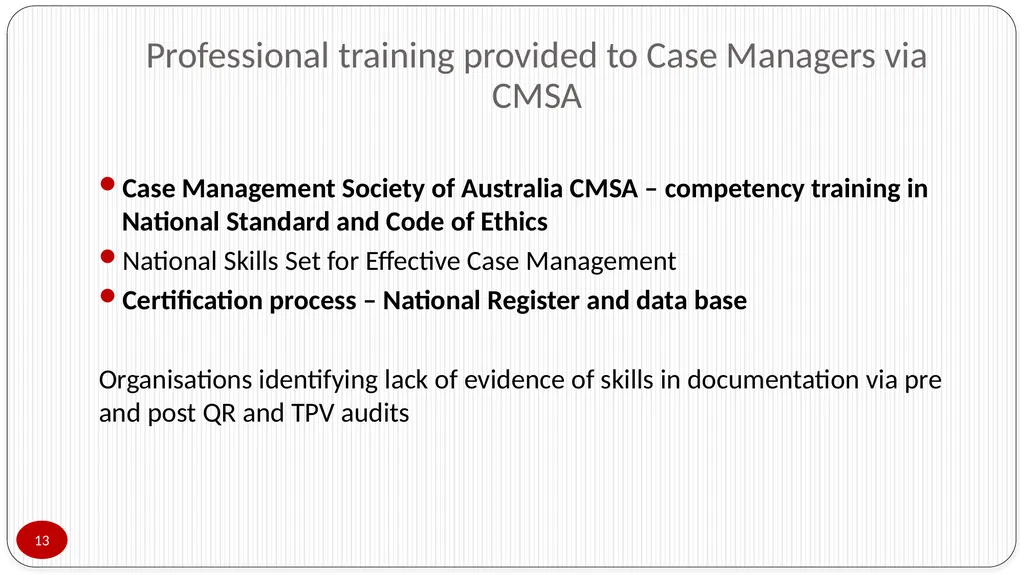
slide13. Professional training provided to Case Managers via CMSA 13 Case Management Society of Australia CMSA – competency training in National Standard and Code of Ethics
National Skills Set for Effective Case Management
Certification process – National Register and data base
Organisations identifying lack of evidence of skills in documentation via pre and post QR and TPV audits<br>
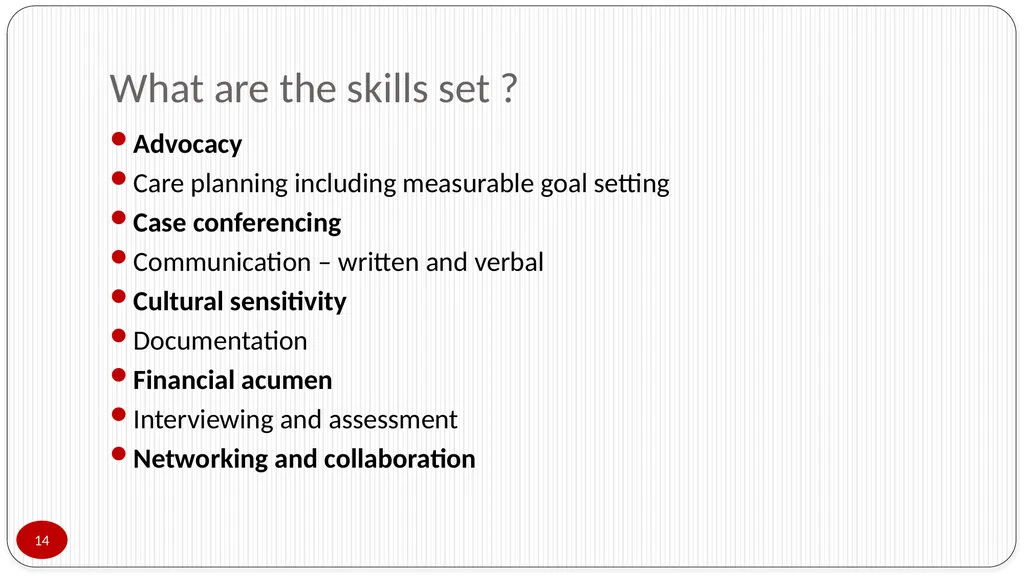
slide14. What are the skills set ? 14 Advocacy
Care planning including measurable goal setting
Case conferencing
Communication – written and verbal
Cultural sensitivity
Documentation
Financial acumen
Interviewing and assessment
Networking and collaboration<br>
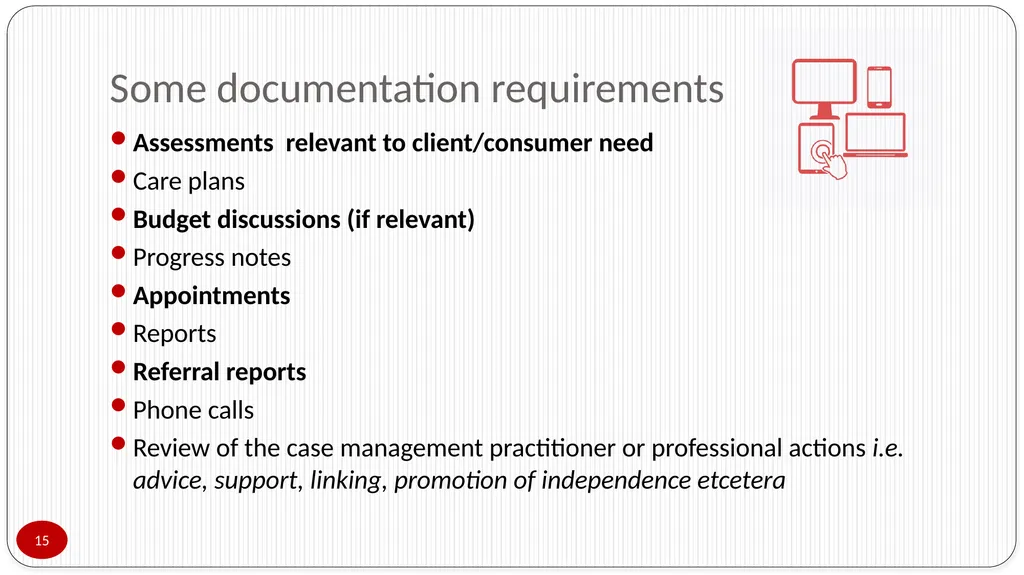
slide15. Some documentation requirements Assessments relevant to client/consumer need
Care plans
Budget discussions (if relevant)
Progress notes
Appointments
Reports
Referral reports
Phone calls
Review of the case management practitioner or professional actions i.e. advice, support, linking, promotion of independence etcetera 15<br>
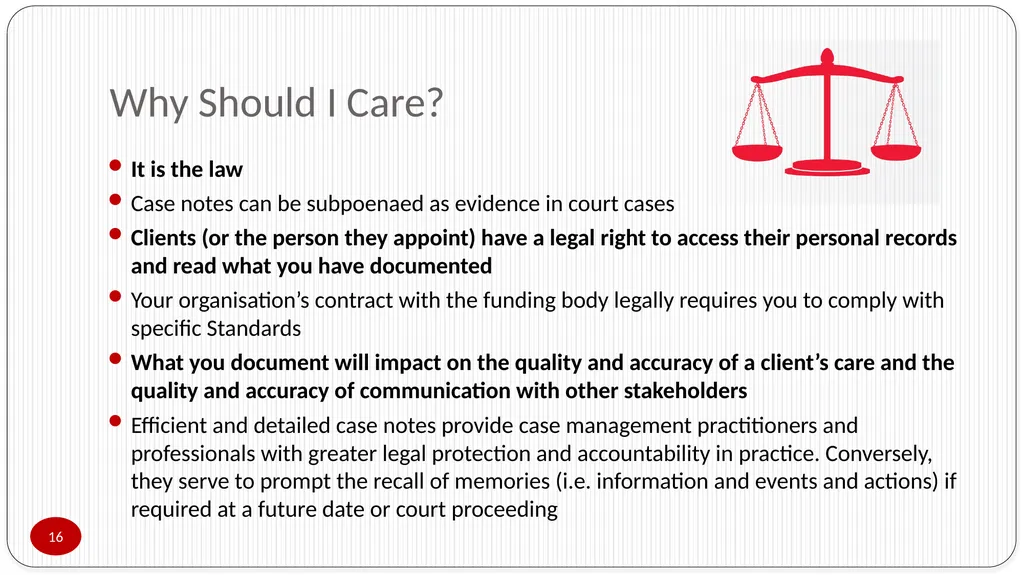
slide16. 16 Why Should I Care? It is the law
Case notes can be subpoenaed as evidence in court cases
Clients (or the person they appoint) have a legal right to access their personal records and read what you have documented
Your organisation’s contract with the funding body legally requires you to comply with specific Standards
What you document will impact on the quality and accuracy of a client’s care and the quality and accuracy of communication with other stakeholders
Efficient and detailed case notes provide case management practitioners and professionals with greater legal protection and accountability in practice. Conversely, they serve to prompt the recall of memories (i.e. information and events and actions) if required at a future date or court proceeding 16<br>
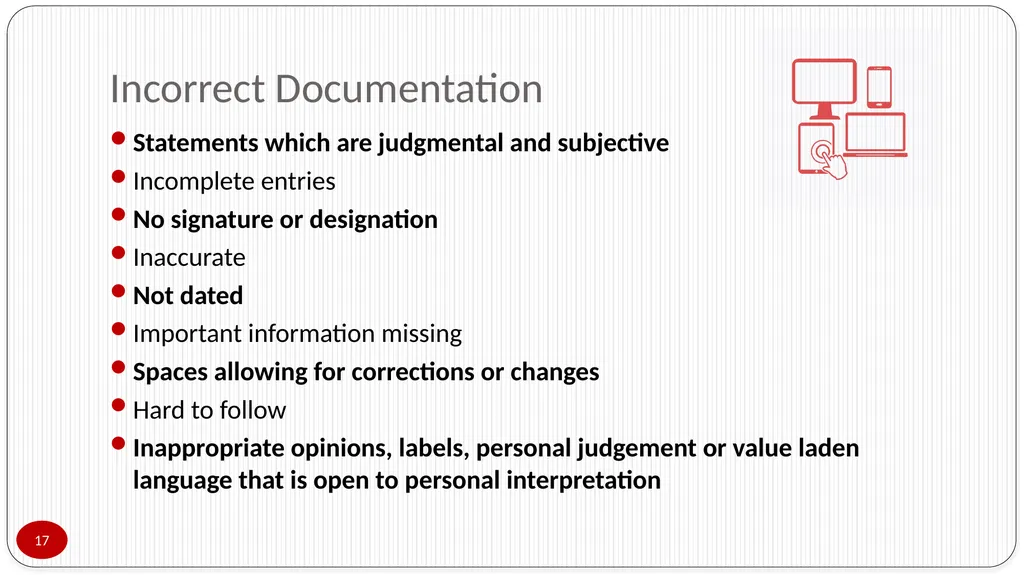
slide17. Incorrect Documentation 17 Statements which are judgmental and subjective
Incomplete entries
No signature or designation
Inaccurate
Not dated
Important information missing
Spaces allowing for corrections or changes
Hard to follow
Inappropriate opinions, labels, personal judgement or value laden language that is open to personal interpretation<br>
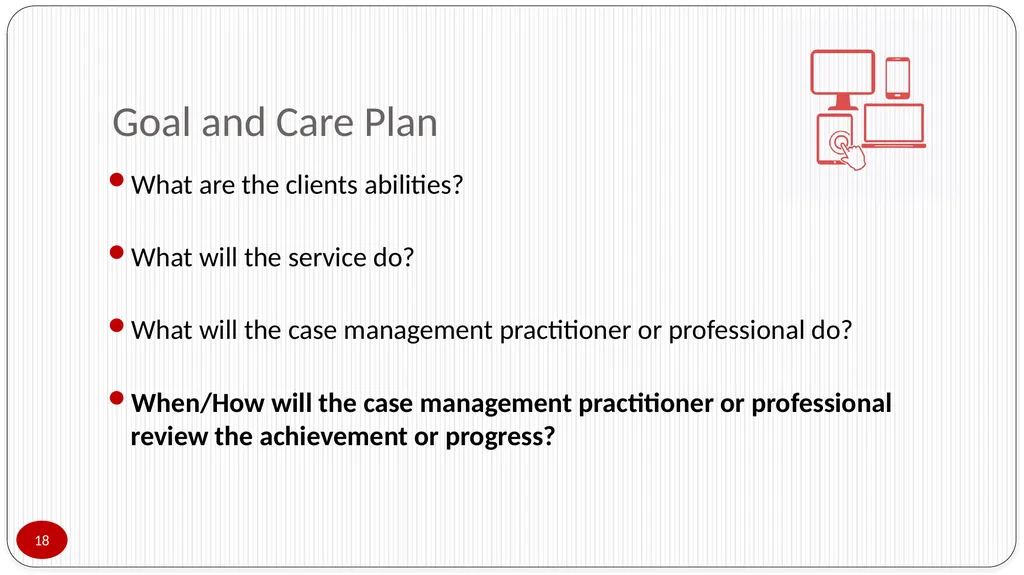
slide18. 18 What are the clients abilities?
What will the service do?
What will the case management practitioner or professional do?
When/How will the case management practitioner or professional review the achievement or progress? Goal and Care Plan<br>
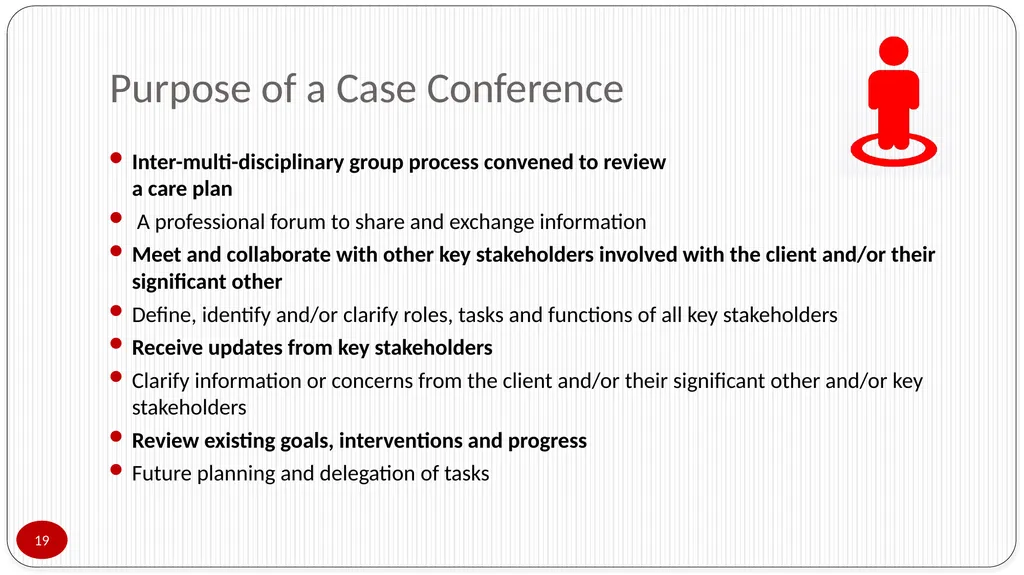
slide19. Purpose of a Case Conference 19 Inter-multi-disciplinary group process convened to review a care plan
A professional forum to share and exchange information
Meet and collaborate with other key stakeholders involved with the client and/or their significant other
Define, identify and/or clarify roles, tasks and functions of all key stakeholders
Receive updates from key stakeholders
Clarify information or concerns from the client and/or their significant other and/or key stakeholders
Review existing goals, interventions and progress
Future planning and delegation of tasks<br>
slide20. Other matters Lorraine Poulos and Associates 20 Case management/core advisory need to be ‘articulated’ on care plans in a meaningful format
Financial conversations
Meaningful solutions
Assistive technologies
Culture change
Fixed cost and variable incomes- case management suffers<br>
slide21. Other matters Lorraine Poulos and Associates 21 Case scenario planning – 50% occupancy
Marketing – needs to ‘sell’ case management
NDIS and CDC – empowered consumers LOVING it !
Home Care today/ NDIS – information for consumers about case management/core advisory
Examples of little or no evidence in files of co-ordination or case management
No system of reviewing files for accuracy and contemporaneous notes
Training expensive
Financial skills of staff<br>
slide22. 22 If we are ‘Case Managing’ we need:
Evidence of all skills via training
Confidence in our abilities
Specialist skill development e.g. dementia, youth issues, restorative care, clinical care
Understand the clients right to choose – dignity of risk/duty of care balances (see Home Care Today website resource)<br>
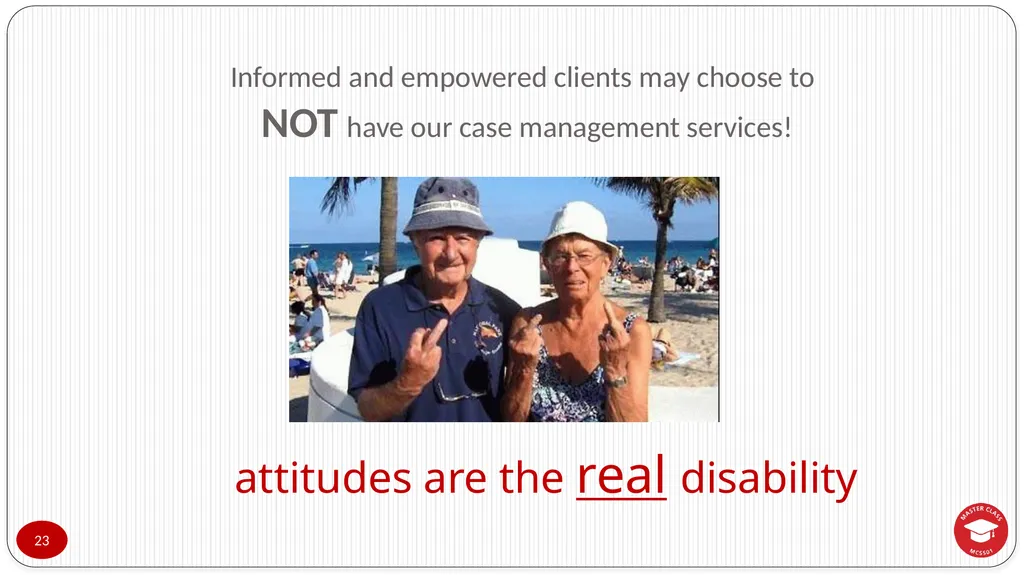
slide23. Informed and empowered clients may choose to NOT have our case management services! 23 attitudes are the real disability<br>
slide24. 24 Thank You
Further details contact
lorraine@lorrainepoulos.com.au Lorraine Poulos and Associates<br>
Lorraine Poulos Professionalising Case Management 1<br>
slide2. Acknowledgement of traditional owners
Background to presentation
Current environment – aged/disabilities/health/childcare moving to a consumer driven human services where funding follows consumer
Moving to a ‘user pay’ system 2<br>
slide3. Implications for Case Managers in changing environments The importance of intermediaries
Consumer preferences
Positioning
Infrastructure and costs
Culture and readiness Lorraine Poulos and Associates 3<br>
slide4. Identified skills 4 The Community Services and Health Industry Skills Council environmental scan 2013/14:
Case management
Care planning
Financial management
Leadership skills
Australian Aged Care Quality Agency INA 2014 confirmed these with the addition of
CDC- budgets, choice, enablement
Quality Customer service
Consumer engagement
Identifying and managing risk<br>
slide5. Current state of play 5 Case Management service type out of CHSP – why ?
RAS- short term re-ablement case management in model – early days
NDIS –planners
CDC – consumers questioning value of ‘Case Management’
Confusion over what it means- co-ordination, rostering, short term/joint/ long term<br>
slide6. Why misunderstanding or lack of ‘value’ 6 Case Management unable to be ‘defined’ by those actually doing it !
Use of jargon when describing to clients particularly those who can self manage
Poor documentation and evidence of timely interventions/support e.g. mental health, aged care
Very poor skills in marketing services and benefits, lack of research/evidence<br>
slide7. 7 All resulting in a reduction in the ratio of
Case Managers to clients<br>
slide8. Case Management – CMSA definitions case management is a collaborative process of assessment, planning, facilitation and advocacy for options and services to meet an individual’s holistic needs through communication and available resources to promote quality cost-effective outcomes. CMSA, National Standards of Practice for Case Management, 3rd Edition 2013 8<br>
slide9. Case Management – CMSA definitions Case Management is a process, encompassing a culmination of consecutive collaborative phases, that assist Clients to access available and relevant resources necessary for the Client to attain their identified goals. Key phases within the case management process include: Client identification (screening), assessment, stratifying risk, planning, implementation (care coordination), monitoring, transitioning and evaluation. Within the case management process the Case Manager navigates each phase of the case management process (as applicable) with careful consideration of the client's individual, diverse and special needs, including aspirations, choices, expectations, motivations, preferences and values, and available resources, services and supports.’
CMSA, National Standards of Practice for Case Management, 3rd Edition 2013 9<br>
slide10. Key phases within the case management process include: client identification (screening)
assessment
stratifying risk
planning
implementation (care coordination)
monitoring
transitioning and
evaluation 10<br>
slide11. Case Management within Human Service delivery 11 Case Management, as it is understood by professionals, promotes clients to self manage as much as possible whilst stratifying, evaluating risk and barriers to clients achieving goals – (social and health determinants)<br>
slide12. Case Management Concepts FACILITATES the personal development of Clients
ADVOCATES for Client rights.
is PURPOSEFUL
PROMOTES sustainable solutions.
is underpinned by COMMUNICATION
CMSA, National Standards of Practice for Case Management, 3rd Edition 2013 12<br>
slide13. Professional training provided to Case Managers via CMSA 13 Case Management Society of Australia CMSA – competency training in National Standard and Code of Ethics
National Skills Set for Effective Case Management
Certification process – National Register and data base
Organisations identifying lack of evidence of skills in documentation via pre and post QR and TPV audits<br>
slide14. What are the skills set ? 14 Advocacy
Care planning including measurable goal setting
Case conferencing
Communication – written and verbal
Cultural sensitivity
Documentation
Financial acumen
Interviewing and assessment
Networking and collaboration<br>
slide15. Some documentation requirements Assessments relevant to client/consumer need
Care plans
Budget discussions (if relevant)
Progress notes
Appointments
Reports
Referral reports
Phone calls
Review of the case management practitioner or professional actions i.e. advice, support, linking, promotion of independence etcetera 15<br>
slide16. 16 Why Should I Care? It is the law
Case notes can be subpoenaed as evidence in court cases
Clients (or the person they appoint) have a legal right to access their personal records and read what you have documented
Your organisation’s contract with the funding body legally requires you to comply with specific Standards
What you document will impact on the quality and accuracy of a client’s care and the quality and accuracy of communication with other stakeholders
Efficient and detailed case notes provide case management practitioners and professionals with greater legal protection and accountability in practice. Conversely, they serve to prompt the recall of memories (i.e. information and events and actions) if required at a future date or court proceeding 16<br>
slide17. Incorrect Documentation 17 Statements which are judgmental and subjective
Incomplete entries
No signature or designation
Inaccurate
Not dated
Important information missing
Spaces allowing for corrections or changes
Hard to follow
Inappropriate opinions, labels, personal judgement or value laden language that is open to personal interpretation<br>
slide18. 18 What are the clients abilities?
What will the service do?
What will the case management practitioner or professional do?
When/How will the case management practitioner or professional review the achievement or progress? Goal and Care Plan<br>
slide19. Purpose of a Case Conference 19 Inter-multi-disciplinary group process convened to review a care plan
A professional forum to share and exchange information
Meet and collaborate with other key stakeholders involved with the client and/or their significant other
Define, identify and/or clarify roles, tasks and functions of all key stakeholders
Receive updates from key stakeholders
Clarify information or concerns from the client and/or their significant other and/or key stakeholders
Review existing goals, interventions and progress
Future planning and delegation of tasks<br>
slide20. Other matters Lorraine Poulos and Associates 20 Case management/core advisory need to be ‘articulated’ on care plans in a meaningful format
Financial conversations
Meaningful solutions
Assistive technologies
Culture change
Fixed cost and variable incomes- case management suffers<br>
slide21. Other matters Lorraine Poulos and Associates 21 Case scenario planning – 50% occupancy
Marketing – needs to ‘sell’ case management
NDIS and CDC – empowered consumers LOVING it !
Home Care today/ NDIS – information for consumers about case management/core advisory
Examples of little or no evidence in files of co-ordination or case management
No system of reviewing files for accuracy and contemporaneous notes
Training expensive
Financial skills of staff<br>
slide22. 22 If we are ‘Case Managing’ we need:
Evidence of all skills via training
Confidence in our abilities
Specialist skill development e.g. dementia, youth issues, restorative care, clinical care
Understand the clients right to choose – dignity of risk/duty of care balances (see Home Care Today website resource)<br>
slide23. Informed and empowered clients may choose to NOT have our case management services! 23 attitudes are the real disability<br>
slide24. 24 Thank You
Further details contact
lorraine@lorrainepoulos.com.au Lorraine Poulos and Associates<br>