
Presented by: Marc Russo, NCCA SURF Process Update
Description: Presented by: Marc Russo, NCCA SURF Process Update and 2017 Review This document was generated as a result of the AFCAA-led, Software Resource Data Report Working Group (SRDRWG). This working group represented a joint effort amongst all DoD
Related Topics
Download Presentation
"Presented by: Marc Russo, NCCA SURF Process Update" is the property of its rightful owner. Permission is granted to download and print the materials on this website for personal, non-commercial use only, and to display it on your personal computer provided you do not modify the materials and that you retain all copyright notices contained in the materials. By downloading content from our website, you accept the terms of this agreement.
Presentation Transcript
slide1. Presented by:
Marc Russo, NCCA SURF Process Update and 2017 Review This document was generated as a result of the AFCAA-led, Software Resource Data Report Working Group (SRDRWG). This working group represented a joint effort amongst all DoD service cost agencies. The following guidance describes SRDR data verification and validation best practices as documented by NCCA, NAVAIR 4.2, AFCAA, ODASA-CE, MDA, and many more.<br>
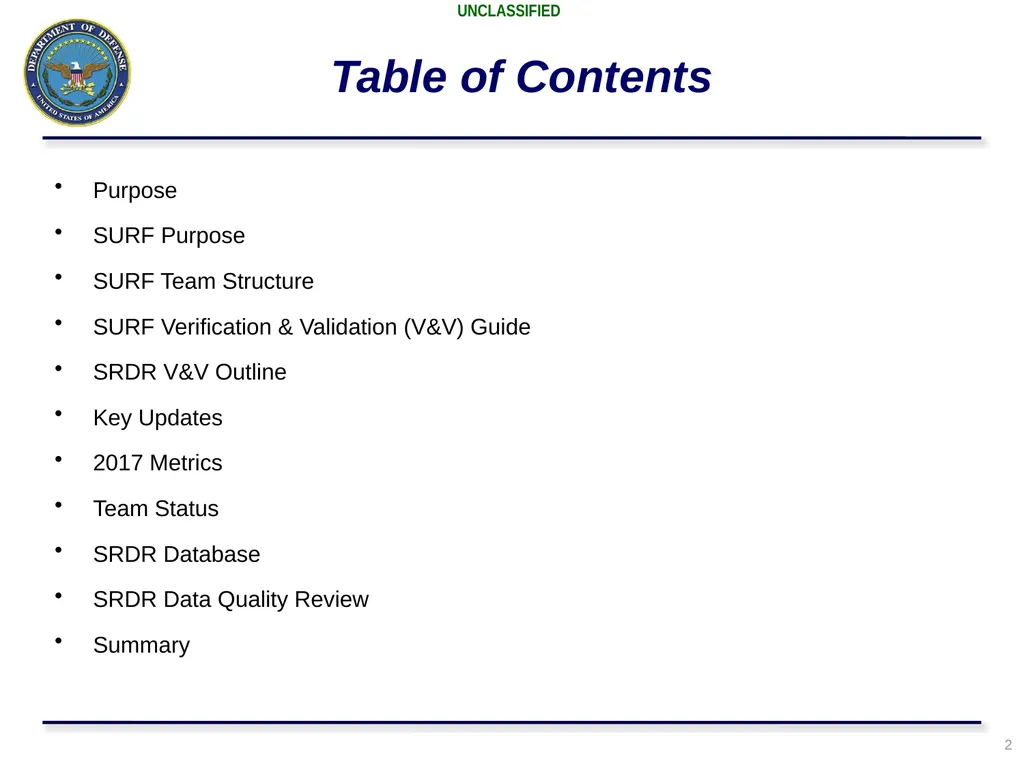
slide2. 2 Purpose
SURF Purpose
SURF Team Structure
SURF Verification & Validation (V&V) Guide
SRDR V&V Outline
Key Updates
2017 Metrics
Team Status
SRDR Database
SRDR Data Quality Review
Summary Table of Contents<br>
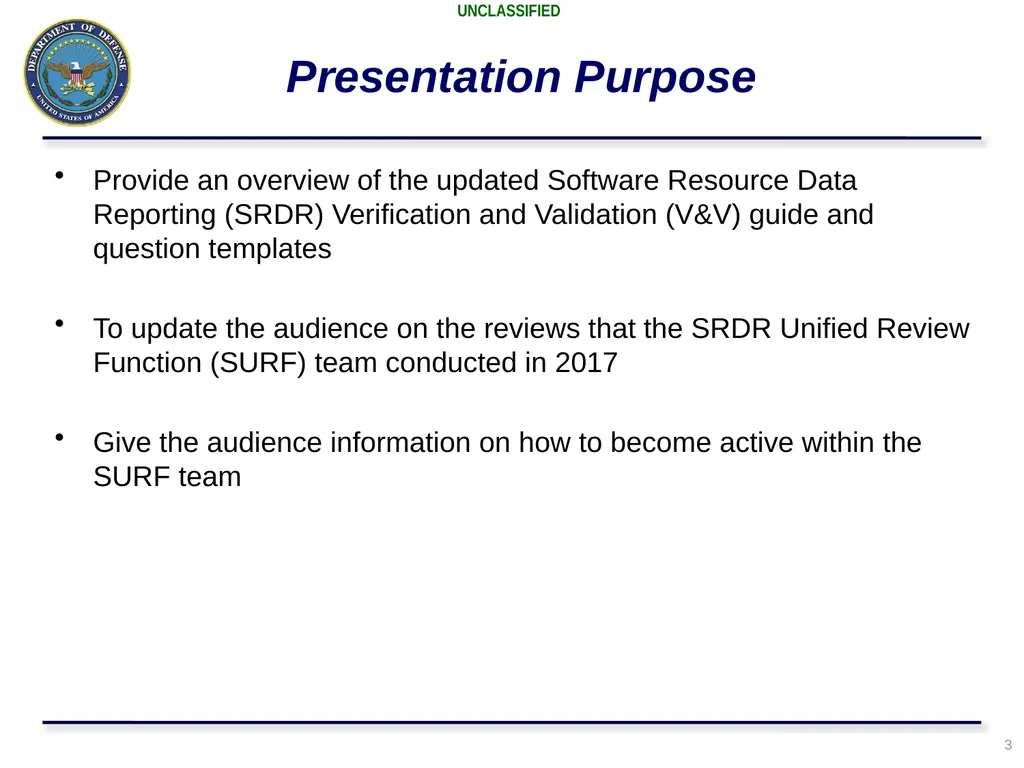
slide3. 3 Provide an overview of the updated Software Resource Data Reporting (SRDR) Verification and Validation (V&V) guide and question templates
To update the audience on the reviews that the SRDR Unified Review Function (SURF) team conducted in 2017
Give the audience information on how to become active within the SURF team Presentation Purpose<br>
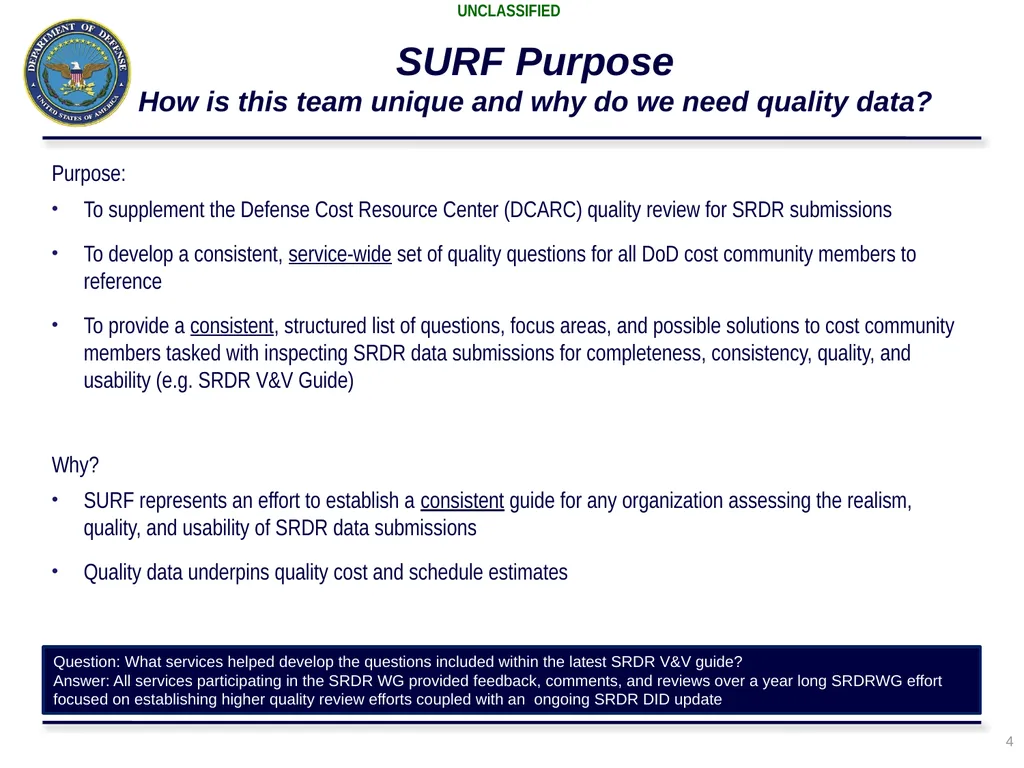
slide4. SURF Purpose How is this team unique and why do we need quality data? 4 Purpose:
To supplement the Defense Cost Resource Center (DCARC) quality review for SRDR submissions
To develop a consistent, service-wide set of quality questions for all DoD cost community members to reference
To provide a consistent, structured list of questions, focus areas, and possible solutions to cost community members tasked with inspecting SRDR data submissions for completeness, consistency, quality, and usability (e.g. SRDR V&V Guide)
Why?
SURF represents an effort to establish a consistent guide for any organization assessing the realism, quality, and usability of SRDR data submissions
Quality data underpins quality cost and schedule estimates Question: What services helped develop the questions included within the latest SRDR V&V guide?
Answer: All services participating in the SRDR WG provided feedback, comments, and reviews over a year long SRDRWG effort focused on establishing higher quality review efforts coupled with an ongoing SRDR DID update<br>
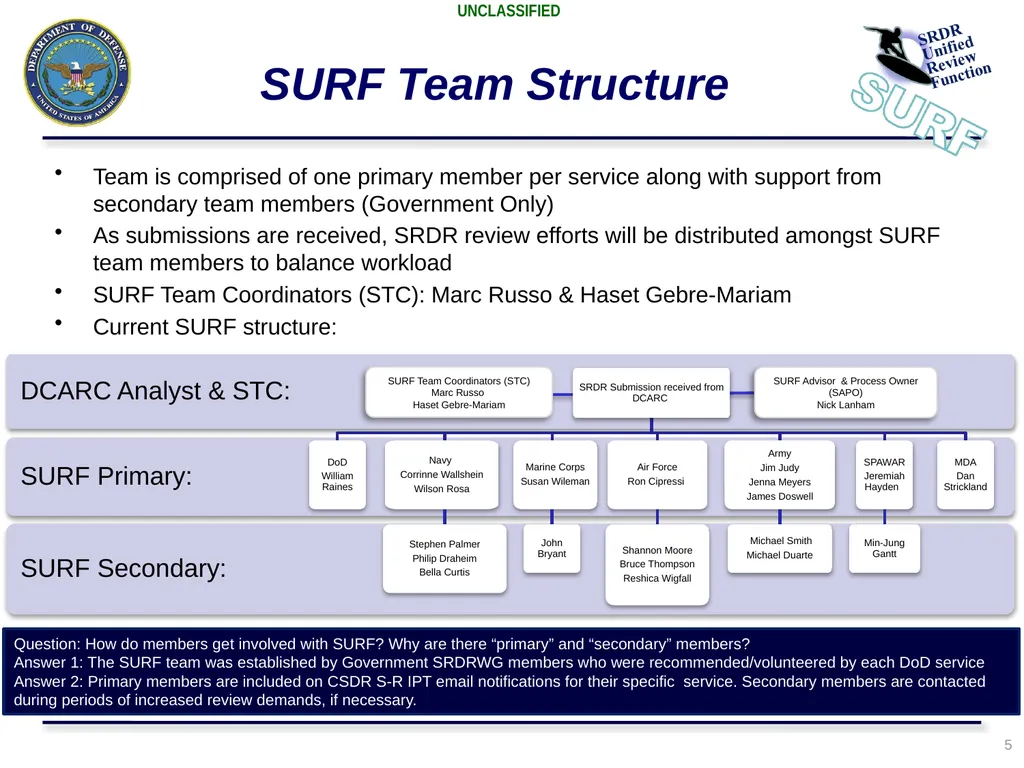
slide5. SURF Secondary: SURF Primary: DCARC Analyst & STC: DoD
William Raines Navy
Corrinne Wallshein
Wilson Rosa Stephen Palmer
Philip Draheim
Bella Curtis Marine Corps
Susan Wileman John Bryant Air Force
Ron Cipressi Shannon Moore
Bruce Thompson
Reshica Wigfall Army
Jim Judy
Jenna Meyers
James Doswell Michael Smith
Michael Duarte SPAWAR
Jeremiah Hayden Min-Jung Gantt MDA
Dan Strickland SURF Team Structure 5 Team is comprised of one primary member per service along with support from secondary team members (Government Only)
As submissions are received, SRDR review efforts will be distributed amongst SURF team members to balance workload
SURF Team Coordinators (STC): Marc Russo & Haset Gebre-Mariam
Current SURF structure: Question: How do members get involved with SURF? Why are there “primary” and “secondary” members?
Answer 1: The SURF team was established by Government SRDRWG members who were recommended/volunteered by each DoD service
Answer 2: Primary members are included on CSDR S-R IPT email notifications for their specific service. Secondary members are contacted during periods of increased review demands, if necessary. SURF Team Coordinators (STC)
Marc Russo
Haset Gebre-Mariam SURF Advisor & Process Owner (SAPO)
Nick Lanham SRDR Submission received from DCARC<br>
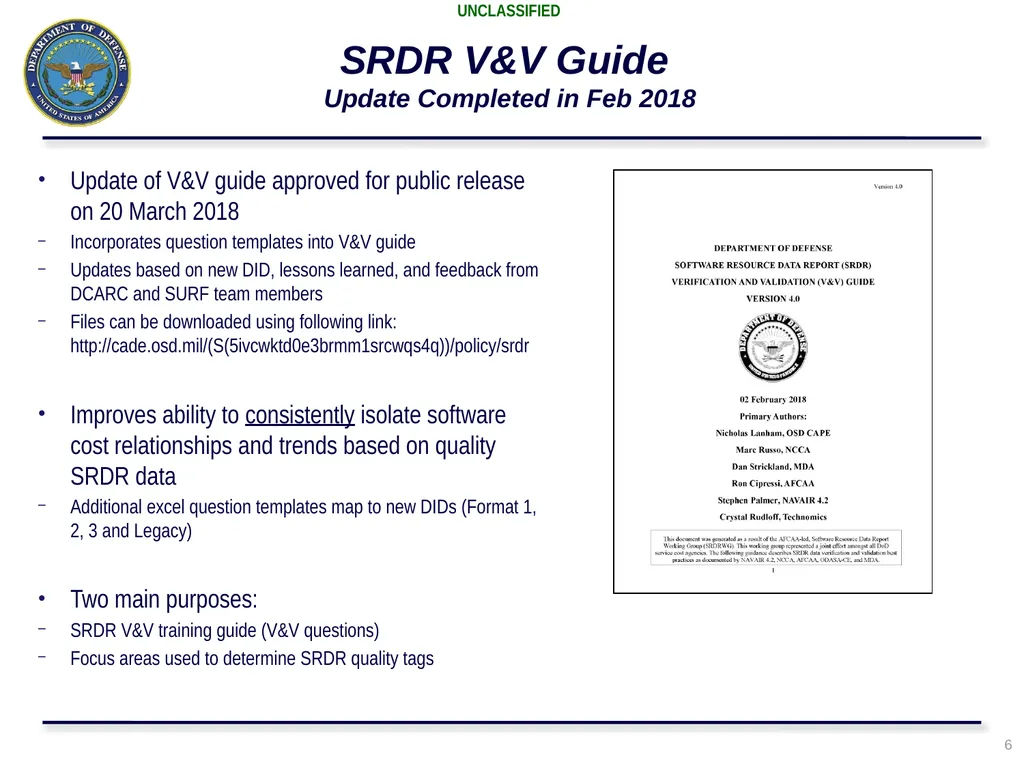
slide6. SRDR V&V Guide Update Completed in Feb 2018 6 Update of V&V guide approved for public release on 20 March 2018
Incorporates question templates into V&V guide
Updates based on new DID, lessons learned, and feedback from DCARC and SURF team members
Files can be downloaded using following link: http://cade.osd.mil/(S(5ivcwktd0e3brmm1srcwqs4q))/policy/srdr
Improves ability to consistently isolate software cost relationships and trends based on quality SRDR data
Additional excel question templates map to new DIDs (Format 1, 2, 3 and Legacy)
Two main purposes:
SRDR V&V training guide (V&V questions)
Focus areas used to determine SRDR quality tags<br>
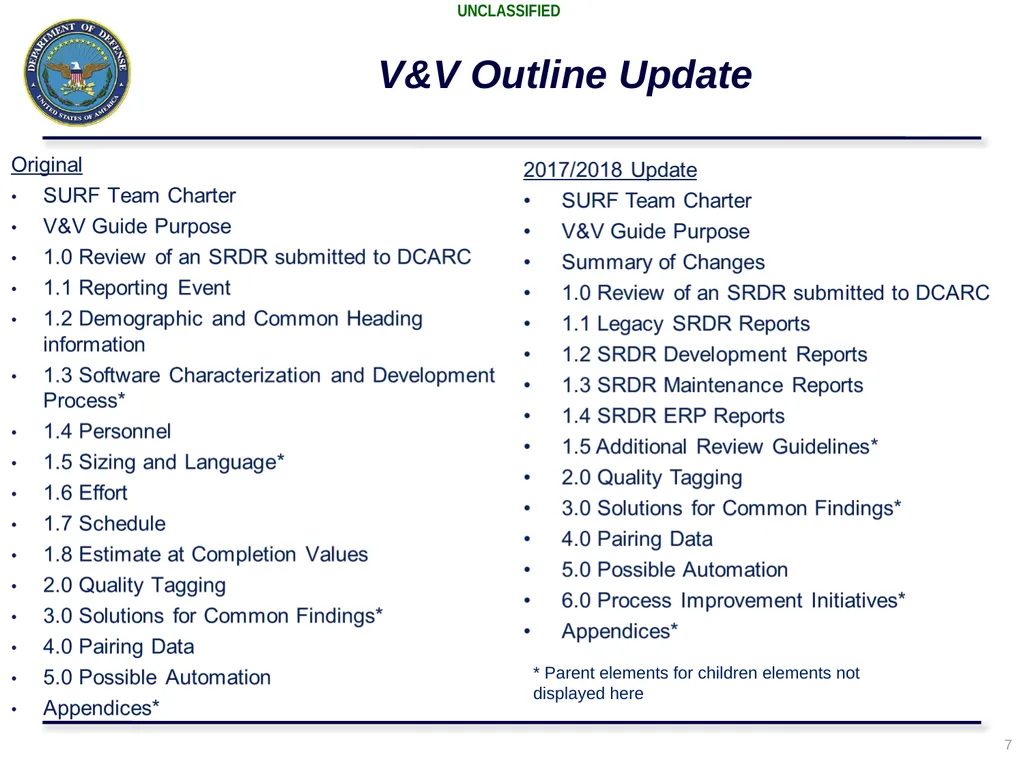
slide7. V&V Outline Update 7 * Parent elements for children elements not displayed here<br>
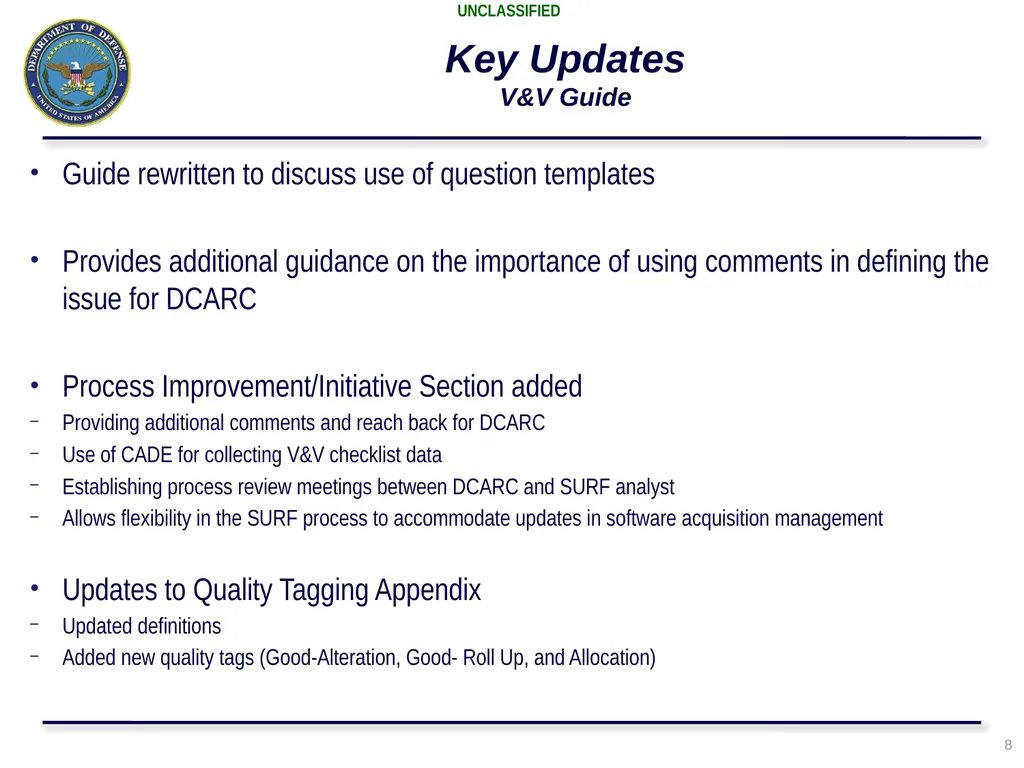
slide8. Guide rewritten to discuss use of question templates
Provides additional guidance on the importance of using comments in defining the issue for DCARC
Process Improvement/Initiative Section added
Providing additional comments and reach back for DCARC
Use of CADE for collecting V&V checklist data
Establishing process review meetings between DCARC and SURF analyst
Allows flexibility in the SURF process to accommodate updates in software acquisition management
Updates to Quality Tagging Appendix
Updated definitions
Added new quality tags (Good-Alteration, Good- Roll Up, and Allocation) Key Updates V&V Guide 8<br>
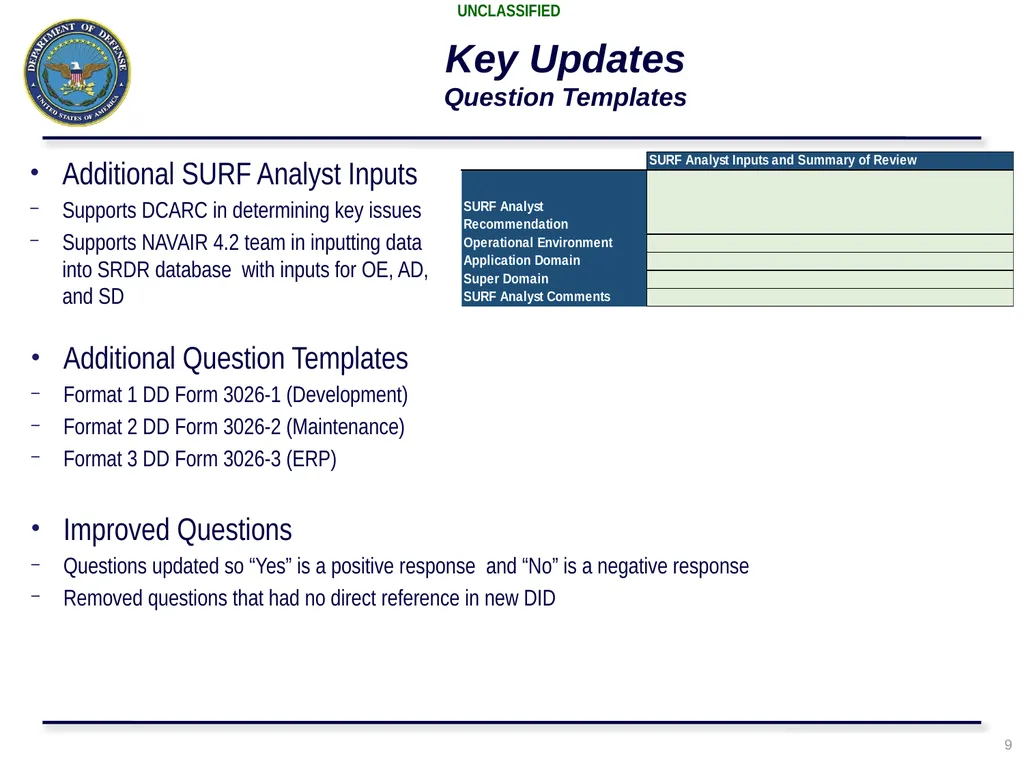
slide9. Key Updates Question Templates Additional SURF Analyst Inputs
Supports DCARC in determining key issues
Supports NAVAIR 4.2 team in inputting data into SRDR database with inputs for OE, AD, and SD 9 Additional Question Templates
Format 1 DD Form 3026-1 (Development)
Format 2 DD Form 3026-2 (Maintenance)
Format 3 DD Form 3026-3 (ERP)
Improved Questions
Questions updated so “Yes” is a positive response and “No” is a negative response
Removed questions that had no direct reference in new DID<br>
slide10. 2017 Metrics 10<br>
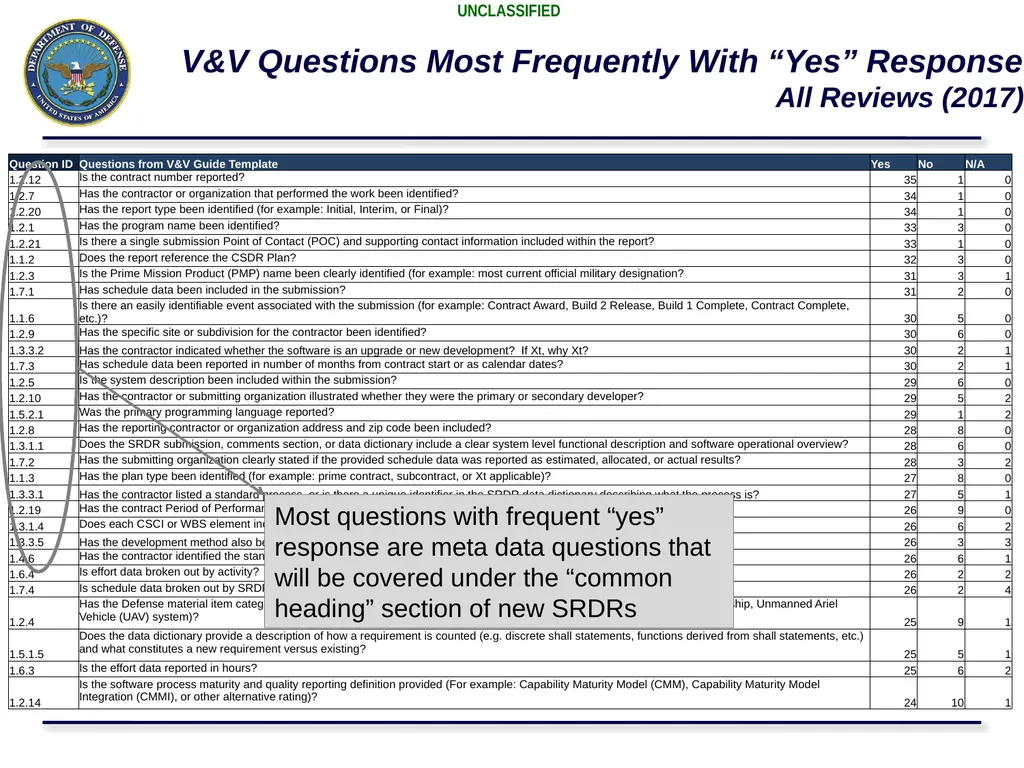
slide11. V&V Questions Most Frequently With “Yes” Response All Reviews (2017) Most questions with frequent “yes” response are meta data questions that will be covered under the “common heading” section of new SRDRs<br>
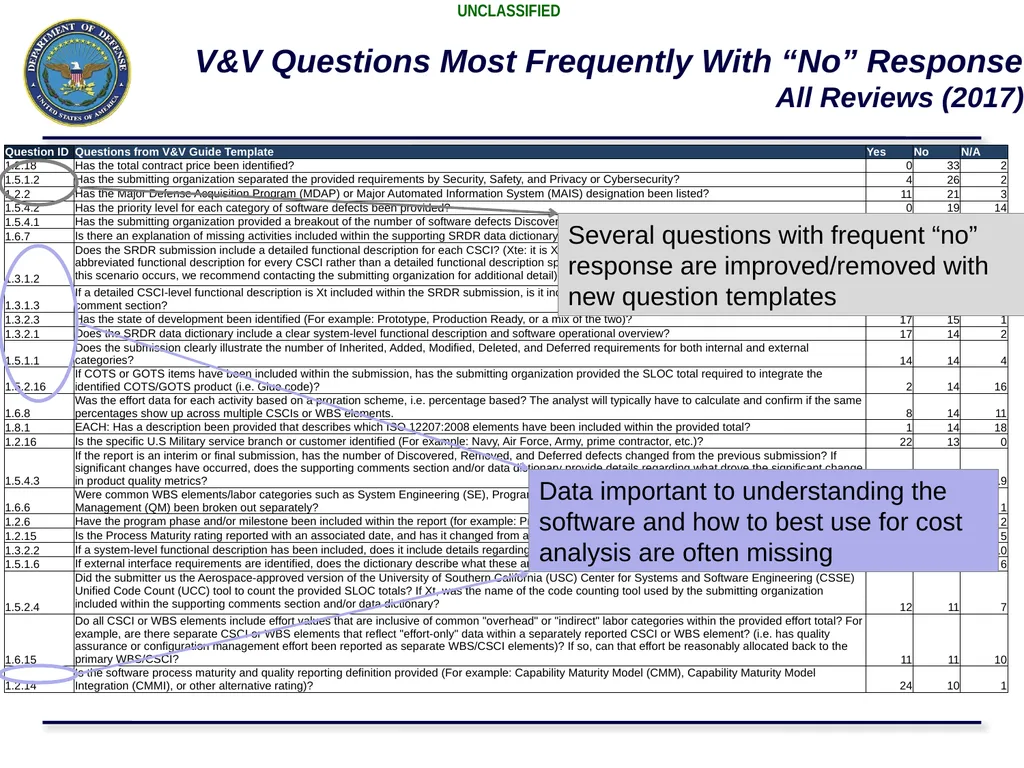
slide12. V&V Questions Most Frequently With “No” Response All Reviews (2017) Several questions with frequent “no” response are improved/removed with new question templates Data important to understanding the software and how to best use for cost analysis are often missing<br>
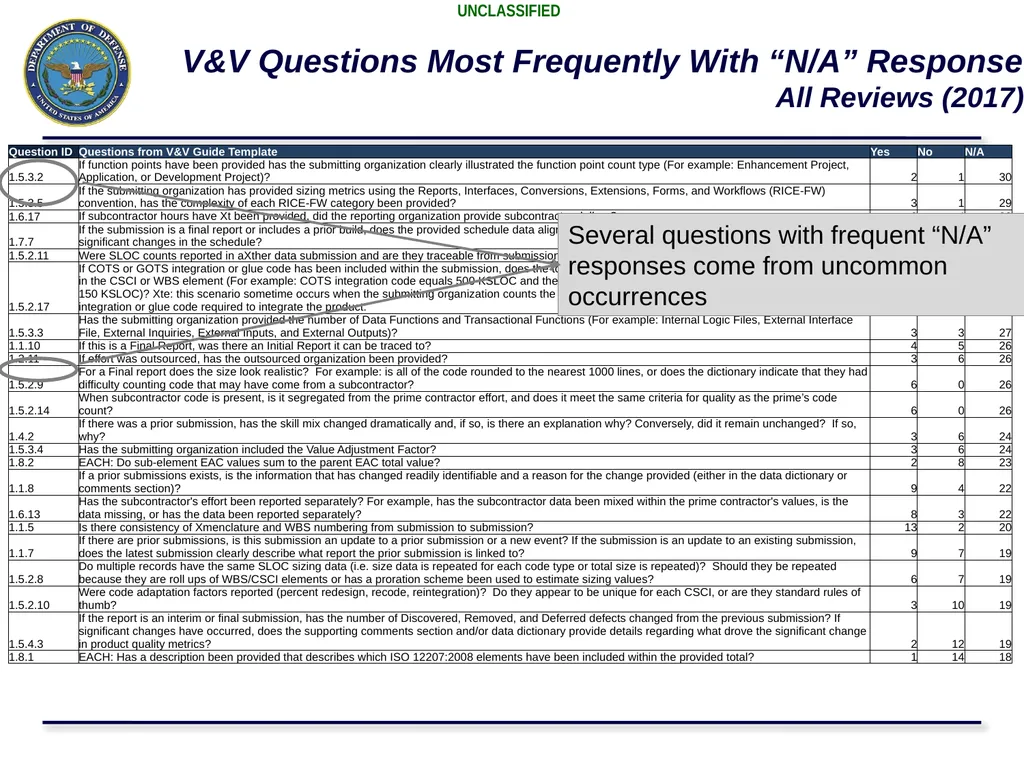
slide13. V&V Questions Most Frequently With “N/A” Response All Reviews (2017) Several questions with frequent “N/A” responses come from uncommon occurrences<br>
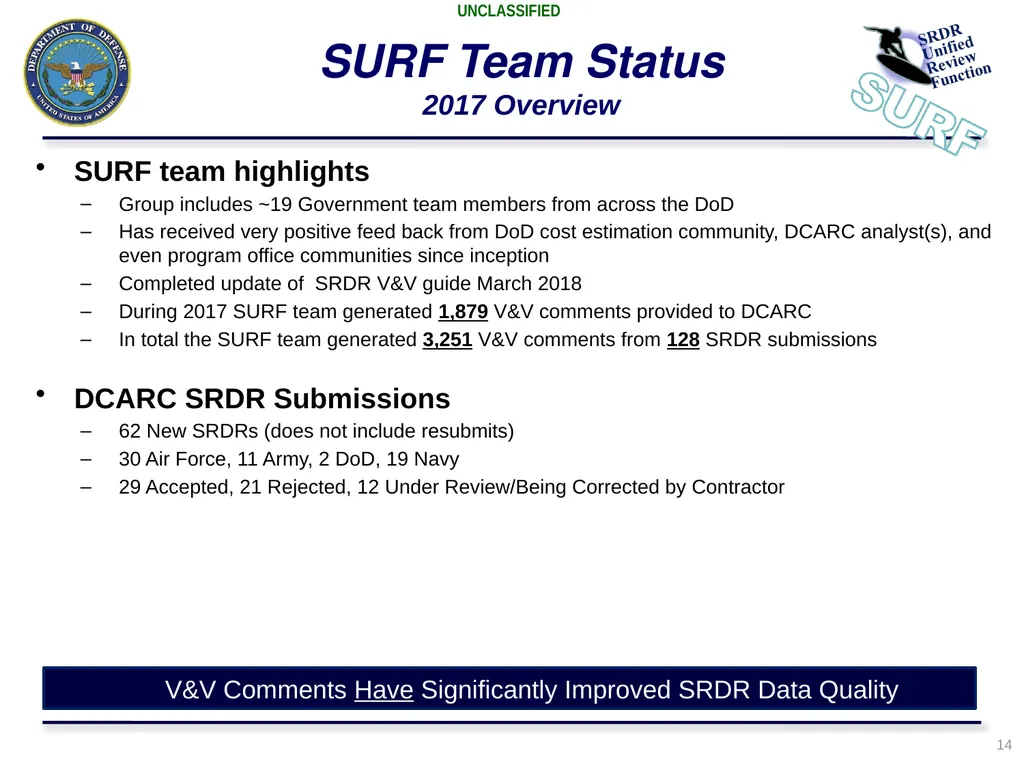
slide14. 14 SURF team highlights
Group includes ~19 Government team members from across the DoD
Has received very positive feed back from DoD cost estimation community, DCARC analyst(s), and even program office communities since inception
Completed update of SRDR V&V guide March 2018
During 2017 SURF team generated 1,879 V&V comments provided to DCARC
In total the SURF team generated 3,251 V&V comments from 128 SRDR submissions
DCARC SRDR Submissions
62 New SRDRs (does not include resubmits)
30 Air Force, 11 Army, 2 DoD, 19 Navy
29 Accepted, 21 Rejected, 12 Under Review/Being Corrected by Contractor V&V Comments Have Significantly Improved SRDR Data Quality SURF Team Status
2017 Overview<br>
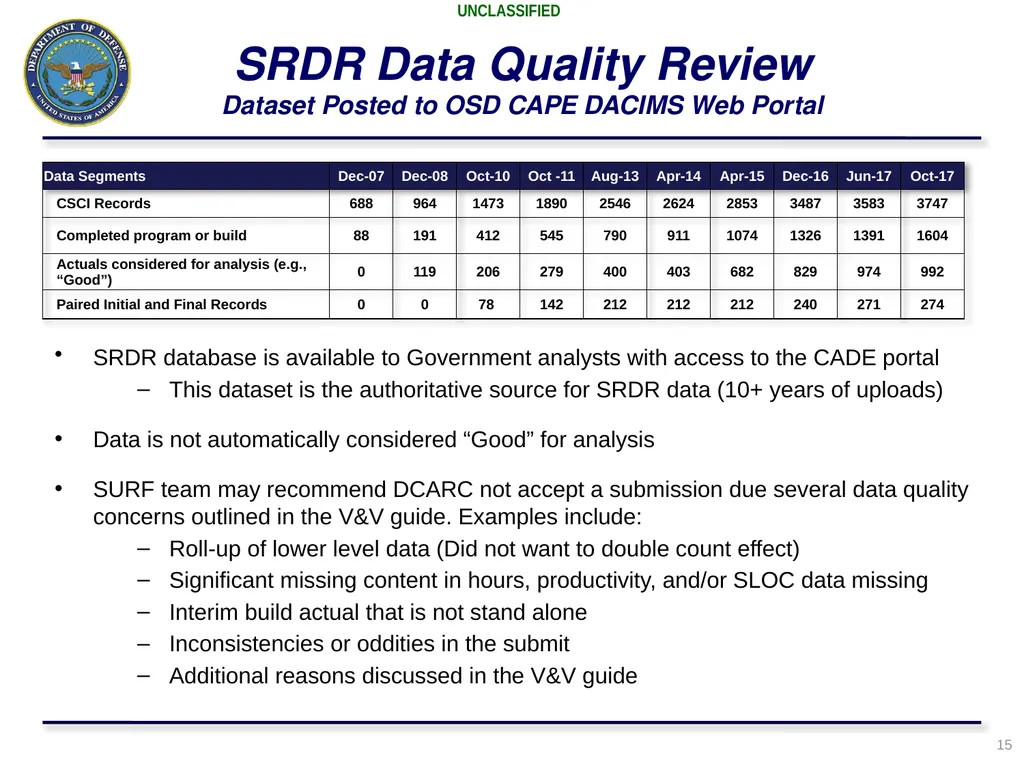
slide15. SRDR database is available to Government analysts with access to the CADE portal
This dataset is the authoritative source for SRDR data (10+ years of uploads)
Data is not automatically considered “Good” for analysis
SURF team may recommend DCARC not accept a submission due several data quality concerns outlined in the V&V guide. Examples include:
Roll-up of lower level data (Did not want to double count effect)
Significant missing content in hours, productivity, and/or SLOC data missing
Interim build actual that is not stand alone
Inconsistencies or oddities in the submit
Additional reasons discussed in the V&V guide 15 SRDR Data Quality Review
Dataset Posted to OSD CAPE DACIMS Web Portal<br>
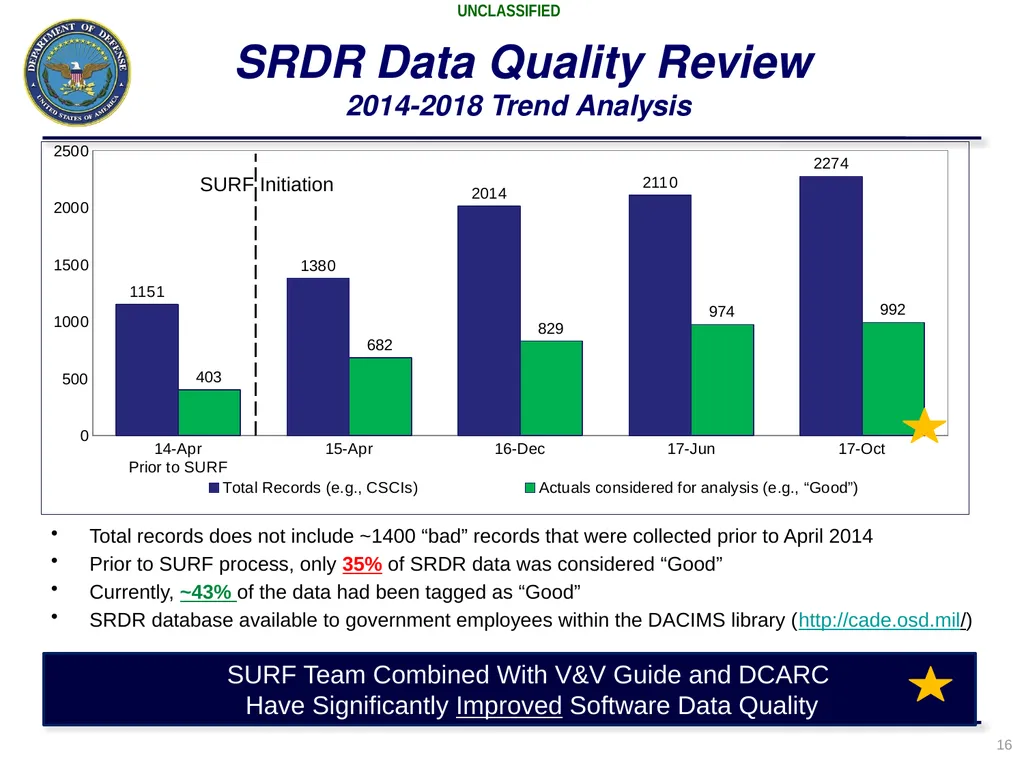
slide16. Total records does not include ~1400 “bad” records that were collected prior to April 2014
Prior to SURF process, only 35% of SRDR data was considered “Good”
Currently, ~43% of the data had been tagged as “Good”
SRDR database available to government employees within the DACIMS library (http://cade.osd.mil/) 16 SRDR Data Quality Review
2014-2018 Trend Analysis SURF Team Combined With V&V Guide and DCARC
Have Significantly Improved Software Data Quality SURF Initiation<br>
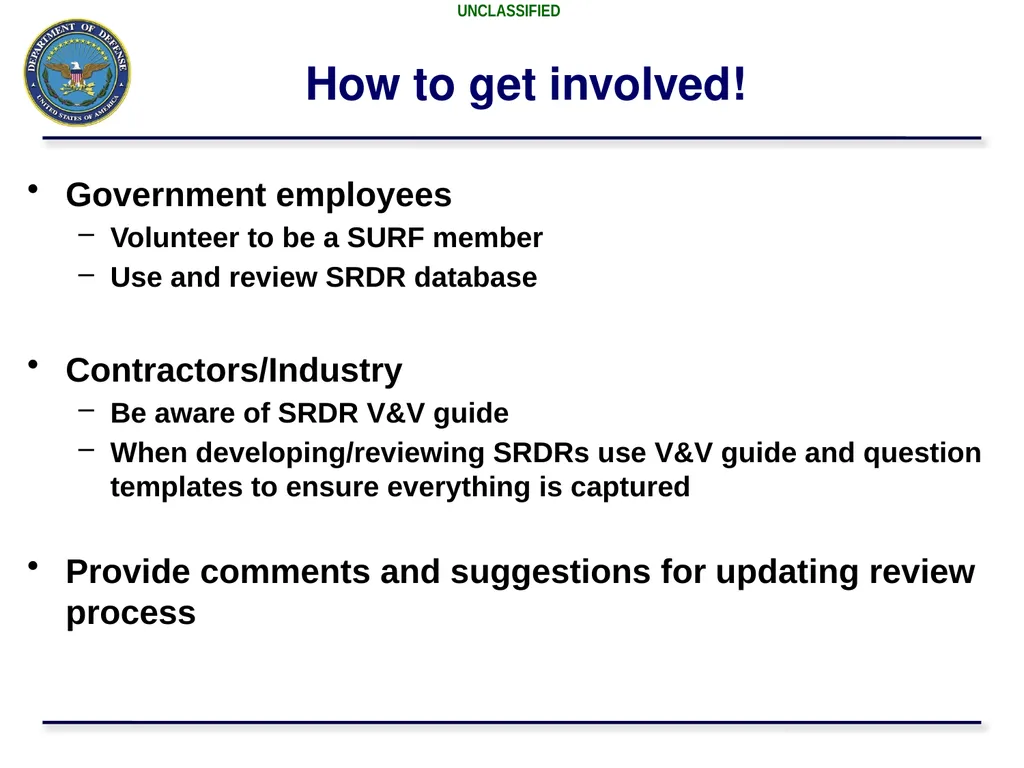
slide17. How to get involved! Government employees
Volunteer to be a SURF member
Use and review SRDR database
Contractors/Industry
Be aware of SRDR V&V guide
When developing/reviewing SRDRs use V&V guide and question templates to ensure everything is captured
Provide comments and suggestions for updating review process<br>
slide18. 18 SURF Summary SURF is focused on improving data quality and helping support robust Government review process
We would like to thank all of the DoD and Non-DoD individuals who have commented, participated, and provided feedback throughout the past few years
Please feel free to use the contact information below if you would like more information regarding SURF, the SRDR V&V Guide, or checklist Marc Russo
Naval Center for Cost Analysis (NCCA)
NIPR: Marc.russo1@navy.mil
Ron Cipressi
Air Force Cost Analysis Agency
NIPR: Ronald.p.cipressi.civ@mail.mil
Nicholas Lanham
Office of Secretary of Defense
Cost Assessment and Program Evaluations
NIPR: Nicholas.a.lanham.civ@mail.mil
Dan Strickland
Missile Defense Agency (MDA)
NIPR: Daniel.strickland@mda.mil<br>
slide19. BACK-UP 19<br>
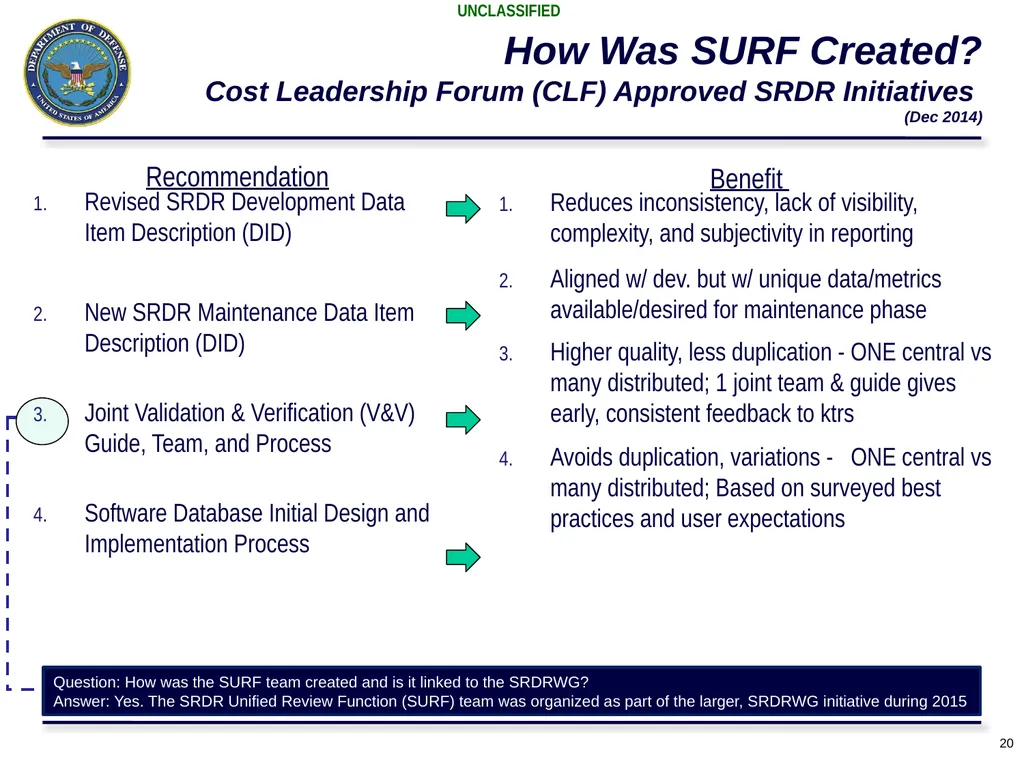
slide20. How Was SURF Created? Cost Leadership Forum (CLF) Approved SRDR Initiatives (Dec 2014) Recommendation Revised SRDR Development Data Item Description (DID)
New SRDR Maintenance Data Item Description (DID)
Joint Validation & Verification (V&V) Guide, Team, and Process
Software Database Initial Design and Implementation Process Benefit Reduces inconsistency, lack of visibility, complexity, and subjectivity in reporting
Aligned w/ dev. but w/ unique data/metrics available/desired for maintenance phase
Higher quality, less duplication - ONE central vs many distributed; 1 joint team & guide gives early, consistent feedback to ktrs
Avoids duplication, variations - ONE central vs many distributed; Based on surveyed best practices and user expectations 20 Question: How was the SURF team created and is it linked to the SRDRWG?
Answer: Yes. The SRDR Unified Review Function (SURF) team was organized as part of the larger, SRDRWG initiative during 2015<br>
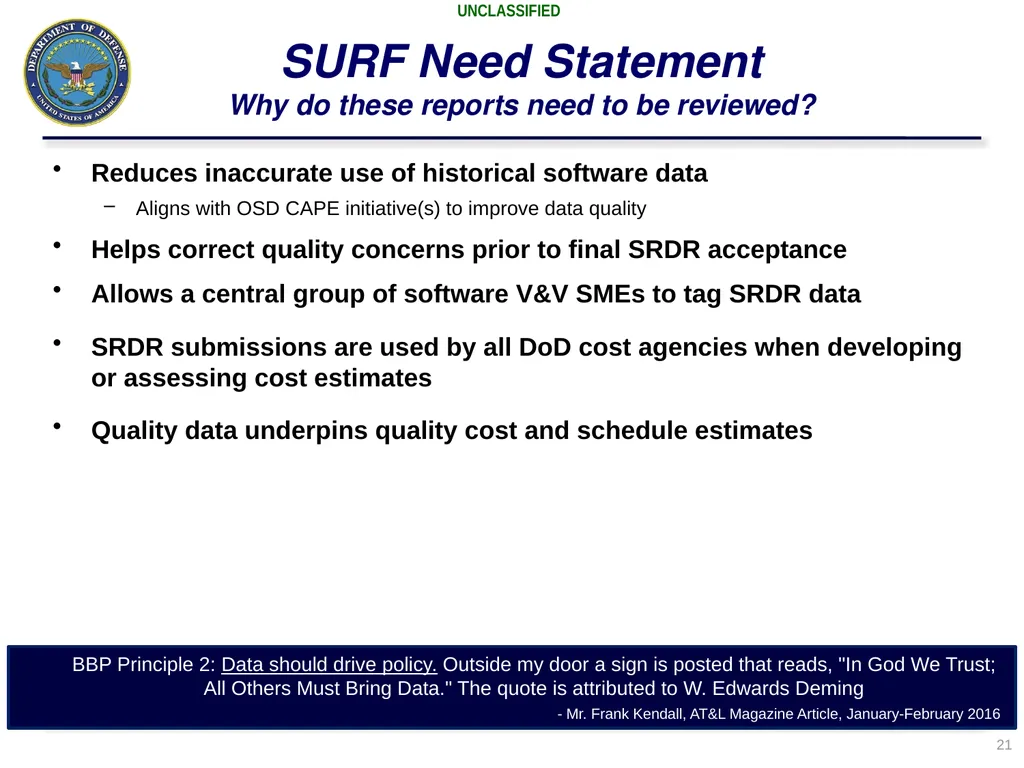
slide21. 21 SURF Need Statement
Why do these reports need to be reviewed? Reduces inaccurate use of historical software data
Aligns with OSD CAPE initiative(s) to improve data quality
Helps correct quality concerns prior to final SRDR acceptance
Allows a central group of software V&V SMEs to tag SRDR data
SRDR submissions are used by all DoD cost agencies when developing or assessing cost estimates
Quality data underpins quality cost and schedule estimates BBP Principle 2: Data should drive policy. Outside my door a sign is posted that reads, "In God We Trust; All Others Must Bring Data." The quote is attributed to W. Edwards Deming
- Mr. Frank Kendall, AT&L Magazine Article, January-February 2016<br>
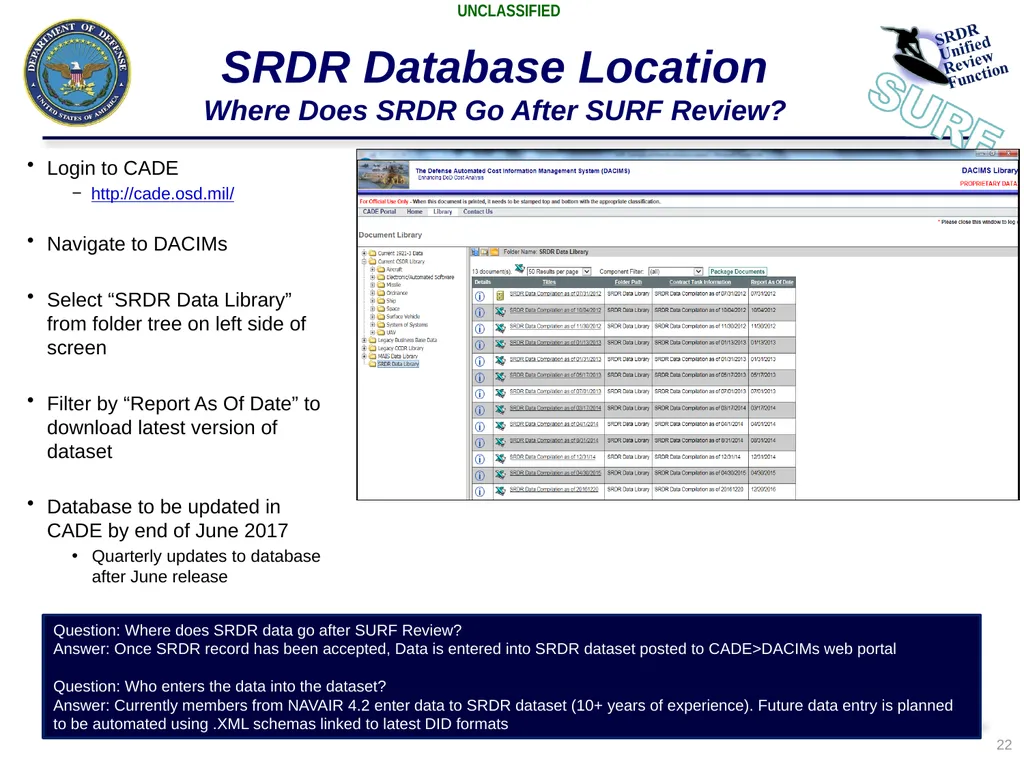
slide22. SRDR Database Location Where Does SRDR Go After SURF Review? 22 Login to CADE
http://cade.osd.mil/
Navigate to DACIMs
Select “SRDR Data Library” from folder tree on left side of screen
Filter by “Report As Of Date” to download latest version of dataset
Database to be updated in CADE by end of June 2017
Quarterly updates to database after June release Question: Where does SRDR data go after SURF Review?
Answer: Once SRDR record has been accepted, Data is entered into SRDR dataset posted to CADE>DACIMs web portal
Question: Who enters the data into the dataset?
Answer: Currently members from NAVAIR 4.2 enter data to SRDR dataset (10+ years of experience). Future data entry is planned to be automated using .XML schemas linked to latest DID formats<br>
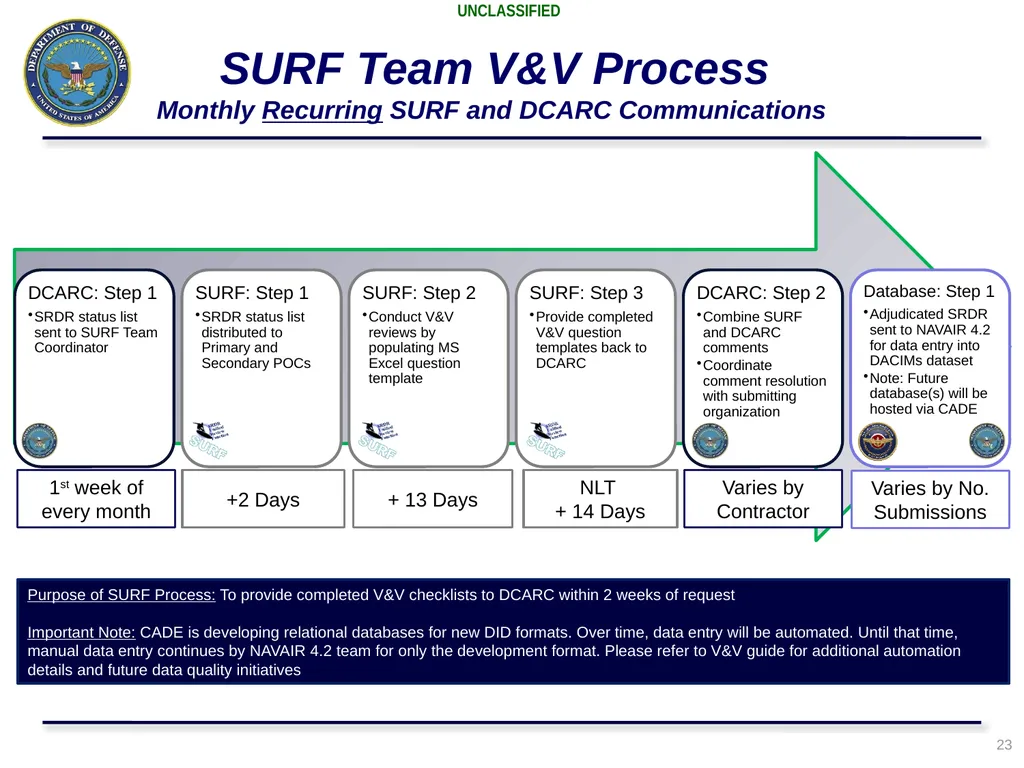
slide23. 23 SURF Team V&V Process
Monthly Recurring SURF and DCARC Communications 1st week of every month +2 Days + 13 Days NLT
+ 14 Days Purpose of SURF Process: To provide completed V&V checklists to DCARC within 2 weeks of request
Important Note: CADE is developing relational databases for new DID formats. Over time, data entry will be automated. Until that time, manual data entry continues by NAVAIR 4.2 team for only the development format. Please refer to V&V guide for additional automation details and future data quality initiatives Varies by Contractor Varies by No. Submissions<br>
Marc Russo, NCCA SURF Process Update and 2017 Review This document was generated as a result of the AFCAA-led, Software Resource Data Report Working Group (SRDRWG). This working group represented a joint effort amongst all DoD service cost agencies. The following guidance describes SRDR data verification and validation best practices as documented by NCCA, NAVAIR 4.2, AFCAA, ODASA-CE, MDA, and many more.<br>
slide2. 2 Purpose
SURF Purpose
SURF Team Structure
SURF Verification & Validation (V&V) Guide
SRDR V&V Outline
Key Updates
2017 Metrics
Team Status
SRDR Database
SRDR Data Quality Review
Summary Table of Contents<br>
slide3. 3 Provide an overview of the updated Software Resource Data Reporting (SRDR) Verification and Validation (V&V) guide and question templates
To update the audience on the reviews that the SRDR Unified Review Function (SURF) team conducted in 2017
Give the audience information on how to become active within the SURF team Presentation Purpose<br>
slide4. SURF Purpose How is this team unique and why do we need quality data? 4 Purpose:
To supplement the Defense Cost Resource Center (DCARC) quality review for SRDR submissions
To develop a consistent, service-wide set of quality questions for all DoD cost community members to reference
To provide a consistent, structured list of questions, focus areas, and possible solutions to cost community members tasked with inspecting SRDR data submissions for completeness, consistency, quality, and usability (e.g. SRDR V&V Guide)
Why?
SURF represents an effort to establish a consistent guide for any organization assessing the realism, quality, and usability of SRDR data submissions
Quality data underpins quality cost and schedule estimates Question: What services helped develop the questions included within the latest SRDR V&V guide?
Answer: All services participating in the SRDR WG provided feedback, comments, and reviews over a year long SRDRWG effort focused on establishing higher quality review efforts coupled with an ongoing SRDR DID update<br>
slide5. SURF Secondary: SURF Primary: DCARC Analyst & STC: DoD
William Raines Navy
Corrinne Wallshein
Wilson Rosa Stephen Palmer
Philip Draheim
Bella Curtis Marine Corps
Susan Wileman John Bryant Air Force
Ron Cipressi Shannon Moore
Bruce Thompson
Reshica Wigfall Army
Jim Judy
Jenna Meyers
James Doswell Michael Smith
Michael Duarte SPAWAR
Jeremiah Hayden Min-Jung Gantt MDA
Dan Strickland SURF Team Structure 5 Team is comprised of one primary member per service along with support from secondary team members (Government Only)
As submissions are received, SRDR review efforts will be distributed amongst SURF team members to balance workload
SURF Team Coordinators (STC): Marc Russo & Haset Gebre-Mariam
Current SURF structure: Question: How do members get involved with SURF? Why are there “primary” and “secondary” members?
Answer 1: The SURF team was established by Government SRDRWG members who were recommended/volunteered by each DoD service
Answer 2: Primary members are included on CSDR S-R IPT email notifications for their specific service. Secondary members are contacted during periods of increased review demands, if necessary. SURF Team Coordinators (STC)
Marc Russo
Haset Gebre-Mariam SURF Advisor & Process Owner (SAPO)
Nick Lanham SRDR Submission received from DCARC<br>
slide6. SRDR V&V Guide Update Completed in Feb 2018 6 Update of V&V guide approved for public release on 20 March 2018
Incorporates question templates into V&V guide
Updates based on new DID, lessons learned, and feedback from DCARC and SURF team members
Files can be downloaded using following link: http://cade.osd.mil/(S(5ivcwktd0e3brmm1srcwqs4q))/policy/srdr
Improves ability to consistently isolate software cost relationships and trends based on quality SRDR data
Additional excel question templates map to new DIDs (Format 1, 2, 3 and Legacy)
Two main purposes:
SRDR V&V training guide (V&V questions)
Focus areas used to determine SRDR quality tags<br>
slide7. V&V Outline Update 7 * Parent elements for children elements not displayed here<br>
slide8. Guide rewritten to discuss use of question templates
Provides additional guidance on the importance of using comments in defining the issue for DCARC
Process Improvement/Initiative Section added
Providing additional comments and reach back for DCARC
Use of CADE for collecting V&V checklist data
Establishing process review meetings between DCARC and SURF analyst
Allows flexibility in the SURF process to accommodate updates in software acquisition management
Updates to Quality Tagging Appendix
Updated definitions
Added new quality tags (Good-Alteration, Good- Roll Up, and Allocation) Key Updates V&V Guide 8<br>
slide9. Key Updates Question Templates Additional SURF Analyst Inputs
Supports DCARC in determining key issues
Supports NAVAIR 4.2 team in inputting data into SRDR database with inputs for OE, AD, and SD 9 Additional Question Templates
Format 1 DD Form 3026-1 (Development)
Format 2 DD Form 3026-2 (Maintenance)
Format 3 DD Form 3026-3 (ERP)
Improved Questions
Questions updated so “Yes” is a positive response and “No” is a negative response
Removed questions that had no direct reference in new DID<br>
slide10. 2017 Metrics 10<br>
slide11. V&V Questions Most Frequently With “Yes” Response All Reviews (2017) Most questions with frequent “yes” response are meta data questions that will be covered under the “common heading” section of new SRDRs<br>
slide12. V&V Questions Most Frequently With “No” Response All Reviews (2017) Several questions with frequent “no” response are improved/removed with new question templates Data important to understanding the software and how to best use for cost analysis are often missing<br>
slide13. V&V Questions Most Frequently With “N/A” Response All Reviews (2017) Several questions with frequent “N/A” responses come from uncommon occurrences<br>
slide14. 14 SURF team highlights
Group includes ~19 Government team members from across the DoD
Has received very positive feed back from DoD cost estimation community, DCARC analyst(s), and even program office communities since inception
Completed update of SRDR V&V guide March 2018
During 2017 SURF team generated 1,879 V&V comments provided to DCARC
In total the SURF team generated 3,251 V&V comments from 128 SRDR submissions
DCARC SRDR Submissions
62 New SRDRs (does not include resubmits)
30 Air Force, 11 Army, 2 DoD, 19 Navy
29 Accepted, 21 Rejected, 12 Under Review/Being Corrected by Contractor V&V Comments Have Significantly Improved SRDR Data Quality SURF Team Status
2017 Overview<br>
slide15. SRDR database is available to Government analysts with access to the CADE portal
This dataset is the authoritative source for SRDR data (10+ years of uploads)
Data is not automatically considered “Good” for analysis
SURF team may recommend DCARC not accept a submission due several data quality concerns outlined in the V&V guide. Examples include:
Roll-up of lower level data (Did not want to double count effect)
Significant missing content in hours, productivity, and/or SLOC data missing
Interim build actual that is not stand alone
Inconsistencies or oddities in the submit
Additional reasons discussed in the V&V guide 15 SRDR Data Quality Review
Dataset Posted to OSD CAPE DACIMS Web Portal<br>
slide16. Total records does not include ~1400 “bad” records that were collected prior to April 2014
Prior to SURF process, only 35% of SRDR data was considered “Good”
Currently, ~43% of the data had been tagged as “Good”
SRDR database available to government employees within the DACIMS library (http://cade.osd.mil/) 16 SRDR Data Quality Review
2014-2018 Trend Analysis SURF Team Combined With V&V Guide and DCARC
Have Significantly Improved Software Data Quality SURF Initiation<br>
slide17. How to get involved! Government employees
Volunteer to be a SURF member
Use and review SRDR database
Contractors/Industry
Be aware of SRDR V&V guide
When developing/reviewing SRDRs use V&V guide and question templates to ensure everything is captured
Provide comments and suggestions for updating review process<br>
slide18. 18 SURF Summary SURF is focused on improving data quality and helping support robust Government review process
We would like to thank all of the DoD and Non-DoD individuals who have commented, participated, and provided feedback throughout the past few years
Please feel free to use the contact information below if you would like more information regarding SURF, the SRDR V&V Guide, or checklist Marc Russo
Naval Center for Cost Analysis (NCCA)
NIPR: Marc.russo1@navy.mil
Ron Cipressi
Air Force Cost Analysis Agency
NIPR: Ronald.p.cipressi.civ@mail.mil
Nicholas Lanham
Office of Secretary of Defense
Cost Assessment and Program Evaluations
NIPR: Nicholas.a.lanham.civ@mail.mil
Dan Strickland
Missile Defense Agency (MDA)
NIPR: Daniel.strickland@mda.mil<br>
slide19. BACK-UP 19<br>
slide20. How Was SURF Created? Cost Leadership Forum (CLF) Approved SRDR Initiatives (Dec 2014) Recommendation Revised SRDR Development Data Item Description (DID)
New SRDR Maintenance Data Item Description (DID)
Joint Validation & Verification (V&V) Guide, Team, and Process
Software Database Initial Design and Implementation Process Benefit Reduces inconsistency, lack of visibility, complexity, and subjectivity in reporting
Aligned w/ dev. but w/ unique data/metrics available/desired for maintenance phase
Higher quality, less duplication - ONE central vs many distributed; 1 joint team & guide gives early, consistent feedback to ktrs
Avoids duplication, variations - ONE central vs many distributed; Based on surveyed best practices and user expectations 20 Question: How was the SURF team created and is it linked to the SRDRWG?
Answer: Yes. The SRDR Unified Review Function (SURF) team was organized as part of the larger, SRDRWG initiative during 2015<br>
slide21. 21 SURF Need Statement
Why do these reports need to be reviewed? Reduces inaccurate use of historical software data
Aligns with OSD CAPE initiative(s) to improve data quality
Helps correct quality concerns prior to final SRDR acceptance
Allows a central group of software V&V SMEs to tag SRDR data
SRDR submissions are used by all DoD cost agencies when developing or assessing cost estimates
Quality data underpins quality cost and schedule estimates BBP Principle 2: Data should drive policy. Outside my door a sign is posted that reads, "In God We Trust; All Others Must Bring Data." The quote is attributed to W. Edwards Deming
- Mr. Frank Kendall, AT&L Magazine Article, January-February 2016<br>
slide22. SRDR Database Location Where Does SRDR Go After SURF Review? 22 Login to CADE
http://cade.osd.mil/
Navigate to DACIMs
Select “SRDR Data Library” from folder tree on left side of screen
Filter by “Report As Of Date” to download latest version of dataset
Database to be updated in CADE by end of June 2017
Quarterly updates to database after June release Question: Where does SRDR data go after SURF Review?
Answer: Once SRDR record has been accepted, Data is entered into SRDR dataset posted to CADE>DACIMs web portal
Question: Who enters the data into the dataset?
Answer: Currently members from NAVAIR 4.2 enter data to SRDR dataset (10+ years of experience). Future data entry is planned to be automated using .XML schemas linked to latest DID formats<br>
slide23. 23 SURF Team V&V Process
Monthly Recurring SURF and DCARC Communications 1st week of every month +2 Days + 13 Days NLT
+ 14 Days Purpose of SURF Process: To provide completed V&V checklists to DCARC within 2 weeks of request
Important Note: CADE is developing relational databases for new DID formats. Over time, data entry will be automated. Until that time, manual data entry continues by NAVAIR 4.2 team for only the development format. Please refer to V&V guide for additional automation details and future data quality initiatives Varies by Contractor Varies by No. Submissions<br>