
Presenter: Karen Johnson, MS, Senior Director,
TD
Published · 31 slides · 0 views

1 / 1


Description
Presenter: Karen Johnson, MS, Senior Director, Quality Measurement National Quality Forum April 3, 2019 2:00-3:00pm EST Where do measure submissions fall short? Pointers for Navigating NQFs Consensus Development Process CMS Measure
Related Topics
Share
Embed code
Download this presentation From Below
"Presenter: Karen Johnson, MS, Senior Director," is the property of its rightful owner. Permission is granted to download and print the materials on this website for personal, non-commercial use only, and to display it on your personal computer provided you do not modify the materials and that you retain all copyright notices contained in the materials. By downloading content from our website, you accept the terms of this agreement.
Presentation Transcript
01
Presenter:
Karen Johnson, MS, Senior Director, Quality Measurement National Quality Forum
April 3, 2019
2:00-3:00pm EST Where do measure submissions fall short?
Pointers for Navigating NQF’s Consensus Development Process CMS Measure Development Education & Outreach MACRA Info Session #5<br>
Karen Johnson, MS, Senior Director, Quality Measurement National Quality Forum
April 3, 2019
2:00-3:00pm EST Where do measure submissions fall short?
Pointers for Navigating NQF’s Consensus Development Process CMS Measure Development Education & Outreach MACRA Info Session #5<br>
02
An ongoing process to engage measure developers through education and outreach in quality measure topics.
Elicit feedback that will help CMS design resources that can help all of those interested in healthcare quality improvement better understand the goals of quality measurement.
Education
Outreach
Dedicated Websites
Measure Development Roadmaps
Listserv opportunities Vision and Goals: MACRA Info Sessions<br>
Elicit feedback that will help CMS design resources that can help all of those interested in healthcare quality improvement better understand the goals of quality measurement.
Education
Outreach
Dedicated Websites
Measure Development Roadmaps
Listserv opportunities Vision and Goals: MACRA Info Sessions<br>
03
Where do measure submissions fall short?
Pointers for Navigating NQF’s Consensus Development Process<br>
04
Objectives 4 Brief background
Limitations specific to the measure itself
Problems with the “defense” of the measure
Contact info
kjohnson@qualityforum.org 202-559-9506
measuremaintenance@qualityforum.org
www.qualityforum.org 202-783-1300<br>
Limitations specific to the measure itself
Problems with the “defense” of the measure
Contact info
kjohnson@qualityforum.org 202-559-9506
measuremaintenance@qualityforum.org
www.qualityforum.org 202-783-1300<br>
05
5 Background<br>
06
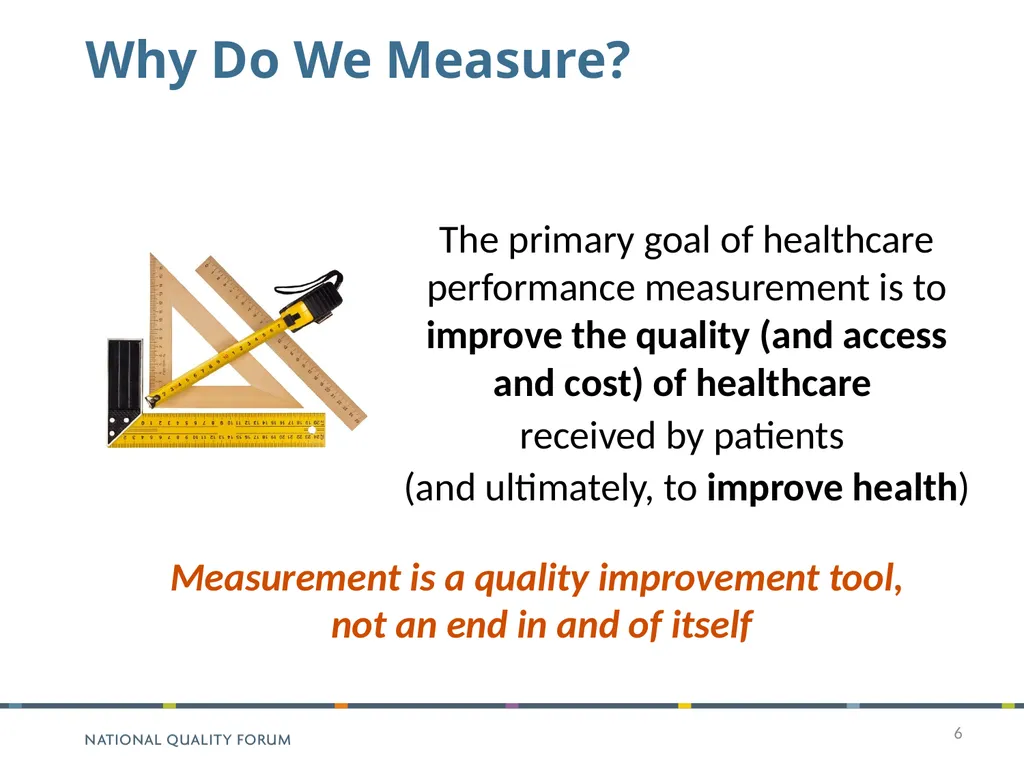
6 The primary goal of healthcare performance measurement is to improve the quality (and access and cost) of healthcare
received by patients
(and ultimately, to improve health) Measurement is a quality improvement tool,
not an end in and of itself Why Do We Measure?<br>
received by patients
(and ultimately, to improve health) Measurement is a quality improvement tool,
not an end in and of itself Why Do We Measure?<br>
07
Intent to Submit
Call for Nominations
Measure Evaluation
Public Commenting Period with Member Support
Measure Endorsement
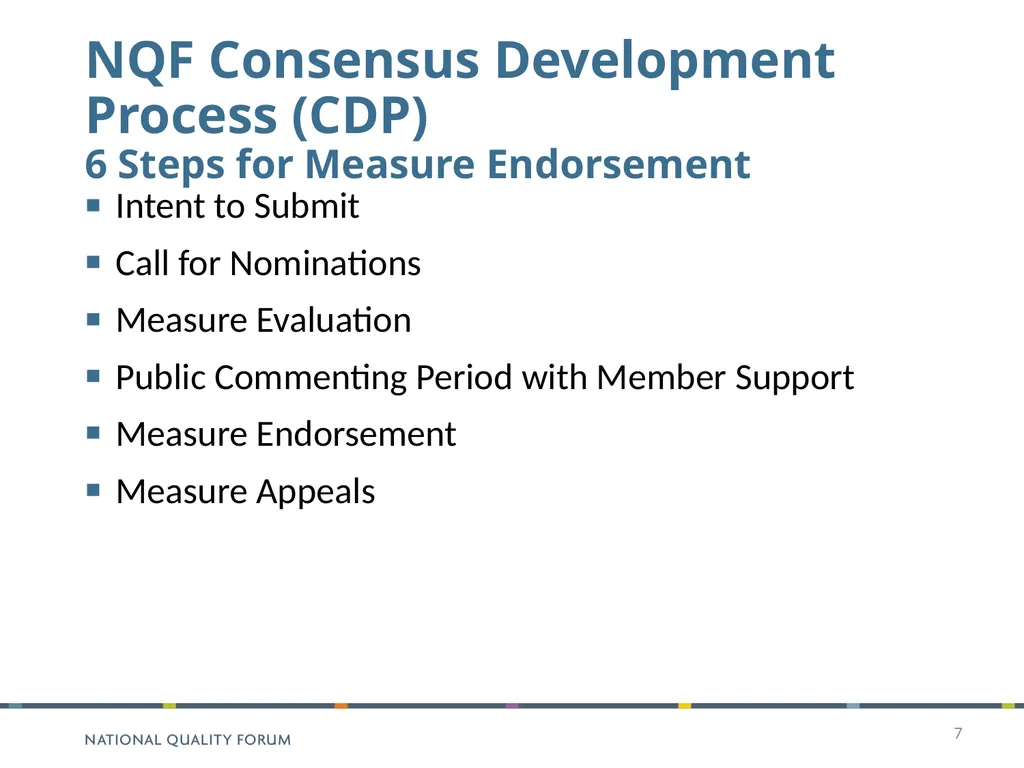
Measure Appeals 7 NQF Consensus Development Process (CDP) 6 Steps for Measure Endorsement<br>
Call for Nominations
Measure Evaluation
Public Commenting Period with Member Support
Measure Endorsement
Measure Appeals 7 NQF Consensus Development Process (CDP) 6 Steps for Measure Endorsement<br>
08
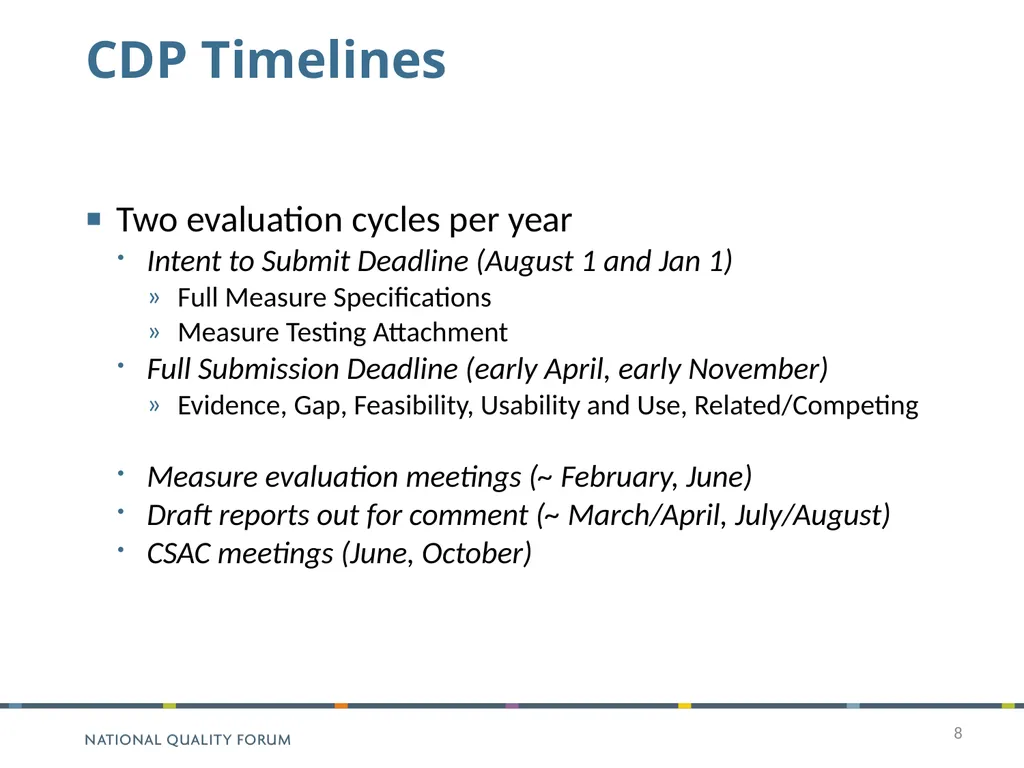
8 Two evaluation cycles per year
Intent to Submit Deadline (August 1 and Jan 1)
Full Measure Specifications
Measure Testing Attachment
Full Submission Deadline (early April, early November)
Evidence, Gap, Feasibility, Usability and Use, Related/Competing
Measure evaluation meetings (~ February, June)
Draft reports out for comment (~ March/April, July/August)
CSAC meetings (June, October) CDP Timelines<br>
Intent to Submit Deadline (August 1 and Jan 1)
Full Measure Specifications
Measure Testing Attachment
Full Submission Deadline (early April, early November)
Evidence, Gap, Feasibility, Usability and Use, Related/Competing
Measure evaluation meetings (~ February, June)
Draft reports out for comment (~ March/April, July/August)
CSAC meetings (June, October) CDP Timelines<br>
09
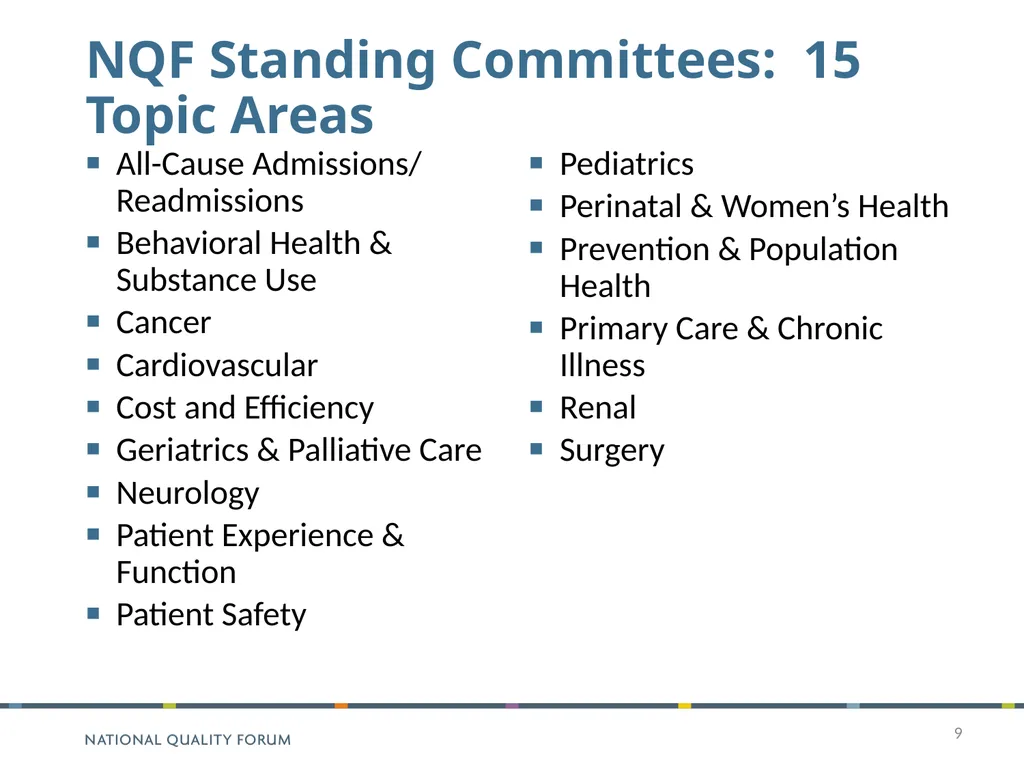
9 All-Cause Admissions/ Readmissions
Behavioral Health & Substance Use
Cancer
Cardiovascular
Cost and Efficiency
Geriatrics & Palliative Care
Neurology
Patient Experience & Function
Patient Safety
Pediatrics
Perinatal & Women’s Health
Prevention & Population Health
Primary Care & Chronic Illness
Renal
Surgery NQF Standing Committees: 15 Topic Areas<br>
Behavioral Health & Substance Use
Cancer
Cardiovascular
Cost and Efficiency
Geriatrics & Palliative Care
Neurology
Patient Experience & Function
Patient Safety
Pediatrics
Perinatal & Women’s Health
Prevention & Population Health
Primary Care & Chronic Illness
Renal
Surgery NQF Standing Committees: 15 Topic Areas<br>
10
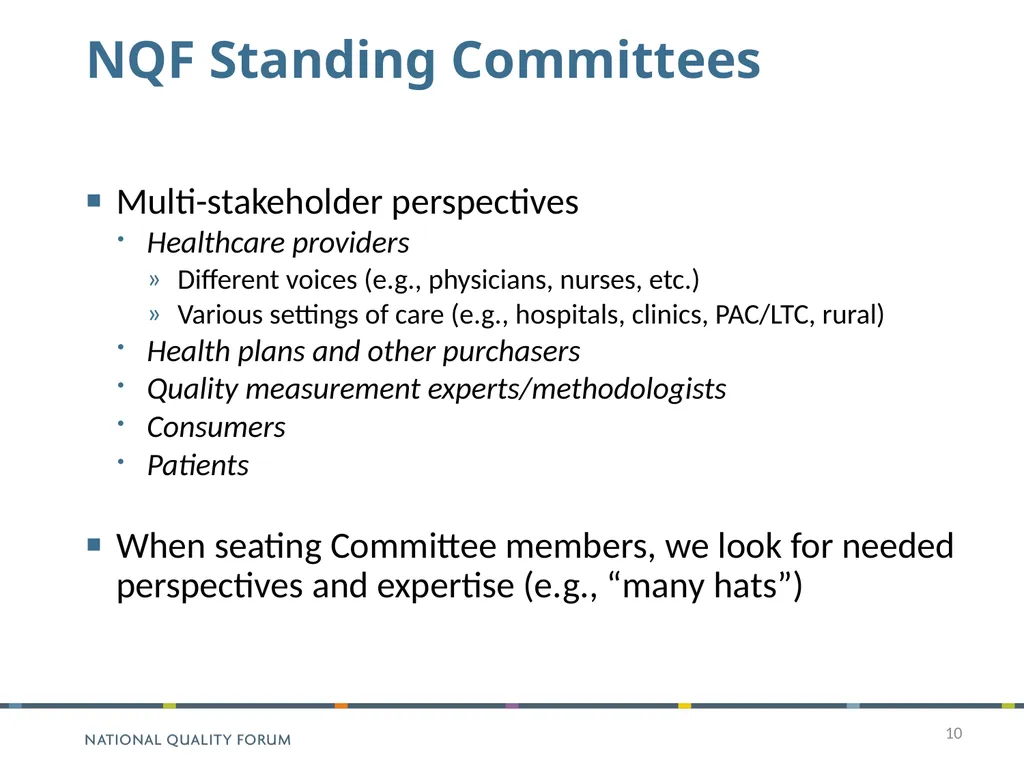
NQF Standing Committees 10 Multi-stakeholder perspectives
Healthcare providers
Different voices (e.g., physicians, nurses, etc.)
Various settings of care (e.g., hospitals, clinics, PAC/LTC, rural)
Health plans and other purchasers
Quality measurement experts/methodologists
Consumers
Patients
When seating Committee members, we look for needed perspectives and expertise (e.g., “many hats”)<br>
Healthcare providers
Different voices (e.g., physicians, nurses, etc.)
Various settings of care (e.g., hospitals, clinics, PAC/LTC, rural)
Health plans and other purchasers
Quality measurement experts/methodologists
Consumers
Patients
When seating Committee members, we look for needed perspectives and expertise (e.g., “many hats”)<br>
11
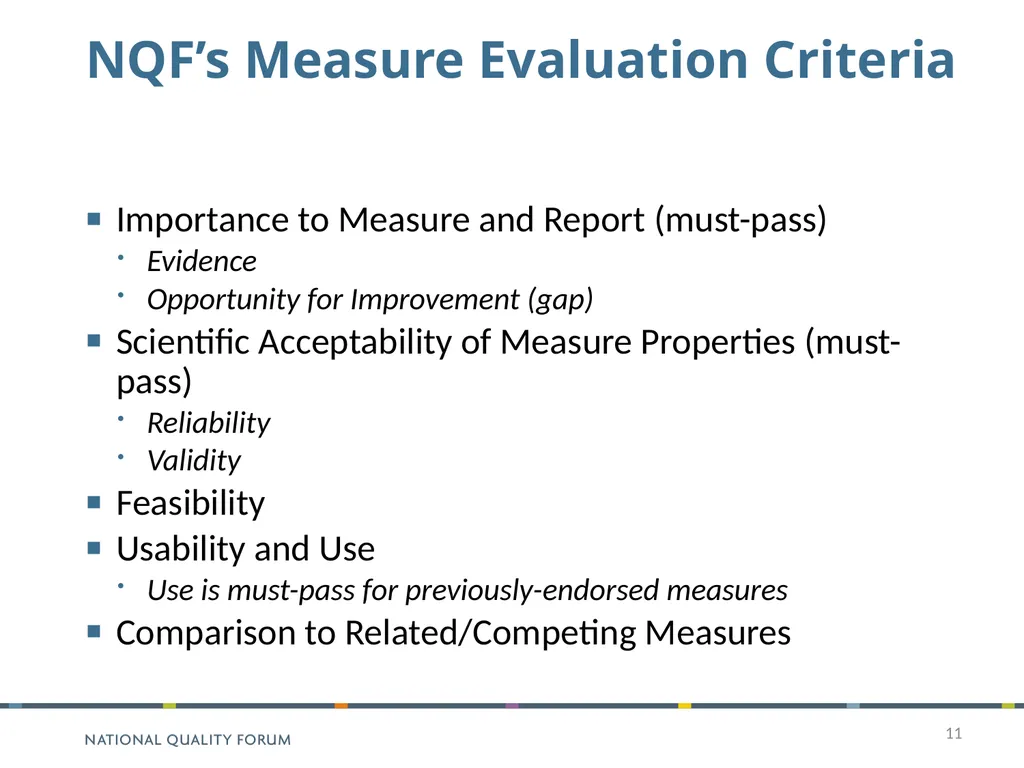
11 Importance to Measure and Report (must-pass)
Evidence
Opportunity for Improvement (gap)
Scientific Acceptability of Measure Properties (must-pass)
Reliability
Validity
Feasibility
Usability and Use
Use is must-pass for previously-endorsed measures
Comparison to Related/Competing Measures NQF’s Measure Evaluation Criteria<br>
Evidence
Opportunity for Improvement (gap)
Scientific Acceptability of Measure Properties (must-pass)
Reliability
Validity
Feasibility
Usability and Use
Use is must-pass for previously-endorsed measures
Comparison to Related/Competing Measures NQF’s Measure Evaluation Criteria<br>
12
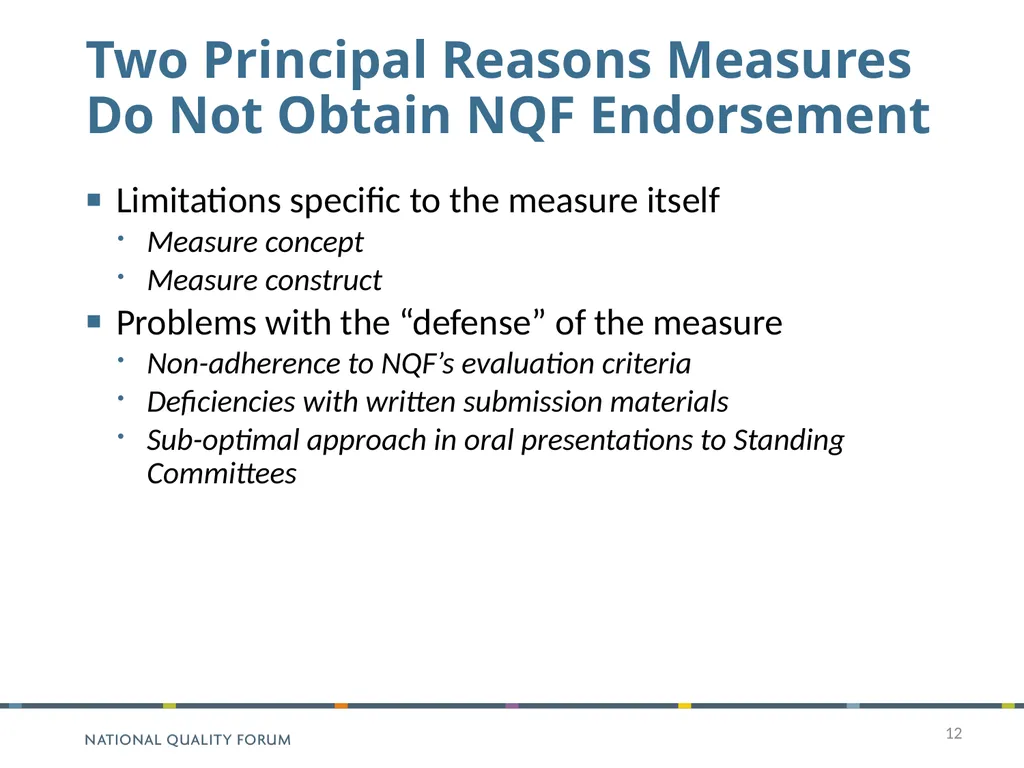
12 Limitations specific to the measure itself
Measure concept
Measure construct
Problems with the “defense” of the measure
Non-adherence to NQF’s evaluation criteria
Deficiencies with written submission materials
Sub-optimal approach in oral presentations to Standing Committees Two Principal Reasons Measures Do Not Obtain NQF Endorsement<br>
Measure concept
Measure construct
Problems with the “defense” of the measure
Non-adherence to NQF’s evaluation criteria
Deficiencies with written submission materials
Sub-optimal approach in oral presentations to Standing Committees Two Principal Reasons Measures Do Not Obtain NQF Endorsement<br>
13
13 Limitations of the Measure<br>
14
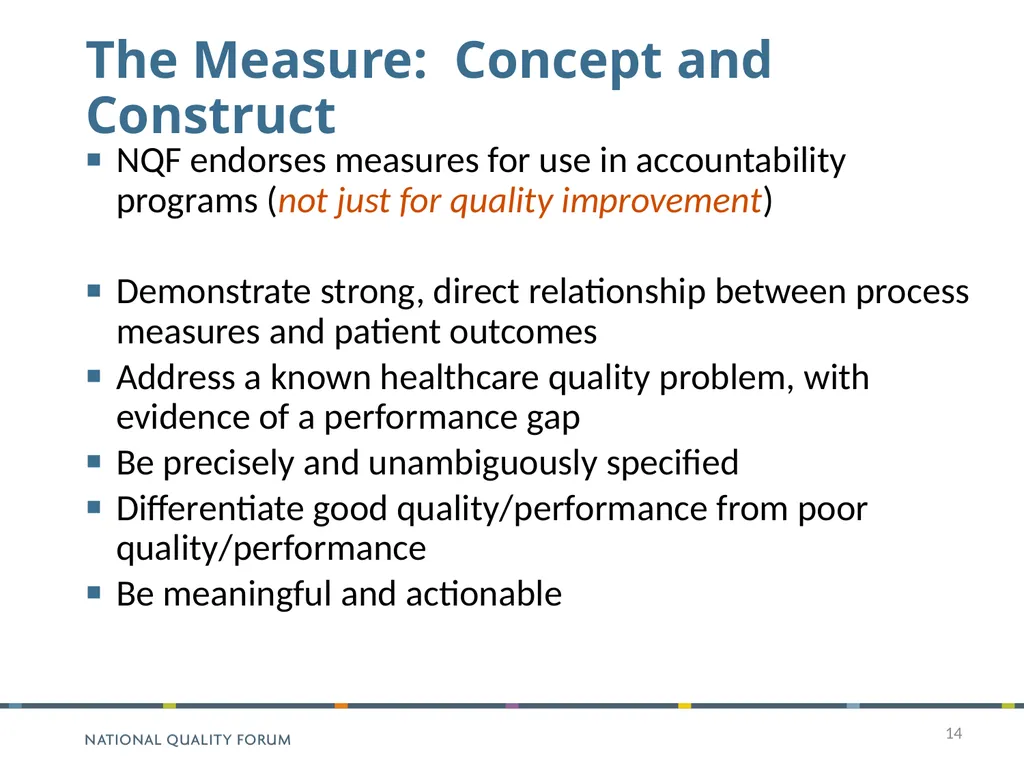
14 NQF endorses measures for use in accountability programs (not just for quality improvement)
Demonstrate strong, direct relationship between process measures and patient outcomes
Address a known healthcare quality problem, with evidence of a performance gap
Be precisely and unambiguously specified
Differentiate good quality/performance from poor quality/performance
Be meaningful and actionable The Measure: Concept and Construct<br>
Demonstrate strong, direct relationship between process measures and patient outcomes
Address a known healthcare quality problem, with evidence of a performance gap
Be precisely and unambiguously specified
Differentiate good quality/performance from poor quality/performance
Be meaningful and actionable The Measure: Concept and Construct<br>
15
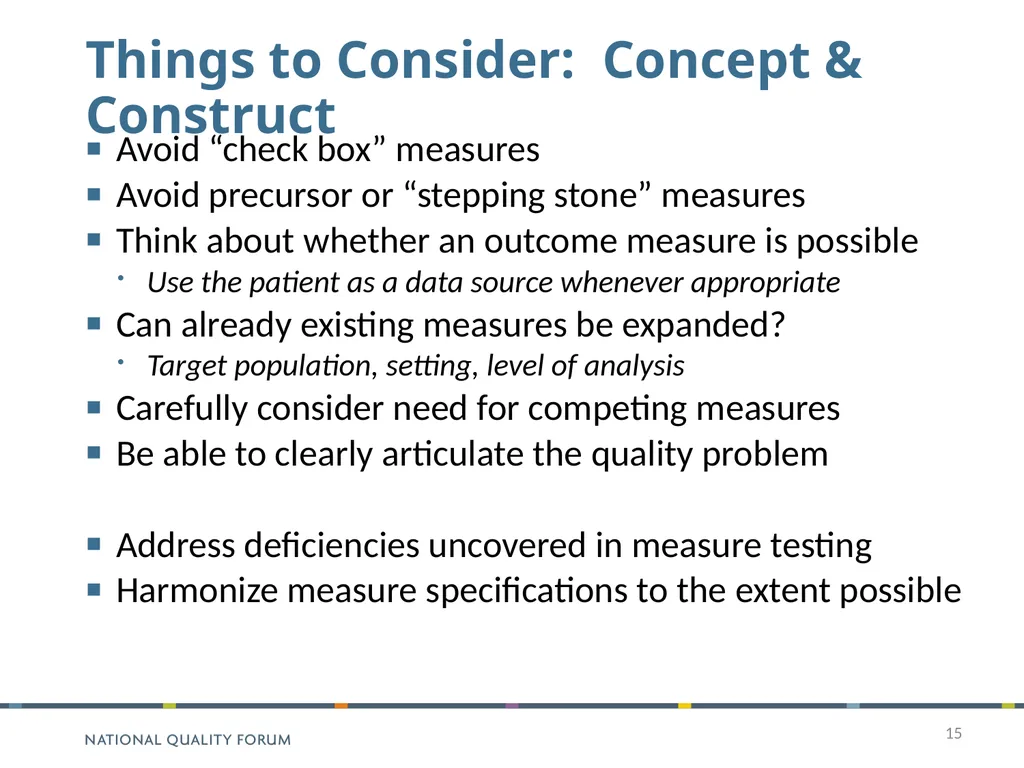
15 Avoid “check box” measures
Avoid precursor or “stepping stone” measures
Think about whether an outcome measure is possible
Use the patient as a data source whenever appropriate
Can already existing measures be expanded?
Target population, setting, level of analysis
Carefully consider need for competing measures
Be able to clearly articulate the quality problem
Address deficiencies uncovered in measure testing
Harmonize measure specifications to the extent possible Things to Consider: Concept & Construct<br>
Avoid precursor or “stepping stone” measures
Think about whether an outcome measure is possible
Use the patient as a data source whenever appropriate
Can already existing measures be expanded?
Target population, setting, level of analysis
Carefully consider need for competing measures
Be able to clearly articulate the quality problem
Address deficiencies uncovered in measure testing
Harmonize measure specifications to the extent possible Things to Consider: Concept & Construct<br>
16
16 Problems with the “Defense”<br>
17
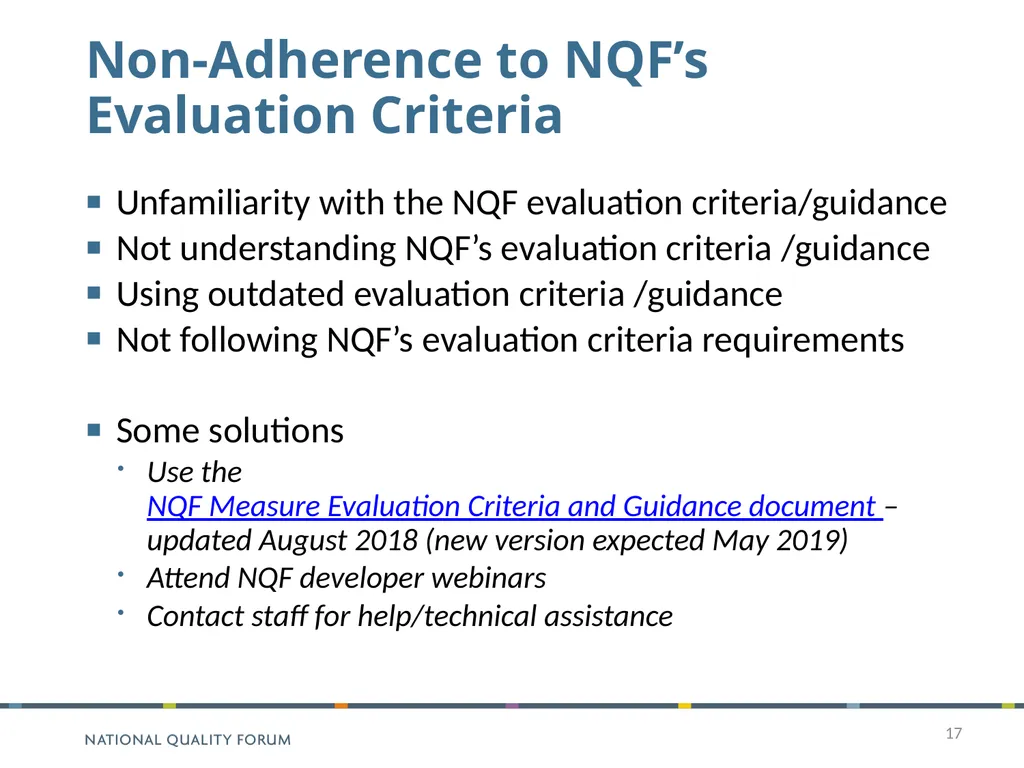
17 Unfamiliarity with the NQF evaluation criteria/guidance
Not understanding NQF’s evaluation criteria /guidance
Using outdated evaluation criteria /guidance
Not following NQF’s evaluation criteria requirements
Some solutions
Use the NQF Measure Evaluation Criteria and Guidance document – updated August 2018 (new version expected May 2019)
Attend NQF developer webinars
Contact staff for help/technical assistance Non-Adherence to NQF’s Evaluation Criteria<br>
Not understanding NQF’s evaluation criteria /guidance
Using outdated evaluation criteria /guidance
Not following NQF’s evaluation criteria requirements
Some solutions
Use the NQF Measure Evaluation Criteria and Guidance document – updated August 2018 (new version expected May 2019)
Attend NQF developer webinars
Contact staff for help/technical assistance Non-Adherence to NQF’s Evaluation Criteria<br>
18
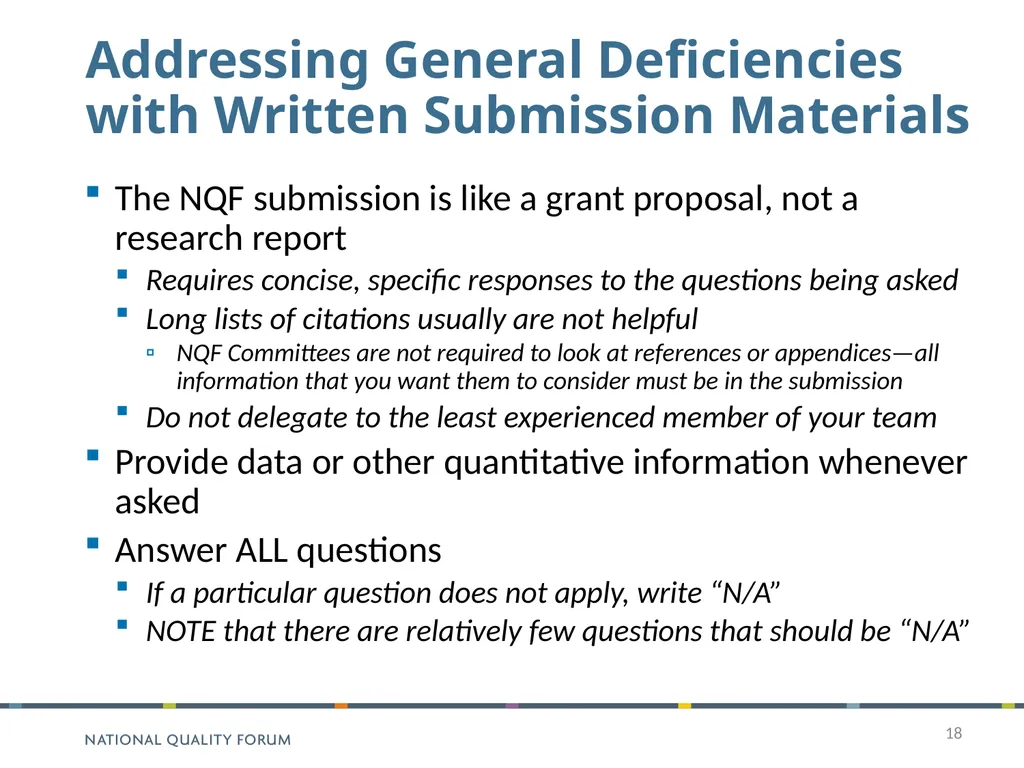
18 The NQF submission is like a grant proposal, not a research report
Requires concise, specific responses to the questions being asked
Long lists of citations usually are not helpful
NQF Committees are not required to look at references or appendices—all information that you want them to consider must be in the submission
Do not delegate to the least experienced member of your team
Provide data or other quantitative information whenever asked
Answer ALL questions
If a particular question does not apply, write “N/A”
NOTE that there are relatively few questions that should be “N/A” Addressing General Deficiencies with Written Submission Materials<br>
Requires concise, specific responses to the questions being asked
Long lists of citations usually are not helpful
NQF Committees are not required to look at references or appendices—all information that you want them to consider must be in the submission
Do not delegate to the least experienced member of your team
Provide data or other quantitative information whenever asked
Answer ALL questions
If a particular question does not apply, write “N/A”
NOTE that there are relatively few questions that should be “N/A” Addressing General Deficiencies with Written Submission Materials<br>
19
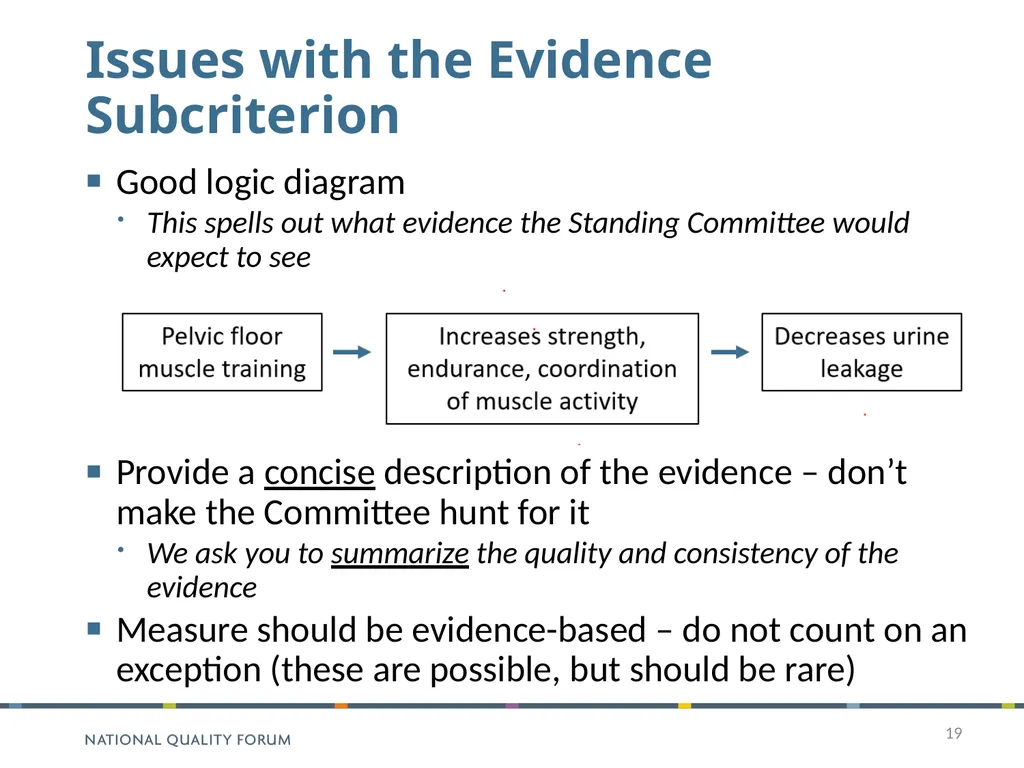
19 Good logic diagram
This spells out what evidence the Standing Committee would expect to see
Provide a concise description of the evidence – don’t make the Committee hunt for it
We ask you to summarize the quality and consistency of the evidence
Measure should be evidence-based – do not count on an exception (these are possible, but should be rare) Issues with the Evidence Subcriterion<br>
This spells out what evidence the Standing Committee would expect to see
Provide a concise description of the evidence – don’t make the Committee hunt for it
We ask you to summarize the quality and consistency of the evidence
Measure should be evidence-based – do not count on an exception (these are possible, but should be rare) Issues with the Evidence Subcriterion<br>
20
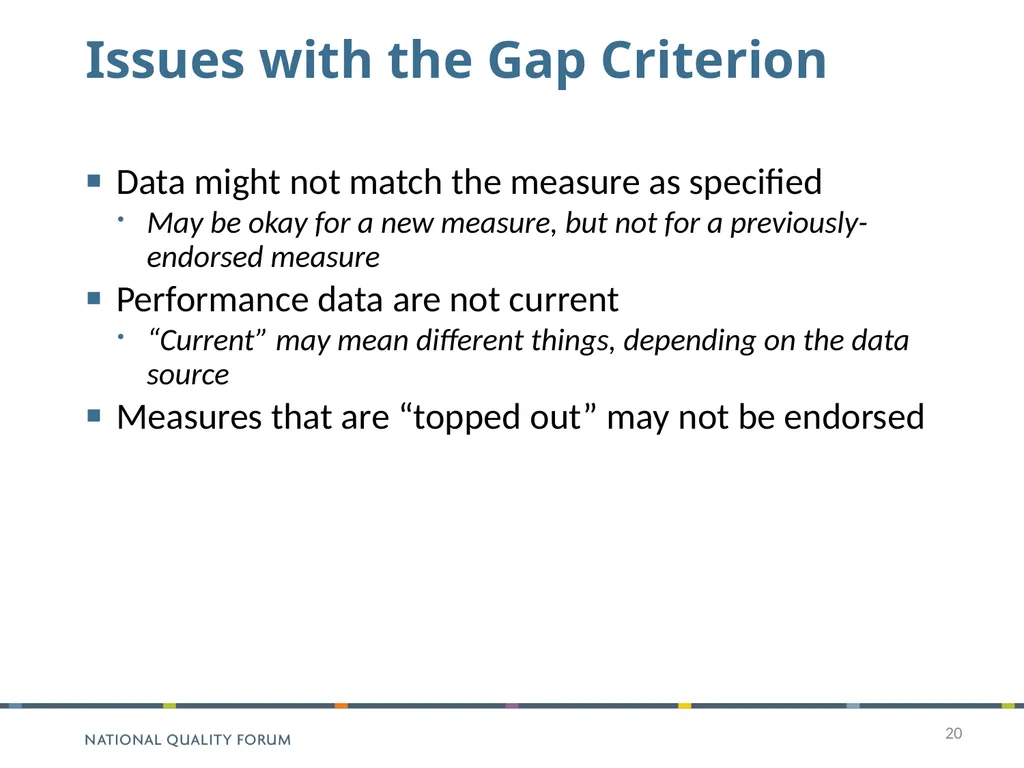
20 Data might not match the measure as specified
May be okay for a new measure, but not for a previously-endorsed measure
Performance data are not current
“Current” may mean different things, depending on the data source
Measures that are “topped out” may not be endorsed Issues with the Gap Criterion<br>
May be okay for a new measure, but not for a previously-endorsed measure
Performance data are not current
“Current” may mean different things, depending on the data source
Measures that are “topped out” may not be endorsed Issues with the Gap Criterion<br>
21
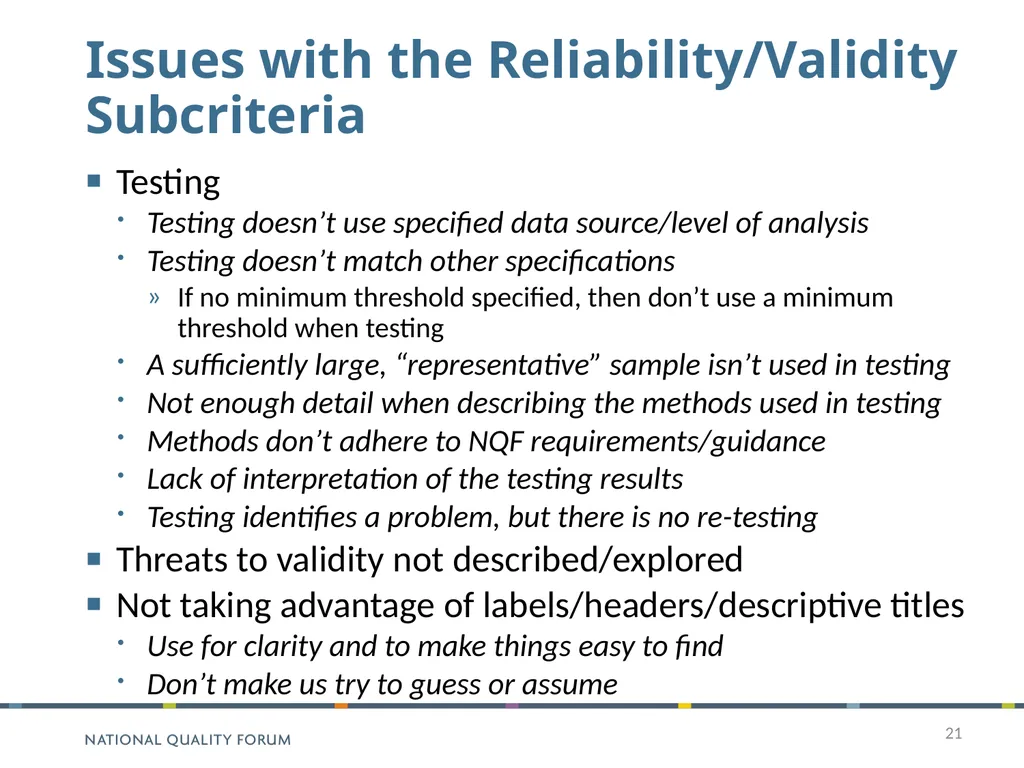
21 Testing
Testing doesn’t use specified data source/level of analysis
Testing doesn’t match other specifications
If no minimum threshold specified, then don’t use a minimum threshold when testing
A sufficiently large, “representative” sample isn’t used in testing
Not enough detail when describing the methods used in testing
Methods don’t adhere to NQF requirements/guidance
Lack of interpretation of the testing results
Testing identifies a problem, but there is no re-testing
Threats to validity not described/explored
Not taking advantage of labels/headers/descriptive titles
Use for clarity and to make things easy to find
Don’t make us try to guess or assume Issues with the Reliability/Validity Subcriteria<br>
Testing doesn’t use specified data source/level of analysis
Testing doesn’t match other specifications
If no minimum threshold specified, then don’t use a minimum threshold when testing
A sufficiently large, “representative” sample isn’t used in testing
Not enough detail when describing the methods used in testing
Methods don’t adhere to NQF requirements/guidance
Lack of interpretation of the testing results
Testing identifies a problem, but there is no re-testing
Threats to validity not described/explored
Not taking advantage of labels/headers/descriptive titles
Use for clarity and to make things easy to find
Don’t make us try to guess or assume Issues with the Reliability/Validity Subcriteria<br>
22
22 Use is now must-pass for maintenance measures
Legwork may be required to know if your measure is being used Issues with Usability and Use Criterion<br>
Legwork may be required to know if your measure is being used Issues with Usability and Use Criterion<br>
23
23 NQF staff will provide technical assistance before and during the submission process – just ask!
Staff will provide feedback on a draft submission before the submission deadline
Completeness/Responsiveness Checks after submission
Provided by NQF to help you “put your best foot forward”
If not clear what you need to do, get in touch quickly
Seriously consider whether to wait for the next evaluation cycle, to give you time to improve your submission
Take advantage of our written guidance How Can NQF Help?<br>
Staff will provide feedback on a draft submission before the submission deadline
Completeness/Responsiveness Checks after submission
Provided by NQF to help you “put your best foot forward”
If not clear what you need to do, get in touch quickly
Seriously consider whether to wait for the next evaluation cycle, to give you time to improve your submission
Take advantage of our written guidance How Can NQF Help?<br>
24
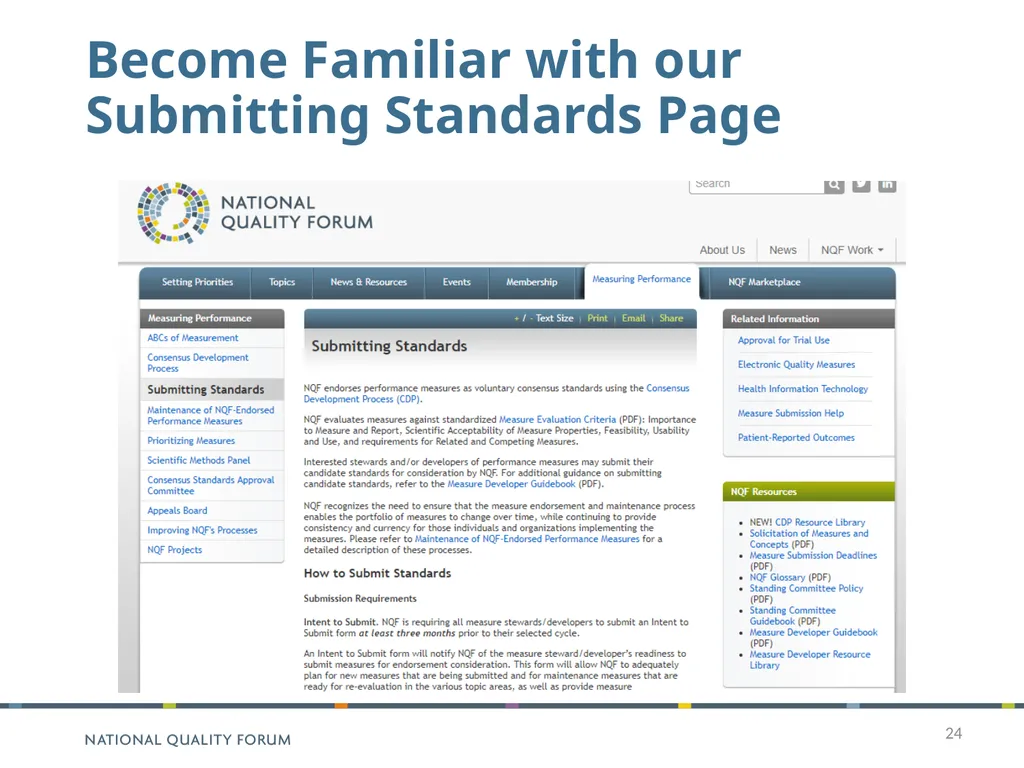
24 Become Familiar with our Submitting Standards Page<br>
25
25 Criteria and Guidance Document
Measure Developer Guidebook – updated annually
Explains the NQF process and expectations for developers
Evaluation algorithms for evidence, reliability and validity
Lays out the logic that committees will use for rating Evidence, Reliability, and Validity subcriteria
What Good Looks Like: examples of good submissions
Blank copies of submission forms
Resource libraries
Recordings of Methods Panel and Developer Webinar meetings
On-demand educational recordings Submitting Standards Web Page Resources<br>
Measure Developer Guidebook – updated annually
Explains the NQF process and expectations for developers
Evaluation algorithms for evidence, reliability and validity
Lays out the logic that committees will use for rating Evidence, Reliability, and Validity subcriteria
What Good Looks Like: examples of good submissions
Blank copies of submission forms
Resource libraries
Recordings of Methods Panel and Developer Webinar meetings
On-demand educational recordings Submitting Standards Web Page Resources<br>
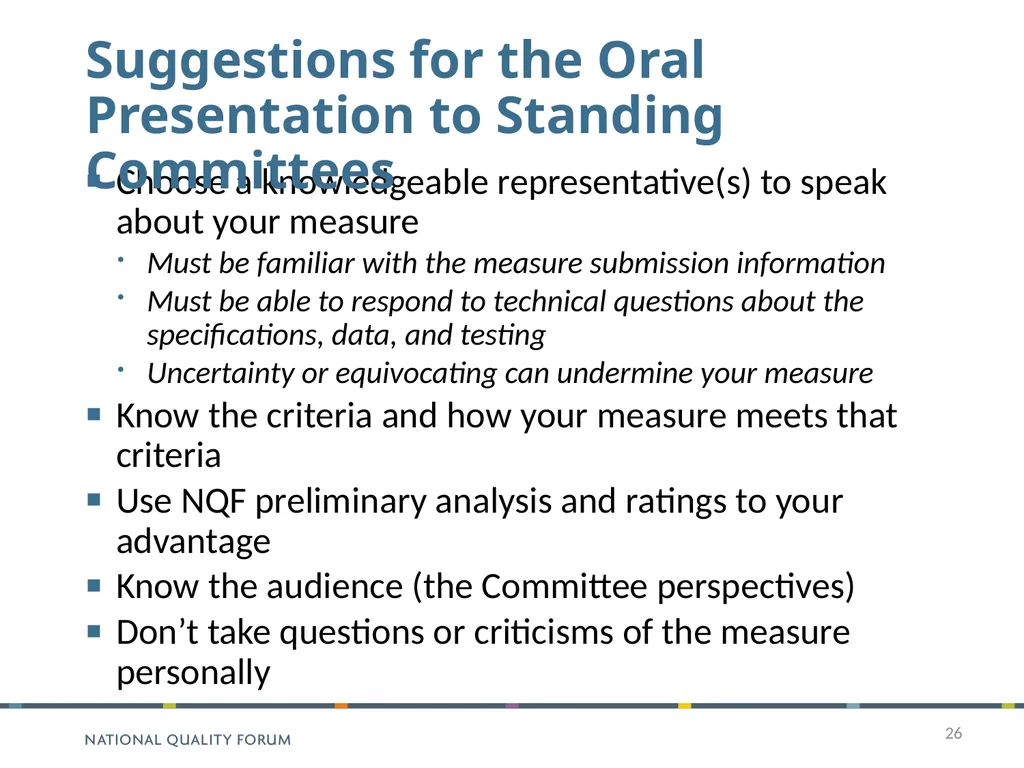
26
26 Choose a knowledgeable representative(s) to speak about your measure
Must be familiar with the measure submission information
Must be able to respond to technical questions about the specifications, data, and testing
Uncertainty or equivocating can undermine your measure
Know the criteria and how your measure meets that criteria
Use NQF preliminary analysis and ratings to your advantage
Know the audience (the Committee perspectives)
Don’t take questions or criticisms of the measure personally Suggestions for the Oral Presentation to Standing Committees<br>
Must be familiar with the measure submission information
Must be able to respond to technical questions about the specifications, data, and testing
Uncertainty or equivocating can undermine your measure
Know the criteria and how your measure meets that criteria
Use NQF preliminary analysis and ratings to your advantage
Know the audience (the Committee perspectives)
Don’t take questions or criticisms of the measure personally Suggestions for the Oral Presentation to Standing Committees<br>
27
27 Thank you<br>
28
Discussion Questions<br>
29
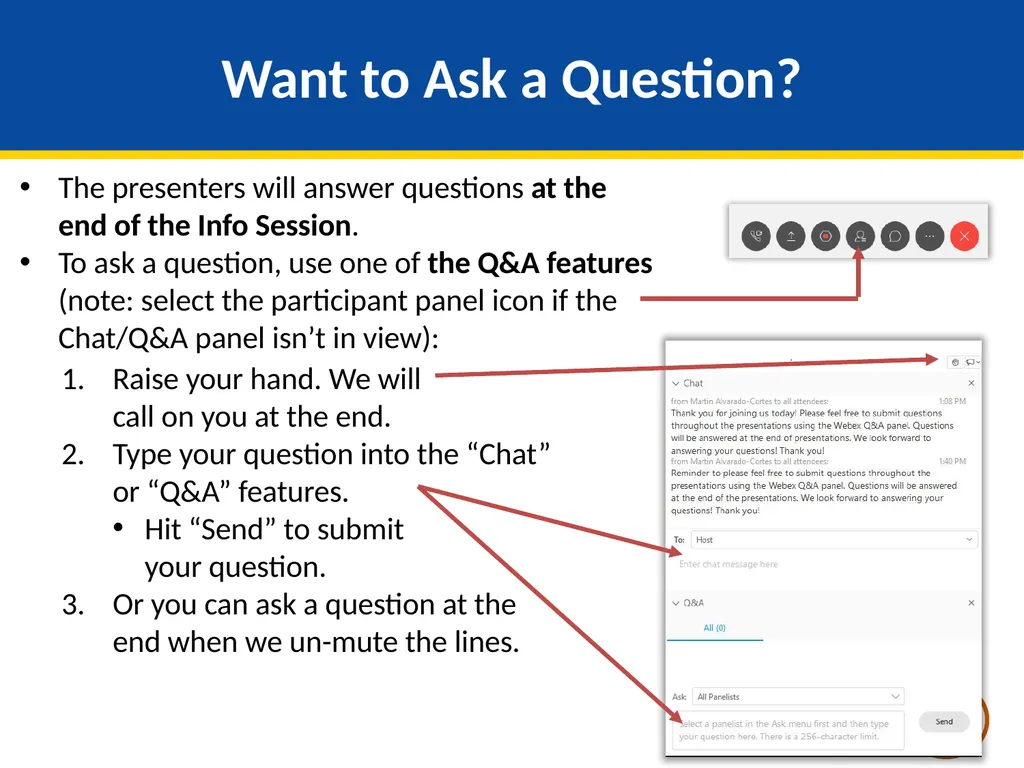
Raise your hand. We will
call on you at the end.
Type your question into the “Chat” or “Q&A” features.
Hit “Send” to submit your question.
Or you can ask a question at the end when we un-mute the lines. The presenters will answer questions at the end of the Info Session.
To ask a question, use one of the Q&A features (note: select the participant panel icon if the Chat/Q&A panel isn’t in view): Want to Ask a Question?<br>
Type your question into the “Chat” or “Q&A” features.
Hit “Send” to submit your question.
Or you can ask a question at the end when we un-mute the lines. The presenters will answer questions at the end of the Info Session.
To ask a question, use one of the Q&A features (note: select the participant panel icon if the Chat/Q&A panel isn’t in view): Want to Ask a Question?<br>
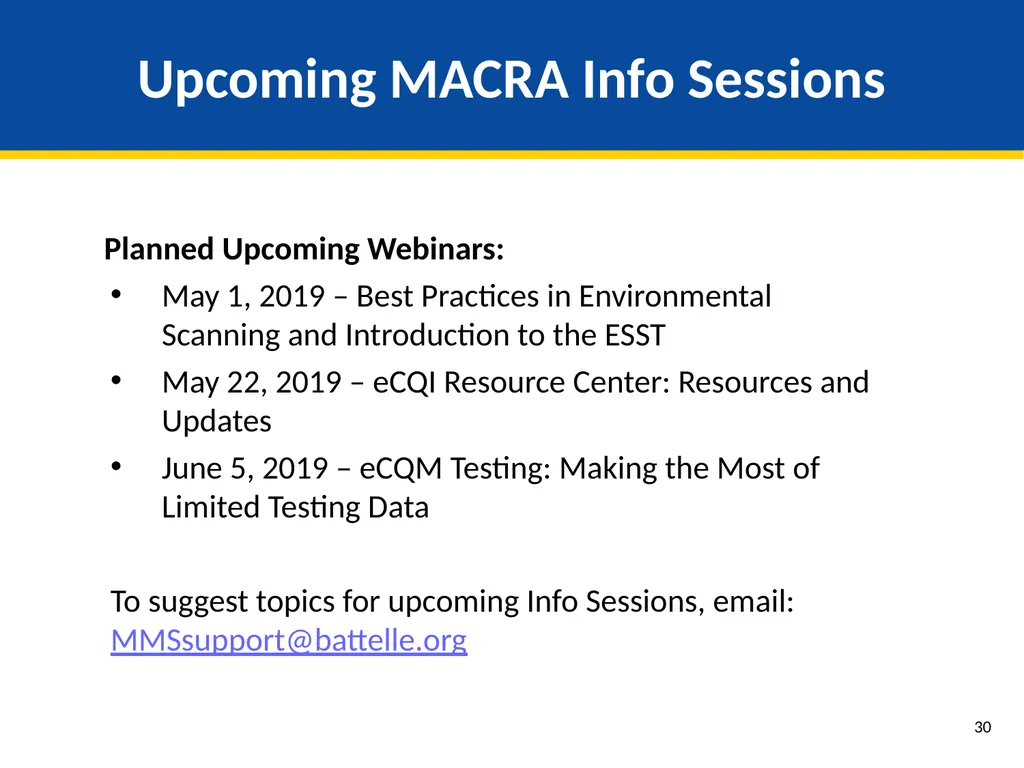
30
Planned Upcoming Webinars:
May 1, 2019 – Best Practices in Environmental Scanning and Introduction to the ESST
May 22, 2019 – eCQI Resource Center: Resources and Updates
June 5, 2019 – eCQM Testing: Making the Most of Limited Testing Data
To suggest topics for upcoming Info Sessions, email: MMSsupport@battelle.org Upcoming MACRA Info Sessions<br>
May 1, 2019 – Best Practices in Environmental Scanning and Introduction to the ESST
May 22, 2019 – eCQI Resource Center: Resources and Updates
June 5, 2019 – eCQM Testing: Making the Most of Limited Testing Data
To suggest topics for upcoming Info Sessions, email: MMSsupport@battelle.org Upcoming MACRA Info Sessions<br>
31
Battelle
Measures Management System Contract Holder Contact: MMSsupport@Battelle.org
CMS
Kimberly Rawlings: Kimberly.Rawlings@cms.hhs.gov Contact Information<br>
Measures Management System Contract Holder Contact: MMSsupport@Battelle.org
CMS
Kimberly Rawlings: Kimberly.Rawlings@cms.hhs.gov Contact Information<br>