
Presenter: Rob Peake Management for Design | ACA
T
Published · 30 slides · 0 views

1 / 1


Description
Presenter: Rob Peake Management for Design ACA Commenced as a shared services business Servicing design and project related businesses 20 people across 2 locations Melbourne and Sydney Clients and Partners located in Australia, US, NZ
Related Topics
Share
Embed code
Download this presentation From Below
"Presenter: Rob Peake Management for Design | ACA" is the property of its rightful owner. Permission is granted to download and print the materials on this website for personal, non-commercial use only, and to display it on your personal computer provided you do not modify the materials and that you retain all copyright notices contained in the materials. By downloading content from our website, you accept the terms of this agreement.
Presentation Transcript
01
Presenter: Rob Peake
Management for Design | ACA Commenced as a shared services business Servicing design and project related businesses 20 people across 2 locations — Melbourne and Sydney Clients and Partners located in Australia, US, NZ and SE Asia Business of Architecture Session 3<br>
Management for Design | ACA Commenced as a shared services business Servicing design and project related businesses 20 people across 2 locations — Melbourne and Sydney Clients and Partners located in Australia, US, NZ and SE Asia Business of Architecture Session 3<br>
02
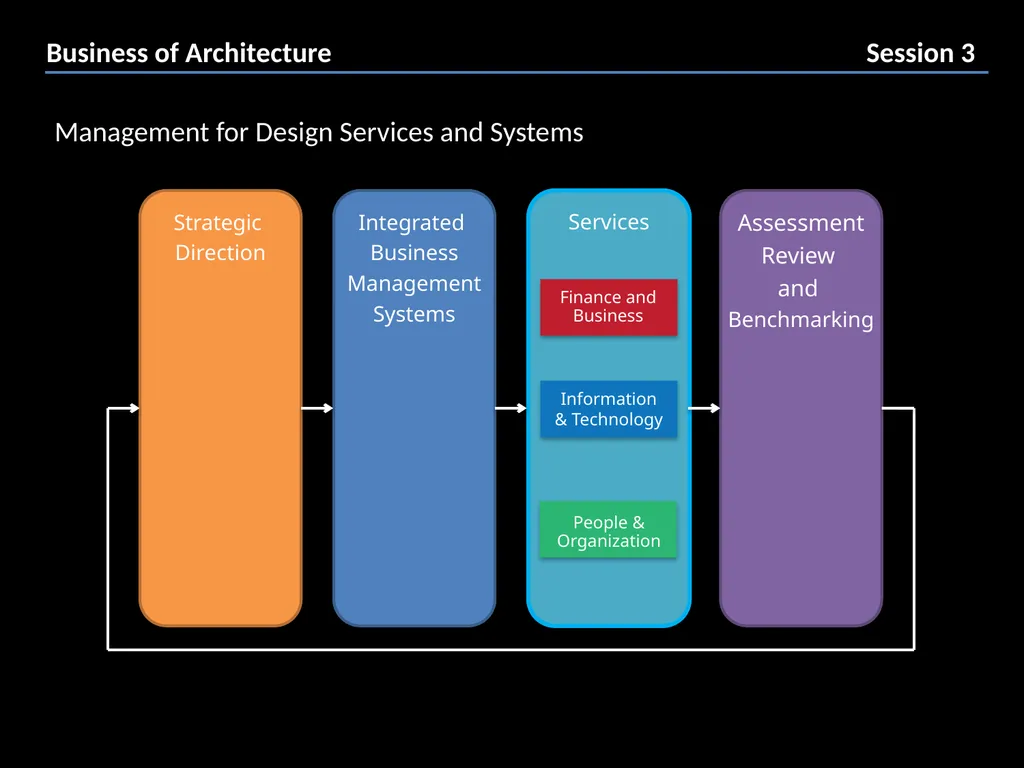
Management for Design Services and Systems Strategic
Direction Integrated
Business
Management
Systems Services Assessment
Review
and
Benchmarking Information & Technology Finance and Business People & Organization Business of Architecture Session 3<br>
Direction Integrated
Business
Management
Systems Services Assessment
Review
and
Benchmarking Information & Technology Finance and Business People & Organization Business of Architecture Session 3<br>
03
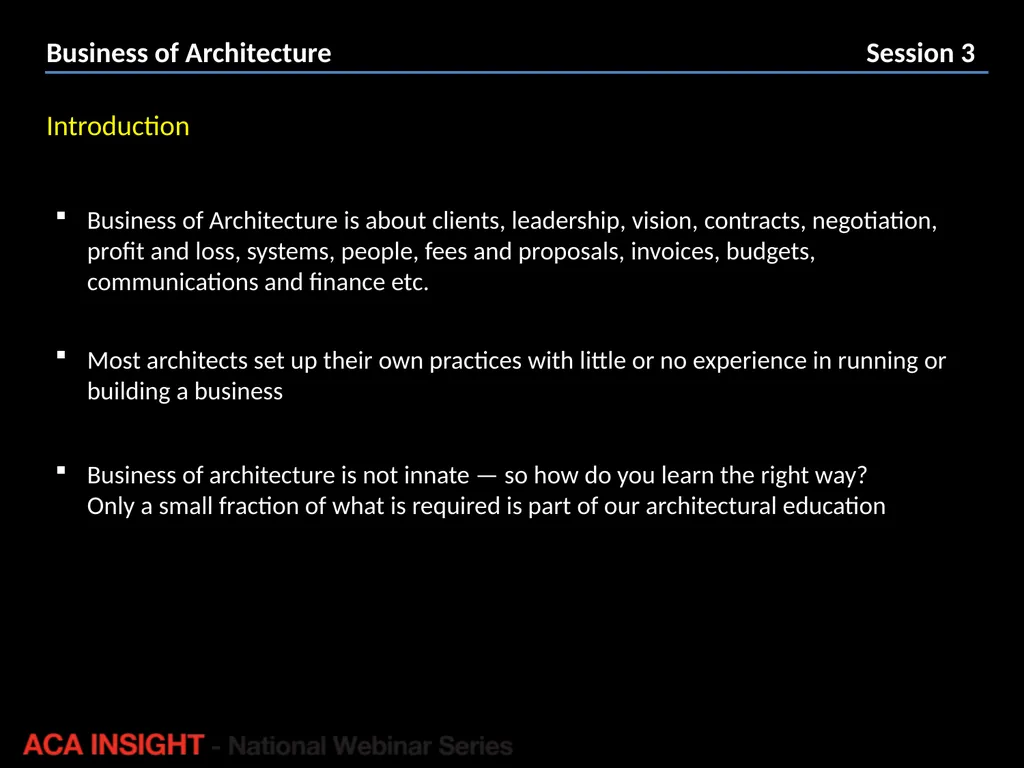
Introduction Business of Architecture Session 3 Most architects set up their own practices with little or no experience in running or building a business Business of architecture is not innate — so how do you learn the right way?
Only a small fraction of what is required is part of our architectural education Business of Architecture is about clients, leadership, vision, contracts, negotiation, profit and loss, systems, people, fees and proposals, invoices, budgets, communications and finance etc.<br>
04
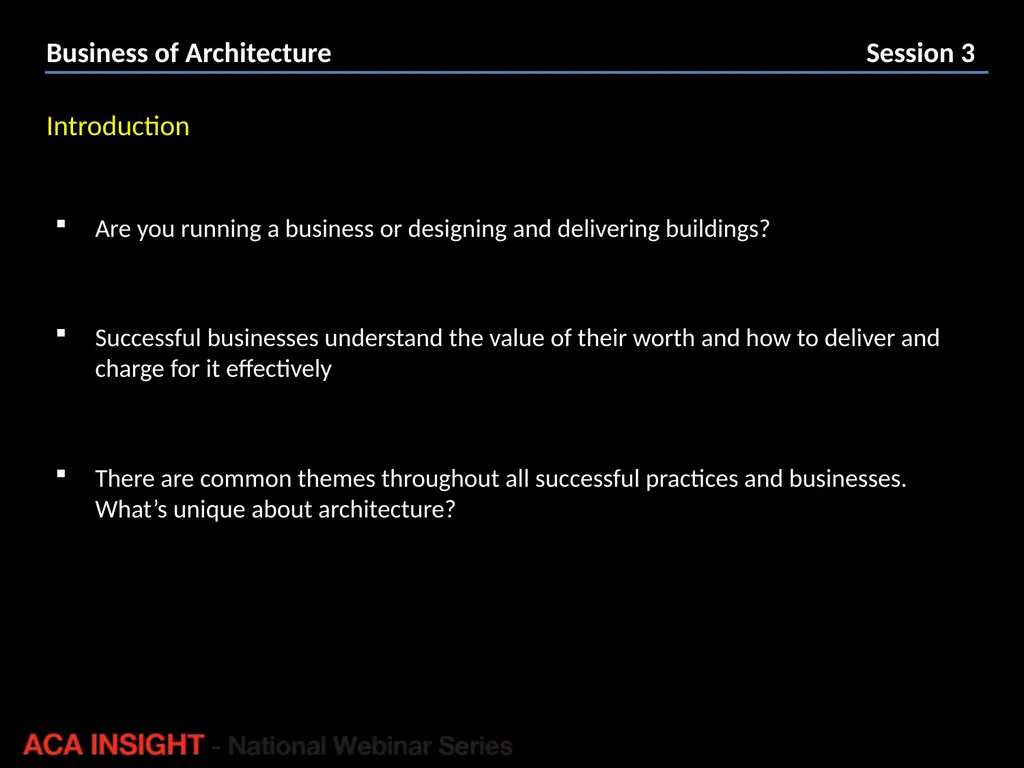
Introduction Are you running a business or designing and delivering buildings? Successful businesses understand the value of their worth and how to deliver and charge for it effectively There are common themes throughout all successful practices and businesses. What’s unique about architecture? Business of Architecture Session 3<br>
05
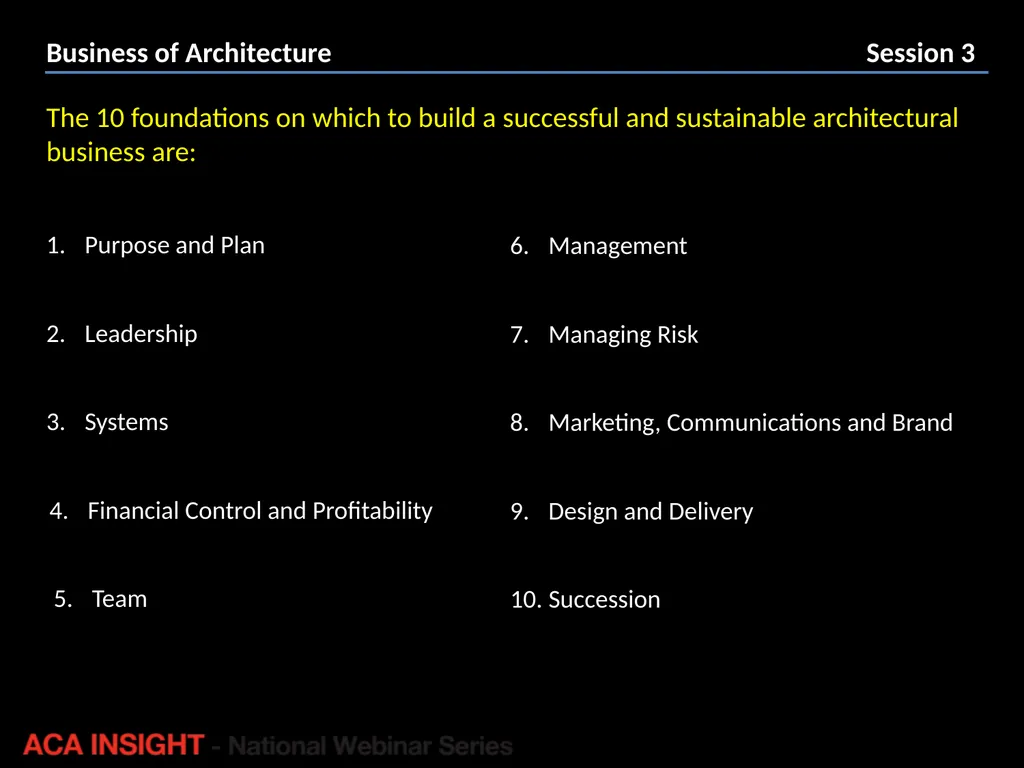
The 10 foundations on which to build a successful and sustainable architectural business are: Purpose and Plan Leadership Systems Management Managing Risk Marketing, Communications and Brand Design and Delivery Succession Financial Control and Profitability Team Business of Architecture Session 3<br>
06
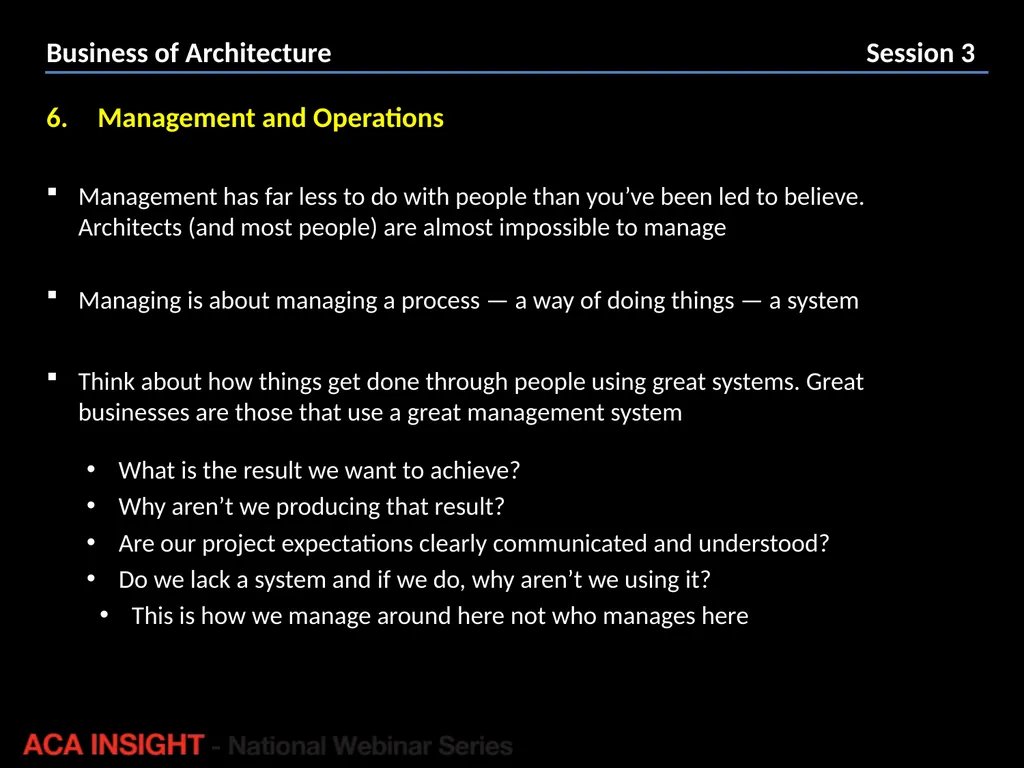
Management and Operations Management has far less to do with people than you’ve been led to believe. Architects (and most people) are almost impossible to manage Managing is about managing a process — a way of doing things — a system Think about how things get done through people using great systems. Great businesses are those that use a great management system What is the result we want to achieve? Why aren’t we producing that result? Are our project expectations clearly communicated and understood? Do we lack a system and if we do, why aren’t we using it? This is how we manage around here not who manages here Business of Architecture Session 3<br>
07
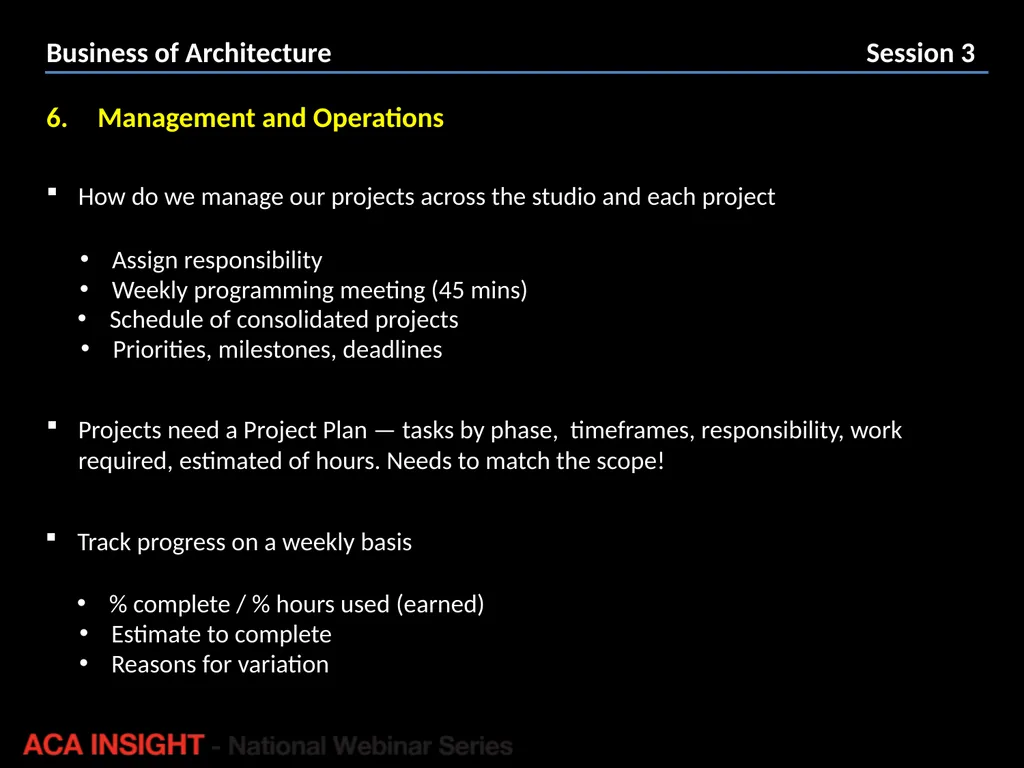
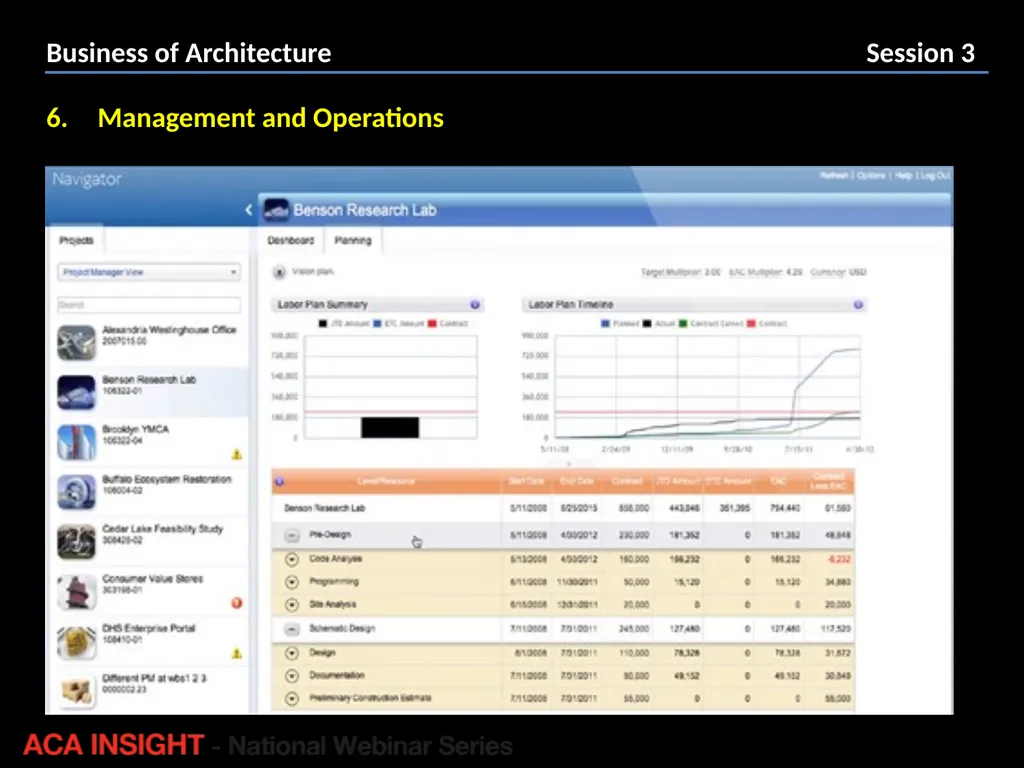
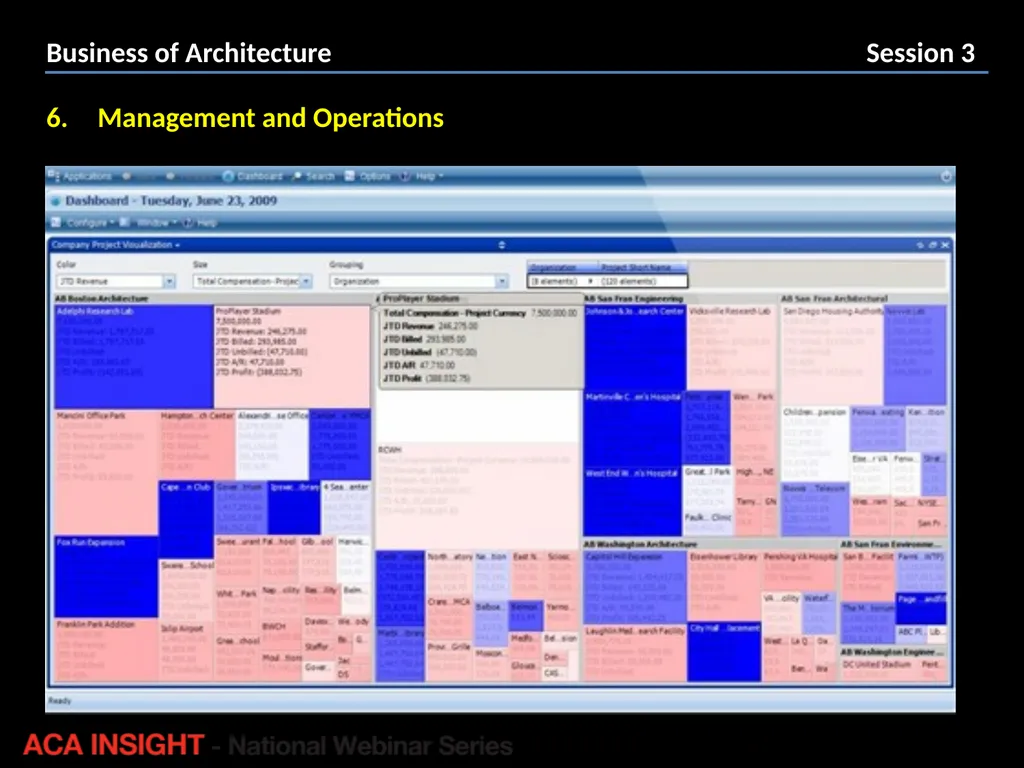
Management and Operations How do we manage our projects across the studio and each project Projects need a Project Plan — tasks by phase, timeframes, responsibility, work required, estimated of hours. Needs to match the scope! Schedule of consolidated projects Weekly programming meeting (45 mins) Priorities, milestones, deadlines Assign responsibility Track progress on a weekly basis % complete / % hours used (earned) Estimate to complete Reasons for variation Business of Architecture Session 3<br>
08
Management and Operations Business of Architecture Session 3<br>
09
Management and Operations Business of Architecture Session 3<br>
10
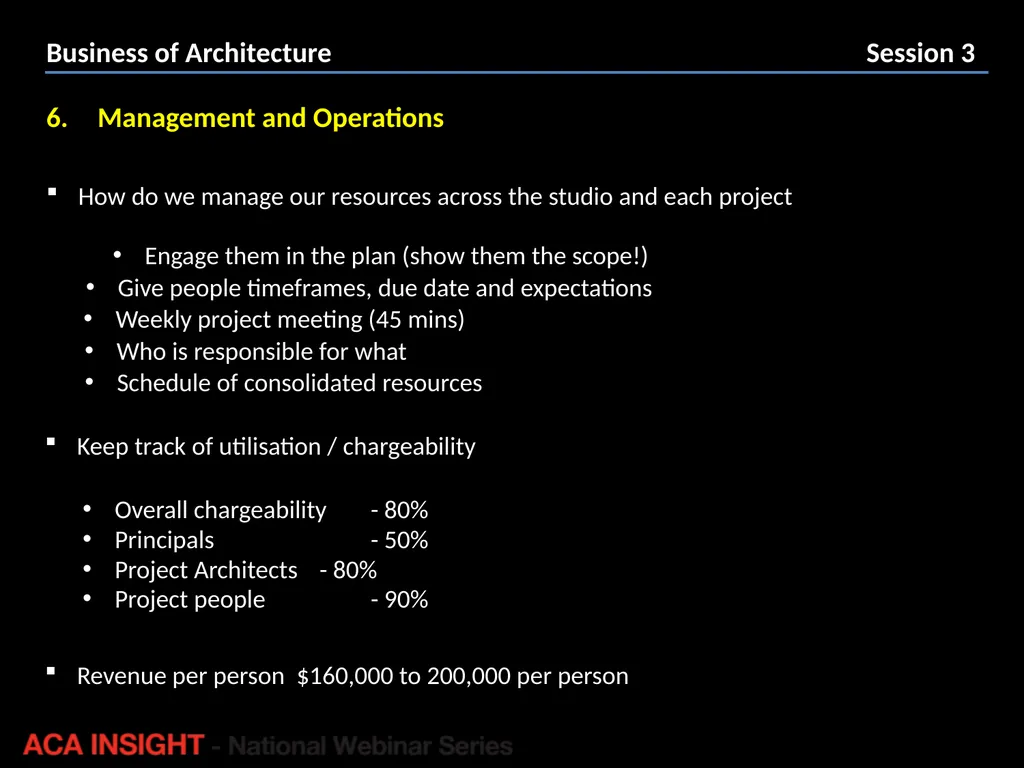
Management and Operations How do we manage our resources across the studio and each project Keep track of utilisation / chargeability Revenue per person $160,000 to 200,000 per person Engage them in the plan (show them the scope!) Give people timeframes, due date and expectations Weekly project meeting (45 mins) Who is responsible for what Schedule of consolidated resources Overall chargeability - 80% Principals - 50% Project Architects - 80% Project people - 90% Business of Architecture Session 3<br>
11
Management and Operations Structure your business to have clear responsibilities / expectations. Draw up an organisation chart Spend your time on your management systems not on managing people — its not your people that are the issue! Train / mentor your people to follow your system and evaluate them according to their use of the systems Focus on creating innovative systems that you can use and monitor — once they are in place its easier to find great employees Business of Architecture Session 3<br>
12
Management and Operations Business owners need to focus ‘on’ their business rather than ‘in’ their business. Is that why you went into business? Get this right and you can focus on what will make your business unique: This is the real essence of the business of architecture and business success Why clients choose your business over others Value your practice will deliver Relationships with your clients Business of Architecture Session 3<br>
13
Risk and Legal Need to adopt strategies to mitigate risk. These include: Business structure Agreements Contract management Terms and conditions Exclusions Fees Insurances Advisors Business of Architecture Session 3<br>
14
Risk and Legal Business Structure — Company, Unit Trust or Partnership Shareholders / Unit holders Agreement Ownership obligations and transfer of ownership Insurances Restraint Decision making Other business interests Exiting the business % of profits linked to performance Employee share plans Buy / Sell Agreement etc. Business of Architecture Session 3<br>
15
Risk and Legal Must have a signed agreement / contract with the client. They define your responsibility and what happens when things aren’t working out Provide as detailed a scope as possible and itemise the exclusions and where additional fees are applicable e.g. Delay in gaining approval Engagement of secondary consultants Additional drawings — as builts etc. Negotiation related to Novation Limit defect inspection etc. Change in documents due to change in scope Business of Architecture Session 3<br>
16
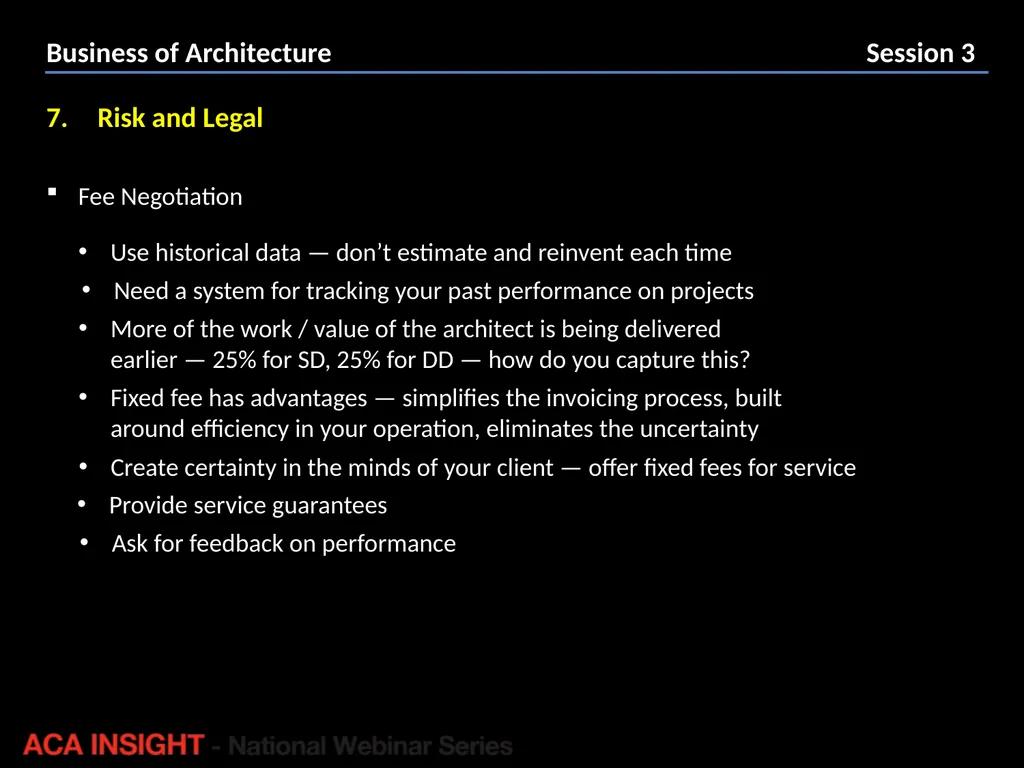
Risk and Legal Fee Negotiation Use historical data — don’t estimate and reinvent each time Need a system for tracking your past performance on projects More of the work / value of the architect is being delivered earlier — 25% for SD, 25% for DD — how do you capture this? Fixed fee has advantages — simplifies the invoicing process, built around efficiency in your operation, eliminates the uncertainty Create certainty in the minds of your client — offer fixed fees for service Provide service guarantees Ask for feedback on performance Business of Architecture Session 3<br>
17
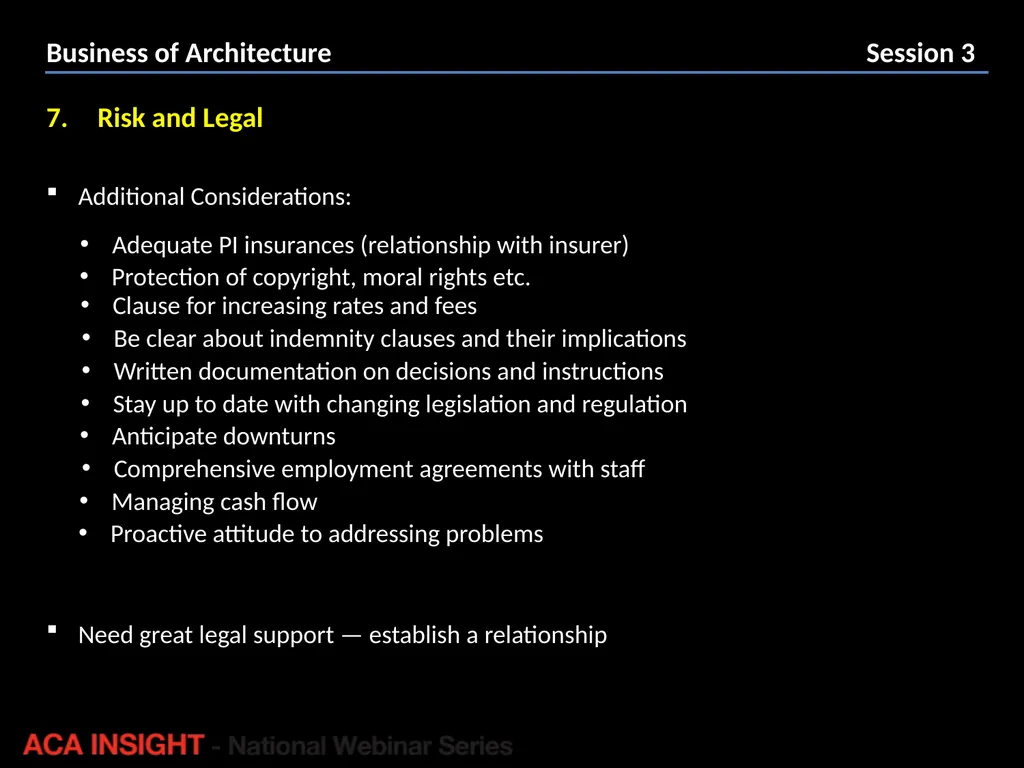
Risk and Legal Additional Considerations: Need great legal support — establish a relationship Adequate PI insurances (relationship with insurer) Protection of copyright, moral rights etc. Clause for increasing rates and fees Be clear about indemnity clauses and their implications Written documentation on decisions and instructions Stay up to date with changing legislation and regulation Anticipate downturns Comprehensive employment agreements with staff Managing cash flow Proactive attitude to addressing problems Business of Architecture Session 3<br>
18
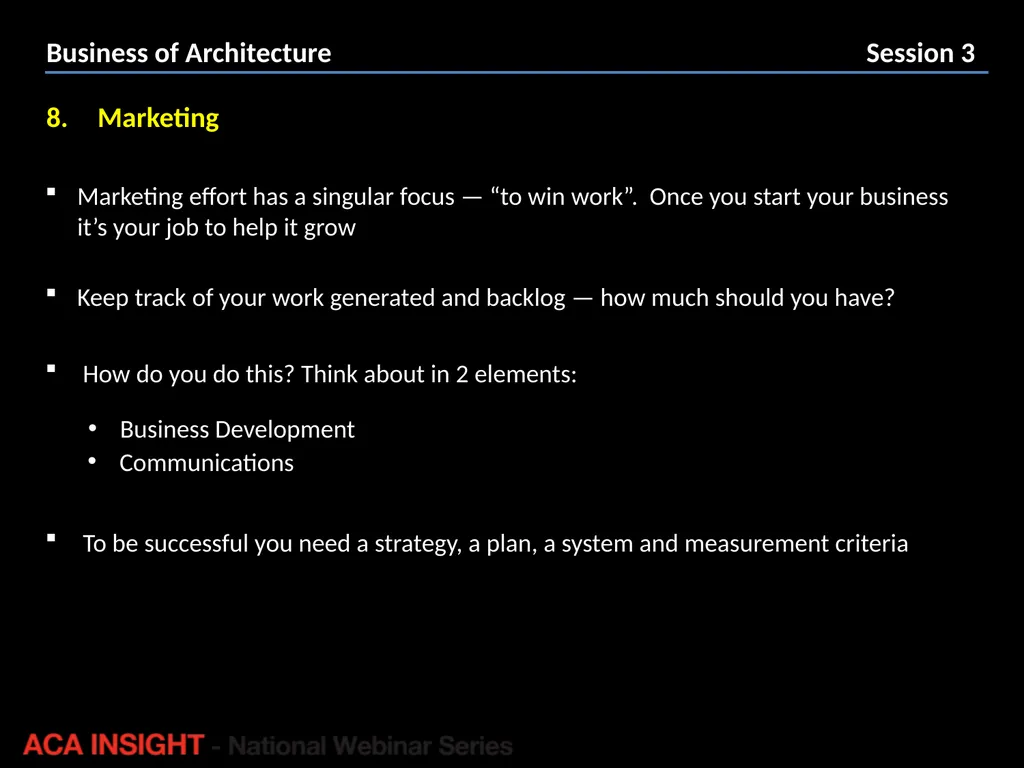
Marketing Marketing effort has a singular focus — “to win work”. Once you start your business it’s your job to help it grow How do you do this? Think about in 2 elements: To be successful you need a strategy, a plan, a system and measurement criteria Keep track of your work generated and backlog — how much should you have? Business Development Communications Business of Architecture Session 3<br>
19
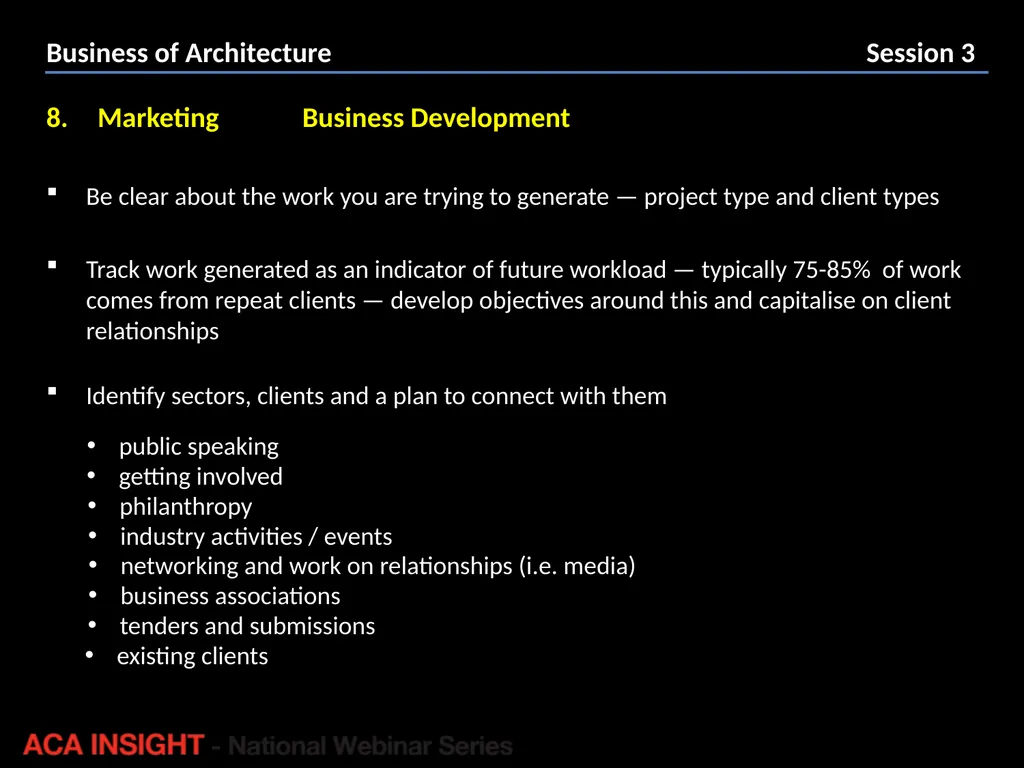
Marketing Business Development Be clear about the work you are trying to generate — project type and client types Identify sectors, clients and a plan to connect with them Track work generated as an indicator of future workload — typically 75-85% of work comes from repeat clients — develop objectives around this and capitalise on client relationships public speaking getting involved philanthropy industry activities / events networking and work on relationships (i.e. media) business associations tenders and submissions existing clients Business of Architecture Session 3<br>
20
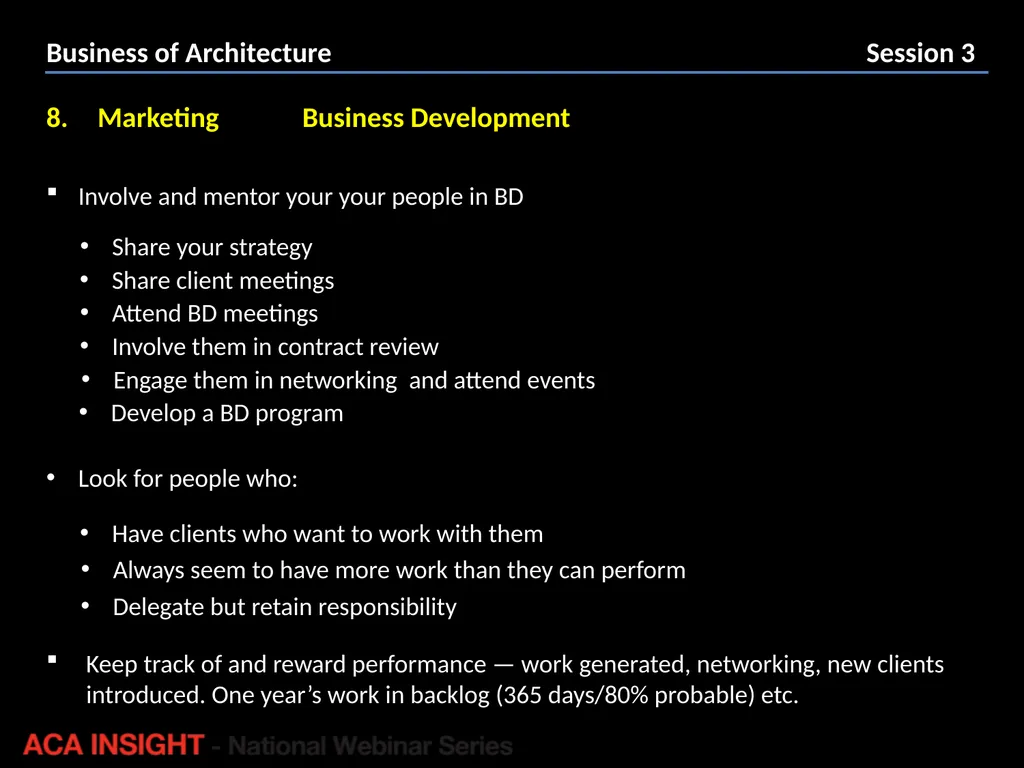
Marketing Business Development Involve and mentor your your people in BD Keep track of and reward performance — work generated, networking, new clients introduced. One year’s work in backlog (365 days/80% probable) etc. Look for people who: Share your strategy Share client meetings Attend BD meetings Involve them in contract review Engage them in networking and attend events Develop a BD program Have clients who want to work with them Always seem to have more work than they can perform Delegate but retain responsibility Business of Architecture Session 3<br>
21
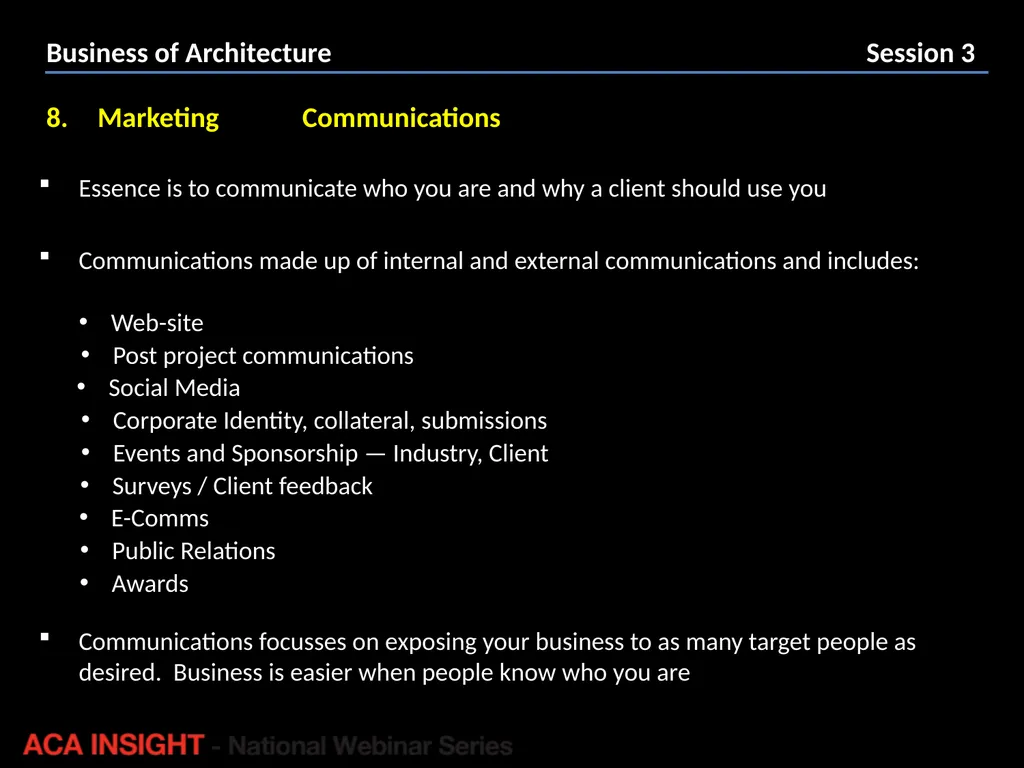
Marketing Communications Communications made up of internal and external communications and includes: Communications focusses on exposing your business to as many target people as desired. Business is easier when people know who you are Essence is to communicate who you are and why a client should use you Web-site Post project communications Social Media Corporate Identity, collateral, submissions Events and Sponsorship — Industry, Client Surveys / Client feedback E-Comms Public Relations Awards Business of Architecture Session 3<br>
22
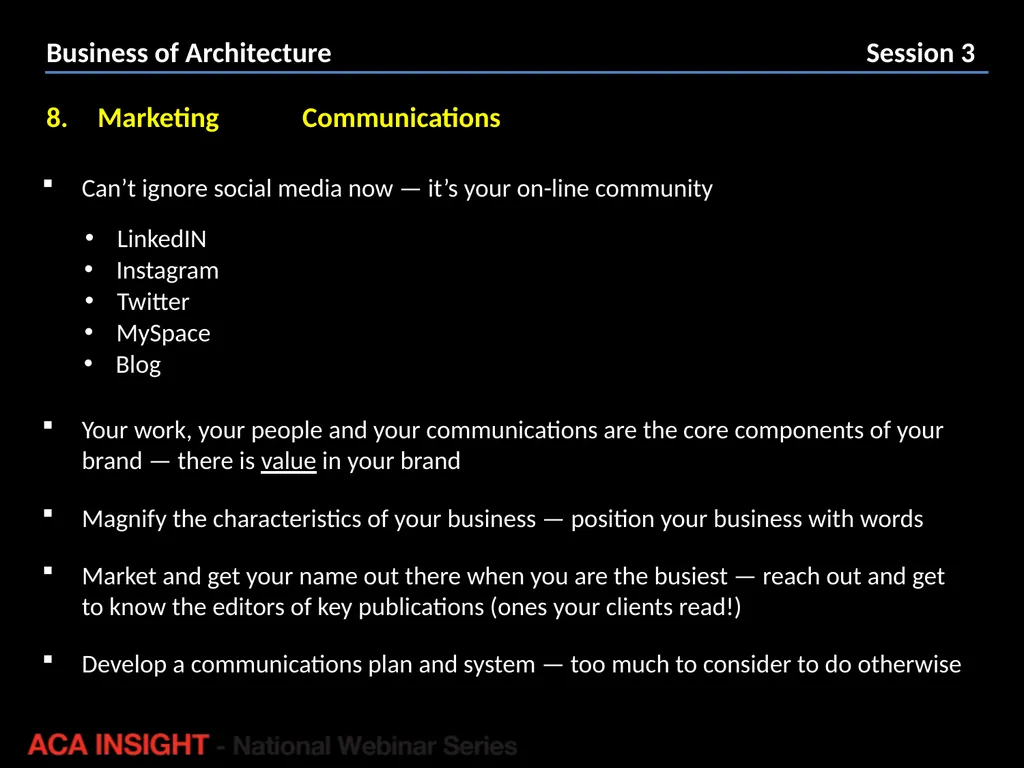
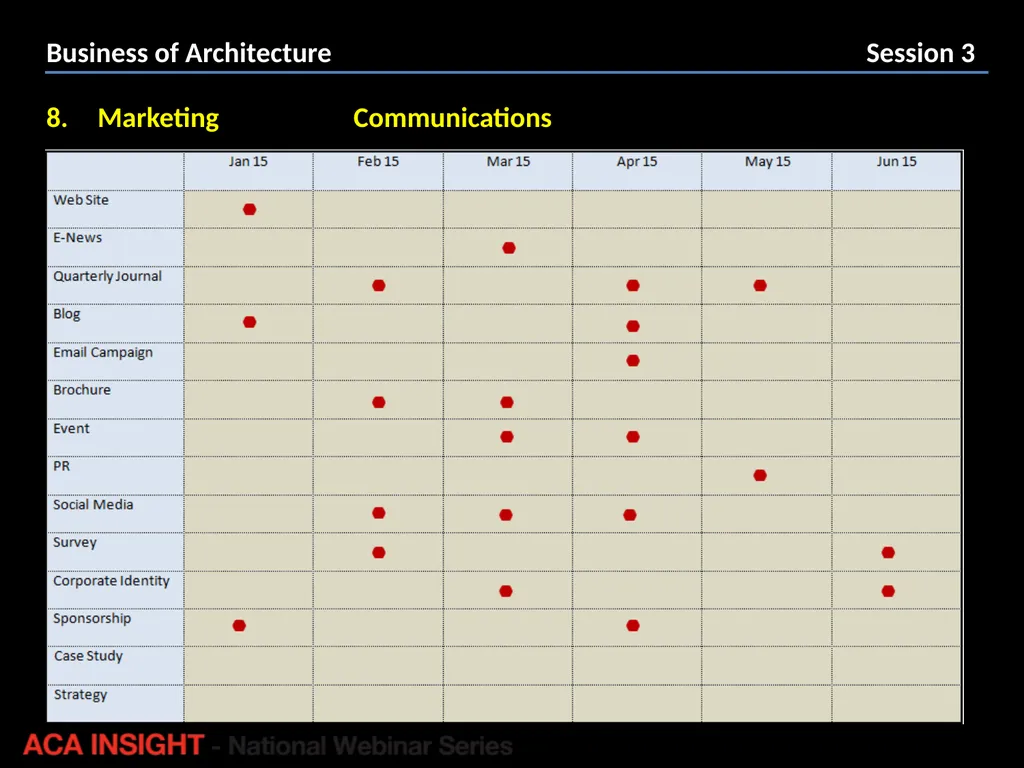
Marketing Communications Can’t ignore social media now — it’s your on-line community Develop a communications plan and system — too much to consider to do otherwise Market and get your name out there when you are the busiest — reach out and get to know the editors of key publications (ones your clients read!) Your work, your people and your communications are the core components of your brand — there is value in your brand Magnify the characteristics of your business — position your business with words LinkedIN Instagram Twitter MySpace Blog Business of Architecture Session 3<br>
23
Marketing Communications Business of Architecture Session 3<br>
24
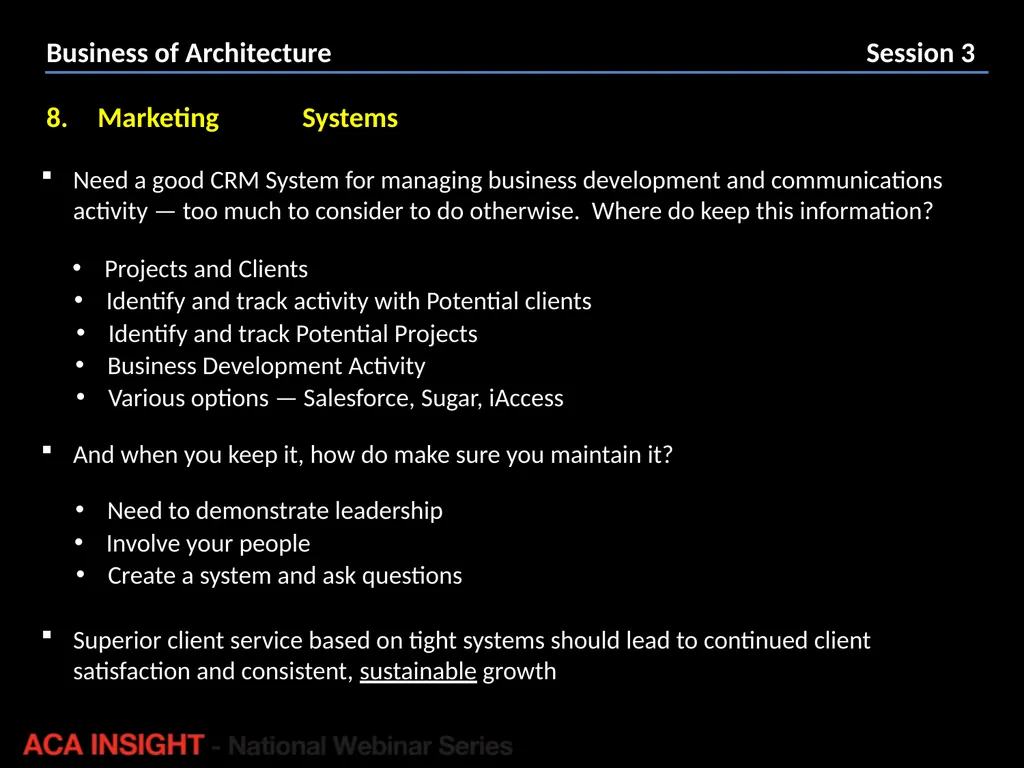
Marketing Systems Need a good CRM System for managing business development and communications activity — too much to consider to do otherwise. Where do keep this information? And when you keep it, how do make sure you maintain it? Superior client service based on tight systems should lead to continued client satisfaction and consistent, sustainable growth Projects and Clients Identify and track activity with Potential clients Identify and track Potential Projects Business Development Activity Various options — Salesforce, Sugar, iAccess Need to demonstrate leadership Involve your people Create a system and ask questions Business of Architecture Session 3<br>
25
CPD
Final 2 elements Design and Delivery Succession Business of Architecture Session 3<br>
Final 2 elements Design and Delivery Succession Business of Architecture Session 3<br>
26
Contact
Management for Design 03 9645 8834
Rob Peake 0419 310 725
rpeake@m4d.com.au
Refer to www.M4D.com.au for sample case studies Business of Architecture Session 3<br>
Management for Design 03 9645 8834
Rob Peake 0419 310 725
rpeake@m4d.com.au
Refer to www.M4D.com.au for sample case studies Business of Architecture Session 3<br>