Pressure Pressure in Solids Pressure is the unit force per unit area. The unit of pressure is Pascal (P) Note: The greater the area over which a force acts the less is the pressure and vice versa. Rule: PFA Ppressure , Fforce A area
"Pressure Pressure in Solids Pressure is the unit" is the property of its rightful owner. Permission is granted to
download and print the materials on this website for personal, non-commercial use only, and to display it
on your personal computer provided you do not modify the materials and that you retain all copyright
notices contained in the materials. By downloading content from our website, you accept the terms of this
agreement.
Presentation Transcript
01
Pressure<br>
02
Pressure in Solids Pressure is the unit force per unit area.
The unit of pressure is Pascal (P)
Note: The greater the area over which a force acts the less is the pressure and vice versa.
Rule: P=F/A P=pressure , F=force & A = area<br>
03
Pressure in fluids When an object is immersed in fluid (liquid or gas ) the fluid exerts a pressure on all sides of the object .
This pressure has several important features :
Pressure in a liquid increases with depth
Pressure at one depth acts equally in all directions
Pressure doesn’t depend on the shape or the size of the container
Pressure depends on the density of the liquid<br>
04
Pressure in a liquid increases with depth Because the farther down you go the greater the weight of the liquid above.
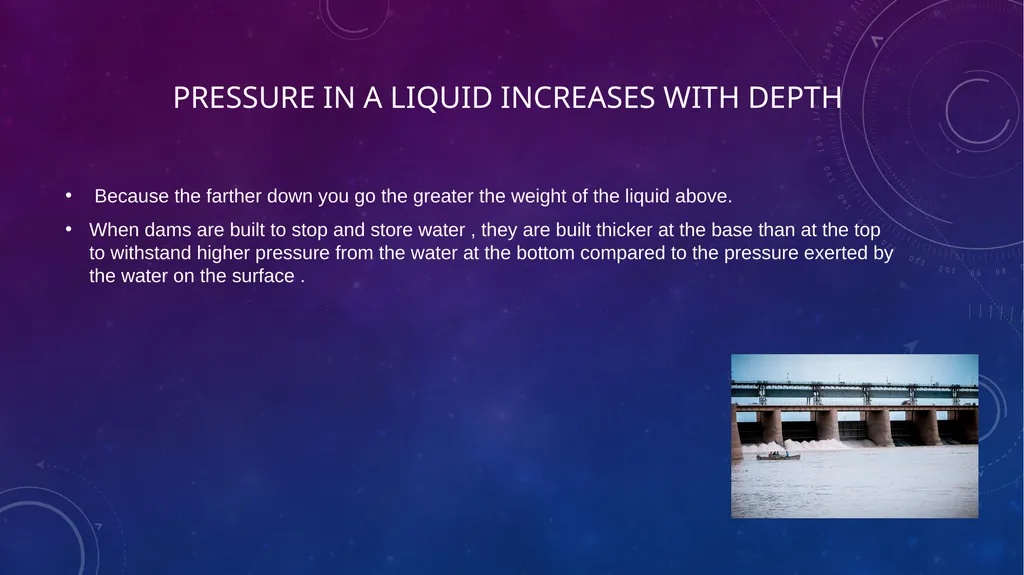
When dams are built to stop and store water , they are built thicker at the base than at the top to withstand higher pressure from the water at the bottom compared to the pressure exerted by the water on the surface .<br>
05
Pressure at one depth acts equally in all directions Picture a can water with holes all around in the same level .
Water comes out equally fast arid spurts equally far from the each hole .
The pressure exerted by the water at a certain depth is equal in all directions<br>
06
Pressure doesn’t depend on size or shape In strange looking container (container of four different shaped tubes connected together )
Presser at the bottom of all container is the same despite the different container shapes and widths .<br>
07
Pressure depending on density The denser the liquid the greater the pressure at any given depth .If the fluid density and gravitational field strength are constant , the excess pressure is easily calculated using this formula : P=pgh
p= is the density of the liquid , the greater the density the greater pressure
g= gravitational field strength
h=the depth beneath the surface of the liquid . The greater the depth the greater the pressure .<br>
08
Pressure depending on density This is described as excess pressure because it adds to any pressure acting on the surface of the fluid.
For example : the total pressure at the bottom of swimming pool is the pressure of the water plus the atmospheric above it .<br>
09
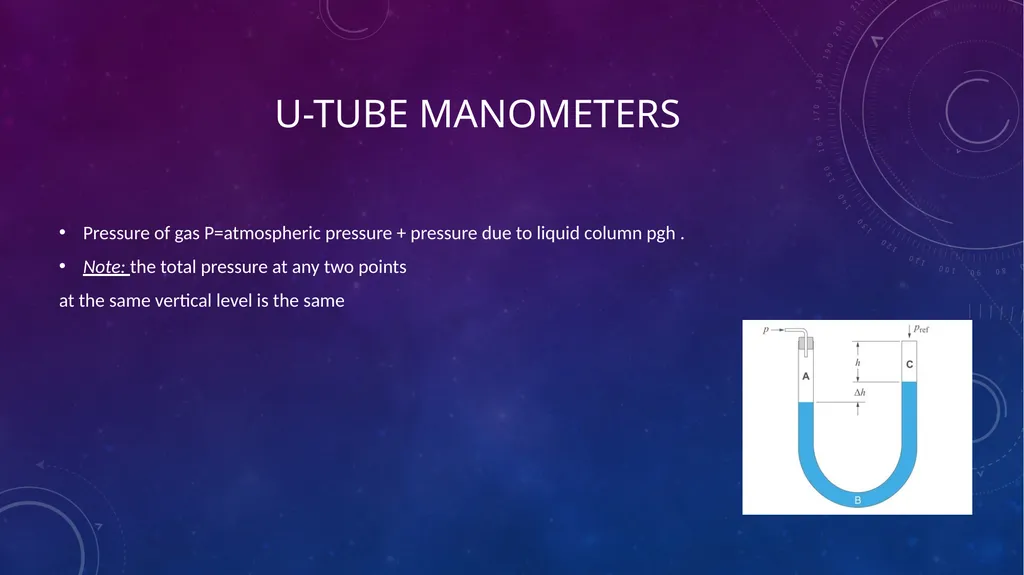
U-tube manometers The excess pressure resulting from a column of liquid used to measure pressure differences .
A manometer can be used to measure pressure difference
It consists of a U-tube of fluid that is displaced when the pressures at each end of the tube are different .
The pressure difference is measured by the difference in height between the two columns.<br>
10
U-tube manometers Pressure of gas P=atmospheric pressure + pressure due to liquid column pgh .
Note: the total pressure at any two points
at the same vertical level is the same<br>