
PREVENTING AND RESPONDING TO Resident-to-resident
LO
Published · 27 slides · 0 views

1 / 1



Description
PREVENTING AND RESPONDING TO Resident-to-resident mistreatment Date Speaker name and contact Learning Objectives Define resident-to-resident mistreatment (RRM), Provide practical solutions to prevent incidents of RRM, Understand the
Related Topics
Share
Embed code
Download this presentation From Below
"PREVENTING AND RESPONDING TO Resident-to-resident" is the property of its rightful owner. Permission is granted to download and print the materials on this website for personal, non-commercial use only, and to display it on your personal computer provided you do not modify the materials and that you retain all copyright notices contained in the materials. By downloading content from our website, you accept the terms of this agreement.
Presentation Transcript
01
PREVENTING AND RESPONDING TO Resident-to-resident mistreatment Date
Speaker name and contact<br>
Speaker name and contact<br>
02
Learning Objectives Define resident-to-resident mistreatment (RRM),
Provide practical solutions to prevent incidents of RRM,
Understand the importance of individualized, resident-centered care, and
Know how to report incidents of RRM.<br>
Provide practical solutions to prevent incidents of RRM,
Understand the importance of individualized, resident-centered care, and
Know how to report incidents of RRM.<br>
03
What is Resident-to-Resident Mistreatment (RRM)? Negative physical, sexual, or verbal interactions between long-term care residents that in a community setting would likely be construed as unwelcome and have high potential to cause physical or psychological distress in the recipient.
Source: A staff intervention targeting resident-to-resident elder mistreatment (R-REM) in long-term care increased staff knowledge, recognition and reporting: Results from a cluster randomized trial. Jeanne A. Teresi, Mildred Ramirez, Julie Ellis, Stephanie Silver, Gabriel Boratgis, Jian Kong, Joseph P. Eimicke, Karl Pillemer, and Mark S. Lachs. International Journal of Nursing Studies (2013), 644–656. https://www.ncbi.nlm.nih.gov/pmc/articles/PMC3677710/<br>
Source: A staff intervention targeting resident-to-resident elder mistreatment (R-REM) in long-term care increased staff knowledge, recognition and reporting: Results from a cluster randomized trial. Jeanne A. Teresi, Mildred Ramirez, Julie Ellis, Stephanie Silver, Gabriel Boratgis, Jian Kong, Joseph P. Eimicke, Karl Pillemer, and Mark S. Lachs. International Journal of Nursing Studies (2013), 644–656. https://www.ncbi.nlm.nih.gov/pmc/articles/PMC3677710/<br>
04
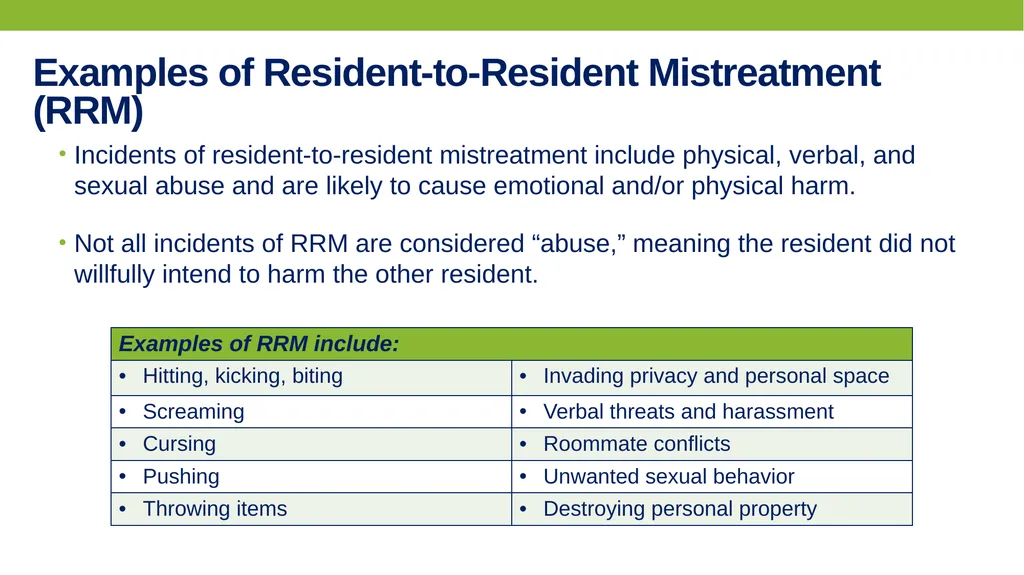
Examples of Resident-to-Resident Mistreatment (RRM) Incidents of resident-to-resident mistreatment include physical, verbal, and sexual abuse and are likely to cause emotional and/or physical harm.
Not all incidents of RRM are considered “abuse,” meaning the resident did not willfully intend to harm the other resident.<br>
Not all incidents of RRM are considered “abuse,” meaning the resident did not willfully intend to harm the other resident.<br>
05
Have you witnessed, or heard about, an incident of resident-to-resident mistreatment?
If so, what did you do?<br>
If so, what did you do?<br>
06
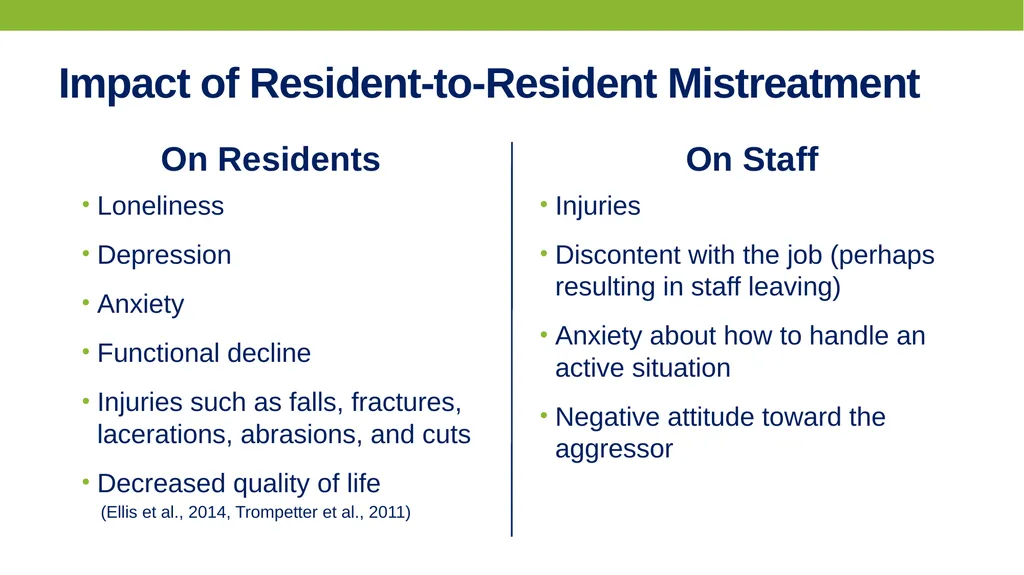
On Residents Loneliness
Depression
Anxiety
Functional decline
Injuries such as falls, fractures, lacerations, abrasions, and cuts
Decreased quality of life
(Ellis et al., 2014, Trompetter et al., 2011) On Staff Injuries
Discontent with the job (perhaps resulting in staff leaving)
Anxiety about how to handle an active situation
Negative attitude toward the aggressor Impact of Resident-to-Resident Mistreatment<br>
Depression
Anxiety
Functional decline
Injuries such as falls, fractures, lacerations, abrasions, and cuts
Decreased quality of life
(Ellis et al., 2014, Trompetter et al., 2011) On Staff Injuries
Discontent with the job (perhaps resulting in staff leaving)
Anxiety about how to handle an active situation
Negative attitude toward the aggressor Impact of Resident-to-Resident Mistreatment<br>
07
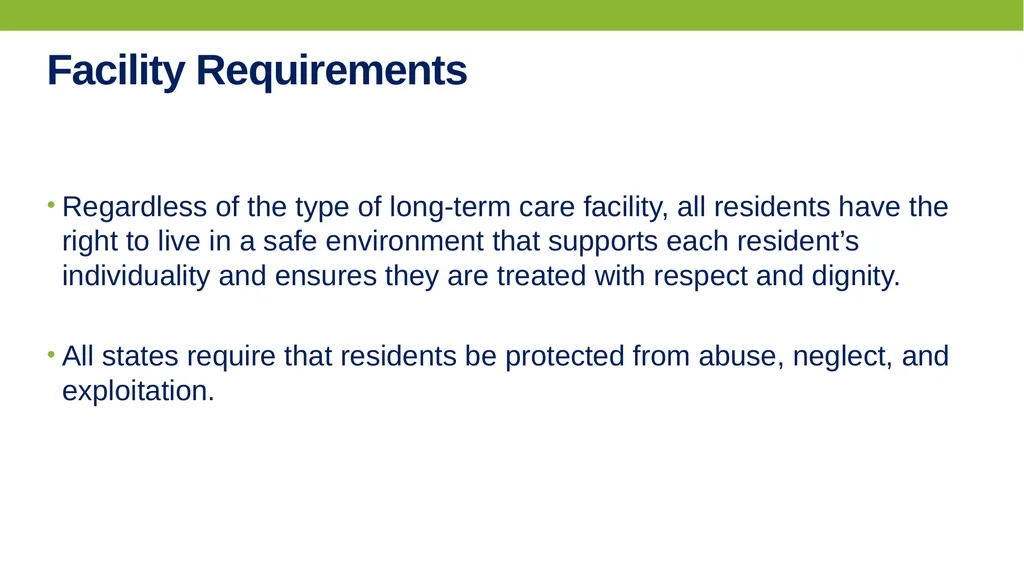
Facility Requirements Regardless of the type of long-term care facility, all residents have the right to live in a safe environment that supports each resident’s individuality and ensures they are treated with respect and dignity.
All states require that residents be protected from abuse, neglect, and exploitation.<br>
All states require that residents be protected from abuse, neglect, and exploitation.<br>
08
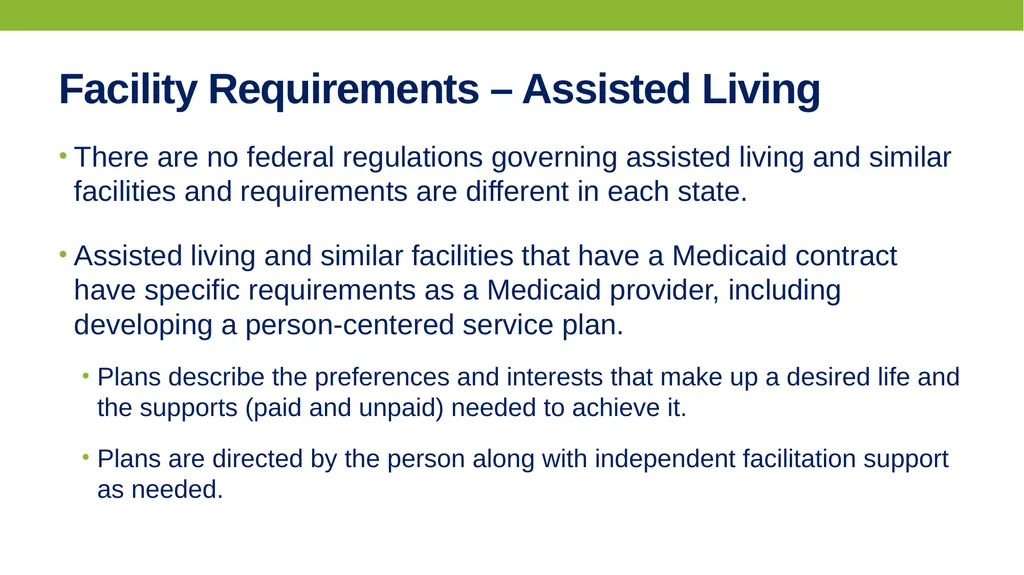
Facility Requirements – Assisted Living There are no federal regulations governing assisted living and similar facilities and requirements are different in each state.
Assisted living and similar facilities that have a Medicaid contract have specific requirements as a Medicaid provider, including developing a person-centered service plan.
Plans describe the preferences and interests that make up a desired life and the supports (paid and unpaid) needed to achieve it.
Plans are directed by the person along with independent facilitation support as needed.<br>
Assisted living and similar facilities that have a Medicaid contract have specific requirements as a Medicaid provider, including developing a person-centered service plan.
Plans describe the preferences and interests that make up a desired life and the supports (paid and unpaid) needed to achieve it.
Plans are directed by the person along with independent facilitation support as needed.<br>
09
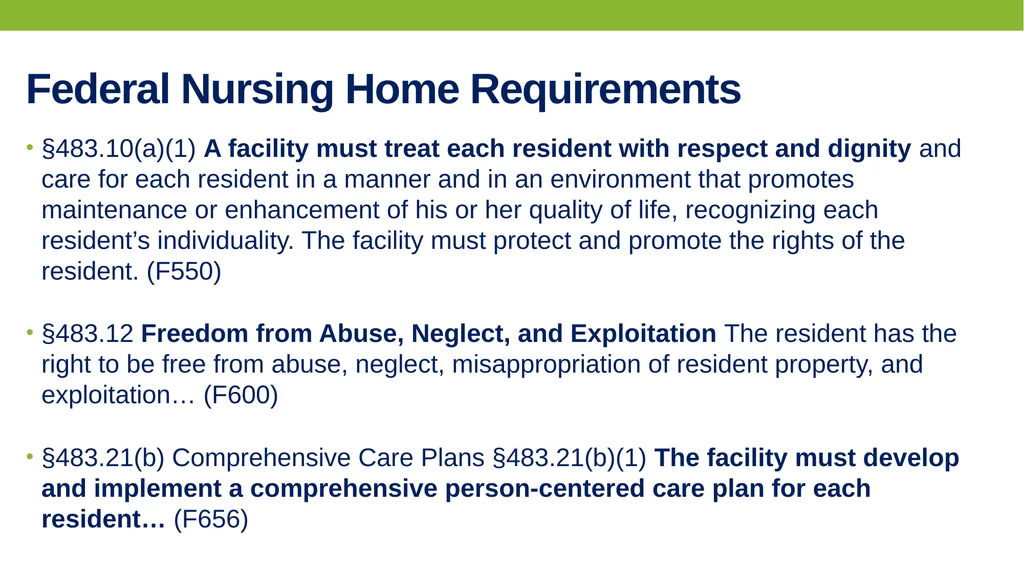
Federal Nursing Home Requirements §483.10(a)(1) A facility must treat each resident with respect and dignity and care for each resident in a manner and in an environment that promotes maintenance or enhancement of his or her quality of life, recognizing each resident’s individuality. The facility must protect and promote the rights of the resident. (F550)
§483.12 Freedom from Abuse, Neglect, and Exploitation The resident has the right to be free from abuse, neglect, misappropriation of resident property, and exploitation… (F600)
§483.21(b) Comprehensive Care Plans §483.21(b)(1) The facility must develop and implement a comprehensive person-centered care plan for each resident… (F656)<br>
§483.12 Freedom from Abuse, Neglect, and Exploitation The resident has the right to be free from abuse, neglect, misappropriation of resident property, and exploitation… (F600)
§483.21(b) Comprehensive Care Plans §483.21(b)(1) The facility must develop and implement a comprehensive person-centered care plan for each resident… (F656)<br>
10
Person-Centered Care
Federal Nursing Home Requirements “Person-centered care means the facility focuses on the resident as the center of control and supports each resident in making his or her own choices. Person-centered care includes making an effort to understand what each resident is communicating, verbally and nonverbally, identifying what is important to each resident with regard to daily routines and preferred activities, and having an understanding of the resident’s life before coming to reside in the nursing home.”
Staff should routinely read the care plans.
The care plans should include interventions (if necessary).
§483.10(c)(2) The right to participate in the development and implementation of his or her person-centered plan of care (F553)
Baseline Care Plans (F655)
§483.21(b) Comprehensive Care Plans (F656)<br>
Staff should routinely read the care plans.
The care plans should include interventions (if necessary).
§483.10(c)(2) The right to participate in the development and implementation of his or her person-centered plan of care (F553)
Baseline Care Plans (F655)
§483.21(b) Comprehensive Care Plans (F656)<br>
11
Nursing Home State Operations Manual - Appendix PP Freedom from Abuse, Neglect, and Exploitation (F600)
“A resident to resident altercation should be reviewed as a potential situation of abuse.”
This F-tag also addresses sexual abuse between residents
Facilities should complete a resident assessment and provide care planning interventions.
Free of Accident Hazards/Supervision/Devices (F689)
Determine if the facility ensured that the resident environment remains as free from accident hazards as is possible and each resident receives adequate supervision to prevent accidents related to resident-to-resident altercations where the resident’s action is not willful.<br>
“A resident to resident altercation should be reviewed as a potential situation of abuse.”
This F-tag also addresses sexual abuse between residents
Facilities should complete a resident assessment and provide care planning interventions.
Free of Accident Hazards/Supervision/Devices (F689)
Determine if the facility ensured that the resident environment remains as free from accident hazards as is possible and each resident receives adequate supervision to prevent accidents related to resident-to-resident altercations where the resident’s action is not willful.<br>
12
As mentioned in the last slide, the SOM states that
“redirection alone is not a sufficiently protective response.”
What other interventions can you suggest?<br>
13
Insert your state’s information, if applicable<br>
14
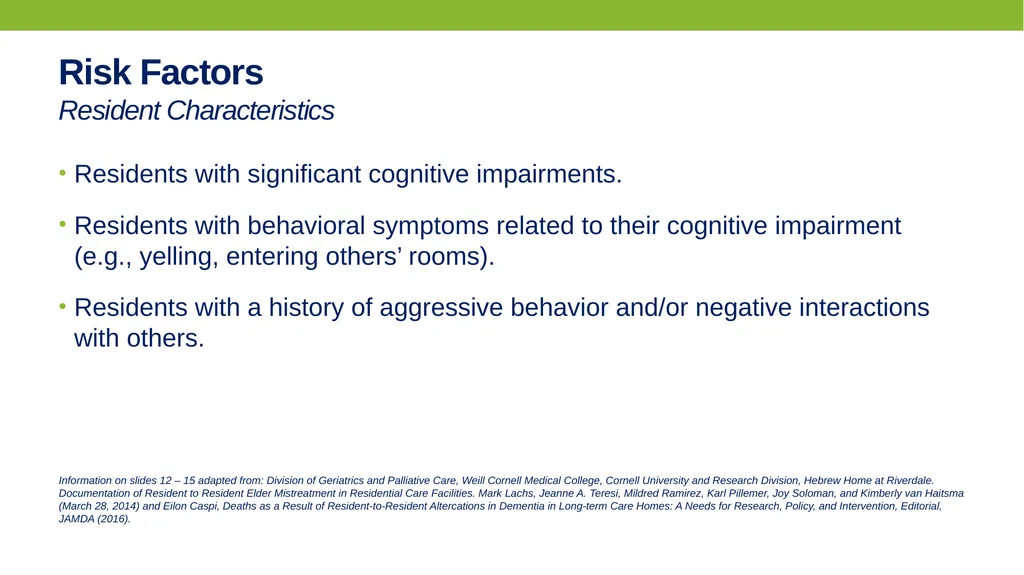
Risk Factors
Resident Characteristics Residents with significant cognitive impairments.
Residents with behavioral symptoms related to their cognitive impairment (e.g., yelling, entering others’ rooms).
Residents with a history of aggressive behavior and/or negative interactions with others.
Information on slides 12 – 15 adapted from: Division of Geriatrics and Palliative Care, Weill Cornell Medical College, Cornell University and Research Division, Hebrew Home at Riverdale. Documentation of Resident to Resident Elder Mistreatment in Residential Care Facilities. Mark Lachs, Jeanne A. Teresi, Mildred Ramirez, Karl Pillemer, Joy Soloman, and Kimberly van Haitsma (March 28, 2014) and Eilon Caspi, Deaths as a Result of Resident-to-Resident Altercations in Dementia in Long-term Care Homes: A Needs for Research, Policy, and Intervention, Editorial, JAMDA (2016).<br>
Residents with behavioral symptoms related to their cognitive impairment (e.g., yelling, entering others’ rooms).
Residents with a history of aggressive behavior and/or negative interactions with others.
Information on slides 12 – 15 adapted from: Division of Geriatrics and Palliative Care, Weill Cornell Medical College, Cornell University and Research Division, Hebrew Home at Riverdale. Documentation of Resident to Resident Elder Mistreatment in Residential Care Facilities. Mark Lachs, Jeanne A. Teresi, Mildred Ramirez, Karl Pillemer, Joy Soloman, and Kimberly van Haitsma (March 28, 2014) and Eilon Caspi, Deaths as a Result of Resident-to-Resident Altercations in Dementia in Long-term Care Homes: A Needs for Research, Policy, and Intervention, Editorial, JAMDA (2016).<br>
15
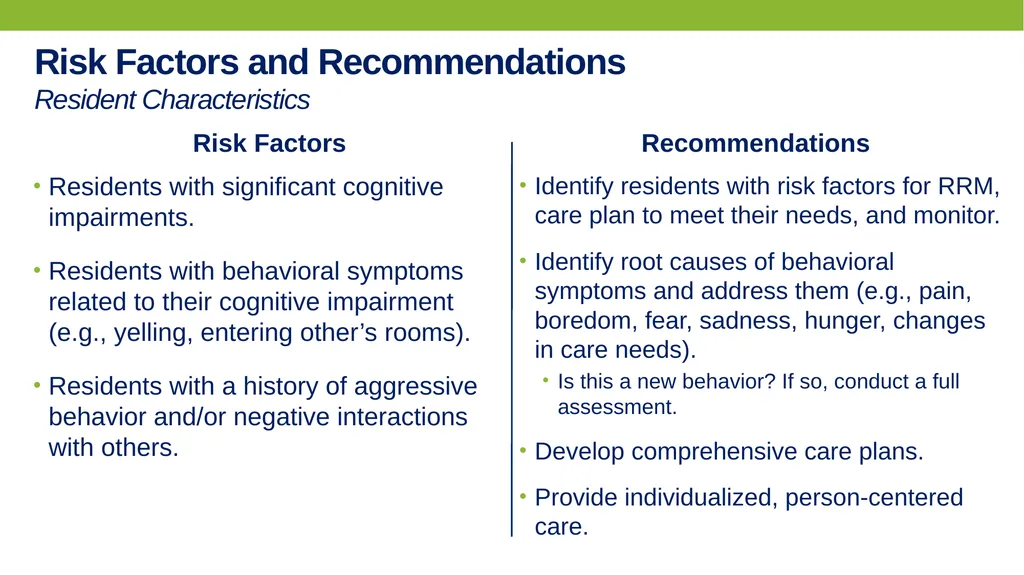
Risk Factors and Recommendations
Resident Characteristics Risk Factors Residents with significant cognitive impairments.
Residents with behavioral symptoms related to their cognitive impairment (e.g., yelling, entering other’s rooms).
Residents with a history of aggressive behavior and/or negative interactions with others. Recommendations Identify residents with risk factors for RRM, care plan to meet their needs, and monitor.
Identify root causes of behavioral symptoms and address them (e.g., pain, boredom, fear, sadness, hunger, changes in care needs).
Is this a new behavior? If so, conduct a full assessment.
Develop comprehensive care plans.
Provide individualized, person-centered care.<br>
Residents with behavioral symptoms related to their cognitive impairment (e.g., yelling, entering other’s rooms).
Residents with a history of aggressive behavior and/or negative interactions with others. Recommendations Identify residents with risk factors for RRM, care plan to meet their needs, and monitor.
Identify root causes of behavioral symptoms and address them (e.g., pain, boredom, fear, sadness, hunger, changes in care needs).
Is this a new behavior? If so, conduct a full assessment.
Develop comprehensive care plans.
Provide individualized, person-centered care.<br>
16
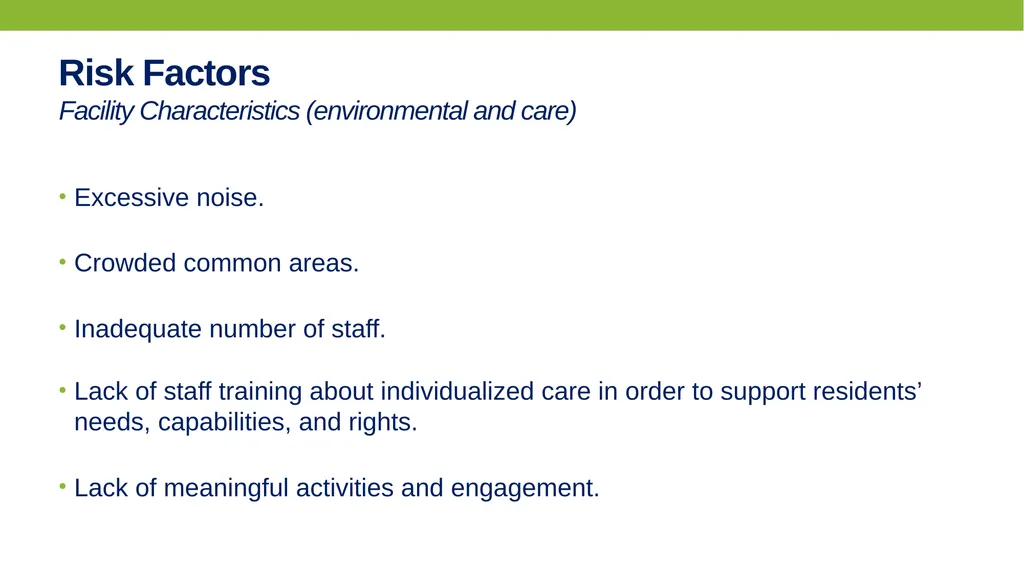
Risk Factors
Facility Characteristics (environmental and care) Excessive noise.
Crowded common areas.
Inadequate number of staff.
Lack of staff training about individualized care in order to support residents’ needs, capabilities, and rights.
Lack of meaningful activities and engagement.<br>
Crowded common areas.
Inadequate number of staff.
Lack of staff training about individualized care in order to support residents’ needs, capabilities, and rights.
Lack of meaningful activities and engagement.<br>
17
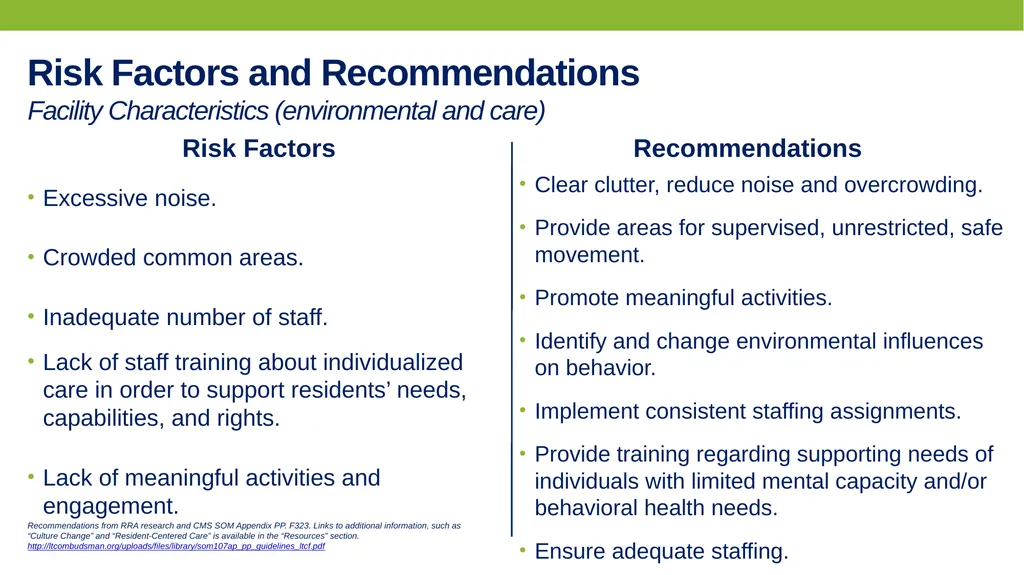
Risk Factors and Recommendations
Facility Characteristics (environmental and care) Risk Factors Excessive noise.
Crowded common areas.
Inadequate number of staff.
Lack of staff training about individualized care in order to support residents’ needs, capabilities, and rights.
Lack of meaningful activities and engagement.
Recommendations from RRA research and CMS SOM Appendix PP. F323. Links to additional information, such as “Culture Change” and “Resident-Centered Care” is available in the “Resources” section. http://ltcombudsman.org/uploads/files/library/som107ap_pp_guidelines_ltcf.pdf Recommendations Clear clutter, reduce noise and overcrowding.
Provide areas for supervised, unrestricted, safe movement.
Promote meaningful activities.
Identify and change environmental influences on behavior.
Implement consistent staffing assignments.
Provide training regarding supporting needs of individuals with limited mental capacity and/or behavioral health needs.
Ensure adequate staffing.<br>
Crowded common areas.
Inadequate number of staff.
Lack of staff training about individualized care in order to support residents’ needs, capabilities, and rights.
Lack of meaningful activities and engagement.
Recommendations from RRA research and CMS SOM Appendix PP. F323. Links to additional information, such as “Culture Change” and “Resident-Centered Care” is available in the “Resources” section. http://ltcombudsman.org/uploads/files/library/som107ap_pp_guidelines_ltcf.pdf Recommendations Clear clutter, reduce noise and overcrowding.
Provide areas for supervised, unrestricted, safe movement.
Promote meaningful activities.
Identify and change environmental influences on behavior.
Implement consistent staffing assignments.
Provide training regarding supporting needs of individuals with limited mental capacity and/or behavioral health needs.
Ensure adequate staffing.<br>
18
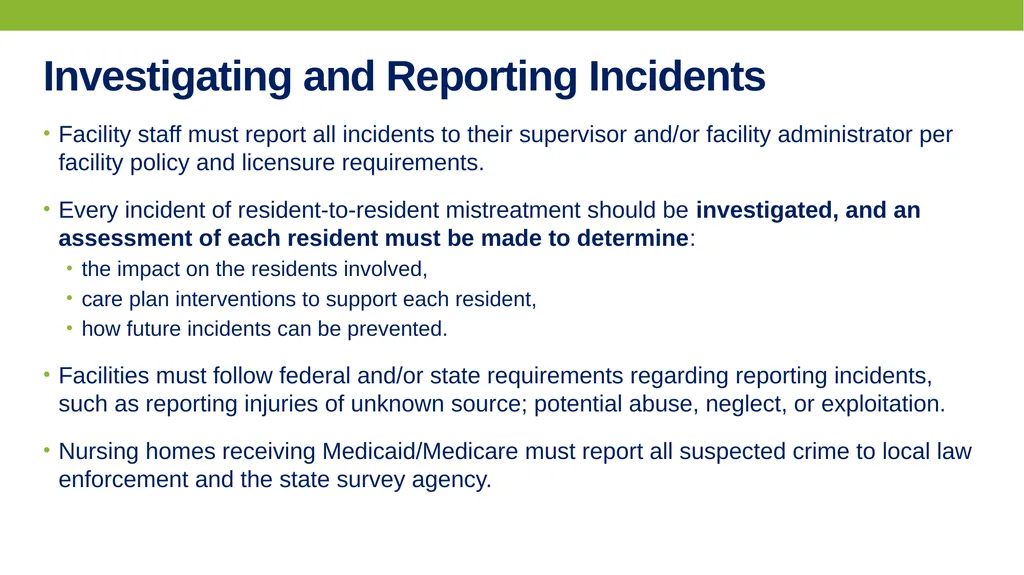
Investigating and Reporting Incidents Facility staff must report all incidents to their supervisor and/or facility administrator per facility policy and licensure requirements.
Every incident of resident-to-resident mistreatment should be investigated, and an assessment of each resident must be made to determine:
the impact on the residents involved,
care plan interventions to support each resident,
how future incidents can be prevented.
Facilities must follow federal and/or state requirements regarding reporting incidents, such as reporting injuries of unknown source; potential abuse, neglect, or exploitation.
Nursing homes receiving Medicaid/Medicare must report all suspected crime to local law enforcement and the state survey agency.<br>
Every incident of resident-to-resident mistreatment should be investigated, and an assessment of each resident must be made to determine:
the impact on the residents involved,
care plan interventions to support each resident,
how future incidents can be prevented.
Facilities must follow federal and/or state requirements regarding reporting incidents, such as reporting injuries of unknown source; potential abuse, neglect, or exploitation.
Nursing homes receiving Medicaid/Medicare must report all suspected crime to local law enforcement and the state survey agency.<br>
19
Resources<br>
20
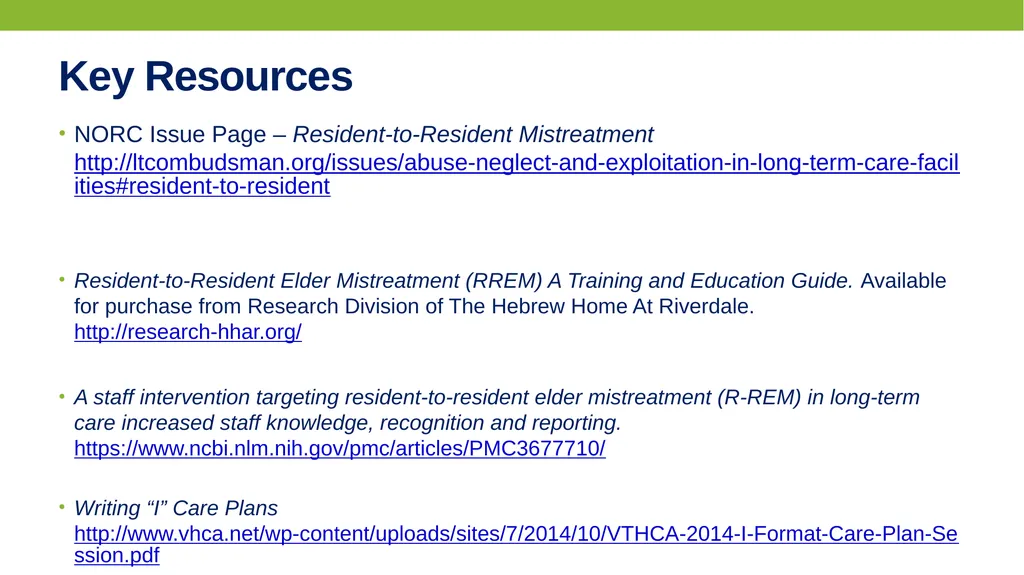
Key Resources NORC Issue Page – Resident-to-Resident Mistreatment http://ltcombudsman.org/issues/abuse-neglect-and-exploitation-in-long-term-care-facilities#resident-to-resident
Resident-to-Resident Elder Mistreatment (RREM) A Training and Education Guide. Available for purchase from Research Division of The Hebrew Home At Riverdale. http://research-hhar.org/
A staff intervention targeting resident-to-resident elder mistreatment (R-REM) in long-term care increased staff knowledge, recognition and reporting. https://www.ncbi.nlm.nih.gov/pmc/articles/PMC3677710/
Writing “I” Care Plans http://www.vhca.net/wp-content/uploads/sites/7/2014/10/VTHCA-2014-I-Format-Care-Plan-Session.pdf<br>
Resident-to-Resident Elder Mistreatment (RREM) A Training and Education Guide. Available for purchase from Research Division of The Hebrew Home At Riverdale. http://research-hhar.org/
A staff intervention targeting resident-to-resident elder mistreatment (R-REM) in long-term care increased staff knowledge, recognition and reporting. https://www.ncbi.nlm.nih.gov/pmc/articles/PMC3677710/
Writing “I” Care Plans http://www.vhca.net/wp-content/uploads/sites/7/2014/10/VTHCA-2014-I-Format-Care-Plan-Session.pdf<br>
21
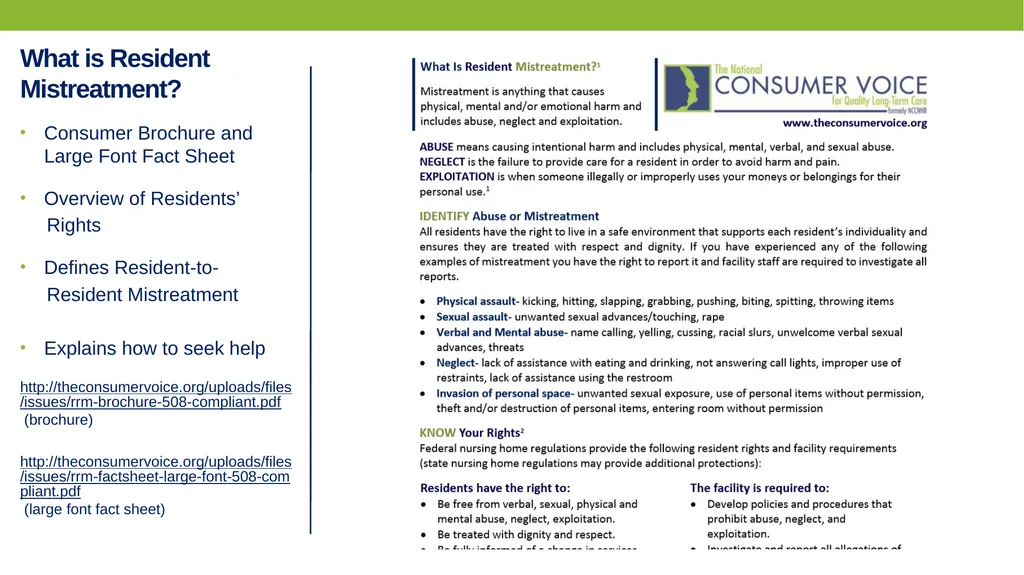
Consumer Brochure and Large Font Fact Sheet
Overview of Residents’
Rights
Defines Resident-to-
Resident Mistreatment
Explains how to seek help
http://theconsumervoice.org/uploads/files/issues/rrm-brochure-508-compliant.pdf (brochure)
http://theconsumervoice.org/uploads/files/issues/rrm-factsheet-large-font-508-compliant.pdf (large font fact sheet) What is Resident Mistreatment?<br>
Overview of Residents’
Rights
Defines Resident-to-
Resident Mistreatment
Explains how to seek help
http://theconsumervoice.org/uploads/files/issues/rrm-brochure-508-compliant.pdf (brochure)
http://theconsumervoice.org/uploads/files/issues/rrm-factsheet-large-font-508-compliant.pdf (large font fact sheet) What is Resident Mistreatment?<br>
22
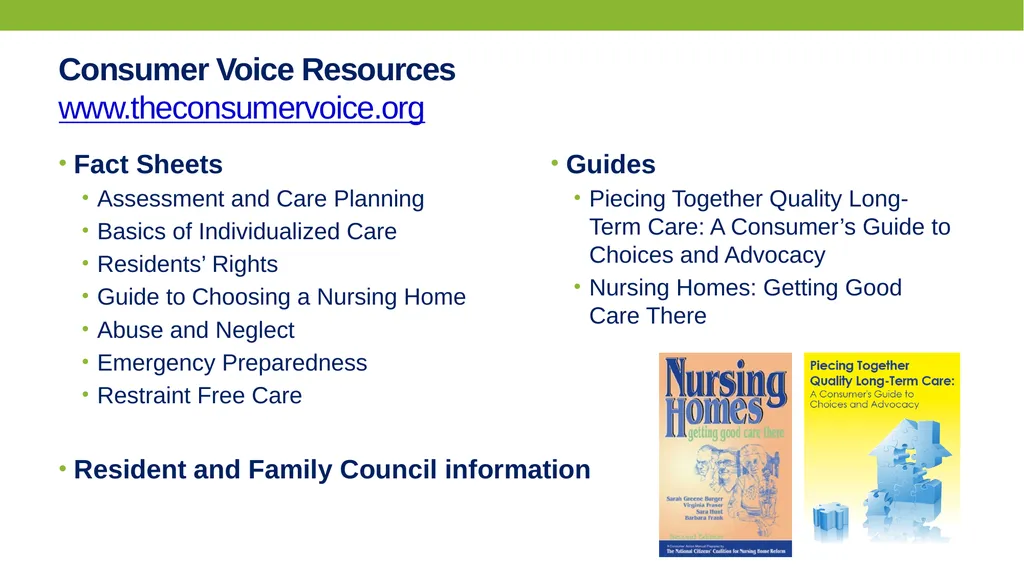
Consumer Voice Resources
www.theconsumervoice.org Fact Sheets
Assessment and Care Planning
Basics of Individualized Care
Residents’ Rights
Guide to Choosing a Nursing Home
Abuse and Neglect
Emergency Preparedness
Restraint Free Care
Resident and Family Council information Guides
Piecing Together Quality Long-Term Care: A Consumer’s Guide to Choices and Advocacy
Nursing Homes: Getting Good Care There<br>
Assessment and Care Planning
Basics of Individualized Care
Residents’ Rights
Guide to Choosing a Nursing Home
Abuse and Neglect
Emergency Preparedness
Restraint Free Care
Resident and Family Council information Guides
Piecing Together Quality Long-Term Care: A Consumer’s Guide to Choices and Advocacy
Nursing Homes: Getting Good Care There<br>
23
Key Takeaways Residents have the right to live in a safe environment that supports each resident’s individuality and ensures they are treated with respect and dignity.
Resident-to-resident mistreatment is a serious issue that has a significant negative impact on all residents involved, but incidents are often not reported and investigated.
Behavior is often a form of communication and in order to provide appropriate, resident-centered care staff need to identify the root cause of the behavior and understand what the resident is trying to communicate.
Providing individualized, resident-centered care and having an adequate number of well-trained staff are critical to ensuring all residents receive the care they need and are protected from mistreatment.<br>
Resident-to-resident mistreatment is a serious issue that has a significant negative impact on all residents involved, but incidents are often not reported and investigated.
Behavior is often a form of communication and in order to provide appropriate, resident-centered care staff need to identify the root cause of the behavior and understand what the resident is trying to communicate.
Providing individualized, resident-centered care and having an adequate number of well-trained staff are critical to ensuring all residents receive the care they need and are protected from mistreatment.<br>
24
Three Barriers to Change Acceptance
Ignorance
Inaction<br>
Ignorance
Inaction<br>
25
Questions?<br>
26
Connect with us:
www.ltcombudsman.org
ombudcenter@theconsumervoice.org
The National LTC Ombudsman Resource Center
@LTCombudcenter
Get our app! Search for "LTC Ombudsman Resource Center" in the Apple Store or Google Play
This project was supported, in part, by grant number 90OMRC0002-01-00, from the U.S. Administration for Community Living, Department of Health and Human Services, Washington, D.C. 20201. Grantees undertaking projects under government sponsorship are encouraged to express freely their findings and conclusions. Points of view or opinions do not, therefore, necessarily represent official Administration for Community Living policy.
Updated May 2022<br>
www.ltcombudsman.org
ombudcenter@theconsumervoice.org
The National LTC Ombudsman Resource Center
@LTCombudcenter
Get our app! Search for "LTC Ombudsman Resource Center" in the Apple Store or Google Play
This project was supported, in part, by grant number 90OMRC0002-01-00, from the U.S. Administration for Community Living, Department of Health and Human Services, Washington, D.C. 20201. Grantees undertaking projects under government sponsorship are encouraged to express freely their findings and conclusions. Points of view or opinions do not, therefore, necessarily represent official Administration for Community Living policy.
Updated May 2022<br>
27
Insert your contact information<br>