
Preventive Practices in Ayurveda Fatima Raad Claim
YM
Published · 37 slides · 0 views

1 / 1

Description
Preventive Practices in Ayurveda Fatima Raad Claim The purpose of this presentation is to address the different aspects of preventive practices according to Ayurveda ,that we can incorporate in our daily lives to be protected from different
Related Topics
Share
Embed code
Download this presentation From Below
"Preventive Practices in Ayurveda Fatima Raad Claim" is the property of its rightful owner. Permission is granted to download and print the materials on this website for personal, non-commercial use only, and to display it on your personal computer provided you do not modify the materials and that you retain all copyright notices contained in the materials. By downloading content from our website, you accept the terms of this agreement.
Presentation Transcript
01
Preventive Practices in Ayurveda Fatima Raad<br>
02
Claim The purpose of this presentation is to address the different aspects of preventive practices according to Ayurveda ,that we can incorporate in our daily lives to be protected from different diseases.<br>
03
Content What is Ayurveda?
Health is harmony
Prevention in Ayurveda
Factors of health Preventive practices:
- Self knowledge
- Like increase like
- Food
- Seasons
- Age
- Mental/emotional
-Stress
- Proper use of senses
- Life purpose
- Daily/seasonal practices<br>
Health is harmony
Prevention in Ayurveda
Factors of health Preventive practices:
- Self knowledge
- Like increase like
- Food
- Seasons
- Age
- Mental/emotional
-Stress
- Proper use of senses
- Life purpose
- Daily/seasonal practices<br>
04
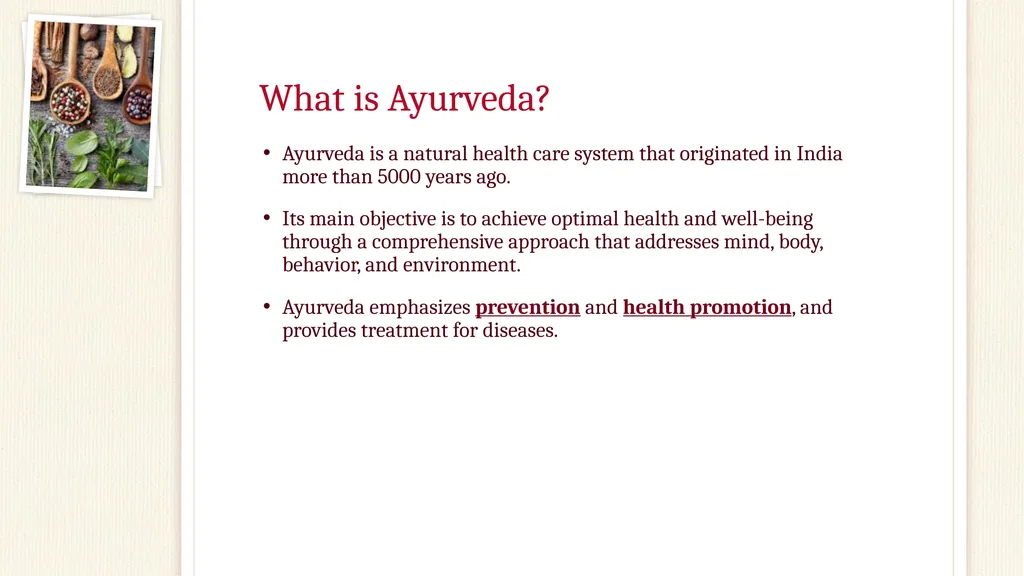
What is Ayurveda? Ayurveda is a natural health care system that originated in India more than 5000 years ago.
Its main objective is to achieve optimal health and well-being through a comprehensive approach that addresses mind, body, behavior, and environment.
Ayurveda emphasizes prevention and health promotion, and provides treatment for diseases.<br>
Its main objective is to achieve optimal health and well-being through a comprehensive approach that addresses mind, body, behavior, and environment.
Ayurveda emphasizes prevention and health promotion, and provides treatment for diseases.<br>
05
Prevention in Ayurveda Ayurveda is the science of producing harmony in our lives.
In Ayurveda we say that where there is harmony, there is health; where there is disharmony, there is disease.
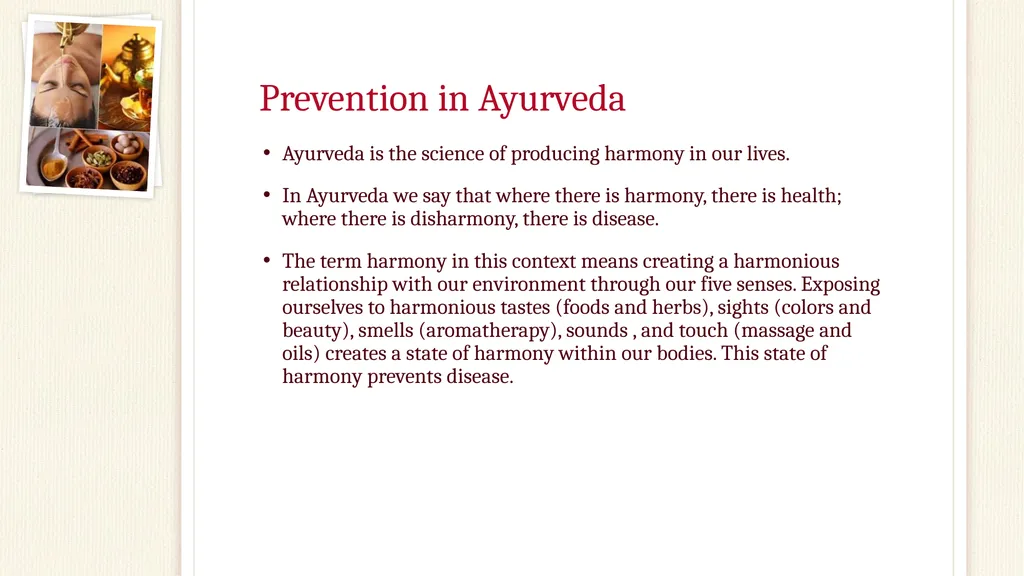
The term harmony in this context means creating a harmonious relationship with our environment through our five senses. Exposing ourselves to harmonious tastes (foods and herbs), sights (colors and beauty), smells (aromatherapy), sounds , and touch (massage and oils) creates a state of harmony within our bodies. This state of harmony prevents disease.<br>
06
Prevention in Ayurveda Ayurveda teaches us that through a healthy lifestyle that is individually designed to be harmonious with our own unique nature (our constitution), and the practices of spirituality, a person can reach their potential physically, emotionally and spiritually.
In this state, disease does not exist. It serves no purpose. For what is disease, really? It is our body communicating disharmony. Remove the disharmony and you remove the disease.<br>
In this state, disease does not exist. It serves no purpose. For what is disease, really? It is our body communicating disharmony. Remove the disharmony and you remove the disease.<br>
07
The state of balance can be created and sustained by maintaining a healthy lifestyle in accordance with nature and the requirements of one’s own constitution.
Proper nutrition ,proper exercise, healthy relationships, positive emotions ,and a regulated daily routine all contribute to a healthy life. (1)<br>
Proper nutrition ,proper exercise, healthy relationships, positive emotions ,and a regulated daily routine all contribute to a healthy life. (1)<br>
08
Thomas Edison said that:
“the doctor of the future will give no medicine but will interest his patients in the care of the human frame, in diet and in the cause and prevention of disease.” (2)<br>
“the doctor of the future will give no medicine but will interest his patients in the care of the human frame, in diet and in the cause and prevention of disease.” (2)<br>
09
Factors of health (3) Knowing better
Like increase like
Food and diet
Seasons
Exercise
Age
Mental/emotional
Stress
Proper use of senses
Relationships
Daily routines Pillars of prevention<br>
Like increase like
Food and diet
Seasons
Exercise
Age
Mental/emotional
Stress
Proper use of senses
Relationships
Daily routines Pillars of prevention<br>
10
Health prevention Health prevention, in holistic terms, means balancing one’s physical, mental and spiritual (inner) health, lifestyle and situation are also examined for their effects on health. (4)<br>
11
Self – knowledge Very often we get sick because we disregard our own knowledge or wisdom. (5)
Knowing better: Awareness
Gives us the opportunity and challenge to maintain good health or fall into illness. (6)<br>
Knowing better: Awareness
Gives us the opportunity and challenge to maintain good health or fall into illness. (6)<br>
12
In tune with nature (7) The master key to good health is to get ourselves into harmony with nature.
Following the great rhythms and forces of nature plays an important role in prevention. (day/night- seasons-life stage).<br>
Following the great rhythms and forces of nature plays an important role in prevention. (day/night- seasons-life stage).<br>
13
Like increases like (8) The first most important principle in considering preventive measures.
A body type is increased by experiences and influences (food,weather,season) with qualities similar to it.
The antidote to “like increase like” is opposite qualities decrease or balance. This is the key to healing.<br>
A body type is increased by experiences and influences (food,weather,season) with qualities similar to it.
The antidote to “like increase like” is opposite qualities decrease or balance. This is the key to healing.<br>
14
Food and diet (9) Eating the right kind of food for your body type maintains vitality and balance, while eating the wrong kinds creates imbalance which is the first step in the genesis of disease.
Examples:
Pitta person eating spicy/soury food.
Vata person eating high raw food diet.
Kapha person eating fried, dairy ,cold foods.<br>
Examples:
Pitta person eating spicy/soury food.
Vata person eating high raw food diet.
Kapha person eating fried, dairy ,cold foods.<br>
15
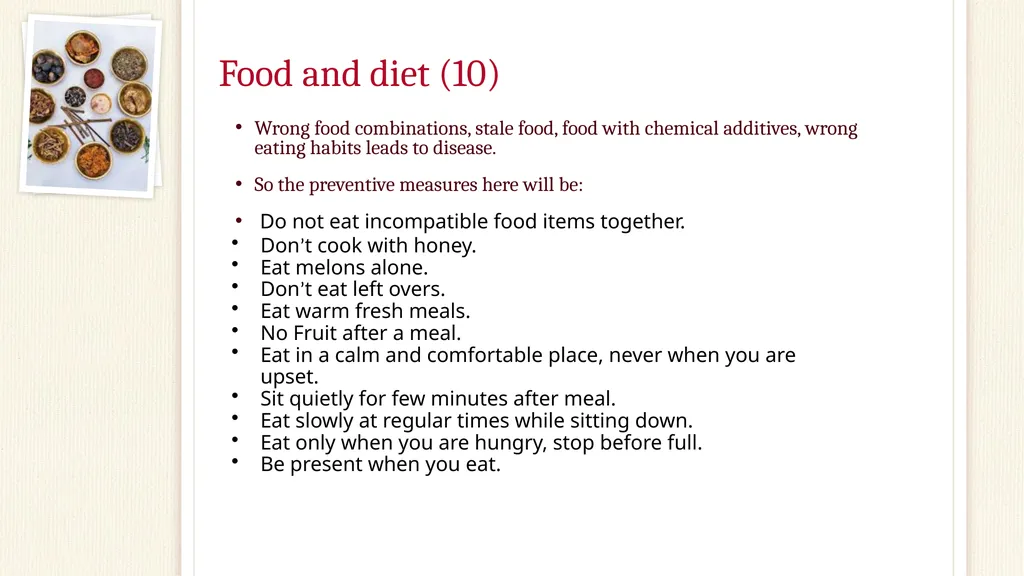
Food and diet (10) Wrong food combinations, stale food, food with chemical additives, wrong eating habits leads to disease.
So the preventive measures here will be:
Do not eat incompatible food items together.
Don’t cook with honey.
Eat melons alone.
Don’t eat left overs.
Eat warm fresh meals.
No Fruit after a meal.
Eat in a calm and comfortable place, never when you are upset.
Sit quietly for few minutes after meal.
Eat slowly at regular times while sitting down.
Eat only when you are hungry, stop before full.
Be present when you eat.<br>
16
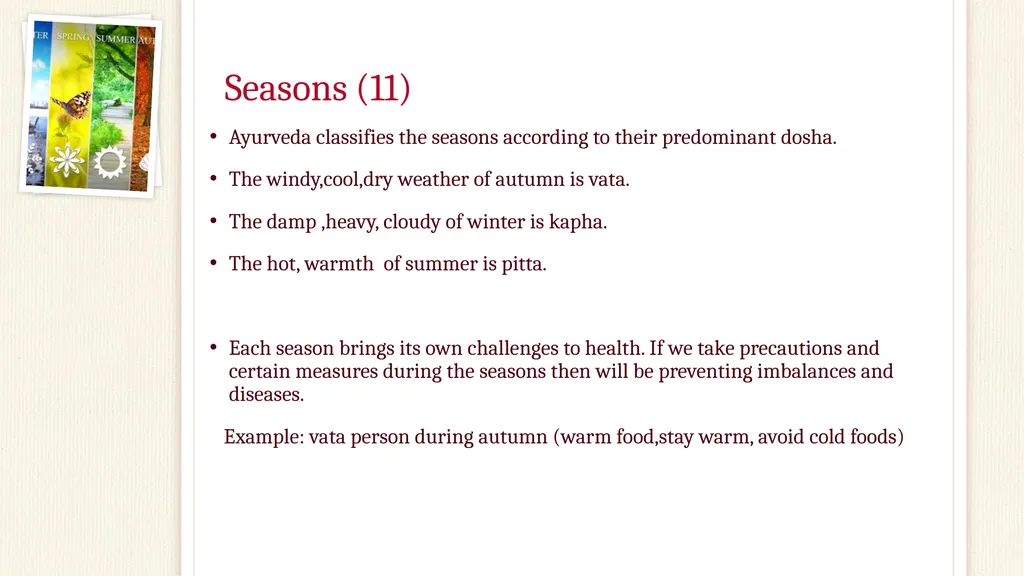
Seasons (11) Ayurveda classifies the seasons according to their predominant dosha.
The windy,cool,dry weather of autumn is vata.
The damp ,heavy, cloudy of winter is kapha.
The hot, warmth of summer is pitta.
Each season brings its own challenges to health. If we take precautions and certain measures during the seasons then will be preventing imbalances and diseases.
Example: vata person during autumn (warm food,stay warm, avoid cold foods)<br>
17
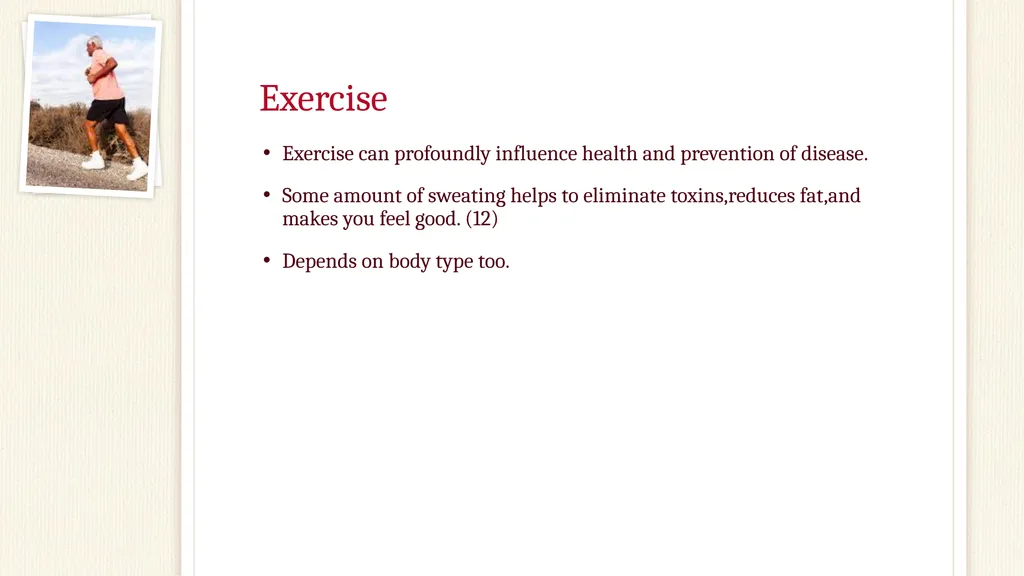
Exercise Exercise can profoundly influence health and prevention of disease.
Some amount of sweating helps to eliminate toxins,reduces fat,and makes you feel good. (12)
Depends on body type too.<br>
Some amount of sweating helps to eliminate toxins,reduces fat,and makes you feel good. (12)
Depends on body type too.<br>
18
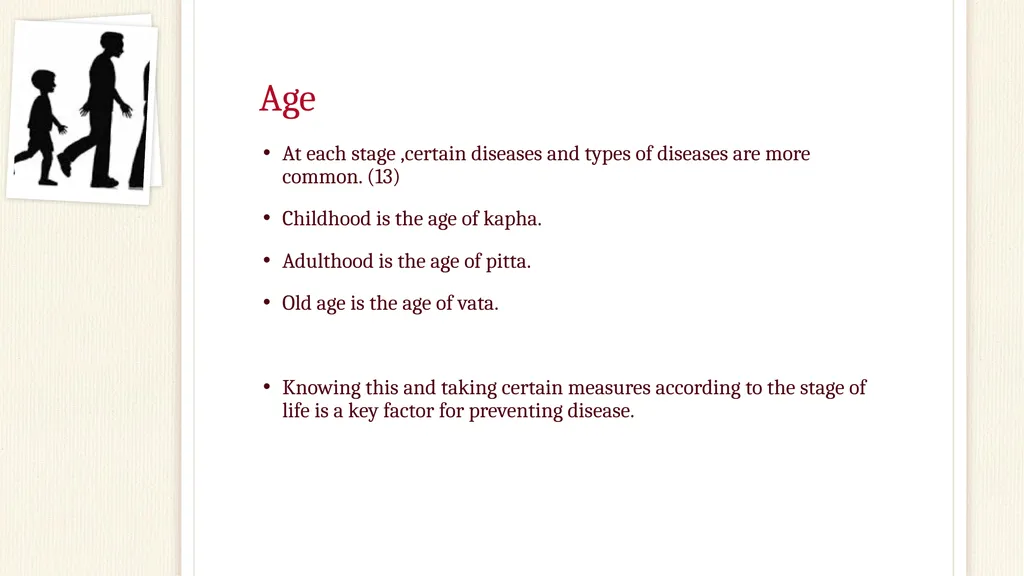
Age At each stage ,certain diseases and types of diseases are more common. (13)
Childhood is the age of kapha.
Adulthood is the age of pitta.
Old age is the age of vata.
Knowing this and taking certain measures according to the stage of life is a key factor for preventing disease.<br>
Childhood is the age of kapha.
Adulthood is the age of pitta.
Old age is the age of vata.
Knowing this and taking certain measures according to the stage of life is a key factor for preventing disease.<br>
19
Mental and emotional (14) Our life is whole : constituting of body ,mind, soul.
Illness may begin in the mind and emotions and then it affects the body and vice versa.
Every perception,thought,feeling, an emotion (weather positive or negative) is a biochemical event that influences the cells, tissues and organs.
Emotions are reactions to situations. If we don’t understand the total movement of an emotion, from arising to dissolution it will affect a particular organ in the body, causing disease.<br>
20
Emotions have an affinity with certain organs: (15)
Lungs= grief and sadness
Anger= liver (lines on the right)
Hatred= gall bladder
Kidneys = fear
Nervousness= colon
knowing how to deal with emotions is a key factor
in disease prevention.<br>
Lungs= grief and sadness
Anger= liver (lines on the right)
Hatred= gall bladder
Kidneys = fear
Nervousness= colon
knowing how to deal with emotions is a key factor
in disease prevention.<br>
21
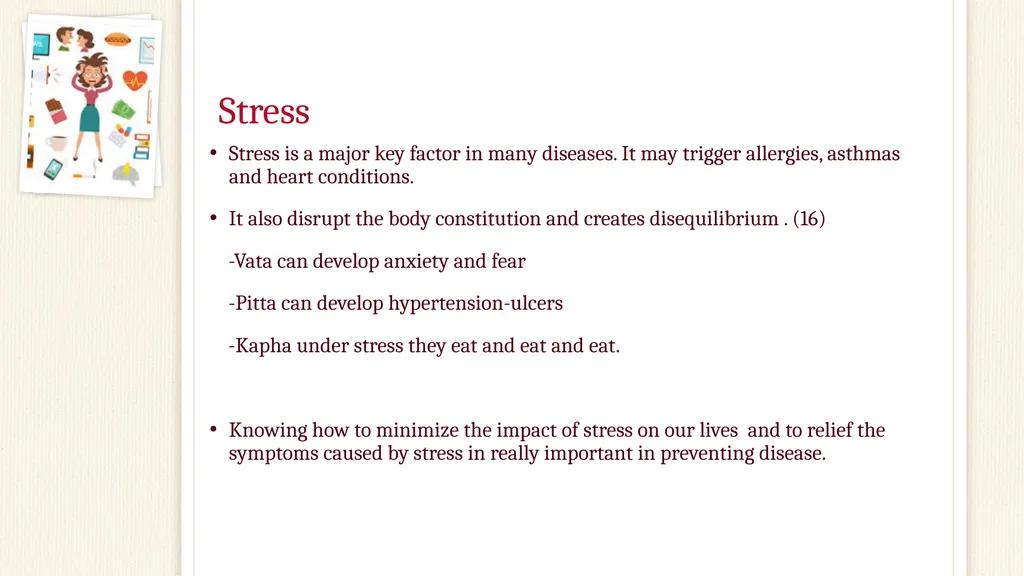
Stress Stress is a major key factor in many diseases. It may trigger allergies, asthmas and heart conditions.
It also disrupt the body constitution and creates disequilibrium . (16)
-Vata can develop anxiety and fear
-Pitta can develop hypertension-ulcers
-Kapha under stress they eat and eat and eat.
Knowing how to minimize the impact of stress on our lives and to relief the symptoms caused by stress in really important in preventing disease.<br>
22
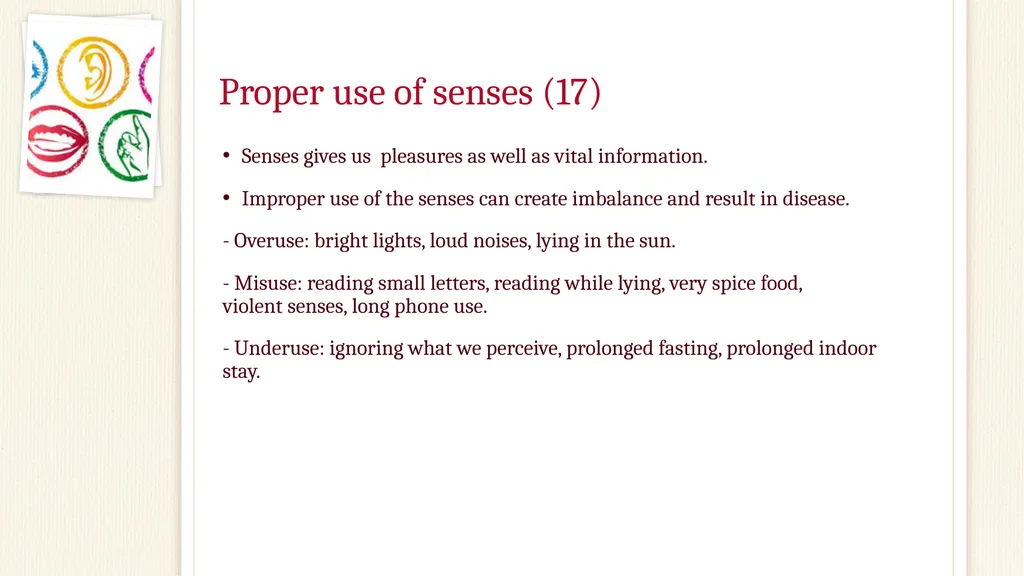
Proper use of senses (17) Senses gives us pleasures as well as vital information.
Improper use of the senses can create imbalance and result in disease.
- Overuse: bright lights, loud noises, lying in the sun.
- Misuse: reading small letters, reading while lying, very spice food, violent senses, long phone use.
- Underuse: ignoring what we perceive, prolonged fasting, prolonged indoor stay.<br>
23
Relationships Our life is a relationship.
In daily life, relationships are most important.
Relationships are fields of love rather than battlefield.
Making healthy relations is a necessity in a persons life, where it can help in disease prevention by getting and receiving love , compassionate, assistance.<br>
In daily life, relationships are most important.
Relationships are fields of love rather than battlefield.
Making healthy relations is a necessity in a persons life, where it can help in disease prevention by getting and receiving love , compassionate, assistance.<br>
24
Relationships (18) Understanding how to deal with relationships is extremely important for one’s health.
When a negative emotion arises from a relationship, instead of judging,criticizing or feeling anxious ,we should look inside and see what our thoughts and feeling are saying to us.
Be honest, out of honesty, clarity comes.
When clarity is lacking, feelings are repressed giving rise to mental and emotional sickness that will affect the organs and the body.<br>
25
Purpose in life (19) Can be a reason for many illness and thus by having a purpose in life, diseases can be prevented.
Example:
The most extreme example of illness caused by lack of purpose is cancer.
By not having a purpose in life people create life within their body : cancer.
When seriously ill people discover what they would love to do, instead of what they are told to do life returns to their eyes and some remarkable recoveries are seen.<br>
26
Spiritual connection (20) If any one is dependent on anything other than God, codependency exists.
When the main focus in peoples lives is the divine, the troubles that seemed like mountains dissolve.
This leads to emotional balance that will affect the health of the body greatly.<br>
When the main focus in peoples lives is the divine, the troubles that seemed like mountains dissolve.
This leads to emotional balance that will affect the health of the body greatly.<br>
27
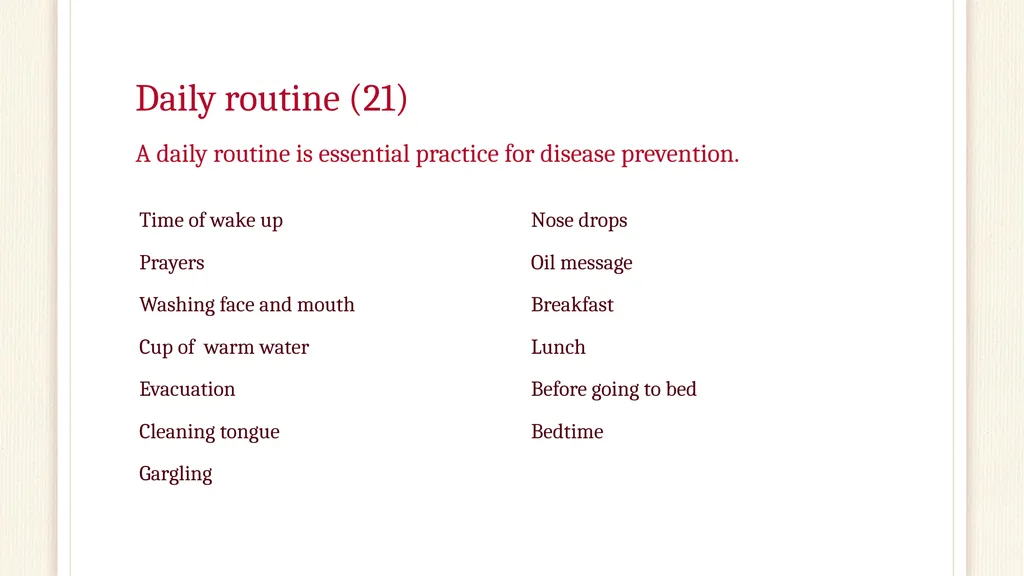
Daily routine (21) A daily routine is essential practice for disease prevention. Time of wake up
Prayers
Washing face and mouth
Cup of warm water
Evacuation
Cleaning tongue
Gargling Nose drops
Oil message
Breakfast
Lunch
Before going to bed
Bedtime<br>
Prayers
Washing face and mouth
Cup of warm water
Evacuation
Cleaning tongue
Gargling Nose drops
Oil message
Breakfast
Lunch
Before going to bed
Bedtime<br>
28
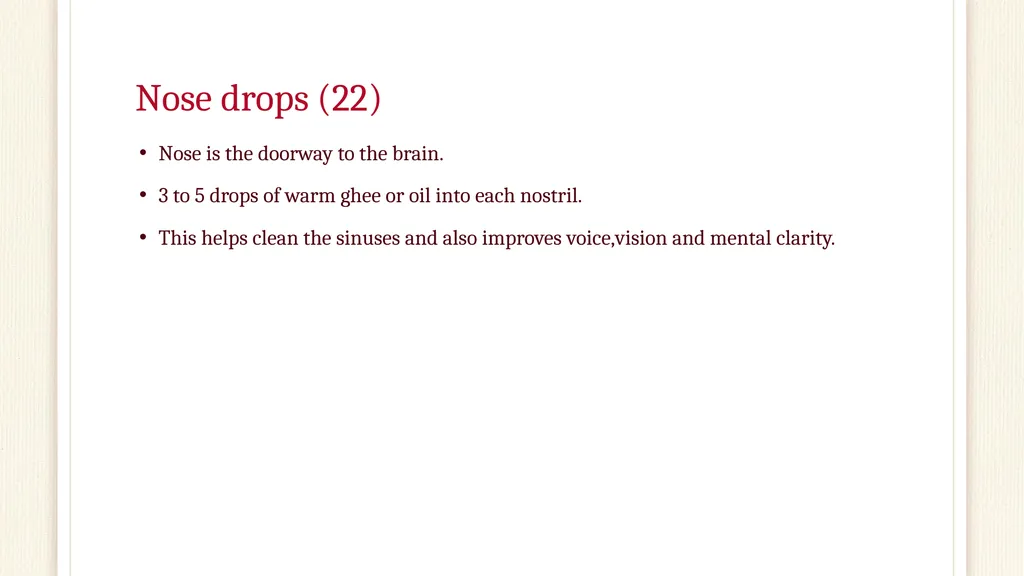
Nose drops (22) Nose is the doorway to the brain.
3 to 5 drops of warm ghee or oil into each nostril.
This helps clean the sinuses and also improves voice,vision and mental clarity.<br>
3 to 5 drops of warm ghee or oil into each nostril.
This helps clean the sinuses and also improves voice,vision and mental clarity.<br>
29
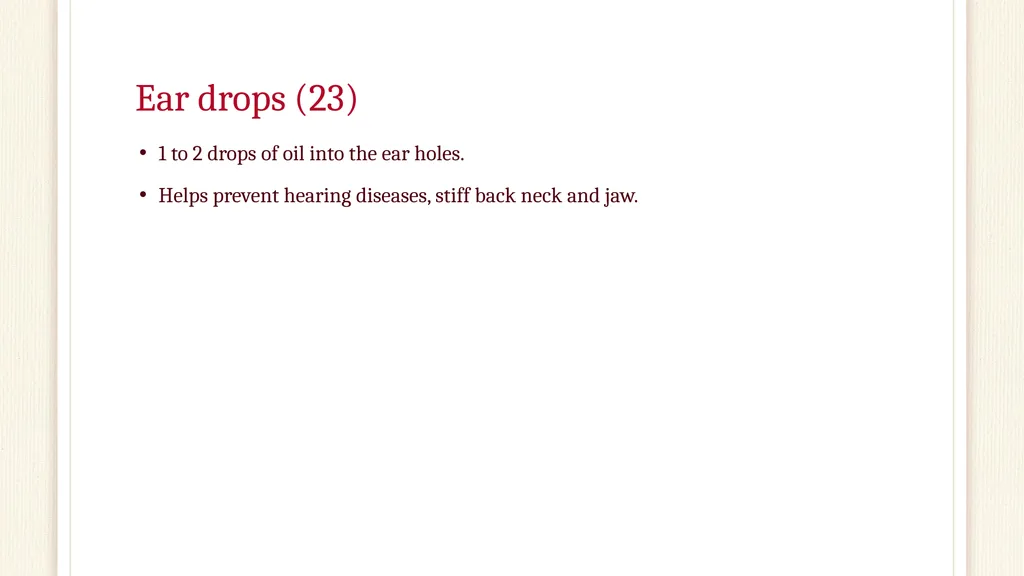
Ear drops (23) 1 to 2 drops of oil into the ear holes.
Helps prevent hearing diseases, stiff back neck and jaw.<br>
Helps prevent hearing diseases, stiff back neck and jaw.<br>
30
Body Oil message (24) Take 4 or 5 ounces of warm oil, and rub it all over your head and body.
Messaging the scalp gently can bring happiness into your day and prevent balding and graying of your hair.<br>
Messaging the scalp gently can bring happiness into your day and prevent balding and graying of your hair.<br>
31
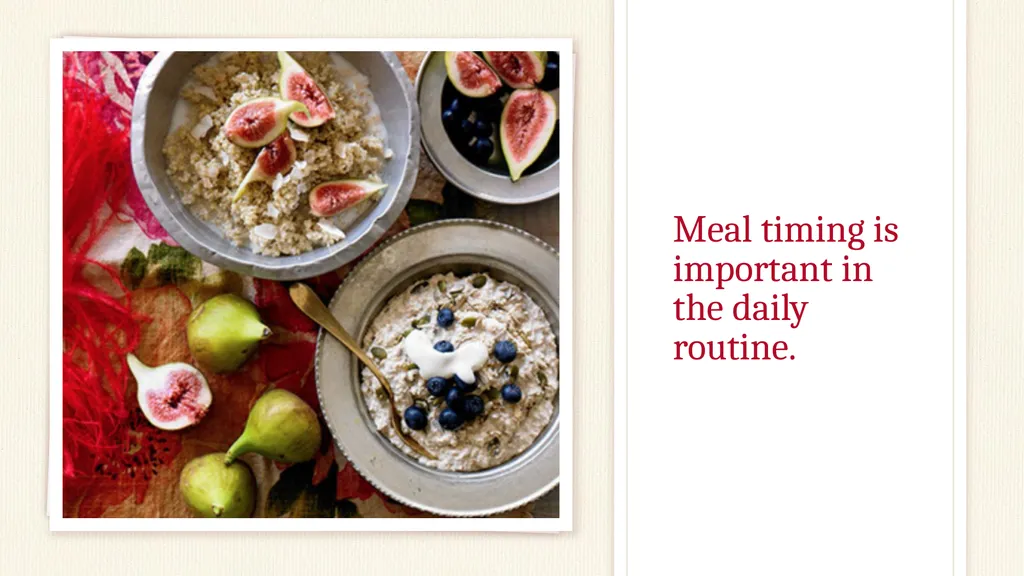
Meal timing is important in the daily routine.<br>
32
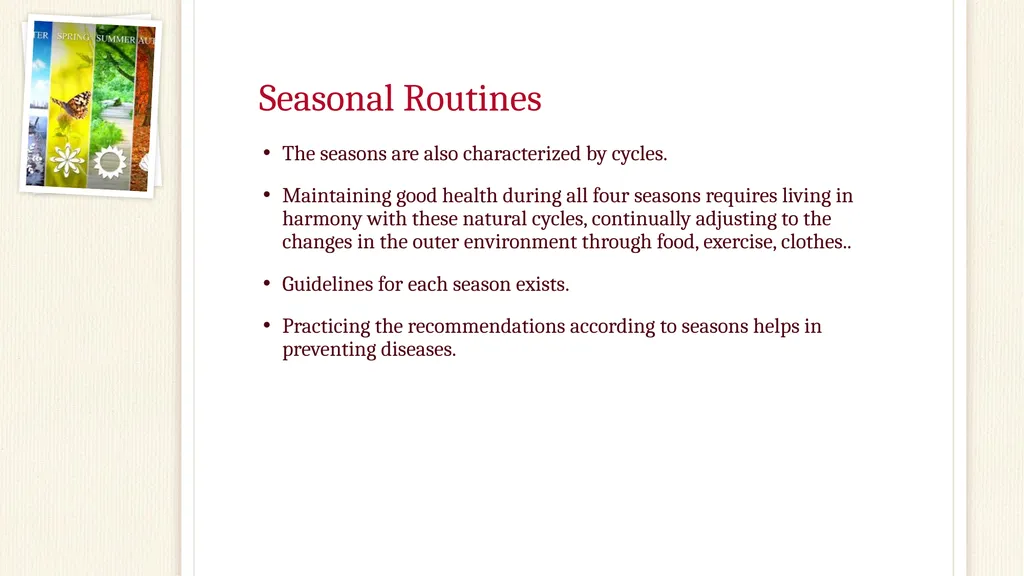
Seasonal Routines The seasons are also characterized by cycles.
Maintaining good health during all four seasons requires living in harmony with these natural cycles, continually adjusting to the changes in the outer environment through food, exercise, clothes..
Guidelines for each season exists.
Practicing the recommendations according to seasons helps in preventing diseases.<br>
33
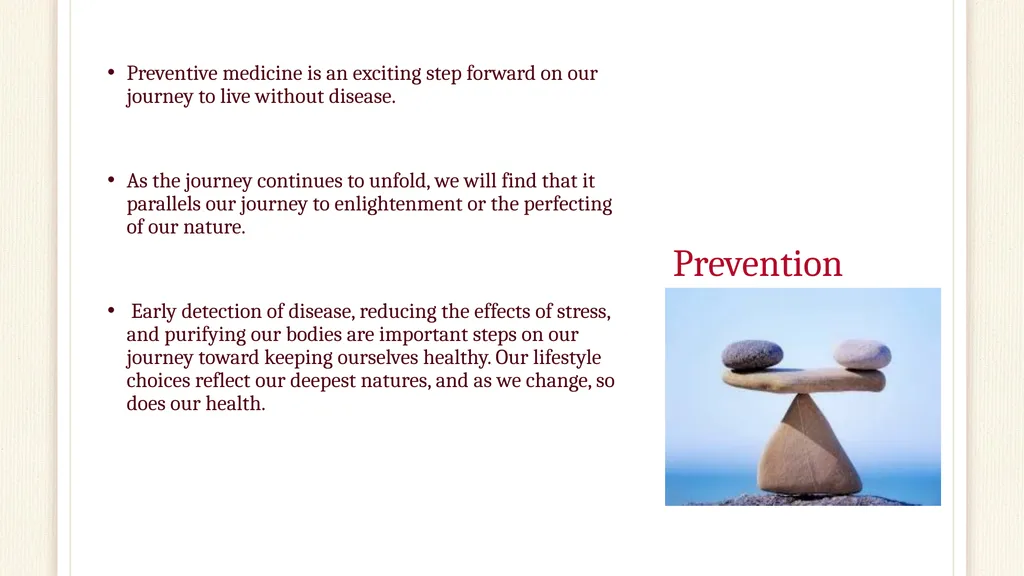
Prevention Preventive medicine is an exciting step forward on our journey to live without disease.
As the journey continues to unfold, we will find that it parallels our journey to enlightenment or the perfecting of our nature.
Early detection of disease, reducing the effects of stress, and purifying our bodies are important steps on our journey toward keeping ourselves healthy. Our lifestyle choices reflect our deepest natures, and as we change, so does our health.<br>
34
References (1) Vasant Lad, The complete book of Ayurvedic Home Remedies,1998,New York, Harmony books ,page 32.
(2) Swami Sadashiva Tirtha, The Ayurveda Encyclopedia, revised third printing 2012,neywork,Ayurvedic Holistic Center ,page:121
(3) Vasant Lad, The complete book of Ayurvedic Home Remedies,1998,New York, Harmony books ,page 32,33.
(4) Swami Sadashiva Tirtha, The Ayurveda Encyclopedia, revised third printing 2012,neywork,Ayurvedic Holistic Center ,page:329
(5) Vasant Lad, The complete book of Ayurvedic Home Remedies,1998,New York, Harmony books ,page 37.
(6) Vasant Lad, The complete book of Ayurvedic Home Remedies,1998,New York, Harmony books ,page 37.
(7) Vasant Lad, The complete book of Ayurvedic Home Remedies,1998,New York, Harmony books ,page 56.<br>
35
References (8) Vasant Lad, The complete book of Ayurvedic Home Remedies,1998,New York, Harmony books ,page 33.
(9) Vasant Lad, The complete book of Ayurvedic Home Remedies,1998,New York, Harmony books ,page 33.
(10) Deepak Chopra,Perfect Health,2000,New York,Three Rivers Press,page 310,311.
(11) Vasant Lad, The complete book of Ayurvedic Home Remedies,1998,New York, Harmony books ,page 33.
(12) Vasant Lad, The complete book of Ayurvedic Home Remedies,1998,New York, Harmony books ,page 34.
(13) Vasant Lad, The complete book of Ayurvedic Home Remedies,1998,New York, Harmony books ,page 35.
(14) Vasant Lad, The complete book of Ayurvedic Home Remedies,1998,New York, Harmony books ,page 35.<br>
36
References (15) Vasant Lad, The complete book of Ayurvedic Home Remedies,1998,New York, Harmony books ,page 36.
(16) Vasant Lad, The complete book of Ayurvedic Home Remedies,1998,New York, Harmony books ,page 36.
(17) Vasant Lad, The complete book of Ayurvedic Home Remedies,1998,New York, Harmony books ,page 37.
(18) Vasant Lad, The complete book of Ayurvedic Home Remedies,1998,New York, Harmony books ,page 38.
(19) Swami Sadashiva Tirtha, The Ayurveda Encyclopedia,revised third printing 2012,neywork,Ayurvedic holisti center press page 9.<br>
37
References (20) Swami Sadashiva Tirtha, The Ayurveda Encyclopedia,revised third printing 2012,neywork,Ayurvedic holisti center press page 9,10.
(21) Vasant Lad, The complete book of Ayurvedic Home Remedies,1998,New York, Harmony books ,page 57,58.
(22) Vasant Lad, The complete book of Ayurvedic Home Remedies,1998,New York, Harmony books ,page 60.
(23) Swami Sadashiva Tirtha, The Ayurveda Encyclopedia,revised third printing 2012,neywork,Ayurvedic holisti center press page 329.
(24) Vasant Lad, The complete book of Ayurvedic Home Remedies,1998,New York, Harmony books ,page 60.<br>