
Preventive Services for Hepatitis B and C








Description: Preventive Services for Hepatitis B and C (Clinical) July 2024 Disclaimer We prepared this education as a tool to assist the provider community. Medicare rules change often. They are in the relevant laws, regulations and rulings on the
Related Topics
Download Presentation
"Preventive Services for Hepatitis B and C" is the property of its rightful owner. Permission is granted to download and print the materials on this website for personal, non-commercial use only, and to display it on your personal computer provided you do not modify the materials and that you retain all copyright notices contained in the materials. By downloading content from our website, you accept the terms of this agreement.
Presentation Transcript
slide1. Preventive Services for Hepatitis B and C (Clinical) July 2024<br>
slide2. Disclaimer We prepared this education as a tool to assist the provider community. Medicare rules change often. They are in the relevant laws, regulations and rulings on the Centers for Medicare & Medicaid Services (CMS) website.
We will provide responses to questions based on the facts given, but the Medicare rules will determine final coverage.
CMS prohibits recording of the presentation for profit-making purposes.<br>
slide3. Acronyms CPT – Current Procedural Terminology
CT – Computed Tomography
FDA – Food and Drug Administration
HCPCS – Healthcare Common Procedure Coding System HIV – Human Immunodeficiency Virus
Ig – Immunoglobulin
IV – Intravenous
NCD – National Coverage Determination
PCR – Polymerase Chain Reaction
RNA – Ribonucleic Acid<br>
slide4. Agenda This webinar will focus on the Medicare preventive service guidelines of screenings for hepatitis B and C viruses. We will cover
Background information on hepatitis
Treatment options and preventive strategies
Medicare Part B coverage criteria for Screening for Hepatitis B Virus (HBV) Infection and Screening for Hepatitis C Virus (HCV) Infection<br>
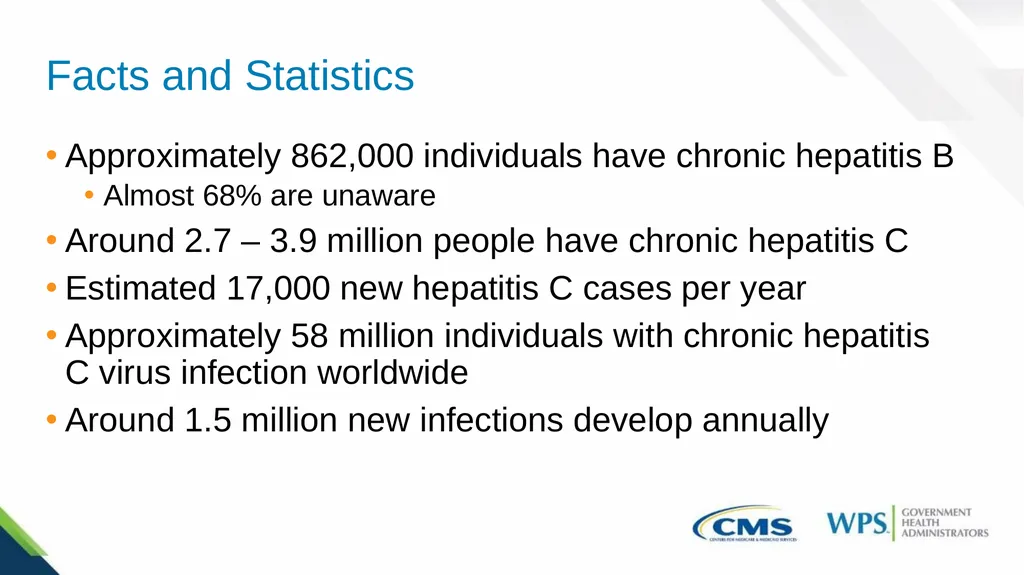
slide5. Facts and Statistics Approximately 862,000 individuals have chronic hepatitis B
Almost 68% are unaware
Around 2.7 – 3.9 million people have chronic hepatitis C
Estimated 17,000 new hepatitis C cases per year
Approximately 58 million individuals with chronic hepatitis C virus infection worldwide
Around 1.5 million new infections develop annually<br>
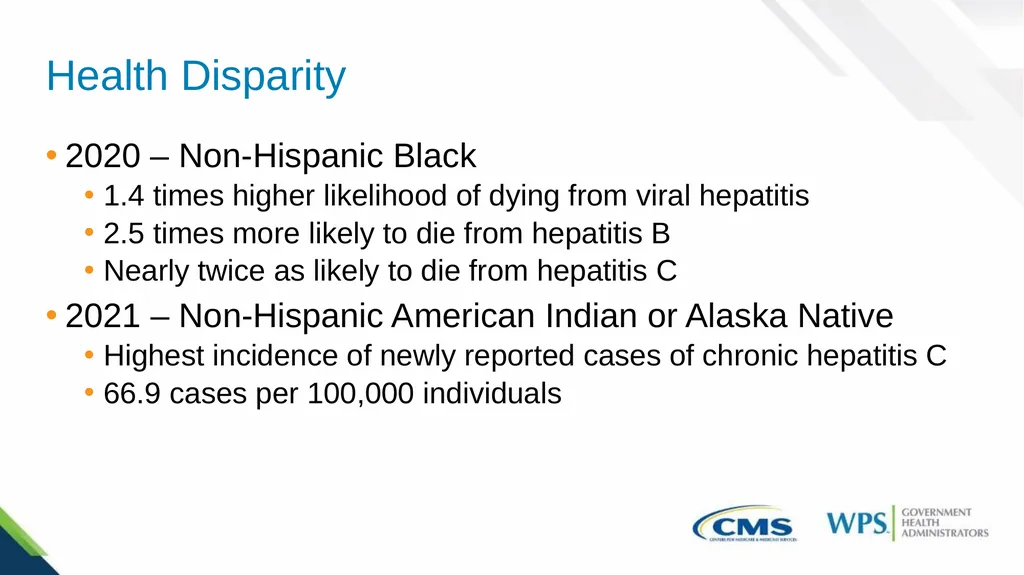
slide6. Health Disparity 2020 – Non-Hispanic Black
1.4 times higher likelihood of dying from viral hepatitis
2.5 times more likely to die from hepatitis B
Nearly twice as likely to die from hepatitis C
2021 – Non-Hispanic American Indian or Alaska Native
Highest incidence of newly reported cases of chronic hepatitis C
66.9 cases per 100,000 individuals<br>
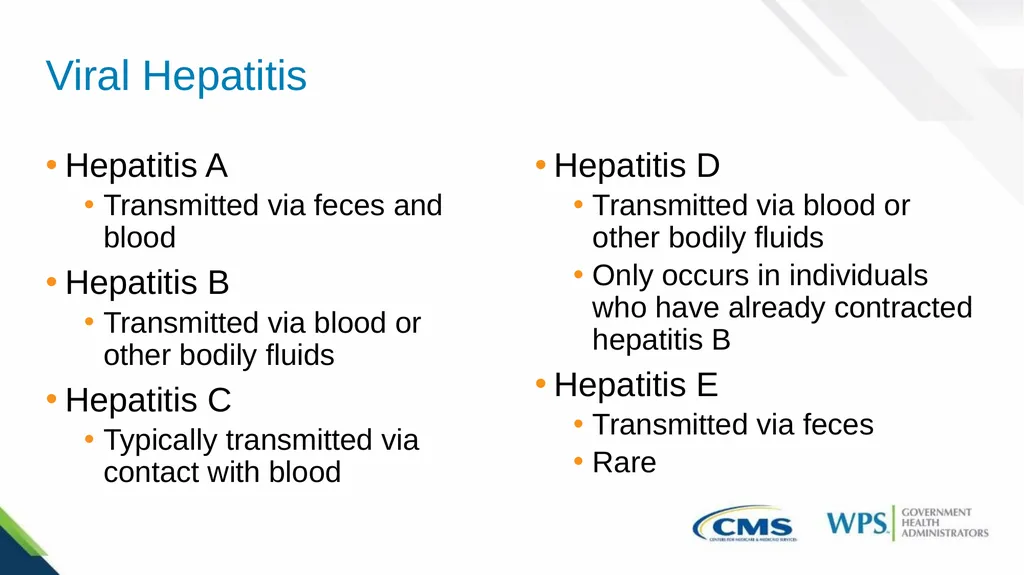
slide7. Viral Hepatitis Hepatitis A
Transmitted via feces and blood
Hepatitis B
Transmitted via blood or other bodily fluids
Hepatitis C
Typically transmitted via contact with blood Hepatitis D
Transmitted via blood or other bodily fluids
Only occurs in individuals who have already contracted hepatitis B
Hepatitis E
Transmitted via feces
Rare<br>
slide8. Acute Hepatitis B Short-term infection, usually lasting no longer than 6 months
Majority of adults experience full recovery
Treatment may not be necessary for certain individuals
Potential for the acute infection to transition to a chronic infection<br>
slide9. Chronic Hepatitis B Persistent viral infection of the liver that lasts longer than 6 months
Potential to persist throughout a person's lifetime
May result in several hepatic-related complications<br>
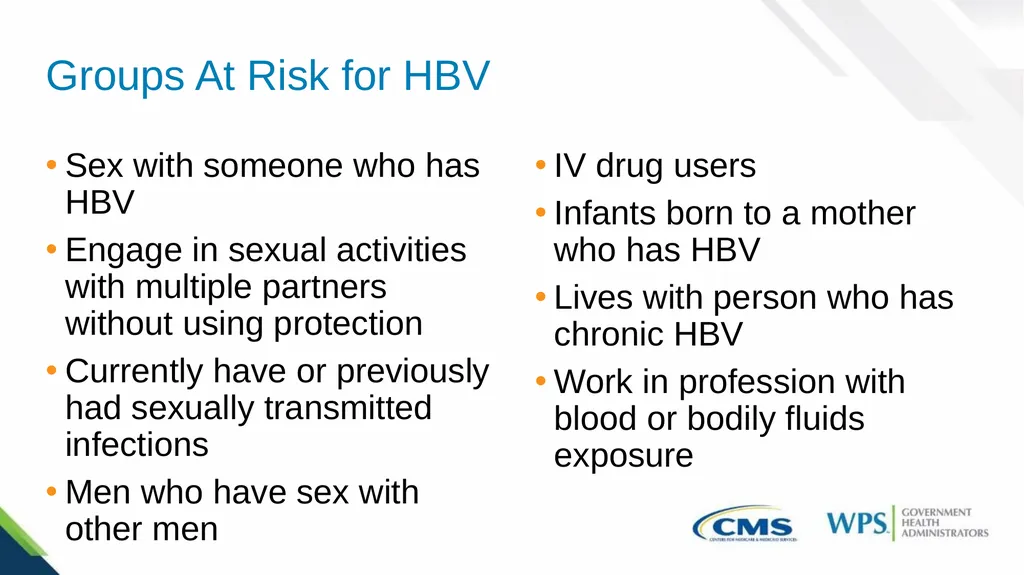
slide10. Groups At Risk for HBV Sex with someone who has HBV
Engage in sexual activities with multiple partners without using protection
Currently have or previously had sexually transmitted infections
Men who have sex with other men IV drug users
Infants born to a mother who has HBV
Lives with person who has chronic HBV
Work in profession with blood or bodily fluids exposure<br>
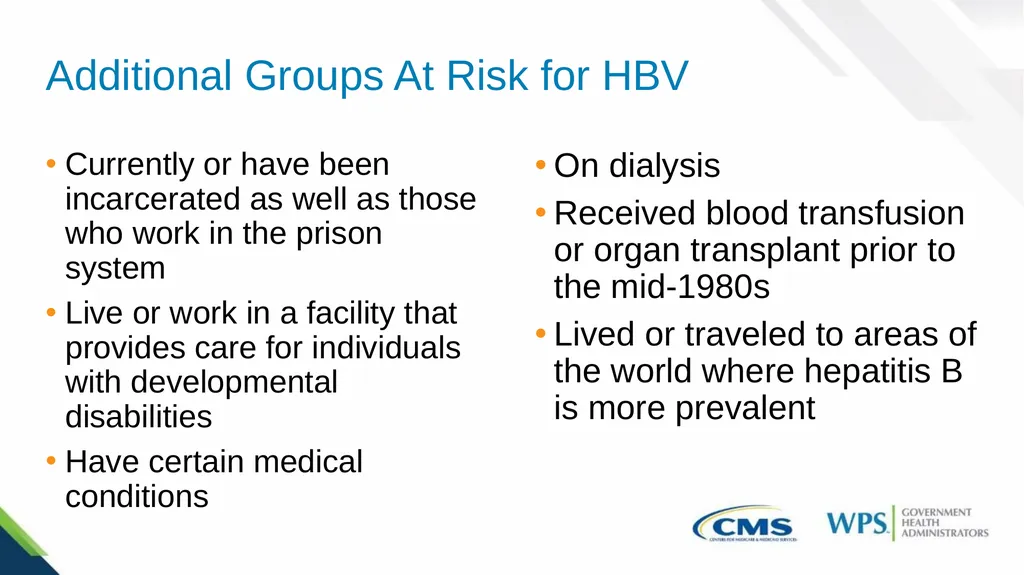
slide11. Additional Groups At Risk for HBV Currently or have been incarcerated as well as those who work in the prison system
Live or work in a facility that provides care for individuals with developmental disabilities
Have certain medical conditions On dialysis
Received blood transfusion or organ transplant prior to the mid-1980s
Lived or traveled to areas of the world where hepatitis B is more prevalent<br>
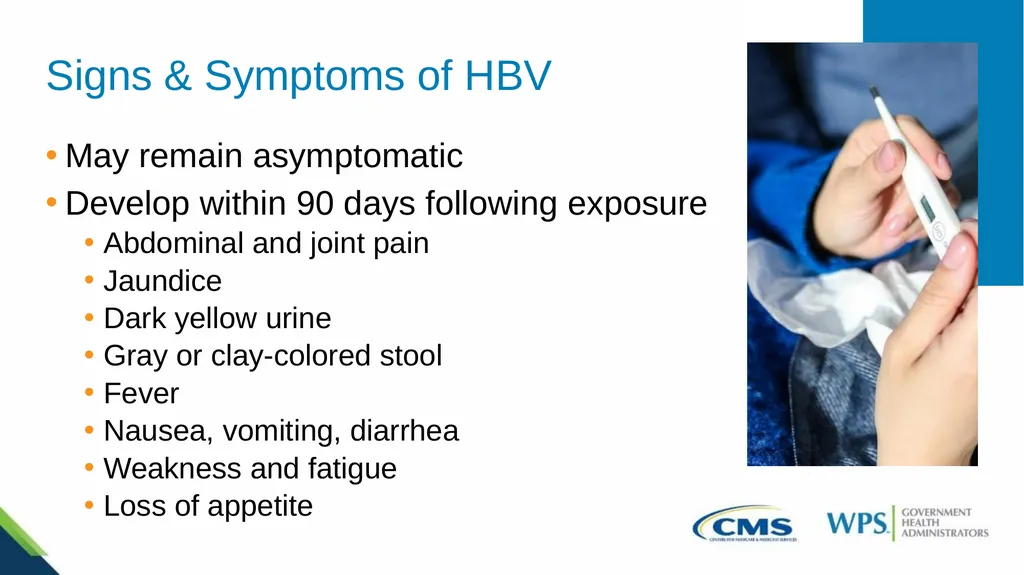
slide12. Signs & Symptoms of HBV May remain asymptomatic
Develop within 90 days following exposure
Abdominal and joint pain
Jaundice
Dark yellow urine
Gray or clay-colored stool
Fever
Nausea, vomiting, diarrhea
Weakness and fatigue
Loss of appetite<br>
slide13. Complications of HBV Cirrhosis of the liver or scarring of the liver
Hepatocellular carcinoma or liver cancer
Liver failure
Development of kidney disease
Inflammation of blood vessels
Death
Reactivation of HBV in immunocompromised people<br>
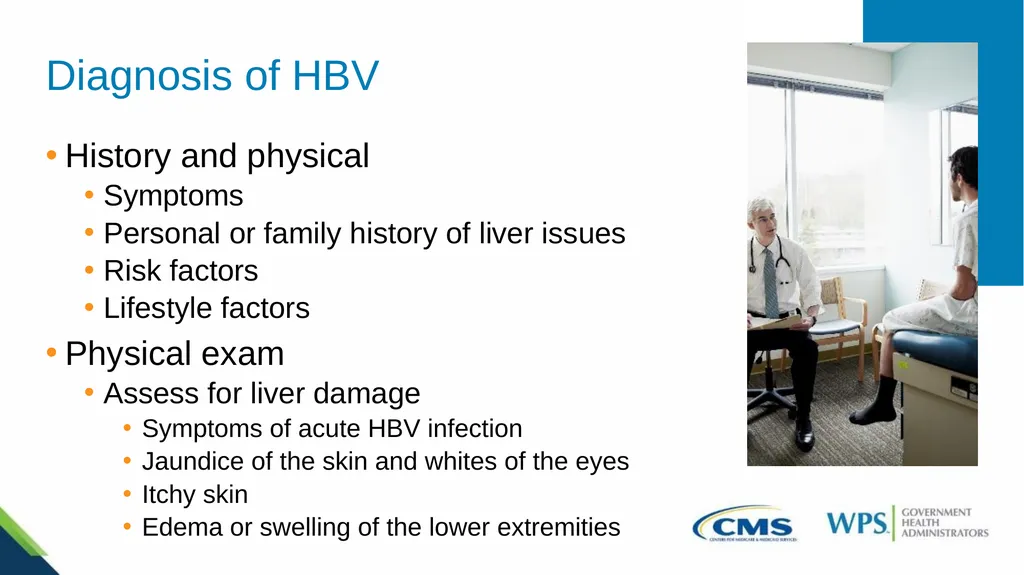
slide14. Diagnosis of HBV History and physical
Symptoms
Personal or family history of liver issues
Risk factors
Lifestyle factors
Physical exam
Assess for liver damage
Symptoms of acute HBV infection
Jaundice of the skin and whites of the eyes
Itchy skin
Edema or swelling of the lower extremities<br>
slide15. Tests for HBV Triple panel test
Hepatitis B Surface Antigen (HBsAg)
Hepatitis B Surface Antibody (Anti-HBs)
Antibody to Hepatitis B Core Antigen (Total Anti-HBc)
Confirmation of acute HBV infection
Positive IgM antibody against the core antigen (HBcAb-IgM)
Positive HBsAg
Confirmation of chronic HBV infection
Positive IgG antibody directed against the core antigen (HBcAb-IgG)
Positive HBsAg<br>
slide16. Exposure to HBV Seek immediate treatment, preferably within the first 24 hours after potential exposure
Administration of hepatitis B immune globin (HBIG) injection intramuscularly
Hepatitis B vaccine series
Reference: Prevention of Hepatitis B Virus Infection in the United States<br>
slide17. Treatment of Hepatitis B Acute Hepatitis Rest
Well-balanced diet
Hydration
Close monitoring
Possible administration of antiviral medications and/or hospitalization Chronic Hepatitis B (lifelong) Antiviral medications
Entecavir
Tenofovir
Lamivudine
Adefovir
Telbivudine
Interferon injections
Liver transplant<br>
slide18. Different Types of Hepatitis C Predominant genotypes in United States – 1a, 1b, 2, and 3
Acute
Short-term infection, usually lasting up to 6 months
For some, immune system combats infection and eliminates HCV from the body (not common)
Most acute cases progress to chronic
Chronic
If not treated, potential to develop into a lifelong infection
Increased risk for hepatic-related complications and mortality<br>
slide19. Groups At Risk for HCV IV drug users (most common)
Sex with someone who has HCV
Engage in sexual activities with multiple partners without using protection
Currently have or previously had sexually transmitted infections Men who have sex with other men
Infants born to a mother with HCV
Received tattoos or body piercings
Individuals living with a person who has chronic HCV<br>
slide20. Additional Groups At Risk for HCV Work in profession with blood or bodily fluids exposure
Currently or have been incarcerated as well as those who work in the prison system
Diagnosed with HIV On or have had dialysis
Individuals with hemophilia who were administered clotting factor prior to 1987
Received blood transfusion or organ transplant prior to July 1992
Rare<br>
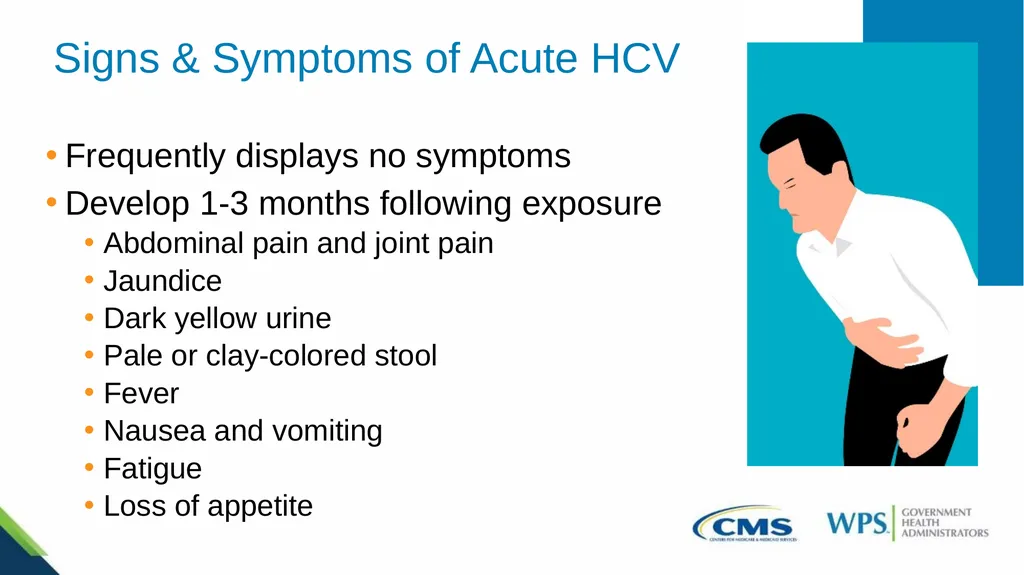
slide21. Signs & Symptoms of Acute HCV Frequently displays no symptoms
Develop 1-3 months following exposure
Abdominal pain and joint pain
Jaundice
Dark yellow urine
Pale or clay-colored stool
Fever
Nausea and vomiting
Fatigue
Loss of appetite<br>
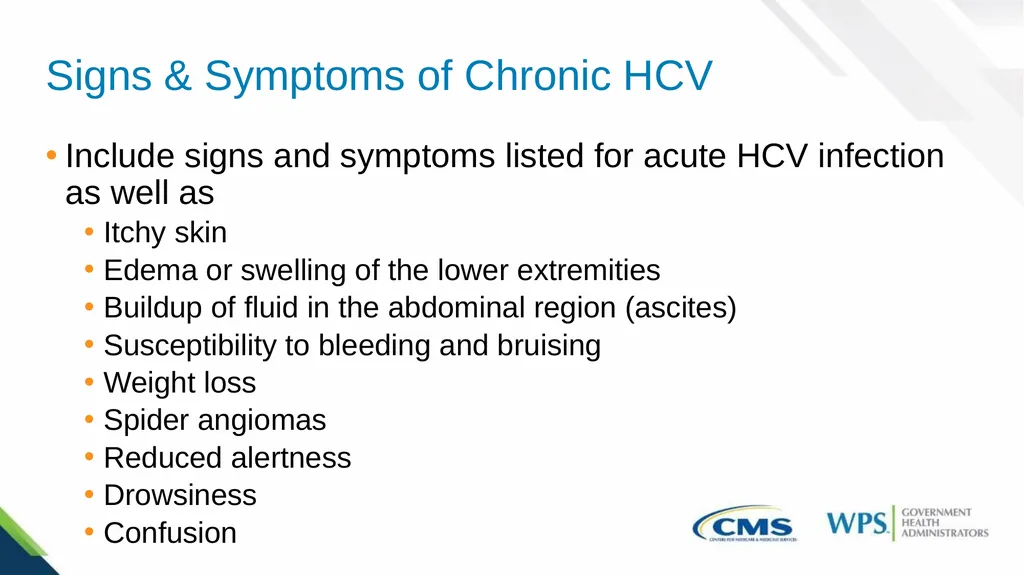
slide22. Signs & Symptoms of Chronic HCV Include signs and symptoms listed for acute HCV infection as well as
Itchy skin
Edema or swelling of the lower extremities
Buildup of fluid in the abdominal region (ascites)
Susceptibility to bleeding and bruising
Weight loss
Spider angiomas
Reduced alertness
Drowsiness
Confusion<br>
slide23. Complications of HCV Cirrhosis of the liver or scarring of the liver
Hepatocellular carcinoma or liver cancer
Liver failure
Death<br>
slide24. Diagnosis of HCV History and physical
Symptoms
Personal or family history of liver issues
Risk factors
Lifestyle factors
Physical exam
Assess for liver damage<br>
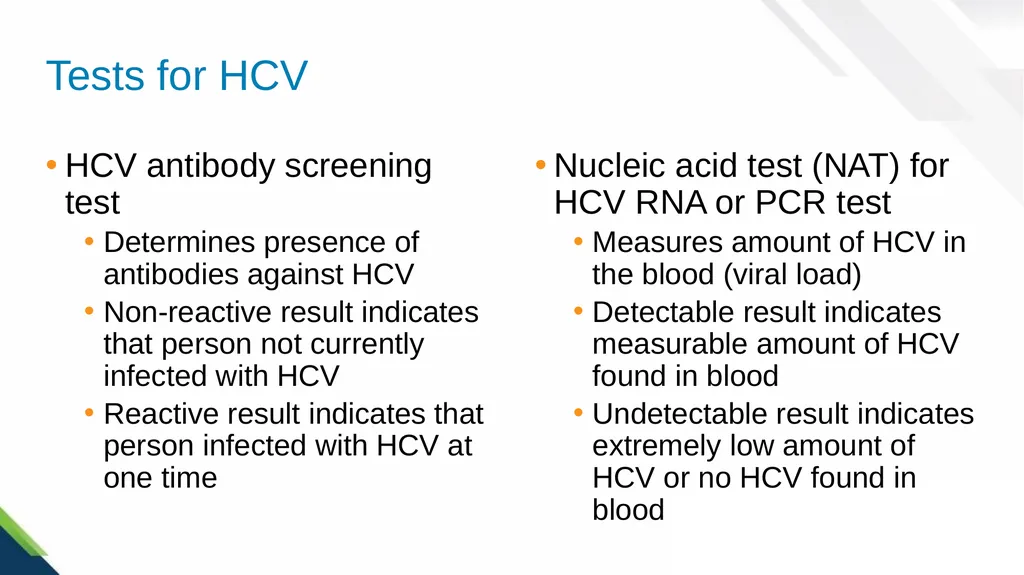
slide25. Tests for HCV HCV antibody screening test
Determines presence of antibodies against HCV
Non-reactive result indicates that person not currently infected with HCV
Reactive result indicates that person infected with HCV at one time Nucleic acid test (NAT) for HCV RNA or PCR test
Measures amount of HCV in the blood (viral load)
Detectable result indicates measurable amount of HCV found in blood
Undetectable result indicates extremely low amount of HCV or no HCV found in blood<br>
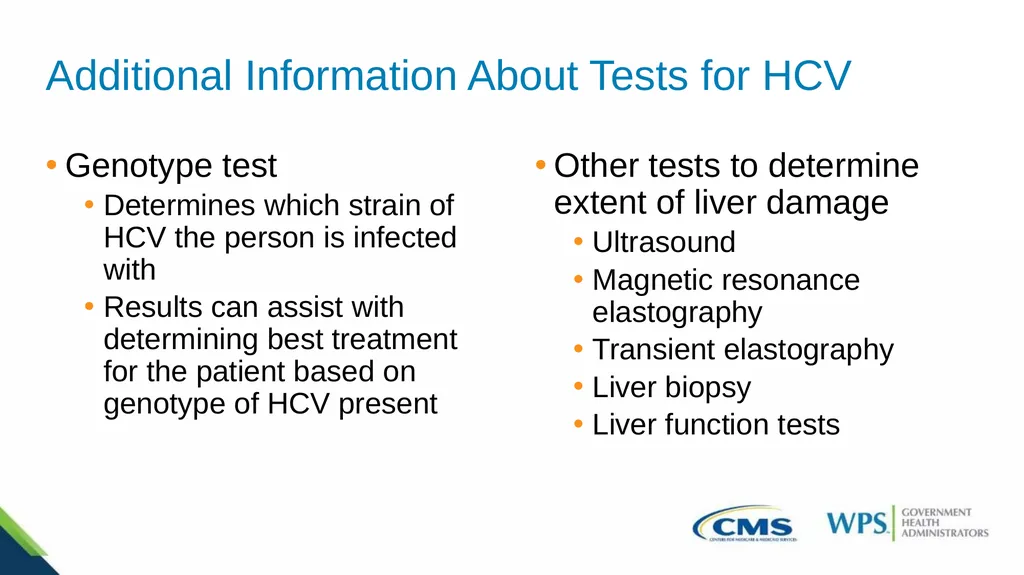
slide26. Additional Information About Tests for HCV Genotype test
Determines which strain of HCV the person is infected with
Results can assist with determining best treatment for the patient based on genotype of HCV present Other tests to determine extent of liver damage
Ultrasound
Magnetic resonance elastography
Transient elastography
Liver biopsy
Liver function tests<br>
slide27. Exposure to HCV Currently no post-exposure prophylaxis recommended
Reference: Testing and Clinical Management of Health Care Personnel Potentially Exposed to Hepatitis C Virus<br>
slide28. Treatment of Hepatitis C Antiviral medications for 8-12 weeks
FDA-approved medications
Elbasvir-Grazoprevir (Zepatier)
Glecaprevi-Pibrentasvir (Mavyret)
Ledipasvir-Sofosbuvir (Harvoni)
Ribavirin (Copegus, Rebetol, Ribasphere)
Sofosbuvir (Sovaldi)
Sofosbuvir-Velpatasvir (Epclusa)
Sofosbuvir-Velpatasvir-Voxilaprevir (Vosevi)
Liver transplant<br>
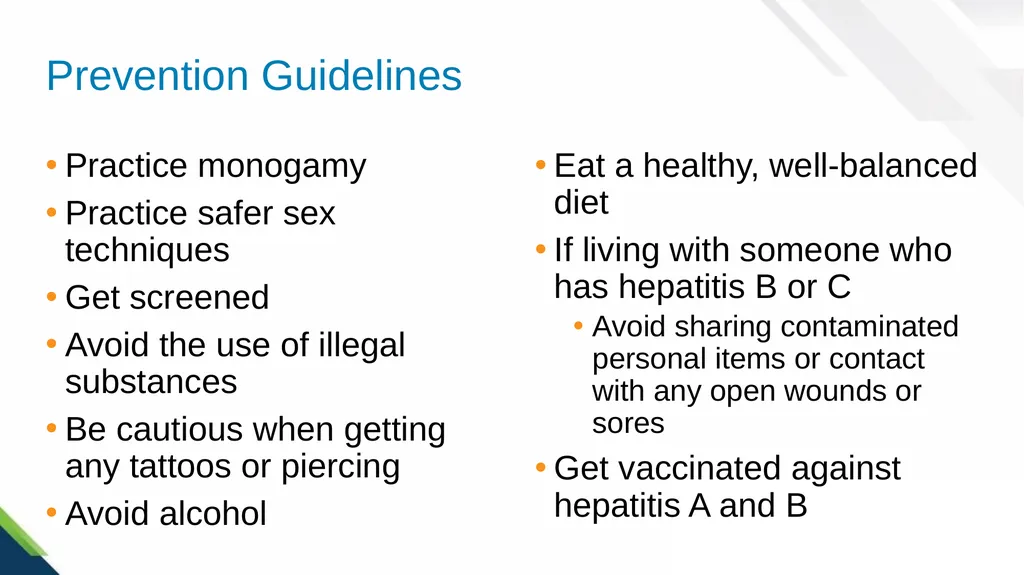
slide29. Prevention Guidelines Practice monogamy
Practice safer sex techniques
Get screened
Avoid the use of illegal substances
Be cautious when getting any tattoos or piercing
Avoid alcohol Eat a healthy, well-balanced diet
If living with someone who has hepatitis B or C
Avoid sharing contaminated personal items or contact with any open wounds or sores
Get vaccinated against hepatitis A and B<br>
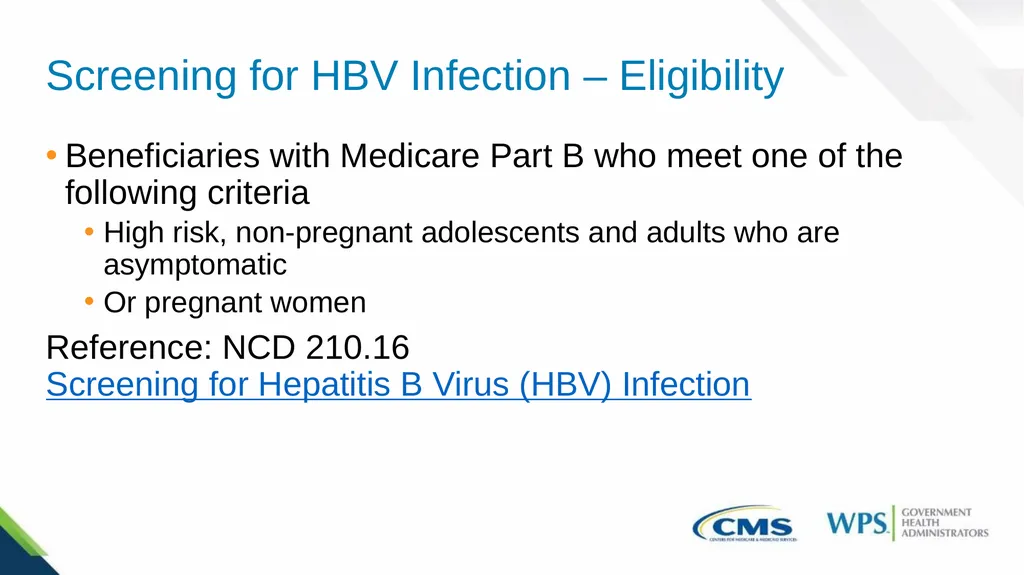
slide30. Screening for HBV Infection – Eligibility Beneficiaries with Medicare Part B who meet one of the following criteria
High risk, non-pregnant adolescents and adults who are asymptomatic
Or pregnant women
Reference: NCD 210.16 Screening for Hepatitis B Virus (HBV) Infection<br>
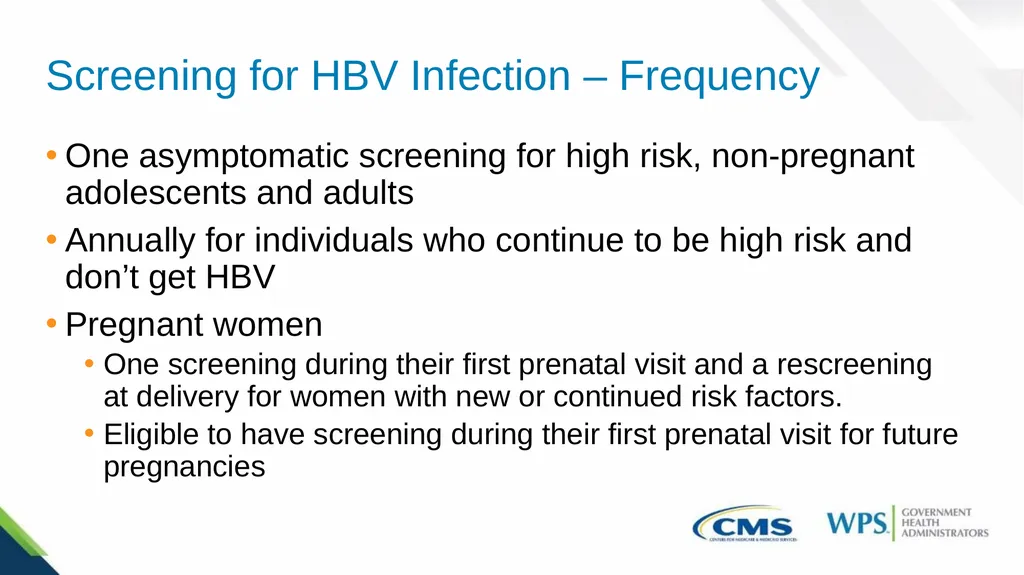
slide31. Screening for HBV Infection – Frequency One asymptomatic screening for high risk, non-pregnant adolescents and adults
Annually for individuals who continue to be high risk and don’t get HBV
Pregnant women
One screening during their first prenatal visit and a rescreening at delivery for women with new or continued risk factors.
Eligible to have screening during their first prenatal visit for future pregnancies<br>
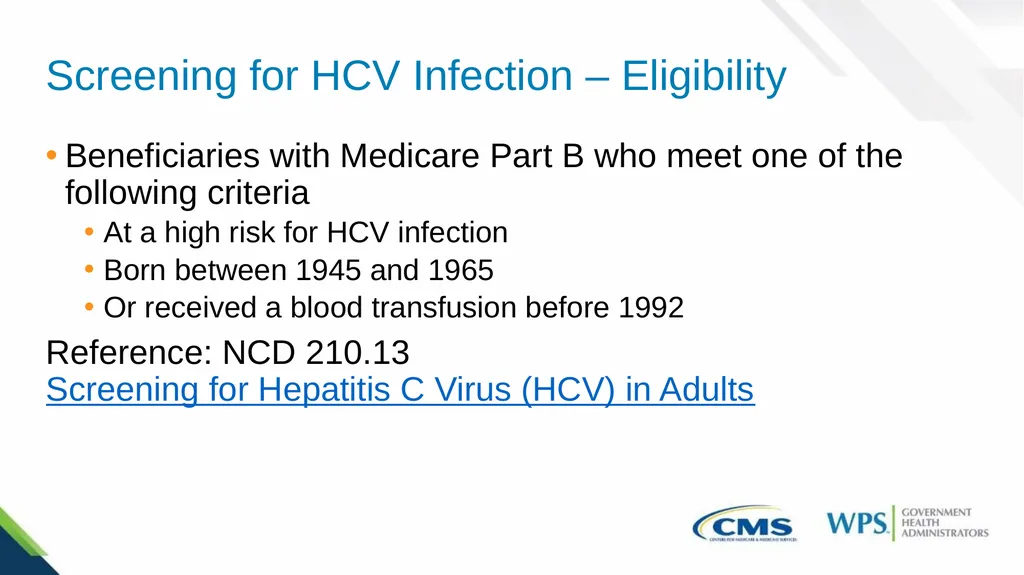
slide32. Screening for HCV Infection – Eligibility Beneficiaries with Medicare Part B who meet one of the following criteria
At a high risk for HCV infection
Born between 1945 and 1965
Or received a blood transfusion before 1992
Reference: NCD 210.13 Screening for Hepatitis C Virus (HCV) in Adults<br>
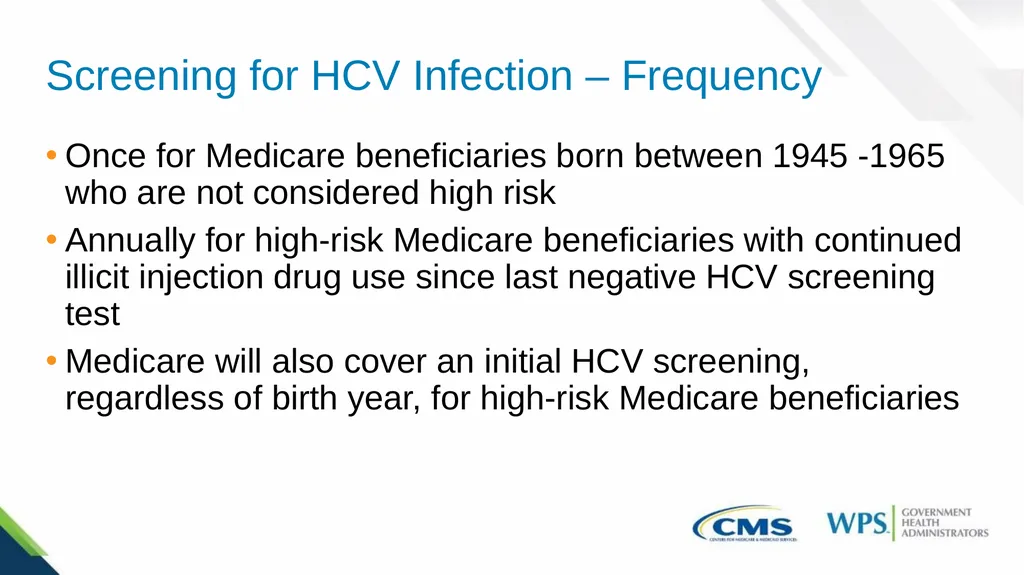
slide33. Screening for HCV Infection – Frequency Once for Medicare beneficiaries born between 1945 -1965 who are not considered high risk
Annually for high-risk Medicare beneficiaries with continued illicit injection drug use since last negative HCV screening test
Medicare will also cover an initial HCV screening, regardless of birth year, for high-risk Medicare beneficiaries<br>
slide34. Cost No copayment, coinsurance, or deductible if the healthcare provider accepts assignment<br>
slide35. Documentation Requirements Date service was provided
Signed and dated physician or qualified non-physician practitioner order for the screening
Test results and documentation of any follow-up care or counseling that was given following evaluation of results Documentation to support medical necessity of screening(s)
All documentation dated and signed with provider’s credentials<br>
slide36. Review of Today’s Webinar During today’s webinar, we
Provided background information on hepatitis
Discussed treatment options and preventive strategies
Reviewed Medicare Part B coverage criteria for Screening for Hepatitis B Virus (HBV) Infection and Screening for Hepatitis C Virus (HCV) Infection<br>
slide37. Resources Centers for Medicare & Medicaid Services
MLN006559 – Medicare Preventive Services
WPS GHA YouTube Encore Presentations<br>
slide38. National Provider Enrollment (PE) Conference In-person CMS and Noridian Healthcare Solutions will host an annual National Provider Enrollment Conference
Purpose
To educate the provider and supplier community on multiple PE aspects
Details
8/28/2024 and 8/29/2024
San Diego, California
Times vary by day
Description and Registration<br>
slide39. National Provider Compliance Conference Join MACs and program integrity experts for this free virtual conference
Purpose
Education on a variety of topics for provider compliance professionals
Details
8/7/2024 and 8/8/2024
12:00 PM – 4:00 PM ET
Agenda and Registration<br>
slide40. Questions and Answers<br>
slide41. Thank you for attending<br>
slide2. Disclaimer We prepared this education as a tool to assist the provider community. Medicare rules change often. They are in the relevant laws, regulations and rulings on the Centers for Medicare & Medicaid Services (CMS) website.
We will provide responses to questions based on the facts given, but the Medicare rules will determine final coverage.
CMS prohibits recording of the presentation for profit-making purposes.<br>
slide3. Acronyms CPT – Current Procedural Terminology
CT – Computed Tomography
FDA – Food and Drug Administration
HCPCS – Healthcare Common Procedure Coding System HIV – Human Immunodeficiency Virus
Ig – Immunoglobulin
IV – Intravenous
NCD – National Coverage Determination
PCR – Polymerase Chain Reaction
RNA – Ribonucleic Acid<br>
slide4. Agenda This webinar will focus on the Medicare preventive service guidelines of screenings for hepatitis B and C viruses. We will cover
Background information on hepatitis
Treatment options and preventive strategies
Medicare Part B coverage criteria for Screening for Hepatitis B Virus (HBV) Infection and Screening for Hepatitis C Virus (HCV) Infection<br>
slide5. Facts and Statistics Approximately 862,000 individuals have chronic hepatitis B
Almost 68% are unaware
Around 2.7 – 3.9 million people have chronic hepatitis C
Estimated 17,000 new hepatitis C cases per year
Approximately 58 million individuals with chronic hepatitis C virus infection worldwide
Around 1.5 million new infections develop annually<br>
slide6. Health Disparity 2020 – Non-Hispanic Black
1.4 times higher likelihood of dying from viral hepatitis
2.5 times more likely to die from hepatitis B
Nearly twice as likely to die from hepatitis C
2021 – Non-Hispanic American Indian or Alaska Native
Highest incidence of newly reported cases of chronic hepatitis C
66.9 cases per 100,000 individuals<br>
slide7. Viral Hepatitis Hepatitis A
Transmitted via feces and blood
Hepatitis B
Transmitted via blood or other bodily fluids
Hepatitis C
Typically transmitted via contact with blood Hepatitis D
Transmitted via blood or other bodily fluids
Only occurs in individuals who have already contracted hepatitis B
Hepatitis E
Transmitted via feces
Rare<br>
slide8. Acute Hepatitis B Short-term infection, usually lasting no longer than 6 months
Majority of adults experience full recovery
Treatment may not be necessary for certain individuals
Potential for the acute infection to transition to a chronic infection<br>
slide9. Chronic Hepatitis B Persistent viral infection of the liver that lasts longer than 6 months
Potential to persist throughout a person's lifetime
May result in several hepatic-related complications<br>
slide10. Groups At Risk for HBV Sex with someone who has HBV
Engage in sexual activities with multiple partners without using protection
Currently have or previously had sexually transmitted infections
Men who have sex with other men IV drug users
Infants born to a mother who has HBV
Lives with person who has chronic HBV
Work in profession with blood or bodily fluids exposure<br>
slide11. Additional Groups At Risk for HBV Currently or have been incarcerated as well as those who work in the prison system
Live or work in a facility that provides care for individuals with developmental disabilities
Have certain medical conditions On dialysis
Received blood transfusion or organ transplant prior to the mid-1980s
Lived or traveled to areas of the world where hepatitis B is more prevalent<br>
slide12. Signs & Symptoms of HBV May remain asymptomatic
Develop within 90 days following exposure
Abdominal and joint pain
Jaundice
Dark yellow urine
Gray or clay-colored stool
Fever
Nausea, vomiting, diarrhea
Weakness and fatigue
Loss of appetite<br>
slide13. Complications of HBV Cirrhosis of the liver or scarring of the liver
Hepatocellular carcinoma or liver cancer
Liver failure
Development of kidney disease
Inflammation of blood vessels
Death
Reactivation of HBV in immunocompromised people<br>
slide14. Diagnosis of HBV History and physical
Symptoms
Personal or family history of liver issues
Risk factors
Lifestyle factors
Physical exam
Assess for liver damage
Symptoms of acute HBV infection
Jaundice of the skin and whites of the eyes
Itchy skin
Edema or swelling of the lower extremities<br>
slide15. Tests for HBV Triple panel test
Hepatitis B Surface Antigen (HBsAg)
Hepatitis B Surface Antibody (Anti-HBs)
Antibody to Hepatitis B Core Antigen (Total Anti-HBc)
Confirmation of acute HBV infection
Positive IgM antibody against the core antigen (HBcAb-IgM)
Positive HBsAg
Confirmation of chronic HBV infection
Positive IgG antibody directed against the core antigen (HBcAb-IgG)
Positive HBsAg<br>
slide16. Exposure to HBV Seek immediate treatment, preferably within the first 24 hours after potential exposure
Administration of hepatitis B immune globin (HBIG) injection intramuscularly
Hepatitis B vaccine series
Reference: Prevention of Hepatitis B Virus Infection in the United States<br>
slide17. Treatment of Hepatitis B Acute Hepatitis Rest
Well-balanced diet
Hydration
Close monitoring
Possible administration of antiviral medications and/or hospitalization Chronic Hepatitis B (lifelong) Antiviral medications
Entecavir
Tenofovir
Lamivudine
Adefovir
Telbivudine
Interferon injections
Liver transplant<br>
slide18. Different Types of Hepatitis C Predominant genotypes in United States – 1a, 1b, 2, and 3
Acute
Short-term infection, usually lasting up to 6 months
For some, immune system combats infection and eliminates HCV from the body (not common)
Most acute cases progress to chronic
Chronic
If not treated, potential to develop into a lifelong infection
Increased risk for hepatic-related complications and mortality<br>
slide19. Groups At Risk for HCV IV drug users (most common)
Sex with someone who has HCV
Engage in sexual activities with multiple partners without using protection
Currently have or previously had sexually transmitted infections Men who have sex with other men
Infants born to a mother with HCV
Received tattoos or body piercings
Individuals living with a person who has chronic HCV<br>
slide20. Additional Groups At Risk for HCV Work in profession with blood or bodily fluids exposure
Currently or have been incarcerated as well as those who work in the prison system
Diagnosed with HIV On or have had dialysis
Individuals with hemophilia who were administered clotting factor prior to 1987
Received blood transfusion or organ transplant prior to July 1992
Rare<br>
slide21. Signs & Symptoms of Acute HCV Frequently displays no symptoms
Develop 1-3 months following exposure
Abdominal pain and joint pain
Jaundice
Dark yellow urine
Pale or clay-colored stool
Fever
Nausea and vomiting
Fatigue
Loss of appetite<br>
slide22. Signs & Symptoms of Chronic HCV Include signs and symptoms listed for acute HCV infection as well as
Itchy skin
Edema or swelling of the lower extremities
Buildup of fluid in the abdominal region (ascites)
Susceptibility to bleeding and bruising
Weight loss
Spider angiomas
Reduced alertness
Drowsiness
Confusion<br>
slide23. Complications of HCV Cirrhosis of the liver or scarring of the liver
Hepatocellular carcinoma or liver cancer
Liver failure
Death<br>
slide24. Diagnosis of HCV History and physical
Symptoms
Personal or family history of liver issues
Risk factors
Lifestyle factors
Physical exam
Assess for liver damage<br>
slide25. Tests for HCV HCV antibody screening test
Determines presence of antibodies against HCV
Non-reactive result indicates that person not currently infected with HCV
Reactive result indicates that person infected with HCV at one time Nucleic acid test (NAT) for HCV RNA or PCR test
Measures amount of HCV in the blood (viral load)
Detectable result indicates measurable amount of HCV found in blood
Undetectable result indicates extremely low amount of HCV or no HCV found in blood<br>
slide26. Additional Information About Tests for HCV Genotype test
Determines which strain of HCV the person is infected with
Results can assist with determining best treatment for the patient based on genotype of HCV present Other tests to determine extent of liver damage
Ultrasound
Magnetic resonance elastography
Transient elastography
Liver biopsy
Liver function tests<br>
slide27. Exposure to HCV Currently no post-exposure prophylaxis recommended
Reference: Testing and Clinical Management of Health Care Personnel Potentially Exposed to Hepatitis C Virus<br>
slide28. Treatment of Hepatitis C Antiviral medications for 8-12 weeks
FDA-approved medications
Elbasvir-Grazoprevir (Zepatier)
Glecaprevi-Pibrentasvir (Mavyret)
Ledipasvir-Sofosbuvir (Harvoni)
Ribavirin (Copegus, Rebetol, Ribasphere)
Sofosbuvir (Sovaldi)
Sofosbuvir-Velpatasvir (Epclusa)
Sofosbuvir-Velpatasvir-Voxilaprevir (Vosevi)
Liver transplant<br>
slide29. Prevention Guidelines Practice monogamy
Practice safer sex techniques
Get screened
Avoid the use of illegal substances
Be cautious when getting any tattoos or piercing
Avoid alcohol Eat a healthy, well-balanced diet
If living with someone who has hepatitis B or C
Avoid sharing contaminated personal items or contact with any open wounds or sores
Get vaccinated against hepatitis A and B<br>
slide30. Screening for HBV Infection – Eligibility Beneficiaries with Medicare Part B who meet one of the following criteria
High risk, non-pregnant adolescents and adults who are asymptomatic
Or pregnant women
Reference: NCD 210.16 Screening for Hepatitis B Virus (HBV) Infection<br>
slide31. Screening for HBV Infection – Frequency One asymptomatic screening for high risk, non-pregnant adolescents and adults
Annually for individuals who continue to be high risk and don’t get HBV
Pregnant women
One screening during their first prenatal visit and a rescreening at delivery for women with new or continued risk factors.
Eligible to have screening during their first prenatal visit for future pregnancies<br>
slide32. Screening for HCV Infection – Eligibility Beneficiaries with Medicare Part B who meet one of the following criteria
At a high risk for HCV infection
Born between 1945 and 1965
Or received a blood transfusion before 1992
Reference: NCD 210.13 Screening for Hepatitis C Virus (HCV) in Adults<br>
slide33. Screening for HCV Infection – Frequency Once for Medicare beneficiaries born between 1945 -1965 who are not considered high risk
Annually for high-risk Medicare beneficiaries with continued illicit injection drug use since last negative HCV screening test
Medicare will also cover an initial HCV screening, regardless of birth year, for high-risk Medicare beneficiaries<br>
slide34. Cost No copayment, coinsurance, or deductible if the healthcare provider accepts assignment<br>
slide35. Documentation Requirements Date service was provided
Signed and dated physician or qualified non-physician practitioner order for the screening
Test results and documentation of any follow-up care or counseling that was given following evaluation of results Documentation to support medical necessity of screening(s)
All documentation dated and signed with provider’s credentials<br>
slide36. Review of Today’s Webinar During today’s webinar, we
Provided background information on hepatitis
Discussed treatment options and preventive strategies
Reviewed Medicare Part B coverage criteria for Screening for Hepatitis B Virus (HBV) Infection and Screening for Hepatitis C Virus (HCV) Infection<br>
slide37. Resources Centers for Medicare & Medicaid Services
MLN006559 – Medicare Preventive Services
WPS GHA YouTube Encore Presentations<br>
slide38. National Provider Enrollment (PE) Conference In-person CMS and Noridian Healthcare Solutions will host an annual National Provider Enrollment Conference
Purpose
To educate the provider and supplier community on multiple PE aspects
Details
8/28/2024 and 8/29/2024
San Diego, California
Times vary by day
Description and Registration<br>
slide39. National Provider Compliance Conference Join MACs and program integrity experts for this free virtual conference
Purpose
Education on a variety of topics for provider compliance professionals
Details
8/7/2024 and 8/8/2024
12:00 PM – 4:00 PM ET
Agenda and Registration<br>
slide40. Questions and Answers<br>
slide41. Thank you for attending<br>