
Pricing Decisions Chapter 11 Learning Objectives
Description: Pricing Decisions Chapter 11 Learning Objectives Review basic pricing concepts that underlie a successful global marketing pricing strategy. Identify the different pricing strategies and objectives that influence decisions about pricing
Related Topics
Download Presentation
"Pricing Decisions Chapter 11 Learning Objectives" is the property of its rightful owner. Permission is granted to download and print the materials on this website for personal, non-commercial use only, and to display it on your personal computer provided you do not modify the materials and that you retain all copyright notices contained in the materials. By downloading content from our website, you accept the terms of this agreement.
Presentation Transcript
slide1. Pricing Decisions
Chapter 11<br>
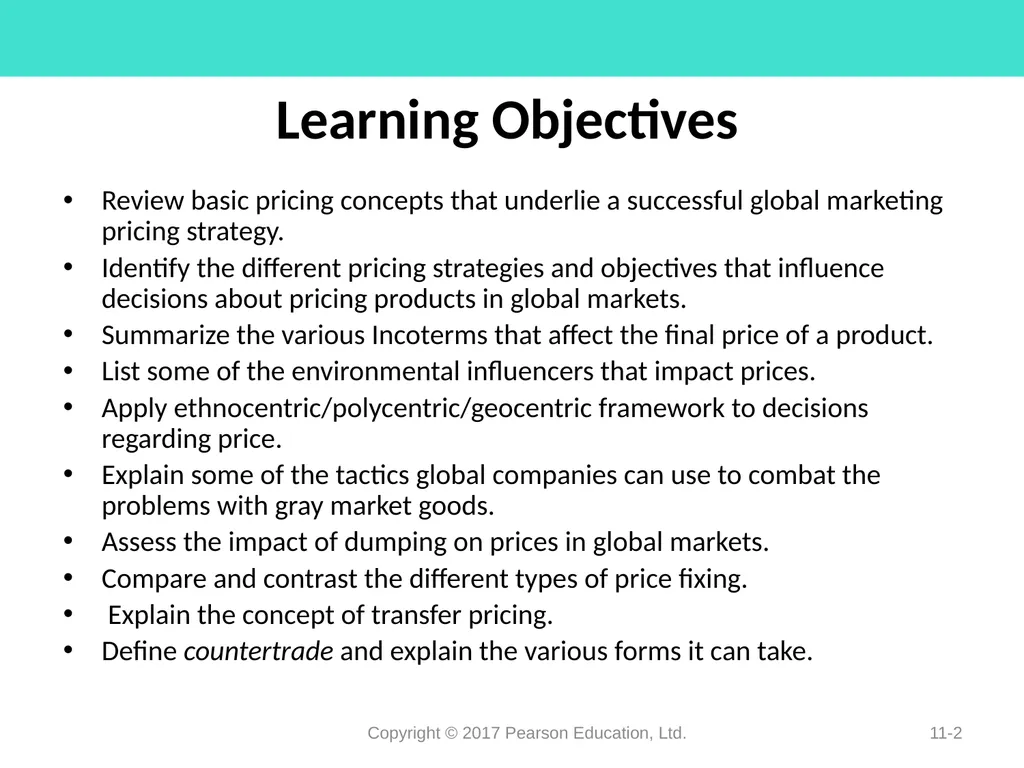
slide2. Learning Objectives Review basic pricing concepts that underlie a successful global marketing pricing strategy.
Identify the different pricing strategies and objectives that influence decisions about pricing products in global markets.
Summarize the various Incoterms that affect the final price of a product.
List some of the environmental influencers that impact prices.
Apply ethnocentric/polycentric/geocentric framework to decisions regarding price.
Explain some of the tactics global companies can use to combat the problems with gray market goods.
Assess the impact of dumping on prices in global markets.
Compare and contrast the different types of price fixing.
Explain the concept of transfer pricing.
Define countertrade and explain the various forms it can take. Copyright © 2017 Pearson Education, Ltd. 11-2<br>
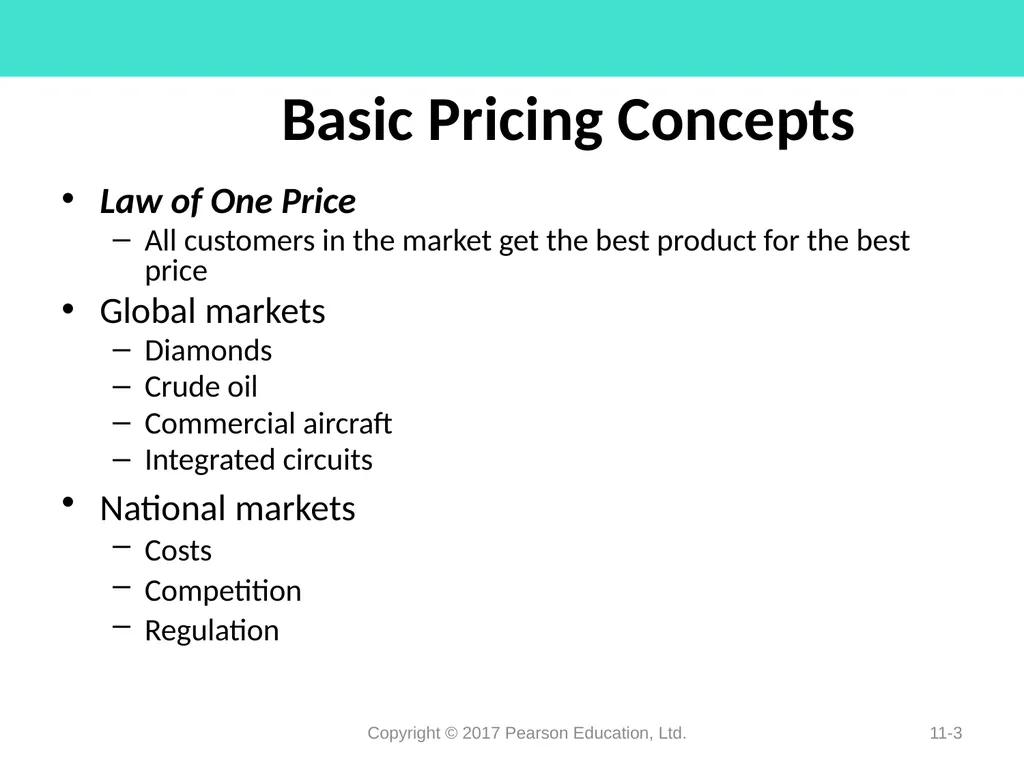
slide3. Basic Pricing Concepts Law of One Price
All customers in the market get the best product for the best price
Global markets
Diamonds
Crude oil
Commercial aircraft
Integrated circuits
National markets
Costs
Competition
Regulation Copyright © 2017 Pearson Education, Ltd. 11-3<br>
slide4. Basic Pricing Concepts The Global Manager must develop systems and policies that address
Price Floor: minimum price
Price Ceiling: maximum price
Optimum Prices: function of demand
Must be consistent with global opportunities and constraints
Be aware of price transparency created by Euro zone, Internet Copyright © 2017 Pearson Education, Ltd. 11-4<br>
slide5. Global Pricing Objectives and Strategies Managers must determine the objectives for the pricing objectives
Unit Sales
Market Share
Return on investment
They must then develop strategies to achieve those objectives
Penetration Pricing
Market Skimming Copyright © 2017 Pearson Education, Ltd. 11-5<br>
slide6. Market Skimming and Financial Objectives Market Skimming
Charging a premium price
May occur at the introduction stage of product life cycle
Luxury goods marketers use price to differentiate products
LVMH, Mercedes-Benz Copyright © 2017 Pearson Education, Ltd. 11-6<br>
slide7. Penetration Pricing and Non-Financial Objectives Penetration Pricing
Charging a low price in order to penetrate market quickly
Appropriate to saturate market prior to imitation by competitors
Packaged food product makers, with products that do not merit patents, may use this strategy to get market saturation before competitors copy the product Copyright © 2017 Pearson Education, Ltd. 11-7<br>
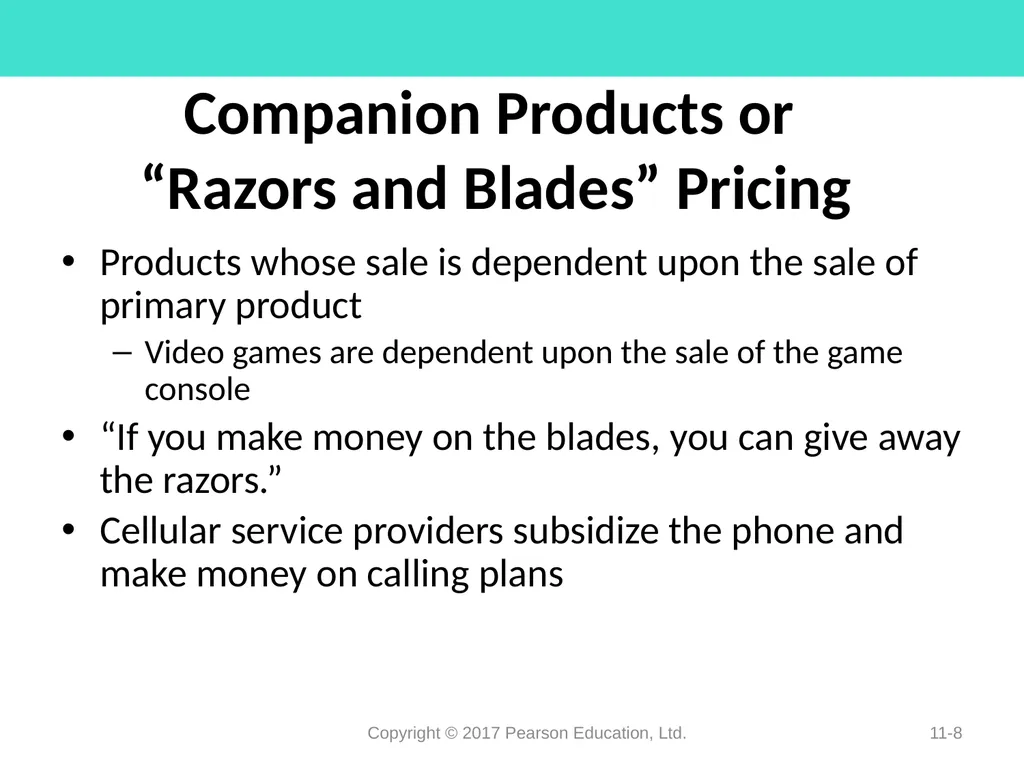
slide8. Companion Products or “Razors and Blades” Pricing Products whose sale is dependent upon the sale of primary product
Video games are dependent upon the sale of the game console
“If you make money on the blades, you can give away the razors.”
Cellular service providers subsidize the phone and make money on calling plans Copyright © 2017 Pearson Education, Ltd. 11-8<br>
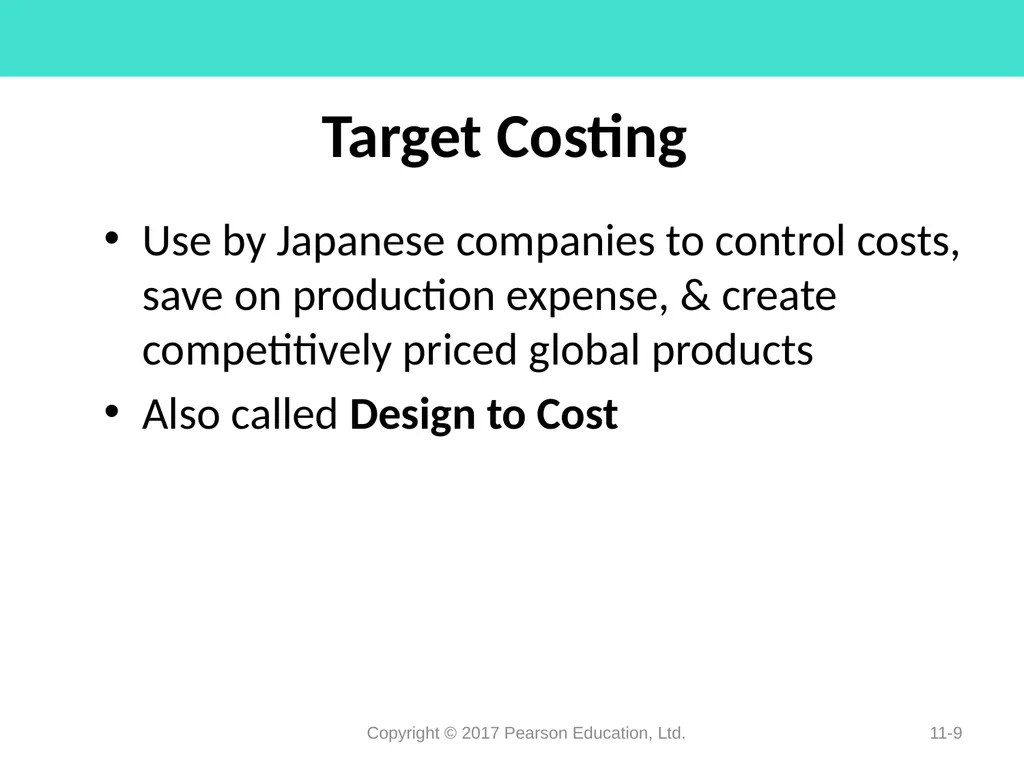
slide9. Target Costing Use by Japanese companies to control costs, save on production expense, & create competitively priced global products
Also called Design to Cost Copyright © 2017 Pearson Education, Ltd. 11-9<br>
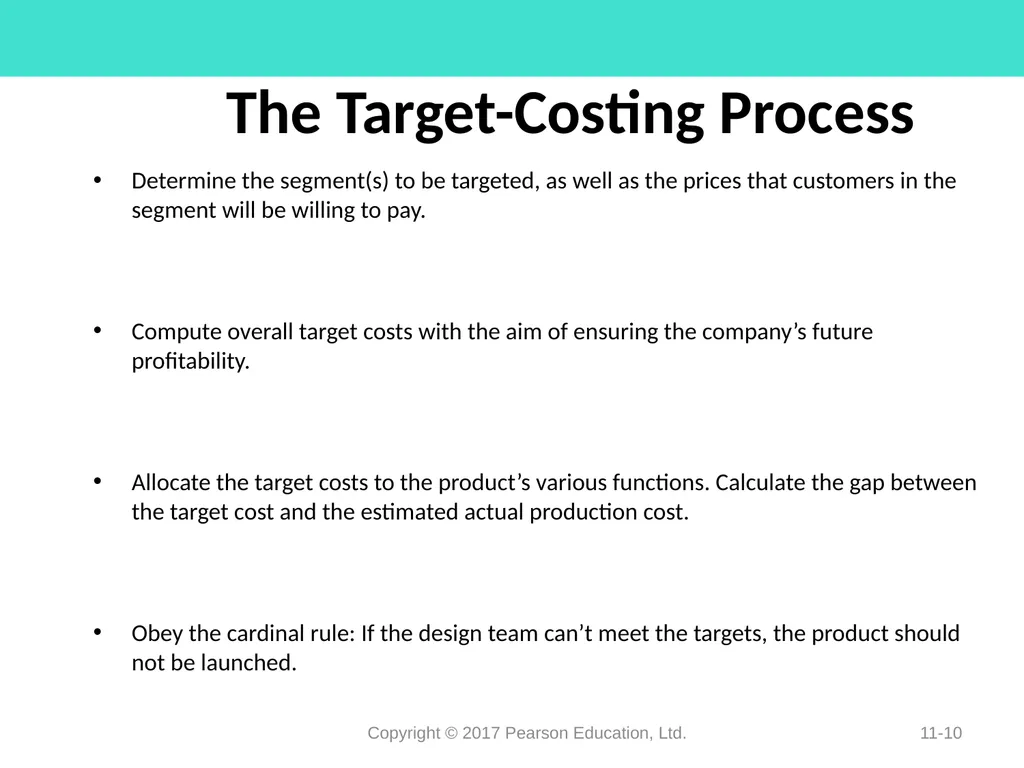
slide10. The Target-Costing Process Determine the segment(s) to be targeted, as well as the prices that customers in the segment will be willing to pay.
Compute overall target costs with the aim of ensuring the company’s future profitability.
Allocate the target costs to the product’s various functions. Calculate the gap between the target cost and the estimated actual production cost.
Obey the cardinal rule: If the design team can’t meet the targets, the product should not be launched. Copyright © 2017 Pearson Education, Ltd. 11-10<br>
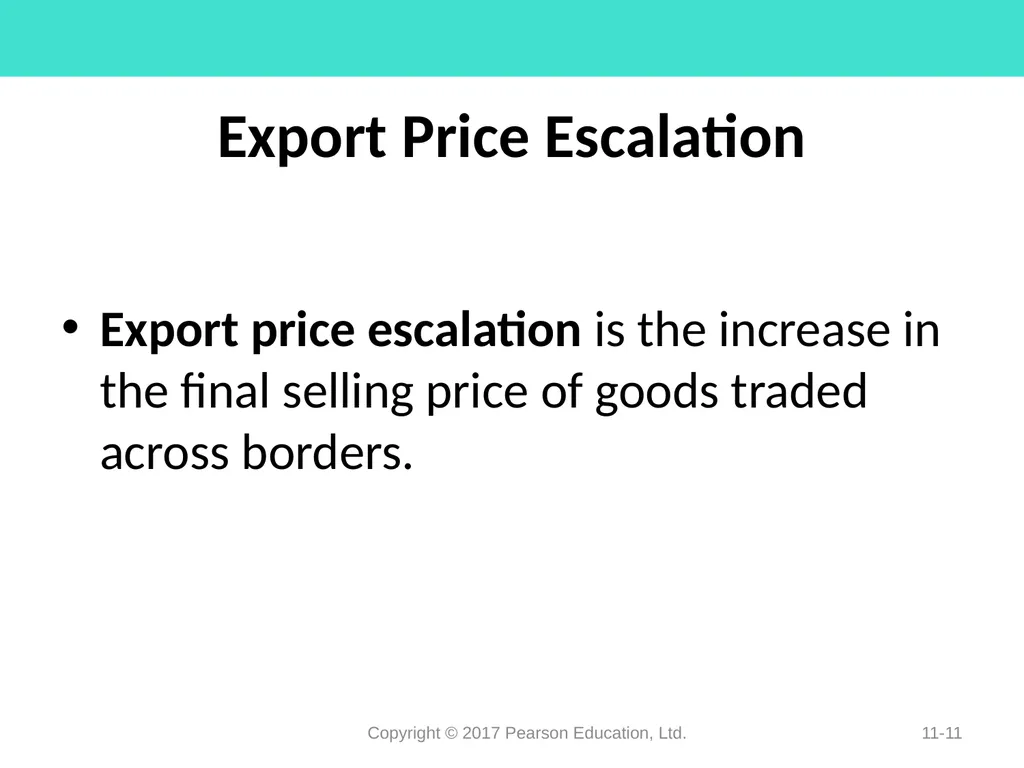
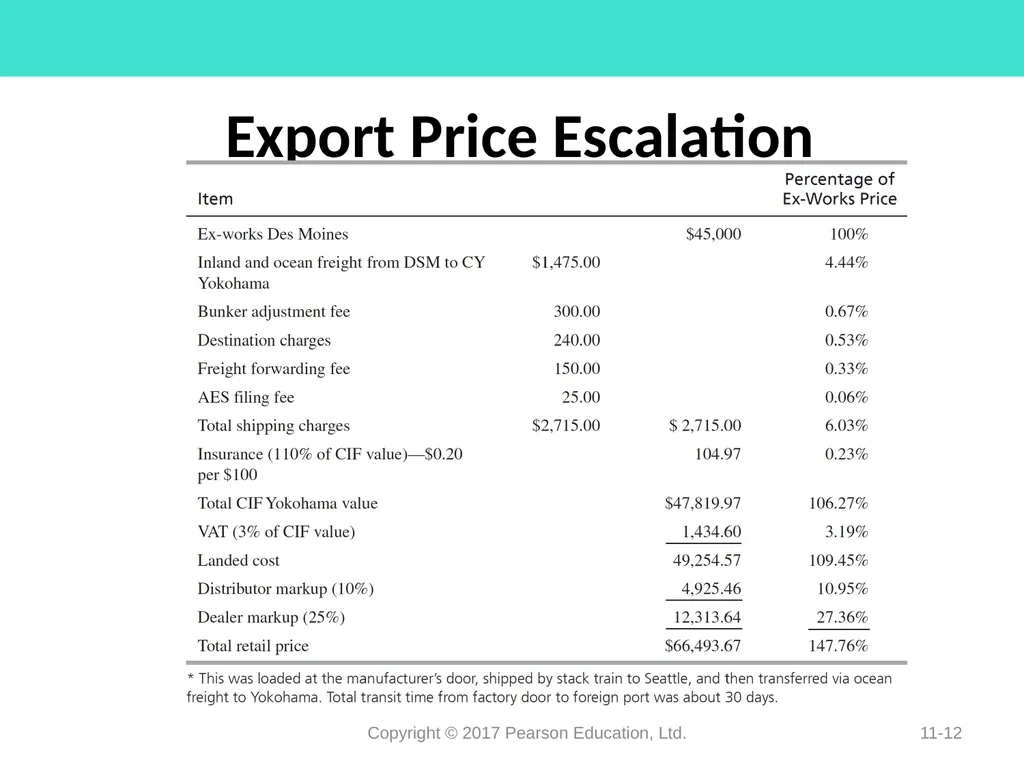
slide11. Export Price Escalation Export price escalation is the increase in the final selling price of goods traded across borders. Copyright © 2017 Pearson Education, Ltd. 11-11<br>
slide12. Export Price Escalation Copyright © 2017 Pearson Education, Ltd. 11-12<br>
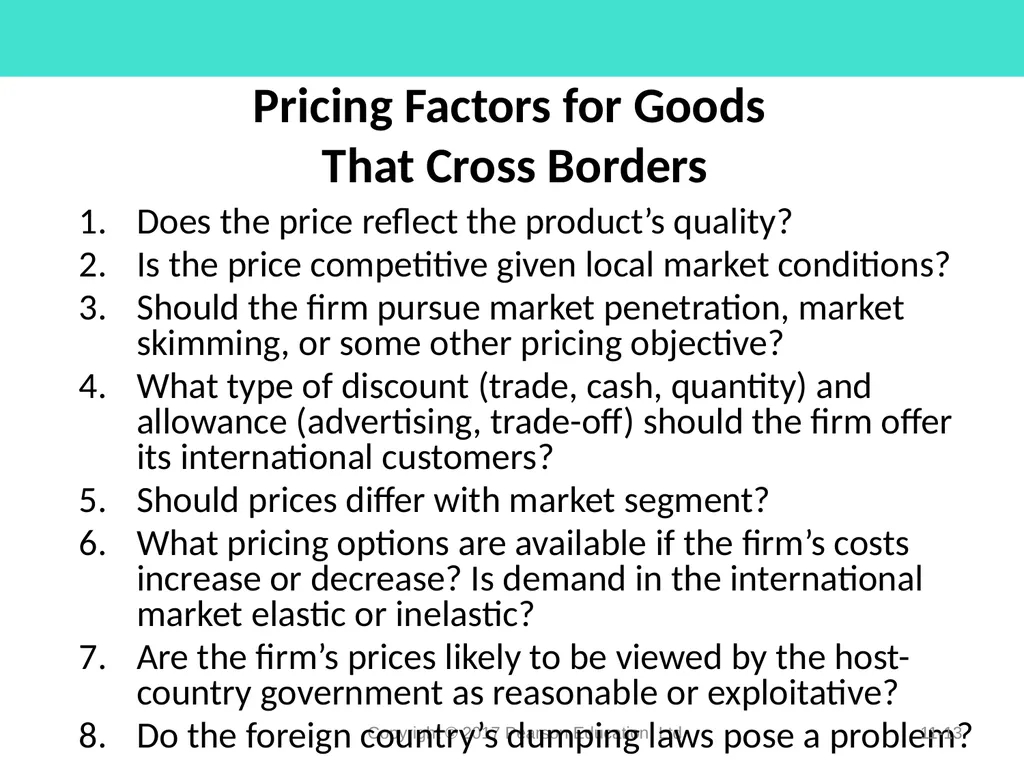
slide13. Pricing Factors for Goods That Cross Borders Does the price reflect the product’s quality?
Is the price competitive given local market conditions?
Should the firm pursue market penetration, market skimming, or some other pricing objective?
What type of discount (trade, cash, quantity) and allowance (advertising, trade-off) should the firm offer its international customers?
Should prices differ with market segment?
What pricing options are available if the firm’s costs increase or decrease? Is demand in the international market elastic or inelastic?
Are the firm’s prices likely to be viewed by the host-country government as reasonable or exploitative?
Do the foreign country’s dumping laws pose a problem? Copyright © 2017 Pearson Education, Ltd. 11-13<br>
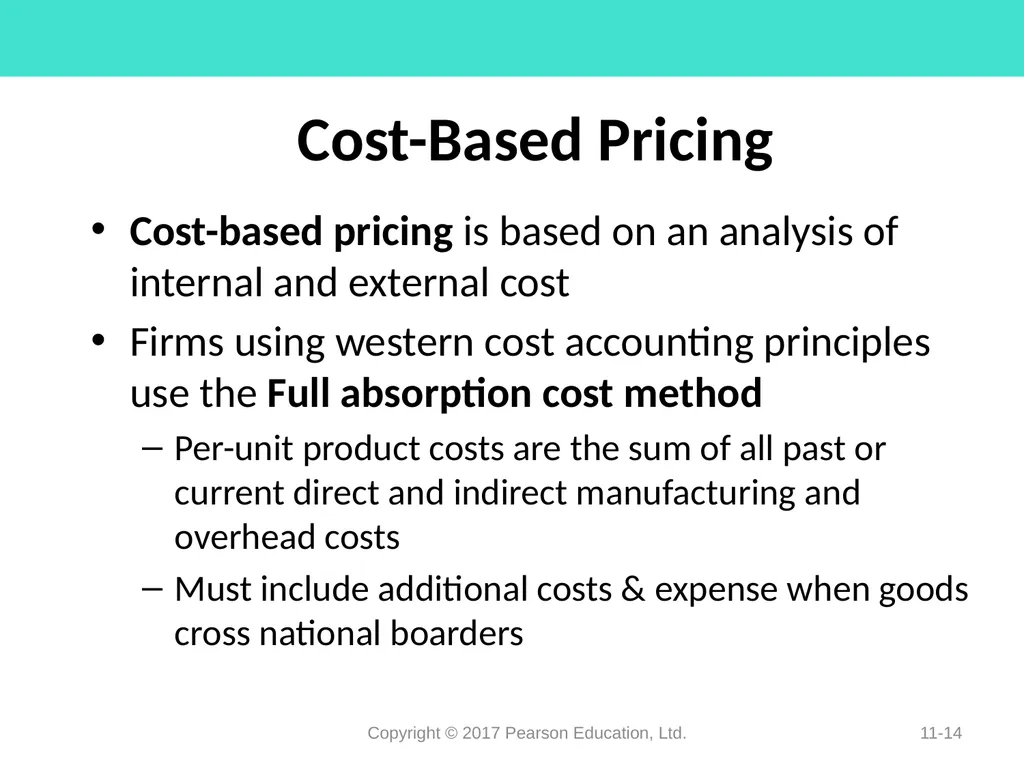
slide14. Cost-Based Pricing Cost-based pricing is based on an analysis of internal and external cost
Firms using western cost accounting principles use the Full absorption cost method
Per-unit product costs are the sum of all past or current direct and indirect manufacturing and overhead costs
Must include additional costs & expense when goods cross national boarders Copyright © 2017 Pearson Education, Ltd. 11-14<br>
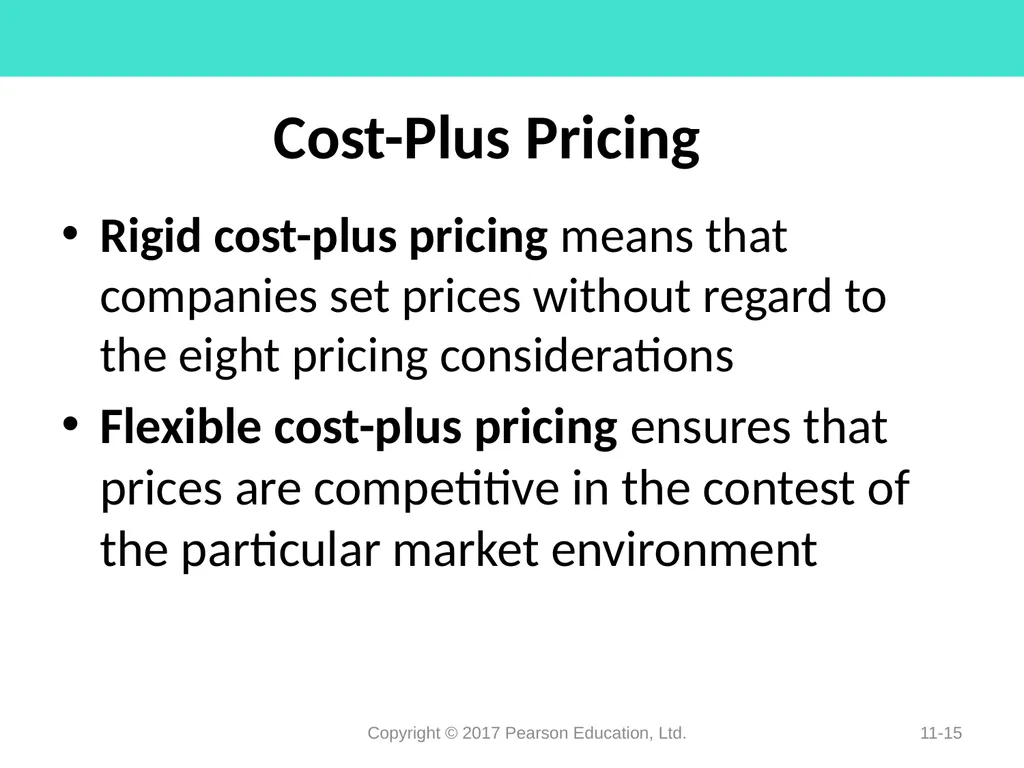
slide15. Cost-Plus Pricing Rigid cost-plus pricing means that companies set prices without regard to the eight pricing considerations
Flexible cost-plus pricing ensures that prices are competitive in the contest of the particular market environment Copyright © 2017 Pearson Education, Ltd. 11-15<br>
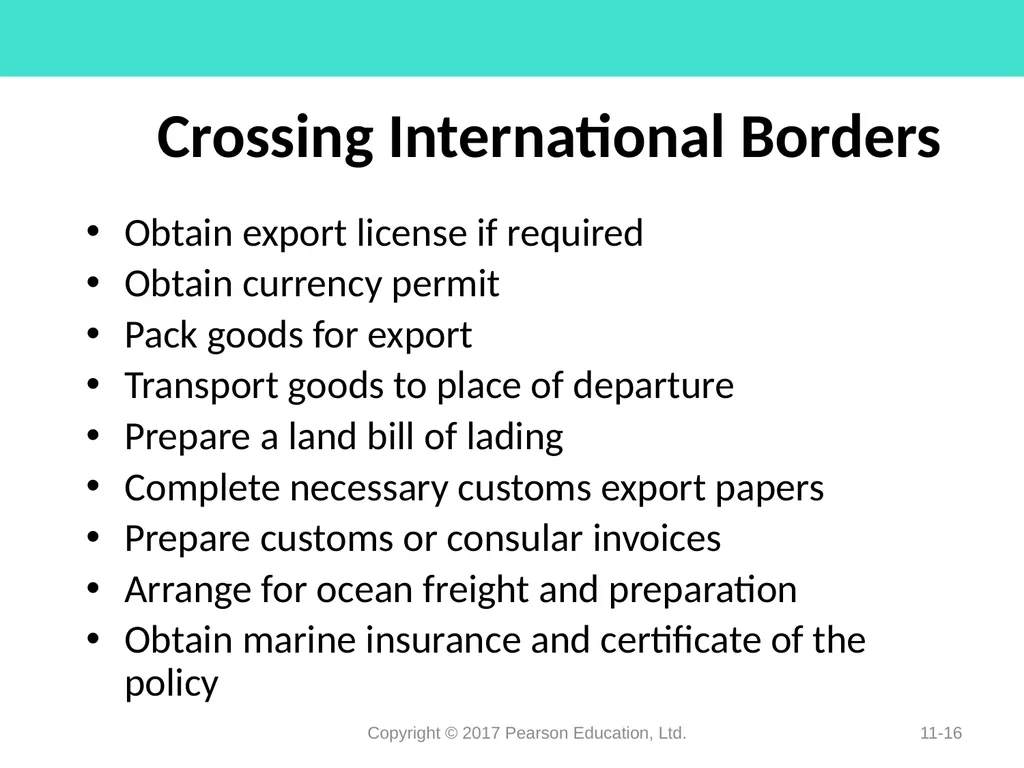
slide16. Crossing International Borders Obtain export license if required
Obtain currency permit
Pack goods for export
Transport goods to place of departure
Prepare a land bill of lading
Complete necessary customs export papers
Prepare customs or consular invoices
Arrange for ocean freight and preparation
Obtain marine insurance and certificate of the policy Copyright © 2017 Pearson Education, Ltd. 11-16<br>
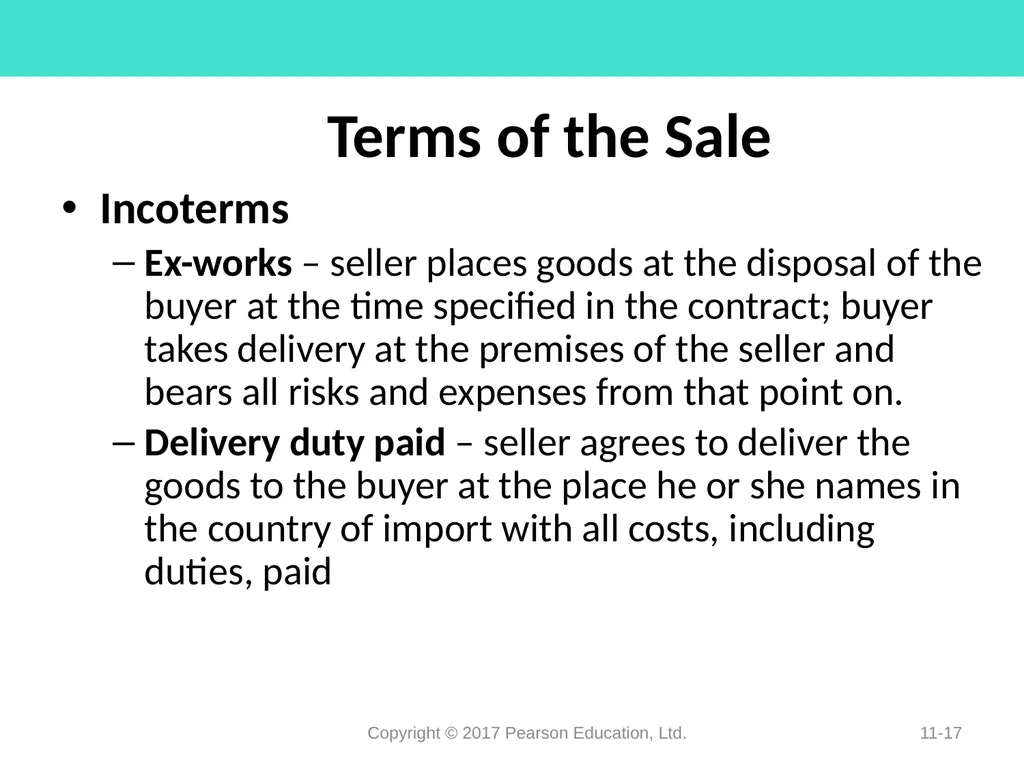
slide17. Terms of the Sale Incoterms
Ex-works – seller places goods at the disposal of the buyer at the time specified in the contract; buyer takes delivery at the premises of the seller and bears all risks and expenses from that point on.
Delivery duty paid – seller agrees to deliver the goods to the buyer at the place he or she names in the country of import with all costs, including duties, paid Copyright © 2017 Pearson Education, Ltd. 11-17<br>
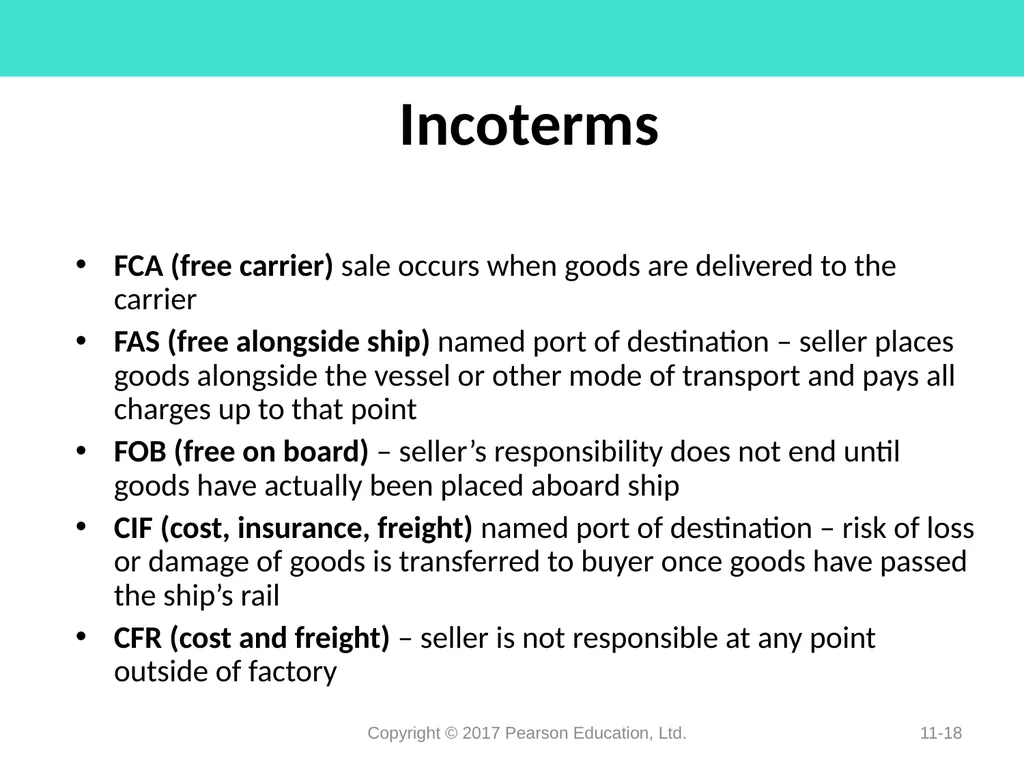
slide18. Incoterms FCA (free carrier) sale occurs when goods are delivered to the carrier
FAS (free alongside ship) named port of destination – seller places goods alongside the vessel or other mode of transport and pays all charges up to that point
FOB (free on board) – seller’s responsibility does not end until goods have actually been placed aboard ship
CIF (cost, insurance, freight) named port of destination – risk of loss or damage of goods is transferred to buyer once goods have passed the ship’s rail
CFR (cost and freight) – seller is not responsible at any point outside of factory Copyright © 2017 Pearson Education, Ltd. 11-18<br>
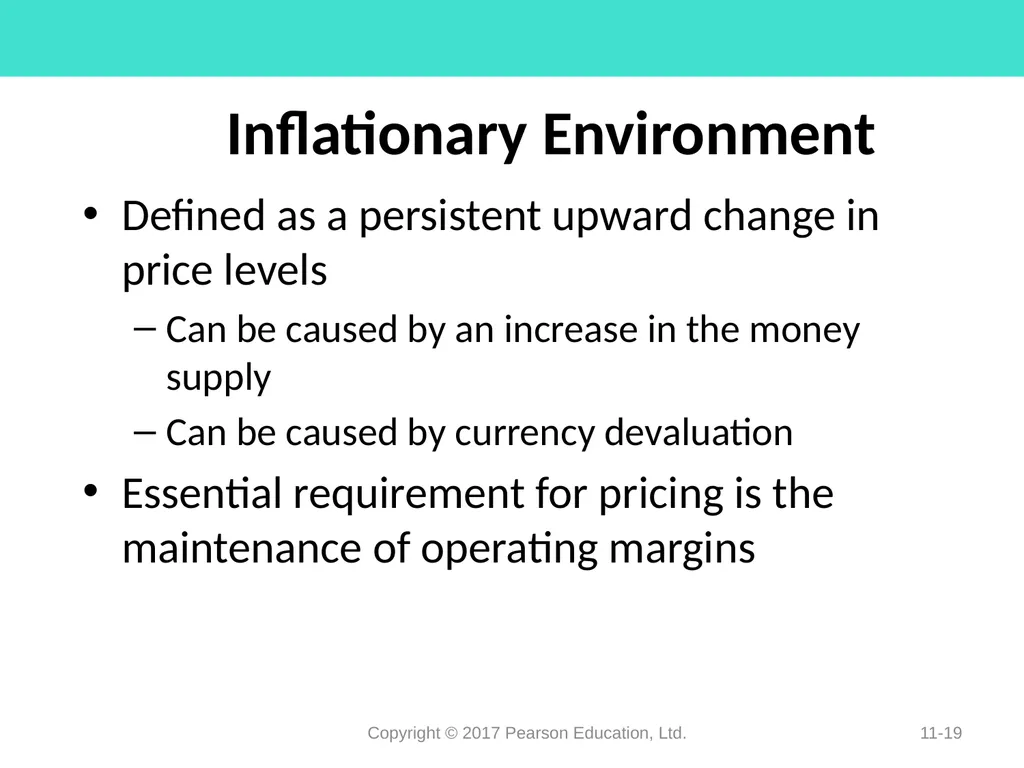
slide19. Inflationary Environment Defined as a persistent upward change in price levels
Can be caused by an increase in the money supply
Can be caused by currency devaluation
Essential requirement for pricing is the maintenance of operating margins Copyright © 2017 Pearson Education, Ltd. 11-19<br>
slide20. Low Inflation Environment Should make it possible to raise prices but consider the global competitive environment
U.S. inflation rate in the 1990s was low and strong demand had factories at capacity
However, mid-1990s Europe had high unemployment, Asia was in recession
By the end of the decade, globalization, the Internet, low-cost products from China, and cost-conscious consumers became other constraining factors Copyright © 2017 Pearson Education, Ltd. 11-20<br>
slide21. Government Controls, Subsidies, and Regulations The types of policies and regulations that affect pricing decisions are:
Dumping legislation
Resale price maintenance legislation
Price ceilings
General reviews of price levels Foreign governments may:
require funds to be noninterest-bearing accounts for a long time
restrict profits taken out of the country and limit funds paid for imported material
Restrict price competition Copyright © 2017 Pearson Education, Ltd. 11-21<br>
slide22. Competitive Behavior If competitors do not adjust their prices in response to rising costs it is difficult to adjust your pricing to maintain operating margins
If competitors are manufacturing or sourcing in a lower-cost country, it may be necessary to cut prices to stay competitive Copyright © 2017 Pearson Education, Ltd. 11-22<br>
slide23. Using Sourcing as a Strategic Pricing Tool Marketers of domestically manufactured finished products may move to offshore sourcing of certain components to keep costs down and prices competitive
China is “the world’s workshop”
Rationalize the distribution system—Toys ‘R’ Us bypasses layers of intermediaries in Japan to operate U.S. style warehouse stores Copyright © 2017 Pearson Education, Ltd. 11-23<br>
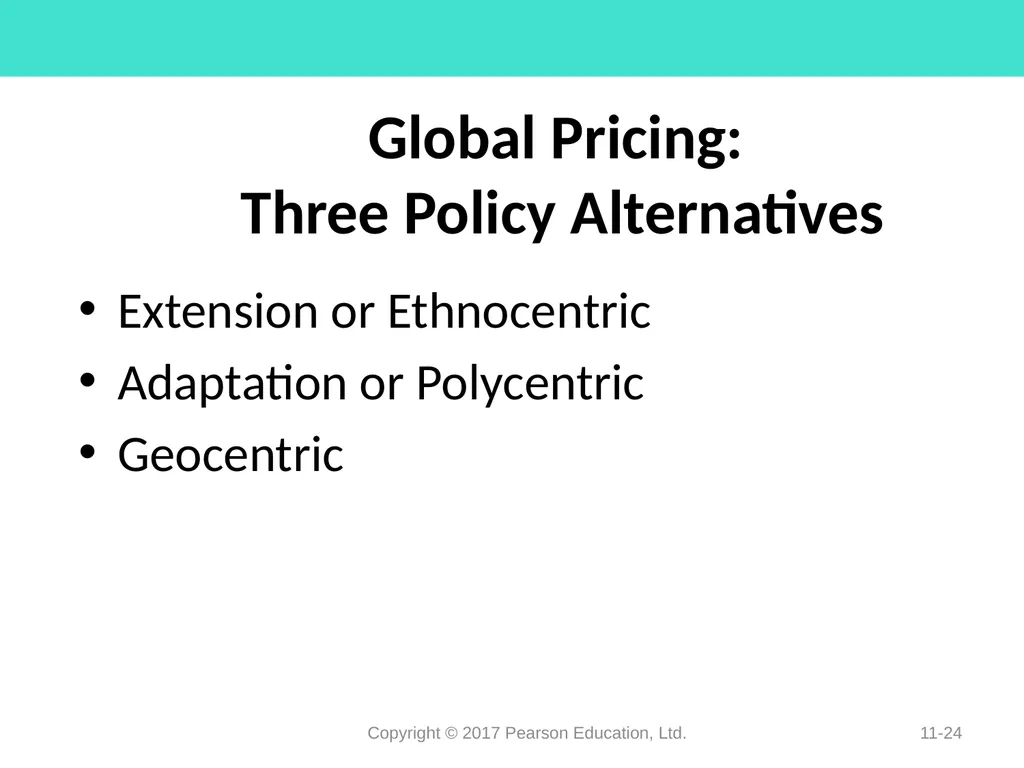
slide24. Global Pricing: Three Policy Alternatives Extension or Ethnocentric
Adaptation or Polycentric
Geocentric Copyright © 2017 Pearson Education, Ltd. 11-24<br>
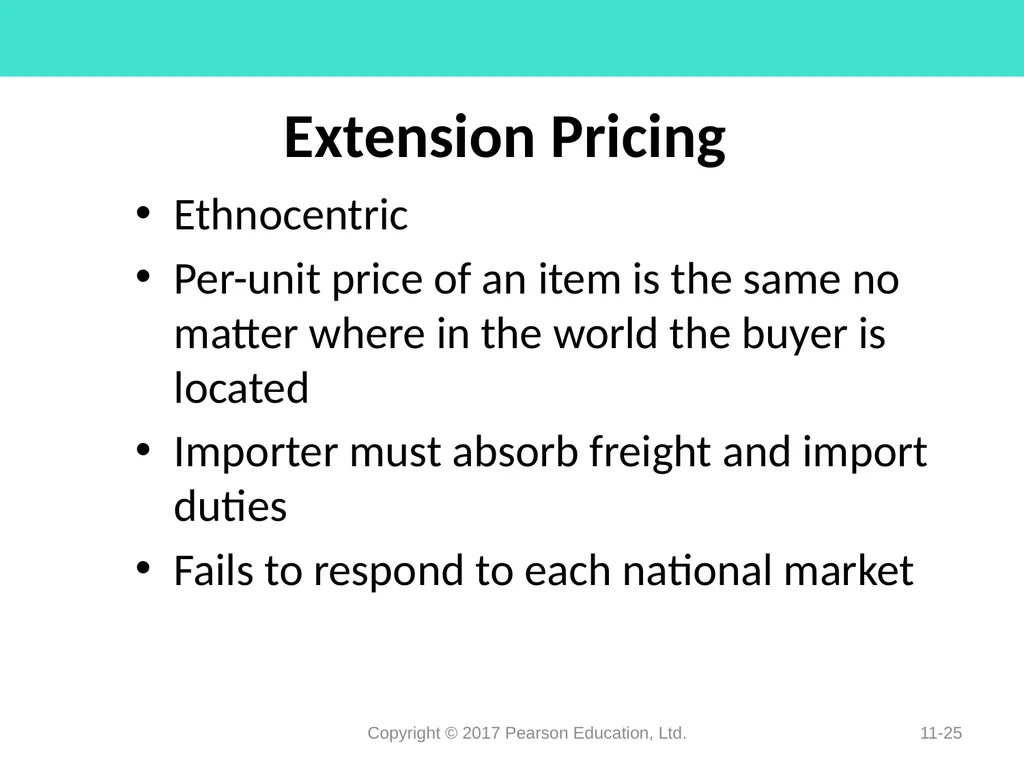
slide25. Extension Pricing Ethnocentric
Per-unit price of an item is the same no matter where in the world the buyer is located
Importer must absorb freight and import duties
Fails to respond to each national market Copyright © 2017 Pearson Education, Ltd. 11-25<br>
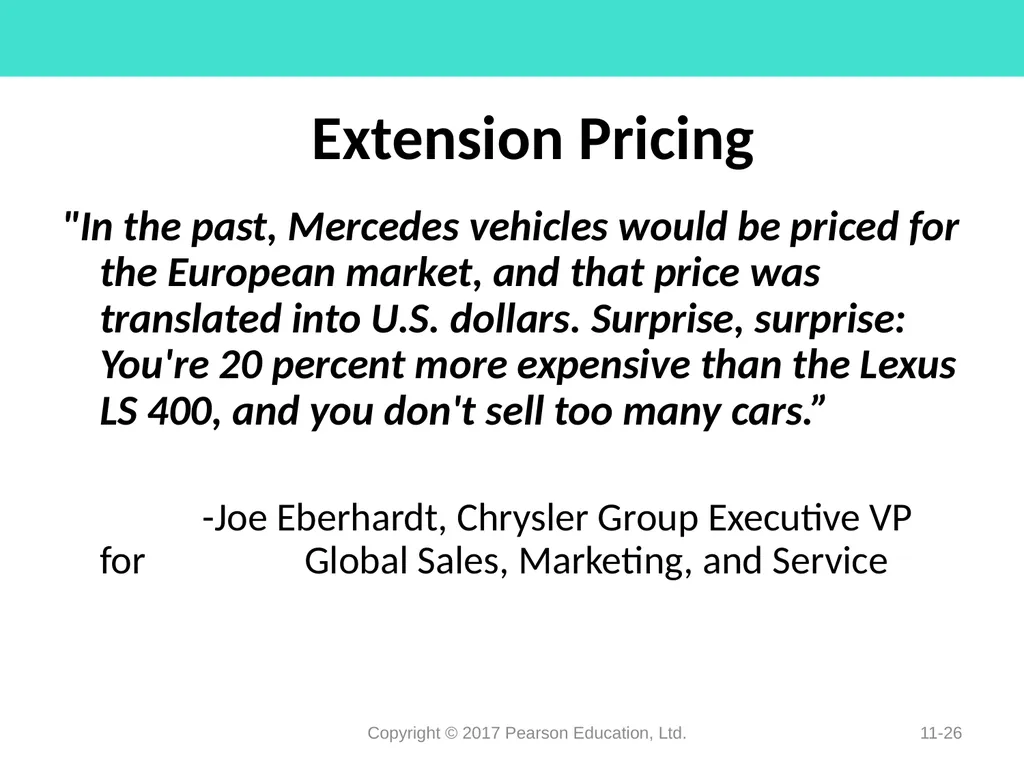
slide26. "In the past, Mercedes vehicles would be priced for the European market, and that price was translated into U.S. dollars. Surprise, surprise: You're 20 percent more expensive than the Lexus LS 400, and you don't sell too many cars.”
-Joe Eberhardt, Chrysler Group Executive VP for Global Sales, Marketing, and Service Extension Pricing Copyright © 2017 Pearson Education, Ltd. 11-26<br>
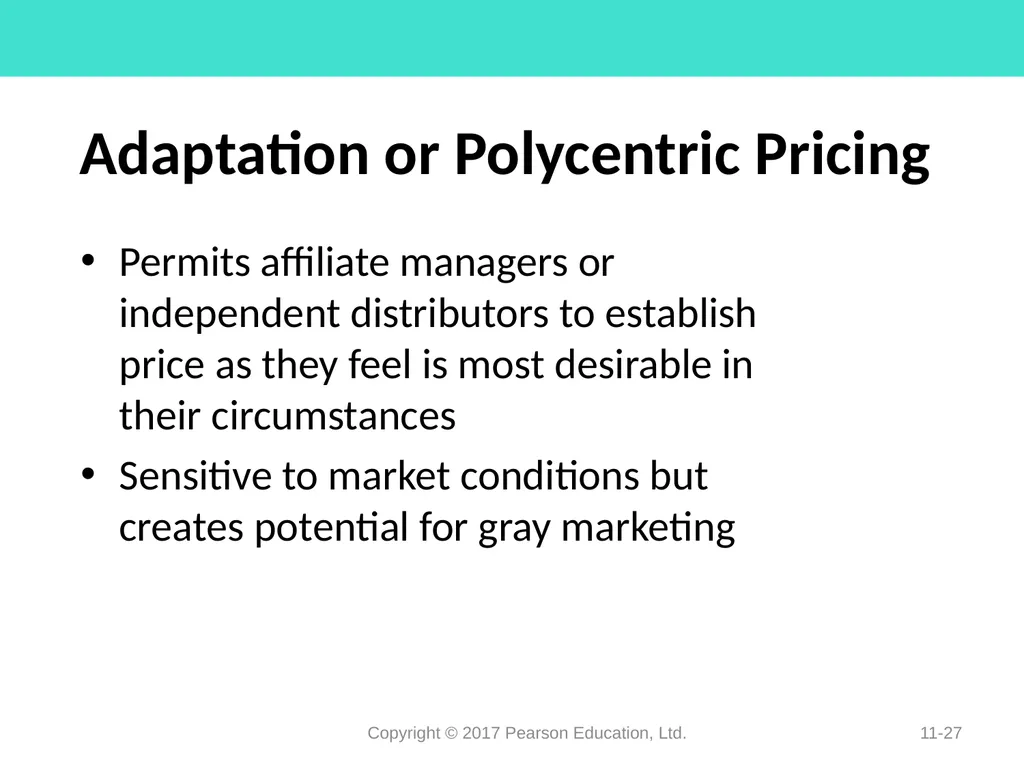
slide27. Adaptation or Polycentric Pricing Permits affiliate managers or independent distributors to establish price as they feel is most desirable in their circumstances
Sensitive to market conditions but creates potential for gray marketing Copyright © 2017 Pearson Education, Ltd. 11-27<br>
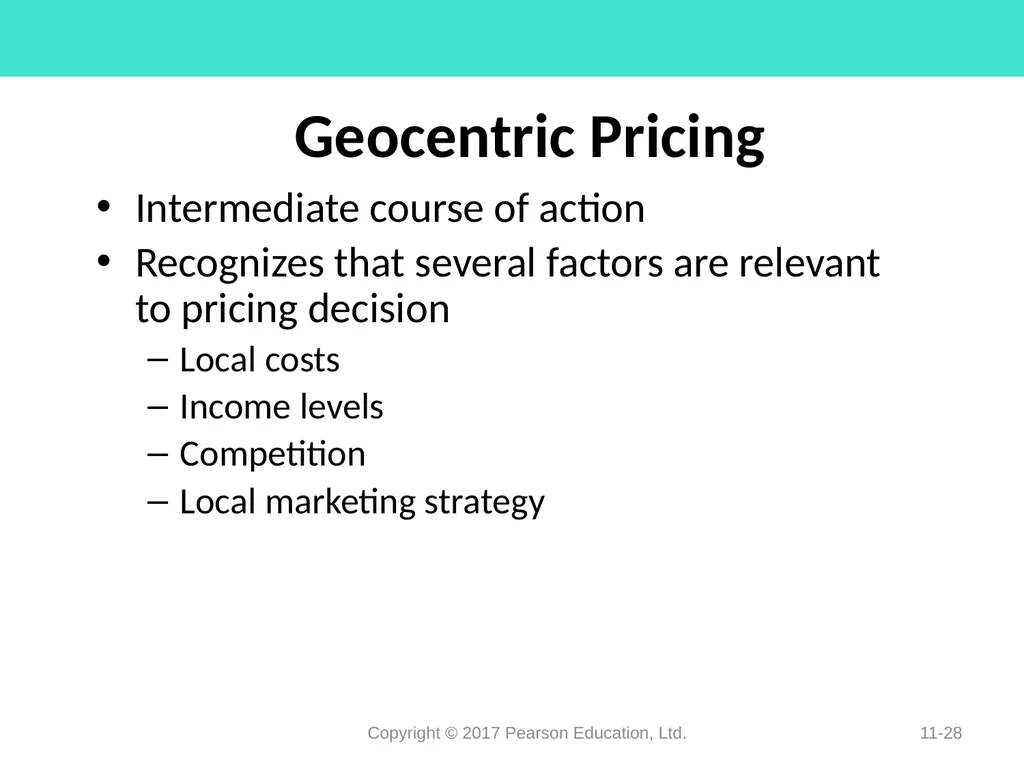
slide28. Geocentric Pricing Intermediate course of action
Recognizes that several factors are relevant to pricing decision
Local costs
Income levels
Competition
Local marketing strategy Copyright © 2017 Pearson Education, Ltd. 11-28<br>
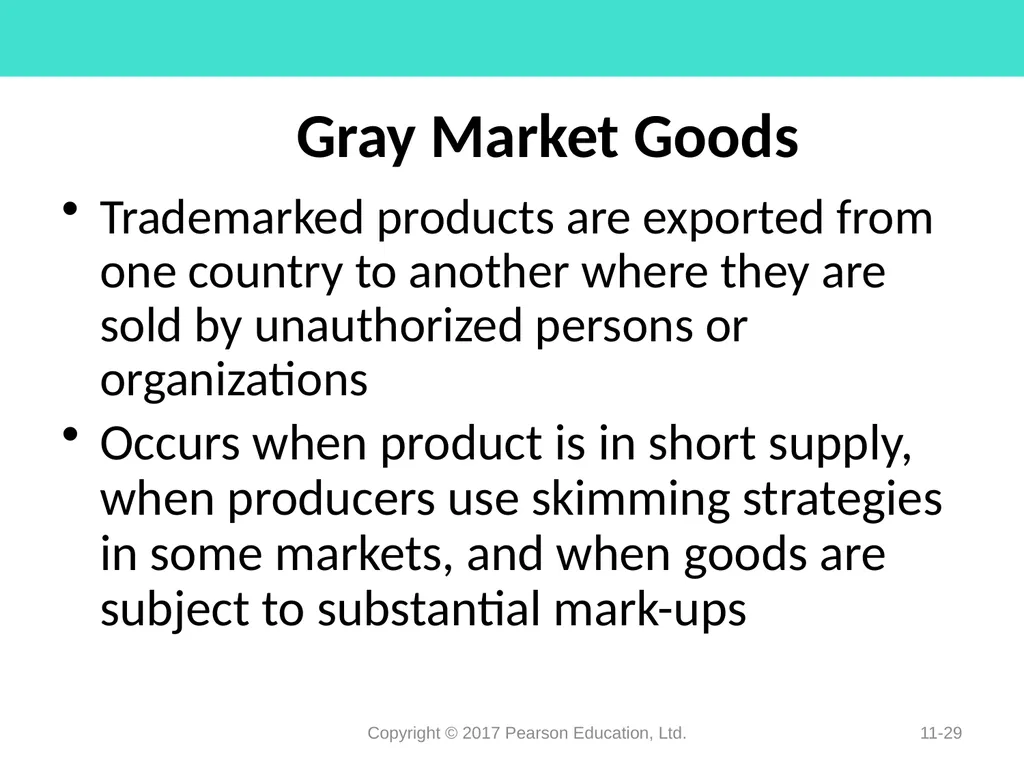
slide29. Gray Market Goods Trademarked products are exported from one country to another where they are sold by unauthorized persons or organizations
Occurs when product is in short supply, when producers use skimming strategies in some markets, and when goods are subject to substantial mark-ups Copyright © 2017 Pearson Education, Ltd. 11-29<br>
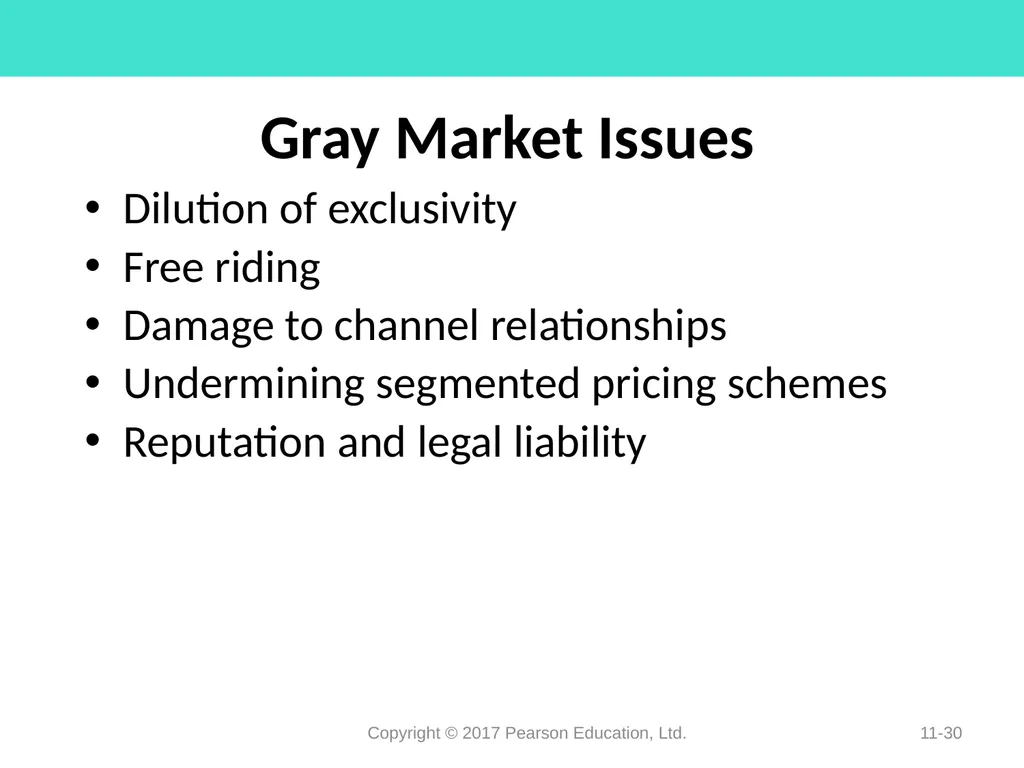
slide30. Gray Market Issues Dilution of exclusivity
Free riding
Damage to channel relationships
Undermining segmented pricing schemes
Reputation and legal liability Copyright © 2017 Pearson Education, Ltd. 11-30<br>
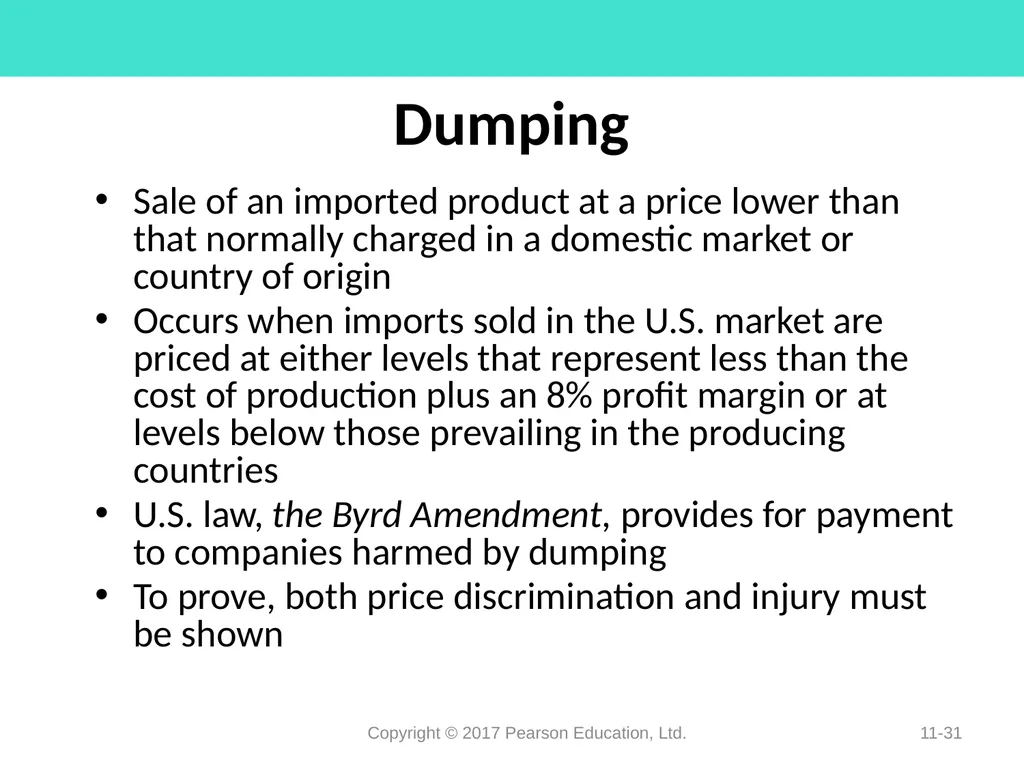
slide31. Dumping Sale of an imported product at a price lower than that normally charged in a domestic market or country of origin
Occurs when imports sold in the U.S. market are priced at either levels that represent less than the cost of production plus an 8% profit margin or at levels below those prevailing in the producing countries
U.S. law, the Byrd Amendment, provides for payment to companies harmed by dumping
To prove, both price discrimination and injury must be shown Copyright © 2017 Pearson Education, Ltd. 11-31<br>
slide32. Price Fixing Representatives of two or more companies secretly set similar prices for their products
Illegal act because it is anticompetitive
Horizontal price fixing occurs when competitors within an industry that make and market the same product conspire to keep prices high
Vertical price fixing occurs when a manufacturer conspires with wholesalers/retailers to ensure certain retail prices are maintained Copyright © 2017 Pearson Education, Ltd. 11-32<br>
slide33. Transfer Pricing Pricing of goods, services, and intangible property bought and sold by operating units or divisions of a company doing business with an affiliate in another jurisdiction
Intra-corporate exchanges
Cost-based transfer pricing
Market-based transfer pricing
Negotiated transfer pricing Copyright © 2017 Pearson Education, Ltd. 11-33<br>
slide34. Countertrade Countertrade occurs when payment is made in some form other than money
Options
Barter
Counterpurchase or parallel trading
Offset
Compensation trading or buyback
Switch trading Copyright © 2017 Pearson Education, Ltd. 11-34<br>
Chapter 11<br>
slide2. Learning Objectives Review basic pricing concepts that underlie a successful global marketing pricing strategy.
Identify the different pricing strategies and objectives that influence decisions about pricing products in global markets.
Summarize the various Incoterms that affect the final price of a product.
List some of the environmental influencers that impact prices.
Apply ethnocentric/polycentric/geocentric framework to decisions regarding price.
Explain some of the tactics global companies can use to combat the problems with gray market goods.
Assess the impact of dumping on prices in global markets.
Compare and contrast the different types of price fixing.
Explain the concept of transfer pricing.
Define countertrade and explain the various forms it can take. Copyright © 2017 Pearson Education, Ltd. 11-2<br>
slide3. Basic Pricing Concepts Law of One Price
All customers in the market get the best product for the best price
Global markets
Diamonds
Crude oil
Commercial aircraft
Integrated circuits
National markets
Costs
Competition
Regulation Copyright © 2017 Pearson Education, Ltd. 11-3<br>
slide4. Basic Pricing Concepts The Global Manager must develop systems and policies that address
Price Floor: minimum price
Price Ceiling: maximum price
Optimum Prices: function of demand
Must be consistent with global opportunities and constraints
Be aware of price transparency created by Euro zone, Internet Copyright © 2017 Pearson Education, Ltd. 11-4<br>
slide5. Global Pricing Objectives and Strategies Managers must determine the objectives for the pricing objectives
Unit Sales
Market Share
Return on investment
They must then develop strategies to achieve those objectives
Penetration Pricing
Market Skimming Copyright © 2017 Pearson Education, Ltd. 11-5<br>
slide6. Market Skimming and Financial Objectives Market Skimming
Charging a premium price
May occur at the introduction stage of product life cycle
Luxury goods marketers use price to differentiate products
LVMH, Mercedes-Benz Copyright © 2017 Pearson Education, Ltd. 11-6<br>
slide7. Penetration Pricing and Non-Financial Objectives Penetration Pricing
Charging a low price in order to penetrate market quickly
Appropriate to saturate market prior to imitation by competitors
Packaged food product makers, with products that do not merit patents, may use this strategy to get market saturation before competitors copy the product Copyright © 2017 Pearson Education, Ltd. 11-7<br>
slide8. Companion Products or “Razors and Blades” Pricing Products whose sale is dependent upon the sale of primary product
Video games are dependent upon the sale of the game console
“If you make money on the blades, you can give away the razors.”
Cellular service providers subsidize the phone and make money on calling plans Copyright © 2017 Pearson Education, Ltd. 11-8<br>
slide9. Target Costing Use by Japanese companies to control costs, save on production expense, & create competitively priced global products
Also called Design to Cost Copyright © 2017 Pearson Education, Ltd. 11-9<br>
slide10. The Target-Costing Process Determine the segment(s) to be targeted, as well as the prices that customers in the segment will be willing to pay.
Compute overall target costs with the aim of ensuring the company’s future profitability.
Allocate the target costs to the product’s various functions. Calculate the gap between the target cost and the estimated actual production cost.
Obey the cardinal rule: If the design team can’t meet the targets, the product should not be launched. Copyright © 2017 Pearson Education, Ltd. 11-10<br>
slide11. Export Price Escalation Export price escalation is the increase in the final selling price of goods traded across borders. Copyright © 2017 Pearson Education, Ltd. 11-11<br>
slide12. Export Price Escalation Copyright © 2017 Pearson Education, Ltd. 11-12<br>
slide13. Pricing Factors for Goods That Cross Borders Does the price reflect the product’s quality?
Is the price competitive given local market conditions?
Should the firm pursue market penetration, market skimming, or some other pricing objective?
What type of discount (trade, cash, quantity) and allowance (advertising, trade-off) should the firm offer its international customers?
Should prices differ with market segment?
What pricing options are available if the firm’s costs increase or decrease? Is demand in the international market elastic or inelastic?
Are the firm’s prices likely to be viewed by the host-country government as reasonable or exploitative?
Do the foreign country’s dumping laws pose a problem? Copyright © 2017 Pearson Education, Ltd. 11-13<br>
slide14. Cost-Based Pricing Cost-based pricing is based on an analysis of internal and external cost
Firms using western cost accounting principles use the Full absorption cost method
Per-unit product costs are the sum of all past or current direct and indirect manufacturing and overhead costs
Must include additional costs & expense when goods cross national boarders Copyright © 2017 Pearson Education, Ltd. 11-14<br>
slide15. Cost-Plus Pricing Rigid cost-plus pricing means that companies set prices without regard to the eight pricing considerations
Flexible cost-plus pricing ensures that prices are competitive in the contest of the particular market environment Copyright © 2017 Pearson Education, Ltd. 11-15<br>
slide16. Crossing International Borders Obtain export license if required
Obtain currency permit
Pack goods for export
Transport goods to place of departure
Prepare a land bill of lading
Complete necessary customs export papers
Prepare customs or consular invoices
Arrange for ocean freight and preparation
Obtain marine insurance and certificate of the policy Copyright © 2017 Pearson Education, Ltd. 11-16<br>
slide17. Terms of the Sale Incoterms
Ex-works – seller places goods at the disposal of the buyer at the time specified in the contract; buyer takes delivery at the premises of the seller and bears all risks and expenses from that point on.
Delivery duty paid – seller agrees to deliver the goods to the buyer at the place he or she names in the country of import with all costs, including duties, paid Copyright © 2017 Pearson Education, Ltd. 11-17<br>
slide18. Incoterms FCA (free carrier) sale occurs when goods are delivered to the carrier
FAS (free alongside ship) named port of destination – seller places goods alongside the vessel or other mode of transport and pays all charges up to that point
FOB (free on board) – seller’s responsibility does not end until goods have actually been placed aboard ship
CIF (cost, insurance, freight) named port of destination – risk of loss or damage of goods is transferred to buyer once goods have passed the ship’s rail
CFR (cost and freight) – seller is not responsible at any point outside of factory Copyright © 2017 Pearson Education, Ltd. 11-18<br>
slide19. Inflationary Environment Defined as a persistent upward change in price levels
Can be caused by an increase in the money supply
Can be caused by currency devaluation
Essential requirement for pricing is the maintenance of operating margins Copyright © 2017 Pearson Education, Ltd. 11-19<br>
slide20. Low Inflation Environment Should make it possible to raise prices but consider the global competitive environment
U.S. inflation rate in the 1990s was low and strong demand had factories at capacity
However, mid-1990s Europe had high unemployment, Asia was in recession
By the end of the decade, globalization, the Internet, low-cost products from China, and cost-conscious consumers became other constraining factors Copyright © 2017 Pearson Education, Ltd. 11-20<br>
slide21. Government Controls, Subsidies, and Regulations The types of policies and regulations that affect pricing decisions are:
Dumping legislation
Resale price maintenance legislation
Price ceilings
General reviews of price levels Foreign governments may:
require funds to be noninterest-bearing accounts for a long time
restrict profits taken out of the country and limit funds paid for imported material
Restrict price competition Copyright © 2017 Pearson Education, Ltd. 11-21<br>
slide22. Competitive Behavior If competitors do not adjust their prices in response to rising costs it is difficult to adjust your pricing to maintain operating margins
If competitors are manufacturing or sourcing in a lower-cost country, it may be necessary to cut prices to stay competitive Copyright © 2017 Pearson Education, Ltd. 11-22<br>
slide23. Using Sourcing as a Strategic Pricing Tool Marketers of domestically manufactured finished products may move to offshore sourcing of certain components to keep costs down and prices competitive
China is “the world’s workshop”
Rationalize the distribution system—Toys ‘R’ Us bypasses layers of intermediaries in Japan to operate U.S. style warehouse stores Copyright © 2017 Pearson Education, Ltd. 11-23<br>
slide24. Global Pricing: Three Policy Alternatives Extension or Ethnocentric
Adaptation or Polycentric
Geocentric Copyright © 2017 Pearson Education, Ltd. 11-24<br>
slide25. Extension Pricing Ethnocentric
Per-unit price of an item is the same no matter where in the world the buyer is located
Importer must absorb freight and import duties
Fails to respond to each national market Copyright © 2017 Pearson Education, Ltd. 11-25<br>
slide26. "In the past, Mercedes vehicles would be priced for the European market, and that price was translated into U.S. dollars. Surprise, surprise: You're 20 percent more expensive than the Lexus LS 400, and you don't sell too many cars.”
-Joe Eberhardt, Chrysler Group Executive VP for Global Sales, Marketing, and Service Extension Pricing Copyright © 2017 Pearson Education, Ltd. 11-26<br>
slide27. Adaptation or Polycentric Pricing Permits affiliate managers or independent distributors to establish price as they feel is most desirable in their circumstances
Sensitive to market conditions but creates potential for gray marketing Copyright © 2017 Pearson Education, Ltd. 11-27<br>
slide28. Geocentric Pricing Intermediate course of action
Recognizes that several factors are relevant to pricing decision
Local costs
Income levels
Competition
Local marketing strategy Copyright © 2017 Pearson Education, Ltd. 11-28<br>
slide29. Gray Market Goods Trademarked products are exported from one country to another where they are sold by unauthorized persons or organizations
Occurs when product is in short supply, when producers use skimming strategies in some markets, and when goods are subject to substantial mark-ups Copyright © 2017 Pearson Education, Ltd. 11-29<br>
slide30. Gray Market Issues Dilution of exclusivity
Free riding
Damage to channel relationships
Undermining segmented pricing schemes
Reputation and legal liability Copyright © 2017 Pearson Education, Ltd. 11-30<br>
slide31. Dumping Sale of an imported product at a price lower than that normally charged in a domestic market or country of origin
Occurs when imports sold in the U.S. market are priced at either levels that represent less than the cost of production plus an 8% profit margin or at levels below those prevailing in the producing countries
U.S. law, the Byrd Amendment, provides for payment to companies harmed by dumping
To prove, both price discrimination and injury must be shown Copyright © 2017 Pearson Education, Ltd. 11-31<br>
slide32. Price Fixing Representatives of two or more companies secretly set similar prices for their products
Illegal act because it is anticompetitive
Horizontal price fixing occurs when competitors within an industry that make and market the same product conspire to keep prices high
Vertical price fixing occurs when a manufacturer conspires with wholesalers/retailers to ensure certain retail prices are maintained Copyright © 2017 Pearson Education, Ltd. 11-32<br>
slide33. Transfer Pricing Pricing of goods, services, and intangible property bought and sold by operating units or divisions of a company doing business with an affiliate in another jurisdiction
Intra-corporate exchanges
Cost-based transfer pricing
Market-based transfer pricing
Negotiated transfer pricing Copyright © 2017 Pearson Education, Ltd. 11-33<br>
slide34. Countertrade Countertrade occurs when payment is made in some form other than money
Options
Barter
Counterpurchase or parallel trading
Offset
Compensation trading or buyback
Switch trading Copyright © 2017 Pearson Education, Ltd. 11-34<br>