PRIDE VERSUS HUMILITY Lesson 3 for April 18, 2026 For whoever exalts himself will be humbled, and he who humbles himself will be exalted (Luke 14:11, NKJV) What is valuable about me? Thats a difficult question to answer. What if I say
"PRIDE VERSUS HUMILITY Lesson 3 for April 18, 2026" is the property of its rightful owner. Permission is granted to
download and print the materials on this website for personal, non-commercial use only, and to display it
on your personal computer provided you do not modify the materials and that you retain all copyright
notices contained in the materials. By downloading content from our website, you accept the terms of this
agreement.
Presentation Transcript
01
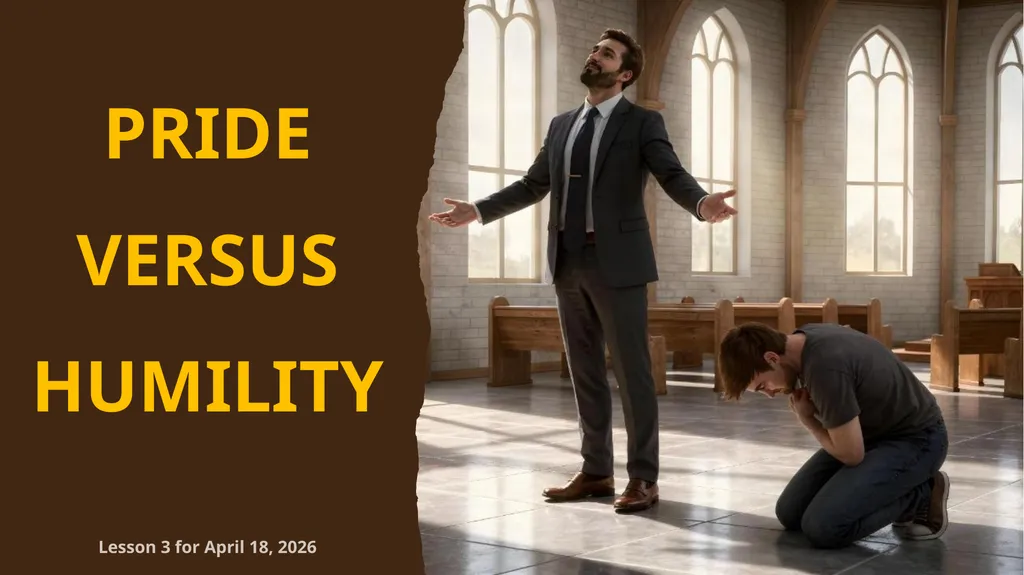
PRIDE VERSUS HUMILITY Lesson 3 for April 18, 2026<br>
02
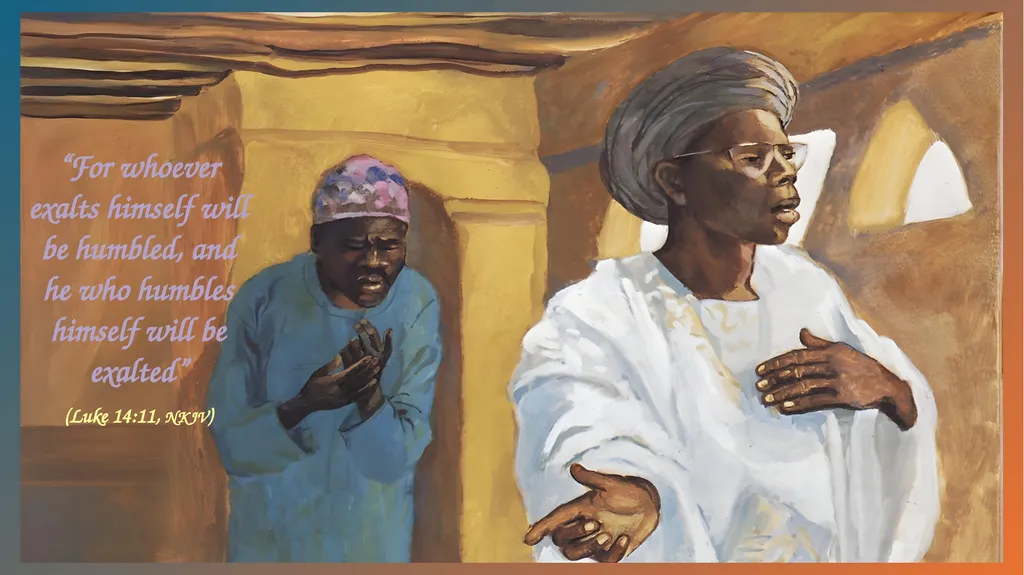
“For whoever exalts himself will be humbled, and he who humbles himself will be exalted”
(Luke 14:11, NKJV)<br>
03
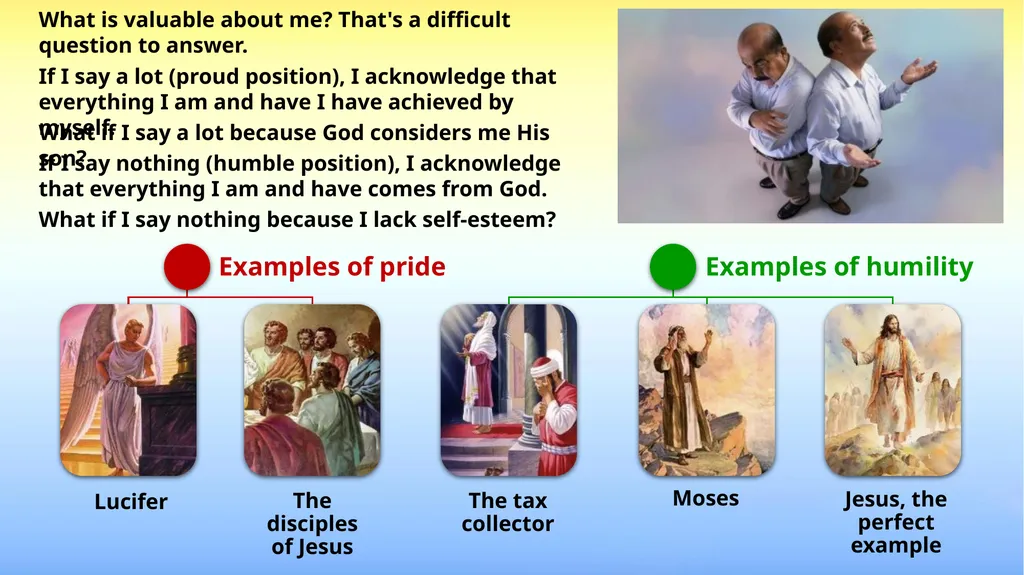
What is valuable about me? That's a difficult question to answer. What if I say nothing because I lack self-esteem? If I say nothing (humble position), I acknowledge that everything I am and have comes from God. What if I say a lot because God considers me His son? If I say a lot (proud position), I acknowledge that everything I am and have I have achieved by myself.<br>
04
EXAMPLES OF PRIDE<br>
05
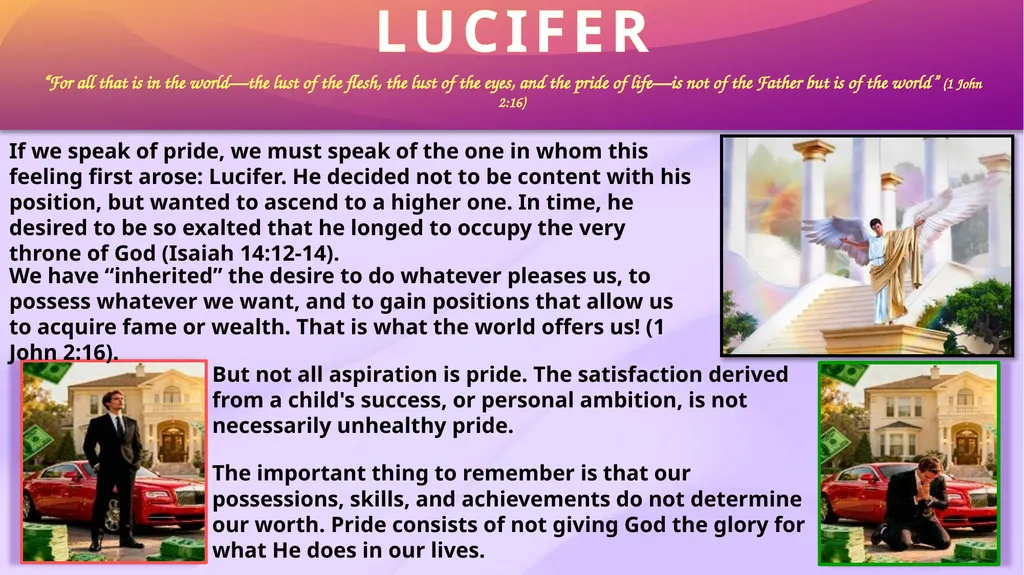
LUCIFER “For all that is in the world—the lust of the flesh, the lust of the eyes, and the pride of life—is not of the Father but is of the world” (1 John 2:16) If we speak of pride, we must speak of the one in whom this feeling first arose: Lucifer. He decided not to be content with his position, but wanted to ascend to a higher one. In time, he desired to be so exalted that he longed to occupy the very throne of God (Isaiah 14:12-14). But not all aspiration is pride. The satisfaction derived from a child's success, or personal ambition, is not necessarily unhealthy pride. We have “inherited” the desire to do whatever pleases us, to possess whatever we want, and to gain positions that allow us to acquire fame or wealth. That is what the world offers us! (1 John 2:16). The important thing to remember is that our possessions, skills, and achievements do not determine our worth. Pride consists of not giving God the glory for what He does in our lives.<br>
06
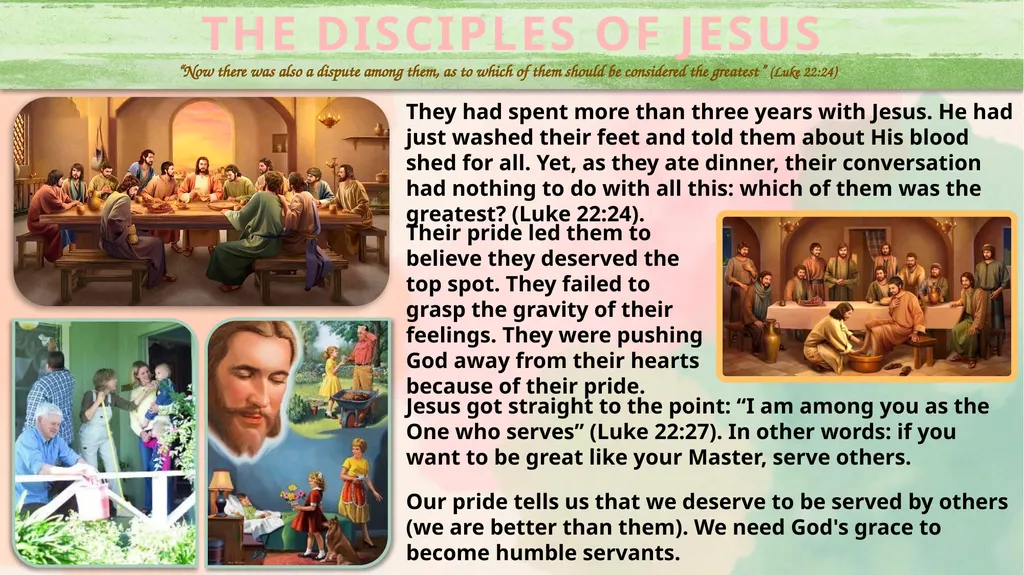
THE DISCIPLES OF JESUS “Now there was also a dispute among them, as to which of them should be considered the greatest” (Luke 22:24) They had spent more than three years with Jesus. He had just washed their feet and told them about His blood shed for all. Yet, as they ate dinner, their conversation had nothing to do with all this: which of them was the greatest? (Luke 22:24). Their pride led them to believe they deserved the top spot. They failed to grasp the gravity of their feelings. They were pushing God away from their hearts because of their pride. Jesus got straight to the point: “I am among you as the One who serves” (Luke 22:27). In other words: if you want to be great like your Master, serve others. Our pride tells us that we deserve to be served by others (we are better than them). We need God's grace to become humble servants.<br>
07
EXAMPLES OF HUMILITY<br>
08
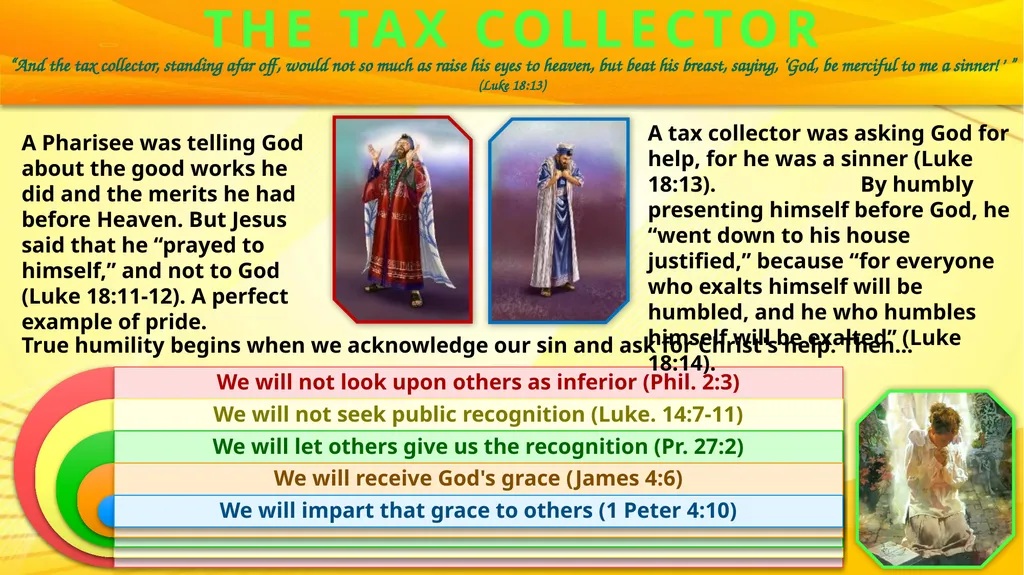
THE TAX COLLECTOR “And the tax collector, standing afar off, would not so much as raise his eyes to heaven, but beat his breast, saying, ‘God, be merciful to me a sinner!’ ” (Luke 18:13) A Pharisee was telling God about the good works he did and the merits he had before Heaven. But Jesus said that he “prayed to himself,” and not to God (Luke 18:11-12). A perfect example of pride. A tax collector was asking God for help, for he was a sinner (Luke 18:13). By humbly presenting himself before God, he “went down to his house justified,” because “for everyone who exalts himself will be humbled, and he who humbles himself will be exalted” (Luke 18:14). True humility begins when we acknowledge our sin and ask for Christ's help. Then…<br>
09
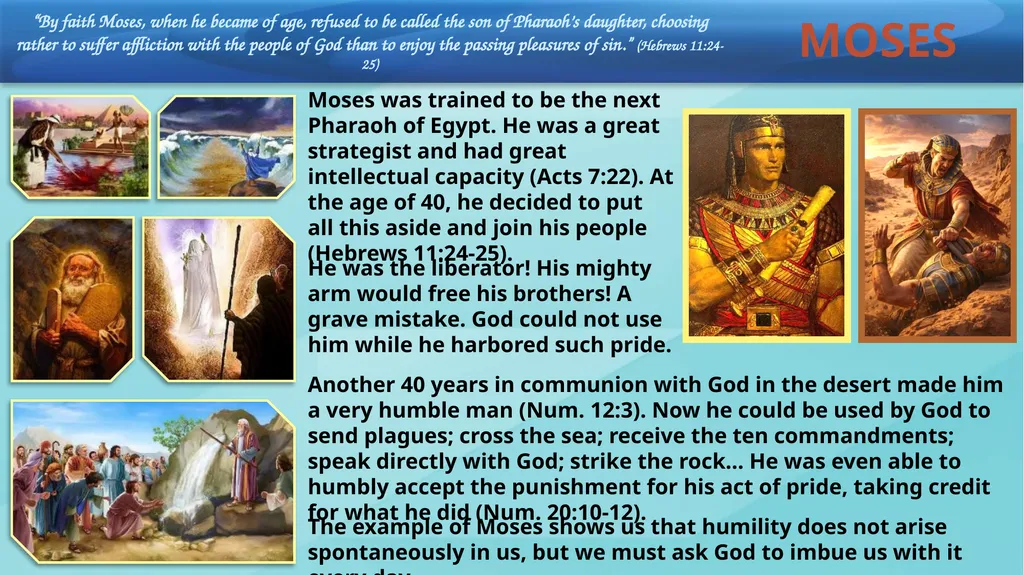
MOSES “By faith Moses, when he became of age, refused to be called the son of Pharaoh’s daughter, choosing rather to suffer affliction with the people of God than to enjoy the passing pleasures of sin.” (Hebrews 11:24-25) Moses was trained to be the next Pharaoh of Egypt. He was a great strategist and had great intellectual capacity (Acts 7:22). At the age of 40, he decided to put all this aside and join his people (Hebrews 11:24-25). Another 40 years in communion with God in the desert made him a very humble man (Num. 12:3). Now he could be used by God to send plagues; cross the sea; receive the ten commandments; speak directly with God; strike the rock… He was even able to humbly accept the punishment for his act of pride, taking credit for what he did (Num. 20:10-12). He was the liberator! His mighty arm would free his brothers! A grave mistake. God could not use him while he harbored such pride. The example of Moses shows us that humility does not arise spontaneously in us, but we must ask God to imbue us with it every day.<br>
10
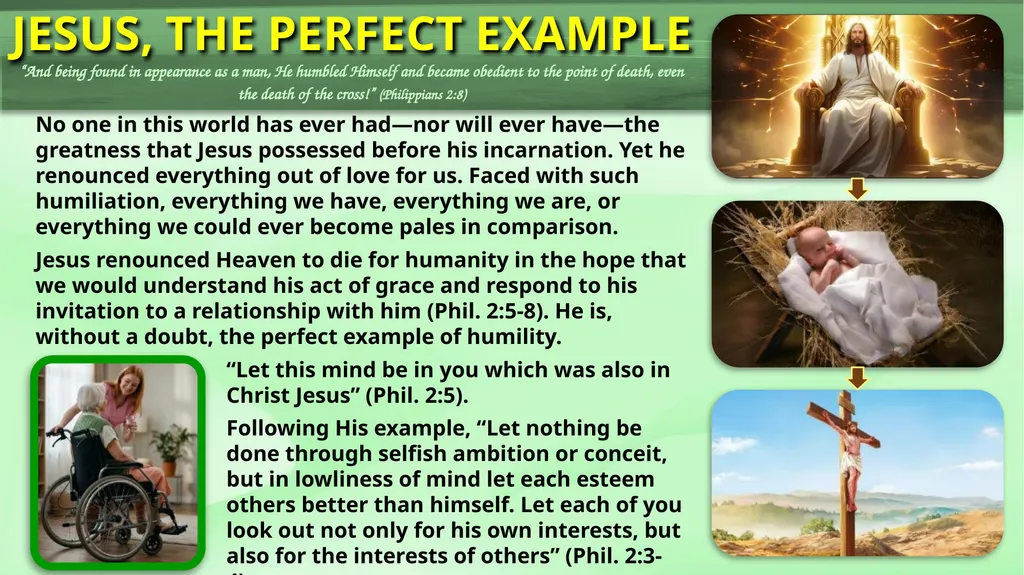
JESUS, THE PERFECT EXAMPLE “And being found in appearance as a man, He humbled Himself and became obedient to the point of death, even the death of the cross!” (Philippians 2:8) No one in this world has ever had—nor will ever have—the greatness that Jesus possessed before his incarnation. Yet he renounced everything out of love for us. Faced with such humiliation, everything we have, everything we are, or everything we could ever become pales in comparison. “Let this mind be in you which was also in Christ Jesus” (Phil. 2:5). Jesus renounced Heaven to die for humanity in the hope that we would understand his act of grace and respond to his invitation to a relationship with him (Phil. 2:5-8). He is, without a doubt, the perfect example of humility. Following His example, “Let nothing be done through selfish ambition or conceit, but in lowliness of mind let each esteem others better than himself. Let each of you look out not only for his own interests, but also for the interests of others” (Phil. 2:3-4).<br>
11
“LORD, I will praise you, Lord, with all my heart;
before the “gods” I will sing your praise.
I will bow down toward your holy temple
and will praise your name for your unfailing love and your faithfulness,
for you have so exalted your solemn decree
that it surpasses your fame. When I called, you answered me;
you greatly emboldened me. May all the kings of the earth praise you, Lord,
when they hear what you have decreed. May they sing of the ways of the Lord,
for the glory of the Lord is great. Though the Lord is exalted, he looks kindly on the lowly;
though lofty, he sees them from afar.
Though I walk in the midst of trouble,
you preserve my life. You stretch out your hand against the anger of my foes;
with your right hand you save me.
The Lord will vindicate me;
your love, Lord, endures forever—
do not abandon the works of your hands!” Psalm 138 NIV<br>
12
“In self-love, self-exaltation, and pride there is great weakness; but in humility there is great strength. Our true dignity is not maintained when we think most of ourselves, but when God is in all our thoughts and our hearts are all aglow with love to our Redeemer and love to our fellow men. Simplicity of character and lowliness of heart will give happiness, while self-conceit will bring discontent, repining, and continual disappointment. It is learning to think less of ourselves and more of making others happy that will bring to us divine strength.” EGW (Testimonies for the Church, vol. 3, p. 476)<br>