
Principles of Taxonomy (Biol 3063) Unit 1.
MS
Published · 39 slides · 0 views

1 / 1









Description
Principles of Taxonomy (Biol 3063) Unit 1. Introduction to Taxonomy Taxonomy is derived from the Greek words taxisarrangementto classify; nomos law or science Definitions: Taxonomy: the science of classification of organisms (from
Related Topics
Share
Embed code
Download this presentation From Below
"Principles of Taxonomy (Biol 3063) Unit 1." is the property of its rightful owner. Permission is granted to download and print the materials on this website for personal, non-commercial use only, and to display it on your personal computer provided you do not modify the materials and that you retain all copyright notices contained in the materials. By downloading content from our website, you accept the terms of this agreement.
Presentation Transcript
01
Principles of Taxonomy
(Biol 3063)<br>
02
Unit 1. Introduction to Taxonomy Taxonomy is derived from the Greek words taxis="arrangement/to classify;" nomos =“law” or “science”
Definitions:
Taxonomy: the science of classification of organisms (from its origin = narrow definition)
Taxonomy: the study of variation + sources of variation + consequences of variation + classification/the principles underlying classification + discovering & naming of organisms/groups of organisms.(Broad definition)<br>
03
Contemporary definition of taxonomy Taxonomy: the science that involves description, identification, classification and nomenclature of organisms/ taxonomic groups (the most accepted), and
Deals with both living and extinct organisms.
Naming, describing & classifying living organisms are natural & integral activity of humans.
Without such knowledge, it would be difficult to communicate.<br>
Deals with both living and extinct organisms.
Naming, describing & classifying living organisms are natural & integral activity of humans.
Without such knowledge, it would be difficult to communicate.<br>
04
Practices of Taxonomy
Description: assignment of features to an organism
Identification: assignment of one single organism or specimen to an existing classification (taxa produced)
Classification: ordering of organisms into groups on the basis of their r/ship.
Nomenclature: naming of taxonomic groups/taxa according to some standardized system (i.e. allocation of name of the taxa produced)
N.B: Classification precedes nomenclature.<br>
05
Accordingly, there are about five different Codes of Nomenclature.
ICBN,
ICZN,
International Code of Nomenclature for Cultivated Plants (ICNCP)
International Code of Nomenclature of Bacteria (ICNB).
International Code of Virus Classification (Draft)
Names that are given to organisms/taxa by obeying nomenclatural code are called scientific names.<br>
ICBN,
ICZN,
International Code of Nomenclature for Cultivated Plants (ICNCP)
International Code of Nomenclature of Bacteria (ICNB).
International Code of Virus Classification (Draft)
Names that are given to organisms/taxa by obeying nomenclatural code are called scientific names.<br>
06
Taxonomy and Systematics Taxonomy: the science that deals with description, identification, classification & nomenclature of taxa.
Systematics: taxonomy + study of evolutionary relatedness among various groups of organisms/phylogenetic analysis
Includes both the traditional activities of taxonomy and investigations of evolutionary relationships, variations and speciation (formation of new species).<br>
Systematics: taxonomy + study of evolutionary relatedness among various groups of organisms/phylogenetic analysis
Includes both the traditional activities of taxonomy and investigations of evolutionary relationships, variations and speciation (formation of new species).<br>
07
Importance of Taxonomy Taxonomy is an important science, and is basic to all biological disciplines since each requires the correct names and descriptions of the organisms being studied.
It is also dependent on the information provided by other disciplines, such as genetics, physiology, ecology and anatomy.<br>
It is also dependent on the information provided by other disciplines, such as genetics, physiology, ecology and anatomy.<br>
08
Classification systems serve four important roles:
They do aid to memory.
Classification systems greatly improve our predictive powers.
Improve our ability to explain relationships among organisms.
Provide relatively stable, unique, and unequivocal names for organisms/taxa.<br>
They do aid to memory.
Classification systems greatly improve our predictive powers.
Improve our ability to explain relationships among organisms.
Provide relatively stable, unique, and unequivocal names for organisms/taxa.<br>
09
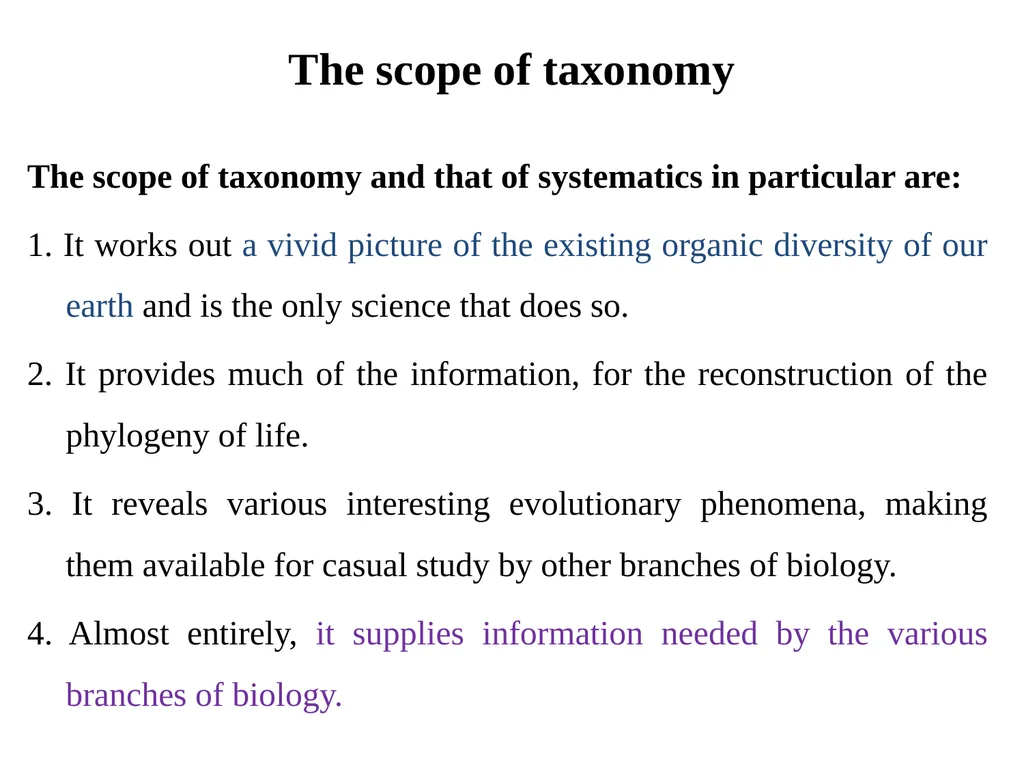
The scope of taxonomy The scope of taxonomy and that of systematics in particular are:
1. It works out a vivid picture of the existing organic diversity of our earth and is the only science that does so.
2. It provides much of the information, for the reconstruction of the phylogeny of life.
3. It reveals various interesting evolutionary phenomena, making them available for casual study by other branches of biology.
4. Almost entirely, it supplies information needed by the various branches of biology.<br>
10
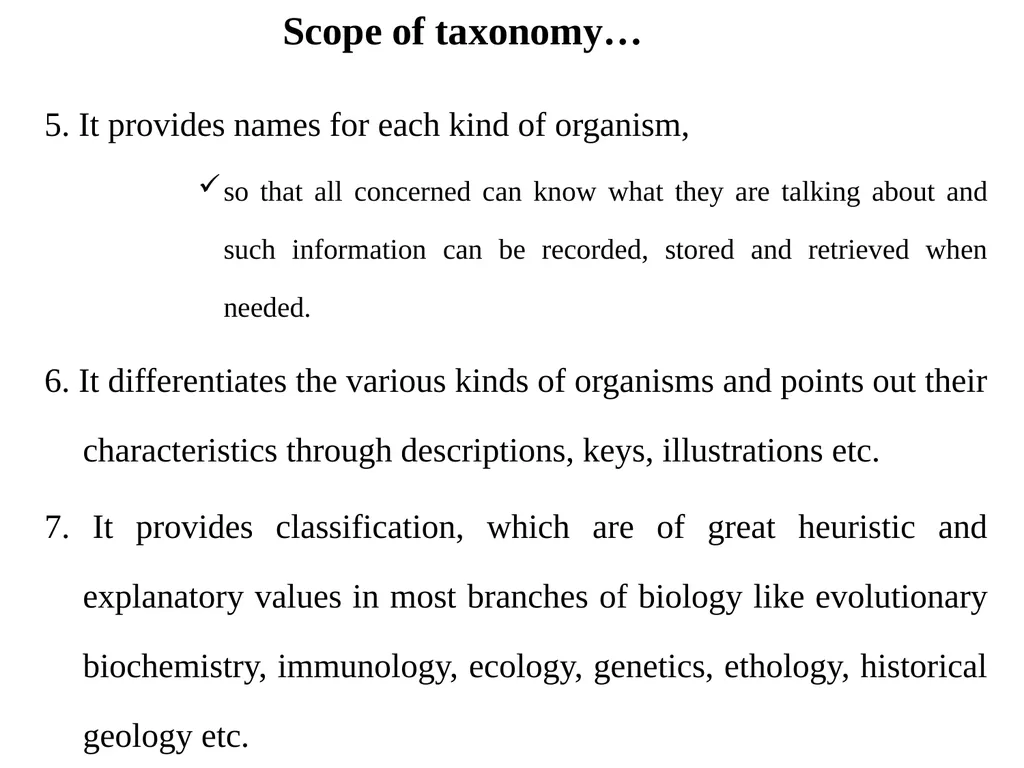
5. It provides names for each kind of organism,
so that all concerned can know what they are talking about and such information can be recorded, stored and retrieved when needed.
6. It differentiates the various kinds of organisms and points out their characteristics through descriptions, keys, illustrations etc.
7. It provides classification, which are of great heuristic and explanatory values in most branches of biology like evolutionary biochemistry, immunology, ecology, genetics, ethology, historical geology etc. Scope of taxonomy…<br>
11
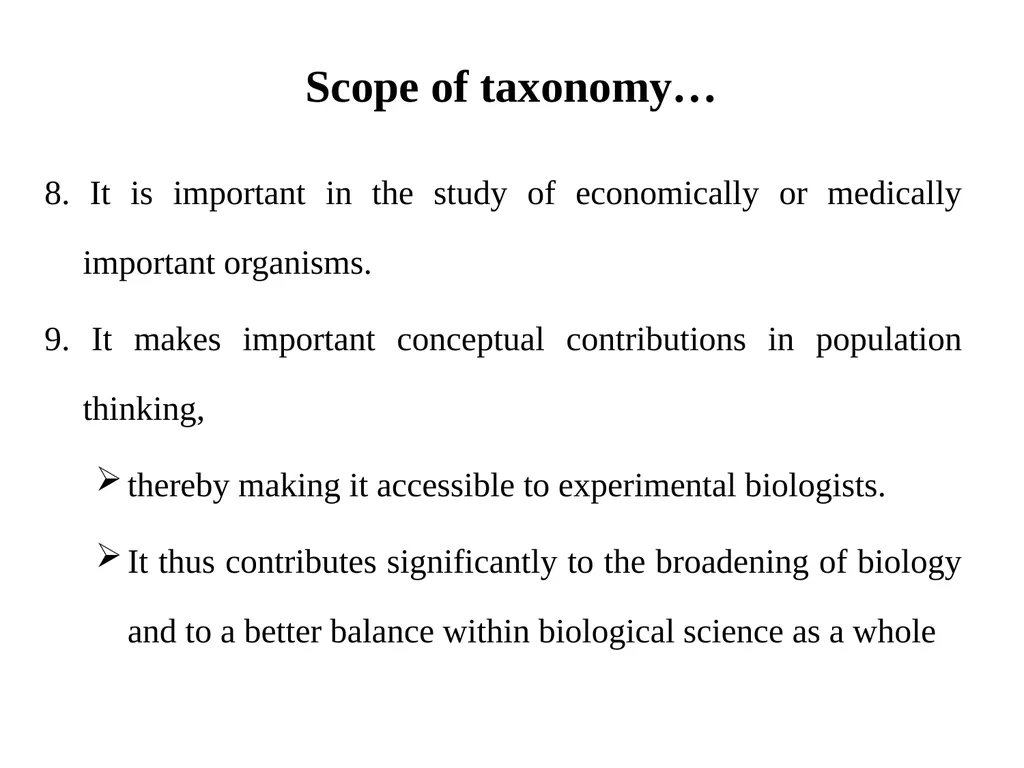
Scope of taxonomy… 8. It is important in the study of economically or medically important organisms.
9. It makes important conceptual contributions in population thinking,
thereby making it accessible to experimental biologists.
It thus contributes significantly to the broadening of biology and to a better balance within biological science as a whole<br>
9. It makes important conceptual contributions in population thinking,
thereby making it accessible to experimental biologists.
It thus contributes significantly to the broadening of biology and to a better balance within biological science as a whole<br>
12
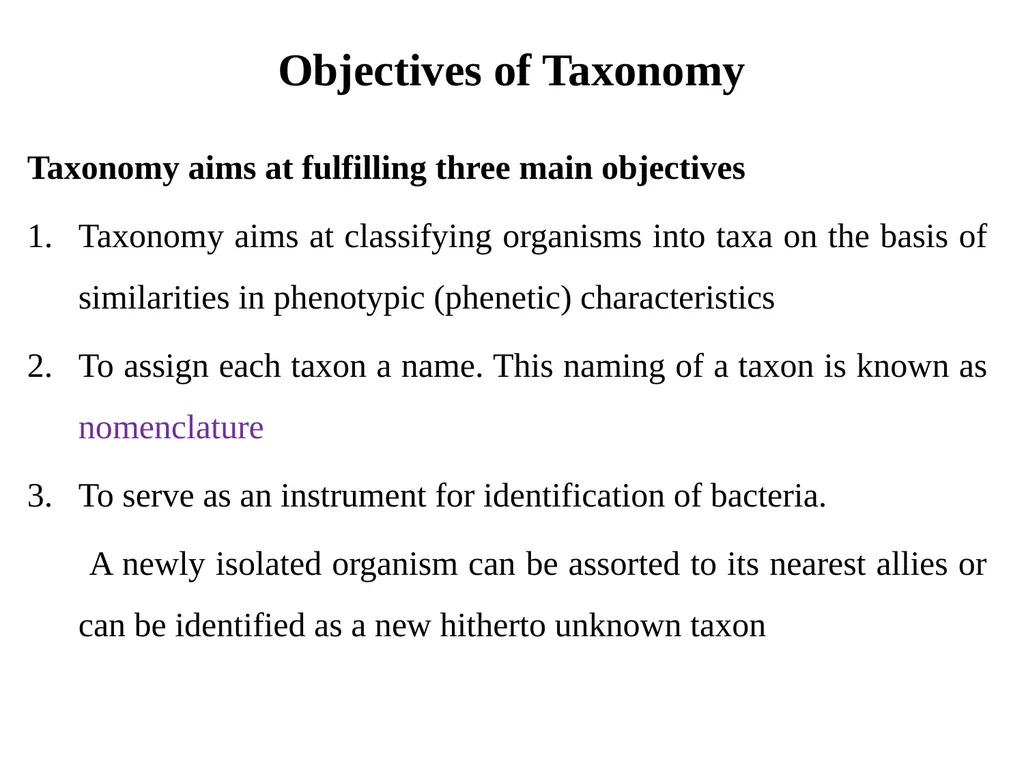
Objectives of Taxonomy Taxonomy aims at fulfilling three main objectives
Taxonomy aims at classifying organisms into taxa on the basis of similarities in phenotypic (phenetic) characteristics
To assign each taxon a name. This naming of a taxon is known as nomenclature
To serve as an instrument for identification of bacteria.
A newly isolated organism can be assorted to its nearest allies or can be identified as a new hitherto unknown taxon<br>
13
Levels of Taxonomy α (alpha), β (beta) and Ƴ (gamma) taxonomy:
Alpha (α) taxonomy:
Alpha (α) taxonomy is the analytic phase in which the species are identified, characterized and named.
At this level when a new species is discovered it is named in accordance with Linnaeus system of binomial nomenclature.
Priority is given to the one who publishes his work first
All problems relating to species are dealt.<br>
14
Beta (β) taxonomy Beta (β) taxonomy refers to the arrangement of the species into a natural system of hierarchial categories.
This is done on the basis of easily observable, shared, structural features and evaluation of numerous characters.
Thus, β-taxonomy relates to the search of a natural system of classification.
Each taxon would thus possess diagnostic features unique to that taxon.<br>
This is done on the basis of easily observable, shared, structural features and evaluation of numerous characters.
Thus, β-taxonomy relates to the search of a natural system of classification.
Each taxon would thus possess diagnostic features unique to that taxon.<br>
15
Gamma (Ƴ) taxonomy: Finally, gamma (Ƴ) taxonomy designates the analysis of intraspecific variations and evolutionary studies.
Much attention is given to a causal interpretation of organic diversity — study of speciation.
There are only a few groups of animals
(some vertebrates, especially the birds and a few insect orders like Lepidoptera etc.) where the taxonomy has reached up to the gamma level.
Otherwise, in almost majority of the groups, the Works are still at the alpha and beta level<br>
16
Unit 2
History and Development of Taxonomy<br>
17
Phases of Developmental Stages of Taxonomy A. Pre-Linnaean Taxonomy
i. Ancient taxonomy
Ancient people have grouped/ categorized living things into groups & gave common/vernacular names.
E.g. Identifying edible plants & animals and non-edible ones,
useful and harmful organisms, and
aggressive and non-aggressive wild animals in their environment, and giving names are as old as human races.
This system is called folk taxonomy.<br>
18
It is important for communication of the people.
In such system of classification, organisms that were obvious (common) or more important (useful or harmful) to the people got names while the others might not.
The system is characterized by existence & non-existence of vernacular names for organisms/groups of them.
Folk taxonomy is characterized by existent & no-existent of common names.
One can say that taxonomy is as old as the language skill of mankind.<br>
19
ii. Taxonomy during the Greek and Roman Philosophers-Essentialists a. Aristotle (384–322 BC)
the first to classify living things into plants & animals
Animals: into “animals with blood” & “animals without blood”
animals with blood: live-bearing & egg-bearing,
Without blood: insects, crustacea and testacea (molluscs)
b. Theophrastus (370–285 BC)
Classified of all known plants during the time, De Historia Plantarum, which contained 480 species.
His plant classification was based on growth form: tree, shrub/herb
Many of his plant genera like Narcissus, Crocus & Cornus still in use.<br>
20
c. Dioscorides (40–90 AD)- Greek physician
De Materia Medica ≈ 600 plant species.
Used in medicine until the 16th C
classification based on medicinal properties
d. Plinius (23–79 AD)
Wrote many books, the only survived is Naturalis Historia
Described several plants & gave them Latin names.
Many of these names are stil in use (e.g. Populus alba & Populus nigra)
Some call him the Father of Botanical Latin.<br>
21
iii. Middle Age /Medieval Period (5th to 15th C)
Little/no progress in botanical & zoological investigation
Europe & Asia = famine, endemics (=Dark Age) during this period.
Mostly copying & recopying of earlier manuscripts + errors
Albertus Magnus (1200-1280) -famous plant taxonomist
“Doctor of Universalis” / “Aristotle of the Middle Age”
Recognized monocots+dicots; vascular + no-vascular<br>
22
Herbalists’ time (16 C): publications of several books on medicinal uses of plants.
After the Middle Age, taxonomy was influenced by two occasions:
Innovation of printing machine & development of science of navigation.
15th century was the onset of Renaissance in Europe.
A. Innovation of printing machine:
eased printing efforts
promoted the publication of many medicinal oriented books, particularly in the next century.
lowered prices of books<br>
23
Medicinal oriented book are said to be Herbals & the authors of such books are Herbalists.
16th century is called the time of great herbalists.
e. g. Otto Brunfels, Jerome Bock & Leonart Fuchs whom named the German fathers of botany
Herbals exhibit excellent illustrations and detailed descriptions of plants.
However, didn’t emphasize on any system of classification
Plants simply arranged in alphabetical/medicinal uses in herbals.<br>
24
B. Innovation of Navigation
Enabled sailors/investigators to go on long voyages.
Exploration of several new areas of the world by crossing large water bodies and collection of new plants and animals.
Increased man’s practical knowledge taxonomy.
V. Early taxonomists- study of living things for basic knowledge
Until end of 16th C, existing studies couldn’t replace the ideas of ancient Greek philosophers.
Discovery of optic lenses & growth of science in 17th C
Emphasis was turned from medical aspects to taxonomic aspects; this means, scientists started to study living things for intrinsic purposes instead of only for food and medicinal uses.<br>
25
Caesalpino (1519–1603) – in Italy
Some call him “the first taxonomist".
He wrote De Plantis (1583,) which contained 1500 spp.
His classification based on growth habit + fruit, seed, ovaries and their position.
Some of the names given by him are still in use .
e.g The names for plant families, Brassicaceae and Asteraceae, have been given by Caesalpino.<br>
26
b. Caspar Bauhin -Swiss botanist
Travelled extensively to collect plant specimens and formed a herbarium of 4000 specimens.
Published Pinax Theatri Botanici (1623) which contained a list of 6000 plants spp.
He also introduced binomial nomenclature (writing species name in two words) for several species.
He sought to clarify in a single publication the confusion regarding the multiplicity of names for all species known at that time.<br>
27
Although he did not describe genera,
He recognized the differences between species and genera, and several species were included under the same generic names.
Jean Bauhin (1541-1613)-elder brother of C. Bauhin
Compiled a description of 5000 plant spp. with more >3500 figures
The work of J. Bauhin was published under the name Historia Plantarum Universalis in 1650-1651, several years after his death.<br>
28
c. John Ray (1627–1705)- English naturalist
Wrote several important works
His most important contribution was the establishment of species as the ultimate unit of taxonomy.
Methodus Plantarum Nova (1682)≈18 000 plant species
His classification was based on many combined characters - more natural than the work of earliest taxonomists.
Ray aimed at publishing a complete system of nature, which included works on mammals, reptiles, birds, fishes and insects.<br>
29
d. de Tournefort (1656–1708)- Franch
Botanical classification –ruled until time of Carl Linnaeus.
Institutiones Rei Herbariae ( 1700 ) = 9000 spp in 698 genera.
primary emphasis on the classification genera
Classification based on floral characters.<br>
Botanical classification –ruled until time of Carl Linnaeus.
Institutiones Rei Herbariae ( 1700 ) = 9000 spp in 698 genera.
primary emphasis on the classification genera
Classification based on floral characters.<br>
30
B. Linnaean Era (1707-1778) -Sexual sysytem
starting points of modern taxonomy
Binary form of species names ("trivial names“) for both plants & animals.
i. Species Plantarum(1753)
Starting point for botanical names
Used "trivial names" (binomial name) for all plant spp.
ii. Systema Naturae (1758, 10th ed.)
Used "trivial names" (binomial name) for all animal spp.<br>
31
He used both trivial and phrasal names (up to 12 words) in his publications
Soon, binomial names replaced the phrasal names
But his classification was based on sexual parts of a flower
Recognized 24 classes of plants based on number of stamens.
Classes subdivided into orders on bases of carpel. e.g. Monogynia, Digynia, etc.
Such classification is sexual system =Artificial system
Plant & animal name published before 1753 & 1758, respectively, are called "prelinnaean" = not valid.
Early names published by Linnaeus himself before these periods are "prelinnaean"!
Pre-Linnaean + Linnaeus =Essentialists& Artificial system
binomial name-still in use, but Linaeus classification system is artificial<br>
32
C. Post-Linnaean Taxonomy
Foundation Natural System of Classification
Different taxonomists criticized classification of Linnaeus= for being artificial, particularly French scientists.
a. Georges de Buffon (1707–1788) - strong critic to Linnaeus work
Considered classification by Linnaeus as artificial order on the disorderly world.
Buffon’s aim was to describe the world rather than to classify it.
His theories touched with the development of species, intraspecific variety & acquired inherited characters in species
Opened pathway for an evolutionary theory.<br>
33
b. Michel Adanson (1727–1806)
Familles des Plantes already in 1763.
Launched the idea that in classification one should :
Use as many characters as possible
Characters should be given equal weight/no priority and
Classification depends on overall similarity
Such classification is said to be called Natural classification.<br>
Familles des Plantes already in 1763.
Launched the idea that in classification one should :
Use as many characters as possible
Characters should be given equal weight/no priority and
Classification depends on overall similarity
Such classification is said to be called Natural classification.<br>
34
c. Antoine L. de Jussieu (1748–1836)
Estabilished family rank b/n genus and class
Acotyledons, Monocotyledons and Dicotyledons
d. B.P. de Lamarck (1744–1829)
Theory of inheritance of acquired characters ="Lamarckism".
Opened path for evolution theory (Charles Darwin & Wallace, 1858)
ii. Formation of nomenclatural code (ICBN & ICZN)
First attempt to create botanical nomenclatural code = by de Candole in 1813.<br>
35
Published names should have priority starting Linnaeus
On a congress in Paris, 100 botanists adopted the rules in a book by the son of Alphons de Candolle (1806–1873), Lois de Nomenclature Adoptee from 1867.
On congress in Vienna (1905) starting date was set to 1753 (Species Plantrum)
In 1907, Americans created their own code
In 1935, both codes merged together by agreement & formed ICBN.<br>
36
Initiation of a zoological code started somewhat later.
In 1842 a British ornithologist Hugh E. Strickland (1811–1853) elaborated the first nomenclatural laws for zoology, the "Strickland Code".<br>
In 1842 a British ornithologist Hugh E. Strickland (1811–1853) elaborated the first nomenclatural laws for zoology, the "Strickland Code".<br>
37
iii.Natural system developed to Numerical Taxonomy/ Phenetics- phenogram
Michel Adanson was published Familles des in 1763 and forwarded the idea that classification should depend on many characters with equal weight=overall similarity.
With the development of computer softwares (1960s)/cluster analysis by computer software → numerical taxonomy/ phenetics became popular
Principles of Numerical Taxonomy by Senath & Sokal (1963 & 1973) & it is the new method of organizing data of N/S & obtaining a classification.<br>
38
v. Phylogenetics/cladistics
Charles Darwin (1809–1882) launched the evolutionary theory in 1858.
However, this did not affect systematics in the beginning.
Ernst Haeckel (1834–1919) and August W. Eichler (1839–18878) were two German biologists who started the construction of evolutionary trees.
Haeckel established the term "phylogeny".
However, the main part of the 20th century was dominated by extended phenetics (i.e., looking for overall similarities and differences to create classification).<br>
39
The German biologist Willi Hennig (1913–1976) founded the cladistic era in 1966, by stating that only similarities in derived characters (synapomorphies) should be used in classification of species, and that taxa should include all descendants from one single ancestor (the rule of monophyly).<br>