
Private Wealth Best Practices – Domain Knowledge
TG
Published · 26 slides · 0 views
1 / 1
Description
Private Wealth Best Practices Domain Knowledge Scan (DKS) December 2013 2 Confidentiality Our clients industries are extremely competitive. The confidentiality of companies plans and data is obviously critical. ICG will protect the
Related Topics
Share
Embed code
Download this presentation From Below
"Private Wealth Best Practices – Domain Knowledge" is the property of its rightful owner. Permission is granted to download and print the materials on this website for personal, non-commercial use only, and to display it on your personal computer provided you do not modify the materials and that you retain all copyright notices contained in the materials. By downloading content from our website, you accept the terms of this agreement.
Presentation Transcript
01
Private Wealth Best Practices – Domain Knowledge Scan (DKS) December 2013<br>
02
2 Confidentiality
Our clients’ industries are extremely competitive. The confidentiality of companies’ plans and data is obviously critical. ICG will protect the confidentiality of all such client information. Similarly, management consulting is a competitive business. We view our approaches and insights as proprietary and therefore look to our clients to protect ICG’s interests in our proposals, presentations, methodologies and analytical techniques. Under no circumstances should this material be shared with any third party without the explicit written permission of ICG.
Disclaimer
ICG has made good faith efforts to ensure that this material is a high-quality publication. However, ICG does not warrant completeness or accuracy, and does not warrant that use of the material ICG’s provisioning service will be uninterrupted or error-free, or that the results obtained will be useful or will satisfy the user's requirements. ICG does not endorse the reputations or opinions of any third party source represented in this material.
Copyright Notice
While third party materials have been referenced and analysed in this material, the content represents the original work of ICG's personnel. This work is subject to copyright. ICG is the legal copyright holder. No person may reproduce this material without the explicit written permission of ICG. Use of the copyright material in any other form, and in any medium whatsoever, requires the prior agreement in writing of the copyright holder. The user is allowed ‘fair use’ of the copyright material for non-commercial, educational, instructional, and scientific purposes by authorised users.<br>
Our clients’ industries are extremely competitive. The confidentiality of companies’ plans and data is obviously critical. ICG will protect the confidentiality of all such client information. Similarly, management consulting is a competitive business. We view our approaches and insights as proprietary and therefore look to our clients to protect ICG’s interests in our proposals, presentations, methodologies and analytical techniques. Under no circumstances should this material be shared with any third party without the explicit written permission of ICG.
Disclaimer
ICG has made good faith efforts to ensure that this material is a high-quality publication. However, ICG does not warrant completeness or accuracy, and does not warrant that use of the material ICG’s provisioning service will be uninterrupted or error-free, or that the results obtained will be useful or will satisfy the user's requirements. ICG does not endorse the reputations or opinions of any third party source represented in this material.
Copyright Notice
While third party materials have been referenced and analysed in this material, the content represents the original work of ICG's personnel. This work is subject to copyright. ICG is the legal copyright holder. No person may reproduce this material without the explicit written permission of ICG. Use of the copyright material in any other form, and in any medium whatsoever, requires the prior agreement in writing of the copyright holder. The user is allowed ‘fair use’ of the copyright material for non-commercial, educational, instructional, and scientific purposes by authorised users.<br>
03
Domain Knowledge Scans (DKS) Domain Knowledge Scans (DKS) are an effective way to ensure your team is exposed to the very latest thinking in your industry, sub-sector or function
Assess the very latest thinking, practices and insights and share with your team in report form and/or via a 2 hour briefing session.
A unique highly distilled synthesis of the newest thinking in your industry, sub sector or function
Can include critical ideas, frameworks, case studies, insights
Garnered from relevant peer markets across consulting and advisory firms as well as academia and industry
Includes a stimulating presentation to your team and or an extended audience
Includes references for further review and investigation
Ensures your team’s expertise is current
DKSs are a companion resource to our monthly global periodical The Insights Review (TIR) and deeper full dives on a specific topic – our Knowledge Area Reviews (KAR). 3 Domain Knowledge Scans<br>
Assess the very latest thinking, practices and insights and share with your team in report form and/or via a 2 hour briefing session.
A unique highly distilled synthesis of the newest thinking in your industry, sub sector or function
Can include critical ideas, frameworks, case studies, insights
Garnered from relevant peer markets across consulting and advisory firms as well as academia and industry
Includes a stimulating presentation to your team and or an extended audience
Includes references for further review and investigation
Ensures your team’s expertise is current
DKSs are a companion resource to our monthly global periodical The Insights Review (TIR) and deeper full dives on a specific topic – our Knowledge Area Reviews (KAR). 3 Domain Knowledge Scans<br>
04
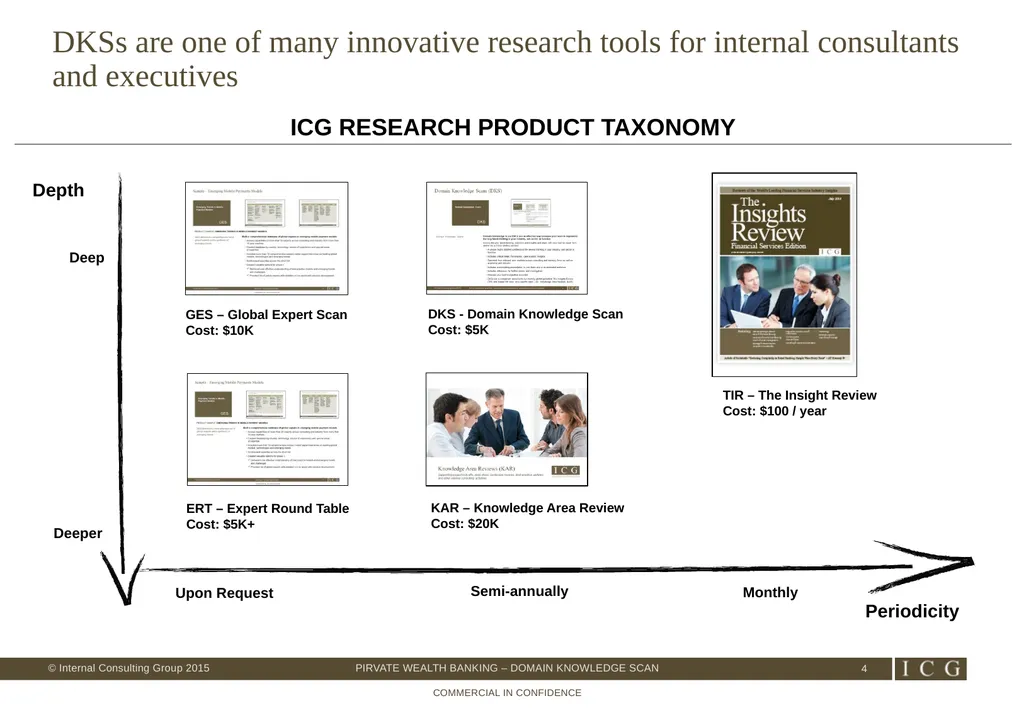
4 DKSs are one of many innovative research tools for internal consultants and executives DKS - Domain Knowledge Scan
Cost: $5K KAR – Knowledge Area Review
Cost: $20K TIR – The Insight Review
Cost: $100 / year GES – Global Expert Scan
Cost: $10K ERT – Expert Round Table
Cost: $5K+ Deep Deeper Depth Periodicity Upon Request Semi-annually Monthly Icg RESEARCH PRODUCT TAXONOMY<br>
Cost: $5K KAR – Knowledge Area Review
Cost: $20K TIR – The Insight Review
Cost: $100 / year GES – Global Expert Scan
Cost: $10K ERT – Expert Round Table
Cost: $5K+ Deep Deeper Depth Periodicity Upon Request Semi-annually Monthly Icg RESEARCH PRODUCT TAXONOMY<br>
05
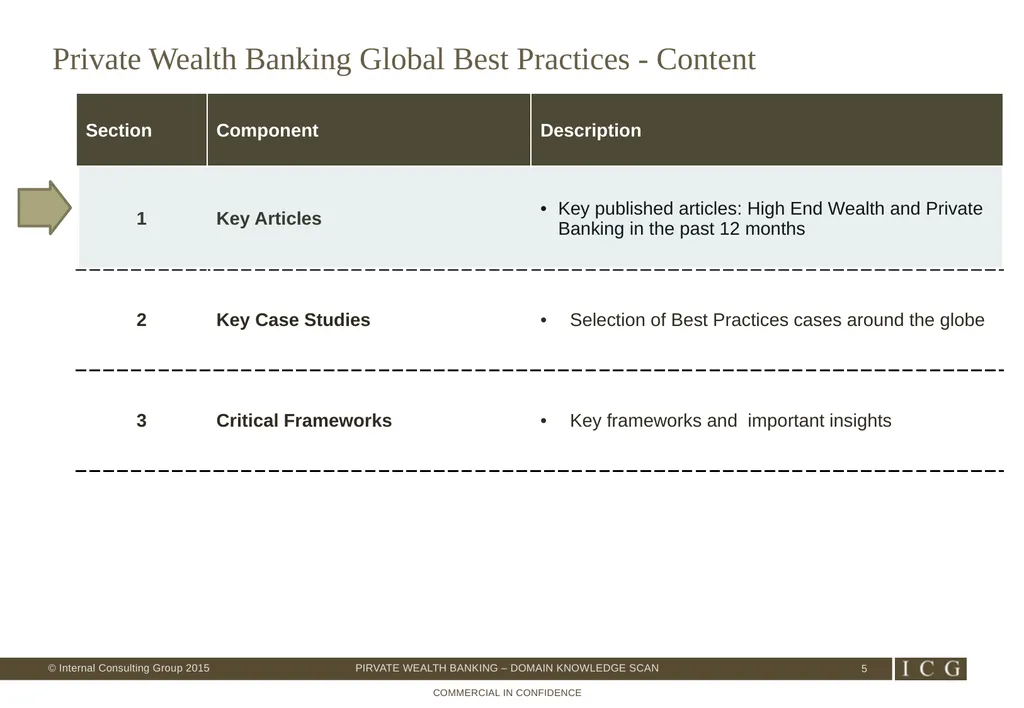
Private Wealth Banking Global Best Practices - Content 5<br>
06
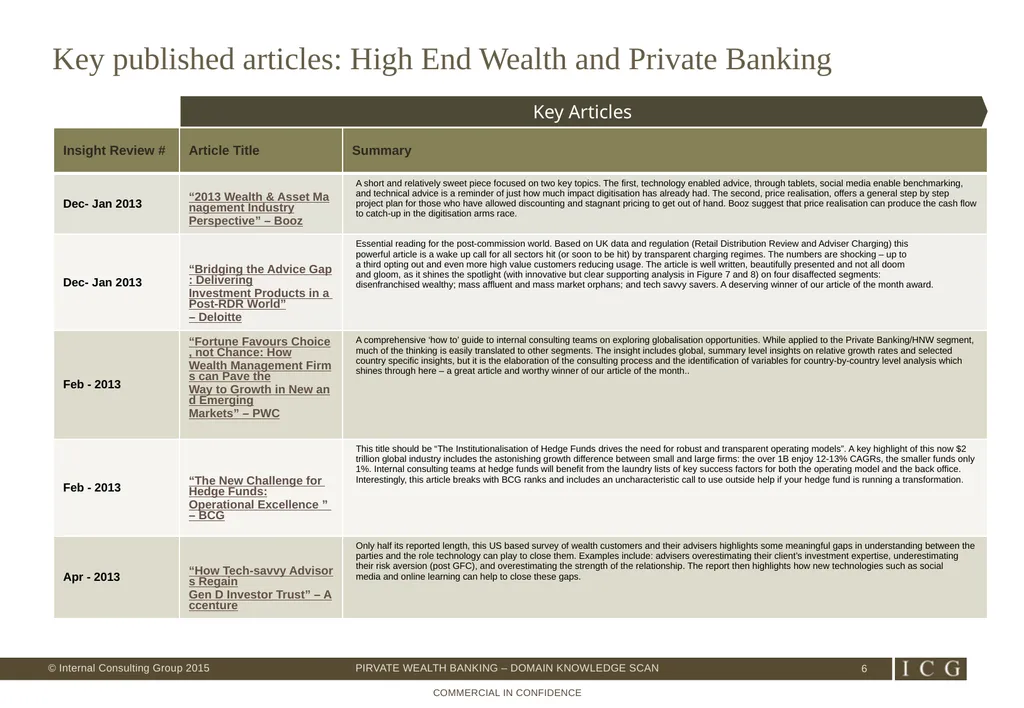
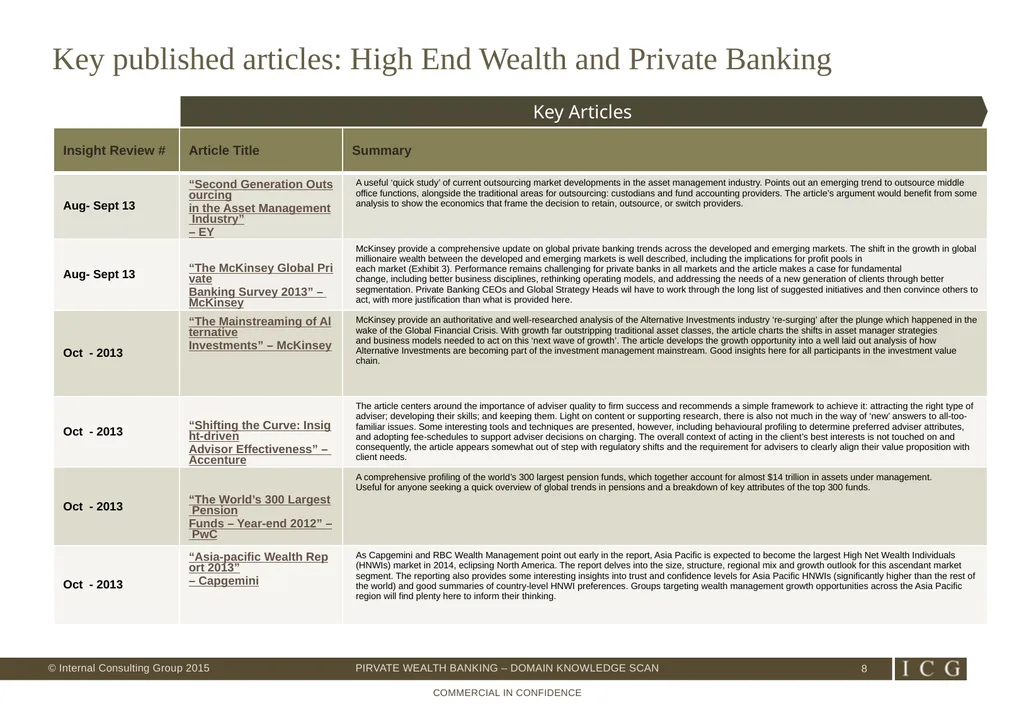
6 Key published articles: High End Wealth and Private Banking Key Articles<br>
07
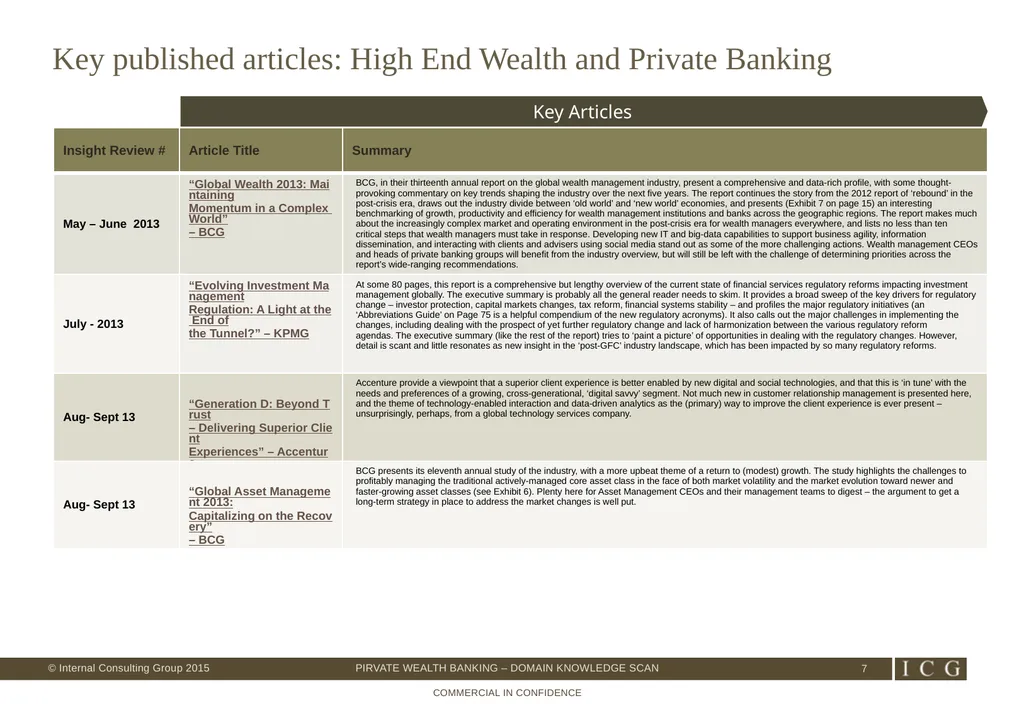
7 Key published articles: High End Wealth and Private Banking Key Articles<br>
08
8 Key published articles: High End Wealth and Private Banking Key Articles<br>
09
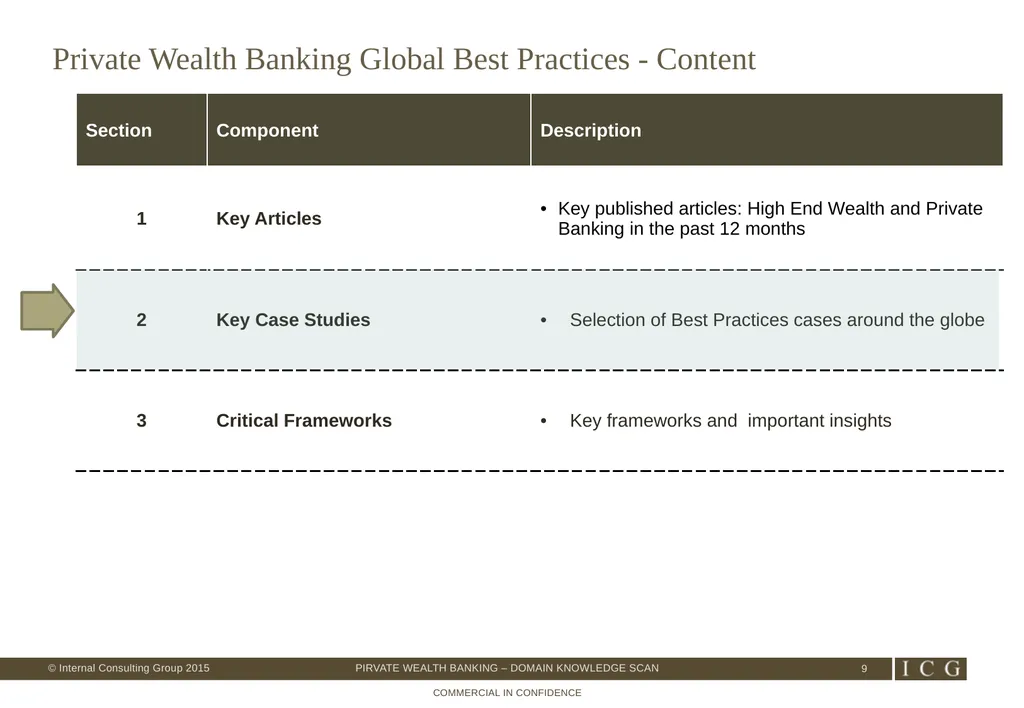
Private Wealth Banking Global Best Practices - Content 9<br>
10
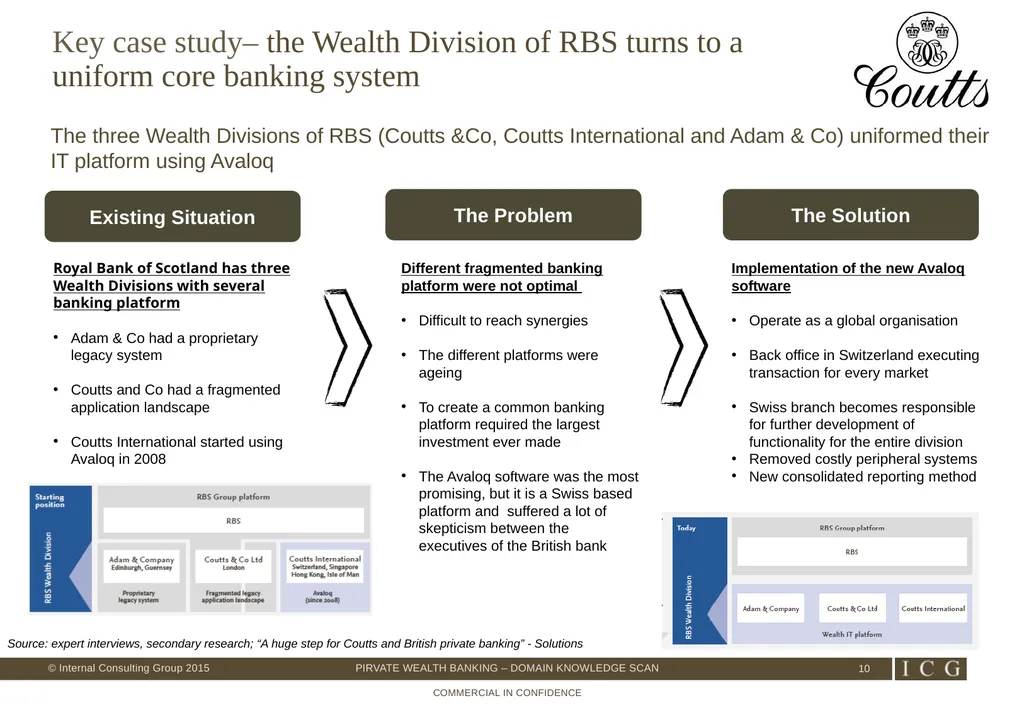
Key case study– the Wealth Division of RBS turns to a uniform core banking system 10 Existing Situation The Problem The Solution Royal Bank of Scotland has three Wealth Divisions with several banking platform
Adam & Co had a proprietary legacy system
Coutts and Co had a fragmented application landscape
Coutts International started using Avaloq in 2008 Implementation of the new Avaloq software
Operate as a global organisation
Back office in Switzerland executing transaction for every market
Swiss branch becomes responsible for further development of functionality for the entire division
Removed costly peripheral systems
New consolidated reporting method Different fragmented banking platform were not optimal
Difficult to reach synergies
The different platforms were ageing
To create a common banking platform required the largest investment ever made
The Avaloq software was the most promising, but it is a Swiss based platform and suffered a lot of skepticism between the executives of the British bank The three Wealth Divisions of RBS (Coutts &Co, Coutts International and Adam & Co) uniformed their IT platform using Avaloq Source: expert interviews, secondary research; “A huge step for Coutts and British private banking” - Solutions<br>
Adam & Co had a proprietary legacy system
Coutts and Co had a fragmented application landscape
Coutts International started using Avaloq in 2008 Implementation of the new Avaloq software
Operate as a global organisation
Back office in Switzerland executing transaction for every market
Swiss branch becomes responsible for further development of functionality for the entire division
Removed costly peripheral systems
New consolidated reporting method Different fragmented banking platform were not optimal
Difficult to reach synergies
The different platforms were ageing
To create a common banking platform required the largest investment ever made
The Avaloq software was the most promising, but it is a Swiss based platform and suffered a lot of skepticism between the executives of the British bank The three Wealth Divisions of RBS (Coutts &Co, Coutts International and Adam & Co) uniformed their IT platform using Avaloq Source: expert interviews, secondary research; “A huge step for Coutts and British private banking” - Solutions<br>
11
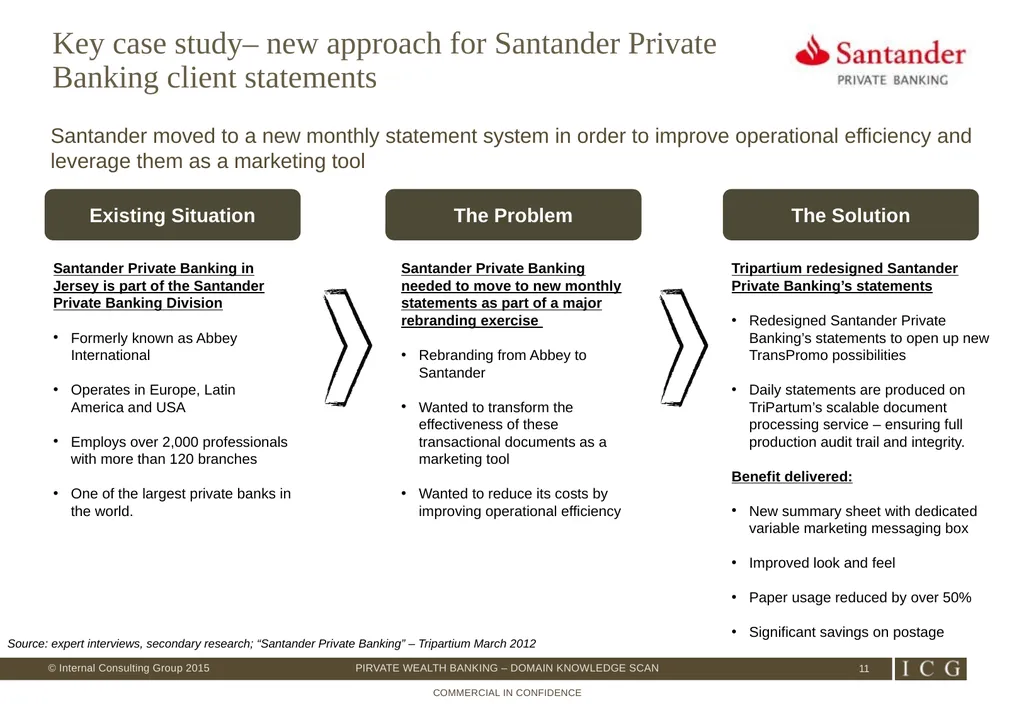
Key case study– new approach for Santander Private Banking client statements 11 Existing Situation The Problem The Solution Santander Private Banking in
Jersey is part of the Santander
Private Banking Division
Formerly known as Abbey International
Operates in Europe, Latin America and USA
Employs over 2,000 professionals with more than 120 branches
One of the largest private banks in the world. Tripartium redesigned Santander
Private Banking’s statements
Redesigned Santander Private Banking’s statements to open up new TransPromo possibilities
Daily statements are produced on TriPartum’s scalable document processing service – ensuring full production audit trail and integrity.
Benefit delivered:
New summary sheet with dedicated variable marketing messaging box
Improved look and feel
Paper usage reduced by over 50%
Significant savings on postage Santander Private Banking
needed to move to new monthly
statements as part of a major
rebranding exercise
Rebranding from Abbey to Santander
Wanted to transform the effectiveness of these transactional documents as a marketing tool
Wanted to reduce its costs by improving operational efficiency Santander moved to a new monthly statement system in order to improve operational efficiency and leverage them as a marketing tool Source: expert interviews, secondary research; “Santander Private Banking” – Tripartium March 2012<br>
Jersey is part of the Santander
Private Banking Division
Formerly known as Abbey International
Operates in Europe, Latin America and USA
Employs over 2,000 professionals with more than 120 branches
One of the largest private banks in the world. Tripartium redesigned Santander
Private Banking’s statements
Redesigned Santander Private Banking’s statements to open up new TransPromo possibilities
Daily statements are produced on TriPartum’s scalable document processing service – ensuring full production audit trail and integrity.
Benefit delivered:
New summary sheet with dedicated variable marketing messaging box
Improved look and feel
Paper usage reduced by over 50%
Significant savings on postage Santander Private Banking
needed to move to new monthly
statements as part of a major
rebranding exercise
Rebranding from Abbey to Santander
Wanted to transform the effectiveness of these transactional documents as a marketing tool
Wanted to reduce its costs by improving operational efficiency Santander moved to a new monthly statement system in order to improve operational efficiency and leverage them as a marketing tool Source: expert interviews, secondary research; “Santander Private Banking” – Tripartium March 2012<br>
12
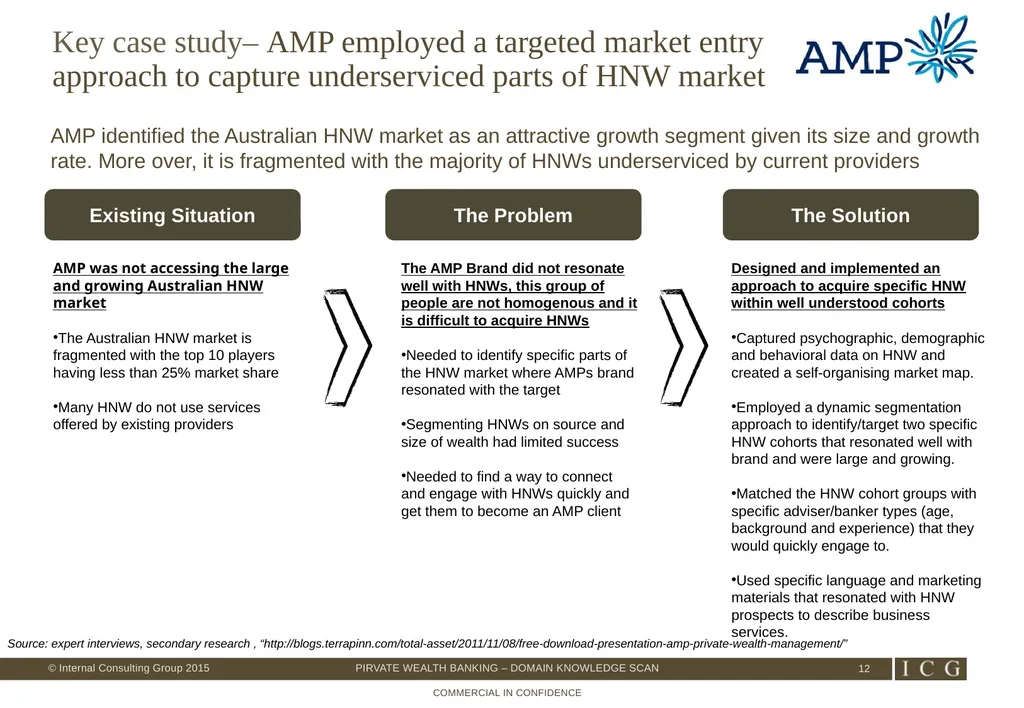
Key case study– AMP employed a targeted market entry approach to capture underserviced parts of HNW market 12 Existing Situation The Problem The Solution AMP was not accessing the large and growing Australian HNW market
The Australian HNW market is fragmented with the top 10 players having less than 25% market share
Many HNW do not use services offered by existing providers Designed and implemented an approach to acquire specific HNW within well understood cohorts
Captured psychographic, demographic and behavioral data on HNW and created a self-organising market map.
Employed a dynamic segmentation approach to identify/target two specific HNW cohorts that resonated well with brand and were large and growing.
Matched the HNW cohort groups with specific adviser/banker types (age, background and experience) that they would quickly engage to.
Used specific language and marketing materials that resonated with HNW prospects to describe business services. The AMP Brand did not resonate well with HNWs, this group of people are not homogenous and it is difficult to acquire HNWs
Needed to identify specific parts of the HNW market where AMPs brand resonated with the target
Segmenting HNWs on source and size of wealth had limited success
Needed to find a way to connect and engage with HNWs quickly and get them to become an AMP client AMP identified the Australian HNW market as an attractive growth segment given its size and growth rate. More over, it is fragmented with the majority of HNWs underserviced by current providers Source: expert interviews, secondary research , “http://blogs.terrapinn.com/total-asset/2011/11/08/free-download-presentation-amp-private-wealth-management/”<br>
The Australian HNW market is fragmented with the top 10 players having less than 25% market share
Many HNW do not use services offered by existing providers Designed and implemented an approach to acquire specific HNW within well understood cohorts
Captured psychographic, demographic and behavioral data on HNW and created a self-organising market map.
Employed a dynamic segmentation approach to identify/target two specific HNW cohorts that resonated well with brand and were large and growing.
Matched the HNW cohort groups with specific adviser/banker types (age, background and experience) that they would quickly engage to.
Used specific language and marketing materials that resonated with HNW prospects to describe business services. The AMP Brand did not resonate well with HNWs, this group of people are not homogenous and it is difficult to acquire HNWs
Needed to identify specific parts of the HNW market where AMPs brand resonated with the target
Segmenting HNWs on source and size of wealth had limited success
Needed to find a way to connect and engage with HNWs quickly and get them to become an AMP client AMP identified the Australian HNW market as an attractive growth segment given its size and growth rate. More over, it is fragmented with the majority of HNWs underserviced by current providers Source: expert interviews, secondary research , “http://blogs.terrapinn.com/total-asset/2011/11/08/free-download-presentation-amp-private-wealth-management/”<br>
13
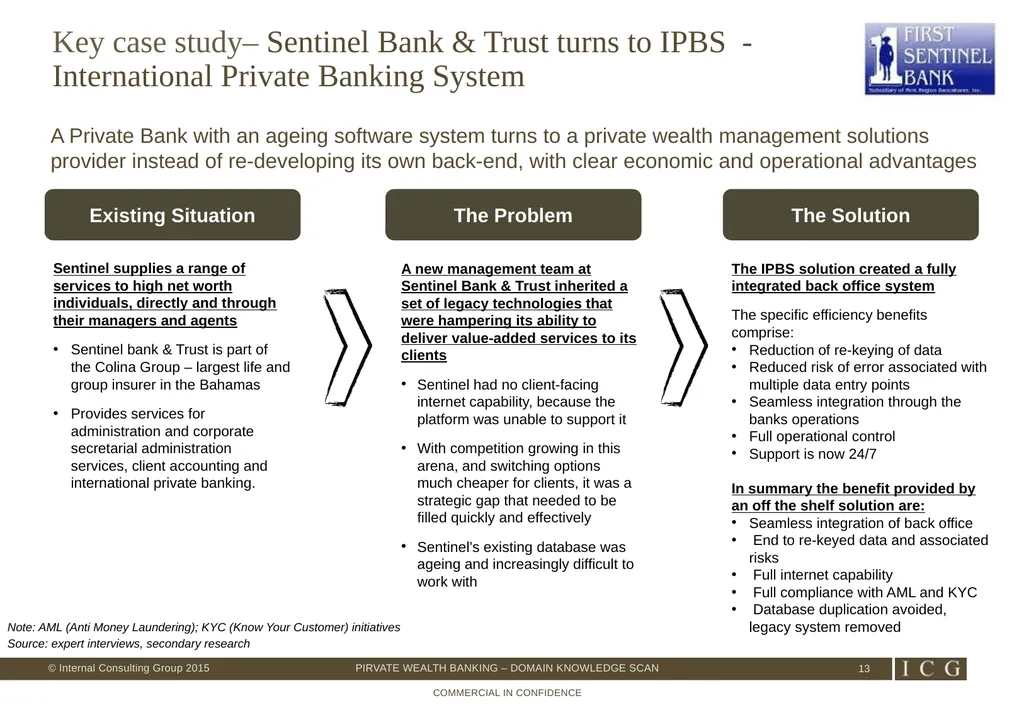
Key case study– Sentinel Bank & Trust turns to IPBS - International Private Banking System 13 Existing Situation The Problem The Solution Sentinel supplies a range of services to high net worth individuals, directly and through their managers and agents
Sentinel bank & Trust is part of the Colina Group – largest life and group insurer in the Bahamas
Provides services for administration and corporate secretarial administration services, client accounting and international private banking. The IPBS solution created a fully integrated back office system
The specific efficiency benefits comprise:
Reduction of re-keying of data
Reduced risk of error associated with multiple data entry points
Seamless integration through the banks operations
Full operational control
Support is now 24/7
In summary the benefit provided by an off the shelf solution are:
Seamless integration of back office
End to re-keyed data and associated risks
Full internet capability
Full compliance with AML and KYC
Database duplication avoided, legacy system removed A new management team at Sentinel Bank & Trust inherited a set of legacy technologies that were hampering its ability to deliver value-added services to its clients
Sentinel had no client-facing internet capability, because the platform was unable to support it
With competition growing in this arena, and switching options much cheaper for clients, it was a strategic gap that needed to be filled quickly and effectively
Sentinel’s existing database was ageing and increasingly difficult to work with A Private Bank with an ageing software system turns to a private wealth management solutions provider instead of re-developing its own back-end, with clear economic and operational advantages Note: AML (Anti Money Laundering); KYC (Know Your Customer) initiatives
Source: expert interviews, secondary research<br>
Sentinel bank & Trust is part of the Colina Group – largest life and group insurer in the Bahamas
Provides services for administration and corporate secretarial administration services, client accounting and international private banking. The IPBS solution created a fully integrated back office system
The specific efficiency benefits comprise:
Reduction of re-keying of data
Reduced risk of error associated with multiple data entry points
Seamless integration through the banks operations
Full operational control
Support is now 24/7
In summary the benefit provided by an off the shelf solution are:
Seamless integration of back office
End to re-keyed data and associated risks
Full internet capability
Full compliance with AML and KYC
Database duplication avoided, legacy system removed A new management team at Sentinel Bank & Trust inherited a set of legacy technologies that were hampering its ability to deliver value-added services to its clients
Sentinel had no client-facing internet capability, because the platform was unable to support it
With competition growing in this arena, and switching options much cheaper for clients, it was a strategic gap that needed to be filled quickly and effectively
Sentinel’s existing database was ageing and increasingly difficult to work with A Private Bank with an ageing software system turns to a private wealth management solutions provider instead of re-developing its own back-end, with clear economic and operational advantages Note: AML (Anti Money Laundering); KYC (Know Your Customer) initiatives
Source: expert interviews, secondary research<br>
14
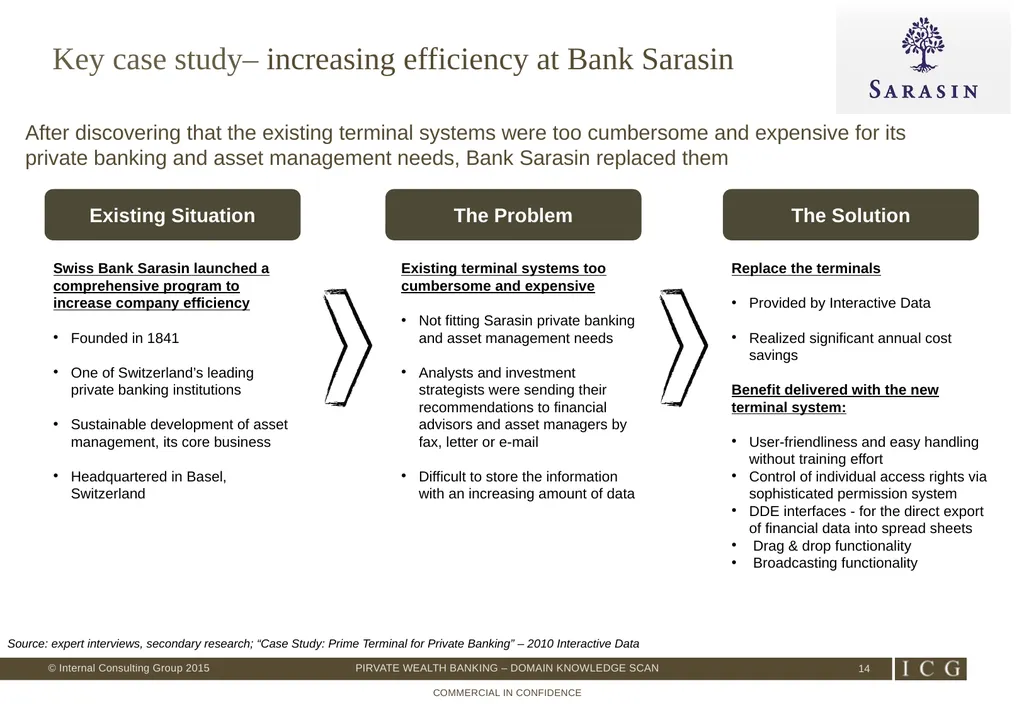
Key case study– increasing efficiency at Bank Sarasin 14 Existing Situation The Problem The Solution Swiss Bank Sarasin launched a comprehensive program to increase company efficiency
Founded in 1841
One of Switzerland’s leading private banking institutions
Sustainable development of asset management, its core business
Headquartered in Basel, Switzerland Replace the terminals
Provided by Interactive Data
Realized significant annual cost savings
Benefit delivered with the new terminal system:
User-friendliness and easy handling without training effort
Control of individual access rights via sophisticated permission system
DDE interfaces - for the direct export of financial data into spread sheets
Drag & drop functionality
Broadcasting functionality Existing terminal systems too cumbersome and expensive
Not fitting Sarasin private banking and asset management needs
Analysts and investment strategists were sending their recommendations to financial advisors and asset managers by fax, letter or e-mail
Difficult to store the information with an increasing amount of data After discovering that the existing terminal systems were too cumbersome and expensive for its private banking and asset management needs, Bank Sarasin replaced them Source: expert interviews, secondary research; “Case Study: Prime Terminal for Private Banking” – 2010 Interactive Data<br>
Founded in 1841
One of Switzerland’s leading private banking institutions
Sustainable development of asset management, its core business
Headquartered in Basel, Switzerland Replace the terminals
Provided by Interactive Data
Realized significant annual cost savings
Benefit delivered with the new terminal system:
User-friendliness and easy handling without training effort
Control of individual access rights via sophisticated permission system
DDE interfaces - for the direct export of financial data into spread sheets
Drag & drop functionality
Broadcasting functionality Existing terminal systems too cumbersome and expensive
Not fitting Sarasin private banking and asset management needs
Analysts and investment strategists were sending their recommendations to financial advisors and asset managers by fax, letter or e-mail
Difficult to store the information with an increasing amount of data After discovering that the existing terminal systems were too cumbersome and expensive for its private banking and asset management needs, Bank Sarasin replaced them Source: expert interviews, secondary research; “Case Study: Prime Terminal for Private Banking” – 2010 Interactive Data<br>
15
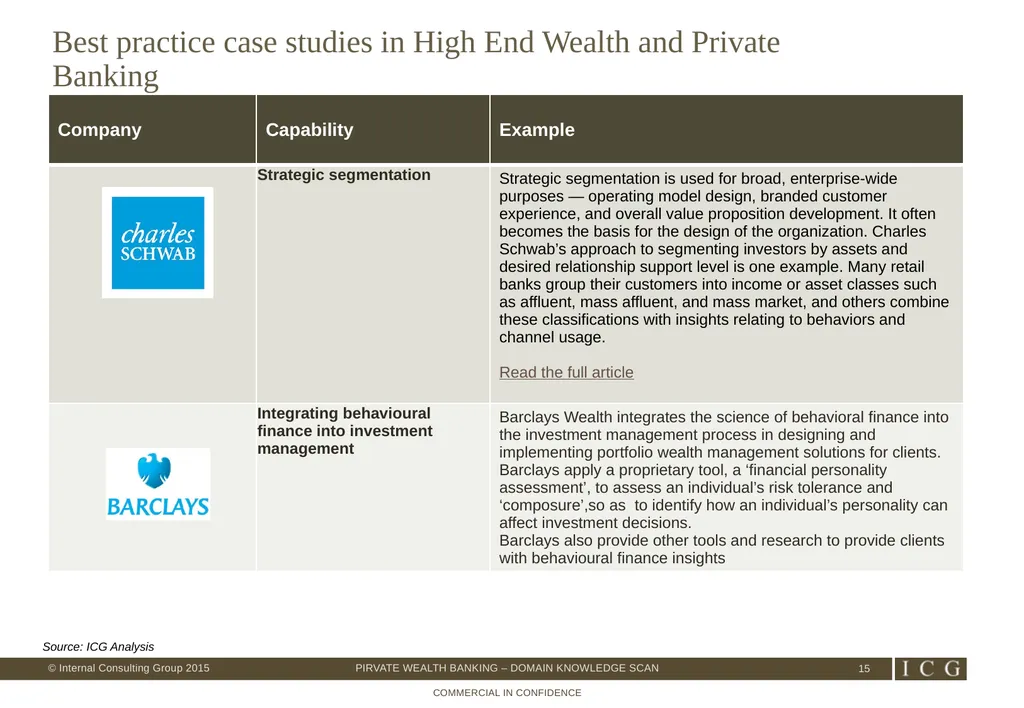
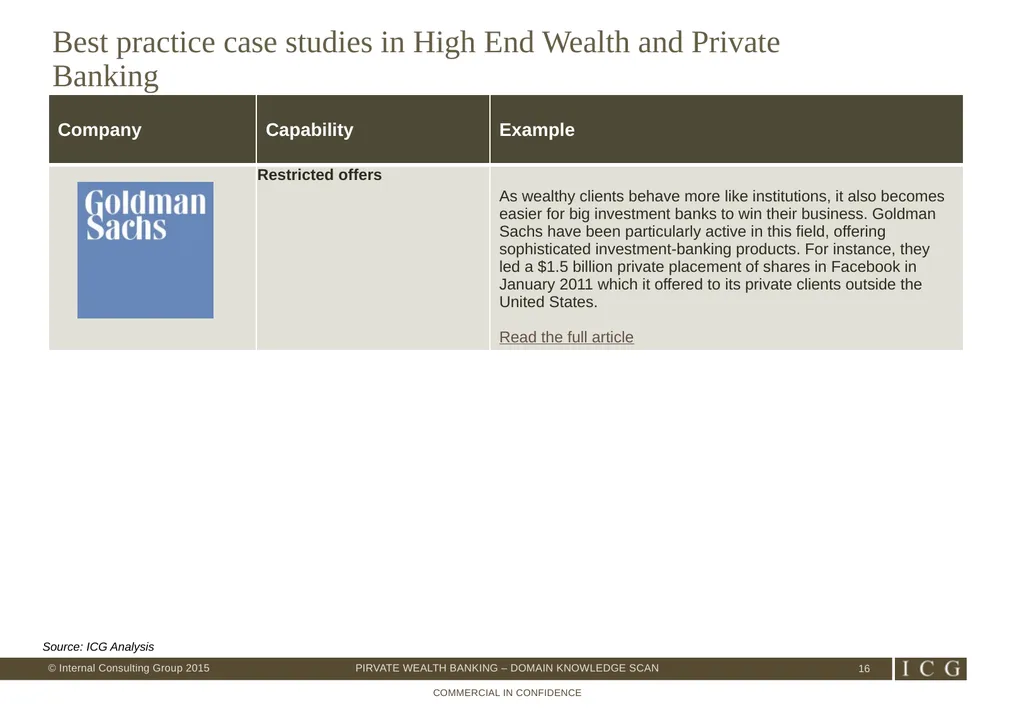
15 Source: ICG Analysis Best practice case studies in High End Wealth and Private Banking<br>
16
16 Source: ICG Analysis Best practice case studies in High End Wealth and Private Banking<br>
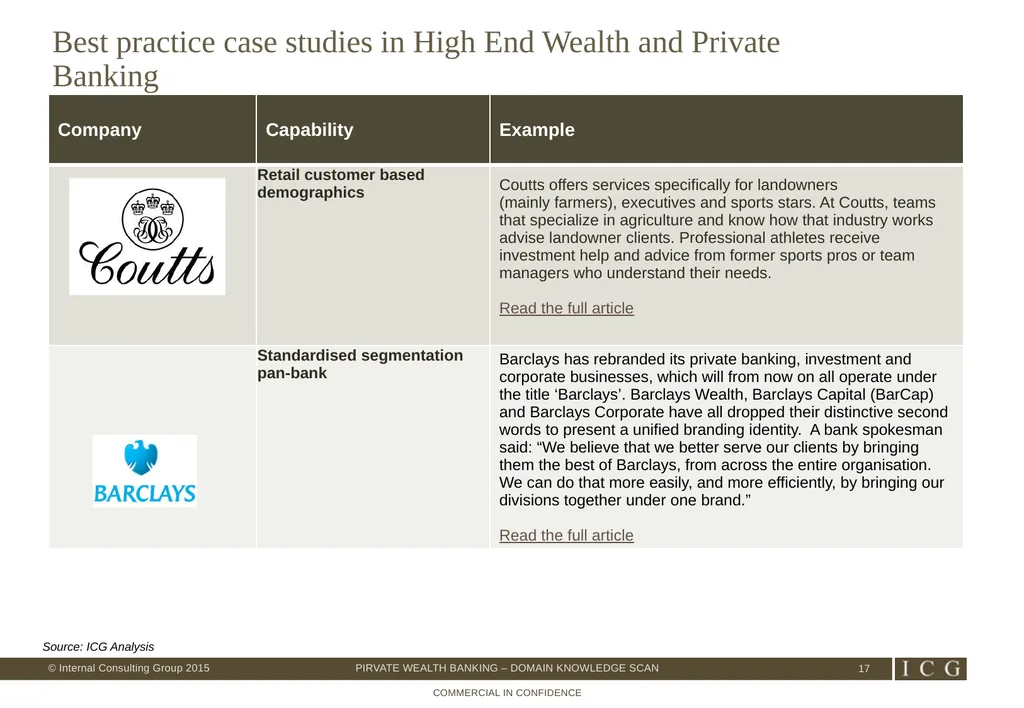
17
17 Source: ICG Analysis Best practice case studies in High End Wealth and Private Banking<br>
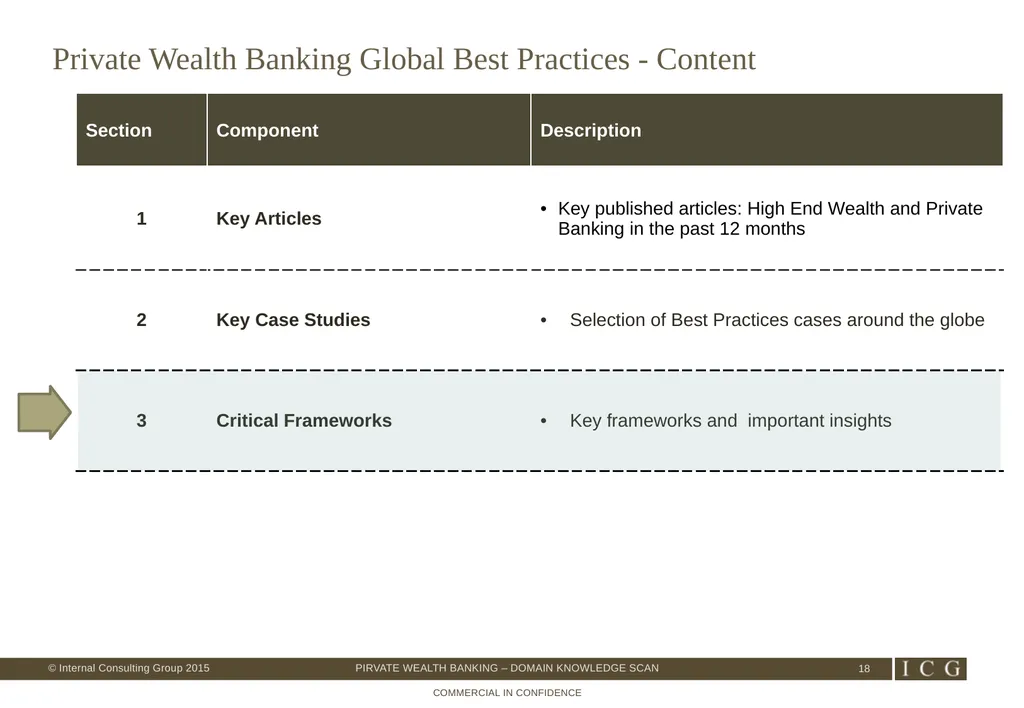
18
Private Wealth Banking Global Best Practices - Content 18<br>
19
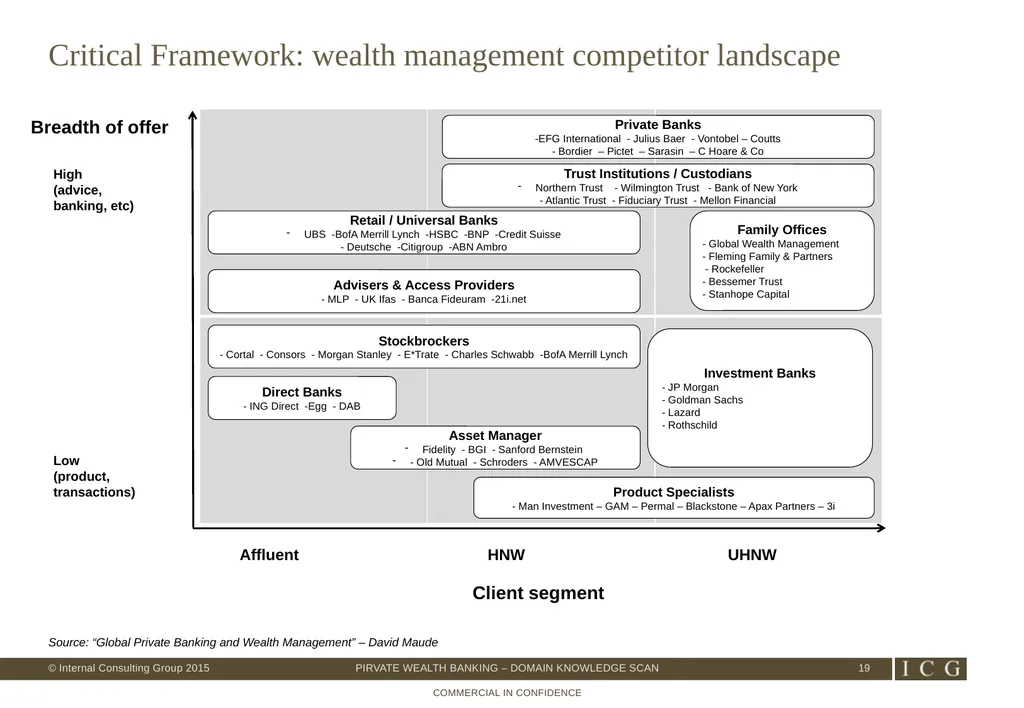
Critical Framework: wealth management competitor landscape 19 Source: “Global Private Banking and Wealth Management” – David Maude Breadth of offer Client segment Affluent HNW UHNW High
(advice, banking, etc) Low
(product, transactions) Product Specialists
- Man Investment – GAM – Permal – Blackstone – Apax Partners – 3i Investment Banks
- JP Morgan
- Goldman Sachs
- Lazard
- Rothschild Family Offices
- Global Wealth Management
- Fleming Family & Partners
- Rockefeller
- Bessemer Trust
- Stanhope Capital Private Banks
-EFG International - Julius Baer - Vontobel – Coutts
- Bordier – Pictet – Sarasin – C Hoare & Co Trust Institutions / Custodians
Northern Trust - Wilmington Trust - Bank of New York
- Atlantic Trust - Fiduciary Trust - Mellon Financial Retail / Universal Banks
UBS -BofA Merrill Lynch -HSBC -BNP -Credit Suisse
- Deutsche -Citigroup -ABN Ambro Advisers & Access Providers
- MLP - UK Ifas - Banca Fideuram -21i.net Stockbrockers
- Cortal - Consors - Morgan Stanley - E*Trate - Charles Schwabb -BofA Merrill Lynch Direct Banks
- ING Direct -Egg - DAB Asset Manager
Fidelity - BGI - Sanford Bernstein
- Old Mutual - Schroders - AMVESCAP<br>
(advice, banking, etc) Low
(product, transactions) Product Specialists
- Man Investment – GAM – Permal – Blackstone – Apax Partners – 3i Investment Banks
- JP Morgan
- Goldman Sachs
- Lazard
- Rothschild Family Offices
- Global Wealth Management
- Fleming Family & Partners
- Rockefeller
- Bessemer Trust
- Stanhope Capital Private Banks
-EFG International - Julius Baer - Vontobel – Coutts
- Bordier – Pictet – Sarasin – C Hoare & Co Trust Institutions / Custodians
Northern Trust - Wilmington Trust - Bank of New York
- Atlantic Trust - Fiduciary Trust - Mellon Financial Retail / Universal Banks
UBS -BofA Merrill Lynch -HSBC -BNP -Credit Suisse
- Deutsche -Citigroup -ABN Ambro Advisers & Access Providers
- MLP - UK Ifas - Banca Fideuram -21i.net Stockbrockers
- Cortal - Consors - Morgan Stanley - E*Trate - Charles Schwabb -BofA Merrill Lynch Direct Banks
- ING Direct -Egg - DAB Asset Manager
Fidelity - BGI - Sanford Bernstein
- Old Mutual - Schroders - AMVESCAP<br>
20
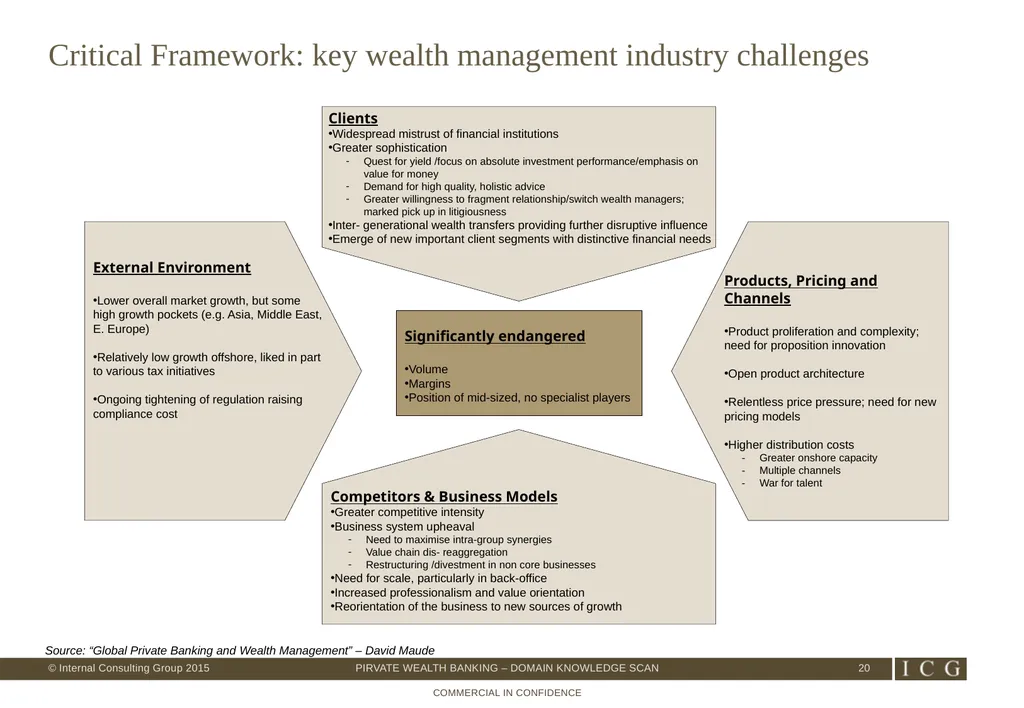
Critical Framework: key wealth management industry challenges 20 Source: “Global Private Banking and Wealth Management” – David Maude External Environment
Lower overall market growth, but some high growth pockets (e.g. Asia, Middle East, E. Europe)
Relatively low growth offshore, liked in part to various tax initiatives
Ongoing tightening of regulation raising compliance cost Clients
Widespread mistrust of financial institutions
Greater sophistication
Quest for yield /focus on absolute investment performance/emphasis on value for money
Demand for high quality, holistic advice
Greater willingness to fragment relationship/switch wealth managers; marked pick up in litigiousness
Inter- generational wealth transfers providing further disruptive influence
Emerge of new important client segments with distinctive financial needs Competitors & Business Models
Greater competitive intensity
Business system upheaval
Need to maximise intra-group synergies
Value chain dis- reaggregation
Restructuring /divestment in non core businesses
Need for scale, particularly in back-office
Increased professionalism and value orientation
Reorientation of the business to new sources of growth Significantly endangered
Volume
Margins
Position of mid-sized, no specialist players Products, Pricing and Channels
Product proliferation and complexity; need for proposition innovation
Open product architecture
Relentless price pressure; need for new pricing models
Higher distribution costs
Greater onshore capacity
Multiple channels
War for talent<br>
Lower overall market growth, but some high growth pockets (e.g. Asia, Middle East, E. Europe)
Relatively low growth offshore, liked in part to various tax initiatives
Ongoing tightening of regulation raising compliance cost Clients
Widespread mistrust of financial institutions
Greater sophistication
Quest for yield /focus on absolute investment performance/emphasis on value for money
Demand for high quality, holistic advice
Greater willingness to fragment relationship/switch wealth managers; marked pick up in litigiousness
Inter- generational wealth transfers providing further disruptive influence
Emerge of new important client segments with distinctive financial needs Competitors & Business Models
Greater competitive intensity
Business system upheaval
Need to maximise intra-group synergies
Value chain dis- reaggregation
Restructuring /divestment in non core businesses
Need for scale, particularly in back-office
Increased professionalism and value orientation
Reorientation of the business to new sources of growth Significantly endangered
Volume
Margins
Position of mid-sized, no specialist players Products, Pricing and Channels
Product proliferation and complexity; need for proposition innovation
Open product architecture
Relentless price pressure; need for new pricing models
Higher distribution costs
Greater onshore capacity
Multiple channels
War for talent<br>
21
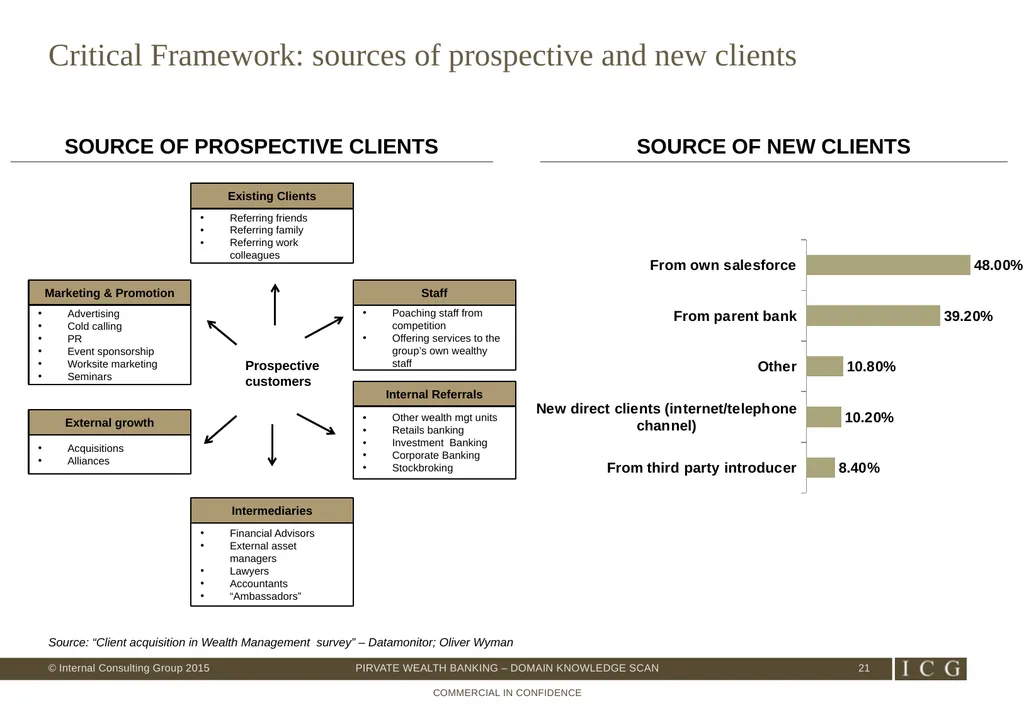
Critical Framework: sources of prospective and new clients 21 Source: “Client acquisition in Wealth Management survey” – Datamonitor; Oliver Wyman Source of prospective clients Source of new clients Referring friends
Referring family
Referring work colleagues Existing Clients Advertising
Cold calling
PR
Event sponsorship
Worksite marketing
Seminars Marketing & Promotion Acquisitions
Alliances External growth Financial Advisors
External asset managers
Lawyers
Accountants
“Ambassadors” Intermediaries Other wealth mgt units
Retails banking
Investment Banking
Corporate Banking
Stockbroking Internal Referrals Poaching staff from competition
Offering services to the group’s own wealthy staff Staff Prospective
customers<br>
Referring family
Referring work colleagues Existing Clients Advertising
Cold calling
PR
Event sponsorship
Worksite marketing
Seminars Marketing & Promotion Acquisitions
Alliances External growth Financial Advisors
External asset managers
Lawyers
Accountants
“Ambassadors” Intermediaries Other wealth mgt units
Retails banking
Investment Banking
Corporate Banking
Stockbroking Internal Referrals Poaching staff from competition
Offering services to the group’s own wealthy staff Staff Prospective
customers<br>
22
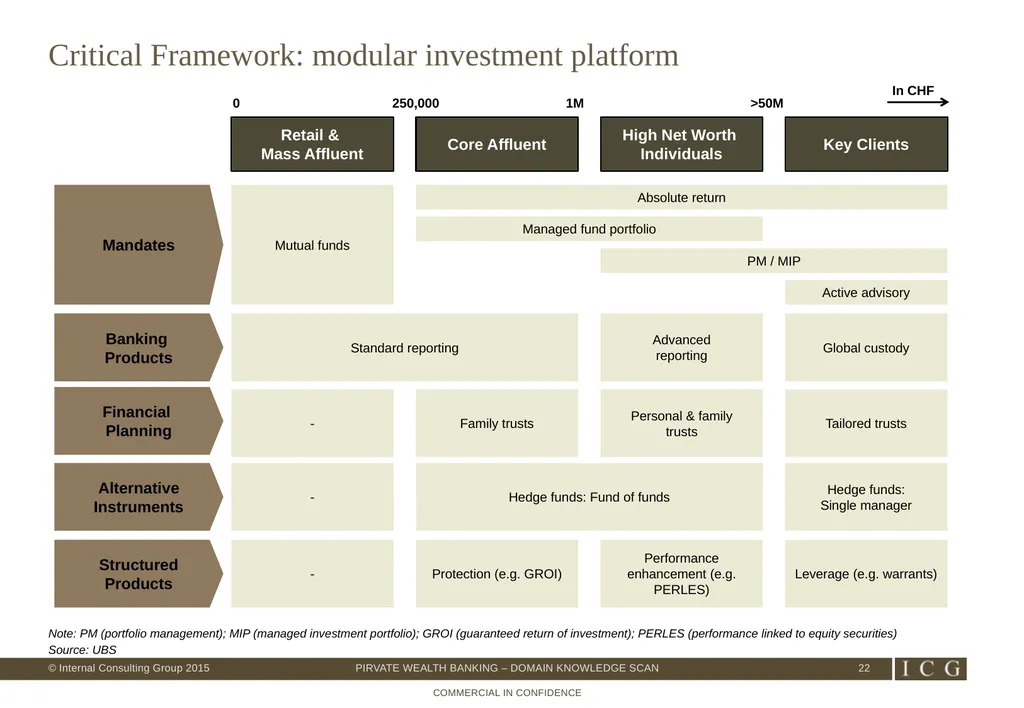
Critical Framework: modular investment platform 22 Note: PM (portfolio management); MIP (managed investment portfolio); GROI (guaranteed return of investment); PERLES (performance linked to equity securities)
Source: UBS Mandates Retail &
Mass Affluent Mutual funds Core Affluent High Net Worth
Individuals Key Clients Banking
Products Financial
Planning Alternative
Instruments Structured
Products Standard reporting - - - Family trusts Personal & family
trusts Advanced
reporting Hedge funds: Fund of funds Protection (e.g. GROI) Performance enhancement (e.g. PERLES) Leverage (e.g. warrants) Hedge funds:
Single manager Tailored trusts Global custody Absolute return Managed fund portfolio PM / MIP Active advisory 0 250,000 1M >50M In CHF<br>
Source: UBS Mandates Retail &
Mass Affluent Mutual funds Core Affluent High Net Worth
Individuals Key Clients Banking
Products Financial
Planning Alternative
Instruments Structured
Products Standard reporting - - - Family trusts Personal & family
trusts Advanced
reporting Hedge funds: Fund of funds Protection (e.g. GROI) Performance enhancement (e.g. PERLES) Leverage (e.g. warrants) Hedge funds:
Single manager Tailored trusts Global custody Absolute return Managed fund portfolio PM / MIP Active advisory 0 250,000 1M >50M In CHF<br>
23
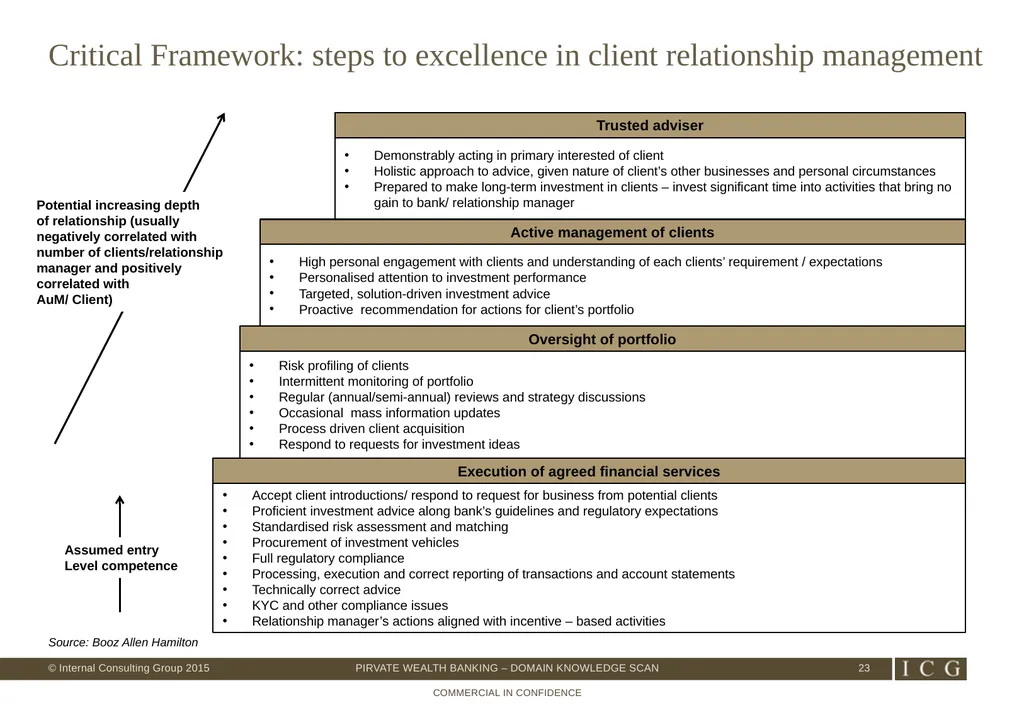
Critical Framework: steps to excellence in client relationship management 23 Source: Booz Allen Hamilton Accept client introductions/ respond to request for business from potential clients
Proficient investment advice along bank’s guidelines and regulatory expectations
Standardised risk assessment and matching
Procurement of investment vehicles
Full regulatory compliance
Processing, execution and correct reporting of transactions and account statements
Technically correct advice
KYC and other compliance issues
Relationship manager’s actions aligned with incentive – based activities Execution of agreed financial services Risk profiling of clients
Intermittent monitoring of portfolio
Regular (annual/semi-annual) reviews and strategy discussions
Occasional mass information updates
Process driven client acquisition
Respond to requests for investment ideas Oversight of portfolio High personal engagement with clients and understanding of each clients’ requirement / expectations
Personalised attention to investment performance
Targeted, solution-driven investment advice
Proactive recommendation for actions for client’s portfolio Active management of clients Demonstrably acting in primary interested of client
Holistic approach to advice, given nature of client’s other businesses and personal circumstances
Prepared to make long-term investment in clients – invest significant time into activities that bring no gain to bank/ relationship manager Trusted adviser Assumed entry
Level competence Potential increasing depth
of relationship (usually negatively correlated with number of clients/relationship manager and positively correlated with
AuM/ Client)<br>
Proficient investment advice along bank’s guidelines and regulatory expectations
Standardised risk assessment and matching
Procurement of investment vehicles
Full regulatory compliance
Processing, execution and correct reporting of transactions and account statements
Technically correct advice
KYC and other compliance issues
Relationship manager’s actions aligned with incentive – based activities Execution of agreed financial services Risk profiling of clients
Intermittent monitoring of portfolio
Regular (annual/semi-annual) reviews and strategy discussions
Occasional mass information updates
Process driven client acquisition
Respond to requests for investment ideas Oversight of portfolio High personal engagement with clients and understanding of each clients’ requirement / expectations
Personalised attention to investment performance
Targeted, solution-driven investment advice
Proactive recommendation for actions for client’s portfolio Active management of clients Demonstrably acting in primary interested of client
Holistic approach to advice, given nature of client’s other businesses and personal circumstances
Prepared to make long-term investment in clients – invest significant time into activities that bring no gain to bank/ relationship manager Trusted adviser Assumed entry
Level competence Potential increasing depth
of relationship (usually negatively correlated with number of clients/relationship manager and positively correlated with
AuM/ Client)<br>
24
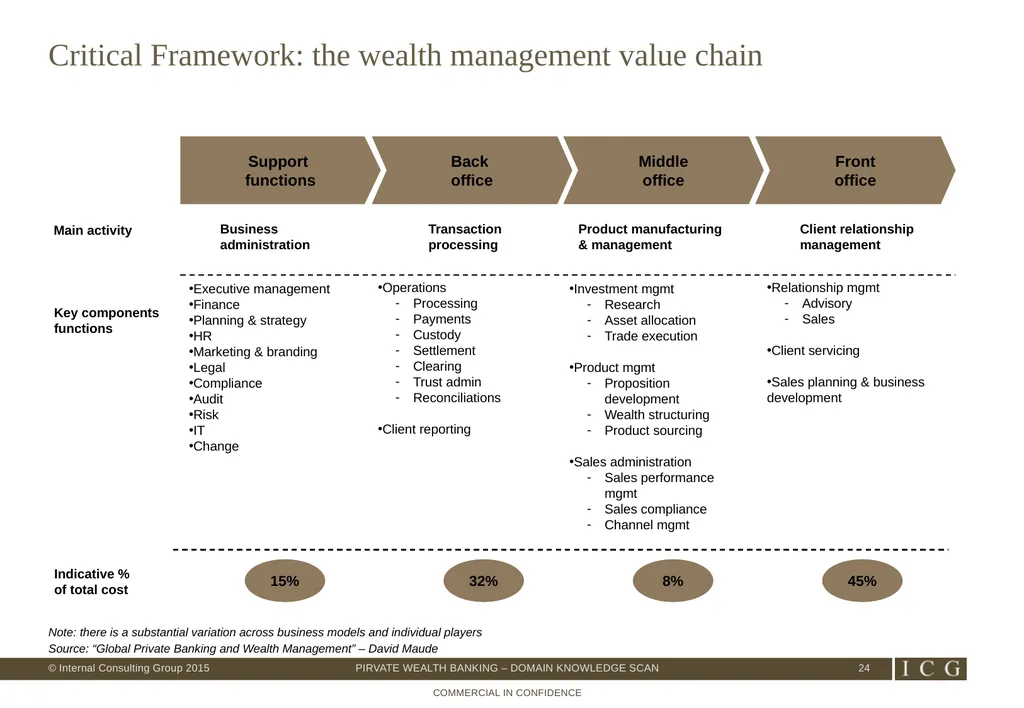
Critical Framework: the wealth management value chain 24 Note: there is a substantial variation across business models and individual players
Source: “Global Private Banking and Wealth Management” – David Maude Front
office Middle
office Back
office Support
functions Main activity Key components
functions Indicative %
of total cost 32% 15% 8% 45% Business
administration Transaction
processing Product manufacturing
& management Client relationship
management Executive management
Finance
Planning & strategy
HR
Marketing & branding
Legal
Compliance
Audit
Risk
IT
Change Operations
Processing
Payments
Custody
Settlement
Clearing
Trust admin
Reconciliations
Client reporting Investment mgmt
Research
Asset allocation
Trade execution
Product mgmt
Proposition development
Wealth structuring
Product sourcing
Sales administration
Sales performance mgmt
Sales compliance
Channel mgmt Relationship mgmt
Advisory
Sales
Client servicing
Sales planning & business development<br>
Source: “Global Private Banking and Wealth Management” – David Maude Front
office Middle
office Back
office Support
functions Main activity Key components
functions Indicative %
of total cost 32% 15% 8% 45% Business
administration Transaction
processing Product manufacturing
& management Client relationship
management Executive management
Finance
Planning & strategy
HR
Marketing & branding
Legal
Compliance
Audit
Risk
IT
Change Operations
Processing
Payments
Custody
Settlement
Clearing
Trust admin
Reconciliations
Client reporting Investment mgmt
Research
Asset allocation
Trade execution
Product mgmt
Proposition development
Wealth structuring
Product sourcing
Sales administration
Sales performance mgmt
Sales compliance
Channel mgmt Relationship mgmt
Advisory
Sales
Client servicing
Sales planning & business development<br>
25
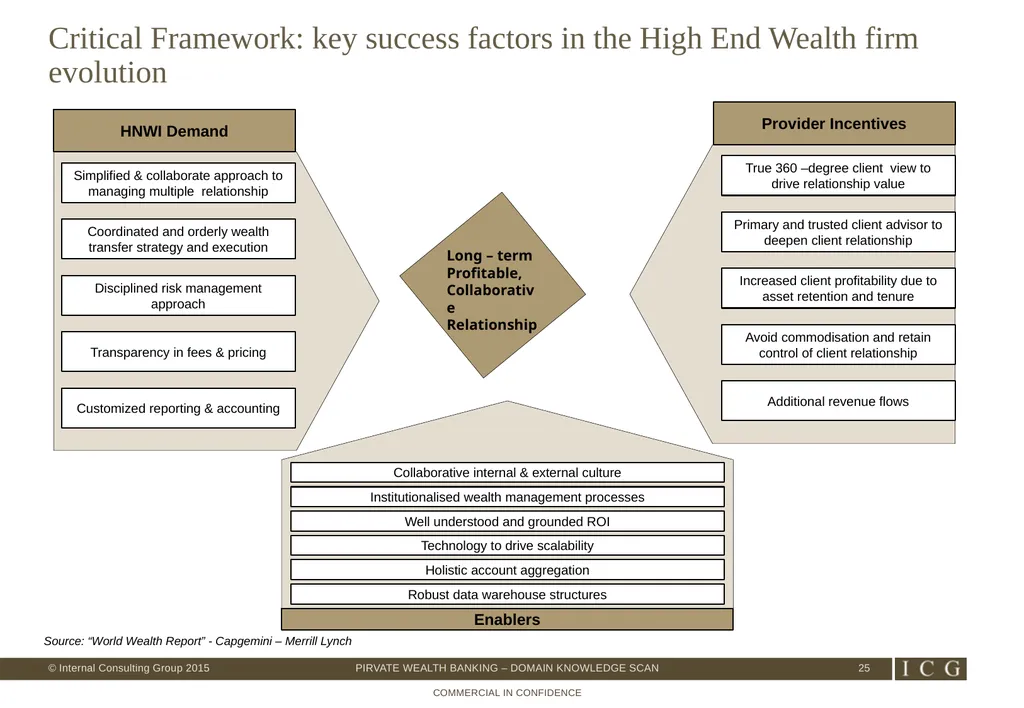
Critical Framework: key success factors in the High End Wealth firm evolution 25 Source: “World Wealth Report” - Capgemini – Merrill Lynch Long – term
Profitable,
Collaborative
Relationship Simplified & collaborate approach to managing multiple relationship HNWI Demand Coordinated and orderly wealth transfer strategy and execution Disciplined risk management approach Transparency in fees & pricing Customized reporting & accounting True 360 –degree client view to drive relationship value Provider Incentives Primary and trusted client advisor to deepen client relationship Increased client profitability due to asset retention and tenure Avoid commodisation and retain control of client relationship Additional revenue flows Institutionalised wealth management processes Enablers Technology to drive scalability Collaborative internal & external culture Well understood and grounded ROI Holistic account aggregation Robust data warehouse structures<br>
Profitable,
Collaborative
Relationship Simplified & collaborate approach to managing multiple relationship HNWI Demand Coordinated and orderly wealth transfer strategy and execution Disciplined risk management approach Transparency in fees & pricing Customized reporting & accounting True 360 –degree client view to drive relationship value Provider Incentives Primary and trusted client advisor to deepen client relationship Increased client profitability due to asset retention and tenure Avoid commodisation and retain control of client relationship Additional revenue flows Institutionalised wealth management processes Enablers Technology to drive scalability Collaborative internal & external culture Well understood and grounded ROI Holistic account aggregation Robust data warehouse structures<br>
26
This document was prepared by ICG’s Financial Services Practice<br>