
Probability Experiment, Outcomes, and Sample Space
CB
Published · 47 slides · 0 views
1 / 1
Description
Probability Experiment, Outcomes, and Sample Space Experiment, Outcomes, and Sample Space An experiment is a process that, when performed, results in one and only one of many observations. These observations are called the outcomes of the
Related Topics
Share
Embed code
Download this presentation From Below
"Probability Experiment, Outcomes, and Sample Space" is the property of its rightful owner. Permission is granted to download and print the materials on this website for personal, non-commercial use only, and to display it on your personal computer provided you do not modify the materials and that you retain all copyright notices contained in the materials. By downloading content from our website, you accept the terms of this agreement.
Presentation Transcript
01
Probability Experiment, Outcomes, and Sample Space<br>
02
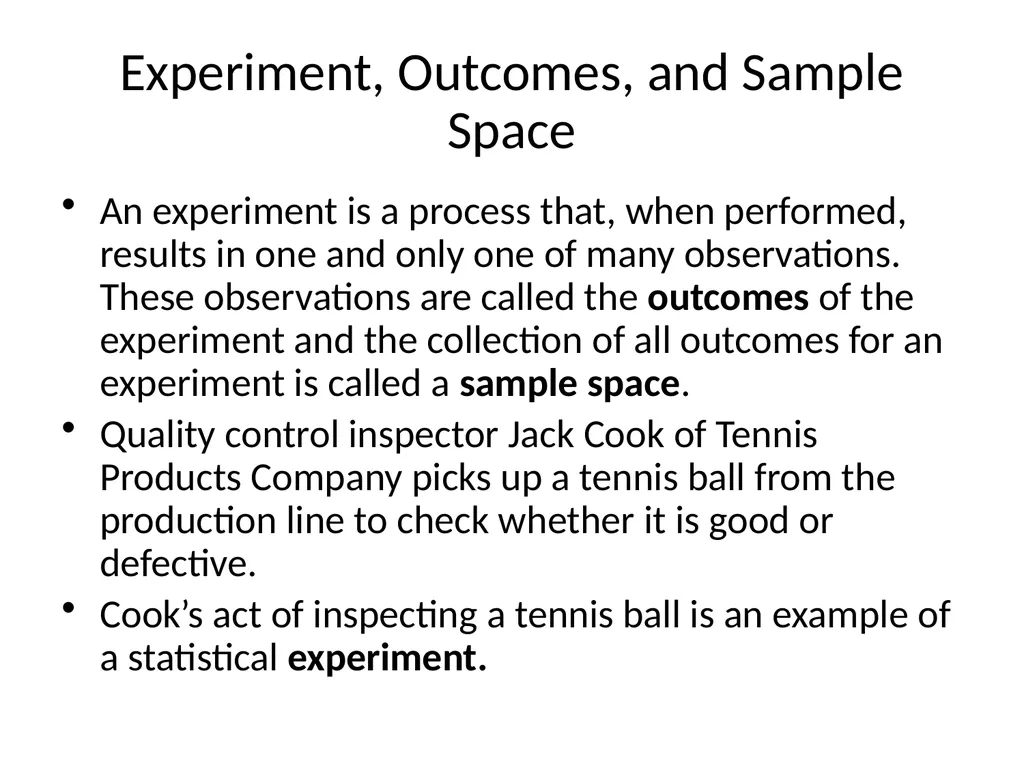
Experiment, Outcomes, and Sample Space An experiment is a process that, when performed, results in one and only one of many observations. These observations are called the outcomes of the experiment and the collection of all outcomes for an experiment is called a sample space.
Quality control inspector Jack Cook of Tennis Products Company picks up a tennis ball from the production line to check whether it is good or defective.
Cook’s act of inspecting a tennis ball is an example of a statistical experiment.<br>
Quality control inspector Jack Cook of Tennis Products Company picks up a tennis ball from the production line to check whether it is good or defective.
Cook’s act of inspecting a tennis ball is an example of a statistical experiment.<br>
03
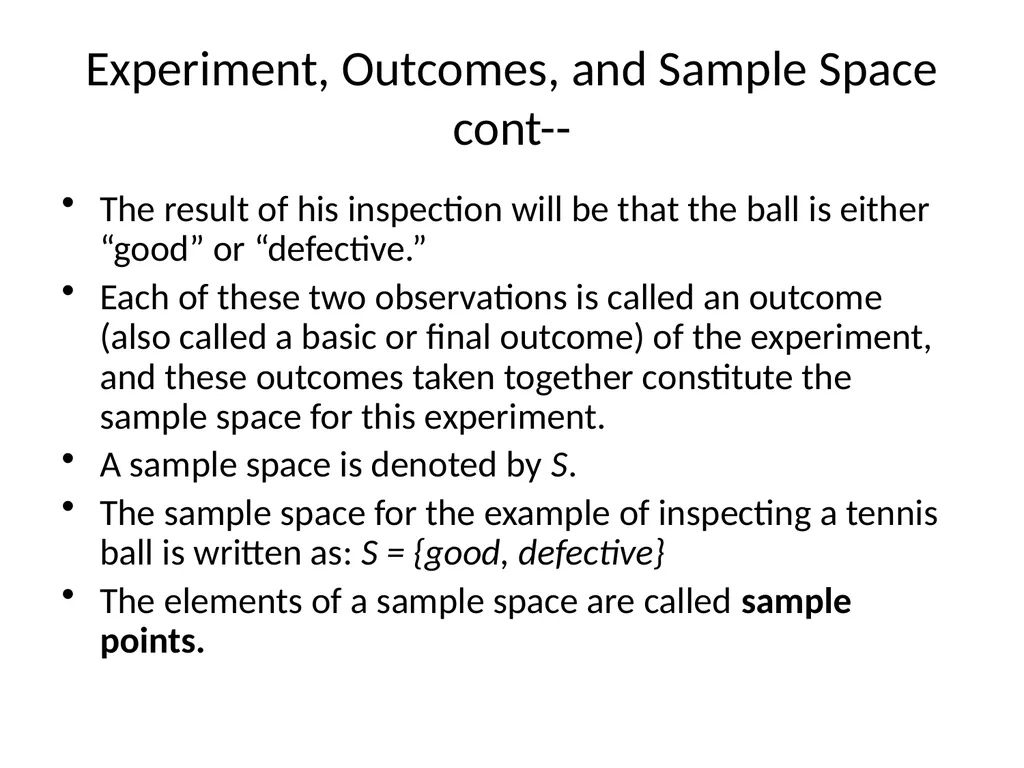
Experiment, Outcomes, and Sample Space cont-- The result of his inspection will be that the ball is either “good” or “defective.”
Each of these two observations is called an outcome (also called a basic or final outcome) of the experiment, and these outcomes taken together constitute the sample space for this experiment.
A sample space is denoted by S.
The sample space for the example of inspecting a tennis ball is written as: S = {good, defective}
The elements of a sample space are called sample points.<br>
Each of these two observations is called an outcome (also called a basic or final outcome) of the experiment, and these outcomes taken together constitute the sample space for this experiment.
A sample space is denoted by S.
The sample space for the example of inspecting a tennis ball is written as: S = {good, defective}
The elements of a sample space are called sample points.<br>
04
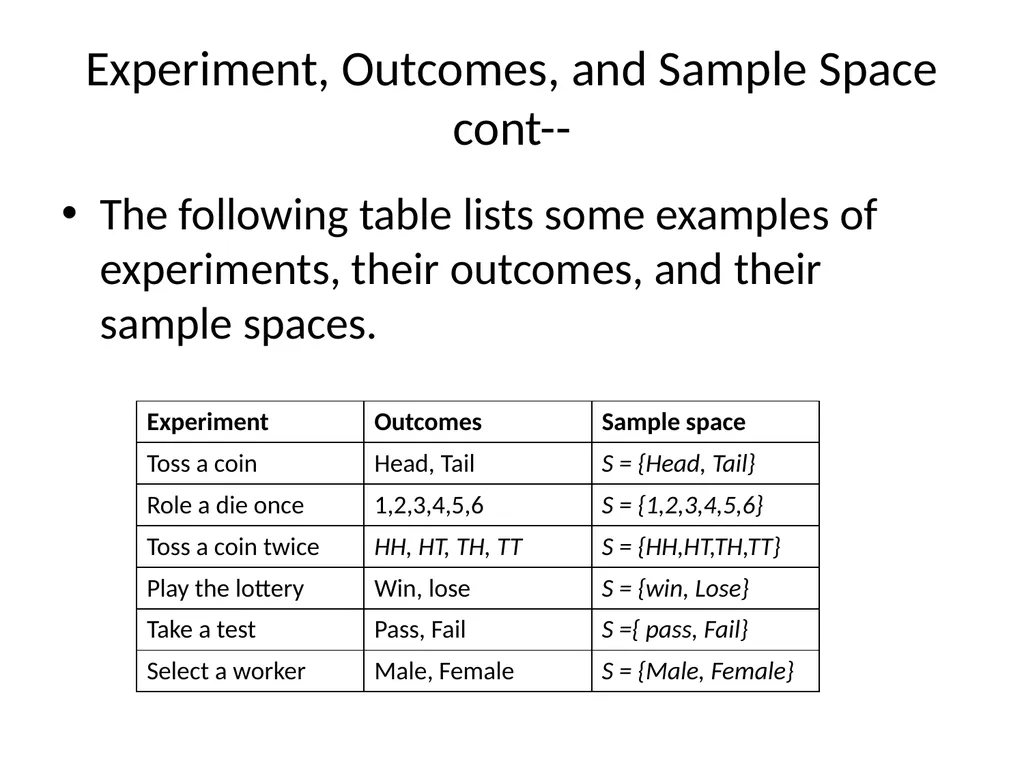
Experiment, Outcomes, and Sample Space cont-- The following table lists some examples of experiments, their outcomes, and their sample spaces.<br>
05
Venn and Tree Diagrams The sample space for an experiment can also be illustrated by drawing either a Venn diagram or a tree diagram.
A Venn diagram is a picture (a closed geometric shape such as a rectangle, a square, or a circle) that depicts all the possible outcomes for an experiment.
In a tree diagram, each outcome is represented by a branch of the tree.
Venn and tree diagrams help us understand probability concepts by presenting them visually.<br>
A Venn diagram is a picture (a closed geometric shape such as a rectangle, a square, or a circle) that depicts all the possible outcomes for an experiment.
In a tree diagram, each outcome is represented by a branch of the tree.
Venn and tree diagrams help us understand probability concepts by presenting them visually.<br>
06
Venn and Tree Diagrams cont-- Example:
Draw the Venn and tree diagrams for the experiment of tossing a coin once
Solution:
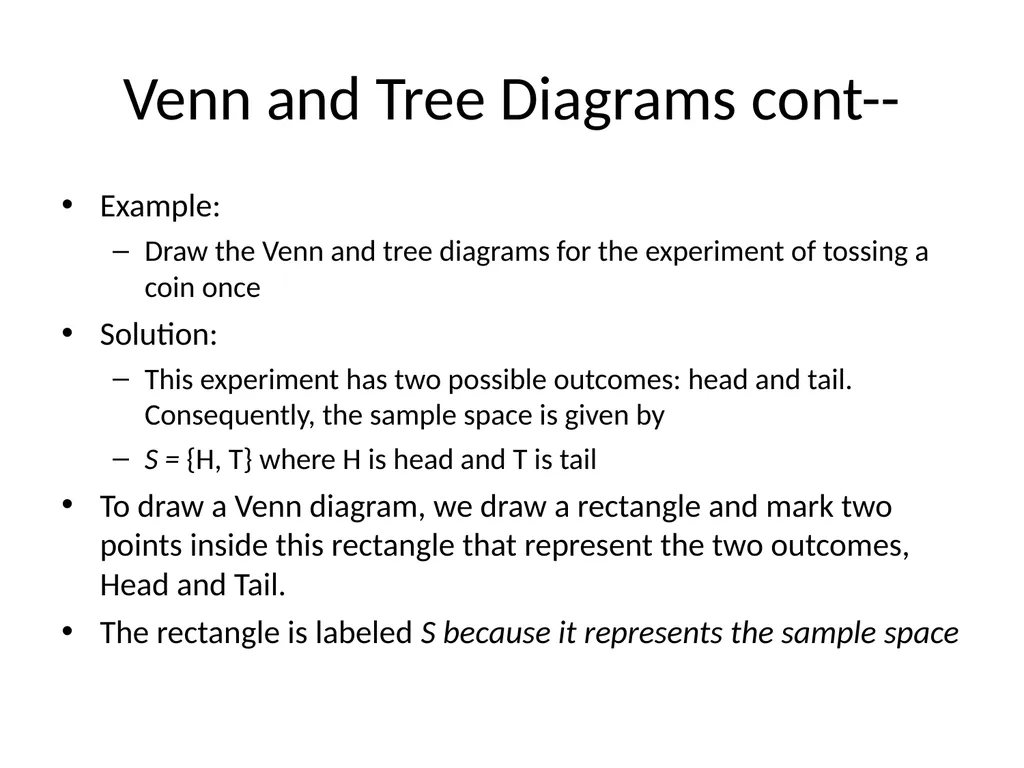
This experiment has two possible outcomes: head and tail. Consequently, the sample space is given by
S = {H, T} where H is head and T is tail
To draw a Venn diagram, we draw a rectangle and mark two points inside this rectangle that represent the two outcomes, Head and Tail.
The rectangle is labeled S because it represents the sample space<br>
Draw the Venn and tree diagrams for the experiment of tossing a coin once
Solution:
This experiment has two possible outcomes: head and tail. Consequently, the sample space is given by
S = {H, T} where H is head and T is tail
To draw a Venn diagram, we draw a rectangle and mark two points inside this rectangle that represent the two outcomes, Head and Tail.
The rectangle is labeled S because it represents the sample space<br>
07
Venn and Tree Diagrams cont-- S
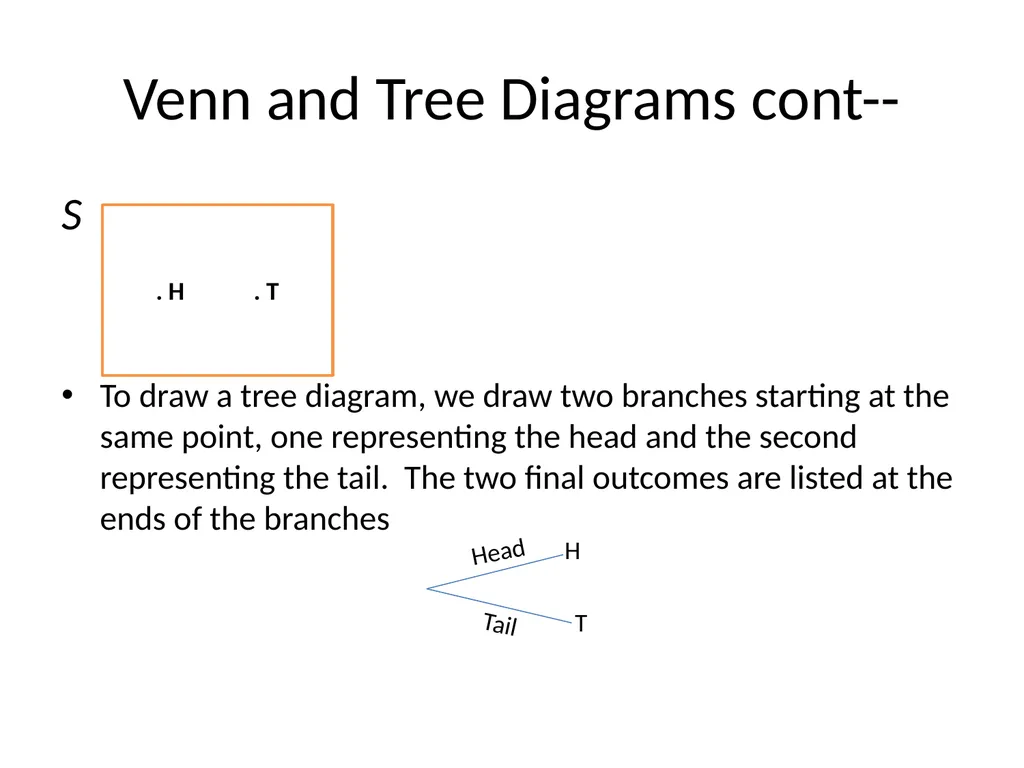
To draw a tree diagram, we draw two branches starting at the same point, one representing the head and the second representing the tail. The two final outcomes are listed at the ends of the branches . H . T T Tail H Head<br>
To draw a tree diagram, we draw two branches starting at the same point, one representing the head and the second representing the tail. The two final outcomes are listed at the ends of the branches . H . T T Tail H Head<br>
08
Venn and Tree Diagrams cont-- Example:
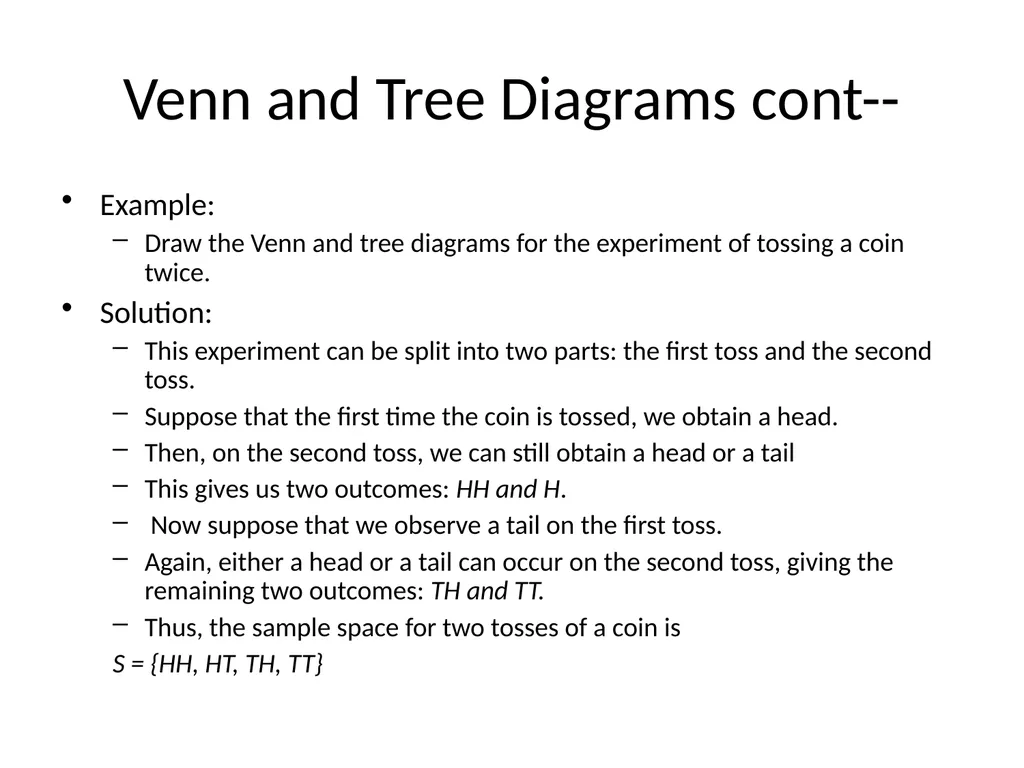
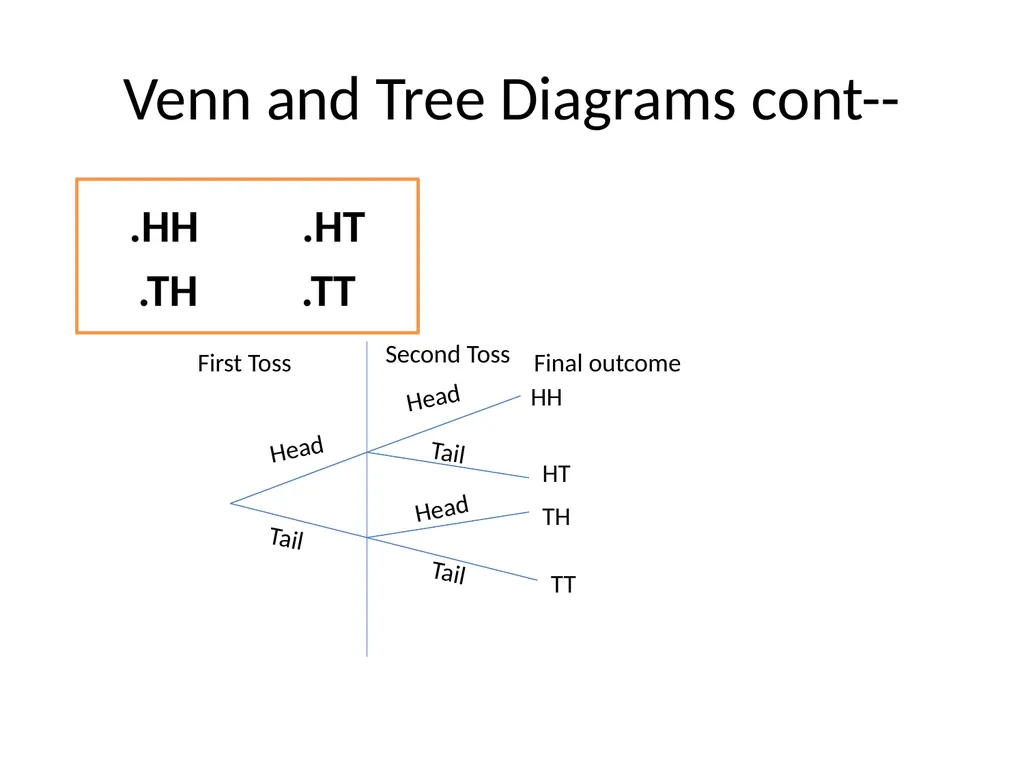
Draw the Venn and tree diagrams for the experiment of tossing a coin twice.
Solution:
This experiment can be split into two parts: the first toss and the second toss.
Suppose that the first time the coin is tossed, we obtain a head.
Then, on the second toss, we can still obtain a head or a tail
This gives us two outcomes: HH and H.
Now suppose that we observe a tail on the first toss.
Again, either a head or a tail can occur on the second toss, giving the remaining two outcomes: TH and TT.
Thus, the sample space for two tosses of a coin is
S = {HH, HT, TH, TT}<br>
Draw the Venn and tree diagrams for the experiment of tossing a coin twice.
Solution:
This experiment can be split into two parts: the first toss and the second toss.
Suppose that the first time the coin is tossed, we obtain a head.
Then, on the second toss, we can still obtain a head or a tail
This gives us two outcomes: HH and H.
Now suppose that we observe a tail on the first toss.
Again, either a head or a tail can occur on the second toss, giving the remaining two outcomes: TH and TT.
Thus, the sample space for two tosses of a coin is
S = {HH, HT, TH, TT}<br>
09
Venn and Tree Diagrams cont-- .HH .HT
.TH .TT Head Head Head Tail Tail Tail TT TH HT HH First Toss Second Toss Final outcome<br>
.TH .TT Head Head Head Tail Tail Tail TT TH HT HH First Toss Second Toss Final outcome<br>
10
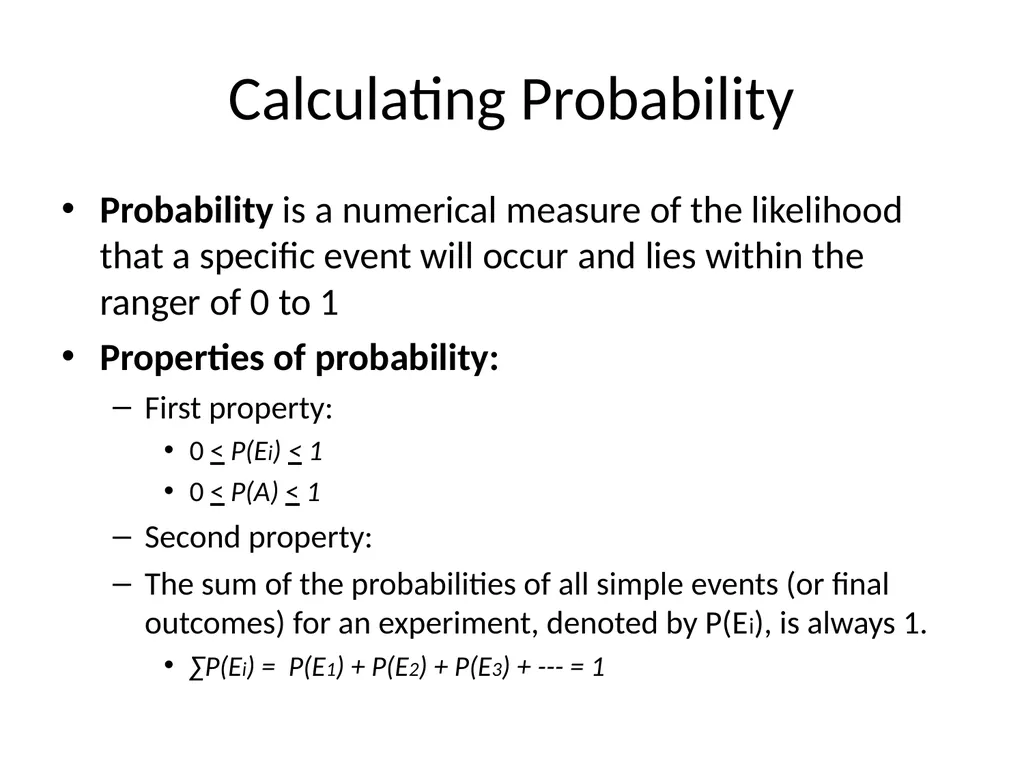
Calculating Probability Probability is a numerical measure of the likelihood that a specific event will occur and lies within the ranger of 0 to 1
Properties of probability:
First property:
0 < P(Ei) < 1
0 < P(A) < 1
Second property:
The sum of the probabilities of all simple events (or final outcomes) for an experiment, denoted by P(Ei), is always 1.
∑P(Ei) = P(E1) + P(E2) + P(E3) + --- = 1<br>
Properties of probability:
First property:
0 < P(Ei) < 1
0 < P(A) < 1
Second property:
The sum of the probabilities of all simple events (or final outcomes) for an experiment, denoted by P(Ei), is always 1.
∑P(Ei) = P(E1) + P(E2) + P(E3) + --- = 1<br>
11
Three Conceptual Approaches to Probability The three conceptual approaches to probability are
Classical probability,
The relative frequency concept of probability, and
The subjective probability concept<br>
Classical probability,
The relative frequency concept of probability, and
The subjective probability concept<br>
12
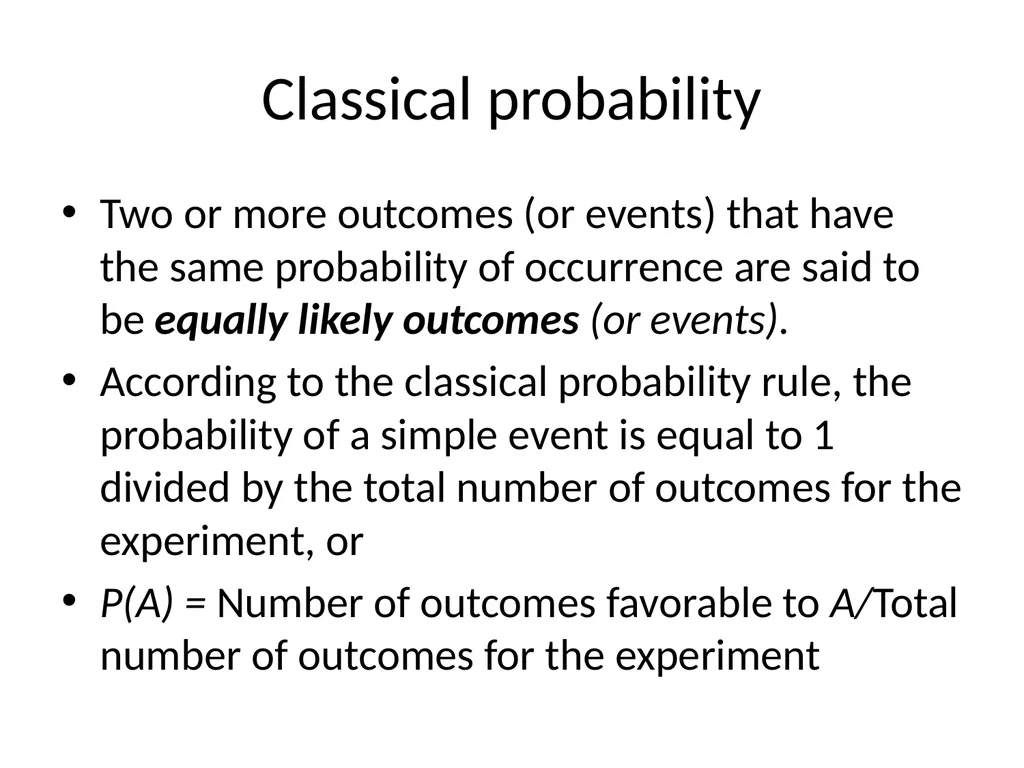
Classical probability Two or more outcomes (or events) that have the same probability of occurrence are said to be equally likely outcomes (or events).
According to the classical probability rule, the probability of a simple event is equal to 1 divided by the total number of outcomes for the experiment, or
P(A) = Number of outcomes favorable to A/Total number of outcomes for the experiment<br>
According to the classical probability rule, the probability of a simple event is equal to 1 divided by the total number of outcomes for the experiment, or
P(A) = Number of outcomes favorable to A/Total number of outcomes for the experiment<br>
13
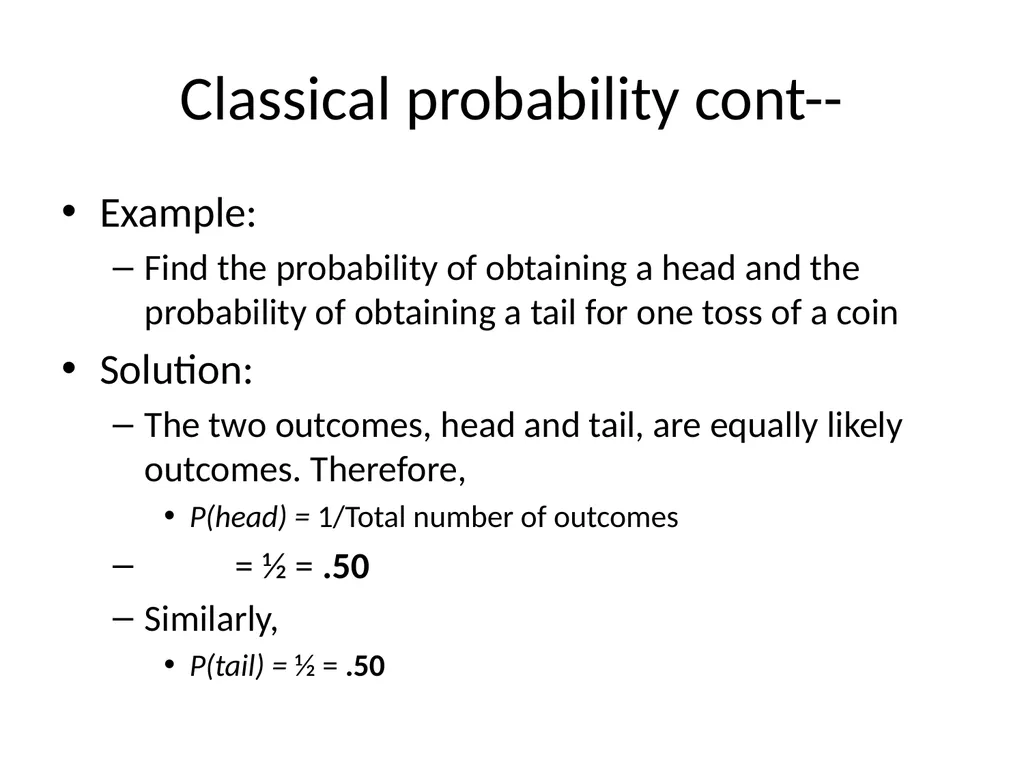
Classical probability cont-- Example:
Find the probability of obtaining a head and the probability of obtaining a tail for one toss of a coin
Solution:
The two outcomes, head and tail, are equally likely outcomes. Therefore,
P(head) = 1/Total number of outcomes
= ½ = .50
Similarly,
P(tail) = ½ = .50<br>
Find the probability of obtaining a head and the probability of obtaining a tail for one toss of a coin
Solution:
The two outcomes, head and tail, are equally likely outcomes. Therefore,
P(head) = 1/Total number of outcomes
= ½ = .50
Similarly,
P(tail) = ½ = .50<br>
14
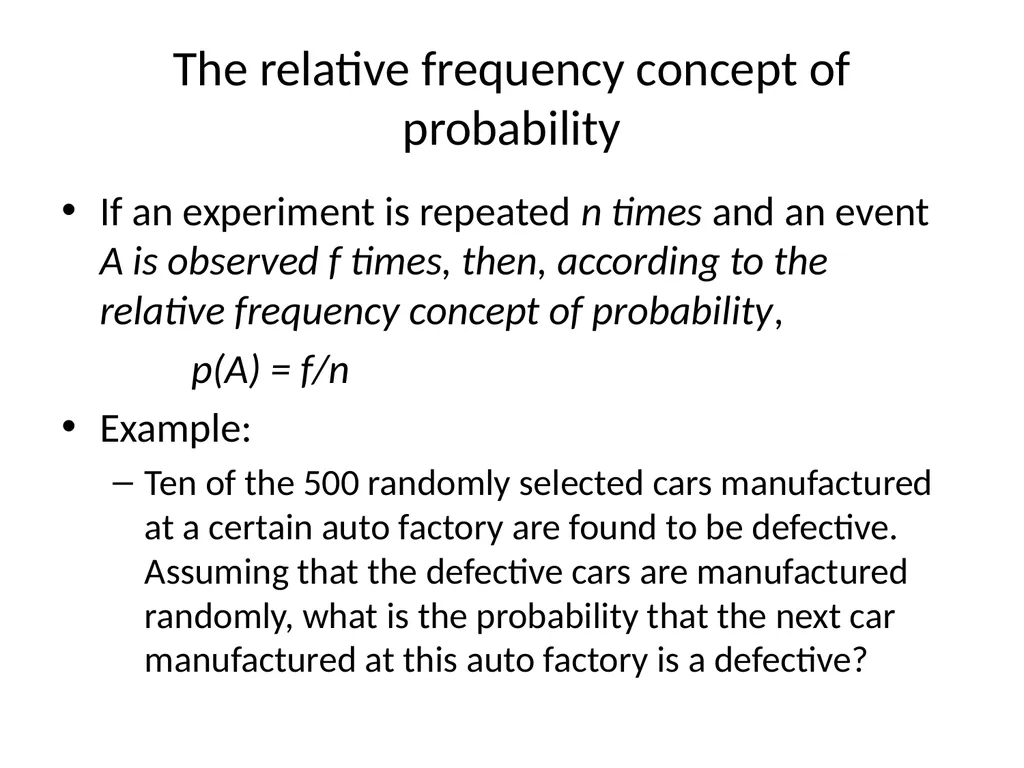
The relative frequency concept of probability If an experiment is repeated n times and an event A is observed f times, then, according to the relative frequency concept of probability,
p(A) = f/n
Example:
Ten of the 500 randomly selected cars manufactured at a certain auto factory are found to be defective. Assuming that the defective cars are manufactured randomly, what is the probability that the next car manufactured at this auto factory is a defective?<br>
p(A) = f/n
Example:
Ten of the 500 randomly selected cars manufactured at a certain auto factory are found to be defective. Assuming that the defective cars are manufactured randomly, what is the probability that the next car manufactured at this auto factory is a defective?<br>
15
The relative frequency concept of probability cont-- Solution:
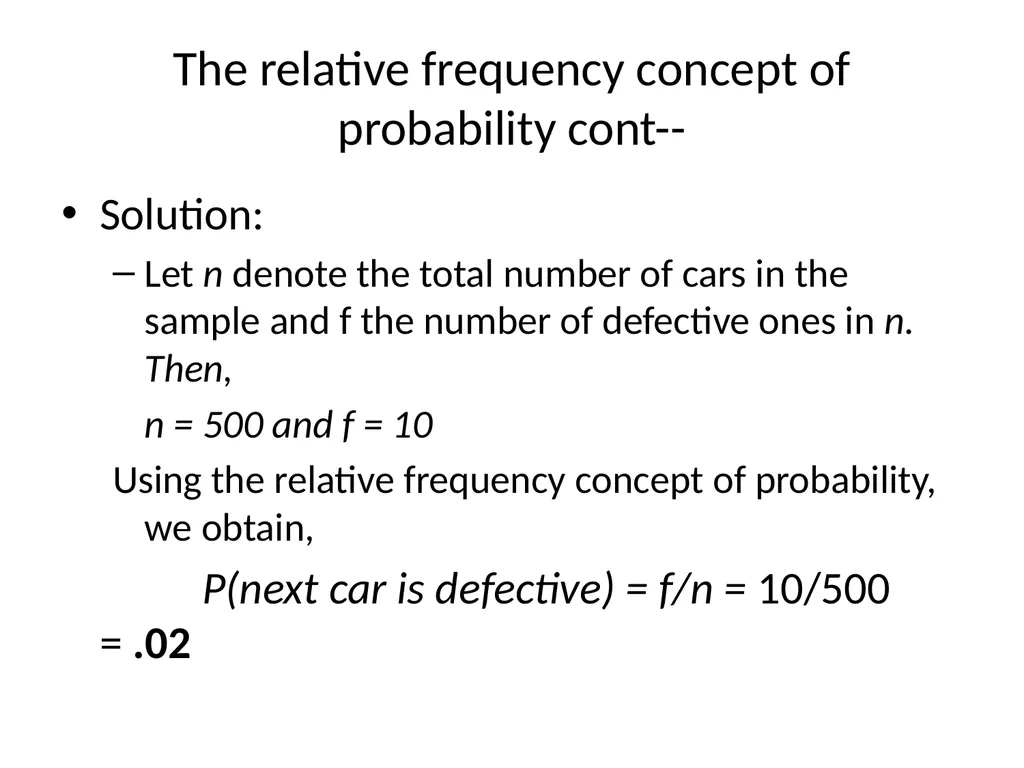
Let n denote the total number of cars in the sample and f the number of defective ones in n. Then,
n = 500 and f = 10
Using the relative frequency concept of probability, we obtain,
P(next car is defective) = f/n = 10/500 = .02<br>
Let n denote the total number of cars in the sample and f the number of defective ones in n. Then,
n = 500 and f = 10
Using the relative frequency concept of probability, we obtain,
P(next car is defective) = f/n = 10/500 = .02<br>
16
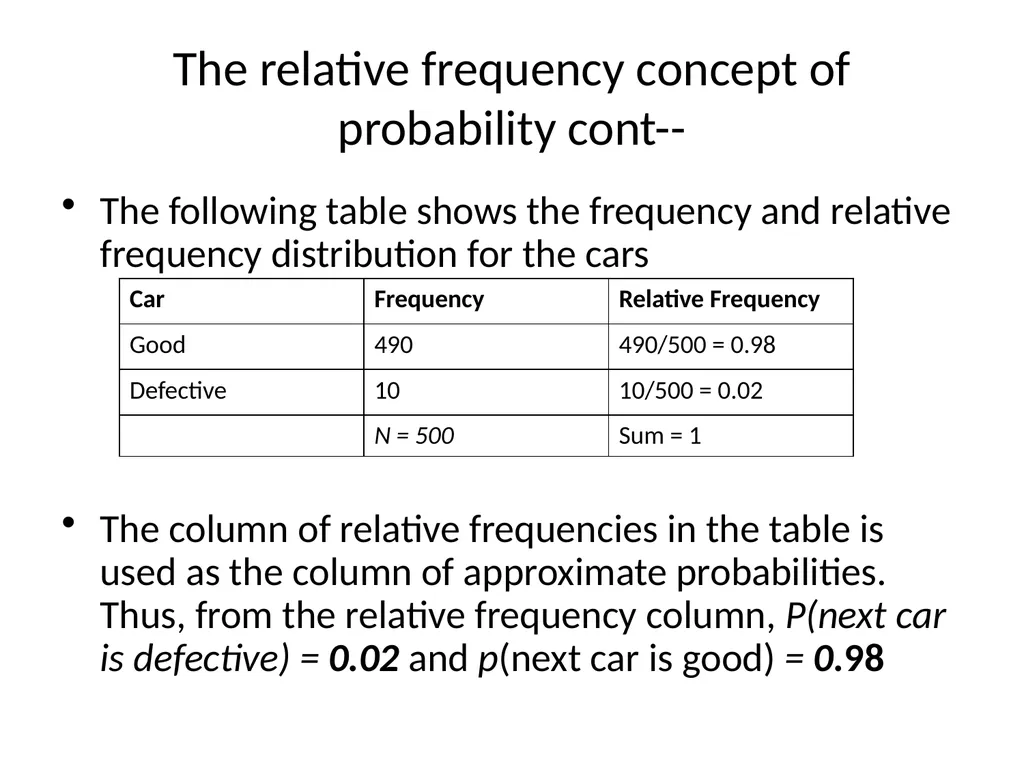
The relative frequency concept of probability cont-- The following table shows the frequency and relative frequency distribution for the cars
The column of relative frequencies in the table is used as the column of approximate probabilities. Thus, from the relative frequency column, P(next car is defective) = 0.02 and p(next car is good) = 0.98<br>
The column of relative frequencies in the table is used as the column of approximate probabilities. Thus, from the relative frequency column, P(next car is defective) = 0.02 and p(next car is good) = 0.98<br>
17
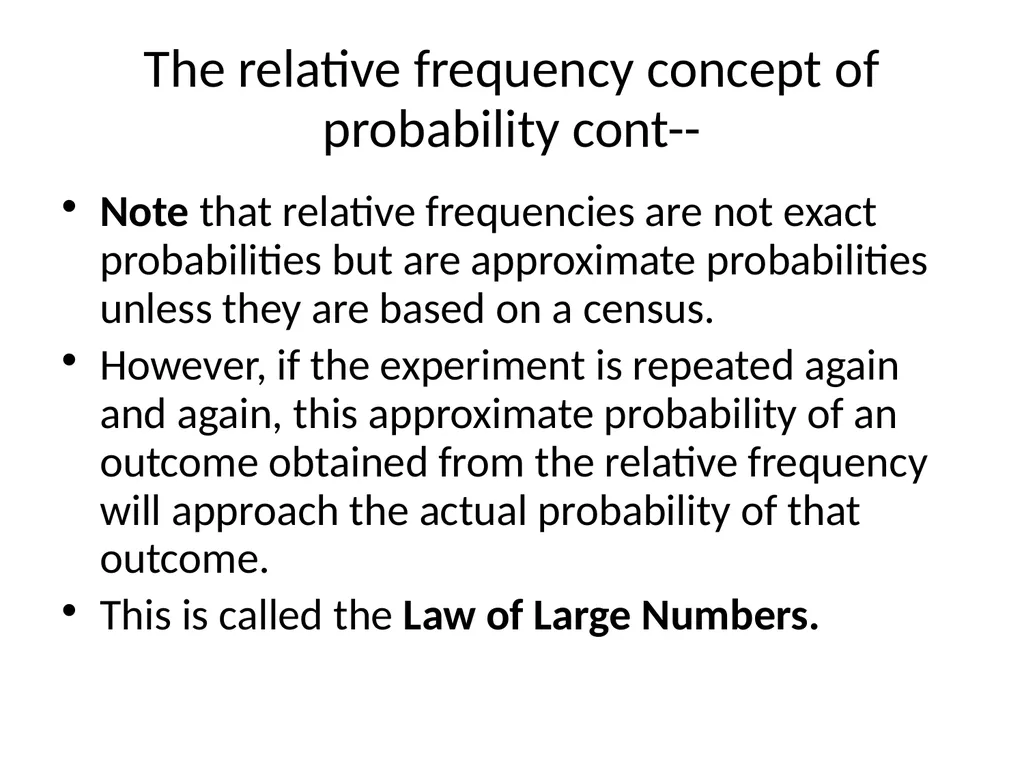
The relative frequency concept of probability cont-- Note that relative frequencies are not exact probabilities but are approximate probabilities unless they are based on a census.
However, if the experiment is repeated again and again, this approximate probability of an outcome obtained from the relative frequency will approach the actual probability of that outcome.
This is called the Law of Large Numbers.<br>
However, if the experiment is repeated again and again, this approximate probability of an outcome obtained from the relative frequency will approach the actual probability of that outcome.
This is called the Law of Large Numbers.<br>
18
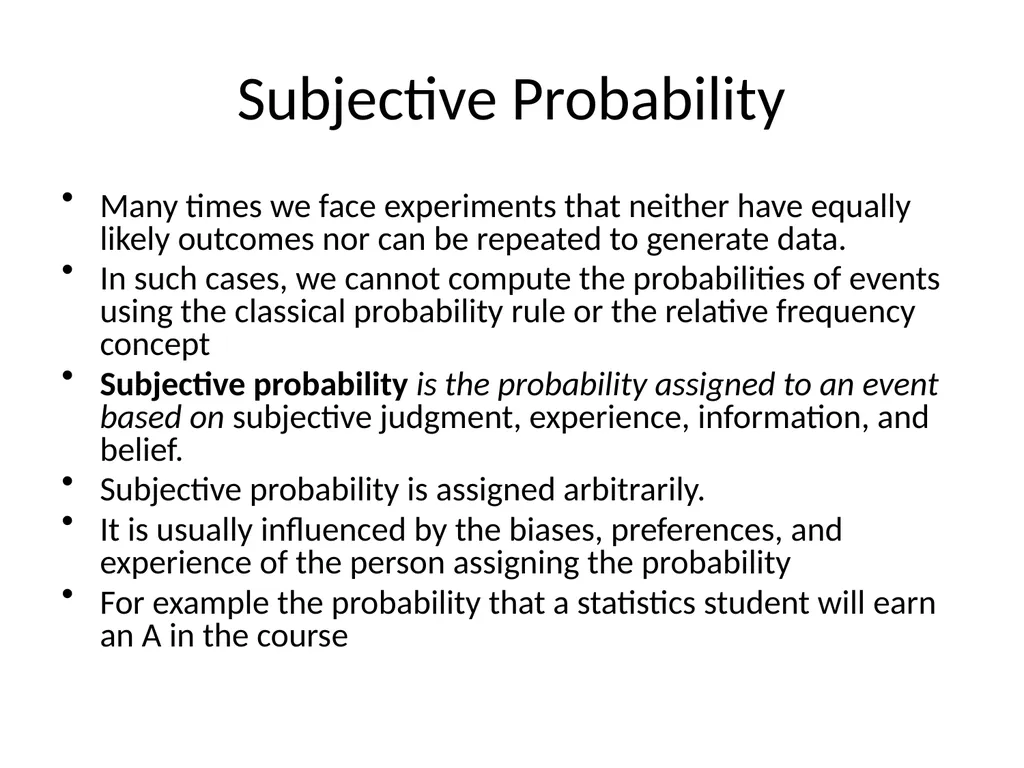
Subjective Probability Many times we face experiments that neither have equally likely outcomes nor can be repeated to generate data.
In such cases, we cannot compute the probabilities of events using the classical probability rule or the relative frequency concept
Subjective probability is the probability assigned to an event based on subjective judgment, experience, information, and belief.
Subjective probability is assigned arbitrarily.
It is usually influenced by the biases, preferences, and experience of the person assigning the probability
For example the probability that a statistics student will earn an A in the course<br>
In such cases, we cannot compute the probabilities of events using the classical probability rule or the relative frequency concept
Subjective probability is the probability assigned to an event based on subjective judgment, experience, information, and belief.
Subjective probability is assigned arbitrarily.
It is usually influenced by the biases, preferences, and experience of the person assigning the probability
For example the probability that a statistics student will earn an A in the course<br>
19
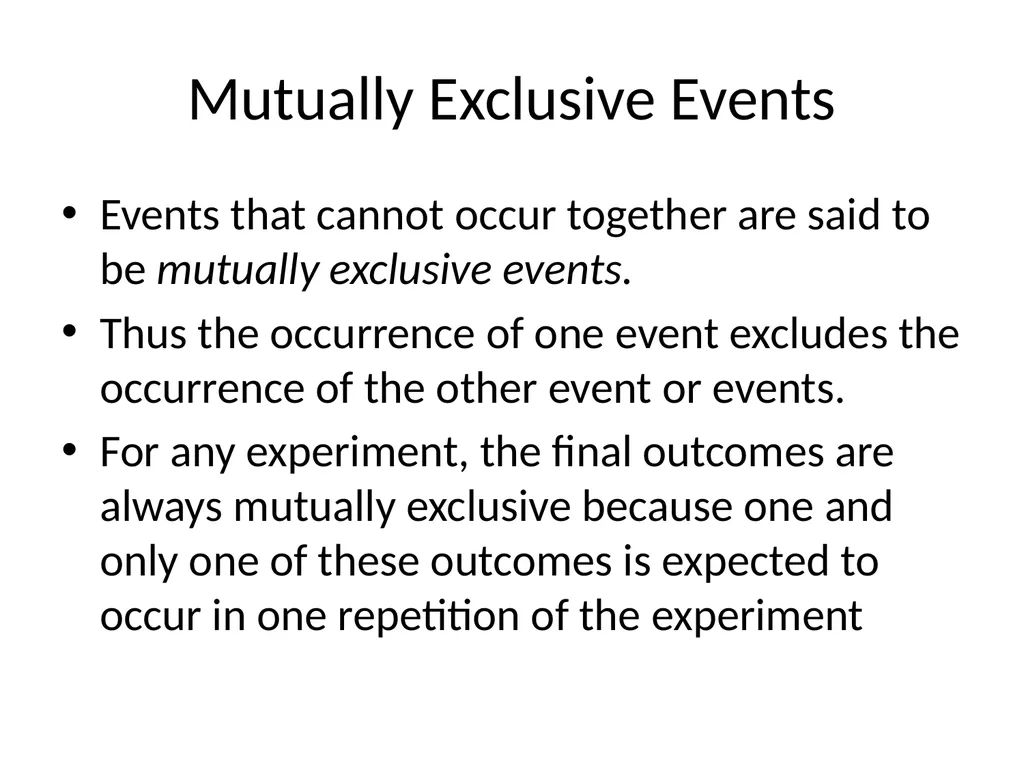
Mutually Exclusive Events Events that cannot occur together are said to be mutually exclusive events.
Thus the occurrence of one event excludes the occurrence of the other event or events.
For any experiment, the final outcomes are always mutually exclusive because one and only one of these outcomes is expected to occur in one repetition of the experiment<br>
Thus the occurrence of one event excludes the occurrence of the other event or events.
For any experiment, the final outcomes are always mutually exclusive because one and only one of these outcomes is expected to occur in one repetition of the experiment<br>
20
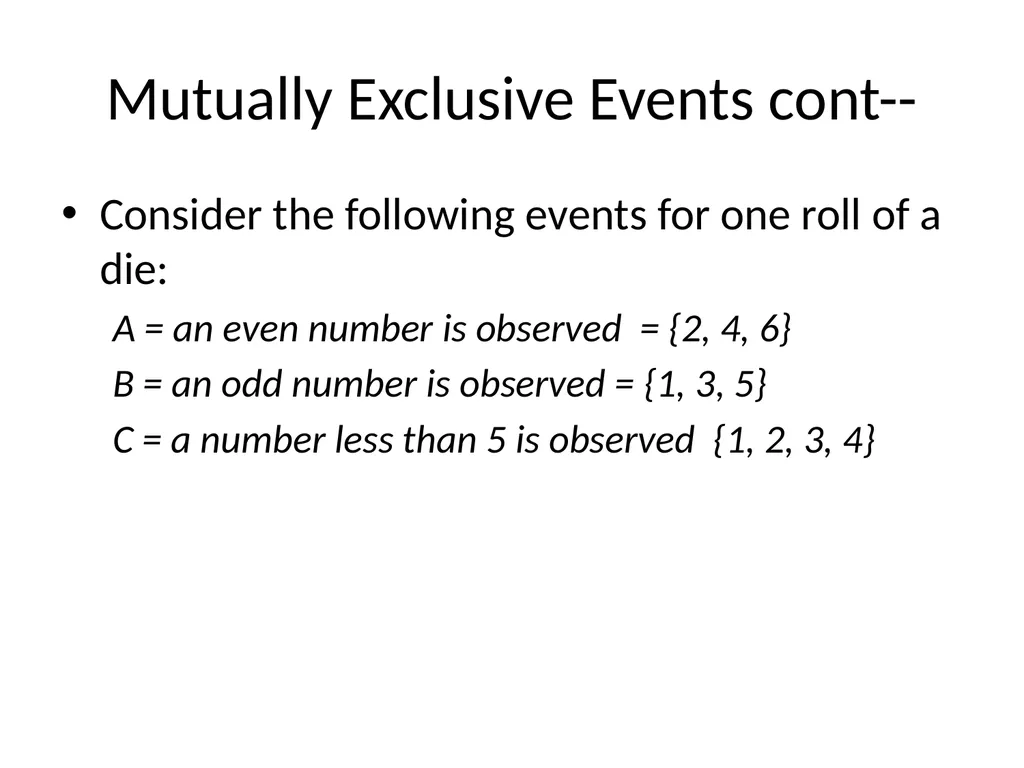
Mutually Exclusive Events cont-- Consider the following events for one roll of a die:
A = an even number is observed = {2, 4, 6}
B = an odd number is observed = {1, 3, 5}
C = a number less than 5 is observed {1, 2, 3, 4}<br>
A = an even number is observed = {2, 4, 6}
B = an odd number is observed = {1, 3, 5}
C = a number less than 5 is observed {1, 2, 3, 4}<br>
21
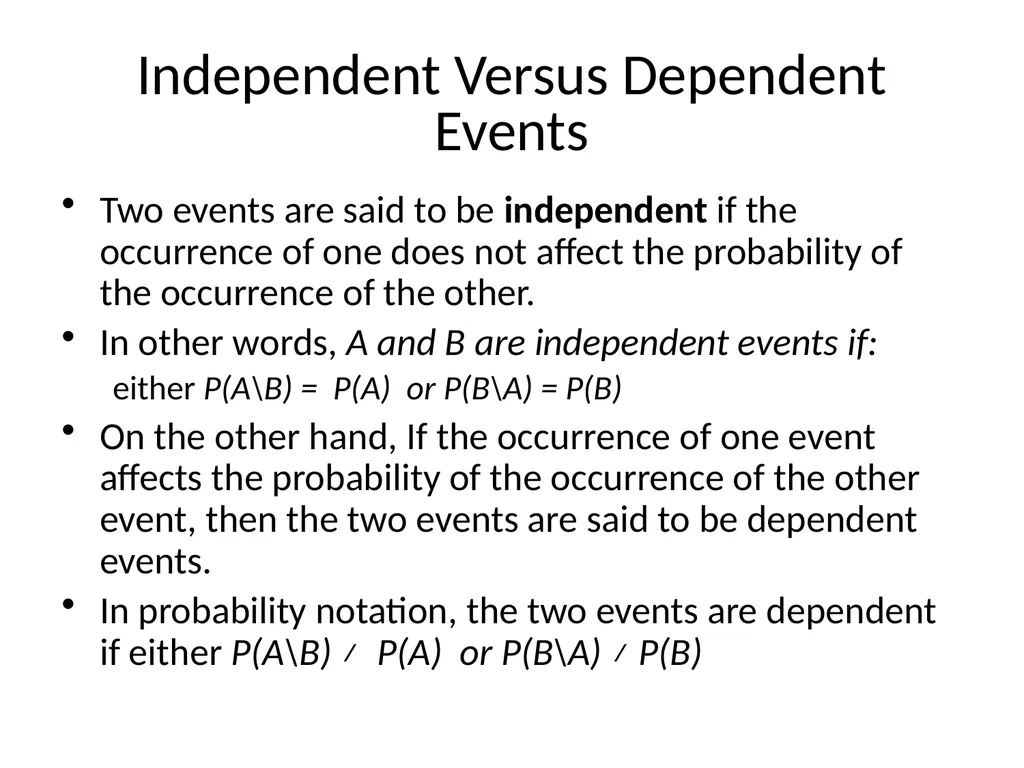
Independent Versus Dependent Events Two events are said to be independent if the occurrence of one does not affect the probability of the occurrence of the other.
In other words, A and B are independent events if:
either P(A\B) = P(A) or P(B\A) = P(B)
On the other hand, If the occurrence of one event affects the probability of the occurrence of the other event, then the two events are said to be dependent events.
In probability notation, the two events are dependent if either P(A\B) ≠ P(A) or P(B\A) ≠ P(B)<br>
In other words, A and B are independent events if:
either P(A\B) = P(A) or P(B\A) = P(B)
On the other hand, If the occurrence of one event affects the probability of the occurrence of the other event, then the two events are said to be dependent events.
In probability notation, the two events are dependent if either P(A\B) ≠ P(A) or P(B\A) ≠ P(B)<br>
22
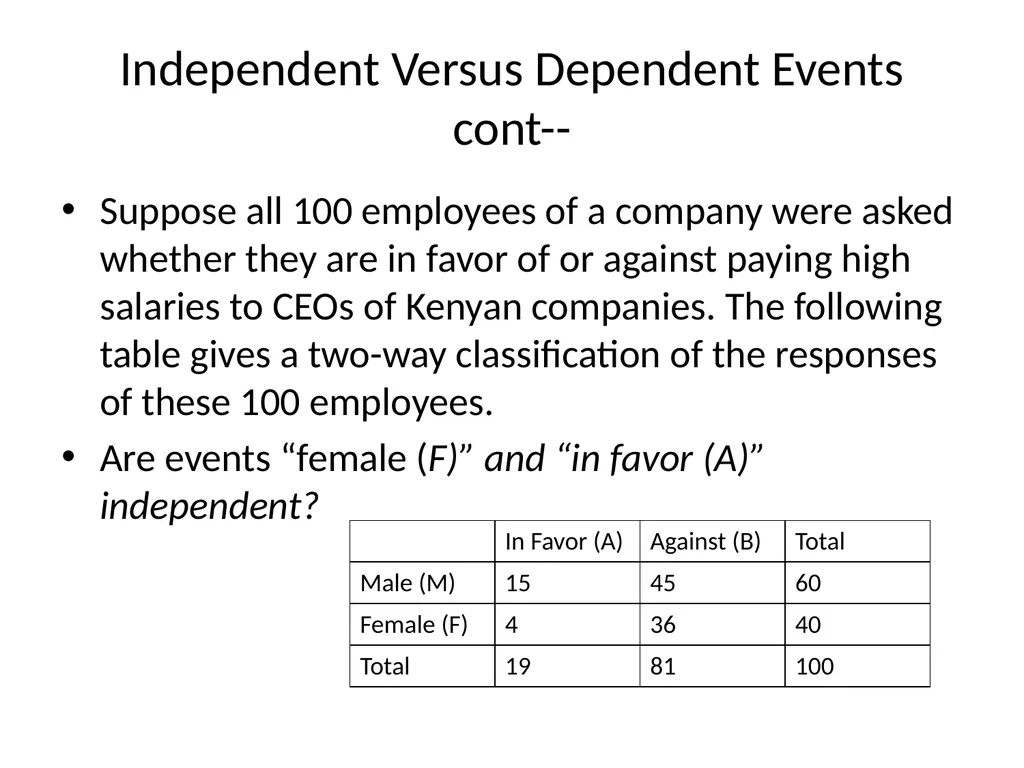
Independent Versus Dependent Events cont-- Suppose all 100 employees of a company were asked whether they are in favor of or against paying high salaries to CEOs of Kenyan companies. The following table gives a two-way classification of the responses of these 100 employees.
Are events “female (F)” and “in favor (A)” independent?<br>
Are events “female (F)” and “in favor (A)” independent?<br>
23
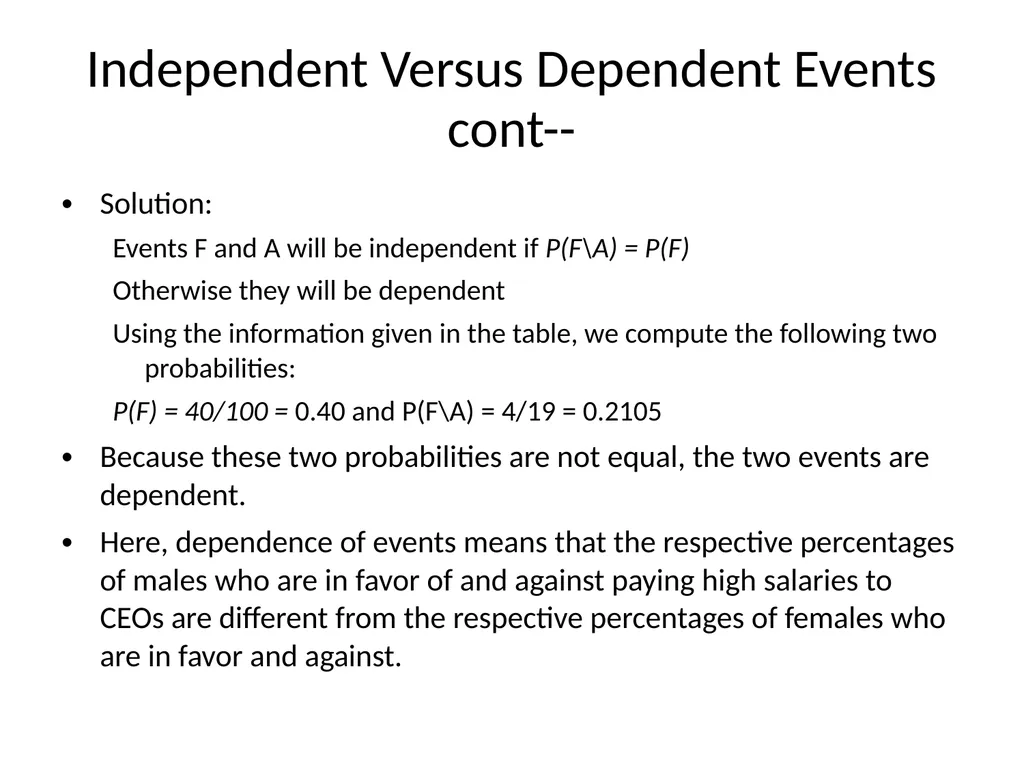
Independent Versus Dependent Events cont-- Solution:
Events F and A will be independent if P(F\A) = P(F)
Otherwise they will be dependent
Using the information given in the table, we compute the following two probabilities:
P(F) = 40/100 = 0.40 and P(F\A) = 4/19 = 0.2105
Because these two probabilities are not equal, the two events are dependent.
Here, dependence of events means that the respective percentages of males who are in favor of and against paying high salaries to CEOs are different from the respective percentages of females who are in favor and against.<br>
Events F and A will be independent if P(F\A) = P(F)
Otherwise they will be dependent
Using the information given in the table, we compute the following two probabilities:
P(F) = 40/100 = 0.40 and P(F\A) = 4/19 = 0.2105
Because these two probabilities are not equal, the two events are dependent.
Here, dependence of events means that the respective percentages of males who are in favor of and against paying high salaries to CEOs are different from the respective percentages of females who are in favor and against.<br>
24
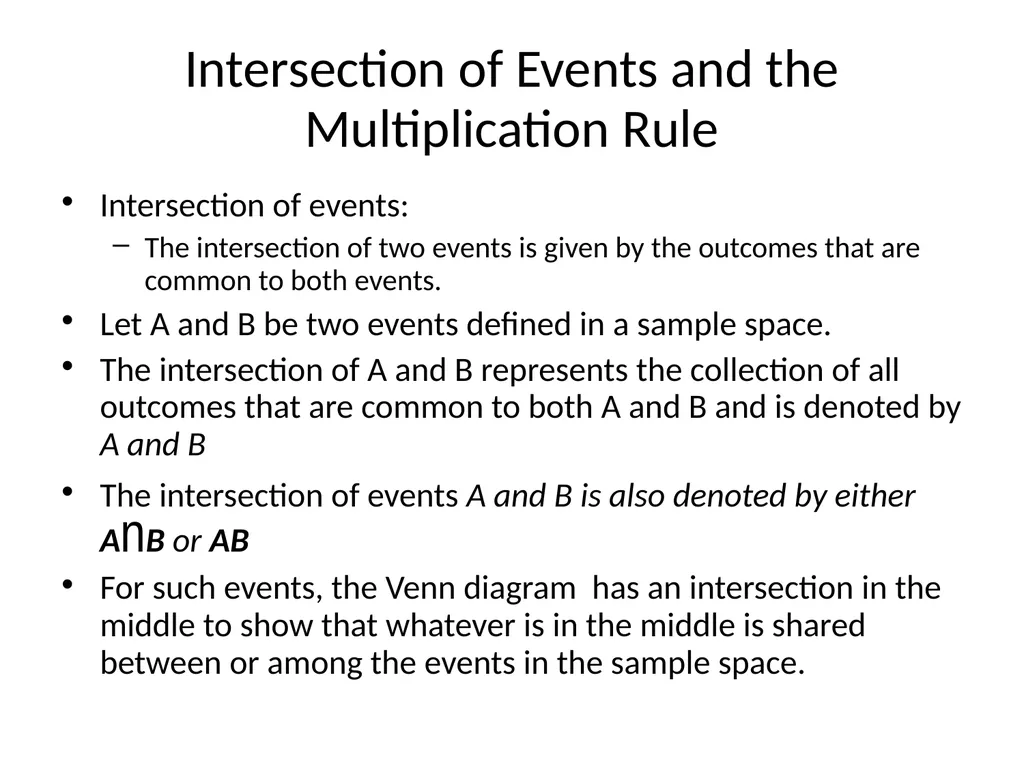
Intersection of Events and the Multiplication Rule Intersection of events:
The intersection of two events is given by the outcomes that are common to both events.
Let A and B be two events defined in a sample space.
The intersection of A and B represents the collection of all outcomes that are common to both A and B and is denoted by A and B
The intersection of events A and B is also denoted by either AnB or AB
For such events, the Venn diagram has an intersection in the middle to show that whatever is in the middle is shared between or among the events in the sample space.<br>
The intersection of two events is given by the outcomes that are common to both events.
Let A and B be two events defined in a sample space.
The intersection of A and B represents the collection of all outcomes that are common to both A and B and is denoted by A and B
The intersection of events A and B is also denoted by either AnB or AB
For such events, the Venn diagram has an intersection in the middle to show that whatever is in the middle is shared between or among the events in the sample space.<br>
25
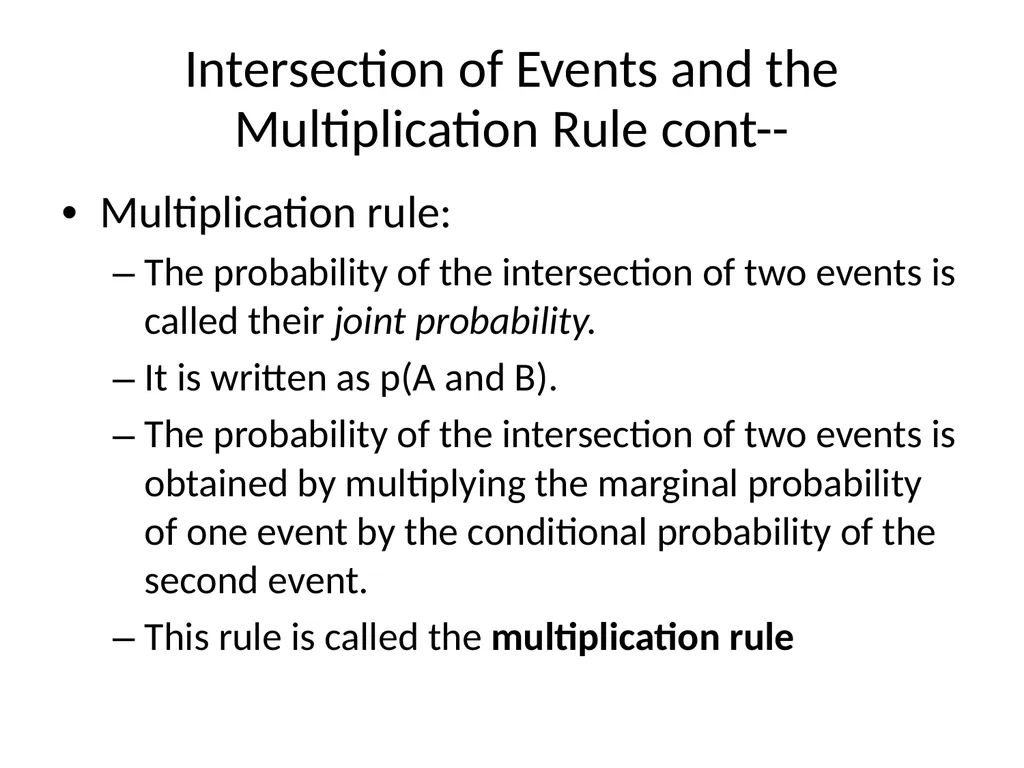
Intersection of Events and the Multiplication Rule cont-- Multiplication rule:
The probability of the intersection of two events is called their joint probability.
It is written as p(A and B).
The probability of the intersection of two events is obtained by multiplying the marginal probability of one event by the conditional probability of the second event.
This rule is called the multiplication rule<br>
The probability of the intersection of two events is called their joint probability.
It is written as p(A and B).
The probability of the intersection of two events is obtained by multiplying the marginal probability of one event by the conditional probability of the second event.
This rule is called the multiplication rule<br>
26
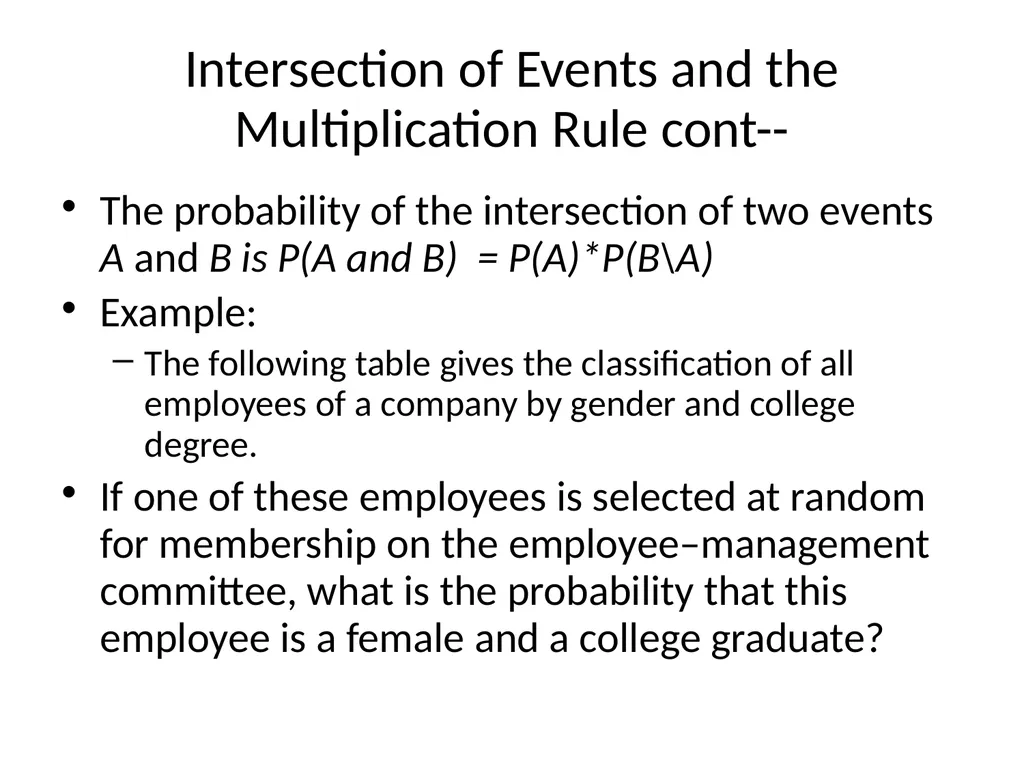
Intersection of Events and the Multiplication Rule cont-- The probability of the intersection of two events A and B is P(A and B) = P(A)*P(B\A)
Example:
The following table gives the classification of all employees of a company by gender and college degree.
If one of these employees is selected at random for membership on the employee–management committee, what is the probability that this employee is a female and a college graduate?<br>
Example:
The following table gives the classification of all employees of a company by gender and college degree.
If one of these employees is selected at random for membership on the employee–management committee, what is the probability that this employee is a female and a college graduate?<br>
27
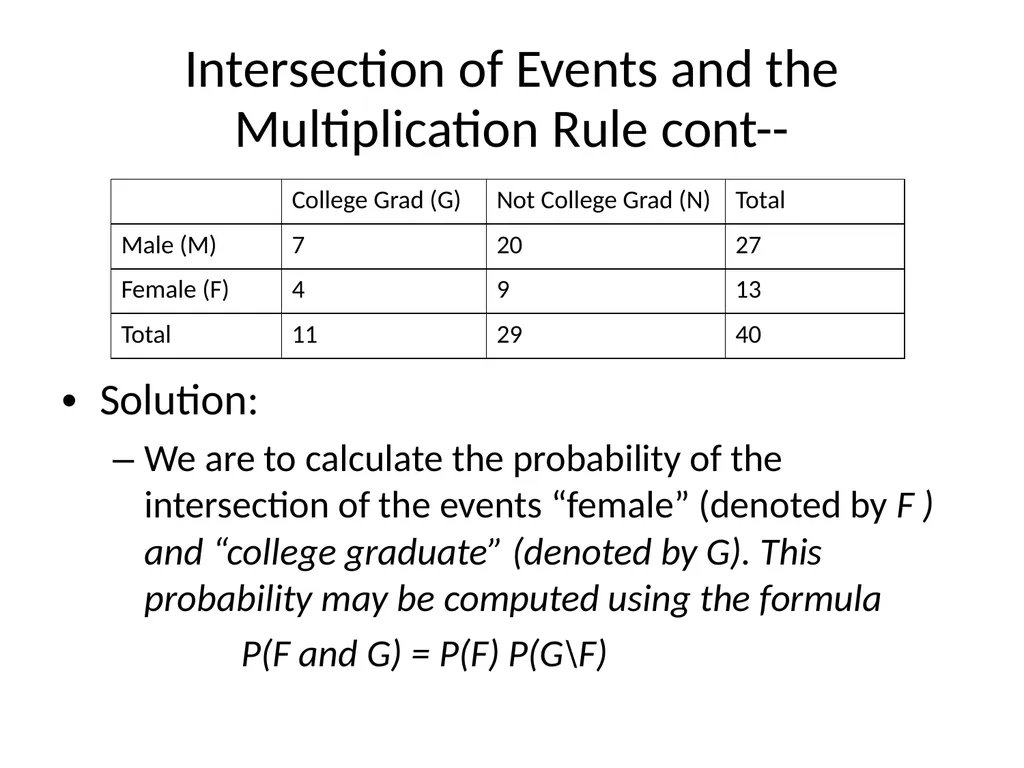
Intersection of Events and the Multiplication Rule cont-- Solution:
We are to calculate the probability of the intersection of the events “female” (denoted by F ) and “college graduate” (denoted by G). This probability may be computed using the formula
P(F and G) = P(F) P(G\F)<br>
We are to calculate the probability of the intersection of the events “female” (denoted by F ) and “college graduate” (denoted by G). This probability may be computed using the formula
P(F and G) = P(F) P(G\F)<br>
28
Intersection of Events and the Multiplication Rule cont-- Solution cont--
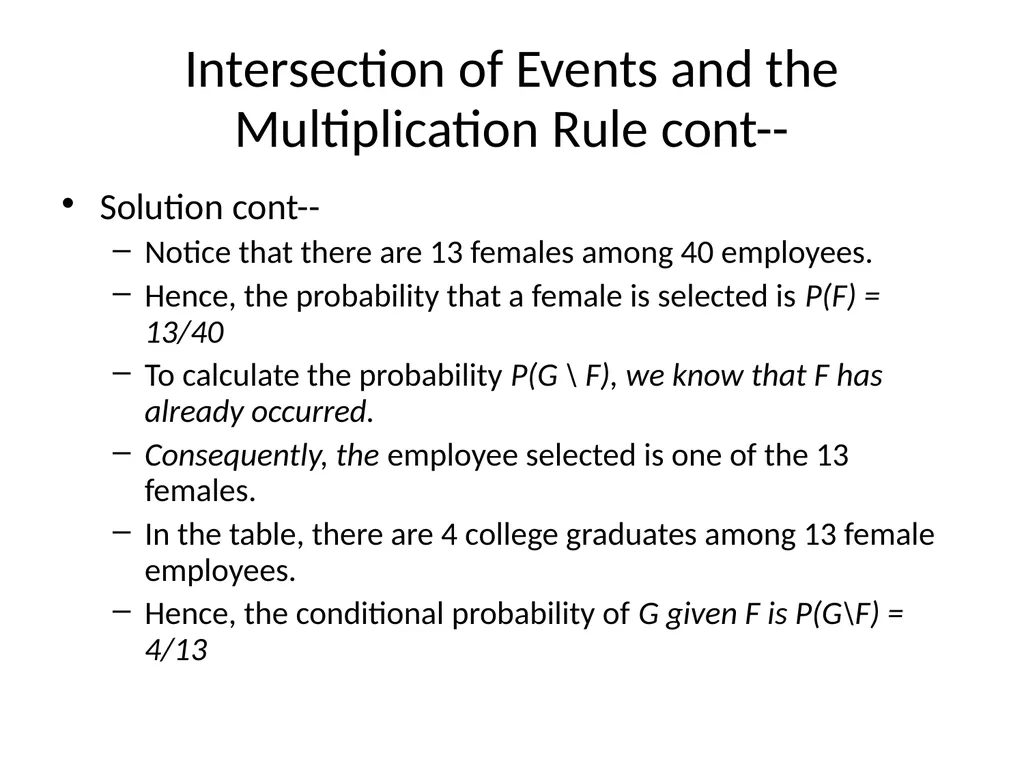
Notice that there are 13 females among 40 employees.
Hence, the probability that a female is selected is P(F) = 13/40
To calculate the probability P(G \ F), we know that F has already occurred.
Consequently, the employee selected is one of the 13 females.
In the table, there are 4 college graduates among 13 female employees.
Hence, the conditional probability of G given F is P(G\F) = 4/13<br>
Notice that there are 13 females among 40 employees.
Hence, the probability that a female is selected is P(F) = 13/40
To calculate the probability P(G \ F), we know that F has already occurred.
Consequently, the employee selected is one of the 13 females.
In the table, there are 4 college graduates among 13 female employees.
Hence, the conditional probability of G given F is P(G\F) = 4/13<br>
29
Intersection of Events and the Multiplication Rule cont-- Solution cont--
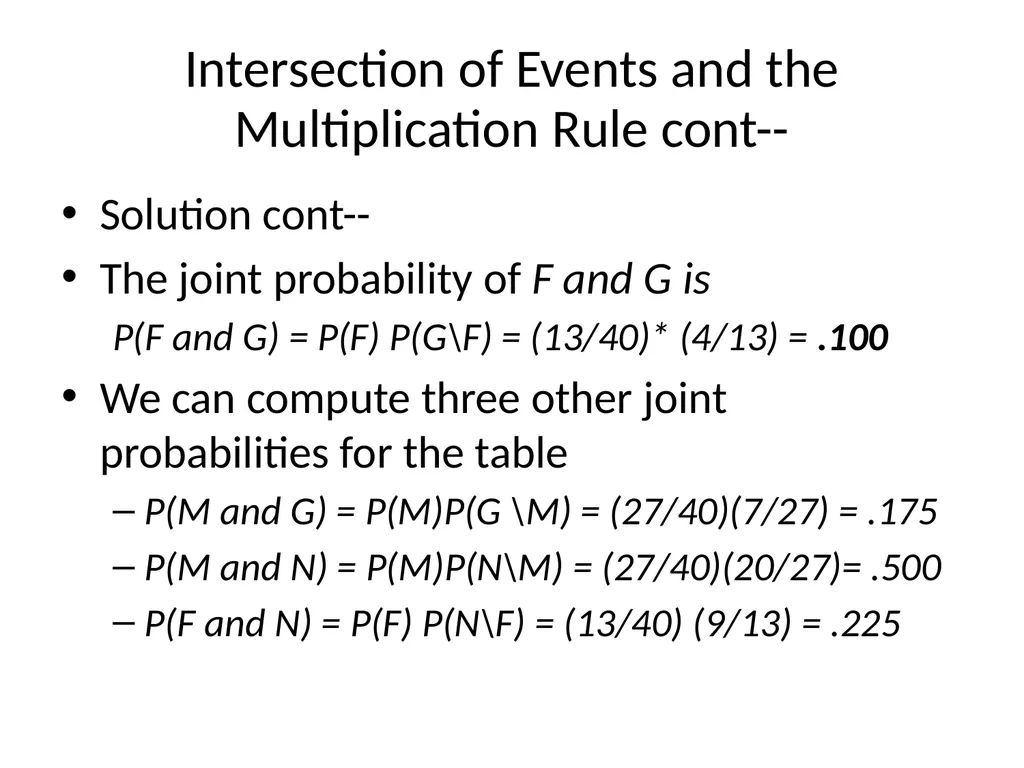
The joint probability of F and G is
P(F and G) = P(F) P(G\F) = (13/40)* (4/13) = .100
We can compute three other joint probabilities for the table
P(M and G) = P(M)P(G \M) = (27/40)(7/27) = .175
P(M and N) = P(M)P(N\M) = (27/40)(20/27)= .500
P(F and N) = P(F) P(N\F) = (13/40) (9/13) = .225<br>
The joint probability of F and G is
P(F and G) = P(F) P(G\F) = (13/40)* (4/13) = .100
We can compute three other joint probabilities for the table
P(M and G) = P(M)P(G \M) = (27/40)(7/27) = .175
P(M and N) = P(M)P(N\M) = (27/40)(20/27)= .500
P(F and N) = P(F) P(N\F) = (13/40) (9/13) = .225<br>
30
Intersection of Events and the Multiplication Rule cont-- Calculating conditional probability
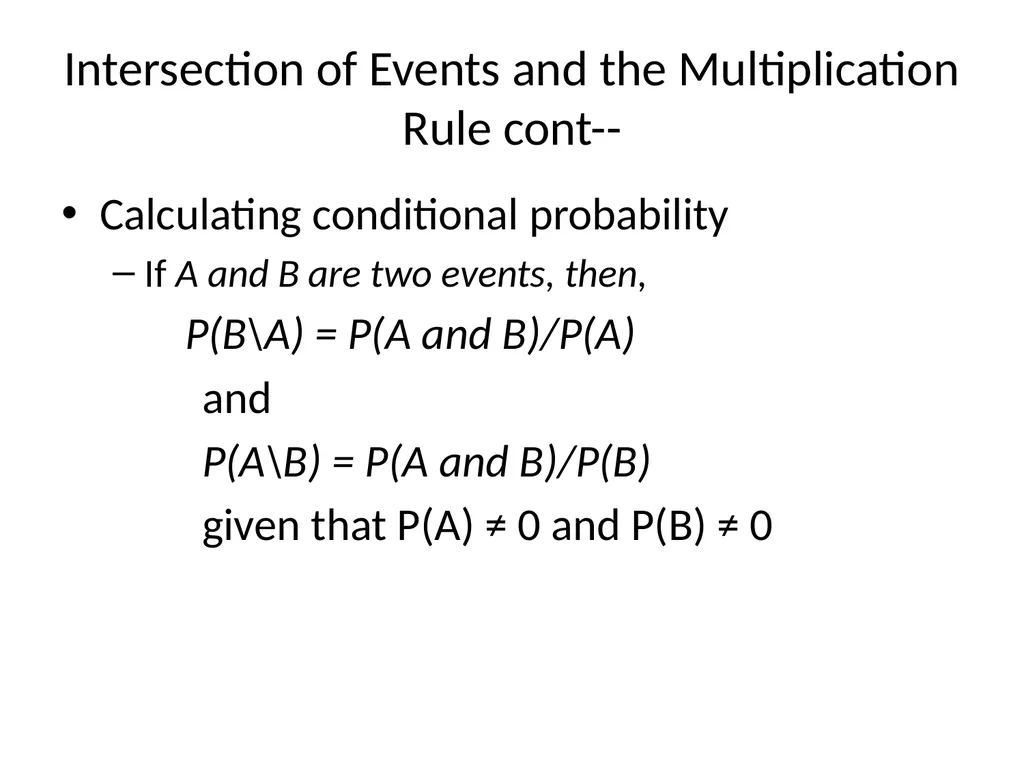
If A and B are two events, then,
P(B\A) = P(A and B)/P(A)
and
P(A\B) = P(A and B)/P(B)
given that P(A) ≠ 0 and P(B) ≠ 0<br>
If A and B are two events, then,
P(B\A) = P(A and B)/P(A)
and
P(A\B) = P(A and B)/P(B)
given that P(A) ≠ 0 and P(B) ≠ 0<br>
31
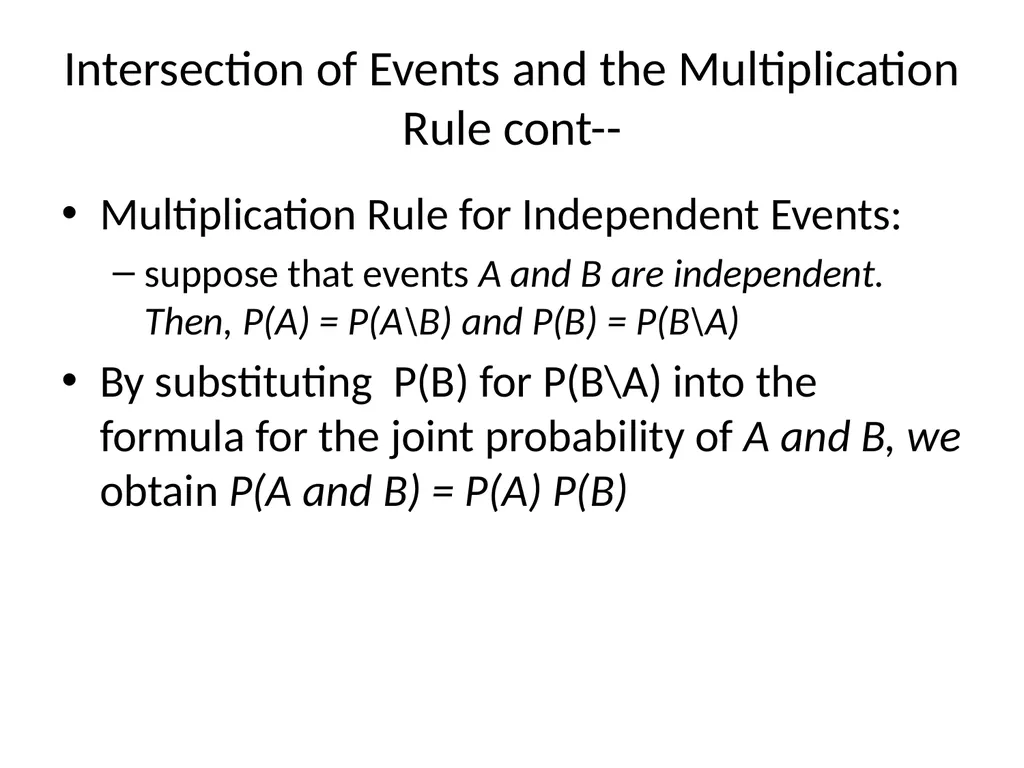
Intersection of Events and the Multiplication Rule cont-- Multiplication Rule for Independent Events:
suppose that events A and B are independent. Then, P(A) = P(A\B) and P(B) = P(B\A)
By substituting P(B) for P(B\A) into the formula for the joint probability of A and B, we obtain P(A and B) = P(A) P(B)<br>
suppose that events A and B are independent. Then, P(A) = P(A\B) and P(B) = P(B\A)
By substituting P(B) for P(B\A) into the formula for the joint probability of A and B, we obtain P(A and B) = P(A) P(B)<br>
32
Intersection of Events and the Multiplication Rule cont-- Example:
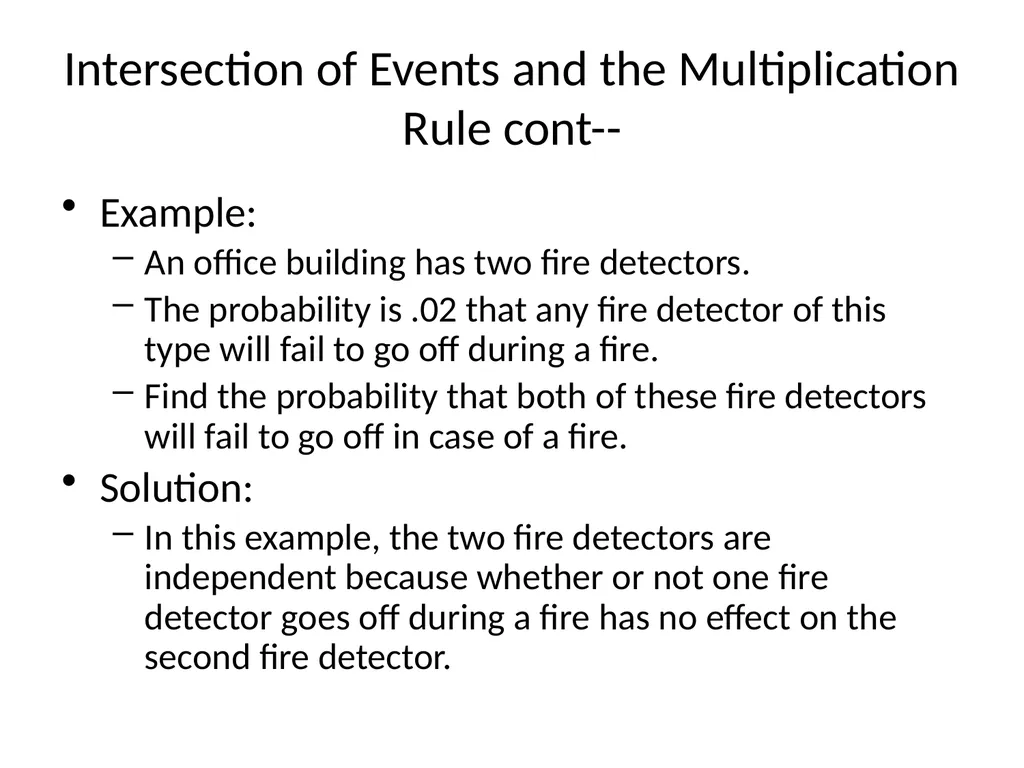
An office building has two fire detectors.
The probability is .02 that any fire detector of this type will fail to go off during a fire.
Find the probability that both of these fire detectors will fail to go off in case of a fire.
Solution:
In this example, the two fire detectors are independent because whether or not one fire detector goes off during a fire has no effect on the second fire detector.<br>
An office building has two fire detectors.
The probability is .02 that any fire detector of this type will fail to go off during a fire.
Find the probability that both of these fire detectors will fail to go off in case of a fire.
Solution:
In this example, the two fire detectors are independent because whether or not one fire detector goes off during a fire has no effect on the second fire detector.<br>
33
Intersection of Events and the Multiplication Rule cont-- Solution cont—
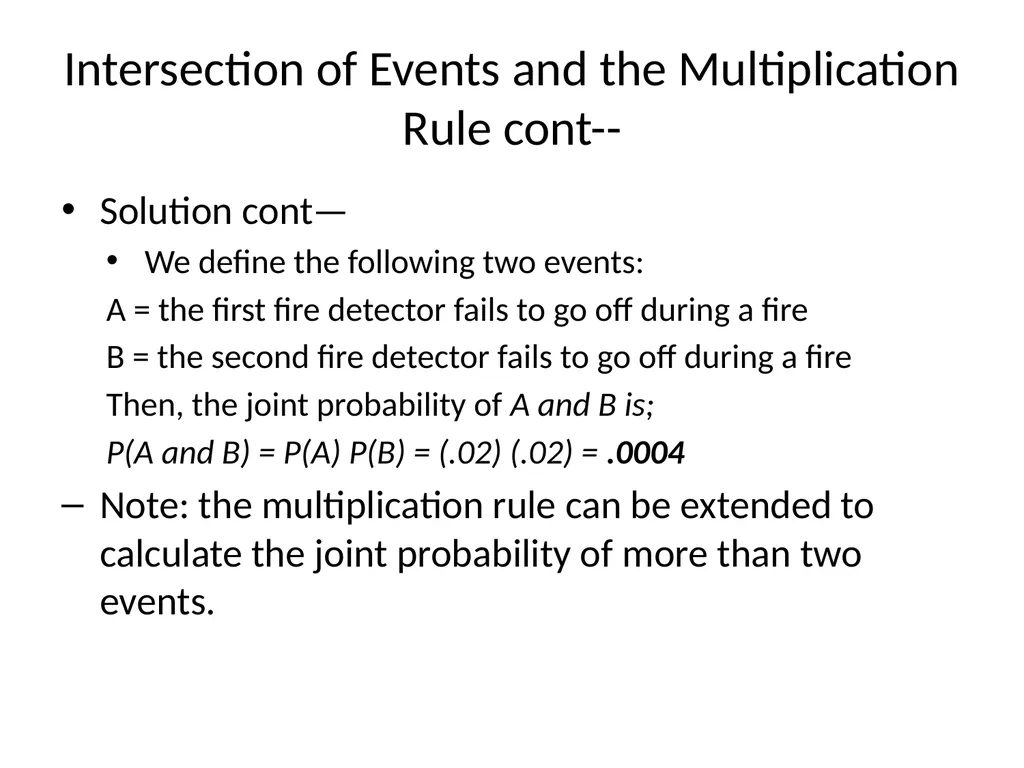
We define the following two events:
A = the first fire detector fails to go off during a fire
B = the second fire detector fails to go off during a fire
Then, the joint probability of A and B is;
P(A and B) = P(A) P(B) = (.02) (.02) = .0004
Note: the multiplication rule can be extended to calculate the joint probability of more than two events.<br>
We define the following two events:
A = the first fire detector fails to go off during a fire
B = the second fire detector fails to go off during a fire
Then, the joint probability of A and B is;
P(A and B) = P(A) P(B) = (.02) (.02) = .0004
Note: the multiplication rule can be extended to calculate the joint probability of more than two events.<br>
34
Intersection of Events and the Multiplication Rule cont-- Joint Probability of Mutually Exclusive Events
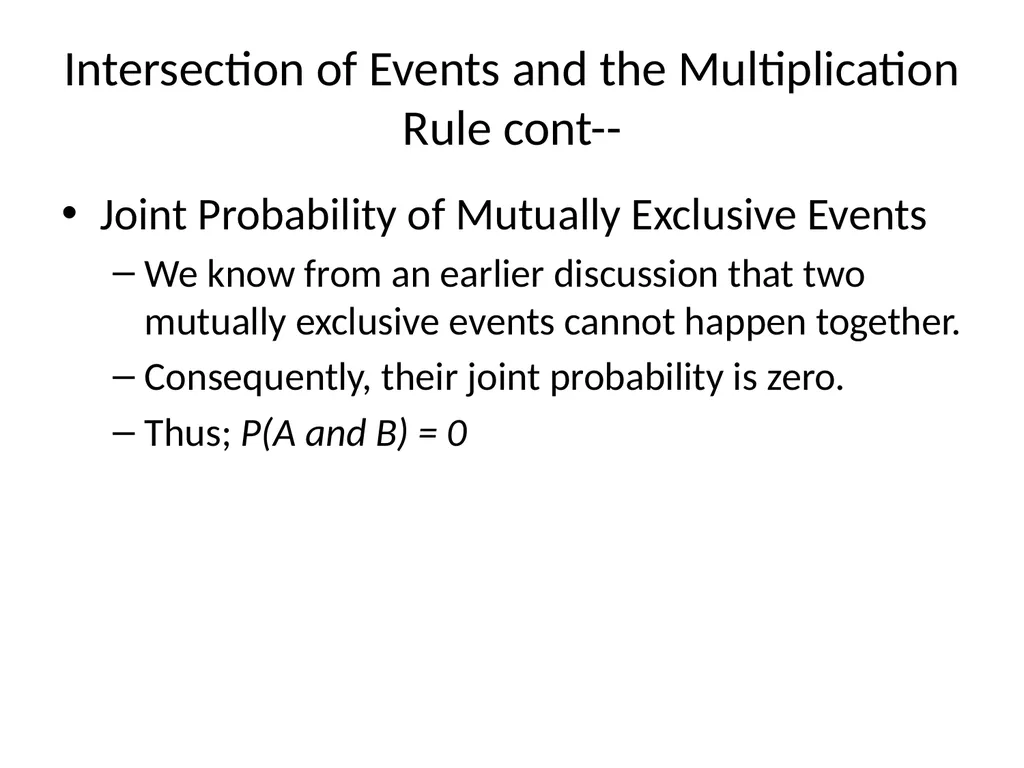
We know from an earlier discussion that two mutually exclusive events cannot happen together.
Consequently, their joint probability is zero.
Thus; P(A and B) = 0<br>
We know from an earlier discussion that two mutually exclusive events cannot happen together.
Consequently, their joint probability is zero.
Thus; P(A and B) = 0<br>
35
Union of Events and the Addition Rule Union of Events
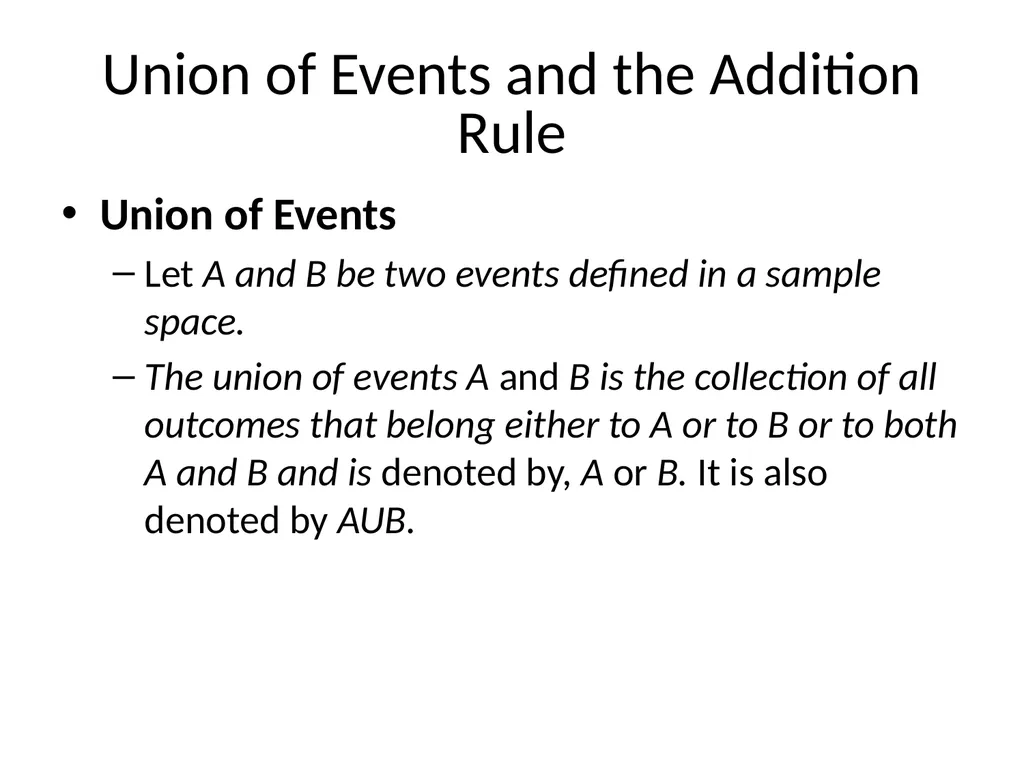
Let A and B be two events defined in a sample space.
The union of events A and B is the collection of all outcomes that belong either to A or to B or to both A and B and is denoted by, A or B. It is also denoted by AUB.<br>
Let A and B be two events defined in a sample space.
The union of events A and B is the collection of all outcomes that belong either to A or to B or to both A and B and is denoted by, A or B. It is also denoted by AUB.<br>
36
Union of Events and the Addition Rule cont-- Example:
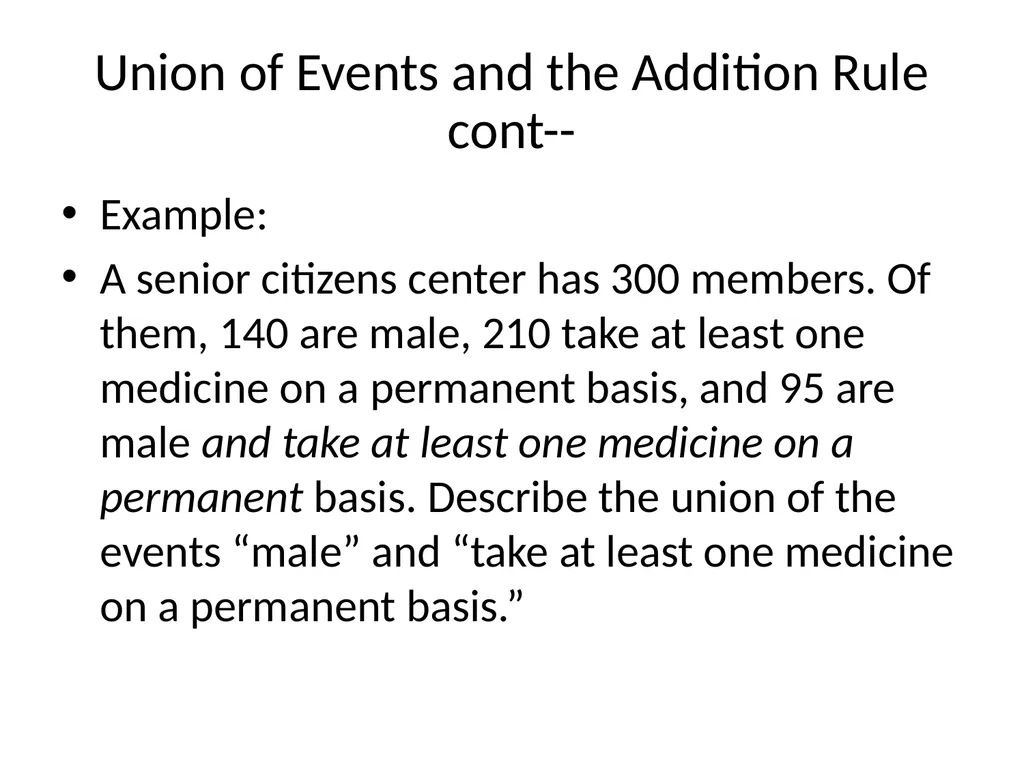
A senior citizens center has 300 members. Of them, 140 are male, 210 take at least one medicine on a permanent basis, and 95 are male and take at least one medicine on a permanent basis. Describe the union of the events “male” and “take at least one medicine on a permanent basis.”<br>
A senior citizens center has 300 members. Of them, 140 are male, 210 take at least one medicine on a permanent basis, and 95 are male and take at least one medicine on a permanent basis. Describe the union of the events “male” and “take at least one medicine on a permanent basis.”<br>
37
Union of Events and the Addition Rule cont-- Solution:
Let us define the following events:
M = A senior citizen is a Male
F = A senior citizen is a Female
A = A senior citizen takes at least one medicine
B = A senior citizen does not take any medicine
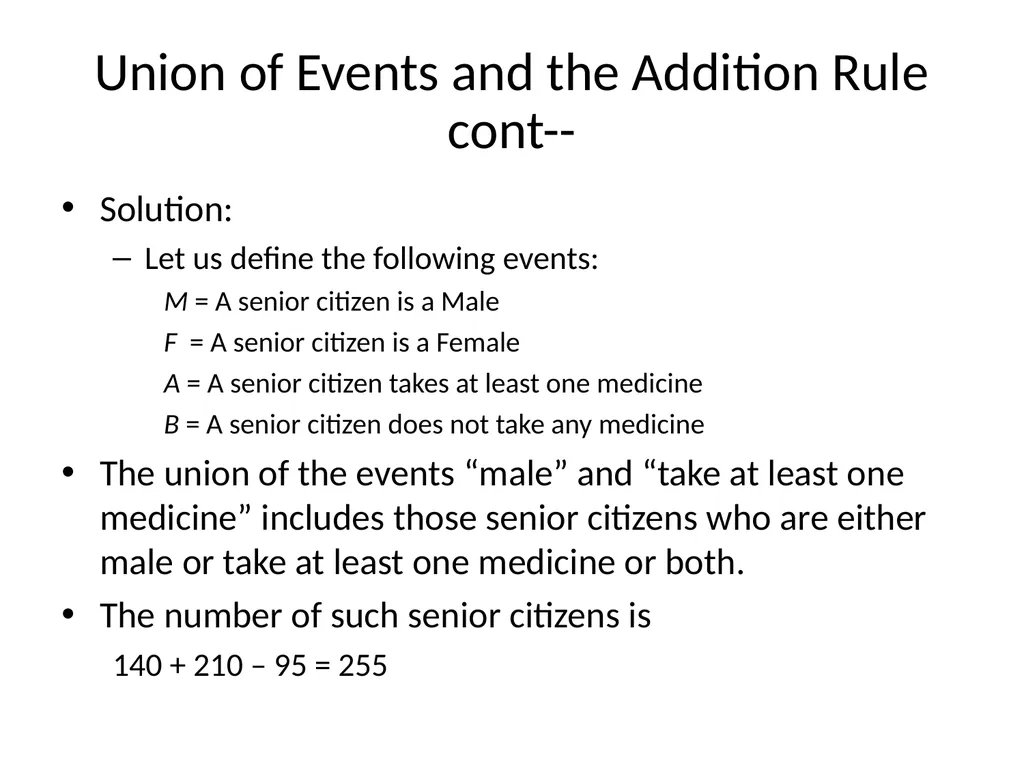
The union of the events “male” and “take at least one medicine” includes those senior citizens who are either male or take at least one medicine or both.
The number of such senior citizens is
140 + 210 – 95 = 255<br>
Let us define the following events:
M = A senior citizen is a Male
F = A senior citizen is a Female
A = A senior citizen takes at least one medicine
B = A senior citizen does not take any medicine
The union of the events “male” and “take at least one medicine” includes those senior citizens who are either male or take at least one medicine or both.
The number of such senior citizens is
140 + 210 – 95 = 255<br>
38
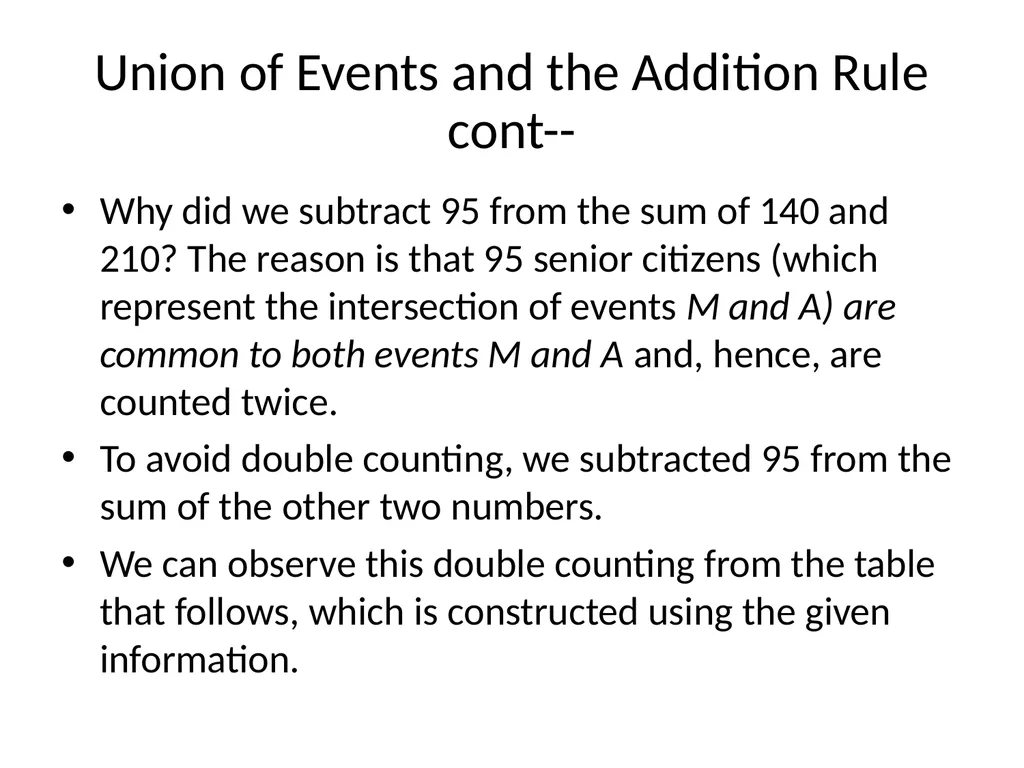
Union of Events and the Addition Rule cont-- Why did we subtract 95 from the sum of 140 and 210? The reason is that 95 senior citizens (which represent the intersection of events M and A) are common to both events M and A and, hence, are counted twice.
To avoid double counting, we subtracted 95 from the sum of the other two numbers.
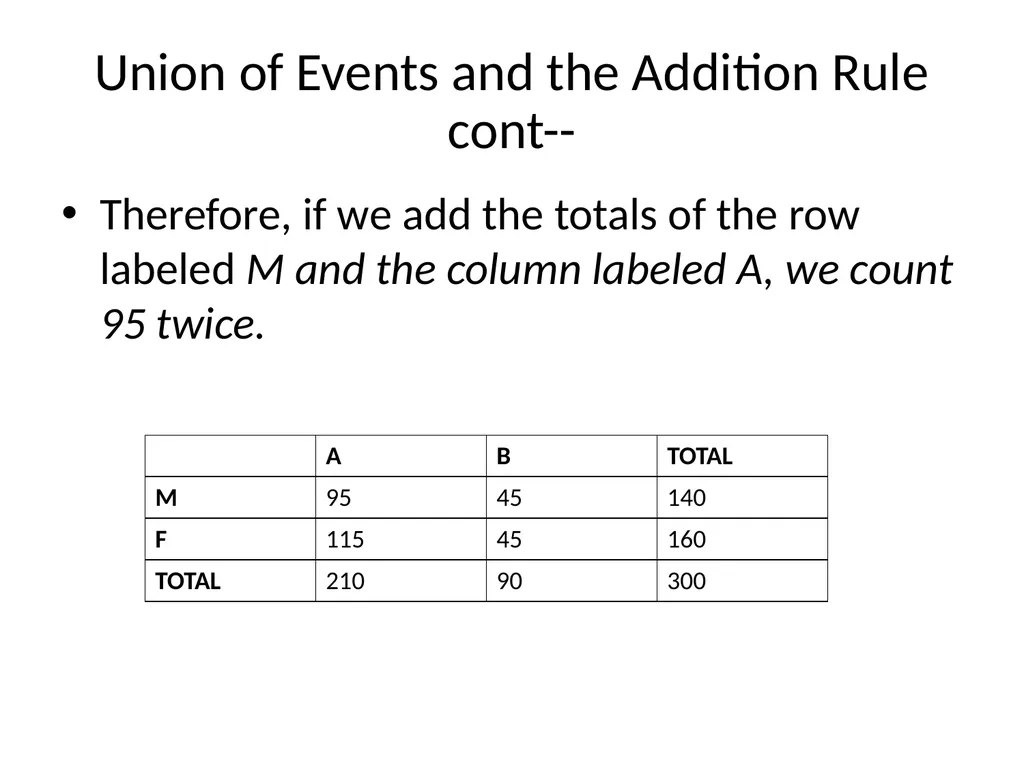
We can observe this double counting from the table that follows, which is constructed using the given information.<br>
To avoid double counting, we subtracted 95 from the sum of the other two numbers.
We can observe this double counting from the table that follows, which is constructed using the given information.<br>
39
Union of Events and the Addition Rule cont-- Therefore, if we add the totals of the row labeled M and the column labeled A, we count 95 twice.<br>
40
Union of Events and the Addition Rule cont-- Addition Rule:
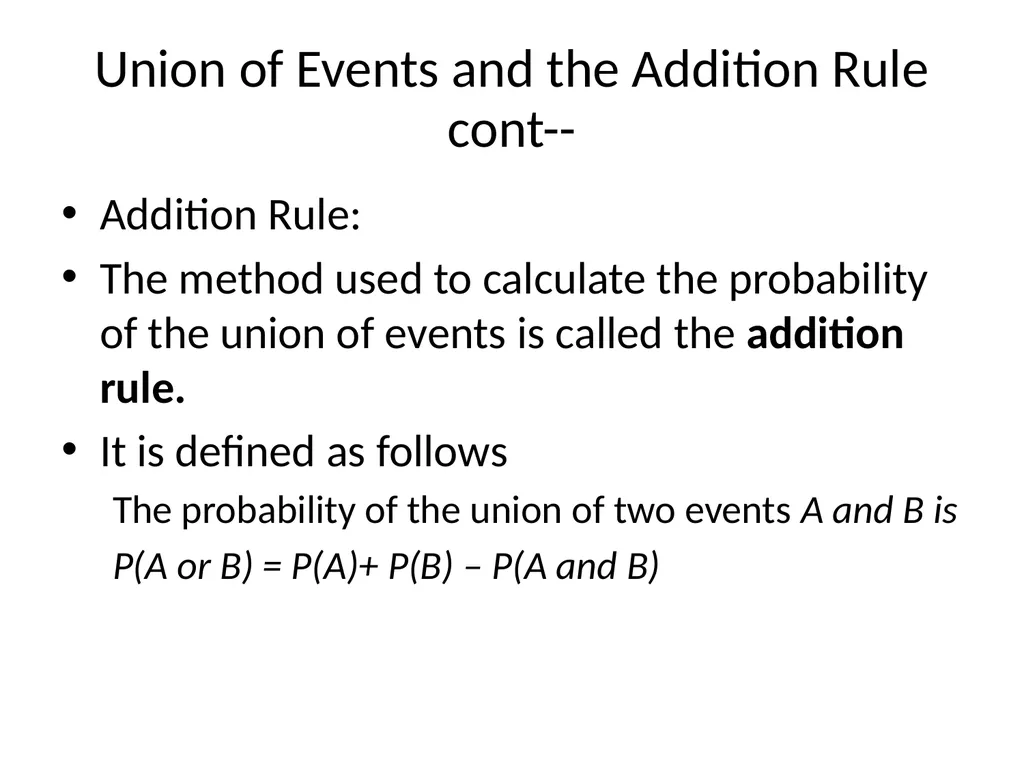
The method used to calculate the probability of the union of events is called the addition rule.
It is defined as follows
The probability of the union of two events A and B is
P(A or B) = P(A)+ P(B) – P(A and B)<br>
The method used to calculate the probability of the union of events is called the addition rule.
It is defined as follows
The probability of the union of two events A and B is
P(A or B) = P(A)+ P(B) – P(A and B)<br>
41
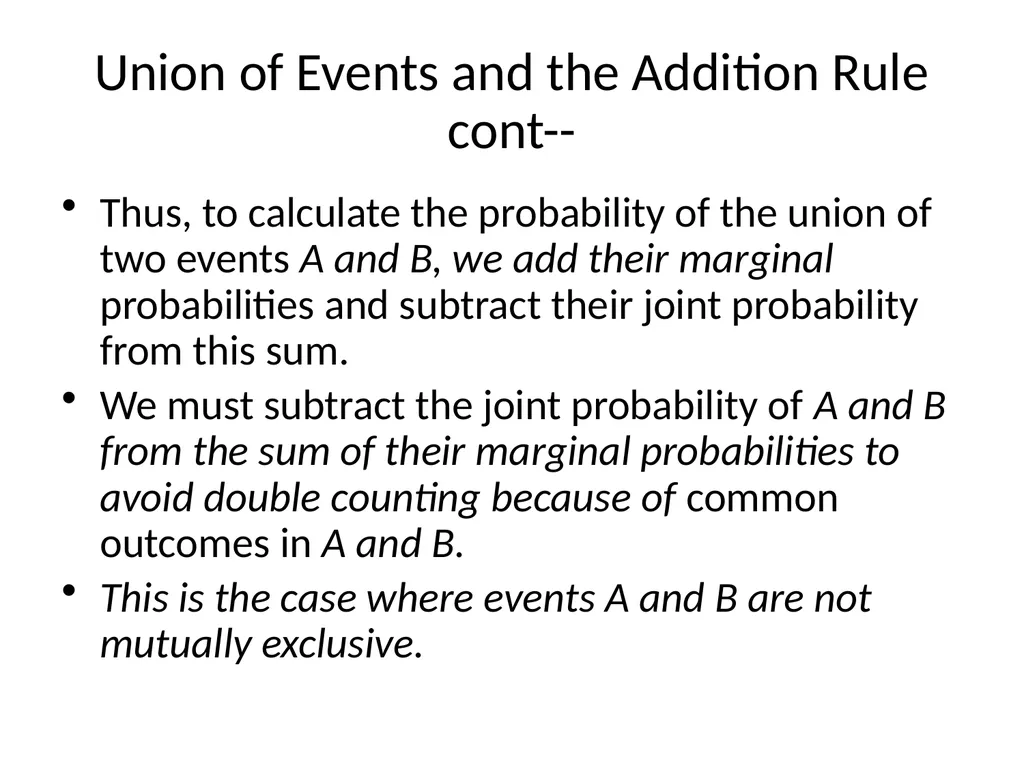
Union of Events and the Addition Rule cont-- Thus, to calculate the probability of the union of two events A and B, we add their marginal probabilities and subtract their joint probability from this sum.
We must subtract the joint probability of A and B from the sum of their marginal probabilities to avoid double counting because of common outcomes in A and B.
This is the case where events A and B are not mutually exclusive.<br>
We must subtract the joint probability of A and B from the sum of their marginal probabilities to avoid double counting because of common outcomes in A and B.
This is the case where events A and B are not mutually exclusive.<br>
42
Union of Events and the Addition Rule cont-- Example:
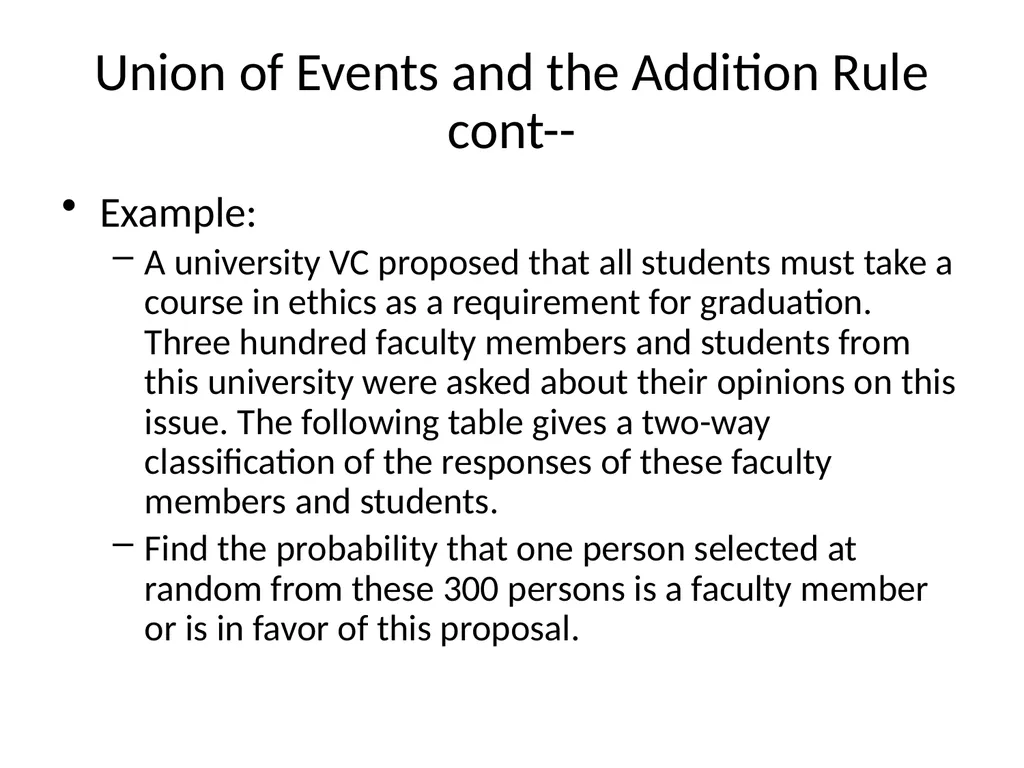
A university VC proposed that all students must take a course in ethics as a requirement for graduation. Three hundred faculty members and students from this university were asked about their opinions on this issue. The following table gives a two-way classification of the responses of these faculty members and students.
Find the probability that one person selected at random from these 300 persons is a faculty member or is in favor of this proposal.<br>
A university VC proposed that all students must take a course in ethics as a requirement for graduation. Three hundred faculty members and students from this university were asked about their opinions on this issue. The following table gives a two-way classification of the responses of these faculty members and students.
Find the probability that one person selected at random from these 300 persons is a faculty member or is in favor of this proposal.<br>
43
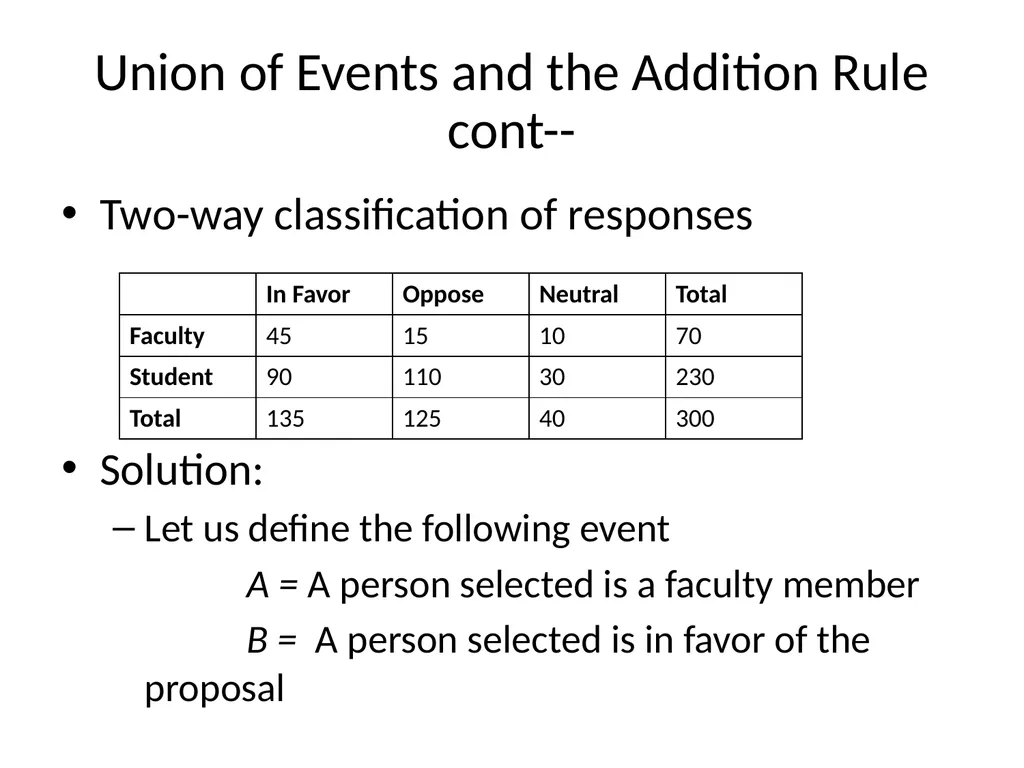
Union of Events and the Addition Rule cont-- Two-way classification of responses
Solution:
Let us define the following event
A = A person selected is a faculty member
B = A person selected is in favor of the proposal<br>
Solution:
Let us define the following event
A = A person selected is a faculty member
B = A person selected is in favor of the proposal<br>
44
Union of Events and the Addition Rule cont-- Solution cont—
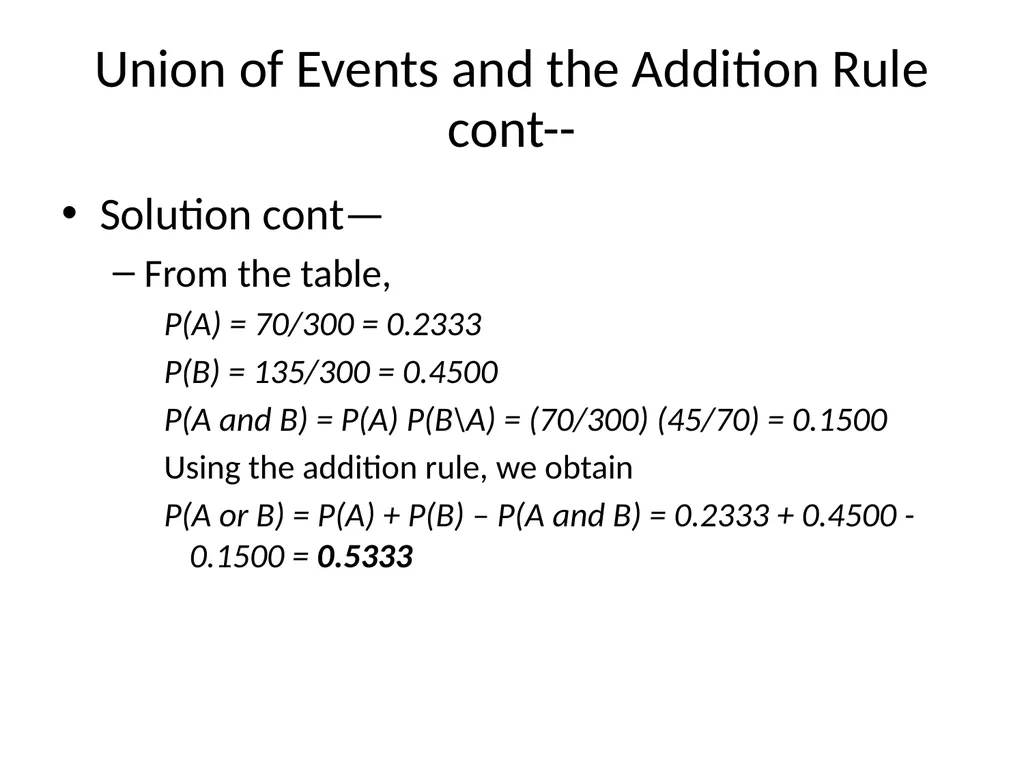
From the table,
P(A) = 70/300 = 0.2333
P(B) = 135/300 = 0.4500
P(A and B) = P(A) P(B\A) = (70/300) (45/70) = 0.1500
Using the addition rule, we obtain
P(A or B) = P(A) + P(B) – P(A and B) = 0.2333 + 0.4500 - 0.1500 = 0.5333<br>
From the table,
P(A) = 70/300 = 0.2333
P(B) = 135/300 = 0.4500
P(A and B) = P(A) P(B\A) = (70/300) (45/70) = 0.1500
Using the addition rule, we obtain
P(A or B) = P(A) + P(B) – P(A and B) = 0.2333 + 0.4500 - 0.1500 = 0.5333<br>
45
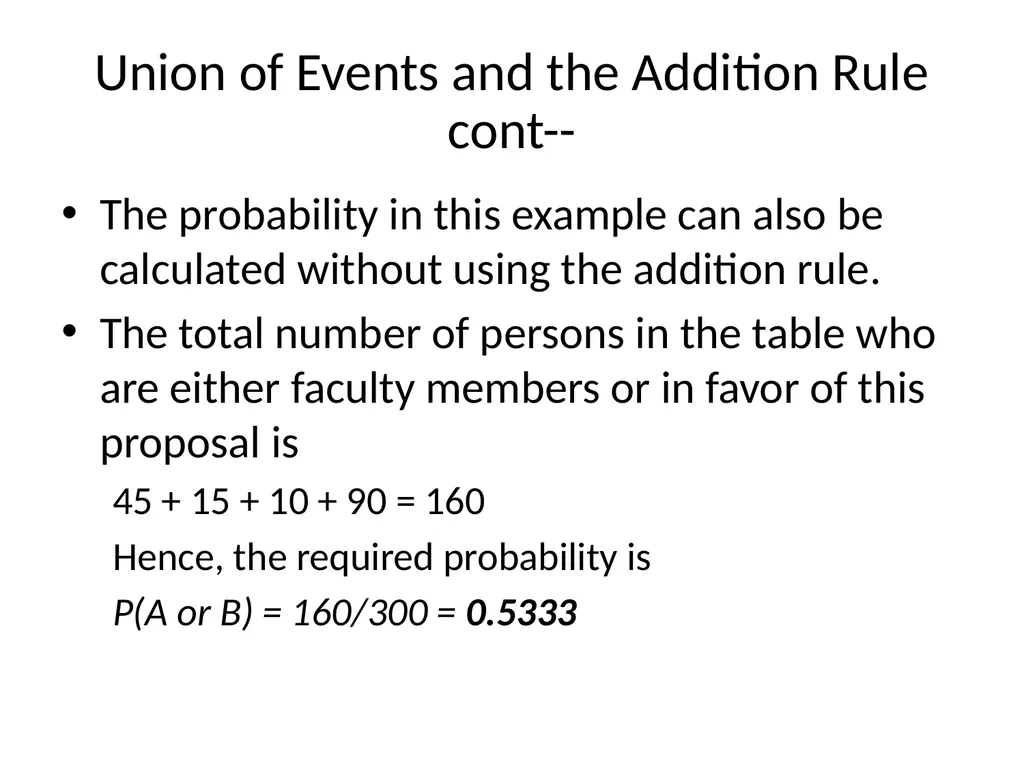
Union of Events and the Addition Rule cont-- The probability in this example can also be calculated without using the addition rule.
The total number of persons in the table who are either faculty members or in favor of this proposal is
45 + 15 + 10 + 90 = 160
Hence, the required probability is
P(A or B) = 160/300 = 0.5333<br>
The total number of persons in the table who are either faculty members or in favor of this proposal is
45 + 15 + 10 + 90 = 160
Hence, the required probability is
P(A or B) = 160/300 = 0.5333<br>
46
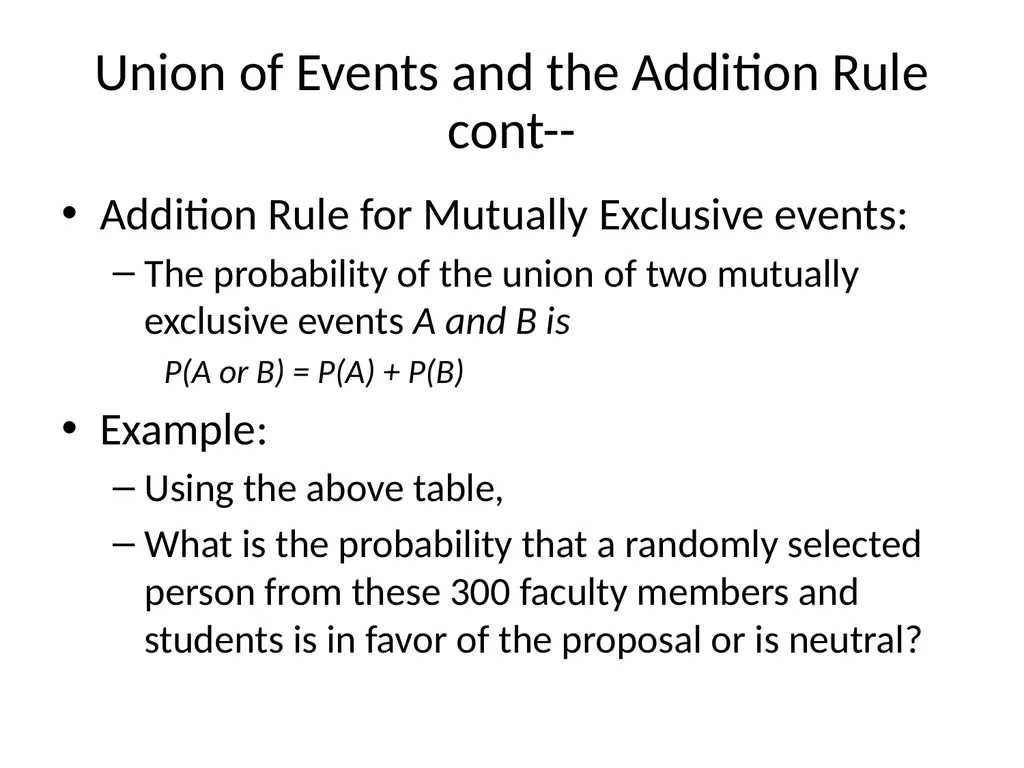
Union of Events and the Addition Rule cont-- Addition Rule for Mutually Exclusive events:
The probability of the union of two mutually exclusive events A and B is
P(A or B) = P(A) + P(B)
Example:
Using the above table,
What is the probability that a randomly selected person from these 300 faculty members and students is in favor of the proposal or is neutral?<br>
The probability of the union of two mutually exclusive events A and B is
P(A or B) = P(A) + P(B)
Example:
Using the above table,
What is the probability that a randomly selected person from these 300 faculty members and students is in favor of the proposal or is neutral?<br>
47
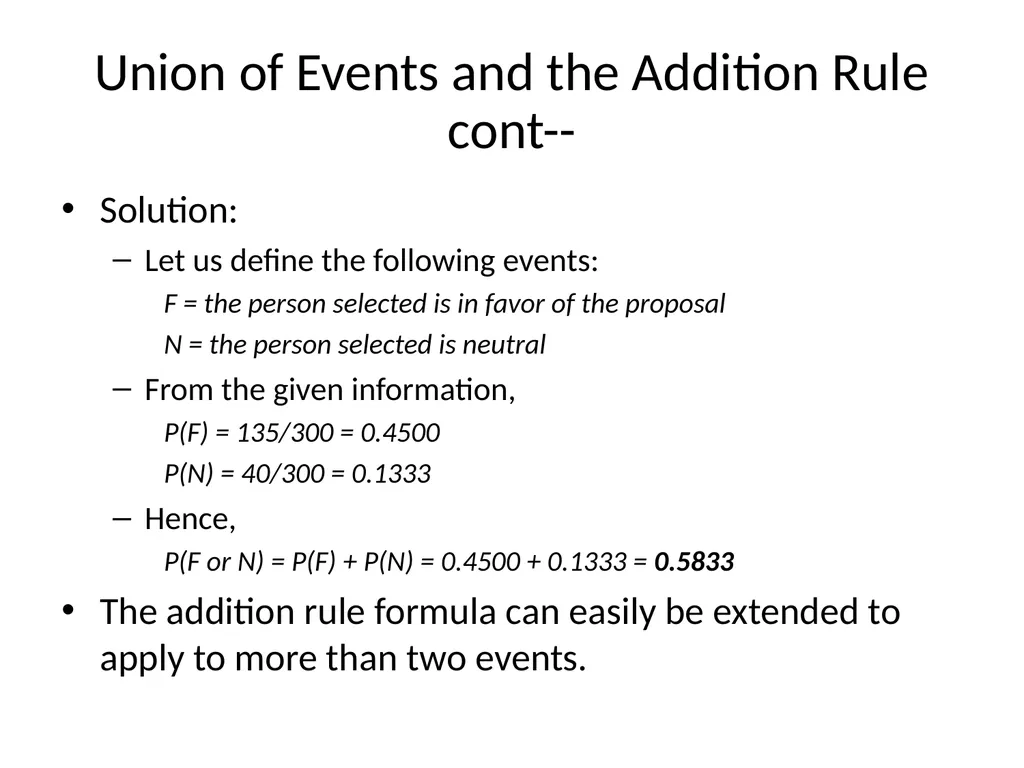
Union of Events and the Addition Rule cont-- Solution:
Let us define the following events:
F = the person selected is in favor of the proposal
N = the person selected is neutral
From the given information,
P(F) = 135/300 = 0.4500
P(N) = 40/300 = 0.1333
Hence,
P(F or N) = P(F) + P(N) = 0.4500 + 0.1333 = 0.5833
The addition rule formula can easily be extended to apply to more than two events.<br>
Let us define the following events:
F = the person selected is in favor of the proposal
N = the person selected is neutral
From the given information,
P(F) = 135/300 = 0.4500
P(N) = 40/300 = 0.1333
Hence,
P(F or N) = P(F) + P(N) = 0.4500 + 0.1333 = 0.5833
The addition rule formula can easily be extended to apply to more than two events.<br>