Procurement of Consultancy Services 2 Differences between Selection Methods available Quality and cost based selection Quality based selection Fixed Budget selection Least Cost Selection Selection based on Consultants Qualifications Single
"Procurement of Consultancy Services 2 Differences" is the property of its rightful owner. Permission is granted to
download and print the materials on this website for personal, non-commercial use only, and to display it
on your personal computer provided you do not modify the materials and that you retain all copyright
notices contained in the materials. By downloading content from our website, you accept the terms of this
agreement.
Presentation Transcript
01
Procurement of Consultancy Services<br>
02
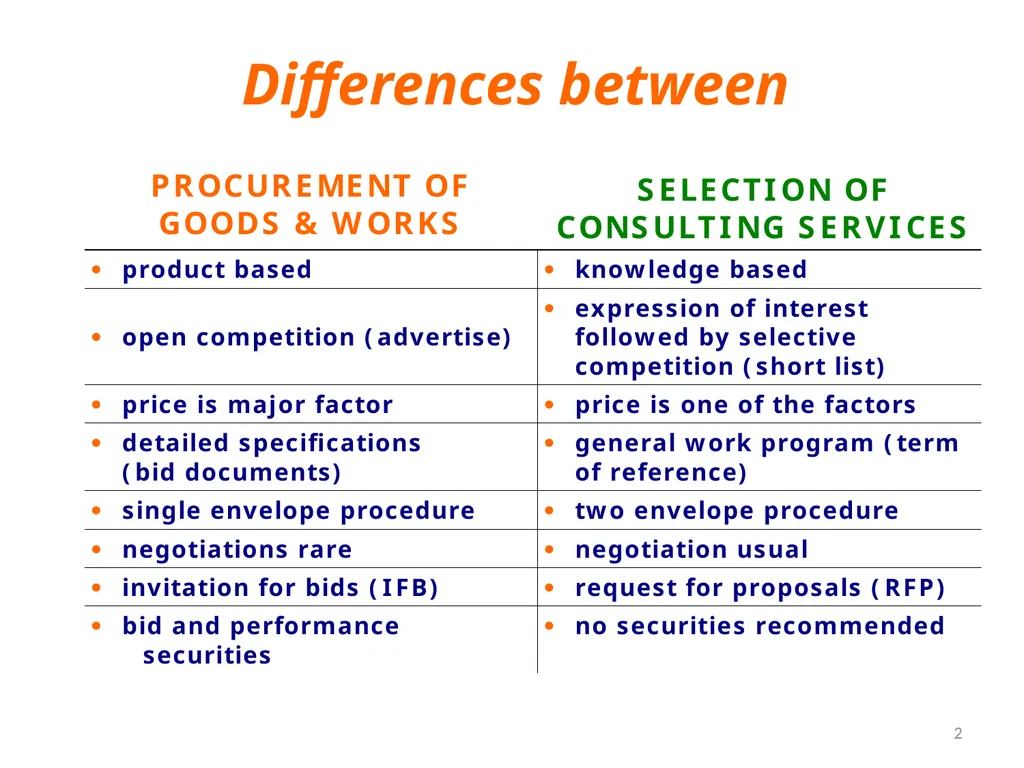
2 Differences between<br>
03
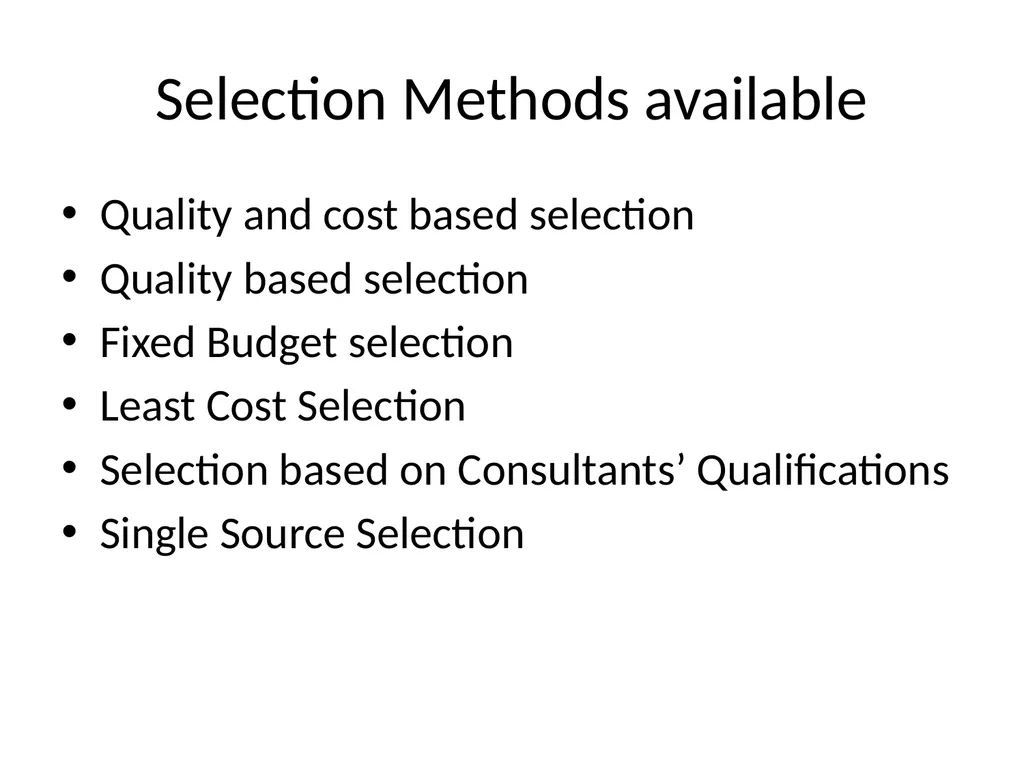
Selection Methods available Quality and cost based selection
Quality based selection
Fixed Budget selection
Least Cost Selection
Selection based on Consultants’ Qualifications
Single Source Selection<br>
04
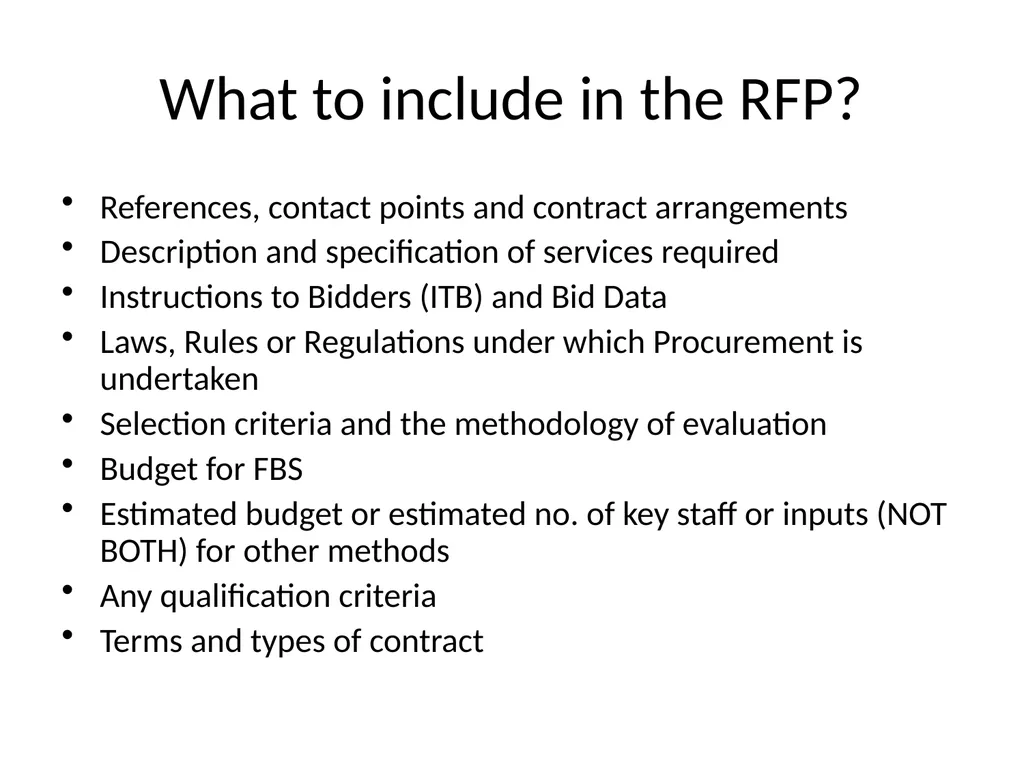
What to include in the RFP? References, contact points and contract arrangements
Description and specification of services required
Instructions to Bidders (ITB) and Bid Data
Laws, Rules or Regulations under which Procurement is undertaken
Selection criteria and the methodology of evaluation
Budget for FBS
Estimated budget or estimated no. of key staff or inputs (NOT BOTH) for other methods
Any qualification criteria
Terms and types of contract<br>
05
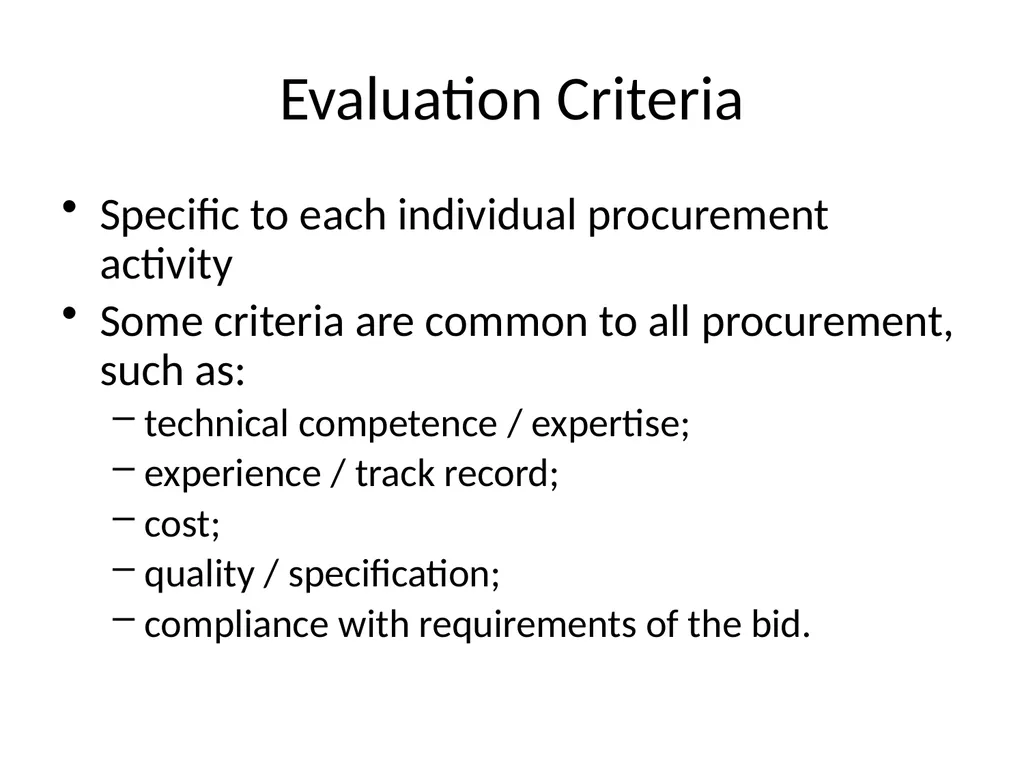
Evaluation Criteria Specific to each individual procurement activity
Some criteria are common to all procurement, such as:
technical competence / expertise;
experience / track record;
cost;
quality / specification;
compliance with requirements of the bid.<br>
06
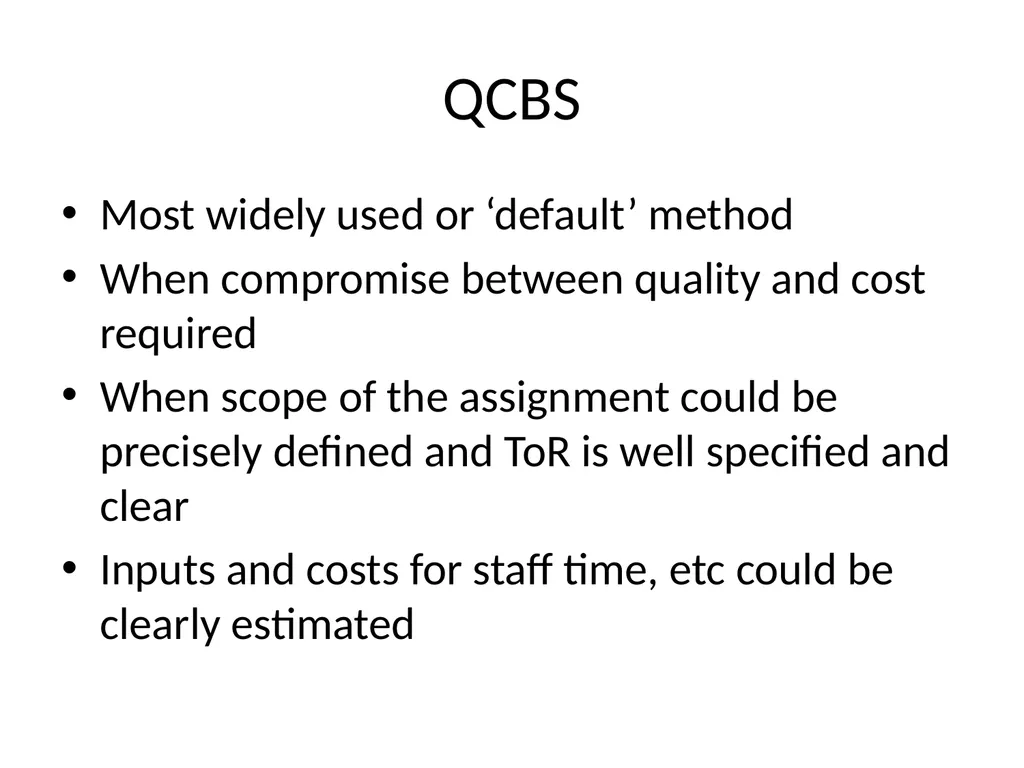
QCBS Most widely used or ‘default’ method
When compromise between quality and cost required
When scope of the assignment could be precisely defined and ToR is well specified and clear
Inputs and costs for staff time, etc could be clearly estimated<br>
07
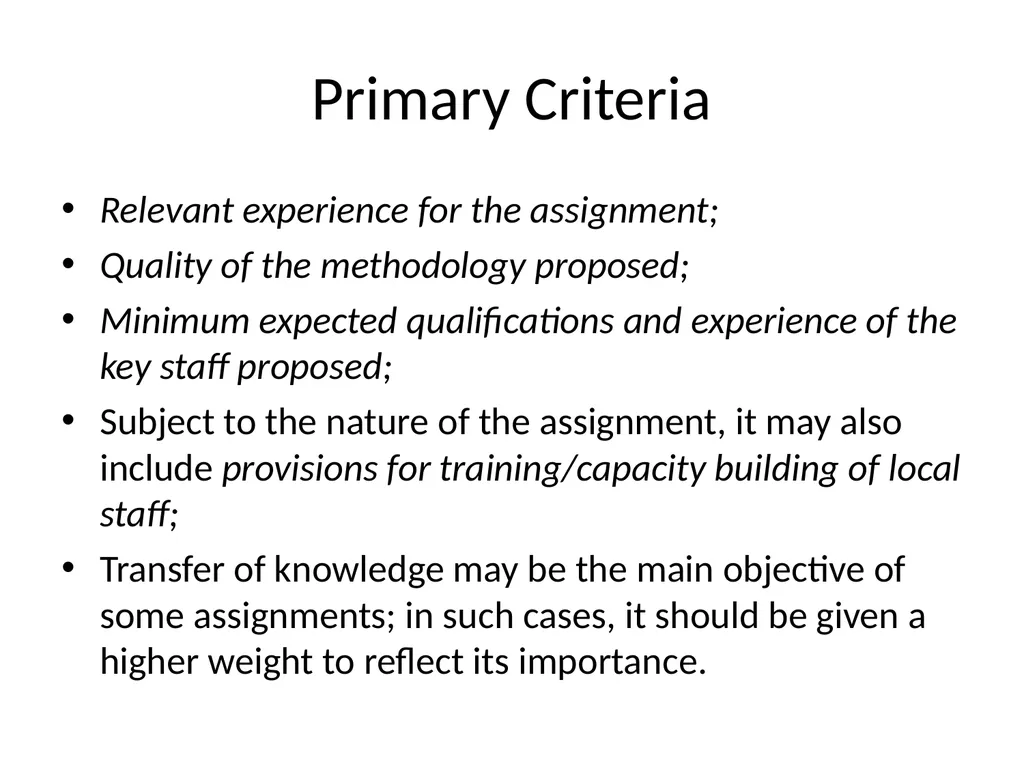
Primary Criteria Relevant experience for the assignment;
Quality of the methodology proposed;
Minimum expected qualifications and experience of the key staff proposed;
Subject to the nature of the assignment, it may also include provisions for training/capacity building of local staff;
Transfer of knowledge may be the main objective of some assignments; in such cases, it should be given a higher weight to reflect its importance.<br>
08
Apportioning Weightage Depending on the requirements, assign weightage for each criteria and sub-criteria
Technical and Financial weightage to be decided.
All these to be declared in the RFP<br>
09
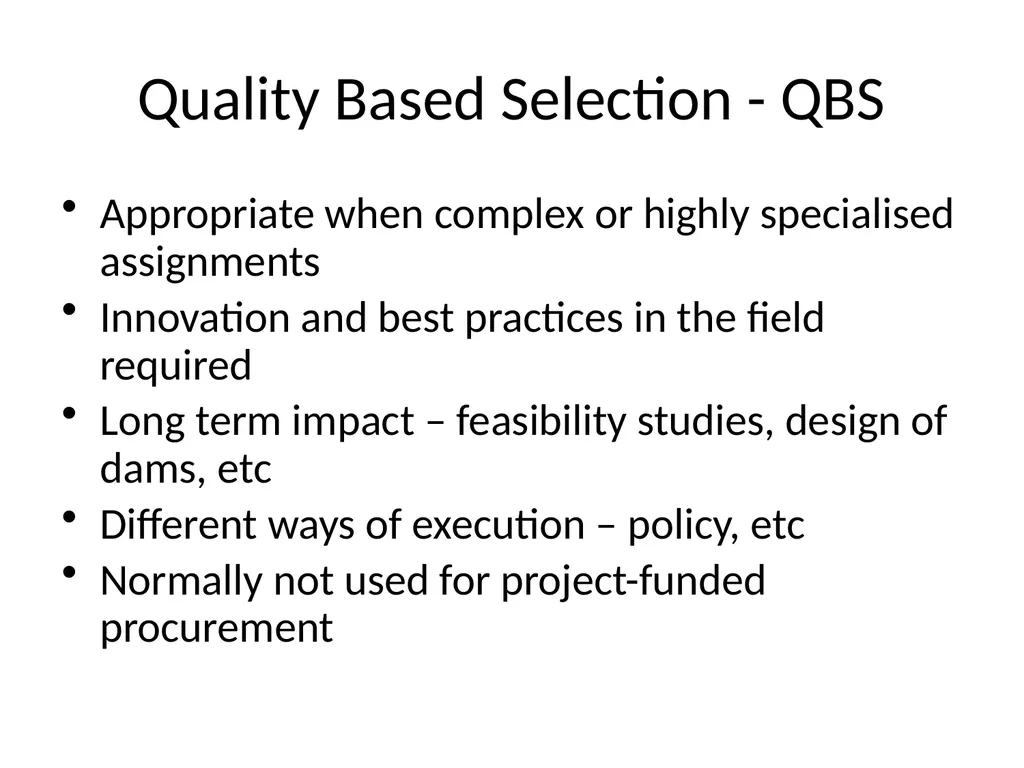
Quality Based Selection - QBS Appropriate when complex or highly specialised assignments
Innovation and best practices in the field required
Long term impact – feasibility studies, design of dams, etc
Different ways of execution – policy, etc
Normally not used for project-funded procurement<br>
10
Some aspects of QBS In RFP, estimated budget is not disclosed
Either only technical proposals are invited or tech. and financial proposals separately
Only highest ranked technical proposal – open the financial proposals
Detailed financial proposal
Negotiation<br>
11
Fixed Budget Selection - FBS Used when the assignment is simple
Tasks could be clearly defined
Absolutely limited budget or no flexibility available in resources<br>
12
Some aspects of FBS The RFP must indicate the available budget and request the consultants to provide their best technical and financial proposals in separate sealed envelopes, within the stated budget.
Terms of Reference have to be carefully prepared to ensure that the budget and TOR are consistent and realistic
Technical proposals will be evaluated and bidders who pass the minimum technical score will be invited to a public opening of their financial envelopes.
Bidders whose technical proposals fail to meet the minimum technical score will have their financial envelopes returned unopened.
Any financial proposals that exceed the indicated budget shall be rejected.
The Consultant who has submitted the highest ranked technical proposal within the budget will be selected for award of contract.<br>
13
Least Cost Selection - LCS Appropriate to use for small value services of a routine nature such as audits, simple engineering design or supervision where well-established practices and professional standards exist.
Technical proposals are examined to ensure minimum qualification scoring
Lowest price among qualified
Has disadvantages
If funds available, adopt QCBS<br>
14
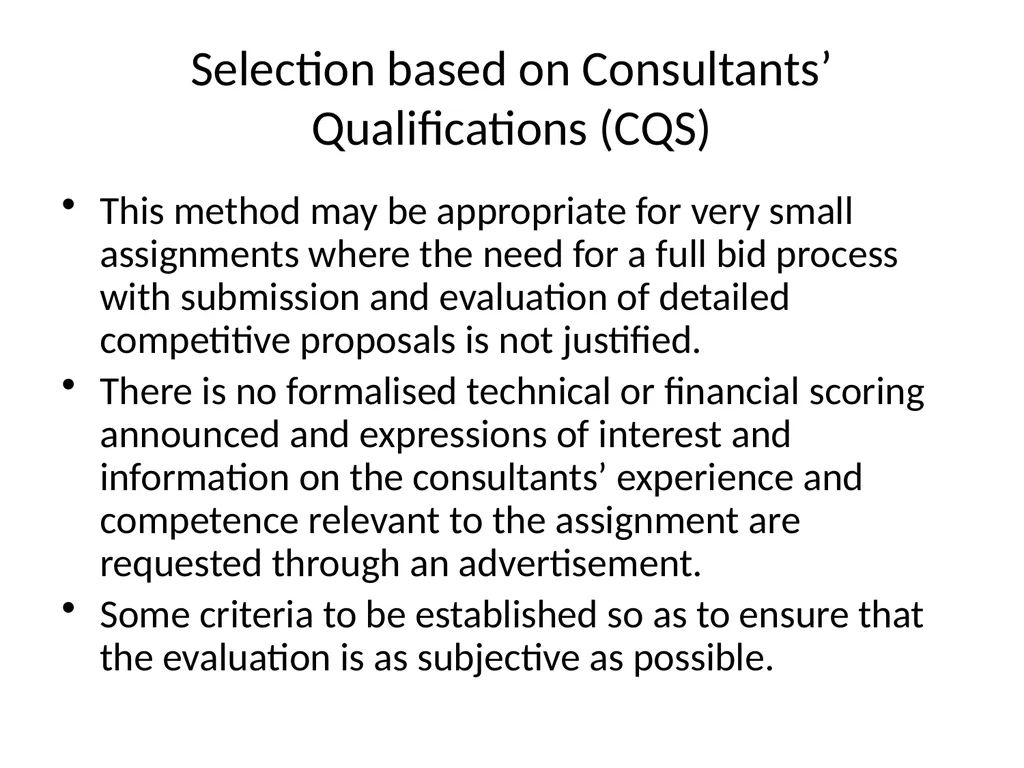
Selection based on Consultants’ Qualifications (CQS) This method may be appropriate for very small assignments where the need for a full bid process with submission and evaluation of detailed competitive proposals is not justified.
There is no formalised technical or financial scoring announced and expressions of interest and information on the consultants’ experience and competence relevant to the assignment are requested through an advertisement.
Some criteria to be established so as to ensure that the evaluation is as subjective as possible.<br>
15
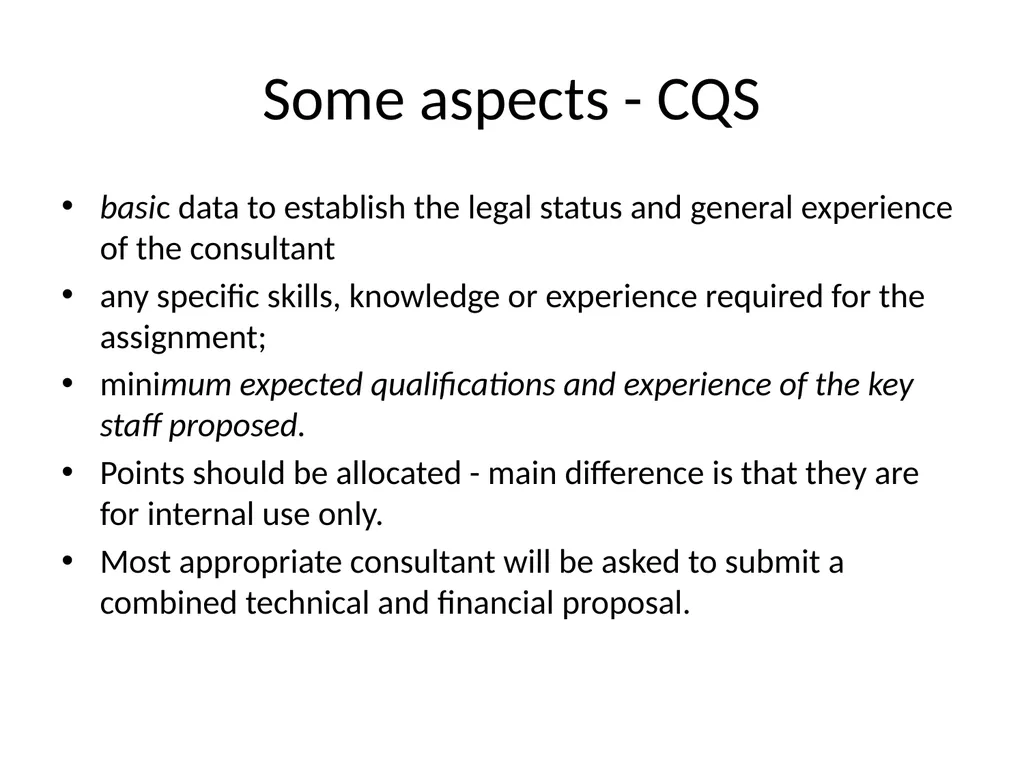
Some aspects - CQS basic data to establish the legal status and general experience of the consultant
any specific skills, knowledge or experience required for the assignment;
minimum expected qualifications and experience of the key staff proposed.
Points should be allocated - main difference is that they are for internal use only.
Most appropriate consultant will be asked to submit a combined technical and financial proposal.<br>
16
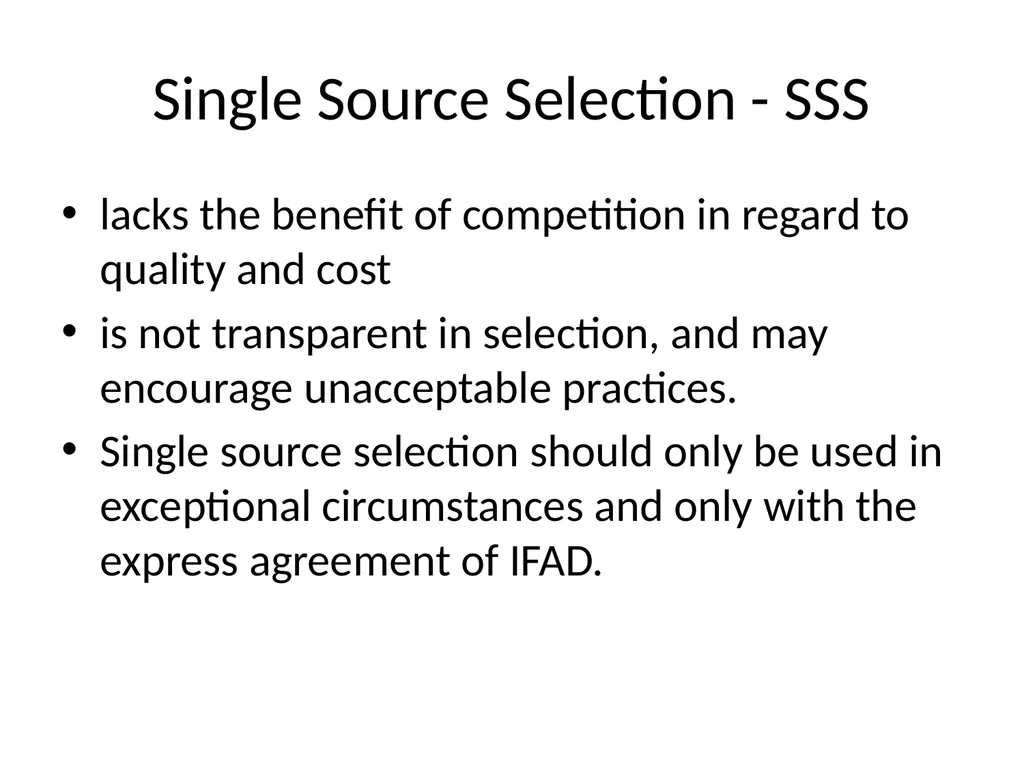
Single Source Selection - SSS lacks the benefit of competition in regard to quality and cost
is not transparent in selection, and may encourage unacceptable practices.
Single source selection should only be used in exceptional circumstances and only with the express agreement of IFAD.<br>