
Prodrugs Basic concepts and application of
DP
Published · 68 slides · 0 views
1 / 1





Description
Prodrugs Basic concepts and application of prodrugs design. Initial definition: A pharmacologically inactive chemical entity that when metabolized or chemically transformed by a mammalian system is converted into a pharmacologically active
Related Topics
Share
Embed code
Download this presentation From Below
"Prodrugs Basic concepts and application of" is the property of its rightful owner. Permission is granted to download and print the materials on this website for personal, non-commercial use only, and to display it on your personal computer provided you do not modify the materials and that you retain all copyright notices contained in the materials. By downloading content from our website, you accept the terms of this agreement.
Presentation Transcript
01
Prodrugs Basic concepts and application of prodrugs design.<br>
02
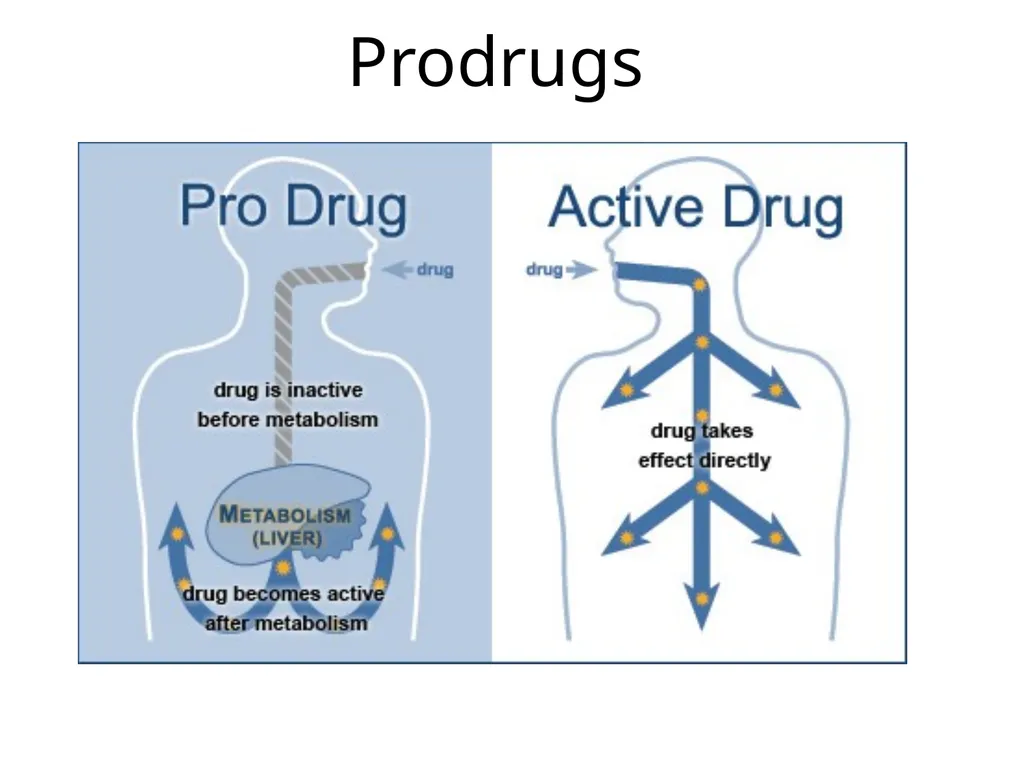
Initial definition: A pharmacologically inactive chemical entity that when metabolized or chemically transformed by a mammalian system is converted into a pharmacologically active substance
“Drug Latentiation” – included later
Process of purposely designing and synthesizing a molecule that specifically requires “bioactivation” to a pharmacologically active substance
Why use prodrugs?
Improve patient acceptability (decrease pain on injection)
Alter and improve absorption
Alter biodistribution
Alter metabolism
Alter elimination Prodrugs<br>
“Drug Latentiation” – included later
Process of purposely designing and synthesizing a molecule that specifically requires “bioactivation” to a pharmacologically active substance
Why use prodrugs?
Improve patient acceptability (decrease pain on injection)
Alter and improve absorption
Alter biodistribution
Alter metabolism
Alter elimination Prodrugs<br>
03
Prodrugs An inactive precursor of a drug, converted into its active form in the body by normal metabolic processes. Prodrugs are used when drugs have unattractive physicochemical properties Prodrugs are bioreversible derivatives of drug molecules that undergo an enzymatic and/or chemical transformation in vivo to release the active parent drug, which can then exert the desired pharmacological effect. In both drug discovery and development, prodrugs have become an established tool for improving physicochemical, biopharmaceutical or pharmacokinetic properties of pharmacologically active agents.
About 5-7% of drugs approved worldwide can be classified as prodrugs, and the implementation of a prodrug approach in the early stages of drug discovery is a growing trend. To illustrate the applicability of the prodrug strategy, this article describes the most common functional groups that are amenable to prodrug design, and highlights examples of prodrugs that are either launched or are undergoing human trials.<br>
About 5-7% of drugs approved worldwide can be classified as prodrugs, and the implementation of a prodrug approach in the early stages of drug discovery is a growing trend. To illustrate the applicability of the prodrug strategy, this article describes the most common functional groups that are amenable to prodrug design, and highlights examples of prodrugs that are either launched or are undergoing human trials.<br>
04
Prodrugs<br>
05
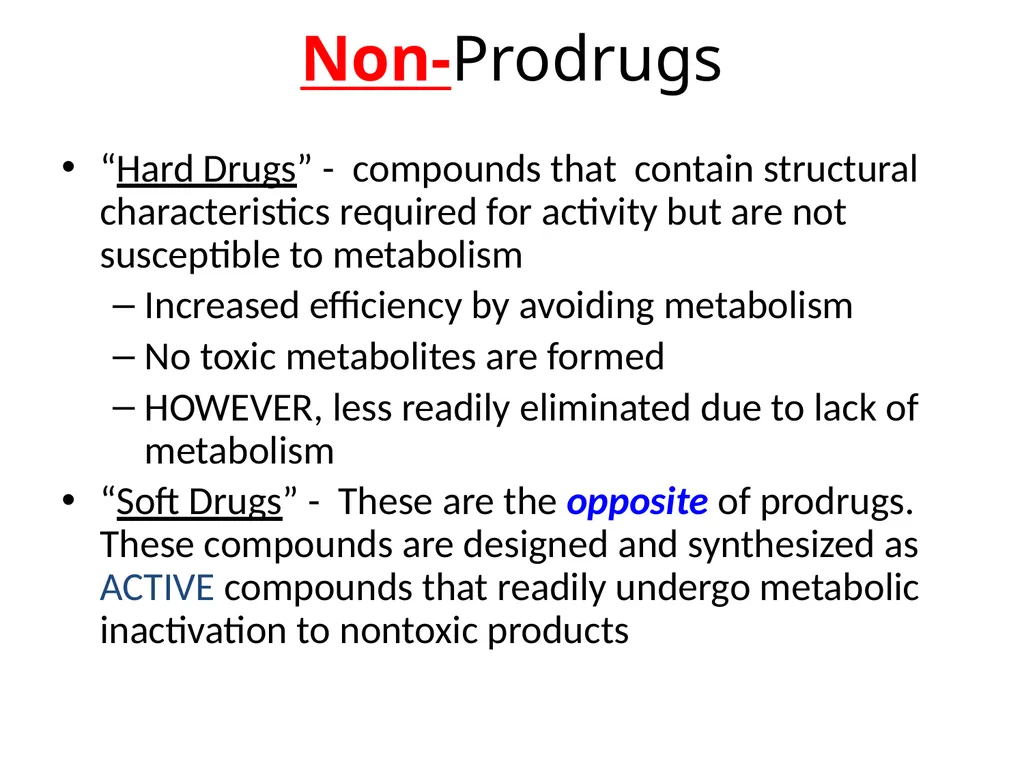
“Hard Drugs” - compounds that contain structural characteristics required for activity but are not susceptible to metabolism
Increased efficiency by avoiding metabolism
No toxic metabolites are formed
HOWEVER, less readily eliminated due to lack of metabolism
“Soft Drugs” - These are the opposite of prodrugs. These compounds are designed and synthesized as ACTIVE compounds that readily undergo metabolic inactivation to nontoxic products Non-Prodrugs<br>
Increased efficiency by avoiding metabolism
No toxic metabolites are formed
HOWEVER, less readily eliminated due to lack of metabolism
“Soft Drugs” - These are the opposite of prodrugs. These compounds are designed and synthesized as ACTIVE compounds that readily undergo metabolic inactivation to nontoxic products Non-Prodrugs<br>
06
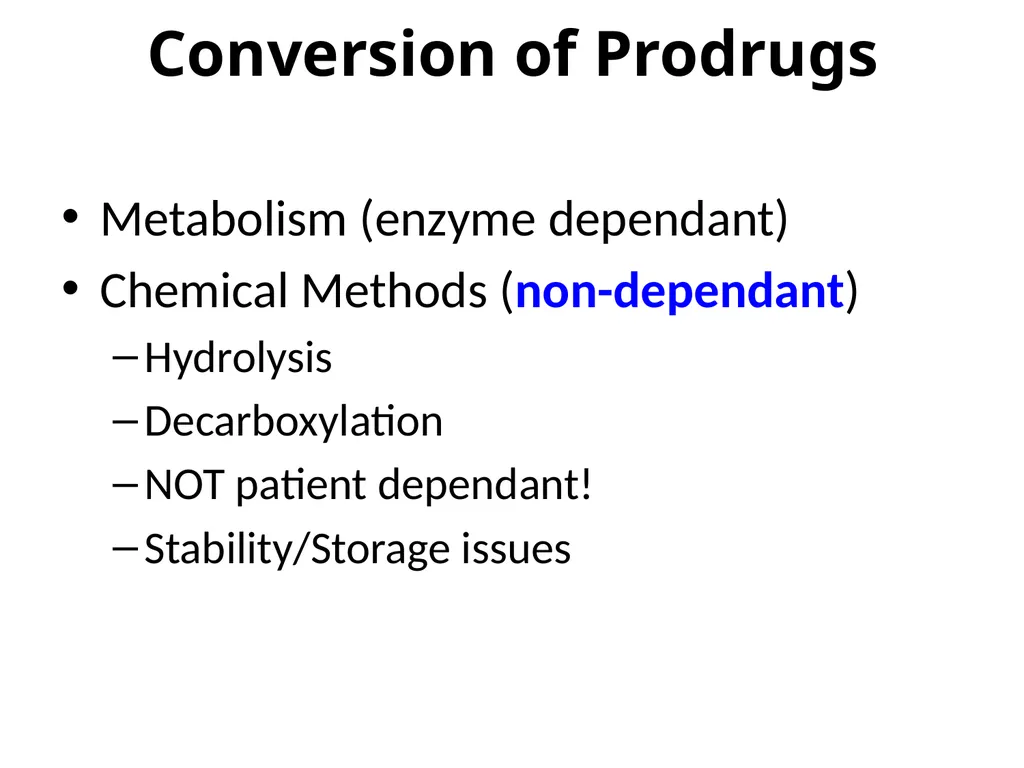
Conversion of Prodrugs Metabolism (enzyme dependant)
Chemical Methods (non-dependant)
Hydrolysis
Decarboxylation
NOT patient dependant!
Stability/Storage issues<br>
Chemical Methods (non-dependant)
Hydrolysis
Decarboxylation
NOT patient dependant!
Stability/Storage issues<br>
07
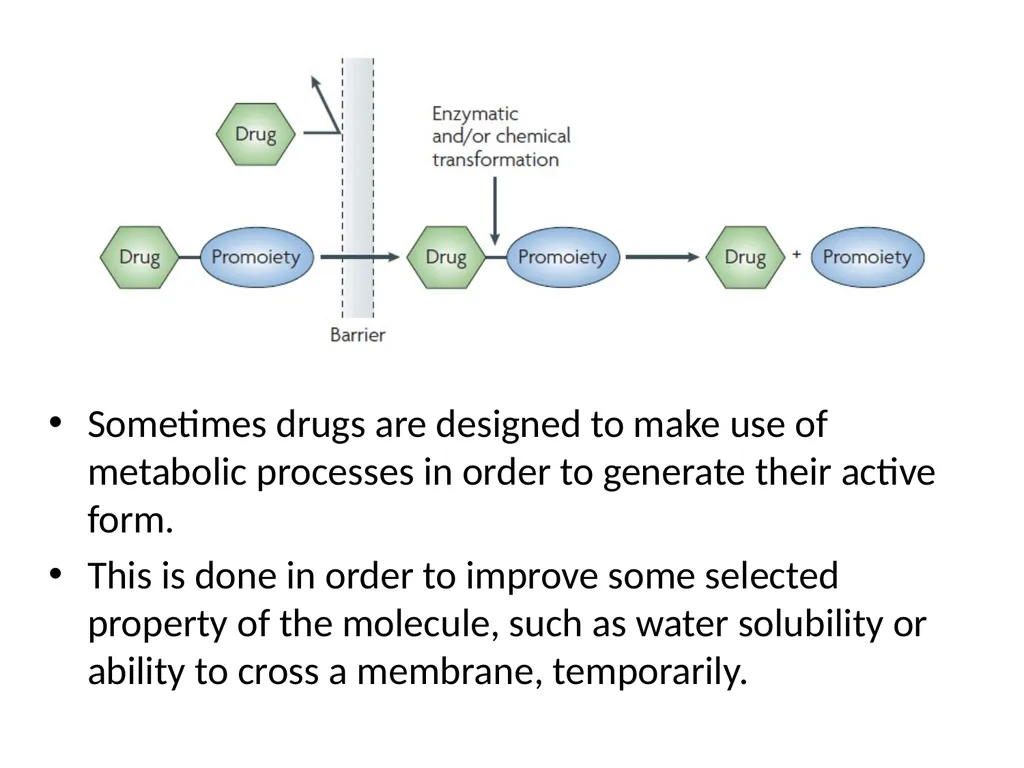
Sometimes drugs are designed to make use of metabolic processes in order to generate their active form.
This is done in order to improve some selected property of the molecule, such as water solubility or ability to cross a membrane, temporarily.<br>
This is done in order to improve some selected property of the molecule, such as water solubility or ability to cross a membrane, temporarily.<br>
08
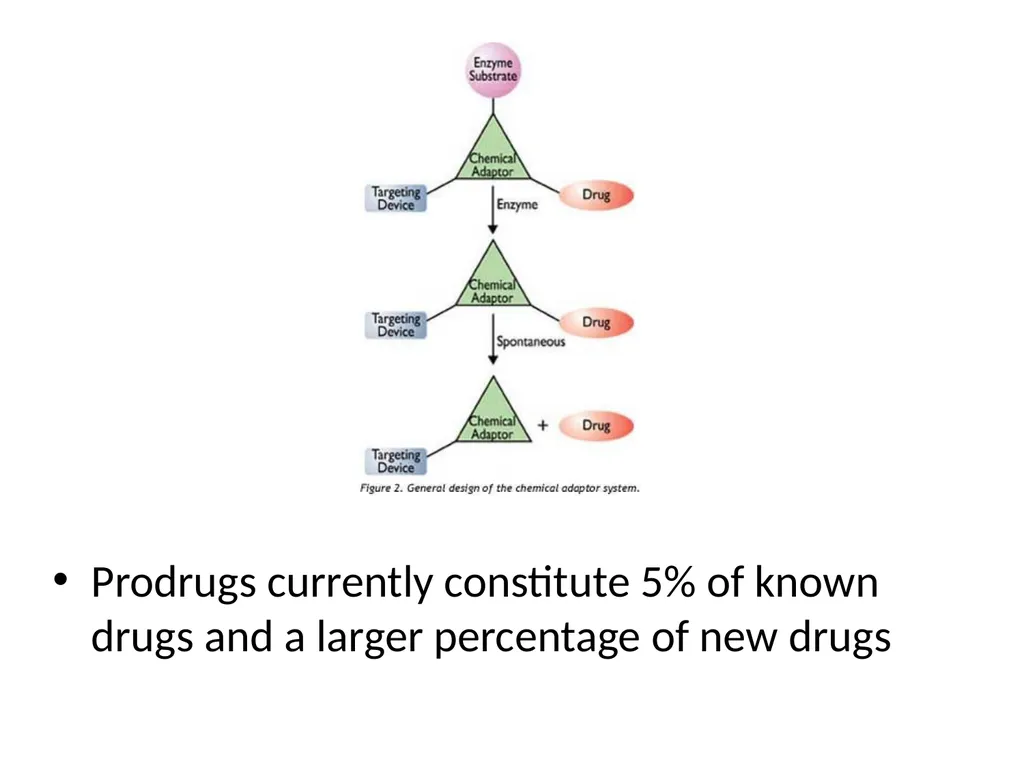
Prodrugs currently constitute 5% of known drugs and a larger percentage of new drugs<br>
09
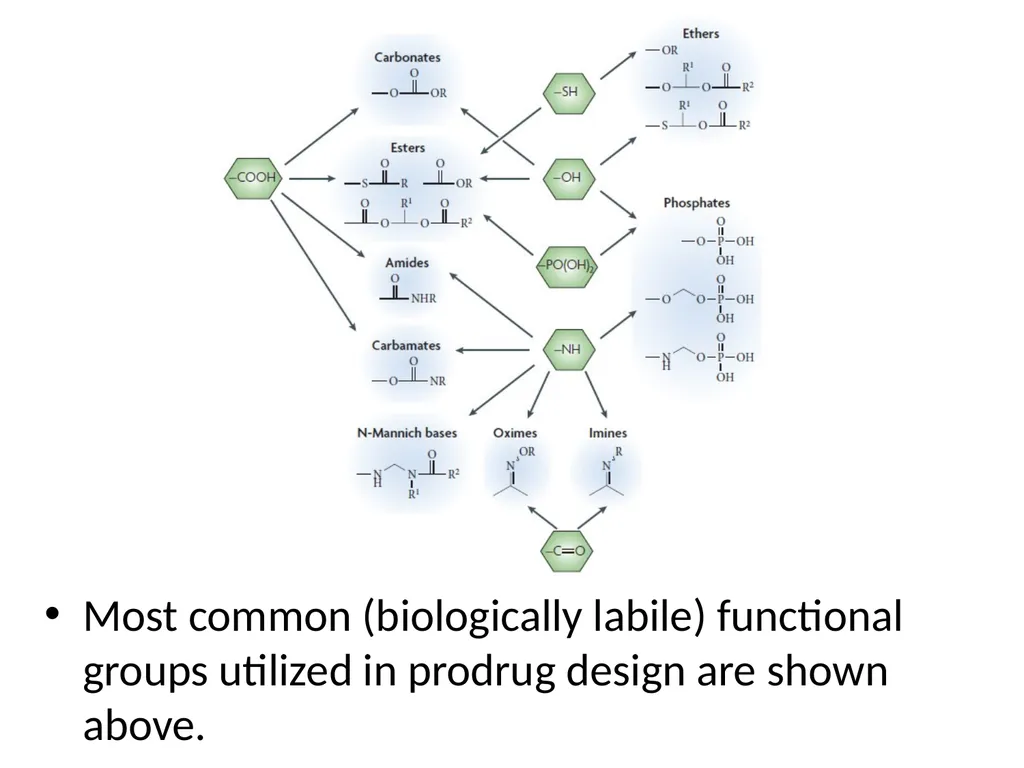
Most common (biologically labile) functional groups utilized in prodrug design are shown above.<br>
10
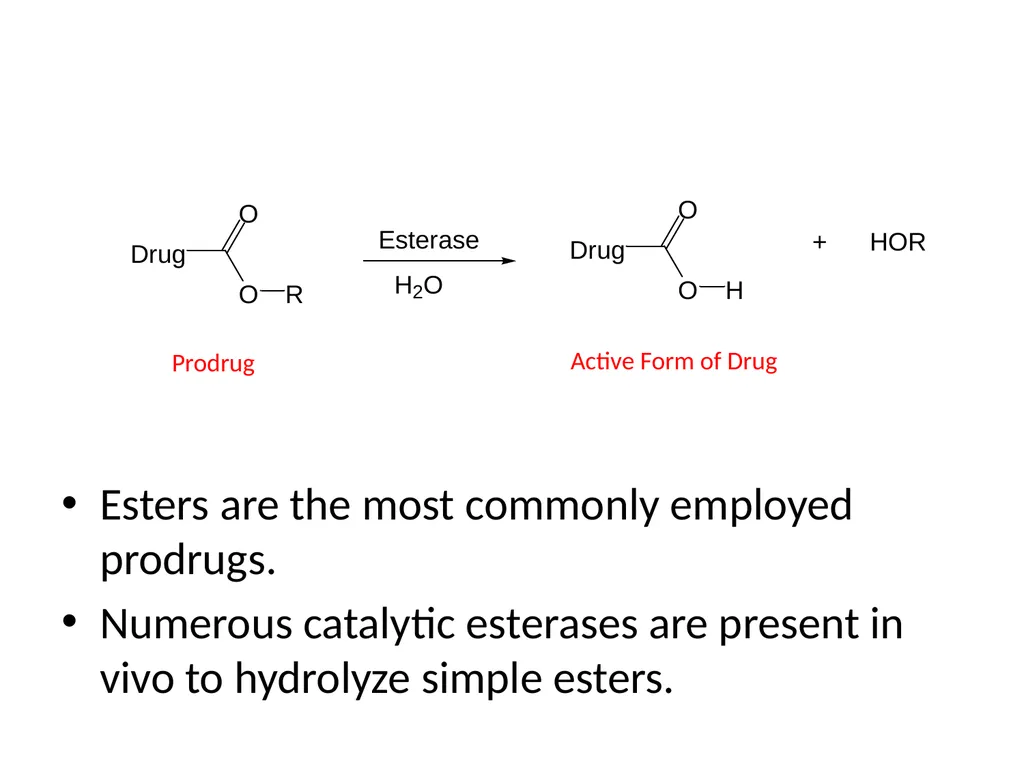
Esters are the most commonly employed prodrugs.
Numerous catalytic esterases are present in vivo to hydrolyze simple esters. Prodrug Active Form of Drug<br>
Numerous catalytic esterases are present in vivo to hydrolyze simple esters. Prodrug Active Form of Drug<br>
11
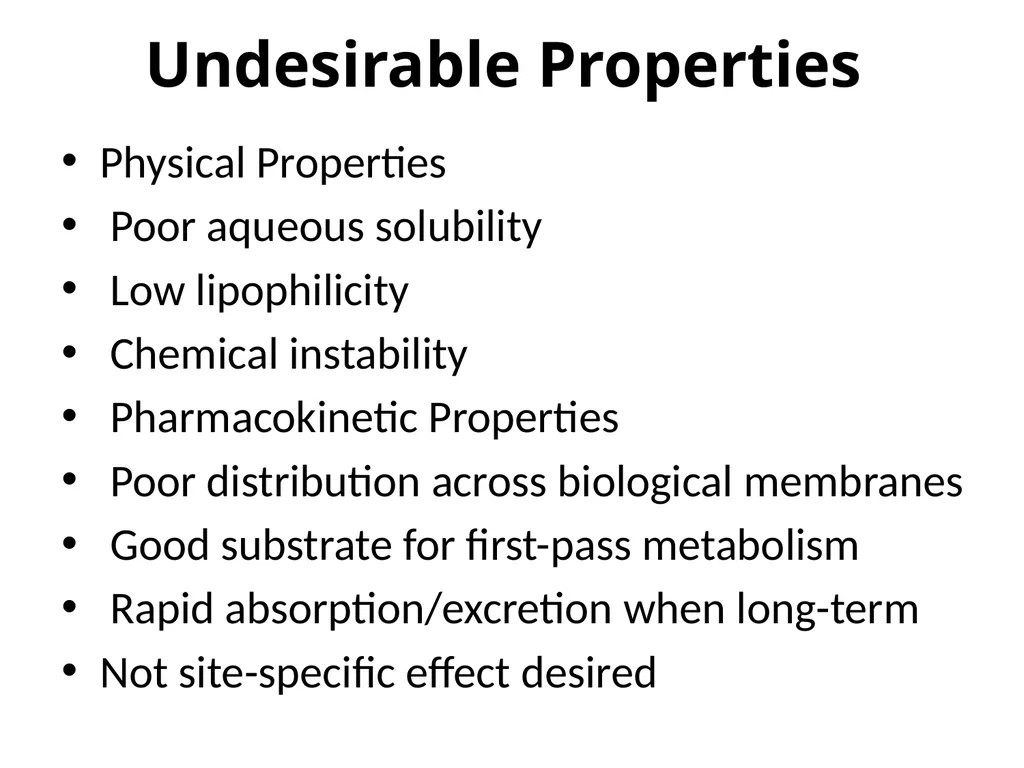
Undesirable Properties Physical Properties
Poor aqueous solubility
Low lipophilicity
Chemical instability
Pharmacokinetic Properties
Poor distribution across biological membranes
Good substrate for first-pass metabolism
Rapid absorption/excretion when long-term
Not site-specific effect desired<br>
Poor aqueous solubility
Low lipophilicity
Chemical instability
Pharmacokinetic Properties
Poor distribution across biological membranes
Good substrate for first-pass metabolism
Rapid absorption/excretion when long-term
Not site-specific effect desired<br>
12
Classification Prodrugs can be classified into two major types, based on how the body converts the prodrug into the final active drug form.
Type I prodrugs are bioactivated intracellularly.
Examples of these are anti-viral nucleoside analogs and lipid-lowering statins.
Type II prodrugs are bioactivated extracellularly, especially in digestive fluids or in the body's circulation system.
Examples of these are antibody-, gene- or virus-directed enzyme
prodrugs [ADEP/GDEP/VDEP] used in chemotherapy or immunotherapy.<br>
Type I prodrugs are bioactivated intracellularly.
Examples of these are anti-viral nucleoside analogs and lipid-lowering statins.
Type II prodrugs are bioactivated extracellularly, especially in digestive fluids or in the body's circulation system.
Examples of these are antibody-, gene- or virus-directed enzyme
prodrugs [ADEP/GDEP/VDEP] used in chemotherapy or immunotherapy.<br>
13
Steps in Prodrug Design Identification of drug delivery problem
Identification of desired physicochemical properties
Selection of transport moiety which will give prodrug
desired transport properties be readily cleaved in the desired biological compartment<br>
Identification of desired physicochemical properties
Selection of transport moiety which will give prodrug
desired transport properties be readily cleaved in the desired biological compartment<br>
14
Carrier-linked prodrugs – drugs that are attached through a metabolically labile chemical linkage to another molecule designated as the “promoiety”
The “promoiety” alters the physical properites of the drug to increase water or fat solubility or provide site-directed delivery
Advantages:
Increased absorption
Injection site pain relief
Elimination of unpleasant taste
Decreased toxicity
Decreased metabolic inactivation
Increased chemical stability
Prolonged or shortened action Prodrugs<br>
The “promoiety” alters the physical properites of the drug to increase water or fat solubility or provide site-directed delivery
Advantages:
Increased absorption
Injection site pain relief
Elimination of unpleasant taste
Decreased toxicity
Decreased metabolic inactivation
Increased chemical stability
Prolonged or shortened action Prodrugs<br>
15
Depending upon the nature of carrier used, the carrier-linked prodrug may further be classified into:
1. Double prodrugs, pro-prodrugs or cascade-latentiated prodrugs, where a prodrug is further derivatized in a fashion such that only enzymatic conversion to prodrug is possible before the latter can cleave to release the active drug.
2. Macromolecular prodrugs, where macromolecules like polysaccharides, dextrans, cyclodextrins, proteins, peptides, and polymers are used as carriers.
3. Site-specific prodrugs where a carrier acts as a transporter of the active drug to a specific targeted site. Carrier-linked prodrugs<br>
1. Double prodrugs, pro-prodrugs or cascade-latentiated prodrugs, where a prodrug is further derivatized in a fashion such that only enzymatic conversion to prodrug is possible before the latter can cleave to release the active drug.
2. Macromolecular prodrugs, where macromolecules like polysaccharides, dextrans, cyclodextrins, proteins, peptides, and polymers are used as carriers.
3. Site-specific prodrugs where a carrier acts as a transporter of the active drug to a specific targeted site. Carrier-linked prodrugs<br>
16
4. Mutual prodrug, where the carrier used is another biologically active drug instead of some inert molecule A mutual prodrug consists of two pharmacologically active agents coupled together so that each acts as a promoiety for the other agent and vice versa. The carrier selected may have the same biological action as that of the parent drug and thus might give synergistic action, or the carrier may have some additional biological action that is lacking in the parent drug, thus ensuring some additional benefit.
The carrier may also be a drug that might help to target the parent drug to a specific site or organ or cells or may improve site specificity of a drug. The carrier drug may be used to overcome some side effects of the parent drugs as well. Carrier-linked prodrugs<br>
The carrier may also be a drug that might help to target the parent drug to a specific site or organ or cells or may improve site specificity of a drug. The carrier drug may be used to overcome some side effects of the parent drugs as well. Carrier-linked prodrugs<br>
17
Criteria for Prodrug A well-designed carrier-linked prodrug should satisfy certain criteria. The linkage between the drug and the carrier should usually be a covalent bond. As a rule, the prodrug itself should be inactive or less active than the parent drug. The linkage should be bioreversible. The prodrug and the carrier released after in vivo enzymatic or non-enzymatic attack should be nontoxic. The generation of active form must take place with rapid kinetics to ensure effective drug levels at the site of action.
The bioavailability of carrier-linked prodrug is modulated by using a transient moiety. The lipophilicity is generally the subject of profound alteration of parent molecule. Bioactivation process is exclusively hydrolytic and sometimes a redox system.<br>
The bioavailability of carrier-linked prodrug is modulated by using a transient moiety. The lipophilicity is generally the subject of profound alteration of parent molecule. Bioactivation process is exclusively hydrolytic and sometimes a redox system.<br>
18
An ideal carrier should be without intrinsic toxicity. It should be non-immunogenic and non-antigenic and should not accumulate in the body. It should possess a suitable number of functional groups for drug attachment and adequate loading capacity. It should be stable to chemical manipulation and autoclaving. It should be easy to characterize and should mask the liganded drug's activity until release of active agent at the desired site of action. In mutual prodrug approach, the carrier should have some biological activity of its own. Criteria for Prodrug<br>
19
Carisoprodol is metabolized into meprobamate. Until 2012,
carisoprodol was not a controlled substance in the United States, but meprobamate was classified as a potentially addictive controlled substance that can produce dangerous and painful withdrawal symptoms upon discontinuation of the drug.
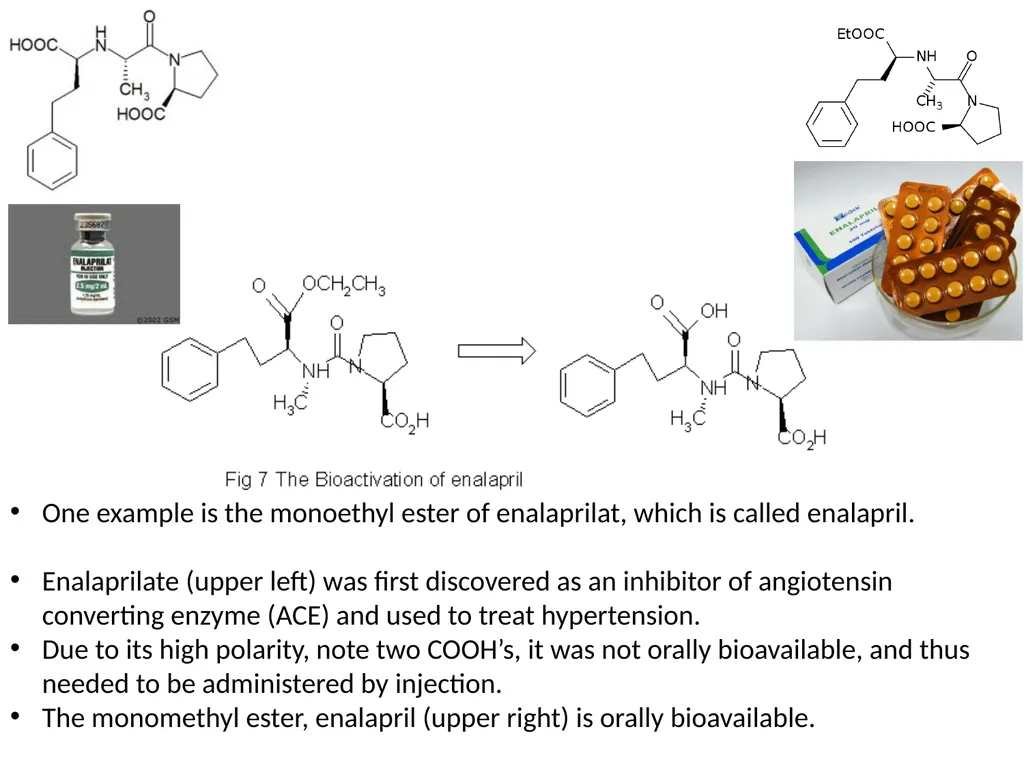
Enalapril is bioactivated by esterase to the active enalaprilat.
Valaciclovir is bioactivated by esterase to the active aciclovir.
Fosamprenavir is hydrolysed to the active amprenavir.
Levodopa is bioactivated by DOPA decarboxylase to the active
dopamine. Examples for Prodrugs<br>
carisoprodol was not a controlled substance in the United States, but meprobamate was classified as a potentially addictive controlled substance that can produce dangerous and painful withdrawal symptoms upon discontinuation of the drug.
Enalapril is bioactivated by esterase to the active enalaprilat.
Valaciclovir is bioactivated by esterase to the active aciclovir.
Fosamprenavir is hydrolysed to the active amprenavir.
Levodopa is bioactivated by DOPA decarboxylase to the active
dopamine. Examples for Prodrugs<br>
20
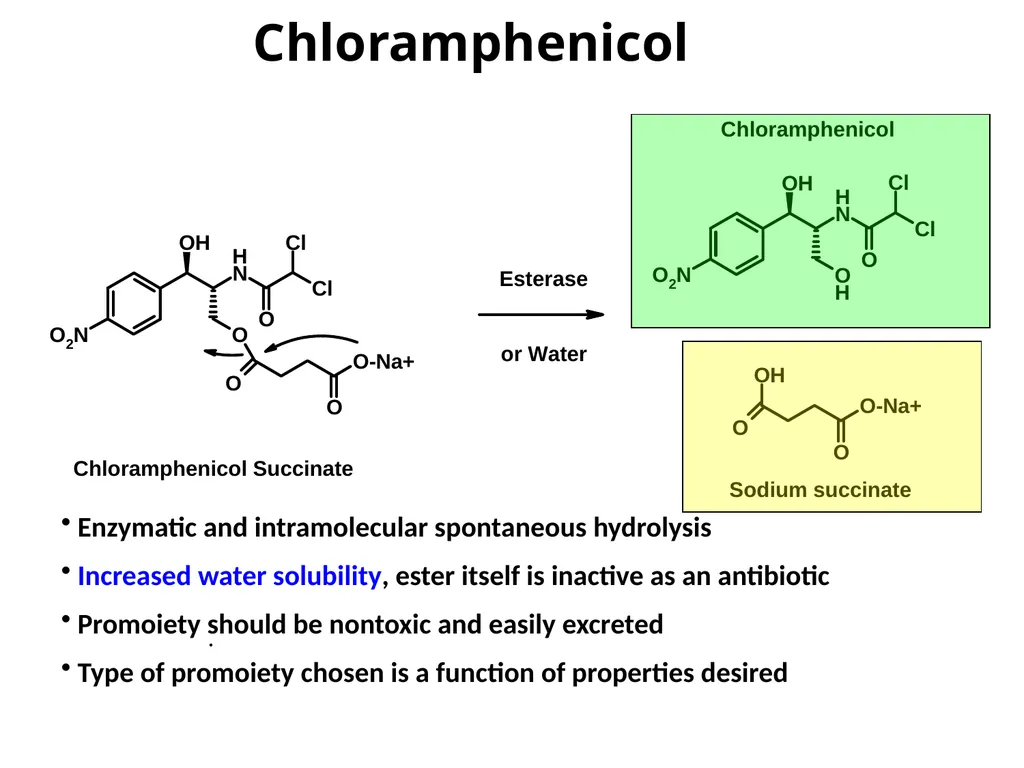
Examples for Prodrugs Chloramphenicol succinate ester is used as an intravenous prodrug of chloramphenicol, because pure chloramphenicol does not dissolve in water.
Psilocybin is dephosphorylated to the active psilocin.
Heroin is deacetylated by esterase to the active morphine.
Molsidomine is metabolized into SIN-1 which decomposes into the active compound nitric oxide.
Paliperidone is an atypical antipsychotic for schizophrenia. It is the active metabolite of risperidone.
Prednisone, a synthetic cortico-steroid drug, is bioactivated by the liver into the active drug prednisolone, which is also a steroid.<br>
Psilocybin is dephosphorylated to the active psilocin.
Heroin is deacetylated by esterase to the active morphine.
Molsidomine is metabolized into SIN-1 which decomposes into the active compound nitric oxide.
Paliperidone is an atypical antipsychotic for schizophrenia. It is the active metabolite of risperidone.
Prednisone, a synthetic cortico-steroid drug, is bioactivated by the liver into the active drug prednisolone, which is also a steroid.<br>
21
Primidone is metabolized by cytochrome P450 enzymes into phenobarbital, which is major, and phenylethylmalonamide, which is minor.
Dipivefrine, given topically as an anti-glaucoma drug, is bioactivated to epinephrine.
Lisdexamfetamine is metabolized in the small intestine to produce dextroamphetamine at a controlled (slow) rate for the treatment of attention-deficit hyperactivity disorder
Diethylpropion is a diet pill that does not become active as a monoamine releaser or reuptake inhibitor until it has been Ndealkylated to ethylpropion. Examples for Prodrugs<br>
Dipivefrine, given topically as an anti-glaucoma drug, is bioactivated to epinephrine.
Lisdexamfetamine is metabolized in the small intestine to produce dextroamphetamine at a controlled (slow) rate for the treatment of attention-deficit hyperactivity disorder
Diethylpropion is a diet pill that does not become active as a monoamine releaser or reuptake inhibitor until it has been Ndealkylated to ethylpropion. Examples for Prodrugs<br>
22
Fesoterodine is an antimuscarinic that is bioactivated to 5-hydroxymethyl tolterodine, the principle active metabolite of tolterodine.
Tenofovir disoproxil fumarate is an anti-HIV drug (NtRTI class) that is bioactivated to tenofovir (PMPA). Examples for Prodrugs<br>
Tenofovir disoproxil fumarate is an anti-HIV drug (NtRTI class) that is bioactivated to tenofovir (PMPA). Examples for Prodrugs<br>
23
Chloramphenicol Enzymatic and intramolecular spontaneous hydrolysis
Increased water solubility, ester itself is inactive as an antibiotic
Promoiety should be nontoxic and easily excreted
Type of promoiety chosen is a function of properties desired<br>
Increased water solubility, ester itself is inactive as an antibiotic
Promoiety should be nontoxic and easily excreted
Type of promoiety chosen is a function of properties desired<br>
24
One example is the monoethyl ester of enalaprilat, which is called enalapril.
Enalaprilate (upper left) was first discovered as an inhibitor of angiotensin converting enzyme (ACE) and used to treat hypertension.
Due to its high polarity, note two COOH’s, it was not orally bioavailable, and thus needed to be administered by injection.
The monomethyl ester, enalapril (upper right) is orally bioavailable.<br>
Enalaprilate (upper left) was first discovered as an inhibitor of angiotensin converting enzyme (ACE) and used to treat hypertension.
Due to its high polarity, note two COOH’s, it was not orally bioavailable, and thus needed to be administered by injection.
The monomethyl ester, enalapril (upper right) is orally bioavailable.<br>
25
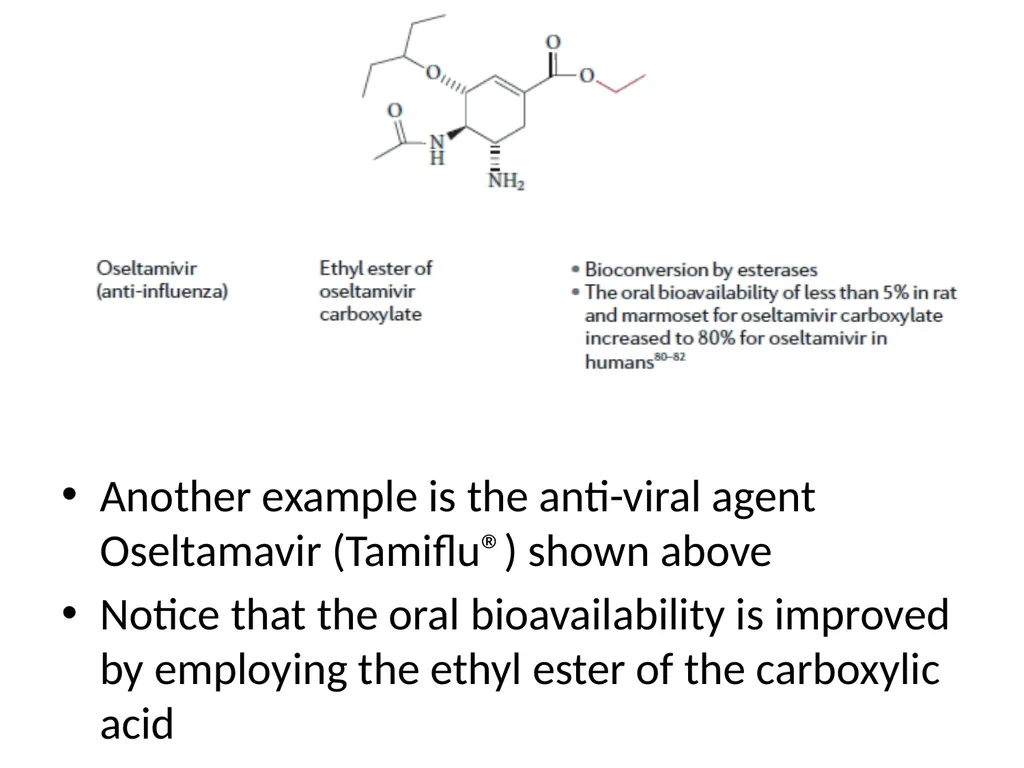
Another example is the anti-viral agent Oseltamavir (Tamiflu®) shown above
Notice that the oral bioavailability is improved by employing the ethyl ester of the carboxylic acid<br>
Notice that the oral bioavailability is improved by employing the ethyl ester of the carboxylic acid<br>
26
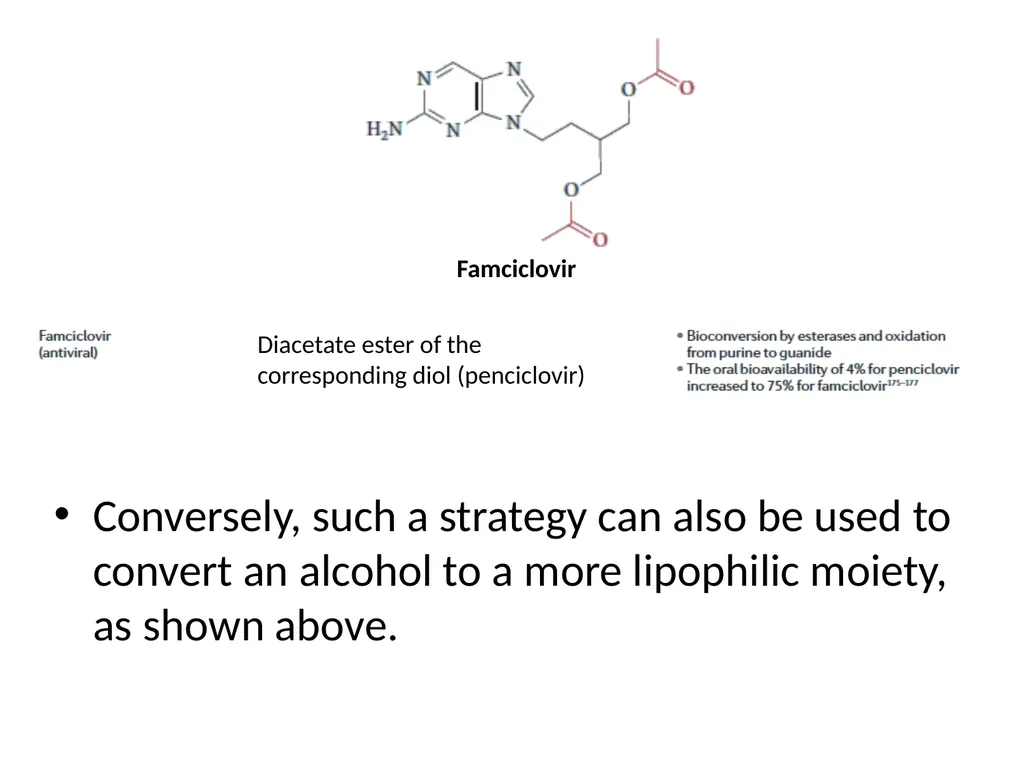
Conversely, such a strategy can also be used to convert an alcohol to a more lipophilic moiety, as shown above. Diacetate ester of the corresponding diol (penciclovir) Famciclovir<br>
27
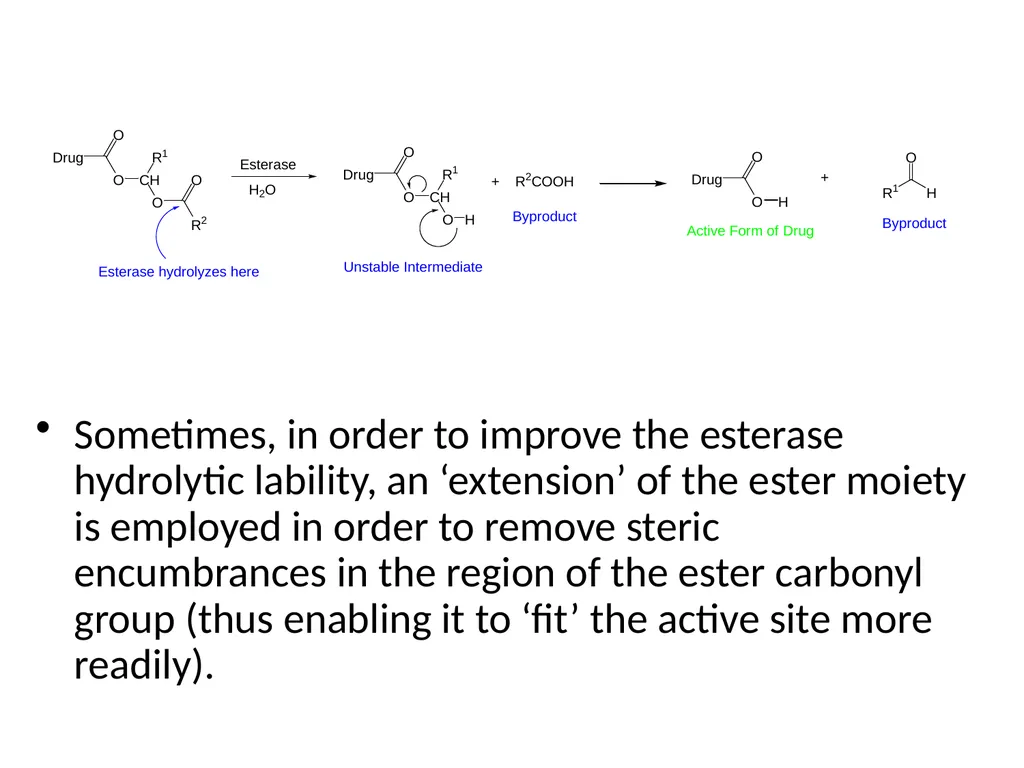
Sometimes, in order to improve the esterase hydrolytic lability, an ‘extension’ of the ester moiety is employed in order to remove steric encumbrances in the region of the ester carbonyl group (thus enabling it to ‘fit’ the active site more readily).<br>
28
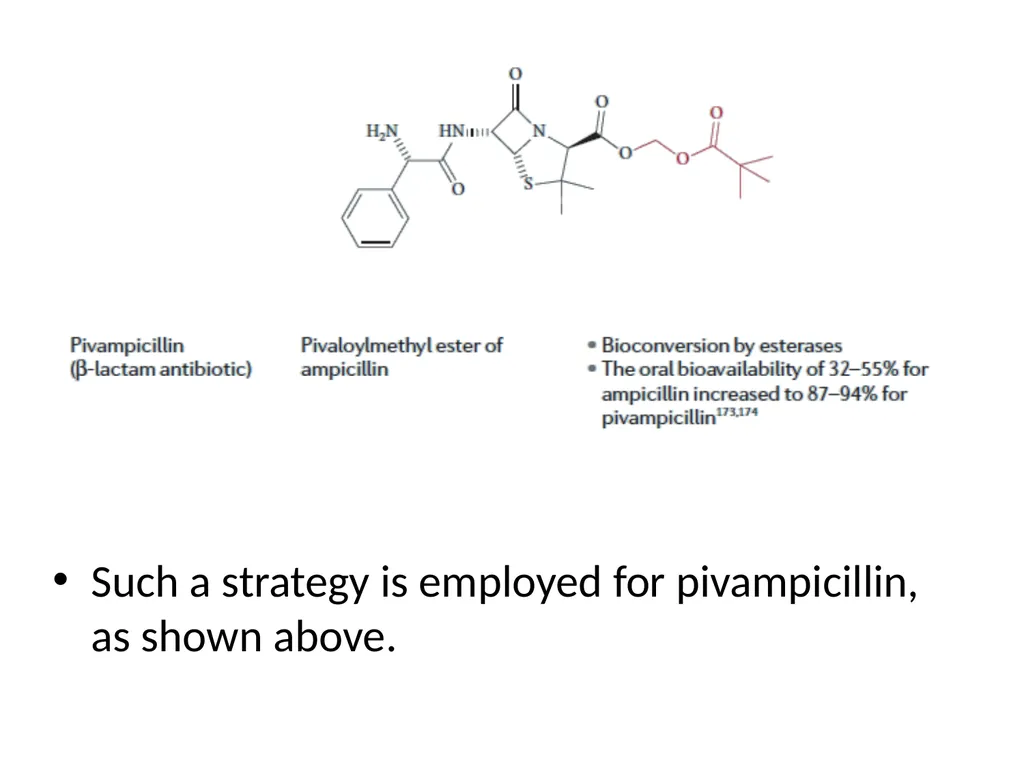
Such a strategy is employed for pivampicillin, as shown above.<br>
29
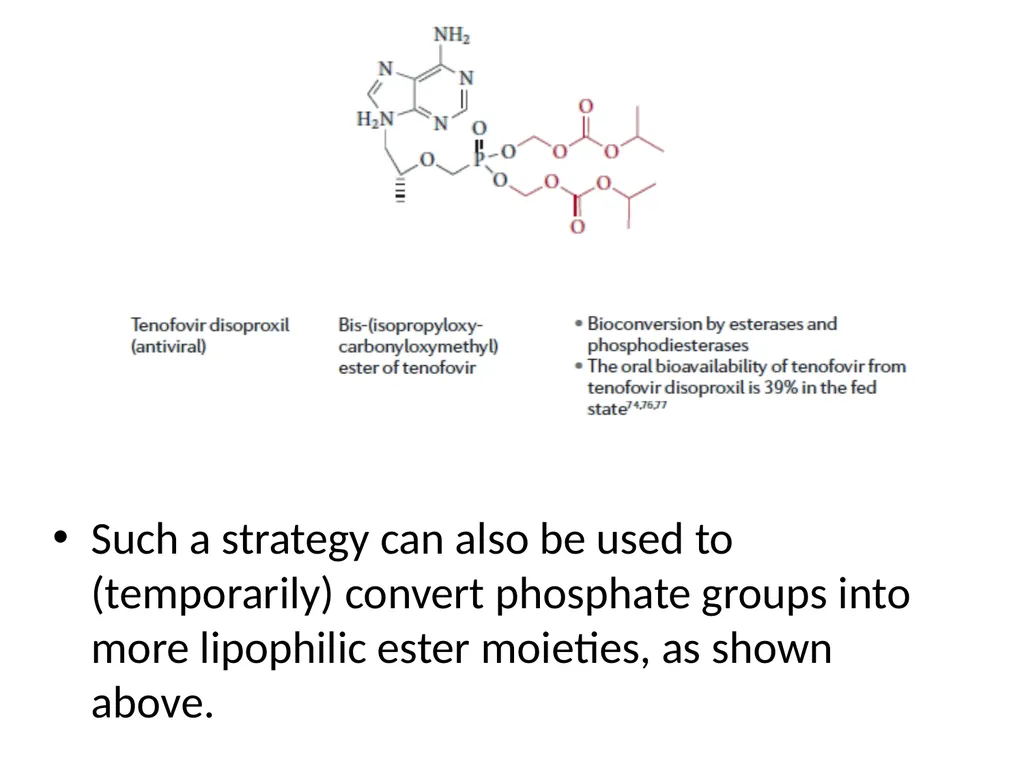
Such a strategy can also be used to (temporarily) convert phosphate groups into more lipophilic ester moieties, as shown above.<br>
30
DRUG
TARGETING<br>
31
Site-specific drug delivery attempts to obtain very precise and direct effects at the ‘site of action’ without subjecting the rest of the body to significant levels of the active agent. Prodrugs for Site Specificity The targeting of drugs for a specific site in the body by conversion to a prodrug is plausible when the physicochemical properties of prodrug are optimal for the target site.
It should be kept in mind, however, that when the lipophilicity of a drug is increased, it would improve passive transport of the drug nonspecifically to all tissues.<br>
It should be kept in mind, however, that when the lipophilicity of a drug is increased, it would improve passive transport of the drug nonspecifically to all tissues.<br>
32
Prodrugs for (increased) Site Specificity To increase the site specificity of certain drugs, the following means of preparing prodrugs are used:
Increase or reduction in volume
Alteration of hydrophilicity or solubility
Introduction or removal of cationic or anionic moieties
Change of pKa
Incorporation of hydrocarbon or other suitable stable or labile moieties, and carriers that transport the compound to specific organs or tissues and make it to accumulate selectively there, where it is bioactivated.<br>
Increase or reduction in volume
Alteration of hydrophilicity or solubility
Introduction or removal of cationic or anionic moieties
Change of pKa
Incorporation of hydrocarbon or other suitable stable or labile moieties, and carriers that transport the compound to specific organs or tissues and make it to accumulate selectively there, where it is bioactivated.<br>
33
Prodrugs for GIT A nice objective of using prodrugs is to restrict the drug action to the upper part of the GIT
If we want to target drugs against an infection of the GIT, then we want to prevent the drugs being absorbed into the blood supply.
How??
Retardation of the drug absorption, as in case of sulfathiazole<br>
If we want to target drugs against an infection of the GIT, then we want to prevent the drugs being absorbed into the blood supply.
How??
Retardation of the drug absorption, as in case of sulfathiazole<br>
34
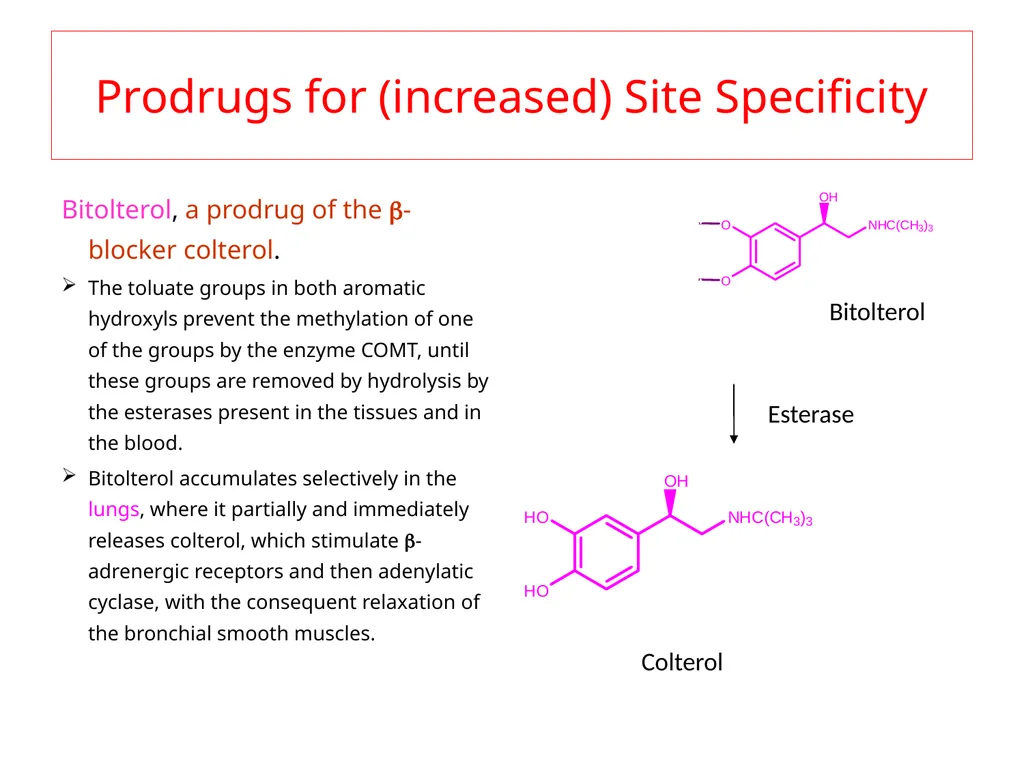
Prodrugs for (increased) Site Specificity Bitolterol, a prodrug of the -blocker colterol.
The toluate groups in both aromatic hydroxyls prevent the methylation of one of the groups by the enzyme COMT, until these groups are removed by hydrolysis by the esterases present in the tissues and in the blood.
Bitolterol accumulates selectively in the lungs, where it partially and immediately releases colterol, which stimulate -adrenergic receptors and then adenylatic cyclase, with the consequent relaxation of the bronchial smooth muscles. Esterase Bitolterol Colterol<br>
The toluate groups in both aromatic hydroxyls prevent the methylation of one of the groups by the enzyme COMT, until these groups are removed by hydrolysis by the esterases present in the tissues and in the blood.
Bitolterol accumulates selectively in the lungs, where it partially and immediately releases colterol, which stimulate -adrenergic receptors and then adenylatic cyclase, with the consequent relaxation of the bronchial smooth muscles. Esterase Bitolterol Colterol<br>
35
Blood-brain barrier (BBB) is one of important membrane often targeted for drug delivery.
It is unique lipid-like protective barrier that prevents hydrophilic compounds from entering the brain unless they are actively transported.
a The blood brain barrier contains active enzyme systems to protect the CNS even further.
Consequently, molecular size and lipophilicity are often necessary, not sufficient, criteria for gaining entry into the brain. Site Specificity : Brain<br>
It is unique lipid-like protective barrier that prevents hydrophilic compounds from entering the brain unless they are actively transported.
a The blood brain barrier contains active enzyme systems to protect the CNS even further.
Consequently, molecular size and lipophilicity are often necessary, not sufficient, criteria for gaining entry into the brain. Site Specificity : Brain<br>
36
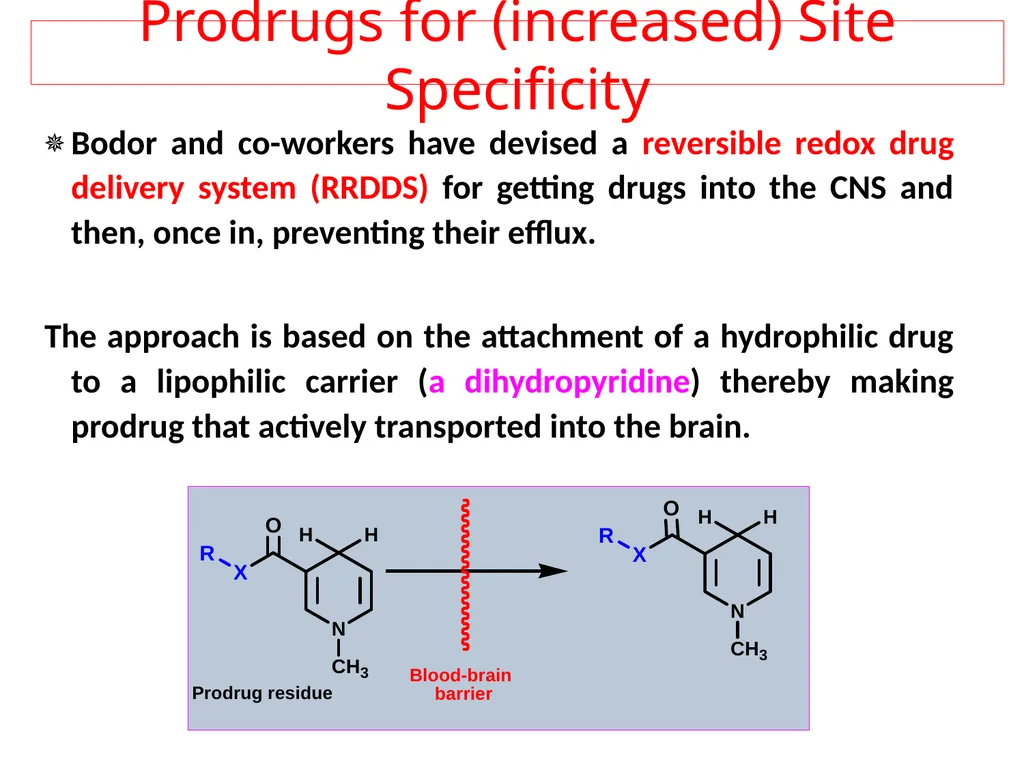
Prodrugs for (increased) Site Specificity Bodor and co-workers have devised a reversible redox drug delivery system (RRDDS) for getting drugs into the CNS and then, once in, preventing their efflux.
The approach is based on the attachment of a hydrophilic drug to a lipophilic carrier (a dihydropyridine) thereby making prodrug that actively transported into the brain.<br>
The approach is based on the attachment of a hydrophilic drug to a lipophilic carrier (a dihydropyridine) thereby making prodrug that actively transported into the brain.<br>
37
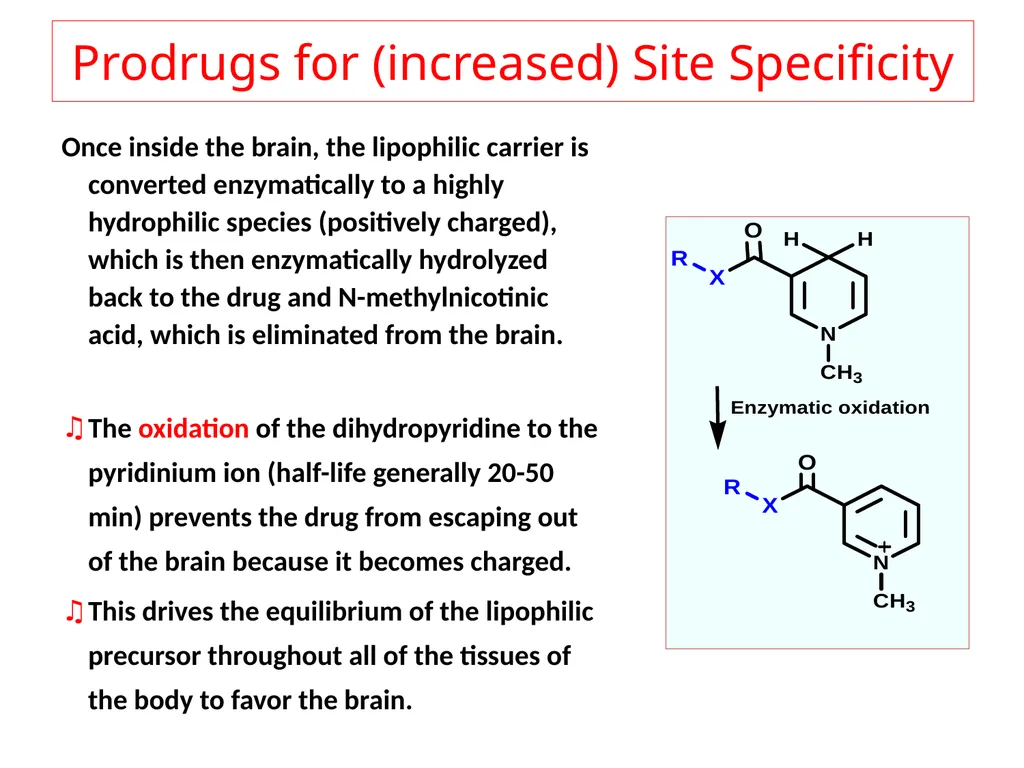
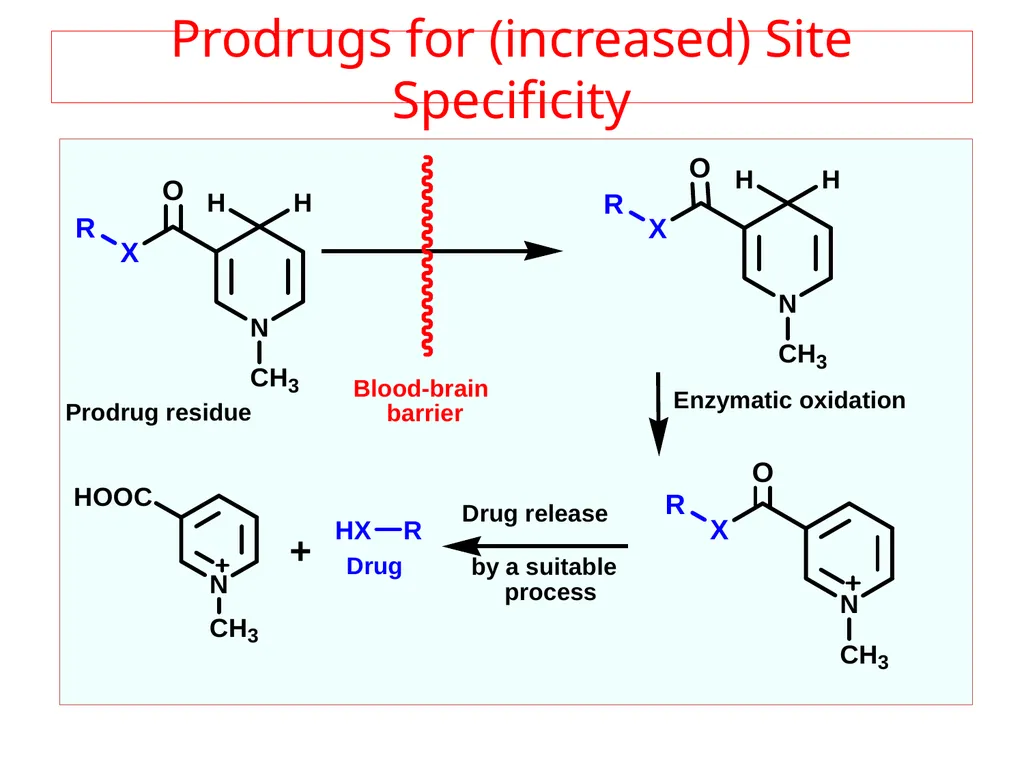
Prodrugs for (increased) Site Specificity Once inside the brain, the lipophilic carrier is converted enzymatically to a highly hydrophilic species (positively charged), which is then enzymatically hydrolyzed back to the drug and N-methylnicotinic acid, which is eliminated from the brain.
The oxidation of the dihydropyridine to the pyridinium ion (half-life generally 20-50 min) prevents the drug from escaping out of the brain because it becomes charged.
This drives the equilibrium of the lipophilic precursor throughout all of the tissues of the body to favor the brain.<br>
The oxidation of the dihydropyridine to the pyridinium ion (half-life generally 20-50 min) prevents the drug from escaping out of the brain because it becomes charged.
This drives the equilibrium of the lipophilic precursor throughout all of the tissues of the body to favor the brain.<br>
38
Prodrugs for (increased) Site Specificity<br>
39
Prodrugs for (increased) Site Specificity The functional group on the drug should be an amino, hydroxyl, or carboxyl group.
When it is a carboxylic acid, the linkage is an acyloxymethyl ester, which decomposes as in pivampicillin.<br>
When it is a carboxylic acid, the linkage is an acyloxymethyl ester, which decomposes as in pivampicillin.<br>
40
Prodrugs for (increased) Site Specificity Any oxidation occurring outside of the brain produces a hydrophilic species that can be rapidly eliminated from the body.
The released oxidized carrier is relatively nontoxic and easily eliminated from the brain.
Although this is a carrier-linked prodrug, it requires enzymatic oxidation to target the drug to the brain.
The oxidation reaction is a bioprecursor reaction.<br>
The released oxidized carrier is relatively nontoxic and easily eliminated from the brain.
Although this is a carrier-linked prodrug, it requires enzymatic oxidation to target the drug to the brain.
The oxidation reaction is a bioprecursor reaction.<br>
41
Prodrugs for (increased) Site Specificity The brain delivery of -lactam antibiotics for the possible treatment of bacterial meningitis.
Since the -lactam antibiotics are hydrophilic, they enter the brain very slowly, but they are actively transported back into the blood.
Therefore, they are not as effective in the treatment of brain infections as elsewhere.
Bodor and co-workers prepared a variety of penicillin prodrugs attached to the dihydropyridine carrier through various linkers and showed that -lactam antibiotics could be delivered in high concentrations into the brain.<br>
Since the -lactam antibiotics are hydrophilic, they enter the brain very slowly, but they are actively transported back into the blood.
Therefore, they are not as effective in the treatment of brain infections as elsewhere.
Bodor and co-workers prepared a variety of penicillin prodrugs attached to the dihydropyridine carrier through various linkers and showed that -lactam antibiotics could be delivered in high concentrations into the brain.<br>
42
Prodrugs for (increased) Site Specificity Increasing the brain concentration of the inhibitory neurotransmitter -aminobutyric acid (GABA) results in anticonvulsant activity.
GABA is too polar to cross the blood-brain barrier, so it is not an effective anticonvulsant drug.
To increase the lipophilicity of GABA, a series of GABT and -aminobutyric Schiff bases were synthesized.
Progabide emerged as an effective lipophilic analog of GABA that crosses the blood-brain barrier, releases GABA inside the brain, and shows anticonvulsant activity.<br>
GABA is too polar to cross the blood-brain barrier, so it is not an effective anticonvulsant drug.
To increase the lipophilicity of GABA, a series of GABT and -aminobutyric Schiff bases were synthesized.
Progabide emerged as an effective lipophilic analog of GABA that crosses the blood-brain barrier, releases GABA inside the brain, and shows anticonvulsant activity.<br>
43
Prodrugs for (increased) Site Specificity The synthesis of a glyceryl lipid (R=linolenoyl) containing one GABA molecule and one vigabatrin molecule, a mechanism-based inactivator of GABA aminotransferase and anticonvulsant drug.
This compound inactivates GABA aminotransferase in vitro only if brain esterases are added to cleave the vigabatrin from the glyceryl lipid.
It also is 300 times more potent than vigabatrin, in vivo, presumably because of its increased ability to enter the brain.<br>
This compound inactivates GABA aminotransferase in vitro only if brain esterases are added to cleave the vigabatrin from the glyceryl lipid.
It also is 300 times more potent than vigabatrin, in vivo, presumably because of its increased ability to enter the brain.<br>
44
Prodrugs for (increased) Site Specificity the application prodrugs to site-specific drug delivery -Glutamyl dopa is an example of a site-specific prodrug of levodopa (L-dopa).
L-dopa is precursor of the neurotransmitter dopamine, which plays an important role in the CNS and also exerts receptor-mediated vasodilation in the kidney.<br>
L-dopa is precursor of the neurotransmitter dopamine, which plays an important role in the CNS and also exerts receptor-mediated vasodilation in the kidney.<br>
45
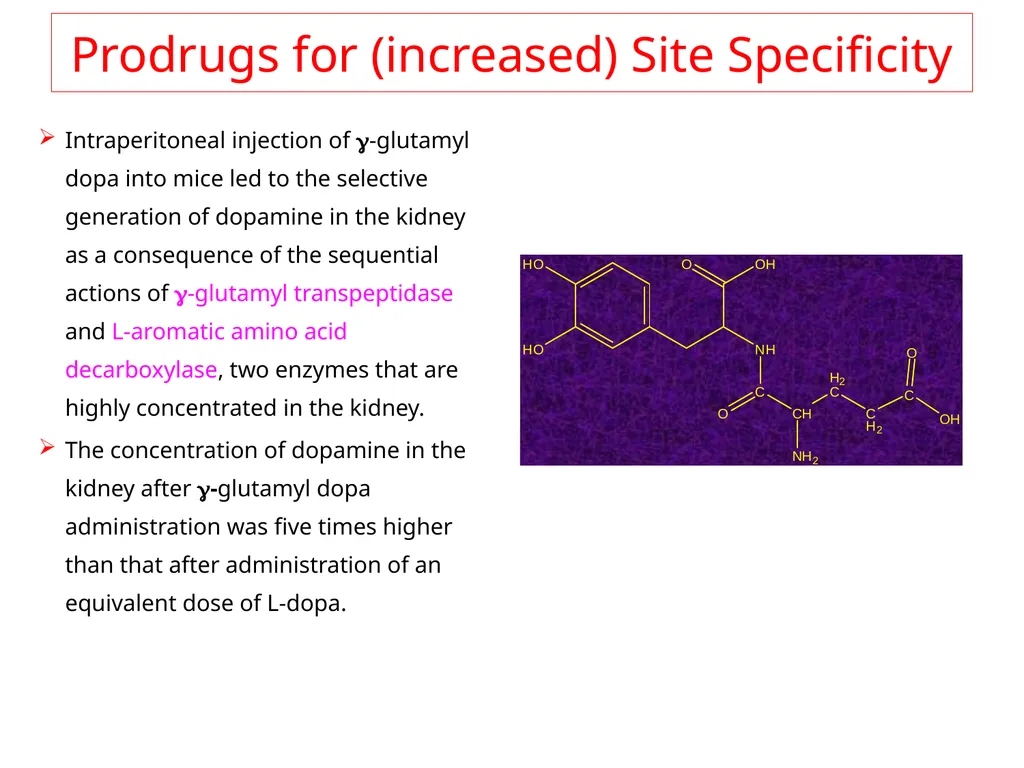
Prodrugs for (increased) Site Specificity Intraperitoneal injection of -glutamyl dopa into mice led to the selective generation of dopamine in the kidney as a consequence of the sequential actions of -glutamyl transpeptidase and L-aromatic amino acid decarboxylase, two enzymes that are highly concentrated in the kidney.
The concentration of dopamine in the kidney after -glutamyl dopa administration was five times higher than that after administration of an equivalent dose of L-dopa.<br>
The concentration of dopamine in the kidney after -glutamyl dopa administration was five times higher than that after administration of an equivalent dose of L-dopa.<br>
46
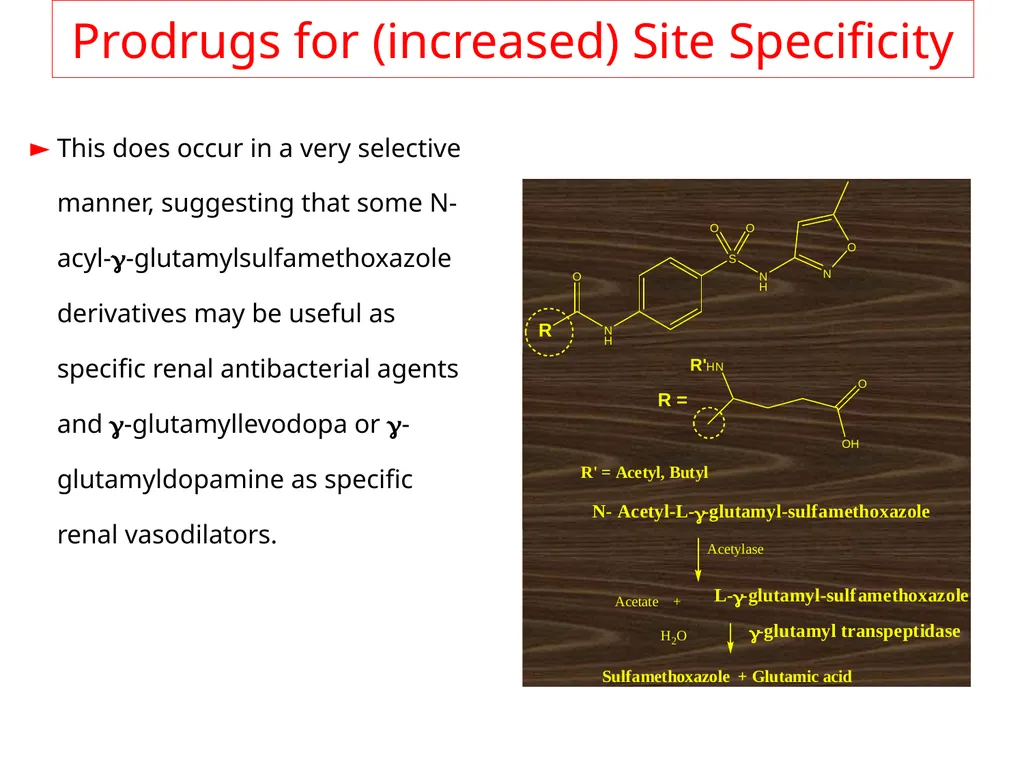
Prodrugs for (increased) Site Specificity This does occur in a very selective manner, suggesting that some N-acyl--glutamylsulfamethoxazole derivatives may be useful as specific renal antibacterial agents and -glutamyllevodopa or -glutamyldopamine as specific renal vasodilators.<br>
47
Prodrugs for (increased) Site Specificity Design a prodrug that requires activation by an enzyme found predominantly at the desired site of action.
For example, tumor cells contain a higher concentration of phosphatases and amidase than do normal cells.
Consequently, a prodrug of a cytotoxic agent could be directed to tumor cells if either of these enzymes were important to the prodrug activation process.<br>
For example, tumor cells contain a higher concentration of phosphatases and amidase than do normal cells.
Consequently, a prodrug of a cytotoxic agent could be directed to tumor cells if either of these enzymes were important to the prodrug activation process.<br>
48
Prodrugs for (increased) Site Specificity Diethylstilbestrol diphosphate was originally designed for site-specific delivery of diethylstilbestrol to prostatic carcinoma tissue.
In general, though, this tumor-selective approach has not been very successful because the appropriate prodrugs are too polar to reach the enzyme site, the relative enzymatic selectivity is insufficient, and the tumor cell perfusion rate is too poor.<br>
In general, though, this tumor-selective approach has not been very successful because the appropriate prodrugs are too polar to reach the enzyme site, the relative enzymatic selectivity is insufficient, and the tumor cell perfusion rate is too poor.<br>
49
designing prodrugs that are activated by enzymes found mainly at the target site.
This strategy has been used to design antitumour drugs because tumors contain higher proportions of phosphatases and peptidases than normal tissues.
For example, diethylstilboestrol diphosphate (Fosfestrol) has been used to deliver the oestrogen agonist diethylstilboestrol to prostatic carcinomas. Site Specificity<br>
This strategy has been used to design antitumour drugs because tumors contain higher proportions of phosphatases and peptidases than normal tissues.
For example, diethylstilboestrol diphosphate (Fosfestrol) has been used to deliver the oestrogen agonist diethylstilboestrol to prostatic carcinomas. Site Specificity<br>
50
Prodrugs for (increased) Site Specificity Certain glycosides of antiinflammatory steroids designed to release the parent drugs in the colon.
Since drug glycosides are bulkier and generally more hydrophilic than the corresponding drugs, their ability to cross the biological membranes is reduced.
Steroid glycosides are not cleaved by the enzymes of the small intestine.
In the colon, however, they are hydrolyzed by the bacterial glycosidases, thus liberating the parent drugs in the large intestine.<br>
Since drug glycosides are bulkier and generally more hydrophilic than the corresponding drugs, their ability to cross the biological membranes is reduced.
Steroid glycosides are not cleaved by the enzymes of the small intestine.
In the colon, however, they are hydrolyzed by the bacterial glycosidases, thus liberating the parent drugs in the large intestine.<br>
51
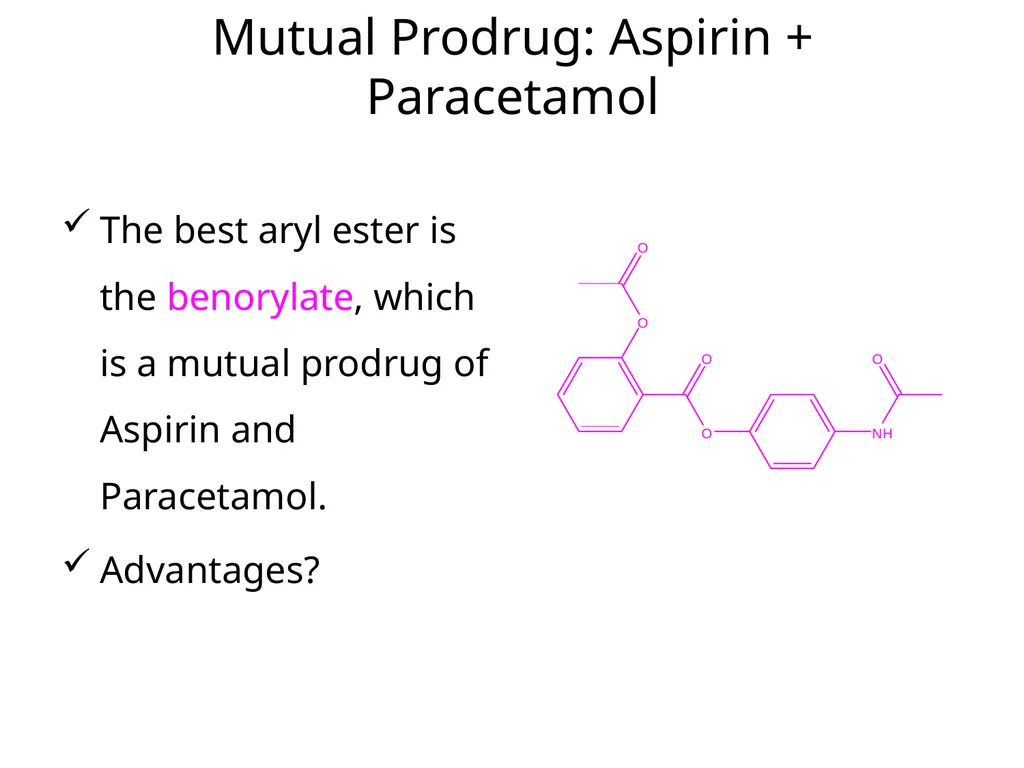
Mutual Prodrug: Aspirin + Paracetamol The best aryl ester is the benorylate, which is a mutual prodrug of Aspirin and Paracetamol.
Advantages?<br>
Advantages?<br>
52
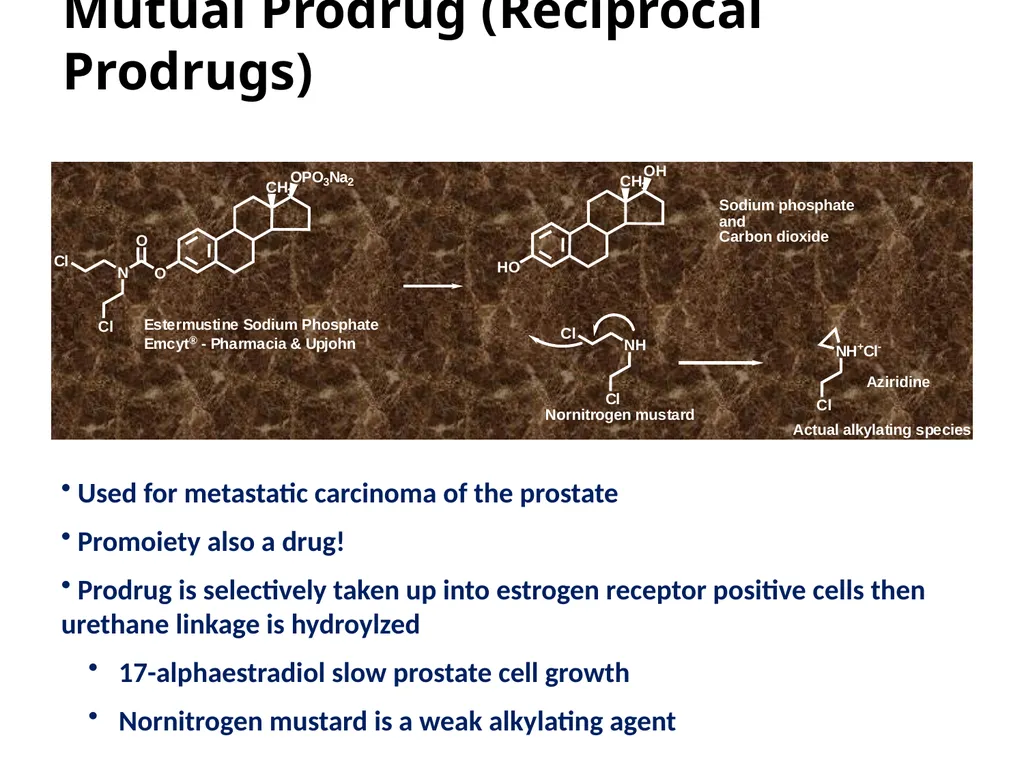
Mutual Prodrug (Reciprocal Prodrugs) Used for metastatic carcinoma of the prostate
Promoiety also a drug!
Prodrug is selectively taken up into estrogen receptor positive cells then urethane linkage is hydroylzed
17-alphaestradiol slow prostate cell growth
Nornitrogen mustard is a weak alkylating agent<br>
Promoiety also a drug!
Prodrug is selectively taken up into estrogen receptor positive cells then urethane linkage is hydroylzed
17-alphaestradiol slow prostate cell growth
Nornitrogen mustard is a weak alkylating agent<br>
53
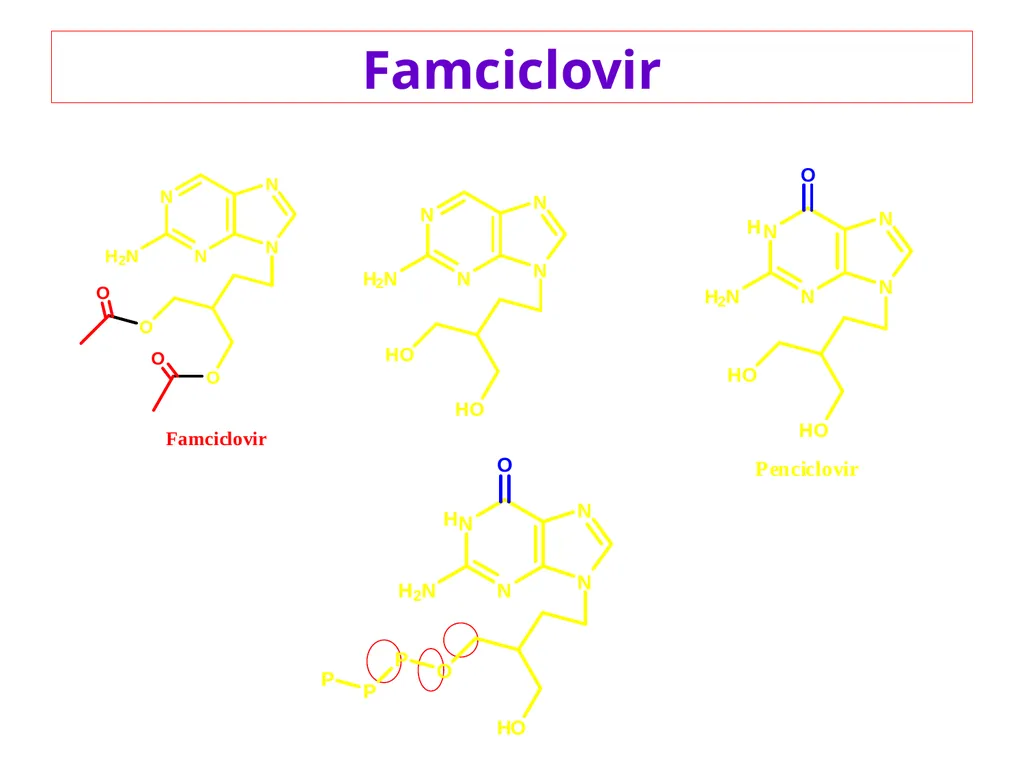
Famciclovir is a prodrug of penciclovir which is itself a prodrug
Penciclovir is poorly absorbed from the gut owing to its polarity.
Famciclovir is less polar and is absorbed more easily. It is then metabolized, mainly in the liver, to form penciclovir which is phosphorylated in virally infected cells. Prodrugs of prodrugs<br>
Penciclovir is poorly absorbed from the gut owing to its polarity.
Famciclovir is less polar and is absorbed more easily. It is then metabolized, mainly in the liver, to form penciclovir which is phosphorylated in virally infected cells. Prodrugs of prodrugs<br>
54
Famciclovir<br>
55
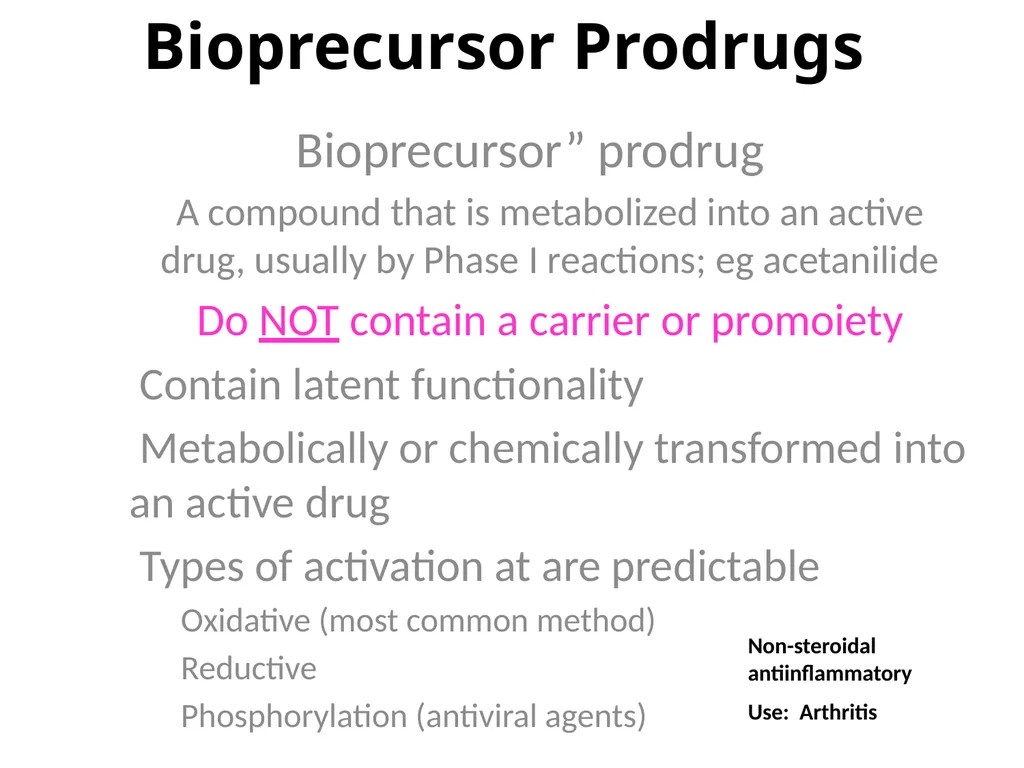
Bioprecursor Prodrugs Bioprecursor” prodrug
A compound that is metabolized into an active drug, usually by Phase I reactions; eg acetanilide
Do NOT contain a carrier or promoiety
Contain latent functionality
Metabolically or chemically transformed into an active drug
Types of activation at are predictable
Oxidative (most common method)
Reductive
Phosphorylation (antiviral agents) Non-steroidal antiinflammatory
Use: Arthritis<br>
A compound that is metabolized into an active drug, usually by Phase I reactions; eg acetanilide
Do NOT contain a carrier or promoiety
Contain latent functionality
Metabolically or chemically transformed into an active drug
Types of activation at are predictable
Oxidative (most common method)
Reductive
Phosphorylation (antiviral agents) Non-steroidal antiinflammatory
Use: Arthritis<br>
56
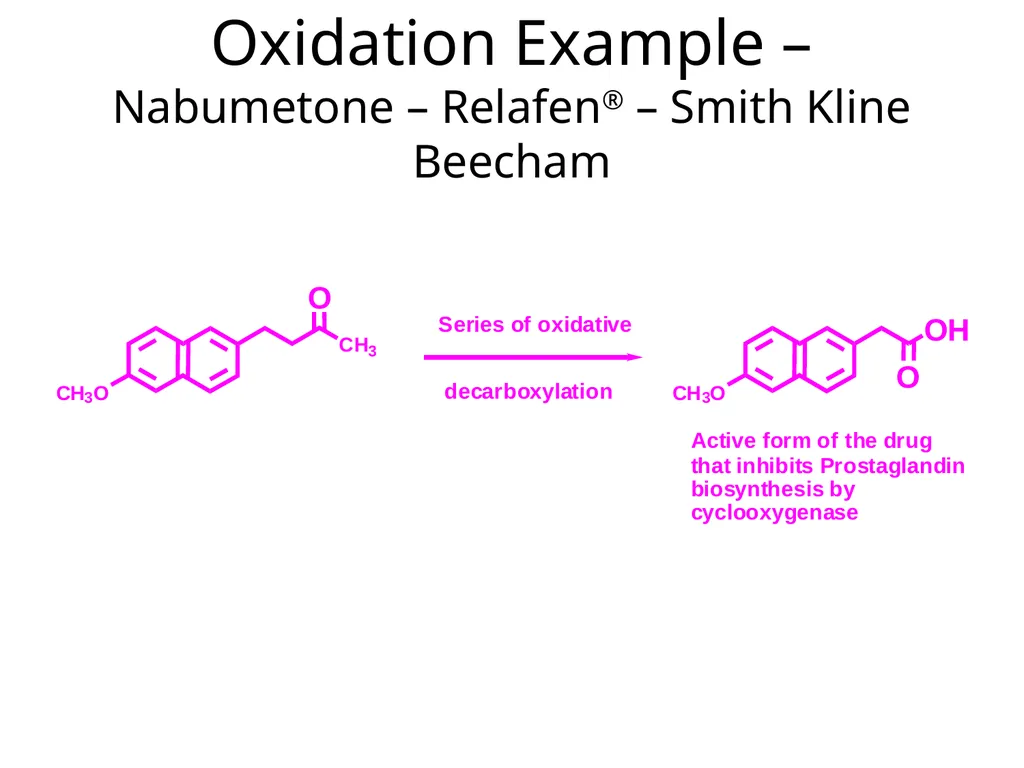
Oxidation Example – Nabumetone – Relafen® – Smith Kline Beecham<br>
57
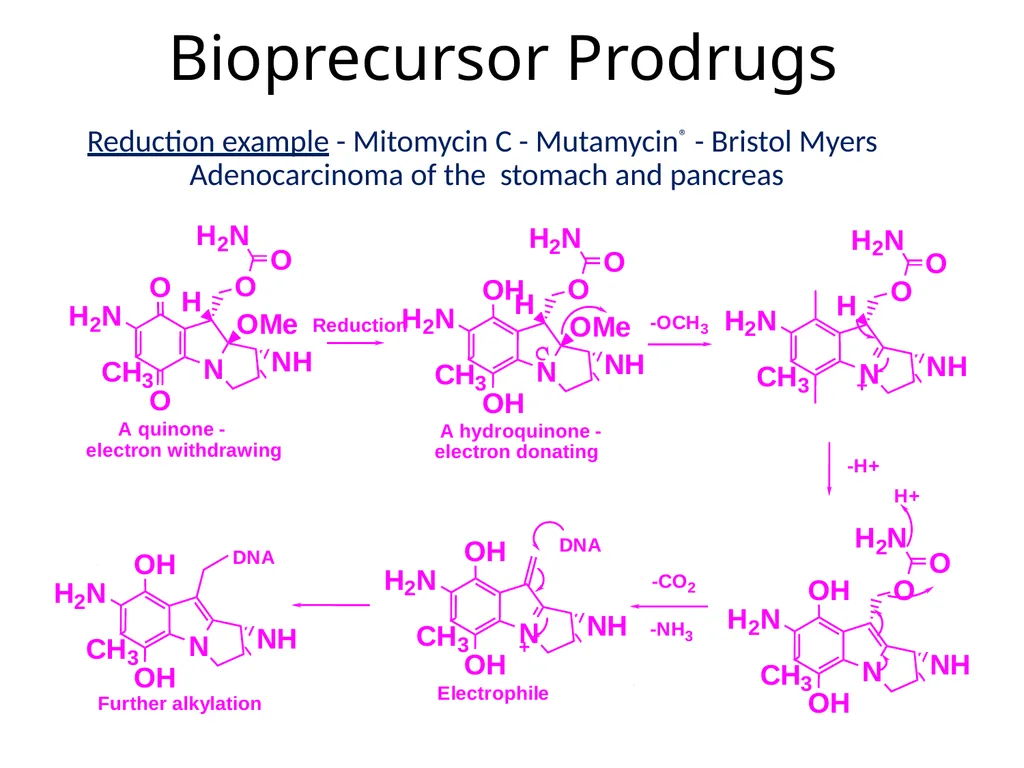
Reduction example - Mitomycin C - Mutamycin® - Bristol Myers Adenocarcinoma of the stomach and pancreas Bioprecursor Prodrugs<br>
58
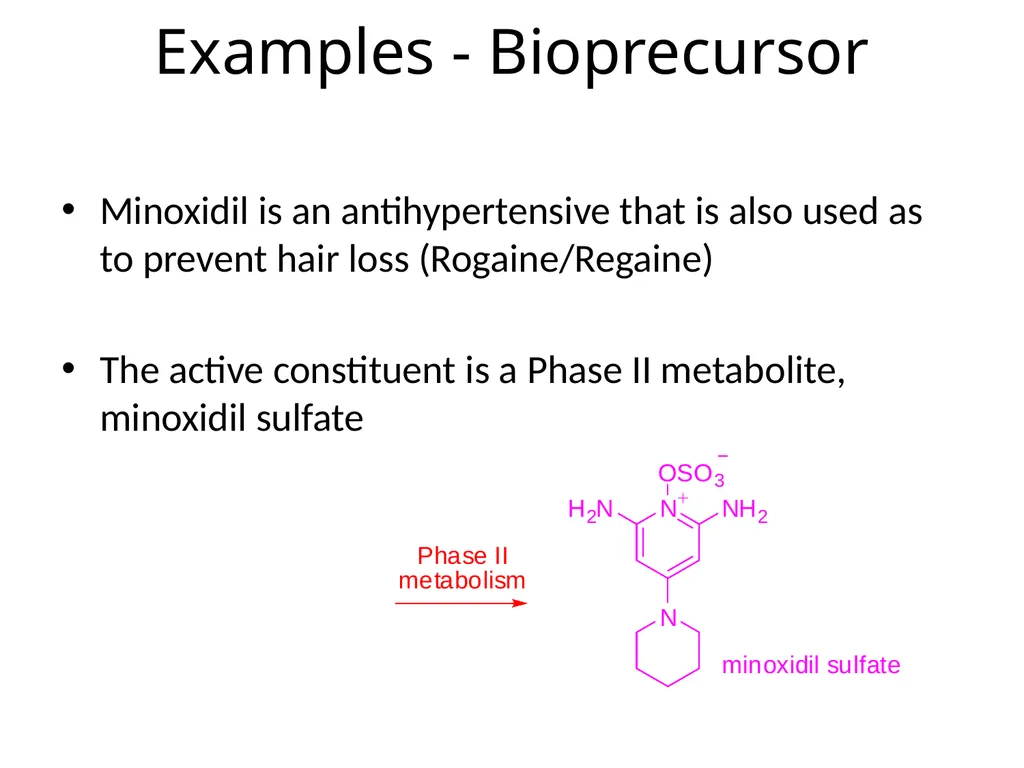
Examples - Bioprecursor Minoxidil is an antihypertensive that is also used as to prevent hair loss (Rogaine/Regaine)
The active constituent is a Phase II metabolite, minoxidil sulfate<br>
The active constituent is a Phase II metabolite, minoxidil sulfate<br>
59
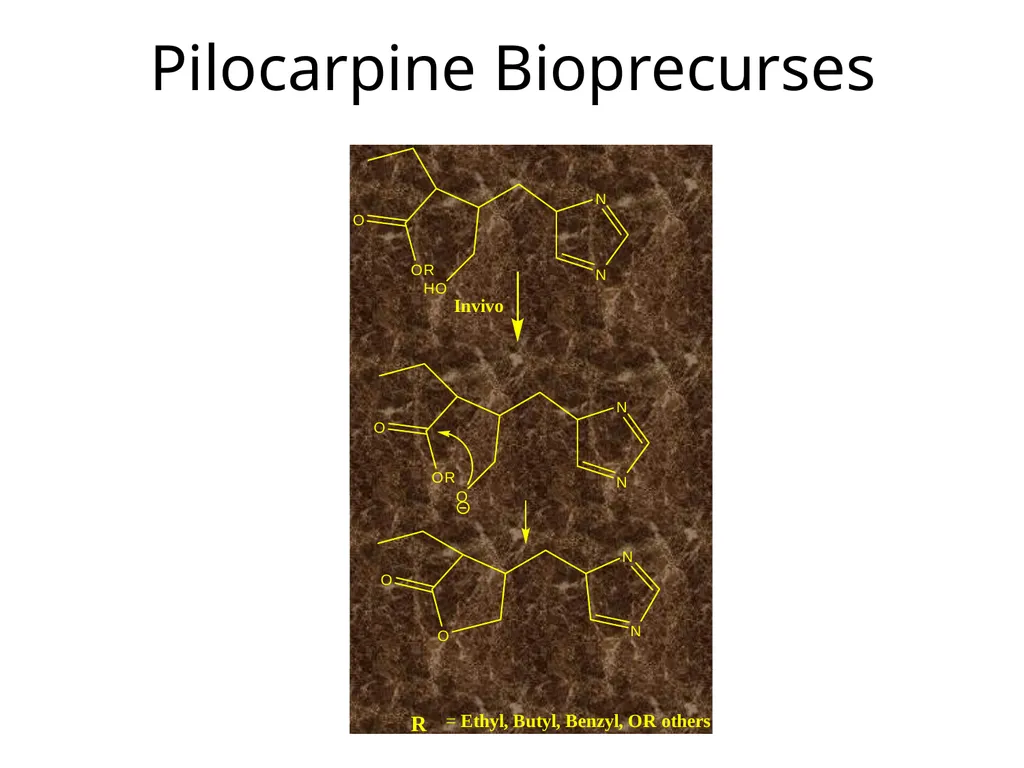
Pilocarpine Bioprecurses<br>
60
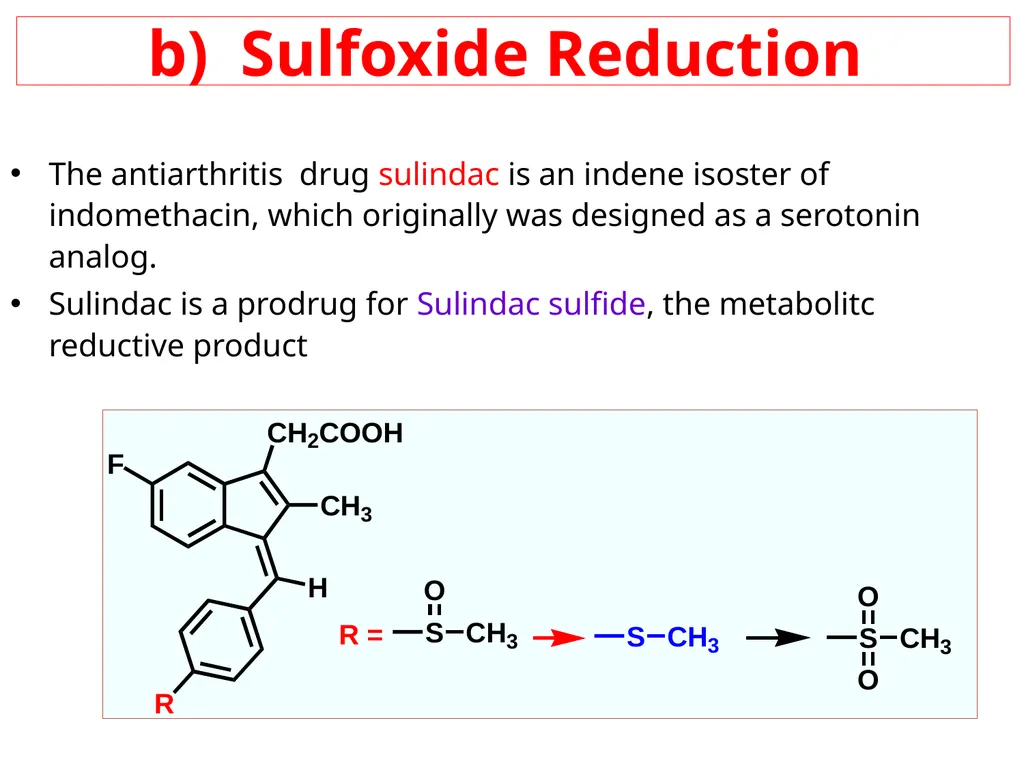
b) Sulfoxide Reduction The antiarthritis drug sulindac is an indene isoster of indomethacin, which originally was designed as a serotonin analog.
Sulindac is a prodrug for Sulindac sulfide, the metabolitc reductive product<br>
Sulindac is a prodrug for Sulindac sulfide, the metabolitc reductive product<br>
61
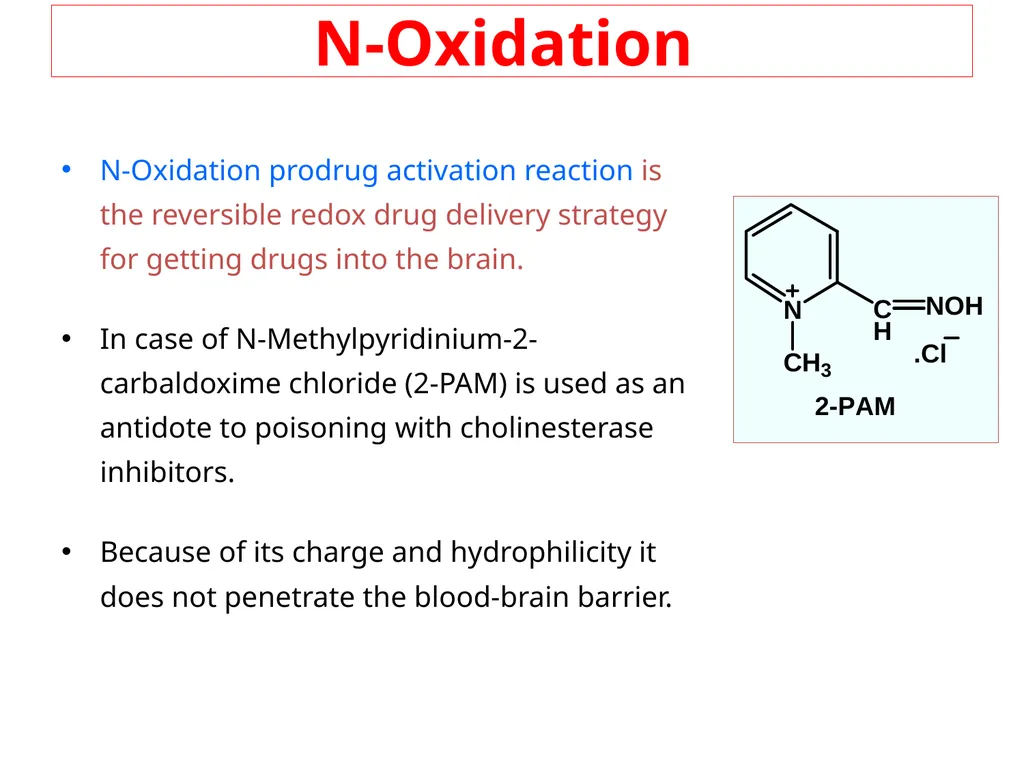
N-Oxidation N-Oxidation prodrug activation reaction is the reversible redox drug delivery strategy for getting drugs into the brain.
In case of N-Methylpyridinium-2-carbaldoxime chloride (2-PAM) is used as an antidote to poisoning with cholinesterase inhibitors.
Because of its charge and hydrophilicity it does not penetrate the blood-brain barrier.<br>
In case of N-Methylpyridinium-2-carbaldoxime chloride (2-PAM) is used as an antidote to poisoning with cholinesterase inhibitors.
Because of its charge and hydrophilicity it does not penetrate the blood-brain barrier.<br>
62
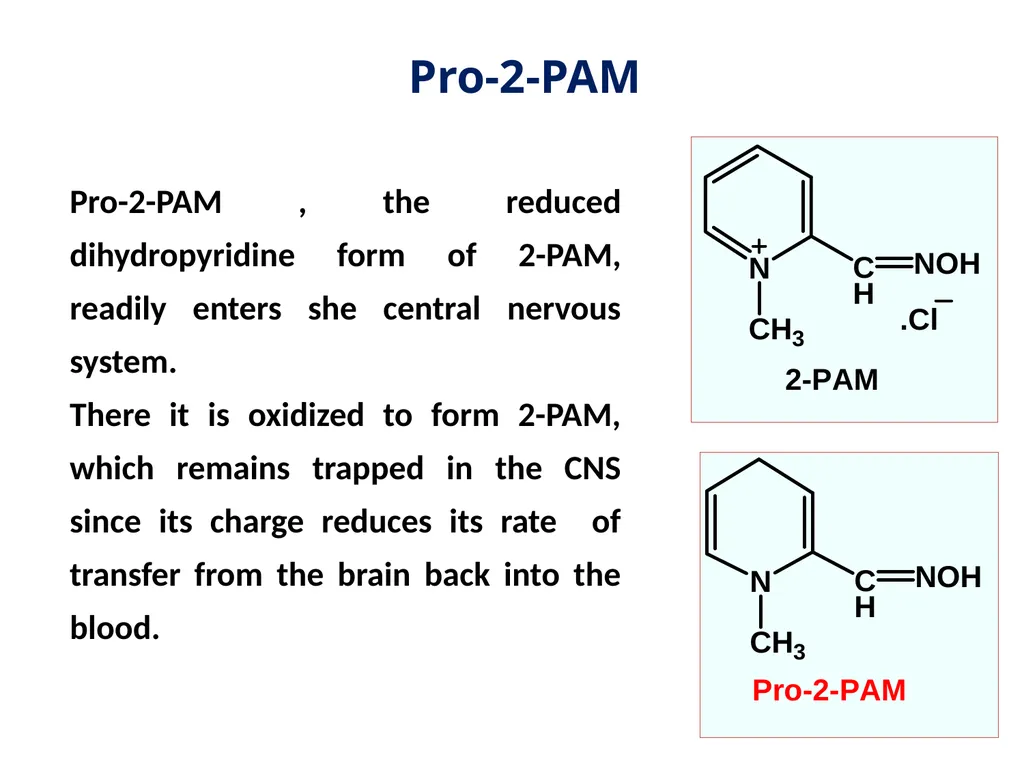
Pro-2-PAM , the reduced dihydropyridine form of 2-PAM, readily enters she central nervous system.
There it is oxidized to form 2-PAM, which remains trapped in the CNS since its charge reduces its rate of transfer from the brain back into the blood. Pro-2-PAM<br>
There it is oxidized to form 2-PAM, which remains trapped in the CNS since its charge reduces its rate of transfer from the brain back into the blood. Pro-2-PAM<br>
63
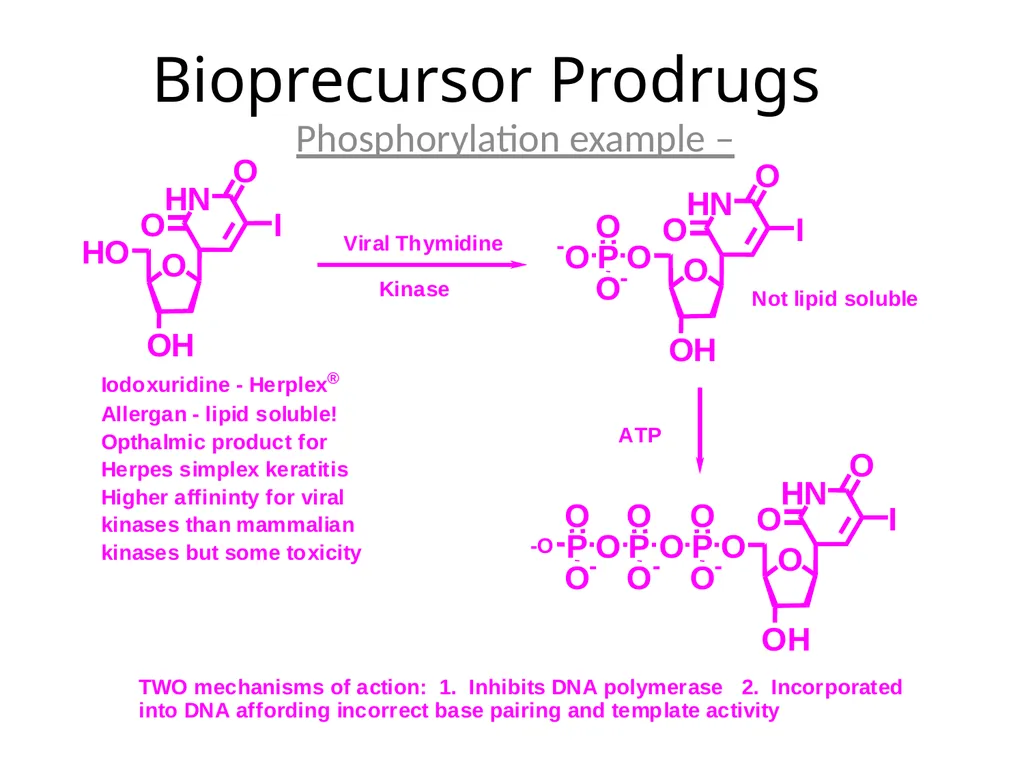
Phosphorylation example – Bioprecursor Prodrugs<br>
64
We have already seen 2 examples of this:
Sulfasalazine – an azo compound
Methenamine – An urinary antibacterial agent
Requirements
Prodrug reach the site of action in high concentrations
Knowledge of high metabolism at site
Other factors
Extent of organ or site perfusion
Information on the rate of prodrug conversion to the active form at both target and non-target sites
Rate of input/output of prodrug from the target site
Limit side effects and increase effectiveness Chemical Delivery Systems<br>
Sulfasalazine – an azo compound
Methenamine – An urinary antibacterial agent
Requirements
Prodrug reach the site of action in high concentrations
Knowledge of high metabolism at site
Other factors
Extent of organ or site perfusion
Information on the rate of prodrug conversion to the active form at both target and non-target sites
Rate of input/output of prodrug from the target site
Limit side effects and increase effectiveness Chemical Delivery Systems<br>
65
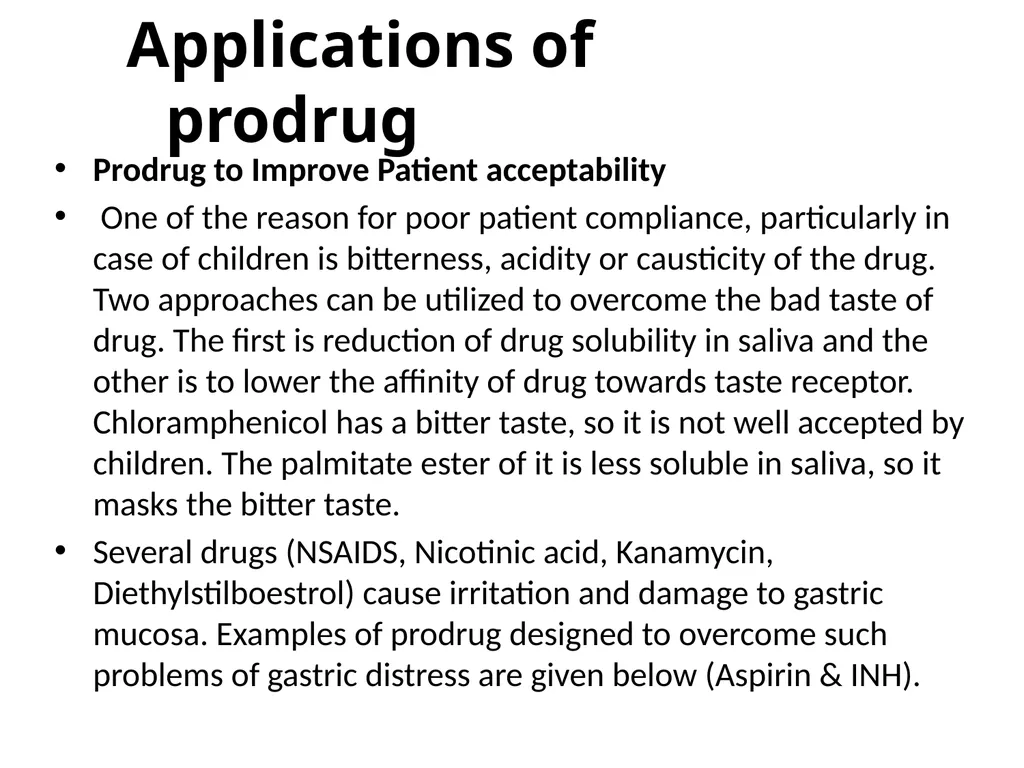
Prodrug to Improve Patient acceptability
One of the reason for poor patient compliance, particularly in case of children is bitterness, acidity or causticity of the drug. Two approaches can be utilized to overcome the bad taste of drug. The first is reduction of drug solubility in saliva and the other is to lower the affinity of drug towards taste receptor. Chloramphenicol has a bitter taste, so it is not well accepted by children. The palmitate ester of it is less soluble in saliva, so it masks the bitter taste.
Several drugs (NSAIDS, Nicotinic acid, Kanamycin, Diethylstilboestrol) cause irritation and damage to gastric mucosa. Examples of prodrug designed to overcome such problems of gastric distress are given below (Aspirin & INH). Applications of prodrug<br>
One of the reason for poor patient compliance, particularly in case of children is bitterness, acidity or causticity of the drug. Two approaches can be utilized to overcome the bad taste of drug. The first is reduction of drug solubility in saliva and the other is to lower the affinity of drug towards taste receptor. Chloramphenicol has a bitter taste, so it is not well accepted by children. The palmitate ester of it is less soluble in saliva, so it masks the bitter taste.
Several drugs (NSAIDS, Nicotinic acid, Kanamycin, Diethylstilboestrol) cause irritation and damage to gastric mucosa. Examples of prodrug designed to overcome such problems of gastric distress are given below (Aspirin & INH). Applications of prodrug<br>
66
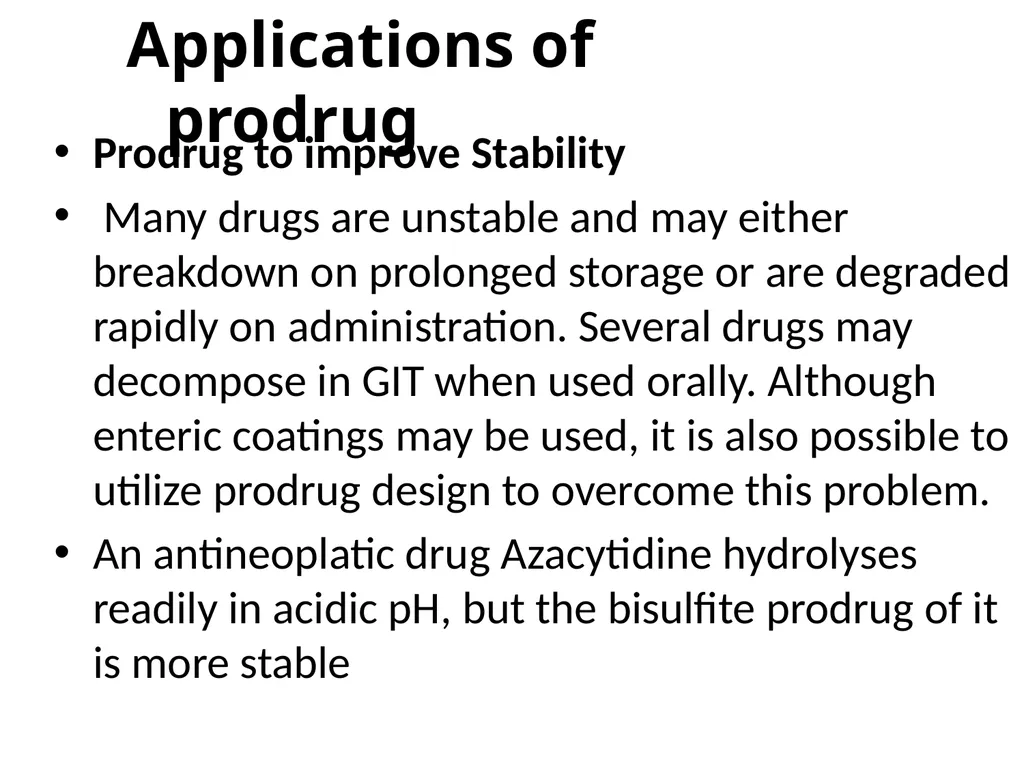
Prodrug to improve Stability
Many drugs are unstable and may either breakdown on prolonged storage or are degraded rapidly on administration. Several drugs may decompose in GIT when used orally. Although enteric coatings may be used, it is also possible to utilize prodrug design to overcome this problem.
An antineoplatic drug Azacytidine hydrolyses readily in acidic pH, but the bisulfite prodrug of it is more stable Applications of prodrug<br>
Many drugs are unstable and may either breakdown on prolonged storage or are degraded rapidly on administration. Several drugs may decompose in GIT when used orally. Although enteric coatings may be used, it is also possible to utilize prodrug design to overcome this problem.
An antineoplatic drug Azacytidine hydrolyses readily in acidic pH, but the bisulfite prodrug of it is more stable Applications of prodrug<br>
67
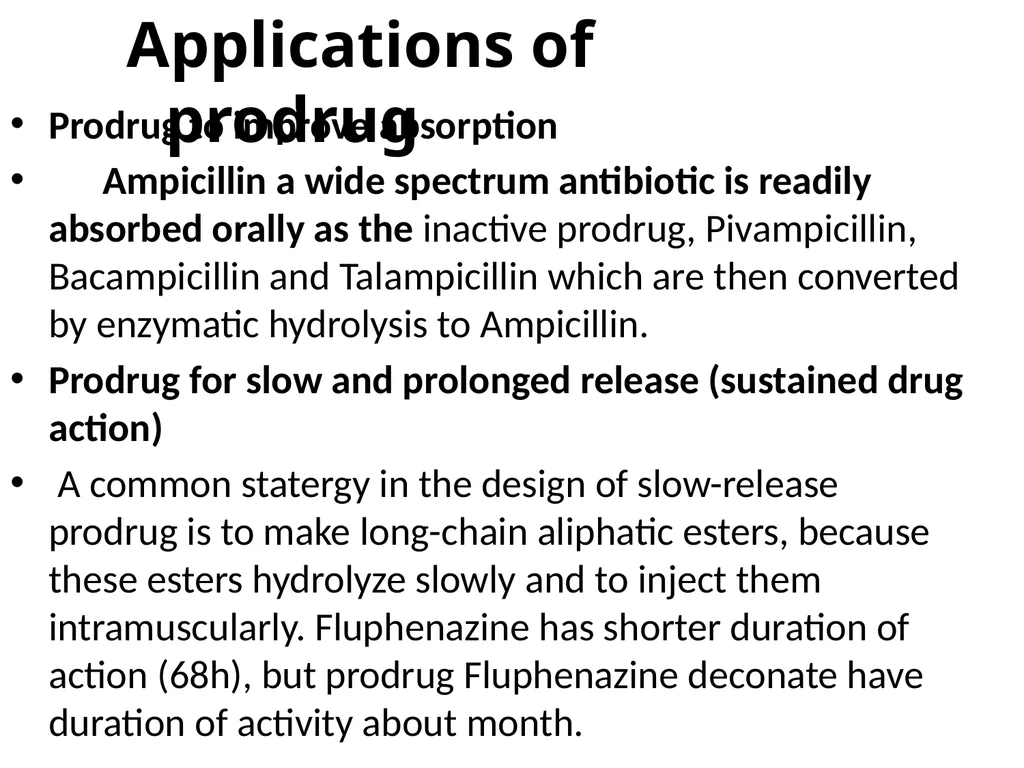
Prodrug to improve absorption
Ampicillin a wide spectrum antibiotic is readily absorbed orally as the inactive prodrug, Pivampicillin, Bacampicillin and Talampicillin which are then converted by enzymatic hydrolysis to Ampicillin.
Prodrug for slow and prolonged release (sustained drug action)
A common statergy in the design of slow-release prodrug is to make long-chain aliphatic esters, because these esters hydrolyze slowly and to inject them intramuscularly. Fluphenazine has shorter duration of action (68h), but prodrug Fluphenazine deconate have duration of activity about month. Applications of prodrug<br>
Ampicillin a wide spectrum antibiotic is readily absorbed orally as the inactive prodrug, Pivampicillin, Bacampicillin and Talampicillin which are then converted by enzymatic hydrolysis to Ampicillin.
Prodrug for slow and prolonged release (sustained drug action)
A common statergy in the design of slow-release prodrug is to make long-chain aliphatic esters, because these esters hydrolyze slowly and to inject them intramuscularly. Fluphenazine has shorter duration of action (68h), but prodrug Fluphenazine deconate have duration of activity about month. Applications of prodrug<br>
68
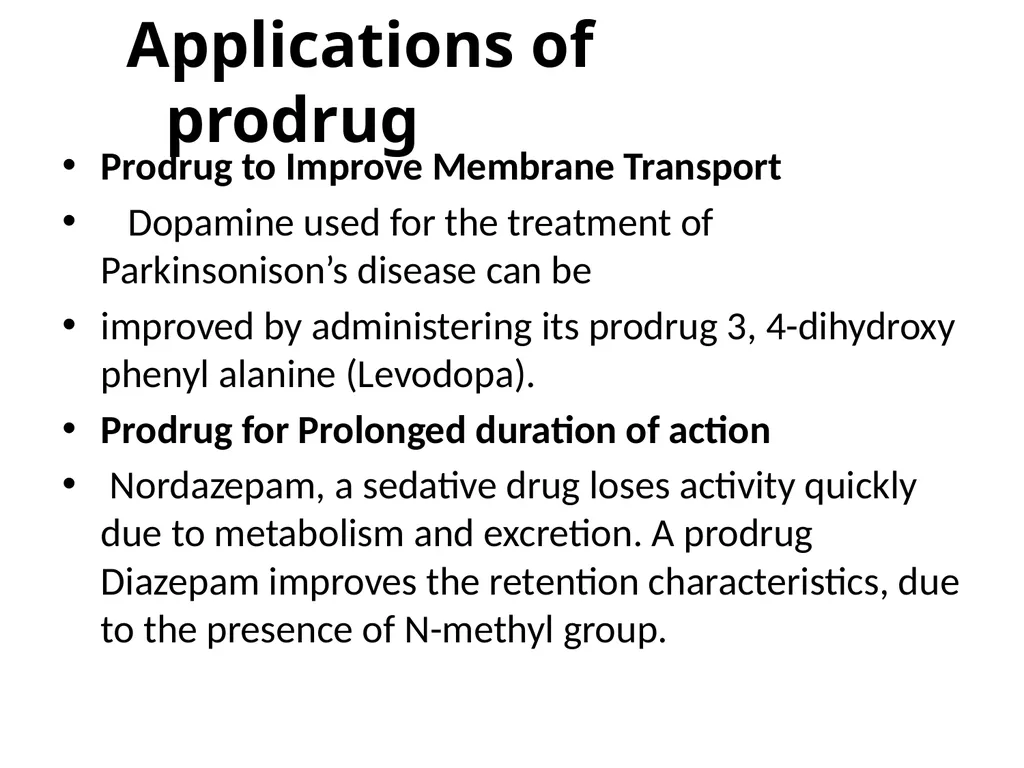
Prodrug to Improve Membrane Transport
Dopamine used for the treatment of Parkinsonison’s disease can be
improved by administering its prodrug 3, 4-dihydroxy phenyl alanine (Levodopa).
Prodrug for Prolonged duration of action
Nordazepam, a sedative drug loses activity quickly due to metabolism and excretion. A prodrug Diazepam improves the retention characteristics, due to the presence of N-methyl group. Applications of prodrug<br>
Dopamine used for the treatment of Parkinsonison’s disease can be
improved by administering its prodrug 3, 4-dihydroxy phenyl alanine (Levodopa).
Prodrug for Prolonged duration of action
Nordazepam, a sedative drug loses activity quickly due to metabolism and excretion. A prodrug Diazepam improves the retention characteristics, due to the presence of N-methyl group. Applications of prodrug<br>