Prof . Dr. Younis A. Alkhafaji Lecture 1 - Biology Biology is a science that deals with the study of life and living organisms, including their structure, function, growth, evolution, origin, distribution and taxonomy. The word biology
"Prof . Dr. Younis A. Alkhafaji Lecture – 1 -" is the property of its rightful owner. Permission is granted to
download and print the materials on this website for personal, non-commercial use only, and to display it
on your personal computer provided you do not modify the materials and that you retain all copyright
notices contained in the materials. By downloading content from our website, you accept the terms of this
agreement.
Presentation Transcript
01
Prof . Dr. Younis A. Alkhafaji Lecture – 1 - Biology Biology is a science that deals with the study of life and living organisms, including their structure, function, growth, evolution, origin, distribution and taxonomy. The word biology means, "The science of life", from the Greek Bios means life and logos means science. Therefore, Biology is the science of Living Things. That is why Biology is sometimes, known as Life Science. The cell is the basic structural, functional, and biological unit of all known living organisms.
A cell is the smallest unit of life that can replicate independently, and cells are often called the "building blocks of life". The study of cells is called cell biology or cytology.
Cell biology or Cytology is a branch of biology that studies the different structures and functions of the cell and focuses mainly on the idea of the cell as the basic unit of life.<br>
02
Cell biology explains the structure, organization of the organelles they contain, their physiological properties, metabolic processes, Signaling pathways, life cycle, and interactions with their environment. Organisms can be classified as unicellular (consisting of a single cell; including bacteria)
and Archaea
multicellular (including plants and animals). While the number of cells in plants and animals varies from species to species, humans contain more than 10 trillion (1012) cells.<br>
03
Cell theory Robert Hooke in (1665) who described the cella (open spaces) of plant tissues discovered the cell. The cell theory is a widely accepted explanation of the relationship between cells and living things. The cell theory states:
1. All organisms are composed of cells.
2. Cell is the structural and functional unit of life.
3. Cells arise from pre-existing cells.
The cells vary considerably, in shape and size. Nerve cells of animals have long extensions. They can be several feet in length. Muscle cells are elongated in shape. Egg of the ostrich is the largest cell (75 mm). Some plant cells have thick walls. There is also wide variation in the number of cells in different organisms.<br>
04
Cell types There are two distinctive types of cells
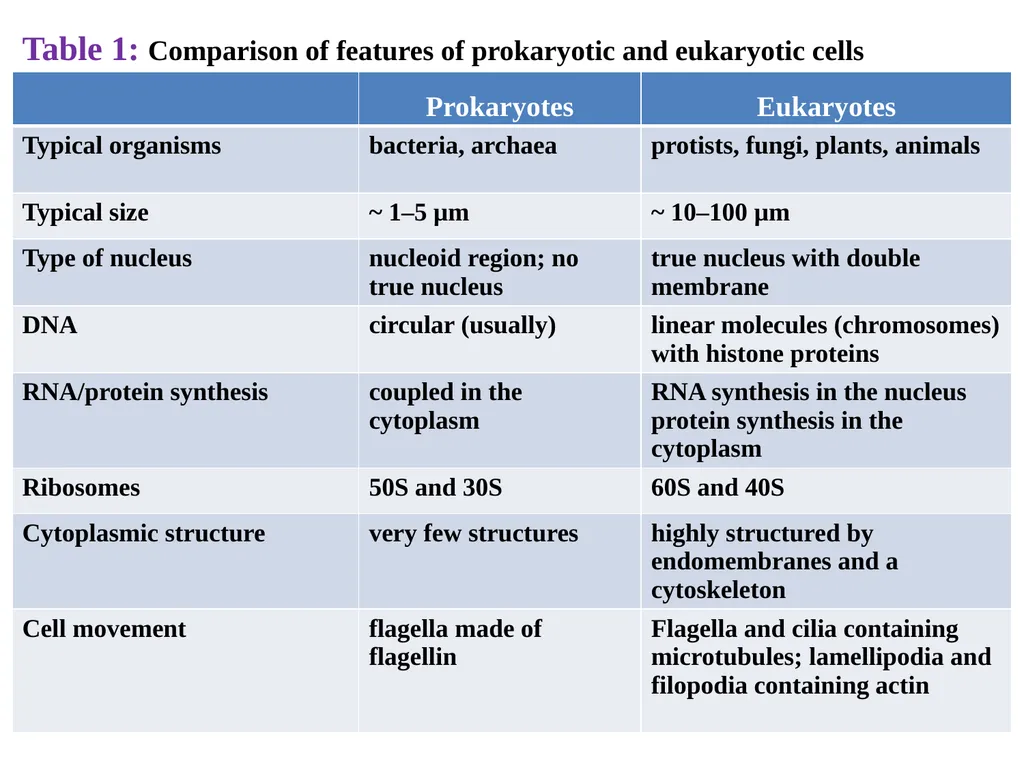
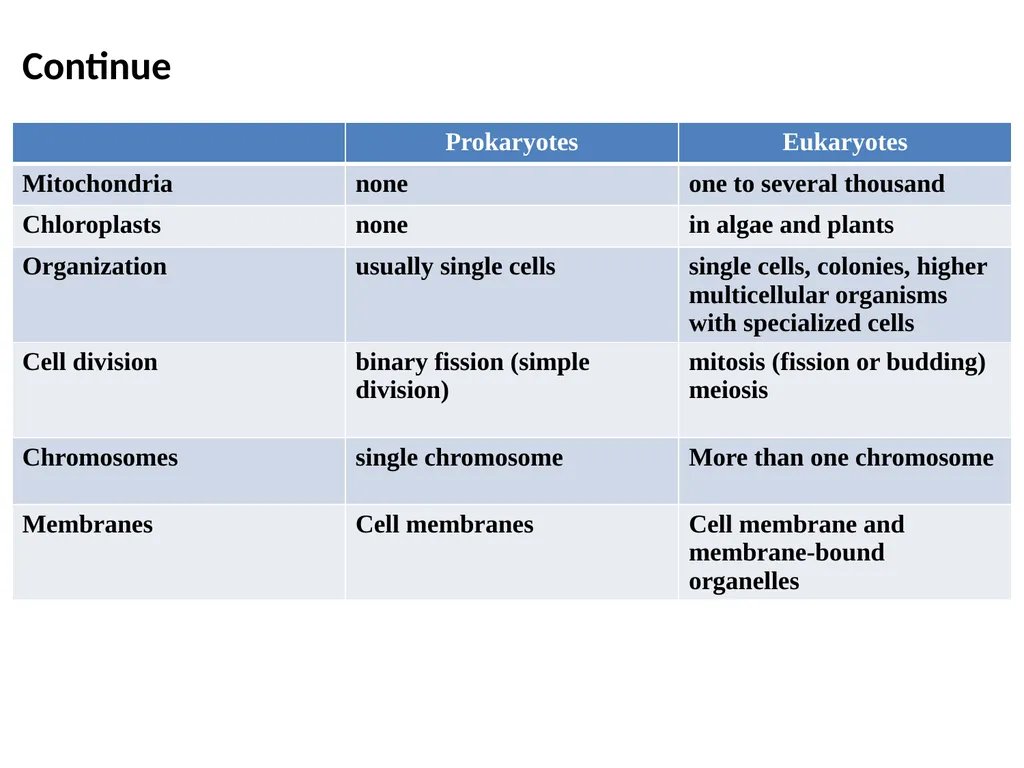
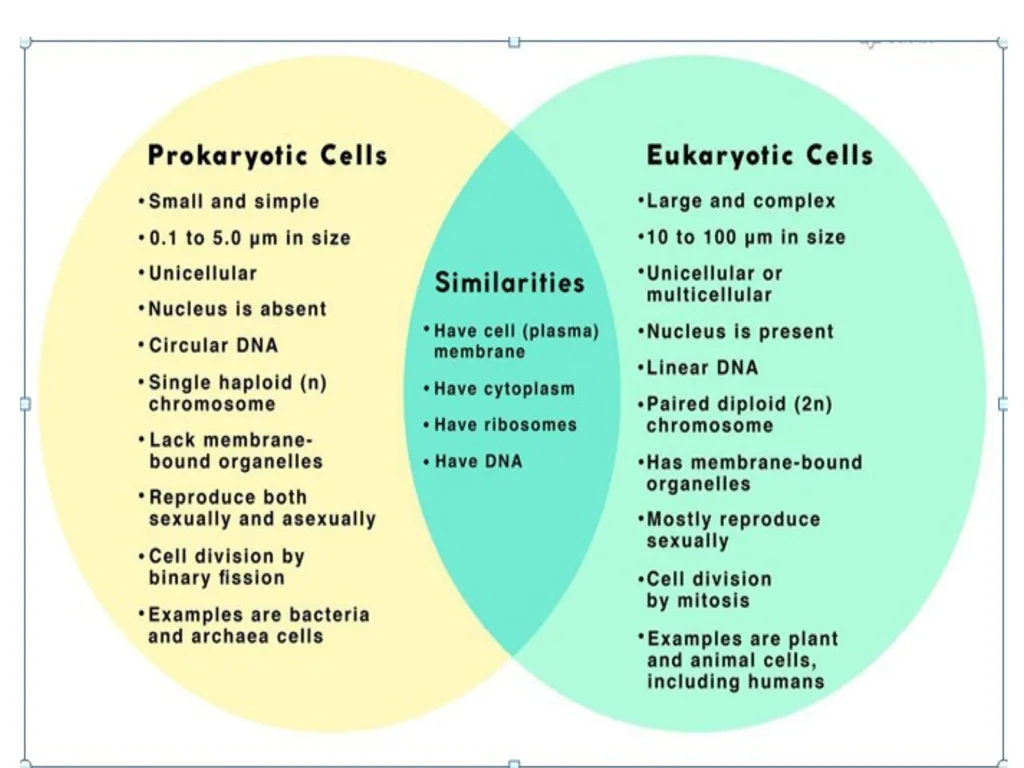
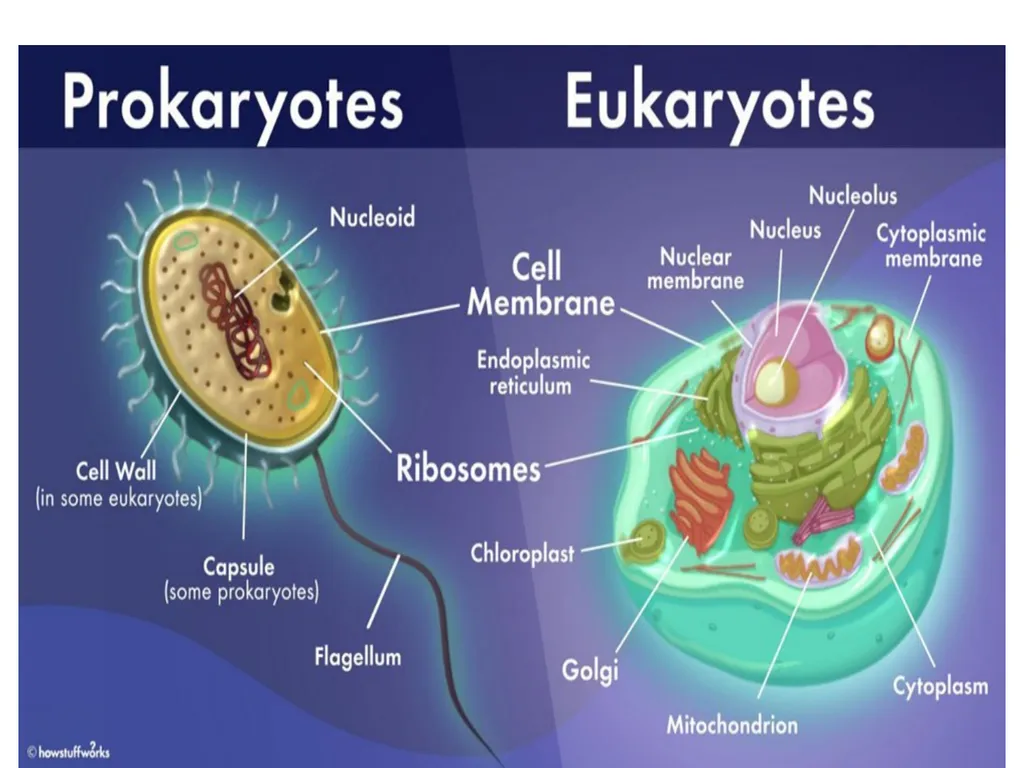
1- Prokaryotic cells: Prokaryotes lack a nucleus (though they do have circular DNA) and other membrane-bound organelles (though they do contain ribosomes).
Bacteria and Archaea are two domains of prokaryotes.
2- Eukaryotic cells: Eukaryotes, have distinct nuclei bound by a nuclear membrane and membrane-bound organelles (mitochondria, chloroplasts, lysosomes, rough and smooth endoplasmic reticulum, vacuoles). In addition, they possess organized chromosomes which store genetic material.
Protists, fungi, animals, and plants all consist of eukaryotic cells.
(“Protist” is an informal term referring to a group of mostly unicellular eukaryotes) .<br>
05
Table 1: Comparison of features of prokaryotic and eukaryotic cells<br>