Prof Md. Mashihur Rahman Additional Director, IQAC Manners Etiquette Manners and Etiquette Both manners and etiquette revolve around human behaviour and are often used interchangeably, but two are different and shouldnt be confused.
"Prof Md. Mashihur Rahman Additional Director, IQAC" is the property of its rightful owner. Permission is granted to
download and print the materials on this website for personal, non-commercial use only, and to display it
on your personal computer provided you do not modify the materials and that you retain all copyright
notices contained in the materials. By downloading content from our website, you accept the terms of this
agreement.
Both manners and etiquette revolve around human behaviour and are often used interchangeably, but two are different and shouldn’t be confused.
Manner is a way of behaving or conducting oneself, especially with respect to social norms and politeness.
It is a way of behaving, especially towards other people, that is considered to be polite, respectful, or dignified.
Manner reflects one’s family background, education, home environment, commonsense, culture, human quality<br>
03
Differences between Manners and Etiquette Manners are the basic general principles of politeness or polite behaviours and courtesies that we use in social situations and are expected of us in our day-to-day life. Etiquette on the other hand is a set of specific rules, regulations, and customs that are expected in particular social situations, often related to a certain profession or culture.
Manners are a reflection of our character, etiquette is a reflection of our culture.
Manners are more individual and can be adapted according to the situation While etiquette is more structured and should be followed exactly as it is laid out.
Manners are flexible and can be adapted to different cultures, while etiquette is much more rigid and is often specific to a certain culture.<br>
04
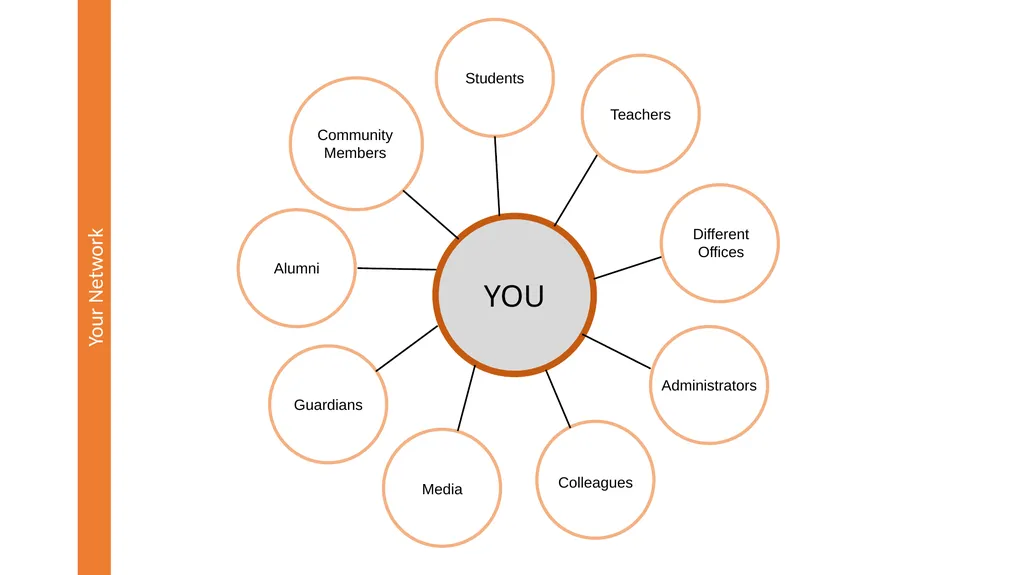
YOU Students Teachers Administrators Community
Members Guardians Media Colleagues Different
Offices Alumni Your Network<br>
05
Makie a positive and lasting impression on others
Strengthen relationships
Improve self-confidence
Avoid potential conflict
Make a positive contribution to society
Respect for yourself and those around you
Give you a professional edge in the workplace
Promote an atmosphere of tolerance and understanding.
Promote civility and politeness in society. Benefits of Good Manners<br>
06
Etiquette and manners go hand in hand. You will find several etiquette for different situations
Social etiquette is the set of conventions and expectations governing how people should behave in social situations. It includes practices such as using polite language, making introductions, and respecting personal space. Different Types of Etiquette<br>
07
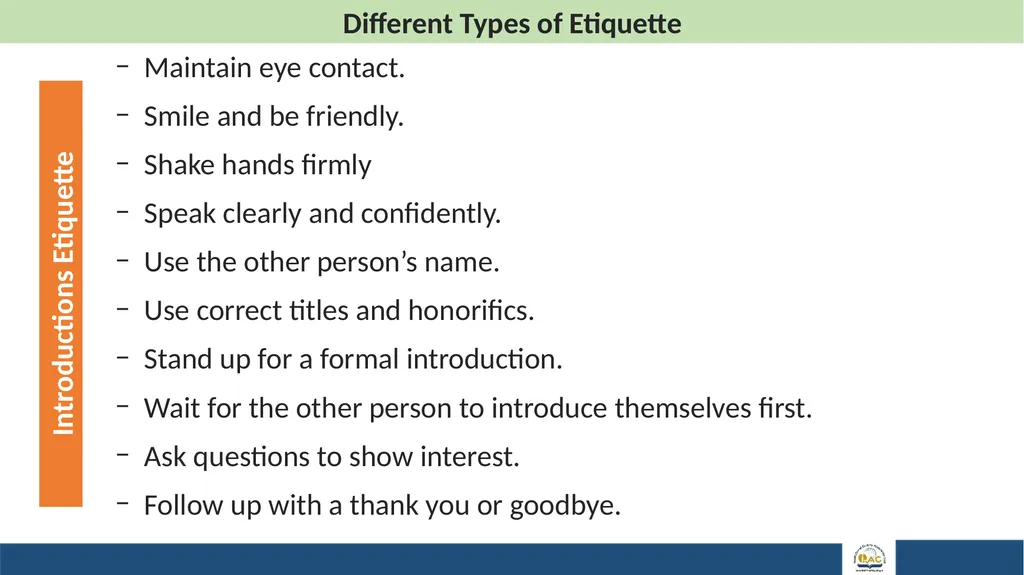
Maintain eye contact.
Smile and be friendly.
Shake hands firmly
Speak clearly and confidently.
Use the other person’s name.
Use correct titles and honorifics.
Stand up for a formal introduction.
Wait for the other person to introduce themselves first.
Ask questions to show interest.
Follow up with a thank you or goodbye. Different Types of Etiquette Introductions Etiquette<br>
08
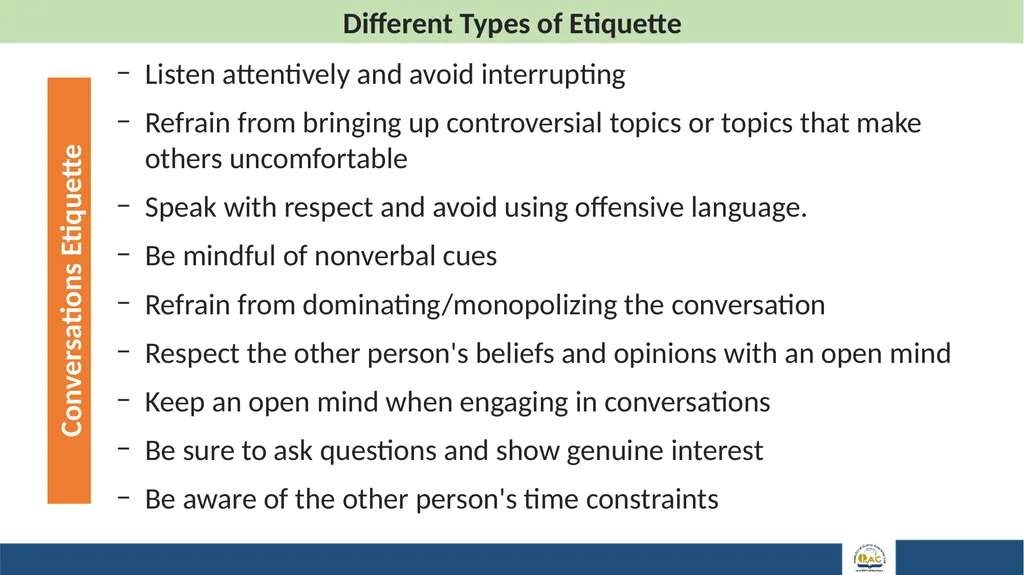
Listen attentively and avoid interrupting
Refrain from bringing up controversial topics or topics that make others uncomfortable
Speak with respect and avoid using offensive language.
Be mindful of nonverbal cues
Refrain from dominating/monopolizing the conversation
Respect the other person's beliefs and opinions with an open mind
Keep an open mind when engaging in conversations
Be sure to ask questions and show genuine interest
Be aware of the other person's time constraints Different Types of Etiquette Conversations Etiquette<br>
09
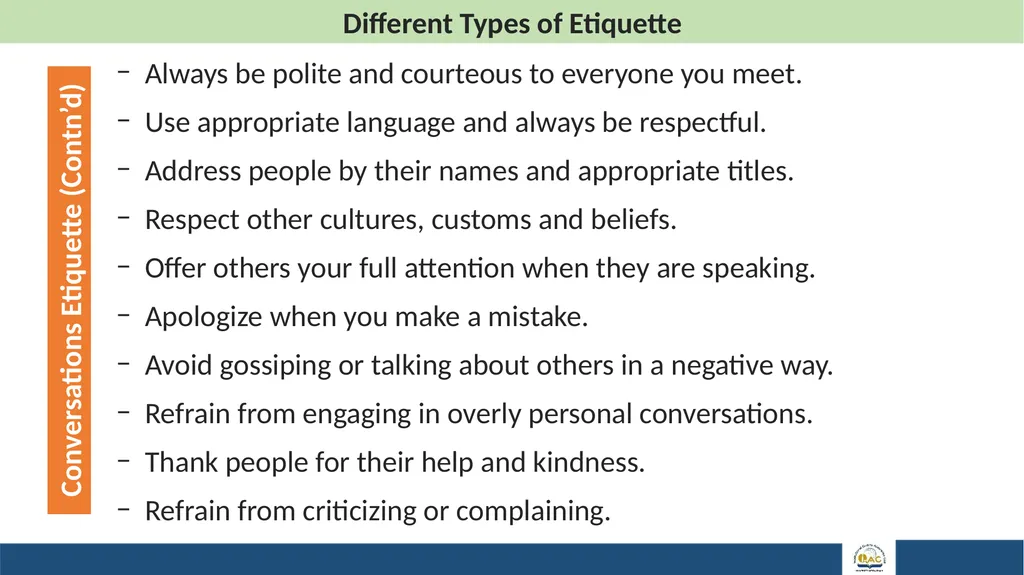
Always be polite and courteous to everyone you meet.
Use appropriate language and always be respectful.
Address people by their names and appropriate titles.
Respect other cultures, customs and beliefs.
Offer others your full attention when they are speaking.
Apologize when you make a mistake.
Avoid gossiping or talking about others in a negative way.
Refrain from engaging in overly personal conversations.
Thank people for their help and kindness.
Refrain from criticizing or complaining. Different Types of Etiquette Conversations Etiquette (Contn’d)<br>
10
Be prompt and arrive to office on time
Dress professionally
Speak and act respectfully towards colleagues and clients
Follow workplace policies and procedures
Be mindful of body language
Avoid gossip and negative conversations
Show appreciation to colleagues, employees and customers
Keep conversations professional
Respect the confidentiality of information
Follow up promptly after meetings Different Types of Etiquette Professional Etiquette<br>
11
Prioritize tasks efficiently
Take initiative when possible
Use polite language
Keep a positive attitude
Always be honest and ethical
Show appreciation for feedback
Listen attentively and be willing to learn
Stay organized
Demonstrate flexibility when needed Different Types of Etiquette Professional Etiquette (Contn’d)<br>
12
Arrive Early: Get to the meeting on time, or even a few minutes early
Greet Everyone (with a smile and a handshake)
Stay Focused and pay attention to the conversation, avoid checking your phone
Participate: Contribute to the conversation by offering your opinion or feedback
Listen to what others are saying and ask relevant questions
Be Respectful of others’ opinions and maintain a supportive and friendly atmosphere
Keep the discussion on-topic and avoid deviating off-topic Different Types of Etiquette Meeting Etiquette<br>
13
Dress appropriately and maintain a professional demeanour
Keep an open mind for new ideas and maintain a positive attitude
Be prepared for the meeting with materials or information you may need
Avoid interrupting, let the speaker finish their thought
Ask questions to clarify points and make sure everyone is on the same page
Take notes during the meeting so you can refer back to them later
Take responsibility for any mistakes or misunderstandings Different Types of Etiquette Meeting Etiquette (Cont’d)<br>
14
Respect others, be mindful of who you are speaking to and the environment you are in.
Don’t talk too loud
Turn off ringer/Use Vibration mode as per the situation/places
Don’t text/call and Drive
Don’t Call at Inappropriate Times
Don’t share personal information over the phone or text message.
Be Courteous: Be polite and respectful in all of your conversations.
Respect others’ equipment/privacy: Don’t damage or tamper with or peep into other people’s phones Different Types of Etiquette Mobile Etiquette<br>
15
Respect other users’ privacy
Do not send unsolicited emails, or spam
Use appropriate language when communicating
Be courteous when communicating with others
Always use secure passwords
Do not spread malicious content
Treat others online as you would like to be treated.
Be aware of cyberbullying and refrain from participating in it. Different Types of Etiquette Network Etiquette<br>
16
Refrain from posting inappropriate content.
Respect the intellectual property of others
Refrain from posting false or misleading or unverified information
Follow applicable laws and regulations.
Refrain from engaging in illegal activities. Different Types of Etiquette Network Etiquette (Cont’d)<br>
17
Dining etiquette refers to the rules of polite behavior one should follow while eating a meal. These rules may vary from culture to culture
Keep your elbows off the table.
Don't speak with your mouth full.
Wait until everyone has been served or seated before starting to eat.
Use the utensils provided to you.
Don't be overly loud or disruptive.
Say please and thank you when ordering or when requesting something Different Types of Etiquette Dining/Table Etiquette<br>
18
Chew with your mouth closed and don't talk with food in your mouth
Place your napkin on your lap and keep it there throughout the meal
Respect the portion sizes served and don't take more than you need
When you're finished eating, place your utensils on your plate in the "resting" position
Don't leave the table until everyone is finished eating Different Types of Etiquette Dining/Table Etiquette<br>
19
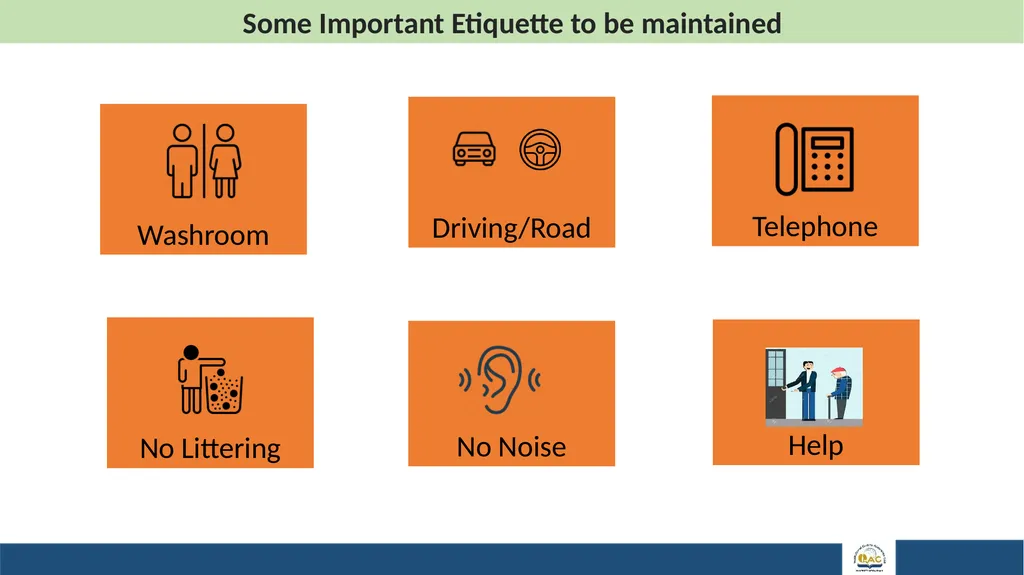
Some Important Etiquette to be maintained Help<br>