
Prof Mike Faborode, Secretary General, Committee
A
Published · 21 slides · 0 views

1 / 1


Description
Prof Mike Faborode, Secretary General, Committee Of Vice Chancellors mofaborodecvcnigeria.org; mfaborodeyahoo.co.uk Integrity in Research ICPCACAN Academic Integrity Workshop July 2015 Research is pivotal to economic growth and
Related Topics
Share
Embed code
Download this presentation From Below
"Prof Mike Faborode, Secretary General, Committee" is the property of its rightful owner. Permission is granted to download and print the materials on this website for personal, non-commercial use only, and to display it on your personal computer provided you do not modify the materials and that you retain all copyright notices contained in the materials. By downloading content from our website, you accept the terms of this agreement.
Presentation Transcript
01
Prof Mike Faborode, Secretary General, Committee Of Vice Chancellors
mofaborode@cvcnigeria.org; mfaborode@yahoo.co.uk Integrity in Research ICPC/ACAN Academic Integrity Workshop July 2015<br>
mofaborode@cvcnigeria.org; mfaborode@yahoo.co.uk Integrity in Research ICPC/ACAN Academic Integrity Workshop July 2015<br>
02
Research is pivotal to economic growth and
addressing societal challenges “Research is not a luxury which is the preserve of developed countries... Technology and innovation are key to achieving long-term economic and social development
Science and innovation are recognised the world over as crucial to economic competitiveness.”
The Royal Society: Knowledge, Networks and Nations, 2011
The seminal work of Jamil (2009), included in the basic features of a world class university: Excellence in Research, International reputation, and the University’s contribution to society – research impact on development. It is given that such research must be credible & ethical.<br>
Science and innovation are recognised the world over as crucial to economic competitiveness.”
The Royal Society: Knowledge, Networks and Nations, 2011
The seminal work of Jamil (2009), included in the basic features of a world class university: Excellence in Research, International reputation, and the University’s contribution to society – research impact on development. It is given that such research must be credible & ethical.<br>
03
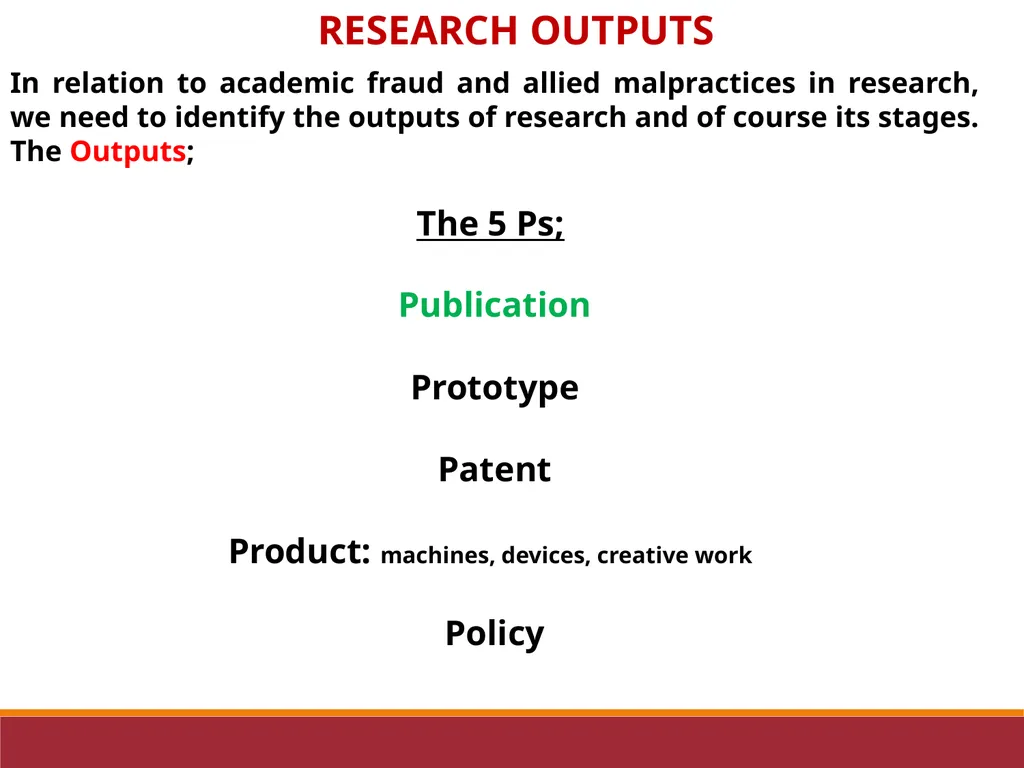
RESEARCH OUTPUTS In relation to academic fraud and allied malpractices in research, we need to identify the outputs of research and of course its stages. The Outputs;
The 5 Ps;
Publication
Prototype
Patent
Product: machines, devices, creative work
Policy<br>
The 5 Ps;
Publication
Prototype
Patent
Product: machines, devices, creative work
Policy<br>
04
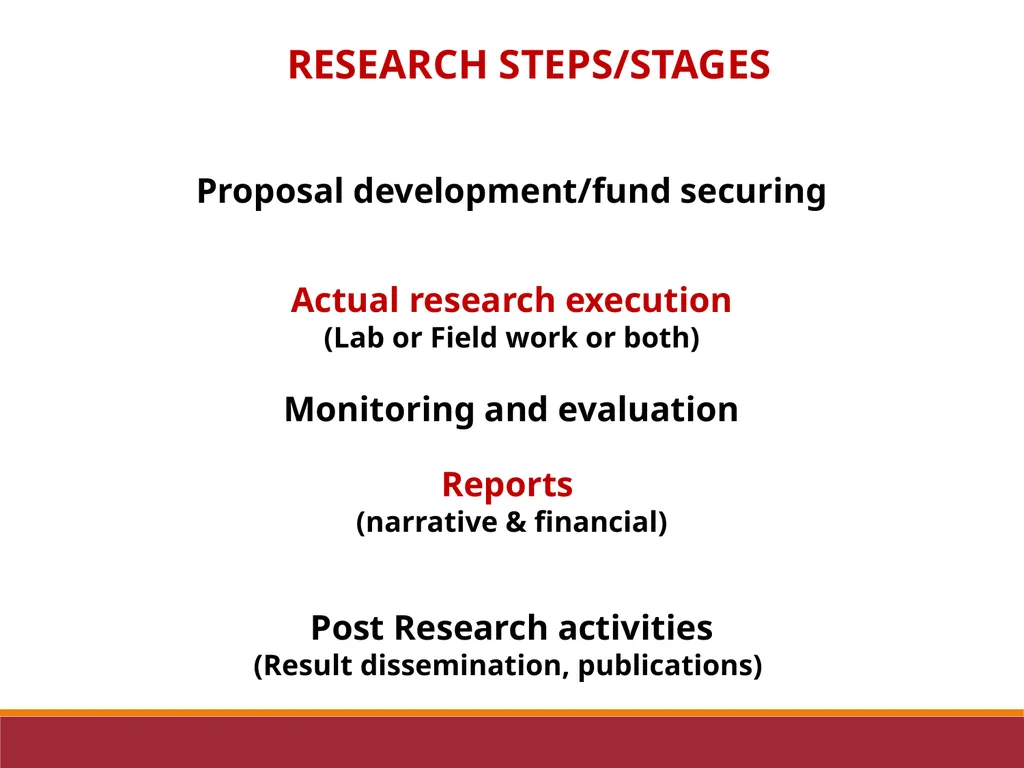
Proposal development/fund securing
Actual research execution
(Lab or Field work or both)
Monitoring and evaluation
Reports
(narrative & financial)
Post Research activities
(Result dissemination, publications) RESEARCH STEPS/STAGES<br>
Actual research execution
(Lab or Field work or both)
Monitoring and evaluation
Reports
(narrative & financial)
Post Research activities
(Result dissemination, publications) RESEARCH STEPS/STAGES<br>
05
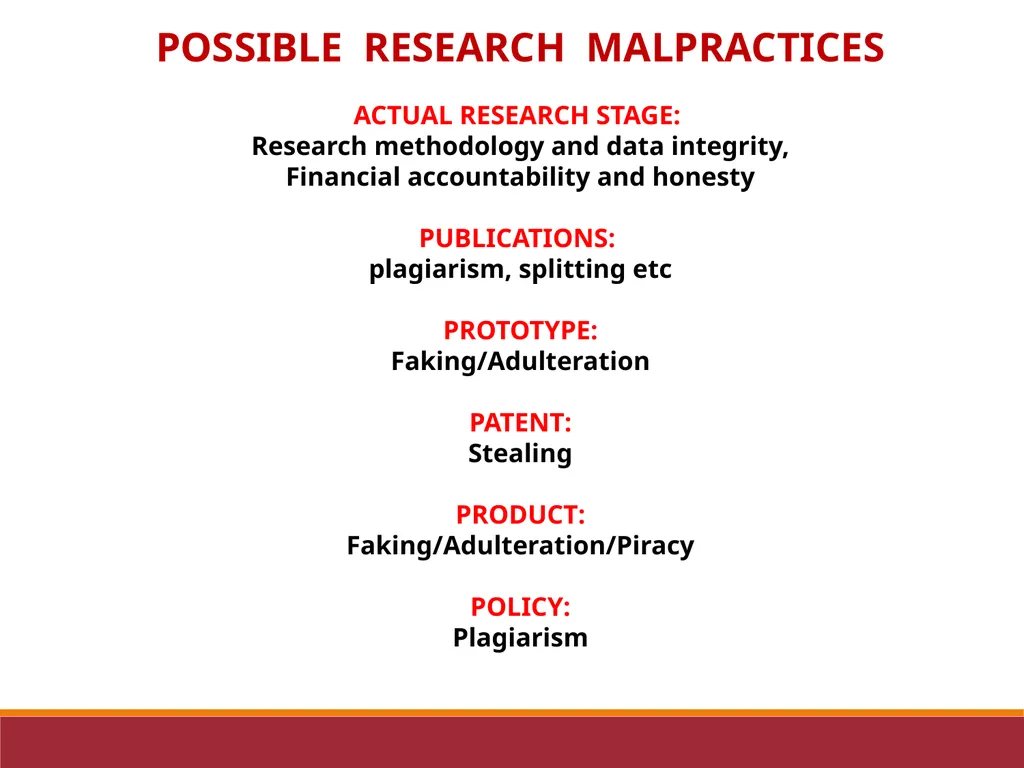
POSSIBLE RESEARCH MALPRACTICES ACTUAL RESEARCH STAGE:
Research methodology and data integrity,
Financial accountability and honesty
PUBLICATIONS:
plagiarism, splitting etc
PROTOTYPE:
Faking/Adulteration
PATENT:
Stealing
PRODUCT:
Faking/Adulteration/Piracy
POLICY:
Plagiarism<br>
Research methodology and data integrity,
Financial accountability and honesty
PUBLICATIONS:
plagiarism, splitting etc
PROTOTYPE:
Faking/Adulteration
PATENT:
Stealing
PRODUCT:
Faking/Adulteration/Piracy
POLICY:
Plagiarism<br>
06
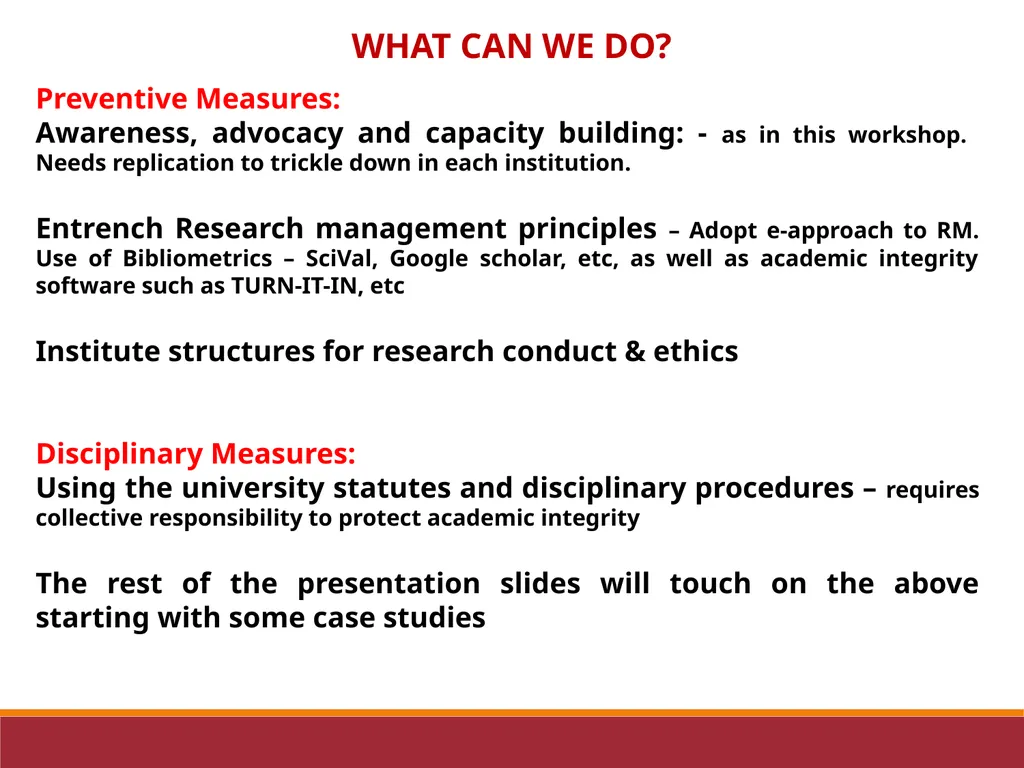
WHAT CAN WE DO? Preventive Measures:
Awareness, advocacy and capacity building: - as in this workshop. Needs replication to trickle down in each institution.
Entrench Research management principles – Adopt e-approach to RM. Use of Bibliometrics – SciVal, Google scholar, etc, as well as academic integrity software such as TURN-IT-IN, etc
Institute structures for research conduct & ethics
Disciplinary Measures:
Using the university statutes and disciplinary procedures – requires collective responsibility to protect academic integrity
The rest of the presentation slides will touch on the above starting with some case studies<br>
Awareness, advocacy and capacity building: - as in this workshop. Needs replication to trickle down in each institution.
Entrench Research management principles – Adopt e-approach to RM. Use of Bibliometrics – SciVal, Google scholar, etc, as well as academic integrity software such as TURN-IT-IN, etc
Institute structures for research conduct & ethics
Disciplinary Measures:
Using the university statutes and disciplinary procedures – requires collective responsibility to protect academic integrity
The rest of the presentation slides will touch on the above starting with some case studies<br>
07
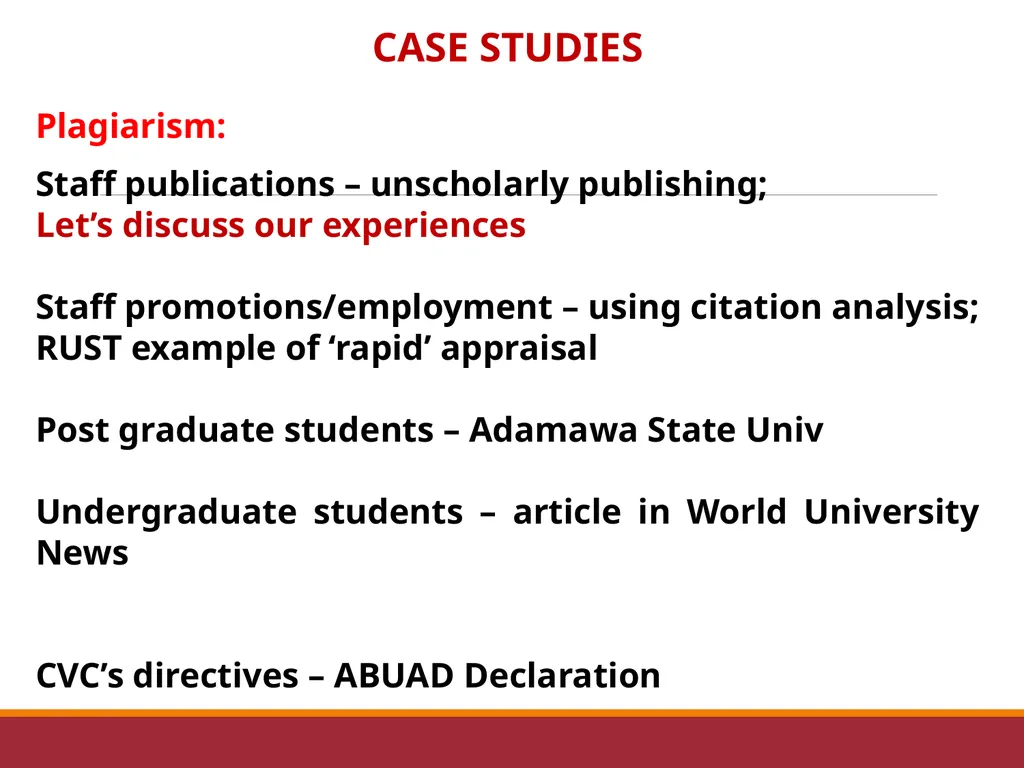
CASE STUDIES
Plagiarism:
Staff publications – unscholarly publishing;
Let’s discuss our experiences
Staff promotions/employment – using citation analysis; RUST example of ‘rapid’ appraisal
Post graduate students – Adamawa State Univ
Undergraduate students – article in World University News
CVC’s directives – ABUAD Declaration<br>
Plagiarism:
Staff publications – unscholarly publishing;
Let’s discuss our experiences
Staff promotions/employment – using citation analysis; RUST example of ‘rapid’ appraisal
Post graduate students – Adamawa State Univ
Undergraduate students – article in World University News
CVC’s directives – ABUAD Declaration<br>
08
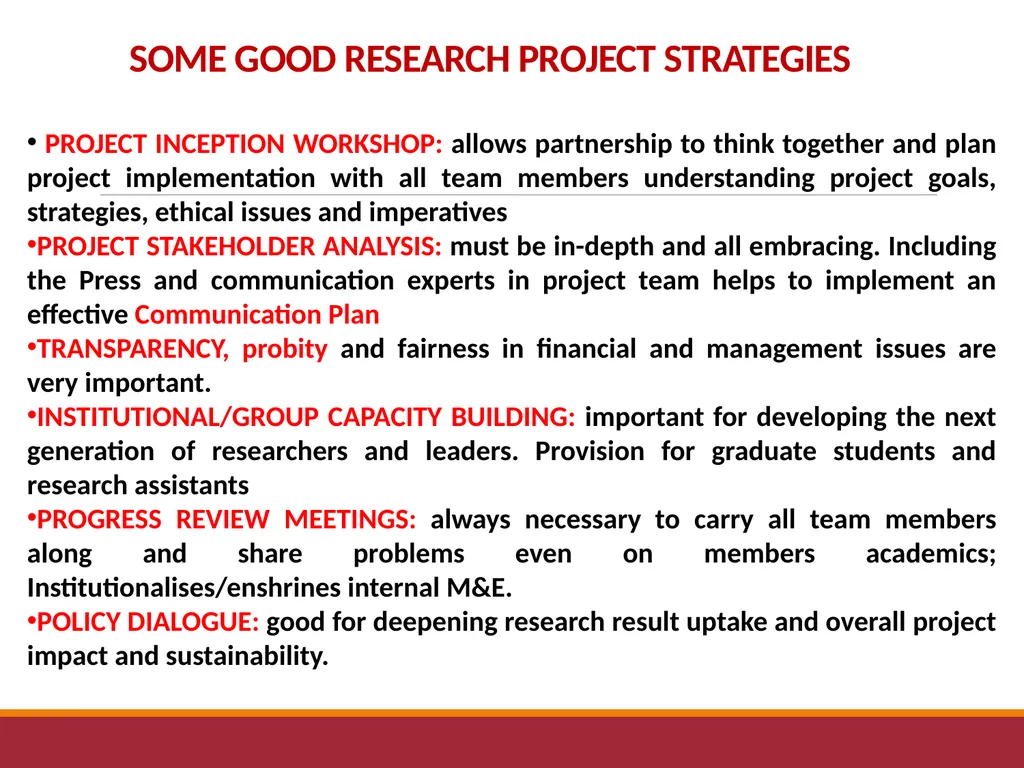
SOME GOOD RESEARCH PROJECT STRATEGIES PROJECT INCEPTION WORKSHOP: allows partnership to think together and plan project implementation with all team members understanding project goals, strategies, ethical issues and imperatives
PROJECT STAKEHOLDER ANALYSIS: must be in-depth and all embracing. Including the Press and communication experts in project team helps to implement an effective Communication Plan
TRANSPARENCY, probity and fairness in financial and management issues are very important.
INSTITUTIONAL/GROUP CAPACITY BUILDING: important for developing the next generation of researchers and leaders. Provision for graduate students and research assistants
PROGRESS REVIEW MEETINGS: always necessary to carry all team members along and share problems even on members academics; Institutionalises/enshrines internal M&E.
POLICY DIALOGUE: good for deepening research result uptake and overall project impact and sustainability.<br>
PROJECT STAKEHOLDER ANALYSIS: must be in-depth and all embracing. Including the Press and communication experts in project team helps to implement an effective Communication Plan
TRANSPARENCY, probity and fairness in financial and management issues are very important.
INSTITUTIONAL/GROUP CAPACITY BUILDING: important for developing the next generation of researchers and leaders. Provision for graduate students and research assistants
PROGRESS REVIEW MEETINGS: always necessary to carry all team members along and share problems even on members academics; Institutionalises/enshrines internal M&E.
POLICY DIALOGUE: good for deepening research result uptake and overall project impact and sustainability.<br>
09
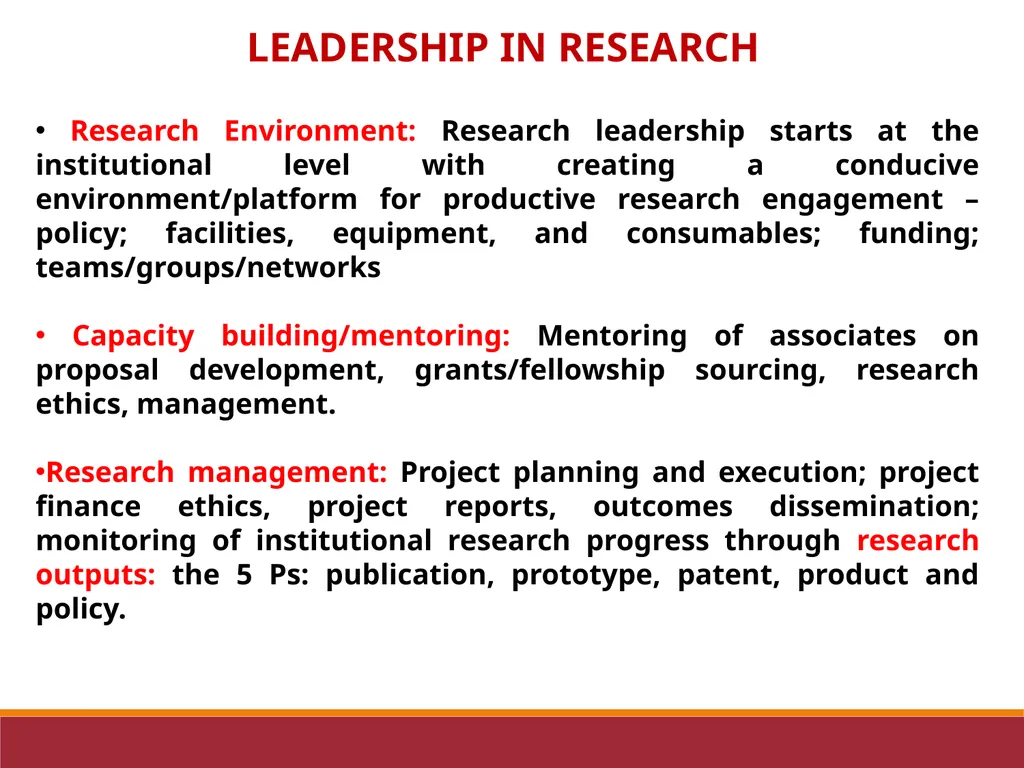
LEADERSHIP IN RESEARCH Research Environment: Research leadership starts at the institutional level with creating a conducive environment/platform for productive research engagement – policy; facilities, equipment, and consumables; funding; teams/groups/networks
Capacity building/mentoring: Mentoring of associates on proposal development, grants/fellowship sourcing, research ethics, management.
Research management: Project planning and execution; project finance ethics, project reports, outcomes dissemination; monitoring of institutional research progress through research outputs: the 5 Ps: publication, prototype, patent, product and policy.<br>
Capacity building/mentoring: Mentoring of associates on proposal development, grants/fellowship sourcing, research ethics, management.
Research management: Project planning and execution; project finance ethics, project reports, outcomes dissemination; monitoring of institutional research progress through research outputs: the 5 Ps: publication, prototype, patent, product and policy.<br>
10
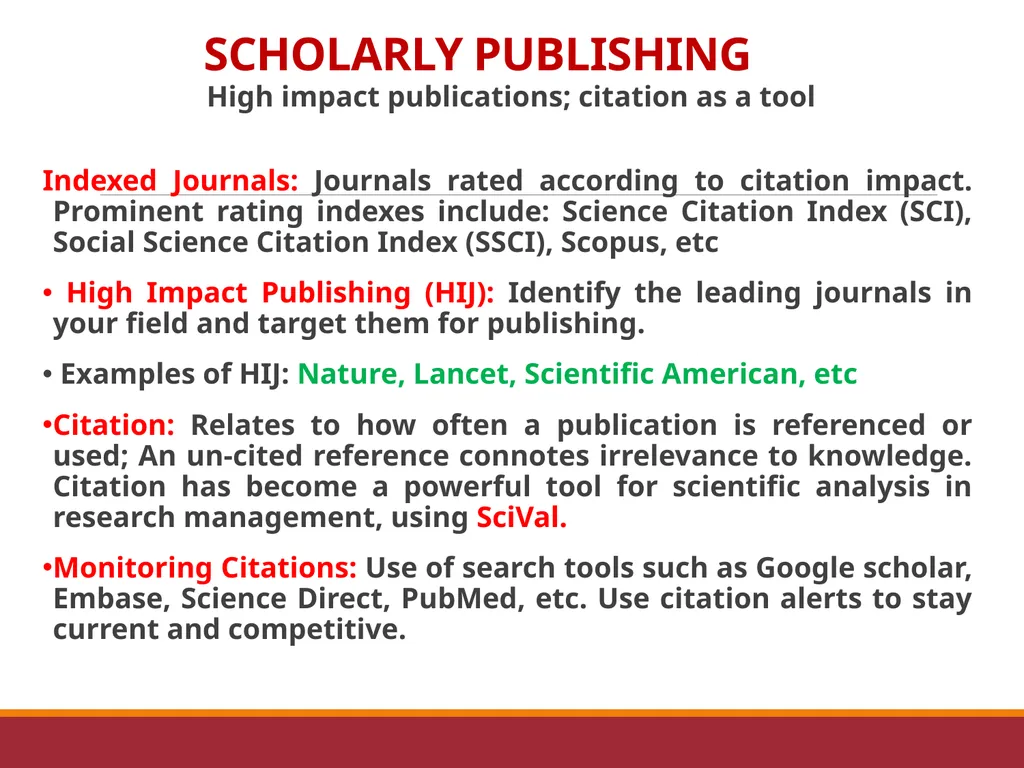
SCHOLARLY PUBLISHING High impact publications; citation as a tool
Indexed Journals: Journals rated according to citation impact. Prominent rating indexes include: Science Citation Index (SCI), Social Science Citation Index (SSCI), Scopus, etc
High Impact Publishing (HIJ): Identify the leading journals in your field and target them for publishing.
Examples of HIJ: Nature, Lancet, Scientific American, etc
Citation: Relates to how often a publication is referenced or used; An un-cited reference connotes irrelevance to knowledge. Citation has become a powerful tool for scientific analysis in research management, using SciVal.
Monitoring Citations: Use of search tools such as Google scholar, Embase, Science Direct, PubMed, etc. Use citation alerts to stay current and competitive.<br>
Indexed Journals: Journals rated according to citation impact. Prominent rating indexes include: Science Citation Index (SCI), Social Science Citation Index (SSCI), Scopus, etc
High Impact Publishing (HIJ): Identify the leading journals in your field and target them for publishing.
Examples of HIJ: Nature, Lancet, Scientific American, etc
Citation: Relates to how often a publication is referenced or used; An un-cited reference connotes irrelevance to knowledge. Citation has become a powerful tool for scientific analysis in research management, using SciVal.
Monitoring Citations: Use of search tools such as Google scholar, Embase, Science Direct, PubMed, etc. Use citation alerts to stay current and competitive.<br>
11
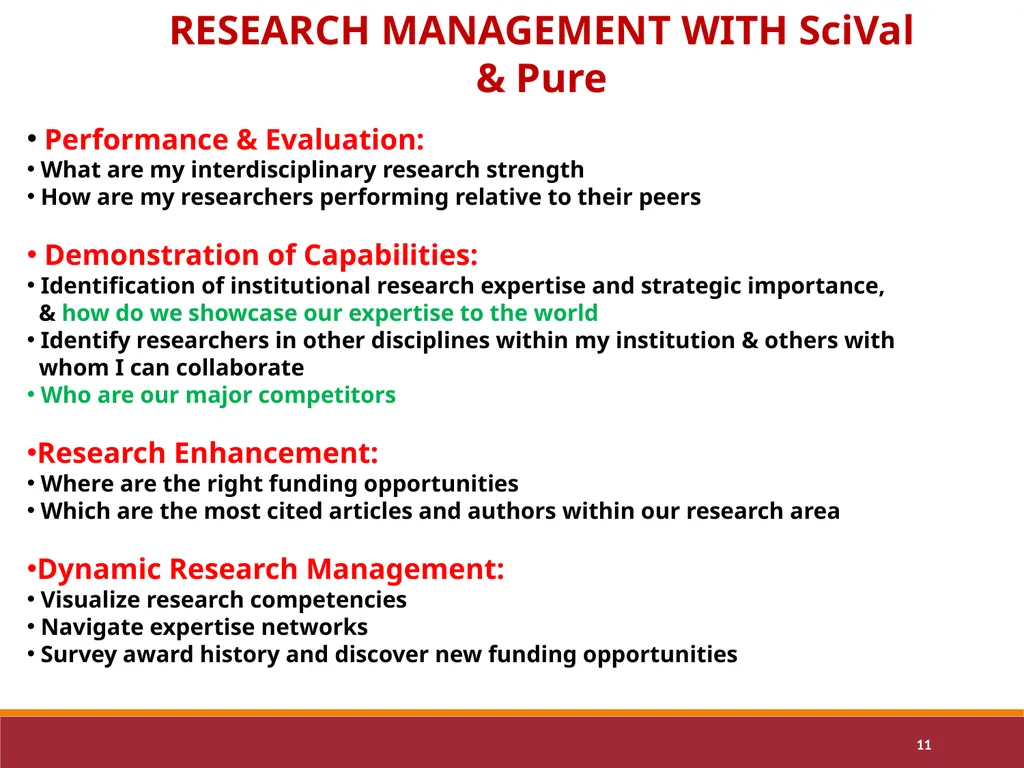
11 RESEARCH MANAGEMENT WITH SciVal & Pure Performance & Evaluation:
What are my interdisciplinary research strength
How are my researchers performing relative to their peers
Demonstration of Capabilities:
Identification of institutional research expertise and strategic importance,
& how do we showcase our expertise to the world
Identify researchers in other disciplines within my institution & others with
whom I can collaborate
Who are our major competitors
Research Enhancement:
Where are the right funding opportunities
Which are the most cited articles and authors within our research area
Dynamic Research Management:
Visualize research competencies
Navigate expertise networks
Survey award history and discover new funding opportunities<br>
What are my interdisciplinary research strength
How are my researchers performing relative to their peers
Demonstration of Capabilities:
Identification of institutional research expertise and strategic importance,
& how do we showcase our expertise to the world
Identify researchers in other disciplines within my institution & others with
whom I can collaborate
Who are our major competitors
Research Enhancement:
Where are the right funding opportunities
Which are the most cited articles and authors within our research area
Dynamic Research Management:
Visualize research competencies
Navigate expertise networks
Survey award history and discover new funding opportunities<br>
12
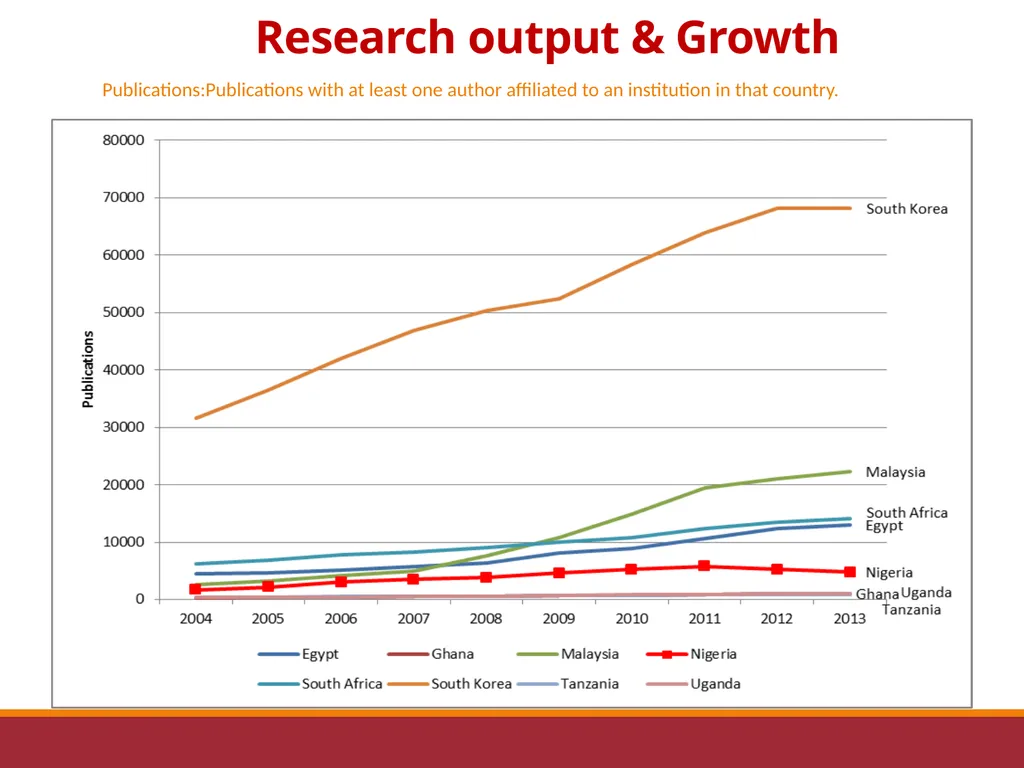
Research output & Growth Publications:Publications with at least one author affiliated to an institution in that country.<br>
13
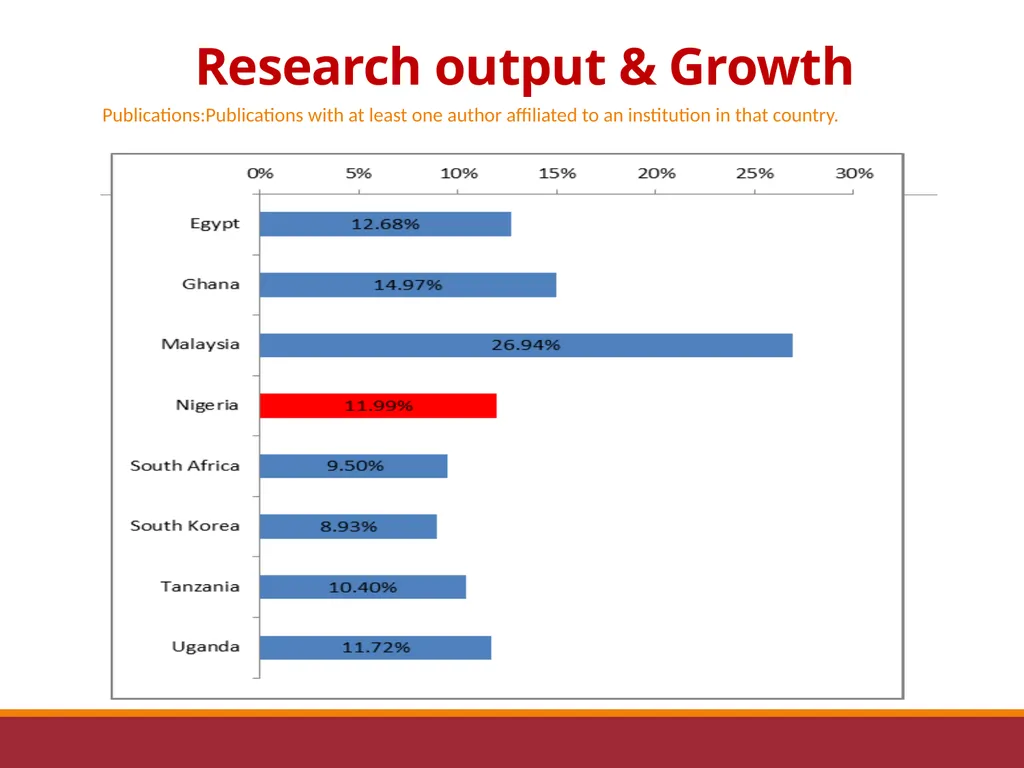
Research output & Growth Publications:Publications with at least one author affiliated to an institution in that country.<br>
14
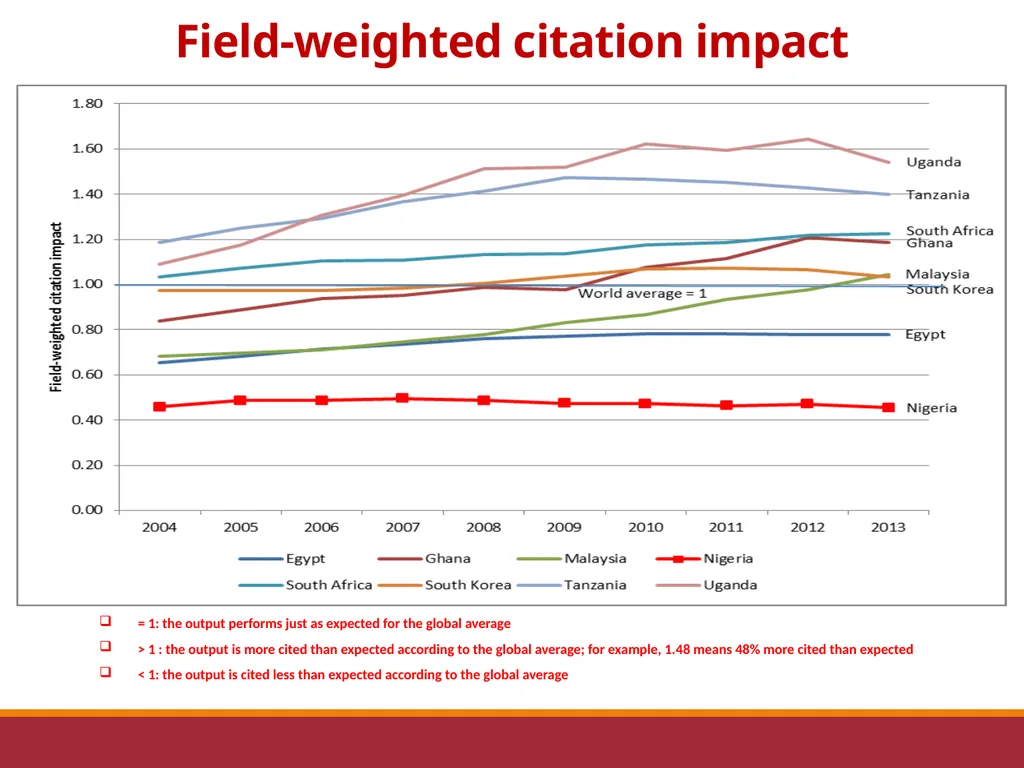
Field-weighted citation impact = 1: the output performs just as expected for the global average
> 1 : the output is more cited than expected according to the global average; for example, 1.48 means 48% more cited than expected
< 1: the output is cited less than expected according to the global average<br>
> 1 : the output is more cited than expected according to the global average; for example, 1.48 means 48% more cited than expected
< 1: the output is cited less than expected according to the global average<br>
15
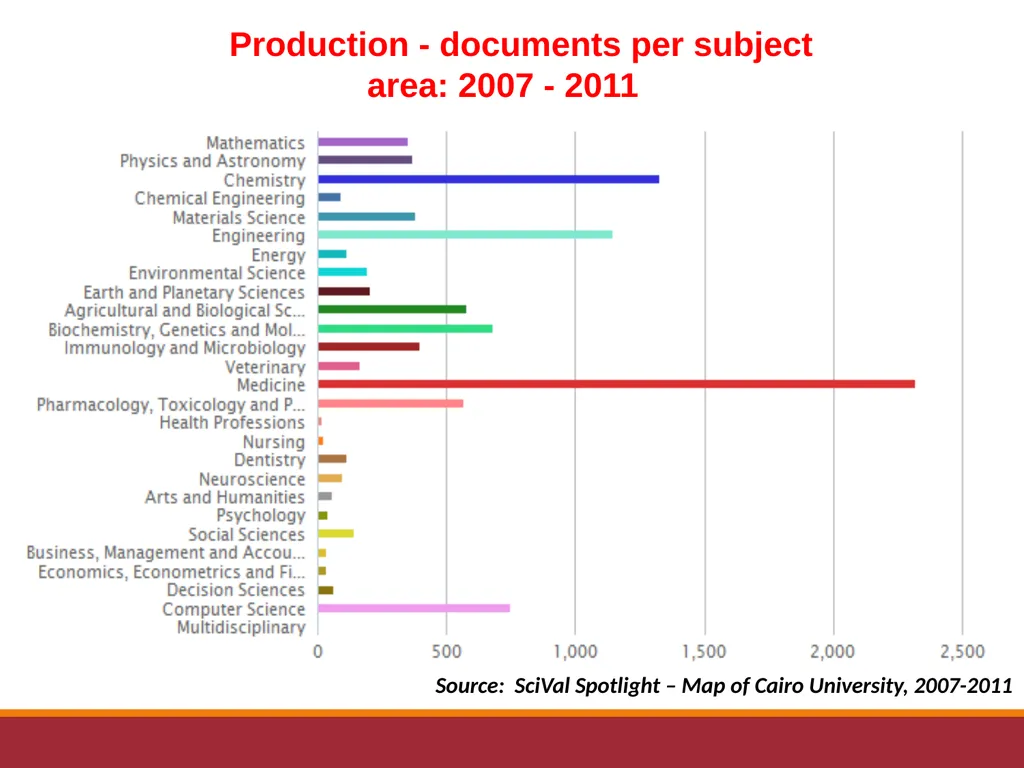
Production - documents per subject
area: 2007 - 2011 Source: SciVal Spotlight – Map of Cairo University, 2007-2011<br>
16
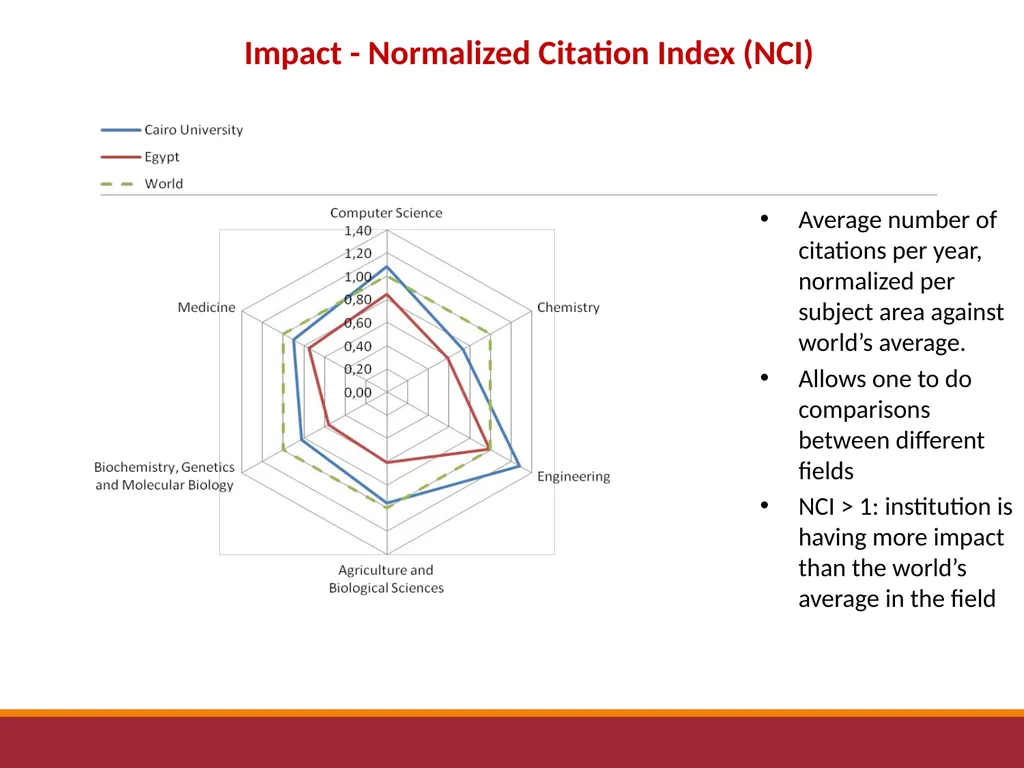
Impact - Normalized Citation Index (NCI) Average number of citations per year, normalized per subject area against world’s average.
Allows one to do comparisons between different fields
NCI > 1: institution is having more impact than the world’s average in the field<br>
Allows one to do comparisons between different fields
NCI > 1: institution is having more impact than the world’s average in the field<br>
17
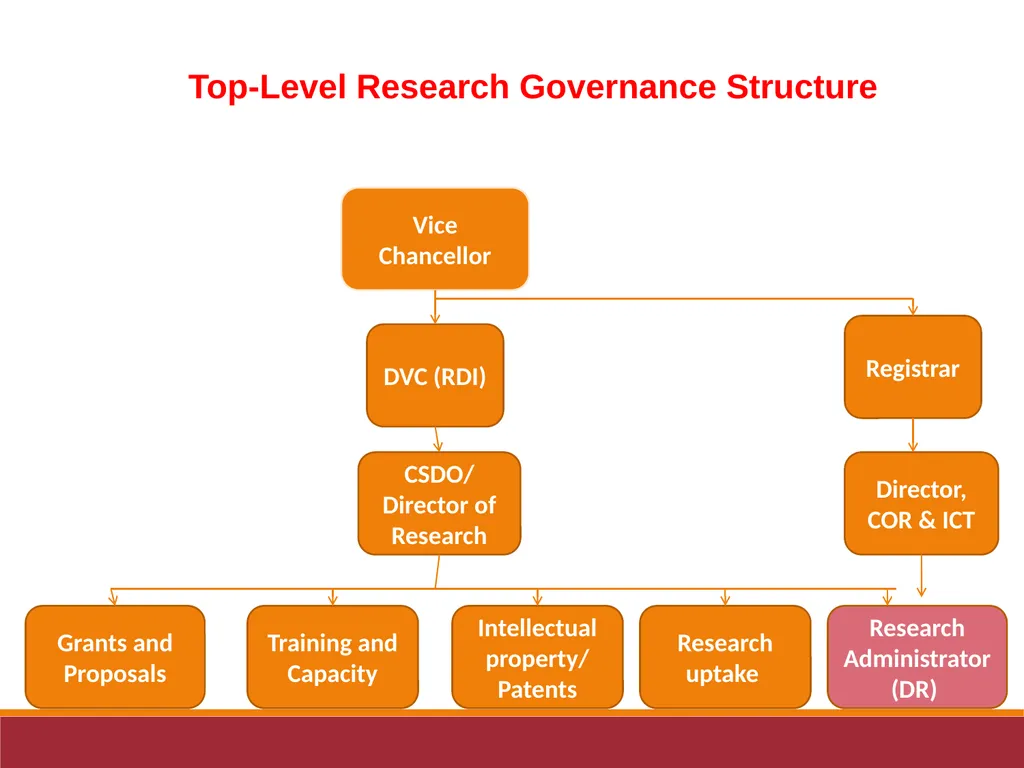
Top-Level Research Governance Structure Vice Chancellor DVC (RDI) Grants and Proposals CSDO/
Director of Research Training and Capacity Intellectual property/ Patents Research uptake Research Administrator (DR) Director, COR & ICT Registrar<br>
Director of Research Training and Capacity Intellectual property/ Patents Research uptake Research Administrator (DR) Director, COR & ICT Registrar<br>
18
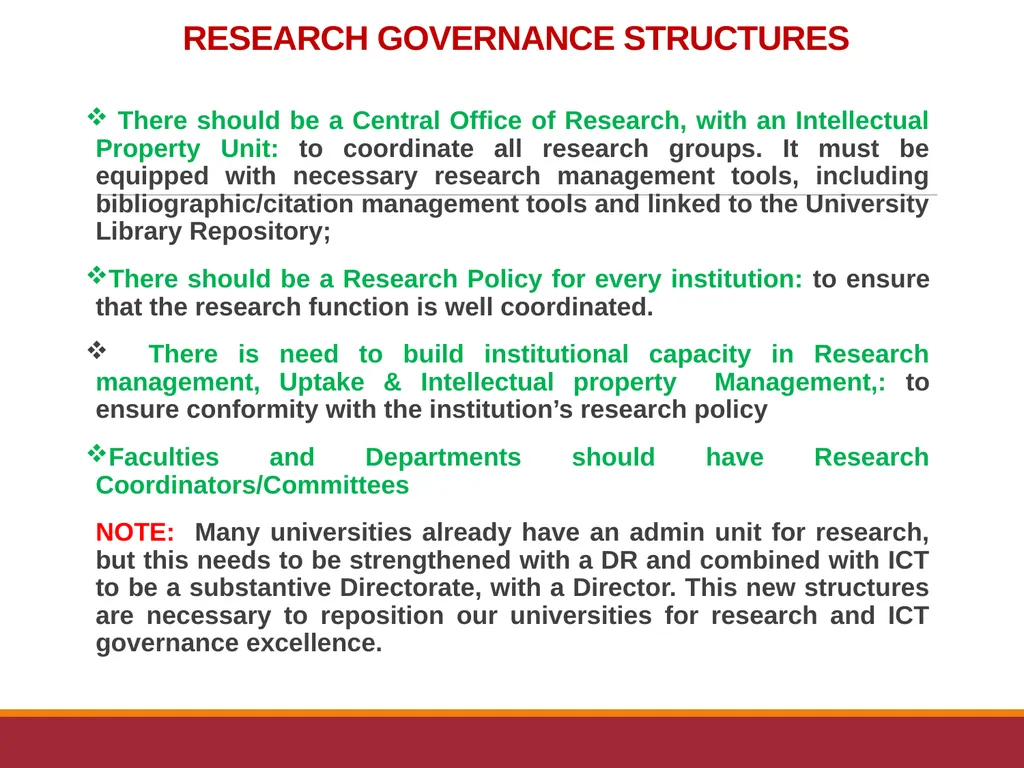
RESEARCH GOVERNANCE STRUCTURES There should be a Central Office of Research, with an Intellectual Property Unit: to coordinate all research groups. It must be equipped with necessary research management tools, including bibliographic/citation management tools and linked to the University Library Repository;
There should be a Research Policy for every institution: to ensure that the research function is well coordinated.
There is need to build institutional capacity in Research management, Uptake & Intellectual property Management,: to ensure conformity with the institution’s research policy
Faculties and Departments should have Research Coordinators/Committees
NOTE: Many universities already have an admin unit for research, but this needs to be strengthened with a DR and combined with ICT to be a substantive Directorate, with a Director. This new structures are necessary to reposition our universities for research and ICT governance excellence.<br>
There should be a Research Policy for every institution: to ensure that the research function is well coordinated.
There is need to build institutional capacity in Research management, Uptake & Intellectual property Management,: to ensure conformity with the institution’s research policy
Faculties and Departments should have Research Coordinators/Committees
NOTE: Many universities already have an admin unit for research, but this needs to be strengthened with a DR and combined with ICT to be a substantive Directorate, with a Director. This new structures are necessary to reposition our universities for research and ICT governance excellence.<br>
19
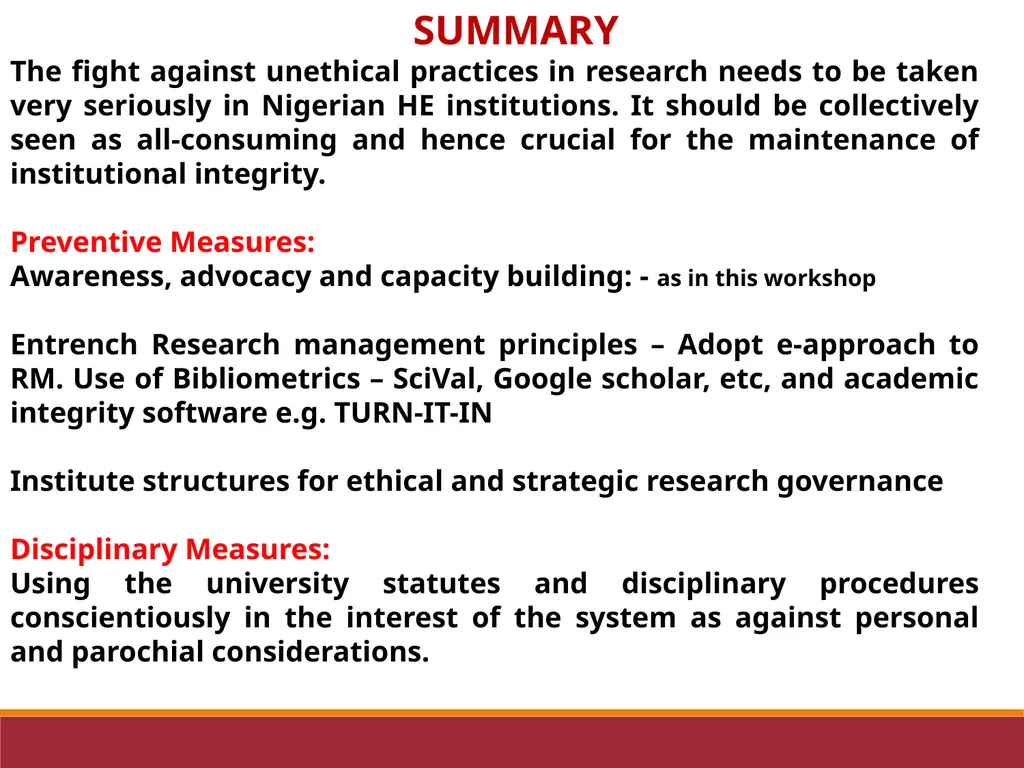
SUMMARY The fight against unethical practices in research needs to be taken very seriously in Nigerian HE institutions. It should be collectively seen as all-consuming and hence crucial for the maintenance of institutional integrity.
Preventive Measures:
Awareness, advocacy and capacity building: - as in this workshop
Entrench Research management principles – Adopt e-approach to RM. Use of Bibliometrics – SciVal, Google scholar, etc, and academic integrity software e.g. TURN-IT-IN
Institute structures for ethical and strategic research governance
Disciplinary Measures:
Using the university statutes and disciplinary procedures conscientiously in the interest of the system as against personal and parochial considerations.<br>
Preventive Measures:
Awareness, advocacy and capacity building: - as in this workshop
Entrench Research management principles – Adopt e-approach to RM. Use of Bibliometrics – SciVal, Google scholar, etc, and academic integrity software e.g. TURN-IT-IN
Institute structures for ethical and strategic research governance
Disciplinary Measures:
Using the university statutes and disciplinary procedures conscientiously in the interest of the system as against personal and parochial considerations.<br>
20
Q & A<br>